EP0424343A2 - Papier zur Verwendung in einem Ionenabscheidungsdruckverfahren - Google Patents
Papier zur Verwendung in einem Ionenabscheidungsdruckverfahren Download PDFInfo
- Publication number
- EP0424343A2 EP0424343A2 EP90850336A EP90850336A EP0424343A2 EP 0424343 A2 EP0424343 A2 EP 0424343A2 EP 90850336 A EP90850336 A EP 90850336A EP 90850336 A EP90850336 A EP 90850336A EP 0424343 A2 EP0424343 A2 EP 0424343A2
- Authority
- EP
- European Patent Office
- Prior art keywords
- toner
- paper
- web
- coating
- sheet
- Prior art date
- Legal status (The legal status is an assumption and is not a legal conclusion. Google has not performed a legal analysis and makes no representation as to the accuracy of the status listed.)
- Granted
Links
Images
Classifications
-
- G—PHYSICS
- G03—PHOTOGRAPHY; CINEMATOGRAPHY; ANALOGOUS TECHNIQUES USING WAVES OTHER THAN OPTICAL WAVES; ELECTROGRAPHY; HOLOGRAPHY
- G03G—ELECTROGRAPHY; ELECTROPHOTOGRAPHY; MAGNETOGRAPHY
- G03G7/00—Selection of materials for use in image-receiving members, i.e. for reversal by physical contact; Manufacture thereof
- G03G7/0006—Cover layers for image-receiving members; Strippable coversheets
-
- G—PHYSICS
- G03—PHOTOGRAPHY; CINEMATOGRAPHY; ANALOGOUS TECHNIQUES USING WAVES OTHER THAN OPTICAL WAVES; ELECTROGRAPHY; HOLOGRAPHY
- G03G—ELECTROGRAPHY; ELECTROPHOTOGRAPHY; MAGNETOGRAPHY
- G03G7/00—Selection of materials for use in image-receiving members, i.e. for reversal by physical contact; Manufacture thereof
- G03G7/0006—Cover layers for image-receiving members; Strippable coversheets
- G03G7/002—Organic components thereof
- G03G7/0026—Organic components thereof being macromolecular
- G03G7/004—Organic components thereof being macromolecular obtained by reactions only involving carbon-to-carbon unsaturated bonds
-
- Y—GENERAL TAGGING OF NEW TECHNOLOGICAL DEVELOPMENTS; GENERAL TAGGING OF CROSS-SECTIONAL TECHNOLOGIES SPANNING OVER SEVERAL SECTIONS OF THE IPC; TECHNICAL SUBJECTS COVERED BY FORMER USPC CROSS-REFERENCE ART COLLECTIONS [XRACs] AND DIGESTS
- Y10—TECHNICAL SUBJECTS COVERED BY FORMER USPC
- Y10S—TECHNICAL SUBJECTS COVERED BY FORMER USPC CROSS-REFERENCE ART COLLECTIONS [XRACs] AND DIGESTS
- Y10S428/00—Stock material or miscellaneous articles
- Y10S428/913—Material designed to be responsive to temperature, light, moisture
-
- Y—GENERAL TAGGING OF NEW TECHNOLOGICAL DEVELOPMENTS; GENERAL TAGGING OF CROSS-SECTIONAL TECHNOLOGIES SPANNING OVER SEVERAL SECTIONS OF THE IPC; TECHNICAL SUBJECTS COVERED BY FORMER USPC CROSS-REFERENCE ART COLLECTIONS [XRACs] AND DIGESTS
- Y10—TECHNICAL SUBJECTS COVERED BY FORMER USPC
- Y10T—TECHNICAL SUBJECTS COVERED BY FORMER US CLASSIFICATION
- Y10T428/00—Stock material or miscellaneous articles
- Y10T428/24—Structurally defined web or sheet [e.g., overall dimension, etc.]
- Y10T428/24802—Discontinuous or differential coating, impregnation or bond [e.g., artwork, printing, retouched photograph, etc.]
-
- Y—GENERAL TAGGING OF NEW TECHNOLOGICAL DEVELOPMENTS; GENERAL TAGGING OF CROSS-SECTIONAL TECHNOLOGIES SPANNING OVER SEVERAL SECTIONS OF THE IPC; TECHNICAL SUBJECTS COVERED BY FORMER USPC CROSS-REFERENCE ART COLLECTIONS [XRACs] AND DIGESTS
- Y10—TECHNICAL SUBJECTS COVERED BY FORMER USPC
- Y10T—TECHNICAL SUBJECTS COVERED BY FORMER US CLASSIFICATION
- Y10T428/00—Stock material or miscellaneous articles
- Y10T428/25—Web or sheet containing structurally defined element or component and including a second component containing structurally defined particles
-
- Y—GENERAL TAGGING OF NEW TECHNOLOGICAL DEVELOPMENTS; GENERAL TAGGING OF CROSS-SECTIONAL TECHNOLOGIES SPANNING OVER SEVERAL SECTIONS OF THE IPC; TECHNICAL SUBJECTS COVERED BY FORMER USPC CROSS-REFERENCE ART COLLECTIONS [XRACs] AND DIGESTS
- Y10—TECHNICAL SUBJECTS COVERED BY FORMER USPC
- Y10T—TECHNICAL SUBJECTS COVERED BY FORMER US CLASSIFICATION
- Y10T428/00—Stock material or miscellaneous articles
- Y10T428/31504—Composite [nonstructural laminate]
- Y10T428/31971—Of carbohydrate
- Y10T428/31993—Of paper
Definitions
- This invention relates to printing papers and particularly to paper useful in ion deposition printing and with ion deposition printers.
- Ion deposition printing involves the steps of: (1) generation of a pattern of ions that is representative of the image to be printed, (2) application of such ions onto a hard dielectric rotatable drum, (3) application of a toner to said drum, such toner being attracted to the drum at only those locations where ions have been deposited, (4) transferring and fixing said toner onto a paper (or other base medium) in an unheated pressure nip, (referred to at times as "trans-fixation") and (5) erasing the latent image from the drum.
- the toner employed in such printing operations comprises particulate matter, e.g. carbon particles, dispersed in a binder, most commonly an ethylene or ethylenevinyl acetate based polymeric binder.
- binder shall include a single material, e.g., polyethylene or a combination of materials, e.g. ethylene and vinyl acetate, unless otherwise indicated.
- Ion deposition printing allows the use of relatively less complicated printers, hence represents considerable savings both in the initial capital investment in equipment and in the costs associated with maintenance.
- One of the major limitations of ion deposition printing, however, has been the inability to retain the toner on the paper following transfixation. Whereas the "cold" (i.e.
- the adhesion of the toner applied to a paper base material in the course of ion deposition printing is enhanced by first applying to the paper prior to its introduction into an ion deposition printer, a coating containing a polymeric latex that exhibits a suitable solubility with the binder of the toner when the toner and such coating are brought together in the unheated pressure nip of the printer.
- the preferred coating is securely bonded to the paper substrate and by reason of its solubilization with the binder of the toner, the toner also becomes securely bonded to the paper substrate.
- This coating exhibits a glass transition temperature, (Tg) in the range of between about -30°C and about +30°C, with the preferred coating having a glass transition temperature between -10° and +20°C, and a solubility parameter of between about 8 and about 12.
- Tg glass transition temperature
- the present invention comprises a sheet or web useful in ion deposition printing employing a polymeric-based toner and comprises a sheet or web substrate, a coating on at least one surface of the substrate, the coating comprising a polymeric latex having a Tg of about -30°C to about +30°C and a solubility parameter in the range of about 8 to about 12 with respect to the binder of the toner employed in the ion deposition printing wherein when the toner disposed on said material is subjected to transfixation in an unheated nip, at least greater than 80% of the toner is retained on the material after the toner-bearing material has been subjected to a tape test.
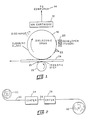
- the apparatus employed comprises an ion cartridge 12 which is electrically connected to and controlled by the input from a computer 14, for example.
- This ion cartridge 12 is disposed contiguous to a rotatable hard, and very durable drum 16 fabricated of a dielectric material (at least on the outer surface thereof).
- Ion streams generated by the ion cartridge and representative of the image produced by the computer (or like source) are directed onto the drum surface 18.
- This selectively charged drum surface is rotated past a source of toner 20 and particles 22 of the toner become attached to the drum surface.
- the drum continues to rotate so that the surface thereof, with the toner particles thereon, is caused to contact a sheet of paper 24 in the nip 26 between the drum and a pressure roll 28.
- the toner is cold fused to the paper and there by transferred from the drum to the paper.
- the fixation of the toner in ion deposition printing is accomplished by pressure, using a "cold" roll. No thermal fusion is employed as in xerography, etc. Pressure of about 100-250 pli or greater is developed in the nip.
- the toner employed in ion deposition printing commonly is of the monocomponent type. That is, the toner comprises particulate colored matter, e.g. carbon and iron oxide particles, carried in a binder. Binders commonly used are polyethylene or polyethylene/vinyl acetate, although other polymer types and combinations thereof may also be employed as toner binders. It is the cold fusion of these binders that develops the adhesion of the colored particulates to the paper.
- Suitable paper substrate for use in ion deposition printing has relatively few required specifications.
- the common xerographic bond type papers at times referred to as "plain" papers, have been used in office-type printing applications heretofore. As noted, however, these paper types, without more, do not provide satisfactory adhesion of the toner particulates to the paper.
- improved adhesion of the toner to the paper is achieved by applying to a paper substrate, before introduction of the paper to an ion deposition printer, a coating that is capable of solubilizing with the binder of the toner under conditions of cold transfixation as described hereinabove, that is, under conditions of about 100-250 pli of pressure, applied as in the nip between two rolls, and at about room temperature.
- the present paper preferably is provided with a coating of a polymeric latex selected from the class comprising acrylic latices, styrene butadiene latices, and/or combinations thereof.
- a polymeric latex selected from the class comprising acrylic latices, styrene butadiene latices, and/or combinations thereof.
- the binder is polyethylene/vinyl acetate based
- the preferred coating applied to the paper is a polymeric latex comprising ethylene vinyl copolymers.
- Solubility parameters are a measure of the compatibility of polymers.
- the solubility parameter is defined as the square root of the cohesive energy which, in turn, is numerically equal to the potential energy of one cc of material.
- the solubility parameter is useful in predicting the solubility of polymers in solvents and may be used as an aid in predicting the mutual solubility of polymers.
- the polymeric latex for use as the paper coating should have a solubility parameter in the range of between about 8 and about 12.
- Polymeric latices having a solubility parameter of less than about 8 or greater than about 12 provide negligible enhancement of the adhesion of the toner to the paper.
- the solubility parameter of the polymeric latex is between about 8 and about 10 for optimum adhesion enhancement.
- the polymeric latex useful in the present paper exhibits a glass transition temperature (Tg) of about -30°C and not materially greater than about +30°C.
- Tg glass transition temperature
- the softer polymeric latex coating on the paper permits better cold flow, hence enhanced toner adhesion.
- the preferred adhesion of the toner to the paper occurs when the polymeric latex has a glass transition temperature that is nearer the central portion of such range so the glass transition temperatures of about -10°C to +20°C are preferred to temperatures nearer the extremes of the high or the low sides of the glass transition temperature range.
- the concept therefore employed here is to match as closely as possible the solubility parameter of the coating material to the solubility parameter of the toner binder, with the further stipulation that the Tg of the coating material remain within the confines of the stated Tg limitations.
- polymer latices possessing the above Tg and solubility parameter restrictions which have been found to provide improved toner adhesion to paper include the following: - methyl, ethyl, butyl and higher alkyl acrylates - methyl methacrylate - ethylene vinyl acetate - vinyl acetate - vinyl acetate/acrylate copolymers - ethylene acrylic acid - ethylene/vinyl chloride emulsions - vinyl acrylic copolymers - vinyl chloride/acrylic copolymers - vinylidene chloride/acrylic copolymers - styrene acrylics - styrene butadiene - acrylonitrile - polyvinyl alcohols
- toner having a polyethylene binder As noted above when employing toner having a polyethylene binder, it has been found that the most effective polymeric latices are the acrylic latices containing polymethyl, polyethyl or polybutyl acrylate. Higher acrylates may be employed, but are not readily commercially available in the latex form. When employing a toner having a polyethylene/vinyl acetate binder, the most effective polymeric latices are the ethylene/vinyl copolymers.
- the present invention is useful with a wide variety of substrates for example transparencies and paper.
- the paper is of the bleached type, but such is not required in that certain unbleached papers may be coated in accordance with the present invention and thereafter be successfully printed by means of ion deposition printing, e.g. certain of the lighter weights of card stock or label stock.
- the bleached papers are preferred. These may be derived from either acid or alkali paper formation processes, bleached kraft papers being especially desirable. The papers may have added thereto during or subsequent to their formation, the usual additives or fillers such as starch, etc.
- the preferred papers are those which do not exhibit curl when passed through the nip defined by the printer drum and the pressure roll.
- Such paper is not limited to the wood species.
- papers formed from softwoods (e.g. southern pine) or hardwoods (e.g. maple, birch) may be employed.
- papers formed from fibers such as eucalyptus, bagasse, etc. may be employed.
- the paper 30, in web form is fed forwardly from a roll 32 to a coater 34 where the coating is applied.
- the paper web 30 is coated on both of its opposite flat surfaces so that the paper may be fed into an ion deposition printer with either surface of the paper facing up, that is either surface of the paper is suitable for receiving the toner from the printing drum.
- the coater 34 is a size press of the type well known in the paper industry for applying coatings to web surfaces.
- the coating may be applied by any of several other known coating techniques, such as spraying, brushing, foaming, roll coating, etc.
- the primary object in the coater is to apply a uniform coating of the polymeric latex to at least one, and preferably both, surfaces of the paper.
- the coated paper web 36 is dried as by passing the coated web through a heated chamber 38 and then collected in a roll 40.
- the polymeric latex is prepared for application to the paper by diluting the latex to that consistency which will result in the deposit of between about 1.0 lb to about 5.0 lb of latex solids onto each 3,000 ft2 of paper surface.
- the coating which results from the application of latex in this range of coating weights has been found to accept and fuse with essentially 100% of the toner disposed on the printer drum. Such coatings do not "bleed" onto the drum, nor do they present any other adverse effect upon the printer, such as jamming of the paper as it is fed into and through the printer.
- Tables 1 and 2 there are presented data relative to several polymeric latices which have been used in the coating of the present invention.
- the latex was coated onto a nonsurface treated xerographic grade paper, approximately 81/2" x 11" having a basis weight of 46 lbs/3,000 ft2.
- the latex was diluted to that consistency which resulted in the application of the noted coating weights.
- the coated paper sheet was oven-dried at 110°C for 2 minutes prior to passing the sheet through a CIE 3000 L2 ion deposition printer operated in accordance with the standard manufacturer's recommendations.
- the toner was supplied by the printer manufacturer and designated as TNRI (polyethylene-based).
- the data presented in Table 2 were obtained from base paper coated on a pilot size press.
- the base paper was a nonsurface treated bleached Kraft sheet with a 46 lbs/3,000 ft2 basis weight.
- the web width was 12", and the size press was run at approximately 200 fpm.
- the latex, or coating formulation was diluted and applied to both sides of the web to give the coat weights listed in Table 2.
- After coating the paper was dried to 4-5% moisture by 5 steam filled can dryers which followed the size press.
- the paper was then cut to 8-1/2 x 11" sheets and passed through a Delphax S-6000 ion deposition printer.
- the toner employed was RP-1329 (Coates) (polyethylene/vinyl acetate-based).
- the customary tests for adhesion of toner to a printed substrate include (1) the Scotch tape test, and (2) the fold test.
- the tape test a strip of 3M Scotch 810 brand tape is pressed onto the printed sheet and then removed.
- the percent toner retention is calculated as the ratio of the final diffused reflection density (after tape pull) and the initial diffused reflection density (before tape pull).
- the quantity of toner which adheres to the tape and which is therefore removed from the printed sheet is noted visually. Excellent adhesion of the toner to the paper is recorded for the test paper where essentially no toner is removed. Poor or unacceptable adhesion is indicated when no more than about 45% to 60% of the toner retention is obtained.
- the printed paper In the fold test (also referred to as the "crease" test), the printed paper is folded and creased as by passing the folded edge of the paper through the thumb and forefinger to emphasize the crease, and thereafter unfolding the paper and either visually checking for dislodged toner or by calculating the percent toner retention as the ratio of the final diffused reflection density (after crease test) and the initial diffused reflection density (before crease test). Any substantial dislodgement of toner due to the creasing is considered to be unacceptable.
- the printed papers described in Tables 1 and 2 were subjected to the Scotch tape test and crease tests. The results of the tape tests are given in the Tables. The results of the crease tests as observed visually generally paralleled the results of the tape tests at the moderate Tg values.
- the polymeric latex of the coating exhibits a solubility parameter in the range of between about 8 and about 12 and a Tg between about -30°C and +30°C.
- the binder of the toner is of the polyethylene/vinyl acetate type or the polyethylene type
- the preferred latices are the ethylene/vinyl copolymers, or the lower acrylates, that is methyl, ethyl and butyl acrylates, respectively.
- coated paper webs having coating weights of from about 1 lb/3000ft2 to about 5 lbs/3000ft2.
Landscapes
- Physics & Mathematics (AREA)
- General Physics & Mathematics (AREA)
- Chemical & Material Sciences (AREA)
- Chemical Kinetics & Catalysis (AREA)
- Spectroscopy & Molecular Physics (AREA)
- Paper (AREA)
Applications Claiming Priority (2)
| Application Number | Priority Date | Filing Date | Title |
|---|---|---|---|
| US422589 | 1989-10-17 | ||
| US07/422,589 US5017416A (en) | 1989-10-17 | 1989-10-17 | Paper for use in ion deposition printing |
Publications (3)
| Publication Number | Publication Date |
|---|---|
| EP0424343A2 true EP0424343A2 (de) | 1991-04-24 |
| EP0424343A3 EP0424343A3 (en) | 1991-09-11 |
| EP0424343B1 EP0424343B1 (de) | 1996-06-19 |
Family
ID=23675534
Family Applications (1)
| Application Number | Title | Priority Date | Filing Date |
|---|---|---|---|
| EP19900850336 Expired - Lifetime EP0424343B1 (de) | 1989-10-17 | 1990-10-16 | Papier zur Verwendung in einem Ionenabscheidungsdruckverfahren |
Country Status (6)
| Country | Link |
|---|---|
| US (1) | US5017416A (de) |
| EP (1) | EP0424343B1 (de) |
| JP (1) | JPH03293362A (de) |
| AT (1) | ATE139629T1 (de) |
| AU (1) | AU623287B2 (de) |
| DE (1) | DE69027505D1 (de) |
Cited By (3)
| Publication number | Priority date | Publication date | Assignee | Title |
|---|---|---|---|---|
| FR2687417A1 (fr) * | 1992-02-13 | 1993-08-20 | Arjo Wiggins Sa | Feuille imprimable infalsifiable par procedes mecaniques. |
| WO1996030811A3 (de) * | 1995-03-24 | 1996-12-12 | Drescher Geschaeftsdrucke | Papiererzeugnis |
| EP0845711A1 (de) * | 1996-11-29 | 1998-06-03 | Agfa-Gevaert N.V. | Verfahren zur Herstellung fälschungssicherer Dokumente mit einer tonerempfangenden Schicht |
Families Citing this family (16)
| Publication number | Priority date | Publication date | Assignee | Title |
|---|---|---|---|---|
| US5698296A (en) * | 1989-04-18 | 1997-12-16 | The Standard Register Company | Business document having security features |
| US5504129A (en) * | 1992-03-12 | 1996-04-02 | International Paper Company | Dispersion and method for producing same |
| US5333042A (en) * | 1992-12-14 | 1994-07-26 | Interscience Computer Corporation | Cold fusing agent |
| US5670005A (en) * | 1993-02-16 | 1997-09-23 | Minnesota Mining And Manufacturing Company | Method for manufacturing improved data display retroreflective sheeting |
| SE507419C2 (sv) * | 1993-03-05 | 1998-05-25 | Straalfors Ab | Registreringsskylt för fordon och förfarande för framställning därav |
| US5486436A (en) | 1993-10-15 | 1996-01-23 | The Standard Register Company | Sealable web or sheet product |
| US5545459A (en) * | 1995-01-20 | 1996-08-13 | Wallace Computer Services, Inc. | Business forms having dual-functional coating |
| US5912205A (en) * | 1997-01-30 | 1999-06-15 | The Standard Register Company | Heat resistant security document |
| US20060254736A1 (en) * | 2001-04-11 | 2006-11-16 | Jackson John F | Paper articles exhibiting water resistance and method for making same |
| NZ528924A (en) | 2001-04-11 | 2005-05-27 | Int Paper Co | Paper articles exhibiting long term storageability |
| US7279071B2 (en) * | 2001-04-11 | 2007-10-09 | International Paper Company | Paper articles exhibiting water resistance and method for making same |
| CN1795307B (zh) * | 2003-04-07 | 2010-09-08 | 国际纸业公司 | 用于液体电子照相印刷的纸张及其制备方法 |
| MX2007000099A (es) * | 2004-07-06 | 2007-04-10 | Int Paper Co | Substratos de papel que contienen un compuesto antimicrobiano asi como metodos para su produccion y uso. |
| US9296244B2 (en) * | 2008-09-26 | 2016-03-29 | International Paper Company | Composition suitable for multifunctional printing and recording sheet containing same |
| WO2010148156A1 (en) * | 2009-06-16 | 2010-12-23 | International Paper Company | Anti-microbial paper substrates useful in wallboard tape applications |
| KR20170046381A (ko) | 2015-10-21 | 2017-05-02 | 에스프린팅솔루션 주식회사 | 정전하상 현상용 토너 |
Family Cites Families (21)
| Publication number | Priority date | Publication date | Assignee | Title |
|---|---|---|---|---|
| US2471607A (en) * | 1947-01-09 | 1949-05-31 | Finch Telecommunications Inc | Facsimile recording papers |
| US3110621A (en) * | 1960-02-01 | 1963-11-12 | Warren S D Co | Electrostatic recording paper |
| US3373090A (en) * | 1963-11-15 | 1968-03-12 | Alden Milton | Adhesive electrolytic recording paper |
| US3515648A (en) * | 1967-06-14 | 1970-06-02 | Dow Chemical Co | Anionic resin for electroconductive paper |
| US3639640A (en) * | 1969-02-27 | 1972-02-01 | Plastic Coating Corp | Electrostatographic recording element |
| JPS4830934A (de) * | 1971-08-25 | 1973-04-23 | ||
| US3873354A (en) * | 1972-03-24 | 1975-03-25 | Preco Corp | Electrostatic printing |
| JPS544613B2 (de) * | 1973-03-10 | 1979-03-08 | ||
| JPS5140468B2 (de) * | 1974-09-25 | 1976-11-04 | ||
| AU508815B2 (en) * | 1976-07-08 | 1980-04-03 | Sekisui Kagaku Kogyo Kabushiki Kaisha | Electric discharge recording method and material |
| JPS5339752A (en) * | 1976-09-24 | 1978-04-11 | Mita Industrial Co Ltd | Transfer sheet and method of preparing same |
| US4206247A (en) * | 1977-06-08 | 1980-06-03 | Canon Kabushiki Kaisha | Electrophotographic process |
| JPS54105555A (en) * | 1978-02-07 | 1979-08-18 | Mitsubishi Paper Mills Ltd | Heatsensitive recording material |
| US4167602A (en) * | 1978-05-26 | 1979-09-11 | Monsanto Company | Electrographic recording material |
| US4259425A (en) * | 1979-05-11 | 1981-03-31 | Monsanto Company | Electrographic recording material |
| JPS564147A (en) * | 1979-06-25 | 1981-01-17 | Kanzaki Paper Mfg Co Ltd | Electrostatic recording material |
| NZ198031A (en) * | 1980-08-21 | 1988-11-29 | Dennison Mfg Co | Electrostatic printer: charged particles extracted from glow discharge |
| US4397883A (en) * | 1980-12-22 | 1983-08-09 | Monsanto Company | Electrographic recording material |
| US4448807A (en) * | 1980-12-22 | 1984-05-15 | Monsanto Company | Preparation of an electrographic recording material |
| US4894306A (en) * | 1986-07-28 | 1990-01-16 | James River Corporation Of Virginia | Ion deposition printing paper |
| US4942410A (en) * | 1989-07-06 | 1990-07-17 | Dennison Manufacturing Company | Toner receptive coating |
-
1989
- 1989-10-17 US US07/422,589 patent/US5017416A/en not_active Expired - Fee Related
-
1990
- 1990-10-16 AU AU64693/90A patent/AU623287B2/en not_active Ceased
- 1990-10-16 DE DE69027505T patent/DE69027505D1/de not_active Expired - Lifetime
- 1990-10-16 AT AT90850336T patent/ATE139629T1/de not_active IP Right Cessation
- 1990-10-16 EP EP19900850336 patent/EP0424343B1/de not_active Expired - Lifetime
- 1990-10-17 JP JP2278836A patent/JPH03293362A/ja active Pending
Cited By (3)
| Publication number | Priority date | Publication date | Assignee | Title |
|---|---|---|---|---|
| FR2687417A1 (fr) * | 1992-02-13 | 1993-08-20 | Arjo Wiggins Sa | Feuille imprimable infalsifiable par procedes mecaniques. |
| WO1996030811A3 (de) * | 1995-03-24 | 1996-12-12 | Drescher Geschaeftsdrucke | Papiererzeugnis |
| EP0845711A1 (de) * | 1996-11-29 | 1998-06-03 | Agfa-Gevaert N.V. | Verfahren zur Herstellung fälschungssicherer Dokumente mit einer tonerempfangenden Schicht |
Also Published As
| Publication number | Publication date |
|---|---|
| EP0424343B1 (de) | 1996-06-19 |
| AU623287B2 (en) | 1992-05-07 |
| EP0424343A3 (en) | 1991-09-11 |
| ATE139629T1 (de) | 1996-07-15 |
| DE69027505D1 (de) | 1996-07-25 |
| JPH03293362A (ja) | 1991-12-25 |
| AU6469390A (en) | 1991-04-26 |
| US5017416A (en) | 1991-05-21 |
Similar Documents
| Publication | Publication Date | Title |
|---|---|---|
| EP0424343A2 (de) | Papier zur Verwendung in einem Ionenabscheidungsdruckverfahren | |
| US5102733A (en) | Repulpable pressure-sensitive adhesive constructions | |
| EP0658650B1 (de) | Polymerverstärktes Papier mit verbesserter Reissfestigkeit in der Querrichtung | |
| AU644512B2 (en) | A coated substrate and method of making same | |
| AU704291B2 (en) | Business form having integral label associated therewith coated with composition capable of receiving toner images thereon, and method for producing the business form | |
| EP0877298A3 (de) | Beschichtetes xerographisches photographisches Papier | |
| CA2159544C (en) | Business forms having dual-functional coating | |
| CA2430478C (en) | Security paper adapted to resist fraudulent alteration | |
| EP0879917B1 (de) | Zusammensetzung zur Papierbehandlung | |
| JPH0769628B2 (ja) | 電子写真用転写紙 | |
| JP3619839B2 (ja) | 切手用糊塗布紙及びその製造方法 | |
| JPH10183498A (ja) | 防湿紙 | |
| JP3919141B2 (ja) | 再生可能な防湿紙及びその製造方法並びに包装紙 | |
| JP4254369B2 (ja) | 耐水耐油紙 | |
| JP3401728B2 (ja) | プリント用紙 | |
| JPS6134550A (ja) | 電子写真方式のプリンタに使用される接着剤付きプリント用紙 | |
| JPH07168386A (ja) | レーザープリンター用粘着シートおよびその製造方法 | |
| JPH02245082A (ja) | 電子写真用粘着シート | |
| JPS6134553A (ja) | プリント用紙 | |
| JPS5942303B2 (ja) | 第二原図用紙 | |
| JPS5941577B2 (ja) | 第二原図用紙 | |
| JP2003261839A (ja) | 感圧接着紙 | |
| JPS60111256A (ja) | プリンタ−用枚葉接着紙 | |
| JPS6134551A (ja) | プリント用紙 | |
| JP2005254612A (ja) | 圧着記録用紙 |
Legal Events
| Date | Code | Title | Description |
|---|---|---|---|
| PUAI | Public reference made under article 153(3) epc to a published international application that has entered the european phase |
Free format text: ORIGINAL CODE: 0009012 |
|
| AK | Designated contracting states |
Kind code of ref document: A2 Designated state(s): AT BE CH DE DK ES FR GB GR IT LI LU NL SE |
|
| PUAL | Search report despatched |
Free format text: ORIGINAL CODE: 0009013 |
|
| AK | Designated contracting states |
Kind code of ref document: A3 Designated state(s): AT BE CH DE DK ES FR GB GR IT LI LU NL SE |
|
| 17P | Request for examination filed |
Effective date: 19920122 |
|
| 17Q | First examination report despatched |
Effective date: 19941104 |
|
| GRAH | Despatch of communication of intention to grant a patent |
Free format text: ORIGINAL CODE: EPIDOS IGRA |
|
| GRAH | Despatch of communication of intention to grant a patent |
Free format text: ORIGINAL CODE: EPIDOS IGRA |
|
| GRAA | (expected) grant |
Free format text: ORIGINAL CODE: 0009210 |
|
| AK | Designated contracting states |
Kind code of ref document: B1 Designated state(s): AT BE CH DE DK ES FR GB GR IT LI LU NL SE |
|
| PG25 | Lapsed in a contracting state [announced via postgrant information from national office to epo] |
Ref country code: GR Free format text: LAPSE BECAUSE OF FAILURE TO SUBMIT A TRANSLATION OF THE DESCRIPTION OR TO PAY THE FEE WITHIN THE PRESCRIBED TIME-LIMIT Effective date: 19960619 Ref country code: NL Free format text: LAPSE BECAUSE OF FAILURE TO SUBMIT A TRANSLATION OF THE DESCRIPTION OR TO PAY THE FEE WITHIN THE PRESCRIBED TIME-LIMIT Effective date: 19960619 Ref country code: LI Effective date: 19960619 Ref country code: DK Effective date: 19960619 Ref country code: CH Effective date: 19960619 Ref country code: BE Effective date: 19960619 Ref country code: AT Effective date: 19960619 Ref country code: IT Free format text: LAPSE BECAUSE OF FAILURE TO SUBMIT A TRANSLATION OF THE DESCRIPTION OR TO PAY THE FEE WITHIN THE PRE;WARNING: LAPSES OF ITALIAN PATENTS WITH EFFECTIVE DATE BEFORE 2007 MAY HAVE OCCURRED AT ANY TIME BEFORE 2007. THE CORRECT EFFECTIVE DATE MAY BE DIFFERENT FROM THE ONE RECORDED.SCRIBED TIME-LIMIT Effective date: 19960619 Ref country code: FR Effective date: 19960619 |
|
| REF | Corresponds to: |
Ref document number: 139629 Country of ref document: AT Date of ref document: 19960715 Kind code of ref document: T |
|
| REF | Corresponds to: |
Ref document number: 69027505 Country of ref document: DE Date of ref document: 19960725 |
|
| PG25 | Lapsed in a contracting state [announced via postgrant information from national office to epo] |
Ref country code: SE Effective date: 19960919 |
|
| PG25 | Lapsed in a contracting state [announced via postgrant information from national office to epo] |
Ref country code: DE Effective date: 19960920 |
|
| PG25 | Lapsed in a contracting state [announced via postgrant information from national office to epo] |
Ref country code: ES Free format text: LAPSE BECAUSE OF FAILURE TO SUBMIT A TRANSLATION OF THE DESCRIPTION OR TO PAY THE FEE WITHIN THE PRESCRIBED TIME-LIMIT Effective date: 19960930 |
|
| EN | Fr: translation not filed | ||
| PGFP | Annual fee paid to national office [announced via postgrant information from national office to epo] |
Ref country code: LU Payment date: 19961201 Year of fee payment: 7 |
|
| NLV1 | Nl: lapsed or annulled due to failure to fulfill the requirements of art. 29p and 29m of the patents act | ||
| PGFP | Annual fee paid to national office [announced via postgrant information from national office to epo] |
Ref country code: GB Payment date: 19961220 Year of fee payment: 7 |
|
| PGFP | Annual fee paid to national office [announced via postgrant information from national office to epo] |
Ref country code: ES Payment date: 19961231 Year of fee payment: 7 |
|
| REG | Reference to a national code |
Ref country code: CH Ref legal event code: PL |
|
| PLBE | No opposition filed within time limit |
Free format text: ORIGINAL CODE: 0009261 |
|
| STAA | Information on the status of an ep patent application or granted ep patent |
Free format text: STATUS: NO OPPOSITION FILED WITHIN TIME LIMIT |
|
| 26N | No opposition filed | ||
| PG25 | Lapsed in a contracting state [announced via postgrant information from national office to epo] |
Ref country code: GB Free format text: LAPSE BECAUSE OF NON-PAYMENT OF DUE FEES Effective date: 19971016 Ref country code: LU Free format text: LAPSE BECAUSE OF NON-PAYMENT OF DUE FEES Effective date: 19971016 |
|
| GBPC | Gb: european patent ceased through non-payment of renewal fee |
Effective date: 19971016 |