EP0424849B1 - Verfahren zur Herstellung von Aminopyrimidinen - Google Patents
Verfahren zur Herstellung von Aminopyrimidinen Download PDFInfo
- Publication number
- EP0424849B1 EP0424849B1 EP90120239A EP90120239A EP0424849B1 EP 0424849 B1 EP0424849 B1 EP 0424849B1 EP 90120239 A EP90120239 A EP 90120239A EP 90120239 A EP90120239 A EP 90120239A EP 0424849 B1 EP0424849 B1 EP 0424849B1
- Authority
- EP
- European Patent Office
- Prior art keywords
- formula
- alcohol
- alkyl
- compounds
- iii
- Prior art date
- Legal status (The legal status is an assumption and is not a legal conclusion. Google has not performed a legal analysis and makes no representation as to the accuracy of the status listed.)
- Expired - Lifetime
Links
- 238000000034 method Methods 0.000 title claims abstract description 25
- 238000002360 preparation method Methods 0.000 title claims abstract description 4
- 150000005005 aminopyrimidines Chemical class 0.000 title abstract 2
- LFQSCWFLJHTTHZ-UHFFFAOYSA-N Ethanol Chemical compound CCO LFQSCWFLJHTTHZ-UHFFFAOYSA-N 0.000 claims abstract description 42
- 150000001875 compounds Chemical class 0.000 claims abstract description 17
- 238000006243 chemical reaction Methods 0.000 claims abstract description 16
- 150000003839 salts Chemical class 0.000 claims abstract description 14
- 239000003960 organic solvent Substances 0.000 claims abstract description 10
- 125000004178 (C1-C4) alkyl group Chemical group 0.000 claims abstract description 9
- XZMCDFZZKTWFGF-UHFFFAOYSA-N Cyanamide Chemical compound NC#N XZMCDFZZKTWFGF-UHFFFAOYSA-N 0.000 claims abstract description 7
- -1 alkaline earth metal salt Chemical class 0.000 claims abstract description 5
- QVGXLLKOCUKJST-UHFFFAOYSA-N atomic oxygen Chemical compound [O] QVGXLLKOCUKJST-UHFFFAOYSA-N 0.000 claims abstract description 5
- 239000001301 oxygen Substances 0.000 claims abstract description 5
- 229910052760 oxygen Inorganic materials 0.000 claims abstract description 5
- 125000004169 (C1-C6) alkyl group Chemical group 0.000 claims abstract description 4
- 238000009835 boiling Methods 0.000 claims abstract description 4
- 238000004821 distillation Methods 0.000 claims abstract description 4
- NINIDFKCEFEMDL-UHFFFAOYSA-N Sulfur Chemical compound [S] NINIDFKCEFEMDL-UHFFFAOYSA-N 0.000 claims abstract description 3
- 229910052783 alkali metal Inorganic materials 0.000 claims abstract description 3
- 229910052717 sulfur Inorganic materials 0.000 claims abstract description 3
- 239000011593 sulfur Substances 0.000 claims abstract description 3
- MVPPADPHJFYWMZ-UHFFFAOYSA-N chlorobenzene Chemical compound ClC1=CC=CC=C1 MVPPADPHJFYWMZ-UHFFFAOYSA-N 0.000 claims description 16
- OKKJLVBELUTLKV-UHFFFAOYSA-N Methanol Chemical group OC OKKJLVBELUTLKV-UHFFFAOYSA-N 0.000 claims description 12
- YXFVVABEGXRONW-UHFFFAOYSA-N Toluene Chemical compound CC1=CC=CC=C1 YXFVVABEGXRONW-UHFFFAOYSA-N 0.000 claims description 12
- CTQNGGLPUBDAKN-UHFFFAOYSA-N O-Xylene Chemical compound CC1=CC=CC=C1C CTQNGGLPUBDAKN-UHFFFAOYSA-N 0.000 claims description 4
- NBIIXXVUZAFLBC-UHFFFAOYSA-N Phosphoric acid Chemical compound OP(O)(O)=O NBIIXXVUZAFLBC-UHFFFAOYSA-N 0.000 claims description 4
- QAOWNCQODCNURD-UHFFFAOYSA-N Sulfuric acid Chemical compound OS(O)(=O)=O QAOWNCQODCNURD-UHFFFAOYSA-N 0.000 claims description 4
- 239000012442 inert solvent Substances 0.000 claims description 4
- 239000008096 xylene Substances 0.000 claims description 4
- 229910052740 iodine Inorganic materials 0.000 claims description 3
- 125000002496 methyl group Chemical group [H]C([H])([H])* 0.000 claims description 3
- BMYNFMYTOJXKLE-UHFFFAOYSA-N 3-azaniumyl-2-hydroxypropanoate Chemical compound NCC(O)C(O)=O BMYNFMYTOJXKLE-UHFFFAOYSA-N 0.000 claims description 2
- VEXZGXHMUGYJMC-UHFFFAOYSA-N Hydrochloric acid Chemical compound Cl VEXZGXHMUGYJMC-UHFFFAOYSA-N 0.000 claims description 2
- 229910000147 aluminium phosphate Inorganic materials 0.000 claims description 2
- 125000001495 ethyl group Chemical group [H]C([H])([H])C([H])([H])* 0.000 claims description 2
- 125000005843 halogen group Chemical group 0.000 claims description 2
- QPJSUIGXIBEQAC-UHFFFAOYSA-N n-(2,4-dichloro-5-propan-2-yloxyphenyl)acetamide Chemical compound CC(C)OC1=CC(NC(C)=O)=C(Cl)C=C1Cl QPJSUIGXIBEQAC-UHFFFAOYSA-N 0.000 claims description 2
- 150000008282 halocarbons Chemical class 0.000 claims 1
- 125000004430 oxygen atom Chemical group O* 0.000 claims 1
- 239000000543 intermediate Substances 0.000 abstract description 5
- 150000001340 alkali metals Chemical class 0.000 abstract 1
- 229910052784 alkaline earth metal Inorganic materials 0.000 abstract 1
- 125000001475 halogen functional group Chemical group 0.000 abstract 1
- 239000004009 herbicide Substances 0.000 abstract 1
- YROXIXLRRCOBKF-UHFFFAOYSA-N sulfonylurea Chemical group OC(=N)N=S(=O)=O YROXIXLRRCOBKF-UHFFFAOYSA-N 0.000 abstract 1
- 239000000243 solution Substances 0.000 description 11
- IJGRMHOSHXDMSA-UHFFFAOYSA-N Atomic nitrogen Chemical compound N#N IJGRMHOSHXDMSA-UHFFFAOYSA-N 0.000 description 6
- 125000000217 alkyl group Chemical group 0.000 description 3
- 230000015572 biosynthetic process Effects 0.000 description 3
- 150000001912 cyanamides Chemical class 0.000 description 3
- 229910052757 nitrogen Inorganic materials 0.000 description 3
- 150000003230 pyrimidines Chemical class 0.000 description 3
- 239000002904 solvent Substances 0.000 description 3
- LVFRCHIUUKWBLR-UHFFFAOYSA-N 4,6-dimethoxypyrimidin-2-amine Chemical compound COC1=CC(OC)=NC(N)=N1 LVFRCHIUUKWBLR-UHFFFAOYSA-N 0.000 description 2
- 230000001476 alcoholic effect Effects 0.000 description 2
- 125000003545 alkoxy group Chemical group 0.000 description 2
- 150000004945 aromatic hydrocarbons Chemical class 0.000 description 2
- 239000006227 byproduct Substances 0.000 description 2
- 239000007795 chemical reaction product Substances 0.000 description 2
- AQVMGRVHEOWKRT-UHFFFAOYSA-N dimethyl propanediimidate Chemical compound COC(=N)CC(=N)OC AQVMGRVHEOWKRT-UHFFFAOYSA-N 0.000 description 2
- 238000002844 melting Methods 0.000 description 2
- 230000008018 melting Effects 0.000 description 2
- 239000011541 reaction mixture Substances 0.000 description 2
- 239000002351 wastewater Substances 0.000 description 2
- 125000004206 2,2,2-trifluoroethyl group Chemical group [H]C([H])(*)C(F)(F)F 0.000 description 1
- ZCYVEMRRCGMTRW-UHFFFAOYSA-N 7553-56-2 Chemical group [I] ZCYVEMRRCGMTRW-UHFFFAOYSA-N 0.000 description 1
- WKBOTKDWSSQWDR-UHFFFAOYSA-N Bromine atom Chemical group [Br] WKBOTKDWSSQWDR-UHFFFAOYSA-N 0.000 description 1
- ZAMOUSCENKQFHK-UHFFFAOYSA-N Chlorine atom Chemical group [Cl] ZAMOUSCENKQFHK-UHFFFAOYSA-N 0.000 description 1
- NTIZESTWPVYFNL-UHFFFAOYSA-N Methyl isobutyl ketone Chemical compound CC(C)CC(C)=O NTIZESTWPVYFNL-UHFFFAOYSA-N 0.000 description 1
- UIHCLUNTQKBZGK-UHFFFAOYSA-N Methyl isobutyl ketone Natural products CCC(C)C(C)=O UIHCLUNTQKBZGK-UHFFFAOYSA-N 0.000 description 1
- 229940100389 Sulfonylurea Drugs 0.000 description 1
- 150000001298 alcohols Chemical class 0.000 description 1
- 125000001931 aliphatic group Chemical group 0.000 description 1
- 150000001447 alkali salts Chemical class 0.000 description 1
- 239000002585 base Substances 0.000 description 1
- GDTBXPJZTBHREO-UHFFFAOYSA-N bromine Chemical group BrBr GDTBXPJZTBHREO-UHFFFAOYSA-N 0.000 description 1
- 229910052794 bromium Inorganic materials 0.000 description 1
- 239000000460 chlorine Chemical group 0.000 description 1
- 229910052801 chlorine Inorganic materials 0.000 description 1
- FFNKZSVHHUBFHT-UHFFFAOYSA-N cyanamide;sodium Chemical compound [Na].[Na].NC#N FFNKZSVHHUBFHT-UHFFFAOYSA-N 0.000 description 1
- QPJDMGCKMHUXFD-UHFFFAOYSA-N cyanogen chloride Chemical compound ClC#N QPJDMGCKMHUXFD-UHFFFAOYSA-N 0.000 description 1
- CEIPQQODRKXDSB-UHFFFAOYSA-N ethyl 3-(6-hydroxynaphthalen-2-yl)-1H-indazole-5-carboximidate dihydrochloride Chemical group Cl.Cl.C1=C(O)C=CC2=CC(C3=NNC4=CC=C(C=C43)C(=N)OCC)=CC=C21 CEIPQQODRKXDSB-UHFFFAOYSA-N 0.000 description 1
- 229910052731 fluorine Inorganic materials 0.000 description 1
- 239000011737 fluorine Substances 0.000 description 1
- 125000001153 fluoro group Chemical group F* 0.000 description 1
- 125000001188 haloalkyl group Chemical group 0.000 description 1
- 230000002363 herbicidal effect Effects 0.000 description 1
- 125000004051 hexyl group Chemical group [H]C([H])([H])C([H])([H])C([H])([H])C([H])([H])C([H])([H])C([H])([H])* 0.000 description 1
- 230000007062 hydrolysis Effects 0.000 description 1
- 238000006460 hydrolysis reaction Methods 0.000 description 1
- 150000002463 imidates Chemical class 0.000 description 1
- 239000011261 inert gas Substances 0.000 description 1
- 239000011630 iodine Chemical group 0.000 description 1
- 125000000959 isobutyl group Chemical group [H]C([H])([H])C([H])(C([H])([H])[H])C([H])([H])* 0.000 description 1
- 238000002955 isolation Methods 0.000 description 1
- 125000001449 isopropyl group Chemical group [H]C([H])([H])C([H])(*)C([H])([H])[H] 0.000 description 1
- 150000002576 ketones Chemical class 0.000 description 1
- 238000004519 manufacturing process Methods 0.000 description 1
- 238000010327 methods by industry Methods 0.000 description 1
- 125000004108 n-butyl group Chemical group [H]C([H])([H])C([H])([H])C([H])([H])C([H])([H])* 0.000 description 1
- 239000011356 non-aqueous organic solvent Substances 0.000 description 1
- 239000012038 nucleophile Substances 0.000 description 1
- 125000001147 pentyl group Chemical group C(CCCC)* 0.000 description 1
- 239000002244 precipitate Substances 0.000 description 1
- 239000000047 product Substances 0.000 description 1
- 230000000750 progressive effect Effects 0.000 description 1
- 125000001436 propyl group Chemical group [H]C([*])([H])C([H])([H])C([H])([H])[H] 0.000 description 1
- 125000002914 sec-butyl group Chemical group [H]C([H])([H])C([H])([H])C([H])(*)C([H])([H])[H] 0.000 description 1
- MBEGFNBBAVRKLK-UHFFFAOYSA-N sodium;iminomethylideneazanide Chemical compound [Na+].[NH-]C#N MBEGFNBBAVRKLK-UHFFFAOYSA-N 0.000 description 1
- 239000007787 solid Substances 0.000 description 1
- 239000000126 substance Substances 0.000 description 1
- LMBFAGIMSUYTBN-MPZNNTNKSA-N teixobactin Chemical compound C([C@H](C(=O)N[C@@H]([C@@H](C)CC)C(=O)N[C@@H](CO)C(=O)N[C@H](CCC(N)=O)C(=O)N[C@H]([C@@H](C)CC)C(=O)N[C@@H]([C@@H](C)CC)C(=O)N[C@@H](CO)C(=O)N[C@H]1C(N[C@@H](C)C(=O)N[C@@H](C[C@@H]2NC(=N)NC2)C(=O)N[C@H](C(=O)O[C@H]1C)[C@@H](C)CC)=O)NC)C1=CC=CC=C1 LMBFAGIMSUYTBN-MPZNNTNKSA-N 0.000 description 1
- 125000000999 tert-butyl group Chemical group [H]C([H])([H])C(*)(C([H])([H])[H])C([H])([H])[H] 0.000 description 1
Classifications
-
- C—CHEMISTRY; METALLURGY
- C07—ORGANIC CHEMISTRY
- C07D—HETEROCYCLIC COMPOUNDS
- C07D239/00—Heterocyclic compounds containing 1,3-diazine or hydrogenated 1,3-diazine rings
- C07D239/02—Heterocyclic compounds containing 1,3-diazine or hydrogenated 1,3-diazine rings not condensed with other rings
- C07D239/24—Heterocyclic compounds containing 1,3-diazine or hydrogenated 1,3-diazine rings not condensed with other rings having three or more double bonds between ring members or between ring members and non-ring members
- C07D239/28—Heterocyclic compounds containing 1,3-diazine or hydrogenated 1,3-diazine rings not condensed with other rings having three or more double bonds between ring members or between ring members and non-ring members with hetero atoms or with carbon atoms having three bonds to hetero atoms with at the most one bond to halogen, directly attached to ring carbon atoms
- C07D239/32—One oxygen, sulfur or nitrogen atom
-
- C—CHEMISTRY; METALLURGY
- C07—ORGANIC CHEMISTRY
- C07D—HETEROCYCLIC COMPOUNDS
- C07D239/00—Heterocyclic compounds containing 1,3-diazine or hydrogenated 1,3-diazine rings
- C07D239/02—Heterocyclic compounds containing 1,3-diazine or hydrogenated 1,3-diazine rings not condensed with other rings
- C07D239/24—Heterocyclic compounds containing 1,3-diazine or hydrogenated 1,3-diazine rings not condensed with other rings having three or more double bonds between ring members or between ring members and non-ring members
- C07D239/28—Heterocyclic compounds containing 1,3-diazine or hydrogenated 1,3-diazine rings not condensed with other rings having three or more double bonds between ring members or between ring members and non-ring members with hetero atoms or with carbon atoms having three bonds to hetero atoms with at the most one bond to halogen, directly attached to ring carbon atoms
- C07D239/46—Two or more oxygen, sulphur or nitrogen atoms
- C07D239/56—One oxygen atom and one sulfur atom
-
- C—CHEMISTRY; METALLURGY
- C07—ORGANIC CHEMISTRY
- C07D—HETEROCYCLIC COMPOUNDS
- C07D239/00—Heterocyclic compounds containing 1,3-diazine or hydrogenated 1,3-diazine rings
- C07D239/02—Heterocyclic compounds containing 1,3-diazine or hydrogenated 1,3-diazine rings not condensed with other rings
- C07D239/24—Heterocyclic compounds containing 1,3-diazine or hydrogenated 1,3-diazine rings not condensed with other rings having three or more double bonds between ring members or between ring members and non-ring members
- C07D239/28—Heterocyclic compounds containing 1,3-diazine or hydrogenated 1,3-diazine rings not condensed with other rings having three or more double bonds between ring members or between ring members and non-ring members with hetero atoms or with carbon atoms having three bonds to hetero atoms with at the most one bond to halogen, directly attached to ring carbon atoms
- C07D239/46—Two or more oxygen, sulphur or nitrogen atoms
- C07D239/52—Two oxygen atoms
-
- C—CHEMISTRY; METALLURGY
- C07—ORGANIC CHEMISTRY
- C07D—HETEROCYCLIC COMPOUNDS
- C07D239/00—Heterocyclic compounds containing 1,3-diazine or hydrogenated 1,3-diazine rings
- C07D239/02—Heterocyclic compounds containing 1,3-diazine or hydrogenated 1,3-diazine rings not condensed with other rings
- C07D239/24—Heterocyclic compounds containing 1,3-diazine or hydrogenated 1,3-diazine rings not condensed with other rings having three or more double bonds between ring members or between ring members and non-ring members
- C07D239/28—Heterocyclic compounds containing 1,3-diazine or hydrogenated 1,3-diazine rings not condensed with other rings having three or more double bonds between ring members or between ring members and non-ring members with hetero atoms or with carbon atoms having three bonds to hetero atoms with at the most one bond to halogen, directly attached to ring carbon atoms
- C07D239/46—Two or more oxygen, sulphur or nitrogen atoms
- C07D239/58—Two sulfur atoms
Definitions
- the compounds of formula I are valuable intermediates in the production of sulfonylureas with herbicidal activity; s. e.g. B. US 4,169,719 or EP 071 958 (US-A-4,492,598).
- alkyl means methyl, ethyl, propyl, isopropyl, n-, i-, t- or 2-butyl.
- Haloalkyl means alkyl substituted by fluorine, chlorine, bromine or iodine.
- Alkoxy means alkyloxy with the possible meanings mentioned in the alkyl part.
- pyrimidines of the formula I are prepared by reacting propanidiimidates with aqueous cyanamide solution or cyanogen chloride in a two- or three-stage process can (EP-A-0 024 200), the formation and subsequent isolation of an N-cyanoimidate as an intermediate to be regarded as characteristic process features.
- the yields available for the end product are unsatisfactory.
- Further disadvantages of the process mentioned are: the formation of not inconsiderable amounts of by-products, the need to carry out the reaction in a narrow pH range and the additional use of a base. It is also disadvantageous that the inorganic salts formed during the reaction, especially when using aqueous cyanamide solution, get into the waste water in dissolved form, from which they have to be removed by additional measures.
- the process according to the invention surprisingly represents a process-technically simple one-step process without isolable intermediates, which allows a reaction to be carried out without pH control. By-products are only formed to a minor extent.
- the strongly basic salts of cyanamide attack the imidate structure.
- the high selectivity for the formation of compounds of the formula I and the resulting high yields were not to be expected due to the strongly basic nature of the cyanamide salts and the structure of the propanediimidates, which is sensitive to nucleophiles.
- imidates or bisimidates are thermolabile, particularly in their salt form. It was therefore not to be expected that the propanediimidates would be so stable at the high reaction temperatures above 100 ° C. that high yields of about 90% and more could be obtained in the process according to the invention.
- reaction is carried out in a non-aqueous organic solvent which is inert under the reaction conditions, so that virtually no free cyanamide is obtained Hydrolysis can be formed.
- the inorganic salts formed during the reaction precipitate out as solids, which are filtered off and thus cannot get into the waste water.
- this aspect of the process is to be regarded as progressive from an ecological point of view. After completion of the reaction and distilling off the solvent, which is recovered almost quantitatively, the reaction product remains in high purity.
- the process according to the invention can be carried out, for example, by dissolving the propanediimidate as a monosalt, disalt or as a free bisimidate in an alcohol, preferably at -10 ° C. to + 10 ° C., together with a cyanamide salt of the formula III and the solution obtained in the inert organic solvent metered in above 100 ° C.
- a solution of propanediimidate as a mono salt, disalt or as a free bisimidate in an alcohol tempered to -10 ° C to + 10 ° C can be added simultaneously to a solution of a cyanamide salt of the formula II in an alcohol in the inert organic solvent above 100 Add ° C.
- the alcohol is continuously distilled off from the reaction mixture.
- Preferred salts of propanediimidate are those of hydrofluoric, hydrochloric or hydrobromic acid, sulfuric or phosphoric acid.
- Haloalkyl radicals for R1, R2 are for example CH2CH2Cl or CH2CF3.
- Preferred meaning for X, Y is oxygen and for R1, R2 (C1-C4) alkyl, especially methyl.
- solvents are, for example, aliphatic and optionally halogenated aromatic hydrocarbons, but also solvents from the group of ketones, such as methyl isobutyl ketone, and other chemical classes.
- Aromatic hydrocarbons such as, for example, are preferred as inert organic solvents.
- the compounds of formula II can be prepared by known methods (SM McElvain and ID Schröder, JACS 71 , 40 (1949); B. Harstun, DOS 2 426 913).
Landscapes
- Chemical & Material Sciences (AREA)
- Organic Chemistry (AREA)
- Low-Molecular Organic Synthesis Reactions Using Catalysts (AREA)
- Organic Low-Molecular-Weight Compounds And Preparation Thereof (AREA)
- Pharmaceuticals Containing Other Organic And Inorganic Compounds (AREA)
- Agricultural Chemicals And Associated Chemicals (AREA)
Description
- Gegenstand der Erfindung ist ein Verfahren zur Herstellung von Pyrimidinen der Formel I

worin
X und Y jeweils Sauerstoff oder Schwefel und - R¹, R² =
- unabhängig voneinander (C₁-C₄)Alkyl, (C₁-C₄)Alkoxy-(C₁-C₂)alkyl oder Halo(C₁-C₄)alkyl bedeutet,
- Die Verbindungen der Formel I sind wertvolle Zwischenprodukte bei der Herstellung von Sulfonylharnstoffen mit herbizider Wirkung; s. z. B. US 4,169,719 oder EP 071 958 (US-A-4,492,598).
- In den Resten R¹ und R² bedeutet Alkyl Methyl, Ethyl, Propyl, Isopropyl, n-, i-, t- oder 2-Butyl. Beim Rest R⁴ kommen dazu noch die geradkettigen oder verzweigten Pentyle oder Hexyle in Frage. Haloalkyl bedeutet durch Fluor, Chlor, Brom oder Jod substituiertes Alkyl. Alkoxy bedeutet Alkyl-oxy mit den im Alkylteil genannten möglichen Bedeutungen.
- Bekannt ist, daß Pyrimidine der Formel I durch Umsetzung von Propanidiimidaten mit wäßriger Cyanamidlösung oder Chlorcyan in einem Zwei- oder Dreistufenprozeß hergestellt werden können (EP-A-0 024 200), wobei die Bildung und anschließende Isolierung eines N-Cyanoimidates als Zwischenprodukt als charakteristische Verfahrensmerkmale anzusehen sind. Die hierbei erhältlichen Ausbeuten für das Endprodukt sind jedoch unbefriedigend. Weitere Nachteile des genannten Verfahrens sind: die Bildung nicht unerheblicher Mengen an Nebenprodukten, die Notwendigkeit der Reaktionsführung in einem engen pH-Bereich und die zusätzliche Verwendung einer Base. Außerdem ist es nachteilig, daß die während der Umsetzung gebildeten anorganischen Salze, speziell beim Einsatz von wäßriger Cyanamidlösung, in gelöster Form ins Abwasser gelangen, aus welchem sie durch zusätzliche Maßnahmen entfernt werden müssen.
- Überraschenderweise stellt das erfindungsgemäße Verfahren demgegenüber einen verfahrenstechnisch einfachen Einstufenprozeß ohne isolierbare Zwischenprodukte dar, der eine Reaktionsführung ohne pH-Kontrolle gestattet. Nebenprodukte werden nur in untergeordnetem Maße gebildet.
- Beim erfindungsgemäßen Verfahren greifen die stark basischen Salze des Cyanamids an der Imidatstruktur an. Die hohe Selektivität zur Bildung von Verbindungen der Formel I und die damit hohen Ausbeuten waren aufgrund der stark basischen Natur der Cyanamidsalze und der gegen Nucleophile empfindlichen Struktur der Propandiimidate nicht zu erwarten. Außerdem ist bekannt, daß Imidate oder Bisimidate besonders in ihrer Salzform thermolabil sind. Es war deshalb nicht zu erwarten, daß die Propandiimidate bei den hohen Reaktionstemperaturen oberhalb von 100°C so stabil sind, daß hohe Ausbeuten von etwa 90 % und mehr beim erfindungsgemäßen Verfahren erhalten werden können.
- Die Reaktion wird in einem nicht wäßrigen, unter den Reaktionsbedingungen inerten organischen Lösungsmittel durchgeführt, so daß praktisch kein freies Cyanamid durch Hydrolyse gebildet werden kann. Die während der Reaktion gebildeten anorganischen Salze fallen als Feststoffe aus, die abfiltriert werden und somit nicht in das Abwasser gelangen können. Neben den bereits beschriebenen verfahrenstechnischen und wirtschaftlichen Vorteilen ist dieser Aspekt des Verfahrens aus ökologischer Sicht als fortschrittlich anzusehen. Nach Beendigung der Reaktion und Abdestillieren des Lösungsmittels, welches nahezu quantitativ zurückgewonnen wird, verbleibt das Reaktionsprodukt in hoher Reinheit.
- Das erfindungsgemäße Verfahren kann beispielsweise so durchgeführt werden, daß man das Propandiimidat als Monosalz, Disalz oder als freies Bisimidat in einem Alkohol, vorzugsweise bei -10°C bis +10°C, zusammen mit einem Cyanamidsalz der Formel III löst und die erhaltene Lösung in das inerte organische Lösungsmittel oberhalb von 100°C eindosiert. Alternativ kann man beispielsweise eine auf -10°C bis +10°C temperierte Lösung von Propandiimidat als Monosalz, Disalz oder als freies Bisimidat in einem Alkohol simultan mit einer Lösung eines Cyanamidsalzes der Formel II in einem Alkohol in das inerte organische Lösungsmittel oberhalb von 100°C eindosieren. Während der kontinuierlichen Zugabe der alkoholischen Lösung bzw. der alkoholischen Lösungen wird der Alkohol kontinuierlich aus dem Reaktionsgemisch abdestilliert.
- Bei der Reaktion zwischen den Verbindungen der Formeln II und III lassen sich keine Zwischenverbindungen isolieren oder nachweisen, sondern es bilden sich direkt die Pyrimidine der Formel I.
- Als Salze des Propandiimidates werden bevorzugt solche der Fluor-, Chlor- oder Bromwasserstoffsäure, der Schwefel- oder Phosphorsäure eingesetzt. Haloalkylreste für R¹, R² sind beispielsweise CH₂CH₂Cl oder CH₂CF₃. Bevorzugte Bedeutung für X, Y ist Sauerstoff und für R¹, R² (C₁-C₄)Alkyl, insbesondere Methyl.
- Die Wahl des inerten organischen Lösungsmittels hängt von dem Siedepunkt des Alkohols ab. Der Alkohol muß sich während der Umsetzung aus dem Reaktionsgemisch abdestillieren lassen. Lösungsmittel sind beispielsweise aliphatische und gegebenenfalls halogenierte aromatische Kohlenwasserstoffe, aber auch Lösungsmittel aus der Gruppe der Ketone, wie Methylisobutylketon, und anderer chemischer Klassen.
- Als Alkohole kommen vor allem Methanol und Ethanol in Frage. Bevorzugt als inerte organische Lösungsmittel sind aromatische Kohlenwasserstoff wie z. B. Toluol, Xylol oder Chlorbenzol.
- Um störende Einflüsse von Sauerstoff auf die Reaktion zu vermeiden, ist es zweckmäßig, unter Inertgasatmosphäre, beispielsweise unter Stickstoff, zu arbeiten.
- Die Verbindungen der Formel II können nach bekannten Methoden hergestellt werden (S. M. McElvain und I. D. Schröder, JACS 71, 40 (1949); B. Harstun, DOS 2 426 913).
- Nachfolgende Beispiele sollen das erfindungsgemäße Verfahren näher erläutern:
- In 1000 ml Methanol werden unter Stickstoffüberlagerung bei 0°C 102 g Dimethylpropandiimidatdihydrochlorid und 33 g Mononatriumcyanamid gelöst und innerhalb von 2 Stunden in 120°C heißes Chlorbenzol getropft. Während dieser Zeit wird kontinuierlich das Methanol abdestilliert und reichert sich das Produkt in der Chlorbenzolphase an. Nach beendeter Reaktion wird vom ausgefallenen Salz abfiltriert und das Chlorbenzol abdestilliert. Es verbleiben 69,3 g 2-Amino-4,6-dimethoxypyrimidin, was einer Ausbeute von 89 % der Theorie entspricht. Der Schmelzpunkt beträgt 92 bis 94°C. Analoge Ergebnisse werden mit Toluol oder Xylol als inertem Lösungsmittel erhalten.
- In 500 ml Ethanol werden unter Stickstoff bei + 10°C 102 g Dimethylpropandiimidatdihydrochlorid gelöst und simultan mit einer Lösung von 43 g Dinatriumcyanamid in 500 ml Ethanol in 120°C heißes Chlorbenzol innerhalb von 3 Stunden eindosiert. Während dieser Zeit wird das Ethanol kontinuierlich abdestilliert. Nach beendeter Reaktion wird von ausgefallenen Salz abfiltriert und das Chlorbenzol abdestilliert. Es verbleiben 70,0 g 2-Amino-4,6-dimethoxypyrimidin, was einer Ausbeute von 90 % der Theorie entspricht. Der Schmelzpunkt beträgt 92 bis 93°C. Analoge Ergebnisse werden mit Toluol und Xylol als inertem Lösungsmittel erhalten.
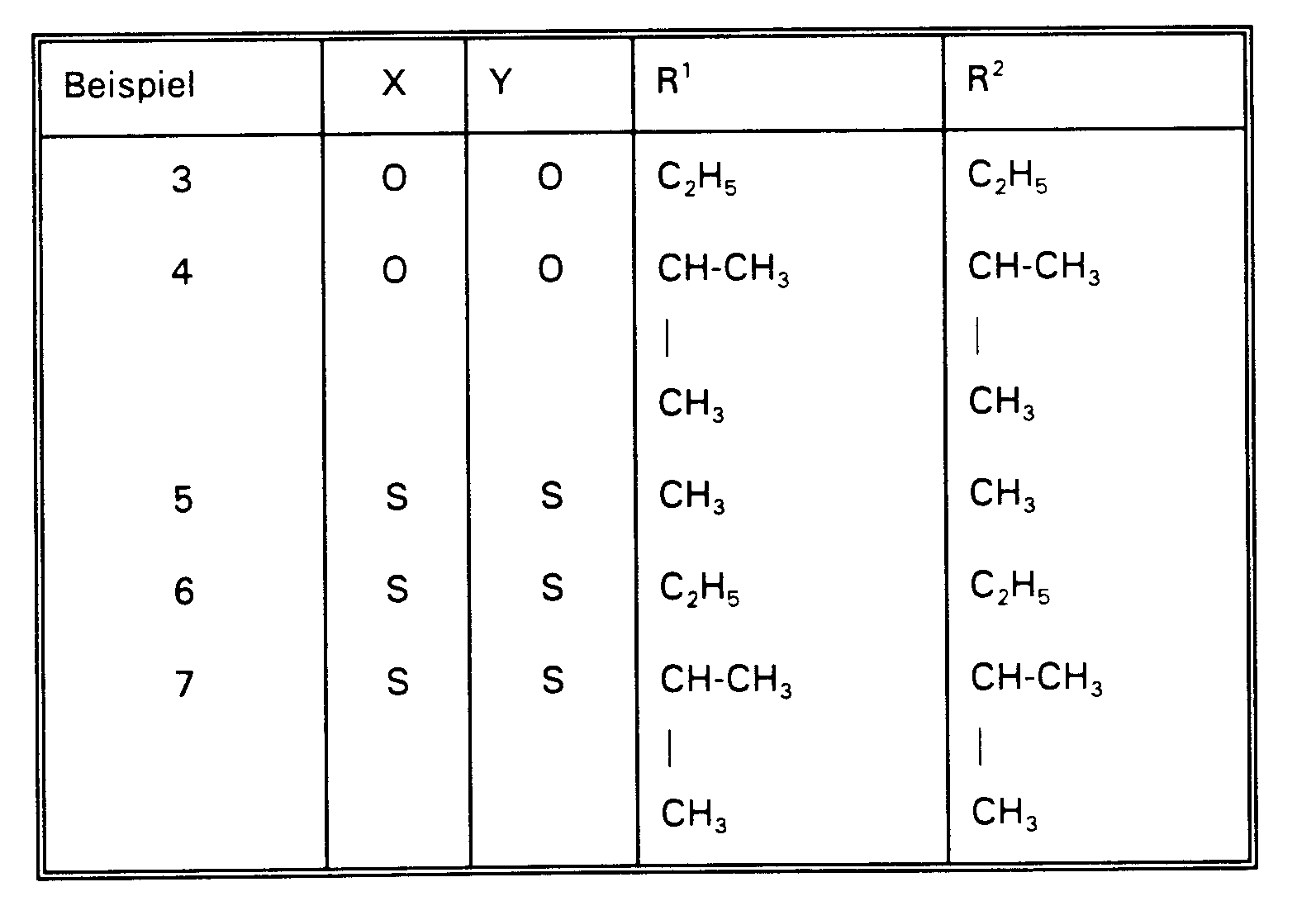
- Entsprechend den in Beispielen 1 oder 2 beschriebenen Verfahrensweisen werden beispielsweise folgende Verbindungen der Formel I erhalten:

oder dessen Salz, wobei R¹, R², X und Y die bei Formel I definierte Bedeutung haben, in Anwesenheit eines Alkohols und eines inerten Lösungsmittels, dadurch gekennzeichnet, daß man die Verbindung der Formel II mit einem Salz des Cyanamides der Formel III
(R³)j (H⁺)k [N-C ≡ N]²⁻ III
worin
R³ ein Alkalimetallkation bedeutet und
j = 1 und k = 1 oder
j = 2 und k = 0
bedeuten, umsetzt, wobei eine Lösung der Verbindungen der Formeln II und III in einem Alkohol der Formel IV
R⁴-OH IV
worin
R⁴ (C₁-C₆)-Alkyl bedeutet,
oder getrennte Lösungen der Verbindungen der Formeln II und III in jeweils einem Alkohol der genannten Formel IV simultan in ein im Vergleich zu dem Alkohol höhersiedendes inertes organisches Lösungsmittel bei Temperaturen oberhalb von 100°C unter gleichzeitigem Abdestillieren des Alkohols der Formel IV gegeben werden.
Claims (10)
- Verfahren zur Herstellung von Verbindungen der Formel I

X und Y jeweils Sauerstoff oder Schwefel undR¹, R² = unabhängig voneinander (C₁-C₄)Alkyl, (C₁-C₄)Alkoxy-(C₁-C₂)alkyl oder Halo(C₁-C₄)alkyl bedeutet,aus einem Propandiimidat der Formel II
(R³)j (H⁺)k [N-C ≡ N]²⁻ III,
worin
R³ ein Alkalimetallkation bedeutet und
j = 1 und k = 1 oder
j = 2 und k = 0
bedeuten, umsetzt, wobei eine Lösung der Verbindungen der Formeln II und III in einem Alkohol der Formel IV
R⁴-OH IV,
worin
R⁴ (C₁-C₆)-Alkyl bedeutet,
oder getrennte Lösungen der Verbindungen der Formeln II und III in jeweils einem Alkohol der genannten Formel IV simultan in ein im Vergleich zu dem Alkohol höhersiedendes inertes organisches Lösungsmittel bei Temperaturen oberhalb von 100°C unter gleichzeitigem Abdestillieren des Alkohols der Formel IV gegeben werden. - Verfahren gemäß Anspruch 1, dadurch gekennzeichnet, daß in Formel I
X und Y jeweils ein Sauerstoffatom und
R¹ und R² (C₁-C₄)Alkyl bedeuten. - Verfahren gemäß Anspruch 1 und 2, dadurch gekennzeichnet, daß in Formel I R¹ und R² jeweils Methyl oder Ethyl bedeuten.
- Verfahren gemäß einem oder mehreren der Ansprüche 1 bis 3, dadurch gekennzeichnet, daß man als Salze der Verbindung der Formel II solche der Fluor-, Chlor- oder Bromwasserstoffsäure, der Schwefel- oder Phosphorsäure verwendet.
- Verfahren nach einem oder mehreren der Ansprüche 1 bis 4, dadurch gekennzeichnet, daß man als inertes organisches Lösungsmittel einen gegebenenfalls halogenierten Kohlenwasserstoff einsetzt.
- Verfahren nach Anspruch 5, dadurch gekennzeichnet, daß Chlorbenzol, Toluol oder Xylol eingesetzt wird.
- Verfahren nach einem oder mehreren der Ansprüche 1 bis 6, dadurch gekennzeichnet, daß der Alkohol der Formel IV Methanol oder Ethanol ist.
- Verfahren nach einem oder mehreren der Ansprüche 1 bis 7, dadurch gekennzeichnet, daß die Lösung bzw. die Lösungen der Verbindungen der Formel II oder III im Alkohol der Formel IV auf -10 bis +10°C temperiert sind.
- Verfahren nach einem oder mehreren der Ansprüche 1 bis 8, dadurch gekennzeichnet, daß die Reaktionslösung nach der Reaktion von ausgefallenen anorganischen Salzen abfiltriert und das inerte organische Lösungsmittel abdestilliert wird.
- Verfahren nach Anspruch 5, dadurch gekennzeichnet, daß Chlorbenzol als inertes organisches Lösungsmittel eingesetzt wird.
Priority Applications (1)
| Application Number | Priority Date | Filing Date | Title |
|---|---|---|---|
| AT90120239T ATE104285T1 (de) | 1989-10-24 | 1990-10-22 | Verfahren zur herstellung von aminopyrimidinen. |
Applications Claiming Priority (2)
| Application Number | Priority Date | Filing Date | Title |
|---|---|---|---|
| DE3935278A DE3935278A1 (de) | 1989-10-24 | 1989-10-24 | Verfahren zur herstellung von aminopyrimidinen |
| DE3935278 | 1989-10-24 |
Publications (2)
| Publication Number | Publication Date |
|---|---|
| EP0424849A1 EP0424849A1 (de) | 1991-05-02 |
| EP0424849B1 true EP0424849B1 (de) | 1994-04-13 |
Family
ID=6392022
Family Applications (1)
| Application Number | Title | Priority Date | Filing Date |
|---|---|---|---|
| EP90120239A Expired - Lifetime EP0424849B1 (de) | 1989-10-24 | 1990-10-22 | Verfahren zur Herstellung von Aminopyrimidinen |
Country Status (7)
| Country | Link |
|---|---|
| US (1) | US5070201A (de) |
| EP (1) | EP0424849B1 (de) |
| JP (1) | JPH03167177A (de) |
| KR (1) | KR910007890A (de) |
| AT (1) | ATE104285T1 (de) |
| DE (2) | DE3935278A1 (de) |
| IL (1) | IL96079A0 (de) |
Families Citing this family (6)
| Publication number | Priority date | Publication date | Assignee | Title |
|---|---|---|---|---|
| IE913245A1 (en) * | 1990-09-15 | 1992-02-25 | Hoechst Ag | Process for the preparation of aminopyrimidines |
| US5289056A (en) * | 1992-06-12 | 1994-02-22 | National Semiconductor Corporation | BICMOS input buffer circuit with integral passgate |
| JP3269192B2 (ja) * | 1992-08-05 | 2002-03-25 | ロンザ リミテッド | 2−ハロゲン−4,6−ジアルコキシ−ピリミジンの製造方法 |
| KR20100122351A (ko) * | 2009-05-12 | 2010-11-22 | 파인텍스 주식회사 | 반도체용 닦음천 제조공정에서 사용되는 수축처리액 조성물 |
| KR102486315B1 (ko) * | 2020-09-24 | 2023-01-09 | (주)인터마루인더스트리 | 반도체 제조 클린룸용 친환경 고밀도 와이퍼의 제조 방법 |
| KR102627614B1 (ko) * | 2021-10-13 | 2024-01-24 | (주)인터마루인더스트리 | 반도체 제조 클린룸용 친환경 세섬도 고밀도 와이퍼의 제조 방법 |
Family Cites Families (5)
| Publication number | Priority date | Publication date | Assignee | Title |
|---|---|---|---|---|
| DE2426913A1 (de) * | 1974-06-04 | 1975-12-11 | Ferring Arzneimittel Gmbh | Malonsaeure- bzw. bernsteinsaeure-di- (imidoester),- verfahren zu ihrer herstellung und anwendung in der peptidchemie |
| US4169719A (en) * | 1976-04-07 | 1979-10-02 | E. I. Du Pont De Nemours And Co. | Herbicidal sulfonamides |
| AR225772A1 (es) * | 1979-08-14 | 1982-04-30 | Du Pont | Nuevo 3-amino-3-alcoxi-n-ciano-2-propenimidato de alquilo y procedimientos para su preparacion y de pirimidinas partiendo de aquellos |
| IL61185A (en) * | 1980-09-30 | 1984-12-31 | Du Pont | Methyl 3-amino-3-methoxy-n-cyano-2-propenimidate,its preparation and rearrangement to the corresponding pyrimidine |
| DE3131489A1 (de) * | 1981-08-08 | 1983-02-24 | Hoechst Ag, 6000 Frankfurt | Heterocyclisch substituierte sulfonylharnstoffe, verfahren zu ihrer herstellung und ihre verwendung in der landwirtschaft |
-
1989
- 1989-10-24 DE DE3935278A patent/DE3935278A1/de not_active Withdrawn
-
1990
- 1990-10-22 JP JP2282054A patent/JPH03167177A/ja active Pending
- 1990-10-22 DE DE59005349T patent/DE59005349D1/de not_active Expired - Fee Related
- 1990-10-22 IL IL96079A patent/IL96079A0/xx unknown
- 1990-10-22 US US07/601,224 patent/US5070201A/en not_active Expired - Fee Related
- 1990-10-22 EP EP90120239A patent/EP0424849B1/de not_active Expired - Lifetime
- 1990-10-22 AT AT90120239T patent/ATE104285T1/de active
- 1990-10-23 KR KR1019900016952A patent/KR910007890A/ko not_active Withdrawn
Also Published As
| Publication number | Publication date |
|---|---|
| KR910007890A (ko) | 1991-05-30 |
| DE59005349D1 (de) | 1994-05-19 |
| ATE104285T1 (de) | 1994-04-15 |
| EP0424849A1 (de) | 1991-05-02 |
| IL96079A0 (en) | 1991-07-18 |
| JPH03167177A (ja) | 1991-07-19 |
| US5070201A (en) | 1991-12-03 |
| DE3935278A1 (de) | 1991-04-25 |
Similar Documents
| Publication | Publication Date | Title |
|---|---|---|
| CA1277317C (en) | Heterocyclic compounds | |
| EP0200051B1 (de) | Verfahren zur Herstellung von Imidaten | |
| EP0271833B1 (de) | Verfahren zur Herstellung von Aminopyrimidinen | |
| EP0424849A1 (de) | Verfahren zur Herstellung von Aminopyrimidinen | |
| EP1503995B1 (de) | Verfahren zur herstellung von substituierten phenylsulfonylharnstoffen | |
| EP3902790B1 (de) | Verbessertes verfahren zur herstellung von 4,6-dihydroxypyrimidin | |
| EP0858447B1 (de) | Verfahren zur herstellung von aminophenylsulfonylharnstoffen und zwischenprodukte zu den verfahren | |
| DE69527719T2 (de) | Synthese penta-substituierter guanidine | |
| EP0603893B1 (de) | Verfahren zur Herstellung von 2-Ethoxy-4,6-dihydroxypyrimidin oder dessen Alkalisalz | |
| EP1097144B1 (de) | Verfahren zur herstellung 4,6-disubstituierter 2-isocyanatopyrimidine und ihre verwendung als zwischenprodukte für wirkstoffsynthesen | |
| EP0167888A1 (de) | Verfahren zur Herstellung von Phosphorsäurederivaten und Zwischenprodukten | |
| EP0476554A1 (de) | Verfahren zur Herstellung von Aminopyridinen | |
| EP1911748B1 (de) | Verfahren zur Herstellung substituierter Phenylsufonylharnstoffe aus Sulfohalogeniden | |
| DE3829957A1 (de) | Verfahren zur herstellung von oxyguanidinen | |
| EP1077210A2 (de) | Verfahren zur Herstellung von 4,6-Dichlor-5-fluorpyrimidin und seine Verwendung als Biocid | |
| DE69819504T2 (de) | Verfahren zur herstellung von 2-alkylthiobenzonitril-derivaten | |
| EP0209779A2 (de) | Verfahren zur Herstellung von 2-Cyanamino-pyrimidin-Derivaten | |
| EP0358044B1 (de) | Verfahren zum Fällen von Cytosin aus alkalischen Lösungen mit Schwefelsäure | |
| EP0948482B1 (de) | Verfahren zur herstellung von trifluoracetessigsäure-aniliden | |
| EP0504873A1 (de) | Verfahren zur Herstellung von N-Alkylsulfonamiden | |
| DE69104710T2 (de) | Verfahren zur herstellung von uracilderivaten. | |
| DE69711397T2 (de) | Herstellung von einem hydrazon-beta-ketoester durch reaktion mit einem diazoester | |
| EP0470430A1 (de) | Verfahren zur Herstellung von Oxyguanidinen | |
| EP0069883A1 (de) | Verfahren zur Herstellung von Hydrazidinen | |
| EP0193807A2 (de) | Verfahren zur Herstellung von 4-Alkoxy-6-alkyl-2-cyanamino-1,3,5-triazinen |
Legal Events
| Date | Code | Title | Description |
|---|---|---|---|
| PUAI | Public reference made under article 153(3) epc to a published international application that has entered the european phase |
Free format text: ORIGINAL CODE: 0009012 |
|
| 17P | Request for examination filed |
Effective date: 19901221 |
|
| AK | Designated contracting states |
Kind code of ref document: A1 Designated state(s): AT BE CH DE FR GB IT LI NL |
|
| 17Q | First examination report despatched |
Effective date: 19921026 |
|
| GRAA | (expected) grant |
Free format text: ORIGINAL CODE: 0009210 |
|
| AK | Designated contracting states |
Kind code of ref document: B1 Designated state(s): AT BE CH DE FR GB IT LI NL |
|
| REF | Corresponds to: |
Ref document number: 104285 Country of ref document: AT Date of ref document: 19940415 Kind code of ref document: T |
|
| REF | Corresponds to: |
Ref document number: 59005349 Country of ref document: DE Date of ref document: 19940519 |
|
| ITF | It: translation for a ep patent filed | ||
| GBT | Gb: translation of ep patent filed (gb section 77(6)(a)/1977) |
Effective date: 19940622 |
|
| ET | Fr: translation filed | ||
| PGFP | Annual fee paid to national office [announced via postgrant information from national office to epo] |
Ref country code: FR Payment date: 19940913 Year of fee payment: 5 |
|
| PGFP | Annual fee paid to national office [announced via postgrant information from national office to epo] |
Ref country code: CH Payment date: 19940915 Year of fee payment: 5 |
|
| PGFP | Annual fee paid to national office [announced via postgrant information from national office to epo] |
Ref country code: GB Payment date: 19940923 Year of fee payment: 5 Ref country code: AT Payment date: 19940923 Year of fee payment: 5 |
|
| PGFP | Annual fee paid to national office [announced via postgrant information from national office to epo] |
Ref country code: BE Payment date: 19941007 Year of fee payment: 5 |
|
| PGFP | Annual fee paid to national office [announced via postgrant information from national office to epo] |
Ref country code: NL Payment date: 19941031 Year of fee payment: 5 |
|
| PLBE | No opposition filed within time limit |
Free format text: ORIGINAL CODE: 0009261 |
|
| STAA | Information on the status of an ep patent application or granted ep patent |
Free format text: STATUS: NO OPPOSITION FILED WITHIN TIME LIMIT |
|
| 26N | No opposition filed | ||
| PG25 | Lapsed in a contracting state [announced via postgrant information from national office to epo] |
Ref country code: GB Effective date: 19951022 Ref country code: AT Effective date: 19951022 |
|
| PG25 | Lapsed in a contracting state [announced via postgrant information from national office to epo] |
Ref country code: LI Effective date: 19951031 Ref country code: CH Effective date: 19951031 Ref country code: BE Effective date: 19951031 |
|
| PG25 | Lapsed in a contracting state [announced via postgrant information from national office to epo] |
Ref country code: DE Effective date: 19951101 |
|
| BERE | Be: lapsed |
Owner name: HOECHST A.G. Effective date: 19951031 |
|
| PG25 | Lapsed in a contracting state [announced via postgrant information from national office to epo] |
Ref country code: NL Effective date: 19960501 |
|
| REG | Reference to a national code |
Ref country code: CH Ref legal event code: PL |
|
| GBPC | Gb: european patent ceased through non-payment of renewal fee |
Effective date: 19951022 |
|
| PG25 | Lapsed in a contracting state [announced via postgrant information from national office to epo] |
Ref country code: FR Effective date: 19960628 |
|
| NLV4 | Nl: lapsed or anulled due to non-payment of the annual fee |
Effective date: 19960501 |
|
| REG | Reference to a national code |
Ref country code: FR Ref legal event code: ST |
|
| PG25 | Lapsed in a contracting state [announced via postgrant information from national office to epo] |
Ref country code: IT Free format text: LAPSE BECAUSE OF NON-PAYMENT OF DUE FEES Effective date: 20051022 |