EP0425185B1 - Gestion de mémoire pour des structures graphiques hierarchiques - Google Patents
Gestion de mémoire pour des structures graphiques hierarchiques Download PDFInfo
- Publication number
- EP0425185B1 EP0425185B1 EP90311385A EP90311385A EP0425185B1 EP 0425185 B1 EP0425185 B1 EP 0425185B1 EP 90311385 A EP90311385 A EP 90311385A EP 90311385 A EP90311385 A EP 90311385A EP 0425185 B1 EP0425185 B1 EP 0425185B1
- Authority
- EP
- European Patent Office
- Prior art keywords
- accessible portion
- state
- child
- row
- parent
- Prior art date
- Legal status (The legal status is an assumption and is not a legal conclusion. Google has not performed a legal analysis and makes no representation as to the accuracy of the status listed.)
- Expired - Lifetime
Links
Images


Classifications
-
- G—PHYSICS
- G06—COMPUTING OR CALCULATING; COUNTING
- G06T—IMAGE DATA PROCESSING OR GENERATION, IN GENERAL
- G06T17/00—Three-dimensional [3D] modelling for computer graphics
Definitions
- the present invention relates to a graphics display system for displaying images generated from hierarchical graphics data structures and to a method for managing hierarchical data structures in a graphics display system.
- Graphics display systems are designed to interpret graphics commands issued by an application program to create a graphics image for display on a display device.
- Early graphics display systems each had unique interfaces and the application programs were required to recognize and program to those unique interfaces.
- More recently several graphics interface standards have evolved. For example, a Graphics Kernel Standard (GKS), Programmer's Hierarchical Interactive Graphics Systems (PHIGS) and CGI each provide a standard method for linking applications programs and graphics systems.
- GKS Graphics Kernel Standard
- PIGS Programmer's Hierarchical Interactive Graphics Systems
- CGI each provide a standard method for linking applications programs and graphics systems.
- a consistent interface frees the application programmer of the burden of developing multiple and different interfaces to various hardware systems. The application programmer can therefore focus more attention on providing features and performance in his specific graphics application.
- the basic building block of the hierarchical graphics interface is the structure.
- the structures contain graphics elements such as drawing primitives (e.g., lines, characters, polygons), attribute selections (color), modelling transformations, labels, and viewing selections. Structures specify the sequence of elements that, when processed, generate a specific effect on the screen.
- drawing primitives e.g., lines, characters, polygons
- attribute selections color
- modelling transformations labels
- viewing selections e.g., viewing selections.
- Structures specify the sequence of elements that, when processed, generate a specific effect on the screen.
- structures execute other structures which, in turn, can execute other structures. This creates a tree-like hierarchy where primitive structures can be repeatedly used throughout the drawing operation. Graphics scenes are created by traversing the structure tree and proceeding down through various levels of structure as defined in the hierarchical database.
- Fig. 1 illustrates the structure hierarchy.
- Structure A 100 is composed of several primitives or drawing commands 102-114. Each of these primitives or commands is executed in order from left to right.
- the structure hierarchy is created through the use of "structure" commands.
- command 106 directs the execution or inclusion of structure B at that point.
- Structure B 116 contains drawing primitives 118-124. Structure B may, in turn, request another structure, for example structure D 126, containing further drawing primitives.
- structure D 126 Upon the completion of all drawing primitives of structure D 126 control returns to the "structure" command 124. Since no further drawing primitives exist in structure B 116 control is returned to structure A to the command following "structure" command 106, i.e., 108. 108 in turn executes structure C 130: Structure E 132 is executed by structure C. As shown by command 114 structure C may be repetitively executed and included in different parts of the hierarchy.
- the called or "child” structure inherits the attributes of the "parent" structure during the execute structure operation.
- the newly formed child structure continues to execute until it encounters another structure command or until it completes its list of display primitives or commands.
- control is returned to the parent structure the previous parent structure state is returned and processing continues for the remaining structure elements.
- Hierarchical graphic interfaces require that the entire state of the graphics context be saved when the structure call is initiated.
- the size of the graphic state can be 512 to 1024 32-bit words.
- a graphics processor must replicate the state in order to give the child structure the same attributes as the parent structure and must save the state for resumption of execution when the child structure is completed.
- a standard 32-bit processor can perform the transfer using a read/write copy loop to transfer the structure state.
- a structure size of 512 entries being copied through a typical copy loop of .25-.5 microseconds per iteration would require 128-256 microseconds to complete. Larger structures or slower processors would take considerably longer.
- the speed of the replication frequently becomes a major bottleneck in the ability of a graphics processor to efficiently execute a hierarchical graphics model.
- An object of the present invention is to provide apparatus and methods to speed structure state storage, replication, and recall.
- a graphics display system for displaying images generated from hierarchical data structures, said system comprising: first processor means for processing hierarchical data structures to create an image: memory means for retaining a description of attributes for the data structures, said memory means having a randomly accessible portion divided into rows and columns and a serially accessible portion capable of retaining one row of said randomly accessible portion: and memory control means for controlling said memory means, said memory control means being responsive to said first processor means and operable to transfer a first row of said randomly accessible portion to said serially accessible portion and to transfer the contents of said serially accessible portion to a second row of said randomly accessible portion.
- a method for managing hierarchical data structures in a graphics display system said structures including a parent structure and a child structure, said parent structure containing an execute structure command for the execution of said child structure, whereby control passes to said child structure before returning to said parent structure, said method comprising the steps of:
- the invention enables a reduction to be achieved in the overhead required to transfer the structure state to memory and to replicate the structure state for child processing. It also leads to a memory structure for state storage which simplifies the process of saving and recalling the memory structure.
- Fig. 1 is an illustration of the relationships between structures in a hierarchical graphics database.
- Fig. 2 is a block diagram showing a portion of a graphics display system employing the present invention.
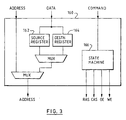
- Fig. 3 is a block diagram showing details of a sequencer for a graphics display system according to the present invention.
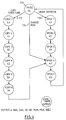
- Fig. 4 is a state diagram representing the operation of the VRAM sequencer.
- the graphics processor 150 decodes and executes graphics orders received from a display list 152. Some of these orders involve generating graphic primitives (line, characters and polygons), on the display. Other orders modify the attributes of these primitives (color, line style, and texture) or the modelling transformation of the graphics environment (view transformation matrices, clipping windows, view mapping windows, etc.). These attributes and modelling transformations make up the structure state and must be passed to child structures as the hierarchical structure tree is traversed.
- Video 154 stores the structure state for parent and child processes.
- a video RAM is a specialized form of dynamic random access memory. Each video RAM contains two input/output ports, one for random access and one for serial access, and a single address port. Internally each VRAM contains a random array 156 addressable like standard random access memory and a serial buffer 158. The random array allows addressing of any memory cell within the array. Like dynamic RAM, the random array of a VRAM is divided into rows and columns. For example, a 1M bit VRAM typically contains 512 rows and 512 columns per row. Each memory cell contains 4 bits of data. Multiple VRAMs are arranged with a depth to provide a 32-bit interface to the graphics processor.
- the serial buffer 158 is designed to sequentially shift the contents of its buffer to the screen.
- Serial buffer 158 is filled by executing a special memory cycle called "read data transfer” that copies an entire row of the VRAM into the serial buffer.
- External controls allow the data to be sequentially clocked out of the serial buffer into circuitry that updates the screen.
- Video RAMs frequently also contain a "write data transfer” memory cycle that copies the serial buffer into a selected row in the random access memory.
- the present implementation employs a video RAM with both "read data transfer” and "write data transfer” cycles.
- VRAM sequencer 160 controls the memory cycles of the VRAM array and manages the VRAM control lines, e.g., RAS (row address select), CAS (column address select), WE (write enable), OE (output enable), during the memory cycles.
- the sequencer also generates refresh cycles when needed.
- the sequencer contains specialized sequences to perform read data transfer and write data transfer operations in the VRAM.
- Structure state information is stored in integral rows in the VRAM random access array 156.
- the structure state can be stored in adjacent rows if more than one row is required to store the full description of the structure.
- the execution of an "execute structure" command requires that the structure state be replicated for the child structure.
- the VRAM technology allows rapid copying of the one or more rows containing the structure state information.
- the use of a read data transfer and write data transfer operation allows a memory controlled process to first copy the state structure to the serial buffer and then to a new row address for the child structure.
- Graphics processor 150 does not participate in the actual copying operation; it is accomplished by the VRAM sequencer.
- VRAM sequencer 160 is shown in additional detail in Fig. 3.
- Source register 162 contains the row address for the parent structure while destination register 164 contains the row address for the child structure.
- Graphics processor 150 will issue a command to transfer the data to the VRAM sequencer.
- the sequencer uses source row register 162 to address the random array and perform a read transfer operation to copy the contents of the parent structure state row into the internal serial buffer 158 of the VRAM. This step is immediately followed by a write data transfer operation using the destination register to designate the random array row address for the child structure causing the data from serial buffer 158 to be copied to child buffer structure row in random array 156.
- State machine 166 translates the commands into the necessary VRAM control signals, RAS, CAS, OE, WE.
- the state diagram of state machine 166 is shown in Fig. 4. Each state is shown with a state name and output. In the preferred embodiment, the output comprises seven binary values, expressed in the diagram as a hexadecimal number. The seven outputs are: RAS, CAS, OE, WE, RUN, MUX, REG.
- the first state, Page 170 has an output of '04' or '0000 0100'B. Thus, all signals are zero except RUN.
- the RUN signal indicates the sequencer is active in processing a command sequence.
- MUX and REG control the multiplexers supplying the address to the video RAMs.
- the refresh sequence is initiated when an internal timer times out and a CAS-before-RAS refresh cycle is begun.
- the CHANGE ROW sequence takes the VRAMs out of the current page (e.g., row) they are accessing and allows them to access a new row. This cycle is used in setting up memory pointers to the new structure state contained in a VRAM row.
- the COPY STRUCTURE sequence allows the VRAMs to copy an entire row into a new VRAM row (512 entries). The sequence performs back-to-back Read Data Transfer cycle and Write Data Transfer cycle. These two operations copy the source row into the serial register and then copy the serial register into the destination row.
- VRAM sequencer 160 has been modified to include control logic to perform the combined read data transfer and write data transfer operation in response to a single command. This added control logic accelerates the structure copying process because the operation is performed totally in the hardware. A similar result could be achieved, however, by requiring the graphics processor 150 to issue individual data transfer operation commands to the VRAM sequencer.
- the implementation in the preferred embodiment reduces the structure state copying time from the 128-256 microseconds required by the graphics copy sequence to 0.8 microseconds by using the preferred embodiment of the present invention.
- Completion of the child structure traversal requires that the machine state be returned to the parent structure state. This can be rapidly accomplished by simply reaccessing the parent structure state using the source row register retained in the VRAM sequencer.
- the addition of appropriate address storage logic associated with the graphics processor will allow the return to any previous structure state in the hierarchy. The manipulation of addresses rather than data transfers greatly speeds the hierarchy traversal process.
Landscapes
- Physics & Mathematics (AREA)
- Engineering & Computer Science (AREA)
- Computer Graphics (AREA)
- Geometry (AREA)
- Software Systems (AREA)
- General Physics & Mathematics (AREA)
- Theoretical Computer Science (AREA)
- Controls And Circuits For Display Device (AREA)
- Image Generation (AREA)
- Digital Computer Display Output (AREA)
- Processing Or Creating Images (AREA)
- Image Input (AREA)
Claims (5)
- Système d'affichage de graphique pour afficher des images produites à partir de structures de données hiérarchiques, ledit système comprenant :un premier moyen de processeur (150) servant à traiter des structures de données hiérarchiques afin de créer une image ;un moyen de mémoire (154) pour contenir une description des attributs pour les structures de données, ledit moyen de mémoire comportant une partie directement accessible divisée en rangées et colonnes et une partie accessible en série capable de contenir une rangée de ladite partie directement accessible ; etun moyen de commande de mémoire (160) pour commander ledit moyen de mémoire, ledit moyen de commande de mémoire étant sensible audit premier moyen de processeur et pouvant être mis en oeuvre pour transférer une première rangée de ladite partie directement accessible à ladite partie accessible en série et pour transférer les contenus de ladite partie accessible en série à une seconde rangée de ladite partie directement accessible.
- Appareil selon la revendication 1 dans lequel le moyen de mémoire (154) comprend une mémoire vive vidéo.
- Procédé pour gérer des structures de données hiérarchiques dans un système d'affichage de graphiques selon la revendication 1 ou la revendication 2, lesdites structures comprenant une structure parent et une structure enfant, ladite structure parent contenant un ordre d'exécution de structure pour l'exécution de ladite structure enfant, d'où il résulte que la commande passe à ladite structure enfant avant de revenir à ladite structure parent, ledit procédé comprenant les étapes consistant à :(a) traiter ladite structure parent afin de produire un état de structure basé sur les ordres dans ladite structure parent ;(b) mémoriser ledit état de structure à un premier emplacement dans la partie directement accessible ;(c) détecter ledit ordre d'exécuter structure tout en traitant ladite structure parent ;(d) transférer ledit état de structure dudit premier emplacement dans ladite partie directement accessible à la partie accessible en série en utilisant une première opération de transfert de rangée ; et(e) transférer ledit état de structure de la partie accessible en série à un second emplacement dans ladite partie directement accessible en utilisant une seconde opération de transfert de rangée.
- Procédé selon la revendication 3 dans lequel l'état de structure mémorisé audit premier emplacement est un premier état de structure, ledit procédé comprenant de plus les étapes consistant à :(f) traiter ladite structure enfant afin de produire une seconde structure afin de générer un second état de structure audit second emplacement dans ladite mémoire directement accessible sur la base des ordres dans ladite structure enfant ; et(g) restaurer ledit premier état de structure sur achèvement du traitement de ladite structure enfant.
- Procédé selon la revendication 4, dans lequel ladite structure enfant contient un ordre d'exécuter structure pour l'exécution d'une autre structure, ledit procédé comprenant les étapes supplémentaires consistant à :
répéter les étapes (c) à (f) pour chaque ordre exécuter structure traité avant de revenir à une structure précédente.
Applications Claiming Priority (2)
| Application Number | Priority Date | Filing Date | Title |
|---|---|---|---|
| US425764 | 1989-10-23 | ||
| US07/425,764 US5119477A (en) | 1989-10-23 | 1989-10-23 | Memory manager for hierarchical graphic structures |
Publications (3)
| Publication Number | Publication Date |
|---|---|
| EP0425185A2 EP0425185A2 (fr) | 1991-05-02 |
| EP0425185A3 EP0425185A3 (en) | 1992-08-26 |
| EP0425185B1 true EP0425185B1 (fr) | 1997-03-26 |
Family
ID=23687934
Family Applications (1)
| Application Number | Title | Priority Date | Filing Date |
|---|---|---|---|
| EP90311385A Expired - Lifetime EP0425185B1 (fr) | 1989-10-23 | 1990-10-17 | Gestion de mémoire pour des structures graphiques hierarchiques |
Country Status (6)
| Country | Link |
|---|---|
| US (1) | US5119477A (fr) |
| EP (1) | EP0425185B1 (fr) |
| JP (1) | JPH0816932B2 (fr) |
| CA (1) | CA2028322C (fr) |
| DE (1) | DE69030295T2 (fr) |
| SG (1) | SG42829A1 (fr) |
Families Citing this family (15)
| Publication number | Priority date | Publication date | Assignee | Title |
|---|---|---|---|---|
| US5249265A (en) * | 1989-10-24 | 1993-09-28 | International Business Machines Corporation | Structure storage management in a graphics display device |
| AU2553592A (en) * | 1991-08-21 | 1993-03-16 | Digital Equipment Corporation | Computer graphics system |
| US5313577A (en) * | 1991-08-21 | 1994-05-17 | Digital Equipment Corporation | Translation of virtual addresses in a computer graphics system |
| US5321806A (en) * | 1991-08-21 | 1994-06-14 | Digital Equipment Corporation | Method and apparatus for transmitting graphics command in a computer graphics system |
| JPH0646121A (ja) * | 1992-04-23 | 1994-02-18 | Nec Corp | 電話機 |
| US5430870A (en) * | 1992-10-13 | 1995-07-04 | Sun Microsystems, Inc. | Saving and restoring traversal state attributes of a directed acyclic graph structure network for a parent structure when it invokes a child structure for traversal |
| JP2857968B2 (ja) * | 1993-07-12 | 1999-02-17 | カシオ計算機株式会社 | 組織図作成装置及び方法 |
| US5422998A (en) * | 1993-11-15 | 1995-06-06 | Margolin; Jed | Video memory with flash fill |
| US5923330A (en) * | 1996-08-12 | 1999-07-13 | Ncr Corporation | System and method for navigation and interaction in structured information spaces |
| US6006291A (en) * | 1997-12-31 | 1999-12-21 | Intel Corporation | High-throughput interface between a system memory controller and a peripheral device |
| DE19845378A1 (de) * | 1998-10-02 | 2000-04-13 | Brinner Hans Werner | Rechenanlage für hierarchisch organisierte Objektstrukturen |
| JP2001075772A (ja) * | 1999-06-29 | 2001-03-23 | Mitsubishi Electric Corp | 画像表示装置および画像表示方法 |
| US9336555B1 (en) | 2012-10-19 | 2016-05-10 | Google Inc. | Record-time optimization of display lists |
| JP5989223B2 (ja) * | 2013-02-21 | 2016-09-07 | 三菱電機株式会社 | 制御装置及びリモコン装置 |
| US10521874B2 (en) * | 2014-09-26 | 2019-12-31 | Intel Corporation | Method and apparatus for a highly efficient graphics processing unit (GPU) execution model |
Family Cites Families (4)
| Publication number | Priority date | Publication date | Assignee | Title |
|---|---|---|---|---|
| US4139838A (en) * | 1977-04-06 | 1979-02-13 | Hitachi, Ltd. | Color pattern and alphanumeric character generator for use with raster-scan display devices |
| US4433377A (en) * | 1981-06-29 | 1984-02-21 | Eustis Mary S | Data processing with format varying |
| US4794389A (en) * | 1984-01-24 | 1988-12-27 | Ibm Corporation | Attribute hierarchy system |
| JPS61239491A (ja) * | 1985-04-13 | 1986-10-24 | Fujitsu Ltd | 電子装置 |
-
1989
- 1989-10-23 US US07/425,764 patent/US5119477A/en not_active Expired - Lifetime
-
1990
- 1990-10-17 DE DE69030295T patent/DE69030295T2/de not_active Expired - Fee Related
- 1990-10-17 SG SG1995002336A patent/SG42829A1/en unknown
- 1990-10-17 EP EP90311385A patent/EP0425185B1/fr not_active Expired - Lifetime
- 1990-10-19 JP JP2279505A patent/JPH0816932B2/ja not_active Expired - Fee Related
- 1990-10-23 CA CA002028322A patent/CA2028322C/fr not_active Expired - Fee Related
Also Published As
| Publication number | Publication date |
|---|---|
| EP0425185A3 (en) | 1992-08-26 |
| CA2028322A1 (fr) | 1991-04-24 |
| SG42829A1 (en) | 1997-10-17 |
| DE69030295D1 (de) | 1997-04-30 |
| US5119477A (en) | 1992-06-02 |
| EP0425185A2 (fr) | 1991-05-02 |
| DE69030295T2 (de) | 1997-09-18 |
| JPH03142690A (ja) | 1991-06-18 |
| CA2028322C (fr) | 1995-09-26 |
| JPH0816932B2 (ja) | 1996-02-21 |
Similar Documents
| Publication | Publication Date | Title |
|---|---|---|
| EP0425185B1 (fr) | Gestion de mémoire pour des structures graphiques hierarchiques | |
| US4679041A (en) | High speed Z-buffer with dynamic random access memory | |
| US4882687A (en) | Pixel processor | |
| EP0197412B1 (fr) | Mémoire tampon d'image à accès variable | |
| US4928247A (en) | Method and apparatus for the continuous and asynchronous traversal and processing of graphics data structures | |
| US9978115B2 (en) | Sprite graphics rendering system | |
| US5777608A (en) | Apparatus and method for in-parallel scan-line graphics rendering using content-searchable memories | |
| KR960003041B1 (ko) | 그래픽 시스템용의 확장 가능한 다영상 버퍼 | |
| US5251322A (en) | Method of operating a computer graphics system including asynchronously traversing its nodes | |
| EP0329771B1 (fr) | Poste de travail graphique a haute performance et methode d'exploitation pour cela | |
| US4901251A (en) | Apparatus and methodology for automated filling of complex polygons | |
| JPH03139777A (ja) | グラフイツク表示システム及び方法 | |
| US5097411A (en) | Graphics workstation for creating graphics data structure which are stored retrieved and displayed by a graphics subsystem for competing programs | |
| US4777485A (en) | Method and apparatus for DMA window display | |
| US6094203A (en) | Architecture for a graphics processing unit using main memory | |
| EP0279227B1 (fr) | Générateur de tracé de vecteur pour l'affichage vidéo à balayage par trame | |
| JPH0355832B2 (fr) | ||
| CA1312393C (fr) | Methode de pavage de figures pour systeme de production de graphiques | |
| Bechtolsheim et al. | High-performance raster graphics for microcomputer systems | |
| JPH0646378B2 (ja) | コンピュータ表示装置 | |
| CA1312683C (fr) | Methode de dessin pour systeme graphique | |
| JPS5952291A (ja) | ビデオram書込み制御装置 | |
| JP2867482B2 (ja) | 画像処理装置 | |
| Green | A System for Designing and Animating Objects with Curved Surfaces | |
| Krell | PLG: a graphics package for producing three-dimensional hierarchical graphics on personal computers |
Legal Events
| Date | Code | Title | Description |
|---|---|---|---|
| PUAI | Public reference made under article 153(3) epc to a published international application that has entered the european phase |
Free format text: ORIGINAL CODE: 0009012 |
|
| 17P | Request for examination filed |
Effective date: 19901213 |
|
| AK | Designated contracting states |
Kind code of ref document: A2 Designated state(s): BE CH DE ES FR GB IT LI NL SE |
|
| PUAL | Search report despatched |
Free format text: ORIGINAL CODE: 0009013 |
|
| AK | Designated contracting states |
Kind code of ref document: A3 Designated state(s): BE CH DE ES FR GB IT LI NL SE |
|
| 17Q | First examination report despatched |
Effective date: 19951006 |
|
| GRAG | Despatch of communication of intention to grant |
Free format text: ORIGINAL CODE: EPIDOS AGRA |
|
| GRAH | Despatch of communication of intention to grant a patent |
Free format text: ORIGINAL CODE: EPIDOS IGRA |
|
| GRAH | Despatch of communication of intention to grant a patent |
Free format text: ORIGINAL CODE: EPIDOS IGRA |
|
| GRAA | (expected) grant |
Free format text: ORIGINAL CODE: 0009210 |
|
| AK | Designated contracting states |
Kind code of ref document: B1 Designated state(s): BE CH DE ES FR GB IT LI NL SE |
|
| PG25 | Lapsed in a contracting state [announced via postgrant information from national office to epo] |
Ref country code: IT Free format text: LAPSE BECAUSE OF FAILURE TO SUBMIT A TRANSLATION OF THE DESCRIPTION OR TO PAY THE FEE WITHIN THE PRE;WARNING: LAPSES OF ITALIAN PATENTS WITH EFFECTIVE DATE BEFORE 2007 MAY HAVE OCCURRED AT ANY TIME BEFORE 2007. THE CORRECT EFFECTIVE DATE MAY BE DIFFERENT FROM THE ONE RECORDED.SCRIBED TIME-LIMIT Effective date: 19970326 Ref country code: CH Effective date: 19970326 Ref country code: ES Free format text: THE PATENT HAS BEEN ANNULLED BY A DECISION OF A NATIONAL AUTHORITY Effective date: 19970326 Ref country code: FR Effective date: 19970326 Ref country code: NL Free format text: LAPSE BECAUSE OF FAILURE TO SUBMIT A TRANSLATION OF THE DESCRIPTION OR TO PAY THE FEE WITHIN THE PRESCRIBED TIME-LIMIT Effective date: 19970326 Ref country code: BE Effective date: 19970326 Ref country code: LI Effective date: 19970326 |
|
| REG | Reference to a national code |
Ref country code: CH Ref legal event code: EP |
|
| REF | Corresponds to: |
Ref document number: 69030295 Country of ref document: DE Date of ref document: 19970430 |
|
| REG | Reference to a national code |
Ref country code: CH Ref legal event code: NV Representative=s name: CARL O. BARTH C/O IBM CORPORATION ZURICH INTELLECT |
|
| PG25 | Lapsed in a contracting state [announced via postgrant information from national office to epo] |
Ref country code: SE Effective date: 19970626 |
|
| EN | Fr: translation not filed | ||
| NLV1 | Nl: lapsed or annulled due to failure to fulfill the requirements of art. 29p and 29m of the patents act | ||
| REG | Reference to a national code |
Ref country code: CH Ref legal event code: PL |
|
| PLBE | No opposition filed within time limit |
Free format text: ORIGINAL CODE: 0009261 |
|
| STAA | Information on the status of an ep patent application or granted ep patent |
Free format text: STATUS: NO OPPOSITION FILED WITHIN TIME LIMIT |
|
| 26N | No opposition filed | ||
| REG | Reference to a national code |
Ref country code: GB Ref legal event code: IF02 |
|
| REG | Reference to a national code |
Ref country code: GB Ref legal event code: 746 Effective date: 20080925 |
|
| PGFP | Annual fee paid to national office [announced via postgrant information from national office to epo] |
Ref country code: DE Payment date: 20081024 Year of fee payment: 19 |
|
| PGFP | Annual fee paid to national office [announced via postgrant information from national office to epo] |
Ref country code: GB Payment date: 20091022 Year of fee payment: 20 |
|
| PG25 | Lapsed in a contracting state [announced via postgrant information from national office to epo] |
Ref country code: DE Free format text: LAPSE BECAUSE OF NON-PAYMENT OF DUE FEES Effective date: 20100501 |
|
| REG | Reference to a national code |
Ref country code: GB Ref legal event code: PE20 Expiry date: 20101016 |
|
| PG25 | Lapsed in a contracting state [announced via postgrant information from national office to epo] |
Ref country code: GB Free format text: LAPSE BECAUSE OF EXPIRATION OF PROTECTION Effective date: 20101016 |