EP0425932B1 - Chinoxalinpentamethinfarbstoffe sowie optisches Aufzeichnungsmedium, enthaltend die neuen Farbstoffe - Google Patents
Chinoxalinpentamethinfarbstoffe sowie optisches Aufzeichnungsmedium, enthaltend die neuen Farbstoffe Download PDFInfo
- Publication number
- EP0425932B1 EP0425932B1 EP19900120079 EP90120079A EP0425932B1 EP 0425932 B1 EP0425932 B1 EP 0425932B1 EP 19900120079 EP19900120079 EP 19900120079 EP 90120079 A EP90120079 A EP 90120079A EP 0425932 B1 EP0425932 B1 EP 0425932B1
- Authority
- EP
- European Patent Office
- Prior art keywords
- alkyl
- hydrogen
- substituted
- bromine
- chlorine
- Prior art date
- Legal status (The legal status is an assumption and is not a legal conclusion. Google has not performed a legal analysis and makes no representation as to the accuracy of the status listed.)
- Expired - Lifetime
Links
- 230000003287 optical effect Effects 0.000 title claims description 17
- -1 amino- Chemical class 0.000 claims description 78
- 229910052739 hydrogen Inorganic materials 0.000 claims description 32
- 239000001257 hydrogen Substances 0.000 claims description 32
- UFHFLCQGNIYNRP-UHFFFAOYSA-N Hydrogen Chemical compound [H][H] UFHFLCQGNIYNRP-UHFFFAOYSA-N 0.000 claims description 30
- 125000004169 (C1-C6) alkyl group Chemical group 0.000 claims description 22
- WKBOTKDWSSQWDR-UHFFFAOYSA-N Bromine atom Chemical compound [Br] WKBOTKDWSSQWDR-UHFFFAOYSA-N 0.000 claims description 18
- 150000002431 hydrogen Chemical class 0.000 claims description 18
- ZAMOUSCENKQFHK-UHFFFAOYSA-N Chlorine atom Chemical compound [Cl] ZAMOUSCENKQFHK-UHFFFAOYSA-N 0.000 claims description 16
- GDTBXPJZTBHREO-UHFFFAOYSA-N bromine Substances BrBr GDTBXPJZTBHREO-UHFFFAOYSA-N 0.000 claims description 16
- 229910052794 bromium Inorganic materials 0.000 claims description 16
- 239000000460 chlorine Substances 0.000 claims description 14
- 229910052801 chlorine Inorganic materials 0.000 claims description 14
- 125000004430 oxygen atom Chemical group O* 0.000 claims description 12
- 125000004178 (C1-C4) alkyl group Chemical group 0.000 claims description 10
- 150000001450 anions Chemical class 0.000 claims description 10
- 125000004400 (C1-C12) alkyl group Chemical group 0.000 claims description 7
- 125000006273 (C1-C3) alkyl group Chemical group 0.000 claims description 6
- 239000000975 dye Substances 0.000 description 27
- 239000010410 layer Substances 0.000 description 27
- XSCHRSMBECNVNS-UHFFFAOYSA-N quinoxaline Chemical compound N1=CC=NC2=CC=CC=C21 XSCHRSMBECNVNS-UHFFFAOYSA-N 0.000 description 20
- WFDIJRYMOXRFFG-UHFFFAOYSA-N Acetic anhydride Chemical compound CC(=O)OC(C)=O WFDIJRYMOXRFFG-UHFFFAOYSA-N 0.000 description 18
- 239000002253 acid Substances 0.000 description 10
- LFQSCWFLJHTTHZ-UHFFFAOYSA-N Ethanol Chemical compound CCO LFQSCWFLJHTTHZ-UHFFFAOYSA-N 0.000 description 8
- 239000000203 mixture Substances 0.000 description 8
- 238000010521 absorption reaction Methods 0.000 description 7
- 150000003254 radicals Chemical class 0.000 description 7
- YMWUJEATGCHHMB-UHFFFAOYSA-N Dichloromethane Chemical compound ClCCl YMWUJEATGCHHMB-UHFFFAOYSA-N 0.000 description 6
- OKKJLVBELUTLKV-UHFFFAOYSA-N Methanol Chemical compound OC OKKJLVBELUTLKV-UHFFFAOYSA-N 0.000 description 6
- JUJWROOIHBZHMG-UHFFFAOYSA-N Pyridine Chemical compound C1=CC=NC=C1 JUJWROOIHBZHMG-UHFFFAOYSA-N 0.000 description 6
- CODNYICXDISAEA-UHFFFAOYSA-N bromine monochloride Chemical compound BrCl CODNYICXDISAEA-UHFFFAOYSA-N 0.000 description 6
- FVAUCKIRQBBSSJ-UHFFFAOYSA-M sodium iodide Chemical compound [Na+].[I-] FVAUCKIRQBBSSJ-UHFFFAOYSA-M 0.000 description 6
- 125000002496 methyl group Chemical group [H]C([H])([H])* 0.000 description 5
- 229920000642 polymer Polymers 0.000 description 5
- 239000004065 semiconductor Substances 0.000 description 5
- 239000000243 solution Substances 0.000 description 5
- 0 Cc1c(C2*(*)=C(C)C(C)=CC2)cccc1 Chemical compound Cc1c(C2*(*)=C(C)C(C)=CC2)cccc1 0.000 description 4
- RTZKZFJDLAIYFH-UHFFFAOYSA-N Diethyl ether Chemical compound CCOCC RTZKZFJDLAIYFH-UHFFFAOYSA-N 0.000 description 4
- SWXVUIWOUIDPGS-UHFFFAOYSA-N diacetone alcohol Chemical compound CC(=O)CC(C)(C)O SWXVUIWOUIDPGS-UHFFFAOYSA-N 0.000 description 4
- 239000000463 material Substances 0.000 description 4
- 238000003756 stirring Methods 0.000 description 4
- ZWEHNKRNPOVVGH-UHFFFAOYSA-N 2-Butanone Chemical compound CCC(C)=O ZWEHNKRNPOVVGH-UHFFFAOYSA-N 0.000 description 3
- 229910000980 Aluminium gallium arsenide Inorganic materials 0.000 description 3
- 229910019142 PO4 Inorganic materials 0.000 description 3
- 239000004793 Polystyrene Substances 0.000 description 3
- YXFVVABEGXRONW-UHFFFAOYSA-N Toluene Chemical compound CC1=CC=CC=C1 YXFVVABEGXRONW-UHFFFAOYSA-N 0.000 description 3
- ZMANZCXQSJIPKH-UHFFFAOYSA-N Triethylamine Chemical compound CCN(CC)CC ZMANZCXQSJIPKH-UHFFFAOYSA-N 0.000 description 3
- 239000011230 binding agent Substances 0.000 description 3
- 150000001875 compounds Chemical class 0.000 description 3
- 229910052736 halogen Inorganic materials 0.000 description 3
- 150000002367 halogens Chemical class 0.000 description 3
- 238000004519 manufacturing process Methods 0.000 description 3
- 125000001434 methanylylidene group Chemical group [H]C#[*] 0.000 description 3
- NBIIXXVUZAFLBC-UHFFFAOYSA-K phosphate Chemical compound [O-]P([O-])([O-])=O NBIIXXVUZAFLBC-UHFFFAOYSA-K 0.000 description 3
- 239000010452 phosphate Substances 0.000 description 3
- 229920002223 polystyrene Polymers 0.000 description 3
- 239000011241 protective layer Substances 0.000 description 3
- UMJSCPRVCHMLSP-UHFFFAOYSA-N pyridine Natural products COC1=CC=CN=C1 UMJSCPRVCHMLSP-UHFFFAOYSA-N 0.000 description 3
- 230000005855 radiation Effects 0.000 description 3
- 125000000020 sulfo group Chemical group O=S(=O)([*])O[H] 0.000 description 3
- UBOXGVDOUJQMTN-UHFFFAOYSA-N 1,1,2-trichloroethane Chemical compound ClCC(Cl)Cl UBOXGVDOUJQMTN-UHFFFAOYSA-N 0.000 description 2
- QLAJNZSPVITUCQ-UHFFFAOYSA-N 1,3,2-dioxathietane 2,2-dioxide Chemical compound O=S1(=O)OCO1 QLAJNZSPVITUCQ-UHFFFAOYSA-N 0.000 description 2
- QTBSBXVTEAMEQO-UHFFFAOYSA-N Acetic acid Chemical compound CC(O)=O QTBSBXVTEAMEQO-UHFFFAOYSA-N 0.000 description 2
- CPELXLSAUQHCOX-UHFFFAOYSA-M Bromide Chemical compound [Br-] CPELXLSAUQHCOX-UHFFFAOYSA-M 0.000 description 2
- QDHHCQZDFGDHMP-UHFFFAOYSA-N Chloramine Chemical group ClN QDHHCQZDFGDHMP-UHFFFAOYSA-N 0.000 description 2
- VEXZGXHMUGYJMC-UHFFFAOYSA-M Chloride anion Chemical compound [Cl-] VEXZGXHMUGYJMC-UHFFFAOYSA-M 0.000 description 2
- AFVFQIVMOAPDHO-UHFFFAOYSA-M Methanesulfonate Chemical compound CS([O-])(=O)=O AFVFQIVMOAPDHO-UHFFFAOYSA-M 0.000 description 2
- PXHVJJICTQNCMI-UHFFFAOYSA-N Nickel Chemical compound [Ni] PXHVJJICTQNCMI-UHFFFAOYSA-N 0.000 description 2
- OAICVXFJPJFONN-UHFFFAOYSA-N Phosphorus Chemical compound [P] OAICVXFJPJFONN-UHFFFAOYSA-N 0.000 description 2
- NQRYJNQNLNOLGT-UHFFFAOYSA-N Piperidine Chemical compound C1CCNCC1 NQRYJNQNLNOLGT-UHFFFAOYSA-N 0.000 description 2
- 238000002835 absorbance Methods 0.000 description 2
- 239000006096 absorbing agent Substances 0.000 description 2
- 150000007513 acids Chemical class 0.000 description 2
- 125000000217 alkyl group Chemical group 0.000 description 2
- 229910052782 aluminium Inorganic materials 0.000 description 2
- XAGFODPZIPBFFR-UHFFFAOYSA-N aluminium Chemical compound [Al] XAGFODPZIPBFFR-UHFFFAOYSA-N 0.000 description 2
- UORVGPXVDQYIDP-UHFFFAOYSA-N borane Chemical compound B UORVGPXVDQYIDP-UHFFFAOYSA-N 0.000 description 2
- 229920001577 copolymer Polymers 0.000 description 2
- 230000007547 defect Effects 0.000 description 2
- VAYGXNSJCAHWJZ-UHFFFAOYSA-N dimethyl sulfate Chemical compound COS(=O)(=O)OC VAYGXNSJCAHWJZ-UHFFFAOYSA-N 0.000 description 2
- 238000001704 evaporation Methods 0.000 description 2
- 230000008020 evaporation Effects 0.000 description 2
- XMBWDFGMSWQBCA-UHFFFAOYSA-N hydrogen iodide Chemical compound I XMBWDFGMSWQBCA-UHFFFAOYSA-N 0.000 description 2
- 239000012442 inert solvent Substances 0.000 description 2
- 238000002347 injection Methods 0.000 description 2
- 239000007924 injection Substances 0.000 description 2
- 238000000034 method Methods 0.000 description 2
- VLTRZXGMWDSKGL-UHFFFAOYSA-M perchlorate Inorganic materials [O-]Cl(=O)(=O)=O VLTRZXGMWDSKGL-UHFFFAOYSA-M 0.000 description 2
- VLTRZXGMWDSKGL-UHFFFAOYSA-N perchloric acid Chemical compound OCl(=O)(=O)=O VLTRZXGMWDSKGL-UHFFFAOYSA-N 0.000 description 2
- 229910052698 phosphorus Inorganic materials 0.000 description 2
- 239000011574 phosphorus Substances 0.000 description 2
- 229920003023 plastic Polymers 0.000 description 2
- 239000004033 plastic Substances 0.000 description 2
- 229920003229 poly(methyl methacrylate) Polymers 0.000 description 2
- 239000004926 polymethyl methacrylate Substances 0.000 description 2
- 239000004800 polyvinyl chloride Substances 0.000 description 2
- 229920000915 polyvinyl chloride Polymers 0.000 description 2
- 238000002360 preparation method Methods 0.000 description 2
- 239000011541 reaction mixture Substances 0.000 description 2
- YGSDEFSMJLZEOE-UHFFFAOYSA-M salicylate Chemical compound OC1=CC=CC=C1C([O-])=O YGSDEFSMJLZEOE-UHFFFAOYSA-M 0.000 description 2
- 229960001860 salicylate Drugs 0.000 description 2
- 235000009518 sodium iodide Nutrition 0.000 description 2
- 239000002904 solvent Substances 0.000 description 2
- 238000004528 spin coating Methods 0.000 description 2
- 239000000758 substrate Substances 0.000 description 2
- JOXIMZWYDAKGHI-UHFFFAOYSA-N toluene-4-sulfonic acid Chemical compound CC1=CC=C(S(O)(=O)=O)C=C1 JOXIMZWYDAKGHI-UHFFFAOYSA-N 0.000 description 2
- WFKWXMTUELFFGS-UHFFFAOYSA-N tungsten Chemical compound [W] WFKWXMTUELFFGS-UHFFFAOYSA-N 0.000 description 2
- 229910052721 tungsten Inorganic materials 0.000 description 2
- 239000010937 tungsten Substances 0.000 description 2
- LSGOVYNHVSXFFJ-UHFFFAOYSA-N vanadate(3-) Chemical class [O-][V]([O-])([O-])=O LSGOVYNHVSXFFJ-UHFFFAOYSA-N 0.000 description 2
- 125000002861 (C1-C4) alkanoyl group Chemical group 0.000 description 1
- 125000000229 (C1-C4)alkoxy group Chemical group 0.000 description 1
- 125000006002 1,1-difluoroethyl group Chemical group 0.000 description 1
- ZPFAVCIQZKRBGF-UHFFFAOYSA-N 1,3,2-dioxathiolane 2,2-dioxide Chemical compound O=S1(=O)OCCO1 ZPFAVCIQZKRBGF-UHFFFAOYSA-N 0.000 description 1
- FCFHMCMUHIEANO-UHFFFAOYSA-N 1-(3-methoxypropyl)-3-methylquinoxalin-2-one Chemical compound C1=CC=C2N=C(C)C(=O)N(CCCOC)C2=C1 FCFHMCMUHIEANO-UHFFFAOYSA-N 0.000 description 1
- CQSDMVLSPKRXOB-UHFFFAOYSA-N 1-dodecyl-3-methylquinoxalin-2-one Chemical compound C1=CC=C2N=C(C)C(=O)N(CCCCCCCCCCCC)C2=C1 CQSDMVLSPKRXOB-UHFFFAOYSA-N 0.000 description 1
- 125000004343 1-phenylethyl group Chemical group [H]C1=C([H])C([H])=C(C([H])=C1[H])C([H])(*)C([H])([H])[H] 0.000 description 1
- 125000005999 2-bromoethyl group Chemical group 0.000 description 1
- 125000000143 2-carboxyethyl group Chemical group [H]OC(=O)C([H])([H])C([H])([H])* 0.000 description 1
- 125000001340 2-chloroethyl group Chemical group [H]C([H])(Cl)C([H])([H])* 0.000 description 1
- 125000004777 2-fluoroethyl group Chemical group [H]C([H])(F)C([H])([H])* 0.000 description 1
- 125000000954 2-hydroxyethyl group Chemical group [H]C([*])([H])C([H])([H])O[H] 0.000 description 1
- 125000004200 2-methoxyethyl group Chemical group [H]C([H])([H])OC([H])([H])C([H])([H])* 0.000 description 1
- 125000005916 2-methylpentyl group Chemical group 0.000 description 1
- KAHYDCBZFBPBCF-UHFFFAOYSA-N 2-n-dodecylbenzene-1,2-diamine Chemical compound CCCCCCCCCCCCNC1=CC=CC=C1N KAHYDCBZFBPBCF-UHFFFAOYSA-N 0.000 description 1
- 125000000094 2-phenylethyl group Chemical group [H]C1=C([H])C([H])=C(C([H])=C1[H])C([H])([H])C([H])([H])* 0.000 description 1
- QOXOZONBQWIKDA-UHFFFAOYSA-N 3-hydroxypropyl Chemical group [CH2]CCO QOXOZONBQWIKDA-UHFFFAOYSA-N 0.000 description 1
- QTBSBXVTEAMEQO-UHFFFAOYSA-M Acetate Chemical compound CC([O-])=O QTBSBXVTEAMEQO-UHFFFAOYSA-M 0.000 description 1
- NIXOWILDQLNWCW-UHFFFAOYSA-M Acrylate Chemical compound [O-]C(=O)C=C NIXOWILDQLNWCW-UHFFFAOYSA-M 0.000 description 1
- VYZAMTAEIAYCRO-UHFFFAOYSA-N Chromium Chemical compound [Cr] VYZAMTAEIAYCRO-UHFFFAOYSA-N 0.000 description 1
- RYGMFSIKBFXOCR-UHFFFAOYSA-N Copper Chemical compound [Cu] RYGMFSIKBFXOCR-UHFFFAOYSA-N 0.000 description 1
- QSJXEFYPDANLFS-UHFFFAOYSA-N Diacetyl Chemical group CC(=O)C(C)=O QSJXEFYPDANLFS-UHFFFAOYSA-N 0.000 description 1
- MYMOFIZGZYHOMD-UHFFFAOYSA-N Dioxygen Chemical compound O=O MYMOFIZGZYHOMD-UHFFFAOYSA-N 0.000 description 1
- SNRUBQQJIBEYMU-UHFFFAOYSA-N Dodecane Natural products CCCCCCCCCCCC SNRUBQQJIBEYMU-UHFFFAOYSA-N 0.000 description 1
- XEKOWRVHYACXOJ-UHFFFAOYSA-N Ethyl acetate Natural products CCOC(C)=O XEKOWRVHYACXOJ-UHFFFAOYSA-N 0.000 description 1
- CPELXLSAUQHCOX-UHFFFAOYSA-N Hydrogen bromide Chemical compound Br CPELXLSAUQHCOX-UHFFFAOYSA-N 0.000 description 1
- JVTAAEKCZFNVCJ-UHFFFAOYSA-M Lactate Chemical compound CC(O)C([O-])=O JVTAAEKCZFNVCJ-UHFFFAOYSA-M 0.000 description 1
- CERQOIWHTDAKMF-UHFFFAOYSA-N Methacrylic acid Chemical compound CC(=C)C(O)=O CERQOIWHTDAKMF-UHFFFAOYSA-N 0.000 description 1
- VVQNEPGJFQJSBK-UHFFFAOYSA-N Methyl methacrylate Chemical compound COC(=O)C(C)=C VVQNEPGJFQJSBK-UHFFFAOYSA-N 0.000 description 1
- ZOKXTWBITQBERF-UHFFFAOYSA-N Molybdenum Chemical compound [Mo] ZOKXTWBITQBERF-UHFFFAOYSA-N 0.000 description 1
- BPQQTUXANYXVAA-UHFFFAOYSA-N Orthosilicate Chemical compound [O-][Si]([O-])([O-])[O-] BPQQTUXANYXVAA-UHFFFAOYSA-N 0.000 description 1
- 229920001328 Polyvinylidene chloride Polymers 0.000 description 1
- XUIMIQQOPSSXEZ-UHFFFAOYSA-N Silicon Chemical compound [Si] XUIMIQQOPSSXEZ-UHFFFAOYSA-N 0.000 description 1
- QAOWNCQODCNURD-UHFFFAOYSA-L Sulfate Chemical compound [O-]S([O-])(=O)=O QAOWNCQODCNURD-UHFFFAOYSA-L 0.000 description 1
- ATJFFYVFTNAWJD-UHFFFAOYSA-N Tin Chemical compound [Sn] ATJFFYVFTNAWJD-UHFFFAOYSA-N 0.000 description 1
- 238000006887 Ullmann reaction Methods 0.000 description 1
- 239000002250 absorbent Substances 0.000 description 1
- 230000002745 absorbent Effects 0.000 description 1
- 229960000583 acetic acid Drugs 0.000 description 1
- 239000000654 additive Substances 0.000 description 1
- 150000001298 alcohols Chemical class 0.000 description 1
- 239000003513 alkali Substances 0.000 description 1
- 150000001447 alkali salts Chemical class 0.000 description 1
- 125000004414 alkyl thio group Chemical group 0.000 description 1
- 125000002947 alkylene group Chemical group 0.000 description 1
- 150000003863 ammonium salts Chemical class 0.000 description 1
- 150000001449 anionic compounds Chemical class 0.000 description 1
- 125000000129 anionic group Chemical group 0.000 description 1
- 239000003963 antioxidant agent Substances 0.000 description 1
- 125000001204 arachidyl group Chemical group [H]C([*])([H])C([H])([H])C([H])([H])C([H])([H])C([H])([H])C([H])([H])C([H])([H])C([H])([H])C([H])([H])C([H])([H])C([H])([H])C([H])([H])C([H])([H])C([H])([H])C([H])([H])C([H])([H])C([H])([H])C([H])([H])C([H])([H])C([H])([H])[H] 0.000 description 1
- 239000002585 base Substances 0.000 description 1
- 238000005815 base catalysis Methods 0.000 description 1
- 125000002511 behenyl group Chemical group [H]C([*])([H])C([H])([H])C([H])([H])C([H])([H])C([H])([H])C([H])([H])C([H])([H])C([H])([H])C([H])([H])C([H])([H])C([H])([H])C([H])([H])C([H])([H])C([H])([H])C([H])([H])C([H])([H])C([H])([H])C([H])([H])C([H])([H])C([H])([H])C([H])([H])C([H])([H])[H] 0.000 description 1
- SRSXLGNVWSONIS-UHFFFAOYSA-M benzenesulfonate Chemical compound [O-]S(=O)(=O)C1=CC=CC=C1 SRSXLGNVWSONIS-UHFFFAOYSA-M 0.000 description 1
- 125000005605 benzo group Chemical group 0.000 description 1
- 125000001797 benzyl group Chemical group [H]C1=C([H])C([H])=C(C([H])=C1[H])C([H])([H])* 0.000 description 1
- 229910052797 bismuth Inorganic materials 0.000 description 1
- JCXGWMGPZLAOME-UHFFFAOYSA-N bismuth atom Chemical compound [Bi] JCXGWMGPZLAOME-UHFFFAOYSA-N 0.000 description 1
- 229910000085 borane Inorganic materials 0.000 description 1
- 125000005997 bromomethyl group Chemical group 0.000 description 1
- 125000000484 butyl group Chemical group [H]C([*])([H])C([H])([H])C([H])([H])C([H])([H])[H] 0.000 description 1
- 229910052799 carbon Inorganic materials 0.000 description 1
- 125000003178 carboxy group Chemical group [H]OC(*)=O 0.000 description 1
- 125000002057 carboxymethyl group Chemical group [H]OC(=O)C([H])([H])[*] 0.000 description 1
- 239000012876 carrier material Substances 0.000 description 1
- 238000006243 chemical reaction Methods 0.000 description 1
- 125000004218 chloromethyl group Chemical group [H]C([H])(Cl)* 0.000 description 1
- 229910052804 chromium Inorganic materials 0.000 description 1
- 239000011651 chromium Substances 0.000 description 1
- 229910017052 cobalt Inorganic materials 0.000 description 1
- 239000010941 cobalt Substances 0.000 description 1
- GUTLYIVDDKVIGB-UHFFFAOYSA-N cobalt atom Chemical compound [Co] GUTLYIVDDKVIGB-UHFFFAOYSA-N 0.000 description 1
- 238000009833 condensation Methods 0.000 description 1
- 230000005494 condensation Effects 0.000 description 1
- 238000001816 cooling Methods 0.000 description 1
- 229910052802 copper Inorganic materials 0.000 description 1
- 239000010949 copper Substances 0.000 description 1
- 125000000582 cycloheptyl group Chemical group [H]C1([H])C([H])([H])C([H])([H])C([H])([H])C([H])(*)C([H])([H])C1([H])[H] 0.000 description 1
- 125000000113 cyclohexyl group Chemical group [H]C1([H])C([H])([H])C([H])([H])C([H])(*)C([H])([H])C1([H])[H] 0.000 description 1
- 125000001511 cyclopentyl group Chemical group [H]C1([H])C([H])([H])C([H])([H])C([H])(*)C1([H])[H] 0.000 description 1
- 125000002704 decyl group Chemical group [H]C([H])([H])C([H])([H])C([H])([H])C([H])([H])C([H])([H])C([H])([H])C([H])([H])C([H])([H])C([H])([H])C([H])([H])* 0.000 description 1
- 125000004663 dialkyl amino group Chemical group 0.000 description 1
- 125000001028 difluoromethyl group Chemical group [H]C(F)(F)* 0.000 description 1
- 238000007598 dipping method Methods 0.000 description 1
- 125000003438 dodecyl group Chemical group [H]C([H])([H])C([H])([H])C([H])([H])C([H])([H])C([H])([H])C([H])([H])C([H])([H])C([H])([H])C([H])([H])C([H])([H])C([H])([H])C([H])([H])* 0.000 description 1
- 238000001035 drying Methods 0.000 description 1
- 239000003822 epoxy resin Substances 0.000 description 1
- 125000001495 ethyl group Chemical group [H]C([H])([H])C([H])([H])* 0.000 description 1
- 238000005562 fading Methods 0.000 description 1
- 230000002349 favourable effect Effects 0.000 description 1
- 125000004216 fluoromethyl group Chemical group [H]C([H])(F)* 0.000 description 1
- 229920002313 fluoropolymer Polymers 0.000 description 1
- 239000011888 foil Substances 0.000 description 1
- 239000012362 glacial acetic acid Substances 0.000 description 1
- 239000011521 glass Substances 0.000 description 1
- KWIUHFFTVRNATP-UHFFFAOYSA-N glycine betaine Chemical group C[N+](C)(C)CC([O-])=O KWIUHFFTVRNATP-UHFFFAOYSA-N 0.000 description 1
- PCHJSUWPFVWCPO-UHFFFAOYSA-N gold Chemical compound [Au] PCHJSUWPFVWCPO-UHFFFAOYSA-N 0.000 description 1
- 229910052737 gold Inorganic materials 0.000 description 1
- 239000010931 gold Substances 0.000 description 1
- 238000009499 grossing Methods 0.000 description 1
- 150000004820 halides Chemical class 0.000 description 1
- LNEPOXFFQSENCJ-UHFFFAOYSA-N haloperidol Chemical compound C1CC(O)(C=2C=CC(Cl)=CC=2)CCN1CCCC(=O)C1=CC=C(F)C=C1 LNEPOXFFQSENCJ-UHFFFAOYSA-N 0.000 description 1
- 125000000755 henicosyl group Chemical group [H]C([*])([H])C([H])([H])C([H])([H])C([H])([H])C([H])([H])C([H])([H])C([H])([H])C([H])([H])C([H])([H])C([H])([H])C([H])([H])C([H])([H])C([H])([H])C([H])([H])C([H])([H])C([H])([H])C([H])([H])C([H])([H])C([H])([H])C([H])([H])C([H])([H])[H] 0.000 description 1
- 125000006343 heptafluoro propyl group Chemical group 0.000 description 1
- 125000003187 heptyl group Chemical group [H]C([*])([H])C([H])([H])C([H])([H])C([H])([H])C([H])([H])C([H])([H])C([H])([H])[H] 0.000 description 1
- 239000011964 heteropoly acid Substances 0.000 description 1
- 125000004051 hexyl group Chemical group [H]C([H])([H])C([H])([H])C([H])([H])C([H])([H])C([H])([H])C([H])([H])* 0.000 description 1
- 125000002887 hydroxy group Chemical group [H]O* 0.000 description 1
- 230000002452 interceptive effect Effects 0.000 description 1
- 125000000959 isobutyl group Chemical group [H]C([H])([H])C([H])(C([H])([H])[H])C([H])([H])* 0.000 description 1
- 125000001972 isopentyl group Chemical group [H]C([H])([H])C([H])(C([H])([H])[H])C([H])([H])C([H])([H])* 0.000 description 1
- 125000001449 isopropyl group Chemical group [H]C([H])([H])C([H])(*)C([H])([H])[H] 0.000 description 1
- 239000011133 lead Substances 0.000 description 1
- 230000031700 light absorption Effects 0.000 description 1
- WPBNNNQJVZRUHP-UHFFFAOYSA-L manganese(2+);methyl n-[[2-(methoxycarbonylcarbamothioylamino)phenyl]carbamothioyl]carbamate;n-[2-(sulfidocarbothioylamino)ethyl]carbamodithioate Chemical compound [Mn+2].[S-]C(=S)NCCNC([S-])=S.COC(=O)NC(=S)NC1=CC=CC=C1NC(=S)NC(=O)OC WPBNNNQJVZRUHP-UHFFFAOYSA-L 0.000 description 1
- 125000002960 margaryl group Chemical group [H]C([*])([H])C([H])([H])C([H])([H])C([H])([H])C([H])([H])C([H])([H])C([H])([H])C([H])([H])C([H])([H])C([H])([H])C([H])([H])C([H])([H])C([H])([H])C([H])([H])C([H])([H])C([H])([H])C([H])([H])[H] 0.000 description 1
- 229910052751 metal Inorganic materials 0.000 description 1
- 239000002184 metal Substances 0.000 description 1
- MEFBJEMVZONFCJ-UHFFFAOYSA-N molybdate Chemical compound [O-][Mo]([O-])(=O)=O MEFBJEMVZONFCJ-UHFFFAOYSA-N 0.000 description 1
- 229910052750 molybdenum Inorganic materials 0.000 description 1
- 239000011733 molybdenum Substances 0.000 description 1
- 125000001421 myristyl group Chemical group [H]C([*])([H])C([H])([H])C([H])([H])C([H])([H])C([H])([H])C([H])([H])C([H])([H])C([H])([H])C([H])([H])C([H])([H])C([H])([H])C([H])([H])C([H])([H])C([H])([H])[H] 0.000 description 1
- 125000001971 neopentyl group Chemical group [H]C([*])([H])C(C([H])([H])[H])(C([H])([H])[H])C([H])([H])[H] 0.000 description 1
- 230000007935 neutral effect Effects 0.000 description 1
- 229910052759 nickel Inorganic materials 0.000 description 1
- 125000001196 nonadecyl group Chemical group [H]C([*])([H])C([H])([H])C([H])([H])C([H])([H])C([H])([H])C([H])([H])C([H])([H])C([H])([H])C([H])([H])C([H])([H])C([H])([H])C([H])([H])C([H])([H])C([H])([H])C([H])([H])C([H])([H])C([H])([H])C([H])([H])C([H])([H])[H] 0.000 description 1
- 125000001400 nonyl group Chemical group [H]C([*])([H])C([H])([H])C([H])([H])C([H])([H])C([H])([H])C([H])([H])C([H])([H])C([H])([H])C([H])([H])[H] 0.000 description 1
- 125000002347 octyl group Chemical group [H]C([*])([H])C([H])([H])C([H])([H])C([H])([H])C([H])([H])C([H])([H])C([H])([H])C([H])([H])[H] 0.000 description 1
- 150000002891 organic anions Chemical class 0.000 description 1
- 239000003960 organic solvent Substances 0.000 description 1
- 125000000913 palmityl group Chemical group [H]C([*])([H])C([H])([H])C([H])([H])C([H])([H])C([H])([H])C([H])([H])C([H])([H])C([H])([H])C([H])([H])C([H])([H])C([H])([H])C([H])([H])C([H])([H])C([H])([H])C([H])([H])C([H])([H])[H] 0.000 description 1
- 125000002958 pentadecyl group Chemical group [H]C([*])([H])C([H])([H])C([H])([H])C([H])([H])C([H])([H])C([H])([H])C([H])([H])C([H])([H])C([H])([H])C([H])([H])C([H])([H])C([H])([H])C([H])([H])C([H])([H])C([H])([H])[H] 0.000 description 1
- 125000001147 pentyl group Chemical group C(CCCC)* 0.000 description 1
- 125000001997 phenyl group Chemical group [H]C1=C([H])C([H])=C(*)C([H])=C1[H] 0.000 description 1
- DHRLEVQXOMLTIM-UHFFFAOYSA-N phosphoric acid;trioxomolybdenum Chemical compound O=[Mo](=O)=O.O=[Mo](=O)=O.O=[Mo](=O)=O.O=[Mo](=O)=O.O=[Mo](=O)=O.O=[Mo](=O)=O.O=[Mo](=O)=O.O=[Mo](=O)=O.O=[Mo](=O)=O.O=[Mo](=O)=O.O=[Mo](=O)=O.O=[Mo](=O)=O.OP(O)(O)=O DHRLEVQXOMLTIM-UHFFFAOYSA-N 0.000 description 1
- 229920003227 poly(N-vinyl carbazole) Polymers 0.000 description 1
- 239000004417 polycarbonate Substances 0.000 description 1
- 229920000515 polycarbonate Polymers 0.000 description 1
- 229920000647 polyepoxide Polymers 0.000 description 1
- 239000011116 polymethylpentene Substances 0.000 description 1
- 229920000306 polymethylpentene Polymers 0.000 description 1
- 229920001290 polyvinyl ester Polymers 0.000 description 1
- 239000005033 polyvinylidene chloride Substances 0.000 description 1
- 229920000036 polyvinylpyrrolidone Polymers 0.000 description 1
- 239000001267 polyvinylpyrrolidone Substances 0.000 description 1
- 235000013855 polyvinylpyrrolidone Nutrition 0.000 description 1
- BDERNNFJNOPAEC-UHFFFAOYSA-N propan-1-ol Chemical compound CCCO BDERNNFJNOPAEC-UHFFFAOYSA-N 0.000 description 1
- 125000001436 propyl group Chemical group [H]C([*])([H])C([H])([H])C([H])([H])[H] 0.000 description 1
- 230000001681 protective effect Effects 0.000 description 1
- 229920005989 resin Polymers 0.000 description 1
- 239000011347 resin Substances 0.000 description 1
- 229910052703 rhodium Inorganic materials 0.000 description 1
- 239000010948 rhodium Substances 0.000 description 1
- MHOVAHRLVXNVSD-UHFFFAOYSA-N rhodium atom Chemical compound [Rh] MHOVAHRLVXNVSD-UHFFFAOYSA-N 0.000 description 1
- 150000003839 salts Chemical class 0.000 description 1
- 125000002914 sec-butyl group Chemical group [H]C([H])([H])C([H])([H])C([H])(*)C([H])([H])[H] 0.000 description 1
- 230000035945 sensitivity Effects 0.000 description 1
- 150000004760 silicates Chemical class 0.000 description 1
- CGFYHILWFSGVJS-UHFFFAOYSA-N silicic acid;trioxotungsten Chemical compound O[Si](O)(O)O.O=[W]1(=O)O[W](=O)(=O)O[W](=O)(=O)O1.O=[W]1(=O)O[W](=O)(=O)O[W](=O)(=O)O1.O=[W]1(=O)O[W](=O)(=O)O[W](=O)(=O)O1.O=[W]1(=O)O[W](=O)(=O)O[W](=O)(=O)O1 CGFYHILWFSGVJS-UHFFFAOYSA-N 0.000 description 1
- 229910052710 silicon Inorganic materials 0.000 description 1
- 239000010703 silicon Substances 0.000 description 1
- 229920002050 silicone resin Polymers 0.000 description 1
- 239000007787 solid Substances 0.000 description 1
- 125000004079 stearyl group Chemical group [H]C([*])([H])C([H])([H])C([H])([H])C([H])([H])C([H])([H])C([H])([H])C([H])([H])C([H])([H])C([H])([H])C([H])([H])C([H])([H])C([H])([H])C([H])([H])C([H])([H])C([H])([H])C([H])([H])C([H])([H])C([H])([H])[H] 0.000 description 1
- 238000003860 storage Methods 0.000 description 1
- 125000001424 substituent group Chemical group 0.000 description 1
- 238000010345 tape casting Methods 0.000 description 1
- 125000000999 tert-butyl group Chemical group [H]C([H])([H])C(*)(C([H])([H])[H])C([H])([H])[H] 0.000 description 1
- 125000001973 tert-pentyl group Chemical group [H]C([H])([H])C([H])([H])C(*)(C([H])([H])[H])C([H])([H])[H] 0.000 description 1
- 229920001169 thermoplastic Polymers 0.000 description 1
- 239000012815 thermoplastic material Substances 0.000 description 1
- 229920001187 thermosetting polymer Polymers 0.000 description 1
- 239000004416 thermosoftening plastic Substances 0.000 description 1
- 229910052718 tin Inorganic materials 0.000 description 1
- 239000011135 tin Substances 0.000 description 1
- 125000003866 trichloromethyl group Chemical group ClC(Cl)(Cl)* 0.000 description 1
- 125000002889 tridecyl group Chemical group [H]C([*])([H])C([H])([H])C([H])([H])C([H])([H])C([H])([H])C([H])([H])C([H])([H])C([H])([H])C([H])([H])C([H])([H])C([H])([H])C([H])([H])C([H])([H])[H] 0.000 description 1
- 125000002023 trifluoromethyl group Chemical group FC(F)(F)* 0.000 description 1
- 230000001960 triggered effect Effects 0.000 description 1
- 125000002948 undecyl group Chemical group [H]C([*])([H])C([H])([H])C([H])([H])C([H])([H])C([H])([H])C([H])([H])C([H])([H])C([H])([H])C([H])([H])C([H])([H])C([H])([H])[H] 0.000 description 1
- 238000007738 vacuum evaporation Methods 0.000 description 1
- 229910052720 vanadium Inorganic materials 0.000 description 1
- GPPXJZIENCGNKB-UHFFFAOYSA-N vanadium Chemical compound [V]#[V] GPPXJZIENCGNKB-UHFFFAOYSA-N 0.000 description 1
Classifications
-
- C—CHEMISTRY; METALLURGY
- C09—DYES; PAINTS; POLISHES; NATURAL RESINS; ADHESIVES; COMPOSITIONS NOT OTHERWISE PROVIDED FOR; APPLICATIONS OF MATERIALS NOT OTHERWISE PROVIDED FOR
- C09B—ORGANIC DYES OR CLOSELY-RELATED COMPOUNDS FOR PRODUCING DYES, e.g. PIGMENTS; MORDANTS; LAKES
- C09B23/00—Methine or polymethine dyes, e.g. cyanine dyes
- C09B23/02—Methine or polymethine dyes, e.g. cyanine dyes the polymethine chain containing an odd number of >CH- or >C[alkyl]- groups
- C09B23/08—Methine or polymethine dyes, e.g. cyanine dyes the polymethine chain containing an odd number of >CH- or >C[alkyl]- groups more than three >CH- groups, e.g. polycarbocyanines
- C09B23/083—Methine or polymethine dyes, e.g. cyanine dyes the polymethine chain containing an odd number of >CH- or >C[alkyl]- groups more than three >CH- groups, e.g. polycarbocyanines five >CH- groups
-
- C—CHEMISTRY; METALLURGY
- C09—DYES; PAINTS; POLISHES; NATURAL RESINS; ADHESIVES; COMPOSITIONS NOT OTHERWISE PROVIDED FOR; APPLICATIONS OF MATERIALS NOT OTHERWISE PROVIDED FOR
- C09B—ORGANIC DYES OR CLOSELY-RELATED COMPOUNDS FOR PRODUCING DYES, e.g. PIGMENTS; MORDANTS; LAKES
- C09B69/00—Dyes not provided for by a single group of this subclass
- C09B69/02—Dyestuff salts, e.g. salts of acid dyes with basic dyes
-
- C—CHEMISTRY; METALLURGY
- C09—DYES; PAINTS; POLISHES; NATURAL RESINS; ADHESIVES; COMPOSITIONS NOT OTHERWISE PROVIDED FOR; APPLICATIONS OF MATERIALS NOT OTHERWISE PROVIDED FOR
- C09B—ORGANIC DYES OR CLOSELY-RELATED COMPOUNDS FOR PRODUCING DYES, e.g. PIGMENTS; MORDANTS; LAKES
- C09B23/00—Methine or polymethine dyes, e.g. cyanine dyes
- C09B23/0066—Methine or polymethine dyes, e.g. cyanine dyes the polymethine chain being part of a carbocyclic ring,(e.g. benzene, naphtalene, cyclohexene, cyclobutenene-quadratic acid)
-
- C—CHEMISTRY; METALLURGY
- C09—DYES; PAINTS; POLISHES; NATURAL RESINS; ADHESIVES; COMPOSITIONS NOT OTHERWISE PROVIDED FOR; APPLICATIONS OF MATERIALS NOT OTHERWISE PROVIDED FOR
- C09B—ORGANIC DYES OR CLOSELY-RELATED COMPOUNDS FOR PRODUCING DYES, e.g. PIGMENTS; MORDANTS; LAKES
- C09B23/00—Methine or polymethine dyes, e.g. cyanine dyes
- C09B23/02—Methine or polymethine dyes, e.g. cyanine dyes the polymethine chain containing an odd number of >CH- or >C[alkyl]- groups
-
- G—PHYSICS
- G11—INFORMATION STORAGE
- G11B—INFORMATION STORAGE BASED ON RELATIVE MOVEMENT BETWEEN RECORD CARRIER AND TRANSDUCER
- G11B7/00—Recording or reproducing by optical means, e.g. recording using a thermal beam of optical radiation by modifying optical properties or the physical structure, reproducing using an optical beam at lower power by sensing optical properties; Record carriers therefor
- G11B7/24—Record carriers characterised by shape, structure or physical properties, or by the selection of the material
- G11B7/241—Record carriers characterised by shape, structure or physical properties, or by the selection of the material characterised by the selection of the material
- G11B7/242—Record carriers characterised by shape, structure or physical properties, or by the selection of the material characterised by the selection of the material of recording layers
- G11B7/244—Record carriers characterised by shape, structure or physical properties, or by the selection of the material characterised by the selection of the material of recording layers comprising organic materials only
- G11B7/246—Record carriers characterised by shape, structure or physical properties, or by the selection of the material characterised by the selection of the material of recording layers comprising organic materials only containing dyes
- G11B7/247—Record carriers characterised by shape, structure or physical properties, or by the selection of the material characterised by the selection of the material of recording layers comprising organic materials only containing dyes methine or polymethine dyes
- G11B7/2472—Record carriers characterised by shape, structure or physical properties, or by the selection of the material characterised by the selection of the material of recording layers comprising organic materials only containing dyes methine or polymethine dyes cyanine
-
- G—PHYSICS
- G11—INFORMATION STORAGE
- G11B—INFORMATION STORAGE BASED ON RELATIVE MOVEMENT BETWEEN RECORD CARRIER AND TRANSDUCER
- G11B7/00—Recording or reproducing by optical means, e.g. recording using a thermal beam of optical radiation by modifying optical properties or the physical structure, reproducing using an optical beam at lower power by sensing optical properties; Record carriers therefor
- G11B7/24—Record carriers characterised by shape, structure or physical properties, or by the selection of the material
- G11B7/241—Record carriers characterised by shape, structure or physical properties, or by the selection of the material characterised by the selection of the material
- G11B7/242—Record carriers characterised by shape, structure or physical properties, or by the selection of the material characterised by the selection of the material of recording layers
- G11B7/244—Record carriers characterised by shape, structure or physical properties, or by the selection of the material characterised by the selection of the material of recording layers comprising organic materials only
- G11B7/245—Record carriers characterised by shape, structure or physical properties, or by the selection of the material characterised by the selection of the material of recording layers comprising organic materials only containing a polymeric component
-
- G—PHYSICS
- G11—INFORMATION STORAGE
- G11B—INFORMATION STORAGE BASED ON RELATIVE MOVEMENT BETWEEN RECORD CARRIER AND TRANSDUCER
- G11B7/00—Recording or reproducing by optical means, e.g. recording using a thermal beam of optical radiation by modifying optical properties or the physical structure, reproducing using an optical beam at lower power by sensing optical properties; Record carriers therefor
- G11B7/24—Record carriers characterised by shape, structure or physical properties, or by the selection of the material
- G11B7/241—Record carriers characterised by shape, structure or physical properties, or by the selection of the material characterised by the selection of the material
- G11B7/252—Record carriers characterised by shape, structure or physical properties, or by the selection of the material characterised by the selection of the material of layers other than recording layers
- G11B7/253—Record carriers characterised by shape, structure or physical properties, or by the selection of the material characterised by the selection of the material of layers other than recording layers of substrates
- G11B7/2531—Record carriers characterised by shape, structure or physical properties, or by the selection of the material characterised by the selection of the material of layers other than recording layers of substrates comprising glass
-
- G—PHYSICS
- G11—INFORMATION STORAGE
- G11B—INFORMATION STORAGE BASED ON RELATIVE MOVEMENT BETWEEN RECORD CARRIER AND TRANSDUCER
- G11B7/00—Recording or reproducing by optical means, e.g. recording using a thermal beam of optical radiation by modifying optical properties or the physical structure, reproducing using an optical beam at lower power by sensing optical properties; Record carriers therefor
- G11B7/24—Record carriers characterised by shape, structure or physical properties, or by the selection of the material
- G11B7/241—Record carriers characterised by shape, structure or physical properties, or by the selection of the material characterised by the selection of the material
- G11B7/252—Record carriers characterised by shape, structure or physical properties, or by the selection of the material characterised by the selection of the material of layers other than recording layers
- G11B7/253—Record carriers characterised by shape, structure or physical properties, or by the selection of the material characterised by the selection of the material of layers other than recording layers of substrates
- G11B7/2533—Record carriers characterised by shape, structure or physical properties, or by the selection of the material characterised by the selection of the material of layers other than recording layers of substrates comprising resins
- G11B7/2534—Record carriers characterised by shape, structure or physical properties, or by the selection of the material characterised by the selection of the material of layers other than recording layers of substrates comprising resins polycarbonates [PC]
-
- Y—GENERAL TAGGING OF NEW TECHNOLOGICAL DEVELOPMENTS; GENERAL TAGGING OF CROSS-SECTIONAL TECHNOLOGIES SPANNING OVER SEVERAL SECTIONS OF THE IPC; TECHNICAL SUBJECTS COVERED BY FORMER USPC CROSS-REFERENCE ART COLLECTIONS [XRACs] AND DIGESTS
- Y10—TECHNICAL SUBJECTS COVERED BY FORMER USPC
- Y10S—TECHNICAL SUBJECTS COVERED BY FORMER USPC CROSS-REFERENCE ART COLLECTIONS [XRACs] AND DIGESTS
- Y10S428/00—Stock material or miscellaneous articles
- Y10S428/913—Material designed to be responsive to temperature, light, moisture
-
- Y—GENERAL TAGGING OF NEW TECHNOLOGICAL DEVELOPMENTS; GENERAL TAGGING OF CROSS-SECTIONAL TECHNOLOGIES SPANNING OVER SEVERAL SECTIONS OF THE IPC; TECHNICAL SUBJECTS COVERED BY FORMER USPC CROSS-REFERENCE ART COLLECTIONS [XRACs] AND DIGESTS
- Y10—TECHNICAL SUBJECTS COVERED BY FORMER USPC
- Y10S—TECHNICAL SUBJECTS COVERED BY FORMER USPC CROSS-REFERENCE ART COLLECTIONS [XRACs] AND DIGESTS
- Y10S430/00—Radiation imagery chemistry: process, composition, or product thereof
- Y10S430/149—Lippmann
-
- Y—GENERAL TAGGING OF NEW TECHNOLOGICAL DEVELOPMENTS; GENERAL TAGGING OF CROSS-SECTIONAL TECHNOLOGIES SPANNING OVER SEVERAL SECTIONS OF THE IPC; TECHNICAL SUBJECTS COVERED BY FORMER USPC CROSS-REFERENCE ART COLLECTIONS [XRACs] AND DIGESTS
- Y10—TECHNICAL SUBJECTS COVERED BY FORMER USPC
- Y10T—TECHNICAL SUBJECTS COVERED BY FORMER US CLASSIFICATION
- Y10T428/00—Stock material or miscellaneous articles
- Y10T428/24—Structurally defined web or sheet [e.g., overall dimension, etc.]
- Y10T428/24802—Discontinuous or differential coating, impregnation or bond [e.g., artwork, printing, retouched photograph, etc.]
- Y10T428/24851—Intermediate layer is discontinuous or differential
- Y10T428/24868—Translucent outer layer
- Y10T428/24876—Intermediate layer contains particulate material [e.g., pigment, etc.]
-
- Y—GENERAL TAGGING OF NEW TECHNOLOGICAL DEVELOPMENTS; GENERAL TAGGING OF CROSS-SECTIONAL TECHNOLOGIES SPANNING OVER SEVERAL SECTIONS OF THE IPC; TECHNICAL SUBJECTS COVERED BY FORMER USPC CROSS-REFERENCE ART COLLECTIONS [XRACs] AND DIGESTS
- Y10—TECHNICAL SUBJECTS COVERED BY FORMER USPC
- Y10T—TECHNICAL SUBJECTS COVERED BY FORMER US CLASSIFICATION
- Y10T428/00—Stock material or miscellaneous articles
- Y10T428/24—Structurally defined web or sheet [e.g., overall dimension, etc.]
- Y10T428/24802—Discontinuous or differential coating, impregnation or bond [e.g., artwork, printing, retouched photograph, etc.]
- Y10T428/24893—Discontinuous or differential coating, impregnation or bond [e.g., artwork, printing, retouched photograph, etc.] including particulate material
- Y10T428/24901—Discontinuous or differential coating, impregnation or bond [e.g., artwork, printing, retouched photograph, etc.] including particulate material including coloring matter
-
- Y—GENERAL TAGGING OF NEW TECHNOLOGICAL DEVELOPMENTS; GENERAL TAGGING OF CROSS-SECTIONAL TECHNOLOGIES SPANNING OVER SEVERAL SECTIONS OF THE IPC; TECHNICAL SUBJECTS COVERED BY FORMER USPC CROSS-REFERENCE ART COLLECTIONS [XRACs] AND DIGESTS
- Y10—TECHNICAL SUBJECTS COVERED BY FORMER USPC
- Y10T—TECHNICAL SUBJECTS COVERED BY FORMER US CLASSIFICATION
- Y10T428/00—Stock material or miscellaneous articles
- Y10T428/31504—Composite [nonstructural laminate]
Definitions
- semiconductor lasers that emit light in the near infrared are suitable as the light source for an optical recording medium.
- Neutral methine dyes which contain an oxidazole nucleus and an electron-withdrawing radical on the ⁇ -carbon atom of the methine chain are known from EP-A-0 217 245.
- the object of the present invention was to provide new radiation-sensitive products which have good reflection and high absorption in the wavelength range of the semiconductor lasers used. They should also be easy to manufacture, stable over a long period of time and easily soluble in polymers.
- the invention was also based on the object of providing a new optical recording medium, the layers containing the new products being homogeneous, having good adhesion to the customary carrier materials and being stable over a long period of time.
- these recording media should be writable by means of a semiconductor laser and then easy to read, and should be characterized by the highest possible signal: noise ratio.
- C1-C12-alkyl which is optionally interrupted by one or more, in particular 1 to 3 oxygen atoms, phenyl, hydroxy, halogen, in particular chlorine or bromine, C1-C22-alkoxy, C1-C10 alkylthio, phenylthio, cyano , Amino, C1-C16 mono- or dialkylamino, pyrrolidino, piperidino, morpholino, piperazino, N- (C1-C4-alkyl) piperazino or hydroxysulfonyl come into consideration.
- radical R1 is substituted C1-C22-alkyl, for example hydroxy, methacryloyloxy, phenyl, halogen, carboxy, hydroxsulfonyl, C1-C4-alkanoyl, C1-C4-alkanoylamino, C1-C4-alkoxycarbonyl or C1-C4-alkoxy carbonylamino come into consideration as a substituent.
- the alkyl chain can also be interrupted by one or more, in particular 1 to 3, oxygen atoms.
- R1 is substituted C5-C7-cycloalkyl, z. B. C1-C4 alkyl or halogen, especially chlorine or bromine.
- Suitable radicals R1 and R2 are, for example, methyl, ethyl, propyl, isopropyl, butyl, isobutyl, sec-butyl or tert-butyl.
- R 1 radicals are furthermore, for example, pentyl, isopentyl, neopentyl, tert-pentyl, hexyl, 2-methylpentyl, heptyl, octyl, 2-ethylhexyl, isooctyl, nonyl, isononyl, decyl, isodecyl, undecyl, dodecyl, tridecyl, isotridecyl, tetradecyl, pentadecyl , Hexadecyl, Heptadecyl, Octadecyl, Nonadecyl, Eicosyl, Heneicosyl, Docosyl (the designations isooctyl, isononyl, isodecyl and isotridecyl are trivial designations and come from the alcohols obtained after oxosynthesis [cf.
- Z 1 and Z 1 together are e.g. - (CH2) 2-, - (CH2) 3-, -CH (CH3) -CH2-, -CH (C2H5) -CH2-, -CH2-CH (CH3) -CH2- or -CH2-CH (C2H5) -CH2-.
- X ⁇ in formula I means an anion. Both inorganic and organic anions can be considered. Suitable anions are, for example, halide, such as chloride, bromide or iodide, sulfate, perchlorate, phosphate, tetrafluoroborate, trichlorozincate, methyl sulfonate, phenyl sulfonate, 4-methylphenyl sulfonate, methosulfate, ethosulfate, acetate, lactate, salicylate or tetraphenyl borane. According to the invention, those dyes of the formula I are also to be encompassed which have betaine structure, ie in which the anionic group is part of the dye molecule.
- X ⁇ can also be, for example, an anion of a heteropoly acid based on tungsten and / or molybdenum with phosphorus, silicon, vanadium, cobalt, aluminum, manganese, chromium and / or nickel. Furthermore, the copper (I) hexacyanoferrate (II) anion is also suitable.
- heteropolyacids or the salts of these acids is known.
- the acids are obtained by acidifying solutions of the tungstates, molybdates and / or vanadates in the form of the alkali and / or ammonium salts in the presence of phosphate and / or water-soluble silicates.
- phosphate and / or water-soluble silicates By choosing the weight ratios of tungsten, molybdate and vanadate as well as of phosphate and silicate, different types of heteropolyacids can be built up. Examples of heteropolyacids are:
- Phosphomolybdic acid silicomolybdic acid, phosphorotungstic acid, silicotungstic acid, phosphorvanadic acid, silicovanadic acid, phosphorotungstammolybdic acid, silicotungstammolybdic acid, phosphoric or silicotungstvanvanadic acid or phosphorus silicotungstol polybdic acid which may also contain vanadine incorporated.
- Preferred anions X ⁇ are chloride, bromide, iodide, perchlorate, tetrafluoroborate, 4-methylphenyl sulfonate, methyl sulfonate, methosulfate, tetraphenylboramate or salicylate.
- the dyes according to the invention are prepared by methods known per se, for example by condensation of cyclammonium compounds of the formula II or III where R1 and X ⁇ each have the meaning given above, or starting from a quinoxaline of the formula IV in which R1 has the meaning given above, with components of the formula V, VI, VII or VIII wherein R2 each has the meaning given above, in an inert solvent, optionally with base catalysis, at a temperature of 20 to 140 ° C.
- Inert solvents for the reactions are e.g. Ethanol, acetic anhydride, pyridine, glacial acetic acid, or compatible mixtures thereof.
- Suitable bases are e.g. B. triethylamine or piperidine.
- the compounds of the formulas II to VIII used as starting products are essentially compounds known per se.
- the new quinoxaline pentamethine dyes of the formula I have a high molar absorption in the range from 750 to 800 nm. They are also readily soluble in organic solvents and in thermoplastic or cross-linked plastics.
- glass plates or panes or plastic plates or panes, in particular plates or panes made of polymethyl methacrylate, polystyrene, polystyrene copolymers, polyvinyl chloride, polymethylpentene or polycarbonate, which may have track grooves.
- the support can have the form of a tape, a square or rectangular plate or preferably a round disk, preference being given to the disks of 10 or 13 cm in diameter which are customary and known for laser-optical recording materials.
- the recording medium according to the invention can be free of binders.
- the recording medium preferably contains a binder.
- binder examples include silicone resins, epoxy resins, acrylate resins, polystyrene homo- and copolymers, polyvinyl carbazole, polyvinyl pyrrolidone, polyvinyl ester copolymers, polyvinylidene chloride copolymers or polyvinyl chloride.
- a reflective layer can be present between the light-absorbing layer and the carrier, so that the radiated light, which migrates through the colored layer, as far as it is not absorbed, is reflected on the reflector layer and migrates again through the colored layer.
- the exposure can also take place through a transparent substrate.
- the arrangement of substrate-absorber layer - possibly reflector layer - then comes into consideration as the layer sequence.
- Suitable light reflecting materials are e.g. As aluminum, rhodium, gold, tin, lead, bismuth, copper or dielectric mirrors.
- the light-reflecting layer should be so thick that it reflects the light used for recording or scanning as completely as possible.
- the carrier or the light-reflecting layer must have an optically smooth, flat surface and be designed on the surface in such a way that the absorbent layer adheres firmly to it.
- the carrier and / or the reflector can be provided with a smoothing layer made of a thermosetting or thermoplastic material.
- the metallic reflection layer is applied preferably by known methods, e.g. B. by evaporation in vacuo or by applying suitable metal foils on the carrier.
- the recording medium according to the invention is applied to a support by spin coating a solution containing a dye of the formula I, optionally a polymeric binder and a solvent, and the layer is dried in air.
- the film can also be dried in vacuo, at elevated temperature or, if appropriate, with radiation.
- Suitable solvents are e.g. B. 1,1,2-trichloroethane, methyl ethyl ketone, diacetone alcohol, toluene, methanol, ethanol, propanol or mixtures thereof.
- the solution to be spin-coated may optionally contain additives, such as antioxidants, singlet oxygen quenchers or UV absorbers.
- a protective layer to the dye-in-polymer layer.
- a number of polymers are suitable for this purpose, which can form a protective layer by spin coating, knife coating, dipping of dissolved polymers or by vacuum evaporation, in particular fluorinated polymers.
- the recording system is constructed from two identical or different recording media in the form of a "sandwich"
- a protective layer can generally be dispensed with.
- the "sandwich” structure offers the advantage of double the storage capacity.
- the protective and / or intermediate layer can usually be dispensed with if the optical recording medium is of sufficient quality. However, if it is not possible to do without intermediate layers, taking into account the refractive index of the material used for this and the laser light wavelength used, the layer thickness must be selected such that no interfering interference can occur.
- the optical recording medium according to the invention has a high absorption at the wavelength of the commercially available semiconductor lasers (approx. 650 to 900 nm).
- the dye-in-polymer systems can be applied to a light-reflecting layer in such a way that there are smooth, homogeneous absorption layers of high optical quality, which have a favorable threshold energy and into which the information to be stored can be written in the form of pits, whereby a excellent signal: noise ratio results.
- the recording media according to the present invention are writable and readable with a semiconductor laser. Recording media according to the invention are very stable against atmospheric influences and daylight.
- the new recording media are very sensitive to the light from near-infrared solid-state injection lasers.
- the AlGaAs laser which works in the wavelength range from 750 to 950 nm, should be mentioned in particular. Due to the small size of the component, its low energy requirement and the possibility of direct modulation of the optical output power by modulating the electrical drive current, such laser types are particularly suitable.
Landscapes
- Chemical & Material Sciences (AREA)
- Organic Chemistry (AREA)
- Thermal Transfer Or Thermal Recording In General (AREA)
- Optical Record Carriers And Manufacture Thereof (AREA)
- Non-Silver Salt Photosensitive Materials And Non-Silver Salt Photography (AREA)
Description
- Die vorliegende Erfindung betrifft neue Chinoxalinpentamethinfarbstoffe der Formel I

in der - R¹
- gleich oder verschieden ist und jeweils Wasserstoff, C₁-C₂₂-Alkyl, das gegebenenfalls substituiert ist und durch ein oder mehrere Sauerstoffatome unterbrochen sein kann oder gegebenenfalls substituiertes C₅-C₇-Cycloalkyl,
- R²
- Wasserstoff, Chlor, Brom oder C₁-C₆-Alkyl,
- Y
- gleich oder verschieden ist und jeweils einen Rest der Formel -N=C(CH₃)- oder -N(R¹)-CO-, worin R¹ die obengenannte Bedeutung besitzt,
- Z¹ und Z²
- jeweils Wasserstoff oder zusammen auch gegebenenfalls durch C₁-C₄-Alkyl substituiertes C₂-C₃-Alkylen und
- X⊖
- ein Anion bedeuten und
- die Ringe A und B
- gleich oder verschieden und unabhängig voneinander gegebenenfalls substituiert und/oder benzoanelliert sind,
- Aufzeichnungsmedien, die mit Strahlen hoher Energiedichte, z.B. Laserlicht, eine lokal begrenzte Zustandsänderung erfahren, sind bekannt. Mit dieser thermisch ausgelösten Zustandsänderung, z. B. Verdampfen, Änderung des Fließverhaltens oder Ausbleichen, ist eine Änderung der optischen Eigenschaften, beispielsweise der Absorption durch Änderung des Absorptionsmaximums oder der Extinktion verbunden, welche zur Informations- oder Datenaufzeichnung ausgenutzt werden kann.
- Als Lichtquelle für ein optisches Aufzeichnungsmedium eignen sich beispielsweise Halbleiterlaser, die Licht im nahen Infrarot emittieren. Festkörper-Injektionlaser, vor allem der AlGaAs-Laser, der im Wellenlängenbereich zwichen etwa 650 und 900 nm arbeitet, sind hierbei besonders zu nennen. Daher besteht besonders Interesse an solchen Aufzeichnungsmaterialien, die Strahlung im Wellenlängenbereich zwischen ca. 650 und 900 nm absorbieren und sich zu dünnen, homogenen Schichten verarbeiten lassen.
- So sollen nach der Lehre der JP-A-112 790/1983 (US-A-4 460 665) sowie der JP-A-125 246/1983 Methinfarbstoffe für diesen Zweck verwendet werden. Die aus dem Stand der Technik bekannten Farbstoffe weisen aber häufig noch Mängel in ihrem anwendungstechnischen Eigenschaftsprofil auf.
- Neutrale Methinfarbstoffe, die einen Oxidazolkern und am α-Kohlenstoffatom der Methinkette einen elektronenziehenden Rest enthalten, sind aus der EP-A-0 217 245 bekannt.
- Aufgabe der vorliegenden Erfindung war es, neue strahlungsempfindliche Produkte bereitzustellen, die im Wellenlängenbereich der verwendeten Halbleiterlaser eine gute Reflexion und eine hohe Absorption aufweisen. Sie sollten außerdem in einfacher Weise herzustellen, über einen langen Zeitraum hinweg stabil und in Polymeren leicht löslich sein. Der Erfindung lag weiterhin die Aufgabe zugrunde, ein neues optisches Aufzeichungsmedium bereitzustellen, wobei die die neuen Produkte enthaltenden Schichten homogen sein, eine gute Haftung auf den gebräuchlichen Trägermaterialien aufweisen und über einen langen Zeitraum hinweg stabil sein sollten. Darüber hinaus sollten diese Aufzeichnungsmedien mittels eines Halbleiterlasers beschreibbar und anschließend gut lesbar sein und sich durch ein möglichst hohes Signal : Rausch-Verhältnis auszeichnen.
- Demgemäß wurden die oben näher bezeichneten Chinoxalinpentamethinfarbstoffe der Formel I gefunden.
- Alle in den obengenannten Resten der Formel I auftretenden Alkyl- und Alkylengruppen können sowohl geradkettig als auch verzweigt sein.
- Wenn die Ringe A und B in Formel I substituiert sind, können als Substituenten z. B. C₁-C₁₂-Alkyl, das gegebenenfalls durch ein oder mehrere, insbesondere 1 bis 3 Sauerstoffatome unterbrochen ist, Phenyl, Hydroxy, Halogen, dabei insbesondere Chlor oder Brom, C₁-C₂₂-Alkoxy, C₁-C₁₀-Alkylthio, Phenylthio, Cyano, Amino, C₁-C₁₆-Mono- oder Dialkylamino, Pyrrolidino, Piperidino, Morpholino, Piperazino, N-(C₁-C₄-Alkyl)piperazino oder Hydroxysulfonyl in Betracht kommen.
- Wenn der Rest R¹ substituiertes C₁-C₂₂-Alkyl bedeutet, können z.B. Hydroxy, Methacryloyloxy, Phenyl, Halogen, Carboxy, Hydroxsulfonyl, C₁-C₄-Alkanoyl, C₁-C₄-Alkanoylamino, C₁-C₄-Alkoxycarbonyl oder C₁-C₄-Alkoxy carbonylamino als Substituenten in Betracht kommen. Die Alkylkette kann außerdem durch ein oder mehrere, insbesondere 1 bis 3 Sauerstoffatome unterbrochen sein.
- Wenn R¹ für substituiertes C₅-C₇-Cycloalkyl steht, können als Substituenten z. B. C₁-C₄-Alkyl oder Halogen, dabei insbesondere Chlor oder Brom, in Betracht kommen.
- Geeignete Reste R¹ und R² sind beispielsweise Methyl, Ethyl, Propyl, Isopropyl, Butyl, Isobutyl, sec-Butyl oder tert-Butyl.
- Reste R¹ sind weiterhin z.B. Pentyl, Isopentyl, Neopentyl, tert-Pentyl, Hexyl, 2-Methylpentyl, Heptyl, Octyl, 2-Ethylhexyl, Isooctyl, Nonyl, Isononyl, Decyl, Isodecyl, Undecyl, Dodecyl, Tridecyl, Isotridecyl, Tetradecyl, Pentadecyl, Hexadecyl, Heptadecyl, Octadecyl, Nonadecyl, Eicosyl, Heneicosyl, Docosyl (die Bezeichnungen Isooctyl, Isononyl, Isodecyl und Isotridecyl sind Trivialbezeichnungen und stammen von den nach der Oxosynthese erhaltenen Alkoholen [vgl. dazu Ullmanns Encyklopädie der technischen Chemie, 4. Auflage, Band 7, Seiten 215 bis 217, sowie Band 11, Seiten 435 und 436]), Benzyl, 1- oder 2-Phenylethyl, Fluormethyl, Chlormethyl, Brommethyl, Difluormethyl, Trifluormethyl, Trichlormethyl, 2-Fluorethyl, 2-Chlorethyl,2-Bromethyl, 1,1-Difluorethyl, 1,1,1-Trifluorethyl, Heptafluorpropyl, 4-Chlorbutyl, 4-Brombutyl, 5-Fluorpentyl, 6-Chlorhexyl, 2-Methoxyethyl, 2-Ethoxyethyl, 2-Propoxyethyl, 2-Isopropoxyethyl, 2-Butoxyethyl, 2-Benzyloxyethyl, 2- oder 3-Methoxypropyl, 2- oder 3-Ethoxypropyl, 2- oder 3-Benzyloxypropyl, 2- oder 4-Ethoxybutyl, 2- oder 4-Isopropoxybutyl, 5-Ethoxypentyl, 6-Methoxyhexyl, 3,6-Dioxaheptyl, 3,6-Dioxaoctyl, 3,6-Dioxadecyl, 3,6,9-Trioxadecyl, 4-Oxa-6-ethyldecyl, 3,6-Dioxa-7-phenylheptyl, Propan-2-on-1-yl, Butan-3-on-1-yl, Butan-3-on-2-yl, 2-Ethylpentan-3-on-1-yl, Carboxymethyl, 2-Carboxyethyl, 3-Carboxypropyl, 4-Carboxybutyl, 5-Carboxypentyl, 4-Carboxy-3-oxabutyl, Acetylaminomethyl, 2-Acetylaminoethyl, 2-Propionylaminoethyl, 2-Butyrylaminoethyl, Ethoxycarbonylmethyl, 2-Ethoxycarbonylethyl, 2-oder 3-Methoxycarbonylpropyl, Ethoxycarbonylaminomethyl, 2-(Ethoxycarbonylamino)ethyl, 2-Hydroxyethyl, 2-Hydroxypropyl, 3-Hydroxypropyl, 2-Hydroxybutyl, 4-Hydroxybutyl, 5-Hydroxypentyl, 6-Hydroxyhexyl, 7-Hydroxyheptyl, 8-Hydroxyoctyl, 2-Methacryloyloxyethyl, 2- oder 3-Methacryloyloxypropyl, 2- oder 4-Methacryloyloxybutyl, 2-Hydroxysulfonylethyl, 2- oder 3-Hydroxysulfonylpropyl, 2- oder 4-Hydroxysulfonylbutyl, Cyclopentyl, Cyclohexyl, Cycloheptyl, 3-Methylcyclopentyl, 4-Methylcyclohexyl, 4-Ethylcyclohexyl oder 2,3-Dichlorcyclohexyl.
- Z¹ und Z¹ sind zusammen z.B. -(CH₂)₂-, -(CH₂)₃-, -CH(CH₃)-CH₂-, -CH(C₂H₅)-CH₂-, -CH₂-CH(CH₃)-CH₂- oder -CH₂-CH(C₂H₅)-CH₂-.
- X⊖ in Formel I bedeutet ein Anion. Dabei kommen sowohl anorganische als auch organische Anionen in Betracht. Geeignete Anionen sind z.B. Halogenid, wie Chlorid, Bromid oder Iodid, Sulfat, Perchlorat, Phosphat, Tetrafluoroborat, Trichlorozinkat, Methylsulfonat, Phenylsulfonat, 4-Methylphenylsulfonat, Methosulfat, Ethosulfat, Acetat, Lactat, Salicylat oder Tetraphenylboranat. Erfindungsgemäß sollen auch solche Farbstoffe der Formel I umfasst werden, die Betainstruktur aufweisen, d. h. bei denen die anionische Gruppe Bestandteil des Farbstoffmoleküls ist.
- X⊖ kann weiterhin beispielsweise auch ein Anion einer Heteropolysäure auf der Basis Wolfram und/oder Molybdän mit Phosphor, Silicium, Vanadium, Kobalt, Aluminium, Mangan, Chrom und/oder Nickel sein. Weiterhin kommt z.B. auch das Kupfer(I)-hexacyanoferrat-(II)-anion in Betracht.
- Die Herstellung der Heteropolysäuren oder der Salze dieser Säuren ist bekannt. Die Säuren werden durch Ansäuern von Lösungen der Wolframate, Molybdate und/oder Vanadate in Form der Alkali- und/oder Ammoniumsalze in Gegenwart von Phosphat und/oder wasserlöslichen Silicaten erhalten. Dabei können durch Wahl der Gewichtsverhältnisse von Wolframat, Molybdat und Vanadat sowie von Phosphat und Silicat verschiedenartige Heteropolysäuren aufgebaut werden. Als Beispiele für Heteropolysäuren sind zu nennen:
- Phosphormolybdänsäure, Silicomolybdänsäure, Phosphorwolframsäure, Silicowolframsäure, Phosphorvanadinsäure, Silicovanadinsäure, Phosphorwolframmolybdänsäure, Silicowolframmolybdänsäure, Phosphor- oder Silicowolframvanadinsäure oder Phosphorsilicowolframmolybdänsäure die gegebenenfalls noch Vanadin eingebaut enthält.
- Bevorzugt sind solche Chinoxalinpentamethinfarbstoffe der Formel I, in der
- R¹
- Wasserstoff oder gegebenenfalls durch 1 bis 3 Sauerstoffatome unterbrochenes C₁-C₂₂-Alkyl, C₁-C₂₂-Bromalkyl, C₁-C₁₂-Hydroxyalkyl, C₁-C₁₂-Methacryloyloxyalkyl, C₁-C₁₂-Hydroxysulfonylalkyl, C₁-C₆-Carboxyalkyl oder (C₁-C₄-Alkoxycarbonyl)-C₁-C₆-alkyl,
- R²
- Wasserstoff, Chlor, Brom oder C₁-C₄-Alkyl und
- Z¹ und Z²
- jeweils Wasserstoff oder zusammen gegebenenfalls durch C₁-C₄-Alkyl substituiertes C₂-C₃-Alkylen bedeuten und
- die Ringe A und B
- gegebenenfalls durch Amino, Chlor, Brom, Hydroxysulfonyl oder C₁-C₆-Alkyl substituiert und/oder benzoanelliert sind.
- Besonders bevorzugt sind solche Chinoxalinpentamethinfarbstoffe der Formel I, in der
- R¹
- gegebenenfalls durch 1 bis 3 Sauerstoffatome unterbrochenes C₁-C₁₂-Alkyl, C₁-C₁₂-Bromalkyl, C₁-C₁₂-Hydroxysulfonylalkyl oder (C₁-C₄-Alkoxycarbonyl)-C₁-C₆-alkyl,
- R²
- Wasserstoff, Chlor, Brom oder C₁-C₃-Alkyl und
- Z¹ und Z²
- jeweils Wasserstoff bedeuten und
- die Ringe A und B
- unsubstituiert sind.
- Bevorzugte Anionen X⊖ sind Chlorid, Bromid, Iodid, Perchlorat, Tetrafluoroborat, 4-Methylphenylsulfonat, Methylsulfonat, Methosulfat, Tetraphenylboramat oder Salicylat.
- Die Herstellung der erfindungsgemäßen Farbstoffe erfolgt nach an sich bekannten Methoden, beispielsweise durch Kondensation von Cyclammoniumverbindungen der Formel II oder III
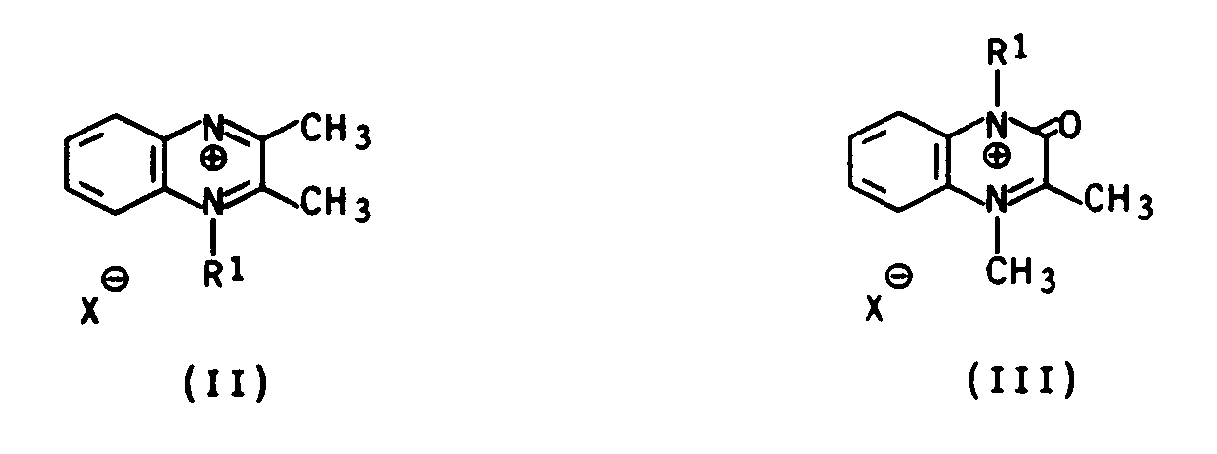
wobei R¹ und X⊖ jeweils die obengenannte Bedeutung besitzen, oder ausgehend von einem Chinoxalin der Formel IV
in der R¹ die obengenannte Bedeutung besitzt, mit Komponenten der Formel V, VI, VII oder VIII
wobei R² jeweils die obengenannte Bedeutung besitzt, in einem inerten Lösungsmittel, gegebenenfalls unter Basenkatalyse, bei einer Temperatur von 20 bis 140°C. - Als inerte Lösungsmittel für die Umsetzungen kommen z.B. Ethanol, Acetanhydrid, Pyridin, Eisessig oder kompatible Gemische davon in Betracht. Geeignete Basen sind z. B. Triethylamin oder Piperidin.
- Weitere Einzelheiten der Herstellung können den Beispielen entnommen werden.
- Bei den als Ausgangsprodukten verwendeten Verbindungen der Formeln II bis VIII handelt es sich im wesentlichen um an sich bekannte Verbindungen.
- Die neuen Chinoxalinpentamethinfarbstoffe der Formel I weisen eine hohe molare Absorption im Bereich von 750 bis 800 nm auf. Sie sind zudem in organischen Lösungsmitteln sowie in thermoplastischen oder vernetzten Kunststoffen gut löslich.
- Die Erfindung betrifft weiterhin ein optisches Aufzeichnungsmedium, enthaltend einen Träger und eine gegenüber Laserlicht empfindliche, Farbstoff enthaltende Schicht, dadurch gekennzeichnet, daß der Farbstoff ein Chinoxalinpentamethinfarbstoff der Formel I

ist, in der - R¹
- gleich oder verschieden ist und jeweils Wasserstoff, C₁-C₂₂-Alkyl, das gegebenenfalls substituiert ist und durch ein oder mehrere Sauerstoffatome unterbrochen sein kann oder gegebenenfalls substituiertes C₅-C₇-Cycloalkyl,
- R²
- Wasserstoff, Chlor, Brom oder C₁-C₆-Alkyl,
- Y
- gleich oder verschieden ist und jeweils einen Rest der Formel -N=C(CH₃)- oder -N(R¹)-CO-, worin R¹ die obengenannte Bedeutung besitzt,
- Z¹ und Z²
- jeweils Wasserstoff oder zusammen auch gegebenenfalls durch C₁-C₄-Alkyl substituiertes C₂-C₃-Alkylen und
- X⊖
- ein Anion bedeuten, und
- die Ringe A und B
- gleich oder verschieden und unabhängig voneinander gegebenenfalls substituiert und/oder benzoanelliert sind.
- Bevorzugt ist ein optisches Aufzeichnungsmedium, das einen Chinoxalinpentamethinfarbstoff der Formel I enthält, in der
- R¹
- Wasserstoff oder gegebenenfalls durch 1 bis 3 Sauerstoffatome unterbrochenes C₁-C₂₂-Alkyl, C₁-C₂₂-Bromalkyl, C₁-C₁₂-Hydroxyalkyl, C₁-C₁₂-Methacryloyloxyalkyl, C₁-C₁₂-Hydroxysulfonylalkyl, C₁-C₆-Carboxyalkyl oder (C₁-C₄-Alkoxycarbonyl)-C₁-C₆-alkyl,
- R²
- Wasserstoff, Chlor, Brom oder C₁-C₄-Alkyl,
- Z¹ und Z²
- jeweils Wasserstoff oder zusammen auch gegebenenfalls durch C₁-C₄-Alkyl substituiertes C₂-C₃-Alkylen bedeuten und
- die Ringe A und B
- gebenenfalls durch Amino, Chlor, Brom, Hydroxysulfonyl oder C₁-C₆-Alkyl substituiert und/oder benzoanelliert sind.
- Besonders bevorzugt ist ein optisches Aufzeichnungsmedium, das einen Chinoxalinpentamethinfarbstoff der Formel I enthält, in der
- R¹
- gegebenenfalls durch 1 bis 3 Sauerstoffatome unterbrochenes C₁-C₁₂-Alkyl, C₁-C₁₂-Bromalkyl, C₁-C₁₂-Hydroxysulfonylalkyl oder (C₁-C₄-Alkoxycarbonyl)-C₁-C₆-alkyl,
- R²
- Wasserstoff, Chlor, Brom oder C₁-C₃-Alkyl und
- Z¹ und Z²
- jeweils Wasserstoff bedeuten und
- die Ringe A und B
- gleich und unsubstituiert sind.
- Als Träger kommen z. B. Glasplatten oder -scheiben, oder Kunststoffplatten oder -scheiben, insbesondere Platten oder Scheiben aus Polymethylmethacrylat, Polystyrol, Polystyrol-Copolymeren, Polyvinylchlorid, Polymethylpenten oder Polycarbonat in Betracht, die gegebenenfalls Spurrillen aufweisen.
- Der Träger kann dabei die Form eines Bandes, einer quadratischen oder rechteckigen Platte oder vorzugsweise einer runden Scheibe haben, wobei die für laseroptische Aufzeichnungsmaterialien üblichen und bekannten Scheiben eines Durchmessers von 10 oder 13 cm bevorzugt werden.
- Das erfindungsgemäße Aufzeichnungsmedium kann frei von Bindemitteln sein. Vorzugsweise enthält das Aufzeichnungsmedium aber ein Bindemittel. Als solche kommen beispielsweise Siliconharze, Epoxidharze, Acrylatharze, Polystyrolhomo- und -copolymerisate, Polyvinylcarbazol, Polyvinylpyrrolidon, Polyvinylestercopolymere, Polyvinylidenchloridcopolymere oder Polyvinylchlorid in Betracht.
- Zwischen der lichtabsorbierenden Schicht und dem Träger kann eine reflektierende Schicht vorhanden sein, so daß das eingestrahlte und durch die farbige Schicht wandernde Licht, so weit es nicht absorbiert wird, an der Reflektorschicht reflektiert wird und nochmals durch die gefärbte Schicht wandert.
- Die Belichtung kann auch durch ein transparentes Substrat erfolgen. Als Schichtfolge kommt dann die Anordnung Substrat-Absorberschicht - gegebenenfalls Reflektorschicht in Betracht.
- Geeignete lichtreflektierende Materialien sind z. B. Aluminium, Rhodium, Gold, Zinn, Blei, Wismut, Kupfer oder dielektrische Spiegel. Die lichtreflektierende Schicht sollte so dick sein, daß sie das zur Aufnahme oder zum Abtasten benutzte Licht möglichst vollständig reflektiert.
- Für diesen Zweck sind Spiegel mit geringer Wärmeleitfähigkeit vorteilhaft. Der Träger oder die lichtreflektierende Schicht müssen eine optisch glatte, ebene Oberfläche aufweisen und an der Oberfläche so beschaffen sein, daß die absorbierende Schicht darauf fest haftet. Um die Oberflächenqualität und Adhäsionsphänomene günstig zu beeinflussen kann der Träger und/oder der Reflektor mit einer Glättungsschicht aus einem duroplastischen oder thermoplastischen Material versehen werden.
- Für den Fall, daß das das optische Aufzeichnungsmedium einen metallischen Reflektor aufweist, erfolgt das Aufbringen der metallischen Reflektionsschicht vorzugsweise nach bekannten Methoden, z. B. durch Aufdampfen im Vakuum oder auch durch Aufbringen geeigneter Metallfolien auf den Träger.
- Das erfindungsgemäße Aufzeichnungsmedium wird durch Aufschleudern einer Lösung, enthaltend einen Farbstoff der Formel I, gegebenenfalls ein polymeres Bindemittel und ein Lösungsmittel, auf einen Träger aufgebracht und die Schicht an der Luft getrocknet. Der Film kann auch im Vakuum, bei erhöhter Temperatur oder gegebenenfalls mit Strahlung getrocknet werden.
- Als geeignete Lösungsmittel sind z. B. 1,1,2-Trichlorethan, Methylethylketon, Diacetonalkohol, Toluol, Methanol, Ethanol, Propanol oder deren Gemische zu nennen.
- Gegebenenfalls kann die aufzuschleudernde Lösung Additive, wie Antioxidantien, Singulett-Sauerstoff-Quencher oder UV-Absorber enthalten.
- Es ist weiterhin auch möglich, auf die Farbstoff-in-Polymer-Schicht eine Schutzschicht aufzubringen. Hierzu bieten sich eine Reihe von Polymeren an, welche durch Aufschleudern, Aufrakeln, Tauchen von gelösten Polymeren oder durch Aufdampfen im Vakuum, insbesondere von fluorierten Polymeren, eine Schutzschicht bilden können.
- Wenn das Aufzeichnungssystem aus zwei gleichen oder verschiedenen Aufzeichnungsmedien in Form eines "Sandwich" aufgebaut wird, kann im allgemeinen auf eine Schutzschicht verzichtet werden. Neben größerer mechanischer und rotationsdynamischer Stabilität bietet der "Sandwich"-Aufbau den Vorteil der doppelten Speicherkapazität.
- Auf die Schutz- und/oder Zwischenschicht kann bei ausreichender Qualität des optischen Aufzeichungsmediums üblicherweise verzichtet werden. Wenn aber auf Zwischenschichten nicht verzichtet werden kann, muß unter Berücksichtigung des Brechungsindex des dazu verwendeten Materials und der verwendeten Laserlichtwellenlänge deren Schichtdicke so gewählt werden, daß keine störenden Interferenzen auftreten können.
- Das erfindungsgemäße optische Aufzeichnungsmedium weist bei der Wellenlänge der kommerziell erhältlichen Halbleiterlaser (ca. 650 bis 900 nm) eine hohe Absorption auf. Die Farbstoff-in-Polymer-Systeme können auf eine lichtreflektierende Schicht so aufgebracht werden, daß sich glatte, homogene Absorptionsschichten hoher optischer Qualität ergeben, die eine günstige Schwellenenergie besitzen und in die die zu speichernde Information in Form von Pits eingeschrieben werden kann, wodurch ein ausgezeichnetes Signal : Rausch-Verhältnis resultiert.
- Die Aufzeichungsmedien gemäß der vorliegenden Erfindung sind mit einem Halbleiter-Laser beschreibbar und lesbar. Aufzeichnungsmedien gemäß der Erfindung sind gegenüber atmosphärischen Einflüssen und Tageslicht sehr stabil.
- Aufgrund der hohen Lichtabsorption der Chinoxalinpentamethinfarbstoffe der Formel I sind die neuen Aufzeichungsmedien sehr empfindlich gegenüber dem Licht von im nahen Infrarot emittierenden Festkörper-Injektionslasern. Insbesondere ist hier der AlGaAs-Laser zu nennen, der im Wellenlängenbereich von 750 bis 950 nm arbeitet. Aufgrund der geringen Größe des Bauelementes, seines geringen Energiebedarfs und der Möglichkeit der direkten Modulation der optischen Ausgangsleistung durch Modulation des elektrischen Antriebsstromes eignen sich solche Lasertypen besonders gut.
- Die folgenden Beispiele sollen die Erfindung näher erläutern.
- Zu 2,85 g (33 mmol) Diacetyl in 60 ml Acetanhydrid wurden bei Raumtemperatur unter Rühren 9,1 g (33 mmol) N-(n-Dodecyl)-o-phenylendiamin gegeben und 15 Minuten bei Raumtemperatur gerührt. Man versetzte dann mit 3,6 g (15 mmol) 3-Methylmalondialdehydbisanil und ließ 5 Stunden bei Raumtemperatur ruhren. Anschließend fügte man 2,25 g (15 mmol) Natriumiodid zu, rührte weitere 2 Stunden und saugte dann den ausgefallenen Farbstoff ab. Man wusch den Filterrückstand mit wenig Acetanhydrid und Ether und trocknete unter vermindertem Druck. Man erhielt einen Farbstoff der Formel

Ausbeute: 1,82 g (13 % der Theorie); Schmp.: 135-136 °C;
λmax = 795 nm (in CH₂Cl₂). - 5,0 g (21 mmol) 2-Methyl-4-(4-oxapentyl)chinoxal-3-on wurden mit 2,1 g (17 mmol) Dimethylsulfat versetzt und während 15 Minuten auf 150 °C erhitzt. Nach Abkühlen wurden 10 ml Acetanhydrid, 7 ml Pyridin und anschließend 2,3 g (7,5 mmol) Mucobromsäurebisanil-hydrobromid zugegeben.
- Das Reaktionsgemisch wurde 60 Minuten bei Raumtemperatur gerührt. Der ausgefallene Farbstoff wurde abgesaugt, zunächst mit wenig Acetanhydrid und dann mit Ether mehrmals gewaschen. Nach dem Trocknen erhielt man einen Farbstoff der Formel

als grünen, metallisch glänzenden Feststoff.
Ausbeute: 2,5 g (30 % der Theorie); Schmp.: 210-212 °C;
λmax = 761 nm (in CH₂Cl₂). - 2,6 g (8 mmol) 4-n-Dodecyl-2-methylchinoxal-3-on wurden mit 1,13 g (9 mmol) Dimethylsulfat vermischt und unter Rühren 15 Minuten auf 150 °C erhitzt. Anschließend kühlte man auf Raumtemperatur ab, setzte 6 ml Acetanhydrid, 4 ml Pyridin und 0,9 g (4 mmol) 3-Methylmalondialdehydbisanil zu. Das Reaktionsgemisch wurde 1 Stunde bei Raumtemperatur gerührt und dann mit einer Lösung von 1,2 g Natriumiodid in 10 ml Methanol vereinigt. Nach weiteren 10 Minuten Rühren bei Raumtemperatur saugte man den ausgefallenen Farbstoff der Formel

ab.
Ausbeute: 1,7 g (50 % der Theorie); Schmp.: 135-136 °C;
λmax = 756 nm (in CH₂Cl₂). - Die im folgenden aufgeführten Farbstoffe wurden analog den Beispielen 1 bis 3 hergestellt.

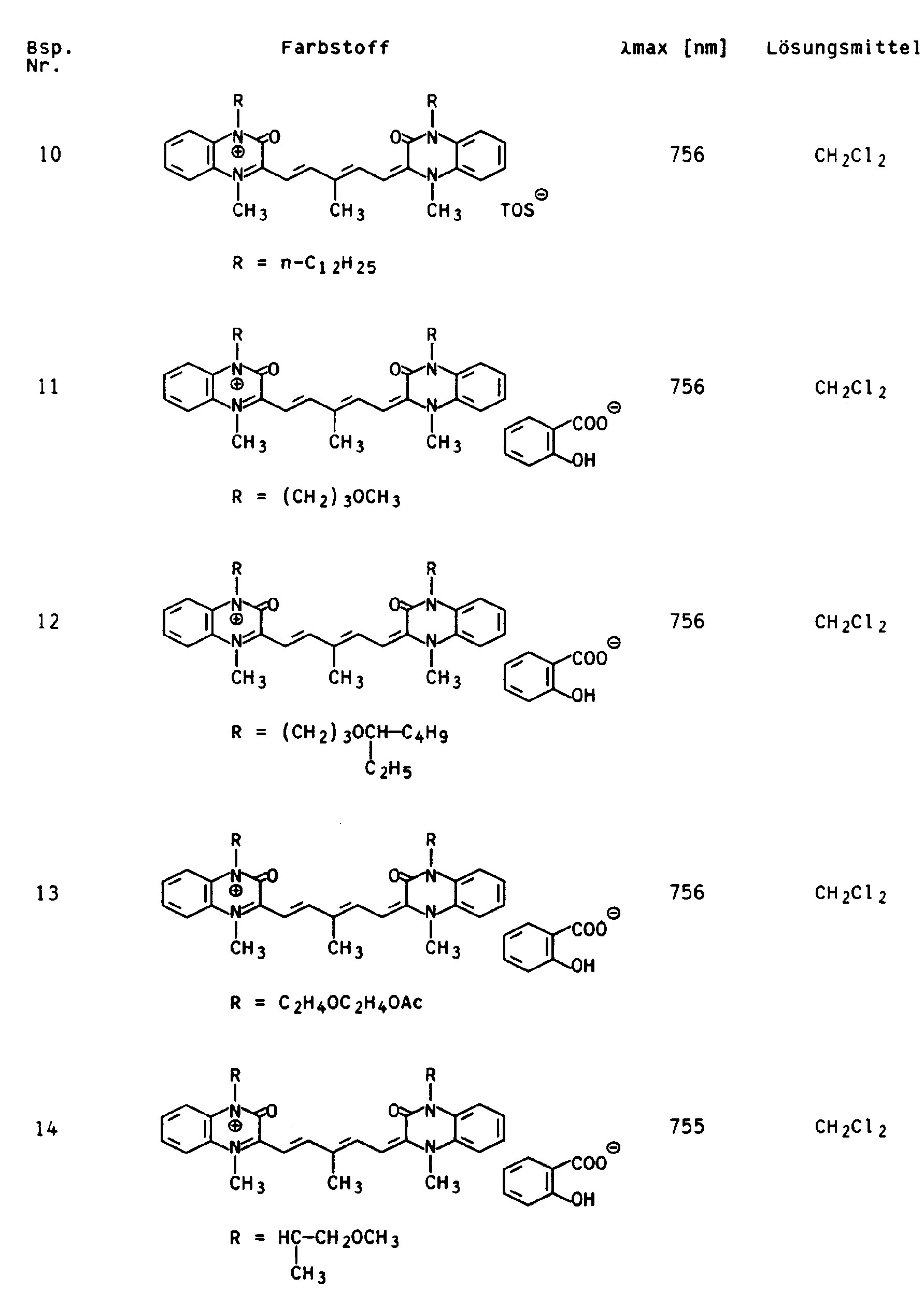
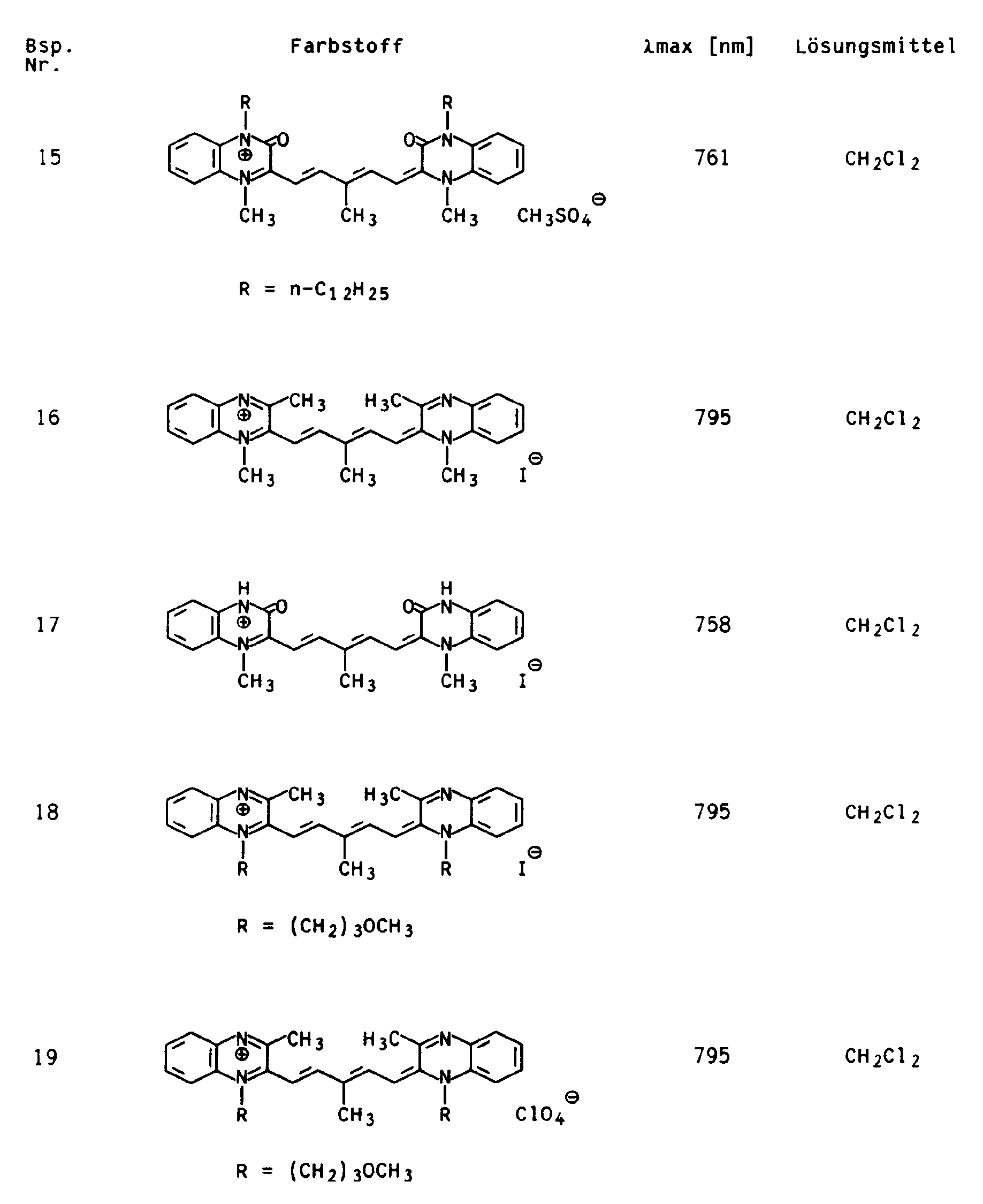

- 0,134 g eines Copolymeren aus Methylmethacrylat/Methacrylsäure (70:30) wurden in 0,808 g Diacetonalkohol und 4,48 g Ethanol gelöst und 0,077 g Farbstoff aus Beispiel 1 zugesetzt. Nach 1 Stunden Rühren bei Raumtemperatur wurde filtriert und die Lösung bei 1800 U/min auf ein Polymethylmethacrylat-Substrat aufgeschleudert. Die auf diese Weise erhaltene Schicht ist homogen und ohne erkennbare Fehler. Sie weist eine breite Absorptionsbande auf; bei 830 nm beträgt die Extinktion 0,35. Die Schichtdicke beträgt 70 nm. Mit einem auf einem Drehtisch montierten AlGaAs-Laser werden einzelne, etwa 1 µ große Löcher in die aktive Schicht geschrieben. Die Empfindlichkeit der Schicht war besser als 1 nJ/Loch. Beim Auslesen der Punkte wurde ein ausgezeichnetes Signal:Rausch-Verhältnis gefunden.
sowie ein optisches Aufzeichnungsmedium, enthaltend die neuen Farbstoffe.
Claims (6)
- Chinoxalinpentamethinfarbstoffe der Formel Iin der
 R¹ gleich oder verschieden ist und jeweils Wasserstoff, C₁-C₂₂-Alkyl, das gegebenenfalls substituiert ist und durch ein oder mehrere Sauerstoffatome unterbrochen sein kann oder gegebenenfalls substituiertes C₅-C₇-Cycloalkyl,R² Wasserstoff, Chlor, Brom oder C₁-C₆-Alkyl,Y gleich oder verschieden ist und jeweils einen Rest der Formel -N=C(CH₃)- oder -N(R¹)-CO-, worin R¹ die obengenannte Bedeutung besitzt,Z¹ und Z² jeweils Wasserstoff oder zusammen auch gegebenenfalls durch C₁-C₄-Alkyl substituiertes C₂-C₃-Alkylen undX⊖ ein Anion bedeuten unddie Ringe A und B gleich oder verschieden und unabhängig voneinander gegebenenfalls substituiert und/oder benzoanelliert sind.
- Chinoxalinpentamethinfarbstoffe nach Anspruch 1, dadurch gekennzeichnet, daßR¹ Wasserstoff oder gegebenenfalls durch 1 bis 3 Sauerstoffatome unterbrochenes C₁-C₂₂-Alkyl, C₁-C₂₂-Bromalkyl, C₁-C₁₂-Hydroxyalkyl, C₁-C₁₂-Methacryloyloxyalkyl, C₁-C₁₂-Hydroxysulfonylalkyl, C₁-C₆-Carboxyalkyl oder (C₁-C₄-Alkoxycarbonyl)-C₁-C₆-alkyl,R² Wasserstoff, Chlor, Brom oder C₁-C₄-Alkyl undZ¹ und Z² jeweils Wasserstoff oder zusammen gegebenenfalls durch C₁-C₄-Alkyl substituiertes C₂-C₃-Alkylen bedeuten unddie Ringe A und B gebenenfalls durch Amino, Chlor, Brom, Hydroxysulfonyl oder C₁-C₆-Alkyl substituiert und/oder benzoanelliert sind.
- Chinoxalinpentamethinfarbstoffe nach Anspruch 1, dadurch gekennzeichnet, daßR¹ gegebenenfalls durch 1 bis 3 Sauerstoffatome unterbrochenes C₁-C₁₂-Alkyl, C₁-C₁₂-Bromalkyl, C₁-C₁₂-Hydroxysulfonylalkyl oder (C₁-C₄-Alkoxycarbonyl)-C₁-C₆-alkyl,R² Wasserstoff, Chlor, Brom oder C₁-C₃-Alkyl undZ¹ und Z² jeweils Wasserstoff bedeuten unddie Ringe A und B unsubstituiert sind.
- Optisches Aufzeichnungsmedium, enthaltend einen Träger und eine gegenüber Laserlicht empfindliche, Farbstoff enthaltende Schicht, dadurch gekennzeichnet, daß der Farbstoff ein Chinoxalinpentamethinfarbstoff der Formel I
 R¹ gleich oder verschieden ist und jeweils Wasserstoff, C₁-C₂₂-Alkyl, das gegebenenfalls substituiert ist und durch ein oder mehrere Sauerstoffatome unterbrochen sein kann oder gegebenenfalls substituiertes C₅-C₇-Cycloalkyl,R² Wasserstoff, Chlor, Brom oder C₁-C₆-Alkyl,Y gleich oder verschieden ist und jeweils einen Rest der Formel -N=C(CH₃)- oder -N(R¹)-CO-, worin R¹ die obengenannte Bedeutung besitzt,Z¹ und Z² jeweils Wasserstoff oder zusammen auch gegebenenfalls durch C₁-C₄-Alkyl substituiertes C₂-C₃-Alkylen undX⊖ ein Anion bedeuten, unddie Ringe A und B gleich oder verschieden und unabhängig voneinander gegebenenfalls substituiert und/oder benzoanelliert sind.
- Optisches Aufzeichnungsmedium nach Anspruch 4, dadurch gekennzeichnet, daßR¹ Wasserstoff oder gegebenenfalls durch 1 bis 3 Sauerstoffatome unterbrochenes C₁-C₂₂-Alkyl, C₁-C₂₂-Bromalkyl, C₁-C₁₂-Hydroxyalkyl, C₁-C₁₂-Methacryloyloxyalkyl, C₁-C₁₂-Hydroxysulfonylalkyl, C₁-C₆-Carboxyalkyl oder (C₁-C₄-Alkoxycarbonyl)-C₁-C₆-alkyl,R² Wasserstoff, Chlor, Brom oder C₁-C₄-Alkyl,Z¹ und Z² jeweils Wasserstoff oder zusammen auch gegebenenfalls durch C₁-C₄-Alkyl substituiertes C₂-C₃-Alkylen bedeuten unddie Ringe A und B gebenenfalls durch Amino, Chlor, Brom, Hydroxysulfonyl oder C₁-C₆-Alkyl substituiert und/oder benzoanelliert sind.
- Optisches Aufzeichnungsmedium nach Anspruch 4, dadurch gekennzeichnet, daßR¹ gegebenenfalls durch 1 bis 3 Sauerstoffatome unterbrochenes C₁-C₁₂-Alkyl, C₁-C₁₂-Bromalkyl, C₁-C₁₂-Hydroxysulfonylalkyl oder (C₁-C₄-Alkoxycarbonyl)-C₁-C₆-alkyl,R² Wasserstoff, Chlor, Brom oder C₁-C₃-Alkyl undZ¹ und Z² jeweils Wasserstoff bedeuten unddie Ringe A und B gleich und unsubstituiert sind.
Applications Claiming Priority (2)
| Application Number | Priority Date | Filing Date | Title |
|---|---|---|---|
| DE3936051 | 1989-10-28 | ||
| DE19893936051 DE3936051A1 (de) | 1989-10-28 | 1989-10-28 | Chinoxalinpentamethinfarbstoffe sowie optisches aufzeichnungsmedium, enthaltend die neuen farbstoffe |
Publications (2)
| Publication Number | Publication Date |
|---|---|
| EP0425932A1 EP0425932A1 (de) | 1991-05-08 |
| EP0425932B1 true EP0425932B1 (de) | 1994-01-05 |
Family
ID=6392493
Family Applications (1)
| Application Number | Title | Priority Date | Filing Date |
|---|---|---|---|
| EP19900120079 Expired - Lifetime EP0425932B1 (de) | 1989-10-28 | 1990-10-19 | Chinoxalinpentamethinfarbstoffe sowie optisches Aufzeichnungsmedium, enthaltend die neuen Farbstoffe |
Country Status (5)
| Country | Link |
|---|---|
| US (1) | US5064702A (de) |
| EP (1) | EP0425932B1 (de) |
| JP (1) | JPH03160057A (de) |
| KR (1) | KR910008088A (de) |
| DE (2) | DE3936051A1 (de) |
Families Citing this family (1)
| Publication number | Priority date | Publication date | Assignee | Title |
|---|---|---|---|---|
| CZ306320B6 (cs) * | 2014-04-01 | 2016-11-30 | Vysoká škola chemicko - technologická v Praze | Využití nových typů pentamethiniových solí s expandovanou chinoxalinovou jednotkou v protinádorové terapii |
Family Cites Families (5)
| Publication number | Priority date | Publication date | Assignee | Title |
|---|---|---|---|---|
| DE693025C (de) * | 1936-05-10 | 1940-07-01 | I G Farbenindustrie Akt Ges | Verfahren zur Herstellung von Polymethinfarbstoffen |
| US4460665A (en) * | 1981-12-28 | 1984-07-17 | Ricoh Co., Ltd. | Optical information recording medium |
| JPS58112790A (ja) * | 1981-12-28 | 1983-07-05 | Ricoh Co Ltd | 光情報記録部材 |
| JPS58125246A (ja) * | 1982-01-22 | 1983-07-26 | Ricoh Co Ltd | レ−ザ記録媒体 |
| DE3533772A1 (de) * | 1985-09-21 | 1987-04-09 | Basf Ag | Methinfarbstoffe, verfahren zu deren herstellung und deren verwendung |
-
1989
- 1989-10-28 DE DE19893936051 patent/DE3936051A1/de not_active Withdrawn
-
1990
- 1990-10-19 EP EP19900120079 patent/EP0425932B1/de not_active Expired - Lifetime
- 1990-10-19 DE DE90120079T patent/DE59004122D1/de not_active Expired - Lifetime
- 1990-10-25 JP JP2286032A patent/JPH03160057A/ja active Pending
- 1990-10-26 US US07/603,552 patent/US5064702A/en not_active Expired - Fee Related
- 1990-10-29 KR KR1019900017310A patent/KR910008088A/ko not_active Withdrawn
Also Published As
| Publication number | Publication date |
|---|---|
| EP0425932A1 (de) | 1991-05-08 |
| JPH03160057A (ja) | 1991-07-10 |
| KR910008088A (ko) | 1991-05-30 |
| DE59004122D1 (de) | 1994-02-17 |
| DE3936051A1 (de) | 1991-05-02 |
| US5064702A (en) | 1991-11-12 |
Similar Documents
| Publication | Publication Date | Title |
|---|---|---|
| DE69725607T2 (de) | Polymethin-komplex-farbstoffe und ihre verwendung | |
| EP0241696B1 (de) | Naphtholactamfarbstoffe und diese ethaltendes optisches Aufzeichnungsmedium | |
| DE69920699T2 (de) | Aminiumsalz- oder diimoniumsalz-verbindungen und ihre anwendung | |
| EP0192215B1 (de) | Neue Tetraphenyldithiolen-Komplexe, unsymmetrisch substituierte Benzoine sowie die neuen Komplexe enthaltende optische Aufzeichnungsmedien | |
| DE69318625T2 (de) | Element, das Azofarbstoffe verwendet, für die Aufzeichnung optischer Informationen | |
| EP0540468B1 (de) | NIR-Farbstoffe, Verfahren zu ihrer Herstellung und ihre Verwendung | |
| DE69718585T2 (de) | Medium für Informationsaufzeichnung | |
| DE69812259T2 (de) | Photostabilisierte cyaninfarbstoffe und optischer aufzeichnungsträger | |
| EP0335236B1 (de) | Methinfarbstoffe sowie optisches Aufzeichnungsmedium, enthaltend die neuen Farbstoffe | |
| EP0464543B1 (de) | Polymethinfarbstoffe | |
| EP0291848B1 (de) | Optisches Aufzeichnungsmedium, das eine Reflektorschicht aufweist, die ein Silicium-Phthalocyaninderivat enthält | |
| WO2002080152A2 (de) | Optischer datenträger enthaltend in der informationsschicht einen heterocyclischen azofarbstoff als lichtabsorbierende verbindung | |
| EP0358080B1 (de) | Siliciumnaphthalocyanine mit ungesättigten Liganden sowie optisches Aufzeichnungsmedium | |
| EP0459201B1 (de) | Carbamat- oder Amidgruppen aufweisende heterocyclische Polymethinfarbstoffe sowie optisches Aufzeichnungsmedium | |
| EP0356971B1 (de) | Tetraazaporphyrine sowie optisches Aufzeichnungsmedium | |
| EP0336213B1 (de) | Siliciumnaphthalocyanine sowie dünne strahlungsempfindliche Beschichtungsfilme, die diese Verbindungen enthalten | |
| EP0338426B1 (de) | Azulenmethinfarbstoffe sowie optisches Aufzeichnungsmedium, enthaltend die neuen Farbstoffe | |
| DE69902111T2 (de) | Metallisierte Azoether-Farbstoffe und diese enthaltende optische Aufzeichnungselemente | |
| DE69316808T2 (de) | Optisches Aufzeichnungsmedium | |
| DE69814741T2 (de) | Optische Aufzeichnungselemente mit Mischungen aus metallisierten Carbamoylazo- und Cyaninfarbstoffen | |
| EP0425932A1 (de) | Chinoxalinpentamethinfarbstoffe sowie optisches Aufzeichnungsmedium, enthaltend die neuen Farbstoffe | |
| EP0319728B1 (de) | Naphtholactamtrimethinfarbstoffe sowie optisches Aufzeichnungsmedium, enthaltend die neuen Farbstoffe | |
| EP0578660B1 (de) | Indolizintrimethinfarbstoffe | |
| US5166359A (en) | Azulenemethine dyes and an optical recording medium containing the novel dyes | |
| DE10117461A1 (de) | Optischer Datenträger enthaltend in der Informationsschicht einen heterocyclischen Azofarbstoff als lichtabsorbierende Verbindung |
Legal Events
| Date | Code | Title | Description |
|---|---|---|---|
| PUAI | Public reference made under article 153(3) epc to a published international application that has entered the european phase |
Free format text: ORIGINAL CODE: 0009012 |
|
| 17P | Request for examination filed |
Effective date: 19901227 |
|
| AK | Designated contracting states |
Kind code of ref document: A1 Designated state(s): CH DE FR GB IT LI |
|
| 17Q | First examination report despatched |
Effective date: 19930413 |
|
| GRAA | (expected) grant |
Free format text: ORIGINAL CODE: 0009210 |
|
| AK | Designated contracting states |
Kind code of ref document: B1 Designated state(s): CH DE FR GB IT LI |
|
| GBT | Gb: translation of ep patent filed (gb section 77(6)(a)/1977) |
Effective date: 19940119 |
|
| REF | Corresponds to: |
Ref document number: 59004122 Country of ref document: DE Date of ref document: 19940217 |
|
| ITF | It: translation for a ep patent filed | ||
| ET | Fr: translation filed | ||
| PLBE | No opposition filed within time limit |
Free format text: ORIGINAL CODE: 0009261 |
|
| STAA | Information on the status of an ep patent application or granted ep patent |
Free format text: STATUS: NO OPPOSITION FILED WITHIN TIME LIMIT |
|
| 26N | No opposition filed | ||
| REG | Reference to a national code |
Ref country code: GB Ref legal event code: IF02 |
|
| PGFP | Annual fee paid to national office [announced via postgrant information from national office to epo] |
Ref country code: FR Payment date: 20020920 Year of fee payment: 13 |
|
| PGFP | Annual fee paid to national office [announced via postgrant information from national office to epo] |
Ref country code: CH Payment date: 20020930 Year of fee payment: 13 |
|
| PGFP | Annual fee paid to national office [announced via postgrant information from national office to epo] |
Ref country code: GB Payment date: 20021015 Year of fee payment: 13 |
|
| PGFP | Annual fee paid to national office [announced via postgrant information from national office to epo] |
Ref country code: DE Payment date: 20021116 Year of fee payment: 13 |
|
| PG25 | Lapsed in a contracting state [announced via postgrant information from national office to epo] |
Ref country code: GB Free format text: LAPSE BECAUSE OF NON-PAYMENT OF DUE FEES Effective date: 20031019 |
|
| PG25 | Lapsed in a contracting state [announced via postgrant information from national office to epo] |
Ref country code: LI Free format text: LAPSE BECAUSE OF NON-PAYMENT OF DUE FEES Effective date: 20031031 Ref country code: CH Free format text: LAPSE BECAUSE OF NON-PAYMENT OF DUE FEES Effective date: 20031031 |
|
| PG25 | Lapsed in a contracting state [announced via postgrant information from national office to epo] |
Ref country code: DE Free format text: LAPSE BECAUSE OF THE APPLICANT RENOUNCES Effective date: 20031117 |
|
| GBPC | Gb: european patent ceased through non-payment of renewal fee |
Effective date: 20031019 |
|
| REG | Reference to a national code |
Ref country code: CH Ref legal event code: PL |
|
| PG25 | Lapsed in a contracting state [announced via postgrant information from national office to epo] |
Ref country code: FR Free format text: LAPSE BECAUSE OF NON-PAYMENT OF DUE FEES Effective date: 20040630 |
|
| REG | Reference to a national code |
Ref country code: FR Ref legal event code: ST |
|
| PG25 | Lapsed in a contracting state [announced via postgrant information from national office to epo] |
Ref country code: IT Free format text: LAPSE BECAUSE OF NON-PAYMENT OF DUE FEES Effective date: 20051019 |