EP0426024B1 - Procédé pour incorporer des charges organiques fibreuses dans le caoutchouc - Google Patents
Procédé pour incorporer des charges organiques fibreuses dans le caoutchouc Download PDFInfo
- Publication number
- EP0426024B1 EP0426024B1 EP90120556A EP90120556A EP0426024B1 EP 0426024 B1 EP0426024 B1 EP 0426024B1 EP 90120556 A EP90120556 A EP 90120556A EP 90120556 A EP90120556 A EP 90120556A EP 0426024 B1 EP0426024 B1 EP 0426024B1
- Authority
- EP
- European Patent Office
- Prior art keywords
- elastomer
- latex
- fiber
- extruder
- polychloroprene
- Prior art date
- Legal status (The legal status is an assumption and is not a legal conclusion. Google has not performed a legal analysis and makes no representation as to the accuracy of the status listed.)
- Expired - Lifetime
Links
Images

Classifications
-
- C—CHEMISTRY; METALLURGY
- C08—ORGANIC MACROMOLECULAR COMPOUNDS; THEIR PREPARATION OR CHEMICAL WORKING-UP; COMPOSITIONS BASED THEREON
- C08J—WORKING-UP; GENERAL PROCESSES OF COMPOUNDING; AFTER-TREATMENT NOT COVERED BY SUBCLASSES C08B, C08C, C08F, C08G or C08H
- C08J5/00—Manufacture of articles or shaped materials containing macromolecular substances
- C08J5/04—Reinforcing macromolecular compounds with loose or coherent fibrous material
- C08J5/046—Reinforcing macromolecular compounds with loose or coherent fibrous material with synthetic macromolecular fibrous material
-
- B—PERFORMING OPERATIONS; TRANSPORTING
- B29—WORKING OF PLASTICS; WORKING OF SUBSTANCES IN A PLASTIC STATE IN GENERAL
- B29C—SHAPING OR JOINING OF PLASTICS; SHAPING OF MATERIAL IN A PLASTIC STATE, NOT OTHERWISE PROVIDED FOR; AFTER-TREATMENT OF THE SHAPED PRODUCTS, e.g. REPAIRING
- B29C48/00—Extrusion moulding, i.e. expressing the moulding material through a die or nozzle which imparts the desired form; Apparatus therefor
- B29C48/25—Component parts, details or accessories; Auxiliary operations
- B29C48/285—Feeding the extrusion material to the extruder
- B29C48/288—Feeding the extrusion material to the extruder in solid form, e.g. powder or granules
- B29C48/2886—Feeding the extrusion material to the extruder in solid form, e.g. powder or granules of fillers or of fibrous materials, e.g. short-fibre reinforcements
-
- B—PERFORMING OPERATIONS; TRANSPORTING
- B29—WORKING OF PLASTICS; WORKING OF SUBSTANCES IN A PLASTIC STATE IN GENERAL
- B29C—SHAPING OR JOINING OF PLASTICS; SHAPING OF MATERIAL IN A PLASTIC STATE, NOT OTHERWISE PROVIDED FOR; AFTER-TREATMENT OF THE SHAPED PRODUCTS, e.g. REPAIRING
- B29C48/00—Extrusion moulding, i.e. expressing the moulding material through a die or nozzle which imparts the desired form; Apparatus therefor
- B29C48/25—Component parts, details or accessories; Auxiliary operations
- B29C48/36—Means for plasticising or homogenising the moulding material or forcing it through the nozzle or die
- B29C48/50—Details of extruders
- B29C48/76—Venting, drying means; Degassing means
- B29C48/762—Vapour stripping
-
- B—PERFORMING OPERATIONS; TRANSPORTING
- B29—WORKING OF PLASTICS; WORKING OF SUBSTANCES IN A PLASTIC STATE IN GENERAL
- B29C—SHAPING OR JOINING OF PLASTICS; SHAPING OF MATERIAL IN A PLASTIC STATE, NOT OTHERWISE PROVIDED FOR; AFTER-TREATMENT OF THE SHAPED PRODUCTS, e.g. REPAIRING
- B29C48/00—Extrusion moulding, i.e. expressing the moulding material through a die or nozzle which imparts the desired form; Apparatus therefor
- B29C48/25—Component parts, details or accessories; Auxiliary operations
- B29C48/88—Thermal treatment of the stream of extruded material, e.g. cooling
- B29C48/919—Thermal treatment of the stream of extruded material, e.g. cooling using a bath, e.g. extruding into an open bath to coagulate or cool the material
-
- C—CHEMISTRY; METALLURGY
- C08—ORGANIC MACROMOLECULAR COMPOUNDS; THEIR PREPARATION OR CHEMICAL WORKING-UP; COMPOSITIONS BASED THEREON
- C08J—WORKING-UP; GENERAL PROCESSES OF COMPOUNDING; AFTER-TREATMENT NOT COVERED BY SUBCLASSES C08B, C08C, C08F, C08G or C08H
- C08J3/00—Processes of treating or compounding macromolecular substances
- C08J3/20—Compounding polymers with additives, e.g. colouring
- C08J3/205—Compounding polymers with additives, e.g. colouring in the presence of a continuous liquid phase
- C08J3/21—Compounding polymers with additives, e.g. colouring in the presence of a continuous liquid phase the polymer being premixed with a liquid phase
- C08J3/215—Compounding polymers with additives, e.g. colouring in the presence of a continuous liquid phase the polymer being premixed with a liquid phase at least one additive being also premixed with a liquid phase
-
- C—CHEMISTRY; METALLURGY
- C08—ORGANIC MACROMOLECULAR COMPOUNDS; THEIR PREPARATION OR CHEMICAL WORKING-UP; COMPOSITIONS BASED THEREON
- C08J—WORKING-UP; GENERAL PROCESSES OF COMPOUNDING; AFTER-TREATMENT NOT COVERED BY SUBCLASSES C08B, C08C, C08F, C08G or C08H
- C08J5/00—Manufacture of articles or shaped materials containing macromolecular substances
- C08J5/04—Reinforcing macromolecular compounds with loose or coherent fibrous material
- C08J5/045—Reinforcing macromolecular compounds with loose or coherent fibrous material with vegetable or animal fibrous material
-
- B—PERFORMING OPERATIONS; TRANSPORTING
- B29—WORKING OF PLASTICS; WORKING OF SUBSTANCES IN A PLASTIC STATE IN GENERAL
- B29C—SHAPING OR JOINING OF PLASTICS; SHAPING OF MATERIAL IN A PLASTIC STATE, NOT OTHERWISE PROVIDED FOR; AFTER-TREATMENT OF THE SHAPED PRODUCTS, e.g. REPAIRING
- B29C48/00—Extrusion moulding, i.e. expressing the moulding material through a die or nozzle which imparts the desired form; Apparatus therefor
- B29C48/03—Extrusion moulding, i.e. expressing the moulding material through a die or nozzle which imparts the desired form; Apparatus therefor characterised by the shape of the extruded material at extrusion
-
- B—PERFORMING OPERATIONS; TRANSPORTING
- B29—WORKING OF PLASTICS; WORKING OF SUBSTANCES IN A PLASTIC STATE IN GENERAL
- B29C—SHAPING OR JOINING OF PLASTICS; SHAPING OF MATERIAL IN A PLASTIC STATE, NOT OTHERWISE PROVIDED FOR; AFTER-TREATMENT OF THE SHAPED PRODUCTS, e.g. REPAIRING
- B29C48/00—Extrusion moulding, i.e. expressing the moulding material through a die or nozzle which imparts the desired form; Apparatus therefor
- B29C48/25—Component parts, details or accessories; Auxiliary operations
- B29C48/285—Feeding the extrusion material to the extruder
- B29C48/29—Feeding the extrusion material to the extruder in liquid form
-
- B—PERFORMING OPERATIONS; TRANSPORTING
- B29—WORKING OF PLASTICS; WORKING OF SUBSTANCES IN A PLASTIC STATE IN GENERAL
- B29C—SHAPING OR JOINING OF PLASTICS; SHAPING OF MATERIAL IN A PLASTIC STATE, NOT OTHERWISE PROVIDED FOR; AFTER-TREATMENT OF THE SHAPED PRODUCTS, e.g. REPAIRING
- B29C48/00—Extrusion moulding, i.e. expressing the moulding material through a die or nozzle which imparts the desired form; Apparatus therefor
- B29C48/25—Component parts, details or accessories; Auxiliary operations
- B29C48/285—Feeding the extrusion material to the extruder
- B29C48/297—Feeding the extrusion material to the extruder at several locations, e.g. using several hoppers or using a separate additive feeding
-
- B—PERFORMING OPERATIONS; TRANSPORTING
- B29—WORKING OF PLASTICS; WORKING OF SUBSTANCES IN A PLASTIC STATE IN GENERAL
- B29K—INDEXING SCHEME ASSOCIATED WITH SUBCLASSES B29B, B29C OR B29D, RELATING TO MOULDING MATERIALS OR TO MATERIALS FOR MOULDS, REINFORCEMENTS, FILLERS OR PREFORMED PARTS, e.g. INSERTS
- B29K2105/00—Condition, form or state of moulded material or of the material to be shaped
- B29K2105/06—Condition, form or state of moulded material or of the material to be shaped containing reinforcements, fillers or inserts
-
- B—PERFORMING OPERATIONS; TRANSPORTING
- B29—WORKING OF PLASTICS; WORKING OF SUBSTANCES IN A PLASTIC STATE IN GENERAL
- B29K—INDEXING SCHEME ASSOCIATED WITH SUBCLASSES B29B, B29C OR B29D, RELATING TO MOULDING MATERIALS OR TO MATERIALS FOR MOULDS, REINFORCEMENTS, FILLERS OR PREFORMED PARTS, e.g. INSERTS
- B29K2105/00—Condition, form or state of moulded material or of the material to be shaped
- B29K2105/06—Condition, form or state of moulded material or of the material to be shaped containing reinforcements, fillers or inserts
- B29K2105/16—Fillers
-
- C—CHEMISTRY; METALLURGY
- C08—ORGANIC MACROMOLECULAR COMPOUNDS; THEIR PREPARATION OR CHEMICAL WORKING-UP; COMPOSITIONS BASED THEREON
- C08J—WORKING-UP; GENERAL PROCESSES OF COMPOUNDING; AFTER-TREATMENT NOT COVERED BY SUBCLASSES C08B, C08C, C08F, C08G or C08H
- C08J2309/00—Characterised by the use of homopolymers or copolymers of conjugated diene hydrocarbons
- C08J2309/06—Copolymers with styrene
- C08J2309/08—Latex
-
- C—CHEMISTRY; METALLURGY
- C08—ORGANIC MACROMOLECULAR COMPOUNDS; THEIR PREPARATION OR CHEMICAL WORKING-UP; COMPOSITIONS BASED THEREON
- C08J—WORKING-UP; GENERAL PROCESSES OF COMPOUNDING; AFTER-TREATMENT NOT COVERED BY SUBCLASSES C08B, C08C, C08F, C08G or C08H
- C08J2311/00—Characterised by the use of homopolymers or copolymers of chloroprene
- C08J2311/02—Latex
-
- C—CHEMISTRY; METALLURGY
- C08—ORGANIC MACROMOLECULAR COMPOUNDS; THEIR PREPARATION OR CHEMICAL WORKING-UP; COMPOSITIONS BASED THEREON
- C08J—WORKING-UP; GENERAL PROCESSES OF COMPOUNDING; AFTER-TREATMENT NOT COVERED BY SUBCLASSES C08B, C08C, C08F, C08G or C08H
- C08J2321/00—Characterised by the use of unspecified rubbers
- C08J2321/02—Latex
Definitions
- Fibrous fillers have been incorporated into plastics and elastomers for the purpose of providing additional strength to articles fabricated from the polymers, obtaining good surface contact properties for articles such as power transmission belts, and reducing compound cost by serving as low cost fillers. Fibrous fillers have been added to plastics and elastomers by heating the polymers to soften them and thoroughly mixing the polymer and filler on a mill or in an internal mixer. This procedure has inherent drawbacks when fibers are incorporated in certain elastomers. The need for incorporating fibers into elastomers is critical for many uses of articles fabricated from elastomers such as, for example, power transmission belts, etc.
- the procedure now used on a commercial scale by the fabricator is to mix the solid uncured elastomer with the fibrous filler in a Banbury mixer or on a rubber mill. Mixing is continued for about 5 to 10 minutes. After that time mixing must be discontinued for a substantial amount of time because the elastomer becomes overheated, which, if mixing is continued, would degrade the elastomer and result in substantial lowering of the important properties of the elastomer and/or scorching of the stock. When the mixture of the elastomer and fiber overheats, it must be cooled before mixing is continued. This procedure of mixing to incorporate the filler in the elastomer and cooling due to heat build-up may require as many as six sequences.
- the incorporation of the fibrous fillers into the elastomer by prior art methods is both energy intensive and expensive due to the long times required by the fabricator to incorporate fiber into the elastomer.
- the present invention provides a process for incorporating organic fibrous fillers into the elastomer which is economical, readily accomplished and minimizes the dispersive work necessary to achieve a given compound quality.
- elastomer latices that can be used in the process of this invention include polychloroprene, styrene-butadiene, polybutadiene, nitrile rubber and polyisoprene. Polychloroprene is especially preferred.
- the chloroprene polymer is a sulfur-modified, an alkyl mercaptan-modified, or a dialkyl- or dialkoxy xanthogen disulfide-modified polychloroprene homopolymer or copolymer of chloroprene and 2,3-dichlorobutadiene-1,3, or a monoethylenically unsaturated monomer containing from 3 to 10 carbon atoms or mixtures thereof.
- the ethylenically unsaturated monomer may be further described as a vinyl monomer having a boiling point of from 0° to 200°C.
- the preferred vinyl monomers are acrylonitrile, methacrylonitrile, lower alkyl acrylates, methacrylates, acrylamides, methacrylamides, maleates and fumarates, acrylic acid, methacrylic acid, fumaric acid, and maleic acid.
- the vinyl monomers are generally less reactive than 2-chloro-1,3-butadiene in contrast to 2,3-dichloro-1,3-butadiene which is more reactive.
- one or more elastomer latices such as a polychloroprene latex or a styrene/butadiene latex can be preblended with the aqueous slurry of organic fibrous filler and the resultant blend fed to the coagulation de-watering extruder.
- the elastomer latex and the aqueous slurry of fibrous fillers can be added as separate streams to the extruder.
- a variety of combinations are envisioned by the present invention.
- Preferred thickeners are Alcogum® 6625 sodium polyacrylate and Alcogum® SL-76 acrylic emulsion terpolymer, available from Alco Chemical Company and used in concentrations of, for example, 1 to 10 parts per hundred parts cotton fibers or, for example, 7 to 50 parts per hundred parts Kevlar® pulp to stabilize typical 5% cotton fiber and 1% Kevlar® pulp slurries.
- Other suitable thickeners include, for example, hydroxyethylcellulose, various starches, gums and peptides known to those skilled in the art.
- the preferred coagulant is an aqueous solution of calcium chloride. The concentration of such a solution can be as low as 2% or as high as 50%. The particular coagulant concentration depends to a large extent on its flow rate being substantially similar to that of the latex.
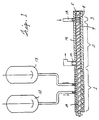
- zone 1 the screw flights intermesh, while in zone 2 they do not intermesh but are tangential.
- Counter-rotating or co-rotating intermeshing screws are preferred because of their good venting characteristics and resistance to fouling.
- Non-intermeshing screws or a single screw extruder are also suitable but could require the use of a high pressure metering pump to force the elastomer latex into the extruder.
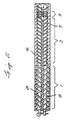
- the elastomer latex/fibrous filler compounded material can be directly expelled or discharged from the extruder assembly shown in Fig. 1 through open die 5 and air dried by conventional means, e.g., in an oven. Alternatively, as shown in Fig.
- the coagulum can be discharged or expelled from the open bores of the extruder and air dried in conventional equipment such as conveyor driers to obtain a product having less than 1% moisture.
- conventional equipment such as conveyor driers
- residual water held by the coagulum which passes through the pressure seal can be substantially removed in subatmospheric pressure zone 6, maintained at a typical pressure of 26.6 kPa (200 mm Hg) absolute and operated to give a dried product temperature in excess of 100°C.
- the polymerization was stopped by addition of an aqueous emulsion of a toluene solution of 0.05 part of 4,4'-thiobis(3-methyl-6-tertiary butyl phenol) and 1.18 parts of tetraethylthiuram disulfide stabilized with sodium lauryl sulfate and the sodium salt of a condensate of formaldehyde and naphthalene-sulfonic acid.
- the polymerized emulsion was treated with 2.00 parts of sodium dibutyldithiocarbamate, cooled to 25°C and allowed to age to effect peptization of the polymer.
- the unpolymerized chloroprene was removed by steam distillation at reduced pressure.
- the resulting latex containing 40% nonvolatile solids and having a pH of 12, was aged for a total of 22 hours.
- a 610 mm length of 60 mm outer diameter intermeshing double-flighted screws was followed by a 902 mm length of 51 mm outer diameter non-intermeshing screws including opposed restrictive reverse flighted sections 44 mm long terminating 162 mm from the end of each screw.
- the resultant coagulated fiber-filled polychloroprene latex was fed through the pressure seal and cloudy wastewater, containing uncompounded fiber and traces of uncoagulated latex at pH 5, was removed upstream from the pressure seal due to back pressure generated by the pressure seal through a 58 mm outer diameter twin screw counter-rotating vent port stuffer centered 762 mm from the start of the intermeshing screws.
- the pressure measured immediately upstream of the pressure seal varied from about 50-420 psi (.3-2.9 MPa).
- the polychloroprene containing 10% water was extruded as expanded crumb from the open barrel discharge. Screw speed was 500 rpm with 29 kW peak drive power.
- the resultant coagulated fiber-filled polychloroprene was fed through the pressure seal and wastewater, containing some 0.3% uncompounded fiber (typical of previous samples) but no uncoagulated latex at pH 5, was removed upstream from the pressure seal through a 58 mm outer diameter twin screw counter-rotating vent port stuffer centered 762 mm from the start of the intermeshing screws due to back pressure generated by the restriction.
- the pressure generated and measured immediately upstream of the pressure seal was about 1420-1440 psi (9.8-0.9 MPa).
- a vacuum of 26.6 kPa (200 mm Hg) absolute pressure was applied to a 203 mm long vent stack starting 1575 mm down the screw.
Landscapes
- Chemical & Material Sciences (AREA)
- Engineering & Computer Science (AREA)
- Chemical Kinetics & Catalysis (AREA)
- Mechanical Engineering (AREA)
- Organic Chemistry (AREA)
- Polymers & Plastics (AREA)
- Medicinal Chemistry (AREA)
- Health & Medical Sciences (AREA)
- Materials Engineering (AREA)
- Manufacturing & Machinery (AREA)
- Thermal Sciences (AREA)
- Physics & Mathematics (AREA)
- Compositions Of Macromolecular Compounds (AREA)
- Processing And Handling Of Plastics And Other Materials For Molding In General (AREA)
- Addition Polymer Or Copolymer, Post-Treatments, Or Chemical Modifications (AREA)
Claims (12)
- Procédé pour incorporer une charge fibreuse dans un élastomère, qui comprend:(a) l'introduction, dans une extrudeuse à vis, d'un latex d'élastomère et d'une suspension épaisse aqueuse contenant 1 à 30 parties en poids de charge fibreuse organique ayant une longueur inférieure à 25 mm, pour 100 parties d'élastomère, la suspension épaisse et le latex étant introduits dans l'extrudeuse soit prémélangés soit sous la forme de courants séparés puis mélangés dans l'extrudeuse,(b) l'ajout d'un coagulant pour le latex d'élastomère au mélange de latex d'élastomère et de suspension épaisse fibreuse aqueuse pour coaguler le latex d'élastomère dans l'extrudeuse à vis et former un élastomère coagulé contenant la charge fibreuse organique,(c) l'introduction de l'élastomère coagulé contenant une charge fibreuse organique dans une zone de déshydratation,(d) l'introduction de l'élastomère coagulé chargé de fibres à travers un restricteur de débit qui applique une contre-pression suffisante pour que l'eau présente dans l'élastomère coagulé soit forcée par un évent fourni dans l'extrudeuse en amont par rapport au restricteur de débit, et(e) le déchargement et la récupération de l'élastomère chargé de fibres organiques.
- Procédé selon la revendication 1, dans lequel le latex d'élastomère est un latex de polychloroprène.
- Procédé selon la revendication 2, dans lequel la suspension épaisse aqueuse de charge fibreuse et le latex de polychloroprène sont prémélangés avant de les introduire dans l'extrudeuse à vis.
- Procédé selon la revendication 1, dans lequel la charge fibreuse est une fibre de polyaramide.
- Procédé selon la revendication 4, dans lequel le polyaramide est un poly(paraphénylène téréphtalamide).
- Procédé selon la revendication 1, dans lequel la charge fibreuse est une fibre de coton.
- Procédé selon la revendication 1, dans lequel le latex d'élastomère est un latex de caoutchouc styrène-butadiène.
- Procédé selon la revendication 1, dans lequel le latex d'élastomère est un latex de polybutadiène.
- Procédé selon la revendication 1, dans lequel le latex d'élastomère est un latex de polyisoprène.
- Procédé selon la revendication 2, dans lequel le latex de polychloroprène est un polychloroprène modifié par du soufre élémentaire.
- Procédé selon la revendication 1, dans lequel l'élastomère coagulé sortant du restricteur de débit est introduit dans une zone à pression sous-atmosphérique pour éliminer l'eau de l'élastomère et sécher substantiellement l'élastomère à moins de 1% d'humidité avant de décharger l'élastomère.
- Procédé selon la revendication 11, dans lequel le latex d'élastomère est un latex de polychloroprène.
Applications Claiming Priority (2)
| Application Number | Priority Date | Filing Date | Title |
|---|---|---|---|
| US42967589A | 1989-10-31 | 1989-10-31 | |
| US429675 | 1989-10-31 |
Publications (3)
| Publication Number | Publication Date |
|---|---|
| EP0426024A2 EP0426024A2 (fr) | 1991-05-08 |
| EP0426024A3 EP0426024A3 (en) | 1991-10-16 |
| EP0426024B1 true EP0426024B1 (fr) | 2000-04-12 |
Family
ID=23704267
Family Applications (1)
| Application Number | Title | Priority Date | Filing Date |
|---|---|---|---|
| EP90120556A Expired - Lifetime EP0426024B1 (fr) | 1989-10-31 | 1990-10-26 | Procédé pour incorporer des charges organiques fibreuses dans le caoutchouc |
Country Status (6)
| Country | Link |
|---|---|
| EP (1) | EP0426024B1 (fr) |
| JP (1) | JP3025902B2 (fr) |
| CN (1) | CN1028158C (fr) |
| CA (1) | CA2028963C (fr) |
| DE (1) | DE69033505T2 (fr) |
| RU (1) | RU2075487C1 (fr) |
Families Citing this family (16)
| Publication number | Priority date | Publication date | Assignee | Title |
|---|---|---|---|---|
| US5830395A (en) * | 1997-08-12 | 1998-11-03 | E. I. Du Pont De Nemours And Company | Process for making a uniform dispersion of aramid fibers and polymer |
| DE19852030A1 (de) * | 1998-11-11 | 2000-05-25 | Fraunhofer Ges Forschung | Verfahren und Vorrichtung zum diskontinuierlichen Ablegen von Strangabschnitten aus faserverstärkten Polymermassen |
| DE10149163A1 (de) * | 2001-10-04 | 2003-04-17 | Buehler Ag | Kontinuierliche Herstellung von Elastomermischungen für die Gummiherstellung |
| JP4533317B2 (ja) * | 2003-08-05 | 2010-09-01 | 株式会社ブリヂストン | ゴムマスターバッチの製造方法 |
| JP3998692B2 (ja) * | 2004-12-27 | 2007-10-31 | 横浜ゴム株式会社 | ゴム/短繊維マスターバッチ及びその製造方法並びにそれらのマスターバッチを用いた空気入りタイヤ |
| MY160881A (en) * | 2010-03-24 | 2017-03-31 | Arlanxeo Deutschland Gmbh | Process for the production of water and solvent-free polymers |
| BR112013013010B1 (pt) * | 2010-11-26 | 2020-10-13 | Denka Company Limited | borracha de cloropreno modificada com enxofre, artigo moldado, e, método para produzir a borracha de cloropreno modificada com enxofre |
| JP5875380B2 (ja) * | 2012-01-19 | 2016-03-02 | 東洋ゴム工業株式会社 | ゴムウエットマスターバッチの製造方法およびゴムウエットマスターバッチ、ならびにゴムウエットマスターバッチを含有するゴム組成物 |
| RU2508197C1 (ru) * | 2012-07-19 | 2014-02-27 | Общество С Ограниченной Ответственностью "Сервисцентр" | Способ изготовления профиля из пвх для оконных и дверных блоков с содержанием ионов серебра, обладающих антибактериальными свойствами |
| JP5485342B2 (ja) * | 2012-07-25 | 2014-05-07 | 電気化学工業株式会社 | クロロプレンゴム、その製造方法及びクロロプレンゴム組成物並びにその加硫物 |
| JP6416749B2 (ja) * | 2013-03-14 | 2018-10-31 | 株式会社ブリヂストン | ゴム組成物の製造方法、ゴム組成物、加硫ゴムおよびタイヤ |
| JP6554802B2 (ja) * | 2015-02-03 | 2019-08-07 | 住友ゴム工業株式会社 | 混練装置および混練り方法 |
| EP3251813B1 (fr) * | 2016-05-20 | 2018-09-05 | Panasonic Corporation | Corps moulé en résine composite, son procédé de fabrication et élément de boîtier l'utilisant |
| US11608417B2 (en) * | 2017-06-30 | 2023-03-21 | Nutrition & Biosciences USA 4, Inc. | Polysaccharide-elastomer masterbatch compositions |
| CN107653499A (zh) * | 2017-08-29 | 2018-02-02 | 新金塔集团有限公司 | 生产复合涤纶丝的方法及螺杆挤出机 |
| CN109208118B (zh) * | 2018-09-27 | 2021-11-19 | 临邑禹王植物蛋白有限公司 | 一种利用大豆纤维生产一次性挂绳的生产方法 |
Family Cites Families (4)
| Publication number | Priority date | Publication date | Assignee | Title |
|---|---|---|---|---|
| US4263184A (en) * | 1977-01-05 | 1981-04-21 | Wyrough And Loser, Inc. | Homogeneous predispersed fiber compositions |
| US4136251A (en) * | 1977-09-12 | 1979-01-23 | E. I. Du Pont De Nemours And Company | Extrusion process for recovery of polymers from their dispersions in liquids |
| CA1242362A (fr) * | 1983-04-19 | 1988-09-27 | Douglas C. Edwards | Melange de fibres aramides et polymere, et leur fabrication |
| US4943402A (en) * | 1989-10-31 | 1990-07-24 | E. I. Du Pont De Nemours And Company | Process for removing chloroprene dimers from polychloroprene |
-
1990
- 1990-10-03 RU SU904831718A patent/RU2075487C1/ru not_active IP Right Cessation
- 1990-10-26 DE DE69033505T patent/DE69033505T2/de not_active Expired - Fee Related
- 1990-10-26 EP EP90120556A patent/EP0426024B1/fr not_active Expired - Lifetime
- 1990-10-30 JP JP02290968A patent/JP3025902B2/ja not_active Expired - Fee Related
- 1990-10-31 CN CN90109592A patent/CN1028158C/zh not_active Expired - Lifetime
- 1990-10-31 CA CA002028963A patent/CA2028963C/fr not_active Expired - Lifetime
Also Published As
| Publication number | Publication date |
|---|---|
| CA2028963C (fr) | 2000-05-02 |
| CA2028963A1 (fr) | 1991-05-01 |
| EP0426024A3 (en) | 1991-10-16 |
| DE69033505D1 (de) | 2000-05-18 |
| RU2075487C1 (ru) | 1997-03-20 |
| CN1052274A (zh) | 1991-06-19 |
| DE69033505T2 (de) | 2000-12-07 |
| CN1028158C (zh) | 1995-04-12 |
| JP3025902B2 (ja) | 2000-03-27 |
| EP0426024A2 (fr) | 1991-05-08 |
| JPH03208607A (ja) | 1991-09-11 |
Similar Documents
| Publication | Publication Date | Title |
|---|---|---|
| US5205972A (en) | Process for incorporating organic fibrous fillers in elastomers | |
| EP0426024B1 (fr) | Procédé pour incorporer des charges organiques fibreuses dans le caoutchouc | |
| EP0426023B1 (fr) | Procédé pour éliminer des dimères de chloroprène de polychloroprène | |
| US4136251A (en) | Extrusion process for recovery of polymers from their dispersions in liquids | |
| US6613871B2 (en) | Method for reducing the polymer content of effluent during the drainage of polymer/water mixtures | |
| US9512240B2 (en) | Process for the production of water and solvent-free polymers | |
| EP0426025A2 (fr) | Séparation par extrusion de mélanges de caoutchouc et d'asphalte | |
| JP3342399B2 (ja) | エラストマー改質熱可塑材の製造方法 | |
| EP2981404A1 (fr) | Procédé d'élimination de composants volatils de matières contenant des élastomères, et dispositifs de dégazage employés à cet effet | |
| US5205973A (en) | Precoagulation process for incorporating organic fibrous fillers | |
| EP0426019B1 (fr) | Procédé de précoagulation pour incorporer des charges organiques fibreuses dans le SBR | |
| USRE30378E (en) | Process for recovery of polymers from their dispersions in liquids | |
| EP1471093B1 (fr) | Procédé et appareil pour fabriquer une résine thermoplastique modifiée à l'aide d'un élastomère | |
| US4410659A (en) | Manufacture of rubber modified copolymers in an extruder type reactor | |
| JP3969145B2 (ja) | 共重合体の製造方法 | |
| JP2003266435A (ja) | アロイの製造方法 | |
| EP1853636B1 (fr) | Procede de coagulation sans sel de dispersions polymeres | |
| JP4100004B2 (ja) | 液状ゴムの製造方法 | |
| EP0091597B1 (fr) | Procédé de coagulation "in line" d'émulsions d'élastomères fluorés | |
| CA2041070A1 (fr) | Mode de preparation par extrusion de melanges d'emulsions bitumineuses et de caoutchouc | |
| JPH0262149B2 (fr) | ||
| JPS6010884B2 (ja) | ゴム系ラテツクスからの乾燥ゴムの連続製造方法 | |
| JP2004010852A (ja) | ポリマーアロイの製造方法 | |
| JPH0422938B2 (fr) |
Legal Events
| Date | Code | Title | Description |
|---|---|---|---|
| PUAI | Public reference made under article 153(3) epc to a published international application that has entered the european phase |
Free format text: ORIGINAL CODE: 0009012 |
|
| 17P | Request for examination filed |
Effective date: 19901206 |
|
| AK | Designated contracting states |
Kind code of ref document: A2 Designated state(s): DE FR GB IT NL |
|
| PUAL | Search report despatched |
Free format text: ORIGINAL CODE: 0009013 |
|
| AK | Designated contracting states |
Kind code of ref document: A3 Designated state(s): DE FR GB IT NL |
|
| 17Q | First examination report despatched |
Effective date: 19940726 |
|
| APAB | Appeal dossier modified |
Free format text: ORIGINAL CODE: EPIDOS NOAPE |
|
| APAA | Appeal reference recorded |
Free format text: ORIGINAL CODE: EPIDOS REFN |
|
| APAB | Appeal dossier modified |
Free format text: ORIGINAL CODE: EPIDOS NOAPE |
|
| APAB | Appeal dossier modified |
Free format text: ORIGINAL CODE: EPIDOS NOAPE |
|
| GRAG | Despatch of communication of intention to grant |
Free format text: ORIGINAL CODE: EPIDOS AGRA |
|
| GRAG | Despatch of communication of intention to grant |
Free format text: ORIGINAL CODE: EPIDOS AGRA |
|
| GRAH | Despatch of communication of intention to grant a patent |
Free format text: ORIGINAL CODE: EPIDOS IGRA |
|
| GRAH | Despatch of communication of intention to grant a patent |
Free format text: ORIGINAL CODE: EPIDOS IGRA |
|
| GRAA | (expected) grant |
Free format text: ORIGINAL CODE: 0009210 |
|
| AK | Designated contracting states |
Kind code of ref document: B1 Designated state(s): DE FR GB IT NL |
|
| REF | Corresponds to: |
Ref document number: 69033505 Country of ref document: DE Date of ref document: 20000518 |
|
| ITF | It: translation for a ep patent filed | ||
| ET | Fr: translation filed | ||
| PLBE | No opposition filed within time limit |
Free format text: ORIGINAL CODE: 0009261 |
|
| STAA | Information on the status of an ep patent application or granted ep patent |
Free format text: STATUS: NO OPPOSITION FILED WITHIN TIME LIMIT |
|
| 26N | No opposition filed | ||
| REG | Reference to a national code |
Ref country code: GB Ref legal event code: IF02 |
|
| APAH | Appeal reference modified |
Free format text: ORIGINAL CODE: EPIDOSCREFNO |
|
| PGFP | Annual fee paid to national office [announced via postgrant information from national office to epo] |
Ref country code: NL Payment date: 20081005 Year of fee payment: 19 |
|
| PGFP | Annual fee paid to national office [announced via postgrant information from national office to epo] |
Ref country code: DE Payment date: 20081027 Year of fee payment: 19 |
|
| PGFP | Annual fee paid to national office [announced via postgrant information from national office to epo] |
Ref country code: IT Payment date: 20081028 Year of fee payment: 19 |
|
| PGFP | Annual fee paid to national office [announced via postgrant information from national office to epo] |
Ref country code: FR Payment date: 20081014 Year of fee payment: 19 |
|
| PGFP | Annual fee paid to national office [announced via postgrant information from national office to epo] |
Ref country code: GB Payment date: 20081022 Year of fee payment: 19 |
|
| REG | Reference to a national code |
Ref country code: NL Ref legal event code: V1 Effective date: 20100501 |
|
| REG | Reference to a national code |
Ref country code: FR Ref legal event code: ST Effective date: 20100630 |
|
| PG25 | Lapsed in a contracting state [announced via postgrant information from national office to epo] |
Ref country code: FR Free format text: LAPSE BECAUSE OF NON-PAYMENT OF DUE FEES Effective date: 20091102 Ref country code: DE Free format text: LAPSE BECAUSE OF NON-PAYMENT OF DUE FEES Effective date: 20100501 Ref country code: NL Free format text: LAPSE BECAUSE OF NON-PAYMENT OF DUE FEES Effective date: 20100501 |
|
| PG25 | Lapsed in a contracting state [announced via postgrant information from national office to epo] |
Ref country code: GB Free format text: LAPSE BECAUSE OF NON-PAYMENT OF DUE FEES Effective date: 20091026 |
|
| PG25 | Lapsed in a contracting state [announced via postgrant information from national office to epo] |
Ref country code: IT Free format text: LAPSE BECAUSE OF NON-PAYMENT OF DUE FEES Effective date: 20091026 |