EP0426291A2 - Farbflüssigkeitskristallanzeiger - Google Patents
Farbflüssigkeitskristallanzeiger Download PDFInfo
- Publication number
- EP0426291A2 EP0426291A2 EP90310216A EP90310216A EP0426291A2 EP 0426291 A2 EP0426291 A2 EP 0426291A2 EP 90310216 A EP90310216 A EP 90310216A EP 90310216 A EP90310216 A EP 90310216A EP 0426291 A2 EP0426291 A2 EP 0426291A2
- Authority
- EP
- European Patent Office
- Prior art keywords
- liquid crystal
- light
- display
- microdroplets
- field
- Prior art date
- Legal status (The legal status is an assumption and is not a legal conclusion. Google has not performed a legal analysis and makes no representation as to the accuracy of the status listed.)
- Withdrawn
Links
Images

Classifications
-
- C—CHEMISTRY; METALLURGY
- C09—DYES; PAINTS; POLISHES; NATURAL RESINS; ADHESIVES; COMPOSITIONS NOT OTHERWISE PROVIDED FOR; APPLICATIONS OF MATERIALS NOT OTHERWISE PROVIDED FOR
- C09K—MATERIALS FOR MISCELLANEOUS APPLICATIONS, NOT PROVIDED FOR ELSEWHERE
- C09K19/00—Liquid crystal materials
- C09K19/52—Liquid crystal materials characterised by components which are not liquid crystals, e.g. additives with special physical aspect: solvents, solid particles
- C09K19/54—Additives having no specific mesophase characterised by their chemical composition
- C09K19/542—Macromolecular compounds
- C09K19/544—Macromolecular compounds as dispersing or encapsulating medium around the liquid crystal
-
- G—PHYSICS
- G02—OPTICS
- G02F—OPTICAL DEVICES OR ARRANGEMENTS FOR THE CONTROL OF LIGHT BY MODIFICATION OF THE OPTICAL PROPERTIES OF THE MEDIA OF THE ELEMENTS INVOLVED THEREIN; NON-LINEAR OPTICS; FREQUENCY-CHANGING OF LIGHT; OPTICAL LOGIC ELEMENTS; OPTICAL ANALOGUE/DIGITAL CONVERTERS
- G02F1/00—Devices or arrangements for the control of the intensity, colour, phase, polarisation or direction of light arriving from an independent light source, e.g. switching, gating or modulating; Non-linear optics
- G02F1/01—Devices or arrangements for the control of the intensity, colour, phase, polarisation or direction of light arriving from an independent light source, e.g. switching, gating or modulating; Non-linear optics for the control of the intensity, phase, polarisation or colour
- G02F1/13—Devices or arrangements for the control of the intensity, colour, phase, polarisation or direction of light arriving from an independent light source, e.g. switching, gating or modulating; Non-linear optics for the control of the intensity, phase, polarisation or colour based on liquid crystals, e.g. single liquid crystal display cells
- G02F1/133—Constructional arrangements; Operation of liquid crystal cells; Circuit arrangements
- G02F1/1333—Constructional arrangements; Manufacturing methods
- G02F1/1334—Constructional arrangements; Manufacturing methods based on polymer dispersed liquid crystals, e.g. microencapsulated liquid crystals
-
- G—PHYSICS
- G02—OPTICS
- G02F—OPTICAL DEVICES OR ARRANGEMENTS FOR THE CONTROL OF LIGHT BY MODIFICATION OF THE OPTICAL PROPERTIES OF THE MEDIA OF THE ELEMENTS INVOLVED THEREIN; NON-LINEAR OPTICS; FREQUENCY-CHANGING OF LIGHT; OPTICAL LOGIC ELEMENTS; OPTICAL ANALOGUE/DIGITAL CONVERTERS
- G02F1/00—Devices or arrangements for the control of the intensity, colour, phase, polarisation or direction of light arriving from an independent light source, e.g. switching, gating or modulating; Non-linear optics
- G02F1/01—Devices or arrangements for the control of the intensity, colour, phase, polarisation or direction of light arriving from an independent light source, e.g. switching, gating or modulating; Non-linear optics for the control of the intensity, phase, polarisation or colour
- G02F1/13—Devices or arrangements for the control of the intensity, colour, phase, polarisation or direction of light arriving from an independent light source, e.g. switching, gating or modulating; Non-linear optics for the control of the intensity, phase, polarisation or colour based on liquid crystals, e.g. single liquid crystal display cells
- G02F1/133—Constructional arrangements; Operation of liquid crystal cells; Circuit arrangements
- G02F1/1333—Constructional arrangements; Manufacturing methods
- G02F1/1347—Arrangement of liquid crystal layers or cells in which the final condition of one light beam is achieved by the addition of the effects of two or more layers or cells
- G02F1/13476—Arrangement of liquid crystal layers or cells in which the final condition of one light beam is achieved by the addition of the effects of two or more layers or cells in which at least one liquid crystal cell or layer assumes a scattering state
-
- G—PHYSICS
- G02—OPTICS
- G02F—OPTICAL DEVICES OR ARRANGEMENTS FOR THE CONTROL OF LIGHT BY MODIFICATION OF THE OPTICAL PROPERTIES OF THE MEDIA OF THE ELEMENTS INVOLVED THEREIN; NON-LINEAR OPTICS; FREQUENCY-CHANGING OF LIGHT; OPTICAL LOGIC ELEMENTS; OPTICAL ANALOGUE/DIGITAL CONVERTERS
- G02F1/00—Devices or arrangements for the control of the intensity, colour, phase, polarisation or direction of light arriving from an independent light source, e.g. switching, gating or modulating; Non-linear optics
- G02F1/01—Devices or arrangements for the control of the intensity, colour, phase, polarisation or direction of light arriving from an independent light source, e.g. switching, gating or modulating; Non-linear optics for the control of the intensity, phase, polarisation or colour
- G02F1/13—Devices or arrangements for the control of the intensity, colour, phase, polarisation or direction of light arriving from an independent light source, e.g. switching, gating or modulating; Non-linear optics for the control of the intensity, phase, polarisation or colour based on liquid crystals, e.g. single liquid crystal display cells
- G02F1/137—Devices or arrangements for the control of the intensity, colour, phase, polarisation or direction of light arriving from an independent light source, e.g. switching, gating or modulating; Non-linear optics for the control of the intensity, phase, polarisation or colour based on liquid crystals, e.g. single liquid crystal display cells characterised by the electro-optical or magneto-optical effect, e.g. field-induced phase transition, orientation effect, guest-host interaction or dynamic scattering
- G02F1/13718—Devices or arrangements for the control of the intensity, colour, phase, polarisation or direction of light arriving from an independent light source, e.g. switching, gating or modulating; Non-linear optics for the control of the intensity, phase, polarisation or colour based on liquid crystals, e.g. single liquid crystal display cells characterised by the electro-optical or magneto-optical effect, e.g. field-induced phase transition, orientation effect, guest-host interaction or dynamic scattering based on a change of the texture state of a cholesteric liquid crystal
-
- G—PHYSICS
- G02—OPTICS
- G02F—OPTICAL DEVICES OR ARRANGEMENTS FOR THE CONTROL OF LIGHT BY MODIFICATION OF THE OPTICAL PROPERTIES OF THE MEDIA OF THE ELEMENTS INVOLVED THEREIN; NON-LINEAR OPTICS; FREQUENCY-CHANGING OF LIGHT; OPTICAL LOGIC ELEMENTS; OPTICAL ANALOGUE/DIGITAL CONVERTERS
- G02F2201/00—Constructional arrangements not provided for in groups G02F1/00 - G02F7/00
- G02F2201/34—Constructional arrangements not provided for in groups G02F1/00 - G02F7/00 reflector
- G02F2201/343—Constructional arrangements not provided for in groups G02F1/00 - G02F7/00 reflector cholesteric liquid crystal reflector
-
- G—PHYSICS
- G02—OPTICS
- G02F—OPTICAL DEVICES OR ARRANGEMENTS FOR THE CONTROL OF LIGHT BY MODIFICATION OF THE OPTICAL PROPERTIES OF THE MEDIA OF THE ELEMENTS INVOLVED THEREIN; NON-LINEAR OPTICS; FREQUENCY-CHANGING OF LIGHT; OPTICAL LOGIC ELEMENTS; OPTICAL ANALOGUE/DIGITAL CONVERTERS
- G02F2203/00—Function characteristic
- G02F2203/02—Function characteristic reflective
Definitions
- the present invention relates generally to liquid crystal materials and displays, and more specifically to a new chiral liquid crystal display and display material.
- French patent application No. 74.30349 discloses various cholesteric liquid crystal materials dispersed in water insoluble polymers. The materials are primarily temperature sensitive, and the esters disclosed do not appear to be electrically sensitive due to their small dielectric anisotropy.
- the PDLC materials are usually made with nematic liquid crystal possessing positive dielectric anisotropy.
- the ordinary index of refraction typically is matched to the refractive index of the polymer so that in a field-ON state the display or material appears visible or clear because the optical axes of the microdroplets are aligned parallel to the field and normal to the viewing surface. In a field-OFF state, the optical axes of the microdroplets are randomly oriented or configured so that incident light is scattered and the material or display appears opaque.
- An object of the present invention is to provide a new electrically addressable liquid crystal color display which is operable under ambient light in reflection or transmitted light in transmission.
- Another object of the invention is to provide a new electrically addressable, liquid crystal color display in the form of a flat sheet or panel.
- Still another object of the invention is to provide a new electrically addressable liquid crystal color display which is translucent or light scattering in a field-OFF state and color reflective or color transmissive in a field-ON state.
- a liquid crystal color display comprising at least one sheet of liquid crystal material formed by microdroplets of liquid crystal phase dispersed in a polymeric matrix, the liquid crystal being in the cholesteric phase and having negative dielectric anisotropy.
- the new display material is further characterized in that the application of an electric field causes the helical planes of the cholesteric liquid crystal to align perpendicular to the direction of the field so as to selectively reflect light of a wavelength determined by the helical pitch of the cholesteric liquid crystal.
- the polymer-liquid crystal boundary conditions result in a liquid crystal director configuration or random orientation such that incident light is non-preferentially scattered and the material is translucent or light-scattering.
- the microdroplets of liquid crystal are dispersed in the polymeric matrix by phase separation as disclosed in U.S. Patents Nos. 4,671,618; 4,673,255; 4,685,771, and 4,688,900.
- the polymer can be either thermosetting, such as a catalyst or U.V. curved thermoset epoxy, or selected from a wide range of thermoplastics, including modified epoxies cured by a non-crosslinking curing agent.
- phase separation of the liquid crystal and resulting droplet formation can be accomplished by dissolving the liquid crystal in a polymer precursor which is then polymerized, by cooling a polymer melt containing dissolved liquid crystal, or by dissolving the liquid crystal and polymer in a common solvent which is then evaporated.
- the liquid crystal making up the microdroplets may be a mixture of different liquid crystal materials, one or more of which individually is not in the cholesteric liquid crystal phase. It is essential to the successful practice of the invention that the admixture rather than any one of the individual components exhibit a cholesteric liquid crystal phase. Therefore, it is to be understood that the terms "cholesteric” and “chiral” used in the specification and claims encompass single liquid crystal materials as well as admixtures exhibiting the cholesteric phase.
- the liquid crystal Since the principal of operation of the new display depends upon the liquid crystal molecules turning perpendicular to the applied electric field, whereby the helical planes are generally parallel to the viewing surface, the liquid crystal must exhibit strong or large negative dielectric anisotropy. A negative anisotropy ranging upward in strength from about -3 is believed to be satisfactory. The negative anisotropy of the materials disclosed in the examples which have been found satisfactory is about -4.
- the new display material selectively reflects light of a wavelength which is dependent upon the helical pitch of the chiral liquid crystal.
- the new polymer-dispersed chiral liquid crystal (PDCLC) display can be made to reflect virtually any color by selecting liquid crystals of known helical pitch.
- Single-color displays can be fabricated with a single sheet of the new material or, alternatively, a plurality of sheets, each reflecting a different color, can be stacked to produce a multi-color display. In either case, the displays are operative without polarizers in ambient light in reflection. With the addition of a circular polarizer, they can be back-lit to operate in transmission. This unique ability to achieve full-color transmission or reflection offers many potential applications.
- the displays of the invention can be used in place of conventional black and white liquid crystal displays to provide a more appealing black and color display for applications such as watches, calculators, computers and TV screens.
- transmissive displays When sheets reflecting different primary colors are stacked or combined as a composite sheet in a display and the display is operated in transmission by back-lighting, it is possible to achieve any desired color by the rule of subtractive color mixing.
- a single, circularly polarizing filter is used to filter either the input light or the exiting light.
- Useful applications of transmissive displays include computer controlled projection panels used with overhead projectors, theater marquees, traffic lights, color displays to be used in darkrooms, etc.
- three independently activated sheets containing the three primary colors can be incorporated into one composite sheet to produce a color-adjustable shutter for transmitted light.
- the composite sheet is translucent when the voltage is off and will selectively block or reflect light when the voltage is on.
- the wavelengths that are blocked or reflected can be selected by activating one or more of the elements of the composite sheet.
- the display of the invention is usable as a voltage-controllable reflecting filter for circularly polarized light.
- Both left and right handed sheets can be incorporated into one composite sheet so that it would be possible to electrically select the reflected or transmitted polarization at the selective reflection wavelength or, by turning both sheets on simultaneously, reflect all the light at that wavelength.
- a liquid crystal color display made according to the invention is generally indicated by reference numeral 10.
- the display 10 comprises a pair of glass or plastic substrates 11, 12 and a solid polymer sheet 13 containing phase dispersed microdroplets 14 of chiral liquid crystal.
- the inner surfaces of the glass substrates 11, 12 have transparent conducting electrode coatings 15 attached to an AC voltage source 16.
- the voltage supply is controlled by a switch 17.
- the helical planes of the chiral liquid crystal in the microdroplets 14 are aligned generally perpendicular to the field applied across the material 13 by the electrodes 15.
- a portion of light incident on the substrate 11 or 12 will be reflected.
- the reflected light will have a wavelength determined by the helical pitch of the chiral liquid crystal and will have a circular polarization (right or left) determined by the sense of twist of the chiral material. That light which is not reflected is transmitted through the display and is not absorbed.
- the transmitted light will, by the rule of subtractive color mixing, be magenta plus left circularly polarized (LCP) green. If the chiral liquid crystal display reflects RCP red incident light, the transmitted light will be cyan plus LCP red, while an RCP blue reflecting display will transmit yellow plus LCP blue.
- RCP right circularly polarized
- LCP left circularly polarized
- Figure 1(A) illustrates the display 10 in a field-OFF state.
- the boundary conditions between the microdroplets 14 and the polymer 13 result in a liquid crystal director configuration that non-preferentially scatters light incident on a display.
- the display 10 In the field-OFF, light scattering state, the display 10 is translucent and non-reflecting.
- Figure 2 shows the reflected intensity of a green reflecting display versus wavelength for various applied voltages.
- the sharp spectral peak at 515nm confirms the pure appearance of the reflected color.
- Figure 3 shows the time response of the green reflecting display to a rapid voltage step.
- the response time is, among other things, related to the size of the droplets with larger droplets having a slower response time.
- Typical droplet sizes in displays of the invention range from about 1 micron to 20 microns, although, smaller or larger droplet sizes can be produced for special situations.
- U.S. Patent No. 4,673,255 discloses techniques for controlling microdroplet size in phase dispersed materials. It is to be understood that Figures 2 and 3 are based on data obtained from experimental displays described in Example 1, and do not represent ultimate or optimum performance of displays made according to the invention.
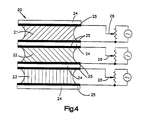
- FIG 4 illustrates the operating principle of a stacked or composite sheet display, each element of which reflects a different color.
- the display is generally designated by reference numeral 20 and includes three sheets 21-23 sandwiched between substrates 24 and conducting electrodes 25.
- the sheets 21-23 are similar to that described in connection with Figures 1(A) and 1(B), and are comprised of polymer dispersed microdroplets of chiral liquid crystal.
- each element or sheet 21-23 is designed to reflect a different primary color.
- sheet 21 may be red reflecting, sheet 22 green reflecting, and sheet 23 blue reflecting.
- the sheets 21-23 are separately addressable by variable voltage supplies 26; alternatively, it is to be understood that each sheet could be actuated by an on-off voltage supply in the manner of Figures 1(A) and 1(B).
- each sheet could be actuated by an on-off voltage supply in the manner of Figures 1(A) and 1(B).
- an on-off voltage supply in the manner of Figures 1(A) and 1(B).
- a continuous range of colors may be observed in either a reflection or transmission mode, since light with a wavelength not reflected by one element is still available to be reflected by another element.
- a circular polarizer (not shown) is necessary for complete color control.
- the elements or sheets 21-23 are selectively actuated to respectively reflect the primary colors red, green and blue.
- the reflected colors will combine additively and all the colors in an area of the chromaticity diagram will be available.
- all colors can be achieved by subtractive color mixing.
- actuation of elements 21, 22 will achieve blue color in transmission
- actuation of elements 22, 23 will achieve red in transmission, and so on.
- light that is not transmitted is reflected and vice-versa, so that no light is absorbed and the display will not be over-heated. This is an important consideration in applications such as overhead projection where the incident light is very intense.
- a green reflecting display was constructed and successfully demonstrated.
- Microdroplets of chiral liquid crystal were phase dispersed in a thermoplastic polymer consisting of polyvinyl butyryl.
- the microdroplets were a mixture of nematic and chiral liquid crystal.
- the liquid crystal mixture had a strong negative dielectric anisotropy of about -4 and the chiral liquid crystal was very highly twisted.
- the proportions in percent by weight were 47% polyvinyl butyryl, 20% chiral liquid crystal and 33% nematic liquid crystal.
- the materials were dissolved in chloroform solvent, mixed, and placed on a conducting slide. The solvent was then evaporated at high temperature.
- a red reflecting display material was prepared by the solvent evaporation technique described in Example 1. The proportions of materials were 48. 3% polyvinyl butyryl, 17.2% chiral liquid crystal and 34.5% nematic liquid crystal. After preparation, the material was examined in a reflecting microscope at a temperature of 85 ⁇ C. The chiral liquid crystal droplets in the polymer matrix appeared bright red.
- a blue reflecting display material was prepared by the solvent evaporation technique described in Example 1. The proportions of material were 46.8% polyvinyl butyryl, 21.9% chiral liquid crystal and 31.3% nematic liquid crystal. The hardened polymer with the phase dispersed microdroplets was examined in a reflecting microscope at 85 ⁇ C. The microdroplets appeared blue.
- a display material was prepared from a catalyst-cured epoxy.
- the liquid crystal was a chiral mixture consisting in percent by weight of 47% EN38 (Chisso Chemical Co.), 30% CE10 (British Drug House), and 23% CM20 (Chisso Chemical Co.).
- the epoxy consisted of 16.7% EPON 828 (Shell Chemical Co.), 32.3% MK107 (Wilmington Chemical Co.), and 50% CAPCURE 3800 (Miller-Stephenson Chemical Co.).
- the liquid crystal and epoxy mixtures were then combined in a 3:1 epoxy:liquid crystal ratio, allowed to cure at room temperature for 3 hours, then placed on conducting microscope slides and baked at 65°C for 30 hours. The resulting microdroplets were 10 ⁇ m in diameter.
Landscapes
- Physics & Mathematics (AREA)
- Chemical & Material Sciences (AREA)
- Nonlinear Science (AREA)
- Crystallography & Structural Chemistry (AREA)
- Optics & Photonics (AREA)
- Mathematical Physics (AREA)
- General Physics & Mathematics (AREA)
- Organic Chemistry (AREA)
- Materials Engineering (AREA)
- Engineering & Computer Science (AREA)
- Dispersion Chemistry (AREA)
- Liquid Crystal (AREA)
- Liquid Crystal Substances (AREA)
Applications Claiming Priority (2)
| Application Number | Priority Date | Filing Date | Title |
|---|---|---|---|
| US43067389A | 1989-10-31 | 1989-10-31 | |
| US430673 | 1989-10-31 |
Publications (2)
| Publication Number | Publication Date |
|---|---|
| EP0426291A2 true EP0426291A2 (de) | 1991-05-08 |
| EP0426291A3 EP0426291A3 (en) | 1992-06-17 |
Family
ID=23708542
Family Applications (1)
| Application Number | Title | Priority Date | Filing Date |
|---|---|---|---|
| EP19900310216 Withdrawn EP0426291A3 (en) | 1989-10-31 | 1990-09-18 | Colour liquid crystal display |
Country Status (4)
| Country | Link |
|---|---|
| EP (1) | EP0426291A3 (de) |
| JP (1) | JPH03209425A (de) |
| CN (1) | CN1024300C (de) |
| CA (1) | CA2028705A1 (de) |
Cited By (7)
| Publication number | Priority date | Publication date | Assignee | Title |
|---|---|---|---|---|
| WO1993014436A1 (en) * | 1992-01-10 | 1993-07-22 | Minnesota Mining And Manufacturing Company | Light modulating devices incorporating an improved electrode |
| DE4240821A1 (de) * | 1992-12-04 | 1994-06-09 | Merck Patent Gmbh | Elektrooptisches System |
| DE4435450A1 (de) * | 1993-10-04 | 1995-04-06 | Matsushita Electric Industrial Co Ltd | Flüssigkristalleinheit und Projektionsanzeige unter Verwendung einer Flüssigkristalleinheit |
| EP0675386A1 (de) * | 1994-03-29 | 1995-10-04 | Thomson-Csf | Reflektierende farbige Flussigkristallanzeigetafel |
| EP0867749A3 (de) * | 1997-03-27 | 1999-02-17 | Xerox Corporation | Flüssigkristallanzeige |
| GB2334111A (en) * | 1998-02-04 | 1999-08-11 | Ibm | High reflectivity liquid crystal display cell |
| EP1202109A1 (de) * | 2000-10-24 | 2002-05-02 | Asulab S.A. | Flüssigkristallanzeigeeinrichtung mit hohem Reflexionskoeffizienten |
Families Citing this family (10)
| Publication number | Priority date | Publication date | Assignee | Title |
|---|---|---|---|---|
| JP2807591B2 (ja) * | 1992-03-06 | 1998-10-08 | シャープ株式会社 | ポリマー分散型液晶表示素子及び反射型液晶表示装置 |
| JP3068401B2 (ja) * | 1994-03-25 | 2000-07-24 | シャープ株式会社 | 液晶表示素子及びその製造方法 |
| JP3147156B2 (ja) | 1997-11-18 | 2001-03-19 | 富士ゼロックス株式会社 | 表示記憶媒体、画像書き込み方法および画像書き込み装置 |
| US6556262B1 (en) * | 2000-01-06 | 2003-04-29 | Eastman Kodak Company | Display sheet having memory using limited coalescence domains |
| JP4226503B2 (ja) * | 2004-03-23 | 2009-02-18 | シャープ株式会社 | 液晶表示装置および電子機器 |
| CN100456093C (zh) * | 2005-12-30 | 2009-01-28 | 财团法人工业技术研究院 | 彩色化胆固醇型液晶显示器及其制造方法 |
| CN108761945B (zh) * | 2018-04-18 | 2021-05-14 | 深圳市国华光电科技有限公司 | 一种电响应的液晶调光器件 |
| CN113467176B (zh) * | 2021-07-20 | 2022-09-13 | 安波福电子(苏州)有限公司 | 投影系统 |
| WO2024000217A1 (zh) * | 2022-06-29 | 2024-01-04 | 京东方科技集团股份有限公司 | 投影装置及显示系统 |
| CN117970717A (zh) * | 2022-10-25 | 2024-05-03 | 北京京东方光电科技有限公司 | 显示器以及显示器的制备方法 |
Family Cites Families (2)
| Publication number | Priority date | Publication date | Assignee | Title |
|---|---|---|---|---|
| US4688901A (en) * | 1984-06-11 | 1987-08-25 | Johnson Light Valve Inc. | Liquid crystal light valve method and apparatus using right and left-handed twist cholesteric liquid crystal |
| WO1988002128A1 (en) * | 1985-03-01 | 1988-03-24 | Manchester R & D Partnership | Liquid crystal color display and method |
-
1990
- 1990-09-18 EP EP19900310216 patent/EP0426291A3/en not_active Withdrawn
- 1990-10-29 CA CA 2028705 patent/CA2028705A1/en not_active Abandoned
- 1990-10-30 JP JP29094890A patent/JPH03209425A/ja active Pending
- 1990-10-31 CN CN 90108764 patent/CN1024300C/zh not_active Expired - Fee Related
Cited By (10)
| Publication number | Priority date | Publication date | Assignee | Title |
|---|---|---|---|---|
| WO1993014436A1 (en) * | 1992-01-10 | 1993-07-22 | Minnesota Mining And Manufacturing Company | Light modulating devices incorporating an improved electrode |
| DE4240821A1 (de) * | 1992-12-04 | 1994-06-09 | Merck Patent Gmbh | Elektrooptisches System |
| DE4435450A1 (de) * | 1993-10-04 | 1995-04-06 | Matsushita Electric Industrial Co Ltd | Flüssigkristalleinheit und Projektionsanzeige unter Verwendung einer Flüssigkristalleinheit |
| EP0675386A1 (de) * | 1994-03-29 | 1995-10-04 | Thomson-Csf | Reflektierende farbige Flussigkristallanzeigetafel |
| FR2718255A1 (fr) * | 1994-03-29 | 1995-10-06 | Thomson Csf | Ecran couleur réflectif. |
| EP0867749A3 (de) * | 1997-03-27 | 1999-02-17 | Xerox Corporation | Flüssigkristallanzeige |
| US6339463B1 (en) | 1997-03-27 | 2002-01-15 | Xerox Corporation | Enhanced viewing angle performance on non-polarizer based color reflective liquid crystal display using a fiber-optic faceplate |
| GB2334111A (en) * | 1998-02-04 | 1999-08-11 | Ibm | High reflectivity liquid crystal display cell |
| US6055031A (en) * | 1998-02-04 | 2000-04-25 | International Business Machines Corporation | High reflectivity liquid crystal display cell |
| EP1202109A1 (de) * | 2000-10-24 | 2002-05-02 | Asulab S.A. | Flüssigkristallanzeigeeinrichtung mit hohem Reflexionskoeffizienten |
Also Published As
| Publication number | Publication date |
|---|---|
| EP0426291A3 (en) | 1992-06-17 |
| JPH03209425A (ja) | 1991-09-12 |
| CN1024300C (zh) | 1994-04-20 |
| CN1051431A (zh) | 1991-05-15 |
| CA2028705A1 (en) | 1991-05-01 |
Similar Documents
| Publication | Publication Date | Title |
|---|---|---|
| US5200845A (en) | Color liquid crystal display consisting of polymer-dispersed chiral liquid crystal having negative dielectric anisotropy | |
| US5875012A (en) | Broadband reflective display, and methods of forming the same | |
| EP0641372B1 (de) | Flüssigkristalline, lichtmodulierende vorrichtung und material | |
| EP0582656B1 (de) | Flüssigkristall lichtmodulierungs-vorrichtung und -material | |
| CA2028705A1 (en) | Color liquid crystal display | |
| US5223959A (en) | Red, blue and green serial encapsulated liquid crystal display and driving method | |
| US5695682A (en) | Liquid crystalline light modulating device and material | |
| JP2807591B2 (ja) | ポリマー分散型液晶表示素子及び反射型液晶表示装置 | |
| JPH04199024A (ja) | 液晶表示素子およびそれを用いた表示装置 | |
| US5452113A (en) | Color display element having PDLC layers and color filter | |
| US6130732A (en) | Paper-white reflective display and methods of forming the same | |
| JP2000147547A (ja) | 多色表示装置 | |
| WO1988002499A1 (en) | Double layer display | |
| US20020176041A1 (en) | Liquid crystal display apparatus | |
| JP3614307B2 (ja) | 表示記憶媒体、画像書き込み方法および画像書き込み装置 | |
| Spruce et al. | Polymer dispersed liquid crystal (PDLC) films | |
| KR100320157B1 (ko) | 키랄네마틱액정복합체 및 이를 포함하는장치 | |
| JPH09218421A (ja) | 反射型液晶表示装置 | |
| JP2778297B2 (ja) | 反射型液晶表示素子およびその駆動方法 | |
| JPH0786621B2 (ja) | 液晶表示装置 | |
| JP3428617B2 (ja) | 反射型液晶表示素子およびその駆動方法、駆動装置 | |
| JP2762774B2 (ja) | カラー表示素子およびその駆動方法 | |
| JP3385130B2 (ja) | 液晶表示素子 | |
| JP2002202526A (ja) | 液晶表示素子 | |
| JPH09160066A (ja) | 反射型液晶表示デバイス |
Legal Events
| Date | Code | Title | Description |
|---|---|---|---|
| PUAI | Public reference made under article 153(3) epc to a published international application that has entered the european phase |
Free format text: ORIGINAL CODE: 0009012 |
|
| AK | Designated contracting states |
Kind code of ref document: A2 Designated state(s): DE FR GB IT SE |
|
| PUAL | Search report despatched |
Free format text: ORIGINAL CODE: 0009013 |
|
| AK | Designated contracting states |
Kind code of ref document: A3 Designated state(s): DE FR GB IT SE |
|
| 17P | Request for examination filed |
Effective date: 19921102 |
|
| 17Q | First examination report despatched |
Effective date: 19940502 |
|
| STAA | Information on the status of an ep patent application or granted ep patent |
Free format text: STATUS: THE APPLICATION IS DEEMED TO BE WITHDRAWN |
|
| 18D | Application deemed to be withdrawn |
Effective date: 19940913 |