EP0426317A2 - Rohling für ATM-Verfahren und Verfahren zum Herstellen des Rohlings - Google Patents
Rohling für ATM-Verfahren und Verfahren zum Herstellen des Rohlings Download PDFInfo
- Publication number
- EP0426317A2 EP0426317A2 EP90311136A EP90311136A EP0426317A2 EP 0426317 A2 EP0426317 A2 EP 0426317A2 EP 90311136 A EP90311136 A EP 90311136A EP 90311136 A EP90311136 A EP 90311136A EP 0426317 A2 EP0426317 A2 EP 0426317A2
- Authority
- EP
- European Patent Office
- Prior art keywords
- web
- reinforcement material
- fibre reinforcement
- preform
- formation
- Prior art date
- Legal status (The legal status is an assumption and is not a legal conclusion. Google has not performed a legal analysis and makes no representation as to the accuracy of the status listed.)
- Withdrawn
Links
Images

Classifications
-
- B—PERFORMING OPERATIONS; TRANSPORTING
- B29—WORKING OF PLASTICS; WORKING OF SUBSTANCES IN A PLASTIC STATE IN GENERAL
- B29C—SHAPING OR JOINING OF PLASTICS; SHAPING OF MATERIAL IN A PLASTIC STATE, NOT OTHERWISE PROVIDED FOR; AFTER-TREATMENT OF THE SHAPED PRODUCTS, e.g. REPAIRING
- B29C70/00—Shaping composites, i.e. plastics material comprising reinforcements, fillers or preformed parts, e.g. inserts
- B29C70/04—Shaping composites, i.e. plastics material comprising reinforcements, fillers or preformed parts, e.g. inserts comprising reinforcements only, e.g. self-reinforcing plastics
- B29C70/28—Shaping operations therefor
- B29C70/54—Component parts, details or accessories; Auxiliary operations, e.g. feeding or storage of prepregs or SMC after impregnation or during ageing
- B29C70/542—Placing or positioning the reinforcement in a covering or packaging element before or during moulding, e.g. drawing in a sleeve
-
- B—PERFORMING OPERATIONS; TRANSPORTING
- B29—WORKING OF PLASTICS; WORKING OF SUBSTANCES IN A PLASTIC STATE IN GENERAL
- B29B—PREPARATION OR PRETREATMENT OF THE MATERIAL TO BE SHAPED; MAKING GRANULES OR PREFORMS; RECOVERY OF PLASTICS OR OTHER CONSTITUENTS OF WASTE MATERIAL CONTAINING PLASTICS
- B29B11/00—Making preforms
- B29B11/14—Making preforms characterised by structure or composition
- B29B11/16—Making preforms characterised by structure or composition comprising fillers or reinforcement
-
- B—PERFORMING OPERATIONS; TRANSPORTING
- B29—WORKING OF PLASTICS; WORKING OF SUBSTANCES IN A PLASTIC STATE IN GENERAL
- B29C—SHAPING OR JOINING OF PLASTICS; SHAPING OF MATERIAL IN A PLASTIC STATE, NOT OTHERWISE PROVIDED FOR; AFTER-TREATMENT OF THE SHAPED PRODUCTS, e.g. REPAIRING
- B29C51/00—Shaping by thermoforming, i.e. shaping sheets or sheet like preforms after heating, e.g. shaping sheets in matched moulds or by deep-drawing; Apparatus therefor
- B29C51/16—Lining or labelling
-
- B—PERFORMING OPERATIONS; TRANSPORTING
- B29—WORKING OF PLASTICS; WORKING OF SUBSTANCES IN A PLASTIC STATE IN GENERAL
- B29C—SHAPING OR JOINING OF PLASTICS; SHAPING OF MATERIAL IN A PLASTIC STATE, NOT OTHERWISE PROVIDED FOR; AFTER-TREATMENT OF THE SHAPED PRODUCTS, e.g. REPAIRING
- B29C61/00—Shaping by liberation of internal stresses; Making preforms having internal stresses; Apparatus therefor
- B29C61/006—Shaping by liberation of internal stresses; Making preforms having internal stresses; Apparatus therefor the force created by the liberation of the internal stresses being used for compression moulding or for pressing preformed material
-
- B—PERFORMING OPERATIONS; TRANSPORTING
- B29—WORKING OF PLASTICS; WORKING OF SUBSTANCES IN A PLASTIC STATE IN GENERAL
- B29C—SHAPING OR JOINING OF PLASTICS; SHAPING OF MATERIAL IN A PLASTIC STATE, NOT OTHERWISE PROVIDED FOR; AFTER-TREATMENT OF THE SHAPED PRODUCTS, e.g. REPAIRING
- B29C70/00—Shaping composites, i.e. plastics material comprising reinforcements, fillers or preformed parts, e.g. inserts
- B29C70/04—Shaping composites, i.e. plastics material comprising reinforcements, fillers or preformed parts, e.g. inserts comprising reinforcements only, e.g. self-reinforcing plastics
- B29C70/28—Shaping operations therefor
- B29C70/30—Shaping by lay-up, i.e. applying fibres, tape or broadsheet on a mould, former or core; Shaping by spray-up, i.e. spraying of fibres on a mould, former or core
- B29C70/305—Spray-up of reinforcing fibres with or without matrix to form a non-coherent mat in or on a mould
-
- B—PERFORMING OPERATIONS; TRANSPORTING
- B29—WORKING OF PLASTICS; WORKING OF SUBSTANCES IN A PLASTIC STATE IN GENERAL
- B29C—SHAPING OR JOINING OF PLASTICS; SHAPING OF MATERIAL IN A PLASTIC STATE, NOT OTHERWISE PROVIDED FOR; AFTER-TREATMENT OF THE SHAPED PRODUCTS, e.g. REPAIRING
- B29C70/00—Shaping composites, i.e. plastics material comprising reinforcements, fillers or preformed parts, e.g. inserts
- B29C70/04—Shaping composites, i.e. plastics material comprising reinforcements, fillers or preformed parts, e.g. inserts comprising reinforcements only, e.g. self-reinforcing plastics
- B29C70/28—Shaping operations therefor
- B29C70/30—Shaping by lay-up, i.e. applying fibres, tape or broadsheet on a mould, former or core; Shaping by spray-up, i.e. spraying of fibres on a mould, former or core
- B29C70/34—Shaping by lay-up, i.e. applying fibres, tape or broadsheet on a mould, former or core; Shaping by spray-up, i.e. spraying of fibres on a mould, former or core and shaping or impregnating by compression, i.e. combined with compressing after the lay-up operation
-
- B—PERFORMING OPERATIONS; TRANSPORTING
- B29—WORKING OF PLASTICS; WORKING OF SUBSTANCES IN A PLASTIC STATE IN GENERAL
- B29C—SHAPING OR JOINING OF PLASTICS; SHAPING OF MATERIAL IN A PLASTIC STATE, NOT OTHERWISE PROVIDED FOR; AFTER-TREATMENT OF THE SHAPED PRODUCTS, e.g. REPAIRING
- B29C2791/00—Shaping characteristics in general
- B29C2791/001—Shaping in several steps
-
- B—PERFORMING OPERATIONS; TRANSPORTING
- B29—WORKING OF PLASTICS; WORKING OF SUBSTANCES IN A PLASTIC STATE IN GENERAL
- B29C—SHAPING OR JOINING OF PLASTICS; SHAPING OF MATERIAL IN A PLASTIC STATE, NOT OTHERWISE PROVIDED FOR; AFTER-TREATMENT OF THE SHAPED PRODUCTS, e.g. REPAIRING
- B29C70/00—Shaping composites, i.e. plastics material comprising reinforcements, fillers or preformed parts, e.g. inserts
- B29C70/04—Shaping composites, i.e. plastics material comprising reinforcements, fillers or preformed parts, e.g. inserts comprising reinforcements only, e.g. self-reinforcing plastics
- B29C70/28—Shaping operations therefor
- B29C70/40—Shaping or impregnating by compression not applied
- B29C70/42—Shaping or impregnating by compression not applied for producing articles of definite length, i.e. discrete articles
- B29C70/46—Shaping or impregnating by compression not applied for producing articles of definite length, i.e. discrete articles using matched moulds, e.g. for deforming sheet moulding compounds [SMC] or prepregs
Definitions
- This invention is directed to resin transfer moulding and, more specifically, to a resin transfer moulding preform and to a resin transfer moulding process employing the same.
- Resin transfer moulding is a closed mould, low pressure moulding process, sometimes referred to as liquid moulding process, applicable to the fabrication of complex high performance composite articles of both large and small size.
- resin transfer moulding processes are well known to the skilled of the art. The process is differentiated from various other moulding processes in that a reinforcement material, such as fibreglass or other fibre reinforcement material, is placed first into a moulding tool cavity and then combined with resin within the mould cavity to form a fibre reinforced plastic ("FRP”) composite product.
- FRP fibre reinforced plastic
- a pre-shaped fibre reinforcement sometimes referred to as a reinforcement preform
- a reinforcement preform is positioned within a moulding tool cavity and the moulding tool is then closed.
- a feed line connects the closed moulding tool cavity with a supply of liquid resin and the resin is pumped or "transferred” into the tool cavity where it impregnates and envelops the fibre reinforcement and subsequently cures.
- the cured or semi-cured FRP product then is removed from the moulding tool cavity.
- resin transfer moulding and RTM are used to refer generically to moulding processes wherein fibre reinforcement is positioned in a moulding tool cavity into which resin is subsequently introduced.
- Structural reaction injection moulding uses a highly reactive resin system comprising two components pumped from separate holding tanks under pressure into an impingement mixing chamber and from there into the moulding tool cavity.
- the tooling typically comprises a metallic shell to facilitate heat transfer.
- the mixing pressure is relatively high, the overall pressure of the resin in the moulding tool typically is only about 50-100 psi.
- the resin flows into the moulding tool cavity and wets-out the fibre reinforcement as the curing reaction is occurring.
- the fibre reinforcement material can be used in amounts up to about 20-30 weight percent of the fibre plus resin composite. Due to rapid resin cure, flow distances may be limited and for longer flow distances multiple inlet ports may be required.
- high speed resin transfer moulding is particularly suitable for commercial production of products requiring a three dimensional reinforcement preform.
- Fibre content typically is in the 35-50 weight percent range.
- Tooling for high production volumes typically is made of steel in order to contain moulding pressures of 100-500 psi and for good heat transfer characteristics. For more limited production requirements, aluminium or zinc tooling may be acceptable.
- moulding is carried out at elevated temperatures to reduce the cure time. The preform is positioned within the moulding tool cavity, the mould is closed and resin is injected. At higher reinforcement levels, that is, at higher fibre weight content, the mould may be left slightly opened during resin injection to promote more rapid filling of the moulding cavity; the mould cavity would then be fully closed.
- the curing of the resin is accomplished in the mould such that the product will require no post-bake cycle and will have acceptable dimensional stability.
- a fixtured post-cure may be required for adequate dimensional stability.
- the fibre reinforcement preform can be designed for optimum performance at minimum weight. That is, the fibre reinforcement preform can be designed and assembled with the most appropriate amount and type of reinforcement fibre (e.g., glass, graphite, aramid, etc., either chopped or continuous, random or oriented) in each portion of the preform. This yields a product of more optimum performance at reduced weight. Also, the low pressure required for resin injection often allows the use of less expensive presses and the use of tooling somewhat less costly than that employed in high pressure compression moulding or thermoplastic stamping processes.
- the most appropriate amount and type of reinforcement fibre e.g., glass, graphite, aramid, etc., either chopped or continuous, random or oriented
- the resin can be cured to fix the shape of the resultant preform.
- the forming mandrel is a screen and vacuum is applied to the back of the screen to hold the fibre onto the screen as they accumulate and also to help ensure uniformity of fibre depth in the various areas of the screen. As the holes in the screen become covered by fibre, the remaining open areas tend to attract more fibre, causing a self-levelling action. This is capable of producing preforms of complex, near net shape with low waste.
- a resin transfer moulding preform which preform comprises a formation of fibre reinforcement material and a web in direct contact with, and encapsulating at least a portion of, the formation.
- the web of such preform may serve several useful functions. Most notably, it can protect the preform to reduce the dislocation and loss of fibres during transportation, storage and handling of the preform.
- Other functions and advantages of the web and of the preform of the invention generally will be apparent from the more detailed discussion of the invention which follows.
- a method is provide of making a resin transfer moulding preform of a type within the scope of the preform invention disclosed immediately above.
- the method of this aspect of the invention comprises: spraying random chopped fibre reinforcement material onto a forming member while drawing a vacuum through the forming member; applying a web over at least a portion of the formation while it remains on the forming member; and compressing the fibre reinforcement material under the web to reduce the loft thereof.
- This aspect of the invention provides an effective and expeditious method for production of resin transfer moulding preforms which provide the advantages discussed above. Further advantages and preferred features of this aspect of the invention will be appreciated from the detailed description thereof which follows.
- a resin transfer moulding process for making FRP parts employs a fibre reinforcement material preform as first disclosed above. Such method comprises placing into a moulding tool cavity a resin transfer moulding preform comprising a formation of fibre reinforcement material and a web in direct contact with the formation and encapsulating at least a portion of such formation.
- a particularly advantageous RTM moulding process for making FRP parts comprises the following steps:
- the resin transfer moulding process aspects of the invention employ fibre reinforcement material preforms of the invention as described above and, therefore, enjoy the benefits and advantages of the preform aspect of the invention. Additional advantages and features of the resin transfer moulding aspects of the invention will be more apparent from the detailed description which follows.
- a fibre reinforcement preform in one or more pieces is provided to fit the geometry of a desired FRP product.
- the preform is placed into the moulding tool cavity, multi-piece preforms being either preassembled for placement into the moulding tool cavity as a single unit or being assembled within the moulding tool cavity.
- the mould is closed and resin is introduced. Air may be vented from the cavity or, in some instances, a vacuum may be applied to the moulding tool cavity to extract air therefrom.
- Suitable preforms according to the present invention may or may not comprise a core.
- Foam cores used in RTM should be capable of withstanding moulding pressure exerted by the resin without excess deformation.
- Cores should also be stable at moulding temperature and ultimately at service temperature. Unstable foam systems will expand in a heated mould causing compaction of the preform and flow restrictions. Cores that are not stable in service can expand and distort the finished component.
- Thermal expansion difference between the laminate and the core must also be considered in some cases, particularly where laminate skins are there and the foam volume is large. In many applications the foam serves only as a tooling and fabrication aid. If the core is structural in nature, that is, is relied upon to supply a portion of the rigidity of the structure, a core with adequate shear and interfacial strength characteristics must be chosen. The long-term environmental and fatigue degradation of the laminate/core interface is known to be an important consideration in such a design.
- the core may comprise any of the numerous core materials known to those skilled in the art such as, for example, structural and semi-structural foam.
- Foam cores can be moulded in a suitable moulding tool having a desired configuration. While the selection of suitable foam material will depend largely on the application for which the core and the ultimate product are intended, generally preferred in view of its favourable costs and good physical properties are any of the numerous commercially available polyurethane foams. It will be understood, however, that suitable cores may comprise any of numerous alternative materials.
- a suitable core may comprise a formed metal or plastic sheet or screen having the desired configuration. In appropriate applications one or more segments or the entire core may be removable from the product following the RTM moulding processes.
- Suitable cores also include pressurised bladders, which optionally are deflatable and removable, and other types of mandrels, the primary consideration being that it act as a support for the fibrous reinforcement material during the resin transfer moulding process.
- pressurised bladders which optionally are deflatable and removable, and other types of mandrels, the primary consideration being that it act as a support for the fibrous reinforcement material during the resin transfer moulding process.
- a core onto which continuous oriented fibres are wound, wrapped, woven, knitted, etc. may already comprise fibrous reinforcement material, either in the same section being overwrapped with the continuous oriented fibres and/or in different sections.
- Suitable fibrous reinforcement materials include numerous materials known to the skilled of the art, among which are such commercially available materials as glass fibres, (both E and S-2), carbon fibres, aramid fibres (including KEVLAR (trademark)), polyester and the like and even wood or other organic fibres in certain applications.
- fibrous reinforcement material can be used in various configurations including, for example, random chopped fibre, continuous random fibre, and oriented continuous fibre, for example, non-woven, woven, knitted, braided, etc.
- the reinforcement material must be capable of being preformed into the desired configuration. The economics required of the preforming process will be dependent upon the application. Aerospace and low volume applications typically can utilise cut and sew preforming.
- Binder percent ranges generally from 4 to 8 percent by weight and can vary through the thickness of the preform if desired.
- the use of conformable mats is generally limited to applications requiring low tensile strength and stiffness.
- Glass content in the final part may be limited to approximately 50% by weight, since typically only marginal benefits, if any, are gained in overall physical properties above this amount. Damage of the glass reinforcement may occur during the preforming of higher glass levels.
- stamping of fully random materials is limited in its level of performance.
- composite structures will normally require the use of either oriented glass or some additional reinforcement type such as carbon or steel. It is possible to include limited amounts of conformable oriented materials with the random material and subsequently form the entire sandwich of materials by stamping.
- Random fibre reinforcement material is available in the form of flat sheets or mats which can be cut and formed to fit, as needed, onto the surface of a core of foam or other material. Several layers of mat can be overlapped to provide greater depth of reinforcement material where needed and may be stitched together either prior to or at the time of attachment to a core, if any. For some applications, it will be required to employ flat sheets or mats of random glass which have been pre-shaped prior to attachment to a core. Such mats comprise not only the random glass but also small amounts of binder resin, either thermoset or, more typically, thermoplastic binder resin. The binder allows the sheet to take a desired configuration when heated and pressed in a suitable forming die. Continuous reinforcement fibres may be included in the mat in some cases to improve physical properties.
- Spray up of reinforcement presents an additional option for the formation of preforms and, as further discussed below, is employed in one aspect of the present invention directed to making a preform.
- a perforated screen is made which conforms to the shape of the desired preform. Vacuum is applied to the rear of the screen and normally the screen is simultaneously rotated.
- a chopper system cuts reinforcement into short lengths and a binder spray is applied. Air is blown through a large chopping manifold to disperse and randomise the fibres and direct them to the preform screen. The vacuum behind the screen holds the fibres securely on the screen in the location where they first contact it.
- the chopped system is turned off and the preform and screen are transferred to a baking oven where the binder cures and rigidizes the preform. Once stabilised, the preform is cooled, removed from the screen, and trimmed if required. Spray up systems have demonstrated a capability to quickly manufacture large preforms.
- Preform manufacturing systems may use a combination of automated technologies.
- Computerised braiding and filament winding combined with the three- dimensional screen spray may be used in fully integrated design and preform manufacturing systems.
- Resins suitable for RTM processes are well known to the skilled of the art and include many commercially available resins. Suitable resins include both thermoplastics and, more typically, thermosetting resins. Most common are the epoxy, vinyl ester and polyester resins in view of their strength and performance characteristics and relatively favourable cost and availability. The resin must have the ability to fill the mould substantially complete, wet out the reinforcement and cure or freeze to a solid state with the desired physical properties. In high performance applications viscous epoxy resins can be moulded using slow cycles. Where cycle time is critical, low viscosity vinyl ester, acrylamate, or RIM resins based on urethane chemistry can be injected very rapidly into the mould. Even the use of some thermoplastic resin systems such as polycarbonate or nylon may be feasible in certain applications. Additional suitable resins for use in the present invention will be apparent to the skilled in the art in view of the present disclosure.
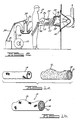
- Figs. 1a and 1b are seen to depict a resin transfer moulding preform 10 having a generally cylindrical shape with certain surface irregularities.
- preform 10 is shown in an exploded view as two sub-components, specifically a foam core 12 and fibre reinforcement material 14 wrapped around the foam core 12.
- An irregularity 16 is seen in the configuration of the core and reinforcement material sub-component. Such irregularity may comprise, for example, additional thickness of fibre reinforcement material or a corresponding irregularity in the configuration of the core, or both.
- the second sub-component is a sleeve-like web or membrane 18 sized to fit snugly over the core and reinforcement material.
- the preform 10 is shown in assembled form with web 18 covering the core and reinforcement material. It can be seen that web 18 is sufficiently elastic or otherwise yielding to closely follow the contours of the core and reinforcement material including, for example, irregularity 16.
- Webs suitable for use in the present invention include innumerable commercially available materials, many of which will be readily apparent to the skilled of the art in the light of the present disclosure.
- the web may comprise, for example, metallic screen, plastic screen or imperforate plastic sheet.
- Porous screens generally will be preferred where it is important to facilitate resin flow to the fibre reinforcement material.
- a metallic screen provides the further advantage of "RF screening".
- a metallic screen can be used in reducing the loft of the fibre reinforcement material by a simple stamping or press forming operation.
- the screen will retain the configuration into which it is pressed and thereby hold the fibre reinforcement material in the desired configuration.
- the various solid sheets of plastic suitable for use as the web is included polyethylene sheeting of appropriate thickness and type.
- Thermoplastic polyester sheeting or screens also may be used for good adhesion between the web and the fibrous reinforcement material of the preform, especially where the RTM process temperature will reach the softening point of such thermoplastic.
- the web comprises styrenic plastic which in the course of the RTM moulding process entirely dissolves into the resin which is injected into the RTM moulding cavity.
- suitable web materials include, for example, wood fibre, metal foils and premanufactured combinations of reinforcement and resin. Others will be apparent to the skilled of the art in view of the present disclosure. Stated generally, the web preferably is any material which provides good encapsulation of the fibre reinforcement material.
- the web can be attached to the preform by any of numerous suitable means which would be apparent to the skilled of the art in view of the present disclosure.
- the web can be stapled, adhesively bonded, etc. to the surface of the core.
- the most appropriate means of attaching the web will be dictated in part by the nature of the fibre reinforcement materials and the configuration and material of the web.
- the term "encapsulate" as used herein with reference to the attachment of the web to the fibre reinforcement material formation means to cover one or more surfaces of the formation but not necessarily to entirely cover every surface thereof, the web being secured or fixed to the fibre reinforcement material.
- the fibre reinforcement material formation is encapsulated by the web in the sense that the web overlies the exterior surface thereof.
- the web 18 is seen to encapsulate the fibre reinforcement material 14 in the sense that it forms a tight fitting sleeve thereover.
- it may be suitable to leave the ends uncovered, as shown in Fig. 1b.
- the web being secured or fixed to the fibre reinforcement material.
- the attachment is by mechanical entrapment of the fibre reinforcement material by the web.
- the web in such cases preferably is sized to fit tightly over the fibre reinforcement material or is sufficiently elastic (or otherwise yielding) to form a snug fit thereover.
- a shrink wrap operation may be applicable, wherein shrinkable plastic film is applied to the fibre reinforcement material and thereafter heated to cause shrinkage of the plastic sheeting.
- Other materials and methods for securing the web to the fibre reinforcement material will be apparent to the skilled of the art in view of the present disclosure.
- the web may be adhesively adhered or bonded to the fibre reinforcement material.
- the adhesion between the web and the fibre reinforcement material may be achieved during curing of the fibre reinforcement material formation.
- This method is particularly suitable where the resin of the fibre reinforcement material is heat curable and will flow or soften during curing to wet the overlaying web.
- separate adhesive may be applied to the exterior of the fibre reinforcement material formation or to the inside surface of the web prior to its application over the fibre reinforcement material formation.
- the fibre reinforcement material is encapsulated by the web.
- Fig. 3c is equally illustrative of the preform both before and after such encapsulation step.
- the web generally will encapsulate a major portion of the formation, e.g. as seen in Fig. 3b, or substantially the entire surface of the formation, e.g. as seen in Fig. 1b.
- a preform is fabricated by spraying random chopped fibre reinforcement material onto a forming member while drawing a vacuum through the forming member to retain the fibre reinforcement material thereon.
- an operator 20 is seen directing a stream of random chopped fibre reinforcement material 22 from the outlet end 23 of a conduit 24 from a chopper/blower apparatus 25 toward a forming member 26.
- the chopper/blower unit 25 comprises a blower fan 27 blowing air through conduit 28 to a fibre feed station 29.
- Fibre material preferably continuous fibreglass roving 30, is fed from supply station 31 to chopper mechanism 32 at which it is chopped, typically to about 2 or 3 inch lengths.
- the chopped fibres are entrained in the air flow through conduit 28 to conduit 24 and are directed from there toward forming member 26.
- Forming member 26 is seen to have perforations 33.
- a vacuum is created by blower 34 such that air is drawn into the forming member 26 through perforations 33.
- the random chopped fibre reinforcement material 22 is thereby drawn to and retained on the surface of the forming member 26. As one section of the forming member 26 is covered, a greater proportion of the air is drawn through any remaining uncovered or less covered perforations 33. In this way, a self-levelling of the fibre reinforcement material is achieved over the surface of the forming member 26.
- a small quantity of resin 35 is sprayed simultaneously with the random chopped fibre reinforcement material 22.
- resin 35 is seen to be sprayed from resin sprayer 36 toward the forming member 26.
- a light coating of resin is sprayed on the fibres sufficient, upon curing, to render the fibre reinforcement material preform (in conjunction with the encapsulating web) sufficiently form-stable to withstand normal handling, transportation, storage and the like.
- fibre reinforcement material could be provided which already comprised a curable resin. In that case the separate application of resin while blowing the fibre at the forming mandrel would not be necessary.
- FIG. 3a an enlarged view is seen of the forming member 26 of Fig. 2.
- the forming member 26 has been sprayed with random chopped fibre reinforcement material 22.
- Arrow 37 shows the direction of air flow through the forming member 26 generated by blower 34 (not shown in this view).
- the fibre reinforcement material 22 has high loft over the surface of the forming member 26.
- a web 38 has been placed over the formation of fibre reinforcement material 22 while still on the forming member 26. Vacuum generated via air flow 37 serves to hold web 38 in place over the fibre reinforcement material 22 and, as seen in Fig.
- One alternative method involves mechanical compression, e.g., between the forming member 26 and another appropriately shaped tool.
- An alternative method is the use of a heat shrinkable web, mentioned above, comprising any of the various materials well known for the purpose of shrink wrapping. According to this alternative, after application of the web to the sprayed-up fibre reinforcement material on the forming member (corresponding to that stage of the method depicted in Fig. 3b) heat would be applied to the web and FRP formation to cause shrinkage of the web, thereby compressing the fibre reinforcement material under the web.
- the fibre reinforcement material 22 comprises heat curable resin and the method of the invention for fabrication of an RTM preform further comprises the step thermally curing the FRP formation with the web thereon.
- the thermal curing of the fibre reinforcement material formation and the shrinking of the web can occur in the same heating step.
- a particularly preferred embodiment of the invention involves such heating step while the fibre reinforcement material formation remains on the forming member. In this way, the preform is given good structural stability while sandwiched between the forming member and the web. Thus, little or no disruption or dislocation of the fibre reinforcement material occurs by handling of the fibre reinforcement material formation in an uncured condition.
- a resin transfer moulding process for making FRP parts.
- the method comprises placing a fibre reinforcement material preform into the moulding cavity of an RTM tool.
- the preform comprises a formation of fibre reinforcement material and a web in direct contact with such formation and encapsulating at least a portion thereof.
- the RTM mould is closed, or substantially closed, and resin is introduced into the cavity. Because the preform is encapsulated by the web, the disruption or dislodging of fibres is reduced or eliminated and, correspondingly, the problem of loose fibres interfering with the closure of the mould is reduced or eliminated. Also, it generally would be found that fewer loose fibres accumulate in the work area.
- the web also may make the preform easier to handle and in certain preferred embodiments lends structural durability to the preform.
- the encapsulating web may be stripped from the preform after its placement in the moulding tool cavity. According to preferred embodiments, however, the web remains a part of the preform and ultimately a part of the FRP part.
- suitable materials for the tool are the same as those which have already been employed in RTM processes, e.g., epoxy tools, nickel shell tools, etc. Sealing of the mould can be accomplished by known methods including, for example, "pinch off” techniques or the use of "O-ring” designs. Similarly, selection of suitable mould releases will be within the ability of those skilled in the art.
- Mold releases must be carefully selected when using epoxy tools, and in the practice of the present invention the mould releases must be likewise compatible with the web of the preform. Selection of suitable mould release agents will be within the ability of those skilled in the art in the light of the present disclosure. Venting of the tooling generally will be required to allow air to escape during resin injection. Vents may be simply small gaps in the seal of the moulding tool or may be tubes or the like inserted through the tool surface. In the present invention where a web encapsulates all or part of the surface of the preform, the selection of suitable venting may be influenced by the path of the air flow from under the web as resin infiltrates the fibre reinforcement material. Here again, it will be within the ability of those skilled in the art to provide suitable venting. Standard liquid resin handling equipment is generally suitable for use in the RTM method aspect of the invention including, for example, hand-held gun injection systems and fixed injection nozzle systems.
Landscapes
- Engineering & Computer Science (AREA)
- Mechanical Engineering (AREA)
- Chemical & Material Sciences (AREA)
- Composite Materials (AREA)
- Casting Or Compression Moulding Of Plastics Or The Like (AREA)
- Moulding By Coating Moulds (AREA)
- Reinforced Plastic Materials (AREA)
Applications Claiming Priority (2)
| Application Number | Priority Date | Filing Date | Title |
|---|---|---|---|
| US429112 | 1989-10-30 | ||
| US07/429,112 US5041260A (en) | 1989-10-30 | 1989-10-30 | Resin transfer molding method |
Publications (2)
| Publication Number | Publication Date |
|---|---|
| EP0426317A2 true EP0426317A2 (de) | 1991-05-08 |
| EP0426317A3 EP0426317A3 (en) | 1992-11-25 |
Family
ID=23701855
Family Applications (1)
| Application Number | Title | Priority Date | Filing Date |
|---|---|---|---|
| EP19900311136 Withdrawn EP0426317A3 (en) | 1989-10-30 | 1990-10-11 | A resin transfer moulding preform and a method of making the preform |
Country Status (3)
| Country | Link |
|---|---|
| US (1) | US5041260A (de) |
| EP (1) | EP0426317A3 (de) |
| CA (1) | CA2025168A1 (de) |
Cited By (8)
| Publication number | Priority date | Publication date | Assignee | Title |
|---|---|---|---|---|
| EP0614740A1 (de) * | 1990-11-05 | 1994-09-14 | The C.A. Lawton Company | Verfahren und Vorrichtung zur Herstellung von Vorformlingen |
| EP0592633A4 (en) * | 1992-04-29 | 1994-10-05 | Davidson Textron Inc | Improved bumper preform and method of forming same |
| GB2323552A (en) * | 1997-03-24 | 1998-09-30 | Alan Roger Harper | Process and apparatus for the manufacture of a fibre-resin component |
| US6383320B1 (en) | 1999-12-03 | 2002-05-07 | Lear Corporation | Method of forming a headliner |
| GB2381494A (en) * | 2001-10-30 | 2003-05-07 | Trysome Ltd | Reinforced fibre articles |
| GB2383556A (en) * | 2001-10-16 | 2003-07-02 | Lear Corp | Spray urethane tool and system |
| WO2014198463A1 (de) * | 2013-06-12 | 2014-12-18 | Bayerische Motoren Werke Aktiengesellschaft | Verfahren und vorrichtung zum herstellen eines faserverbundbauteils sowie faserverbundbauteil |
| CN113043619A (zh) * | 2021-02-01 | 2021-06-29 | 重庆门朵新材料科技有限公司 | 一种湿法制造聚氨酯安全套的系统 |
Families Citing this family (47)
| Publication number | Priority date | Publication date | Assignee | Title |
|---|---|---|---|---|
| US6001300A (en) * | 1989-12-06 | 1999-12-14 | C.A. Lawton Company | Method for making rigid three-dimensional preforms using directed electromagnetic energy |
| US5217656A (en) * | 1990-07-12 | 1993-06-08 | The C. A. Lawton Company | Method for making structural reinforcement preforms including energetic basting of reinforcement members |
| GB2246111B (en) * | 1990-07-13 | 1994-05-04 | Samsung Heavy Ind | Dipper stick for excavator of high strength polymeric composite materials and method for manufacturing such |
| US5204042A (en) * | 1990-08-03 | 1993-04-20 | Northrop Corporation | Method of making composite laminate parts combining resin transfer molding and a trapped expansion member |
| FR2670427B1 (fr) * | 1990-12-18 | 1994-07-08 | Francois Savigny | Procede de moulage sous vide d'un panneau en materiau plastique et panneau obtenu selon le procede. |
| FR2684369B1 (fr) * | 1991-12-03 | 1995-05-24 | Deutsche Forschungsanstalt Luft | Procede pour la fabrication de structures renforcees par fibres comportant une matrice en verre. |
| US5217654A (en) * | 1992-01-30 | 1993-06-08 | The C. A. Lawton Company | Two-stage mat forming preforming and molding process |
| US5281388A (en) * | 1992-03-20 | 1994-01-25 | Mcdonnell Douglas Corporation | Resin impregnation process for producing a resin-fiber composite |
| US5328494A (en) * | 1992-04-08 | 1994-07-12 | Davidson Textron Inc. | Method of forming a preform by precoating glass fibers prior to chopping and preforming |
| US5543225A (en) * | 1992-05-22 | 1996-08-06 | Aqua Glass Corporation | Multilayer fiber reinforced polymeric shaped article |
| US5215796A (en) * | 1992-05-22 | 1993-06-01 | Aqua Glass Corporation | Multilayer polymeric shaped article |
| US5714105A (en) * | 1992-06-04 | 1998-02-03 | Sulzer Medizinaltechnik | Method of making an endoprosthesis of compact thermoplastic composite material |
| US5217672A (en) * | 1992-08-06 | 1993-06-08 | Davidson Textron Inc. | Preform forming and curing process and an apparatus for the process |
| US5336455A (en) * | 1992-10-08 | 1994-08-09 | Davidson Textron Inc. | Method of adding shredded structural reinforced injected molded plastic to a preform |
| TW297046B (de) * | 1993-06-15 | 1997-02-01 | Dow Chemical Co | |
| US5407631A (en) * | 1993-10-28 | 1995-04-18 | Davidson Textron Inc. | Casting process for making glass fiber preforms |
| ES2105470T3 (es) * | 1993-11-22 | 1997-10-16 | Michelin & Cie | Procedimiento de fabricacion de piezas compuestas por moldes por compresion. |
| US5615508A (en) * | 1994-12-30 | 1997-04-01 | Pacific Research Laboratories, Inc. | Camouflage gunstock |
| GB9510046D0 (en) * | 1995-05-18 | 1995-07-12 | Ecole Polytechnique Fudurale D | Process for the manufacture of polymer and composite materials and related equipment |
| JP4031062B2 (ja) * | 1995-08-11 | 2008-01-09 | 株式会社荏原製作所 | プラスチック製部品及びその製造方法 |
| WO1997034850A1 (en) * | 1996-03-22 | 1997-09-25 | Textron Automotive Company Inc. | Method for fabricating painted bumper |
| US5766541A (en) * | 1996-12-03 | 1998-06-16 | O-C Fiberglas Sweden Ab | Method and apparatus for making preforms from glass fiber strand material |
| US5976453A (en) * | 1998-06-29 | 1999-11-02 | Owens-Corning Sweden Ab | Device and process for expanding strand material |
| US6090335A (en) * | 1999-01-08 | 2000-07-18 | Northrop Grumman Corporation | Process of forming fiber reinforced composite articles using an insitu cured resin infusion port |
| US6656411B1 (en) | 1999-01-11 | 2003-12-02 | Northrop Grumman Corporation | Grooved core pattern for optimum resin distribution |
| US6555045B2 (en) | 1999-01-11 | 2003-04-29 | Northrop Grumman Corporation | Grooved mold apparatus and process for forming fiber reinforced composite structures |
| US6333092B1 (en) * | 1999-02-25 | 2001-12-25 | The United States Of America As Represented By The Secretary Of The Navy | Fractal interfacial enhancement of composite delamination resistance |
| US6221291B1 (en) | 1999-02-26 | 2001-04-24 | Lear Corporation | Method for making a preform |
| US6216752B1 (en) | 1999-03-31 | 2001-04-17 | Northrop Grumman Corporation | Gravity feed resin delivery system for VARTM fabrication |
| US6620369B1 (en) * | 2000-02-09 | 2003-09-16 | Northrop Grumman Corporation | Net molding of resin composite parts |
| US6497566B2 (en) * | 2000-12-27 | 2002-12-24 | Ford Global Technologies, Inc. | Robotic systems for automated preform processing |
| US6713012B2 (en) * | 2001-01-16 | 2004-03-30 | Owens Corning Fiberglas Technology, Inc. | Automated process and apparatus for forming a molded article |
| US7842145B2 (en) | 2004-10-05 | 2010-11-30 | The Boeing Company | Method for laying composite tape |
| US20060073311A1 (en) * | 2004-10-05 | 2006-04-06 | The Boeing Company | Apparatus and method for composite tape profile cutting |
| US8318291B2 (en) * | 2005-09-07 | 2012-11-27 | The Boeing Company | Composite member defining a contour surface |
| US8771823B2 (en) * | 2006-07-14 | 2014-07-08 | Huchinson Aéronautique & Industrie Limitée | Thermoplastic part, tool and method for the manufacturing thereof |
| US7910038B2 (en) * | 2008-11-24 | 2011-03-22 | GM Global Technology Operations LLC | Preforms and methods of making the same |
| US8474115B2 (en) * | 2009-08-28 | 2013-07-02 | Ocv Intellectual Capital, Llc | Apparatus and method for making low tangle texturized roving |
| US8336673B2 (en) * | 2010-07-07 | 2012-12-25 | Bay Industries Inc. | Muffler, muffler insert, and methods and apparatus for making |
| DE102010045888A1 (de) * | 2010-09-17 | 2012-03-22 | Schmidt & Heinzmann Gmbh & Co. Kg | Direkt-SMC-Produktionsvorrichtung |
| US8685194B2 (en) | 2011-09-19 | 2014-04-01 | Velcro Industries B.V. | Laminated touch fasteners |
| US20130146061A1 (en) * | 2011-12-09 | 2013-06-13 | 3M Innovative Properties Company | Respirator made from in-situ air-laid web(s) |
| EP2695982A1 (de) * | 2012-08-06 | 2014-02-12 | Oskar Dilo Maschinenfabrik KG | Vorrichtung und Verfahren zur Vergleichmäßigung oder Profilierung einer Faserflockenmatte |
| CA2805826C (en) * | 2013-02-11 | 2019-11-05 | Glen Aylward | Tank made of a composite material and closed molding process for manufacturing the same |
| US9938872B2 (en) | 2015-06-09 | 2018-04-10 | Bay Fabrication, Inc. | Muffler insert, and systems, methods and apparatus for making |
| EP4081396A4 (de) * | 2020-03-06 | 2024-03-27 | Galactic Co., LLC | Geformte verbundmaterialfahrzeughäute und verfahren zu deren herstellung mit hoher geschwindigkeit |
| FR3120009B1 (fr) * | 2021-02-23 | 2024-07-12 | Corso Magenta | Procédé de réalisation d’une pièce par moulage, installation de moulage et utilisation d’un feuil à cet effet |
Family Cites Families (20)
| Publication number | Priority date | Publication date | Assignee | Title |
|---|---|---|---|---|
| US3054714A (en) * | 1958-02-03 | 1962-09-18 | Owens Corning Fiberglass Corp | Method of producing panels of fibrous glass |
| NL256458A (de) * | 1959-10-02 | |||
| US3382125A (en) * | 1964-05-20 | 1968-05-07 | Goodyear Tire & Rubber | Method of making mats |
| US3796617A (en) * | 1970-06-05 | 1974-03-12 | Structural Fibers | Method for making fibrous preform |
| US3708563A (en) * | 1970-09-21 | 1973-01-02 | Sells Inc | Magazine for aerial dispenser and method of making same |
| DE2129523C3 (de) * | 1971-06-15 | 1975-10-09 | Bayer Ag, 5090 Leverkusen | Geschäumte thermoplastische Formkörper |
| US3825642A (en) * | 1971-11-03 | 1974-07-23 | Owens Corning Fiberglass Corp | Method for producing a film-faced product |
| US3887750A (en) * | 1973-01-08 | 1975-06-03 | Dayco Corp | Compressible printing blanket |
| US3962394A (en) * | 1975-06-02 | 1976-06-08 | Trw Inc. | Method for molding fiber reinforced composite tube |
| US3988089A (en) * | 1975-09-10 | 1976-10-26 | The Goodyear Tire & Rubber Company | Apparatus for manufacturing curved bodies of fiber reinforced plastic |
| US4032683A (en) * | 1976-09-27 | 1977-06-28 | Phillips Petroleum Company | Structural member and method of making same |
| SE420991B (sv) * | 1978-02-13 | 1981-11-16 | Scandinavian Glasfiber Ab | Sett for framstellning av foremal av med glasfibrer armerad herdplast |
| US4560523A (en) * | 1984-04-30 | 1985-12-24 | A&M Engineered Composites Corporation | Intrusion molding process for forming composite structures |
| US4556438A (en) * | 1984-08-20 | 1985-12-03 | The United States Of America As Represented By The Secretary Of The Army | Lightweight composite launcher pod production process |
| US4863771A (en) * | 1985-08-22 | 1989-09-05 | The Budd Company | Hollow fiber reinforced structure and method of making same |
| US4676041A (en) * | 1985-11-19 | 1987-06-30 | Warminster Fiberglass Co. | Corrosion-resistant door and its method of manufacture |
| US4869855A (en) * | 1986-05-02 | 1989-09-26 | Allied Signal Inc. | Method of manufacturing molded articles |
| US4808362A (en) * | 1987-06-04 | 1989-02-28 | The Budd Company | Hollow reinforced fiber structure formed by resin transfer molding |
| SE459798B (sv) * | 1987-12-15 | 1989-08-07 | Volvo Ab | Saett att anbringa en materialsats av plast med armering i ett formverktyg |
| US4891176A (en) * | 1988-05-31 | 1990-01-02 | Auto-Fab, Inc. | Resin transfer molding process |
-
1989
- 1989-10-30 US US07/429,112 patent/US5041260A/en not_active Expired - Fee Related
-
1990
- 1990-09-12 CA CA002025168A patent/CA2025168A1/en not_active Abandoned
- 1990-10-11 EP EP19900311136 patent/EP0426317A3/en not_active Withdrawn
Cited By (15)
| Publication number | Priority date | Publication date | Assignee | Title |
|---|---|---|---|---|
| EP0614740A1 (de) * | 1990-11-05 | 1994-09-14 | The C.A. Lawton Company | Verfahren und Vorrichtung zur Herstellung von Vorformlingen |
| EP0592633A4 (en) * | 1992-04-29 | 1994-10-05 | Davidson Textron Inc | Improved bumper preform and method of forming same |
| GB2323552A (en) * | 1997-03-24 | 1998-09-30 | Alan Roger Harper | Process and apparatus for the manufacture of a fibre-resin component |
| GB2323552B (en) * | 1997-03-24 | 2001-12-12 | Alan Roger Harper | Method and apparatus for manufacture of a preform |
| US6383320B1 (en) | 1999-12-03 | 2002-05-07 | Lear Corporation | Method of forming a headliner |
| US6736915B2 (en) | 1999-12-03 | 2004-05-18 | Lear Corporation | Method of forming a headliner |
| GB2383556A (en) * | 2001-10-16 | 2003-07-02 | Lear Corp | Spray urethane tool and system |
| GB2383556B (en) * | 2001-10-16 | 2004-09-01 | Lear Corp | Spray urethane tool and system |
| US6877972B2 (en) | 2001-10-16 | 2005-04-12 | Lear Corporation | Spray urethane tool and system |
| GB2381494A (en) * | 2001-10-30 | 2003-05-07 | Trysome Ltd | Reinforced fibre articles |
| GB2381494B (en) * | 2001-10-30 | 2004-12-08 | Trysome Ltd | Reinforced fibre articles |
| WO2014198463A1 (de) * | 2013-06-12 | 2014-12-18 | Bayerische Motoren Werke Aktiengesellschaft | Verfahren und vorrichtung zum herstellen eines faserverbundbauteils sowie faserverbundbauteil |
| CN105142882A (zh) * | 2013-06-12 | 2015-12-09 | 宝马股份公司 | 用于制造纤维复合构件的方法和设备以及纤维复合构件 |
| US10464266B2 (en) | 2013-06-12 | 2019-11-05 | Bayerische Motoren Werke Aktiengesellschaft | Method and device for producing a fiber composite component and fiber composite component |
| CN113043619A (zh) * | 2021-02-01 | 2021-06-29 | 重庆门朵新材料科技有限公司 | 一种湿法制造聚氨酯安全套的系统 |
Also Published As
| Publication number | Publication date |
|---|---|
| US5041260A (en) | 1991-08-20 |
| EP0426317A3 (en) | 1992-11-25 |
| CA2025168A1 (en) | 1991-05-01 |
Similar Documents
| Publication | Publication Date | Title |
|---|---|---|
| US5041260A (en) | Resin transfer molding method | |
| CA1287716C (en) | Resin transfer molding core, preform and process | |
| US5045251A (en) | Method of resin transfer molding a composite article | |
| US3879245A (en) | Method of making composite cored structures | |
| CA2030419C (en) | Method and apparatus for making preforms | |
| CA2043747C (en) | Method of manufacturing fan blades | |
| US5134002A (en) | Mold liners for resin transfer molding | |
| US5035602A (en) | Resin transfer molding core and preform | |
| US4271116A (en) | Composite structure | |
| US4740346A (en) | Perimeter resin feeding of composite structures | |
| CN106103013B (zh) | 臂端工具 | |
| US20050025929A1 (en) | Sandwich panel with interior barrier | |
| US5213476A (en) | Fan blade | |
| EP0592633B1 (de) | Faserverstärkte stossstangenvorform, vorrichtung und verfahren zu dessen herstellung | |
| US20130127092A1 (en) | Moulded multilayer plastics component with continuously reinforced fibre plies and process for producing this component | |
| CA2110431A1 (en) | Process for producing composite material connections of lattice-like stuctures or lattice elements, and lattice obtained by said process | |
| CN104736312A (zh) | 用于生产较佳为纤维加强的塑料构件的模具、控制装置、方法和设备 | |
| US20040219251A1 (en) | Method and apparatus for producing fabric reinforced structural components | |
| JP5819896B2 (ja) | 繊維強化部材の製造方法 | |
| US5226997A (en) | Mold liners for resin transfer molding | |
| US7662334B2 (en) | Vacuum heat-set of net shape latex vacuum bags | |
| JP7745552B2 (ja) | 複合材料製の四角形シェルを製造するための方法及び工具 | |
| ATE265312T1 (de) | Verfahren zur herstellung eines profilierten, schalenartigen gegenstands sowie eine hierzu verwendbare form | |
| EP0295819B1 (de) | Kern, Rohling und Verfahren zum Transfer-Spritzen von Kunstharz (RTM) | |
| JP2002248620A (ja) | 繊維強化プラスチック成形用基材および繊維強化プラスチックの成形方法 |
Legal Events
| Date | Code | Title | Description |
|---|---|---|---|
| PUAI | Public reference made under article 153(3) epc to a published international application that has entered the european phase |
Free format text: ORIGINAL CODE: 0009012 |
|
| AK | Designated contracting states |
Kind code of ref document: A2 Designated state(s): DE FR GB |
|
| PUAL | Search report despatched |
Free format text: ORIGINAL CODE: 0009013 |
|
| AK | Designated contracting states |
Kind code of ref document: A3 Designated state(s): DE FR GB |
|
| STAA | Information on the status of an ep patent application or granted ep patent |
Free format text: STATUS: THE APPLICATION IS DEEMED TO BE WITHDRAWN |
|
| 18D | Application deemed to be withdrawn |
Effective date: 19930526 |