EP0426766B1 - Ensemble mixer-petrisseur et procede de fabrication de pate, en particulier pour pates alimentaires - Google Patents
Ensemble mixer-petrisseur et procede de fabrication de pate, en particulier pour pates alimentaires Download PDFInfo
- Publication number
- EP0426766B1 EP0426766B1 EP89912384A EP89912384A EP0426766B1 EP 0426766 B1 EP0426766 B1 EP 0426766B1 EP 89912384 A EP89912384 A EP 89912384A EP 89912384 A EP89912384 A EP 89912384A EP 0426766 B1 EP0426766 B1 EP 0426766B1
- Authority
- EP
- European Patent Office
- Prior art keywords
- dough
- kneader mixer
- kneader
- kneading
- shaft
- Prior art date
- Legal status (The legal status is an assumption and is not a legal conclusion. Google has not performed a legal analysis and makes no representation as to the accuracy of the status listed.)
- Expired - Lifetime
Links
- 238000000034 method Methods 0.000 title claims abstract description 34
- 235000015927 pasta Nutrition 0.000 title claims abstract description 30
- 230000008569 process Effects 0.000 title abstract description 21
- 238000004898 kneading Methods 0.000 claims abstract description 37
- 108090000623 proteins and genes Proteins 0.000 claims abstract description 18
- 102000004169 proteins and genes Human genes 0.000 claims abstract description 18
- 239000002994 raw material Substances 0.000 claims abstract description 16
- 238000010008 shearing Methods 0.000 claims abstract 4
- 238000002156 mixing Methods 0.000 claims description 32
- XLYOFNOQVPJJNP-UHFFFAOYSA-N water Substances O XLYOFNOQVPJJNP-UHFFFAOYSA-N 0.000 claims description 21
- 238000004519 manufacturing process Methods 0.000 claims description 20
- 230000015572 biosynthetic process Effects 0.000 claims description 18
- 230000000694 effects Effects 0.000 claims description 14
- 239000000463 material Substances 0.000 claims description 13
- 238000012545 processing Methods 0.000 claims description 8
- 238000012546 transfer Methods 0.000 claims description 7
- 235000013312 flour Nutrition 0.000 claims description 6
- 239000007788 liquid Substances 0.000 claims description 4
- 235000014347 soups Nutrition 0.000 claims description 4
- 230000009471 action Effects 0.000 claims description 3
- 235000019699 ravioli Nutrition 0.000 claims description 3
- 239000008187 granular material Substances 0.000 claims description 2
- 238000001816 cooling Methods 0.000 claims 1
- 238000003825 pressing Methods 0.000 claims 1
- 239000000126 substance Substances 0.000 claims 1
- 238000002360 preparation method Methods 0.000 abstract description 2
- 238000000748 compression moulding Methods 0.000 abstract 1
- 239000000047 product Substances 0.000 description 29
- 238000010411 cooking Methods 0.000 description 11
- 238000005520 cutting process Methods 0.000 description 9
- 238000001125 extrusion Methods 0.000 description 7
- 238000001035 drying Methods 0.000 description 5
- 239000007795 chemical reaction product Substances 0.000 description 4
- 238000010276 construction Methods 0.000 description 4
- 238000013461 design Methods 0.000 description 4
- 238000011156 evaluation Methods 0.000 description 4
- 230000002427 irreversible effect Effects 0.000 description 4
- 238000007493 shaping process Methods 0.000 description 4
- 235000008429 bread Nutrition 0.000 description 3
- 230000006835 compression Effects 0.000 description 3
- 238000007906 compression Methods 0.000 description 3
- 235000013305 food Nutrition 0.000 description 3
- 230000005484 gravity Effects 0.000 description 3
- 238000000265 homogenisation Methods 0.000 description 3
- 239000000203 mixture Substances 0.000 description 3
- 238000000465 moulding Methods 0.000 description 3
- 239000002245 particle Substances 0.000 description 3
- 241000196324 Embryophyta Species 0.000 description 2
- 241000519995 Stachys sylvatica Species 0.000 description 2
- 230000008901 benefit Effects 0.000 description 2
- 238000009835 boiling Methods 0.000 description 2
- 230000008859 change Effects 0.000 description 2
- 210000000991 chicken egg Anatomy 0.000 description 2
- 238000004140 cleaning Methods 0.000 description 2
- 238000009826 distribution Methods 0.000 description 2
- 238000002474 experimental method Methods 0.000 description 2
- 238000010438 heat treatment Methods 0.000 description 2
- 230000003993 interaction Effects 0.000 description 2
- 108010082495 Dietary Plant Proteins Proteins 0.000 description 1
- 241000237858 Gastropoda Species 0.000 description 1
- 241000209140 Triticum Species 0.000 description 1
- 235000021307 Triticum Nutrition 0.000 description 1
- 230000003851 biochemical process Effects 0.000 description 1
- 235000012813 breadcrumbs Nutrition 0.000 description 1
- 230000015271 coagulation Effects 0.000 description 1
- 238000005345 coagulation Methods 0.000 description 1
- 235000009508 confectionery Nutrition 0.000 description 1
- 239000002826 coolant Substances 0.000 description 1
- 230000001419 dependent effect Effects 0.000 description 1
- 238000011161 development Methods 0.000 description 1
- 238000006073 displacement reaction Methods 0.000 description 1
- 239000000945 filler Substances 0.000 description 1
- 239000012530 fluid Substances 0.000 description 1
- 235000015243 ice cream Nutrition 0.000 description 1
- 238000010348 incorporation Methods 0.000 description 1
- 238000009776 industrial production Methods 0.000 description 1
- 230000002401 inhibitory effect Effects 0.000 description 1
- 238000009434 installation Methods 0.000 description 1
- 238000009940 knitting Methods 0.000 description 1
- 238000012423 maintenance Methods 0.000 description 1
- 235000013372 meat Nutrition 0.000 description 1
- 230000036961 partial effect Effects 0.000 description 1
- 235000014594 pastries Nutrition 0.000 description 1
- 230000008092 positive effect Effects 0.000 description 1
- 238000003672 processing method Methods 0.000 description 1
- 230000001737 promoting effect Effects 0.000 description 1
- 238000001303 quality assessment method Methods 0.000 description 1
- 238000011160 research Methods 0.000 description 1
- 230000000717 retained effect Effects 0.000 description 1
- 238000005096 rolling process Methods 0.000 description 1
- 235000013580 sausages Nutrition 0.000 description 1
- 238000003756 stirring Methods 0.000 description 1
- 238000012360 testing method Methods 0.000 description 1
- 238000007669 thermal treatment Methods 0.000 description 1
- 235000013311 vegetables Nutrition 0.000 description 1
- 238000010792 warming Methods 0.000 description 1
- 239000002699 waste material Substances 0.000 description 1
Images



Classifications
-
- A—HUMAN NECESSITIES
- A21—BAKING; EDIBLE DOUGHS
- A21C—MACHINES OR EQUIPMENT FOR MAKING OR PROCESSING DOUGHS; HANDLING BAKED ARTICLES MADE FROM DOUGH
- A21C1/00—Mixing or kneading machines for the preparation of dough
- A21C1/003—Plant; Systems, i.e. flow charts or diagrams
-
- A—HUMAN NECESSITIES
- A21—BAKING; EDIBLE DOUGHS
- A21C—MACHINES OR EQUIPMENT FOR MAKING OR PROCESSING DOUGHS; HANDLING BAKED ARTICLES MADE FROM DOUGH
- A21C1/00—Mixing or kneading machines for the preparation of dough
- A21C1/006—Methods
-
- A—HUMAN NECESSITIES
- A21—BAKING; EDIBLE DOUGHS
- A21C—MACHINES OR EQUIPMENT FOR MAKING OR PROCESSING DOUGHS; HANDLING BAKED ARTICLES MADE FROM DOUGH
- A21C1/00—Mixing or kneading machines for the preparation of dough
- A21C1/06—Mixing or kneading machines for the preparation of dough with horizontally-mounted mixing or kneading tools; Worm or screw mixers
- A21C1/065—Worm or screw mixers, e.g. with consecutive mixing receptacles
-
- A—HUMAN NECESSITIES
- A21—BAKING; EDIBLE DOUGHS
- A21C—MACHINES OR EQUIPMENT FOR MAKING OR PROCESSING DOUGHS; HANDLING BAKED ARTICLES MADE FROM DOUGH
- A21C11/00—Other machines for forming the dough into its final shape before cooking or baking
- A21C11/16—Extruding machines
- A21C11/20—Extruding machines with worms
-
- A—HUMAN NECESSITIES
- A23—FOODS OR FOODSTUFFS; TREATMENT THEREOF, NOT COVERED BY OTHER CLASSES
- A23L—FOODS, FOODSTUFFS OR NON-ALCOHOLIC BEVERAGES, NOT OTHERWISE PROVIDED FOR; PREPARATION OR TREATMENT THEREOF
- A23L7/00—Cereal-derived products; Malt products; Preparation or treatment thereof
- A23L7/10—Cereal-derived products
- A23L7/109—Types of pasta, e.g. macaroni or noodles
-
- B—PERFORMING OPERATIONS; TRANSPORTING
- B01—PHYSICAL OR CHEMICAL PROCESSES OR APPARATUS IN GENERAL
- B01F—MIXING, e.g. DISSOLVING, EMULSIFYING OR DISPERSING
- B01F27/00—Mixers with rotary stirring devices in fixed receptacles; Kneaders
- B01F27/60—Mixers with rotary stirring devices in fixed receptacles; Kneaders with stirrers rotating about a horizontal or inclined axis
- B01F27/72—Mixers with rotary stirring devices in fixed receptacles; Kneaders with stirrers rotating about a horizontal or inclined axis with helices or sections of helices
- B01F27/721—Mixers with rotary stirring devices in fixed receptacles; Kneaders with stirrers rotating about a horizontal or inclined axis with helices or sections of helices with two or more helices in the same receptacle
- B01F27/722—Mixers with rotary stirring devices in fixed receptacles; Kneaders with stirrers rotating about a horizontal or inclined axis with helices or sections of helices with two or more helices in the same receptacle the helices closely surrounded by a casing
- B01F27/7221—Mixers with rotary stirring devices in fixed receptacles; Kneaders with stirrers rotating about a horizontal or inclined axis with helices or sections of helices with two or more helices in the same receptacle the helices closely surrounded by a casing the stirrers being composed of helices and paddles on the same shaft, e.g. helically arranged ovally shaped paddles
-
- B—PERFORMING OPERATIONS; TRANSPORTING
- B01—PHYSICAL OR CHEMICAL PROCESSES OR APPARATUS IN GENERAL
- B01F—MIXING, e.g. DISSOLVING, EMULSIFYING OR DISPERSING
- B01F27/00—Mixers with rotary stirring devices in fixed receptacles; Kneaders
- B01F27/05—Stirrers
- B01F27/11—Stirrers characterised by the configuration of the stirrers
- B01F27/114—Helically shaped stirrers, i.e. stirrers comprising a helically shaped band or helically shaped band sections
- B01F27/1143—Helically shaped stirrers, i.e. stirrers comprising a helically shaped band or helically shaped band sections screw-shaped, e.g. worms
-
- B—PERFORMING OPERATIONS; TRANSPORTING
- B01—PHYSICAL OR CHEMICAL PROCESSES OR APPARATUS IN GENERAL
- B01F—MIXING, e.g. DISSOLVING, EMULSIFYING OR DISPERSING
- B01F27/00—Mixers with rotary stirring devices in fixed receptacles; Kneaders
- B01F27/60—Mixers with rotary stirring devices in fixed receptacles; Kneaders with stirrers rotating about a horizontal or inclined axis
Definitions
- the invention relates to a mixer-kneader device for the production of raw dough, with a closed housing, with a product feed opening, a discharge mouthpiece designed without a compression mold, and working elements which act continuously in the housing in the form of two working shafts, on which mixing and kneading elements work together are arranged in the entire working cross-section of the housing with a positive conveying effect.
- Pasta makes up an increasing proportion of the foods prepared using the dough mold.
- the majority of the shaping is done by an extrusion process, in which the viscous dough with high pressures of e.g. 80 to 120 bar is pressed through the molds and cut to a desired length.
- the protein scaffold is the network-like, spatial concatenation of all protein cells that hold the strength in crystalline form together.
- the protein scaffold can be changed and converted as often as required, but only as long as there is enough water and the protein is not coagulated by higher temperatures.
- the vegetable protein behaves very similar to the chicken egg. If a chicken egg is broken into cold water, it will almost remain in its shape if you do this very carefully. With strong stirring resp. Whipping gives you a watery egg-colored egg soup. The behavior is completely different if the same egg is broken into boiling water. The egg takes on an almost marble outline shape in a few seconds and retains it without mechanical intervention.
- the temperature limit values up to the irreversible point are 60 to 80 ° C, i.e. already below the actual cooking temperature (i.e. below 100 ° C). If a product mass is brought into the range of 100 ° C or above during the mixing, kneading and dough formation, a subsequent molding process, e.g. for classic pasta such as macaroni, there is only an insufficient protein structure.
- twin-screw extruder In practice, the so-called twin-screw extruder is very common for process A. In the professional world, this is often referred to as the worm conveyor pair with the worst efficiency.
- the poor efficiency primarily involves converting the corresponding drive power into frictional heat.
- the frictional heat generated in the dough is one of the process parameters for heating and thermal treatment of the goods.
- the product is heated to 100 to 200 ° C by the frictional heat and, if necessary, subjected to a cooking effect with additional heating elements.
- any local increase in the dough temperature over the range of 60 to 70 ° C must be avoided.
- troughs for dough formation for pasta are mixing troughs for mixing all raw materials as well as one or more single-shaft screws for the construction of the protein structure or for dough formation and for the construction of the final shaping Pressure of 80 to 120 bar have been used.
- the temperature can not only be kept under control, but remains significantly below the critical value of 60 to 70 ° C, so that no irreversible damage to the product occurs.
- the easiest Evidence of this is given by the fact that cutting waste can be added to the raw material to be pressed after the goods have been pressed without any loss of quality.
- Process A A major difference between Process A and Process B is that the product throughput for pasta dough or pasta presses for larger plants is usually in the order of magnitude of 500 kg to 2500 kg per hour. With comparable motor drive powers for process A, the product throughput is several hundred kg / hour.
- a second difference also lies in the speed of the press screw.
- the speed is 20 to 100 rpm
- speeds of 200 to 300 rpm are regularly. and applied significantly above.
- a device of the type mentioned in the preamble of claim 1 is known from GB-PS 1002910.
- two parallel screw conveyors are used to mix and pre-knead the dough.
- the dough is then conveyed through the screw conveyors into a mixing and kneading chamber, in which it is mixed and kneaded using a single mixing and kneading tool that can be controlled independently of the screw conveyors.
- the invention has for its object to provide a device for dough formation for uncooked goods, especially for pasta products, which meets the highest requirements in terms of hygiene, is simple in construction and enables the production of a high quality dough with high throughput.
- the inventive design of the mixing kneader device achieves intensive mixing of the dough components and a strong kneading effect.
- the kneading effect is not dependent on a high pressure build-up, as is the case with extrusion devices, but on repeated intensive kneading.
- a rolling effect between the pair of screws on the one hand and a cutting effect or a dismembering of the dough on the other hand are used.
- high-quality dough formation in particular the build-up of a good protein structure, is guaranteed.
- only a very slight warming of the goods and no local heat damage were found in many experiments.
- Experiments on an industrial scale have also shown that the energy required for dough formation is approximately the same as was previously required for driving the mixing shafts of the mixing trough alone.
- the forced action of the kneading screws causes the device to self-clean.
- the shear elements can have a self-locking effect. The product is pushed through even in the event of idling.
- the shear elements preferably have a shape that is effective over the entire cross section. This makes it possible to achieve an ideal kneading effect with very little power requirement without high pressure build-up.
- the first set of kneading screws is advantageously designed as a pair of feed screws and the last set of kneading screws as a pair of ejection screws.
- three or more sets of screw pairs are arranged in succession, each with a set of shear element pairs arranged between them.
- the working shafts are designed as shafts rotating in the same direction, the two shafts preferably having a drive for less than 200, particularly preferably for 20 to 100, very particularly preferably for 40 to 70 revolutions per minute exhibit.
- the working waves can be arranged in opposite directions.
- the advantage of this design idea lies in structurally simplified requirements for the device or for the drive of the device.
- connections for the raw material feed are arranged directly in the first section of the device which is provided with screw elements and is constructed as a low-pressure two-shaft mixer kneader.
- the device is very particularly preferably designed as a short low-pressure mixer kneader, which is used in combination with a long single-shaft press screw for the production of pasta.
- the single-shaft press screw now takes over the part of the homogenization in interaction with the high pressure build-up.
- the outlet opening of the mixing kneader is therefore preferably designed freely, that is to say without extrusion nozzles.
- the opening is preferably chosen to be smaller than the double cylinder cross section, but larger than the free working cross section between the working shafts and the double cylinders.
- the rearmost set of cutting knives cuts the dough apart and without pressure build-up in the area of the discharge mouthpiece, the rearmost set of screw elements in the product flow direction predominantly results in an ejection function for the dough pieces.
- the active length of the single-shaft press screw is preferably built at least twice longer than the active length of corresponding screw elements of the low-pressure two-shaft mixer kneader, with the single-shaft press screw being particularly preferably at least 2.5 times longer than the low-pressure two-shaft mixer kneader.
- an air-vacuum connection is advantageously provided between the low-pressure twin-shaft mixer kneader and the single-shaft press screw.
- the invention further relates to a method for producing raw dough for pasta dough with a liquid content of 25 to 40 percent by weight according to the preamble of claim 15.
- the new process is based on the task of simplifying the production of dough, in particular that it can be better kept under control, the quality of the end product should meet the highest standards, in particular that easy handling of all hygienic questions can be guaranteed.
- the new method according to the invention has made it possible for the first time to separate the dough effect from the problem of shaping for dough formation (especially with regard to products with low water contents of less than 40% or less than 34%).
- the optimum dough formation as has been shown, can be done much more efficiently, since it was recognized that a real mechanical cutting process would only be possible is possible if the parts to be cut can be spatially separated or displaced. One part must be able to escape from the other, but this is not possible in a compact, high-pressure dough mass. In the compact dough mass, the picture of the viscous liquid mass is rather correct. With fluids one does not speak of cutting.
- the all-round ties over the protein scaffold require frequent mechanical displacement of the individual dough sections, and at the same time the most complete possible water distribution.
- the raw dough is preferably transferred from the first stage to the second stage without pressure.
- the raw dough is very particularly preferably ejected in pieces from the first stage and this is transferred by gravity directly to the second stage to form a closed, homogeneous dough mass.
- a negative pressure is advantageously generated by connecting the corresponding transfer space to a vacuum pump, so that air pockets in the molded dough are prevented.
- the material can be processed in the step continuously in less than 60 seconds with a material temperature of 40 to 70 ° C., preferably of 40 to 50 ° C., and converted into the finished form.
- the invention further relates to the application of the method for the production of long or short pasta, and the use of the mixing kneader for a pasta line for the production of long or short pasta directly in front of the press screw or with an intermediate transfer element.
- FIG. 1 represents a new mixing kneader 1, with essentially the upper part of a housing 2, which is closed per se, to illustrate the working elements 3 and. 4 is omitted for illustration.
- the two working elements 3 and 4 have two shafts 5 rotating in the same direction. 6, which turn clockwise. Both waves 5 respectively. 6 are alternately with a set of kneading screws 7,8 and 9 respectively. 7 ', 8' and 9 'and corresponding to a set of shear elements 10 and 11 respectively. 10 'and 11' provided which on the shafts designed as a spline 5 and 5 respectively. 6 are wedged against rotation.
- the material is fed into the mixing kneader via a material feed opening 12.
- the liquid component e.g. Water or ice soup is also let in directly close to the product feed opening 12 through a connection 13.
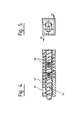
- Both the material supply opening 12 and the connection 13 are in the region of the first screws 7 and 7, respectively, formed as a pair of feed screws 14. 7 'arranged, as can also be seen in simplified form from FIG. 4.
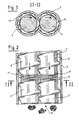
- each two pairs of screws 8, 8 'and 9, 9' and a pair of kneading screws 11, 11 'arranged between them are shown on a larger scale and in plan.
- the product is forcibly driven through the housing 2 by the screws 8, 8 ', 9, 9'.
- the material in FIG. 2 passes the pair of shear elements 11, 11 '.
- each set of shear elements 11, 11 ' consists of three polygonal disks 15 which, like a gearwheel with three teeth, but rotating in the same sense, cut through the entire housing cross section forming a figure eight.
- FIG. 2 shows the outlet end of the mixer kneader 1.
- the material that is cut up by the shear elements 11, 11 ' is ejected by the pair of ejection screws 9, 9' in pieces or in pieces by a free discharge mouthpiece 16.
- a drive gear, not shown for both waves 5 resp. 6 is arranged on the side of the material feed opening, so that in the example shown the two shafts 5 and 5 respectively. 6 are overhung from the drive side. This measure allows a simplified installation and removal of the work elements, in particular easy maintenance of the entire work area, for example by the working elements can be pulled out in the direction of the discharge mouthpiece 16.
- FIGS. 4 and 5 show the same mixer kneader as shown in FIGS. 1, 2 and 3, but with a heat exchange system 20, for example. tempered water can be let in through an inlet connection 21 and can be discharged again through an outlet connection 22.
- FIG. 6 shows a schematic representation of a particularly advantageous implementation of the new invention for the production of pasta such as spaghetti, pasta, macaroni, etc.
- the dry component semolina or flour
- the dry component is fed via a funnel 30 with metering device 31 and a feed screw 32 to the product feed opening 12 and fed in the initial section or directly to the auger pair 14.
- a quantity of water calculated precisely for the metering capacity for the dry component is removed from a container 33 designed as a balance and added to the dry components or the pair of feed screws by means of a pump 34.
- additional ice soup can be added to the mixture via a second container 34.
- the single-shaft press screw represents a special embodiment of the extrusion, a pressure of, for example, approx. 80 to 120 bar must be built up so that the very viscous dough mass can be pressed through the mold openings.
- the mixer kneader is not an extruder. All elements of the production unit, as shown in FIG. 6, are controlled and coordinated by a common SP controller 42.
- the length ratio L M of the mixing kneader to L E of the single-shaft press screw is interesting, the active length of the working elements being compared (FIG. 7).
- FIG. 7 also shows the possibility of producing filled goods such as Cannelloni 52, Ravioli 53, etc.
- the filler meat, vegetable or sweet components are removed from a container 50 and pressed into the goods via a special pump 51 directly via the corresponding channel system of the press head.
- the dough pieces falling off the mixing kneader 1 are transferred directly to a pre-calibration roller 60 and the band formed to a calibration roller 61.
- the dough sheet is first converted into a desired dough sheet shape by a slitter 62 and then by a cross cutter 63, which is brought to a storable water content in a subsequent dryer.
- the invention can also be used in a variety of other specialty products, e.g. for the production of puff pastry or for breadcrumbs for the production of raw dough.
- Water is metered directly into the mixing kneader 11 via a line 70.
- the dry raw material components are fed in uniformly via a feed head 71.
- the dry raw material is immediately moistened in the entrance area and mixed intimately and passed into the multiple kneading zones.
- the mixing kneader 11 acts as a crumb dough from the raw material. If the outlet end 73 of the mixer kneader 11 is free, dough pieces of e.g. 1 to 5 cm in size, some almost hand-sized pieces that make a crumbly, crumbling impression, similar to the inside of a baked bread.
- the crumb dough is now prepared as follows: The raw materials water and semolina or flour are fed into the inlet of the mixer kneader 11. 9 and 10 the actual kneader bodies are shown in a horizontal position, that is to say in a top view. In contrast, the inlet is drawn from the side, i.e. in an upright position. In other words, the kneader body is shown tilted by 90 ° into the upright image plane, which is indicated by the image section lines 73.
- the raw material is 74 or. Feed zone 75 from the two working shafts 76, respectively. 77 captured and conveyed to the right, according to arrow 78, into a first kneading zone 79.
- the kneading screws 79 ' can be designed in such a way that they result in a slight jamming and yet conveying effect.
- the mass leaving the kneading zone 79 is pressed through a shear zone 81 into a second kneading zone 82, likewise with positive positive conveyance.
- the formation of the protein scaffold is now completed in the next shear zone 83.
- Similar or other kneading elements can be used alternately in the kneading zone 82. Overall, the action of the mechanical pressure and conveying forces takes place very selectively on relatively small portions of dough, so that there are almost no unnecessary pressure forces and friction effects.
- the 2-shaft mixer kneader shown has the particular advantage that it works to a very high degree of self-cleaning.
- the dough can be ejected as dough pieces or with a slight narrowing and corresponding pressure build-up.
- the crumb dough is transferred directly to the following screw 86.
- the following screw can already be the actual press screw 87, as shown in FIG. 10. It is important, however, that the follower screw 86 has a greater delivery capacity than the mixing kneader 11, so that an uncontrollable build-up of pressure is avoided for the kneader and thus also the risk of an uncontrolled rise in temperature is avoided.
- the crumb dough is transferred from the mixer kneader 11 to the subsequent screw 86 by the screw conveyor 87 cutting off the incoming dough pouring.
- the raw materials semolina and water were fed continuously into the mixing kneader at a rate of 500 kg / h.
- the screw speed was set at 42 rpm. fixed and the cylinder tempered at 35 ° C. After a lingering or The mixing and kneading time of 16 seconds fell Dough pieces in free fall in the press cylinder.
- the compression parameters were set as follows:
- the shaped spaghetti was then hung on rods and dried in a drying plant to a moisture content of 11.5% H 2 0.
- the spaghetti produced with the new process shows no external differences compared to the traditional ones.
- the transparency for typical water products from Durum could be achieved. Unresolved, disturbing white spots could not be found. Very good results were achieved in terms of cooking quality. After a cooking time of 12 minutes the "Al dente" quality was reached. Stickiness and loss of cooking were within the scope of the market products compared.
- the starting mixture of 50% durum and 50% wheat flour was fed into the mixing kneader continuously at a rate of 1000 kg / h and kneaded to a homogeneous raw dough within 6 seconds.
- the raw dough was not fed into the press screw in free fall, but was transferred directly to the press screw according to Fig. 9.
- the kneader press screw can be arranged in any manner.
- the raw dough was transferred to the press screw in the low pressure area, i.e. free of mold pressure, i.e. the pressure never exceeded 50 bar.
- the compression parameters had the following values:
- the macaroni were dried as in Example 1.
- Example 3 Egg horns, diameter 5 x 3 mm, length 25 mm
- the raw materials were fed to the mixing kneader at a drying rate of 700 kg / h via the metering and processed into a raw dough in the same way as Examples 1 and 2.
- a granulating device was attached to the outlet of the mixing kneader in order to granulate the resulting pieces of dough. The transfer took place free-falling in a vacuum on the press screw.
- the egg horns cut on the mold were dried over shaking, pre-drying and final drying.
- the raw material was moistened together with water to a dough moisture of 32% H 2 0 and processed into a raw dough in the mixer kneader.
- the dough pieces were conveyed onto a converted pasta press by means of a conveyor transport, where they were fed directly into a screw conveyor and then pressed into spirals.
Landscapes
- Life Sciences & Earth Sciences (AREA)
- Engineering & Computer Science (AREA)
- Food Science & Technology (AREA)
- Chemical & Material Sciences (AREA)
- Health & Medical Sciences (AREA)
- Nutrition Science (AREA)
- Polymers & Plastics (AREA)
- Chemical Kinetics & Catalysis (AREA)
- Botany (AREA)
- Manufacturing And Processing Devices For Dough (AREA)
- Noodles (AREA)
- Nitrogen And Oxygen Or Sulfur-Condensed Heterocyclic Ring Systems (AREA)
Abstract
Claims (23)
caractérisé en ce que les matériaux bruts sont soumis à une action, dans un premier étage, au moyen du couple d'arbres travailleurs, pour donner, au moyen d'une alternance continue de pétrissage et de cisaillemet, une pâte brute non comprimée, et, dans un deuxième étage, la pâte brute étant éventuellement homogénéisée dans une presse à un arbre, placée sous haute pression et comprimée à la forme souhaitée, au moyen d'une moule à pression, ou par l'intermédiaire de rouleaux, puis découpée.
Priority Applications (1)
| Application Number | Priority Date | Filing Date | Title |
|---|---|---|---|
| AT89912384T ATE100999T1 (de) | 1989-05-25 | 1989-11-16 | Mischkneter-vorrichtung und verfahren zur herstellung von teig, insbesondere fuer teigwaren. |
Applications Claiming Priority (4)
| Application Number | Priority Date | Filing Date | Title |
|---|---|---|---|
| CH1968/89 | 1989-05-25 | ||
| CH196889 | 1989-05-25 | ||
| CH196889 | 1989-05-25 | ||
| PCT/CH1989/000202 WO1990005452A1 (fr) | 1987-11-27 | 1989-11-16 | Ensemble mixer-petrisseur et procede de fabrication de pate, en particulier pour pates alimentaires |
Publications (3)
| Publication Number | Publication Date |
|---|---|
| EP0426766A1 EP0426766A1 (fr) | 1991-05-15 |
| EP0426766B1 true EP0426766B1 (fr) | 1994-02-02 |
| EP0426766B2 EP0426766B2 (fr) | 2003-08-13 |
Family
ID=4222822
Family Applications (1)
| Application Number | Title | Priority Date | Filing Date |
|---|---|---|---|
| EP89912384A Expired - Lifetime EP0426766B2 (fr) | 1989-05-25 | 1989-11-16 | Ensemble mixer-petrisseur et procede de fabrication de pate, en particulier pour pates alimentaires |
Country Status (17)
| Country | Link |
|---|---|
| US (1) | US5186539A (fr) |
| EP (1) | EP0426766B2 (fr) |
| JP (1) | JP2540220B2 (fr) |
| AR (1) | AR243729A1 (fr) |
| AT (1) | ATE100999T1 (fr) |
| CS (1) | CS277062B6 (fr) |
| DD (1) | DD288978A5 (fr) |
| DE (1) | DE58906914D1 (fr) |
| DK (1) | DK168990D0 (fr) |
| ES (1) | ES2017232A6 (fr) |
| HU (1) | HU208906B (fr) |
| LT (1) | LT3453B (fr) |
| LV (1) | LV10832B (fr) |
| MD (1) | MD402C2 (fr) |
| MX (1) | MX171785B (fr) |
| PL (1) | PL163996B1 (fr) |
| WO (1) | WO1990005452A1 (fr) |
Cited By (1)
| Publication number | Priority date | Publication date | Assignee | Title |
|---|---|---|---|---|
| EP1516661A1 (fr) * | 2003-09-18 | 2005-03-23 | Bühler AG | Mélangeur-Melaxeur et procédé pour la préparation d'une pâte crue pour la préparation de pâtes alimentaires |
Families Citing this family (47)
| Publication number | Priority date | Publication date | Assignee | Title |
|---|---|---|---|---|
| DE69105370T2 (de) * | 1990-06-27 | 1995-07-20 | Kao Corp | Pulverisierungs- und Knetapparat und Verfahren zur Herstellung von Seife mit diesem Apparat. |
| ATE109952T1 (de) * | 1990-08-16 | 1994-09-15 | Nestle Sa | Verfahren zur herstellung von teigwaren durch extrusion und einrichtung dafür. |
| GB9307417D0 (en) * | 1993-04-08 | 1993-06-02 | Castings Technology Int | Mixing |
| TW253831B (fr) * | 1993-06-11 | 1995-08-11 | Reon Zidoki Kk | |
| US5573332A (en) * | 1993-09-02 | 1996-11-12 | Werner & Pfleiderer Gmbh | Screw element for a screw-like extrusion machine |
| CH687842A5 (fr) * | 1994-04-28 | 1997-03-14 | Nestle Sa | Procédé de fabrication de pâtes alimentaires. |
| DE19512230A1 (de) * | 1995-03-24 | 1995-12-07 | Robert Klingler | Vorrichtung für Doppelschraubenspindelpumpen zur Strukturbeeinflussung bei der Lebensmittelproduktion |
| IN181843B (fr) * | 1995-04-28 | 1998-10-03 | Nestle Sa | |
| US5997934A (en) * | 1995-04-28 | 1999-12-07 | Nestec S.A. | Manufacture of cooked cereals |
| IT1287360B1 (it) * | 1996-11-08 | 1998-08-04 | Seko Spa | Carro trincia-miscelatore-impagliatore provvisto di un gruppo perfezionato per la distribuzione della paglia all'esterno del carro. |
| DE69710868T2 (de) * | 1997-05-07 | 2002-09-12 | Societe Des Produits Nestle S.A., Vevey | Verfahren zur Herstellung von gefüllten Teigwaren |
| DE19802143A1 (de) * | 1998-01-22 | 1999-09-16 | Robert Servos | Veränderbare Volumen mit Turborotoren: Neue Rotoren für Verfahrenstechnik und Maschinenbau |
| ATE288206T1 (de) * | 1999-03-16 | 2005-02-15 | Nestle Sa | Spritzgiessteigware und verfahren ihrer herstellung |
| DE19919206A1 (de) | 1999-04-28 | 2000-11-02 | Buehler Ag | Verfahren zur Herstellung von Teigwaren |
| US6229107B1 (en) * | 1999-08-06 | 2001-05-08 | Steven G Flint | Safety electrical receptacle |
| ATE270393T1 (de) * | 2001-04-03 | 2004-07-15 | Cfs Slagelse As | Schneckenfördereinrichtung für flüssigkeiten und/oder materialbrocken |
| EP1462235B1 (fr) * | 2001-11-30 | 2011-08-31 | Kohei Sawa | Extrudeuse |
| NO317773B1 (no) * | 2003-02-04 | 2004-12-13 | Gilde Norge Ba | Matprodukt, samt fremgangsmate ved tilvirkning av dette |
| ATE468912T1 (de) * | 2005-04-18 | 2010-06-15 | Gea Pharma Systems Nv | Vorrichtung zur durchgehenden granulierung und verfahren zur durchgehenden granulierung von pulvermaterial |
| DE102006011362A1 (de) | 2006-03-09 | 2007-09-27 | Bühler AG | Herstellung von Artikeln mit verschiedenem Gehalt an Zusatzstoffen |
| US9272468B1 (en) * | 2008-04-03 | 2016-03-01 | Purdue Research Foundation | Apparatus and method for producing biobased carriers from byproducts of biomass processing |
| US20100055284A1 (en) * | 2008-08-28 | 2010-03-04 | Jan Karwowski | Production of extruded cheese crackers and snacks |
| US8095275B2 (en) | 2008-08-28 | 2012-01-10 | Trw Automotive U.S. Llc | Method and apparatus for controlling an actuatable safety device |
| US8060968B2 (en) * | 2008-08-28 | 2011-11-22 | Emerson Electric Co. | Variable belt tensioner for drain cleaning devices |
| DE102008043090A1 (de) | 2008-10-22 | 2010-04-29 | Bühler AG | Verfahren und Vorrichtung zur Herstellung von Teig |
| US8846776B2 (en) | 2009-08-14 | 2014-09-30 | Boral Ip Holdings Llc | Filled polyurethane composites and methods of making same |
| US9481759B2 (en) | 2009-08-14 | 2016-11-01 | Boral Ip Holdings Llc | Polyurethanes derived from highly reactive reactants and coal ash |
| JP5722622B2 (ja) * | 2010-12-15 | 2015-05-27 | 不二パウダル株式会社 | 連続混練造粒機 |
| US9745224B2 (en) | 2011-10-07 | 2017-08-29 | Boral Ip Holdings (Australia) Pty Limited | Inorganic polymer/organic polymer composites and methods of making same |
| CN102519515B (zh) * | 2011-12-19 | 2013-11-06 | 中国检验认证集团河南有限公司 | 面筋测定仪计量校准方法 |
| US8968816B2 (en) * | 2012-02-14 | 2015-03-03 | General Mills, Inc. | Method and apparatus for making cereal flakes |
| FR2987546B1 (fr) * | 2012-03-05 | 2015-06-05 | Vmi | Machine a petrir en continu une pate pour preparation boulangere ou patissiere telle que du pain de mie, et fraseur pour une telle machine |
| US10137600B2 (en) * | 2013-03-21 | 2018-11-27 | Toyota Jidosha Kabushiki Kaisha | Twin-screw extruding kneader and method for producing electrode mixture using the same |
| US9932457B2 (en) | 2013-04-12 | 2018-04-03 | Boral Ip Holdings (Australia) Pty Limited | Composites formed from an absorptive filler and a polyurethane |
| EP2796189B2 (fr) * | 2013-04-26 | 2019-12-25 | Buss-SMS-Canzler GmbH | Réacteur/mélangeur à deux arbres |
| US9763455B1 (en) * | 2013-07-10 | 2017-09-19 | Stewart Systems Baking, LLC | Apparatus system and process for making a bakery product |
| WO2016018226A1 (fr) | 2014-07-28 | 2016-02-04 | Crocco Guy | Utilisation d'agents réfrigérants évaporatifs pour fabriquer des composites de polyuréthane chargés |
| US9752015B2 (en) | 2014-08-05 | 2017-09-05 | Boral Ip Holdings (Australia) Pty Limited | Filled polymeric composites including short length fibers |
| WO2016118141A1 (fr) | 2015-01-22 | 2016-07-28 | Boral Ip Holdings (Australia) Pty Limited | Composites de polyuréthanne hautement chargés |
| WO2016195717A1 (fr) | 2015-06-05 | 2016-12-08 | Boral Ip Holdings (Australia) Pty Limited | Composites de polyuréthane chargés à charges légères |
| US20170267585A1 (en) | 2015-11-12 | 2017-09-21 | Amitabha Kumar | Filled polyurethane composites with size-graded fillers |
| JP6325137B2 (ja) * | 2016-02-24 | 2018-05-16 | 日清食品ホールディングス株式会社 | 即席フライ麺の製造方法 |
| PL236548B1 (pl) * | 2017-11-29 | 2021-01-25 | Univ Technologiczno Przyrodniczy Im Jana I Jedrzeja Sniadeckich W Bydgoszczy | Miesiarka śrubowo-kulowa i sposób miesienia ciast średniej i twardej konsystencji |
| EP3855900B1 (fr) * | 2018-09-28 | 2022-09-07 | Sulbana AG | Procédé et dispositif pour le transport et la plastification continus de lait caillé |
| CN109221935B (zh) * | 2018-11-08 | 2022-03-01 | 河南工业大学 | 一种高膳食纤维面条制作设备 |
| JP6951820B1 (ja) * | 2020-02-20 | 2021-10-20 | 株式会社Mizkan Holdings | 油脂含有組成物及びその製造方法 |
| US11986979B2 (en) | 2021-09-24 | 2024-05-21 | Aaron Engineered Process Equipment, Inc. | Double arm mixer extruder |
Family Cites Families (16)
| Publication number | Priority date | Publication date | Assignee | Title |
|---|---|---|---|---|
| FR887144A (fr) * | 1940-12-18 | 1943-11-04 | Dispositif de pétrissage et de compression pour les machines automatiques à faire les pâtes alimentaires | |
| GB754954A (en) * | 1953-03-25 | 1956-08-15 | Angelo Marinoni | A combined kneading and calendering machine for dough and like pastes |
| BE622870A (fr) * | 1961-10-11 | |||
| US3332369A (en) * | 1964-05-19 | 1967-07-25 | Bak Kraft Corp | Bread dough making machine |
| CH453257A (de) * | 1965-05-28 | 1968-06-14 | Buehler Ag Geb | Teigwarenpresse |
| DE1604396A1 (de) * | 1966-03-26 | 1970-09-17 | Werner & Pfleiderer | Verfahren und Vorrichtung zur Herstellung thermoplastischer Mischungen durch kontinuierliches Homogenisieren mehrerer Mischungsteile |
| US3819837A (en) * | 1972-02-02 | 1974-06-25 | Campbell Taggart Inc | Continuous dough making process |
| US4269582A (en) * | 1978-11-21 | 1981-05-26 | Mario Mella | Pasta-making machine |
| DE3026842C2 (de) * | 1980-07-16 | 1984-02-16 | Hermann Berstorff Maschinenbau Gmbh, 3000 Hannover | Doppelschnecken-Entgasungsextruder für thermoplastische Materialien |
| DE3206325C2 (de) * | 1982-02-22 | 1985-10-10 | AUTOMATIK Apparate-Maschinenbau GmbH, 8754 Großostheim | Mehrwellige, kontinuierlich arbeitende Misch- und Knetmaschine für plastifizierbare Massen |
| JPS6031857B2 (ja) * | 1982-06-28 | 1985-07-24 | 株式会社阪田商会 | 顔料分散体の製造方法 |
| DE3400300C2 (de) | 1983-06-24 | 1986-01-23 | Gebrüder Bühler AG, Uzwil | Verfahren zur Herstellung von langen Teigwaren und Vorrichtung zur Durchführung eines solchen Verfahrens |
| JPS6016562A (ja) * | 1983-07-08 | 1985-01-28 | Hiroyuki Yamato | 小麦粉を主とした生地の製造法 |
| JPS62269736A (ja) * | 1986-05-16 | 1987-11-24 | Nisshin Flour Milling Co Ltd | 連続式ミキサ− |
| US4752135A (en) * | 1986-12-01 | 1988-06-21 | Baker Perkins, Inc. | Mixing apparatus and methods |
| CH677309A5 (fr) † | 1987-11-27 | 1991-05-15 | Buehler Ag |
-
1988
- 1988-11-18 MX MX018402A patent/MX171785B/es unknown
-
1989
- 1989-11-13 CS CS896415A patent/CS277062B6/cs not_active IP Right Cessation
- 1989-11-16 DE DE89912384T patent/DE58906914D1/de not_active Expired - Lifetime
- 1989-11-16 DD DD89334633A patent/DD288978A5/de not_active IP Right Cessation
- 1989-11-16 ES ES8903916A patent/ES2017232A6/es not_active Expired - Lifetime
- 1989-11-16 WO PCT/CH1989/000202 patent/WO1990005452A1/fr not_active Ceased
- 1989-11-16 AT AT89912384T patent/ATE100999T1/de not_active IP Right Cessation
- 1989-11-16 MD MD95-0096A patent/MD402C2/ro unknown
- 1989-11-16 EP EP89912384A patent/EP0426766B2/fr not_active Expired - Lifetime
- 1989-11-16 HU HU896557A patent/HU208906B/hu not_active IP Right Cessation
- 1989-11-16 JP JP1511482A patent/JP2540220B2/ja not_active Expired - Fee Related
- 1989-11-17 PL PL89282347A patent/PL163996B1/pl unknown
- 1989-11-17 AR AR89315475A patent/AR243729A1/es active
-
1990
- 1990-04-11 US US07/508,086 patent/US5186539A/en not_active Expired - Lifetime
- 1990-07-13 DK DK168990A patent/DK168990D0/da not_active Application Discontinuation
-
1993
- 1993-06-30 LV LVP-93-928A patent/LV10832B/lv unknown
- 1993-12-08 LT LTIP1570A patent/LT3453B/lt unknown
Cited By (1)
| Publication number | Priority date | Publication date | Assignee | Title |
|---|---|---|---|---|
| EP1516661A1 (fr) * | 2003-09-18 | 2005-03-23 | Bühler AG | Mélangeur-Melaxeur et procédé pour la préparation d'une pâte crue pour la préparation de pâtes alimentaires |
Also Published As
| Publication number | Publication date |
|---|---|
| JP2540220B2 (ja) | 1996-10-02 |
| LTIP1570A (en) | 1995-06-26 |
| EP0426766B2 (fr) | 2003-08-13 |
| AR243729A1 (es) | 1993-09-30 |
| PL163996B1 (pl) | 1994-06-30 |
| DK168990A (da) | 1990-07-13 |
| US5186539A (en) | 1993-02-16 |
| HU896557D0 (en) | 1991-07-29 |
| HU208906B (en) | 1994-02-28 |
| MX171785B (es) | 1993-11-15 |
| ES2017232A6 (es) | 1991-01-01 |
| CS641589A3 (en) | 1992-06-17 |
| ATE100999T1 (de) | 1994-02-15 |
| JPH03504803A (ja) | 1991-10-24 |
| EP0426766A1 (fr) | 1991-05-15 |
| DK168990D0 (da) | 1990-07-13 |
| MD402C2 (ro) | 1996-07-31 |
| WO1990005452A1 (fr) | 1990-05-31 |
| LV10832A (lv) | 1995-10-20 |
| LT3453B (en) | 1995-10-25 |
| DD288978A5 (de) | 1991-04-18 |
| CS277062B6 (en) | 1992-11-18 |
| DE58906914D1 (de) | 1994-03-17 |
| LV10832B (en) | 1996-06-20 |
Similar Documents
| Publication | Publication Date | Title |
|---|---|---|
| EP0426766B1 (fr) | Ensemble mixer-petrisseur et procede de fabrication de pate, en particulier pour pates alimentaires | |
| EP0351423B1 (fr) | Procede et installation pour la fabrication de pate et notamment de pates alimentaires | |
| EP0919127B1 (fr) | Procédé et dispositif pour la fabrication de pate | |
| DE2445820C3 (de) | Verfahren zum Herstellen eines Kartoffelerzeugnisses aus Trockenkartoffelmasse | |
| DE69520167T2 (de) | Herstellung von Teigwaren | |
| DE60129353T2 (de) | Extrusionsverfahren, vorrichtung und erzeugnis | |
| DE2534294A1 (de) | Verfahren zur kontinuierlichen zerkleinerung und aufbereitung von weichen pflanzlichen nahrungsmitteln | |
| DE3990873C2 (de) | Verfahren und Vorrichtung zum Zerhacken, Feinzerkleinern und Mischen von gefrorenen Rohmaterial, wieTierfleisch, Fischfleisch und Bohnen | |
| DE3447533A1 (de) | Mehrschnecken-nudelherstellungsverfahren | |
| DE3021739A1 (de) | Verfahren und doppelschnecken-extruder zur verarbeitung von lebens- und futtermitteln | |
| DE102011086981A1 (de) | Einschneckenextruder und Verfahren zum Herstellen eines plastifizierten Lebensmittelproduktes | |
| DE19800390C1 (de) | Verfahren zur Herstellung eines stückigen Futter- oder Lebensmittels sowie danach herstellbares Produkt | |
| DE602006000775T2 (de) | Homogenisierender Mischer | |
| DE2012081C2 (de) | Vorrichtung zur kontinuierlichen Herstellung von Teig für Backwaren, Teigwaren, Brot oder dergleichen | |
| DE69611034T2 (de) | Verfahren und Vorrichtung zur Herstellung von extrudierten und gekochten Nahrungsmitteln | |
| DE1692485B2 (de) | Verfahren zur herstellung und verpackung eines fleischfutters fuer haustiere | |
| EP0537110A1 (fr) | Méthode pour produire des articles moulés à partir de compositions façonnables comme des matières thermoplastiques | |
| DE19643206A1 (de) | Verfahren und Vorrichtung zum Herstellen von Teig | |
| RU2005379C1 (ru) | Месильное устройство и способ приготовления макаронных изделий из теста | |
| DE2837294A1 (de) | Nahrungsmittelprodukt auf der basis von kleie | |
| WO2010046451A2 (fr) | Procédé et dispositif de fabrication de pâte | |
| WO2012104057A1 (fr) | Procédé et dispositif pour préparer de la pâte de boulangerie | |
| EP2168429A1 (fr) | Méthode de production de fermenter produits laitiers, en particulier Mozzarella | |
| DE718509C (de) | Verfahren zur Aufteilung wasserhaltiger Massen, die trotz hohen Wassergehaltes von steifer Konsistenz sind und sich unter Druck in feste und fluessige Anteile entmischen, unter Durchpressung durch Lochplatten in duenne Straenge | |
| DE4442934C2 (de) | Verfahren und Vorrichtung zum Herstellen von Feinmehlbrot |
Legal Events
| Date | Code | Title | Description |
|---|---|---|---|
| PUAI | Public reference made under article 153(3) epc to a published international application that has entered the european phase |
Free format text: ORIGINAL CODE: 0009012 |
|
| 17P | Request for examination filed |
Effective date: 19900712 |
|
| AK | Designated contracting states |
Kind code of ref document: A1 Designated state(s): AT BE CH DE ES FR GB IT LI LU NL SE |
|
| 17Q | First examination report despatched |
Effective date: 19920305 |
|
| GRAA | (expected) grant |
Free format text: ORIGINAL CODE: 0009210 |
|
| ITF | It: translation for a ep patent filed | ||
| AK | Designated contracting states |
Kind code of ref document: B1 Designated state(s): AT BE CH DE ES FR GB IT LI LU NL SE |
|
| PG25 | Lapsed in a contracting state [announced via postgrant information from national office to epo] |
Ref country code: ES Free format text: THE PATENT HAS BEEN ANNULLED BY A DECISION OF A NATIONAL AUTHORITY Effective date: 19940202 |
|
| REF | Corresponds to: |
Ref document number: 100999 Country of ref document: AT Date of ref document: 19940215 Kind code of ref document: T |
|
| GBT | Gb: translation of ep patent filed (gb section 77(6)(a)/1977) |
Effective date: 19940211 |
|
| REF | Corresponds to: |
Ref document number: 58906914 Country of ref document: DE Date of ref document: 19940317 |
|
| ET | Fr: translation filed | ||
| PLBI | Opposition filed |
Free format text: ORIGINAL CODE: 0009260 |
|
| PG25 | Lapsed in a contracting state [announced via postgrant information from national office to epo] |
Ref country code: LU Free format text: LAPSE BECAUSE OF NON-PAYMENT OF DUE FEES Effective date: 19941130 |
|
| 26 | Opposition filed |
Opponent name: PAVAN MAPIMPIANTI SPA Effective date: 19941102 |
|
| EAL | Se: european patent in force in sweden |
Ref document number: 89912384.8 |
|
| NLR1 | Nl: opposition has been filed with the epo |
Opponent name: PAVAN MAPIMPIANTI SPA |
|
| REG | Reference to a national code |
Ref country code: FR Ref legal event code: CL |
|
| PLAB | Opposition data, opponent's data or that of the opponent's representative modified |
Free format text: ORIGINAL CODE: 0009299OPPO |
|
| PGFP | Annual fee paid to national office [announced via postgrant information from national office to epo] |
Ref country code: GB Payment date: 19981012 Year of fee payment: 10 |
|
| PGFP | Annual fee paid to national office [announced via postgrant information from national office to epo] |
Ref country code: NL Payment date: 19981020 Year of fee payment: 10 |
|
| PGFP | Annual fee paid to national office [announced via postgrant information from national office to epo] |
Ref country code: SE Payment date: 19981022 Year of fee payment: 10 |
|
| R26 | Opposition filed (corrected) |
Opponent name: PAVAN S.P.A. Effective date: 19941102 |
|
| PGFP | Annual fee paid to national office [announced via postgrant information from national office to epo] |
Ref country code: BE Payment date: 19981030 Year of fee payment: 10 |
|
| NLR1 | Nl: opposition has been filed with the epo |
Opponent name: PAVAN S.P.A. |
|
| PG25 | Lapsed in a contracting state [announced via postgrant information from national office to epo] |
Ref country code: GB Free format text: LAPSE BECAUSE OF NON-PAYMENT OF DUE FEES Effective date: 19991116 |
|
| PG25 | Lapsed in a contracting state [announced via postgrant information from national office to epo] |
Ref country code: SE Free format text: LAPSE BECAUSE OF NON-PAYMENT OF DUE FEES Effective date: 19991117 |
|
| PG25 | Lapsed in a contracting state [announced via postgrant information from national office to epo] |
Ref country code: BE Free format text: LAPSE BECAUSE OF NON-PAYMENT OF DUE FEES Effective date: 19991130 |
|
| BERE | Be: lapsed |
Owner name: BUHLER A.G. Effective date: 19991130 |
|
| PG25 | Lapsed in a contracting state [announced via postgrant information from national office to epo] |
Ref country code: NL Free format text: LAPSE BECAUSE OF NON-PAYMENT OF DUE FEES Effective date: 20000601 |
|
| PLAW | Interlocutory decision in opposition |
Free format text: ORIGINAL CODE: EPIDOS IDOP |
|
| GBPC | Gb: european patent ceased through non-payment of renewal fee |
Effective date: 19991116 |
|
| EUG | Se: european patent has lapsed |
Ref document number: 89912384.8 |
|
| NLV4 | Nl: lapsed or anulled due to non-payment of the annual fee |
Effective date: 20000601 |
|
| APAC | Appeal dossier modified |
Free format text: ORIGINAL CODE: EPIDOS NOAPO |
|
| APAE | Appeal reference modified |
Free format text: ORIGINAL CODE: EPIDOS REFNO |
|
| APAC | Appeal dossier modified |
Free format text: ORIGINAL CODE: EPIDOS NOAPO |
|
| PGFP | Annual fee paid to national office [announced via postgrant information from national office to epo] |
Ref country code: CH Payment date: 20021002 Year of fee payment: 14 |
|
| PGFP | Annual fee paid to national office [announced via postgrant information from national office to epo] |
Ref country code: AT Payment date: 20021029 Year of fee payment: 14 |
|
| APAC | Appeal dossier modified |
Free format text: ORIGINAL CODE: EPIDOS NOAPO |
|
| PLAW | Interlocutory decision in opposition |
Free format text: ORIGINAL CODE: EPIDOS IDOP |
|
| PUAH | Patent maintained in amended form |
Free format text: ORIGINAL CODE: 0009272 |
|
| STAA | Information on the status of an ep patent application or granted ep patent |
Free format text: STATUS: PATENT MAINTAINED AS AMENDED |
|
| 27A | Patent maintained in amended form |
Effective date: 20030813 |
|
| AK | Designated contracting states |
Designated state(s): AT BE CH DE ES FR GB IT LI LU NL SE |
|
| REG | Reference to a national code |
Ref country code: CH Ref legal event code: AEN Free format text: AUFRECHTERHALTUNG DES PATENTES IN GEAENDERTER FORM |
|
| PG25 | Lapsed in a contracting state [announced via postgrant information from national office to epo] |
Ref country code: AT Free format text: LAPSE BECAUSE OF NON-PAYMENT OF DUE FEES Effective date: 20031116 |
|
| PG25 | Lapsed in a contracting state [announced via postgrant information from national office to epo] |
Ref country code: LI Free format text: LAPSE BECAUSE OF NON-PAYMENT OF DUE FEES Effective date: 20031130 Ref country code: CH Free format text: LAPSE BECAUSE OF NON-PAYMENT OF DUE FEES Effective date: 20031130 |
|
| ET3 | Fr: translation filed ** decision concerning opposition | ||
| REG | Reference to a national code |
Ref country code: CH Ref legal event code: PL |
|
| APAH | Appeal reference modified |
Free format text: ORIGINAL CODE: EPIDOSCREFNO |
|
| PGFP | Annual fee paid to national office [announced via postgrant information from national office to epo] |
Ref country code: IT Payment date: 20081118 Year of fee payment: 20 |
|
| PGFP | Annual fee paid to national office [announced via postgrant information from national office to epo] |
Ref country code: FR Payment date: 20081106 Year of fee payment: 20 |
|
| PGFP | Annual fee paid to national office [announced via postgrant information from national office to epo] |
Ref country code: DE Payment date: 20081128 Year of fee payment: 20 |