EP0426978A1 - Verfahren zur selektiven nicht-katalytischen Reduktion der Emission von Schadstoffen aus ölbefeuerten Kesselanlagen - Google Patents
Verfahren zur selektiven nicht-katalytischen Reduktion der Emission von Schadstoffen aus ölbefeuerten Kesselanlagen Download PDFInfo
- Publication number
- EP0426978A1 EP0426978A1 EP90117723A EP90117723A EP0426978A1 EP 0426978 A1 EP0426978 A1 EP 0426978A1 EP 90117723 A EP90117723 A EP 90117723A EP 90117723 A EP90117723 A EP 90117723A EP 0426978 A1 EP0426978 A1 EP 0426978A1
- Authority
- EP
- European Patent Office
- Prior art keywords
- reducing agent
- oil
- urea
- boiler
- acids
- Prior art date
- Legal status (The legal status is an assumption and is not a legal conclusion. Google has not performed a legal analysis and makes no representation as to the accuracy of the status listed.)
- Granted
Links
Images

Classifications
-
- B—PERFORMING OPERATIONS; TRANSPORTING
- B01—PHYSICAL OR CHEMICAL PROCESSES OR APPARATUS IN GENERAL
- B01D—SEPARATION
- B01D53/00—Separation of gases or vapours; Recovering vapours of volatile solvents from gases; Chemical or biological purification of waste gases, e.g. engine exhaust gases, smoke, fumes, flue gases, aerosols
- B01D53/34—Chemical or biological purification of waste gases
- B01D53/46—Removing components of defined structure
- B01D53/54—Nitrogen compounds
- B01D53/56—Nitrogen oxides
-
- C—CHEMISTRY; METALLURGY
- C10—PETROLEUM, GAS OR COKE INDUSTRIES; TECHNICAL GASES CONTAINING CARBON MONOXIDE; FUELS; LUBRICANTS; PEAT
- C10L—FUELS NOT OTHERWISE PROVIDED FOR; NATURAL GAS; SYNTHETIC NATURAL GAS OBTAINED BY PROCESSES NOT COVERED BY SUBCLASSES C10G OR C10K; LIQUIFIED PETROLEUM GAS; USE OF ADDITIVES TO FUELS OR FIRES; FIRE-LIGHTERS
- C10L1/00—Liquid carbonaceous fuels
- C10L1/10—Liquid carbonaceous fuels containing additives
-
- C—CHEMISTRY; METALLURGY
- C10—PETROLEUM, GAS OR COKE INDUSTRIES; TECHNICAL GASES CONTAINING CARBON MONOXIDE; FUELS; LUBRICANTS; PEAT
- C10L—FUELS NOT OTHERWISE PROVIDED FOR; NATURAL GAS; SYNTHETIC NATURAL GAS OBTAINED BY PROCESSES NOT COVERED BY SUBCLASSES C10G OR C10K; LIQUIFIED PETROLEUM GAS; USE OF ADDITIVES TO FUELS OR FIRES; FIRE-LIGHTERS
- C10L10/00—Use of additives to fuels or fires for particular purposes
- C10L10/02—Use of additives to fuels or fires for particular purposes for reducing smoke development
-
- F—MECHANICAL ENGINEERING; LIGHTING; HEATING; WEAPONS; BLASTING
- F23—COMBUSTION APPARATUS; COMBUSTION PROCESSES
- F23J—REMOVAL OR TREATMENT OF COMBUSTION PRODUCTS OR COMBUSTION RESIDUES; FLUES
- F23J7/00—Arrangement of devices for supplying chemicals to fire
-
- F—MECHANICAL ENGINEERING; LIGHTING; HEATING; WEAPONS; BLASTING
- F23—COMBUSTION APPARATUS; COMBUSTION PROCESSES
- F23K—FEEDING FUEL TO COMBUSTION APPARATUS
- F23K5/00—Feeding or distributing other fuel to combustion apparatus
- F23K5/02—Liquid fuel
- F23K5/08—Preparation of fuel
- F23K5/10—Mixing with other fluids
-
- B—PERFORMING OPERATIONS; TRANSPORTING
- B01—PHYSICAL OR CHEMICAL PROCESSES OR APPARATUS IN GENERAL
- B01D—SEPARATION
- B01D2251/00—Reactants
- B01D2251/20—Reductants
- B01D2251/206—Ammonium compounds
- B01D2251/2062—Ammonia
-
- B—PERFORMING OPERATIONS; TRANSPORTING
- B01—PHYSICAL OR CHEMICAL PROCESSES OR APPARATUS IN GENERAL
- B01D—SEPARATION
- B01D2251/00—Reactants
- B01D2251/20—Reductants
- B01D2251/206—Ammonium compounds
- B01D2251/2067—Urea
-
- B—PERFORMING OPERATIONS; TRANSPORTING
- B01—PHYSICAL OR CHEMICAL PROCESSES OR APPARATUS IN GENERAL
- B01D—SEPARATION
- B01D2251/00—Reactants
- B01D2251/20—Reductants
- B01D2251/21—Organic compounds not provided for in groups B01D2251/206 or B01D2251/208
-
- C—CHEMISTRY; METALLURGY
- C10—PETROLEUM, GAS OR COKE INDUSTRIES; TECHNICAL GASES CONTAINING CARBON MONOXIDE; FUELS; LUBRICANTS; PEAT
- C10L—FUELS NOT OTHERWISE PROVIDED FOR; NATURAL GAS; SYNTHETIC NATURAL GAS OBTAINED BY PROCESSES NOT COVERED BY SUBCLASSES C10G OR C10K; LIQUIFIED PETROLEUM GAS; USE OF ADDITIVES TO FUELS OR FIRES; FIRE-LIGHTERS
- C10L1/00—Liquid carbonaceous fuels
- C10L1/10—Liquid carbonaceous fuels containing additives
- C10L1/12—Inorganic compounds
- C10L1/1233—Inorganic compounds oxygen containing compounds, e.g. oxides, hydroxides, acids and salts thereof
-
- C—CHEMISTRY; METALLURGY
- C10—PETROLEUM, GAS OR COKE INDUSTRIES; TECHNICAL GASES CONTAINING CARBON MONOXIDE; FUELS; LUBRICANTS; PEAT
- C10L—FUELS NOT OTHERWISE PROVIDED FOR; NATURAL GAS; SYNTHETIC NATURAL GAS OBTAINED BY PROCESSES NOT COVERED BY SUBCLASSES C10G OR C10K; LIQUIFIED PETROLEUM GAS; USE OF ADDITIVES TO FUELS OR FIRES; FIRE-LIGHTERS
- C10L1/00—Liquid carbonaceous fuels
- C10L1/10—Liquid carbonaceous fuels containing additives
- C10L1/12—Inorganic compounds
- C10L1/1233—Inorganic compounds oxygen containing compounds, e.g. oxides, hydroxides, acids and salts thereof
- C10L1/1241—Inorganic compounds oxygen containing compounds, e.g. oxides, hydroxides, acids and salts thereof metal carbonyls
-
- C—CHEMISTRY; METALLURGY
- C10—PETROLEUM, GAS OR COKE INDUSTRIES; TECHNICAL GASES CONTAINING CARBON MONOXIDE; FUELS; LUBRICANTS; PEAT
- C10L—FUELS NOT OTHERWISE PROVIDED FOR; NATURAL GAS; SYNTHETIC NATURAL GAS OBTAINED BY PROCESSES NOT COVERED BY SUBCLASSES C10G OR C10K; LIQUIFIED PETROLEUM GAS; USE OF ADDITIVES TO FUELS OR FIRES; FIRE-LIGHTERS
- C10L1/00—Liquid carbonaceous fuels
- C10L1/10—Liquid carbonaceous fuels containing additives
- C10L1/12—Inorganic compounds
- C10L1/1233—Inorganic compounds oxygen containing compounds, e.g. oxides, hydroxides, acids and salts thereof
- C10L1/125—Inorganic compounds oxygen containing compounds, e.g. oxides, hydroxides, acids and salts thereof water
-
- C—CHEMISTRY; METALLURGY
- C10—PETROLEUM, GAS OR COKE INDUSTRIES; TECHNICAL GASES CONTAINING CARBON MONOXIDE; FUELS; LUBRICANTS; PEAT
- C10L—FUELS NOT OTHERWISE PROVIDED FOR; NATURAL GAS; SYNTHETIC NATURAL GAS OBTAINED BY PROCESSES NOT COVERED BY SUBCLASSES C10G OR C10K; LIQUIFIED PETROLEUM GAS; USE OF ADDITIVES TO FUELS OR FIRES; FIRE-LIGHTERS
- C10L1/00—Liquid carbonaceous fuels
- C10L1/10—Liquid carbonaceous fuels containing additives
- C10L1/12—Inorganic compounds
- C10L1/1266—Inorganic compounds nitrogen containing compounds, (e.g. NH3)
-
- C—CHEMISTRY; METALLURGY
- C10—PETROLEUM, GAS OR COKE INDUSTRIES; TECHNICAL GASES CONTAINING CARBON MONOXIDE; FUELS; LUBRICANTS; PEAT
- C10L—FUELS NOT OTHERWISE PROVIDED FOR; NATURAL GAS; SYNTHETIC NATURAL GAS OBTAINED BY PROCESSES NOT COVERED BY SUBCLASSES C10G OR C10K; LIQUIFIED PETROLEUM GAS; USE OF ADDITIVES TO FUELS OR FIRES; FIRE-LIGHTERS
- C10L1/00—Liquid carbonaceous fuels
- C10L1/10—Liquid carbonaceous fuels containing additives
- C10L1/14—Organic compounds
- C10L1/16—Hydrocarbons
-
- C—CHEMISTRY; METALLURGY
- C10—PETROLEUM, GAS OR COKE INDUSTRIES; TECHNICAL GASES CONTAINING CARBON MONOXIDE; FUELS; LUBRICANTS; PEAT
- C10L—FUELS NOT OTHERWISE PROVIDED FOR; NATURAL GAS; SYNTHETIC NATURAL GAS OBTAINED BY PROCESSES NOT COVERED BY SUBCLASSES C10G OR C10K; LIQUIFIED PETROLEUM GAS; USE OF ADDITIVES TO FUELS OR FIRES; FIRE-LIGHTERS
- C10L1/00—Liquid carbonaceous fuels
- C10L1/10—Liquid carbonaceous fuels containing additives
- C10L1/14—Organic compounds
- C10L1/16—Hydrocarbons
- C10L1/1616—Hydrocarbons fractions, e.g. lubricants, solvents, naphta, bitumen, tars, terpentine
-
- C—CHEMISTRY; METALLURGY
- C10—PETROLEUM, GAS OR COKE INDUSTRIES; TECHNICAL GASES CONTAINING CARBON MONOXIDE; FUELS; LUBRICANTS; PEAT
- C10L—FUELS NOT OTHERWISE PROVIDED FOR; NATURAL GAS; SYNTHETIC NATURAL GAS OBTAINED BY PROCESSES NOT COVERED BY SUBCLASSES C10G OR C10K; LIQUIFIED PETROLEUM GAS; USE OF ADDITIVES TO FUELS OR FIRES; FIRE-LIGHTERS
- C10L1/00—Liquid carbonaceous fuels
- C10L1/10—Liquid carbonaceous fuels containing additives
- C10L1/14—Organic compounds
- C10L1/18—Organic compounds containing oxygen
- C10L1/182—Organic compounds containing oxygen containing hydroxy groups; Salts thereof
- C10L1/1822—Organic compounds containing oxygen containing hydroxy groups; Salts thereof hydroxy group directly attached to (cyclo)aliphatic carbon atoms
-
- C—CHEMISTRY; METALLURGY
- C10—PETROLEUM, GAS OR COKE INDUSTRIES; TECHNICAL GASES CONTAINING CARBON MONOXIDE; FUELS; LUBRICANTS; PEAT
- C10L—FUELS NOT OTHERWISE PROVIDED FOR; NATURAL GAS; SYNTHETIC NATURAL GAS OBTAINED BY PROCESSES NOT COVERED BY SUBCLASSES C10G OR C10K; LIQUIFIED PETROLEUM GAS; USE OF ADDITIVES TO FUELS OR FIRES; FIRE-LIGHTERS
- C10L1/00—Liquid carbonaceous fuels
- C10L1/10—Liquid carbonaceous fuels containing additives
- C10L1/14—Organic compounds
- C10L1/18—Organic compounds containing oxygen
- C10L1/182—Organic compounds containing oxygen containing hydroxy groups; Salts thereof
- C10L1/1822—Organic compounds containing oxygen containing hydroxy groups; Salts thereof hydroxy group directly attached to (cyclo)aliphatic carbon atoms
- C10L1/1824—Organic compounds containing oxygen containing hydroxy groups; Salts thereof hydroxy group directly attached to (cyclo)aliphatic carbon atoms mono-hydroxy
-
- C—CHEMISTRY; METALLURGY
- C10—PETROLEUM, GAS OR COKE INDUSTRIES; TECHNICAL GASES CONTAINING CARBON MONOXIDE; FUELS; LUBRICANTS; PEAT
- C10L—FUELS NOT OTHERWISE PROVIDED FOR; NATURAL GAS; SYNTHETIC NATURAL GAS OBTAINED BY PROCESSES NOT COVERED BY SUBCLASSES C10G OR C10K; LIQUIFIED PETROLEUM GAS; USE OF ADDITIVES TO FUELS OR FIRES; FIRE-LIGHTERS
- C10L1/00—Liquid carbonaceous fuels
- C10L1/10—Liquid carbonaceous fuels containing additives
- C10L1/14—Organic compounds
- C10L1/18—Organic compounds containing oxygen
- C10L1/185—Ethers; Acetals; Ketals; Aldehydes; Ketones
- C10L1/1857—Aldehydes; Ketones
-
- C—CHEMISTRY; METALLURGY
- C10—PETROLEUM, GAS OR COKE INDUSTRIES; TECHNICAL GASES CONTAINING CARBON MONOXIDE; FUELS; LUBRICANTS; PEAT
- C10L—FUELS NOT OTHERWISE PROVIDED FOR; NATURAL GAS; SYNTHETIC NATURAL GAS OBTAINED BY PROCESSES NOT COVERED BY SUBCLASSES C10G OR C10K; LIQUIFIED PETROLEUM GAS; USE OF ADDITIVES TO FUELS OR FIRES; FIRE-LIGHTERS
- C10L1/00—Liquid carbonaceous fuels
- C10L1/10—Liquid carbonaceous fuels containing additives
- C10L1/14—Organic compounds
- C10L1/18—Organic compounds containing oxygen
- C10L1/188—Carboxylic acids; metal salts thereof
-
- C—CHEMISTRY; METALLURGY
- C10—PETROLEUM, GAS OR COKE INDUSTRIES; TECHNICAL GASES CONTAINING CARBON MONOXIDE; FUELS; LUBRICANTS; PEAT
- C10L—FUELS NOT OTHERWISE PROVIDED FOR; NATURAL GAS; SYNTHETIC NATURAL GAS OBTAINED BY PROCESSES NOT COVERED BY SUBCLASSES C10G OR C10K; LIQUIFIED PETROLEUM GAS; USE OF ADDITIVES TO FUELS OR FIRES; FIRE-LIGHTERS
- C10L1/00—Liquid carbonaceous fuels
- C10L1/10—Liquid carbonaceous fuels containing additives
- C10L1/14—Organic compounds
- C10L1/18—Organic compounds containing oxygen
- C10L1/188—Carboxylic acids; metal salts thereof
- C10L1/1881—Carboxylic acids; metal salts thereof carboxylic group attached to an aliphatic carbon atom
-
- C—CHEMISTRY; METALLURGY
- C10—PETROLEUM, GAS OR COKE INDUSTRIES; TECHNICAL GASES CONTAINING CARBON MONOXIDE; FUELS; LUBRICANTS; PEAT
- C10L—FUELS NOT OTHERWISE PROVIDED FOR; NATURAL GAS; SYNTHETIC NATURAL GAS OBTAINED BY PROCESSES NOT COVERED BY SUBCLASSES C10G OR C10K; LIQUIFIED PETROLEUM GAS; USE OF ADDITIVES TO FUELS OR FIRES; FIRE-LIGHTERS
- C10L1/00—Liquid carbonaceous fuels
- C10L1/10—Liquid carbonaceous fuels containing additives
- C10L1/14—Organic compounds
- C10L1/18—Organic compounds containing oxygen
- C10L1/188—Carboxylic acids; metal salts thereof
- C10L1/1886—Carboxylic acids; metal salts thereof naphthenic acid
-
- C—CHEMISTRY; METALLURGY
- C10—PETROLEUM, GAS OR COKE INDUSTRIES; TECHNICAL GASES CONTAINING CARBON MONOXIDE; FUELS; LUBRICANTS; PEAT
- C10L—FUELS NOT OTHERWISE PROVIDED FOR; NATURAL GAS; SYNTHETIC NATURAL GAS OBTAINED BY PROCESSES NOT COVERED BY SUBCLASSES C10G OR C10K; LIQUIFIED PETROLEUM GAS; USE OF ADDITIVES TO FUELS OR FIRES; FIRE-LIGHTERS
- C10L1/00—Liquid carbonaceous fuels
- C10L1/10—Liquid carbonaceous fuels containing additives
- C10L1/14—Organic compounds
- C10L1/18—Organic compounds containing oxygen
- C10L1/188—Carboxylic acids; metal salts thereof
- C10L1/1888—Carboxylic acids; metal salts thereof tall oil
-
- C—CHEMISTRY; METALLURGY
- C10—PETROLEUM, GAS OR COKE INDUSTRIES; TECHNICAL GASES CONTAINING CARBON MONOXIDE; FUELS; LUBRICANTS; PEAT
- C10L—FUELS NOT OTHERWISE PROVIDED FOR; NATURAL GAS; SYNTHETIC NATURAL GAS OBTAINED BY PROCESSES NOT COVERED BY SUBCLASSES C10G OR C10K; LIQUIFIED PETROLEUM GAS; USE OF ADDITIVES TO FUELS OR FIRES; FIRE-LIGHTERS
- C10L1/00—Liquid carbonaceous fuels
- C10L1/10—Liquid carbonaceous fuels containing additives
- C10L1/14—Organic compounds
- C10L1/22—Organic compounds containing nitrogen
- C10L1/222—Organic compounds containing nitrogen containing at least one carbon-to-nitrogen single bond
- C10L1/2227—Organic compounds containing nitrogen containing at least one carbon-to-nitrogen single bond urea; derivatives thereof; urethane
-
- C—CHEMISTRY; METALLURGY
- C10—PETROLEUM, GAS OR COKE INDUSTRIES; TECHNICAL GASES CONTAINING CARBON MONOXIDE; FUELS; LUBRICANTS; PEAT
- C10L—FUELS NOT OTHERWISE PROVIDED FOR; NATURAL GAS; SYNTHETIC NATURAL GAS OBTAINED BY PROCESSES NOT COVERED BY SUBCLASSES C10G OR C10K; LIQUIFIED PETROLEUM GAS; USE OF ADDITIVES TO FUELS OR FIRES; FIRE-LIGHTERS
- C10L1/00—Liquid carbonaceous fuels
- C10L1/10—Liquid carbonaceous fuels containing additives
- C10L1/14—Organic compounds
- C10L1/24—Organic compounds containing sulfur, selenium and/or tellurium
- C10L1/2431—Organic compounds containing sulfur, selenium and/or tellurium sulfur bond to oxygen, e.g. sulfones, sulfoxides
- C10L1/2437—Sulfonic acids; Derivatives thereof, e.g. sulfonamides, sulfosuccinic acid esters
-
- C—CHEMISTRY; METALLURGY
- C10—PETROLEUM, GAS OR COKE INDUSTRIES; TECHNICAL GASES CONTAINING CARBON MONOXIDE; FUELS; LUBRICANTS; PEAT
- C10L—FUELS NOT OTHERWISE PROVIDED FOR; NATURAL GAS; SYNTHETIC NATURAL GAS OBTAINED BY PROCESSES NOT COVERED BY SUBCLASSES C10G OR C10K; LIQUIFIED PETROLEUM GAS; USE OF ADDITIVES TO FUELS OR FIRES; FIRE-LIGHTERS
- C10L1/00—Liquid carbonaceous fuels
- C10L1/10—Liquid carbonaceous fuels containing additives
- C10L1/14—Organic compounds
- C10L1/30—Organic compounds compounds not mentioned before (complexes)
- C10L1/301—Organic compounds compounds not mentioned before (complexes) derived from metals
-
- C—CHEMISTRY; METALLURGY
- C10—PETROLEUM, GAS OR COKE INDUSTRIES; TECHNICAL GASES CONTAINING CARBON MONOXIDE; FUELS; LUBRICANTS; PEAT
- C10L—FUELS NOT OTHERWISE PROVIDED FOR; NATURAL GAS; SYNTHETIC NATURAL GAS OBTAINED BY PROCESSES NOT COVERED BY SUBCLASSES C10G OR C10K; LIQUIFIED PETROLEUM GAS; USE OF ADDITIVES TO FUELS OR FIRES; FIRE-LIGHTERS
- C10L1/00—Liquid carbonaceous fuels
- C10L1/10—Liquid carbonaceous fuels containing additives
- C10L1/14—Organic compounds
- C10L1/30—Organic compounds compounds not mentioned before (complexes)
- C10L1/305—Organic compounds compounds not mentioned before (complexes) organo-metallic compounds (containing a metal to carbon bond)
-
- F—MECHANICAL ENGINEERING; LIGHTING; HEATING; WEAPONS; BLASTING
- F23—COMBUSTION APPARATUS; COMBUSTION PROCESSES
- F23J—REMOVAL OR TREATMENT OF COMBUSTION PRODUCTS OR COMBUSTION RESIDUES; FLUES
- F23J2219/00—Treatment devices
- F23J2219/20—Non-catalytic reduction devices
Definitions
- the invention relates to a process for the selective non-catalytic reduction of the emission of pollutants from oil-fired boiler plants with the addition of chemical compounds influencing the combustion process to the liquid fuel or to the combustion air, including salts of organic acids such as naphthenates, octoates, tallates, salts of sulfonic acids, saturated or unsaturated Fatty acids, oleic acids, tall oil with metals from the group K, Ba, Mg, Ca, Ce, Mn, Fe, rare earth metals; Organometallic compounds such as carbonyl compounds, mixed cyclopentadienylcarbonyl compounds or aromatic complexes of the transition metals Fe or Mn, in particular ferrocene, manganocene or their derivatives, for example ethyl ferrocene, in solutions miscible with the liquid fuel.
- organic acids such as naphthenates, octoates, tallates, salts of sulfonic acids, saturated or unsaturated Fatty acids, oleic acids,
- U.S. Patent 4,325,924 to Arand et al. discloses NO x- containing combustion gases, but which have an excess of fuel in relation to the stoichiometric oxygen demand, with urea either as a solid or in solution at temperatures above 1900 ° F and in amounts which lead to a substantial reduction in the NO x content are sufficient to contact.
- the equivalence ratio of fuel to oxygen has a value greater than 1: 1, in particular greater than 1.05: 1 and generally less than 1.5: 1.
- the obtained values given in a table show significant reductions in the NO x concentration, but depending on the temperature and concentration ratios used, varying amounts of ammonia are also observed in the reduced exhaust gas.
- US Pat. No. 3,900,554 discloses the use of ammonia to reduce the concentration of nitrogen oxide (NO) in combustion exhaust gases.
- the task on which the patent is based is to selectively reduce NO in the presence of residual oxygen in the flue gas.
- the cost of a reducing agent in such a selective non-catalytic reduction of NO would correspond to the small amounts of NO to be reduced and not the much larger amounts that would be needed to reduce NO and the residual oxygen.
- Patent application WO 87/02025 relates to a method for reducing NO x in an outflow of the combustion of carbon-containing fuels with an excess of oxygen, the generation of C-containing emissions being minimized.
- a dispersion of a dilute aqueous urea solution is injected into the effluent at a temperature above 2000 ° F, preferably above 2100 ° F.
- the concentration of the urea solution and the droplet size in the dispersion are preferably at least 80% by weight solvent content and a droplet size in the range from 150 to 10000 ⁇ m.
- An aqueous solution of urea in the presence of an "oxygenate", for example ethylene glycol, is injected into said effluent as a dispersion of droplets at a temperature above 1600 ° F.
- the invention is based on the object of realizing the content of solid partial combustion products (coke, soot) and minimizing the NO x values in the exhaust gas with economical use of chemicals.
- the invention is characterized in that a reducing agent in the combustion chamber (burner chamber) via a boiler metering system using a liquid or gaseous carrier stream as an aqueous solution of urea or also urea precursors such as ammonia or ammonium carbonate, which also contain other components such as alkanols, alkane carboxylic acids, alkanals or Can contain alkanones is metered.
- the lambda number identifies the air-fuel mixture and is defined by the ratio of the amount of air supplied to the theoretical air requirement.
- heating oil S Since the power range of approximately up to 50 MW thermal power, which is subject to TA ships, is the preferred area of use for heavy oil firing systems, a preferred application of the invention relates to the use of heavy heating oil (heating oil S).
- the chemical compounds influencing the combustion process are preferably supplied as solutions which are miscible with the liquid fuel without a gap in the mixture via a load or emission-controlled burner metering system.
- a load or emission-controlled burner metering system Such a method is optimized in that, on the one hand, the NO x content is used as a control variable, on the other hand, it is taken into account that combustion plants of the type mentioned are operated at different load levels.
- Suitable solvents for preparing the solutions of chemical compounds that affect the combustion process are e.g. B. gas oil, kerosene or spindle oil. If ferrocene is added as such to the combustion process by addition to the liquid fuel or to the combustion air-promoting chemical compound in dissolved form, a solvent must be selected which contains aromatic components e.g. B. contains benzene, toluene or xylenes so that sufficient amounts of ferrocene can be brought into solution.
- aromatic components e.g. B. contains benzene, toluene or xylenes
- a typical example of the addition amounts of the metal compounds to be used on the primary side in the present process looks as follows: 15.1% by weight gas oil, 40.5% by weight spindle oil, 37.0% by weight calcium sulfonate, 7.5% by weight iron tallate.
- Preferred ranges of the metal contents in the primary system on the burner side which result from admixing to the liquid fuel used or from atomization and spraying of the solution used into the combustion air are the following: 5 to 200, preferably 50 to 60 ppm calcium (Ca), 3 to 200, preferably 5 to 50 ppm iron (Fe), 5 to 200, preferably 10 to 50 ppm cerium (Ce).
- Combinations of the compounds of the metals mentioned can also be used here. If e.g. B. iron and calcium are used in combinations, contents of 2 to 20 ppm iron and 50 to 60 ppm calcium, calculated on the amount of fuel used, are preferred.
- the preferred amounts of the metal compounds dissolved in the solvent also depend on the type (gravity) of the fuel used. In the case of light oils, 3 to 15 ppm of the metal compound are preferred, and in the case of heavier oils 10 to 200 ppm of the metal compound (s) used, the contents given being based on metal in the fuel used.
- urea is used as the reducing agent in the form of aqueous solutions in a secondary-side boiler metering system by means of metering lances which can be moved in the furnace with respect to the burner or furnace flame position.
- a urea metering in the form of the aqueous solution will be sufficient, in which 1 to 10, preferably 2 to 6 kg of urea per ton of fuel oil used are used.
- a part by weight of a 40% aqueous urea stock solution with six parts by weight of water and the resulting urea solution with about 6 wt .-% urea is sprayed on the secondary side into the combustion chamber from the side opposite the burner.
- the aqueous urea solution is sprayed directly into the hot combustion gases, a so-called temperature window between approximately 800 and 1000 ° C being typical for the task-based minimization of the NOx concentration in the exhaust gas.
- the quantity of fuel required per unit of time which is determined anyway when operating such industrial systems to control the combustion process and the load, is used as a reference variable.
- This quantity, as well as the NO x content found in the exhaust gas flow, is fed, for example, to a computer or a controller which acts on the output side on a metering lance (s) for the reducing agent which can be moved in the combustion chamber in relation to the burner positions, in such a way that the lowest NO x content in the exhaust gas is controlled as the operating variable.
- a computer or a controller which acts on the output side on a metering lance (s) for the reducing agent which can be moved in the combustion chamber in relation to the burner positions, in such a way that the lowest NO x content in the exhaust gas is controlled as the operating variable.
- a preferred embodiment of the invention is to control the addition of the reducing agent into the firing chamber by means of a load-dependent boiler metering system in relation to the position in the firing chamber and the concentration of the reducing agent, the boiler metering system for by metering lance (s) which can be moved in relation to the burner positions the reducing agent is controlled.
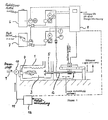
- FIG. 1 A system for carrying out the method according to the invention in accordance with the present description is shown in the diagram in FIG. 1, in which the primary system 1 uses fuel oil, e.g. B. a heavy oil firing with burner 4, and the secondary system 2 comprises a movable lance 5 on the burner 4 opposite side of the furnace 3.
- the aqueous urea solution which supplies the reducing agent, is fed to the combustion chamber via the lance 5.
- the aqueous urea solution is prepared by adding demineralized water (deionized) by means of the metering unit 7 to a stock solution containing the reducing agent in aqueous solution, the mixing ratio being predetermined by a control unit 8.
- the air supply to the lance 5 is also specified by the control unit 8.
- Heating oil is fed to the burner 4 with burner motor and blower 10 via line 9, the solution of the metal compound in the hydrocarbon-containing solvent for influencing the combustion process on the primary side being added via line 11 and the metering device 12 likewise controlled by the control unit 8.
- the control unit 8 takes on two tasks. First, depending on the load, it doses the metal compound dissolved in the solvent via the primary dosing system. Secondly, it uses the secondary metering system to add the reducing agent on the secondary side directly into the flue gas flow depending on the load and depending on the NOx concentration.
- the lance 5 is prepositioned by means of the control unit 8 and readjusted by means of a meshed control loop (cascade control). The consumption of reducing agent is input into the computer of the control unit 8 depending on the load, depending on the load.
- aqueous urea solution with a content of 6% by weight urea is controlled depending on the load and sprayed into the flame tubes of the boiler from behind via movable lances.
- the required amounts of water are metered in by means of metering pumps (one pump per flame tube) by diluting the 40% by weight aqueous urea solution used as the stock solution to about 20 to 0.5, preferably 10 to 2% by weight, the amounts automatically being NOx and be changed depending on the load.
- the data of the steam generator and the oil firing systems are the following: 1. Steam generator data Type: Two-flame smoke flue tube three-pass boiler with superheater Manufacturer: Standard boiler Duisburg Perm. Boiler power: 20 t / h permissible operating pressure: 20 bar Permitted superheated steam temperature: 285 ° C 2. Oil burner system data Type: Rotary atomizer Manufacturer: RAY, Fellbach / Stuttgart Type: 2 x BGEC 700 Oil throughput: 120 - 700 kg / h Type number: 18304 / 82K
- the measuring point was in the flue gas duct after the end of the boiler in front of the flue gas density meter.
- the measuring point fulfills the requirements of VDI guideline 2066, sheet 1 with regard to the trouble-free inlet and outlet sections.
- the fuel throughputs were determined on the existing oil meters.
- ammonia concentration in the exhaust gas was determined with a detection limit of 0.5 mg / m3.
- the fuel used had the following specifications: Additive 30 ppm by weight Ca + 7.5 ppm by weight Fe in the form of oil-soluble compounds ash DIN EN 7 0.07% by weight Asphaltenes DIN 51 595 0.68% by weight nitrogen ASTM 0.31% by weight
- Tables 3 and 4 The main results are summarized in Tables 3 and 4 below. Furthermore, the measured values obtained for the NH3 content are given. The values given relate to dry exhaust gas, standard condition and 3 vol.% 02.
- Table 1 Load range Base load Half load Full load Heating oil consumption at nominal load 1395 kg / h determined heating oil consumption 675 960 1330 kg / h Firing heat output based on nominal output 48.4 68.8 95.3 % Steam pressure boiler (overpressure) 15.8-16.3 14.5-15.0 14.0-14.8 bar Superheated steam temperature 235 240 - 245 245-250 ° C Feed water temp.
- Table 1 shows the operating values achieved with aqueous urea solution.
- Table 2 shows the operating values without the use of aqueous urea solution as reducing agent.
- Table 3 Emissions Readings Base load Half load Full load Dust content mg / m3n - - 41.2-52.8 Soot number - - 1 - 2 Oil derivatives - - no Carbon monoxide content mg / m3n - - 10th Nitrogen dioxide content mg / m3n 371-388 402 - 406 446-450 Ammonia content mg / m3n 5.4 - 5.6 14.4-18.5 16.0-20.8 Emissions Readings Base load Half load Full load Dust content mg / m3n - - 53.0-59.2 Soot number - - 2nd Oil derivatives - - no Carbon monoxide content - - ⁇ 10 Nitrogen dioxide content mg / m3n 537 619 675-678
- the calculated value of the oxide ash gives a value of approx. 59 mg / m3, i.e. the dust content of the exhaust gas was almost carbon-free due to the use of the additive on the primary side.
Landscapes
- Chemical & Material Sciences (AREA)
- Engineering & Computer Science (AREA)
- Oil, Petroleum & Natural Gas (AREA)
- Chemical Kinetics & Catalysis (AREA)
- Organic Chemistry (AREA)
- General Engineering & Computer Science (AREA)
- General Chemical & Material Sciences (AREA)
- Mechanical Engineering (AREA)
- Combustion & Propulsion (AREA)
- Biomedical Technology (AREA)
- Health & Medical Sciences (AREA)
- Environmental & Geological Engineering (AREA)
- Analytical Chemistry (AREA)
- Catalysts (AREA)
- Treating Waste Gases (AREA)
- Exhaust Gas Treatment By Means Of Catalyst (AREA)
- Liquid Carbonaceous Fuels (AREA)
- Solid Fuels And Fuel-Associated Substances (AREA)
- Chimneys And Flues (AREA)
Abstract
Description
- Die Erfindung betrifft ein Verfahren zur selektiven nicht-katalytischen Reduktion der Emission von Schadstoffen aus ölbefeuerten Kesselanlagen unter Zudosierung den Verbrennungsvorgang beeinflussender chemischer Verbindungen zum flüssigen Brennstoff oder zur Verbrennungsluft, hierunter Salze organischer Säuren wie Naphthenate, Octoate, Tallate, Salze von Sulfonsäuren, gesättigten oder ungesättigten Fettsäuren, Ölsäuren, Tallöl mit Metallen aus der Gruppe K, Ba, Mg, Ca, Ce, Mn, Fe, Seltenerdmetallen; Organometallverbindungen wie Carbonylverbindungen, gemischte Cyclopentadienylcarbonylverbindungen oder Aromatenkomplexe der Übergangsmetalle Fe oder Mn insbesondere Ferrocen, Manganocen oder deren Derivate, beispielsweise Ethylferrocen, in mit dem flüssigen Brennstoff mischbaren Lösungen.
- Zum Stand der Technik wird verwiesen auf einen Aufsatz von V. Hoenig und G. Baumbach, erschienen in dem Sammelband der VGB-Konferenz Kraftwerk und Umwelt 1989, Seiten 213 - 217, "Schadstoffminderung bei Schwerölfeuerungen durch Additive: Ruß, SO₃, NOx, dessen nachfolgend zitierte Einleitung das technische Umfeld und das der Erfindung zugrundliegende Problem umreißt.
- Durch die 1983 in der 13. BImSchV (Großfeuerungsanlagenverordnung, GFAVO) und 1986 in der TA Luft eingeführten Schadstoffemissions-Grenzwerte für Feuerungsanlagen stehen auch die Betreiber von Schwerölfeuerungen vor dem Problem, ihre Anlagen umweltfreundlicher betreiben zu müssen. Schweres Heizöl wird heute vorwiegend in der Industrie (Dampf- bzw. Heißwassererzeuger, Prozeßwärme), und in geringem Maße noch in Spitzenlastkraftwerken verbrannt. Die meisten Schwerölfeuerungen liegen in dem der TA Luft unterliegenden Leistungsbereich 50 MWth. Im Bereich der GFAVO sind in der Bundesrepublik Deutschland nur noch wenige Ölkraftwerke in Betrieb.
- Obwohl der Gesamtverbrauch von Heizöl S seit Mitte der 70er Jahre um mehr als die Hälfte zurückgegangen ist, ist sein Einsatz für manche Betreiber nach wie vor interessant. Vor allem wegen der niedrigen Ölpreise hat sich der Schwerölverbrauch in den Jahren 1986/87 stabilisiert.
(Schweres Heizöl fällt bei der Rohölverarbeitung an und wird zu einem Entsorgungsproblem, wenn in einer Vielzahl von sogenannten TA Luft Anlagen kein Heizöl S mehr eingesetzt werden kann.)
Neben den Stickoxidemissionen stellen die Emissionen von SO₂, Staub und von sauren Rauchgasbestandteilen (SO₃, an Flugstaub bzw. Flugkoks absorbierte Schwefelsäure) ein Problem dar. Die SO₂-Grenzwerte der TA Luft lassen sich durch die Verwendung eines schwefelarmen Öls (max. 1 %-Ware) einhalten. Zur Verminderung der NOx-Emission kommen bei diesen Anlagen heute vorwiegend feuerungstechnische Primärmaßnahmen bzw. SNCR-Verfahren (selektive nichtkatalytische Reduktion) zum Einsatz. Eine Möglichkeit, die Emissionen von Ruß und sauren Rauchgasbestandteilen zu reduzieren, stellt die Aufbereitung des Öls mit Additiven dar. Hierzu wurden am Institut für Verfahrenstechnik und Dampfkesselwesen der Universität Stuttgart (IVD) spezielle Untersuchungen durchgeführt. - In dem U.S. Patent 4 208 386 für Arand et al. ist offenbart, Verbrennungsabgase mit Restsauerstoffgehalt und einem Gehalt an NOx mit Harnstoff, entweder als Feststoff oder in einem Lösungsmittel, beispielsweise ein Alkanol mit 1 - 3 Kohlenstoffatomen, Wasser, ein Keton mit 3 - 4 Kohlenstoffatomen, gelöst, bei erhöhter Temperatur in Kontakt zu bringen. Der Harnstoff soll in einer Menge angewandt werden, die wirksam ist, um den NOx- Gehalt in dem Abgas wesentlich zu reduzieren. Die anzuwendenden Temperaturen liegen bei mindestens 1300 °F, wenn ein zusätzliches Reduktionsmittel anwesend ist und bei mindestens 1600 °F in Abwesenheit eines weiteren Reduktionsmittels.
- In dem weiteren U.S. Patent 4 325 924 für Arand et al. wird offenbart, NOx enthaltende Verbrennungsabgase, die aber einen Überschuß an Brennstoff in Bezug auf den stöchiometrischen Sauerstoffbedarf aufweisen, mit Harnstoff entweder als Feststoff oder in Lösung bei Temperaturen oberhalb 1900 °F und in Mengen, die zu einer wesentlichen Verminderung des Gehaltes an NOx ausreichend sind, zu kontaktieren. Hier weist das Äquivalenzverhältnis von Brennstoff zu Sauerstoff einen Wert von größer als 1 : 1, insbesondere größer als 1,05 : 1 und im allgemeinen weniger als 1,5 : 1 auf. Die in einer Tabelle angegebenen erhaltenen Werte weisen in Abhängigkeit von der angewandten Harnstoffkonzentration signifikante Verminderungen der NOx-Konzentration aus, allerdings werden je nach den angewandten Temperatur- und Konzentrationsverhältnissen auch wechselnde Mengen an Ammoniak in dem reduzierten Abgas beobachtet.
- In dem U.S. Patent 3 900 554 ist der Einsatz von Ammoniak zur Reduzierung der Konzentration von Stickoxid (NO) in Verbrennungsabgasen offenbart. Die dem Patent zugrundeliegende Aufgabe ist, NO in Gegenwart von Restsauerstoff im Rauchgas selektiv zu reduzieren. Die Kosten eines Reduktionsmittels in einer solchen selektiven nicht-katalytischen Reduktion von NO würden den kleinen Mengen an zu reduzierendem NO entsprechen und nicht den viel größeren Mengen, die zum Reduzieren von NO sowie dem Restsauerstoff benötigt werden würden.
- Die Patentanmeldung WO 87/02025 betrifft ein Verfahren zum Reduzieren von NOx in einem Abstrom der Verbrennung kohlenstoffhaltiger Brennstoffe unter Sauerstoffüberschuß, wobei die Entstehung C-haltiger Emissionen minimiert ist. Es wird eine Dispersion einer verdünnten wässrigen Harnstofflösung in den Abstrom bei einer Temperatur von oberhalb 2000 °F, vorzugsweise oberhalb 2100 °F, injiziert. Die Konzentration der Harnstofflösung und die Tröpfchengröße in der Dispersion liegen vorzugsweuse bei mindestens 80 Gew.-% Lösungsmittelgehalt und einer Tröpfchengröße im Bereich von 150 - 10000 µm. In den besagten Abstrom wird eine wässrige Lösung von Harnstoff in Gegenwart eines "Oxygenates", beispielsweise Ethylenglykol, als eine Dispersion von Tröpfchen bei einer Temperatur oberhalb 1600 °F injiziert.
- Der Erfindung liegt die Aufgabe zugrunde, den Gehalt an festen Teilverbrennungsprodukten (Koks, Ruß) und eine Minimierung der NOx-Werte im Abgas bei sparsamem Chemikalieneinsatz zu realisieren.
- Die Erfindung ist dadurch gekennzeichnet, daß ein Reduktionsmittel in den Feuerungsraum (Brennerraum) über ein Kesseldosiersystem unter Verwendung eines flüssigen oder auch gasförmigen Trägermittelstroms als wässrige Lösung von Harnstoff oder auch Harnstoffvorläufern wie Ammoniak oder Ammoniumcarbonat, die auch weitere Bestandteile wie Alkanole, Alkancarbonsäuren, Alkanale oder Alkanone enthalten können, zudosiert wird.
- Durch die Kombination dieser Maßnahmen in Verbindung mit dem eingangs bezeichneten Verfahren gelingt es in Bezug auf die Lambda-Zahl der Verbrennungsabgase in einen günstigeren Bereich bezüglich der NOx-Bildung zu kommen und die Aufgabe der Minimierung der NOx-Werte im Abgas bei sparsamem Chemikalieneinsatz zu realisieren. Die Lambda-Zahl kennzeichnet das Luft-Brennstoffgemisch und ist definiert durch das Verhältnis von zugeführter Luftmenge zu theoretischem Luftbedarf.
- Da es sich bei dem der TA Luft unterliegenden Leistungsbereich von etwa bis zu 50 MW thermischer Leistung um den bevorzugten Einsatzbereich von Schwerölfeuerungen handelt, bezieht sich eine bevorzugte Anwendung der Erfindung auf den Einsatz von schwerem Heizöl (Heizöl S).
- Die den Verbrennungsvorgang beeinflussenden chemischen Verbindungen werden vorzugsweise als mit dem flüssigen Brennstoff ohne Mischungslücke mischbare Lösungen über ein last- oder auch emissionsgesteuertes Brennerdosiersystem zugeführt. Ein derartiges Verfahren wird dadurch optimiert, daß einerseits auf den NOx-Gehalt als Steuergröße abgestellt wird, andererseits berücksichtigt wird, daß Feuerungsanlagen der genannten Art auf unterschiedlichen Laststufen betrieben werden.
- Geeignete Lösungsmittel zur Herstellung der Lösungen von chemischen Verbindungen, die den Verbrennungsvorgang beeinflussen, sind z. B. Gasöl, Kerosin oder Spindelöl. Falls Ferrocen als eine solche den Verbrennungsvorgang durch Zugabe zu dem flüssigen Brennstoff oder auch zu der Verbrennungsluft fördernde chemische Verbindung in gelöster Form zugegeben wird, muß ein Lösungsmittel ausgewählt werden, welches aromatische Komponenten z. B. Benzol, Toluol oder Xylole enthält, damit ausreichende Mengen Ferrocen in Lösung gebracht werden können.
- Beim Einsatz von Ferrocen ist ferner zu beachten, daß diese Verbindung umso wirksamer ist, je leichter das als Brennstoff verwendete Öl ist. Demgemäß hat Ferrocen beim Einsatz von Heizöl S keinen nennenswerten Vorteil mehr.
- Ein typisches Beispiel für die Zugabemengen der primärseitig in dem vorliegenden Verfahren anzuwendenden Metallverbindungen sieht wie folgt aus:
15,1 Gew-% Gasöl,
40,5 Gew-% Spindelöl,
37,0 Gew-% Calciumsulfonat,
7,5 Gew-% Eisentallat. - Bevorzugte Bereiche der sich durch Zumischung zu dem eingesetzten flüssigen Brennstoff oder durch Zerstäubung und Einsprühen der eingesetzten Lösung in die Verbrennungsluft ergebenden Metallgehalte in dem brennerseitigen Primärsystem sind die folgenden:
5 bis 200, vorzugsweise 50 bis 60 ppm Calcium (Ca),
3 bis 200, vorzugsweise 5 bis 50 ppm Eisen (Fe),
5 bis 200, vorzugsweise 10 bis 50 ppm Cer (Ce). - Hierbei können auch Kombinationen der Verbindungen der genannten Metalle eingesetzt werden. Falls z. B. Eisen und Calcium in Kombinationn eingesetzt werden, sind Gehalte von 2 bis 20 ppm Eisen und 50 bis 60 ppm Calcium, berechnet auf die Menge des eingesetzten Brennstoffes, bevorzugt.
- Die bevorzugten Mengen der in dem Lösungsmittel gelösten Metallverbindungen hängen auch ab von der Art (Schwere) des eingesetzten Brennstoffes. Bei leichten Ölen sind 3 bis 15 ppm der Metallverbindung, bei schwereren Ölen 10 bis 200 ppm der eingesetzten Metallverbindung(en) bevorzugt, wobei die angegebenen Gehalte auf Metall in dem eingesetzten Brennstoff gerechnet sind.
- Als Reduktionsmittel wird erfindungsgemäß Harnstoff in Form von wässrigen Lösungen in einem sekundärseitigen Kesseldosiersystem mittels im Feuerungsraum in Bezug auf die Brenner - bzw. Feuerungsflammenposition verfahrbarer Dosierlanzen eingesetzt.
- Im allg. wird eine Harnstoffdosierung in Form der wässrigen Lösung ausreichend sein, bei welcher 1 bis 10, vorzugsweise, 2 bis 6 kg Harnstoff pro t eingesetzten Brennstofföles zur Anwendung kommen.
- In einer typischen Fahrweise wird z. B. ein Gewichtsteil einer 40 %igen wässrigen Harnstoffstammlösung mit sechs Gewichtsteilen Wasser vermischt und die resultierende Harnstofflösung mit etwa 6 Gew.-% Harnstoff wird sekundärseitig in den Feuerungsraum von der dem Brenner gegenüberliegenden Seite aus eingesprüht. Die wässrige Harnstofflösung wird direkt in die heißen Verbrennungsgase eingesprüht, wobei ein sog. Temperaturfenster zwischen etwa 800 bis 1000 °C für die aufgabengemäße Minimierung der NOx-Konzentration im Abgas typisch ist.
- Mit der Schwere des eingesetzten Heizöls nimmt u. a. auch der Gehalt an organisch gebundenem Stickstoff zu, welcher ebenfalls die unerwünschte NOx-Bildung bei der Verbrennung fördert. Daher wird man sich bei dem Einsatz von schwerem Heizöl im Verbrauch an Reduktionsmittel eher der oberen Grenze des angegebenen Bereiches von 1 bis 10 kg Harnstoff pro t Brennstoff nähern.
- Als Führungsgröße wird die pro Zeiteinheit benötigte Brennstoffmenge herangezogen, die ohnehin beim Betrieb derartiger industrieller Anlagen zur Kontrolle des Verbrennungsvorganges und der Last ermittelt wird.
- Diese Größe sowie der im Abgasstrom festgestelle NOx-Gehalt werden beispielsweise einem Rechner oder einem Regler zugeführt, der ausgangsseitig auf (eine) im Feuerungsraum in Bezug auf die Brennerpositionen verfahrbare Dosierlanze(n) für das Reduktionsmittel einwirkt und zwar in der Weise, daß der niedrigste NOx-Gehalt im Abgas als Betriebsgröße angesteuert wird.
- Demgemäß besteht eine bevorzugte Ausführungsform der Erfindung darin, die Zugabe des Reduktionsmittels in den Feuerungsraum mittels eines lastabhängigen Kesseldosiersystems in Bezug auf die Position im Feuerungsraum sowie die Konzentration des Reduktionsmittels zu steuern, wobei das Kesseldosiersystem durch in Bezug auf die Brennerpositionen verfahrbare Dosierlanze(n) für das Reduktionsmittel gesteuert wird.
- Das Reduktionsmittel wird so injiziert, daß in Abhängigkeit von der Auslastung der Feuerungsanlage der NOx-Gehalt der Abgase bei vorgegebenem Ruß- bzw. Koksgehalt (= Staubgehalt) minimiert wird.
- Das Funktionsschema eines solchen Systems zur Dosierung des Reduktionsmittels in den Feuerungsraum (Brennerraum) über das Kesseldosiersystem in Form einer wässrigen Lösung von Harnstoff wird anhand der Figur 1 der Zeichnung wie folgt weiter erläutert. Gleichzeitig werden nachfolgend Ergebnisse über Emissionsmessungen an einem Dampferzeuger (einem Zweiflammrohr- Rauchrohr Dreizug-Kessel), der neben Erdgas auch mit schwerem Heizöl befeuert werden kann, mitgeteilt.
- Ein System zur Durchführung des erfindungsgemäßen Verfahrens entsprechend der vorliegenden Beschreibung ist in dem Schema in der Figur 1 gezeigt, in welchem das Primärsystem 1 eine Heizölfeuerung, z. B. eine Schwerölfeuerung mit Brenner 4, und das Sekundärsystem 2 eine verfahrbare Lanze 5 an der dem Brenner 4 gegenüberliegenden Seite des Feuerungsraumes 3 umfaßt. Die wässrige Harnstofflösung, die das Reduktionsmittel liefert, wird dem Feuerungsraum über die Lanze 5 zugeführt. Die wässrige Harnstofflösung wird durch Zumischung von entsalztem Wasser (Deionat) mittel Dosiereinheit 7 zu einer das Reduktionsmittel in wässriger Lösung enthaltenden Stammlösung hergestellt, wobei das Mischungsverhältnis über eine Steuereinheit 8 vorgegeben wird. Die Luftversorgung der Lanze 5 wird ebenfalls durch die Steuereinheit 8 vorgegeben.
- Heizöl wird dem Brenner 4 mit Brennermotor und Gebläse 10 über Leitung 9 zugeführt, wobei die Lösung der Metallverbindung in dem kohlenwasserstoffhaltigen Lösungsmittel zur primärseitigen Beeinflussung des Verbrennungsvorganges über Leitung 11 und die ebenfalls von der Steuereinheit 8 gesteuerte Dosiervorrichtung 12 zugegeben wird.
- Die Steuereinheit 8 übernimmt zwei Aufgaben. Erstens dosiert sie lastabhängig über das primäre Dosiersystem die in dem Lösungsmittel gelöste Metallverbindung. Zweitens nimmt sie mit Hilfe des Sekundärdosiersystems die Zugabe des Reduktionsmittels sekundärseitig direkt in den Rauchgasstrom lastabhängig und in Abhängigkeit von der NOx-Konzentration vor. Die Lanze 5 wird mittels der Steuereinheit 8 vorpositioniert und mittels eines vermaschten Regelkreises (Kaskadenregelung) nachreguliert. Der Verbrauch an Reduktionsmittel wird kesselspezifisch in Abhängigkeit von der Last in den Rechner der Steuereinheit 8 eingegeben.
- Für das Verhalten des Gesamtsystems sind insbesondere der Einfluß des Brennstoffes, der Brennerkonstruktion sowie des Feuerungskessels von Bedeutung, wobei sich der Fachmann darüber klar ist, daß das Gesamtsystem auf den spezifischen Kessel eingeeicht werden muß.
- Die wässrige Harnstofflösung mit einem Gehalt von 6 Gew.-% Harnstoff wird lastabhängig gesteuert und über verfahrbare Lanzen von hinten in die Flammenrohre des Kessels eingesprüht.
- Die benötigten Wassermengen werden mittels Dosierpumpen (eine Pumpe je Flammrohr) unter Verdünnung der als Stammlösung eingesetzten 40 Gew-%igen wässrigen Harnstofflösung auf etwa 20 bis 0,5, vorzugsweise 10 bis 2 Gew.-% zudosiert, wobei die Mengen automatisch NOx - und lastabhängig verändert werden.
- Die Daten des Dampferzeugers und der Ölfeuerungsanlagen sind die folgenden:
1. Daten des Dampferzeugers Bauart: Zweiflammrohr-Rauchrohr-Dreizugkessel mit Überhitzer Hersteller: Standardkessel Duisburg Zul. Kesselleistung: 20 t/h zul. Betriebsüberdruck: 20 bar zul. Heißdampftemperatur: 285 °C 2. Daten des Ölfeuerungsanlage Bauart: Drehzerstäuber Hersteller: RAY, Fellbach/Stuttgart Typ: 2 x BGEC 700 Öldurchsatz: 120 - 700 kg/h Baumusternummer: 18304/82K - Die Meßstelle befand sich im Abgaskanal nach Kesselende vor dem Rauchgasdichtemeßgerät. Die Meßstelle erfüllt in Bezug auf die störungsfreien Ein- und Auslaufstrecken die Anforderungen der VDI Richtlinie 2066, Blatt 1.
- Bei jedem Betriebszustand wurden 1 bis 2 Messungen von 30 Minuten Dauer durchgeführt.
- Es wurden gemessen:

- Die Brennstoffdurchsätze wurden an den vorhandenen Ölzählern bestimmt.
- Ferner wurde die Ammoniakkonzentration im Abgas mit einer Nachweisgrenze von 0,5 mg/m³ bestimmt.
- Der eingesetzte Brennstoff wies die folgenden Spezifikationen auf:
Additiv 30 Gew.-ppm Ca + 7,5 Gew.-ppm Fe in Form öllöslicher Verbindungen Asche DIN EN 7 0,07 Gew.-% Asphaltene DIN 51 595 0,68 Gew.-% Stickstoff ASTM 0,31 Gew.-% - Die wesentlichen Ergebnisse sind in den folgenden Tabellen 3 und 4 zusammengefaßt. Ferner sind die erhaltenen Meßwerte für den NH₃-Gehalt angegeben. Die angegebenen Werte beziehen sich auf trockenes Abgas, Normzustand und 3 Vol.-% 0₂.
Tabelle 1: Lastbereich Grundlast Halblast Vollast Heizölverbrauch bei Nennlast 1395 kg/h ermittelter Heizölverbrauch 675 960 1330 kg/h Feuerungswärmeleistung bezogen auf Nennleistung 48,4 68,8 95,3 % Dampfdruck Kessel (Überdruck) 15,8-16,3 14,5-15,0 14,0-14,8 bar Heißdampftemperatur 235 240 - 245 245- 250 °C Speisewassertemp. vor Eco 105 105 105 °C O₂-Gehalt 31,1 3,6 3,1 3,1 3,1 2,8 2,8 % Abgastemperatur 166 165 175 175 176 189 189 °C Staubgehalt - - - - - 53,4 41,7 mg/m³n desgl. bez. auf 3% O₂ - - - - - 52,8 41,2 mg/m³n Rußzahl - - - - - 1-2 1-2 Ölderivate - - - - - keine keine CO-Gehalt - - - - - 10 10 mg/m³n desgl. bez. auf 3% O₂ - - - - - 10 10 mg/m³n NOX berechnet als NO₂ 396 375 400 404 402 455 451 mg/m³n desgl. bez. auf 3% O₂ 371 388 402 406 404 450 446 mg/m³n Verbrauch-Reduktionsmittel 2,9 2,9 11,75 11,75 11,75 25,9 25,9 1/h NH3-Gehalt 5,4 5,4 14,3 18,4 15,4 21,0 16,2 mg/m³n desgl. bez. auf 3% O₂ 5,4 5,6 14,4 18,5 15,5 20,8 16,0 mg/m³n Tabelle 2: Lastbereich Grundlast Halblast Vollast Heizölverbrauch bei Nennlast 1380 kg/h ermittelter Heizölverbrauch 666 953 1316 kg/h Feuerungswärmeleistung bezogen auf Nennleistung 48,3 69,1 95,4 % Dampfdruck Kessel (Überdruck) 13,5 - 15,0 15,7 14,7 - 15,5 bar Heißdampftemp. 230 - 233 245 - 250 247 - 250 °C Speisewassertemp. vor Eco 105 105 105 °C O₂ Gehalt 3,6 3,0 3,1 2,8 % Abgastemperatur 166 178 192 192 °C Staubgehalt - - 58,9 53,6 mg/m³n desgl. bez. auf 3% O₂ - - 59,2 53,0 mg/m³n Rußzahl - - 2 2 Ölderivate - - keine keine CO-Gehalt - - <10 <10 mg/m³n desgl. bez. auf 3% O₂ - - <10 <10 mg/m³n NOX berechnet als NO₂ 519 619 674 683 mg/m³n desgl. bez. auf 3% O₂ 537 619 678 675 mg/m³n - In der Tabelle 1 sind die mit wässriger Harnstofflösung erzielten Betriebswerte angegeben. In der Tabelle 2 sind als Vergleichsversuch die Betriebswerte ohne den Einsatz von wässriger Harnstofflösung als Reduktionsmittel angegeben.
Tabelle 3: Emissionen Meßwerte Grundlast Halblast Vollast Staubgehalt mg/m³n - - 41,2-52,8 Rußzahl - - 1 - 2 Ölderivate - - keine Kohlenmonoxidgehalt mg/m³n - - 10 Stickstoffdioxidgehalt mg/m³n 371 - 388 402 - 406 446 - 450 Ammoniakgehalt mg/m³n 5,4 - 5,6 14,4-18,5 16,0-20,8 Tabelle 4: Emissionen Meßwerte Grundlast Halblast Vollast Staubgehalt mg/m³n - - 53,0-59,2 Rußzahl - - 2 Ölderivate - - keine Kohlenmonoxidgehalt - - <10 Stickstoffdioxidgehalt mg/m³n 537 619 675-678 - Wie aus den Tabellen 3 und 4 sowie der Figur 2 der Zeichnung, in der die erhaltenen Meßwerte graphisch dargestellt sind, ersichtlich ist, wurden beim Einsatz von wässrigen Harnstofflösungen als Reduktionsmittel in Verbindung mit den in dem Brennstoff als Additive zugesetzten öllöslichen Verbindungen Calciumsulfonat und Eisen(II)-tallat die Stickstoffoxidgehalte im Abgas um etwa ein Drittel gesenkt.
- In allen Lastzuständen wurde der in der TA Luft vom Februar 1986 angegebene Grenzwert von 450 mg/m

- Im Bezug auf den Staubgehalt werden bei vergleichbarer Rußzahl und vergleichbarem Kohlenmonoxidgehalt Staubmeßwerte von 41,7 bis 58,9 mg/m

- Der rechnerische Wert der Oxidasche ergibt einen Wert von ca. 59 mg/m³, d.h. der Staubgehalt des Abgases war durch den Einsatz des primärseitigen Additives nahezu kohlenstoffrei.
- Durch das erfindungsgemäße Verfahren gelingt est, in Bezug auf die Lambda-Zahl der Verbrennungsabgase in einen günstigen Bereich bezüglich der NOx-Bildung zu kommen und in Kombination mit dem Kesseldosiersystem zur NOx-Reduzierung auch eine Minimierung der NOx-Werte im Abgas bei wirksamer Reduzierung des Gehaltes an festen Teilverbrennungsprodukten (Koks, Ruß) und sparsamem Chemikalieneinsatz zu realiseren.
Claims (7)
Priority Applications (1)
| Application Number | Priority Date | Filing Date | Title |
|---|---|---|---|
| EP90117723A EP0426978B1 (de) | 1989-09-15 | 1990-09-14 | Verfahren zur selektiven nicht-katalytischen Reduktion der Emission von Schadstoffen aus ölbefeuerten Kesselanlagen |
Applications Claiming Priority (5)
| Application Number | Priority Date | Filing Date | Title |
|---|---|---|---|
| DE3930851 | 1989-09-15 | ||
| DE3930851 | 1989-09-15 | ||
| EP90107062 | 1990-04-12 | ||
| EP90107062A EP0423417A1 (de) | 1989-09-15 | 1990-04-12 | Verfahren zur selektiven nichtkatalytischen Reduktion der Emission von Schadstoffen aus ölbefeuerten Kesselanlagen |
| EP90117723A EP0426978B1 (de) | 1989-09-15 | 1990-09-14 | Verfahren zur selektiven nicht-katalytischen Reduktion der Emission von Schadstoffen aus ölbefeuerten Kesselanlagen |
Publications (2)
| Publication Number | Publication Date |
|---|---|
| EP0426978A1 true EP0426978A1 (de) | 1991-05-15 |
| EP0426978B1 EP0426978B1 (de) | 1996-06-26 |
Family
ID=25885204
Family Applications (1)
| Application Number | Title | Priority Date | Filing Date |
|---|---|---|---|
| EP90117723A Revoked EP0426978B1 (de) | 1989-09-15 | 1990-09-14 | Verfahren zur selektiven nicht-katalytischen Reduktion der Emission von Schadstoffen aus ölbefeuerten Kesselanlagen |
Country Status (6)
| Country | Link |
|---|---|
| EP (1) | EP0426978B1 (de) |
| AT (1) | ATE139712T1 (de) |
| DE (1) | DE59010391D1 (de) |
| DK (1) | DK0426978T3 (de) |
| ES (1) | ES2088932T3 (de) |
| GR (1) | GR3020373T3 (de) |
Cited By (16)
| Publication number | Priority date | Publication date | Assignee | Title |
|---|---|---|---|---|
| WO1993023147A1 (en) * | 1992-05-18 | 1993-11-25 | Gothia Tool Trading Hb | Reducing proceeding and/or a system to intermix and means for the same |
| WO1996007717A1 (de) * | 1994-09-02 | 1996-03-14 | Chemische Betriebe Pluto Gmbh | Pumpfähige paste zur additivierung flüssiger kraftstoffe |
| WO1996026255A1 (fr) * | 1995-02-24 | 1996-08-29 | Rhone-Poulenc Chimie | Utilisation d'un compose de cerium pour la protection des moteurs a combustion interne |
| EP0807677A3 (de) * | 1996-05-14 | 1998-01-07 | Ethyl Corporation | Verbesserte Kohlenwasserstoffenbrennerkraftstoffeverbrennung |
| FR2751662A1 (fr) * | 1996-07-29 | 1998-01-30 | Total Raffinage Distribution | Composition organometalliques mixtes, comprenant au moins trois metaux, et leurs applications comme additifs pour combustibles ou carburants |
| DE19731546A1 (de) * | 1997-07-23 | 1999-02-04 | Erc Emissions Reduzierungs Con | Verfahren, Vorrichtung und Mittel zur selektiven Reduktion von Stickoxiden in Rauchgasen von Kesselanlagen |
| FR2768155A1 (fr) * | 1997-09-11 | 1999-03-12 | Rhodia Chimie Sa | Composition a base d'un sol organique d'oxyde tetravalent, et d'un compose organique d'alcalin ou d'alcalino-terreux, son utilisation comme additif de composes hydrocarbones |
| WO2001040415A3 (en) * | 1999-12-03 | 2002-01-03 | Icerp Sa | Additive for preventing deposits and corrosion of heating furnaces or steam generators, and method for its obtaining |
| EP1233235A2 (de) | 2001-02-19 | 2002-08-21 | ERC Emissions-Reduzierungs-Concepte GmbH | Verfahren und Vorrichtung zum Reduzieren der sauren Schadstoffemissionen von Industrieanlagen |
| FR2837214A1 (fr) * | 2002-03-12 | 2003-09-19 | Marcel Bonnaud | Procede pour combattre la formation des oxydes de soufre et d'azote resultant de la combustion des hydrocarbures liquides ou gazeux et du charbon et du bois |
| EP1487944A4 (de) * | 2002-03-22 | 2010-08-04 | Clean Diesel Tech Inc | Katalytisch wirksames metall enthaltende additivzusammensetzung und herstellungsverfahren und verwendung |
| CN102553405A (zh) * | 2010-12-20 | 2012-07-11 | 邱吉康 | 燃油锅炉的二次联合烟气脱硝装置及其烟气脱硝方法 |
| CN103113937A (zh) * | 2013-03-18 | 2013-05-22 | 江苏丽港稀土材料有限公司 | 一种铈基稀土催化助燃剂及其制备方法 |
| DE102018101865A1 (de) | 2018-01-28 | 2019-08-01 | Erc Emissions-Reduzierungs-Concepte Gmbh | Verfahren zur Stickoxidreduzierung in Rauchgasen von Abfallverbrennungsanlagen |
| DE102018101866A1 (de) | 2018-01-28 | 2019-08-01 | Erc Emissions-Reduzierungs-Concepte Gmbh | Rechnergestützes Verfahren zur Stickoxidreduzierung in Rauchgasen von Abfallverbrennungsanlagen |
| CN113877392A (zh) * | 2020-07-01 | 2022-01-04 | 中冶长天国际工程有限责任公司 | 一种烟气高温脱硝的复合氨剂及其制备方法和用途 |
Families Citing this family (5)
| Publication number | Priority date | Publication date | Assignee | Title |
|---|---|---|---|---|
| DE102014101021A1 (de) | 2014-01-28 | 2015-07-30 | Erc Emissions-Reduzierungs-Concepte Gmbh | Verfahren zum Eindüsen eines flüssigen Reduktionsmittels in einen Abgasstrom |
| DE102015117316B4 (de) | 2015-10-12 | 2017-08-10 | Erc Emissions-Reduzierungs-Concepte Gmbh | Verfahren zur Entstickung von Abgasen |
| DE102019127869B4 (de) * | 2019-10-16 | 2022-02-03 | Cmv Systems Gmbh & Co. Kg | Verfahren und Vorrichtung zur selektiven nicht-katalytischen Reduktion von Stickoxiden in Rauchgasen |
| DE202020100584U1 (de) | 2020-02-03 | 2020-03-19 | Erc Emissions-Reduzierungs-Concepte Gmbh | Zerstäuberdüse zum Eindüsen eines Reduktionsmittels in das Rauchgas einer Verbrennungsanlage |
| DE102020106213A1 (de) | 2020-03-06 | 2021-09-09 | Erc Emissions-Reduzierungs-Concepte Gmbh | Verfahren und Vorrichtung zur selektiven nicht-katalytischen Reduktion von Stickoxiden in Abgasen |
Citations (10)
| Publication number | Priority date | Publication date | Assignee | Title |
|---|---|---|---|---|
| US3900554A (en) | 1973-03-16 | 1975-08-19 | Exxon Research Engineering Co | Method for the reduction of the concentration of no in combustion effluents using ammonia |
| DE2803876A1 (de) * | 1977-01-31 | 1978-08-03 | Kurashiki Boseki Kk | Verfahren und einrichtung zur ermittlung der zusammensetzung eines einer stickstoffoxid-abtrenneinheit zugeleiteten gasstromes |
| US4166724A (en) * | 1971-10-08 | 1979-09-04 | Mitsuhiro Kanao | Fuel composition |
| US4208386A (en) | 1976-03-03 | 1980-06-17 | Electric Power Research Institute, Inc. | Urea reduction of NOx in combustion effluents |
| US4325924A (en) | 1977-10-25 | 1982-04-20 | Electric Power Research Institute, Inc. | Urea reduction of NOx in fuel rich combustion effluents |
| DE3530277A1 (de) * | 1985-08-24 | 1987-02-26 | Hoelter Heinz | Simultane so(pfeil abwaerts)2(pfeil abwaerts)- und no(pfeil abwaerts)x(pfeil abwaerts)-abscheidung vorzugsweise bei wirbelbettfeuerungsanlagen |
| WO1987002025A1 (en) | 1985-10-04 | 1987-04-09 | Fuel Tech, Inc. | Reduction of nitrogen- and carbon-based pollutants through the use of urea solutions |
| EP0263183A1 (de) * | 1986-03-14 | 1988-04-13 | Mitsubishi Jukogyo Kabushiki Kaisha | NH3-Einspritzregler |
| EP0270719A1 (de) * | 1986-12-12 | 1988-06-15 | TECHNIQUE FRANCAISE DE DETARTRAGE dite T.F.D., Société Anonyme | Verfahren zur Reduzierung von nichtverbrannten Anteilen bei der Verbrennung und Agens zu dessen Durchführung |
| DE3722523C1 (en) * | 1987-07-08 | 1988-06-30 | Babcock Anlagen Ag | Furnace with nozzles for blowing in ammonia for selective noncatalytic flue gas denitration (SNCR) |
-
1990
- 1990-09-14 AT AT90117723T patent/ATE139712T1/de not_active IP Right Cessation
- 1990-09-14 ES ES90117723T patent/ES2088932T3/es not_active Expired - Lifetime
- 1990-09-14 DE DE59010391T patent/DE59010391D1/de not_active Expired - Fee Related
- 1990-09-14 DK DK90117723.8T patent/DK0426978T3/da active
- 1990-09-14 EP EP90117723A patent/EP0426978B1/de not_active Revoked
-
1996
- 1996-06-27 GR GR960401744T patent/GR3020373T3/el unknown
Patent Citations (10)
| Publication number | Priority date | Publication date | Assignee | Title |
|---|---|---|---|---|
| US4166724A (en) * | 1971-10-08 | 1979-09-04 | Mitsuhiro Kanao | Fuel composition |
| US3900554A (en) | 1973-03-16 | 1975-08-19 | Exxon Research Engineering Co | Method for the reduction of the concentration of no in combustion effluents using ammonia |
| US4208386A (en) | 1976-03-03 | 1980-06-17 | Electric Power Research Institute, Inc. | Urea reduction of NOx in combustion effluents |
| DE2803876A1 (de) * | 1977-01-31 | 1978-08-03 | Kurashiki Boseki Kk | Verfahren und einrichtung zur ermittlung der zusammensetzung eines einer stickstoffoxid-abtrenneinheit zugeleiteten gasstromes |
| US4325924A (en) | 1977-10-25 | 1982-04-20 | Electric Power Research Institute, Inc. | Urea reduction of NOx in fuel rich combustion effluents |
| DE3530277A1 (de) * | 1985-08-24 | 1987-02-26 | Hoelter Heinz | Simultane so(pfeil abwaerts)2(pfeil abwaerts)- und no(pfeil abwaerts)x(pfeil abwaerts)-abscheidung vorzugsweise bei wirbelbettfeuerungsanlagen |
| WO1987002025A1 (en) | 1985-10-04 | 1987-04-09 | Fuel Tech, Inc. | Reduction of nitrogen- and carbon-based pollutants through the use of urea solutions |
| EP0263183A1 (de) * | 1986-03-14 | 1988-04-13 | Mitsubishi Jukogyo Kabushiki Kaisha | NH3-Einspritzregler |
| EP0270719A1 (de) * | 1986-12-12 | 1988-06-15 | TECHNIQUE FRANCAISE DE DETARTRAGE dite T.F.D., Société Anonyme | Verfahren zur Reduzierung von nichtverbrannten Anteilen bei der Verbrennung und Agens zu dessen Durchführung |
| DE3722523C1 (en) * | 1987-07-08 | 1988-06-30 | Babcock Anlagen Ag | Furnace with nozzles for blowing in ammonia for selective noncatalytic flue gas denitration (SNCR) |
Non-Patent Citations (2)
| Title |
|---|
| V. HOENIG; G. BAUMBACH, SAMMELBAND DER VGB-KONFERENZ KRAFTWERK UND UMWELT, 1989, pages 213 - 217 |
| VGB - KONFERENZ KRAFTWERK UND UMWELT, 1989, Seiten 213-217; V. HOENIG et al.: "Schadstoffminderung bei Schwerölfeuerungen durch Additive: Russ, SO3, NOx" * |
Cited By (25)
| Publication number | Priority date | Publication date | Assignee | Title |
|---|---|---|---|---|
| WO1993023147A1 (en) * | 1992-05-18 | 1993-11-25 | Gothia Tool Trading Hb | Reducing proceeding and/or a system to intermix and means for the same |
| WO1996007717A1 (de) * | 1994-09-02 | 1996-03-14 | Chemische Betriebe Pluto Gmbh | Pumpfähige paste zur additivierung flüssiger kraftstoffe |
| WO1996026255A1 (fr) * | 1995-02-24 | 1996-08-29 | Rhone-Poulenc Chimie | Utilisation d'un compose de cerium pour la protection des moteurs a combustion interne |
| FR2731009A1 (fr) * | 1995-02-24 | 1996-08-30 | Rhone Poulenc Chimie | Procede de protection des moteurs a combustion interne et application de compose a base de cerium a la protection des moteurs contre l'usure et l'oxydation |
| EP0807677A3 (de) * | 1996-05-14 | 1998-01-07 | Ethyl Corporation | Verbesserte Kohlenwasserstoffenbrennerkraftstoffeverbrennung |
| CN1086730C (zh) * | 1996-07-29 | 2002-06-26 | 多塔乐精制销售有限公司 | 含有至少三种金属的混合有机金属组合物及其作为燃料添加剂的应用 |
| US6096104A (en) * | 1996-07-29 | 2000-08-01 | Total Raffinage Distribution S.A. | Mixed organometallic compositions including at least three metals, and uses thereof as fuel additives |
| WO1998004655A1 (fr) * | 1996-07-29 | 1998-02-05 | Total Raffinage Distribution S.A. | Compositions organometalliques mixtes, comprenant au moins trois metaux, et leurs applications comme additifs pour combustibles ou carburants |
| FR2751662A1 (fr) * | 1996-07-29 | 1998-01-30 | Total Raffinage Distribution | Composition organometalliques mixtes, comprenant au moins trois metaux, et leurs applications comme additifs pour combustibles ou carburants |
| DE19731546C2 (de) * | 1997-07-23 | 2002-11-07 | Erc Emissions Reduzierungs Con | Verfahren und Mittel zur selektiven Reduktion von Stickoxiden in Rauchgasen von Kesselanlagen |
| DE19731546A1 (de) * | 1997-07-23 | 1999-02-04 | Erc Emissions Reduzierungs Con | Verfahren, Vorrichtung und Mittel zur selektiven Reduktion von Stickoxiden in Rauchgasen von Kesselanlagen |
| WO1999013026A1 (fr) * | 1997-09-11 | 1999-03-18 | Rhodia Chimie | Composition a base d'un sol organique d'oxyde de metal tetravalent et d'un compose organique d'alcalino-terreux |
| FR2768155A1 (fr) * | 1997-09-11 | 1999-03-12 | Rhodia Chimie Sa | Composition a base d'un sol organique d'oxyde tetravalent, et d'un compose organique d'alcalin ou d'alcalino-terreux, son utilisation comme additif de composes hydrocarbones |
| WO2001040415A3 (en) * | 1999-12-03 | 2002-01-03 | Icerp Sa | Additive for preventing deposits and corrosion of heating furnaces or steam generators, and method for its obtaining |
| EP1233235A2 (de) | 2001-02-19 | 2002-08-21 | ERC Emissions-Reduzierungs-Concepte GmbH | Verfahren und Vorrichtung zum Reduzieren der sauren Schadstoffemissionen von Industrieanlagen |
| FR2837214A1 (fr) * | 2002-03-12 | 2003-09-19 | Marcel Bonnaud | Procede pour combattre la formation des oxydes de soufre et d'azote resultant de la combustion des hydrocarbures liquides ou gazeux et du charbon et du bois |
| EP1487944A4 (de) * | 2002-03-22 | 2010-08-04 | Clean Diesel Tech Inc | Katalytisch wirksames metall enthaltende additivzusammensetzung und herstellungsverfahren und verwendung |
| CN102553405A (zh) * | 2010-12-20 | 2012-07-11 | 邱吉康 | 燃油锅炉的二次联合烟气脱硝装置及其烟气脱硝方法 |
| CN102553405B (zh) * | 2010-12-20 | 2015-04-08 | 邱吉康 | 燃油锅炉的二次联合烟气脱硝装置及其烟气脱硝方法 |
| CN103113937A (zh) * | 2013-03-18 | 2013-05-22 | 江苏丽港稀土材料有限公司 | 一种铈基稀土催化助燃剂及其制备方法 |
| CN103113937B (zh) * | 2013-03-18 | 2015-03-11 | 江苏丽港科技有限公司 | 一种铈基稀土催化助燃剂及其制备方法 |
| DE102018101865A1 (de) | 2018-01-28 | 2019-08-01 | Erc Emissions-Reduzierungs-Concepte Gmbh | Verfahren zur Stickoxidreduzierung in Rauchgasen von Abfallverbrennungsanlagen |
| DE102018101866A1 (de) | 2018-01-28 | 2019-08-01 | Erc Emissions-Reduzierungs-Concepte Gmbh | Rechnergestützes Verfahren zur Stickoxidreduzierung in Rauchgasen von Abfallverbrennungsanlagen |
| CN113877392A (zh) * | 2020-07-01 | 2022-01-04 | 中冶长天国际工程有限责任公司 | 一种烟气高温脱硝的复合氨剂及其制备方法和用途 |
| CN113877392B (zh) * | 2020-07-01 | 2023-06-23 | 中冶长天国际工程有限责任公司 | 一种烟气高温脱硝的复合氨剂及其制备方法和用途 |
Also Published As
| Publication number | Publication date |
|---|---|
| GR3020373T3 (en) | 1996-09-30 |
| EP0426978B1 (de) | 1996-06-26 |
| DE59010391D1 (de) | 1996-08-01 |
| ATE139712T1 (de) | 1996-07-15 |
| ES2088932T3 (es) | 1996-10-01 |
| DK0426978T3 (da) | 1996-07-29 |
Similar Documents
| Publication | Publication Date | Title |
|---|---|---|
| EP0426978B1 (de) | Verfahren zur selektiven nicht-katalytischen Reduktion der Emission von Schadstoffen aus ölbefeuerten Kesselanlagen | |
| EP0423417A1 (de) | Verfahren zur selektiven nichtkatalytischen Reduktion der Emission von Schadstoffen aus ölbefeuerten Kesselanlagen | |
| DE3688741T2 (de) | Verminderung der stickstoff- und kohlenstoffhaltigen schadstoffe mittels harnstofflösungen. | |
| DE3687656T2 (de) | Ermaessigung stickstoffhaltiger schadstoffe durch verwendung von sauerstoffhaltiges kohlenwasserstoffloesungsmittel aufweisendem harnstoffloesungen. | |
| DE69821505T2 (de) | Verfahren zur herstellung von ammonium aus harnstoff und anwendung dieses verfahrens | |
| DE4023030C2 (de) | Trockenverfahren zur Behandlung von Verbrennungsabgasen | |
| DE3132224C2 (de) | ||
| DE69427744T2 (de) | Methode zur entfernung von in abgas enthaltenen stickstoffoxyden | |
| DE2411672A1 (de) | Verfahren zur reduzierung von no in verbrennungsabgasen | |
| DE2320304C2 (de) | Verfahren zur thermischen Behandlung eines Verbrennungsabgases | |
| DE69110670T2 (de) | Verfahren zur reduktion von stickstoffoxiden ohne erzeugung von distickstoffmonoxid. | |
| DE2630202A1 (de) | Verfahren zum reduzieren von stickoxiden in verbrennungsabgasen | |
| EP0350706B1 (de) | Verfahren zur Minderung von Stickoxiden (NOx) aus Feuerungsabgasen | |
| DE2232506C2 (de) | Verfahren und Vorrichtung zur Erzeugung eines durch katalytische Umsetzung von Brennstoff und einem als Sauerstoffträger dienenden Gas zu bildenden Gasgemisches | |
| DE2944153C2 (de) | Verfahren zur Verminderung der NO&darr;x&darr; - und/oder SO&darr;2&darr;-Emmission bei der Verbrennung von Brennstoffen | |
| DE68918587T2 (de) | Ermässigung des gehaltes an stickstoffmonooxyds durch sublimation von cyanürsäure. | |
| DE69417955T2 (de) | Kraftstoffzusätze | |
| DE68924594T2 (de) | Mehrstufenverfahren zur minderung der konzentration an schadstoffen in einem abgas unter verwendung von ammoniumsalzen. | |
| DE2500683B2 (de) | Verfahren zur katalytischen entgiftung von verbrennungsabgasen und brennstoffe zur durchfuehrung des verfahrens | |
| EP0342184A2 (de) | Verfahren zur Entfernung von Stickoxiden mittels fester Reduktionsmittel | |
| CH626976A5 (de) | ||
| DD264274B5 (de) | Verfahren zur Verminderung der Stickoxide in einem Rauchgas sowie dementsprechende Rauchgasleitung | |
| DE4436389C2 (de) | Vorrichtung und Verfahren zur Reduzierung von NO¶x¶-Emissionen | |
| DE2844274A1 (de) | Verfahren und vorrichtung zur adsorption von verunreinigungen | |
| DE2717528A1 (de) | Verfahren zum reinigen von verbrennungsabgasen |
Legal Events
| Date | Code | Title | Description |
|---|---|---|---|
| PUAI | Public reference made under article 153(3) epc to a published international application that has entered the european phase |
Free format text: ORIGINAL CODE: 0009012 |
|
| 17P | Request for examination filed |
Effective date: 19900928 |
|
| AK | Designated contracting states |
Kind code of ref document: A1 Designated state(s): AT BE CH DE DK ES FR GB GR IT LI LU NL SE |
|
| 17Q | First examination report despatched |
Effective date: 19911210 |
|
| RAP1 | Party data changed (applicant data changed or rights of an application transferred) |
Owner name: ERC EMISSIONS-REDUZIERUNGSKONZEPTE GMBH |
|
| RAP3 | Party data changed (applicant data changed or rights of an application transferred) |
Owner name: ERC EMISSIONS-REDUZIERUNGS-CONCEPTE GMBH |
|
| 19A | Proceedings stayed before grant |
Effective date: 19950125 |
|
| GRAA | (expected) grant |
Free format text: ORIGINAL CODE: 0009210 |
|
| 19F | Resumption of proceedings before grant (after stay of proceedings) |
Effective date: 19960506 |
|
| AK | Designated contracting states |
Kind code of ref document: B1 Designated state(s): AT BE CH DE DK ES FR GB GR IT LI LU NL SE |
|
| REF | Corresponds to: |
Ref document number: 139712 Country of ref document: AT Date of ref document: 19960715 Kind code of ref document: T |
|
| REG | Reference to a national code |
Ref country code: CH Ref legal event code: NV Representative=s name: TROESCH SCHEIDEGGER WERNER AG |
|
| REG | Reference to a national code |
Ref country code: DK Ref legal event code: T3 |
|
| REF | Corresponds to: |
Ref document number: 59010391 Country of ref document: DE Date of ref document: 19960801 |
|
| REG | Reference to a national code |
Ref country code: GR Ref legal event code: FG4A Free format text: 3020373 |
|
| GBT | Gb: translation of ep patent filed (gb section 77(6)(a)/1977) |
Effective date: 19960813 |
|
| PGFP | Annual fee paid to national office [announced via postgrant information from national office to epo] |
Ref country code: ES Payment date: 19960917 Year of fee payment: 7 |
|
| ET | Fr: translation filed | ||
| ITF | It: translation for a ep patent filed | ||
| PG25 | Lapsed in a contracting state [announced via postgrant information from national office to epo] |
Ref country code: DK Effective date: 19960926 |
|
| REG | Reference to a national code |
Ref country code: DK Ref legal event code: EBP |
|
| PG25 | Lapsed in a contracting state [announced via postgrant information from national office to epo] |
Ref country code: LU Free format text: LAPSE BECAUSE OF NON-PAYMENT OF DUE FEES Effective date: 19960930 |
|
| REG | Reference to a national code |
Ref country code: ES Ref legal event code: FG2A Ref document number: 2088932 Country of ref document: ES Kind code of ref document: T3 |
|
| REG | Reference to a national code |
Ref country code: ES Ref legal event code: FG2A Ref document number: 2088932 Country of ref document: ES Kind code of ref document: T3 |
|
| PLBQ | Unpublished change to opponent data |
Free format text: ORIGINAL CODE: EPIDOS OPPO |
|
| PLBI | Opposition filed |
Free format text: ORIGINAL CODE: 0009260 |
|
| PGFP | Annual fee paid to national office [announced via postgrant information from national office to epo] |
Ref country code: CH Payment date: 19961202 Year of fee payment: 7 |
|
| 26 | Opposition filed |
Opponent name: FUEL TECH GMBH Effective date: 19961114 |
|
| PLBI | Opposition filed |
Free format text: ORIGINAL CODE: 0009260 |
|
| PLBQ | Unpublished change to opponent data |
Free format text: ORIGINAL CODE: EPIDOS OPPO |
|
| NLR1 | Nl: opposition has been filed with the epo |
Opponent name: FUEL TECH GMBH |
|
| PLBQ | Unpublished change to opponent data |
Free format text: ORIGINAL CODE: EPIDOS OPPO |
|
| PLBI | Opposition filed |
Free format text: ORIGINAL CODE: 0009260 |
|
| PLAV | Examination of admissibility of opposition |
Free format text: ORIGINAL CODE: EPIDOS OPEX |
|
| PLBQ | Unpublished change to opponent data |
Free format text: ORIGINAL CODE: EPIDOS OPPO |
|
| PG25 | Lapsed in a contracting state [announced via postgrant information from national office to epo] |
Ref country code: NL Effective date: 19970401 |
|
| PLBI | Opposition filed |
Free format text: ORIGINAL CODE: 0009260 |
|
| 26 | Opposition filed |
Opponent name: STANDARD-KESSEL-GESELLSCHAFT LENTJES-FASEL GMBH & Effective date: 19970214 Opponent name: FUEL TECH GMBH Effective date: 19961114 |
|
| 26 | Opposition filed |
Opponent name: BYCOSIN GMBH & CO. KG Effective date: 19970317 Opponent name: STANDARD-KESSEL-GESELLSCHAFT LENTJES-FASEL GMBH & Effective date: 19970214 Opponent name: FUEL TECH GMBH Effective date: 19961114 |
|
| 26 | Opposition filed |
Opponent name: PAPIERFABRIK MELDORF GMBH & CO. KG Effective date: 19970326 Opponent name: BYCOSIN GMBH & CO. KG Effective date: 19970317 Opponent name: STANDARD-KESSEL-GESELLSCHAFT LENTJES-FASEL GMBH & Effective date: 19970214 Opponent name: FUEL TECH GMBH Effective date: 19961114 |
|
| NLV4 | Nl: lapsed or anulled due to non-payment of the annual fee |
Effective date: 19970401 |
|
| PLBF | Reply of patent proprietor to notice(s) of opposition |
Free format text: ORIGINAL CODE: EPIDOS OBSO |
|
| PGFP | Annual fee paid to national office [announced via postgrant information from national office to epo] |
Ref country code: SE Payment date: 19970821 Year of fee payment: 8 |
|
| PGFP | Annual fee paid to national office [announced via postgrant information from national office to epo] |
Ref country code: GR Payment date: 19970822 Year of fee payment: 8 |
|
| PG25 | Lapsed in a contracting state [announced via postgrant information from national office to epo] |
Ref country code: ES Free format text: LAPSE BECAUSE OF NON-PAYMENT OF DUE FEES Effective date: 19970915 |
|
| PG25 | Lapsed in a contracting state [announced via postgrant information from national office to epo] |
Ref country code: LI Free format text: LAPSE BECAUSE OF NON-PAYMENT OF DUE FEES Effective date: 19970930 Ref country code: CH Free format text: LAPSE BECAUSE OF NON-PAYMENT OF DUE FEES Effective date: 19970930 |
|
| PLBF | Reply of patent proprietor to notice(s) of opposition |
Free format text: ORIGINAL CODE: EPIDOS OBSO |
|
| RDAH | Patent revoked |
Free format text: ORIGINAL CODE: EPIDOS REVO |
|
| APAC | Appeal dossier modified |
Free format text: ORIGINAL CODE: EPIDOS NOAPO |
|
| APAE | Appeal reference modified |
Free format text: ORIGINAL CODE: EPIDOS REFNO |
|
| APAE | Appeal reference modified |
Free format text: ORIGINAL CODE: EPIDOS REFNO |
|
| APAC | Appeal dossier modified |
Free format text: ORIGINAL CODE: EPIDOS NOAPO |
|
| REG | Reference to a national code |
Ref country code: CH Ref legal event code: PL |
|
| PG25 | Lapsed in a contracting state [announced via postgrant information from national office to epo] |
Ref country code: SE Free format text: LAPSE BECAUSE OF NON-PAYMENT OF DUE FEES Effective date: 19980915 |
|
| PG25 | Lapsed in a contracting state [announced via postgrant information from national office to epo] |
Ref country code: GR Free format text: LAPSE BECAUSE OF NON-PAYMENT OF DUE FEES Effective date: 19990331 |
|
| EUG | Se: european patent has lapsed |
Ref document number: 90117723.8 |
|
| PGFP | Annual fee paid to national office [announced via postgrant information from national office to epo] |
Ref country code: GB Payment date: 19990922 Year of fee payment: 10 |
|
| PGFP | Annual fee paid to national office [announced via postgrant information from national office to epo] |
Ref country code: AT Payment date: 19990923 Year of fee payment: 10 |
|
| PGFP | Annual fee paid to national office [announced via postgrant information from national office to epo] |
Ref country code: FR Payment date: 19990929 Year of fee payment: 10 |
|
| PGFP | Annual fee paid to national office [announced via postgrant information from national office to epo] |
Ref country code: DE Payment date: 19991008 Year of fee payment: 10 |
|
| PGFP | Annual fee paid to national office [announced via postgrant information from national office to epo] |
Ref country code: BE Payment date: 19991015 Year of fee payment: 10 |
|
| APAC | Appeal dossier modified |
Free format text: ORIGINAL CODE: EPIDOS NOAPO |
|
| RDAG | Patent revoked |
Free format text: ORIGINAL CODE: 0009271 |
|
| STAA | Information on the status of an ep patent application or granted ep patent |
Free format text: STATUS: PATENT REVOKED |
|
| 27W | Patent revoked |
Effective date: 19991221 |
|
| GBPR | Gb: patent revoked under art. 102 of the ep convention designating the uk as contracting state |
Free format text: 991221 |
|
| APAH | Appeal reference modified |
Free format text: ORIGINAL CODE: EPIDOSCREFNO |