EP0428784A1 - Verfahren zum Trocknen von Oberflächen - Google Patents
Verfahren zum Trocknen von Oberflächen Download PDFInfo
- Publication number
- EP0428784A1 EP0428784A1 EP89121671A EP89121671A EP0428784A1 EP 0428784 A1 EP0428784 A1 EP 0428784A1 EP 89121671 A EP89121671 A EP 89121671A EP 89121671 A EP89121671 A EP 89121671A EP 0428784 A1 EP0428784 A1 EP 0428784A1
- Authority
- EP
- European Patent Office
- Prior art keywords
- vapor
- drying
- rinsing fluid
- vessel
- fluid
- Prior art date
- Legal status (The legal status is an assumption and is not a legal conclusion. Google has not performed a legal analysis and makes no representation as to the accuracy of the status listed.)
- Granted
Links
Images
Classifications
-
- H—ELECTRICITY
- H10—SEMICONDUCTOR DEVICES; ELECTRIC SOLID-STATE DEVICES NOT OTHERWISE PROVIDED FOR
- H10P—GENERIC PROCESSES OR APPARATUS FOR THE MANUFACTURE OR TREATMENT OF DEVICES COVERED BY CLASS H10
- H10P70/00—Cleaning of wafers, substrates or parts of devices
- H10P70/10—Cleaning before device manufacture, i.e. Begin-Of-Line process
- H10P70/15—Cleaning before device manufacture, i.e. Begin-Of-Line process by wet cleaning only
-
- F—MECHANICAL ENGINEERING; LIGHTING; HEATING; WEAPONS; BLASTING
- F26—DRYING
- F26B—DRYING SOLID MATERIALS OR OBJECTS BY REMOVING LIQUID THEREFROM
- F26B21/00—Arrangements for supplying or controlling air or other gases for drying solid materials or objects
- F26B21/40—Arrangements for supplying or controlling air or other gases for drying solid materials or objects using gases other than air
-
- H—ELECTRICITY
- H10—SEMICONDUCTOR DEVICES; ELECTRIC SOLID-STATE DEVICES NOT OTHERWISE PROVIDED FOR
- H10P—GENERIC PROCESSES OR APPARATUS FOR THE MANUFACTURE OR TREATMENT OF DEVICES COVERED BY CLASS H10
- H10P72/00—Handling or holding of wafers, substrates or devices during manufacture or treatment thereof
- H10P72/04—Apparatus for manufacture or treatment
- H10P72/0402—Apparatus for fluid treatment
- H10P72/0406—Apparatus for fluid treatment for cleaning followed by drying, rinsing, stripping, blasting or the like
- H10P72/0408—Apparatus for fluid treatment for cleaning followed by drying, rinsing, stripping, blasting or the like for drying
Definitions
- the present invention is directed to the drying of surfaces after fluid treatment or wet processing. More particularly, the invention relates to the manufacture of semiconductor components, and in particular to the preparation of semiconductor wafers prior to high temperature processing steps, such as diffusion, ion implantation, epitaxial growth, and chemical vapor deposition steps. Still more particularly, the invention relates to methods and apparatus for the drying of semiconductor wafers after prediffusion cleaning.
- the wafers After fluid processing the wafers normally need to be dried. This can be a particularly challenging process because it is important that no contamination be created during the drying process. Evaporation is undesirable since it often leads to spotting or streaking. Even the evaporation of ultra high purity water can lead to problems because such water is very aggressive to the wafer surface and will dissolve traces of silicon and silicon dioxide during even short periods of water contact. Subsequent evaporation will leave residues of the solute material on the wafer surface. Contamination and other causes of semiconductor failure are discussed, for example, in J. Schadel, "Device Failure Mechanisms In Integrated Circuits," Solid State Devices 1983 Conf. Ser. No. 69 (Institute of Physics, London 1984) 105-120.
- Chemical drying generally comprises two steps. First, the rinsing fluid, preferably water is driven off the wafers and replaced by a nonaqueous drying fluid. Second, the nonaqueous drying fluid is evaporated using a predried gas, preferably an inert gas such as nitrogen at a low flow velocity.
- a predried gas preferably an inert gas such as nitrogen
- Another chemical drying process currently used in Japan consists of sequentially immersing the wafer carrying vessel in tanks of deionized water, followed by suspending the wafers above a tank of boiling isopropanol. The wafer-carrying vessel is then slowly withdrawn from the isopropanol vapor to pull the water droplets off the wafer surfaces.
- the most important feature for an effective wafer drying technology is that the wafers produced be ultraclean, i.e., with minimum particle contamination and minimum chemical residue. Because many drying solvents are flammable, safety is also a very important consideration. Other important design criteria include low chemical consumption, low waste generation, and automated handling with little or no operator exposure.
- a method and apparatus are provided for drying surfaces of objects such as semiconductor wafers after rinsing the surfaces to remove process fluids such as etchants, photoresist strippers or prediffusion cleaners.
- a drying vapor is supplied to the surfaces in such a manner that the vapor replaces the rinsing fluid by directly displacing the rinsing fluid on the surfaces at such a rate that substantially no liquid droplets are left on the surfaces after replacement of the rinsing fluid with drying vapor.
- the drying vapor is provided from above the objects in a fully enclosed, hydraulically full system, and the drying vapor pushes the rinsing liquid off the surfaces as the liquid level recedes downwardly.
- the drying vapor be miscible with water and form a minimum boiling azeotrope with water, isopropanol being a particularly preferred drying vapor.
- the drying vapor should be substantially pure and either saturated or preferably superheated, and the surfaces should be heated to a temperature near to but preferably below that of the drying vapor prior to contact. While this may result in some condensation of vapor on the surfaces, and too much condensation should be avoided, it has been found that preheating to above the temperature of the drying vapor yields poorer results.
- the method and apparatus further include a supply of dry, inert, non-condensable gas to purge the drying vapor after replacement of the rinsing fluid, and a boiler and distillation column for concentrating the mixture of rinsing fluid and drying vapor after exit from the processing vessel.
- a vaporizer for producing the saturated drying vapor is provided with a lower boiler section and an upper holding section in which the drying vapor may be rapidly produced in the boiler section and held in the upper section at just the boiling point of the drying fluid. This may be accomplished by an insulating gasket to limit the amount of heat transfer from the boiler section to the holding section.
- the vaporizer is preferably totally enclosed and may be automatically replenished with fresh drying fluid by lowering the temperature of the fluid in the upper holding section to create a subatmospheric pressure which will draw fresh drying fluid into the vaporizer from a storage source which is preferably maintained below the temperature of the vaporizer.
- Saturated drying vapor with an appropriate latent heat curve is preferably superheated by means of a pressure drop valve and filtered between the vaporizer and the processing vessel.
- drying system of the present invention may be used with a variety of cleaning, etching or other wafer processing methods and apparatus
- the present system is specifically adapted for use in the process and apparatus for treating wafers with process fluids, as described and claimed in U.S. Patent No. 4,778,532.
- the present invention is an improvement which may be substituted for the steam or chemical drying systems described in that application.
- the wafer carrier described in our U.S. Patent No. 4,577,650 has been found to be particularly suitable for use in the method and apparatus of the present invention.
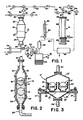
- Such carriers are shown in simplified form in Figure 2 of the present application for purposes of illustrating the present invention.
- the apparatus for carrying out the present invention includes three primary pieces of equipment, namely a vaporizer 10 for producing drying vapor, a vessel 12 for holding the wafers for treatment with rinsing fluid and drying vapor, and a boiler 14 for concentrating used rinsing fluid and drying vapor for disposal and/or reuse.
- a vaporizer 10 for producing drying vapor
- a vessel 12 for holding the wafers for treatment with rinsing fluid and drying vapor
- a boiler 14 for concentrating used rinsing fluid and drying vapor for disposal and/or reuse.
- FIG. 2 a preferred vessel 12 for use in the present invention is illustrated.
- a plurality of semiconductor wafers 16 is shown (from a side view) suspended in two rows of parallel, vertically oriented wafers in upper and lower wafer carriers 18, 20, of the type described more fully in our U.S. Patent 4,577,650. While two such wafer carriers 18, 20 are illustrated in Figure 2 stacked one on top of the other, it will be understood that vessel 12 could include only one such wafer carrier or more than two such carriers. In some instances vertical stacking may cause undesirable dripping onto lower carriers.
- Wafer carriers 18, 20 are held in place by upper vessel clamp 22 connected to the fluid inlet 24 and lower vessel clamp 26 connected to fluid outlet 28.
- vessel 12 is shown partially full of rinsing liquid 30 as drying vapor 32 fills the upper portion of vessel 12 and pushes the gas-liquid-solid interface 34 downwardly across wafers 16 in upper wafer carrier 18.
- a vessel 12′ is shown which allows for a plurality of SEMI (Semiconductor Equipment and Materials Institute, Inc.) approved wafer carriers to be arranged side by side.
- upper vessel clamp 22′ is in the form of a bell jar lid which is sealed over lower vessel clamp 26′ by means of a gasket 25 and clamp fittings 27.
- Wafer vessels 18′, 20′, holding wafers 16′, are supported on rods 21 in lower vessel clamp 26′.
- the vessel 12′ is shown empty of rinsing fluid.
- vessel arrangements can be used in carrying out the present invention.
- another embodiment would allow for one or more wafer carriers to be placed in an overflow-type sink situated in a lower vessel clamp with an appropriate cover, such as a bell jar lid similar to upper vessel clamp 22′ in Figure 3, to seal the system and provide for overflow and waste removal. Sealing the system is important to allow blanketing the vapor space around the wafers with drying vapor to prevent the introduction of foreign gases, e.g., nitrogen gas, during the direct displacement of the rinsing fluid with the drying fluid.
- foreign gases e.g., nitrogen gas
- vaporizer 10 includes a lower boiler section 36 and an upper holding section 38, with the metal casings of the boiler and holding sections being separated by an insulating gasket 40 which limits the amount of heat transfer from the lower metal casing to the upper metal casing.
- Boiler 36 is provided with heating bands 42 or other suitable heat transfer device to quickly heat the drying fluid above its boiling point.
- the boiler 36 should always be maintained full of liquid drying fluid so that the heat transfer surfaces are continually immersed.
- a liquid level detector and switch (not shown) may be provided, as well as resistance temperature detectors (not shown) for measuring the heat of the drying liquid and monitoring the temperature of the heating bands.
- the insulating gasket 40 may be of any suitable material which will withstand the heat of boiler section 36 and will resist corrosion by the drying fluid.
- an envelope gasket which will fit between two ANSI flanges 44 of the boiler section 36 and holding section 38 will be suitable.
- the insulating gasket prevents troublesome temperature/pressure overshoot from rapid heatup of the metal casings without simultaneous heatup of the contained drying fluid.
- the holding section 38 should remain at just the temperature of the boiling drying fluid, which may be an elevated pressure boiling point.
- the holding section 38 essentially holds the liquid capacity of the vaporizer, with the disengagement between liquid and vapor occurring at the very top, near flanges 46.
- a similar insulating gasket 48 may be placed between the flanges 46 to avoid unnecessary heat transfer from the top of holding section 38 near the liquid vapor interface.
- Holding section 38 may be provided with other associated devices (not shown), including a level detector and switch, heat tracing, and water cool-down jacket.
- Fresh and/or recirculated liquid drying fluid enters vaporizer 10 through valve 54, preferably a bellows valve, and filter 56, preferably a submicron filter such as available under the trademark Millipore, in inlet line 58 which is connected to a source of fresh drying fluid (not shown) through 53 and/or to distillation column 94 and waste liquid receiver 95 which provide recirculated drying fluid as discussed below.
- Saturated drying vapor flows to vessel 12 through valve 60, preferably also a bellows valve, and flash valve 62 in line 64.
- the flash valve may be used to lower the pressure and thereby superheat the saturated drying vapor.
- the drying vapor After passing through flash valve 62 and 3-way selector valve 68, the drying vapor preferably also goes through a final 0.01 micron ceramic filter 69, such as a Model PGF-2 filter manufactured by Fastek division of Eastman Technology, Inc., because gases can be filtered to a higher degree than liquids.
- Cross connection 52 is also provided with a pressure release valve 66 for emergency over pressurization of the vaporizer.
- the vaporizer may also be provided with a maintenance drain (not shown) at the bottom of the boiler 36.
- Vessel 12 may be provided with other valves 70, 72, 74 and 76 for the control of various process fluids, such as etching, stripping, cleaning and/or rinsing fluids which may enter and exit the vessel 12 for treatment of wafers 16.
- process fluids such as etching, stripping, cleaning and/or rinsing fluids which may enter and exit the vessel 12 for treatment of wafers 16.
- process fluids such as etching, stripping, cleaning and/or rinsing fluids which may enter and exit the vessel 12 for treatment of wafers 16.
- process fluids such as etching, stripping, cleaning and/or rinsing fluids
- drying fluid displaces rinsing fluid from wafers 16 at interface 34, the drying fluid mixes with the rinsing fluid and also forms a distinctive drying fluid layer on top of the rinsing fluid, reaching more than one half inch in thickness in some cases.
- This final rinsing fluid and drying fluid layer exit vessel 12 through valve 78 or metering pump 79 in line 80 which leads to boiler 14 for concentration and/or disposal of the used fluids.
- metering pump 79 is a variable rate pump to allow better control of the interface descent rate and to optimize drying time.
- a capacitance switch (limit switch) 82 Just preceding valve 78 and metering pump 79 in line 80 is a capacitance switch (limit switch) 82 which senses when vessel 12 has drained completely. At that point vapor line 64 is closed and a purging gas may be passed into vessel 12 through valves 71, 68 and 70 and filter 69.
- Drying vapor and purging gas may also exit vessel 12 through valve 78 and pass into boiler 14.
- the rinsing liquid may be removed during at least part of the descent by a variable rate metering pump 79. The rinsing fluid is discarded to drain through valve 81. At the appropriate time, the layer of drying fluid and a layer of rinsing fluid immediately below it are diverted to boiler 14 through valve 83.
- Boiler 14 is provided with band heaters 92 or immersion heaters to strip the drying fluid or an azeotrope of the drying fluid and rinsing fluid from the waste water.
- the vapor goes through distillation column 94 for further concentration.
- a water-cooled condenser 86 condenses the drying vapor. Cool, non-condensable gas (e.g., purge gas) exits the condenser through vent 88, while a portion of the condensate exits through drain 90 into a waste liquid receiver 95 for recirculation to the feed line 58 for vaporizer 10.
- Cool, non-condensable gas e.g., purge gas
- Distillation column 94 may be a single column or a series of columns of generally conventional design, depending upon the degree of concentration of the drying fluid desired for recirculation or disposal of used fluid.
- the waste water from which the vapor has been stripped exits boiler 14 through overflow valve 96 as a new batch of used fluid enters boiler 14 from the next run.
- Fresh drying fluid may be added to the recycled fluid through valve 83.
- a drying fluid is selected which is miscible with the rinsing fluid and preferably forms a minimum-boiling azeotrope with the rinsing fluid. Since water is the most convenient and commonly used rinsing fluid, a drying fluid which forms a minimum-boiling azeotrope with water is especially preferred. Generally, the drying fluid should be an organic compound which is non-reactive with the surface to be dried and has a boiling point less than 140 degrees Centigrade at atmospheric pressure.
- isopropyl alcohol isopropanol
- isopropanol is economical, relatively safe (nontoxic) and forms a minimum-boiling azeotrope with water.
- isopropanol has a low surface tension and has both hydrophobic and hydrophilic characteristics (i.e., it is miscible in both oil and water). Without wishing to be bound by any particular theory, it is believed that isopropanol has a tendency to break the harsh surface tension between the hydrophilic water and the relatively hydrophobic wafer surface. Since the solid phase at interface 34 is the wafer surface and the liquid phase is ultra pure water, the choice of gas phase properties can have a tremendous impact which isopropanol appears to satisfy best.
- the last cycle of rinsing with ultra pure water is with hot water (e.g., 65-85 degrees Centigrade) in order to heat the wafers to approximately the boiling point of the isopropanol (82 degrees Centigrade).
- hot water e.g., 65-85 degrees Centigrade
- the wafers 16 may be heated by direct solid solid heat transfer through wafer carriers 18, 20 by means of heating bands or other heating devices applied to the carriers.
- vessel 12 is left hydraulically full with ultra pure hot water.
- Valve 78 may then be opened. However, the water will not leave vessel 12 because nothing has been allowed to enter at the top to replace it. Flash valve 62 and valve 70 are then opened to introduce a stream of pure, saturated isopropanol vapor to vessel 12 through inlet 24. As vapor enters the upper vessel 22, water flows out the bottom 26 through fluid outlet 28 and valve 78.
- the rinsing water may be removed from vessel 12 by metering pump 79, with the flow rate being changed depending upon the phase of the removal cycle.
- the metering pump 79 can be run at a very high rate until the interface 34 is just above the wafers, then slowed down as the interface descends past the wafers.
- the bypass valve 78 around pump 79 may simply be opened and the remaining water and drying fluid may be blown from the vessel by purging gas.
- the downward velocity of the gas-liquid-solid interface 34 be controlled at a relatively slow rate, although there is a compromise which must be taken into consideration.
- the drying vapor displace the rinsing fluid from the wafers at such a rate that substantially no liquid droplets are left on the wafer surfaces after replacement of the water with isopropanol.
- a faster descent of interface 34 increases dryer productivity and minimizes chemical consumption.
- interface descent rates in the range of about one to four inches per minute have been found satisfactory. Descent rates much beyond five inches per minute yield poor results, whereas descent rates below about one inch per minute are inefficient. It has also been found that warmer vessel temperatures of about 75 degrees Centigrade result in better drying performance by allowing a faster interface descent than a cooler vessel at about 60 degrees Centigrade.
- the isopropanol be superheated in order to provide a drier vapor and avoid the risk of condensation of a vapor on the wafer surfaces.
- An advantage of an organic liquid such as isopropanol is that its latent heat curve in its pressure-enthalpy diagram slopes backwardly so that a pressure drop pushes the saturated vapor into the superheated region of the phase diagram. As a result, passing the saturated vapor produced by vaporizer 10 through a flash valve 62 results in a drier, superheated vapor being supplied to wafers 16 in vessel 12.
- Holding section 38 of vaporizer 10 preferably holds enough liquid IPA so that vaporizer 10 may supply several loads of wafers without being replenished.
- this may be done automatically by allowing the temperature of the boiling isopropanol in holding section 38 to drop below its boiling point (82 degrees Centigrade at atmospheric pressure). The temperature lowering may be assisted by use of a cooling jacket (not shown) on holding section 38.
- a cooling jacket (not shown) on holding section 38.
- valve 54 is then opened, liquid isopropanol is drawn from storage by suction to the vaporizer. Because this liquid isopropanol is generally cooler than the vaporizer itself, the pressure in the vaporizer reduces further, enhancing the refill operation.
- limit switch 82 senses when vessel 12 has drained completely of liquid. As soon as the vessel is completely empty, line 64 is closed and a stream of dry, inert, non-condensable gas, such as nitrogen, is admitted through valves 71, 68 and 70 to purge vessel 12 of isopropanol vapor. Since the nitrogen purge gas also goes through ceramic filter 69 between valves 68 and 70, the filter is inherently purged with nitrogen after the isopropanol. It is believed that this purge prevents isopropanol condensation and resultant blinding problems inside the filter.
- a stream of dry, inert, non-condensable gas such as nitrogen
- This purge quickly flushes all of the remaining vapor out of vessel 12 through drain valve 78.
- the nitrogen purge displaces isopropanol vapor out of the vessel and removes what appears to be a monolayer of isopropanol on the wafer surfaces.
- the monolayer is very volatile but the mechanism of removal appears different from evaporation.
- boiler 14 The purpose of boiler 14 and distribution column 94 is to hold the isopropanol contaminated water mixture and reconcentrate the isopropanol into a smaller volume for recirculation or disposal.
- the nitrogen purge begins. This nitrogen gas flows through and out of vessel 12 into boiler 14, exiting through condenser 86 and vent 88.
- boiler 14 performs a crude separation, so that liquid sent to distillation column 94 from condenser 86 might be 50 weight percent water and 50 weight percent isopropanol.
- the distillation column will then separate the azeotrope from the water to a 90 weight percent isopropanol/10 percent water azeotrope.
- This azeotrope may be reintroduced to vaporizer 10 on a batch basis, or continuously, as desired, through waste receiver 95 and appropriate mixing tanks and/or filters.
- the azeotrope mixture has a lower flash point and better heat transfer characteristics including heat capacity and heat transfer coefficient, apparently without sacrifice of particle performance (cleanness) of the wafers compared to the use of fresh, pure isopropanol alone.
- the method and apparatus of the invention may be an enclosed, full flow system which is preferably hydraulically full (i.e. sealed) during both rinsing and drying steps, and requires no movement or handling of the wafers between rinsing and drying.
- the advantages of such systems are disclosed in our U.S. Patent No. 4,778,532.
- the present invention results in improved drying efficiency of semiconductor wafers with less contamination of the wafer surfaces by dissolved particles and other contaminants which may be present in prior systems.
Landscapes
- Engineering & Computer Science (AREA)
- Mechanical Engineering (AREA)
- General Engineering & Computer Science (AREA)
- Cleaning Or Drying Semiconductors (AREA)
- Drying Of Solid Materials (AREA)
Priority Applications (2)
| Application Number | Priority Date | Filing Date | Title |
|---|---|---|---|
| DE68921757T DE68921757T2 (de) | 1989-11-23 | 1989-11-23 | Verfahren zum Trocknen von Oberflächen. |
| EP89121671A EP0428784B1 (de) | 1989-11-23 | 1989-11-23 | Verfahren zum Trocknen von Oberflächen |
Applications Claiming Priority (1)
| Application Number | Priority Date | Filing Date | Title |
|---|---|---|---|
| EP89121671A EP0428784B1 (de) | 1989-11-23 | 1989-11-23 | Verfahren zum Trocknen von Oberflächen |
Publications (2)
| Publication Number | Publication Date |
|---|---|
| EP0428784A1 true EP0428784A1 (de) | 1991-05-29 |
| EP0428784B1 EP0428784B1 (de) | 1995-03-15 |
Family
ID=8202157
Family Applications (1)
| Application Number | Title | Priority Date | Filing Date |
|---|---|---|---|
| EP89121671A Expired - Lifetime EP0428784B1 (de) | 1989-11-23 | 1989-11-23 | Verfahren zum Trocknen von Oberflächen |
Country Status (2)
| Country | Link |
|---|---|
| EP (1) | EP0428784B1 (de) |
| DE (1) | DE68921757T2 (de) |
Cited By (8)
| Publication number | Priority date | Publication date | Assignee | Title |
|---|---|---|---|---|
| EP0602842A3 (de) * | 1992-12-15 | 1995-01-18 | At & T Corp | Kontrolle der zeitabhängigen Schleierbildung in der Herstellung von integrierten Schaltungen. |
| GB2327147A (en) * | 1997-07-09 | 1999-01-13 | Sugai Corp | Wafer rinsing/drying process and apparatus |
| WO1999008057A3 (en) * | 1997-08-07 | 1999-06-17 | Applied Materials Inc | Method and apparatus for drying substrates |
| EP0886548A4 (de) * | 1996-03-14 | 2002-03-20 | L Tec Corp | Verfahren und vorrichtung zur trocknung und reinigung von gegenständen mittels aerosolen |
| WO2002052637A3 (en) * | 2000-12-27 | 2003-08-14 | Lam Res Corp | Method and apparatus for monitoring a semiconductor wafer during a spin drying operation |
| EP1600219A3 (de) * | 2004-05-29 | 2007-03-28 | Khs Ag | Verfahren zum Reinigen von Flaschen o. dgl. Behälter sowie Reinigungsmaschine |
| CN111578680A (zh) * | 2019-02-15 | 2020-08-25 | 北京北方华创微电子装备有限公司 | 一种晶圆的干燥方法 |
| CN115751918A (zh) * | 2022-11-14 | 2023-03-07 | 中化学科学技术研究有限公司 | 一种物料闪蒸干燥系统及方法 |
Families Citing this family (1)
| Publication number | Priority date | Publication date | Assignee | Title |
|---|---|---|---|---|
| US5983907A (en) * | 1997-08-05 | 1999-11-16 | Seh America, Inc. | Method of drying semiconductor wafers using hot deionized water and infrared drying |
Citations (3)
| Publication number | Priority date | Publication date | Assignee | Title |
|---|---|---|---|---|
| WO1987000094A1 (en) * | 1985-06-24 | 1987-01-15 | Cfm Technologies, Inc. | Semiconductor wafer flow treatment |
| GB2185444A (en) * | 1985-08-13 | 1987-07-22 | Cfm Technologies Ltd | Treating wafers with process fluids |
| EP0328746A2 (de) * | 1988-02-18 | 1989-08-23 | Sonic Fellow Kabushiki Kaisha | Trocknungsverfahren für Präzisionsreinigung |
-
1989
- 1989-11-23 DE DE68921757T patent/DE68921757T2/de not_active Expired - Lifetime
- 1989-11-23 EP EP89121671A patent/EP0428784B1/de not_active Expired - Lifetime
Patent Citations (3)
| Publication number | Priority date | Publication date | Assignee | Title |
|---|---|---|---|---|
| WO1987000094A1 (en) * | 1985-06-24 | 1987-01-15 | Cfm Technologies, Inc. | Semiconductor wafer flow treatment |
| GB2185444A (en) * | 1985-08-13 | 1987-07-22 | Cfm Technologies Ltd | Treating wafers with process fluids |
| EP0328746A2 (de) * | 1988-02-18 | 1989-08-23 | Sonic Fellow Kabushiki Kaisha | Trocknungsverfahren für Präzisionsreinigung |
Cited By (12)
| Publication number | Priority date | Publication date | Assignee | Title |
|---|---|---|---|---|
| EP0602842A3 (de) * | 1992-12-15 | 1995-01-18 | At & T Corp | Kontrolle der zeitabhängigen Schleierbildung in der Herstellung von integrierten Schaltungen. |
| EP0886548A4 (de) * | 1996-03-14 | 2002-03-20 | L Tec Corp | Verfahren und vorrichtung zur trocknung und reinigung von gegenständen mittels aerosolen |
| GB2327147A (en) * | 1997-07-09 | 1999-01-13 | Sugai Corp | Wafer rinsing/drying process and apparatus |
| GB2327147B (en) * | 1997-07-09 | 2002-06-05 | Sugai Corp | Treatment method of semiconductor wafers and the like |
| WO1999008057A3 (en) * | 1997-08-07 | 1999-06-17 | Applied Materials Inc | Method and apparatus for drying substrates |
| WO2002052637A3 (en) * | 2000-12-27 | 2003-08-14 | Lam Res Corp | Method and apparatus for monitoring a semiconductor wafer during a spin drying operation |
| US6848194B2 (en) | 2000-12-27 | 2005-02-01 | Lam Research Corporation | Apparatus for monitoring a semiconductor wafer during a spin drying operation |
| CN100380619C (zh) * | 2000-12-27 | 2008-04-09 | 拉姆研究公司 | 用于在旋转干燥操作期间监测半导体晶片的方法和设备 |
| EP1600219A3 (de) * | 2004-05-29 | 2007-03-28 | Khs Ag | Verfahren zum Reinigen von Flaschen o. dgl. Behälter sowie Reinigungsmaschine |
| CN111578680A (zh) * | 2019-02-15 | 2020-08-25 | 北京北方华创微电子装备有限公司 | 一种晶圆的干燥方法 |
| CN111578680B (zh) * | 2019-02-15 | 2022-01-11 | 北京北方华创微电子装备有限公司 | 一种晶圆的干燥方法 |
| CN115751918A (zh) * | 2022-11-14 | 2023-03-07 | 中化学科学技术研究有限公司 | 一种物料闪蒸干燥系统及方法 |
Also Published As
| Publication number | Publication date |
|---|---|
| DE68921757D1 (de) | 1995-04-20 |
| DE68921757T2 (de) | 1995-10-26 |
| EP0428784B1 (de) | 1995-03-15 |
Similar Documents
| Publication | Publication Date | Title |
|---|---|---|
| US4984597A (en) | Apparatus for rinsing and drying surfaces | |
| US4911761A (en) | Process and apparatus for drying surfaces | |
| US5105556A (en) | Vapor washing process and apparatus | |
| US6012472A (en) | Method and arrangement for drying substrates after treatment in a liquid | |
| US4841645A (en) | Vapor dryer | |
| US4879041A (en) | Process for producing ultra-pure water and process for using said ultra-pure water | |
| JPS6323326A (ja) | ウエハ−をプロセス流体で処理する方法及び装置 | |
| JPH06103686B2 (ja) | 表面乾燥処理方法および装置 | |
| EP0428784B1 (de) | Verfahren zum Trocknen von Oberflächen | |
| US20140290090A1 (en) | System and method for drying substrates | |
| KR19980086453A (ko) | 건조장치 및 건조방법 | |
| US4745690A (en) | Method of replenishing and/or preparing treating liquids | |
| US5249371A (en) | Vapor drier | |
| EP0047307A1 (de) | Vorrichtung zum Behandeln von Gegenständen mit einem flüchtigen Fluid. | |
| JPH1116873A (ja) | 洗浄乾燥方法及び洗浄乾燥装置 | |
| IE893716A1 (en) | Process for drying surfaces | |
| JPS62106630A (ja) | 処理装置 | |
| JPS63182818A (ja) | 乾燥装置 | |
| US6658764B2 (en) | Apparatus and method for preventing droplets on wafers during solvent drying process | |
| JP3275044B2 (ja) | 乾燥処理装置 | |
| JP4906198B2 (ja) | イソプロピルアルコール蒸気乾燥装置及びシリコンウエハの乾燥方法 | |
| US5682913A (en) | Vapor rinse-vapor dry processing tool | |
| JPH054155B2 (de) | ||
| JPH04199715A (ja) | 半導体乾燥装置 | |
| JPH03242205A (ja) | 水切り乾燥装置 |
Legal Events
| Date | Code | Title | Description |
|---|---|---|---|
| PUAI | Public reference made under article 153(3) epc to a published international application that has entered the european phase |
Free format text: ORIGINAL CODE: 0009012 |
|
| 17P | Request for examination filed |
Effective date: 19901220 |
|
| AK | Designated contracting states |
Kind code of ref document: A1 Designated state(s): DE FR GB NL |
|
| 17Q | First examination report despatched |
Effective date: 19920924 |
|
| GRAA | (expected) grant |
Free format text: ORIGINAL CODE: 0009210 |
|
| AK | Designated contracting states |
Kind code of ref document: B1 Designated state(s): DE FR GB NL |
|
| REF | Corresponds to: |
Ref document number: 68921757 Country of ref document: DE Date of ref document: 19950420 |
|
| ET | Fr: translation filed | ||
| PLBQ | Unpublished change to opponent data |
Free format text: ORIGINAL CODE: EPIDOS OPPO |
|
| PLBI | Opposition filed |
Free format text: ORIGINAL CODE: 0009260 |
|
| PLBF | Reply of patent proprietor to notice(s) of opposition |
Free format text: ORIGINAL CODE: EPIDOS OBSO |
|
| 26 | Opposition filed |
Opponent name: INSTITUTE OF TECHNICAL INFORMATION, INC. Effective date: 19951215 |
|
| NLR1 | Nl: opposition has been filed with the epo |
Opponent name: INSTITUTE OF TECHNICAL INFORMATION, INC. |
|
| PLBF | Reply of patent proprietor to notice(s) of opposition |
Free format text: ORIGINAL CODE: EPIDOS OBSO |
|
| PLBF | Reply of patent proprietor to notice(s) of opposition |
Free format text: ORIGINAL CODE: EPIDOS OBSO |
|
| PLBO | Opposition rejected |
Free format text: ORIGINAL CODE: EPIDOS REJO |
|
| PLBN | Opposition rejected |
Free format text: ORIGINAL CODE: 0009273 |
|
| STAA | Information on the status of an ep patent application or granted ep patent |
Free format text: STATUS: OPPOSITION REJECTED |
|
| 27O | Opposition rejected |
Effective date: 19970409 |
|
| NLR2 | Nl: decision of opposition | ||
| REG | Reference to a national code |
Ref country code: GB Ref legal event code: 772C |
|
| PGFP | Annual fee paid to national office [announced via postgrant information from national office to epo] |
Ref country code: GB Payment date: 19990401 Year of fee payment: 10 |
|
| REG | Reference to a national code |
Ref country code: GB Ref legal event code: 772B |
|
| REG | Reference to a national code |
Ref country code: GB Ref legal event code: 772E |
|
| REG | Reference to a national code |
Ref country code: GB Ref legal event code: IF02 |
|
| PGFP | Annual fee paid to national office [announced via postgrant information from national office to epo] |
Ref country code: NL Payment date: 20071119 Year of fee payment: 19 |
|
| PGFP | Annual fee paid to national office [announced via postgrant information from national office to epo] |
Ref country code: FR Payment date: 20071115 Year of fee payment: 19 |
|
| PG25 | Lapsed in a contracting state [announced via postgrant information from national office to epo] |
Ref country code: GB Free format text: LAPSE BECAUSE OF NON-PAYMENT OF DUE FEES Effective date: 19991123 |
|
| PG25 | Lapsed in a contracting state [announced via postgrant information from national office to epo] |
Ref country code: NL Free format text: LAPSE BECAUSE OF NON-PAYMENT OF DUE FEES Effective date: 20090601 |
|
| NLV4 | Nl: lapsed or anulled due to non-payment of the annual fee |
Effective date: 20090601 |
|
| PGFP | Annual fee paid to national office [announced via postgrant information from national office to epo] |
Ref country code: DE Payment date: 20090529 Year of fee payment: 20 |
|
| REG | Reference to a national code |
Ref country code: FR Ref legal event code: ST Effective date: 20090731 |
|
| PG25 | Lapsed in a contracting state [announced via postgrant information from national office to epo] |
Ref country code: FR Free format text: LAPSE BECAUSE OF NON-PAYMENT OF DUE FEES Effective date: 20081130 |