EP0429265A2 - Wärmeschrumpfbarer Film, der nach kurzer Zeit bei niedriger Betriebstemperatur stark schrumpft - Google Patents
Wärmeschrumpfbarer Film, der nach kurzer Zeit bei niedriger Betriebstemperatur stark schrumpft Download PDFInfo
- Publication number
- EP0429265A2 EP0429265A2 EP90312529A EP90312529A EP0429265A2 EP 0429265 A2 EP0429265 A2 EP 0429265A2 EP 90312529 A EP90312529 A EP 90312529A EP 90312529 A EP90312529 A EP 90312529A EP 0429265 A2 EP0429265 A2 EP 0429265A2
- Authority
- EP
- European Patent Office
- Prior art keywords
- heat
- copolymer
- cond
- melt index
- shrinkable film
- Prior art date
- Legal status (The legal status is an assumption and is not a legal conclusion. Google has not performed a legal analysis and makes no representation as to the accuracy of the status listed.)
- Granted
Links
Images
Classifications
-
- C—CHEMISTRY; METALLURGY
- C08—ORGANIC MACROMOLECULAR COMPOUNDS; THEIR PREPARATION OR CHEMICAL WORKING-UP; COMPOSITIONS BASED THEREON
- C08L—COMPOSITIONS OF MACROMOLECULAR COMPOUNDS
- C08L23/00—Compositions of homopolymers or copolymers of unsaturated aliphatic hydrocarbons having only one carbon-to-carbon double bond; Compositions of derivatives of such polymers
- C08L23/02—Compositions of homopolymers or copolymers of unsaturated aliphatic hydrocarbons having only one carbon-to-carbon double bond; Compositions of derivatives of such polymers not modified by chemical after-treatment
- C08L23/04—Homopolymers or copolymers of ethene
- C08L23/08—Copolymers of ethene
- C08L23/0846—Copolymers of ethene with unsaturated hydrocarbons containing atoms other than carbon or hydrogen
- C08L23/0853—Ethylene vinyl acetate copolymers
-
- A—HUMAN NECESSITIES
- A61—MEDICAL OR VETERINARY SCIENCE; HYGIENE
- A61F—FILTERS IMPLANTABLE INTO BLOOD VESSELS; PROSTHESES; DEVICES PROVIDING PATENCY TO, OR PREVENTING COLLAPSING OF, TUBULAR STRUCTURES OF THE BODY, e.g. STENTS; ORTHOPAEDIC, NURSING OR CONTRACEPTIVE DEVICES; FOMENTATION; TREATMENT OR PROTECTION OF EYES OR EARS; BANDAGES, DRESSINGS OR ABSORBENT PADS; FIRST-AID KITS
- A61F13/00—Bandages or dressings; Absorbent pads
- A61F13/15—Absorbent pads, e.g. sanitary towels, swabs or tampons for external or internal application to the body; Supporting or fastening means therefor; Tampon applicators
- A61F13/15577—Apparatus or processes for manufacturing
- A61F13/15585—Apparatus or processes for manufacturing of babies' napkins, e.g. diapers
- A61F13/15593—Apparatus or processes for manufacturing of babies' napkins, e.g. diapers having elastic ribbons fixed thereto; Devices for applying the ribbons
-
- A—HUMAN NECESSITIES
- A61—MEDICAL OR VETERINARY SCIENCE; HYGIENE
- A61L—METHODS OR APPARATUS FOR STERILISING MATERIALS OR OBJECTS IN GENERAL; DISINFECTION, STERILISATION OR DEODORISATION OF AIR; CHEMICAL ASPECTS OF BANDAGES, DRESSINGS, ABSORBENT PADS OR SURGICAL ARTICLES; MATERIALS FOR BANDAGES, DRESSINGS, ABSORBENT PADS OR SURGICAL ARTICLES
- A61L15/00—Chemical aspects of, or use of materials for, bandages, dressings or absorbent pads
- A61L15/16—Bandages, dressings or absorbent pads for physiological fluids such as urine or blood, e.g. sanitary towels, tampons
- A61L15/22—Bandages, dressings or absorbent pads for physiological fluids such as urine or blood, e.g. sanitary towels, tampons containing macromolecular materials
- A61L15/225—Mixtures of macromolecular compounds
-
- A—HUMAN NECESSITIES
- A61—MEDICAL OR VETERINARY SCIENCE; HYGIENE
- A61L—METHODS OR APPARATUS FOR STERILISING MATERIALS OR OBJECTS IN GENERAL; DISINFECTION, STERILISATION OR DEODORISATION OF AIR; CHEMICAL ASPECTS OF BANDAGES, DRESSINGS, ABSORBENT PADS OR SURGICAL ARTICLES; MATERIALS FOR BANDAGES, DRESSINGS, ABSORBENT PADS OR SURGICAL ARTICLES
- A61L15/00—Chemical aspects of, or use of materials for, bandages, dressings or absorbent pads
- A61L15/16—Bandages, dressings or absorbent pads for physiological fluids such as urine or blood, e.g. sanitary towels, tampons
- A61L15/42—Use of materials characterised by their function or physical properties
-
- B—PERFORMING OPERATIONS; TRANSPORTING
- B29—WORKING OF PLASTICS; WORKING OF SUBSTANCES IN A PLASTIC STATE IN GENERAL
- B29C—SHAPING OR JOINING OF PLASTICS; SHAPING OF MATERIAL IN A PLASTIC STATE, NOT OTHERWISE PROVIDED FOR; AFTER-TREATMENT OF THE SHAPED PRODUCTS, e.g. REPAIRING
- B29C61/00—Shaping by liberation of internal stresses; Making preforms having internal stresses; Apparatus therefor
- B29C61/003—Shaping by liberation of internal stresses; Making preforms having internal stresses; Apparatus therefor characterised by the choice of material
-
- C—CHEMISTRY; METALLURGY
- C08—ORGANIC MACROMOLECULAR COMPOUNDS; THEIR PREPARATION OR CHEMICAL WORKING-UP; COMPOSITIONS BASED THEREON
- C08J—WORKING-UP; GENERAL PROCESSES OF COMPOUNDING; AFTER-TREATMENT NOT COVERED BY SUBCLASSES C08B, C08C, C08F, C08G or C08H
- C08J5/00—Manufacture of articles or shaped materials containing macromolecular substances
- C08J5/18—Manufacture of films or sheets
-
- C—CHEMISTRY; METALLURGY
- C08—ORGANIC MACROMOLECULAR COMPOUNDS; THEIR PREPARATION OR CHEMICAL WORKING-UP; COMPOSITIONS BASED THEREON
- C08L—COMPOSITIONS OF MACROMOLECULAR COMPOUNDS
- C08L53/00—Compositions of block copolymers containing at least one sequence of a polymer obtained by reactions only involving carbon-to-carbon unsaturated bonds; Compositions of derivatives of such polymers
- C08L53/02—Compositions of block copolymers containing at least one sequence of a polymer obtained by reactions only involving carbon-to-carbon unsaturated bonds; Compositions of derivatives of such polymers of vinyl-aromatic monomers and conjugated dienes
-
- C—CHEMISTRY; METALLURGY
- C08—ORGANIC MACROMOLECULAR COMPOUNDS; THEIR PREPARATION OR CHEMICAL WORKING-UP; COMPOSITIONS BASED THEREON
- C08J—WORKING-UP; GENERAL PROCESSES OF COMPOUNDING; AFTER-TREATMENT NOT COVERED BY SUBCLASSES C08B, C08C, C08F, C08G or C08H
- C08J2323/00—Characterised by the use of homopolymers or copolymers of unsaturated aliphatic hydrocarbons having only one carbon-to-carbon double bond; Derivatives of such polymers
- C08J2323/02—Characterised by the use of homopolymers or copolymers of unsaturated aliphatic hydrocarbons having only one carbon-to-carbon double bond; Derivatives of such polymers not modified by chemical after treatment
- C08J2323/04—Homopolymers or copolymers of ethene
- C08J2323/08—Copolymers of ethene
-
- C—CHEMISTRY; METALLURGY
- C08—ORGANIC MACROMOLECULAR COMPOUNDS; THEIR PREPARATION OR CHEMICAL WORKING-UP; COMPOSITIONS BASED THEREON
- C08L—COMPOSITIONS OF MACROMOLECULAR COMPOUNDS
- C08L2205/00—Polymer mixtures characterised by other features
- C08L2205/02—Polymer mixtures characterised by other features containing two or more polymers of the same C08L -group
-
- C—CHEMISTRY; METALLURGY
- C08—ORGANIC MACROMOLECULAR COMPOUNDS; THEIR PREPARATION OR CHEMICAL WORKING-UP; COMPOSITIONS BASED THEREON
- C08L—COMPOSITIONS OF MACROMOLECULAR COMPOUNDS
- C08L2205/00—Polymer mixtures characterised by other features
- C08L2205/03—Polymer mixtures characterised by other features containing three or more polymers in a blend
-
- C—CHEMISTRY; METALLURGY
- C08—ORGANIC MACROMOLECULAR COMPOUNDS; THEIR PREPARATION OR CHEMICAL WORKING-UP; COMPOSITIONS BASED THEREON
- C08L—COMPOSITIONS OF MACROMOLECULAR COMPOUNDS
- C08L23/00—Compositions of homopolymers or copolymers of unsaturated aliphatic hydrocarbons having only one carbon-to-carbon double bond; Compositions of derivatives of such polymers
- C08L23/02—Compositions of homopolymers or copolymers of unsaturated aliphatic hydrocarbons having only one carbon-to-carbon double bond; Compositions of derivatives of such polymers not modified by chemical after-treatment
- C08L23/04—Homopolymers or copolymers of ethene
- C08L23/06—Polyethylene
Definitions
- the invention concerns heat-shrinkable plastic films and, more specifically, is concerned with disposable diapers that employ such films for such purposes as elastic waist bands.
- Disposable diapers typically include a liquid-permeable skin-contacting layer, a liquid-impermeable outer shell, and an intermediate absorbent element.
- strips of heat-shrinkable plastic film are adhesively bonded to the outer shell and then heated to cause them to contract to form shirred, elastic waistband and leg openings.
- the outer shell is a thin film of polyethylene which would become distorted if exposed to high temperatures, but at temperatures low enough not to distort the polyethylene film, known heat-shrinkable plastic films contract slowly and hence can require diaper-manufacturing lines to be operated at slower speeds than otherwise would be feasible.
- U.S. Pat. No. 4,563,185 (Reiter) describes at length known techniques for applying strips that are contractible, e.g., by heat, to impart both shirring and elasticization at the waistband and/or leg openings of a disposable diaper.
- the strip employed by Reiter at the waistband is "ethylene propylene rubber blended with ethylene vinyl acetate" (col. 14, lines 30-32) which Reiter says (col. 7, lines 53-62) is described in U.S. Pat. No. 4,303,571 (Jansen, et al.). The Jansen patent says that uniaxial orientation of a film of this composition renders it heat-shrinkable, and that exposure of the oriented film to heat results in a return to the unoriented state and the original elastic properties.
- U.S. Pat. No. 4,337,771 (Pieniak et al.) describes a film, strips of which are useful for providing shirred waistbands and leg openings. "The strip is intermittently secured to the backing and/or facing in the central portion of the diaper margin to maintain its elasticity; however, the end portions of the strip are continuously ... secured at the corner portions of the diaper whereby the previously elastic end portions of the strip are effectively rendered inelastic, and the strip reinforces the diaper in such regions" (col. 2, lines 30-39).
- the strip usually called an "elastic film member,” preferably is made from compositions of A-B-A or A-B block copolymers wherein the A-blocks can be derived from styrene and the B-blocks are derived from conjugated dienes or lower alkenes, which compositions include low-molecular-weight modifiers such as amorphous polypropylene.
- the elastic film member can be made from a material that becomes elastic when heat shrunk such as a polyolefin or a copolymer of ethylene and vinyl acetate.
- the elastic film member Upon being secured to the facing and/or backing of the diaper by ultrasonic welding, the elastic film member "is heated at its end portions to a point where it almost melts and loses substantially all of its memory and is thus non-elastic in those areas" (col. 11, lines 2-12).
- U.S. Pat. No. 4,515,595 (Kievit et al.) describes a disposable diaper with a waistband that can be made elastic by affixing an elastic member or tape made from natural rubber.
- the elastic member can be stretched to an elongated orientation, affixed to the diaper, and then contracted (e.g., by heating) to gather the diaper material adjacent the elastic member.
- U.S. Pat. No. 4,476,180 (Wnuk) describes elastic films made from blends of an elastomeric linear triblock copolymer and ethylene/vinyl acetate (EVA) copolymer.
- the end blocks of the elastomeric copolymer are polystyrene, and preferred interior blocks are polybutadiene and polyisoprene.
- the melt index of the elastomeric block copolymer of Wnuk's elastic films is less than about 10 (Cond. E of ASTM Method D 1238) and that of the EVA copolymer is less than about 0.6 (Cond. B).
- These elastic films are made from about 40% to about 80% of the elastomeric block copolymer and about 20% to 60% of the EVA copolymer.
- Wnuk's elastic films may be used in a wide variety of applications where a thin, elastic material would be useful. Such films are particularly useful as low cost elastic members for disposable wearing apparel such as diapers and incontinent briefs; they may be used as leg bands or waist bands" (col. 6, lines 41-45).
- An elastic film of the Wnuk patent has low permanent set in a test wherein the film is stretched to twice its original length, held at that extension for 10 minutes at room temperature and then allowed to relax. In that test, films of Wnuk's examples have a permanent set of from 12 to 24%.
- the elastic films can be made nonblocking "by loading the film surface with small particles or powders such as chalk, clay, silica, and similar materials" in amounts from about 0.5 g/m2 to about 5 g/m2 (col. 4, lines 18-29).
- the invention should permit disposable diapers to be manufactured at higher production speeds and lower energy consumption than have heretofore been feasible by using for the waistband a heat-shrinkable plastic film which is believed to be the first that is dimensionally stable at ordinary room temperatures and shrinks in one direction at least 25% within 5 seconds at 54°C (130°F).
- This heat-shrinkable plastic film is believed to be novel, and its extraordinary heat-shrinkability at that moderately elevated temperature is surprising, considering that it is chemically similar to Nyberg,s elastic films which resist shrinkage at elevated temperatures and to Wnuk's films which have low permanent set as opposed to the high permanent set of the novel heat-shrinkable plastic film when cold-drawn (cold-stretched) either at room temperature or at moderately elevated temperatures.
- the heat-shrinkable plastic film of the present invention is obtained by uniaxially cold-stretching (cold-drawing) to a length of at least 3X its original dimension a thin extrudate of a blend of from 40 to 85 parts by weight of an EVA copolymer having a vinyl acetate content of from 10% to 50% and a melt index of from 1 to 100 (Cond.
- the extrudate might break at the preferred degree of cold-stretching, i.e., at 4X to 5.5X.
- the resulting heat-shrinkable films have excellent shrinkability at 54°C, with very little risk of breakage when made of preferred blends of EVA copolymer and (A-B) block copolymer.
- Significantly higher cold-stretching ratios are not recommended, because an unsupported extrudate might break at 6X or higher.
- cold-stretching at less than 4X may not afford desirably high shrinkage within 5 seconds at 54°C.
- the cold-stretching temperature exceeds 50°C, the cold-stretched film tends to have better permanent set (that is, less springback), but also tends to shrink to a lesser extent within 5 seconds at 54°C than does a film that has been cold-stretched at a temperature with the aforementioned preferred range of 40-50°C.
- the extrudate is supported by two adhered surface layers of polyolefin such as polyethylene, polypropylene, or a blend of polyethylene or polypropylene with another polyolefin. Those surface layers also afford nonblocking surfaces.
- the blend to be cold-stretched preferably incorporates an anti-blocking agent, or slip agent, e.g., finely divided calcium carbonate, diatomaceous earth, and erucamide in amounts from about 1 to 10% by weight of the film. Significantly larger amounts might prevent a thin extrudate from being cold-stretched at least 3X without breaking.
- the novel heat shrinkable film preferably is quenched immediately following cold-stretching in order to lock it into a thermodynamically-unstable, oriented configuration.
- a roll of the novel heat-shrinkable film can bear an adhesive layer by which it can be adhered to a diaper blank. Then, in conjunction with the conversion of that diaper blank into disposable diapers, the heat-shrinkable film is cut into short lengths, each of which is adhered by its adhesive layer to the outer shell of the diaper blank. Instead of being precoated with an adhesive layer, the uniaxially cold-stretched film can be coated with adhesive while being unwound from the supply roll.
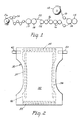
- a thin, unoriented plastic extrudate 10 is unwound from a roll 12 and drawn through a first pair of nip rolls 14 (steel) and 15 (rubber covered) and four heated idler rolls 16 over which the extrudate is stretched at least 3X in the lengthwise direction due to faster rotation of a second pair of nip rolls 18 (steel) and 19 (rubber covered).
- Each of the four idler rolls is internally heated to keep its surface temperature within the range of about 40-50°C.
- the resulting cold-stretched, heat-shrinkable plastic film 20 is drawn across a water-cooled idler chill roll 22 at which the film is locked into a thermodynamically-unstable oriented configuration. From the second nip rolls 18 and 19, the heat-shrinkable film 20 travels to a slitter 24 at which it is slit to a useful width before being wound up on a winder 26.
- a diaper blank 30 is shown with its skin-contacting layer 32 facing upwardly, beneath which are two strips 34 and 35 of the novel heat-shrinkable film at the waistbands and two strips 37 and 38 at the leg openings.
- the diaper blank 30 also includes an absorbent element 40 and a pair of adhesive closure tabs 42 and 43.
- A-B block copolymers include linear A-B-A linear triblock copolymers such a KRATONTM D-1107, KRATONTM D-1101, KRATONTM D-1111, and KRATONTM G-1657 from Shell Chemical. Also preferred are radial (A-B) copolymers such as KRATONTM Dx-1116 and KRATONTM DX-1184X and multiblock ABABA copolymers such as STEREONTM 840A from Firestone Synthetic Rubber and Latex Co.
- the melt index of the (A-B) block copolymer is from 1 to 15 (Cond. G), more preferably from 3 to 10.
- Cond. G Cond. G
- melt index is substantially below 1
- a blend with the EVA copolymer tends to be so viscous that it is difficult to form a thin extrudate to be cold-stretched.
- melt index is substantially above 15, it is difficult to cold-stretch a thin extrudate of the blend at least 3X without breaking.
- the EVA copolymer has a vinyl acetate content of from 18% to 32%.
- the novel cold-stretched plastic films tend to have less heat-shrinkage.
- the heat-shrinkable plastic films have a tendency to block that cannot be fully offset by the use of anti-blocking agents without a significant reduction in strength and integrity.
- the EVA copolymer has a melt index of from 3 to 40 (Cond. E), more preferably from S to 30.
- a melt index of 5 (Cond. E) roughly corresponds to a melt index of 0.5 (Cond. B).
- the EVA copolymer has a melt index substantially below 5 (Cond. E)
- a blend with the (A-B) block copolymer is difficult to extrude, and this limits the line speed at which a heat-shrinkable film can be produced.
- the melt index of the EVA copolymer is substantially above 30, the blend may lack sufficient tensile strength to be cold-stretched at least 3X without danger of breakage.
- Preferred heat-shrinkable plastic films of the invention undergo 40-50% unidirectional shrinkage upon exposure to 54°C for 5 seconds.
- Cold-stretched films having such high shrinkage have been made when the ratio of the EVA copolymer to the (A-B) block copolymer is from 2:1 to 5:1. When that ratio is substantially higher that 5:1, there is a danger of a thin extrudate breaking upon being being cold-stretched to 3X or greater. When that ratio is substantially below 2:1, the cold-stretched film might not have the high permanent set necessary to afford the desired degree of heat-shrinkability.
- Heat-Shrinkage Value is the ratio of the reduction in length (i.e., original length minus shrunk length) to the original length, expressed as a percent.
- Blends were made using an EVA copolymer (ELVAXTM 260 from E.I. duPont) which has a vinyl acetate content of 28% and a melt index (Cond. E) of 6; a linear (A-B) block copolymer (KRATONTM 1111 from Shell Chemical Co.) of polystyrene and polyisoprene having polystyrene end blocks, which has a styrene content of 21% and a melt index (Cond.
- EVA copolymer ELVAXTM 260 from E.I. duPont
- A-B block copolymer KRATONTM 1111 from Shell Chemical Co.
- Blends were prepared as in Example 1 and also employing two other EVA copolymers: vinyl acetate content melt index (Cond. E) ELVAXTM 450 18% 8 ELVAXTM 660 12% 2.5 Also included in the blends were erucamide, a fatty acid slip agent, namely, AMPACETTM 10110 from Ampacet Corp.; an antioxidant, namely IRGANOXTM 1076 from Ciba-Geigy; and a pigment, namely a blend of equal parts of TiO2 and polypropylene. The compositions of the blends are noted in Table III.
- the heat-shrinkable film of the invention should have many other uses such as for arcuating the sides of a sanitary napkin. It also should be useful for the legbands of a disposable diaper, preferably being cold-stretched in the lengthwise direction for that use.
Landscapes
- Health & Medical Sciences (AREA)
- Chemical & Material Sciences (AREA)
- Engineering & Computer Science (AREA)
- Organic Chemistry (AREA)
- Polymers & Plastics (AREA)
- Medicinal Chemistry (AREA)
- Chemical Kinetics & Catalysis (AREA)
- Materials Engineering (AREA)
- Epidemiology (AREA)
- General Health & Medical Sciences (AREA)
- Public Health (AREA)
- Veterinary Medicine (AREA)
- Life Sciences & Earth Sciences (AREA)
- Manufacturing & Machinery (AREA)
- Animal Behavior & Ethology (AREA)
- Hematology (AREA)
- Biomedical Technology (AREA)
- Heart & Thoracic Surgery (AREA)
- Vascular Medicine (AREA)
- Shaping By String And By Release Of Stress In Plastics And The Like (AREA)
- Absorbent Articles And Supports Therefor (AREA)
- Manufacture Of Macromolecular Shaped Articles (AREA)
- Compositions Of Macromolecular Compounds (AREA)
- Lining Or Joining Of Plastics Or The Like (AREA)
- Professional, Industrial, Or Sporting Protective Garments (AREA)
- Orthopedics, Nursing, And Contraception (AREA)
Applications Claiming Priority (2)
| Application Number | Priority Date | Filing Date | Title |
|---|---|---|---|
| US07/438,360 US5043383A (en) | 1989-11-17 | 1989-11-17 | Heat-shrinkable film having high shrinkage upon brief exposure to low activation temperatures |
| US438360 | 1989-11-17 |
Publications (3)
| Publication Number | Publication Date |
|---|---|
| EP0429265A2 true EP0429265A2 (de) | 1991-05-29 |
| EP0429265A3 EP0429265A3 (en) | 1992-04-15 |
| EP0429265B1 EP0429265B1 (de) | 1996-01-03 |
Family
ID=23740341
Family Applications (1)
| Application Number | Title | Priority Date | Filing Date |
|---|---|---|---|
| EP90312529A Expired - Lifetime EP0429265B1 (de) | 1989-11-17 | 1990-11-16 | Wärmeschrumpfbarer Film, der nach kurzer Zeit bei niedriger Betriebstemperatur stark schrumpft |
Country Status (6)
| Country | Link |
|---|---|
| US (1) | US5043383A (de) |
| EP (1) | EP0429265B1 (de) |
| JP (1) | JPH0622894B2 (de) |
| CA (1) | CA2027805A1 (de) |
| DE (1) | DE69024621T2 (de) |
| MX (1) | MX168514B (de) |
Cited By (1)
| Publication number | Priority date | Publication date | Assignee | Title |
|---|---|---|---|---|
| EP1550690A4 (de) * | 2002-10-08 | 2006-12-06 | Denki Kagaku Kogyo Kk | Wärmeschrumpfbare folie |
Families Citing this family (7)
| Publication number | Priority date | Publication date | Assignee | Title |
|---|---|---|---|---|
| US5186991A (en) * | 1988-06-29 | 1993-02-16 | W. R. Grace & Co.-Conn. | Container closures, sealed containers and sealing compositions for them |
| ZA92308B (en) | 1991-09-11 | 1992-10-28 | Kimberly Clark Co | Thin absorbent article having rapid uptake of liquid |
| DE4313153C1 (de) * | 1993-04-22 | 1994-05-05 | Stewing Nachrichtentechnik | Verfahren zur Verminderung der Rißanfälligkeit bei einer wärmerückstellbaren Werkstoffbahn |
| US6193630B1 (en) * | 1999-07-26 | 2001-02-27 | Deere & Company | Slip-based shift control system |
| US6994469B2 (en) * | 2002-01-25 | 2006-02-07 | The Glad Products Company | Shirred elastic sheet material |
| US7946765B2 (en) * | 2002-01-25 | 2011-05-24 | The Glad Products Company | Shirred elastic sheet material |
| US20150316308A1 (en) * | 2014-05-02 | 2015-11-05 | North Carolina State University | Cooling panel |
Family Cites Families (15)
| Publication number | Priority date | Publication date | Assignee | Title |
|---|---|---|---|---|
| USRE28688E (en) * | 1960-10-31 | 1976-01-20 | Raychem Corporation | Solid heat-flowable dispersed phase in a crosslinked elastomer |
| US3459832A (en) * | 1965-09-24 | 1969-08-05 | Monsanto Co | Crystalline polystyrene having activity as a polymerization catalyst |
| US3819401A (en) * | 1970-11-13 | 1974-06-25 | Fmc Corp | Method of preparing shirred, elastic, flexible articles |
| US3912565A (en) * | 1972-01-24 | 1975-10-14 | Fmc Corp | Method of preparing shirred, elastic, flexible articles |
| US4337771A (en) * | 1978-01-27 | 1982-07-06 | Johnson & Johnson Baby Products Company | Conformable disposable diaper having reinforced portions |
| US4247584A (en) * | 1979-05-22 | 1981-01-27 | American Can Company | Composition comprising a blend of EVA polymers having differing VA contents; films and laminates made therefrom by extrusion; and heat-sealed food bags made from the laminates |
| US4303571A (en) * | 1980-01-17 | 1981-12-01 | Exxon Research & Engineering Co. | Film-forming thermoplastic elastomeric polymer compositions |
| DE3260590D1 (en) * | 1981-02-20 | 1984-09-27 | Asahi Chemical Ind | A film, sheet or tube of a block copolymer or a composition containing the same |
| US4515595A (en) * | 1982-11-26 | 1985-05-07 | The Procter & Gamble Company | Disposable diapers with elastically contractible waistbands |
| US4476180A (en) * | 1983-02-01 | 1984-10-09 | The Procter & Gamble Company | Nonblocking elastomeric polymer blends of ABA block copolymer and ethylene-vinyl acetate copolymer |
| US4705657A (en) * | 1984-02-29 | 1987-11-10 | Essex Group, Inc. | Method of making and applying ethylene-propylene diene terpolymer texturized heat shrinkable tubing |
| ZA852583B (en) * | 1984-05-01 | 1985-11-27 | Kimberly Clark Co | Heat-shrinkable elastomer,method of producing the elastomer and articles utilising the elastomer |
| US4596728A (en) * | 1985-02-01 | 1986-06-24 | The Johns Hopkins University | Low temperature heat shrinkable polymer material |
| US4820590A (en) * | 1985-05-08 | 1989-04-11 | Exxon Chemical Patents Inc. | Oriented elastomeric film and method of manufacture |
| CA1275769C (en) * | 1986-09-05 | 1990-11-06 | Edward J. Zuscik | Film for forming shirred articles |
-
1989
- 1989-11-17 US US07/438,360 patent/US5043383A/en not_active Expired - Lifetime
-
1990
- 1990-10-17 CA CA002027805A patent/CA2027805A1/en not_active Abandoned
- 1990-11-05 MX MX023186A patent/MX168514B/es unknown
- 1990-11-16 DE DE69024621T patent/DE69024621T2/de not_active Expired - Fee Related
- 1990-11-16 JP JP2311248A patent/JPH0622894B2/ja not_active Expired - Lifetime
- 1990-11-16 EP EP90312529A patent/EP0429265B1/de not_active Expired - Lifetime
Cited By (1)
| Publication number | Priority date | Publication date | Assignee | Title |
|---|---|---|---|---|
| EP1550690A4 (de) * | 2002-10-08 | 2006-12-06 | Denki Kagaku Kogyo Kk | Wärmeschrumpfbare folie |
Also Published As
| Publication number | Publication date |
|---|---|
| EP0429265B1 (de) | 1996-01-03 |
| CA2027805A1 (en) | 1991-05-18 |
| MX168514B (es) | 1993-05-27 |
| JPH0622894B2 (ja) | 1994-03-30 |
| EP0429265A3 (en) | 1992-04-15 |
| US5043383A (en) | 1991-08-27 |
| DE69024621T2 (de) | 1996-09-12 |
| JPH03172329A (ja) | 1991-07-25 |
| DE69024621D1 (de) | 1996-02-15 |
Similar Documents
| Publication | Publication Date | Title |
|---|---|---|
| EP0249073B1 (de) | Streckbarer Verbindungsstreifen für wegwerfbare Windel | |
| US6617016B2 (en) | Low stress relaxation elastomeric materials | |
| EP0703068B1 (de) | Anisotropischer Verbundfilm | |
| US5429856A (en) | Composite materials and process | |
| EP0802949B1 (de) | Klebstoffzusammensetzung, verfahren und gerät zu dessen herstellung und absorbierende gegenstände die diese klebstoffzusammensetzung enthalten | |
| US6978486B2 (en) | Garment including an elastomeric composite laminate | |
| US4705812A (en) | Process for producing porous films involving a stretching step and the resultant product | |
| EP1228144B1 (de) | Strahlungvernetzte elastomerische materialien | |
| US7316840B2 (en) | Strand-reinforced composite material | |
| EP0652102A1 (de) | Zwischenplatte oder Verpackungsmaterial | |
| US6191055B1 (en) | Oil-tolerant reinforcement strip | |
| US5127977A (en) | Heat-shrinkable film having high shrinkage upon brief exposure to low activation temperature | |
| EP0702571B1 (de) | Absorbierender artikel | |
| US6261278B1 (en) | Film with improved self-adhesive properties | |
| JP3628376B2 (ja) | 多孔性シート及びその製法並びにそれを用いた吸収性物品 | |
| EP0429265B1 (de) | Wärmeschrumpfbarer Film, der nach kurzer Zeit bei niedriger Betriebstemperatur stark schrumpft | |
| MXPA05000105A (es) | Laminados compuestos elastomericos reforzados con hilo, prendas que incluyen los laminados y metodos para hacer los laminados. | |
| US5885269A (en) | Oil-tolerant reinforcement strip | |
| AU677912B2 (en) | Oil-tolerant reinforcement strip | |
| JP3155351B2 (ja) | 多孔性シート及びその製造方法 | |
| JP3556304B2 (ja) | 多孔性シート及びその製法並びにそれを用いた吸収性物品 | |
| JP3272821B2 (ja) | 伸縮性材、それを用いた吸収性物品及びその製造方法 | |
| JP3827165B2 (ja) | 皮膚貼付材用基材および皮膚貼付材 | |
| JPH0947471A (ja) | 吸収性物品 | |
| JPH0724005A (ja) | 多孔性シート及びそれを用いた吸収性物品 |
Legal Events
| Date | Code | Title | Description |
|---|---|---|---|
| PUAI | Public reference made under article 153(3) epc to a published international application that has entered the european phase |
Free format text: ORIGINAL CODE: 0009012 |
|
| 17P | Request for examination filed |
Effective date: 19901210 |
|
| AK | Designated contracting states |
Kind code of ref document: A2 Designated state(s): DE FR GB IT |
|
| PUAL | Search report despatched |
Free format text: ORIGINAL CODE: 0009013 |
|
| AK | Designated contracting states |
Kind code of ref document: A3 Designated state(s): DE FR GB IT |
|
| 17Q | First examination report despatched |
Effective date: 19931207 |
|
| ITF | It: translation for a ep patent filed | ||
| GRAA | (expected) grant |
Free format text: ORIGINAL CODE: 0009210 |
|
| AK | Designated contracting states |
Kind code of ref document: B1 Designated state(s): DE FR GB IT |
|
| REF | Corresponds to: |
Ref document number: 69024621 Country of ref document: DE Date of ref document: 19960215 |
|
| ET | Fr: translation filed | ||
| PLBE | No opposition filed within time limit |
Free format text: ORIGINAL CODE: 0009261 |
|
| STAA | Information on the status of an ep patent application or granted ep patent |
Free format text: STATUS: NO OPPOSITION FILED WITHIN TIME LIMIT |
|
| 26N | No opposition filed | ||
| PGFP | Annual fee paid to national office [announced via postgrant information from national office to epo] |
Ref country code: FR Payment date: 20001101 Year of fee payment: 11 |
|
| PGFP | Annual fee paid to national office [announced via postgrant information from national office to epo] |
Ref country code: GB Payment date: 20001103 Year of fee payment: 11 |
|
| PG25 | Lapsed in a contracting state [announced via postgrant information from national office to epo] |
Ref country code: GB Free format text: LAPSE BECAUSE OF NON-PAYMENT OF DUE FEES Effective date: 20011116 |
|
| REG | Reference to a national code |
Ref country code: GB Ref legal event code: IF02 |
|
| PG25 | Lapsed in a contracting state [announced via postgrant information from national office to epo] |
Ref country code: FR Free format text: LAPSE BECAUSE OF NON-PAYMENT OF DUE FEES Effective date: 20020730 |
|
| REG | Reference to a national code |
Ref country code: FR Ref legal event code: ST |
|
| REG | Reference to a national code |
Ref country code: FR Ref legal event code: ST |
|
| PGFP | Annual fee paid to national office [announced via postgrant information from national office to epo] |
Ref country code: DE Payment date: 20021202 Year of fee payment: 13 |
|
| PG25 | Lapsed in a contracting state [announced via postgrant information from national office to epo] |
Ref country code: DE Free format text: LAPSE BECAUSE OF NON-PAYMENT OF DUE FEES Effective date: 20040602 |
|
| PG25 | Lapsed in a contracting state [announced via postgrant information from national office to epo] |
Ref country code: IT Free format text: LAPSE BECAUSE OF NON-PAYMENT OF DUE FEES Effective date: 20051116 |