EP0429529B1 - Ameliorations relatives a la mesure par resonance magnetique - Google Patents
Ameliorations relatives a la mesure par resonance magnetique Download PDFInfo
- Publication number
- EP0429529B1 EP0429529B1 EP89909815A EP89909815A EP0429529B1 EP 0429529 B1 EP0429529 B1 EP 0429529B1 EP 89909815 A EP89909815 A EP 89909815A EP 89909815 A EP89909815 A EP 89909815A EP 0429529 B1 EP0429529 B1 EP 0429529B1
- Authority
- EP
- European Patent Office
- Prior art keywords
- sample
- slices
- applying
- signal
- pulse
- Prior art date
- Legal status (The legal status is an assumption and is not a legal conclusion. Google has not performed a legal analysis and makes no representation as to the accuracy of the status listed.)
- Expired - Lifetime
Links
- 238000005259 measurement Methods 0.000 title claims description 11
- 230000006872 improvement Effects 0.000 title description 4
- 238000005481 NMR spectroscopy Methods 0.000 claims abstract description 8
- 238000000034 method Methods 0.000 claims description 54
- 238000001208 nuclear magnetic resonance pulse sequence Methods 0.000 claims description 11
- 238000004611 spectroscopical analysis Methods 0.000 claims description 9
- 230000005284 excitation Effects 0.000 claims description 8
- 230000001629 suppression Effects 0.000 claims description 5
- 230000004807 localization Effects 0.000 abstract description 20
- ABEXEQSGABRUHS-UHFFFAOYSA-N 16-methylheptadecyl 16-methylheptadecanoate Chemical compound CC(C)CCCCCCCCCCCCCCCOC(=O)CCCCCCCCCCCCCCC(C)C ABEXEQSGABRUHS-UHFFFAOYSA-N 0.000 description 15
- 238000005417 image-selected in vivo spectroscopy Methods 0.000 description 14
- 241000764238 Isis Species 0.000 description 13
- 238000012739 integrated shape imaging system Methods 0.000 description 13
- 238000001228 spectrum Methods 0.000 description 11
- 238000002474 experimental method Methods 0.000 description 10
- 238000004326 stimulated echo acquisition mode for imaging Methods 0.000 description 10
- 238000003384 imaging method Methods 0.000 description 6
- 238000001727 in vivo Methods 0.000 description 5
- 230000001788 irregular Effects 0.000 description 4
- 230000005415 magnetization Effects 0.000 description 4
- OAICVXFJPJFONN-UHFFFAOYSA-N Phosphorus Chemical compound [P] OAICVXFJPJFONN-UHFFFAOYSA-N 0.000 description 3
- 210000003484 anatomy Anatomy 0.000 description 3
- 230000008901 benefit Effects 0.000 description 3
- 230000000694 effects Effects 0.000 description 3
- 206010028980 Neoplasm Diseases 0.000 description 2
- 230000009286 beneficial effect Effects 0.000 description 2
- 238000011109 contamination Methods 0.000 description 2
- 238000011835 investigation Methods 0.000 description 2
- 230000003902 lesion Effects 0.000 description 2
- 210000000056 organ Anatomy 0.000 description 2
- 230000010355 oscillation Effects 0.000 description 2
- 230000003534 oscillatory effect Effects 0.000 description 2
- 230000009467 reduction Effects 0.000 description 2
- 239000000126 substance Substances 0.000 description 2
- 238000005160 1H NMR spectroscopy Methods 0.000 description 1
- 238000004679 31P NMR spectroscopy Methods 0.000 description 1
- 208000003174 Brain Neoplasms Diseases 0.000 description 1
- PXGOKWXKJXAPGV-UHFFFAOYSA-N Fluorine Chemical compound FF PXGOKWXKJXAPGV-UHFFFAOYSA-N 0.000 description 1
- 238000012565 NMR experiment Methods 0.000 description 1
- 238000010521 absorption reaction Methods 0.000 description 1
- 238000013459 approach Methods 0.000 description 1
- 210000004556 brain Anatomy 0.000 description 1
- 239000002131 composite material Substances 0.000 description 1
- 238000004590 computer program Methods 0.000 description 1
- 230000001351 cycling effect Effects 0.000 description 1
- 230000001419 dependent effect Effects 0.000 description 1
- 238000006073 displacement reaction Methods 0.000 description 1
- 229940079593 drug Drugs 0.000 description 1
- 239000003814 drug Substances 0.000 description 1
- 230000009977 dual effect Effects 0.000 description 1
- 210000003734 kidney Anatomy 0.000 description 1
- 238000002595 magnetic resonance imaging Methods 0.000 description 1
- 238000012986 modification Methods 0.000 description 1
- 230000004048 modification Effects 0.000 description 1
- 230000036278 prepulse Effects 0.000 description 1
- 238000000079 presaturation Methods 0.000 description 1
- 230000008569 process Effects 0.000 description 1
- 238000011084 recovery Methods 0.000 description 1
- 230000003595 spectral effect Effects 0.000 description 1
- 238000012306 spectroscopic technique Methods 0.000 description 1
- XLYOFNOQVPJJNP-UHFFFAOYSA-N water Substances O XLYOFNOQVPJJNP-UHFFFAOYSA-N 0.000 description 1
Images



Classifications
-
- G—PHYSICS
- G01—MEASURING; TESTING
- G01R—MEASURING ELECTRIC VARIABLES; MEASURING MAGNETIC VARIABLES
- G01R33/00—Arrangements or instruments for measuring magnetic variables
- G01R33/20—Arrangements or instruments for measuring magnetic variables involving magnetic resonance
- G01R33/44—Arrangements or instruments for measuring magnetic variables involving magnetic resonance using nuclear magnetic resonance [NMR]
- G01R33/48—NMR imaging systems
- G01R33/483—NMR imaging systems with selection of signals or spectra from particular regions of the volume, e.g. in vivo spectroscopy
- G01R33/485—NMR imaging systems with selection of signals or spectra from particular regions of the volume, e.g. in vivo spectroscopy based on chemical shift information [CSI] or spectroscopic imaging, e.g. to acquire the spatial distributions of metabolites
-
- G—PHYSICS
- G01—MEASURING; TESTING
- G01R—MEASURING ELECTRIC VARIABLES; MEASURING MAGNETIC VARIABLES
- G01R33/00—Arrangements or instruments for measuring magnetic variables
- G01R33/20—Arrangements or instruments for measuring magnetic variables involving magnetic resonance
- G01R33/44—Arrangements or instruments for measuring magnetic variables involving magnetic resonance using nuclear magnetic resonance [NMR]
- G01R33/48—NMR imaging systems
- G01R33/483—NMR imaging systems with selection of signals or spectra from particular regions of the volume, e.g. in vivo spectroscopy
- G01R33/4833—NMR imaging systems with selection of signals or spectra from particular regions of the volume, e.g. in vivo spectroscopy using spatially selective excitation of the volume of interest, e.g. selecting non-orthogonal or inclined slices
-
- G—PHYSICS
- G01—MEASURING; TESTING
- G01R—MEASURING ELECTRIC VARIABLES; MEASURING MAGNETIC VARIABLES
- G01R33/00—Arrangements or instruments for measuring magnetic variables
- G01R33/20—Arrangements or instruments for measuring magnetic variables involving magnetic resonance
- G01R33/44—Arrangements or instruments for measuring magnetic variables involving magnetic resonance using nuclear magnetic resonance [NMR]
- G01R33/48—NMR imaging systems
- G01R33/54—Signal processing systems, e.g. using pulse sequences ; Generation or control of pulse sequences; Operator console
- G01R33/56—Image enhancement or correction, e.g. subtraction or averaging techniques, e.g. improvement of signal-to-noise ratio and resolution
Definitions
- This invention relates to magnetic resonance measurement e.g. spectroscopy, or imaging and in particular to methods of measurement in which the signals received from the sample are processed to give a spectrum from a localized region of the sample.
- Such techniques are particularly useful in medical applications of nuclear magnetic resonance (N.M.R.) for examining at a particular organ or region, e.g. tumour, in a body.
- N.M.R. nuclear magnetic resonance
- N.M.R. relies on the resonant oscillation of magnetic nuclei, e.g. protons or phosphorus 31 or fluorine 19, which have been aligned by a magnetic field (usually referred to as B o ), the resonant oscillations being induced by applying an oscillatory magnetic field (referred to as B 1 ) which is usually the magnetic component of a radio wave.
- B 1 oscillatory magnetic field
- the resonant frequency of the nuclei is a function of field strength B o , the resonant frequency will vary through the sample.
- the magnetic field strength is set to have a linear gradient in one direction then the shape of the region excited will be a slice orthogonal to that direction, the slice being the locus of points where the field strength is such that the resonant frequency equals the applied frequency.
- the magnetic nuclei are first oriented throughout the sample using a uniform field. Then the nuclei in a slice of the sample are inverted by applying a gradient field and selective signal, which may be an resonance signal of chosen frequency and shape. Finally a read-out resonance R.F. signal is applied to the whole sample and the weak R.F. signal emitted from the sample is detected. The signal from the inverted nuclei is reversed in phase and subtracts from the signal from the others. If this signal is subtracted from a signal obtained with a uniform field, then the result is representative of the slice of inverted nuclei only.
- This technique has been used to obtain a signal from a cuboidal region of the sample using sums from three orthogonal slices. The volume which is selected by the intersection of the slices is known as the "volume of interest" or VOI.
- ISIS Image-Selected in-vivo spectroscopy
- T 2 is a relaxation time
- SNR signal-to-noise ratio
- ISIS adiabatic pulses
- the principles behind the ISIS technique may be demonstrated by an examination of the simplest possible ISIS experiment which consists of two scans, localizing to a slice.
- a non-selective read pulse which may be of the adiabatic half passage type
- a slice selective inversion is performed, employing a hyperbolic secant 180deg pulse, in conjunction with a linear B o field gradient.
- Spins lying outside the slice are unaffected by the selective pulse, so given the condition that prior to each scan the magnetization is in a steady state then, within the stability limits of the system, these spins will contribute equal signal in both scans.
- subtraction of the second signal, or FID from the first will eliminate all signal from outside the slice.
- Multiple VOIs may be interrogated simultaneously by addition of further slices, for example 2 cubes require a minimum of 4 slices and 16 scans.
- WO-A-88/03655 discloses an imaging technique in which data can be obtained in a single scan from a plurality of planes in an object oriented at different angles.
- the present invention provides a method of magnetic resonance measurement which enables the volume of interest to be conformed to the boundaries of an irregularly shaped region, Figure 1(d), in a small number of scans, whilst maintaining optimum signal-to-noise ratio over the volume of interest.
- this method is being termed "Conformal ISIS" (C-ISIS).
- a method of spatially localised magnetic resonance spectroscopy including the steps of:
- the present invention also provides apparatus operating according to such a method.
- Three or more intersecting slices may be defined through the sample to create a polyhedral sampled region, e.g. four slices can define a tetrahedron or octahedron and six slices can define a dodecahedron. and the slices may be oriented and positioned to define unconnected sampled regions in the sample.
- the method may include the steps of: energizing a first combination of the gradient magnetic field coils and applying a first electro-magnetic preparation pulse to the sample, successively energizing at least one of the gradient field coils by a different magnitude at least three further times each with application of a respective electro-magnetic preparation pulse, subsequently applying a read-out signal to the sample and reading the resonance signal from the sample, and repeating the above steps with different energizations of the gradient field coils and combining the results to derive a signal from a localized region of the sample.
- the method may also include the step of applying a suppression, preparation or editing pulse train to a sample, for instance: two excitation pulses applied immediately after the suppression signal and one excitation pulse immediately before the read signal as in a STEAM sequence.
- the invention is also applicable to many other spectroscopic localization techniques which formerly used 3 orthogonal slices to examine a VOI and which use different sequences of field gradient and excitation pulses including VSE (Aue W.P., Muller, S., Cross T.A. and Seelig J. J.Magn.Res. 56, 350, 1984), SPARS (Luyten P.R. and Hollander J.A.Den Magn.Reson.Imaging 4, 237, 1986), NOSY (Ximmich R., Schnur G., Hoepfel D. and Ratzel D. Phys.Med.Biol. 32, 1335, 1987), STEAM (Frahm J., and Merboldt K.D., Hanicke W. and Haase A. J.Magn.Res. 64, 81 1985) and SPALL (Kienlin M.von and Decorps M Works in Progress, 6th Meeting of Society of Magnetic Resonance in Medicine, New York, 53, 1987).
- VSE Alu
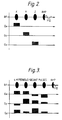
- a standard ISIS sequence is shown in Fig 2. To obtain a result this sequence is followed by seven others with different inversion pulses and the results summed.
- RF is the radio frequency signal.
- the first three signals labelled X, Y and Z are selective pulses which comprise high frequency signals modulated by a low frequency envelope. Each of these pulses are applied to the sample simultaneously with a gradient magnetic field pulse in either the X, Y or Z direction as shown on the lower three axes.
- Each combination of an R.F. pulse and a gradient magnetic field pulse causes a slice inversion in the respective orthogonal direction.
- the present invention achieves improved localization by tailoring the shape and orientation of the VOI in three dimensions.
- the shape of the VOI is modified by using non-orthogonal slices in the sample.
- the volume of interest defined by the intersection of three slices is only a cuboid if all three slices are mutually orthogonal as defined by the three gradient coils.
- the volume defined by three arbitrarily oriented slices is a parallelepiped.
- Multi-dimensional B o gradient spectroscopic localization techniques such as Fourier techniques; Brown T.R. Kircaid B.M. and Ugurbil K; Proc.Nath.Acad.Sci. 79 3523-6 (1982); and Hadamard techniques; Muller S. Magn.Reson.Med. 6, 364 (1988); Bolinger L & Leigh J.S.J. Mag.Res.80,162 (1988); Ordidge R.J. Bowley R.M. & McHale G. Mag.Res.Med. 8,323 (1988) are conventionally implemented within a Cartesian coordinate system, each spatial dimension corresponding to a single gradient coil: X, Y or Z.
- the coordinate direction is defined by selection, phase-encoding or read-out gradients having the same vector direction as the gradients used to prepare the region.
- the coordinate direction is defined by selection, phase-encoding or read-out gradients having the same vector direction as the gradients used to prepare the region.
- FOV field of view
- the first case is the reduction of partial volume effects which occur when a voxel overlaps two distinct anatomical regions.
- the voxel shape may be tailored to conform better to the edges of the site under investigation and thus avoid contamination, Fig. (IE).
- the second is the improvement in spatial resolution for a given array by reduction of the FOV volume.
- Signals from sample regions outside the FOV either produce aliasing artifacts (Fourier) or are lost (Hadamard; Fourier + volume suppression). In either case it may often be possible to significantly reduce the FOV volume without penalty by conforming the FOV to the target region, Fig. 1(F).
- This also applies to magnetic resonance imaging (MRI) sequences as well as spectroscopy and allows increased resolution through the more efficient use of the imaged volume. Both of these methods increase the number of useful voxels that may be acquired in a given experiment.
- MRI magnetic resonance imaging
- the invention allow VOI's to be defined with considerably improved flexibility and provide improvements in localization and signal-to-noise ratio for many situations.
- a gradient field is applied to the sample by each of the X, Y and Z gradient field coils. These gradient fields are of such a magnitude and sense that the slices are oriented as desired.
- the normal non-selective read pulse is used to excite the nuclei to produce the detected FID signal.
- the resulting detected signal will include not only the signal from the region of intersection but also the signal from the rest of each of the four slices.
- the table contains columns for only one of the six prisms (AuB,AuC,AuD,BuC,BuD,CuD), and one of the four parallelepipeds (AuBuC,AuBuD,AuCuD,BuCuD). Since the ordering of the slices is arbitrary it follows that there will be no signal contribution from any of these other regions either. For clarity the effects of incomplete spin inversion and Tl recovery have been neglected in this table. (These effects result in a loss of SNR from the VOI but do not impair the spatial selectivity.)
- the first column shows the number of the experiment, and the second polarity of the inversion for each slice A, B, C and D.
- the sign of the signal from combinations of the slices are shown in the third, fourth and fifth columns.
- the sixth column the result of multiplying the individual slice signals and the combination by the polyhedron combination in column five is shown.
- Polyhedra consisting of pairs of parallel opposing faces may be formed efficiently by C-ISIS, each pair of faces corresponding to an inverted slice, but other forms of polyhedron are easily formed: e.g. a cube with just one corner section removed.
- the polyhedral volumes bounded by 4,5 and 6 slices may be regarded as respectively the intersection of a parallelepiped with a slice, a prism and with a second parallelepiped, and can be seen as successively truncated parallelepipeds, in the same way as a parallelepiped is a truncated prism.
- the minimum number of slices required to define each polyhedron can be denoted as its "Order", so for example cubes and parallelepipeds are 3rd order polyhedra, while a dodecahedron is of 6th order.
- the limit on the highest order of useable polyhedra is determined by experimental conditions as the measurements usually have to be made within a limited time and the higher the order, the more time the scan takes.
- the different localization options offered by the use of polyhedral VOIs are highly advantageous when high SNR spectra from various irregular shaped lesions are required.
- C-ISIS can localize to any polyhedron without signal-to-noise ratio loss as will be appreciated from the following. Since a cube may be localized in an 8-scan experiment with optimum SNR, given the provisos mentioned above, it follows trivially that a 16 scan experiment consisting of these 8 scans repeated twice (2 sets of 8 named A & B respectively) also yields localization to the cube with full SNR if the signals from sets A & B are added. Now consider the modification of this experiment so that set B includes an additional inversion pulse so that only a certain sub-region of the cube undergoes inversion. Now set A still yields signal from the whole cube and so does set B, but with the signal from the sub-region inverted in sign.
- 2 cuboid regions can be defined using 4 slices, 2 of them parallel, in 16 scans.
- 4 parallelepipedal VOIs can be defined at the 4 corners of a (thin walled) tetrahedron, each face of which corresponds to one of the 4 slices. If the 4 slices are allowed to overlap at the centre of the tetrahedron then a 4th order polyhedron, such as an octahedron, may also be localized.
- a suitable number of slices of appropriate width may be positioned at any orientation with respect to the rectilinear co-ordinate system.
- the approach may also be used with non-linear gradients to better specify volumes.
- the sequence may be used with composite RF pulses that simultaneously affect several slices and reduced sequence cycling may be achieved with partial Hadamard signal summation schemes.
- multiple volumes may be defined with 4 or more slices, for instance 5 slices can be used to localize to 2 VOIs of equal shape and size formed by the intersection of a hexagonal prism with 2 parallel slices.
- This arrangement can be used to obtain a directly comparable control spectrum from contralateral normal tissue. It can also be used to look at two kidneys or the two lobes of the brain etc.
- This technique used in combination with the true multivolume method can be used to rapidly select regions of similar tissue from a volume containing heterogeneous tissue types. It can also be used to localise disconnected regions which approximate a concave-shaped region (one with an outer surface containing regions of negative surface curvature).
- the implementation of the first and second aspects of the invention to produce a VOI consisting of an arbitrarily oriented parallelepiped is not confined to ISIS and may be incorporated into any localization technique which in its standard form uses slice selective pulses in three orthogonal directions, such as VSE, SPARS and STEAM.
- the implementation of the third aspect of the invention to generate higher order polyhedra can be approached in one of two ways, only one of which involves hyperbolic-secant inversion pulses.
- Several localization methods (VSE/VOSY,SPARS,SPALL) subject the spin population to repeated preparation episodes so that only those spins that experience all episodes contribute signal to the final spectrum.
- Fig 4 shows the R.F. and gradient field pulses for a C-SPARS sequence.
- the STEAM sequence is not amenable to the addition of further preparation episodes as the three selective pulses have the dual function of both defining the VOI in terms of XYZ coordinates and of generating the stimulated echo, which is by nature a 3-pulse signal, i.e. no read-out pulse has to be applied to obtain a resanance signal.
- this does not preclude the use of higher order polyhedra as the STEAM sequence may be modified to incorporate a C-ISIS period using inversion pulses. This may be done either prior to the first sinc pulse or between the second and third, which may be advantageous in terms of Tl behaviour and sequence timing if other pre-pulses such as pre-saturation water suppresion are required.
- C-ISIS/STEAM RF and gradient field pulse sequence An example of a C-ISIS/STEAM RF and gradient field pulse sequence is illustrated in Figure 5.
- angled slices are used for both the ISIS inversion pulses and the stimulated echo 90deg pulses.
- STEAM is in principle a single scan method
- C-ISIS/STEAM may achieve a given order of polyhedron with 8 times fewer scans than the full C-ISIS sequence.
- Other hybrid sequences may be considered, such as C-ISIS/SPARS which for instance has the advantage that it introduces no further T2 weighting over SPARS, unlike C-SPARS.
- the selection gradient is produced by simultaneously energizing two or more gradient coils.
- the slice orientation is determined by the relative strengths of the currents in the coils energized.
- a beneficial consequence of this method is that the chemical shift induced slice displacement (chemical shift means that the nuclei experience a slightly different magnetic field to that applied because of the electrons around them) can be reduced, since, depending on the slice orientation, the maximum available effective gradient strength is increased by up to a maximum of the square root of 3 times the value for a single gradient coil.
- There is a general implementation advantage in using parallel slices where possible as this reduces the required gradient switching, and will also reduce the number of distinct RF pulses needed if more than 1 slice is inverted simultaneously.
- Conformal ISIS In order to take full advantage of the localization afforded by Conformal ISIS a 3D imaging computer program is used. For some cases (e.g. examination of brain tumours) images may be available from prior MR or CT examinations and it is possible to select the slice positions based upon anatomical ROI information supplied by an operator.
- Conformal ISIS enables in vivo 31P spectroscopy to be performed with both improved signal to noise ratios and the reliability necessary for quantitative studies.
- C-ISIS allows more multivolume elements to be positioned within the sensitive region of the coil than does conventional ISIS and allows the volume element sizes to be chosen to suit the signal to noise ratio. Further, as discussed above the technique may readily be applied to extend the versatility of other NMR localization methods.
- the above described apparatus provides a means of obtaining a spatially localised magnetic resonance signal from one or more defined regions. It also provides a means of obtaining a spatially localised magnetic resonance signal from one or more regions that are non-cuboidal or non-rectangular in shape. A further aspect is that it provides a means of obtaining a spatially localised magnetic resonance signal using a variable number of orthogonal or non-orthogonal selected planes to prepare, select, phase-encode or read out magnetisation; the signals from an appropriate scheme of acquisitions utilising such planes to be combined in a suitable manner to obtain signal localised in the said way.
- the method of "conformal" spectroscopy may also be applied to the localization of spectra from concave VOI's, rather than convex as described above, by using a pulse sequence termed the "OR Pulse”.
- Fig 6 shows a simple concave volume employing 4 slices, two of which define a column within which the oblique slices A and B define the concave VOI.
- Two pulse sequences are shown in Figs. 7 and 8 in which Ga and Gb are the oblique selection gradients corresponding to slices A and B, and are created by energization of combinations of gradient field coils.
- Fig. 7 shows a "selective 'OR Pulse' " sequence and Fig.8 a "non-selective 'OR Pulse"' sequence.
- the non-selective "OR Pulse" sequence shown in Figure 8 consists, as can be seen, of applying a first selective electromagnetic preparation pulse having a first phase (labelled 60+x) to the sample while applying a first gradient magnetic field Ga to select a region in the form of a first slice of the sample. Then an electromagnetic pulse having a second phase (labelled 180y) is applied to the sample and subsequently a second selective electromagnetic preparation pulse having a third phase (labelled 60-x) is applied to the sample while applying a second gradient magnetic field Gb to select a region in the form of a second slice of the sample.
- the phases and the amplitudes of the selective electromagnetic pulses are chosen such that the resonance signal from the sample has substantially the same intensity and phase from within the first and second slices and from the region of the sample defined by the overlap of the first and second slices.
- the selective OR pulse sequence which is used in similar fashion, is illustrated in Figure 7 and it can be seen that the sequence consists of applying a first selective electromagnetic preparation pulse having a first phase (labelled 120x) to the sample while applying a first gradient magnetic field Ga to select a region in the form of a first slice of the sample. Then a second selective electromagnetic preparation pulse having a second phase (labelled 180y) is applied while applying a second gradient magnetic field Ga to further condition the magnetization in the first slice. Then a third electromagnetic preparation pulse having a third phase (labelled 60x) is applied while applying a third gradient magnetic field to select a region in the form of a second slice of the sample.
- the non-selective implementation is preferably in terms of RF requirements, a shorter echo-time and uniformity of excitation (due to the avoidance of saturation bands adjacent to slice A which occur with selective refocusing).
- selective refocusing preferably using an optimised pulse waveform, can give acceptable results in applications where it is undesirable to disturb the entire sample magnetization.
- the OR pulse can be used as a building block with multi-frequency pulses (5) to define complex VOI's such as toroids.
- Single-shot shimming with STEAM may be performed using the OR-pulse, which is an important feature for practical 1 H spectroscopy.
Landscapes
- Physics & Mathematics (AREA)
- Spectroscopy & Molecular Physics (AREA)
- High Energy & Nuclear Physics (AREA)
- Condensed Matter Physics & Semiconductors (AREA)
- General Physics & Mathematics (AREA)
- Optics & Photonics (AREA)
- Health & Medical Sciences (AREA)
- General Health & Medical Sciences (AREA)
- Nuclear Medicine, Radiotherapy & Molecular Imaging (AREA)
- Radiology & Medical Imaging (AREA)
- Engineering & Computer Science (AREA)
- Signal Processing (AREA)
- Magnetic Resonance Imaging Apparatus (AREA)
Abstract
Claims (16)
- Procédé de spectroscopie par résonance magnétique localisée dans l'espace, comprenant les étapes consistant à:1) obtenir un premier signal de résonance (FID) à partir d'un échantillon;2) inverser la population de spin d'une pluralité de tranches entrecroisées sélectionnées de l'échantillon;3) obtenir un second signal de résonance (FID) à partir de l'échantillon après l'étape (2);4) soustraire le second signal de résonance du premier signal de résonance pour obtenir un signal représentatif du signal de rmn à partir d'un volume concerné à l'intersection des tranches sélectionnées;caractérisé en ce que
lors de l'étape 2), il y a au moins deux tranches entrecroisées sélectionnées qui sont mutuellement non orthogonales. - Procédé selon la revendication 1, dans lequel sont prévues une pluralité de bobines à champs magnétiques à gradient conçues pour générer des champs magnétiques (Gx, Gy, Gz) à gradient suivant des axes orthogonaux et caractérisé en ce que, lors de l'étape 2), au moins une desdites tranches entrecroisées est sélectionnée par la mise sous tension simultanée de plus d'une bobine à gradient.
- Procédé selon la revendication 2, dans lequel les champs magnétiques (Gx, Gy, Gz) à gradient sont appliqués en impulsions et ne sont pas variables dans le temps pendant l'impulsion.
- Procédé selon la revendication 2 ou 3, dans lequel les champs magnétiques (Gx, Gy, Gz) à gradient sont non linéaires dans l'espace à travers au moins une partie de l'échantillon.
- Procédé selon la revendication 2 ou 3, dans lequel les champs magnétiques (Gx, Gy, Gz) à gradient sont linéaires dans l'espace à travers au moins une partie de l'échantillon.
- Procédé selon la revendication 2, 3, 4 ou 5, dans lequel trois bobines à champs orthogonaux à gradient sont utilisées.
- Procédé selon l'une quelconque des revendications précédentes, dans lequel les étapes 1) et 3) comprennent l'application d'une séquence d'impulsions de lecture (AHP) à l'échantillon pour obtenir lesdits signaux de résonance (FID).
- Procédé selon l'une quelconque des revendications précédentes, dans lequel les étapes 2) et 3) sont répétées avec des inversions de tranches différentes et les signaux de résonance obtenus lors de l'étape 1) et de l'étape répétée 3) sont combinés de manière arithmétique par addition ou soustraction pour obtenir un signal à partir de l'intersection des tranches.
- Procédé selon l'une quelconque des revendications précédentes, comprenant en outre l'étape consistant à appliquer d'autres impulsions électromagnétiques pour adapter le signal.
- Procédé selon la revendication 1 ou 2, comprenant les étapes consistant à appliquer à l'échantillon une première impulsion électromagnétique sélective de préparation ayant une première phase tout en appliquant le premier champ magnétique à gradient pour sélectionner une région sous la forme de la première tranche (A) de l'échantillon, puis à appliquer à l'échantillon une impulsion électromagnétique ayant une seconde phase, à appliquer à l'échantillon une seconde impulsion électromagnétique sélective de préparation ayant une troisième phase tout en appliquant le second champ magnétique à gradient à l'échantillon pour sélectionner une région sous la forme de la seconde tranche de l'échantillon, dans lequel les première, seconde et troisième phases et les amplitudes de toutes les impulsions électromagnétiques sélectives sont telles que le signal de résonance provenant de l'échantillon a sensiblement la même intensité et la même phase depuis l'intérieur des première et seconde tranches (A+B) et depuis la région de l'échantillon (A+B) définie par le chevauchement des première et seconde tranches (A, B).
- Procédé selon la revendication 1 ou 2, comprenant les étapes consistant à appliquer à appliquer à l'échantillon une première impulsion électromagnétique sélective de préparation ayant une première phase tout en appliquant un premier champ magnétique à gradient pour sélectionner une région sous la forme de la première tranche (A) de l'échantillon, puis à appliquer une seconde impulsion électromagnétique de préparation ayant une seconde phase tout en appliquant un second champ magnétique à gradient pour adapter davantage l'aimantation dans la première tranche (A), puis à appliquer une troisième impulsion électromagnétique sélective de préparation ayant une troisième phase tout en appliquant à l'échantillon un troisième champ magnétique à gradient pour sélectionner une région sous la forme de la seconde tranche (B) de l'échantillon.
- Procédé selon l'une quelconque des revendications 1 à 9, comprenant l'étape consistant à définir plus de trois tranches entrecroisées à travers l'échantillon pour créer une région échantillonnée polyédrique.
- Procédé selon l'une quelconque des revendications 1 à 9, comprenant l'étape consistant à définir au moins trois tranches à travers l'échantillon pour définir dans l'échantillon des régions échantillonnées sans liaisons.
- Procédé selon l'une quelconque des revendications précédentes, comprenant l'étape consistant à appliquer à un échantillon un train d'impulsions de suppression, de préparation ou de modification.
- Procédé selon la revendication 14, dans lequel deux impulsions d'excitation sont appliquées juste après un signal de suppression et une impulsion d'excitation est appliquée juste avant le signal de lecture.
- Dispositif de mesure de résonance magnétique nucléaire comprenant une pluralité de bobines à champs magnétiques à gradient, dont chacune peut créer individuellement dans un échantillon un champ magnétique (Gx, Gy, Gz) dans une direction respective, un moyen pour appliquer à l'échantillon des impulsions électromagnétiques de préparation, un moyen de lecture pour extraire de l'échantillon des signaux de résonance et un moyen de commande pour commander la mise sous tension des bobines à champs magnétiques à gradient, du moyen pour appliquer des impulsions électromagnétiques de préparation et du moyen de lecture, caractérisé en ce que le moyen de commande est conçu pour fonctionner selon le procédé de l'une quelconque des revendications 1 à 15.
Applications Claiming Priority (3)
| Application Number | Priority Date | Filing Date | Title |
|---|---|---|---|
| GB888819705A GB8819705D0 (en) | 1988-08-19 | 1988-08-19 | Improvements in nmr spectroscopy localisation |
| GB8819705 | 1988-08-19 | ||
| PCT/GB1989/000966 WO1990002344A1 (fr) | 1988-08-19 | 1989-08-18 | Ameliorations relatives a la mesure par resonance magnetique |
Publications (2)
| Publication Number | Publication Date |
|---|---|
| EP0429529A1 EP0429529A1 (fr) | 1991-06-05 |
| EP0429529B1 true EP0429529B1 (fr) | 1996-10-16 |
Family
ID=10642383
Family Applications (1)
| Application Number | Title | Priority Date | Filing Date |
|---|---|---|---|
| EP89909815A Expired - Lifetime EP0429529B1 (fr) | 1988-08-19 | 1989-08-18 | Ameliorations relatives a la mesure par resonance magnetique |
Country Status (6)
| Country | Link |
|---|---|
| US (1) | US5374889A (fr) |
| EP (1) | EP0429529B1 (fr) |
| JP (1) | JP2942579B2 (fr) |
| DE (1) | DE68927349T2 (fr) |
| GB (2) | GB8819705D0 (fr) |
| WO (1) | WO1990002344A1 (fr) |
Families Citing this family (22)
| Publication number | Priority date | Publication date | Assignee | Title |
|---|---|---|---|---|
| GB8907493D0 (en) * | 1989-04-03 | 1989-05-17 | Crespigny Alexander J D | Region selection in nuclear magnetic resonance inspection |
| GB9111738D0 (en) * | 1991-05-31 | 1991-07-24 | Instrumentarium Corp | Method |
| US5709208A (en) * | 1994-04-08 | 1998-01-20 | The United States Of America As Represented By The Department Of Health And Human Services | Method and system for multidimensional localization and for rapid magnetic resonance spectroscopic imaging |
| JPH10505780A (ja) * | 1995-07-20 | 1998-06-09 | フィリップス エレクトロニクス エヌ ベー | 磁気共鳴を利用して身体の湾曲部分を画像化する方法及び装置 |
| US5903149A (en) * | 1997-04-11 | 1999-05-11 | The Trustees Of The University Of Pennsylvania | Three-dimensional localized proton NMR spectroscopy using a hybrid of one-dimensional hadamard with two-dimensional chemical shift imaging |
| DE19922461C2 (de) * | 1999-05-17 | 2002-08-08 | Forschungszentrum Juelich Gmbh | Verfahren zum Betreiben eines Kernresonanztomographen mit einem Unterdrücken von Bildartefakten |
| US6998841B1 (en) | 2000-03-31 | 2006-02-14 | Virtualscopics, Llc | Method and system which forms an isotropic, high-resolution, three-dimensional diagnostic image of a subject from two-dimensional image data scans |
| DE10203237B4 (de) * | 2002-01-28 | 2006-08-17 | Siemens Ag | Verfahren zur Magnetresonanz-Bildgebung mit automatischer Anpassung des Messfeldes |
| US7319784B2 (en) * | 2003-02-05 | 2008-01-15 | National Research Council Of Canada | Magnetic resonance spectroscopy using a conformal voxel |
| US7064544B1 (en) * | 2004-05-18 | 2006-06-20 | General Electric Company | Method and system of scaling MR spectroscopic data acquired with phased-array coils |
| US8219176B2 (en) | 2007-03-08 | 2012-07-10 | Allegheny-Singer Research Institute | Single coil parallel imaging |
| US7541808B2 (en) | 2007-04-11 | 2009-06-02 | Allegheny-Singer Research Institute | Rapid MRI dynamic imaging using MACH |
| DE102007044463B4 (de) * | 2007-09-18 | 2009-05-14 | Bruker Biospin Mri Gmbh | Verfahren zur Bestimmung der räumlichen Verteilung von Magnetresonanzsignalen durch mehrdimensionale HF-Anregungspulse |
| US8688193B2 (en) | 2008-06-26 | 2014-04-01 | Allegheny-Singer Research Institute | Magnetic resonance imager, method and program which continuously applies steady-state free precession to k-space |
| US8131046B2 (en) | 2008-10-29 | 2012-03-06 | Allegheny-Singer Research Institute | Magnetic resonance imager using cylindrical offset region of excitation, and method |
| US8198892B2 (en) | 2009-04-22 | 2012-06-12 | Allegheny-Singer Research Institute | Steady-state-free-precession (SSFP) magnetic resonance imaging (MRI) and method |
| US8405394B2 (en) | 2009-10-20 | 2013-03-26 | Allegheny-Singer Research Institute | Targeted acquisition using holistic ordering (TACHO) approach for high signal to noise imaging |
| DE102010038777B4 (de) | 2010-08-02 | 2012-12-13 | Siemens Aktiengesellschaft | Erstellung von MR-Bildern eines vorbestimmten Volumenabschnitts innerhalb eines Untersuchungsobjekts bei kontinuierlicher Tischverschiebung |
| CN104062611B (zh) * | 2013-03-22 | 2017-02-15 | 西门子(深圳)磁共振有限公司 | 一种磁共振系统的射频激发方法和装置 |
| US10502803B2 (en) * | 2015-05-15 | 2019-12-10 | The Regents Of The University Of California | Magnetic resonance imaging based on altering the shape of the inversion region in pulsed arterial spin labeling |
| CN105476635B (zh) | 2015-12-29 | 2019-02-05 | 沈阳东软医疗系统有限公司 | 一种核磁共振成像系统中射频线圈的定位方法和装置 |
| WO2021030466A1 (fr) * | 2019-08-12 | 2021-02-18 | The Medical College Of Wisconsin, Inc. | Imagerie par résonance magnétique multi-orientation simultanée |
Family Cites Families (20)
| Publication number | Priority date | Publication date | Assignee | Title |
|---|---|---|---|---|
| US4318043A (en) * | 1978-07-20 | 1982-03-02 | The Regents Of The University Of California | Method and apparatus for rapid NMR imaging of nuclear densities within an object |
| GB2114756B (en) * | 1982-02-09 | 1986-11-26 | Oxford Res Syst | Method and apparatus for obtaining nmr spectra |
| FR2526968B1 (fr) * | 1982-05-14 | 1986-02-28 | Thomson Csf | Procede de tomographie d'un objet par resonance magnetique nucleaire |
| US4710716A (en) * | 1985-09-20 | 1987-12-01 | Elscint Ltd. | Slice orientation selection arrangement |
| US4736160A (en) * | 1985-05-29 | 1988-04-05 | Hitachi, Ltd. | Nuclear magnetic resonance imaging method |
| US4634553A (en) * | 1985-08-12 | 1987-01-06 | Eastman Kodak Company | Novel 4H-tellurin tellurane electron-accepting sensitizers for electron-donating photoconductive compositions |
| US4743851A (en) * | 1985-08-27 | 1988-05-10 | Resonex, Inc. | Apparatus and method for creating non-orthogonal magnetic resonance imaging |
| GB8523673D0 (en) * | 1985-09-25 | 1985-10-30 | Picker Int Ltd | Nuclear magnetic resonance methods |
| US4649347A (en) * | 1985-11-15 | 1987-03-10 | General Electric Company | Method for off-center field-of-view imaging using MR |
| US4684893A (en) * | 1985-12-23 | 1987-08-04 | Kabushiki Kaisha Toshiba | Field gradient correction apparatus for compensating static field inhomogeneities in NMR imaging system |
| FR2602869B1 (fr) * | 1986-08-14 | 1989-03-31 | Thomson Cgr | Procede d'application des impulsions de gradient dans une experimentation d'imagerie au moyen d'une machine de resonance magnetique nucleaire |
| JPH02501033A (ja) * | 1986-11-14 | 1990-04-12 | フォナル・コーポレイション | 多角傾斜磁気共鳴像形成装置および方法 |
| WO1988004058A1 (fr) * | 1986-11-28 | 1988-06-02 | Fonar Corporation | Appareil et procede d'imagerie par resonance magnetique oblique generalisee |
| GB8702951D0 (en) * | 1987-02-10 | 1987-03-18 | Surrey Medical Imaging Systems | Nmr imaging |
| US4812760A (en) * | 1987-07-27 | 1989-03-14 | General Electric Company | Multi-dimensional selective NMR excitation with a single RF pulse |
| US4830012A (en) * | 1987-08-14 | 1989-05-16 | Duke University | High speed NMR imaging method and apparatus |
| US4908573A (en) * | 1989-01-05 | 1990-03-13 | The Regents Of The University Of California | 3D image reconstruction method for placing 3D structure within common oblique or contoured slice-volume without loss of volume resolution |
| US4933639A (en) * | 1989-02-13 | 1990-06-12 | The Board Of Regents, The University Of Texas System | Axis translator for magnetic resonance imaging |
| US4970457A (en) * | 1989-04-05 | 1990-11-13 | The Regents Of The University Of California | MRI compensated for spurious rapid variations in static magnetic field during a single MRI sequence |
| US4983920A (en) * | 1989-08-11 | 1991-01-08 | Picker International, Inc. | NMR spectroscopy with phase encoding within a selected voxel |
-
1988
- 1988-08-19 GB GB888819705A patent/GB8819705D0/en active Pending
-
1989
- 1989-08-18 JP JP1509472A patent/JP2942579B2/ja not_active Expired - Fee Related
- 1989-08-18 DE DE68927349T patent/DE68927349T2/de not_active Expired - Fee Related
- 1989-08-18 WO PCT/GB1989/000966 patent/WO1990002344A1/fr not_active Ceased
- 1989-08-18 US US08/217,128 patent/US5374889A/en not_active Expired - Lifetime
- 1989-08-18 GB GB8918864A patent/GB2225431B/en not_active Expired - Lifetime
- 1989-08-18 EP EP89909815A patent/EP0429529B1/fr not_active Expired - Lifetime
Non-Patent Citations (1)
| Title |
|---|
| R.J. Ordidge et al. ; J. Magn. Res. 66, 283-294 (1986) * |
Also Published As
| Publication number | Publication date |
|---|---|
| GB8819705D0 (en) | 1988-09-21 |
| JP2942579B2 (ja) | 1999-08-30 |
| GB2225431A (en) | 1990-05-30 |
| DE68927349D1 (de) | 1996-11-21 |
| DE68927349T2 (de) | 1997-02-13 |
| WO1990002344A1 (fr) | 1990-03-08 |
| EP0429529A1 (fr) | 1991-06-05 |
| GB8918864D0 (en) | 1989-09-27 |
| JPH05504688A (ja) | 1993-07-22 |
| GB2225431B (en) | 1992-12-16 |
| US5374889A (en) | 1994-12-20 |
Similar Documents
| Publication | Publication Date | Title |
|---|---|---|
| EP0429529B1 (fr) | Ameliorations relatives a la mesure par resonance magnetique | |
| US5168226A (en) | Acquisition of multiple images in fast spin echo nmr scans | |
| US4506223A (en) | Method for performing two-dimensional and three-dimensional chemical shift imaging | |
| US4521733A (en) | NMR Imaging of the transverse relaxation time using multiple spin echo sequences | |
| US6078176A (en) | Fast spin echo pulse sequence for diffusion weighted imaging | |
| US5256967A (en) | Fast NMR image acquisition with spectrally selective inversion pulses | |
| EP1037067B1 (fr) | Méthode d'IRM non-CPMG à échos de spin rapides | |
| US5749834A (en) | Intersecting multislice MRI data acquistion method | |
| US6876199B2 (en) | Method and system for accelerated imaging using parallel MRI | |
| US5422576A (en) | Magnetic resonance angiography using fast spin echo pulse sequence | |
| US5170122A (en) | NMR imaging using flow compensated SSFP pulse sequences | |
| US20100256478A1 (en) | Systems and methods for phase encode placement | |
| US20100016708A1 (en) | Mri rf encoding using multiple transmit coils | |
| US6304084B1 (en) | Method of improved magnetic resonance spectroscopic localization using spectral-spatial pulses | |
| US4881032A (en) | Method of, and apparatus for, NMR spectroscopic metabolite imaging and quantification | |
| US4891595A (en) | Restricted volume imaging | |
| US20110109314A1 (en) | Method and apparatus for improving 2D acceleration in MRI using a new coil array design | |
| EP0390086B1 (fr) | Méthode d'imagerie par résonance magnétique | |
| JP2001095773A (ja) | 磁気共鳴画像診断装置 | |
| Gonen et al. | Simultaneous and interleaved multinuclear chemical-shift imaging, a method for concurrent, localized spectroscopy | |
| EP0135143B1 (fr) | Procédé et appareil pour la production d'images par résonance magnétique nucléaire | |
| JP4383568B2 (ja) | 磁気共鳴スペクトロスコピー・イメージング方法及び装置 | |
| US5235280A (en) | Method for determining optimized radio-frequency pulse shapes for selective excitation in magnetic resonance spectroscopy and imaging | |
| US12385998B2 (en) | System and method for reduced fine-line artifacts in magnetic resonance imaging | |
| CN113544526B (zh) | 使用波编码的并行mr成像 |
Legal Events
| Date | Code | Title | Description |
|---|---|---|---|
| PUAI | Public reference made under article 153(3) epc to a published international application that has entered the european phase |
Free format text: ORIGINAL CODE: 0009012 |
|
| 17P | Request for examination filed |
Effective date: 19901231 |
|
| AK | Designated contracting states |
Kind code of ref document: A1 Designated state(s): DE FR NL |
|
| RAP1 | Party data changed (applicant data changed or rights of an application transferred) |
Owner name: BRITISH TECHNOLOGY GROUP PLC |
|
| RAP3 | Party data changed (applicant data changed or rights of an application transferred) |
Owner name: BRITISH TECHNOLOGY GROUP LTD |
|
| 17Q | First examination report despatched |
Effective date: 19940420 |
|
| GRAG | Despatch of communication of intention to grant |
Free format text: ORIGINAL CODE: EPIDOS AGRA |
|
| GRAH | Despatch of communication of intention to grant a patent |
Free format text: ORIGINAL CODE: EPIDOS IGRA |
|
| GRAH | Despatch of communication of intention to grant a patent |
Free format text: ORIGINAL CODE: EPIDOS IGRA |
|
| GRAA | (expected) grant |
Free format text: ORIGINAL CODE: 0009210 |
|
| AK | Designated contracting states |
Kind code of ref document: B1 Designated state(s): DE FR NL |
|
| REF | Corresponds to: |
Ref document number: 68927349 Country of ref document: DE Date of ref document: 19961121 |
|
| ET | Fr: translation filed | ||
| PLBE | No opposition filed within time limit |
Free format text: ORIGINAL CODE: 0009261 |
|
| STAA | Information on the status of an ep patent application or granted ep patent |
Free format text: STATUS: NO OPPOSITION FILED WITHIN TIME LIMIT |
|
| 26N | No opposition filed | ||
| PGFP | Annual fee paid to national office [announced via postgrant information from national office to epo] |
Ref country code: DE Payment date: 20070816 Year of fee payment: 19 |
|
| PGFP | Annual fee paid to national office [announced via postgrant information from national office to epo] |
Ref country code: NL Payment date: 20070805 Year of fee payment: 19 |
|
| PGFP | Annual fee paid to national office [announced via postgrant information from national office to epo] |
Ref country code: FR Payment date: 20070808 Year of fee payment: 19 |
|
| NLV4 | Nl: lapsed or anulled due to non-payment of the annual fee |
Effective date: 20090301 |
|
| PG25 | Lapsed in a contracting state [announced via postgrant information from national office to epo] |
Ref country code: NL Free format text: LAPSE BECAUSE OF NON-PAYMENT OF DUE FEES Effective date: 20090301 |
|
| REG | Reference to a national code |
Ref country code: FR Ref legal event code: ST Effective date: 20090430 |
|
| PG25 | Lapsed in a contracting state [announced via postgrant information from national office to epo] |
Ref country code: DE Free format text: LAPSE BECAUSE OF NON-PAYMENT OF DUE FEES Effective date: 20090303 Ref country code: FR Free format text: LAPSE BECAUSE OF NON-PAYMENT OF DUE FEES Effective date: 20080901 |