EP0429793B1 - Feuille d'acier inoxydable résistante à la chaleur comme support de catalyseur pour épurateurs d'éffluents gazeux de combustion - Google Patents
Feuille d'acier inoxydable résistante à la chaleur comme support de catalyseur pour épurateurs d'éffluents gazeux de combustion Download PDFInfo
- Publication number
- EP0429793B1 EP0429793B1 EP90118476A EP90118476A EP0429793B1 EP 0429793 B1 EP0429793 B1 EP 0429793B1 EP 90118476 A EP90118476 A EP 90118476A EP 90118476 A EP90118476 A EP 90118476A EP 0429793 B1 EP0429793 B1 EP 0429793B1
- Authority
- EP
- European Patent Office
- Prior art keywords
- hot
- steels
- content
- catalyst
- foil
- Prior art date
- Legal status (The legal status is an assumption and is not a legal conclusion. Google has not performed a legal analysis and makes no representation as to the accuracy of the status listed.)
- Expired - Lifetime
Links
Images

Classifications
-
- F—MECHANICAL ENGINEERING; LIGHTING; HEATING; WEAPONS; BLASTING
- F01—MACHINES OR ENGINES IN GENERAL; ENGINE PLANTS IN GENERAL; STEAM ENGINES
- F01N—GAS-FLOW SILENCERS OR EXHAUST APPARATUS FOR MACHINES OR ENGINES IN GENERAL; GAS-FLOW SILENCERS OR EXHAUST APPARATUS FOR INTERNAL-COMBUSTION ENGINES
- F01N3/00—Exhaust or silencing apparatus having means for purifying, rendering innocuous, or otherwise treating exhaust
- F01N3/08—Exhaust or silencing apparatus having means for purifying, rendering innocuous, or otherwise treating exhaust for rendering innocuous
- F01N3/10—Exhaust or silencing apparatus having means for purifying, rendering innocuous, or otherwise treating exhaust for rendering innocuous by thermal or catalytic conversion of noxious components of exhaust
- F01N3/24—Exhaust or silencing apparatus having means for purifying, rendering innocuous, or otherwise treating exhaust for rendering innocuous by thermal or catalytic conversion of noxious components of exhaust characterised by constructional aspects of converting apparatus
- F01N3/28—Construction of catalytic reactors
- F01N3/2803—Construction of catalytic reactors characterised by structure, by material or by manufacturing of catalyst support
- F01N3/2807—Metal other than sintered metal
- F01N3/281—Metallic honeycomb monoliths made of stacked or rolled sheets, foils or plates
-
- C—CHEMISTRY; METALLURGY
- C22—METALLURGY; FERROUS OR NON-FERROUS ALLOYS; TREATMENT OF ALLOYS OR NON-FERROUS METALS
- C22C—ALLOYS
- C22C38/00—Ferrous alloys, e.g. steel alloys
- C22C38/18—Ferrous alloys, e.g. steel alloys containing chromium
-
- F—MECHANICAL ENGINEERING; LIGHTING; HEATING; WEAPONS; BLASTING
- F01—MACHINES OR ENGINES IN GENERAL; ENGINE PLANTS IN GENERAL; STEAM ENGINES
- F01N—GAS-FLOW SILENCERS OR EXHAUST APPARATUS FOR MACHINES OR ENGINES IN GENERAL; GAS-FLOW SILENCERS OR EXHAUST APPARATUS FOR INTERNAL-COMBUSTION ENGINES
- F01N3/00—Exhaust or silencing apparatus having means for purifying, rendering innocuous, or otherwise treating exhaust
- F01N3/08—Exhaust or silencing apparatus having means for purifying, rendering innocuous, or otherwise treating exhaust for rendering innocuous
- F01N3/10—Exhaust or silencing apparatus having means for purifying, rendering innocuous, or otherwise treating exhaust for rendering innocuous by thermal or catalytic conversion of noxious components of exhaust
- F01N3/24—Exhaust or silencing apparatus having means for purifying, rendering innocuous, or otherwise treating exhaust for rendering innocuous by thermal or catalytic conversion of noxious components of exhaust characterised by constructional aspects of converting apparatus
- F01N3/28—Construction of catalytic reactors
- F01N3/2803—Construction of catalytic reactors characterised by structure, by material or by manufacturing of catalyst support
- F01N3/2807—Metal other than sintered metal
-
- F—MECHANICAL ENGINEERING; LIGHTING; HEATING; WEAPONS; BLASTING
- F02—COMBUSTION ENGINES; HOT-GAS OR COMBUSTION-PRODUCT ENGINE PLANTS
- F02B—INTERNAL-COMBUSTION PISTON ENGINES; COMBUSTION ENGINES IN GENERAL
- F02B1/00—Engines characterised by fuel-air mixture compression
- F02B1/02—Engines characterised by fuel-air mixture compression with positive ignition
- F02B1/04—Engines characterised by fuel-air mixture compression with positive ignition with fuel-air mixture admission into cylinder
-
- Y—GENERAL TAGGING OF NEW TECHNOLOGICAL DEVELOPMENTS; GENERAL TAGGING OF CROSS-SECTIONAL TECHNOLOGIES SPANNING OVER SEVERAL SECTIONS OF THE IPC; TECHNICAL SUBJECTS COVERED BY FORMER USPC CROSS-REFERENCE ART COLLECTIONS [XRACs] AND DIGESTS
- Y02—TECHNOLOGIES OR APPLICATIONS FOR MITIGATION OR ADAPTATION AGAINST CLIMATE CHANGE
- Y02A—TECHNOLOGIES FOR ADAPTATION TO CLIMATE CHANGE
- Y02A50/00—TECHNOLOGIES FOR ADAPTATION TO CLIMATE CHANGE in human health protection, e.g. against extreme weather
- Y02A50/20—Air quality improvement or preservation, e.g. vehicle emission control or emission reduction by using catalytic converters
Definitions
- the present invention relates to a stainless steel foil having a high oxidation resistance and good processability and applicable to catalyst-carriers of combustion exhaust gas purifiers.
- the catalyst-carriers of combustion exhaust gas purifiers of automobiles, etc. are conventionally fabricated of a ceramics honeycomb.
- An advantageous alternative to the ceramics honeycomb is a heat-resistant stainless steel foil, by which the honeycomb wall thickness as well as the gas flow resistance and the heat capacity can be reduced, to thereby improve the engine performance and save the expensive catalyst metals.
- Japanese Unexamined Patent Publication (Kokai) Nos. 50-92286, 50-144689 and 57-71898 & US-A-3957692, US-A-3920583, US-A-4318828
- Such an alloy must have specific characteristics, particularly the oxidation resistance and the adhesion of an oxide film thereof, and accordingly, the conventional metal foils are made of an alloy based on an Fe-Cr-Al alloy, and modified to provide an improved oxidation resistance and/or an improved adhesion with a wash coat, i.e, a direct support for catalysts, utilizing the established excellent properties of the Fe-Cr-Al alloy, such as the oxidation resistance and the adhesion of an oxide film, as an electrical heating element and a material to be used for the high temperature members of heating systems.
- the above-referred Japanese patent publications both use yttrium (Y) to improve the oxidation resistance, and the use of such an expensive element is acceptable only for very limited applications.
- Japanese Unexamined Patent Publication (Kokai) No. 63-45351 & EP-A-0246939 proposed another modified Fe-Cr-Al-based alloy containing rare earth metals in a total amount of up to 0.06 wt%, including 0.002 to 0.05 wt% of rare earth metals from the group of La, Ce, Pr, and Nd, to prevent the spalling of an oxide film, and further proposed modified alloys supplemented with Zr or Nb in a content specified with respect to the C and N contents, to stabilize carbon and nitrogen in the alloy as a carbide and a nitride or to ensure the high temperature creep strength of the former alloy, respectively.
- This Japanese patent publication states that a total amount of rare earth metals of more than 0.06 wt% does not substantially improve the oxidation resistance, in comparison with a lower total amount, and further the working of the alloy becomes impossible at the usual hot-working temperatures.
- Japanese Unexamined Patent Publication (Kokai) No. 63-45351 also states that the addition of Y to Fe-Cr-Al-based alloys is unacceptably expensive, and proposed that lanthanoid elements (hereinafter simply referred to as "Ln” or “the Ln elements”) other than Ce or La alone be added to an alloy in an amount of from 0.05 to 0.20 wt%.
- Ln lanthanoid elements
- This publication states that such a specified composition is based on the phenomenon that the reduction of the hot workability due to the Ln addition is caused by the presence of Ce, which also lowers the oxidation resistance, and therefore, the addition of Ln other than Ce enables an alloy to be hot-worked and improves the oxidation resistance.
- the Ln elements are very reactive and have similar chemical properties, and therefore, are difficult to separate from each other and purify, and thus La is in fact much more expensive than mischmetal, which is a generally available mixture of the Ln elements, although La is inexpensive when compared with Y in an essentially pure form. Similarly, the separation and removal of Ce would also unavoidably raise the material price.
- the object of the present invention is to provide a heat-resistant stainless steel foil having an improved oxidation resistance and adhesion of an oxide film even when exposed to a hot combustion exhaust gas, which will effectively enhance the structural durability of a catalyst-carrier, and furthermore has a good process-ability, including a hot-workability, and is available at a low price.
- a heat-resistant stainless steel foil for a catalyst-carrier of combustion exhaust gas purifiers consisting in weight percentage of: more than 0.06 up to 0.15 of mischmetal being a mixture of La, Ce, Pr and Nd; from 8x(% mischmetal +0.015)/45 to 0.1 of P; from 4.5 to 6.5 of Al; from 13 to 25 of Cr; not more than 0.025 of C; not more than 0.02 of N; not more than 0.03 of C+N; optionally (0.03+4x%C+24x%N/7)% or less Ti, and/or (93x%C/12+93x%N/14)x1.5% or less Nb and the balance consisting of Fe and unavoidable impurities.
- the present inventive steel foil may further contain (0.03+4x%C+24x%N/7) or less of Ti and/or (93x%C/12+93x%N/14)x1.5 or less of Nb, whereby the toughness of a hot strip is remarkably improved.
- the present inventors found that an mischmetal content of more than 0.06 wt% remarkably improves the oxidation resistance of an Fe-Cr-Al-based alloy foil in an exhaust gas and that, in this case, hot-working can be carried out under the hot-working condition for usual stainless steels, and a separation of the Ln elements such as proposed by J.U.P.P. No. 63-45351 is not required, provided that the P content is within the specified range as later described in accordance with the Ln content. Stress is generated between an oxide film and a substrate metal, as the oxide film grows, and this stress causes a deformation of the substrate metal, and in particular, a large deformation occurs when the substrate metal has a thickness of less than 100 »m. The present inventors found that an mischmetal content of more than 0.06 wt% also mitigates such a deformation of the metal foil.
- a poor toughness of hot-rolled strip renders the mass-production difficult, because brittle cracks easily occur during handling or cold-rolling after hot-rolling.
- the present inventors studied the processability of such an Fe-Cr-Al-based stainless steel and found that an addition of Ti and/or Nb to the steel remarkably improves the toughness of hot strips, which is vital to the factory mass-production of usual stainless steel sheets from hot coils.
- Ln or lanthanoids
- Ln is a general term expressing fifteen elements from La to Lu in the periodic table.
- "mischmetal" is used as an inexpensive source material providing Ln elements in the steel.
- the elements actually detected when analyzing a foil are La, Ce, Pr, and Nd; other elements, if any, are present in an amount so minute that they can be ignored. Accordingly, the Ln of the present invention means a mixture of these four elements La, Ce, Pr, and Nd, and mischmetal is used as the Ln source.
- Ln improves the resistance of a foil against an abnormal oxidation by an exhaust gas.
- Figure 3 shows that the endurance time to the beginning of an abnormal oxidation (or the life to breakaway of foil) is significantly increased when the Ln content is greater than 0.06%, and is again reduced when the Ln content is greater than 0.15%.
- the foil of the present invention usually has a thickness so small that the stress generated at the oxide film/substrate metal interface due to the growth of the oxide film causes an elongation or deformation of the foil.
- the present inventors found that the extent of this deformation depends of the Ln content, and is reduced when the Ln content is increased to an amount of more than 0.06 wt%. This effectively reduces the shape change of a catalyst-carrier made of the foil when used at high temperatures, and thus improves the structural durability of a catalyst carrier, as later shown in examples.
- Ln is an indispensable component in the present inventive steel, to ensure the provision of the total effect as represented by the above-described two effects, and must be contained in an amount of more than 0.06% up to 0.15%.
- P or phosphorus is important to an improvement of the hot-workability, when interrelated with Ln.
- the present invention uses Ln in an amount within the above-specified range, to improve not only the oxidation resistance of a foil but also the durability of a catalyst carrier composed of the foil. It is conventionally believed that such a great amount of Ln lowers the hot-workability and makes it difficult to produce a foil by a process for the mass-production of usual stainless steel sheets, and that this is because Ce, which is a major component of a mischmetal, tends to react with Fe to form an intermetallic compound having a low melting point.
- the present inventors found that the hot-workability is not lowered at all by a large amount of Ln, when used together with P, because a portion of Ce and La form a high melting point phosphide in the form of relatively fine particles as small as, for example, 3 »m or less.
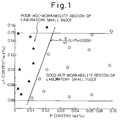
- the P content must be 8x(Ln%-0.009)/45 in wt% or more when Ln is present in the specified amount of more than 0.06 wt% and up to 0.15 wt%, as seen from Fig. 1.
- the P content must be limited, particularly when added to an Fe-Cr-Al-based stainless steel which essentially has a poor toughness. Accordingly, in the present invention, the P content must not be more than 0.1 wt%. Note, a P addition at an amount within this range does not adversely affect the oxidation resistance of the foil.
- the addition of Al or aluminum is essential to ensure the oxidation resistance of the present inventive steel.
- the Al content is less than 4.5 wt%, the protection against oxidation in an exhaust gas is very poor and an abnormal oxidation of a foil easily occurs to an extent such that the foil cannot be used as a catalyst-carrier.
- the Al content is more than 6.5 wt%, not only the toughness of a hot-rolled strip is greatly lowered to thereby impair the processability but also the thermal expansion coefficient becomes extremely high and leads to a serious amount of thermal fatigue due to the repeated heating and cooling effects when used as a catalyst carrier. Therefore, according to the present invention, the Al content must be from 4.5 to 6.5 wt%.
- the sufficient, but not excessive, Cr content according to the present invention is 13 to 25 wt%.
- Both carbon and nitrogen causes an extreme lowering of the toughness of a hot-rolled strip according to the present invention, and although this harmful effect can be suppressed by Ti or Nb, as will be later described in detail, the recovery of the toughness becomes difficult when the C content is more than 0.025 wt%, when the N content is more than 0.02 wt%, or when the C+N content or the total amount of C and N is 0.03 wt%. Accordingly, the C content must be not more than 0.025 wt%, the N content must be not more than 0.02 wt%, and the C+N content must be not more than 0.03 wt%.
- Ti is optionally used as an additive element to improve the toughness of hot-rolled strip of the present inventive steel, and the Ti content is determined in relation to the C and the N contents.
- the Ti content is limited to not more than (0.03+4x%C+24x%N/7) in wt%. This Ti addition, even at such a minute amount, significantly improves the toughness.
- the toughness-improving effect of Ti is originally due to the stabilizing of C and N, and therefore, when Ti is added to the present inventive steel for this purpose, the addition is preferably effected at a Ti content of at least 0.02 wt%.
- Nb is also optionally used as an additive element, to improve the toughness of hot-rolled strip of the present inventive steel, as described for Ti, and the Nb content is also limited in relation to the C and the N contents.
- Nb is preferably added at an amount of not less than (93x%C/12+93x%N/14)x0.8 in wt%.
- the Nb content must be limited to not more than (93x%C/12+93x%N/14)x1.5 in wt%, because when it exceeds this limit, a problem arises in that cracks in an as-cast ingot tends to appear during the cooling thereof before the toughness-improvement effect reaches saturation.
- Ti and Nb may be used either separately or in combination, to improve the toughness of hot-rolled strip without an adverse effect on the oxidation resistance of a catalyst-carrier.
- Mn is preferably limited to not more than 0.3 wt%, because Mn is concentrated in an oxide film formed during the initial oxidation, to thereby adversely affect the subsequent formation of an Al2O3 film and yield a defective film structure.
- the high-Al ferritic stainless steel of the present invention essentially has a superior oxidation resistance, and thus the Si content is preferably as small as possible or not more than 0.5 wt%.
- the S content is preferably limited to not more than 0.003 wt% in the present invention.
- Mg improves the adhesion of oxide film and the oxidation resistance of the high-Al stainless steel of the present invention, but the Mg addition is not necessarily required for this purpose in the present invention.
- Mg is unavoidably entrained in the high-Al stainless steel during the steelmaking process, the amount of entrained Mg is around 200 ppm at most, which does not adversely affect the hot-workability and the oxidation resistance at all.
- the present inventive Fe-Cr-Al-based alloy having the above-described composition is produced in the form of a foil as thin as around 50 »m, by the melting, hot-rolling and cold-rolling processes such as used for the large scale manufacture or mass-production of usual stainless steels, an annealing being carried out in accordance with need.
- the thus-produced foil, a catalyst-carrier composed of the foil for purifying exhaust emissions, and a catalyst apparatus not only have an excellent resistance to an abnormal oxidation even under a high temperature combustion exhaust gas atmosphere but also effectively improve the structural durability of such catalyst-carriers and apparatuses.
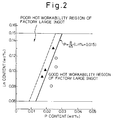
- the invention is described in detail in connection with the drawings in which Figures 1 and 2 show the hot-workability of Fe-Cr-Al-based stainless steels as a function of the Ln and P contents of steel; and
- Fig. 3 shows a relationship between the lanthanoids content of the present inventive Fe-Cr-Al stainless steel foil and the durability time before a breakaway occurs due to an abnormal oxidation by an engine exhaust emission.
- the hot-workability was studied in relation to the Ln and P contents of Fe-20Cr-5Al steels having the chemical compositions as shown in Table 1, in which the S content is 0.003 wt% or less and the oxygen content was 0.003 wt% or less for all of the steels used.
- the P content must be 8x(%Ln-0.009)/45 wt% or more when the Ln content is from more than 0.06 and up to 0.15 wt%.
- the P content must be 8x(%Ln+0.015)/45 wt% or more when the Ln content is from more than 0.06 and up to 0.15 wt%.
- the difference between the P contents required for the small and the large ingots is considered to be mainly due to the segregation of Ln.
- the steels were vacuum-melted and cast into a 25-kg ingot, which was heated at 1180°C for 1 hr and immediately hot-rolled, to form a 4 mm thick strip, at a finishing temperature of 880 to 900°C, from which the hot-rolled strip was allowed to cool in the air until the temperature of the strip surface reached 300°C, placed in a heating furnace held at 250°C, held there for 1 hr, and then cooled in the furnace to room temperature.
- the toughness was evaluated by the testing temperature at which the average value of the impact absorbed energy for three tests exceeded 5.5 kgm/cm2, and was graded "aa” when the temperature was 60°C or lower, "a” when higher than 60°C and up to 90°C, "x” when higher than 90°C and up to 120°C, and "xx” when higher than 120°C.
- the "aa” grade steel can be cold-rolled in the mass-production process without particular care, and the grade "a” steel is also essentially mass-productable, although a slight heating and heat reserving is required in some cases.
- the strip temperature must be precisely controlled, which unavoidably causes a great reduction of the productivity and a significant cost rise.
- the "xx" grade steel can not apply at all to the factory mass-production process for usual stainless steels by a hot-coil.
- All of the series A steels of the present invention show a superior toughness of the hot-rolled strip and are relatively easily applied to the factory mass-production line.
- the steels supplemented with Ti and/or Nb exhibit a very high toughness.
- all of the comparative steels have a poor toughness and are judged to have problems in the processability thereof.
- the hot-rolled strips were annealed, shot-blasted, and pickled, and were then cold-rolled to a thickness of 0.8 mm at room temperature for steels Al and A7 through All, at 70°C for other steels of the series A, at 110°C for steels B4 and B8 through B11, or at 160°C or higher for steels B3 and B5 through B7. Edge cracks were observed in steels B6 and B7.
- foils prepared in Example 2 were used for some of these steels and for the other steels, foils were prepared by the same process steps as used in Example 2, from melting to hot-rolling, except that the hot-rolled strips were allowed to be air-cooled to room temperature, and the hot-rolled strips were again processed in the same way as in Example 2, in which cold-rolling was carried out with the necessary heating of the strips, to obtain 50 »m thick foils.
- the hot-rolled strips were allowed to be air-cooled to room temperature, and the hot-rolled strips were again processed in the same way as in Example 2, in which cold-rolling was carried out with the necessary heating of the strips, to obtain 50 »m thick foils.
- neither edge cracks nor slivers occurred in the steel series A and B.
- a test of these foils was carried out to evaluate the durability thereof against abnormal oxidation, in which the foil was placed in a heating furnace containing a gasoline engine exhaust gas and held there at 1170°C for 20 hr, and this heating was repeated until an abnormal oxidation of foil occurred. All of the foils used for testing were 50 ⁇ 2 »m thick, and three foils were tested for each steel; in which the duration times until the abnormal oxidation occurred were averaged and the thus obtained value is used as an "abnormal oxidation life" for the steel. The occurrence of an abnormal oxidation was judged by visual observation.
- Figure 3 shows the interrelationship between the abnormal oxidation life and the lanthanoids content of the present inventive steels A1, A4, A6, A18 and A19 and the comparative steels B12, B13, B14 and B15. It is apparent from Fig. 3 that the abnormal oxidation life is significantly prolonged when the Ln content is more than 0.06 wt% and the life is shortened again when the Ln content is more than 0.15 wt%.
- test pieces cut from the foils were subjected to oxidation by heating at 1100°C in air for 100 hr, and the length change of the test pieces were then determined, as summarized in Table 4.
- the length change due to oxidation depends on the Ln content, in that the length change is significantly great in the comparative steels having the Ln content of 0.06 wt% or less or of more than 0.15 wt%, which lowers the structural durability of a catalyst-carrier.
- the optimum range of the Ln content is more than 0.06 wt% and up to 0.15 wt%, on which basis the total Ln content according to the present invention is specified.
- a sheet of the aforementioned cold-rolled flat foil was shaped to a wavy foil having a wave period of 3.5 mm and a wave amplitude of 3.2 mm, which was then overlaid on and wound with a sheet of a non-shaped flat foil, to form a cylindrical honeycomb having an apparent outer diameter of about 40 mm and a length of 60 mm, and this structure was brazed in vacuum by using a commercially available Ni-base brazing powder, to produce a catalyst-carrier.
- the thus-obtained catalyst-carrier of each steel was placed in a heating furnace containing an engine exhaust gas atmosphere, heated there at 1000°C for 5 min, taken out of the furnace, and forcibly air-cooled to room temperature. After this heating-and-cooling cycle was repeated 900 times, the length change of the catalyst-carrier was measured and the external appearance of the catalyst-carrier was visually observed. The results are summarized in Table 5.
- catalyst-carriers of the series A steels according to the present invention have an elongation as small as 1.5% or less and a small change in external shape, but the catalyst-carriers of the comparative steels of the series B have a large elongation of 4% or more and a large change in external shape, an abnormal oxidation being also partially observed.
- the Fe-Cr-Al-based stainless steel foil according to the present invention has both a superior resistance to an abnormal oxidation in an engine exhaust gas and a superior processability, because of a good hot-workability and a high toughness of the hot-rolled strips, and further, has an advantage of improving the structural durability of catalyst-carriers, and thus is suitable as a foil composing a catalyst-carrier of combustion exhaust gas purifiers of automobiles, etc.
Landscapes
- Chemical & Material Sciences (AREA)
- Engineering & Computer Science (AREA)
- Chemical Kinetics & Catalysis (AREA)
- Mechanical Engineering (AREA)
- Health & Medical Sciences (AREA)
- Toxicology (AREA)
- Combustion & Propulsion (AREA)
- General Engineering & Computer Science (AREA)
- Metallurgy (AREA)
- Organic Chemistry (AREA)
- Materials Engineering (AREA)
- Catalysts (AREA)
- Heat Treatment Of Sheet Steel (AREA)
Claims (3)
- Famille d'acier inoxydable thermo-résistante pour support de catalyseur de purificateurs de gaz d'échappement brulés, constituée, en pourcentage en poids :
de 0,06 à 0,15 de mischmétal, ledit mischmétal étant un mélange de La, Ce, Pr et ND ;
de 8 x (% mischmetal + 0,15)/45 à 0,1 de P ;
de 4,5 à 6,5 de Al ;
de 13 à 25 de Cr ;
pas plus de 0,025 de C ;
pas plus de 0,02 de N ;
pas plus de 0,03 de C+N; et optionnellement (0,03 + 4 x %C + 24 X % N/7) % en poids, ou moins de Ti et/ou (93 x %C/12 + 93 x % N/14) x 1,5 % en poids, ou moins, de Nb, le reste étant du Fe et des impuretés inévitables. - Feuille d'acier inoxydables thermo-résistante selon la revendication 1, dans laquelle la teneur en Ti est égale ou supérieure à 0,02 % en poids, et/ou la teneur en Nb est égale ou supérieure à (93 x % C/12 + 93 x % N/14) x 0,8 % en poids.
- Utilisation d'une feuille d'acier inoxydable selon la revendication 1 ou la revendication 2, comme support de catalyseur de purificateur de gaz d'échappement brulés.
Applications Claiming Priority (2)
| Application Number | Priority Date | Filing Date | Title |
|---|---|---|---|
| JP306412/89 | 1989-11-28 | ||
| JP1306412A JPH0672287B2 (ja) | 1989-11-28 | 1989-11-28 | 燃焼排ガス中での耐酸性に優れた耐熱フェライト系ステンレス鋼箔 |
Publications (2)
| Publication Number | Publication Date |
|---|---|
| EP0429793A1 EP0429793A1 (fr) | 1991-06-05 |
| EP0429793B1 true EP0429793B1 (fr) | 1995-08-16 |
Family
ID=17956709
Family Applications (1)
| Application Number | Title | Priority Date | Filing Date |
|---|---|---|---|
| EP90118476A Expired - Lifetime EP0429793B1 (fr) | 1989-11-28 | 1990-09-26 | Feuille d'acier inoxydable résistante à la chaleur comme support de catalyseur pour épurateurs d'éffluents gazeux de combustion |
Country Status (5)
| Country | Link |
|---|---|
| EP (1) | EP0429793B1 (fr) |
| JP (1) | JPH0672287B2 (fr) |
| AU (1) | AU630234B2 (fr) |
| CA (1) | CA2026125C (fr) |
| DE (1) | DE69021692T2 (fr) |
Families Citing this family (8)
| Publication number | Priority date | Publication date | Assignee | Title |
|---|---|---|---|---|
| JP3176403B2 (ja) * | 1991-12-20 | 2001-06-18 | 新日本製鐵株式会社 | 波付け加工用高強度ステンレス鋼箔およびその製造方法 |
| KR960014949B1 (ko) * | 1992-02-25 | 1996-10-21 | 가와사끼 세이데쓰 가부시끼가이샤 | 내기후성, 내녹성이 우수한 고 Cr, P첨가 페라이트계 스테인레스강 |
| JPH06389A (ja) * | 1992-03-02 | 1994-01-11 | Nippon Steel Corp | 自動車触媒用高耐熱型メタル担体 |
| EP0646657B1 (fr) * | 1993-03-19 | 1998-08-26 | Nippon Yakin Kogyo Co., Ltd. | Acier ferritique inoxydable presentant une excellente resistance a l'oxydation |
| AU1133995A (en) * | 1994-02-09 | 1995-08-17 | Allegheny Ludlum Corporation | Creep resistant iron-chromium-aluminum alloy and article thereof |
| ZA95523B (en) * | 1994-02-09 | 1995-10-02 | Allegheny Ludium Corp | Creep resistant iron-chromium-aluminum alloy substantially free of molybdenum |
| FR2806940B1 (fr) * | 2000-03-29 | 2002-08-16 | Usinor | Feuillard en acier inoxydable ferritique contenant de l'aluminium, utilisable notamment pour un support de catalyseur d'echappement de vehicule automobile et procede de fabrication dudit feuillard |
| JP5544106B2 (ja) * | 2009-03-24 | 2014-07-09 | 新日鐵住金ステンレス株式会社 | 燃料電池用Al含有耐熱フェライト系ステンレス鋼およびその製造方法 |
Family Cites Families (6)
| Publication number | Priority date | Publication date | Assignee | Title |
|---|---|---|---|---|
| GB2070642A (en) * | 1980-02-28 | 1981-09-09 | Firth Brown Ltd | Ferritic iron-aluminium- chromium alloys |
| EP0246939B1 (fr) * | 1986-04-21 | 1992-07-01 | Kawasaki Steel Corporation | Acier inoxydable au chrome-aluminium à haute résistance contre l'oxydation et l'écaillement et feuillard en acier au chrome-aluminium pour substrat de catalyseur d'un convertisseur catalytique |
| JPS6342347A (ja) * | 1986-08-06 | 1988-02-23 | Kawasaki Steel Corp | 酸化スケ−ルの耐剥離性に優れたFe−Cr−Al系合金の製造方法 |
| DE3706415A1 (de) * | 1987-02-27 | 1988-09-08 | Thyssen Edelstahlwerke Ag | Halbfertigerzeugnis aus ferritischem stahl und seine verwendung |
| JPH01287253A (ja) * | 1988-05-16 | 1989-11-17 | Nisshin Steel Co Ltd | 耐酸化性および製造性に優れたa1含有フェライト系ステンレス鋼 |
| GB2224288B (en) * | 1988-11-01 | 1992-05-13 | British Steel Plc | Improvements in and relating to hafnium-containing alloy steels |
-
1989
- 1989-11-28 JP JP1306412A patent/JPH0672287B2/ja not_active Expired - Fee Related
-
1990
- 1990-09-25 CA CA002026125A patent/CA2026125C/fr not_active Expired - Fee Related
- 1990-09-25 AU AU63200/90A patent/AU630234B2/en not_active Ceased
- 1990-09-26 EP EP90118476A patent/EP0429793B1/fr not_active Expired - Lifetime
- 1990-09-26 DE DE69021692T patent/DE69021692T2/de not_active Expired - Lifetime
Also Published As
| Publication number | Publication date |
|---|---|
| JPH0672287B2 (ja) | 1994-09-14 |
| DE69021692T2 (de) | 1996-04-25 |
| AU630234B2 (en) | 1992-10-22 |
| CA2026125C (fr) | 1994-12-13 |
| DE69021692D1 (de) | 1995-09-21 |
| CA2026125A1 (fr) | 1991-05-29 |
| EP0429793A1 (fr) | 1991-06-05 |
| AU6320090A (en) | 1991-08-08 |
| JPH03170642A (ja) | 1991-07-24 |
Similar Documents
| Publication | Publication Date | Title |
|---|---|---|
| US4414023A (en) | Iron-chromium-aluminum alloy and article and method therefor | |
| EP0306578B1 (fr) | Acier inoxydable ferritique et procédé de fabrication | |
| US4204862A (en) | Austenitic heat-resistant steel which forms Al2 O3 film in high-temperature oxidizing atmosphere | |
| JP3397092B2 (ja) | 熱間加工性に優れるAl含有オーステナイト系ステンレス鋼 | |
| US5045404A (en) | Heat-resistant stainless steel foil for catalyst-carrier of combustion exhaust gas purifiers | |
| US6773660B2 (en) | Ferritic stainless steel for use in high temperature applications | |
| JP2011162843A (ja) | 耐酸化性及び耐二次加工脆性に優れたフェライト系ステンレス鋼、並びに鋼材及び二次加工品 | |
| EP0429793B1 (fr) | Feuille d'acier inoxydable résistante à la chaleur comme support de catalyseur pour épurateurs d'éffluents gazeux de combustion | |
| EP3527683B1 (fr) | Feuille en acier inoxydable et film en acier inoxydable | |
| US4661169A (en) | Producing an iron-chromium-aluminum alloy with an adherent textured aluminum oxide surface | |
| JP3247162B2 (ja) | 耐酸化性に優れたFe−Cr−Al系合金およびその箔 | |
| EP0625585B1 (fr) | Feuille mince d'alliages fer-chrome-aluminium résistant à l'oxydation pour substrat de catalyseur d'un convertisseur et sa méthode de production | |
| JPS63266045A (ja) | 熱間加工性の優れた高Alオ−ステナイト系耐熱鋼 | |
| EP0678587A1 (fr) | Acier ferritique laminé à chaud pour un dispositif d'échappement d'un véhicule à moteur | |
| JP6624345B1 (ja) | フェライト系ステンレス鋼 | |
| JP3200160B2 (ja) | 耐酸化性および耐高温脆化性に優れたFe−Cr−Al合金、それを用いた触媒担体ならびに合金箔の製造方法 | |
| JP3335647B2 (ja) | 耐久性に優れたFe−Cr−Al合金およびそれを用いた触媒担体 | |
| CA1114655A (fr) | Acier soudable peu couteux resistant a l'oxydation aux temperatures elevees | |
| JPH06212363A (ja) | 高温耐酸化性および高温耐久性に優れたFe−Cr−Al系合金鋼 | |
| JP2801832B2 (ja) | 加工性に優れたFe−Cr合金 | |
| JPH0835043A (ja) | 熱間加工性フェライト系ステンレス鋼合金 | |
| CA2142035A1 (fr) | Alliage de fer-chrome-aluminium resistant au fluage et substantiellement depourvu de molybdene | |
| JP3491334B2 (ja) | 耐酸化性に優れた触媒コンバーター担体用Fe−Cr−Al合金およびこれを用いた合金箔の製造方法 | |
| JP2914736B2 (ja) | 耐熱疲労性を有する燃焼排気ガス浄化触媒担体用耐熱ステンレス箔 | |
| JP2885497B2 (ja) | 製造性に優れた高温高強度、高耐熱性Fe―Cr―Al係合金 |
Legal Events
| Date | Code | Title | Description |
|---|---|---|---|
| PUAI | Public reference made under article 153(3) epc to a published international application that has entered the european phase |
Free format text: ORIGINAL CODE: 0009012 |
|
| 17P | Request for examination filed |
Effective date: 19901228 |
|
| AK | Designated contracting states |
Kind code of ref document: A1 Designated state(s): DE GB SE |
|
| 17Q | First examination report despatched |
Effective date: 19930921 |
|
| GRAA | (expected) grant |
Free format text: ORIGINAL CODE: 0009210 |
|
| AK | Designated contracting states |
Kind code of ref document: B1 Designated state(s): DE GB SE |
|
| REF | Corresponds to: |
Ref document number: 69021692 Country of ref document: DE Date of ref document: 19950921 |
|
| PLBQ | Unpublished change to opponent data |
Free format text: ORIGINAL CODE: EPIDOS OPPO |
|
| PLBI | Opposition filed |
Free format text: ORIGINAL CODE: 0009260 |
|
| 26 | Opposition filed |
Opponent name: KRUPP VDM GMBH Effective date: 19960229 |
|
| PLBF | Reply of patent proprietor to notice(s) of opposition |
Free format text: ORIGINAL CODE: EPIDOS OBSO |
|
| PLBF | Reply of patent proprietor to notice(s) of opposition |
Free format text: ORIGINAL CODE: EPIDOS OBSO |
|
| PLBF | Reply of patent proprietor to notice(s) of opposition |
Free format text: ORIGINAL CODE: EPIDOS OBSO |
|
| PLBO | Opposition rejected |
Free format text: ORIGINAL CODE: EPIDOS REJO |
|
| PLBN | Opposition rejected |
Free format text: ORIGINAL CODE: 0009273 |
|
| STAA | Information on the status of an ep patent application or granted ep patent |
Free format text: STATUS: OPPOSITION REJECTED |
|
| 27O | Opposition rejected |
Effective date: 19980125 |
|
| REG | Reference to a national code |
Ref country code: GB Ref legal event code: IF02 |
|
| PGFP | Annual fee paid to national office [announced via postgrant information from national office to epo] |
Ref country code: SE Payment date: 20030904 Year of fee payment: 14 |
|
| PGFP | Annual fee paid to national office [announced via postgrant information from national office to epo] |
Ref country code: GB Payment date: 20030924 Year of fee payment: 14 |
|
| PG25 | Lapsed in a contracting state [announced via postgrant information from national office to epo] |
Ref country code: GB Free format text: LAPSE BECAUSE OF NON-PAYMENT OF DUE FEES Effective date: 20040926 |
|
| PG25 | Lapsed in a contracting state [announced via postgrant information from national office to epo] |
Ref country code: SE Free format text: LAPSE BECAUSE OF NON-PAYMENT OF DUE FEES Effective date: 20040927 |
|
| EUG | Se: european patent has lapsed | ||
| GBPC | Gb: european patent ceased through non-payment of renewal fee |
Effective date: 20040926 |
|
| PGFP | Annual fee paid to national office [announced via postgrant information from national office to epo] |
Ref country code: DE Payment date: 20090923 Year of fee payment: 20 |
|
| PG25 | Lapsed in a contracting state [announced via postgrant information from national office to epo] |
Ref country code: DE Free format text: LAPSE BECAUSE OF EXPIRATION OF PROTECTION Effective date: 20100926 |