EP0430130A1 - Arbeitsflüssigkeit - Google Patents
Arbeitsflüssigkeit Download PDFInfo
- Publication number
- EP0430130A1 EP0430130A1 EP90122527A EP90122527A EP0430130A1 EP 0430130 A1 EP0430130 A1 EP 0430130A1 EP 90122527 A EP90122527 A EP 90122527A EP 90122527 A EP90122527 A EP 90122527A EP 0430130 A1 EP0430130 A1 EP 0430130A1
- Authority
- EP
- European Patent Office
- Prior art keywords
- weight
- working fluid
- less
- mixture
- chlorodifluoromethane
- Prior art date
- Legal status (The legal status is an assumption and is not a legal conclusion. Google has not performed a legal analysis and makes no representation as to the accuracy of the status listed.)
- Granted
Links
Images



Classifications
-
- C—CHEMISTRY; METALLURGY
- C09—DYES; PAINTS; POLISHES; NATURAL RESINS; ADHESIVES; COMPOSITIONS NOT OTHERWISE PROVIDED FOR; APPLICATIONS OF MATERIALS NOT OTHERWISE PROVIDED FOR
- C09K—MATERIALS FOR MISCELLANEOUS APPLICATIONS, NOT PROVIDED FOR ELSEWHERE
- C09K5/00—Heat-transfer, heat-exchange or heat-storage materials, e.g. refrigerants; Materials for the production of heat or cold by chemical reactions other than by combustion
- C09K5/02—Materials undergoing a change of physical state when used
- C09K5/04—Materials undergoing a change of physical state when used the change of state being from liquid to vapour or vice versa
- C09K5/041—Materials undergoing a change of physical state when used the change of state being from liquid to vapour or vice versa for compression-type refrigeration systems
- C09K5/044—Materials undergoing a change of physical state when used the change of state being from liquid to vapour or vice versa for compression-type refrigeration systems comprising halogenated compounds
- C09K5/045—Materials undergoing a change of physical state when used the change of state being from liquid to vapour or vice versa for compression-type refrigeration systems comprising halogenated compounds containing only fluorine as halogen
-
- C—CHEMISTRY; METALLURGY
- C09—DYES; PAINTS; POLISHES; NATURAL RESINS; ADHESIVES; COMPOSITIONS NOT OTHERWISE PROVIDED FOR; APPLICATIONS OF MATERIALS NOT OTHERWISE PROVIDED FOR
- C09K—MATERIALS FOR MISCELLANEOUS APPLICATIONS, NOT PROVIDED FOR ELSEWHERE
- C09K2205/00—Aspects relating to compounds used in compression type refrigeration systems
- C09K2205/10—Components
- C09K2205/12—Hydrocarbons
- C09K2205/122—Halogenated hydrocarbons
Definitions
- the present invention relates to a working fluid which comprises plural halogenated hydrocarbons and is used in refrigerators, heat pumps and the like.
- halogenated hydrocarbons derived from methane or ethane which are also called as fluorinated halocarbons. They work at such utilization temperature that a condensation temperature and/or an evaporation temperature are from about 0 (zero) to about 50°C.
- dichlorodifluoromethane CCl2F2 , R12
- a boiling point of -29.8°C is widely used as a working fluid in a refrigerator, an air conditioner for an automobile and a large size refrigeration system.
- R12 has an ozone depletion potential (hereinafter referred to as "ODP") of 1.0 when ODP of trichlorofluoromethane ( CCl3F , R11) is defined to be 1 (one).
- ODP ozone depletion potential
- An object of the present invention is to provide a working fluid which has less influence on the ozone layer in the stratosphere and can be used as a substitute for R12.
- a working fluid comprising trifluoromethane ( CHF3 , R23), chlorodifluoromethane ( CHClF2 , R22) and at least one halogenated ethane which consists of two carbon atoms, 1 or 2 hydrogen atoms, 0 to 2 chlorine atoms and balance of fluorine atoms (hereinafter referred to as "halogenated ethane derivative”) and has a boiling point of not lower than -30°C under atmospheric pressure.
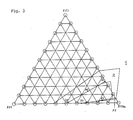
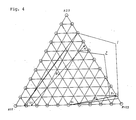
- Figs. 1 to 5 are ternary composition diagrams of the working fluids in Examples 1 to 5, respectively.
- R23 has substantially no ozone depletion potential, namely its ODP is substantially zero and it contains no chlorine atom in its molecular structure.
- R22 has a very low ozone depletion potential, namely its ODP is only 0.05, and it contains both the hydrogen atom and the chlorine atom in its molecular structure.
- R23 and R22 are widely used as working fluids together with R12.
- the halogenated ethane derivatives include fluorinated halocarbons having no chlorine atom in molecular structures and fluorinated halocarbons having chlorine and hydrogen atoms. It has substantially no or very low ozone depletion potential, no inflammability and low toxicity.
- the halogenated ethane derivative having a boiling point of not lower than -30°C under atmospheric pressure is used in combination with R23 and R22, the working fluid of the present invention has a similar boiling point to that of R12.
- a weight ratio of R23, R22 and the halogenated ethane derivative depends on the properties of the working fluid to be prepared and/or the kind of the halogenated ethane derivative.
- the working fluid of the present invention comprises 1 to 80 % by weight of R23, 1 to 90 % by weight of R22 and 10 to 95 % by weight of the halogenated ethane derivative.
- the working fluid of the present invention comprises 80 % by weight or less (for example, 1 to 80 % by weight) of R23, 90 % by weight or less (for example 1 to 90 % by weight) of R22, and 55 to 95 % by weight of tetrafluoroethane or 40 to 95 % by weight of chlorotetrafluoroethane or 10 to 95 % by weight of dichlorotrifluoroethane, with the total amount being 100 % by weight.
- the working fluid of the present invention comprises 65 % by weight or less (for example, 1 to 65 % by weight) of R23, 85 % by weight or less (for example, 1 to 85 % by weight) of R22, and 65 to 95 % by weight of tetrafluoroethane or 50 to 95 % by weight of chlorotetrafluoroethane or 15 to 90 % by weight of dichlorotrifluoroethane, with the total amount being 100 % by weight.
- the working fluid of the present invention comprises 25 % by weight or less (for example, 1 to 25 % by weight) of R23, 45 % by weight or less (for example, 1 to 45 % by weight) of R22 and 55 to 95 % by weight of tetrafluoroethane.
- the working fluid of the present invention comprises 15 % by weight or less (for example, 1 to 15 % by weight) of R23, 35 % by weight or less (for example, 1 to 35 % by weight) of R22 and 65 to 95 % by weight of tetrafluoroethane.
- the working fluid of the present invention comprises 35 % by weight or less (for example, 1 to 35 % by weight) of R23, 60 % by weight or less (for example, 1 to 60 % by weight) of R22 and 40 to 95 % by weight of chlorotetrafluoroethane.
- the working fluid of the present invention comprises 25 % by weight or less (for example, 1 to 25 % by weight) of R23, 50 % by weight or less (for example, 1 to 50 % by weight) of R22 and 50 to 95 % by weight of chlorotetrafluoroethane.
- the working fluid of the present invention comprises 80 % by weight or less (for example, 1 to 80 % by weight) of R23, 90 % by weight or less (for example, 1 to 90 % by weight) of R22 and 10 to 95 % by weight of dichlorotrifluoroethane.
- the working fluid of the present invention comprises 65 % by weight or less (for example, 1 to 65 % by weight) of R23, 85 % by weight or less (for example, 1 to 85 % by weight) of R22 and 15 to 90 % by weight of dichlorotrifluoroethane.
- the working fluid of the present invention has substantially the same vapor pressure as R12 in a temperature range between about 0°C to about 50°C, and is suitable as a working fluid which can be used in presently used apparatuses as a substitute for R12.
- the working fluid of the present invention is expected to have very small ODP, no flammability and little toxicity.
- the working fluid of the present invention is a non-azeotropic mixture and has a temperature gradient in the condensing and evaporating processes, a higher coefficient of performance (COP) than R12 is expected when Lorenz cycle in which a temperature difference from a heat source is decreased is assembled.
- COP coefficient of performance
- R23 Since R23 has a low critical temperature (25.7°C) and high vapor pressure, it alone cannot be used in the refrigerator or heat pump which is used in a utilization temperature range between about 0°C and about 50°C. According to the present invention, by mixing R23 with R22 which has widely been used as a working fluid and at least one third fluorinated halocarbon having a lower vapor pressure, low ODP and no flammability, the vapor pressure of the mixture is substantially the same as that of R12, and the working fluid having low ODP and no flammability can be provided. This means that the working fluid does not include a mixture of R23, R22 and R142b as disclosed in U.S. Patent No. 4,812,250 because of the presence of R142b having flammability.
- Fig. 1 shows a ternary composition diagram indicating equilibrium states of a mixture consisting of R23, R22 and 1,1,2,2-tetrafluoroethane (R134) at specific temperatures under specific pressure in a triangular coordinate.
- a composition (weight ratio) of the three compound at one point on the triangular coordinate is expressed by a ratio of distances between said point and the opposite sides. The distance between said point and the opposite side corresponds to a proportion of the compound which is assigned to the vertex which faces said side.
- the lines 1 are phase equilibrium lines of the mixture at 0°C under pressure of 2.116 kg/cm2G. These temperature and pressure correspond to a saturated state of R12.
- the upper one of the phase equilibrium lines 1 (corresponding to R12 at 0°C) is a saturated vapor line, and the lower one is a saturated liquid line. In the area between these two lines, the mixture is in the phase equilibrium state.
- the lines 2 are phase equilibrium lines of the mixture at 50°C under pressure of 11.373 kg/cm2G. These temperature and pressure correspond to a saturated state of R12.
- R23 alone it exceeds the critical temperature at 50°C.
- the mixture has the saturated state so that it can be used in the refrigerator or heat pump which has the utilization temperature range between about 0°C and about 50°C.
- the mixture comprising about 0 to about 25 % by weight of R23, about 0 to about 45 % by weight of R22 and about 55 to about 95 % by weight of R134 is preferred, since it has substantially the same vapor pressure as R12 in the temperature range between about 0°C and about 50°C. Further, the mixture comprising about 0 to about 15 % by weight of R23, about 0 to about 35 % by weight of R22 and about 65 to about 95 % by weight of R134 is more preferred, since it has substantially the same vapor pressure as R12 at all the utilizing temperatures between 0°C and 50°C.
- compositions and ODPs of the working fluids at the points A1 to F1 in Fig. 1 are shown in Table 1.
- the points A1, B1 and C1 are on the saturated vapor line of the phase equilibrium lines 2 (corresponding to R12 at 50°C), and the point F1 is on the saturated liquid line of the phase equilibrium lines 2. Further, all of them are in the area between the saturated vapor line and the saturated liquid line of the phase equilibrium lines 1 (corresponding to R12 at 0°C). Therefore, the mixture is in the phase equilibrium state at 0°C under pressure of 2.116 kg/cm2G which correspond to the saturated state of R12.
- the working fluid having the composition in Table 1 is in the saturated state or the phase equilibrium state under the saturated vapor pressure condition of R12 at 0°C and 50°C, so that, in the utilization temperature range between about 0°C and about 50°C, the working liquid has substantially the same condensation and evaporation temperatures as R12 when operated under the saturated vapor pressure of R12 at said temperatures.
- the working fluid comprising about 0 to about 25 % by weight of R23, about 0 to about 45 % by weight of R22 and about 55 to about 95 % by weight of tetrafluoroethane is preferred since it has substantially the same vapor pressure as R12 in the utilization temperature range between about 0°C to about 50°C.
- the working fluid comprising about 0 to about 15 % by weight of R23, about 0 to about 35 % by weight of R22 and about 65 to about 95 % by weight of tetrafluoroethane is more preferred since it has substantially the same vapor pressure as R12 in the whole utilization temperature range between 0°C to 50°C.
- the working fluids in this Example are expected to have the ODP of 0 to 0.02 and very promising as substitute working fluids to R12.
- Fig. 2 shows a ternary composition diagram indicating equilibrium states of a mixture consisting of R23, R22 and 2-chloro-1,1,1,2-tetrafluoroethane (R124) at specific temperatures under specific pressure in a triangular coordinate.
- the lines 1 are phase equilibrium lines of the mixture at 0°C under pressure of 2.116 kg/cm2G
- the lines 2 are phase equilibrium lines of the mixture at 50°C under pressure of 11.373 kg/cm2G.
- the mixture comprising about 0 to about 35 % by weight of R23, about 0 to about 60 % by weight of R22 and about 40 to about 95 % by weight of R124 is preferred, since it has substantially the same vapor pressure as R12 in the temperature range between about 0°C and about 50°C. Further, the mixture comprising about 0 to about 20 % by weight of R23, about 0 to about 45 % by weight of R22 and about 55 to about 95 % by weight of R124 is more preferred, since it has substantially the same vapor pressure as R12 at all the utilizing temperatures between 0°C and 50°C.
- compositions and ODPs of the working fluids at the points A1 to F1 in Fig. 2 are shown in Table 2.
- the working fluid having the composition in Table 2 is in the saturated state or the phase equilibrium state under the saturated vapor pressure condition of R12 at 0°C and 50°C, so that, in the utilization temperature range between about 0°C and about 50°C, the working fluid has substantially the same condensation and evaporation temperatures as R12 when operated under the saturated vapor pressure of R12 at said temperatures.
- Fig. 3 shows a ternary composition diagram indicating equilibrium states of a mixture consisting of R23, R22 and 2-chloro-1,1,2,2-tetrafluoroethane (R124a) at specific temperatures under specific pressure in a triangular coordinate.
- compositions and ODPs of the working fluids at the points A1 to F1 in Fig. 3 are shown in Table 3.
- the mixture comprising about 0 to about 35 % by weight of R23, about 0 to about 60 % by weight of R22 and about 40 to about 95 %% by weight of R124a is preferred, and further, the mixture comprising about 0 to about 25 % by weight of R23, about 0 to about 50 % by weight of R22 and about 50 to about 95 % by weight of R124a is more preferred.
- the mixture comprising about 0 to about 35 % by weight of R23, about 0 to about 60 % by weight of R22 and about 40 to about 95 % by weight of chlorotetrafluoroethane is preferred. Further, the mixture comprising about 0 to about 20 % by weight of R23, about 0 to about 50 % by weight of R22 and about 50 to about 95 % by weight of chlorotetrafluoroethane is more preferred.
- Fig. 4 shows a ternary composition diagram indicating equilibrium states of a mixture consisting of R23, R22 and 2,2-dichloro-1,1,1-trifluoroethane (R123) at specific temperatures under specific pressure in a triangular coordinate.
- the lines 1 are phase equilibrium lines of the mixture at 0°C under pressure of 2.116 kg/cm2G
- the lines 2 are phase equilibrium lines of the mixture at 50°C under pressure of 11.373 kg/cm2G.
- the mixture comprising about 0 to about 80 % by weight of R23, about 0 to about 90 % by weight of R22 and about 10 to about 95 % by weight of R123 is preferred, since it has substantially the same vapor pressure as R12 in the temperature range between about 0°C and about 50°C. Further, the mixture comprising about 0 to about 65 % by weight of R23, about 0 to about 85 % by weight of R22 and about 15 to about 90 % by weight of R123 is more preferred, since it has substantially the same vapor pressure as R12 at all the utilizing temperatures between 0°C and 50°C.
- compositions and ODPs of the working fluids at the points A1 to F1 in Fig. 4 are shown in Table 4.
- the working fluid having the composition in Table 4 is in the saturated state or the phase equilibrium state under the saturated vapor pressure condition of R12 at 0°C and 50°C, so that, in the utilization temperature range between about 0°C and about 50°C, the working fluid has substantially the same condensation and evaporation temperatures as R12 when operated under the saturated vapor pressure of R12 at said temperatures.
- Fig. 5 shows a ternary composition diagram indicating equilibrium states of a mixture consisting of R23, R22 and 1,2-dichlorotrifluoroethane (R123a) at specific temperatures under specific pressure in a triangular coordinate.
- compositions and ODPs of the working fluids at the points A1 to F1 in Fig. 5 are shown in Table 5.
- the mixture comprising about 0 to about 80 % by weight of R23, about 0 to about 90 % by weight of R22 and about 10 to about 95 % by weight of R123a is preferred, and further, the mixture comprising about 0 to about 65 % by weight of R23, about 0 to about 85 % by weight of R22 and about 15 to about 90 % by weight of R123a is more preferred, since it has substantially the same vapor pressure as R12 at all the utilizing temperatures between 0°C and 50°C.
- the mixture comprising about 0 to about 80 % by weight of R23, about 0 to about 90 % by weight of R22 and about 10 to about 90 % by weight of dichlorotrifluoroethane is preferred. Further, the mixture comprising about 0 to about 65 % by weight of R23, about 0 to about 85 % by weight of R22 and about 15 to about 90 % by weight of dichlorotrifluoroethane is more preferred.
- the mixture comprising 80 % by weight or less of R23, 90 % by weight or less of R22, and 55 to 95 % by weight of tetrafluoroethane or 40 to 95 % by weight of chlorotetrafluoroethane or 10 to 95 by weight of dichlorotrifluoroethane is preferred. Further, the mixture comprising 65 % by weight or less of R23, 85 % by weight or less of R22, and 65 to 95 % by weight of tetrafluoroethane or 50 to 95 % by weight of chlorotetrafluoroethane or 15 to 95 by weight of dichlorotrifluoroethane is more preferred.
- the mixtures contain three fluorinated halocarbons, although it is possible to mix four or more fluorinated halocarbons including structural isomers.
Landscapes
- Chemical & Material Sciences (AREA)
- Engineering & Computer Science (AREA)
- Physics & Mathematics (AREA)
- Chemical Kinetics & Catalysis (AREA)
- Combustion & Propulsion (AREA)
- Thermal Sciences (AREA)
- Materials Engineering (AREA)
- Organic Chemistry (AREA)
- Organic Low-Molecular-Weight Compounds And Preparation Thereof (AREA)
- Lubricants (AREA)
Applications Claiming Priority (6)
| Application Number | Priority Date | Filing Date | Title |
|---|---|---|---|
| JP309644/89 | 1989-11-29 | ||
| JP1309670A JPH03168288A (ja) | 1989-11-29 | 1989-11-29 | 作動流体 |
| JP1309644A JPH03168265A (ja) | 1989-11-29 | 1989-11-29 | 作動流体 |
| JP309671/89 | 1989-11-29 | ||
| JP309670/89 | 1989-11-29 | ||
| JP1309671A JPH03168289A (ja) | 1989-11-29 | 1989-11-29 | 作動流体 |
Publications (2)
| Publication Number | Publication Date |
|---|---|
| EP0430130A1 true EP0430130A1 (de) | 1991-06-05 |
| EP0430130B1 EP0430130B1 (de) | 1994-07-20 |
Family
ID=27339052
Family Applications (1)
| Application Number | Title | Priority Date | Filing Date |
|---|---|---|---|
| EP90122527A Expired - Lifetime EP0430130B1 (de) | 1989-11-29 | 1990-11-26 | Arbeitsflüssigkeit |
Country Status (3)
| Country | Link |
|---|---|
| US (1) | US5059338A (de) |
| EP (1) | EP0430130B1 (de) |
| DE (1) | DE69010849T2 (de) |
Cited By (3)
| Publication number | Priority date | Publication date | Assignee | Title |
|---|---|---|---|---|
| EP0522511A3 (en) * | 1991-07-12 | 1993-03-10 | Matsushita Electric Industrial Co., Ltd. | Working fluid |
| EP0579072A1 (de) * | 1992-07-11 | 1994-01-19 | Solvay Fluor und Derivate GmbH | Neue Kältemittelzusammensetzungen |
| WO1995005429A1 (de) * | 1993-08-14 | 1995-02-23 | Solvay Fluor Und Derivate Gmbh | Tieftemperatur-kältemittelzusammensetzungen und deren verwendung |
Families Citing this family (2)
| Publication number | Priority date | Publication date | Assignee | Title |
|---|---|---|---|---|
| US5295357A (en) * | 1991-10-31 | 1994-03-22 | Idemitsu Kosan Co, Ltd. | Method for lubricating compression type refrigerating system |
| DE4404328C2 (de) * | 1994-02-11 | 1996-01-11 | Danfoss As | Verfahren zum Erreichen eines spezifischen Temperaturverhaltens von temperaturabhängig arbeitenden Verstellorganen und temperaturabhängig arbeitendes Verstellorgan |
Citations (4)
| Publication number | Priority date | Publication date | Assignee | Title |
|---|---|---|---|---|
| EP0066439A1 (de) * | 1981-05-26 | 1982-12-08 | Daikin Kogyo Co., Ltd. | Rankine Kreislauf mit organischem Arbeitsmittel |
| EP0272953A1 (de) * | 1986-11-21 | 1988-06-29 | Institut Français du Pétrole | Mischungen von Arbeitsmitteln für Thermokompressionszyklus, die Trifluormethan und Chlordifluorethan enthalten |
| EP0315069A1 (de) * | 1987-11-02 | 1989-05-10 | Daikin Industries, Limited | Kühlmittel |
| EP0314978A1 (de) * | 1987-10-19 | 1989-05-10 | Daikin Industries, Limited | Kühlmittel |
Family Cites Families (2)
| Publication number | Priority date | Publication date | Assignee | Title |
|---|---|---|---|---|
| FR2514875A1 (fr) * | 1981-10-19 | 1983-04-22 | Inst Francais Du Petrole | Procede de chauffage et/ou de conditionnement thermique d'un local au moyen d'une pompe a chaleur a compression utilisant un melange specifique de fluides de travail |
| FR2564955B1 (fr) * | 1984-05-28 | 1987-03-20 | Inst Francais Du Petrole | Procede de production de chaleur et/ou de froid au moyen d'une machine a compression fonctionnant avec un fluide mixte de travail |
-
1990
- 1990-11-26 EP EP90122527A patent/EP0430130B1/de not_active Expired - Lifetime
- 1990-11-26 DE DE69010849T patent/DE69010849T2/de not_active Expired - Fee Related
- 1990-11-28 US US07/618,962 patent/US5059338A/en not_active Expired - Fee Related
Patent Citations (4)
| Publication number | Priority date | Publication date | Assignee | Title |
|---|---|---|---|---|
| EP0066439A1 (de) * | 1981-05-26 | 1982-12-08 | Daikin Kogyo Co., Ltd. | Rankine Kreislauf mit organischem Arbeitsmittel |
| EP0272953A1 (de) * | 1986-11-21 | 1988-06-29 | Institut Français du Pétrole | Mischungen von Arbeitsmitteln für Thermokompressionszyklus, die Trifluormethan und Chlordifluorethan enthalten |
| EP0314978A1 (de) * | 1987-10-19 | 1989-05-10 | Daikin Industries, Limited | Kühlmittel |
| EP0315069A1 (de) * | 1987-11-02 | 1989-05-10 | Daikin Industries, Limited | Kühlmittel |
Cited By (5)
| Publication number | Priority date | Publication date | Assignee | Title |
|---|---|---|---|---|
| EP0522511A3 (en) * | 1991-07-12 | 1993-03-10 | Matsushita Electric Industrial Co., Ltd. | Working fluid |
| EP0579072A1 (de) * | 1992-07-11 | 1994-01-19 | Solvay Fluor und Derivate GmbH | Neue Kältemittelzusammensetzungen |
| TR26928A (tr) * | 1992-07-11 | 1994-08-24 | Solvay Flour Und Derivate Gmbh | Yeni sogutucu bilesimler. |
| US5429760A (en) * | 1992-07-11 | 1995-07-04 | Solvay Fluor Und Derivate Gmbh | Refrigerant composition containing trifluoromethane and 1,1,1,2-tetrafluoroethane |
| WO1995005429A1 (de) * | 1993-08-14 | 1995-02-23 | Solvay Fluor Und Derivate Gmbh | Tieftemperatur-kältemittelzusammensetzungen und deren verwendung |
Also Published As
| Publication number | Publication date |
|---|---|
| US5059338A (en) | 1991-10-22 |
| DE69010849T2 (de) | 1994-11-10 |
| DE69010849D1 (de) | 1994-08-25 |
| EP0430130B1 (de) | 1994-07-20 |
Similar Documents
| Publication | Publication Date | Title |
|---|---|---|
| EP0430169B1 (de) | Arbeitsmittel | |
| US5438849A (en) | Air conditioner and heat pump with tetra fluoroethane-containing working fluid | |
| EP0539952B1 (de) | Propan enthaltendes Treibmittel | |
| KR100208112B1 (ko) | 비점이 일정한 불소화 탄화수소 조성물 | |
| KR100190185B1 (ko) | 디플루오로메탄; 1,1,1-트리플루오로에탄; 또는 프로판을 함유하는 비공비성 냉매 조성물들 | |
| EP0314978B1 (de) | Kühlmittel | |
| EP0430170A1 (de) | Arbeitsmittel | |
| EP0840768B1 (de) | Mischungen aus pentafluorpropan und einem hydrofluorkohlenwasserstoff mit 4 bis 6 kohlenstoffatomen | |
| EP0664822B1 (de) | Zusammensetzung von difluormethan und propan mit wesentlichem konstantem siedepunkt | |
| EP0430131A1 (de) | Arbeitsflüssigkeit | |
| EP0430130B1 (de) | Arbeitsflüssigkeit | |
| EP0574897B1 (de) | Arbeitsflüssigkeit die Perfluordimethylether enthält | |
| EP0430171B1 (de) | Arbeitsmittel | |
| US5304319A (en) | Working fluid | |
| JPH06172227A (ja) | ジフルオロメタン、ペンタフルオロエタン及び1、1、1−トリフルオロエタン系の疑似共沸混合物、並びに該混合物である低温度用冷媒 | |
| US5470496A (en) | Working fluid containing chlorotetrafluoroethane | |
| US5433879A (en) | Working fluid containing difluoroethane | |
| EP0522511A2 (de) | Arbeitsflüssigkeit | |
| JP2568775B2 (ja) | 作動流体 | |
| KR930010515B1 (ko) | 작동유체 | |
| KR930009250B1 (ko) | 작동유체 | |
| WO1994000528A1 (en) | Mixtures of pentafluoroethane and trifluoroethane | |
| US6423757B1 (en) | Process for producing polymer foam using mixtures of pentafluoropropane and a hydrofluorocarbon having 3 to 6 carbon atoms | |
| JPH10168436A (ja) | ジフルオロメタン及びペンタフルオロエタンを主成分とする混合物の極低温冷凍冷媒としての使用 | |
| JPH05117649A (ja) | 作動流体 |
Legal Events
| Date | Code | Title | Description |
|---|---|---|---|
| PUAI | Public reference made under article 153(3) epc to a published international application that has entered the european phase |
Free format text: ORIGINAL CODE: 0009012 |
|
| 17P | Request for examination filed |
Effective date: 19901126 |
|
| AK | Designated contracting states |
Kind code of ref document: A1 Designated state(s): DE FR GB |
|
| 17Q | First examination report despatched |
Effective date: 19921215 |
|
| GRAA | (expected) grant |
Free format text: ORIGINAL CODE: 0009210 |
|
| AK | Designated contracting states |
Kind code of ref document: B1 Designated state(s): DE FR GB |
|
| REF | Corresponds to: |
Ref document number: 69010849 Country of ref document: DE Date of ref document: 19940825 |
|
| ET | Fr: translation filed | ||
| PGFP | Annual fee paid to national office [announced via postgrant information from national office to epo] |
Ref country code: GB Payment date: 19941116 Year of fee payment: 5 |
|
| PGFP | Annual fee paid to national office [announced via postgrant information from national office to epo] |
Ref country code: DE Payment date: 19941125 Year of fee payment: 5 |
|
| PGFP | Annual fee paid to national office [announced via postgrant information from national office to epo] |
Ref country code: FR Payment date: 19941129 Year of fee payment: 5 |
|
| PLBE | No opposition filed within time limit |
Free format text: ORIGINAL CODE: 0009261 |
|
| STAA | Information on the status of an ep patent application or granted ep patent |
Free format text: STATUS: NO OPPOSITION FILED WITHIN TIME LIMIT |
|
| 26N | No opposition filed | ||
| PG25 | Lapsed in a contracting state [announced via postgrant information from national office to epo] |
Ref country code: GB Effective date: 19951126 |
|
| GBPC | Gb: european patent ceased through non-payment of renewal fee |
Effective date: 19951126 |
|
| PG25 | Lapsed in a contracting state [announced via postgrant information from national office to epo] |
Ref country code: FR Effective date: 19960731 |
|
| PG25 | Lapsed in a contracting state [announced via postgrant information from national office to epo] |
Ref country code: DE Effective date: 19960801 |
|
| REG | Reference to a national code |
Ref country code: FR Ref legal event code: ST |