EP0430173A2 - Méthode d'affectation de canaux de radio-communication à chacune d'une pluralité de stations mobiles - Google Patents
Méthode d'affectation de canaux de radio-communication à chacune d'une pluralité de stations mobiles Download PDFInfo
- Publication number
- EP0430173A2 EP0430173A2 EP90122657A EP90122657A EP0430173A2 EP 0430173 A2 EP0430173 A2 EP 0430173A2 EP 90122657 A EP90122657 A EP 90122657A EP 90122657 A EP90122657 A EP 90122657A EP 0430173 A2 EP0430173 A2 EP 0430173A2
- Authority
- EP
- European Patent Office
- Prior art keywords
- channel
- electric field
- communication
- radio
- field level
- Prior art date
- Legal status (The legal status is an assumption and is not a legal conclusion. Google has not performed a legal analysis and makes no representation as to the accuracy of the status listed.)
- Granted
Links
Images



Classifications
-
- H—ELECTRICITY
- H04—ELECTRIC COMMUNICATION TECHNIQUE
- H04W—WIRELESS COMMUNICATION NETWORKS
- H04W72/00—Local resource management
- H04W72/50—Allocation or scheduling criteria for wireless resources
- H04W72/54—Allocation or scheduling criteria for wireless resources based on quality criteria
- H04W72/542—Allocation or scheduling criteria for wireless resources based on quality criteria using measured or perceived quality
Definitions
- the present invention relates to a method of assigning radio communication channels to each of a plurality of mobile stations, in which method a dispersed control system is employed in a dynamic channel assignment system.
- conventional channel assignment methods include a fixed channel assignment method, in which the assignment of all channels to radio zones is unchanged on a time basis, and a dynamic channel assignment method, in which channels to be assigned are changed on a time basis while the buffer zone is monitored by a central processing unit.
- the following problem occurs: when a new call is generated in a radio zone where a mobile station is busy, only one channel is available; thus the new call is rendered ineffective.
- a channel which is not used in a buffer zone for the radio zone, can be assigned to the mobile station, thereby preventing the occurrence of an ineffective call and realizing flexible re-use of frequencies.
- the dynamic channel assignment method is disclosed, for example, in Published Unexamined Japanese Patent Application No. 2-141036.
- a control station for controlling base stations collects detailed information relating to the channels used by peripheral base stations. On the basis of the collected information, the channels are checked to select an optimal channel, thus realizing effective use of frequencies.
- This system is called a dynamic central control system.
- additional control operations are required for assigning channels and to be transmitted among stations. This results in an increase in the system cost and in a delay of connection operation between the mobile station and the base station.
- the object of the present invention is to provide a method of assigning radio communication channels to a plurality of mobile stations, which method employs a dispersed control system wherein drawbacks in a dynamic central control system are eliminated, the increase in the amount of control operations can be prevented, there is no need to transfer information for channel assignment control, and spatial frequency use efficiency can be enhanced.
- channel assignment control for enhancing spatial frequency use efficiency is carried out in a dispersed manner, so that the channel assignment is made in the base stations in the respective radio zones.
- the present invention does not use a large-scale control apparatus for performing centralized control, or a control circuit for collecting a great deal of information. Therefore, an inexpensive mobile communication system with a large capacity can be provided.
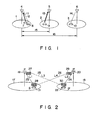
- Fig. 1 illustrates the mode in which the same frequency is repeatedly used in a mobile radio system.
- Fig. 1 shows only three radio zones and two frequencies to be repeatedly used. In fact, a service area is fully occupied by radio zones, and more frequencies are repeatedly used.
- reference numerals 1, 2 and 3 denote radio zones; 4, 5 and 6 radio base stations; 7 to 10 mobile stations; and 11 to 14 communication connections between the base stations and the corresponding mobile stations.
- the communication connections 11 and 13 are indicated by thicker lines than the communication connections 12 and 14, since the communication connections 11 and 13 have higher electric field levels of received signals because of better communication conditions.
- the same frequencies may be used repeatedly for the communication connections 11 and 13 and the communication connections 12 and 14, respectively.
- a high electric field level of a desired received wave can be obtained, and therefore the connections 11 and 13 can withstand a high interference wave reception electric field level.
- a desirable ratio of a desired wave power to interference wave power (hereinafter, called D/U) is obtained with a repetition use interval 15.
- D/U a desired wave power to interference wave power
- the communication connections 12 and 14 under undesirable communication conditions in order to obtain a desirable D/U, it is necessary to lower the interference wave reception electric field level.
- the frequency can be repeated at the distance 16. In other words, unless the distance is made greater, the channel is influenced by the interference wave reception electric field level.
- the frequency can be repeatedly used at less intervals, that is, such communication connection can withstand the influence of the interference wave reception electric field level.
- a channel of a minimum use interval can be selected at the time of assigning channels, thereby enhancing the use efficiency of frequencies.
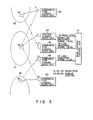
- Reference numerals 17 and 18 denote radio zones; 19 and 20 radio base stations; 21 and 22 mobile stations; 23 and 24 communication connections; 25 and 26 incoming interference waves; and 27 to 30 regions of interference.
- Reference numerals 17 and 18 denote radio zones; 19 and 20 radio base stations; 21 and 22 mobile stations; 23 and 24 communication connections; 25 and 26 incoming interference waves; and 27 to 30 regions of interference.
- a control station for controlling base stations collects all information relating to the peripheral zone, and a system wherein information is transferred to the zone 17 to select a channel to be assigned.
- the present invention employs a dispersed system wherein a channel is assigned on the basis only of information obtained in the zone where the channel is to be assigned.
- This invention is characterized in that reception electric field level conditions for using channels are determined in advance to obtain an estimate of the quality of the communication using the channels.
- the transmission power control includes an up-link power control and a down-link power control.
- a signal is transmitted from a mobile station to a base station to equalize the reception electric field levels of both station.
- a signal is transmitted from the base station to the mobile station to reduce the power consumption of the mobile station.
- P and P' denote real transmission outputs [dB] of base stations 19 and 20, and p and p' denote real transmission outputs [dB] of mobile stations 21 and 22.
- the reception electric field level is found from a difference between the real transmission outputs and propagation losses L1 to L4.
- the D/U is found from a difference between the desired wave electric field level and the interference wave electric field level.
- the D/U of interference region 27 is equal to that of interference region 30, and the D/U of interference region 28 is equal to that of interference region 29.
- the D/U of interference region 27 is equal to that of interference region 30, and the D/U of interference region 28 is equal to that of interference region 29.
- the D/U of interference region 27 is equal to that of interference region 30, and the D/U of interference region 28 is equal to that of interference region 29.
- the D/U of the zone 18 is equal to that of the zone 17.
- the quality of an assigned channel is ensured in other zones, too.
- the D/Us of the two communications are substantially equal.
- an actual system is not necessarily operated under ideal conditions, and therefore the D/Us are not always equal.
- the D/Us have high correlation. If a given margin is provided in the desired D/U and an assigned channel is selected, it becomes possible to meet predetermined conditions in the peripheral zone with a sufficiently high possibility.
- Fig. 3 shows an example of the structure of a system for working a method of assigning radio channels, according to an embodiment of the present invention.
- reference numerals 31, 32 and 33 denote radio zones; 34, 35 and 36 mobile stations; 37 a control radio unit of a base station; 38, 39 and 40 communication radio units of the base station; and 41 a base station control unit.
- All radio communication channels are divided into a plurality of channel groups. Each channel group has an assigned lower limit value of a reception electric field level necessary for communication. If a reception level is the lower limit value or higher, communication is allowed with the channels of the group.
- control information Prior to communication connection, control information is transmitted between the base station and the mobile station via a radio communication channel, which channel is selected and assigned by the control unit.
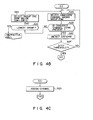
- the radio communication channel is assigned according to the steps shown in Figs. 4A to 4C. That is, the channel assignment is carried out through the process including the steps of Fig. 4A of determining whether or not a communication reception electric field level belongs to a channel group capable of meeting the lower limit value of a predetermined reception electric field level; the steps of Fig. 4B of determining whether or not the D/U of the present radio communication channel satisfies a predetermined threshold; and the steps of Fig. 4C of assigning the radio communication channel selected by the above steps as a channel between the mobile station, which demands communication connection, and the base station.
- a radio control channel reception electric field level Rc of a control signal from the mobile station is measured by the control radio unit (S1A).
- a desired wave reception electric field level Rt for communication between the mobile station and the base station is estimated on the basis of the radio reception electric field level Rc of the radio control channel (S1 B).
- the control unit receives the reception electric field level Rt and selects the channel group having the lowest one of the lower limit values which meet the condition (S1 C).
- one or more candidate channels which meet a predetermined D/U, are searched from among the previously selected channel group (S2A), and the presencelabsence of such candidate channels is determined (S2B).
- S2A the previously selected channel group
- S2B the presencelabsence of such candidate channels
- S2C the lowest rank group
- S2D the channel group one rank below
- S2E the D/U value is detected on the basis of the reception electric field level (D-wave level) and the interference wave reception electric field level (U-wave level) (S2E).
- the radio communication channel which has been determined to meet the threshold, is assigned as a channel between the mobile station and the base station, as shown in Fig. 4C (S2G).
- FIG. 5 corresponds to the system structure shown in Fig. 3.
- a channel which is assigned to the system and is not used is set in a non-busy communication radio unit 38.
- the radio unit 38 detects a reception electric field level (S1) and tells the detected level to the control unit 41.
- the control unit 41 classifies the channels (S2).
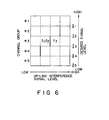
- Fig. 6 shows an example of a classification table. In Fig. 6, the ordinate indicates channel groups, and the abscissa indicates an ascending interference wave reception electric field level.
- Symbols #1 to #5 denote group numbers
- t1 to 15 denote lower limit values of reception electric field levels of channels of the respective groups
- thick lines denote thresholds of interference wave reception electric field levels which satisfy a predetermined D/U with respect to channel groups #1, #3 and #4.
- the thresholds differ among the channel groups.
- channels f1 and f2 meet predetermined D/U but channel f3 fails to meet the D/U.
- a desired wave reception electric field level for communication between the mobile station 35 and the base station is estimated on the basis of a reception electric field level (i.e. D-wave level) in the control radio unit 37 corresponding to a control channel of a control signal delivered from the mobile station 35, and the estimated level is told to the control unit 41.
- a reception electric field level i.e. D-wave level
- the control unit 41 refers to the channel classification table of Fig. 6, on the basis of the reception electric field level.
- the control unit 41 selects a channel group having a lowest lower limit value of the satisfactory lower limits, as a group from which a channel is selected (S3). In other words, a channel group having a least allowance of the reception electric field level is selected.
- One or more of the channels within the group, which meets the threshold of the predetermined D/U, are selected as candidate channels to be assigned (S4, S5 and S6). If there is no channel which meets the threshold, a candidate channel is selected from a channel group one rank below, which has a little allowance of the reception electric field level (S7).
- the selected candidate channel to be assigned is told to the mobile station 35 via a radio control channel.
- the mobile station 35 once changes the radio control channel to the selected candidate channel, and the reception electric field level is detected. Since this channel is not used by the mobile station, the reception electric field level corresponds to the interference wave reception electric field level (i.e. U-wave level) of the interference wave from the communication radio units 39 and 40 of the base stations in the peripheral zones 32 and 33 where the same channel is used. Similarly, this interference wave reception electric field level is told to the base station via the radio control channel.
- the control unit 41 confirms whether the down-link D/U is met (S8). Finally, one channel is selected and assigned (S9).
- various algorisms are performed in the process of finding the candidate channels on the basis of the channel classification table, and in the process of confirming the down-link D/U in the mobile station and selecting the channel to be assigned. For example, it is possible to select predetermined conditions from ones with a small allowance or from ones with a large allowance, to determine the number of candidate channels, and to determine whether reselection should be done. In this invention, various choices are possible.
- this invention is applicable when the transmission power control is performed.
- the transmission power is controlled so that the reception electric field level takes its lower limit value in each channel group.
- Figs. 7A to 7C show simulated effects of the embodiments of the invention.
- Fig. 7A shows an ineffective call rate and a peripheral interference rate in the case where a conventional fixed channel arrangement is employed.
- Fig. 7B shows the same in the case where a conventional dynamic channel arrangement is employed, and
- Fig. 7C shows the same in the case of the present invention.
- dynamic channel assignment is carried out with respect to all channels assigned to the system.
- the interference rate is increased, the interference rate is lowered by the techniques of the embodiments.
- the ineffective call rate lowers, compared to the conventional fixed channel arrangement.
Landscapes
- Engineering & Computer Science (AREA)
- Quality & Reliability (AREA)
- Computer Networks & Wireless Communication (AREA)
- Signal Processing (AREA)
- Mobile Radio Communication Systems (AREA)
Applications Claiming Priority (2)
| Application Number | Priority Date | Filing Date | Title |
|---|---|---|---|
| JP306417/89 | 1989-11-28 | ||
| JP1306417A JP2719619B2 (ja) | 1989-11-28 | 1989-11-28 | 移動通信チャネル割当て制御方法 |
Publications (3)
| Publication Number | Publication Date |
|---|---|
| EP0430173A2 true EP0430173A2 (fr) | 1991-06-05 |
| EP0430173A3 EP0430173A3 (en) | 1992-05-20 |
| EP0430173B1 EP0430173B1 (fr) | 1995-09-27 |
Family
ID=17956772
Family Applications (1)
| Application Number | Title | Priority Date | Filing Date |
|---|---|---|---|
| EP90122657A Expired - Lifetime EP0430173B1 (fr) | 1989-11-28 | 1990-11-27 | Méthode d'affectation de canaux de radio-communication à chacune d'une pluralité de stations mobiles |
Country Status (4)
| Country | Link |
|---|---|
| US (1) | US5203008A (fr) |
| EP (1) | EP0430173B1 (fr) |
| JP (1) | JP2719619B2 (fr) |
| DE (1) | DE69022686T2 (fr) |
Cited By (15)
| Publication number | Priority date | Publication date | Assignee | Title |
|---|---|---|---|---|
| AU630782B2 (en) * | 1990-01-30 | 1992-11-05 | Nec Corporation | Cellular mobile telephone system |
| EP0522276A3 (en) * | 1991-05-29 | 1993-05-19 | Nec Corporation | Channel assignment method in mobile communication system |
| EP0569559A4 (fr) * | 1991-10-17 | 1994-04-27 | Motorola, Inc. | |
| EP0592487A4 (fr) * | 1991-07-01 | 1994-12-07 | Motorola Inc | Procede et appareil destines a amorcer une communication sur une frequence assignee. |
| EP0616481A3 (fr) * | 1993-03-17 | 1995-01-04 | Nippon Electric Co | Procédé d'allocation de canaux radio pour système de communication mobile. |
| EP0635989A1 (fr) * | 1993-07-19 | 1995-01-25 | Nec Corporation | Allocation dynamique de canaux à corrélation croisée élevée pour cellules sectorisées |
| GB2285900A (en) * | 1993-12-23 | 1995-07-26 | Motorola Ltd | Communications system |
| EP0720402A3 (fr) * | 1994-12-28 | 1997-05-14 | Nippon Telegraph & Telephone | Procédé pour la formation automatique des zones d'information périphérique |
| DE19705502A1 (de) * | 1997-02-13 | 1998-08-20 | Wolfgang Brendel | Funkfernsteueranlage |
| WO2000049823A1 (fr) * | 1999-02-16 | 2000-08-24 | Ntt Mobile Communications Network, Inc. | Procede de jugement de l'attribution d'une liaison radio dans un systeme mobile de communication et controleur de liaison radio |
| EP1148750A1 (fr) * | 2000-04-22 | 2001-10-24 | Deutsche Thomson-Brandt Gmbh | Méthode de présélection de canal dans un système de radiocommunication |
| EP1156689A1 (fr) * | 2000-05-17 | 2001-11-21 | Deutsche Thomson-Brandt Gmbh | Méthode de sélection de canal dans un système de communication sans fil et station mobile |
| EP1156690A1 (fr) * | 2000-05-17 | 2001-11-21 | Deutsche Thomson-Brandt Gmbh | Méthode de sélection de canal dans un système de communication sans fil et station mobile |
| RU2190939C2 (ru) * | 1996-03-27 | 2002-10-10 | Эрикссон Инк. | Способ и устройство для обнаружения цифрового канала управления в сотовой системе радиосвязи нижних диапазонов |
| EP1139581A3 (fr) * | 1994-07-25 | 2003-03-26 | QUALCOMM Incorporated | Regulation de puissance d'un emetteur à distance dans un système à acces multiple avec fonction des conflicts |
Families Citing this family (31)
| Publication number | Priority date | Publication date | Assignee | Title |
|---|---|---|---|---|
| SE9100117L (sv) * | 1991-01-14 | 1992-07-15 | Ellemtel Utvecklings Ab | Naetstruktur foer mobiltelefonnaet |
| DE69230716T2 (de) * | 1991-11-25 | 2000-12-28 | Motorola, Inc. | Verringerte Interferenzstörungen durch Frequenzaufteilung in zellularen Kommunikationssystemen |
| JPH05206941A (ja) * | 1992-01-28 | 1993-08-13 | Fujitsu Ltd | 回線制御方式 |
| JPH05292010A (ja) * | 1992-04-10 | 1993-11-05 | Fujitsu Ltd | 無線チャネル割当て方法および装置 |
| WO1993022881A1 (fr) * | 1992-04-24 | 1993-11-11 | Motorola Inc. | Procede et appareil de mesure des niveaux de qualite de transmission d'un signal transmis |
| KR960000147B1 (ko) * | 1992-11-05 | 1996-01-03 | 삼성전자주식회사 | 셀룰라 무선전화시스템의 송신전력 제어방법 |
| US5722082A (en) * | 1992-11-16 | 1998-02-24 | Schloemer; Jerry R. | Decentralized radio communication system and method for assigning channels with a minimum of signaling between remotes and bases |
| JP2757243B2 (ja) * | 1993-03-26 | 1998-05-25 | 松下電器産業株式会社 | マイクロセルラーシステムにおける不正使用防止方法 |
| FI100044B (fi) * | 1993-09-03 | 1997-08-29 | Nokia Telecommunications Oy | Menetelmä kanavan valitsemiseksi radiopuhelinjärjestelmässä ja radiopu helinjärjestelmän tukiasema |
| JPH07107545A (ja) * | 1993-10-07 | 1995-04-21 | Nec Corp | セクタセル構成移動通信システム |
| US5551064A (en) * | 1994-07-27 | 1996-08-27 | Motorola, Inc. | Method and apparatus for communication unit frequency assignment |
| US5590399A (en) * | 1995-02-23 | 1996-12-31 | Nextel Communications | Up-link channel assignment scheme for cellular mobile communications systems employing multi-beam antennas with beam selection |
| US5634195A (en) * | 1995-03-27 | 1997-05-27 | Telefonaktiebolaget Lm Ericsson | System and method for setting of output power parameters in a cellular mobile telecommunication system |
| JP2986388B2 (ja) * | 1995-10-19 | 1999-12-06 | エヌ・ティ・ティ移動通信網株式会社 | 移動通信におけるとまり木チャネル設定方法 |
| US5878328A (en) * | 1995-12-21 | 1999-03-02 | At&T Wireless Services, Inc. | Method and apparatus for wireless communication system organization |
| JP3241261B2 (ja) * | 1996-03-01 | 2001-12-25 | 株式会社東芝 | 移動通信システムとその無線通信装置 |
| US6496700B1 (en) * | 1996-04-04 | 2002-12-17 | At&T Wireless Services, Inc. | Method for determining organization parameters in a wireless communication system |
| JP3545895B2 (ja) * | 1996-12-19 | 2004-07-21 | 京セラ株式会社 | 空きチャネル割当方法 |
| US6563806B1 (en) * | 1997-12-12 | 2003-05-13 | Hitachi, Ltd. | Base station for multi-carrier TDMA mobile communication system and method for assigning communication channels |
| US6292664B1 (en) * | 1998-02-06 | 2001-09-18 | Telefon Aktiebolaget Lm Ericsson (Publ) | Channel quality in wireless communications |
| US6549782B2 (en) | 1999-03-31 | 2003-04-15 | Siemens Information And Communication Networks, Inc. | Radio communications systems |
| US7245594B1 (en) * | 2000-05-12 | 2007-07-17 | Qualcomm Incorporated | Method and apparatus for fast closed-loop rate adaptation in a high rate packet data transmission |
| US6947748B2 (en) | 2000-12-15 | 2005-09-20 | Adaptix, Inc. | OFDMA with adaptive subcarrier-cluster configuration and selective loading |
| JP5036305B2 (ja) | 2004-06-10 | 2012-09-26 | パナソニック株式会社 | 通信端末装置及び通信方法 |
| US7242920B2 (en) | 2005-05-31 | 2007-07-10 | Scenera Technologies, Llc | Methods, systems, and computer program products for controlling data transmission based on power cost |
| JP4823756B2 (ja) | 2006-04-27 | 2011-11-24 | 京セラ株式会社 | 移動体通信システム、基地局装置及び移動体通信システムの周波数割当方法 |
| US20090124233A1 (en) * | 2007-11-09 | 2009-05-14 | Morris Robert P | Methods, Systems, And Computer Program Products For Controlling Data Transmission Based On Power Cost |
| US20100157821A1 (en) * | 2008-12-18 | 2010-06-24 | Morris Robert P | Methods, Systems, And Computer Program Products For Sending Data Units Based On A Measure Of Energy |
| US20100161777A1 (en) * | 2008-12-22 | 2010-06-24 | Morris Robert P | Method and System For Providing A Subscription To A Tuple Based On A Variable Identifier |
| JP4803281B2 (ja) * | 2009-06-03 | 2011-10-26 | カシオ計算機株式会社 | 無線通信装置及びプログラム |
| JP4766158B2 (ja) * | 2009-06-30 | 2011-09-07 | カシオ計算機株式会社 | 無線通信装置及び無線通信方法 |
Family Cites Families (9)
| Publication number | Priority date | Publication date | Assignee | Title |
|---|---|---|---|---|
| US4144411A (en) * | 1976-09-22 | 1979-03-13 | Bell Telephone Laboratories, Incorporated | Cellular radiotelephone system structured for flexible use of different cell sizes |
| US4561114A (en) * | 1983-02-08 | 1985-12-24 | Nippon Telegraph & Telephone Public Corporation | Cochannel interference measurement system |
| US4736453A (en) * | 1985-12-10 | 1988-04-05 | Schloemer Gerald R | Method and apparatus for making frequency channel assignment in a cellular or non-cellular radiotelephone communications system |
| US4670906A (en) * | 1986-04-02 | 1987-06-02 | Motorola, Inc. | Data communications system transmitter selection method and apparatus |
| US4750198A (en) * | 1986-12-12 | 1988-06-07 | Astronet Corporation/Plessey U.K. | Cellular radiotelephone system providing diverse separately-accessible groups of channels |
| SE457763B (sv) * | 1987-05-27 | 1989-01-23 | Ericsson Telefon Ab L M | Foerfarande att utjaemna spaerrsannolikheten i ett cellindelat mobilradiosystem |
| JPS6451838A (en) * | 1987-08-24 | 1989-02-28 | Kokusai Denshin Denwa Co Ltd | Radio communication system with plural carriers |
| JP2619507B2 (ja) * | 1988-11-21 | 1997-06-11 | 日本電信電話株式会社 | 移動通信方式 |
| US5038399A (en) * | 1990-05-21 | 1991-08-06 | Motorola, Inc. | Method for assigning channel reuse levels in a multi-level cellular system |
-
1989
- 1989-11-28 JP JP1306417A patent/JP2719619B2/ja not_active Expired - Fee Related
-
1990
- 1990-11-27 DE DE69022686T patent/DE69022686T2/de not_active Expired - Fee Related
- 1990-11-27 US US07/618,456 patent/US5203008A/en not_active Expired - Fee Related
- 1990-11-27 EP EP90122657A patent/EP0430173B1/fr not_active Expired - Lifetime
Cited By (24)
| Publication number | Priority date | Publication date | Assignee | Title |
|---|---|---|---|---|
| AU630782B2 (en) * | 1990-01-30 | 1992-11-05 | Nec Corporation | Cellular mobile telephone system |
| US5507008A (en) * | 1991-05-29 | 1996-04-09 | Nec Corporation | Channel assignment method in mobile communication system in which channel which meets predetermined criteria is channel selected |
| EP0522276A3 (en) * | 1991-05-29 | 1993-05-19 | Nec Corporation | Channel assignment method in mobile communication system |
| EP0592487A4 (fr) * | 1991-07-01 | 1994-12-07 | Motorola Inc | Procede et appareil destines a amorcer une communication sur une frequence assignee. |
| EP0569559A4 (fr) * | 1991-10-17 | 1994-04-27 | Motorola, Inc. | |
| US5613200A (en) * | 1993-03-17 | 1997-03-18 | Nec Corporation | Method of allocating radio channels for mobile communication system |
| EP0616481A3 (fr) * | 1993-03-17 | 1995-01-04 | Nippon Electric Co | Procédé d'allocation de canaux radio pour système de communication mobile. |
| US5475864A (en) * | 1993-07-19 | 1995-12-12 | Nec Corporation | High-cross correlation dynamic channel assignment for sectorized cells |
| EP0635989A1 (fr) * | 1993-07-19 | 1995-01-25 | Nec Corporation | Allocation dynamique de canaux à corrélation croisée élevée pour cellules sectorisées |
| GB2285900A (en) * | 1993-12-23 | 1995-07-26 | Motorola Ltd | Communications system |
| EP1139581A3 (fr) * | 1994-07-25 | 2003-03-26 | QUALCOMM Incorporated | Regulation de puissance d'un emetteur à distance dans un système à acces multiple avec fonction des conflicts |
| EP0720402A3 (fr) * | 1994-12-28 | 1997-05-14 | Nippon Telegraph & Telephone | Procédé pour la formation automatique des zones d'information périphérique |
| US5732327A (en) * | 1994-12-28 | 1998-03-24 | Ntt Mobile Communications Network Inc. | Method for automatic creation of peripheral zone information |
| RU2190939C2 (ru) * | 1996-03-27 | 2002-10-10 | Эрикссон Инк. | Способ и устройство для обнаружения цифрового канала управления в сотовой системе радиосвязи нижних диапазонов |
| DE19705502A1 (de) * | 1997-02-13 | 1998-08-20 | Wolfgang Brendel | Funkfernsteueranlage |
| DE19705502B4 (de) * | 1997-02-13 | 2009-11-05 | Wolfgang Brendel | Funkfernsteueranlage |
| WO2000049823A1 (fr) * | 1999-02-16 | 2000-08-24 | Ntt Mobile Communications Network, Inc. | Procede de jugement de l'attribution d'une liaison radio dans un systeme mobile de communication et controleur de liaison radio |
| EP1075157A4 (fr) * | 1999-02-16 | 2005-09-14 | Nippon Telegraph & Telephone | Procede de jugement de l'attribution d'une liaison radio dans un systeme mobile de communication et controleur de liaison radio |
| EP1148750A1 (fr) * | 2000-04-22 | 2001-10-24 | Deutsche Thomson-Brandt Gmbh | Méthode de présélection de canal dans un système de radiocommunication |
| WO2001082644A1 (fr) * | 2000-04-22 | 2001-11-01 | Thomson Licensing S.A. | Procede de preselection de canal pour un systeme de communication radioelectrique |
| US6975861B2 (en) | 2000-04-22 | 2005-12-13 | Thomson Licensing | Channel preselection method for a RF communication system |
| EP1156689A1 (fr) * | 2000-05-17 | 2001-11-21 | Deutsche Thomson-Brandt Gmbh | Méthode de sélection de canal dans un système de communication sans fil et station mobile |
| EP1156690A1 (fr) * | 2000-05-17 | 2001-11-21 | Deutsche Thomson-Brandt Gmbh | Méthode de sélection de canal dans un système de communication sans fil et station mobile |
| US6694140B2 (en) | 2000-05-17 | 2004-02-17 | Thomson Licensing S.A. | Channel entering method for a wireless communication system and subscriber station |
Also Published As
| Publication number | Publication date |
|---|---|
| JP2719619B2 (ja) | 1998-02-25 |
| DE69022686D1 (de) | 1995-11-02 |
| US5203008A (en) | 1993-04-13 |
| JPH03167924A (ja) | 1991-07-19 |
| EP0430173A3 (en) | 1992-05-20 |
| DE69022686T2 (de) | 1996-05-30 |
| EP0430173B1 (fr) | 1995-09-27 |
Similar Documents
| Publication | Publication Date | Title |
|---|---|---|
| EP0430173B1 (fr) | Méthode d'affectation de canaux de radio-communication à chacune d'une pluralité de stations mobiles | |
| EP0202485B1 (fr) | Méthode pour la détermination d'un canal de transmission optimal dans un système de communications à plusieurs stations | |
| KR100431045B1 (ko) | 적응적채널할당시스템에서의자동적인제어채널계획 | |
| US5956642A (en) | Adaptive channel allocation method and apparatus for multi-slot, multi-carrier communication system | |
| EP0544095B1 (fr) | Réduction d'interférence par partage de fréquences dans des systèmes de communication cellulaire | |
| US5548807A (en) | Mobile communication system comprising base stations each having omnidirectional antenna for reception of interference wave | |
| EP0720407B1 (fr) | Procédé de détection de l'état d'interférence d'une station de base d'un système de communication radio-mobile | |
| US5726978A (en) | Adaptive channel allocation in a frequency division multiplexed system | |
| US6608823B1 (en) | CDMA mobile communication system and service area | |
| KR930022756A (ko) | 이동 통신 시스템에서 다이내믹 채널 할당의 분할 방법 | |
| US5239682A (en) | Inter-cell call hand-over in radio communication systems with dynamic channel allocation | |
| JPH05500447A (ja) | マルチレベル・セルラシステムにおけるチャネル再使用レベルの割当て方法 | |
| CN1135151A (zh) | 基于信道质量的越局切换方法 | |
| EP0819364B1 (fr) | Planification stabilisee de disposition des voies de commande grace a des canaux de trafic reserves a configuration dispersee | |
| EP0411878A2 (fr) | Dispositif pour la commande de puissance d'un système de radio-communication | |
| AU3260395A (en) | A method for selecting the way to perform a handover, and a cellular radio system | |
| US6320854B1 (en) | Method and radio communications system for allocating a radio channel | |
| EP1075157B1 (fr) | Procede de jugement de l'attribution d'une liaison radio dans un systeme mobile de communication et controleur de liaison radio | |
| US6507569B1 (en) | Dynamic control of cellular radio communication system resources | |
| GB2292655A (en) | Dynamic channel allocation in a radio telephone communications sytem | |
| JP2908991B2 (ja) | 無線チャネル割当方法 | |
| JP2699854B2 (ja) | 移動通信システムのチャネル割当て方式 | |
| CA2217192C (fr) | Planification stabilisee de disposition des voies de commande grace a des canaux de trafic reserves a configuration dispersee | |
| Cong et al. | Power control supported dynamic channel assignment in cellular radio systems | |
| KR100198954B1 (ko) | 도시고속도로상에서의 부호분할다중접속(cdma) 채널할당방법 |
Legal Events
| Date | Code | Title | Description |
|---|---|---|---|
| PUAI | Public reference made under article 153(3) epc to a published international application that has entered the european phase |
Free format text: ORIGINAL CODE: 0009012 |
|
| 17P | Request for examination filed |
Effective date: 19901127 |
|
| AK | Designated contracting states |
Kind code of ref document: A2 Designated state(s): DE SE |
|
| PUAL | Search report despatched |
Free format text: ORIGINAL CODE: 0009013 |
|
| AK | Designated contracting states |
Kind code of ref document: A3 Designated state(s): DE SE |
|
| 17Q | First examination report despatched |
Effective date: 19940616 |
|
| RAP1 | Party data changed (applicant data changed or rights of an application transferred) |
Owner name: NTT MOBILE COMMUNICATIONS NETWORK INC. Owner name: NIPPON TELEGRAPH AND TELEPHONE CORPORATION |
|
| GRAA | (expected) grant |
Free format text: ORIGINAL CODE: 0009210 |
|
| AK | Designated contracting states |
Kind code of ref document: B1 Designated state(s): DE SE |
|
| REF | Corresponds to: |
Ref document number: 69022686 Country of ref document: DE Date of ref document: 19951102 |
|
| RAP2 | Party data changed (patent owner data changed or rights of a patent transferred) |
Owner name: NTT MOBILE COMMUNICATIONS NETWORK INC. Owner name: NIPPON TELEGRAPH AND TELEPHONE CORPORATION |
|
| PLBE | No opposition filed within time limit |
Free format text: ORIGINAL CODE: 0009261 |
|
| STAA | Information on the status of an ep patent application or granted ep patent |
Free format text: STATUS: NO OPPOSITION FILED WITHIN TIME LIMIT |
|
| 26N | No opposition filed | ||
| PGFP | Annual fee paid to national office [announced via postgrant information from national office to epo] |
Ref country code: SE Payment date: 20001116 Year of fee payment: 11 |
|
| PGFP | Annual fee paid to national office [announced via postgrant information from national office to epo] |
Ref country code: DE Payment date: 20010130 Year of fee payment: 11 |
|
| PG25 | Lapsed in a contracting state [announced via postgrant information from national office to epo] |
Ref country code: SE Free format text: LAPSE BECAUSE OF NON-PAYMENT OF DUE FEES Effective date: 20011128 |
|
| EUG | Se: european patent has lapsed |
Ref document number: 90122657.1 |
|
| PG25 | Lapsed in a contracting state [announced via postgrant information from national office to epo] |
Ref country code: DE Free format text: LAPSE BECAUSE OF NON-PAYMENT OF DUE FEES Effective date: 20020702 |