EP0430641A2 - Wegwerfwindel mit biologisch abbaubarem Verschlusssystem - Google Patents
Wegwerfwindel mit biologisch abbaubarem Verschlusssystem Download PDFInfo
- Publication number
- EP0430641A2 EP0430641A2 EP90312861A EP90312861A EP0430641A2 EP 0430641 A2 EP0430641 A2 EP 0430641A2 EP 90312861 A EP90312861 A EP 90312861A EP 90312861 A EP90312861 A EP 90312861A EP 0430641 A2 EP0430641 A2 EP 0430641A2
- Authority
- EP
- European Patent Office
- Prior art keywords
- disposable diaper
- diaper
- film
- backing
- degradable
- Prior art date
- Legal status (The legal status is an assumption and is not a legal conclusion. Google has not performed a legal analysis and makes no representation as to the accuracy of the status listed.)
- Withdrawn
Links
Images
Classifications
-
- A—HUMAN NECESSITIES
- A61—MEDICAL OR VETERINARY SCIENCE; HYGIENE
- A61F—FILTERS IMPLANTABLE INTO BLOOD VESSELS; PROSTHESES; DEVICES PROVIDING PATENCY TO, OR PREVENTING COLLAPSING OF, TUBULAR STRUCTURES OF THE BODY, e.g. STENTS; ORTHOPAEDIC, NURSING OR CONTRACEPTIVE DEVICES; FOMENTATION; TREATMENT OR PROTECTION OF EYES OR EARS; BANDAGES, DRESSINGS OR ABSORBENT PADS; FIRST-AID KITS
- A61F13/00—Bandages or dressings; Absorbent pads
- A61F13/15—Absorbent pads, e.g. sanitary towels, swabs or tampons for external or internal application to the body; Supporting or fastening means therefor; Tampon applicators
-
- A—HUMAN NECESSITIES
- A61—MEDICAL OR VETERINARY SCIENCE; HYGIENE
- A61F—FILTERS IMPLANTABLE INTO BLOOD VESSELS; PROSTHESES; DEVICES PROVIDING PATENCY TO, OR PREVENTING COLLAPSING OF, TUBULAR STRUCTURES OF THE BODY, e.g. STENTS; ORTHOPAEDIC, NURSING OR CONTRACEPTIVE DEVICES; FOMENTATION; TREATMENT OR PROTECTION OF EYES OR EARS; BANDAGES, DRESSINGS OR ABSORBENT PADS; FIRST-AID KITS
- A61F13/00—Bandages or dressings; Absorbent pads
- A61F13/15—Absorbent pads, e.g. sanitary towels, swabs or tampons for external or internal application to the body; Supporting or fastening means therefor; Tampon applicators
- A61F13/56—Supporting or fastening means
- A61F13/58—Adhesive tab fastener elements
-
- C—CHEMISTRY; METALLURGY
- C09—DYES; PAINTS; POLISHES; NATURAL RESINS; ADHESIVES; COMPOSITIONS NOT OTHERWISE PROVIDED FOR; APPLICATIONS OF MATERIALS NOT OTHERWISE PROVIDED FOR
- C09J—ADHESIVES; NON-MECHANICAL ASPECTS OF ADHESIVE PROCESSES IN GENERAL; ADHESIVE PROCESSES NOT PROVIDED FOR ELSEWHERE; USE OF MATERIALS AS ADHESIVES
- C09J7/00—Adhesives in the form of films or foils
- C09J7/20—Adhesives in the form of films or foils characterised by their carriers
- C09J7/22—Plastics; Metallised plastics
- C09J7/24—Plastics; Metallised plastics based on macromolecular compounds obtained by reactions involving only carbon-to-carbon unsaturated bonds
- C09J7/241—Polyolefin, e.g.rubber
Definitions
- the invention concerns disposable diapers that are degradable and is more specifically concerned with the biodegradability of their diaper-fastening means, namely, the pressure-sensitive adhesive fastening tabs, release tapes, and frontal target strips of such diapers.
- Disposable diapers have employed pressure-sensitive adhesive fastening tabs with paper backings that may be biodegradable.
- paper backings are not reliable unless treated to resist moisture and to afford good strength.
- treatments that are effective may inhibit the degradability of the paper.
- the application of such treatments can make paper expensive.
- paper is comparatively stiff, so that the tape may not flex with the diaper, and the edge of the tape might injure a baby's tender skin.
- the fastening tab of each of these Sipinen patents has a backing of a substantially untensilized, ductile film of a blend of crystalline isotactic polypropylene and a compatible ethylene-based polymer in proportions found to make, e.g., fastening tabs tough or soft, respectively.
- Useful compatible ethylene-based polymers include an ethylene-propylene polymer and polymers of ethylene-vinyl acetate and ethylene-acrylic acid.
- U.S. Pat. No. 4,016,117 imparts biodegradability to a synthetic resin by blending it with natural starch as well as fatty material that apparently serves as a lubricating substance.
- maize starch was blended with ethyl oleate, oleic acid, and low-density polyethylene to form a smooth compound which was diced into cubes that were about 50% by weight starch.
- the cubes were blended with additional low-density polyethylene to give 8% starch in a composition which was formed into a translucent flexible film that was biodegradable under laboratory conditions designed to simulate a landfill, as reported in Example II.
- Pellets used like the cubes of Griffin '117, are currently marketed as "Polygrade II" by Ampacet Corp., Mt. Vernon, NY. These pellets are based on linear low-density polyethylene and contain 36% by weight starch. The pellets also contain by weight about 0.4% of what is called a chemical prodegradant that is a metal salt plus about 13% by weight of an unsaturated elastomer. Ampacet literature states that these pellets can be blended with either linear or nonlinear low-density polyethylene to produce a film that is biodegradable when its starch content is from about 6 to 12% by weight, and suggests using the film to make garbage bags. The tensile and tear strengths of garbage bags as well as their method of manufacture makes these films unsuitable for use as diaper tapes.
- the invention provides reliable, economical polyolefin diaper-fastening means for disposable diapers that are degradable, hence making it feasible for the first time to manufacture disposable diapers that are almost completely degradable.
- Degradability of the diaper-fastening means is achieved by employing as the backing of each of the fastening tabs, release tapes, and frontal target strip, which may be used in the particular diaper fastening means, a polyolefin film that contains a chemical prodegradant, such as a metal salt, together with an unsaturated elastomer.
- the fastening tab can be of any conventional construction and may include target tapes or release tape portions and designed for use with or without a target strip.
- the polyolefins used have been commercial blends which contain suitable amounts of antioxidants to protect the polyolefin during melt processing.
- the degradable polyolefin backings of the diaper-fastening means are made from polypropylene, most preferably from a copolymer of polypropylene and polyethylene or from blends of crystalline isotactic polypropylene and a compatible ethylene-based polymer like those of the above-cited Sipinen and Sipinen et al. patents.
- These polypropylene copolymers and blends provide tapes having superior tape performance characteristics; further, they can be readily blended with a chemical prodegradant and unsaturated elastomer, directly or with a suitable carrier.
- carriers to incorporate the prodegradant and elastomer, they are chosen to be compatible with the copolymer or blend.
- the novel degradable backings can also incorporate a starch, such as corn or rice starch, in amounts up to about 30% by weight of the backing, preferably from 2 to 15%.
- a starch such as corn or rice starch
- Starch alone in a polyolefin backing is insufficient to enable such a backing to degrade at a reasonably rapid rate in most landfills, which are sterile.
- Starch is useful to assist in degradation of the diaper fastening means when the diaper is disposed of in non-sterile surroundings, such as in a compost heap.
- the metal salt and unsaturated elastomer have been found to ensure degradation in both sterile and non-sterile environments.
- Diaper-fastening means of the invention have been made with backings having a starch content as high as 36% by weight of the backing.
- a backing tends to be undesirably weak for any tape used in the fastening means, even in a release tape backing for which strength is not as important. Release tapes protect the adhesive fastening tape prior to use.
- the proportion of starch preferably does not exceed 30%.
- the fastening means is a diaper fastening tab, which requires greater strength and toughness (measured here as tear strength)
- the proportion of starch preferably does not exceed 20% by weight.
- the backing of a frontal target strip needs to be somewhat tougher than that of a release tape but not as tough as a fastening tab, so preferably it can comprise up to about 25% starch by weight.
- the minimum acceptable tear strength for fastening tabs, frontal strips and release tapes is generally at least about 100, 70 and 40 grams/ply, respectively, and preferably at least 120, 90 and 60 grams/ply, respectively. Strength is not as critical for the tapes of the diaper-fastening means. However, generally a tensile strength of about at least 120 Kgs/cm2 in the cross direction is required for an acceptable tape performance. As such for a tape to be suitable for use as a diaper-fastening means of the invention its tear strength should generally be at least 40 grams/ply while its tensile strength generally should be at least 120 Kgs/cm2.
- the metal salt is employed in amounts such that the metal comprises from 0.001 to 1.0% by weight of the novel backings. At substantially larger amounts, the backing might excessively degrade under ordinary storage conditions, whereas degradation would be undesirably slow if smaller amounts were used.
- Suitable metal salts include, for example, transition metal salts of Ce, Zn, Cu, Ag, Ni, Co, Fe, Mn, Cr and V and organic acids such as stearates, oleates, behenates, myristates, erucates, linoleates, or naphthenates. Complexes can also be used.
- the unsaturated elastomer is employed in amounts from 0.25 to 30% by weight of the novel backings. At substantially larger amounts, the backing would not have sufficient tensile strength and modulus. At substantially smaller amounts, degradation has been found to be unduly slow with preferred amounts of metal salt.
- suitable unsaturated elastomers include natural rubber and A-B or A-B-A block copolymers, such as styrene-isoprene or styrene-butadiene block copolymers.
- Pressure-sensitive adhesives that are based on unsaturated elastomers gradually degrade and do so more quickly at moderately elevated temperatures. Such adhesives are preferred to adhere the novel fastening tabs, release tapes, and frontal target strip to the outer shell of the disposable diaper, and also as the fastening adhesive of the fastening tabs.
- the outer shell is polyethylene film
- each of the frontal target strips and release tapes can instead be heat-sealed directly to the outer shell or adhered thereto using a heat- or solvent-activated adhesive.
- Preferred degradable pressure-sensitive adhesives are those which are based on a blend of natural rubber or an elastomeric block copolymer with one or more tackifying resins and plasticizers. Especially preferred are blends of an elastomeric block copolymer with a plasticizing oil such as naphthenic oil and a tackifying resin such as a solid hydrocarbon resin.
- the actual tackifiers and plasticizers used are not important as long as they are compatible with the natural rubber or elastomeric block copolymer.
- the tackifying resin preferably comprises a blend of a solid tackifying resin and a liquid tackifying resin, a single solid tackifying resin, or a blend of a solid tackifying resin and a liquid plasticizer.
- Tackifying resins include those aliphatic hydrocarbon resins made from the polymerization of a feed stream consisting mainly of unsaturated species containing four to six carbon atoms, such as "Wingtack Plus” and “Wingtack” 95 from Goodyear Tire and Rubber Co., “Escorez” 1310 from Exxon Chemical Co., and “Hercotac” RT-95 from Hercules, Inc.; and rosin esters and rosin acids such as “Hercoflex” 400, “Regalite” 355 and “Permalyn” 305 from Hercules, Inc.; mixed aliphatic/aromatic tackifiers such as “Escorez” 2520 polyterpene tackifiers such as "Zonarez” A-25 from Arizona Chemical Co.
- Preferred liquid plasticizers include naphthenic oils such as “Shellflex” 371 from Shell Chemical Co., paraffinic oils, aromatic oils, and mineral oils such as "Kaydol” oil from Witco Chemical Corp.
- each of the frontal target strip and release tapes preferably has a low-adhesion backsize (LAB) coating to permit the fastening tabs to be removed and refastened.
- LAB low-adhesion backsize
- Preferred is a urethane-type LAB formed by the reaction of an ethylene/vinyl alcohol copolymer with octadecyl isocyanate.
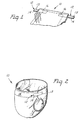
- FIG. 1 is a fragmentary schematic perspective view of a disposable diaper having degradable diaper-fastening means, namely, pressure-sensitive adhesive fastening tabs, release tapes, and a frontal target strip, with one of the fastening tabs open; and
- FIG. 2 is a schematic perspective view of the diaper of FIG. 1 as it would appear while being worn.
- a disposable diaper 10 has a pair of fastening tabs 12, each having a flexible backing, one end 13 of which is adhered to the body of the diaper by a pressure-sensitive adhesive (not shown).
- the free end 14 of each fastening tab bears a fastening layer of pressure-sensitive adhesive 15.
- the fastening adhesive layer of each of the fastening tabs is protected by one of a pair of release tapes 16, each of which has a backing that is adhered to the diaper by a layer of pressure-sensitive adhesive (not shown).
- a frontal target strip 18 has been adhered to the diaper by its layer of pressure-sensitive adhesive (not shown).
- tensile strength was measured using ASTM D-882-81.
- the tensile strength is based on the cross-sectional area of the backing.
- Tear Resistance can be measured using an Elmendorf TM Tear Tester. In this test a 7.5 cm long by 6.3 cm wide tape sample is mounted between a pair of fixed vertical clamps with a spacing of 2.5 mm between the clamps. A 20 mm starter slit is cut in the lower edge of the tape between the clamps. A pendulum is released that tears the tape between the clamps. The pendulum carries a pointer that indicates the tear strength of the tape. The measurement is in the machine (downweb) direction of the tape.
- This test employs a polyethylene substrate, namely an embossed material found on LUV TM brand disposable diapers manufactured by Procter and Gamble which is about 30.5 ⁇ m thick.
- the polyethylene substrate is laminated to a pressure-sensitive tape.
- a one inch (2.54 cm) square area of the test tab tape is rolled down onto the polyethylene substrate using two passes of a hard rubber (2.2 kg) roll.
- the laminated substrate and test tab tape are hung vertically in a 40°C oven, and a 500 gram weight is hung from the test tab tape.
- the time for the weight to drop is reported as "Shear Creep Resistance". The test is discontinued when there has been no failure after 1000 minutes.
- Dry blends as indicated in Table I were extruded in an extruder having a 6.25-cm diameter screw with a 30/1 length/diameter ratio.
- Each of the extruded films was cast into a nip incorporating a rubber-covered roll that had a coarse matte surface and a water-cooled metal roll that had a finish as described here.
- Example 1 is a pure polypropylene tab.
- Examples 2 and 7 are polypropylenes with white pigment.
- Example 5 is a copolymer with pigment.
- Example 9 is a copolymer alone.
- Example 12 is a second polypropylene polymer alone.
- the film of each of Examples 1-13 was coated with a (50%) solution (a toluene/heptane 80:20 mixture) of a degradable pressure-sensitive adhesive.
- a degradable pressure-sensitive adhesive Three adhesives were employed (here called PSAs X, Y and Z).
- PSA Z was coated from hot melt without solvent.
- compositions of the three PSAs are reported in Table II.
- Kraton TM 1111 styrene-isoprene-styrene block copolymer from Shell Chemical.
- Wingtack TM Plus solid hydrocarbon tackifying resin from Goodyear Chemical.
- Irganox TM 1076 antioxidant from Ciba-Geigy.
- Example 3 Although the degradable polypropylene tape of Example 3 has significantly lower tear strength than the comparative Example 1 tape, this value is still acceptable for use in a diaper tape. The addition of the degradation system components did not significantly affect the tensile strength, peel value or shear value of the tape, which is true also for Example 4, as compared to comparative Example 2.
- Example 6 demonstrates significant tear strength improvement of the degradable copolymer tape over both the degradable and non-degradable polypropylene tapes of Examples 3 and 1, respectively, although the tape basis weight is not that much higher.
- a very remarkable feature of Example 6 is that the additive increased rather than decreased the tear and tensile strength, rather than decreased these values, when compared to comparative Example 5. This increase in tear strength was also noticed in Example 10 as compared to comparative Example 9.
- Example 8 also demonstrates the effect of Roll Temperature. With a higher Roll Temperature crystallinity will increase, increasing the tensile strength, however decreasing the tear strength, which is not as critical for release tapes or target strips.
- Example 11 demonstrates the effect of an overall increase in the degradant components as decreasing the tensile and tear strength as compared to Example 4.
- Example 13 demonstrates the use of the chemical degradant alone without starch, which produced tapes with superior tear and tensile strengths as compared to the starch loaded Examples 3 and 4.
- Examples 11 is a tape prepared for use as a fastening tab but had too low of a tear strength to be useful as such. If the most preferred copolymer was used instead of polypropylene it would be expected that this amount of starch loading (i.e., 30 weight percent of Polygrade TM II 20835F) could be achieved.
- degradable tapes of the invention should be useful in other items, e.g., surgical gowns and other disposable garments.
Landscapes
- Health & Medical Sciences (AREA)
- Chemical & Material Sciences (AREA)
- Vascular Medicine (AREA)
- Life Sciences & Earth Sciences (AREA)
- Epidemiology (AREA)
- Engineering & Computer Science (AREA)
- Biomedical Technology (AREA)
- Heart & Thoracic Surgery (AREA)
- Veterinary Medicine (AREA)
- Public Health (AREA)
- Animal Behavior & Ethology (AREA)
- General Health & Medical Sciences (AREA)
- Organic Chemistry (AREA)
- Chemical Kinetics & Catalysis (AREA)
- Absorbent Articles And Supports Therefor (AREA)
- Orthopedics, Nursing, And Contraception (AREA)
- Compositions Of Macromolecular Compounds (AREA)
Applications Claiming Priority (2)
| Application Number | Priority Date | Filing Date | Title |
|---|---|---|---|
| US07/444,519 US4985024A (en) | 1989-12-01 | 1989-12-01 | Disposable diaper having fastening means that are degradable |
| US444519 | 1989-12-01 |
Publications (2)
| Publication Number | Publication Date |
|---|---|
| EP0430641A2 true EP0430641A2 (de) | 1991-06-05 |
| EP0430641A3 EP0430641A3 (en) | 1992-08-05 |
Family
ID=23765250
Family Applications (1)
| Application Number | Title | Priority Date | Filing Date |
|---|---|---|---|
| EP19900312861 Withdrawn EP0430641A3 (en) | 1989-12-01 | 1990-11-27 | Disposable diaper having fastening means that are degradable |
Country Status (7)
| Country | Link |
|---|---|
| US (1) | US4985024A (de) |
| EP (1) | EP0430641A3 (de) |
| JP (1) | JPH03228764A (de) |
| KR (1) | KR910011228A (de) |
| AU (1) | AU623838B2 (de) |
| BR (1) | BR9006113A (de) |
| CA (1) | CA2030207A1 (de) |
Cited By (2)
| Publication number | Priority date | Publication date | Assignee | Title |
|---|---|---|---|---|
| US5759569A (en) * | 1995-01-10 | 1998-06-02 | The Procter & Gamble Company | Biodegradable articles made from certain trans-polymers and blends thereof with other biodegradable components |
| EP0809952A3 (de) * | 1996-05-31 | 1998-08-12 | Ykk Corporation | Haftbandverschluss |
Families Citing this family (23)
| Publication number | Priority date | Publication date | Assignee | Title |
|---|---|---|---|---|
| US5308906A (en) * | 1991-12-11 | 1994-05-03 | Kimberly-Clark Corporation | Extrudable elastomeric composition having controlled rate of degradation |
| US5258422A (en) * | 1992-05-05 | 1993-11-02 | Tredegar Industries, Inc. | Compostable thermoplastic compositions |
| US5284889A (en) * | 1992-11-20 | 1994-02-08 | Minnesota Mining And Manufacturing Company | Electrically insulating film backing |
| CA2128347C (en) * | 1993-07-28 | 1998-12-08 | Akihiko Takano | Biodegradable adhesive tape and biodegradable adhesive label |
| US5498476A (en) * | 1993-10-08 | 1996-03-12 | Minnesota Mining And Manufacturing Company | Electrically insulating film backing |
| US6630238B2 (en) * | 1995-02-16 | 2003-10-07 | 3M Innovative Properties Company | Blended pressure-sensitive adhesives |
| DE19654052C1 (de) * | 1996-12-23 | 1997-12-18 | Hartmann Paul Ag | Hygieneartikel zum einmaligen Gebrauch mit kombiniertem mechanischen und klebenden Verschlußsystem |
| JPH1142249A (ja) * | 1997-07-25 | 1999-02-16 | Ykk Corp | 使い捨ておむつとその廃棄時の折り畳み固定方法 |
| JPH1142252A (ja) * | 1997-07-25 | 1999-02-16 | Ykk Corp | 使い捨ておむつ |
| EP1045887B1 (de) | 1998-01-09 | 2005-12-14 | Minnesota Mining And Manufacturing Company | Isolations-schutzband |
| GB0515294D0 (en) | 2005-07-26 | 2005-08-31 | Novamedix Distrib Ltd | Limited durability closure means for an inflatable medical garment |
| US8038661B2 (en) * | 2005-09-02 | 2011-10-18 | The Procter & Gamble Company | Absorbent article with low cold flow construction adhesive |
| US8016779B2 (en) | 2007-04-09 | 2011-09-13 | Tyco Healthcare Group Lp | Compression device having cooling capability |
| US8070699B2 (en) | 2007-04-09 | 2011-12-06 | Tyco Healthcare Group Lp | Method of making compression sleeve with structural support features |
| US8506508B2 (en) | 2007-04-09 | 2013-08-13 | Covidien Lp | Compression device having weld seam moisture transfer |
| US8162861B2 (en) | 2007-04-09 | 2012-04-24 | Tyco Healthcare Group Lp | Compression device with strategic weld construction |
| US8034007B2 (en) | 2007-04-09 | 2011-10-11 | Tyco Healthcare Group Lp | Compression device with structural support features |
| US8114117B2 (en) | 2008-09-30 | 2012-02-14 | Tyco Healthcare Group Lp | Compression device with wear area |
| US8235923B2 (en) * | 2008-09-30 | 2012-08-07 | Tyco Healthcare Group Lp | Compression device with removable portion |
| US9205021B2 (en) | 2012-06-18 | 2015-12-08 | Covidien Lp | Compression system with vent cooling feature |
| WO2016023016A1 (en) * | 2014-08-08 | 2016-02-11 | Li Clive | Biodegradable, biobased diaper |
| US11643261B2 (en) | 2020-02-28 | 2023-05-09 | Illinois Tool Works Inc. | Biodegradable multi-pack carriers |
| US11864602B2 (en) * | 2021-01-17 | 2024-01-09 | Clay Robinson Dorsey | Personal protector shield |
Family Cites Families (15)
| Publication number | Priority date | Publication date | Assignee | Title |
|---|---|---|---|---|
| US4016117A (en) * | 1972-05-18 | 1977-04-05 | Coloroll Limited | Biodegradable synthetic resin sheet material containing starch and a fatty material |
| US3952347A (en) * | 1973-12-13 | 1976-04-27 | Personal Products Company | Biodegradable barrier film and absorbent pad utilizing same |
| IT1015654B (it) * | 1974-07-03 | 1977-05-20 | Montedison Spa | Composizioni polimeriche fotodegra dabili dotate di elevata stabilita termica |
| US4021338A (en) * | 1976-08-07 | 1977-05-03 | Wisconsin Alumni Research Foundation | Method for treating septic tank effluent seepage beds and the like |
| GB1600496A (en) * | 1977-09-16 | 1981-10-14 | Coloroll Ltd | Plasticsbased composition |
| US4133784A (en) * | 1977-09-28 | 1979-01-09 | The United States Of America As Represented By The Secretary Of Agriculture | Biodegradable film compositions prepared from starch and copolymers of ethylene and acrylic acid |
| US4237889A (en) * | 1978-09-13 | 1980-12-09 | Minnesota Mining And Manufacturing Company | Diaper closure utilizing pressure-sensitive adhesive tape having textured foil backing |
| US4337181A (en) * | 1980-01-17 | 1982-06-29 | The United States Of America As Represented By The Secretary Of Agriculture | Biodegradable starch-based blown films |
| US4769283A (en) * | 1986-01-31 | 1988-09-06 | Minnesota Mining And Manufacturing Company | Pressure-sensitive adhesive tape |
| US4683268A (en) * | 1986-02-18 | 1987-07-28 | Exxon Chemical Patents Inc. | Pressure sensitive adhesive using light color, low softening point petroleum hydrocarbon resins |
| US4808474A (en) * | 1986-05-07 | 1989-02-28 | Minnesota Mining And Manufacturing Company | Pressure-sensitive adhesive tape having improved toughness |
| US4793337A (en) * | 1986-11-17 | 1988-12-27 | E. R. Squibb & Sons, Inc. | Adhesive structure and products including same |
| CH671961A5 (de) * | 1987-02-27 | 1989-10-13 | Amrotex Ag | |
| GB8712009D0 (en) * | 1987-05-21 | 1987-06-24 | Folk Drive Eng Ltd | Degradable plastics |
| BE1002431A4 (nl) * | 1987-07-07 | 1991-02-05 | Lilaran & Sons Uk Ltd B | In de lucht afbreekbare ethyleenpolymeren. |
-
1989
- 1989-12-01 US US07/444,519 patent/US4985024A/en not_active Expired - Lifetime
-
1990
- 1990-11-16 CA CA002030207A patent/CA2030207A1/en not_active Abandoned
- 1990-11-21 AU AU66819/90A patent/AU623838B2/en not_active Ceased
- 1990-11-27 EP EP19900312861 patent/EP0430641A3/en not_active Withdrawn
- 1990-11-29 JP JP2326167A patent/JPH03228764A/ja active Pending
- 1990-11-30 BR BR909006113A patent/BR9006113A/pt not_active Application Discontinuation
- 1990-11-30 KR KR1019900019517A patent/KR910011228A/ko not_active Withdrawn
Cited By (3)
| Publication number | Priority date | Publication date | Assignee | Title |
|---|---|---|---|---|
| US5759569A (en) * | 1995-01-10 | 1998-06-02 | The Procter & Gamble Company | Biodegradable articles made from certain trans-polymers and blends thereof with other biodegradable components |
| EP0809952A3 (de) * | 1996-05-31 | 1998-08-12 | Ykk Corporation | Haftbandverschluss |
| US5985406A (en) * | 1996-05-31 | 1999-11-16 | Ykk Corporation | Separable fastener |
Also Published As
| Publication number | Publication date |
|---|---|
| CA2030207A1 (en) | 1991-06-02 |
| KR910011228A (ko) | 1991-08-07 |
| AU6681990A (en) | 1991-06-06 |
| JPH03228764A (ja) | 1991-10-09 |
| EP0430641A3 (en) | 1992-08-05 |
| US4985024A (en) | 1991-01-15 |
| AU623838B2 (en) | 1992-05-21 |
| BR9006113A (pt) | 1991-09-24 |
Similar Documents
| Publication | Publication Date | Title |
|---|---|---|
| US4985024A (en) | Disposable diaper having fastening means that are degradable | |
| AU677991B2 (en) | Release films formed by coextrusion | |
| US5389438A (en) | Repositionable adhesive tape | |
| US5378536A (en) | Repositionable adhesive tape | |
| AU627415B2 (en) | Adhesive fastening tab | |
| US6120866A (en) | Re-peeling pressure-sensitive adhesive tape or pressure-sensitive adhesive, and fastening system using the same | |
| EP0235930B1 (de) | Druckempfindliche Klebestreifen | |
| EP0599861B1 (de) | Druckempfindliches klebemittel und klebeverschluss für wegwerfwindeln | |
| CA1219393A (en) | Reduced build-up pressure-sensitive adhesives | |
| US4335026A (en) | Pressure-sensitive adhesive compositions having high shear and low peel resistance | |
| US5242726A (en) | Pattern-coated anchorage system for porous film | |
| KR100341083B1 (ko) | 흡수성물품 | |
| EP1601736B1 (de) | Verschlusssysteme mit selbsthaftenden klebstoffen sowie gegenstände | |
| KR970000306B1 (ko) | 정면의 테이프에 의한 기저귀 체결 시스템 | |
| CA2088157C (en) | Attachment tape for foam backed absorbent product | |
| JPH09111202A (ja) | 再剥離用粘着テープもしくは粘着剤、及びこれらを用いたファスニングシステム | |
| AU655378B1 (en) | Improved frontal tape-based diaper closure system | |
| WO1997013486A1 (en) | Pressure activated adhesive article |
Legal Events
| Date | Code | Title | Description |
|---|---|---|---|
| PUAI | Public reference made under article 153(3) epc to a published international application that has entered the european phase |
Free format text: ORIGINAL CODE: 0009012 |
|
| 17P | Request for examination filed |
Effective date: 19901220 |
|
| AK | Designated contracting states |
Kind code of ref document: A2 Designated state(s): BE DE ES FR GB IT NL SE |
|
| PUAL | Search report despatched |
Free format text: ORIGINAL CODE: 0009013 |
|
| AK | Designated contracting states |
Kind code of ref document: A3 Designated state(s): BE DE ES FR GB IT NL SE |
|
| 17Q | First examination report despatched |
Effective date: 19940304 |
|
| STAA | Information on the status of an ep patent application or granted ep patent |
Free format text: STATUS: THE APPLICATION IS DEEMED TO BE WITHDRAWN |
|
| 18D | Application deemed to be withdrawn |
Effective date: 19940915 |