EP0430879A2 - Farbstoffmischungen und deren Verwendung - Google Patents
Farbstoffmischungen und deren Verwendung Download PDFInfo
- Publication number
- EP0430879A2 EP0430879A2 EP90810894A EP90810894A EP0430879A2 EP 0430879 A2 EP0430879 A2 EP 0430879A2 EP 90810894 A EP90810894 A EP 90810894A EP 90810894 A EP90810894 A EP 90810894A EP 0430879 A2 EP0430879 A2 EP 0430879A2
- Authority
- EP
- European Patent Office
- Prior art keywords
- dye
- alkyl
- formula
- methyl
- sulfo
- Prior art date
- Legal status (The legal status is an assumption and is not a legal conclusion. Google has not performed a legal analysis and makes no representation as to the accuracy of the status listed.)
- Granted
Links
- 239000000203 mixture Substances 0.000 title claims abstract description 67
- 239000000975 dye Substances 0.000 title claims description 144
- 125000002496 methyl group Chemical group [H]C([H])([H])* 0.000 claims abstract description 36
- 125000001495 ethyl group Chemical group [H]C([H])([H])C([H])([H])* 0.000 claims abstract description 17
- 125000001997 phenyl group Chemical group [H]C1=C([H])C([H])=C(*)C([H])=C1[H] 0.000 claims abstract description 13
- 125000001544 thienyl group Chemical group 0.000 claims abstract description 12
- 229910052739 hydrogen Inorganic materials 0.000 claims abstract description 11
- 239000001257 hydrogen Substances 0.000 claims abstract description 11
- 125000001164 benzothiazolyl group Chemical group S1C(=NC2=C1C=CC=C2)* 0.000 claims abstract description 7
- 238000004043 dyeing Methods 0.000 claims description 29
- 238000000034 method Methods 0.000 claims description 20
- 125000000020 sulfo group Chemical group O=S(=O)([*])O[H] 0.000 claims description 18
- -1 sulfo, methylaminosulfonyl Chemical group 0.000 claims description 17
- 239000000463 material Substances 0.000 claims description 16
- 125000000217 alkyl group Chemical group 0.000 claims description 14
- 239000004952 Polyamide Substances 0.000 claims description 13
- 229920002647 polyamide Polymers 0.000 claims description 13
- UFHFLCQGNIYNRP-UHFFFAOYSA-N Hydrogen Chemical compound [H][H] UFHFLCQGNIYNRP-UHFFFAOYSA-N 0.000 claims description 10
- 125000001797 benzyl group Chemical group [H]C1=C([H])C([H])=C(C([H])=C1[H])C([H])([H])* 0.000 claims description 8
- 125000000956 methoxy group Chemical group [H]C([H])([H])O* 0.000 claims description 7
- 229910052801 chlorine Inorganic materials 0.000 claims description 5
- 239000000460 chlorine Substances 0.000 claims description 5
- 125000003754 ethoxycarbonyl group Chemical group C(=O)(OCC)* 0.000 claims description 5
- 229910052736 halogen Inorganic materials 0.000 claims description 5
- 150000002367 halogens Chemical class 0.000 claims description 5
- 239000001043 yellow dye Substances 0.000 claims description 5
- ZAMOUSCENKQFHK-UHFFFAOYSA-N Chlorine atom Chemical compound [Cl] ZAMOUSCENKQFHK-UHFFFAOYSA-N 0.000 claims description 4
- 239000001045 blue dye Substances 0.000 claims description 4
- 238000002360 preparation method Methods 0.000 claims description 3
- 239000004753 textile Substances 0.000 claims description 3
- 239000001048 orange dye Substances 0.000 claims 2
- 125000004178 (C1-C4) alkyl group Chemical group 0.000 abstract 2
- 125000004209 (C1-C8) alkyl group Chemical group 0.000 abstract 1
- 125000004435 hydrogen atom Chemical group [H]* 0.000 abstract 1
- QTBSBXVTEAMEQO-UHFFFAOYSA-N Acetic acid Chemical compound CC(O)=O QTBSBXVTEAMEQO-UHFFFAOYSA-N 0.000 description 6
- 239000004744 fabric Substances 0.000 description 6
- 239000002657 fibrous material Substances 0.000 description 5
- 239000001044 red dye Substances 0.000 description 5
- XLYOFNOQVPJJNP-UHFFFAOYSA-N water Substances O XLYOFNOQVPJJNP-UHFFFAOYSA-N 0.000 description 5
- 239000000835 fiber Substances 0.000 description 4
- 150000003839 salts Chemical class 0.000 description 4
- 0 *c(ccc(N=Nc(cc(*)c1c2cccc1)c2O)c1)c1S(Nc1ccccc1)(=O)=O Chemical compound *c(ccc(N=Nc(cc(*)c1c2cccc1)c2O)c1)c1S(Nc1ccccc1)(=O)=O 0.000 description 3
- 229920002292 Nylon 6 Polymers 0.000 description 3
- HEMHJVSKTPXQMS-UHFFFAOYSA-M Sodium hydroxide Chemical compound [OH-].[Na+] HEMHJVSKTPXQMS-UHFFFAOYSA-M 0.000 description 3
- 239000002253 acid Substances 0.000 description 3
- 239000000654 additive Substances 0.000 description 3
- 239000003795 chemical substances by application Substances 0.000 description 3
- 125000000959 isobutyl group Chemical group [H]C([H])([H])C([H])(C([H])([H])[H])C([H])([H])* 0.000 description 3
- 125000001449 isopropyl group Chemical group [H]C([H])([H])C([H])(*)C([H])([H])[H] 0.000 description 3
- AJDUTMFFZHIJEM-UHFFFAOYSA-N n-(9,10-dioxoanthracen-1-yl)-4-[4-[[4-[4-[(9,10-dioxoanthracen-1-yl)carbamoyl]phenyl]phenyl]diazenyl]phenyl]benzamide Chemical compound O=C1C2=CC=CC=C2C(=O)C2=C1C=CC=C2NC(=O)C(C=C1)=CC=C1C(C=C1)=CC=C1N=NC(C=C1)=CC=C1C(C=C1)=CC=C1C(=O)NC1=CC=CC2=C1C(=O)C1=CC=CC=C1C2=O AJDUTMFFZHIJEM-UHFFFAOYSA-N 0.000 description 3
- 125000004108 n-butyl group Chemical group [H]C([H])([H])C([H])([H])C([H])([H])C([H])([H])* 0.000 description 3
- 230000007935 neutral effect Effects 0.000 description 3
- 125000001436 propyl group Chemical group [H]C([*])([H])C([H])([H])C([H])([H])[H] 0.000 description 3
- 125000002914 sec-butyl group Chemical group [H]C([H])([H])C([H])([H])C([H])(*)C([H])([H])[H] 0.000 description 3
- 125000000999 tert-butyl group Chemical group [H]C([H])([H])C(*)(C([H])([H])[H])C([H])([H])[H] 0.000 description 3
- USFZMSVCRYTOJT-UHFFFAOYSA-N Ammonium acetate Chemical compound N.CC(O)=O USFZMSVCRYTOJT-UHFFFAOYSA-N 0.000 description 2
- 239000005695 Ammonium acetate Substances 0.000 description 2
- QAOWNCQODCNURD-UHFFFAOYSA-N Sulfuric acid Chemical compound OS(O)(=O)=O QAOWNCQODCNURD-UHFFFAOYSA-N 0.000 description 2
- 229940043376 ammonium acetate Drugs 0.000 description 2
- 235000019257 ammonium acetate Nutrition 0.000 description 2
- 150000003863 ammonium salts Chemical class 0.000 description 2
- 238000001816 cooling Methods 0.000 description 2
- 125000001160 methoxycarbonyl group Chemical group [H]C([H])([H])OC(*)=O 0.000 description 2
- 238000002156 mixing Methods 0.000 description 2
- AZUYLZMQTIKGSC-UHFFFAOYSA-N 1-[6-[4-(5-chloro-6-methyl-1H-indazol-4-yl)-5-methyl-3-(1-methylindazol-5-yl)pyrazol-1-yl]-2-azaspiro[3.3]heptan-2-yl]prop-2-en-1-one Chemical compound ClC=1C(=C2C=NNC2=CC=1C)C=1C(=NN(C=1C)C1CC2(CN(C2)C(C=C)=O)C1)C=1C=C2C=NN(C2=CC=1)C AZUYLZMQTIKGSC-UHFFFAOYSA-N 0.000 description 1
- LSNNMFCWUKXFEE-UHFFFAOYSA-M Bisulfite Chemical compound OS([O-])=O LSNNMFCWUKXFEE-UHFFFAOYSA-M 0.000 description 1
- WKBOTKDWSSQWDR-UHFFFAOYSA-N Bromine atom Chemical compound [Br] WKBOTKDWSSQWDR-UHFFFAOYSA-N 0.000 description 1
- 229920001353 Dextrin Polymers 0.000 description 1
- 239000004375 Dextrin Substances 0.000 description 1
- VGGSQFUCUMXWEO-UHFFFAOYSA-N Ethene Chemical compound C=C VGGSQFUCUMXWEO-UHFFFAOYSA-N 0.000 description 1
- 239000005977 Ethylene Substances 0.000 description 1
- PXGOKWXKJXAPGV-UHFFFAOYSA-N Fluorine Chemical compound FF PXGOKWXKJXAPGV-UHFFFAOYSA-N 0.000 description 1
- DGAQECJNVWCQMB-PUAWFVPOSA-M Ilexoside XXIX Chemical compound C[C@@H]1CC[C@@]2(CC[C@@]3(C(=CC[C@H]4[C@]3(CC[C@@H]5[C@@]4(CC[C@@H](C5(C)C)OS(=O)(=O)[O-])C)C)[C@@H]2[C@]1(C)O)C)C(=O)O[C@H]6[C@@H]([C@H]([C@@H]([C@H](O6)CO)O)O)O.[Na+] DGAQECJNVWCQMB-PUAWFVPOSA-M 0.000 description 1
- WHXSMMKQMYFTQS-UHFFFAOYSA-N Lithium Chemical compound [Li] WHXSMMKQMYFTQS-UHFFFAOYSA-N 0.000 description 1
- 229920002302 Nylon 6,6 Polymers 0.000 description 1
- GSEJCLTVZPLZKY-UHFFFAOYSA-N Triethanolamine Chemical compound OCCN(CCO)CCO GSEJCLTVZPLZKY-UHFFFAOYSA-N 0.000 description 1
- 230000000996 additive effect Effects 0.000 description 1
- 235000010443 alginic acid Nutrition 0.000 description 1
- 229920000615 alginic acid Polymers 0.000 description 1
- 239000003513 alkali Substances 0.000 description 1
- 150000001412 amines Chemical class 0.000 description 1
- 125000000129 anionic group Chemical group 0.000 description 1
- 239000002518 antifoaming agent Substances 0.000 description 1
- GDTBXPJZTBHREO-UHFFFAOYSA-N bromine Substances BrBr GDTBXPJZTBHREO-UHFFFAOYSA-N 0.000 description 1
- 229910052794 bromium Inorganic materials 0.000 description 1
- 125000004106 butoxy group Chemical group [*]OC([H])([H])C([H])([H])C(C([H])([H])[H])([H])[H] 0.000 description 1
- 229940090204 c.i. acid blue 324 Drugs 0.000 description 1
- 229920003086 cellulose ether Polymers 0.000 description 1
- 125000001309 chloro group Chemical group Cl* 0.000 description 1
- 238000004040 coloring Methods 0.000 description 1
- 238000010014 continuous dyeing Methods 0.000 description 1
- 238000010411 cooking Methods 0.000 description 1
- 235000019425 dextrin Nutrition 0.000 description 1
- FPVGTPBMTFTMRT-UHFFFAOYSA-L disodium;2-amino-5-[(4-sulfonatophenyl)diazenyl]benzenesulfonate Chemical compound [Na+].[Na+].C1=C(S([O-])(=O)=O)C(N)=CC=C1N=NC1=CC=C(S([O-])(=O)=O)C=C1 FPVGTPBMTFTMRT-UHFFFAOYSA-L 0.000 description 1
- 235000019233 fast yellow AB Nutrition 0.000 description 1
- 239000003063 flame retardant Substances 0.000 description 1
- 229910052731 fluorine Inorganic materials 0.000 description 1
- 239000011737 fluorine Substances 0.000 description 1
- 239000006260 foam Substances 0.000 description 1
- 239000011521 glass Substances 0.000 description 1
- 238000010438 heat treatment Methods 0.000 description 1
- 125000003187 heptyl group Chemical group [H]C([*])([H])C([H])([H])C([H])([H])C([H])([H])C([H])([H])C([H])([H])C([H])([H])[H] 0.000 description 1
- 125000004051 hexyl group Chemical group [H]C([H])([H])C([H])([H])C([H])([H])C([H])([H])C([H])([H])C([H])([H])* 0.000 description 1
- 229910052744 lithium Inorganic materials 0.000 description 1
- 125000006261 methyl amino sulfonyl group Chemical group [H]N(C([H])([H])[H])S(*)(=O)=O 0.000 description 1
- 125000000325 methylidene group Chemical group [H]C([H])=* 0.000 description 1
- 125000002347 octyl group Chemical group [H]C([*])([H])C([H])([H])C([H])([H])C([H])([H])C([H])([H])C([H])([H])C([H])([H])C([H])([H])[H] 0.000 description 1
- 125000001147 pentyl group Chemical group C(CCCC)* 0.000 description 1
- 238000009971 piece dyeing Methods 0.000 description 1
- 239000004014 plasticizer Substances 0.000 description 1
- 239000005871 repellent Substances 0.000 description 1
- 230000002940 repellent Effects 0.000 description 1
- 229910052708 sodium Inorganic materials 0.000 description 1
- 239000011734 sodium Substances 0.000 description 1
- JXRBVOFBCVPZOV-UHFFFAOYSA-M sodium 4-[4-[(4-hydroxy-2-methylphenyl)diazenyl]anilino]-3-nitrobenzenesulfonate Chemical compound [Na+].Cc1cc(O)ccc1N=Nc1ccc(Nc2ccc(cc2[N+]([O-])=O)S([O-])(=O)=O)cc1 JXRBVOFBCVPZOV-UHFFFAOYSA-M 0.000 description 1
- MIBVDSFVCOIWCC-UHFFFAOYSA-M sodium;4-(3-acetamidoanilino)-1-amino-9,10-dioxoanthracene-2-sulfonate Chemical compound [Na+].CC(=O)NC1=CC=CC(NC=2C=3C(=O)C4=CC=CC=C4C(=O)C=3C(N)=C(C=2)S([O-])(=O)=O)=C1 MIBVDSFVCOIWCC-UHFFFAOYSA-M 0.000 description 1
- NTOOJLUHUFUGQI-UHFFFAOYSA-M sodium;4-(4-acetamidoanilino)-1-amino-9,10-dioxoanthracene-2-sulfonate Chemical compound [Na+].C1=CC(NC(=O)C)=CC=C1NC1=CC(S([O-])(=O)=O)=C(N)C2=C1C(=O)C1=CC=CC=C1C2=O NTOOJLUHUFUGQI-UHFFFAOYSA-M 0.000 description 1
- 238000001694 spray drying Methods 0.000 description 1
- 229920002994 synthetic fiber Polymers 0.000 description 1
- 239000004758 synthetic textile Substances 0.000 description 1
- 239000002562 thickening agent Substances 0.000 description 1
- 238000009423 ventilation Methods 0.000 description 1
- 239000000080 wetting agent Substances 0.000 description 1
- 210000002268 wool Anatomy 0.000 description 1
Classifications
-
- C—CHEMISTRY; METALLURGY
- C09—DYES; PAINTS; POLISHES; NATURAL RESINS; ADHESIVES; COMPOSITIONS NOT OTHERWISE PROVIDED FOR; APPLICATIONS OF MATERIALS NOT OTHERWISE PROVIDED FOR
- C09B—ORGANIC DYES OR CLOSELY-RELATED COMPOUNDS FOR PRODUCING DYES, e.g. PIGMENTS; MORDANTS; LAKES
- C09B67/00—Influencing the physical, e.g. the dyeing or printing properties of dyestuffs without chemical reactions, e.g. by treating with solvents grinding or grinding assistants, coating of pigments or dyes; Process features in the making of dyestuff preparations; Dyestuff preparations of a special physical nature, e.g. tablets, films
- C09B67/0033—Blends of pigments; Mixtured crystals; Solid solutions
- C09B67/0046—Mixtures of two or more azo dyes
- C09B67/0051—Mixtures of two or more azo dyes mixture of two or more monoazo dyes
-
- D—TEXTILES; PAPER
- D06—TREATMENT OF TEXTILES OR THE LIKE; LAUNDERING; FLEXIBLE MATERIALS NOT OTHERWISE PROVIDED FOR
- D06P—DYEING OR PRINTING TEXTILES; DYEING LEATHER, FURS OR SOLID MACROMOLECULAR SUBSTANCES IN ANY FORM
- D06P3/00—Special processes of dyeing or printing textiles, or dyeing leather, furs, or solid macromolecular substances in any form, classified according to the material treated
- D06P3/02—Material containing basic nitrogen
- D06P3/04—Material containing basic nitrogen containing amide groups
- D06P3/06—Material containing basic nitrogen containing amide groups using acid dyes
-
- Y—GENERAL TAGGING OF NEW TECHNOLOGICAL DEVELOPMENTS; GENERAL TAGGING OF CROSS-SECTIONAL TECHNOLOGIES SPANNING OVER SEVERAL SECTIONS OF THE IPC; TECHNICAL SUBJECTS COVERED BY FORMER USPC CROSS-REFERENCE ART COLLECTIONS [XRACs] AND DIGESTS
- Y10—TECHNICAL SUBJECTS COVERED BY FORMER USPC
- Y10S—TECHNICAL SUBJECTS COVERED BY FORMER USPC CROSS-REFERENCE ART COLLECTIONS [XRACs] AND DIGESTS
- Y10S8/00—Bleaching and dyeing; fluid treatment and chemical modification of textiles and fibers
- Y10S8/916—Natural fiber dyeing
- Y10S8/917—Wool or silk
-
- Y—GENERAL TAGGING OF NEW TECHNOLOGICAL DEVELOPMENTS; GENERAL TAGGING OF CROSS-SECTIONAL TECHNOLOGIES SPANNING OVER SEVERAL SECTIONS OF THE IPC; TECHNICAL SUBJECTS COVERED BY FORMER USPC CROSS-REFERENCE ART COLLECTIONS [XRACs] AND DIGESTS
- Y10—TECHNICAL SUBJECTS COVERED BY FORMER USPC
- Y10S—TECHNICAL SUBJECTS COVERED BY FORMER USPC CROSS-REFERENCE ART COLLECTIONS [XRACs] AND DIGESTS
- Y10S8/00—Bleaching and dyeing; fluid treatment and chemical modification of textiles and fibers
- Y10S8/92—Synthetic fiber dyeing
- Y10S8/924—Polyamide fiber
-
- Y—GENERAL TAGGING OF NEW TECHNOLOGICAL DEVELOPMENTS; GENERAL TAGGING OF CROSS-SECTIONAL TECHNOLOGIES SPANNING OVER SEVERAL SECTIONS OF THE IPC; TECHNICAL SUBJECTS COVERED BY FORMER USPC CROSS-REFERENCE ART COLLECTIONS [XRACs] AND DIGESTS
- Y10—TECHNICAL SUBJECTS COVERED BY FORMER USPC
- Y10S—TECHNICAL SUBJECTS COVERED BY FORMER USPC CROSS-REFERENCE ART COLLECTIONS [XRACs] AND DIGESTS
- Y10S8/00—Bleaching and dyeing; fluid treatment and chemical modification of textiles and fibers
- Y10S8/929—Carpet dyeing
Definitions
- the present invention relates to mixtures of red-dyeing dyes which are suitable for dyeing natural or synthetic textile polyamide fiber materials from an aqueous bath, which have very good fastness properties and which, particularly in combination with other dyes, have good drawing properties, in particular from short liquors.
- the present invention relates to a dye mixture comprising a dye of the formula wherein R 1 is methyl or ethyl, and at least one dye of the formulas (2) and (3) wherein D is optionally substituted phenyl, thiophenyl or benzthiazolyl, R 2 is C 1 -C 8 alkyl, R 3 is optionally substituted C 1 -C 8 alkyl and R 4 is hydrogen or C 1 -C 4 alkyl, and wherein R 5 is C 1 -C 4 alkyl.
- the dye mixture according to the invention which contains a dye of the formula (1) and a dye of the formula (2) or a dye of the formula (1) and a dye of the formula (3) is preferred.
- R 2 and R 3 in the formula (2) are independently z.
- R 2 and R 3 are C 1 -C 4 alkyl.
- the radical R 3 as C 1 -C 8 alkyl can be substituted, for example by sulfo, sulfato or phenyl. Examples include benzyl, ⁇ -sulfoethyl, y-sulfopropyl and ⁇ -sulfatoethyl.
- C 1 -C 4 alkyl for R 4 in formula (2) and for R 5 in formula (3) are independently z.
- B methyl, ethyl, propyl, isopropyl, n-butyl, sec-butyl, tert-butyl or isobutyl, especially methyl, into consideration.
- the radical D in formula (2) can be, for example, halogen, such as fluorine, chlorine or bromine, C 1 -C 4 -alkyl, such as methyl, ethyl, propyl, isopropyl, n-butyl, sec-butyl, tert-butyl or isobutyl, C 1 -C 4 alkoxy such as methoxy, ethoxy, propoxy or butoxy, C 1 -C 4 alkoxycarbonyl such as methoxycarbonyl or ethoxycarbonyl, sulfo or C 1 -C 4 alkylamino sulfonyl optionally substituted by sulfo in the alkyl part such as methylaminosulfonyl, Aethylaminosulfonyl or ⁇ -sulfoethylaminosulfonyl, may be substituted.
- halogen such as fluorine, chlorine or bromine
- a dye mixture which comprises at least one dye of the formula (2) in which D is phenyl, thiophenyl or benzothiazolyl, each of the radicals mentioned being halogen, C 1 -C 4 -alkyl, C 1 -C 4 -alkoxy, C 1 -C 4 alkoxycarbonyl, sulfo or C 1 -C 4 alkylamino sulfonyl which is optionally substituted in the alkyl part by sulfo, R 2 C 1 -C 4 alkyl, R 3 benzyl or C 1 -C 4 optionally substituted by sulfo or sulfato Alkyl and R 4 is hydrogen or C 1 -C 4 alkyl.
- the radical D of the dye of the formula (2) is preferably phenyl which is substituted by halogen, sulfo or in the alkyl part optionally substituted by sulfo-substituted C 1 -C 4 -alkylaminosulfonyl, or by C 1 -C 4 -alkyl or C 1 -C 4 alkoxycarbonyl substituted thiophenyl or benzthiophenyl optionally substituted by C 1 -C 4 alkyl, C 1 -C 4 alkoxy or sulfo.
- a dye mixture which contains a dye of the formula as the dye of the formula (3) wherein R 6 is C 1 -C 4 alkyl, in particular methyl.
- a dye mixture which comprises at least one dye of the formula (2), in which D is phenyl substituted by chlorine, sulfo, methylaminosulfonyl, ethylaminosulfonyl or ⁇ -sulfoethylaminosulfonyl, thiophenyl substituted by methyl, methoxy- or ethoxycarbonyl or optionally by methyl, methoxy or sulfo substituted benzthiophenyl, R 2 is C 1 -C 4 alkyl, R 3 benzyl or C 1 -C 4 alkyl optionally substituted by sulfo or sulfato, and R 4 is hydrogen or C 1 -C 4 alkyl, and / or a Dye of the formula (4) in which R 6 is C 1 -C 4 alkyl, in particular methyl.
- a dye mixture which is a dye of the formula (1), in which R 1 is methyl or ethyl, in particular methyl, and at least one dye of the formula (2), in which D is chlorine, sulfo, methylaminosulfonyl, ethylaminosulfonyl or ⁇ , is very particularly preferred -Sulfoethylaminosulfonyl is substituted phenyl, thiophenyl substituted by methyl, methoxy or ethoxycarbonyl or benzthiophenyl optionally substituted by methyl, methoxy or sulfo, R 2 is ethyl, R 3 is ethyl, ⁇ -sulfatoethyl, Hoder benzyl and R 4 is hydrogen or methyl, and / or contains a dye of formula (4), wherein R a is methyl.
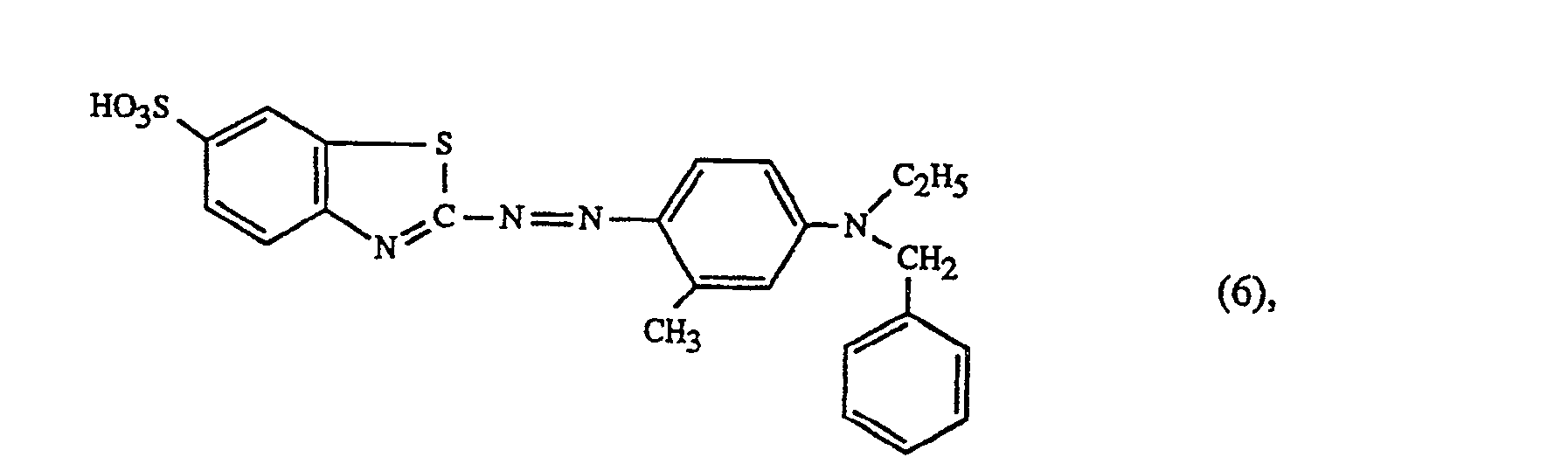
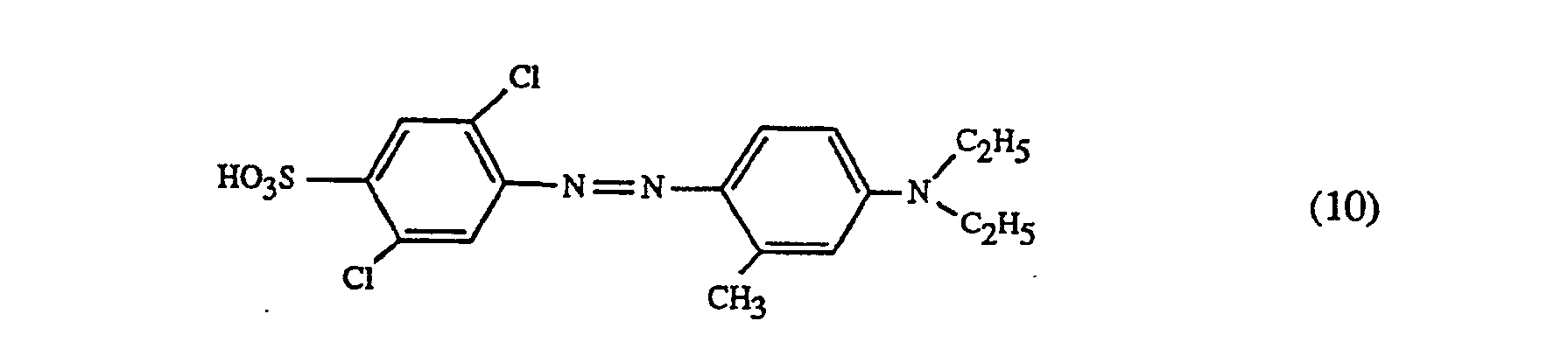
- a dye mixture which comprises a dye of the formula (1), in which R 1 is methyl or ethylene, in particular methylene, and at least one dye of the formulas (5) to (10) and (4): and a dye of formula (4) wherein Rg is methyl.
- the particularly important dye mixtures thus contain a dye of the formula (1) and at least one of the dyes of the formulas (4), (5), (6), (7), (8), (9) and (10).
- the ratio of the dyes of the formulas (1) and (2) or (3) or the ratio of the dyes of the formulas (1) and (4), (5), (6), (7), ( 8), (9) or (10) from 10:90 to 90:10 and in particular from 40:60 to 60:40 are preferred.
- the ratio of the dyes of the formulas (1) and (2) or (3) and in particular the ratio of the dyes of the formulas (1) and (4), (5), (6), (7), (8), ( 9) or (10) from 55:45 to 45:55 is very particularly preferred.
- the dyes of the formulas (1), (2) and (3) are known per se or can be prepared analogously to known dyes.
- the dye mixture according to the invention can be produced by mixing the individual dyes. This mixing process takes place, for example, in suitable mills, e.g. Ball and pin mills, as well as in kneaders or mixers.
- the dye mixtures can be prepared by spray drying the aqueous dye mixtures.
- the invention further relates to a process for dyeing and printing natural or synthetic polyamide materials with a dye mixture which contains the dye of the formula (1) and at least one dye of the formulas (2) and (3).
- synthetic polyamide materials e.g. Polyamide 6.6 or polyamide 6 fiber materials are considered and as natural polyamide materials e.g. Wool.
- the usual dyeing and printing processes are used for dyeing and printing.
- the dye mixture with the dye of the formula (1) and at least one dye of the formulas (2) and (3) is particularly suitable for dyeing and printing in combination with other dyes and in particular for dyeing and printing according to the trichromatic principle.
- Trichromatic is the additive color mixture of three suitably selected yellow, red and blue coloring dyes in the amounts necessary to achieve the desired shade.
- the dye mixture according to the invention is particularly suitable for dyeing from short liquors, for example in continuous dyeing processes or discontinuous and continuous foam dyeing processes.
- the dye mixture according to the invention is characterized by generally good properties, such as good solubility, resistance to cold solutions, good draw-up behavior and in particular due to good combinability with other dyes and uniform good draw behavior on different fiber materials.
- the textile material to be dyed or printed can be in various processing forms, e.g. as fiber, yarn, woven or knitted fabric and in particular in the form of carpets.
- the dyes of the formulas (1) and (2) or (3) are either in the form of their free sulfonic acid or preferably as their salts, e.g. the alkali, alkaline earth or ammonium salts or as salts of an organic amine.
- their salts e.g. the alkali, alkaline earth or ammonium salts or as salts of an organic amine. Examples include the sodium, lithium or ammonium salts or the salt of triethanolamine.
- the dye mixture usually contains other additives such as Cooking salt or dextrin.
- the dye liquors or printing pastes can also contain other additives, for example wetting agents, anti-foaming agents, leveling agents or agents influencing the properties of the textile material, such as e.g. Plasticizers, flame retardants or dirt, water and oil repellents, water softeners and natural or synthetic thickeners such as Alginates and cellulose ethers.
- wetting agents for example wetting agents, anti-foaming agents, leveling agents or agents influencing the properties of the textile material, such as e.g. Plasticizers, flame retardants or dirt, water and oil repellents, water softeners and natural or synthetic thickeners such as Alginates and cellulose ethers.
- parts represent parts by weight.
- the temperatures are given in degrees Celsius.
- the relationship between parts by weight and parts by volume is the same as that between grams and cubic centimeters.
- Example 2 10 parts of polyamide 6.6 fiber material (Helancatrikot) are dyed in 500 parts of an aqueous liquor which contains 2 g / l of ammonium acetate and is adjusted to pH 5 with acetic acid. 0.12% of the red dye mixture A according to Example 1a), 0.27% of the yellow dye of the formula are used as dyes and 0.13% of the blue dye of the formula used, the quantities refer to the fiber weight.
- the dyeing time for one Temperature from 60 to 98 ° is 30 to 90 minutes.
- the dyed polyamide 6.6 fiber material is then removed and rinsed and dried as usual. A piece of fabric dyed in neutral brown shade that has no streakiness due to the material is obtained.
- Example 2 instead of 0.13% of the dye of the formula (110), an equimolar amount of the dye C.I. Acid Blue 40, C.I. Acid Blue 258, C.I. Acid Blue 288, C.I. Acid Blue 324 or C.I. Acid Blue 336 can be used.
- Example 2 instead of 0.27% of the dye of formula (109), an equimolar amount of C.I. Acid Yellow 199 or C.I. Acid Yellow 219 can be used.
- Examples 3 to 9 instead of 0.12% of the red dye mixture A and 0.27% of the yellow dye of the formula (109) and 0.13% of the blue dye of the formula (110), those given in Table 1 below are used Dyestuffs of the formulas (109) and (110) and the dyestuff mixtures from Example 1, the pieces of fabric dyed in the color shade given no matter what is obtained.
- Example 10 10 parts of polyamide 66 yarn are dyed in 400 parts of an aqueous liquor which contains 1.5 gll of ammonium acetate and is adjusted to pH 5.5 with acetic acid. 0.12% of the dye mixture B, 0.27% of the dye of the formula (109) and 0.13% of the dye of the formula (110) are used as dyes, the quantitative data relating to the fiber weight. The dyebath is heated to 98 ° within 30 minutes and held at 96 ° to 98 ° for 60 minutes. The dyed yarn is then removed and rinsed and dried as usual. A yarn dyed in a neutral brown color is obtained.
- the dyeing temperature is set to 97 to 98 °, the pH is 10.7.
- the pH of a sample taken and cooled to 20 ° is 11.9.
- the pH is 3.8.
- the dye bath is exhausted, i.e. more than 99% of the dyes are applied to the material to be dyed.
- the heating is switched off and cooled to 60 ° using the indirect cooling of the dye liquor.
- the pH increases to 3.9.
- the almost water-clear fleet is pumped back into the auxiliary boiler and the goods tree removed.
- the carpet material is unwound, centrifuged and dried.
- the polyamide 6 loop carpet is colored orange in all areas.
Landscapes
- Chemical & Material Sciences (AREA)
- Engineering & Computer Science (AREA)
- Textile Engineering (AREA)
- Chemical Kinetics & Catalysis (AREA)
- Organic Chemistry (AREA)
- Coloring (AREA)
Abstract
Description
- Die vorliegende Erfindung betrifft Mischungen rotfärbender Farbstoffe, die zum Färben von natürlichen oder synthetischen textilen Polyamidfasermaterialien aus wässrigem Bad geeignet sind, die sehr gute Echtheitseigenschaften aufweisen und die insbesondere in Kombination mit anderen Farbstoffen ein gutes Ziehverhalten, insbesondere aus Kurzflotten, zeigen.
- Gegenstand der vorliegenden Erfindung ist eine Farbstoffmischung, die einen Farbstoff der Formel


- Bevorzugt ist die erfindungsgemässe Farbstoffmischung, die einen Farbstoff der Formel (1) und einen Farbstoff der Formel (2) oder einen Farbstoff der Formel (1) und einen Farbstoff der Formel (3) enthält.
- Als C1-C8-Alkyl kommen für R2 und R3 in der Formel (2) unabhängig voneinanderz. B. Methyl, Äthyl, Propyl, Isopropyl, n-Butyl, sek.-Butyl, tert.-Butyl, Isobutyl, Pentyl, Hexyl, Heptyl und Octyl in Betracht. Vorzugsweise sind R2 und R3 C1-C4-Alkyl.
- Der Rest R3 als C1-C8-Alkyl kann substituiert sein, z.B. durch Sulfo, Sulfato oder Phenyl. Als Beispiele seien Benzyl, β-Sulfoäthyl, y-Sulfopropyl und β-Sulfatoäthyl genannt.
- Als C1-C4-Alkyl kommen für R4 in Formel (2) und für R5 in Formel (3) unabhängig voneinanderz. B. Methyl, Äthyl, Propyl, Isopropyl, n-Butyl, sek.-Butyl, tert.-Butyl oder Isobutyl, insbesondere Methyl, in Betracht.
- Der Rest D in Formel (2) kann z.B. durch Halogen, wie Fluor, Chlor oder Brom, C1-C4-Alkyl, wie Methyl, Äthyl, Propyl, Isopropyl, n-Butyl, sek.-Butyl, tert.-Butyl oder Isobutyl, C1-C4-Alkoxy, wie z.B. Methoxy, Äthoxy, Propoxy oder Butoxy, C1-C4-Alkoxycarbonyl, wie z.B. Methoxycarbonyl oder Aethoxycarbonyl, Sulfo oder gegebenenfalls im Alkylteil durch Sulfo substituiertes C1-C4-Alkylaminosulfonyl, wie z.B. Methylaminosulfonyl, Aethylaminosulfonyl oder β-Sulfoäthylaminosulfonyl, substituiert sein.
- Bevorzugt ist eine Farbstoffmischung, die mindestens einen Farbstoff der Formel (2), worin D Phenyl, Thiophenyl oder Benzthiazolyl ist, wobei jeder der genannten Reste durch Halogen, C1-C4-Alkyl, C1-C4-Alkoxy, C1-C4-Alkoxycarbonyl, Sulfo oder gegebenenfalls im Alkylteil durch Sulfo substituiertes C1-C4-Alkylaminosulfonyl substituiert sein kann, R2 C1-C4-Alkyl, R3 Benzyl oder gegebenenfalls durch Sulfo oder Sulfato substituiertes C1-C4-Alkyl und R4 Wasserstoff oder C1-C4-Alkyl ist, enthält. Vorzugsweise ist in der oben angegebenen Farbstoffmischung der Rest D des Farbstoffs der Formel (2) Phenyl, welches durch Halogen, Sulfo oder im Alkylteil gegebenenfalls durch Sulfo substituiertes C1-C4-Alkylaminosulfonyl substituiert ist, oder durch C1-C4-Alkyl oder C1-C4-Alkoxycarbonyl substituiertes Thiophenyl oder gegebenenfalls durch C1-C4-Alkyl, C1-C4-Alkoxy oder Sulfo substituiertes Benzthiophenyl.
- Weiterhin bevorzugt ist eine Farbstoffmischung, die als Farbstoff der Formel (3) einen Farbstoff der Formel

- Besonders bevorzugt ist eine Farbstoffmischung, die mindestens einen Farbstoff der Formel (2), worin D durch Chlor, Sulfo, Methylaminosulfonyl, Aethylaminosulfonyl oder β-Sulfoäthylaminosulfonyl substituiertes Phenyl, durch Methyl, Methoxy- oder Aethoxycarbonyl substituiertes Thiophenyl oder gegebenenfalls durch Methyl, Methoxy oder Sulfo substituiertes Benzthiophenyl ist, R2 C1-C4-Alkyl, R3 Benzyl oder gegebenenfalls durch Sulfo oder Sulfato substituiertes C1-C4-Alkyl, und R4 Wasserstoff oder C1-C4-Alkyl ist, und/oder einen Farbstoff der Formel (4), worin R6 C1-C4-Alkyl, insbesondere Methyl, ist, enthält.
- Ganz besonders bevorzugt ist eine Farbstoffmischung, die einen Farbstoff der Formel (1), worin R1 Methyl oder Aethyl, insbesondere Methyl, ist, und mindestens einen Farbstoff der Formel (2), worin D durch Chlor, Sulfo, Methylaminosulfonyl, Aethylaminosulfonyl oder β-Sulfoäthylaminosulfonyl substituiertes Phenyl, durch Methyl, Methoxy- oder Aethoxycarbonyl substituiertes Thiophenyl oder gegebenenfalls durch Methyl, Methoxy oder Sulfo substituiertes Benzthiophenyl ist, R2 Aethyl, R3 Aethyl, β-Sulfatoäthyl ,

- Besonders wichtig ist eine Farbstoffmischung, die einen Farbstoff der Formel (1), worin R1 Methyl oder Aethvl, insbesondere Methvl, ist, und mindestens einen Farbstoff der Formeln (5) bis (10) und (4) :


- Ganz besonders wichtig ist eine Farbstoffmischung, die einen Farbstoff der Formel (1), worin R1 Methyl oder Aethyl, insbesondere Methyl, ist, und mindestens einen Farbstoff der Formeln (6), (7) oder (8) enthält.
- In den erfindungsgemässen Farbstoffmischungen ist das Verhältnis der Farbstoffe der Formeln (1) und (2) oder (3) oder das Verhältnis der Farbstoffe der Formeln (1) und (4), (5), (6), (7), (8), (9) oder (10) von 10 : 90 bis 90 : 10 und insbesondere von 40 : 60 bis 60 : 40 bevorzugt. Das Verhältnis der Farbstoffe der Formeln (1) und (2) oder (3) und insbesondere das Verhältnis der Farbstoffe der Formeln (1) und (4), (5), (6), (7), (8), (9) oder (10) von 55 : 45 bis 45 : 55 ist ganz besonders bevorzugt.
- Die Farbstoffe der Formeln (1), (2) und (3) sind an sich bekannt oder können in Analogie zu bekannten Farbstoffen hergestellt werden.
- Die erfindungsgemässe Farbstoffmischung kann durch Mischung der Einzelfarbstoffe hergestellt werden. Dieser Mischprozess erfolgt beispielsweise in geeigneten Mühlen, z.B. Kugel- und Stiftmühlen, sowie in Knetem oder Mixern.
- Ferner können die Farbstoffmischungen durch Zerstäubungstrocknung der wässrigen Farbstoffmischungen hergestellt werden.
- Gegenstand der Erfindung ist ferner ein Verfahren zum Färben und Bedrucken von natürlichen oder synthetischen Polyamidmaterialien mit einer Farbstoffmischung, die den Farbstoff der Formel (1) und mindestens einen Farbstoff der Formeln (2) und (3) enthält. Als synthetische Polyamidmaterialien kommen z.B. Polyamid 6.6- oder Polyamid 6-Fasermaterialien in Betracht und als natürliche Polyamidmaterialien z.B. Wolle. Zum Färben und Bedrucken werden dabei die üblichen Färbe- bzw. Druckverfahren angewendet.
- Die Farbstoffmischung mit dem Farbstoff der Formel (1) und mindestens einem Farbstoff der Formeln (2) und (3) eignet sich besonders zum Färben und Bedrucken in Kombination mit anderen Farbstoffen und insbesondere zum Färben und Bedrucken nach dem Trichromie-Prinzip. Unter Trichromie ist dabei die additive Farbmischung dreier passend gewählter gelb-, rot- und blaufärbender Farbstoffe in den zur Erzielung der gewünschten Nuance notwendigen Mengen zu verstehen. Besonders geeignet ist die erfindungsgemässe Farbstoffmischung zum Färben aus Kurzflotten wie z.B. bei Kontinuefärbeverfahren oder diskontinuierlichen und kontinuierlichen Schaumfärbeverfahren.
- Die erfindungsgemässe Farbstoffmischung zeichnet sich durch allgemein gute Eigenschaften wie z.B. gute Löslichkeit, Kaltlösungsbeständigkeit, gutes Aufziehverhalten und insbesondere durch gute Kombinierbarkeit mit anderen Farbstoffen sowie gleichmässiges gutes Ziehverhalten auf unterschiedlichen Fasermaterialien aus.
- Das zu färbende oder zu bedruckende Textilmaterial kann in verschiedenen Verarbeitungsformen vorliegen, wie z.B. als Faser, Garn, Gewebe oder Gewirke und insbesondere in Form von Teppichen.
- In der erfindungsgemässen Farbstoffmischung liegen die Farbstoffe der Formeln (1) und (2) bzw. (3) entweder in der Form ihrer freien Sulfonsäure oder vorzugsweise als deren Salze wie z.B. derAlkali-, Erdalkali-oder Ammoniumsalze oder als Salze eines organischen Amins vor. Als Beispiele seien die Natrium-, Lithium-oder Ammoniumsalze oder das Salz des Triäthanolamins genannt.
- Die Farbstoffmischung enthält in der Regel weitere Zusätze wie z.B. Kochsalz oder Dextrin.
- Die Färbeflotten oder Druckpasten können ebenfalls weitere Zusätze, beispielsweise Netzmittel, Antischaummittel, Egalisiermittel oder die Eigenschaft des Textilmaterials beeinflussende Mittel wie z.B. Weichmachungsmittel, Zusätze zum Flammfestausrüsten oder schmutz-, wasser- und öl-abweisende Mittel sowie wasserenthärtende Mittel und natürliche oder synthetische Verdicker wie z.B. Alginate und Celluloseäther, enthalten.
- In den folgenden Beispielen stehen Teile für Gewichtsteile. Die Temperaturen sind in Celsiusgraden angegeben. Die Beziehung zwischen Gewichtsteilen und Volumenteilen ist dieselbe wie diejenige zwischen Gramm und Kubikzentimeter.
- Beispiel 1 : Zur Herstellung der Farbstoffmischung, die einen Farbstoff der Formel


- a) 30 Teile des Farbstoffs der Formel (101) und 70 Teile des Farbstoffs der Formel (102) homogen gemischt und ergeben 100 Teile der Mischung, die im folgenden als Farbstoffmischung A bezeichnet wird ;
- b) 60 Teile des Farbstoffs der Formel (101) und 40 Teile des Farbstoffs der Formel (104) homogen gemischt und ergeben 100 Teile der Mischung, die im folgenden als Farbstoffmischung B bezeichnet wird ;
- c) 80 Teile des Farbstoffs der Formel (101) und 20 Teile des Farbstoffs der Formel (103) homogen gemischt und ergeben 100 Teile der Mischung, die im folgenden als Farbstoffmischung C bezeichnet wird ;
- d) 30 Teile des Farbstoffs der Formel (105) und 70 Teile des Farbstoffs der Formel (101) homogen gemischt und ergeben 100 Teile der Mischung, die im folgenden als Farbstoffmischung D bezeichnet wird ;
- e) 60 Teile des Farbstoffs der Formel (106) und 40 Teile des Farbstoffs der Formel (101) homogen gemischt und ergeben 100 Teile der Mischung, die im folgenden als Farbstoffmischung E bezeichnet wird ;
- f) 80 Teile des Farbstoffs der Formel (107) und 20 Teile des Farbstoffs der Formel (101) homogen gemischt und ergeben 100 Teile der Mischung, die im folgenden als Farbstoffmischung F bezeichnet wird ;
- g) 10 Teile des Farbstoffs der Formel (108) und 90 Teile des Farbstoffs der Formel (101) homogen gemischt und ergeben 100 Teile der Mischung, die im folgenden als Farbstoffmischung G bezeichnet wird.
- h) 50 Teile des Farbstoffs der Formel (101), 25 Teile des Farbstoffs der Formel (102) und 25 Teile des Farbstoffs der Formel (107) homogen gemischt und ergeben 100 Teile der Mischung, die im folgenden als Farbstoffmischung H bezeichnet wird.
- Beispiel 2 : Man färbt 10 Teile Polyamid 6.6-Fasermaterial (Helancatrikot) in 500 Teilen einer wässrigen Flotte, die 2 g/l Ammonacetat enthält und mit Essigsäure auf pH 5 gestellt wird. Als Farbstoffe werden 0,12% der roten Farbstoffmischung A gemäss Beispiel 1a), 0,27% des gelben Farbstoffs der Formel


- Anstelle von 0,13% des Farbstoffs der Formel (110) kann in Beispiel 2 auch eine äquimolare Menge des Farbstoffs C.I. Acid Blue 40, C.I. Acid Blue 258, C.I. Acid Blue 288, C.I. Acid Blue 324 oder C.I. Acid Blue 336 verwendet werden. Ebenso kann in Beispiel 2 anstelle von 0,27% des Farbstoffs der Formel (109) eine äquimolare Menge des Farbstoffs C.I. Acid Yellow 199 oder C.I. Acid Yellow 219 verwendet werden.
- Beispiele 3 bis 9 : Verwendet man anstelle von 0,12% der roten Farbstoffmischung A und 0,27% des gelben Farbstoffs der Formel (109) sowie 0,13% des blauen Farbstoffs der Formel (110) die in der folgenden Tabelle 1 angegebenen Farbstoffe der Formeln (109) und (110) sowie die Farbstoffmischungen aus Beispiel 1, so erhält man die in dem angegebenen Farbton völlig egal gefärbten Gewebestücke.

- Verfährt man wie in Beispiel 2 angegeben, verwendet jedoch anstelle von 0,12% der roten Farbstoffmischung A 0,12% einer roten Farbstoffmischung aus 50 Teilen des Farbstoffs der Formel

- Beispiel 10: Man färbt 10 Teile Polyamid 66-Garn in 400 Teilen einer wässrigen Flotte, die 1,5 gll Ammonacetat enthält und mit Essigsäure auf pH 5,5 gestellt wird. Als Farbstoffe werden 0,12% der Farbstoffmischung B, 0,27% des Farbstoffs der Formel (109) und 0,13% des Farbstoffs der Formel (110) verwendet, wobei sich die Mengenangaben auf das Fasergewicht beziehen. Das Färbebad wird innerhalb von 30 Minuten auf 98° erhitzt und 60 Minuten bei 96° bis 98° gehalten. Das gefärbte Garn wird anschliessend herausgenommen und wie üblich gespült und getrocknet Man erhält ein in neutral braunem Farbton gefärbtes Garn.
- Beispiel 11 : (Teppichausziehverfahren) :
- Ein Baumfärbeappärat (Labor-Stückfarbeapparat, Modell 10 der Firma Rudolf Then) besteht in seinen Hauptteilen aus dem liegenden Färbekessel mit Kühlmantel, der mit dem Nebenkessel mit seiner Spezial-Umkehrpumpe zu einem Zirkulationssystem verbunden ist.
- In diesen Färbeapparat wird ein Warenbaum eingeführt, der mit einer Polyamid-6 Schlingenflor-Teppichware von 50 cm Breite, 135 cm Länge und einem Gewicht von 380 g bestückt wurde. In den Nebenkessel wurden 6 Liter enthärtetes Wasser eingefüllt und 60 ml 2n Natronlauge zugegeben. Durch Öffnen der entsprechenden Ventile (Nebenkessel, bzw. Verbindungsleitungen, PumpelFärbekessel) strömt die Flotte aus dem Nebenkessel mit eigenem Gefälle in den Färbekessel, dabei fliesst die verdrängte Luft durch Entlüftungsleitung in den Nebenkessel ab. Nach Füllung des Färbeapparates bleibt im Nebenkessel ein Flottenrest von ca. 5 cm Höhe, danach wird die Umwälzpumpe eingeschaltet. Zur Kontrolle des pH-Wertes wurde in die Rohrleitung zwischen Färbe- und Nebenkessel (Fliessrichtung) eine Bohrung angebracht und eine kombinierte Glaselektrode eingeführt. Die Färbeflotte zirkuliert während des gesamten Färbeprozesses von innen nach aussen, dabei beträgt das Druckgefälle 0,1 bis 0,2 Bar, die Förderleistung der Pumpe ca. 6 Liter pro Minute. Die Flotte wird auf 98° erhitzt und 7,6 g eines anionischen faseraffinen Egalisiermittels, gelöst in 100 ml Wasser, innerhalb von 5 Minuten in den Nebenkessel zugegeben.
- Die Färbetemperatur wird auf 97 bis 98° eingestellt, der pH-Wert beträgt 10,7. Der pH-Wert einer entnommenen, auf 20° abgekühlten Probe beträgt 11,9.
- Nun werden 2,5 g der roten Farbstoffmischung B und 1,8 g des gelben Farbstoffs der Formel (109), beide gelöst in 200 ml heissem Wasser, innerhalb von 10 Minuten aus einem Tropftrichter in den Nebenkessel zulaufen gelassen. Nach 30 Minuten werden mittels. einer Kolbenbürette während 10 Minuten mit einer Geschwindigkeit von 5,5 ml pro Minute und während weiteren 20 Minuten mit einer Geschwindigkeit von 2,25 ml pro Minute, insgesamt 10 ml 1 n Schwefelsäure zudosiert
- Der pH-Wert beträgt nach weiteren 10 Minuten 3,8. Das Färbebad ist erschöpft, d.h. die Farbstoffe sind zu über 99% auf das Färbegut aufgezogen. Die Beheizung wird abgestellt und mit Hilfe der indirekten Kühlung der Färbeflotte auf 60° gekühlt. Während dieser Zeit erhöht sich der pH-Wert auf 3,9. Die fast wasserklare Flotte wird in den Nebenkessel zurückgepumpt und der Warenbaum herausgenommen. Das Teppichmaterial wird abgewickelt, zentrifugiert und getrocknet. Die Polyamid-6-Schlingen-Teppichware ist flächenegal orange gefärbt.
Claims (23)








Applications Claiming Priority (2)
| Application Number | Priority Date | Filing Date | Title |
|---|---|---|---|
| CH425089 | 1989-11-28 | ||
| CH4250/89 | 1989-11-28 |
Publications (3)
| Publication Number | Publication Date |
|---|---|
| EP0430879A2 true EP0430879A2 (de) | 1991-06-05 |
| EP0430879A3 EP0430879A3 (en) | 1991-11-13 |
| EP0430879B1 EP0430879B1 (de) | 1994-12-14 |
Family
ID=4272604
Family Applications (1)
| Application Number | Title | Priority Date | Filing Date |
|---|---|---|---|
| EP90810894A Expired - Lifetime EP0430879B1 (de) | 1989-11-28 | 1990-11-20 | Farbstoffmischungen und deren Verwendung |
Country Status (5)
| Country | Link |
|---|---|
| US (1) | US5096460A (de) |
| EP (1) | EP0430879B1 (de) |
| DE (1) | DE59008017D1 (de) |
| DK (1) | DK0430879T3 (de) |
| ES (1) | ES2066190T3 (de) |
Families Citing this family (2)
| Publication number | Priority date | Publication date | Assignee | Title |
|---|---|---|---|---|
| EP0524148B1 (de) * | 1991-07-19 | 1997-03-19 | Ciba SC Holding AG | Farbstoffmischungen und deren Verwendung |
| US6443998B1 (en) | 2000-04-14 | 2002-09-03 | Shaw Industries, Inc. | Trichromatic fiber dyeing processes and compositions thereof |
Family Cites Families (6)
| Publication number | Priority date | Publication date | Assignee | Title |
|---|---|---|---|---|
| DE2434119A1 (de) * | 1973-07-20 | 1975-02-06 | Sandoz Ag | Verfahren zum faerben von voluminoesen textilen materialien |
| DE3363254D1 (en) * | 1982-04-08 | 1986-06-05 | Ciba Geigy Ag | Process for trichromatic dyeing or printing |
| EP0127579B1 (de) * | 1983-05-25 | 1987-10-07 | Ciba-Geigy Ag | Verfahren zum Trichromie-Färben oder -Bedrucken |
| EP0139617B1 (de) * | 1983-09-27 | 1990-09-05 | Ciba-Geigy Ag | Verfahren und Vorrichtung zum gleichzeitigen Auftragen und Fixieren von Chemikalien auf ein Textilsubstrat |
| EP0181292B1 (de) * | 1984-11-08 | 1990-07-25 | Ciba-Geigy Ag | Verfahren zum Kontinuierlichen Trichromie-Färben von synthetischen Polyamidmaterialien |
| EP0387201B1 (de) * | 1989-03-10 | 1994-02-02 | Ciba-Geigy Ag | Farbstoffmischung und deren Verwendung |
-
1990
- 1990-11-19 US US07/615,535 patent/US5096460A/en not_active Expired - Lifetime
- 1990-11-20 DK DK90810894.7T patent/DK0430879T3/da not_active Application Discontinuation
- 1990-11-20 DE DE59008017T patent/DE59008017D1/de not_active Expired - Fee Related
- 1990-11-20 EP EP90810894A patent/EP0430879B1/de not_active Expired - Lifetime
- 1990-11-20 ES ES90810894T patent/ES2066190T3/es not_active Expired - Lifetime
Also Published As
| Publication number | Publication date |
|---|---|
| EP0430879A3 (en) | 1991-11-13 |
| DE59008017D1 (de) | 1995-01-26 |
| US5096460A (en) | 1992-03-17 |
| ES2066190T3 (es) | 1995-03-01 |
| EP0430879B1 (de) | 1994-12-14 |
| DK0430879T3 (da) | 1995-01-23 |
Similar Documents
| Publication | Publication Date | Title |
|---|---|---|
| EP0387201B1 (de) | Farbstoffmischung und deren Verwendung | |
| EP0775776B1 (de) | Verfahren zum Di- oder Trichromie-Färben oder -Bedrucken | |
| EP0092512B1 (de) | Verfahren zum Trichromie-Färben oder -Bedrucken | |
| EP0425434B1 (de) | Farbstoffmischungen und deren Verwendung | |
| EP0127579A1 (de) | Verfahren zum Trichromie-Färben oder -Bedrucken | |
| EP0083300B1 (de) | Farbstoffmischungen und deren Verwendung | |
| DE19851389A1 (de) | Gelbe Farbstoffmischungen von wasserlöslichen faserreaktiven Azofarbstoffen und ihre Verwendung | |
| EP0042357B1 (de) | Azofarbstoffe, deren Herstellung und Verwendung | |
| EP0181292B1 (de) | Verfahren zum Kontinuierlichen Trichromie-Färben von synthetischen Polyamidmaterialien | |
| EP0099859B1 (de) | Verfahren zum Färben von differential-dyeing-Fasern | |
| EP0548014B1 (de) | Farbstoffmischungen und deren Verwendung | |
| EP0524148B1 (de) | Farbstoffmischungen und deren Verwendung | |
| EP0430879B1 (de) | Farbstoffmischungen und deren Verwendung | |
| EP0430877B1 (de) | Farbstoffmischungen und deren Verwendung | |
| EP0823505B1 (de) | Verfahren zum Trichromie-Färben oder -Bedrucken | |
| EP0430878B1 (de) | Farbstoffmischungen und deren Verwendung | |
| EP0808940B1 (de) | Verfahren zum Trichromie-Färben oder-Bedrucken | |
| EP0651028B1 (de) | Verfahren zum Trichromie-Färben oder -Bedrucken | |
| DE102005012730A1 (de) | Metallkomplexfarbstoffmischungen | |
| DE60004597T2 (de) | Farbstoffmischungen von faserreaktiven Azofarbstoffen und ihre Verwendung zum Färben von hydroxy- und/oder carbonamidgruppenhaltigem Material | |
| EP0601971B1 (de) | Verfahren zum Trichromie-Färben oder -Bedrucken | |
| EP0524147B1 (de) | Azofarbstoffe, Verfahren zu deren Herstellung und deren Verwendung | |
| EP0924266B1 (de) | Farbstoffmischungen und deren Verwendung | |
| EP0739952B1 (de) | Azofarbstoffmischungen und deren Verwendung | |
| EP0439423B1 (de) | Azofarbstoffe, Verfahren zu deren Herstellung und deren Verwendung |
Legal Events
| Date | Code | Title | Description |
|---|---|---|---|
| PUAI | Public reference made under article 153(3) epc to a published international application that has entered the european phase |
Free format text: ORIGINAL CODE: 0009012 |
|
| 17P | Request for examination filed |
Effective date: 19901126 |
|
| AK | Designated contracting states |
Kind code of ref document: A2 Designated state(s): BE CH DE DK ES FR GB IT LI NL |
|
| PUAL | Search report despatched |
Free format text: ORIGINAL CODE: 0009013 |
|
| AK | Designated contracting states |
Kind code of ref document: A3 Designated state(s): BE CH DE DK ES FR GB IT LI NL |
|
| 17Q | First examination report despatched |
Effective date: 19940211 |
|
| GRAA | (expected) grant |
Free format text: ORIGINAL CODE: 0009210 |
|
| AK | Designated contracting states |
Kind code of ref document: B1 Designated state(s): BE CH DE DK ES FR GB IT LI NL |
|
| ET | Fr: translation filed | ||
| REG | Reference to a national code |
Ref country code: DK Ref legal event code: T3 |
|
| REF | Corresponds to: |
Ref document number: 59008017 Country of ref document: DE Date of ref document: 19950126 |
|
| ITF | It: translation for a ep patent filed | ||
| GBT | Gb: translation of ep patent filed (gb section 77(6)(a)/1977) |
Effective date: 19950126 |
|
| REG | Reference to a national code |
Ref country code: ES Ref legal event code: FG2A Ref document number: 2066190 Country of ref document: ES Kind code of ref document: T3 |
|
| PLBE | No opposition filed within time limit |
Free format text: ORIGINAL CODE: 0009261 |
|
| STAA | Information on the status of an ep patent application or granted ep patent |
Free format text: STATUS: NO OPPOSITION FILED WITHIN TIME LIMIT |
|
| PGFP | Annual fee paid to national office [announced via postgrant information from national office to epo] |
Ref country code: ES Payment date: 19951107 Year of fee payment: 6 |
|
| 26N | No opposition filed | ||
| REG | Reference to a national code |
Ref country code: CH Ref legal event code: PUE Owner name: CIBA-GEIGY AG TRANSFER- CIBA SC HOLDING AG |
|
| PG25 | Lapsed in a contracting state [announced via postgrant information from national office to epo] |
Ref country code: ES Free format text: LAPSE BECAUSE OF NON-PAYMENT OF DUE FEES Effective date: 19961121 |
|
| NLS | Nl: assignments of ep-patents |
Owner name: CIBA SC HOLDING AG |
|
| REG | Reference to a national code |
Ref country code: FR Ref legal event code: TP |
|
| REG | Reference to a national code |
Ref country code: CH Ref legal event code: PFA Free format text: CIBA SC HOLDING AG TRANSFER- CIBA SPECIALTY CHEMICALS HOLDING INC. |
|
| REG | Reference to a national code |
Ref country code: GB Ref legal event code: 732E |
|
| NLT1 | Nl: modifications of names registered in virtue of documents presented to the patent office pursuant to art. 16 a, paragraph 1 |
Owner name: CIBA SPECIALTY CHEMICALS HOLDING INC. |
|
| PGFP | Annual fee paid to national office [announced via postgrant information from national office to epo] |
Ref country code: NL Payment date: 19971014 Year of fee payment: 8 |
|
| PGFP | Annual fee paid to national office [announced via postgrant information from national office to epo] |
Ref country code: DK Payment date: 19971015 Year of fee payment: 8 |
|
| REG | Reference to a national code |
Ref country code: FR Ref legal event code: CD |
|
| PG25 | Lapsed in a contracting state [announced via postgrant information from national office to epo] |
Ref country code: DK Free format text: LAPSE BECAUSE OF NON-PAYMENT OF DUE FEES Effective date: 19981130 |
|
| PG25 | Lapsed in a contracting state [announced via postgrant information from national office to epo] |
Ref country code: NL Free format text: LAPSE BECAUSE OF NON-PAYMENT OF DUE FEES Effective date: 19990601 |
|
| NLV4 | Nl: lapsed or anulled due to non-payment of the annual fee |
Effective date: 19990601 |
|
| REG | Reference to a national code |
Ref country code: GB Ref legal event code: IF02 |
|
| REG | Reference to a national code |
Ref country code: DK Ref legal event code: EBP |
|
| PGFP | Annual fee paid to national office [announced via postgrant information from national office to epo] |
Ref country code: FR Payment date: 20021017 Year of fee payment: 13 |
|
| PGFP | Annual fee paid to national office [announced via postgrant information from national office to epo] |
Ref country code: CH Payment date: 20021018 Year of fee payment: 13 |
|
| PG25 | Lapsed in a contracting state [announced via postgrant information from national office to epo] |
Ref country code: LI Free format text: LAPSE BECAUSE OF NON-PAYMENT OF DUE FEES Effective date: 20031130 Ref country code: CH Free format text: LAPSE BECAUSE OF NON-PAYMENT OF DUE FEES Effective date: 20031130 |
|
| REG | Reference to a national code |
Ref country code: ES Ref legal event code: FD2A Effective date: 19971213 |
|
| REG | Reference to a national code |
Ref country code: CH Ref legal event code: PL |
|
| PG25 | Lapsed in a contracting state [announced via postgrant information from national office to epo] |
Ref country code: FR Free format text: LAPSE BECAUSE OF NON-PAYMENT OF DUE FEES Effective date: 20040730 |
|
| REG | Reference to a national code |
Ref country code: FR Ref legal event code: ST |
|
| PG25 | Lapsed in a contracting state [announced via postgrant information from national office to epo] |
Ref country code: IT Free format text: LAPSE BECAUSE OF NON-PAYMENT OF DUE FEES;WARNING: LAPSES OF ITALIAN PATENTS WITH EFFECTIVE DATE BEFORE 2007 MAY HAVE OCCURRED AT ANY TIME BEFORE 2007. THE CORRECT EFFECTIVE DATE MAY BE DIFFERENT FROM THE ONE RECORDED. Effective date: 20051120 |
|
| PGFP | Annual fee paid to national office [announced via postgrant information from national office to epo] |
Ref country code: DE Payment date: 20061124 Year of fee payment: 17 |
|
| PGFP | Annual fee paid to national office [announced via postgrant information from national office to epo] |
Ref country code: GB Payment date: 20061127 Year of fee payment: 17 |
|
| PGFP | Annual fee paid to national office [announced via postgrant information from national office to epo] |
Ref country code: BE Payment date: 20061214 Year of fee payment: 17 |
|
| BERE | Be: lapsed |
Owner name: *CIBA SC HOLDING A.G. Effective date: 20071130 |
|
| GBPC | Gb: european patent ceased through non-payment of renewal fee |
Effective date: 20071120 |
|
| PG25 | Lapsed in a contracting state [announced via postgrant information from national office to epo] |
Ref country code: BE Free format text: LAPSE BECAUSE OF NON-PAYMENT OF DUE FEES Effective date: 20071130 |
|
| PG25 | Lapsed in a contracting state [announced via postgrant information from national office to epo] |
Ref country code: DE Free format text: LAPSE BECAUSE OF NON-PAYMENT OF DUE FEES Effective date: 20080603 |
|
| PG25 | Lapsed in a contracting state [announced via postgrant information from national office to epo] |
Ref country code: GB Free format text: LAPSE BECAUSE OF NON-PAYMENT OF DUE FEES Effective date: 20071120 |