EP0431237A1 - Depôt d'or direct sur une fibre de carbone - Google Patents
Depôt d'or direct sur une fibre de carbone Download PDFInfo
- Publication number
- EP0431237A1 EP0431237A1 EP90104679A EP90104679A EP0431237A1 EP 0431237 A1 EP0431237 A1 EP 0431237A1 EP 90104679 A EP90104679 A EP 90104679A EP 90104679 A EP90104679 A EP 90104679A EP 0431237 A1 EP0431237 A1 EP 0431237A1
- Authority
- EP
- European Patent Office
- Prior art keywords
- fibers
- metal
- bath
- voltage
- fiber
- Prior art date
- Legal status (The legal status is an assumption and is not a legal conclusion. Google has not performed a legal analysis and makes no representation as to the accuracy of the status listed.)
- Withdrawn
Links
- 229920000049 Carbon (fiber) Polymers 0.000 title claims description 18
- 239000004917 carbon fiber Substances 0.000 title claims description 18
- 230000008021 deposition Effects 0.000 title claims description 4
- AHTSCRNWVSEMPI-UHFFFAOYSA-N gold;methane Chemical group C.[Au] AHTSCRNWVSEMPI-UHFFFAOYSA-N 0.000 title 1
- 239000000835 fiber Substances 0.000 claims abstract description 93
- 229910052751 metal Inorganic materials 0.000 claims abstract description 63
- 239000002184 metal Substances 0.000 claims abstract description 63
- 238000000034 method Methods 0.000 claims abstract description 42
- 238000004519 manufacturing process Methods 0.000 claims abstract description 5
- PXHVJJICTQNCMI-UHFFFAOYSA-N Nickel Chemical compound [Ni] PXHVJJICTQNCMI-UHFFFAOYSA-N 0.000 claims description 24
- 239000000243 solution Substances 0.000 claims description 19
- 229910052759 nickel Inorganic materials 0.000 claims description 11
- 238000007747 plating Methods 0.000 claims description 10
- 238000000151 deposition Methods 0.000 claims description 8
- 239000011133 lead Substances 0.000 claims description 7
- 229920000914 Metallic fiber Polymers 0.000 claims description 6
- 239000008151 electrolyte solution Substances 0.000 claims description 6
- RYGMFSIKBFXOCR-UHFFFAOYSA-N Copper Chemical compound [Cu] RYGMFSIKBFXOCR-UHFFFAOYSA-N 0.000 claims description 5
- 229910052802 copper Inorganic materials 0.000 claims description 5
- 239000010949 copper Substances 0.000 claims description 5
- 239000000203 mixture Substances 0.000 claims description 5
- XEEYBQQBJWHFJM-UHFFFAOYSA-N Iron Chemical compound [Fe] XEEYBQQBJWHFJM-UHFFFAOYSA-N 0.000 claims description 4
- KDLHZDBZIXYQEI-UHFFFAOYSA-N Palladium Chemical compound [Pd] KDLHZDBZIXYQEI-UHFFFAOYSA-N 0.000 claims description 4
- ATJFFYVFTNAWJD-UHFFFAOYSA-N Tin Chemical compound [Sn] ATJFFYVFTNAWJD-UHFFFAOYSA-N 0.000 claims description 4
- PCHJSUWPFVWCPO-UHFFFAOYSA-N gold Chemical compound [Au] PCHJSUWPFVWCPO-UHFFFAOYSA-N 0.000 claims description 4
- 229910052737 gold Inorganic materials 0.000 claims description 4
- 239000010931 gold Substances 0.000 claims description 4
- BASFCYQUMIYNBI-UHFFFAOYSA-N platinum Chemical compound [Pt] BASFCYQUMIYNBI-UHFFFAOYSA-N 0.000 claims description 4
- HBMJWWWQQXIZIP-UHFFFAOYSA-N silicon carbide Chemical compound [Si+]#[C-] HBMJWWWQQXIZIP-UHFFFAOYSA-N 0.000 claims description 4
- 229910010271 silicon carbide Inorganic materials 0.000 claims description 4
- 239000011135 tin Substances 0.000 claims description 4
- 229910052718 tin Inorganic materials 0.000 claims description 4
- ZOXJGFHDIHLPTG-UHFFFAOYSA-N Boron Chemical compound [B] ZOXJGFHDIHLPTG-UHFFFAOYSA-N 0.000 claims description 3
- BQCADISMDOOEFD-UHFFFAOYSA-N Silver Chemical compound [Ag] BQCADISMDOOEFD-UHFFFAOYSA-N 0.000 claims description 3
- 238000004070 electrodeposition Methods 0.000 claims description 3
- 229910052709 silver Inorganic materials 0.000 claims description 3
- 239000004332 silver Substances 0.000 claims description 3
- HCHKCACWOHOZIP-UHFFFAOYSA-N Zinc Chemical compound [Zn] HCHKCACWOHOZIP-UHFFFAOYSA-N 0.000 claims description 2
- 229910052785 arsenic Inorganic materials 0.000 claims description 2
- RQNWIZPPADIBDY-UHFFFAOYSA-N arsenic atom Chemical compound [As] RQNWIZPPADIBDY-UHFFFAOYSA-N 0.000 claims description 2
- 229910052796 boron Inorganic materials 0.000 claims description 2
- 229910052793 cadmium Inorganic materials 0.000 claims description 2
- BDOSMKKIYDKNTQ-UHFFFAOYSA-N cadmium atom Chemical compound [Cd] BDOSMKKIYDKNTQ-UHFFFAOYSA-N 0.000 claims description 2
- 229910017052 cobalt Inorganic materials 0.000 claims description 2
- 239000010941 cobalt Substances 0.000 claims description 2
- GUTLYIVDDKVIGB-UHFFFAOYSA-N cobalt atom Chemical compound [Co] GUTLYIVDDKVIGB-UHFFFAOYSA-N 0.000 claims description 2
- 229910052738 indium Inorganic materials 0.000 claims description 2
- APFVFJFRJDLVQX-UHFFFAOYSA-N indium atom Chemical compound [In] APFVFJFRJDLVQX-UHFFFAOYSA-N 0.000 claims description 2
- 229910052741 iridium Inorganic materials 0.000 claims description 2
- GKOZUEZYRPOHIO-UHFFFAOYSA-N iridium atom Chemical compound [Ir] GKOZUEZYRPOHIO-UHFFFAOYSA-N 0.000 claims description 2
- 229910052742 iron Inorganic materials 0.000 claims description 2
- 229910052763 palladium Inorganic materials 0.000 claims description 2
- 229910052697 platinum Inorganic materials 0.000 claims description 2
- 239000010937 tungsten Substances 0.000 claims description 2
- WFKWXMTUELFFGS-UHFFFAOYSA-N tungsten Chemical compound [W] WFKWXMTUELFFGS-UHFFFAOYSA-N 0.000 claims description 2
- 229910052721 tungsten Inorganic materials 0.000 claims description 2
- 229910052725 zinc Inorganic materials 0.000 claims description 2
- 239000011701 zinc Substances 0.000 claims description 2
- 229910052714 tellurium Inorganic materials 0.000 claims 1
- PORWMNRCUJJQNO-UHFFFAOYSA-N tellurium atom Chemical compound [Te] PORWMNRCUJJQNO-UHFFFAOYSA-N 0.000 claims 1
- 239000010410 layer Substances 0.000 description 16
- 150000002739 metals Chemical class 0.000 description 11
- OKTJSMMVPCPJKN-UHFFFAOYSA-N Carbon Chemical compound [C] OKTJSMMVPCPJKN-UHFFFAOYSA-N 0.000 description 9
- 229910052799 carbon Inorganic materials 0.000 description 9
- 239000004033 plastic Substances 0.000 description 9
- 229920003023 plastic Polymers 0.000 description 9
- 239000011248 coating agent Substances 0.000 description 8
- 238000000576 coating method Methods 0.000 description 8
- 238000009713 electroplating Methods 0.000 description 8
- 239000000463 material Substances 0.000 description 7
- 239000011159 matrix material Substances 0.000 description 7
- 239000002131 composite material Substances 0.000 description 6
- 239000003792 electrolyte Substances 0.000 description 5
- -1 R. V. Sara Chemical class 0.000 description 4
- 238000001816 cooling Methods 0.000 description 4
- 238000007654 immersion Methods 0.000 description 4
- 230000002787 reinforcement Effects 0.000 description 4
- 239000011521 glass Substances 0.000 description 3
- VNWKTOKETHGBQD-UHFFFAOYSA-N methane Chemical compound C VNWKTOKETHGBQD-UHFFFAOYSA-N 0.000 description 3
- 239000002344 surface layer Substances 0.000 description 3
- 235000001674 Agaricus brunnescens Nutrition 0.000 description 2
- RTAQQCXQSZGOHL-UHFFFAOYSA-N Titanium Chemical compound [Ti] RTAQQCXQSZGOHL-UHFFFAOYSA-N 0.000 description 2
- 230000001464 adherent effect Effects 0.000 description 2
- 229910052782 aluminium Inorganic materials 0.000 description 2
- XAGFODPZIPBFFR-UHFFFAOYSA-N aluminium Chemical compound [Al] XAGFODPZIPBFFR-UHFFFAOYSA-N 0.000 description 2
- QVGXLLKOCUKJST-UHFFFAOYSA-N atomic oxygen Chemical compound [O] QVGXLLKOCUKJST-UHFFFAOYSA-N 0.000 description 2
- 230000015572 biosynthetic process Effects 0.000 description 2
- 230000006835 compression Effects 0.000 description 2
- 238000007906 compression Methods 0.000 description 2
- 238000005336 cracking Methods 0.000 description 2
- 239000013078 crystal Substances 0.000 description 2
- 239000003822 epoxy resin Substances 0.000 description 2
- 229910021645 metal ion Inorganic materials 0.000 description 2
- 230000006911 nucleation Effects 0.000 description 2
- 238000010899 nucleation Methods 0.000 description 2
- 229910052760 oxygen Inorganic materials 0.000 description 2
- 239000001301 oxygen Substances 0.000 description 2
- 229920000647 polyepoxide Polymers 0.000 description 2
- 238000005086 pumping Methods 0.000 description 2
- 230000003134 recirculating effect Effects 0.000 description 2
- 230000003014 reinforcing effect Effects 0.000 description 2
- 239000010936 titanium Substances 0.000 description 2
- 229910052719 titanium Inorganic materials 0.000 description 2
- 238000001771 vacuum deposition Methods 0.000 description 2
- 239000002759 woven fabric Substances 0.000 description 2
- 229910052580 B4C Inorganic materials 0.000 description 1
- 229910000831 Steel Inorganic materials 0.000 description 1
- 229910003481 amorphous carbon Inorganic materials 0.000 description 1
- 239000010425 asbestos Substances 0.000 description 1
- 238000005452 bending Methods 0.000 description 1
- 239000011247 coating layer Substances 0.000 description 1
- 239000000356 contaminant Substances 0.000 description 1
- 238000010924 continuous production Methods 0.000 description 1
- 229920001577 copolymer Polymers 0.000 description 1
- 238000010494 dissociation reaction Methods 0.000 description 1
- 230000005593 dissociations Effects 0.000 description 1
- 239000004744 fabric Substances 0.000 description 1
- 239000002657 fibrous material Substances 0.000 description 1
- 239000012467 final product Substances 0.000 description 1
- 238000005087 graphitization Methods 0.000 description 1
- LNEPOXFFQSENCJ-UHFFFAOYSA-N haloperidol Chemical compound C1CC(O)(C=2C=CC(Cl)=CC=2)CCN1CCCC(=O)C1=CC=C(F)C=C1 LNEPOXFFQSENCJ-UHFFFAOYSA-N 0.000 description 1
- 238000010438 heat treatment Methods 0.000 description 1
- 238000007689 inspection Methods 0.000 description 1
- 229910000765 intermetallic Inorganic materials 0.000 description 1
- 150000002500 ions Chemical class 0.000 description 1
- 229910052755 nonmetal Inorganic materials 0.000 description 1
- 150000002843 nonmetals Chemical class 0.000 description 1
- 229920001778 nylon Polymers 0.000 description 1
- 239000011368 organic material Substances 0.000 description 1
- 150000001282 organosilanes Chemical class 0.000 description 1
- 230000000704 physical effect Effects 0.000 description 1
- 229920002239 polyacrylonitrile Polymers 0.000 description 1
- 229920000515 polycarbonate Polymers 0.000 description 1
- 239000004417 polycarbonate Substances 0.000 description 1
- 229920000728 polyester Polymers 0.000 description 1
- 235000013824 polyphenols Nutrition 0.000 description 1
- 239000000047 product Substances 0.000 description 1
- 229910052895 riebeckite Inorganic materials 0.000 description 1
- 150000003839 salts Chemical class 0.000 description 1
- 239000002904 solvent Substances 0.000 description 1
- 239000010959 steel Substances 0.000 description 1
- 239000000126 substance Substances 0.000 description 1
- 229920002554 vinyl polymer Polymers 0.000 description 1
- 239000003039 volatile agent Substances 0.000 description 1
- XLYOFNOQVPJJNP-UHFFFAOYSA-N water Substances O XLYOFNOQVPJJNP-UHFFFAOYSA-N 0.000 description 1
Images

Classifications
-
- D—TEXTILES; PAPER
- D01—NATURAL OR MAN-MADE THREADS OR FIBRES; SPINNING
- D01F—CHEMICAL FEATURES IN THE MANUFACTURE OF ARTIFICIAL FILAMENTS, THREADS, FIBRES, BRISTLES OR RIBBONS; APPARATUS SPECIALLY ADAPTED FOR THE MANUFACTURE OF CARBON FILAMENTS
- D01F11/00—Chemical after-treatment of artificial filaments or the like during manufacture
- D01F11/10—Chemical after-treatment of artificial filaments or the like during manufacture of carbon
- D01F11/16—Chemical after-treatment of artificial filaments or the like during manufacture of carbon by physicochemical methods
-
- D—TEXTILES; PAPER
- D06—TREATMENT OF TEXTILES OR THE LIKE; LAUNDERING; FLEXIBLE MATERIALS NOT OTHERWISE PROVIDED FOR
- D06M—TREATMENT, NOT PROVIDED FOR ELSEWHERE IN CLASS D06, OF FIBRES, THREADS, YARNS, FABRICS, FEATHERS OR FIBROUS GOODS MADE FROM SUCH MATERIALS
- D06M11/00—Treating fibres, threads, yarns, fabrics or fibrous goods made from such materials, with inorganic substances or complexes thereof; Such treatment combined with mechanical treatment, e.g. mercerising
- D06M11/83—Treating fibres, threads, yarns, fabrics or fibrous goods made from such materials, with inorganic substances or complexes thereof; Such treatment combined with mechanical treatment, e.g. mercerising with metals; with metal-generating compounds, e.g. metal carbonyls; Reduction of metal compounds on textiles
-
- C—CHEMISTRY; METALLURGY
- C25—ELECTROLYTIC OR ELECTROPHORETIC PROCESSES; APPARATUS THEREFOR
- C25D—PROCESSES FOR THE ELECTROLYTIC OR ELECTROPHORETIC PRODUCTION OF COATINGS; ELECTROFORMING; APPARATUS THEREFOR
- C25D5/00—Electroplating characterised by the process; Pretreatment or after-treatment of workpieces
- C25D5/54—Electroplating of non-metallic surfaces
- C25D5/56—Electroplating of non-metallic surfaces of plastics
-
- D—TEXTILES; PAPER
- D01—NATURAL OR MAN-MADE THREADS OR FIBRES; SPINNING
- D01F—CHEMICAL FEATURES IN THE MANUFACTURE OF ARTIFICIAL FILAMENTS, THREADS, FIBRES, BRISTLES OR RIBBONS; APPARATUS SPECIALLY ADAPTED FOR THE MANUFACTURE OF CARBON FILAMENTS
- D01F11/00—Chemical after-treatment of artificial filaments or the like during manufacture
- D01F11/10—Chemical after-treatment of artificial filaments or the like during manufacture of carbon
- D01F11/12—Chemical after-treatment of artificial filaments or the like during manufacture of carbon with inorganic substances ; Intercalation
- D01F11/127—Metals
-
- D—TEXTILES; PAPER
- D06—TREATMENT OF TEXTILES OR THE LIKE; LAUNDERING; FLEXIBLE MATERIALS NOT OTHERWISE PROVIDED FOR
- D06M—TREATMENT, NOT PROVIDED FOR ELSEWHERE IN CLASS D06, OF FIBRES, THREADS, YARNS, FABRICS, FEATHERS OR FIBROUS GOODS MADE FROM SUCH MATERIALS
- D06M2101/00—Chemical constitution of the fibres, threads, yarns, fabrics or fibrous goods made from such materials, to be treated
- D06M2101/40—Fibres of carbon
Definitions
- Bundles of high strength fibers of non-metals and semi-metals, such as carbon, silicon carbide, and the like, in the form of filaments, mats, cloths and chopped strands are known to be useful in reinforcing metals and organic polymeric materials.
- Articles comprising metals or plastics reinforced with such fibers find wide-spread use in replacing heavier components made of lower strength conventional materials such as aluminum, steel, titanium, vinyl polymers, nylons, polyesters, etc., in aircraft, automobiles, office equipment, sporting goods, and in many other fields.
- the problem is manifested in a variety of ways: for example, if a length of high strength carbon fiber yarn is enclosed lengthwise in the center of a rod formed from solidified molten lead, and the rod is pulled until broken, its breaking strength will be less than expected from the rule of mixtures, and greater than that of a rod formed from lead alone, due to the mechanical entrapment of the fibers.
- the lack of reinforcement is entirely due to poor translation of strength between the carbon fibers and the lead.
- an incompatible high strength fiber is mixed with a plastic material. If some types of carbon fibers, boron fibers, silicon carbide fibers, and the like in the forms of strands, chopped strands, non-woven mats, felts, papers, etc.
- woven fabrics are mixed with organic polymeric substances, such as phenolics, styrenics, epoxy resins, polycarbonates, and the like, or mixed into molten metals, such as lead, aluminum, titanium, etc., they merely fill them without providing any reinforcement, and in many cases even cause their physical properties to deteriorate.
- organic polymeric substances such as phenolics, styrenics, epoxy resins, polycarbonates, and the like
- molten metals such as lead, aluminum, titanium, etc.
- High strength carbon fibers are made by heating polymeric fiber, e.g. acrylonitrile polymers of co-polymers, in two stages, one to remove volatiles and carbonize and another to convert amorphous carbon into crystalline carbon. During such procedure, it is known that the carbon changes from amorphous to single crystal then orients into fibrils. If the fibers are stretched during graphitization, then high strength fibers are formed. This is critical to the formation of the boundary layer, because as the crystals grow, there are formed high surface energies, as exemplified by incomplete bonds, edge-to-edge stresses, differences in morphology, and the like.
- polymeric fiber e.g. acrylonitrile polymers of co-polymers
- the new carbon fibrils in this form can scavenge nascent oxygen from the air, and even organic materials, to produce non-carbon surface layers which are firmly and chemically bonded thereto, although some can be removed by solvent treating, and there are some gaps or open spaces in the boundary layers. Not unlike the contaminants or uncleaned, unsized glass filaments, these boundary layers on carbon fibers are mainly responsible for failure to achieve reinforcement with plastics and metals.
- Vacuum deposition e.g., of nickel, as described in U.S. Pat. No. 4,132,828, results in what appears to be a continuous coating, but really isn't upon closer inspection because the vacuum deposited metal first touches the fibrils through spaces in the boundary layers, then grows outwardly like a mushroom, then joins away from the surface, as observed under a scanning electron microscope as nodular nucleation. If the fiber is twisted, such a coating will separate from the core and fall off. The low density non-crystalline deposit limits use.
- Electroless nickel baths have been employed to plate such fibers but again there is the same problem, the initial nickel or other electroless metal seeds only small spots through holes in the boundary layer, then new metal grows up like a mushroom and joins into what looks like a continuous coating. It too will fall off when the fiber is twisted. The intermetallic compound is very locally nucleated and this, too, limits its use. In the case of both vacuum deposition and electroless deposition, the strength of the metal-to-core bond is always substantially less than one-tenth that of the tensile strength of the metal deposit itself.
- Electroplating with nickel and other metals is also featured in reported attempts to provide carbon fibers with a metal layer to make compatible with metals and plastics, e.g., R. V. Sara, U.S. Pat. No. 3,622,283.
- Short lengths of carbon fibers were clamped in a battery clip, immersed in an electrolyte, and electroplated with nickel.
- the plated fibers were put into a tin metal matrix, the fibers did not translate their strength to the matrix to the extent expected from the rule of mixtures.
- fibers produced by such a process are sharply bent, on the compression side of the bend there appear a number of transverse cracks and on the tension side of the bend the metal breaks and flakes off.
- the metal-to-core bond strength is no greater than one-half of the tensile strength on at most 10% of the fibers, and substantially less than one-tenth on the remaining 90%.
- U.S. Pat. No. 4,661,403 the contents of which are hereby incorporate by reference, is directed to the production of continuous yarns or tows of high strength composite fibers, the majority of which have an electrically conductive semi-metallic core and at least one thin, uniform and firmly adherent, electrically conductive layer of at least one metal on said core.
- the process with which said yarns and tows are produced involves the application of high voltages sufficient to provide uniform nucleation of the yarns or tow fibrils directly.
- the yarns and tows produced thereby are said to be superior to those of the prior art because they possess a superior core-to-metal bond which prevents transverse cracking of the metal on the compression side of a bent fibril and breaking or flaking of the metal on the tension side of the bent fibril.
- continuous yarns or tows of high strength metal-coated fibers having superior qualities may be produced by subjecting the fibers to an anodic pretreatment prior to their introduction into the traditional plating process.
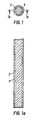
- FIG 1 is a transverse cross sectional view of a metal coated fiber produced in accordance with this invention.
- FIG 1a is a transverse cross sectional view of a metal coated fiber produced in accordance with this invention.
- FIG 2 is a view showing an apparatus for carrying out the process of the present invention.
- a process for the production of continuous tows or yarns of high strength metal-coated fibers each of which has a core and at least one thin, uniform, firmly adherent, electrically conductive layer of at least one electrodepositable metal.
- the process of the present invention comprises
- Other preferred features include carrying out the process with a portion of the solution(s) of said first and/or second bath(s) being recycled into contact with the fibers immediately prior to and subsequent to their immersion in the negative bath(s) so as to cool the fibers, provide increased current carrying capacity to the fibers and replenish the electrolyte on the surface of the fibers.
- continuous yarns and tows for use according to the present invention are available from a number of sources commercially.
- suitable carbon fiber yarns are available from Amoco Performance Products, Hercule Company, Hitco, Great Lakes Carbon Company, AVCO Company and similar sources in the United States, and overseas. All are made, in general, by procedures described in U.S. Pat. No. 3,677,705.
- the fibers can be long and continuous or they can be short, e.g., 1 to 15 cm. in length.
- all such carbon fibers will contain a thin, imperfect boundary layer (not shown) of chemically bonded oxygen and chemically or mechanically bonded other materials, such as organics.
- fibers composed of boron and silicon carbide are also suitable for use in the present invention. The use of carbon fibers is preferred.
- Metal layer 4 will be of any electrodepositable metal, and it will be electrically continuous. Two layers, or even more, of metal can be applied and metal can be the same of different, as will be shown in the working examples. In any case, the innermost layer will be so firmly bonded to core 2 that sharp bending will neck the metal down snapping the fiber core and breaking the metal on the tension side of the bend when its elastic limit is exceeded. This is accomplished without causing the metal to flake off when broken which is a problem in fibers metal coated according to the prior art. As a further distinction from the prior art, the metal layer of the present invention fills interstices and "cracks" in fibers, uniformly and completely.
- coating metals useful in the practice of the present invention are nickel, silver, zinc, copper, lead, arsenic, cadmium, tin, cobalt, gold, indium, iridium, iron, palladium, platinum, tellurim, tungsten or mixtures thereof.
- the metals are in crystalline form.
- the high strength metal coated fibers of this invention can be assembled by conventional means into composites in which matrix 6 is a plastic, e.g., epoxy resin, or a metal, e.g., lead, the matrix being reinforced by virtue of the presence of high strength fibrous cores 2.
- matrix 6 is a plastic, e.g., epoxy resin, or a metal, e.g., lead, the matrix being reinforced by virtue of the presence of high strength fibrous cores 2.
- Formation of the metal coating layer by the electrodeposition process of this invention can be carried out in a number of ways.
- a plurality of core fibers can be immersed in an electrolytic bath and through suitable electrical connections the required external voltage can be applied.
- a voltage is applied for a short period of time.
- a pulse generator for example, will send a surge of voltage through the electrolyte, sufficient to bind the metal ion with the carbon or other fiber comprising the cathode. The short time elapsing in the pulse will prevent heat from building up in the fiber and burning it up or out.
- the fibers are typically so small, e.g., 5 to 10 microns in diameter, and because the innermost fibers are usually surrounded by hundreds or even thousands of other, even though only 0.5 or 2.6 volts are needed to dissociate the electrolytic metal ion, e.g., nickel, gold, silver, copper, depending on the salt used, significantly higher external voltages may be used, on the order of 5 times the dissociation values, to uniformly nucleate the ions through the bundle of fibers into the innermost fibril and then through the boundary layer. External voltages of e.g., 10 to 50, or even more, volts may therefore be supplied. However, voltages on the order of 1-5 volts (sce) may be used. Current densities of 1-100 milliamps/cm2 should also be employed.
- the electrolytic metal ion e.g., nickel, gold, silver, copper, depending on the salt used
- significantly higher external voltages may be used, on the order of 5 times the dissociation values,
- Electrolytic bath solution 8 is maintained in tank 10. Also included are anode baskets 12 and idler rolls 14 near the bottom of tank 10. Two electrical contact roller 16 are located above the tank.
- Tow 24 is pulled by means not shown off feed roll 26, over first contact roller 16 down into the bath under idler rolls 14, up through the bath, over second contact roller 16 and into take up roller 28.
- the immersed tow length may be about 6 feet.
- a simple recycle loop comprising pump 18, conduit 20, and feed head 22. This permits recirculating the electroplating solution at a large flow rate, e.g., 2-3 gallons/min. and pumping it onto contact rolls 16. Discharged just above the rolls, the sections of tow 24 and leaving the plating solution are totally bathed, thus cooling them. At the high current carried by the tow, the I2R heat generated in some cases might destroy them before it reachs or after it leaves the bath surface without such cooling.
- the flow of the electrolyte overcomes anisotropy.
- more than one plating bath can be used in series, and the fibers can be rinsed free of electrolyte solution, treated with other conventional materials and dried, chopped, woven into fabric, all in accordance with conventional procedures.
- the fibers of tow 24 are subjected to an anodic pretreatment process prior to their introduction into the plating bath.
- anodic pretreatment process comprises the application to the tow of a positive D.C. current during which time it is introduced into at least one electrolytic bath to which has been applied a negative D.C. current.
- the anodic pretreatment process and the apparatus associated therewith is identical to the process and apparatus used in the electrolytic plating of the tow, except that the polarity of the applied D.C. current is reversed.
- the voltage applied to the tow in the anodic pretreatment process generally ranges from about 1 to about 10 volts although higher voltage can be applied. Preferably, the voltages employed ranges from about 1 to about 5 volts. Current densities of about 1 to about 100 millamps/cm2 are preferably used.
- electrolytic bath used in the anodic pretreatment process of the present invention may contain a solution different from that contained in the bath electroplating process it is preferred that similar solutions, perhaps differing only in the concentration of their respective components, are used in both baths 10 and 10A. Most preferably, baths 10 and 10A contain identical solutions.
- Electrolytic bath solution 8A is maintained in tank 10A. Also included are cathode/baskets 12A and idler roller 14A near the bottom of tank 10A. Two electrical contact roller 16A are located above the tank. Tow 24 is pulled by means not shown off feed roller 26 over contact roller 16A down into the bath under idler rolls 14A, up through the bath, over second contact roller 16A and into bath 10 by way of contact roller 16.
- a simple recycle loop comprising pump 18A, conduit 20 A, and feed head 22A. This also permits recirculating the plating solution at a large flow rate, e.g. 2-3 gallons/min. and pumping it onto contact rolls 16A.
- a serial array of more than one anodic pretreatment bath can also be used.
- the path of fiber travel in the pretreatment bath may need to be modified relative to the schematic representation shown in Figure 2.
- the vertical fiber travel between rollers 16A and 14A may require reduction.
- at least one roller 14A can optionally be eliminated so long as provisions are made to ensure that fiber 24 achieves complete immersion in the bath during its travel between contact rollers 16A.
- fibers having superior properties are produced if the elapsed time between anodic treatment and electroplating is reduced. In the practice of the present invention as a continuous process, this requires that the distance between the preteatment bath and the electroplating bath be minimized.
- bath 10 and 10A are provided with solutions having the following composition:
- baths 10 and 10A are heated to 140°-160°F. and each has a pH of 3.8-4.2.
- the cathode baskets 12A in bath 10A are filled with nickel pellets and 4 tows of 12,000 strand each of 7 micron carbon fibers are continuously drawn through bath 10A while an external voltage of 30 volts is applied at a current adjusted to give 10 ampere-minute per 1000 strands total.
- electrolytic solution is recycled through conduit 20A and head 22A so as to contact the tow as it passes over rollers 16A.
- a tow speed of 5.0 ft./min is used. After the tow exits the anodic pretreatment process, it proceeds on to the electroplating apparatus.
- the anode baskets in bath 10 are kept filled with electrolytic nickel pellets and 4 tows (fiber bundles) of 12,000 strands each of 7 micron carbon fibers are continuously drawn through the bath while an external voltage of 30 volts is applied at a current adjusted to give 10 ampere-minutes per 1000 strands total.
- electrolytic solution is recycled through conduit 20 and head 22 so as to contact the tows as it passes over rollers 16.
- the tow is next passed continuously through an identical bath, at a tow speed of 5.0 ft./min. with 180 amps. current in each bath.
- the final product is a tow of high strength composite fibers according to this invention comprising of 7 micron fiber core and about 50% by weight of the composite of crystalline electrodeposited nickel adhered firmly to the core.
Landscapes
- Chemical & Material Sciences (AREA)
- Engineering & Computer Science (AREA)
- Chemical Kinetics & Catalysis (AREA)
- Textile Engineering (AREA)
- Electrochemistry (AREA)
- Materials Engineering (AREA)
- Metallurgy (AREA)
- Organic Chemistry (AREA)
- General Chemical & Material Sciences (AREA)
- Inorganic Chemistry (AREA)
- Chemical Or Physical Treatment Of Fibers (AREA)
- Electroplating Methods And Accessories (AREA)
Applications Claiming Priority (2)
| Application Number | Priority Date | Filing Date | Title |
|---|---|---|---|
| US33719989A | 1989-04-12 | 1989-04-12 | |
| US337199 | 1989-12-04 |
Publications (1)
| Publication Number | Publication Date |
|---|---|
| EP0431237A1 true EP0431237A1 (fr) | 1991-06-12 |
Family
ID=23319519
Family Applications (1)
| Application Number | Title | Priority Date | Filing Date |
|---|---|---|---|
| EP90104679A Withdrawn EP0431237A1 (fr) | 1989-04-12 | 1990-03-12 | Depôt d'or direct sur une fibre de carbone |
Country Status (4)
| Country | Link |
|---|---|
| EP (1) | EP0431237A1 (fr) |
| JP (1) | JPH02307984A (fr) |
| KR (1) | KR900016540A (fr) |
| CA (1) | CA2014253A1 (fr) |
Cited By (1)
| Publication number | Priority date | Publication date | Assignee | Title |
|---|---|---|---|---|
| WO2016139529A1 (fr) * | 2015-03-04 | 2016-09-09 | D.B. Textile S.R.L. | Substrats textiles métallisés, son procédé de préparation et appareil associé |
Families Citing this family (3)
| Publication number | Priority date | Publication date | Assignee | Title |
|---|---|---|---|---|
| KR20010002179A (ko) * | 1999-06-11 | 2001-01-05 | 안정오 | 미세금속입자 함유 합성수지재와 섬유제법 |
| KR100572995B1 (ko) * | 2001-12-17 | 2006-04-24 | 한국화학연구원 | 전해도금법에 의한 니켈 도금된 탄소섬유의 제조 방법 |
| CN102719869A (zh) * | 2012-06-11 | 2012-10-10 | 天津大学 | 多束连续长碳纤维同时电镀金属的装置及其方法 |
-
1990
- 1990-03-12 EP EP90104679A patent/EP0431237A1/fr not_active Withdrawn
- 1990-04-10 JP JP2093307A patent/JPH02307984A/ja active Pending
- 1990-04-10 CA CA002014253A patent/CA2014253A1/fr not_active Abandoned
- 1990-04-11 KR KR1019900005011A patent/KR900016540A/ko not_active Withdrawn
Non-Patent Citations (1)
| Title |
|---|
| DERWENT WPI, accession no. 77-15976Y [09], Derwent Publications Ltd, London, GB; & SU-A-496 331 (AMLA) * |
Cited By (1)
| Publication number | Priority date | Publication date | Assignee | Title |
|---|---|---|---|---|
| WO2016139529A1 (fr) * | 2015-03-04 | 2016-09-09 | D.B. Textile S.R.L. | Substrats textiles métallisés, son procédé de préparation et appareil associé |
Also Published As
| Publication number | Publication date |
|---|---|
| CA2014253A1 (fr) | 1990-10-12 |
| KR900016540A (ko) | 1990-11-13 |
| JPH02307984A (ja) | 1990-12-21 |
Similar Documents
| Publication | Publication Date | Title |
|---|---|---|
| US4661403A (en) | Yarns and tows comprising high strength metal coated fibers, process for their production, and articles made therefrom | |
| US4852453A (en) | Chaff comprising metal coated fibers | |
| US4942090A (en) | Chaff comprising metal coated fibers | |
| US4808481A (en) | Injection molding granules comprising copper coated fibers | |
| US4609449A (en) | Apparatus for the production of continuous yarns or tows comprising high strength metal coated fibers | |
| US4909910A (en) | Yarns and tows comprising high strength metal coated fibers, process for their production, and articles made therefrom | |
| US4680093A (en) | Metal bonded composites and process | |
| US5171419A (en) | Metal-coated fiber compositions containing alloy barrier layer | |
| EP0088884B1 (fr) | Filés et cordes contenant des fibres métallisées de grande solidité, méthode pour leur production, et leur utilisation | |
| KR101917105B1 (ko) | 섬유 복합체 및 이의 제조 방법 | |
| US4624751A (en) | Process for fiber plating and apparatus with special tensioning mechanism | |
| US4904351A (en) | Process for continuously plating fiber | |
| EP0431237A1 (fr) | Depôt d'or direct sur une fibre de carbone | |
| AU609425B2 (en) | Copper coated fibers | |
| US4976828A (en) | Chaff comprising metal coated fibers | |
| US3505177A (en) | Electroforming process | |
| US4911797A (en) | Contact roller mounting assembly and tensioning mechanism for electroplating fiber | |
| US3865705A (en) | Process for modifying the surface characteristics of carbon substrates and composite articles produced from the treated substrates | |
| CA1254167A (fr) | Metallisation par electrodeposition sur fibres de graphite nettoyees | |
| CA1263338A (fr) | Filaments metallises, leur production, et articles faits desdits filaments | |
| FI77900C (fi) | Foerfarande och anordning foer elbelaeggning av fibrer. | |
| JP2637493B2 (ja) | 金属繊維およびその製造方法 | |
| CA1323328C (fr) | Rouleau a contact pour fibre d'electroplacage | |
| CA1256053A (fr) | Dispositif et methode d'electrodeposition continue sur fibres conductrices | |
| CA1262886A (fr) | Mecanisme tendeur et cylindres cathodiques pour le plaquage des fibres |
Legal Events
| Date | Code | Title | Description |
|---|---|---|---|
| PUAI | Public reference made under article 153(3) epc to a published international application that has entered the european phase |
Free format text: ORIGINAL CODE: 0009012 |
|
| AK | Designated contracting states |
Kind code of ref document: A1 Designated state(s): AT BE CH DE DK ES FR GB IT LI NL SE |
|
| 17P | Request for examination filed |
Effective date: 19910917 |
|
| 17Q | First examination report despatched |
Effective date: 19920611 |
|
| STAA | Information on the status of an ep patent application or granted ep patent |
Free format text: STATUS: THE APPLICATION IS DEEMED TO BE WITHDRAWN |
|
| 18D | Application deemed to be withdrawn |
Effective date: 19921022 |