EP0431425A2 - Chromogen enamine compounds, their preparation and use as colour formers - Google Patents
Chromogen enamine compounds, their preparation and use as colour formers Download PDFInfo
- Publication number
- EP0431425A2 EP0431425A2 EP90122435A EP90122435A EP0431425A2 EP 0431425 A2 EP0431425 A2 EP 0431425A2 EP 90122435 A EP90122435 A EP 90122435A EP 90122435 A EP90122435 A EP 90122435A EP 0431425 A2 EP0431425 A2 EP 0431425A2
- Authority
- EP
- European Patent Office
- Prior art keywords
- alkyl
- compounds
- substituted
- phenyl
- alkoxy
- Prior art date
- Legal status (The legal status is an assumption and is not a legal conclusion. Google has not performed a legal analysis and makes no representation as to the accuracy of the status listed.)
- Withdrawn
Links
- 0 *C1(*)c(cc(*)cc2*)c2N(*)[C@@]1(*C(c1c2cc(*)c(*)c1)=O)C2=CN1c2cc(*)c(*)cc2*CCC1 Chemical compound *C1(*)c(cc(*)cc2*)c2N(*)[C@@]1(*C(c1c2cc(*)c(*)c1)=O)C2=CN1c2cc(*)c(*)cc2*CCC1 0.000 description 3
Classifications
-
- C—CHEMISTRY; METALLURGY
- C09—DYES; PAINTS; POLISHES; NATURAL RESINS; ADHESIVES; COMPOSITIONS NOT OTHERWISE PROVIDED FOR; APPLICATIONS OF MATERIALS NOT OTHERWISE PROVIDED FOR
- C09B—ORGANIC DYES OR CLOSELY-RELATED COMPOUNDS FOR PRODUCING DYES, e.g. PIGMENTS; MORDANTS; LAKES
- C09B23/00—Methine or polymethine dyes, e.g. cyanine dyes
- C09B23/02—Methine or polymethine dyes, e.g. cyanine dyes the polymethine chain containing an odd number of >CH- or >C[alkyl]- groups
- C09B23/04—Methine or polymethine dyes, e.g. cyanine dyes the polymethine chain containing an odd number of >CH- or >C[alkyl]- groups one >CH- group, e.g. cyanines, isocyanines, pseudocyanines
-
- B—PERFORMING OPERATIONS; TRANSPORTING
- B41—PRINTING; LINING MACHINES; TYPEWRITERS; STAMPS
- B41M—PRINTING, DUPLICATING, MARKING, OR COPYING PROCESSES; COLOUR PRINTING
- B41M5/00—Duplicating or marking methods; Sheet materials for use therein
- B41M5/124—Duplicating or marking methods; Sheet materials for use therein using pressure to make a masked colour visible, e.g. to make a coloured support visible, to create an opaque or transparent pattern, or to form colour by uniting colour-forming components
- B41M5/132—Chemical colour-forming components; Additives or binders therefor
- B41M5/136—Organic colour formers, e.g. leuco dyes
- B41M5/145—Organic colour formers, e.g. leuco dyes with a lactone or lactam ring
-
- B—PERFORMING OPERATIONS; TRANSPORTING
- B41—PRINTING; LINING MACHINES; TYPEWRITERS; STAMPS
- B41M—PRINTING, DUPLICATING, MARKING, OR COPYING PROCESSES; COLOUR PRINTING
- B41M5/00—Duplicating or marking methods; Sheet materials for use therein
- B41M5/26—Thermography ; Marking by high energetic means, e.g. laser otherwise than by burning, and characterised by the material used
- B41M5/30—Thermography ; Marking by high energetic means, e.g. laser otherwise than by burning, and characterised by the material used using chemical colour formers
- B41M5/323—Organic colour formers, e.g. leuco dyes
- B41M5/327—Organic colour formers, e.g. leuco dyes with a lactone or lactam ring
-
- C—CHEMISTRY; METALLURGY
- C07—ORGANIC CHEMISTRY
- C07D—HETEROCYCLIC COMPOUNDS
- C07D471/00—Heterocyclic compounds containing nitrogen atoms as the only ring hetero atoms in the condensed system, at least one ring being a six-membered ring with one nitrogen atom, not provided for by groups C07D451/00 - C07D463/00
- C07D471/02—Heterocyclic compounds containing nitrogen atoms as the only ring hetero atoms in the condensed system, at least one ring being a six-membered ring with one nitrogen atom, not provided for by groups C07D451/00 - C07D463/00 in which the condensed system contains two hetero rings
- C07D471/10—Spiro-condensed systems
-
- C—CHEMISTRY; METALLURGY
- C07—ORGANIC CHEMISTRY
- C07D—HETEROCYCLIC COMPOUNDS
- C07D491/00—Heterocyclic compounds containing in the condensed ring system both one or more rings having oxygen atoms as the only ring hetero atoms and one or more rings having nitrogen atoms as the only ring hetero atoms, not provided for by groups C07D451/00 - C07D459/00, C07D463/00, C07D477/00 or C07D489/00
- C07D491/02—Heterocyclic compounds containing in the condensed ring system both one or more rings having oxygen atoms as the only ring hetero atoms and one or more rings having nitrogen atoms as the only ring hetero atoms, not provided for by groups C07D451/00 - C07D459/00, C07D463/00, C07D477/00 or C07D489/00 in which the condensed system contains two hetero rings
- C07D491/10—Spiro-condensed systems
Definitions
- Nonionic substituents common in dye chemistry are e.g. Halogen, hydroxy, alkoxy, aryloxy, aralkoxy, heteryloxy, aryl, heteryl, alkylmercapto, arylmercapto, aralkylmercapto, alkylsulfonyl, cyano, carbamoyl, alkoxycarbonyl, amino, which can be substituted by 1 or 2 alkyl, aryl or aralkyl groups or their substituents may be ring-closed, alkenyloxy, alkylcarbonyloxy, arylcarbonyloxy and, as substituents for the rings, also alkyl, aralkyl, nitro or arylvinyl.
- Alkyl is preferably C1-C30-alkyl, in particular C1-C12-alkyl and very particularly C1-C4-alkyl, and alkenyl for C2-C5-alkenyl.
- Suitable alkylene bridges R1 / R2 have 5 or 6 carbon atoms, while the alkylene bridges Z preferably contain 2 to 3 carbon atoms in the chain.
- Halogen is to be understood as fluorine, bromine and especially chlorine.
- alkyl radicals and the alkyl radicals in alkoxy, alkylthio, dialkylamino, alkanoylamino, alkylsulfonyl and alkoxycarbonyl groups can be branched and substituted, for example, by fluorine, chlorine, C1-C4alkoxy, cyano or C1-C4alkoxycarbonyl.
- Particular examples are methyl, ethyl, propyl, 2-propyl, 2,2-dimethyl-propyl, 2-butyl, 1-hexyl, 1-octyl, 1-dodecyl, 1-tetradecyl, 1-hexadecyl, 1-octadecyl, 2 -Bornylmethyl, 2-chloroethyl, 2-cyanoethyl, 2-methoxyethyl, 2-ethoxycarbonylethyl, trifluoromethyl.
- cycloalkyl cyclohexyl, under aryl phenyl and naphthyl, under aralkyl benzyl and phenethyl, under heteryl pyridyl, pyrimidyl, pyrazinyl, triazinyl, imidazolyl, oxazolyl, thiazolyl, triazolyl, thiadiazolyl or tetrazolyl, which can be benzanellated, and under het Rings or ring systems which are bonded to nitrogen via methylene or ethylene are understood.
- the rings can be substituted by nonionic substituents, in particular by C1-C4-alkyl, C1-C4-alkoxy, cyano, nitro or halogen.
- substituted phenyl radicals are 2-, 3- or 4-tolyl, 2-, 3- or 4-anisyl, 2-, 3- or 4-chlorophenyl, 2-, 3- or 4-nitro-phenyl, 2-, 3- or 4-cyano-phenyl, 2-, 3- or 4-ethoxycarbonyl-phenyl, 2-, 3- or 4-methoxysulfonyl-phenyl, 2-, 3- or 4-trifluoromethyl-phenyl, 2, 3-dinitro-phenyl, 3,4-dimethyl-phenyl, 2-chloro-4-nitro-phenyl, 3-chloro-4-nitro-phenyl, 5-chloro-2-methyl-4-nitro-phenyl, 4-chloro-3-methyl-phenyl, 3-chloro-4-methoxy-phenyl, 3-chloro-4-trifluoromethyl-phenyl, 3,4-dicyano- phenyl, 2,5-dichloro-4-cyano-phenyl, 2-methyl-1-naph
- Anions An ⁇ are e.g. Cl ⁇ , Br ⁇ , J ⁇ , BF4 ⁇ , ClO4 ⁇ , HSO4 ⁇ , SO42 ⁇ , SiF62 ⁇ , PF6 ⁇ , H2PO4 ⁇ , PO43 ⁇ or the anions of optionally by halogen, C1-C4-alkyl, C1-C4 -Alkoxy, hydroxy, cyano, C1-C4-alkoxycarbonyl, nitro or C1-C4-alkylsulfonyl-substituted C1-C18-carboxylic acids, C2-C18-dicarboxylic acids, C1-C18-alkylsulfonic acids, benzene- or naphthalene-mono- or -dicarbon- or sulfonic acids.
- the compounds VII and VIII are usually reacted with water-releasing reagents without or with solvents which are inert under these conditions at temperatures between 0 ° C. and the boiling point of the respective medium. Then, after removal of the inert solvents, it is possibly carried out on water or an alcohol, for example.
- Water-releasing reagents are, for example, phosphorus oxychloride, phosphorus pentachloride, diphosphorus pentoxide, phosgene, phosphorus trichloride, phosphorus tribromide, sulfuryl chloride, thionyl chloride, oxalyl chloride or mixtures thereof.
- Phosphoryl chloride and phosphorus oxychloride / diphosphorus pentoxide are preferably used.
- Inert solvents suitable for the reaction of VII and VIII or VII and IX are, for example, toluene, chlorobenzene, dichlorobenzene, nitrobenzene, chlorinated aliphatic hydrocarbons, such as 1,2-dichloroethane.
- This reaction is preferably carried out in an aqueous medium at pH values between 4 and 11, in particular between 7 and 9, and at temperatures between 60 ° C. and the boiling point of the reaction medium, generally at ⁇ 100 ° C.
- Cu powder, CuCl and KJ have proven themselves as catalysts, each individually or in a mixture.
- the reaction times are generally between 1 and 48 hours.
- components of the general formula XI are: 1,3,3-trimethyl-2-methylene-indoline, 1-ethyl-3,3-dimethyl-2-methylene-indoline, 1-cyanoethyl-3,3-dimethyl -2-methylene indoline, 1-carbonamidoethyl-3,3-dimethyl-2-methylene indoline, 1- (2-hydroxyethyl) -3,3-dimethyl-2-methylene indoline, 1- (2-chloroethyl) -3,3-dimethyl-2-methylene indoline, 1-octadecyl-3,3-dimethyl-2-methylene indoline, 1-octyl-3,3-dimethyl-2-methylene indoline, 1,3,3 Trimethyl-2-methylene-5-chloro-indoline, 1,3,3-trimethyl-2-methylene-5-methoxycarbonyl-indoline, 1,3,3-trimethyl-2-methylene-5
- Components of the general formula XII can be, for example: o-chloro-benzoic acid, 2,4-dichloro-benzoic acid, 2,4,6-trichloro-benzoic acid, 2-chloro-4-methyl-benzoic acid, 2-chloro-4,6 -dimethyl-benzoic acid, 2-chloro-4-nitro-benzoic acid, 2-chloro-5-nitro-benzoic acid, 2-chloro-4,5-dinitro-benzoic acid, 2-chloro-4,6-dinitro-benzoic acid.
- Suitable enamine end systems include: Indoline, 2-methyl-indoline, 2,3-dimethyl-indoline, 2,3,3-trimethyl-indoline, 2-phenyl-indoline, tetrahydroquinoline, 2,2,4-trimethyl-tetrahydroquinoline, tetrahydrocarbazole, N-alkyl- quinoxaline, N-alkyl-benzimidazoline, benzoxazoline, all of which may optionally be further substituted.
- Suitable bases for the cyclization of the color former are, for example, alkali metal hydroxide, alkaline earth metal hydroxides, alkali metal or alkaline earth metal carbonates or bicarbonates, amines, such as ammonia, methylamine, ethylamine, N-propylamine, isopropylamine, N-butylamine, isobutylamine, sec-butylamine, tert.-butylamine, N-octylamine, isooctylamine, octadecylamine or others, benzylamine, phenylethylamine, phenylbutylamine, aniline, alkoxyaniline, p-alkylaniline, dialkylaminoaniline.
- amines such as ammonia, methylamine, ethylamine, N-propylamine, isopropylamine, N-butylamine, isobutylamine, sec-butylamine
- Another object of the invention is the use of the chromogenic enamine compounds of the formula I or mixtures thereof for printable, thermoreactive or electrochromic recording materials, the Recording material contains an acidic color developer.
- Acidic developers include, in particular, clays, acidic oxides or acidic salts, and monomeric or polymeric phenols or carboxylic acids.
- color formers e.g. 3,3-bis (aminophenyl) phthalides, 3,3-bis (indolyl) phthalides, 3-aminofluoranes, spirodipyrans, chromenoindoles, phenoxazines, phenothiazines, carbazolylmethanes, 4,4-diaryldihydroquinazolones, benzoxazines or other triarylmethane leuco dyes to give green, gray or black colors.
- color formers e.g. 3,3-bis (aminophenyl) phthalides, 3,3-bis (indolyl) phthalides, 3-aminofluoranes, spirodipyrans, chromenoindoles, phenoxazines, phenothiazines, carbazolylmethanes, 4,4-diaryldihydroquinazolones, benzoxazines or other triarylmethane leu
- the enamine compounds of formula I show good color intensity both on phenolic substrates and especially on activated clays. They are particularly suitable as color formers for use in a heat- or pressure-sensitive recording material, which can be both copying and registration material. In general, they are characterized by a high development speed with a reduced sensitivity of the recording materials to unintentional premature development.
- the enamine compounds of the formula I are distinguished by good lightfastness and climate aging stability both in the developed and in the undeveloped state.
- a pressure-sensitive material consists, for example, of at least one pair of leaves which contain at least one color former of the formula I, dissolved or dispersed in a non-volatile organic solvent, and an acidic developer.
- microcapsules In order to prevent early activation of the color formers present in the pressure-sensitive recording material, they are preferably enclosed in microcapsules, which can generally be broken by pressure.
- Suitable capsule wall materials are e.g. Gelatin / gum arabic, polyamides, polyurethanes, polyureas, polysulfonamides, polyesters, polycarbonates, polysulfonates, polyacrylates and phenol, melamine or urea-formaldehyde condensates, as described, for example, in M. Gutcho, Capsule Technology and Microencapsulation, Noyes Data Corporation 1972 , G. Baster, Microencapsulation, Processeses and Applications, publisher JE Vandegaar and German Offenlegungsschriften 2 237 545 and 2 119 933 are described.
- Microcapsules are preferably used in the process according to the invention, the shells of which are made of polyaddition pro Products consist of polyisocyanates and polyamines.
- Isocyanates to be used for the production of such microcapsules are diisocyanates, polyisocyanates, diisocyanates with a biuret structure, polyisocyanates modified by di- or trifunctional alcohols or other modified isocyanates, for example those of the formula:
- Diamines suitable for reaction with the isocyanates mentioned are aliphatic primary or secondary di- or polyamines.
- Thermoreactive recording systems include e.g. heat sensitive recording and copying materials and papers.
- Suitable developers are the same electron acceptors as are used in pressure-sensitive papers, preferably phenolic compounds, which are described, for example, in DE-A 12 51 348, and boric acid and organic, preferably aliphatic Dicarboxylic acids.
- thermoreactive development system is described in DE-A 33 37 296, in which acid-modified polymers, preferably acrylonitrile, act as developers.
- a further application of the compounds of the formula I-VI is the production of a color image by means of photocurable microcapsules, such as those e.g. is described in DE-A 3 247 488.
- the enamine compounds of the formula I or the dyes of the formula X formed therefrom by ring opening are suitable for dyeing polyacrylonitrile, tannic cotton and other acid-modified fibers, fabrics and powders.
- 191 g of o-bromobenzoic acid, 113 g of water and 148 g of 1,3,3-trimethyl-2-methylene-indoline are adjusted to pH 8 with ⁇ 105 ml of 30% sodium hydroxide solution, and 1 g of CuCl and 2 g of Cu powder are added and heated to 100 ° C for 12 h.
- the pH is kept at 8 by continuously adding ⁇ 89 ml of 30% sodium hydroxide solution to the autotitrator. It is then filtered hot, adjusted to pH 6 with sulfuric acid and suction filtered.
- the moist precipitate is boiled up in 1.5 l of methanol, suction filtered and dried. 184.7 g of the compound of the formula: Melting point: 132-133 ° C.
- 117.2 g of the intermediate 1a described in Example 1 are dissolved in 400 ml of chlorobenzene and 192 g of 10% sodium hydroxide solution, 1 g of hexadecyltrimethylammonium bromide is added and the mixture is esterified at 40 ° C. with 72 g of dimethyl sulfate. The mixture is stirred overnight, the organic phase is separated off, washed three times with water and rotated in. 111.1 g of a yellow oil are obtained, which has the formula corresponds.
- Example 1 If this intermediate compound is reacted further in the manner described in Example 1, the color former of Example 1 is also obtained.
- Example 1 If this intermediate compound is reacted further in the manner given in Example 1, the color former of Example 1 is also obtained.
- the color formers of Examples 2 and 3 can also be obtained in an analogous manner from the intermediate compound 5a .
- the compounds of the general formula 10 are prepared in an analogous manner: After the reaction with amines which are not miscible with water, it is first discharged onto dilute hydrochloric acid and the precipitated dye is cyclized to the color former in the manner described in Example 1.
- a solution of 3 g of the enamine compound of Example 1 in 80 g of diisopropylnaphthalene and 17 g of kerosene is microencapsulated in a manner known per se with gelatin and gum arabic by coacervation, mixed with starch solution and spread on a sheet of paper.
- a second sheet of paper is coated on the front with acid-activated bentonite as a color developer. That he The first sheet and the sheet coated with color developer are placed on top of one another with the coatings. Writing by hand or typewriter on the first sheet exerts pressure and an intense yellow copy develops on the sheet coated with the developer, which is excellent in lightfastness.
- the developer substances on the commercially available carbonless carbonless paper are equally well suited e.g. acid-activated bentonite (e.g. Copisil D4A10 from Südchemie Kunststoff), p-tert-butylphenol-formaldehyde condensation products (e.g. UCAR-CKWA 9870 from Union Carbide Corp.) and p-alkyl-zinc salicylates.
- acid-activated bentonite e.g. Copisil D4A10 from Südchemie Kunststoff
- p-tert-butylphenol-formaldehyde condensation products e.g. UCAR-CKWA 9870 from Union Carbide Corp.
- p-alkyl-zinc salicylates e.g. acid-activated bentonite (e.g. Copisil D4A10 from Südchemie Kunststoff)
- p-tert-butylphenol-formaldehyde condensation products e.g. UCAR-CKWA 98
Landscapes
- Chemical & Material Sciences (AREA)
- Organic Chemistry (AREA)
- Chemical Kinetics & Catalysis (AREA)
- General Chemical & Material Sciences (AREA)
- Physics & Mathematics (AREA)
- Optics & Photonics (AREA)
- Heat Sensitive Colour Forming Recording (AREA)
- Indole Compounds (AREA)
- Nitrogen Condensed Heterocyclic Rings (AREA)
- Color Printing (AREA)
Abstract
Verbindungen der Formel <IMAGE> worin R¹/R² : Alkyl, Cycloalkyl, Aralkyl oder Alkylen, R³ : Alkyl, Cycloalkyl oder Aralkyl, Z : Alkylen, X : 0 oder NR<4> und; R<4> : KW-Rest oder Aryl bedeuten, eignen sich hervorragend als Farbbildner in Aufzeichnungsmaterialien auf der Basis saurer Entwickler. Man erhält gelbe oder orange Farbtöne, die ausgezeichnet sublimations-und lichtecht sind.Compounds of the formula <IMAGE> wherein R¹ / R²: alkyl, cycloalkyl, aralkyl or alkylene, R³: alkyl, cycloalkyl or aralkyl, Z: alkylene, X: 0 or NR <4> and; R <4>: KW residue or aryl are ideal as color formers in recording materials based on acidic developers. One obtains yellow or orange shades which are excellent sublimation and lightfast.
Description
Die vorliegende Erfindung betrifft chromogene Enaminverbindungen, Verfahren zu ihrer Herstellung und ihrer Verwendung in druck- und wärmeempfindlichen Aufzeichnungsmaterialien.
Die neuen Verbindungen entsprechen der allgemeinen Formel

- R¹ und R²
- unabhängig voneinander Alkyl, Cycloalkyl, Aralkyl oder zusammen eine Alkylenbrücke,
- R³
- Alkyl, Cycloalkyl oder Aralkyl,
- Z
- eine Alkylenbrücke, die ggf. weiter substi tuiert sein kann oder zusammen mit dem Stickstoff und einem weiteren Heteroatom einen 5- oder 6-Ring bildet, und
- X
- Sauerstoff oder NR⁴,
- R⁴
- Wasserstoff, Alkyl, Aryl, Aralkyl, Alkylcarbonyl, Aralkylcarbonyl, Alkylsulfonyl, Aralkylsulfonyl oder Arylsulfonyl bedeuten und
The new compounds correspond to the general formula
- R1 and R2
- independently of one another alkyl, cycloalkyl, aralkyl or together an alkylene bridge,
- R³
- Alkyl, cycloalkyl or aralkyl,
- Z
- an alkylene bridge, which may further substi can be tuiert or forms a 5- or 6-ring together with the nitrogen and another heteroatom, and
- X
- Oxygen or NR⁴,
- R⁴
- Are hydrogen, alkyl, aryl, aralkyl, alkylcarbonyl, aralkylcarbonyl, alkylsulfonyl, aralkylsulfonyl or arylsulfonyl and
In der Farbstoffchemie übliche nichtionische Substituenten sind z.B. Halogen, Hydroxy, Alkoxy, Aryloxy, Aralkoxy, Heteryloxy, Aryl, Heteryl, Alkylmercapto, Arylmercapto, Aralkylmercapto, Alkylsulfonyl, Cyan, Carbamoyl, Alkoxycarbonyl, Amino, das durch 1 oder 2 Alkyl-, Aryl- oder Aralkylgruppen substituiert sein kann oder dessen Substituenten ringgeschlossen sein können, Alkenyloxy, Alkylcarbonyloxy, Arylcarbonyloxy und als Substituenten der Ringe außerdem Alkyl, Aralkyl, Nitro oder Arylvinyl.Nonionic substituents common in dye chemistry are e.g. Halogen, hydroxy, alkoxy, aryloxy, aralkoxy, heteryloxy, aryl, heteryl, alkylmercapto, arylmercapto, aralkylmercapto, alkylsulfonyl, cyano, carbamoyl, alkoxycarbonyl, amino, which can be substituted by 1 or 2 alkyl, aryl or aralkyl groups or their substituents may be ring-closed, alkenyloxy, alkylcarbonyloxy, arylcarbonyloxy and, as substituents for the rings, also alkyl, aralkyl, nitro or arylvinyl.
Bevorzugt stehen Alkyl für C₁-C₃₀-Alkyl, insbesondere für C₁-C₁₂-Alkyl und ganz besonders für C₁-C₄-Alkyl, und Alkenyl für C₂-C₅-Alkenyl.Alkyl is preferably C₁-C₃₀-alkyl, in particular C₁-C₁₂-alkyl and very particularly C₁-C₄-alkyl, and alkenyl for C₂-C₅-alkenyl.
Geeignete Alkylenbrücken R¹/R² weisen 5- oder 6 C-Atome auf, während die Alkylenbrücken Z vorzugsweise 2- bis 3-C-Atome in der Kette enthalten.Suitable alkylene bridges R¹ / R² have 5 or 6 carbon atoms, while the alkylene bridges Z preferably contain 2 to 3 carbon atoms in the chain.
Unter Halogen ist Fluor, Brom und insbesondere Chlor zu verstehen.Halogen is to be understood as fluorine, bromine and especially chlorine.
Die Alkylreste und die Alkylreste in Alkoxy-, Alkylthio-, Dialkylamino-, Alkanoylamino-, Alkylsulfonyl- und Alkoxycarbonylgruppen können verzweigt und beispielsweise durch Fluor, Chlor, C₁-C₄-Alkoxy, Cyano oder C₁-C₄-Alkoxycarbonyl substituiert sein. Besondere Beispiele sind Methyl, Ethyl, Propyl, 2-Propyl, 2,2-Dimethyl-propyl, 2-Butyl, 1-Hexyl, 1-Octyl, 1-Dodecyl, 1-Tetradecyl, 1-Hexadecyl, 1-Octadecyl, 2-Bornylmethyl, 2-Chlorethyl, 2-Cyanoethyl, 2-Methoxyethyl, 2-Ethoxycarbonylethyl, Trifluormethyl.The alkyl radicals and the alkyl radicals in alkoxy, alkylthio, dialkylamino, alkanoylamino, alkylsulfonyl and alkoxycarbonyl groups can be branched and substituted, for example, by fluorine, chlorine, C₁-C₄alkoxy, cyano or C₁-C₄alkoxycarbonyl. Particular examples are methyl, ethyl, propyl, 2-propyl, 2,2-dimethyl-propyl, 2-butyl, 1-hexyl, 1-octyl, 1-dodecyl, 1-tetradecyl, 1-hexadecyl, 1-octadecyl, 2 -Bornylmethyl, 2-chloroethyl, 2-cyanoethyl, 2-methoxyethyl, 2-ethoxycarbonylethyl, trifluoromethyl.
Insbesondere werden unter Cycloalkyl Cyclohexyl, unter Aryl Phenyl und Naphthyl, unter Aralkyl Benzyl und Phenethyl, unter Heteryl Pyridyl, Pyrimidyl, Pyrazinyl, Triazinyl, Imidazolyl, Oxazolyl, Thiazolyl, Triazolyl, Thiadiazolyl oder Tetrazolyl, die benzanelliert sein können, und unter Hetaralkyl die genannten Ringe oder Ringsysteme, die über Methylen oder Ethylen an Stickstoff gebunden sind, verstanden. Die Ringe können durch nichtionische Substituenten, insbesondere durch C₁-C₄-Alkyl, C₁-C₄-Alkoxy, Cyan, Nitro oder Halogen substituiert sein.In particular, under cycloalkyl, cyclohexyl, under aryl phenyl and naphthyl, under aralkyl benzyl and phenethyl, under heteryl pyridyl, pyrimidyl, pyrazinyl, triazinyl, imidazolyl, oxazolyl, thiazolyl, triazolyl, thiadiazolyl or tetrazolyl, which can be benzanellated, and under het Rings or ring systems which are bonded to nitrogen via methylene or ethylene are understood. The rings can be substituted by nonionic substituents, in particular by C₁-C₄-alkyl, C₁-C₄-alkoxy, cyano, nitro or halogen.
Besondere Beispiele für substituierte Phenylreste sind 2-, 3- oder 4-Tolyl, 2-, 3- oder 4-Anisyl, 2-, 3- oder 4-Chlor-phenyl, 2-, 3- oder 4-Nitro-phenyl, 2-, 3- oder 4-Cyano-phenyl, 2-, 3- oder 4-Ethoxycarbonyl-phenyl, 2-, 3- oder 4-Methoxysulfonyl-phenyl, 2-, 3- oder 4-Trifluormethyl-phenyl, 2,3-Dinitro-phenyl, 3,4-Dimethyl-phenyl, 2-Chlor-4-nitro-phenyl, 3-Chlor-4-nitro-phenyl, 5-Chlor-2-methyl-4-nitro-phenyl, 4-Chlor-3-methyl-phenyl, 3-Chlor-4-methoxy-phenyl, 3-Chlor-4-trifluormethyl-phenyl, 3,4-Dicyano-phenyl, 2,5-Dichlor-4-cyano-phenyl, 2-Methyl-1-naphthyl.Particular examples of substituted phenyl radicals are 2-, 3- or 4-tolyl, 2-, 3- or 4-anisyl, 2-, 3- or 4-chlorophenyl, 2-, 3- or 4-nitro-phenyl, 2-, 3- or 4-cyano-phenyl, 2-, 3- or 4-ethoxycarbonyl-phenyl, 2-, 3- or 4-methoxysulfonyl-phenyl, 2-, 3- or 4-trifluoromethyl-phenyl, 2, 3-dinitro-phenyl, 3,4-dimethyl-phenyl, 2-chloro-4-nitro-phenyl, 3-chloro-4-nitro-phenyl, 5-chloro-2-methyl-4-nitro-phenyl, 4-chloro-3-methyl-phenyl, 3-chloro-4-methoxy-phenyl, 3-chloro-4-trifluoromethyl-phenyl, 3,4-dicyano- phenyl, 2,5-dichloro-4-cyano-phenyl, 2-methyl-1-naphthyl.
Von besonderem Interesse sind Verbindungen der allgemeinen Formel

- R⁵,R⁶,R⁷,R⁸,R¹²,R¹³
- Wasserstoff, C₁-C₁₈-Alkyl, das ggf. durch Hydroxy, C₁-C₈-Alkoxy, Cyano, Carbonamido, Chlor oder Brom substituiert sein kann, Phenyl, das ggf. durch Halogen, C₁-C₄-Alkyl, C₁-C₄-Alkoxy substituiert sein kann, Phenyl-C₁-C₄-alkyl, Halogen, C₁-C₁₈-Alkoxy, Phenoxy, Carboxy, C₁-C₁₈-Alkoxycarbonyl, C₁-C₁₈-Alkylsulfonyl, Cyano, Hydroxyl, C₁-C₁₈-Alkylcarbonyl, C₁-C₁₈-Alkylcarbonyloxy, C₁-C₁₈-Alkylamino, C₁-C₁₈-Dialkylamino, C₁-C₁₈-N-Alkyl-N-phenylamino, Phenylamino, C₁-C₁₈-Alkylcarbonylamino, Cyano, Nitro oder
- R⁵ u. R⁶ sowie R⁷ u. R⁸
- einen weiteren anellierten Benzolring,
- R⁹ und R¹⁰
- C₁-C₁₈-Alkyl, C₅- oder C₆-Cycloalkyl, Benzyl oder zusammen C₅- oder C₆-Alkylen, die ggf. weiter substituiert sein können,
- R¹¹
- C₁-C₁₈-Alkyl, Benzyl, Phenethyl, die ggf. weiter substituiert sein können,
- Z¹
- eine C₂- oder C₃-Alkylenbrücke, die ggf. weiter substituiert sein kann, oder zusammen mit dem Stickstoff und einem weiteren Heteroatom einen 5- oder 6-Ring bildet,
- X¹
- Sauerstoff oder NR¹⁴ bedeuten, wobei
- R¹⁴
- für Wasserstoff, C₁-C₁₈-Alkyl, Phenyl, C₁-C₄-Aralkyl, C₁-C₁₈-Alkylcarbonyl, C₁-C₄-Aralkylcarbonyl, C₁-C₁₈-Alkylsulfonyl, C₁-C₄-Aralkylsulfonyl, die ggf. weiter substituiert sein können, steht.
- R⁵, R⁶, R⁷, R⁸, R¹², R¹³
- Hydrogen, C₁-C₁₈-alkyl, which may optionally be substituted by hydroxy, C₁-C₈-alkoxy, cyano, carbonamido, chlorine or bromine, phenyl, which may be substituted by halogen, C₁-C₄-alkyl, C₁-C₄-alkoxy may be substituted, phenyl-C₁-C₄-alkyl, halogen, C₁-C₁₈-alkoxy, phenoxy, carboxy, C₁-C₁₈-alkoxycarbonyl, C₁-C₁₈-alkylsulfonyl, cyano, hydroxyl, C₁-C₁₈-alkylcarbonyl, C₁-C₁₈- Alkylcarbonyloxy, C₁-C₁₈ alkylamino, C₁-C₁₈ dialkylamino, C₁-C₁₈-N-alkyl-N-phenylamino, phenylamino, C₁-C₁₈ alkylcarbonylamino, cyano, nitro or
- R⁵ u. R⁶ and R⁷ u. R⁸
- another fused benzene ring,
- R⁹ and R¹⁰
- C₁-C₁₈-alkyl, C₅- or C₆-cycloalkyl, benzyl or together C₅- or C₆-alkylene, which can optionally be further substituted,
- R¹¹
- C₁-C₁₈ alkyl, benzyl, phenethyl, which may optionally be further substituted,
- Z¹
- a C₂ or C₃ alkylene bridge, which may optionally be further substituted, or together with the nitrogen and another heteroatom forms a 5- or 6-ring,
- X¹
- Are oxygen or NR¹⁴, wherein
- R¹⁴
- represents hydrogen, C₁-C₁₈-alkyl, phenyl, C₁-C₄-aralkyl, C₁-C₁₈-alkylcarbonyl, C₁-C₄-aralkylcarbonyl, C₁-C₁₈-alkylsulfonyl, C₁-C₄-aralkylsulfonyl, which may optionally be further substituted .
Selbstverständlich wird die Auswahl der zahlreichen Substituenten so vorgenommen, daß möglichst preiswerte und anwendungstechnisch optimal wirksame Produkte entstehen. So ist es beispielsweise nicht empfehlenswert, daß in einem Farbbildnermolekül mehr als 2 langkettige (d.h. mehr als 4 C-Atome aufweisende) Alkylreste enthalten sind. Es genügt vielmehr, die Kettenlänge so zu wählen, daß ein im Anwendungsmedium gut lösliches Produkt entsteht.Of course, the selection of the numerous substituents is carried out in such a way that products which are as inexpensive as possible and which are optimal in terms of application technology are produced. For example, it is not recommended that more than 2 long-chain (ie, more than 4 carbon atoms) alkyl radicals are contained in a color image molecule. Rather, it is sufficient to choose the chain length so that a product which is readily soluble in the application medium is formed.
Von besonderem Interesse sind auch Verbindungen der allgemeinen Formel

- R¹⁵,R¹⁶,R¹⁷,R¹⁸
- Wasserstoff, C₁-C₈-Alkyl, Phenyl, Chlor, Brom, C₁-C₄-Alkoxycarbonyl, C₁-C₄-Alkoxy, Cyano oder Nitro,
- R¹⁹ und R²⁰
- C₁-C₄-Alkyl, C₅- oder C₆-Cycloalkyl, Benzyl oder zusammen eine C₅- oder C₆-Alkylenbrücke,
- R²¹
- C₁-C₈-Alkyl, Benzyl, Phenethyl, Cyanoethyl, Amidoethyl, C₁-C₄-Alkoxyethyl, C₁-C₄-Halogenalkyl oder C₁-C₄-Hydroxyalkyl,
- Z²
- eine C₂- oder C₃-Alkylenbrücke, die ggf. durch Methylgruppen substituiert sein kann, oder
- Z²
- zusammen mit dem Stickstoff und einem weiteren NH- oder 0-Atom einen 5- oder 6-Ring bildet, der ggf. durch C₁-C₄-Alkylgruppen, Halogen oder C₁-C₄-Alkoxygruppen substituiert sein kann,
- R²² und R²³
- Wasserstoff, C₁-C₄-Alkyl, Chlor, Brom oder C₁-C₄-Alkoxy,
- X²
- Sauerstoff oder NR²⁴ bedeuten, wobei
- R²⁴
- Wasserstoff, C₁-C₁₈-Alkyl, Phenyl, C₁-C₄-Alkoxyphenyl, 4-Chlorphenyl, 2-, 3- oder 4-Tolyl, Benzyl, Phenylethyl, C₁-C₁₈-Alkylcarbonyl, Phenyl-C₁-C₄-alkylcarbonyl oder C₁- C₁₈-Alkylsulfonyl sein kann.
- R¹⁵, R¹⁶, R¹⁷, R¹⁸
- Hydrogen, C₁-C₈-alkyl, phenyl, chlorine, bromine, C₁-C₄-alkoxycarbonyl, C₁-C₄-alkoxy, cyano or nitro,
- R¹⁹ and R²⁰
- C₁-C₄ alkyl, C₅ or C₆ cycloalkyl, benzyl or together a C₅ or C₆ alkylene bridge,
- R²¹
- C₁-C₈-alkyl, benzyl, phenethyl, cyanoethyl, amidoethyl, C₁-C₄-alkoxyethyl, C₁-C₄-haloalkyl or C₁-C₄-hydroxyalkyl,
- Z²
- a C₂- or C₃-alkylene bridge, which may optionally be substituted by methyl groups, or
- Z²
- together with the nitrogen and another NH or 0 atom, a 5 or 6 ring forms, which may optionally be substituted by C₁-C₄-alkyl groups, halogen or C₁-C₄-alkoxy groups,
- R²² and R²³
- Hydrogen, C₁-C₄-alkyl, chlorine, bromine or C₁-C₄-alkoxy,
- X²
- Are oxygen or NR²⁴, wherein
- R²⁴
- Hydrogen, C₁-C₁₈-alkyl, phenyl, C₁-C Alk-alkoxyphenyl, 4-chlorophenyl, 2-, 3- or 4-tolyl, benzyl, phenylethyl, C₁-C₁₈-alkylcarbonyl, phenyl-C₁-C₄-alkylcarbonyl or C₁- C₁₈ alkylsulfonyl can be.
Unter diesen sind vor allem Verbindungen der allgemeinen Formel

- R¹⁵ bis R²³, X² und Z²
- die oben angegebene Bedeutung haben

- R¹⁵ bis R²³, X² und Z²
- die oben angegebene Bedeutung haben
- R¹⁵ to R²³, X² and Z²
- have the meaning given above
- R¹⁵ to R²³, X² and Z²
- have the meaning given above
Von ganz besonderem Interesse sind Verbindungen der allgemeinen Formel

- R²⁵und R²⁶
- Wasserstoff, C₁-C₄-Alkyl, C₁-C₄-Alkoxy, Chlor, Cyano, Nitro oder C₁-C₄-Alkoxycarbonyl,
- X³
- Sauerstoff oder NR²⁷,
- R²⁷
- Wasserstoff, C₁-C₈-Alkyl, das geradkettig oder verzweigt sein kann, Benzyl oder Phenethyl bedeuten und
- Z³
- für eine -C₂- oder -C₃-Alkylenbrücke steht, die jeweils durch Methylgruppen substituiert sein kann.
- R²⁵ and R²⁶
- Hydrogen, C₁-C₄-alkyl, C₁-C₄-alkoxy, chlorine, cyano, nitro or C₁-C₄-alkoxycarbonyl,
- X³
- Oxygen or NR²⁷,
- R²⁷
- Hydrogen, C₁-C₈-alkyl, which can be straight-chain or branched, mean benzyl or phenethyl and
- Z³
- represents a -C₂- or -C₃-alkylene bridge, which can each be substituted by methyl groups.
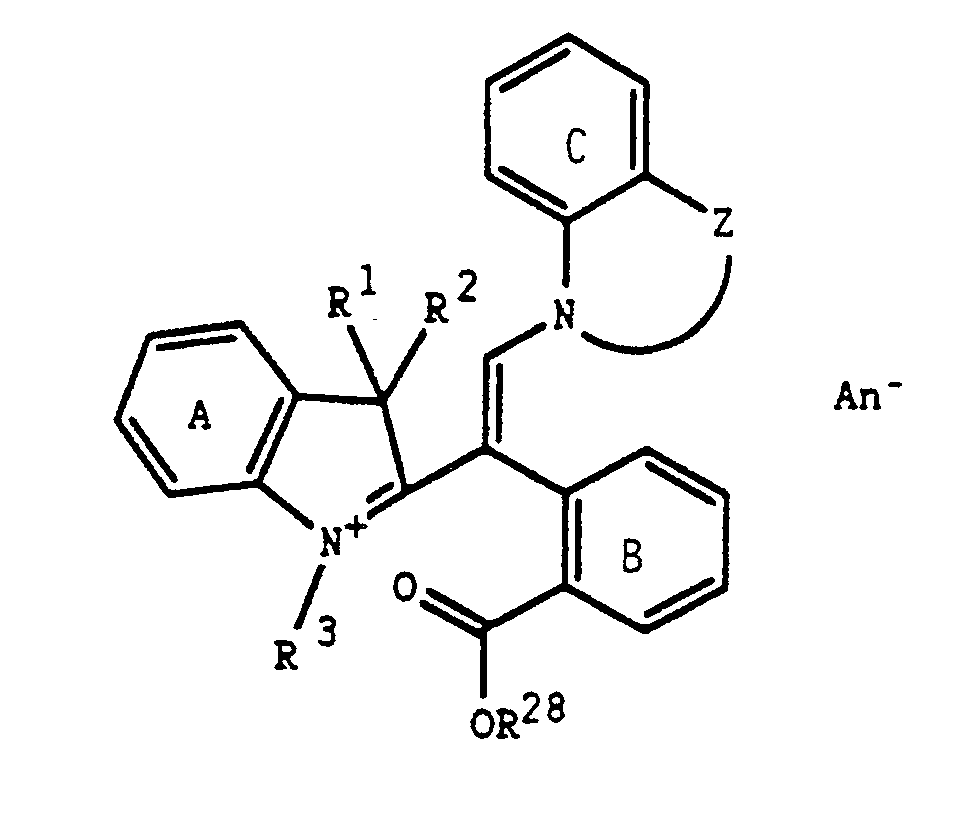
Ein weiterer Gegenstand der Erfindung ist ein Verfahren zur Herstellung von Verbindungen der Formel I, welches dadurch gekennzeichnet ist, daß man Verbindungen der Formel

- A, B, R¹ bis
- R³ die oben angegebene Bedeutung haben und
- R²⁸
- für C₁-C₄-Alkyl, das vorzugsweise durch elektronenanziehende Gruppen, wie z.B. CN oder COOC₁-C₄-Alkyl substituiert ist, oder ggf. durch C₁-C₄-Alkyl, Chlor, Nitro, Cyano oder C₁-C₄-Alkoxy substituiertes Phenyl steht,

- C und Z
- die oben angegebene Bedeutung haben,

- C und Z
- die oben angegebene Bedeutung haben,

- R¹-R³, Z, A, B und C
- die oben angegebene Bedeutung haben und
- An⁻
- für ein Anion steht,
- A, B, R1 to
- R³ have the meaning given above and
- R²⁸
- represents C₁-C₄-alkyl, which is preferably substituted by electron-withdrawing groups, such as CN or COOC₁-C₄-alkyl, or optionally substituted by C₁-C₄-alkyl, chlorine, nitro, cyano or C₁-C₄-alkoxy,
- C and Z
- have the meaning given above,
- C and Z
- have the meaning given above,
- R¹-R³, Z, A, B and C
- have the meaning given above and
- An⁻
- represents an anion,
Anionen An⁻ sind z.B. Cl⁻, Br⁻, J⁻, BF₄⁻, ClO₄⁻, HSO₄⁻, SO₄²⁻, SiF₆²⁻, PF₆⁻, H₂PO₄⁻, PO₄³⁻ oder die Anionen von ggf. durch Halogen, C₁-C₄-Alkyl, C₁-C₄-Alkoxy, Hydroxy, Cyano, C₁-C₄-Alkoxycarbonyl, Nitro oder C₁-C₄-Alkylsulfonyl substituierten C₁-C₁₈-Carbonsäuren, C₂-C₁₈-Dicarbonsäuren, C₁-C₁₈-Alkylsulfonsäuren, Benzol- oder Naphthalin-mono-oder -dicarbon- oder -sulfonsäuren.Anions An⁻ are e.g. Cl⁻, Br⁻, J⁻, BF₄⁻, ClO₄⁻, HSO₄⁻, SO₄²⁻, SiF₆²⁻, PF₆⁻, H₂PO₄⁻, PO₄³⁻ or the anions of optionally by halogen, C₁-C₄-alkyl, C₁-C₄ -Alkoxy, hydroxy, cyano, C₁-C₄-alkoxycarbonyl, nitro or C₁-C₄-alkylsulfonyl-substituted C₁-C₁₈-carboxylic acids, C₂-C₁₈-dicarboxylic acids, C₁-C₁₈-alkylsulfonic acids, benzene- or naphthalene-mono- or -dicarbon- or sulfonic acids.
Die Umsetzung der Verbindungen VII und VIII erfolgt üblicherweise mit wasserabspaltenden Reagenzien ohne oder auch mit unter diesen Bedingungen inerten Lösungsmitteln bei Temperaturen zwischen 0°C und dem Siedepunkt des jeweiligen Mediums. Anschließend wird evtl. nach Entfernen der inerten Lösungsmittel auf beispielsweise Wasser oder einen Alkohol ausgetragen.The compounds VII and VIII are usually reacted with water-releasing reagents without or with solvents which are inert under these conditions at temperatures between 0 ° C. and the boiling point of the respective medium. Then, after removal of the inert solvents, it is possibly carried out on water or an alcohol, for example.
Wasserabspaltende Reagenzien sind beispielsweise Phosphoroxychlorid, Phosphorpentachlorid, Diphosphorpentoxid, Phosgen, Phosphortrichlorid, Phosphortribromid, Sulfurylchlorid, Thionylchlorid, Oxalylchlorid oder Mischungen hiervon. Vorzugsweise werden Phosphorylchlorid und Phosphoroxychlorid/Diphosphorpentoxid eingesetzt.Water-releasing reagents are, for example, phosphorus oxychloride, phosphorus pentachloride, diphosphorus pentoxide, phosgene, phosphorus trichloride, phosphorus tribromide, sulfuryl chloride, thionyl chloride, oxalyl chloride or mixtures thereof. Phosphoryl chloride and phosphorus oxychloride / diphosphorus pentoxide are preferably used.
Für die Umsetzung von VII und VIII oder VII und IX geeignete inerte Lösungsmittel sind beispielsweise Toluol, Chlorbenzol, Dichlorbenzol, Nitrobenzol, chlorierte aliphatische Kohlenwasserstoffe, wie 1,2-Dichlor-ethan.Inert solvents suitable for the reaction of VII and VIII or VII and IX are, for example, toluene, chlorobenzene, dichlorobenzene, nitrobenzene, chlorinated aliphatic hydrocarbons, such as 1,2-dichloroethane.
Die Verbindungen der allgemeinen Formel VII erhält man, indem man 2-Methylen-indolinverbindungen der allgemeinen Formel


- Hal
- bevorzugt für Chlor, Brom oder Jod steht,
- Hal
- preferably represents chlorine, bromine or iodine,
Diese Umsetzung führt man bevorzugt in wäßrigem Medium bei pH-Werten zwischen 4 und 11, insbesondere zwischen 7 und 9, und bei Temperaturen zwischen 60°C und dem Siedepunkt des Umsetzungsmediums, im allgemeinen bei ∿100°C, durch.This reaction is preferably carried out in an aqueous medium at pH values between 4 and 11, in particular between 7 and 9, and at temperatures between 60 ° C. and the boiling point of the reaction medium, generally at ∿100 ° C.
Als Katalysator bewährt sich Cu-Pulver, CuCl und KJ, jeder für sich alleine oder im Gemisch. Die Umsetzungszeiten liegen im allgemeinen zwischen 1 und 48 h.Cu powder, CuCl and KJ have proven themselves as catalysts, each individually or in a mixture. The reaction times are generally between 1 and 48 hours.
Als Komponenten der allgemeinen Formel XI kommen z.B. in Frage: 1,3,3-Trimethyl-2-methylen-indolin, 1-Ethyl-3,3-dimethyl-2-methylen-indolin, 1-Cyanoethyl-3,3-dimethyl-2-methylen-indolin, 1-Carbonamidoethyl-3,3-dimethyl-2-methylen-indolin, 1-(2-Hydroxyethyl)-3,3-dimethyl-2-methylen-indolin, 1-(2-Chlorethyl)-3,3-dimethyl-2-methylen-indolin, 1-Octadecyl-3,3-dimethyl-2-methylen-indolin, 1-Octyl-3,3-dimethyl-2-methylen-indolin, 1,3,3-Trimethyl-2-methylen-5-chlor-indolin, 1,3,3-Trimethyl-2-methylen-5-methoxycarbonyl-indolin, 1,3,3-Trimethyl-2-methylen-5-butoxycarbonyl-indolin, 1,3,3-Trimethyl-2-methylen-5-octadecyloxycarbonyl-indolin, 1,3-Dimethyl-3-ethyl-2-methylen-indolin, 1,3-Dimethyl-3-octadecyl-2-methylen-indolin, 1,3-Dimethyl-3-isopropyl-2-methylen-indolin, 1,3,3,4-Tetramethyl-2-methylen-indolin, 1,3,3,5-Tetramethyl-2-methylen-indolin, 1,3,3,6-Tetramethyl-2-methylen-indolin, 1,3,3,7-Tetramethyl-2-methylen-indolin oder Isomerengemische dieser Verbindungen, 1,3,3-Trimethyl-5-octyl-2-methylen-indolin, 1,3,3-Trimethyl-5-dodecyl-2-methylen-indolin, 1,3,3-Trimethyl-5-octadecyl-2-methylen-indolin, 1,3,3-Trimethyl-4,5-benzo-2-methylen-indolin, 1,3,3-Trimethyl-5,6-benzo-2-methylen-indolin, 1,3,3-Trimethyl-6,7-benzo-2-methylen-indolin, 1,3,3-Trimethyl-2-methylen-5-methoxy-indolin, 1,3,3-Trimethyl-2-methylen-5-butoxy-indolin, 1,3,3-Trimethyl-2-methylen-5-octyloxy-indolin, 1,3,3-Trimethyl-2-methylen-5-phenyl-indolin, 1,3,3-Trimethyl-2-methylen-5-phenoxy-indolin, 1,3,3-Trimethyl-2-methylen-5-methylsulfonyl-indolin, 1,3,3-Trimethyl-2-methylen-5-cyano-indolin, 1,3,3-Trimethyl-2-methylen-5-methylcarbonyl-indolin, 1,3,3-Trimethyl-2-methylen-5-octylcarbonyl-indolin, 1,3,3-Trimethyl-2-methylen-5-dimethylamino-indolin, 1,3,3-Trime thyl-2-methylen-5-anilino-indolin, 1,3,3-Trimethyl-2-methylen-5-methylphenylamino-indolin, 1,3,3-Trimethyl-2-methylen-5-acetamino-indolin.Examples of components of the general formula XI are: 1,3,3-trimethyl-2-methylene-indoline, 1-ethyl-3,3-dimethyl-2-methylene-indoline, 1-cyanoethyl-3,3-dimethyl -2-methylene indoline, 1-carbonamidoethyl-3,3-dimethyl-2-methylene indoline, 1- (2-hydroxyethyl) -3,3-dimethyl-2-methylene indoline, 1- (2-chloroethyl) -3,3-dimethyl-2-methylene indoline, 1-octadecyl-3,3-dimethyl-2-methylene indoline, 1-octyl-3,3-dimethyl-2-methylene indoline, 1,3,3 Trimethyl-2-methylene-5-chloro-indoline, 1,3,3-trimethyl-2-methylene-5-methoxycarbonyl-indoline, 1,3,3-trimethyl-2-methylene-5-butoxycarbonyl-indoline, 1 , 3,3-trimethyl-2-methylene-5-octadecyloxycarbonyl-indoline, 1,3-dimethyl-3-ethyl-2-methylene-indoline, 1,3-dimethyl-3-octadecyl-2-methylene-indoline, 1 , 3-Dimethyl-3-isopropyl-2-methylene-indoline, 1,3,3,4-tetramethyl-2-methylene-indoline, 1,3,3,5-tetramethyl-2-methylene-indoline, 1,3 , 3,6-tetramethyl-2-methylene-indoline, 1,3,3,7-tetramethyl-2-methylene-indoline or mixtures of isomers of these compounds, 1,3,3-trimethyl-5-octyl-2-methyl en-indoline, 1,3,3-trimethyl-5-dodecyl-2-methylene-indoline, 1,3,3-trimethyl-5-octadecyl-2-methylene-indoline, 1,3,3-trimethyl-4, 5-benzo-2-methylene-indoline, 1,3,3-trimethyl-5,6-benzo-2-methylene-indoline, 1,3,3-trimethyl-6,7-benzo-2-methylene-indoline, 1,3,3-trimethyl-2-methylene-5-methoxy-indoline, 1,3,3-trimethyl-2-methylene-5-butoxy-indoline, 1,3,3-trimethyl-2-methylene-5- octyloxy-indoline, 1,3,3-trimethyl-2-methylene-5-phenyl-indoline, 1,3,3-trimethyl-2-methylene-5-phenoxy-indoline, 1,3,3-trimethyl-2- methylene-5-methylsulfonyl-indoline, 1,3,3-trimethyl-2-methylene-5-cyano-indoline, 1,3,3-trimethyl-2-methylene-5-methylcarbonyl-indoline, 1,3,3- Trimethyl-2-methylene-5-octylcarbonyl-indoline, 1,3,3-trimethyl-2-methylene-5-dimethylamino-indoline, 1,3,3-trime thyl-2-methylene-5-anilino-indoline, 1,3,3-trimethyl-2-methylene-5-methylphenylamino-indoline, 1,3,3-trimethyl-2-methylene-5-acetamino-indoline.
Komponenten der allgemeinen Formel XII können beispielsweise sein: o-Chlor-benzoesäure, 2,4-Dichlor-benzoesäure, 2,4,6-Trichlor-benzoesäure, 2-Chlor-4-methyl-benzoesäure, 2-Chlor-4,6-dimethyl-benzoesäure, 2-Chlor-4-nitro-benzoesäure, 2-Chlor-5-nitro-benzoesäure, 2-Chlor-4,5-dinitro-benzoesäure, 2-Chlor-4,6-dinitro-benzoesäure.Components of the general formula XII can be, for example: o-chloro-benzoic acid, 2,4-dichloro-benzoic acid, 2,4,6-trichloro-benzoic acid, 2-chloro-4-methyl-benzoic acid, 2-chloro-4,6 -dimethyl-benzoic acid, 2-chloro-4-nitro-benzoic acid, 2-chloro-5-nitro-benzoic acid, 2-chloro-4,5-dinitro-benzoic acid, 2-chloro-4,6-dinitro-benzoic acid.
Geeignete Enaminendsysteme sind z.B.:
Indolin, 2-Methyl-indolin, 2,3-Dimethyl-indolin, 2,3,3-Trimethyl-indolin, 2-Phenyl-indolin, Tetrahydrochinolin, 2,2,4-Trimethyl-tetrahydrochinolin, Tetrahydrocarbazol, N-Alkyl-chinoxalin, N-Alkyl-benzimidazolin, Benzoxazolin, die ggf. alle weiter substituiert sein können.Suitable enamine end systems include:
Indoline, 2-methyl-indoline, 2,3-dimethyl-indoline, 2,3,3-trimethyl-indoline, 2-phenyl-indoline, tetrahydroquinoline, 2,2,4-trimethyl-tetrahydroquinoline, tetrahydrocarbazole, N-alkyl- quinoxaline, N-alkyl-benzimidazoline, benzoxazoline, all of which may optionally be further substituted.
Geeignete Basen zur Cyclisierung des Farbbildners sind beispielsweise Alkalihydroxid, Erdalkalihydroxide, Alkali-oder Erdalkalicarbonate oder -bicarbonate, Amine, wie Ammoniak, Methylamin, Ethylamin, N-Propylamin, Isopropylamin, N-Butylamin, Isobutylamin, sek-Butylamin, tert.-Butylamin, N-Octylamin, Isooctylamin, Octadecylamin oder andere, Benzylamin, Phenylethylamin, Phenyl-butylamin, Anilin, Alkoxyanilin, p-Alkylanilin, Dialkylaminoanilin.Suitable bases for the cyclization of the color former are, for example, alkali metal hydroxide, alkaline earth metal hydroxides, alkali metal or alkaline earth metal carbonates or bicarbonates, amines, such as ammonia, methylamine, ethylamine, N-propylamine, isopropylamine, N-butylamine, isobutylamine, sec-butylamine, tert.-butylamine, N-octylamine, isooctylamine, octadecylamine or others, benzylamine, phenylethylamine, phenylbutylamine, aniline, alkoxyaniline, p-alkylaniline, dialkylaminoaniline.
Ein weiterer Gegenstand der Erfindung ist die Verwendung der chromogenen Enaminverbindungen der Formel I oder Mischungen hiervon für druckkopierfähige, thermoreaktive oder elektrochrome Aufzeichnungsmaterialien, wobei das Aufzeichnungsmaterial einen sauren Farbentwickler enthält.Another object of the invention is the use of the chromogenic enamine compounds of the formula I or mixtures thereof for printable, thermoreactive or electrochromic recording materials, the Recording material contains an acidic color developer.
Als saure Entwickler sind insbesondere Tone, saure Oxide oder saure Salze sowie monomere oder polymere Phenole oder Carbonsäuren zu nennen.Acidic developers include, in particular, clays, acidic oxides or acidic salts, and monomeric or polymeric phenols or carboxylic acids.
Wenn die Farbbildner mit dem sauren Entwickler in Kontakt gebracht werden, ergeben sich intensive gelbe oder orange Farbtöne, die ausgezeichnet sublimations- und lichtecht sind.When the color formers are brought into contact with the acidic developer, intense yellow or orange tones result, which are excellent sublimation and lightfast.
Sie sind auch wertvoll im Gemisch mit einem oder mehreren anderen bekannten Farbbildnern, z.B. 3,3-Bis-(amino-phenyl)-phthaliden, 3,3-Bis-(indolyl)-phthaliden, 3-Aminofluoranen, Spirodipyranen, Chromenoindolen, Phenoxazinen, Phenothiazinen, Carbazolylmethanen, 4,4-Diaryldihydrochinazolonen, Benzoxazinen oder anderen Triarylmethanleukofarbstoffen, um grüne, graue oder schwarze Färbungen zu ergeben.They are also valuable when mixed with one or more other known color formers, e.g. 3,3-bis (aminophenyl) phthalides, 3,3-bis (indolyl) phthalides, 3-aminofluoranes, spirodipyrans, chromenoindoles, phenoxazines, phenothiazines, carbazolylmethanes, 4,4-diaryldihydroquinazolones, benzoxazines or other triarylmethane leuco dyes to give green, gray or black colors.
Die Enaminverbindungen der Formel I zeigen sowohl auf phenolischen Unterlagen als auch besonders auf aktivierten Tonen eine gute Farbintensität. Sie eignen sich vor allem als Farbbildner für die Verwendung in einem wärme- oder druckempfindlichen Aufzeichnungsmaterial, das sowohl Kopier- als auch Registriermaterial sein kann. Im allgemeinen zeichnen sie sich durch eine hohe Entwicklungsgeschwindigkeit aus bei gleichzeitig reduzierter Empfindlichkeit der Aufzeichnungsmaterialien gegenüber unbeabsichtigter vorzeitiger Entwicklung.The enamine compounds of formula I show good color intensity both on phenolic substrates and especially on activated clays. They are particularly suitable as color formers for use in a heat- or pressure-sensitive recording material, which can be both copying and registration material. In general, they are characterized by a high development speed with a reduced sensitivity of the recording materials to unintentional premature development.
Die Enaminverbindungen der Formel I zeichnen sich durch gute Lichtechtheit und Klimaalterungsstabilität sowohl im entwickelten als auch unentwickelten Zustand aus.The enamine compounds of the formula I are distinguished by good lightfastness and climate aging stability both in the developed and in the undeveloped state.
Ein druckempfindliches Material besteht beispielsweise aus mindestens einem Paar von Blättern, die mindestens einen Farbbildner der Formeln I, gelöst oder dispergiert in einem nichtflüchtigen organischen Lösungsmittel, und einen sauren Entwickler enthalten.A pressure-sensitive material consists, for example, of at least one pair of leaves which contain at least one color former of the formula I, dissolved or dispersed in a non-volatile organic solvent, and an acidic developer.
Solche Verfahren und Zubereitungen sind beispielsweise aus den US-Patentschriften 2 800 457, 2 800 458, 2 948 753, 3 096 189 und 3 193 404 und aus den deutschen Offenlegungsschriften 2 555 080 und 2 700 937 bekannt.Such methods and preparations are known, for example, from US Pat. Nos. 2,800,457, 2,800,458, 2,948,753, 3,096,189 and 3,193,404 and from German Offenlegungsschriften 2,555,080 and 2,700,937.
Um eine frühzeitige Aktivierung der in dem druckempfindlichen Aufzeichnungsmaterial vorhandenen Farbbildner zu verhindern, werden diese vorzugsweise in Mikrokapseln eingeschlossen, die sich in der Regel durch Druck zerbrechen lassen.In order to prevent early activation of the color formers present in the pressure-sensitive recording material, they are preferably enclosed in microcapsules, which can generally be broken by pressure.
Als Kapselwandmaterialien eignen sich z.B. Gelatine/Gummi arabicum, Polyamide, Polyurethane, Polyharnstoffe, Polysulfonamide, Polyester, Polycarbonate, Polysulfonate, Polyacrylate und Phenol-, Melamin- oder Harnstoff-Formaldehyd-Kondensate, wie sie beispielsweise in M. Gutcho, Capsule Technology and Microencapsulation, Noyes Data Corporation 1972, G. Baster, Microencapsulation, Processses and Applications, Herausgeber J.E. Vandegaar und den deutschen Offenlegungsschriften 2 237 545 und 2 119 933 beschrieben sind.Suitable capsule wall materials are e.g. Gelatin / gum arabic, polyamides, polyurethanes, polyureas, polysulfonamides, polyesters, polycarbonates, polysulfonates, polyacrylates and phenol, melamine or urea-formaldehyde condensates, as described, for example, in M. Gutcho, Capsule Technology and Microencapsulation, Noyes Data Corporation 1972 , G. Baster, Microencapsulation, Processeses and Applications, publisher JE Vandegaar and German Offenlegungsschriften 2 237 545 and 2 119 933 are described.
Bevorzugt werden beim erfindungsgemäßen Verfahren Mikrokapseln verwendet, deren Hüllen aus Polyadditionspro dukten aus Polyisocyanaten und Polyaminen bestehen. Zur Herstellung derartiger Mikrokapseln einzusetzende Isocyanate sind Diisocyanate, Polyisocyanate, Diisocyanate mit Biuretstruktur, durch di- oder trifunktionelle Alkohole modifizierte Polyisocyanate oder andere modifizierte Isocyanate, z.B. solche der Formel:

Zur Umsetzung mit den genannten Isocyanaten geeignete Diamine sind aliphatische primäre oder sekundäre Di- oder Polyamine.Diamines suitable for reaction with the isocyanates mentioned are aliphatic primary or secondary di- or polyamines.
Isocyanate, Amine, Lösungsmittel und ein geeignetes Herstellungsverfahren für solche Mikrokapseln sind beispielsweise in DE-A 32 03 059 beschrieben. Thermoreaktive Aufzeichnungssysteme umfassen z.B. wärmeempfindliche Aufzeichnungs- und Kopiermaterialien und -papiere.Isocyanates, amines, solvents and a suitable production process for such microcapsules are described, for example, in DE-A 32 03 059. Thermoreactive recording systems include e.g. heat sensitive recording and copying materials and papers.
Ein solches Material ist beispielsweise in der DE-A 25 55 080 beschrieben.Such a material is described for example in DE-A 25 55 080.
Als Entwickler eignen sich die gleichen Elektronenakzeptoren, wie sie in druckempfindlichen Papieren verwendet werden, vorzugsweise phenolische Verbindungen, die beispielsweise in der DE-A 12 51 348 beschrieben sind, sowie Borsäure und organische, vorzugsweise aliphatische Dicarbonsäuren.Suitable developers are the same electron acceptors as are used in pressure-sensitive papers, preferably phenolic compounds, which are described, for example, in DE-A 12 51 348, and boric acid and organic, preferably aliphatic Dicarboxylic acids.
Eine weiteres geeignetes thermoreaktives Entwicklungssystem ist in DE-A 33 37 296 beschrieben, bei dem sauer modifizierte Polymerisate, vorzugsweise des Acrylnitrils als Entwickler wirken.Another suitable thermoreactive development system is described in DE-A 33 37 296, in which acid-modified polymers, preferably acrylonitrile, act as developers.
Eine weitere Anwendung der Verbindungen der Formel I-VI ist die Herstellung eines Farbbildes mittels photohärtbarer Mikrokapseln, wie sie z.B. in der DE-A 3 247 488 beschrieben wird.A further application of the compounds of the formula I-VI is the production of a color image by means of photocurable microcapsules, such as those e.g. is described in DE-A 3 247 488.
Die Enaminverbindungen der Formel I bzw. die hieraus durch Ringöffnung gebildeten Farbstoffe der Formel X sind zum Anfärben von Polyacrylnitril, tannierter Baumwolle und anderen sauer modifizierten Fasern, Geweben und Pulvern geeignet.The enamine compounds of the formula I or the dyes of the formula X formed therefrom by ring opening are suitable for dyeing polyacrylonitrile, tannic cotton and other acid-modified fibers, fabrics and powders.
191 g o-Brombenzoesäure, 113 g Wasser und 148 g 1,3,3-Trimethyl-2-methylen-indolin werden mit ∿105 ml 30%iger Natronlauge auf pH 8 gestellt, mit 1 g CuCl und 2 g Cu-Pulver versetzt und 12 h auf 100°C erhitzt. Dabei wird durch kontinuierliche Zugabe von ∿89 ml 30%iger Natronlauge am Autotitrator der pH-Wert auf 8 gehalten. Anschließend wird heiß filtriert, mit Schwefelsäure auf pH 6 gestellt und abgesaugt. Der feuchte Niederschlag wird in 1,5 1 Methanol aufgekocht, abgesaugt und getrocknet. Man erhält 184,7 g der Verbindung der Formel:

In 800 ml Methylenchlorid werden 141 g der Zwischenverbindung 1a, 72,5 g p-Nitrophenol und 67,36 g 4-Dimethyl-aminopyridin vorgelegt und mit 160 g Dicyclohexylcarbodiimid versetzt. Man rührt 24 h bei Raumtemperatur und filtriert ab. Die Mutterlauge wird zweimal mit je 1 1 5%iger Essigsäure und 1 1 Wasser ausgeschüttelt und einrotiert. Der Rückstand wird aus Cyclohexan umkristallisiert. Man erhält 188 g der Verbindung der Formel

10,32 g des Zwischenproduktes 1b werden in eine Lösung von 4,025 N-Formyl-2-methyl-indolin in 50 ml Phosphoroxychlorid eingetragen und 12 h bei Raumtemperatur verrührt. Der Ansatz wird auf 500 ml Wasser ausgetragen, wobei nach 24stündigem Nachrühren der Farbstoff der Formel


Setzt man die in Beispiel 1 beschriebene Zwischenverbindung 1b anstelle von N-Formyl-2-methyl-indolin mit 4,025 g N-Formyl-tetrahydrochinolin um und verfährt sonst in gleicher Weise, so gelangt man ebenfalls zu einem wertvollen Farbbildner, der auf Säureton gelb entwickelt (λmax (in Eisessig ) = 432 nm).If the intermediate compound 1b described in Example 1 is reacted with 4.025 g of N-formyl-tetrahydroquinoline instead of N-formyl-2-methyl-indoline and the procedure is otherwise the same, a valuable color former is also obtained which develops yellow on acid clay (λ max (in glacial acetic acid) = 432 nm).
Setzt man die in Beispiel 1 beschriebene Zwischenverbindung 1b anstelle von N-Formyl-2-methyl-indolin mit 5,075 g N-Formyl-2,2,4-trimethyl-tetrahydrochinolin um und verfährt sonst in gleicher Weise, so gelangt man gleichfalls zu einem wertvollen Farbbildner, der auf Säureton gelb entwickelt (λmax ( in Eisessig )= 431 nm).If the intermediate compound 1b described in Example 1 is reacted with 5.075 g of N-formyl-2,2,4-trimethyl-tetrahydroquinoline instead of N-formyl-2-methyl-indoline and the procedure is otherwise the same, one also obtains one valuable color former that develops yellow on acid clay (λ max (in glacial acetic acid) = 431 nm).
117,2 g des in Beispiel 1 beschriebenen Zwischenproduktes 1a werden in 400 ml Chlorbenzol und 192 g 10%iger Natronlauge gelöst, mit 1 g Hexadecyltrimethylammoniumbromid versetzt und bei 40°C mit 72 g Dimethylsulfat verestert. Man rührt über Nacht, trennt die organische Phase ab, wäscht dreimal mit Wasser und rotiert ein. Man erhält 111,1 g eines gelben Öls, welches der Formel

Setzt man diese Zwischenverbindung gemäß der in Beispiel 1 beschriebenen Weise weiter um, so gelangt man ebenfalls zu dem Farbbildner des Beispiels 1.If this intermediate compound is reacted further in the manner described in Example 1, the color former of Example 1 is also obtained.
29,4 g des in Beispiel 1 beschriebenen Zwischenproduktes 1a werden mit 21,4 g Diphenylcarbonat und 1 g Natriumcarbonat 5 h auf 140°C erhitzt. Der abgekühlte Ansatz wird in Chloroform aufgenommen, mit NaOH ausgeschüttelt und im Vakuum einrotiert. Man erhält 22,4 g der Verbindung der Formel

Setzt man diese Zwischenverbindung in der in Beispiel 1 angegebenen Weise weiter um, so gelangt man ebenfalls zu dem Farbbildner des Beispiels 1.If this intermediate compound is reacted further in the manner given in Example 1, the color former of Example 1 is also obtained.
Aus der Zwischenverbindung 5a kann man in analoger Weise auch die Farbbildner der Beispiele 2 und 3 erhalten.The color formers of Examples 2 and 3 can also be obtained in an analogous manner from the intermediate compound 5a .
Verwendet man anstelle des in Beispiel 1 beschriebenen 1,3,3-Trimethyl-2-methylen-indolins die äquimolekulare Menge 1,3,3-Trimethyl-2-methylen-5-chlor-indolin und verfährt ansonsten weiter nach den Angaben des Beispiels 1, so erhält man einen weiteren wertvollen Farbbildner, der auf Säureton gelb entwickelt (λmax (in Eisessig) = 406 nm).If, instead of the 1,3,3-trimethyl-2-methylene-indoline described in Example 1, the equimolecular amount of 1,3,3-trimethyl-2-methylene-5-chloro-indoline is used and the procedure is otherwise as described in the example 1, another valuable color former is obtained which develops yellow on acid clay (λ max (in glacial acetic acid) = 406 nm).
Setzt man anstelle des in Beipsiel 1 beschriebenen 1,3,3-Trimethyl-2-methylen-indolins die äquimolekulare Menge 1,3,3-Trimethyl-2-methylen-5-methoxycarbonyl-indolin ein, so erhält man in der 1. Stufe die Zwischenver bindung der Formel:

Sie läßt sich in Analogie zu Beispiel 1 oder 5 weiter zu einem Farbbildner umsetzen, der auf Säureton gelb entwickelt und in Eisessig λmax bei 440 nm zeigt.In analogy to example 1 or 5, it can be further converted into a color former which develops yellow on acid clay and shows λ max at 440 nm in glacial acetic acid.
Zu einem ebenso wertvollen Farbbildner kommt man, wenn man die Zwischenverbindung 7a des Beispiels 7 in der in Beispiel 1 oder 5 beschriebenen Weise weiter umsetzt, jedoch statt N-Formyl-1,3,3-trimethyl-2-indolin die äquimolare Menge N-Formyl-tetrahydrochinolin einsetzt (λmax (in Eisessig) = 438 nm).An equally valuable color former is obtained if the intermediate 7a of Example 7 is reacted further in the manner described in Example 1 or 5, but instead of N-formyl-1,3,3-trimethyl-2-indoline, the equimolar amount of N- Formyl tetrahydroquinoline is used (λ max (in glacial acetic acid) = 438 nm).
14 g des in Beispiel 1 erhaltenen Zwischenproduktes 1c werden in 100 ml n-Butylamin eingetragen und 1 h bei Raumtemperatur verrührt. Der Ansatz wird auf 1 1 Wasser ausgetragen. Das ausgefallene Harz wird in 50 ml Methanol gelöst und auf eine Lösung von 50 ml konz. Natronlauge in 1 1 Wasser ausgetropft. Der farblose Niederschlag wird abgesaugt, neutral gewaschen und getrocknet. Man erhält 6,9 g einer Verbindung der Formel:

In analoger Weise werden die Verbindungen der allgemeinen Formel 10 hergestellt:


Eine Lösung von 3 g der Enaminverbindung des Beispiels 1 in 80 g Diisopropylnaphthalin und 17 g Kerosin wird auf an sich bekannte Weise mit Gelatine und Gummiarabicum durch Koazervation mikroverkapselt, mit Stärkelösung vermischt und auf ein Blatt Papier gestrichen. Ein zweites Blatt Papier wird auf der Frontseite mit säureaktiviertem Bentonit als Farbentwickler beschichtet. Das er ste Blatt und das mit Farbentwickler beschichtete Blatt werden mit den Beschichtungen benachbart aufeinandergelegt. Durch Schreiben mit der Hand oder mit der Schreibmaschine auf dem ersten Blatt wird Druck ausgeübt, und es entwickelt sich auf dem mit dem Entwickler beschichteten Blatt eine intensive gelbe Kopie, die ausgezeichnet lichtecht ist.A solution of 3 g of the enamine compound of Example 1 in 80 g of diisopropylnaphthalene and 17 g of kerosene is microencapsulated in a manner known per se with gelatin and gum arabic by coacervation, mixed with starch solution and spread on a sheet of paper. A second sheet of paper is coated on the front with acid-activated bentonite as a color developer. That he The first sheet and the sheet coated with color developer are placed on top of one another with the coatings. Writing by hand or typewriter on the first sheet exerts pressure and an intense yellow copy develops on the sheet coated with the developer, which is excellent in lightfastness.
Wird das mit Mikrokapseln beschichtete Papier mit Tageslicht belichtet und anschließend auf das zweite Blatt geschrieben, so erhält man eine ebenso intensive gelbe Kopie, wie oben beschrieben.If the paper coated with microcapsules is exposed to daylight and then written on the second sheet, an equally intense yellow copy is obtained, as described above.
Als Entwicklersubstanzen auf dem handelsüblichen kohlefreien Durchschreibepapier eignen sich gleichermaßen gut z.B. säureaktivierter Bentonit (z.B. Copisil D4A10 der Fa. Südchemie München), p-tert.-Butylphenol-Formaldehyd-Kondensationsprodukte (z.B. UCAR-CKWA 9870 der Fa. Union Carbide Corp.) und p-Alkyl-Zink-Salicylate.The developer substances on the commercially available carbonless carbonless paper are equally well suited e.g. acid-activated bentonite (e.g. Copisil D4A10 from Südchemie Munich), p-tert-butylphenol-formaldehyde condensation products (e.g. UCAR-CKWA 9870 from Union Carbide Corp.) and p-alkyl-zinc salicylates.
Claims (10)

sowie die daraus durch Ringöffnung ableitbaren kationischen Farbstoffe.Compounds of the general formula
as well as the cationic dyes which can be derived therefrom by ring opening.


Applications Claiming Priority (2)
| Application Number | Priority Date | Filing Date | Title |
|---|---|---|---|
| DE3940480A DE3940480A1 (en) | 1989-12-07 | 1989-12-07 | CHROMOGENIC ENAMINE COMPOUNDS, THEIR PRODUCTION AND USE AS A COLOR IMAGE |
| DE3940480 | 1989-12-07 |
Publications (2)
| Publication Number | Publication Date |
|---|---|
| EP0431425A2 true EP0431425A2 (en) | 1991-06-12 |
| EP0431425A3 EP0431425A3 (en) | 1991-11-06 |
Family
ID=6395001
Family Applications (1)
| Application Number | Title | Priority Date | Filing Date |
|---|---|---|---|
| EP19900122435 Withdrawn EP0431425A3 (en) | 1989-12-07 | 1990-11-24 | Chromogen enamine compounds, their preparation and use as colour formers |
Country Status (4)
| Country | Link |
|---|---|
| US (1) | US5130442A (en) |
| EP (1) | EP0431425A3 (en) |
| JP (1) | JPH03190970A (en) |
| DE (1) | DE3940480A1 (en) |
Cited By (1)
| Publication number | Priority date | Publication date | Assignee | Title |
|---|---|---|---|---|
| WO1999043666A1 (en) * | 1998-02-26 | 1999-09-02 | Great Lakes Chemical (Europe) Gmbh | Photochromatic compositions endowed with light fatigue resistance and photochromatic articles containing them |
Families Citing this family (21)
| Publication number | Priority date | Publication date | Assignee | Title |
|---|---|---|---|---|
| TWI417095B (en) | 2006-03-15 | 2013-12-01 | Janssen Pharmaceuticals Inc | 1,4-disubstituted 3-cyano-pyridone derivatives and their use as positive allosteric modulators of mglur2-receptors |
| TW200845978A (en) * | 2007-03-07 | 2008-12-01 | Janssen Pharmaceutica Nv | 3-cyano-4-(4-tetrahydropyran-phenyl)-pyridin-2-one derivatives |
| TW200900065A (en) | 2007-03-07 | 2009-01-01 | Janssen Pharmaceutica Nv | 3-cyano-4-(4-pyridinyloxy-phenyl)-pyridin-2-one derivatives |
| US8252937B2 (en) | 2007-09-14 | 2012-08-28 | Janssen Pharmaceuticals, Inc. | 1,3-disubstituted 4-(aryl-X-phenyl)-1H-pyridin-2-ones |
| PL2203439T3 (en) | 2007-09-14 | 2011-06-30 | Addex Pharmaceuticals Sa | 1',3'-disubstituted-4-phenyl-3,4,5,6-tetrahydro-2h, 1'h-ý1, 4'¨bipyridinyl-2'-ones |
| US8722894B2 (en) * | 2007-09-14 | 2014-05-13 | Janssen Pharmaceuticals, Inc. | 1,3-disubstituted-4-phenyl-1H-pyridin-2-ones |
| RU2492170C9 (en) * | 2007-11-14 | 2013-12-27 | Орто-Макнейл-Янссен Фармасьютикалз, Инк. | Imidazo[1,2-a]pyridine derivatives and their application as positive allosteric modulators of mglur2 receptors |
| JP5547194B2 (en) | 2008-09-02 | 2014-07-09 | ジャンセン ファーマシューティカルズ, インコーポレイテッド. | 3-Azabicyclo [3.1.0] hexyl derivatives as modulators of metabotropic glutamate receptors |
| RU2517181C2 (en) | 2008-10-16 | 2014-05-27 | Орто-Макнейл-Янссен Фармасьютикалз, Инк. | Indole and benzomorpholine derivatives as modulator of metabotropic glutamate receptors |
| WO2010060589A1 (en) | 2008-11-28 | 2010-06-03 | Ortho-Mcneil-Janssen Pharmaceuticals, Inc. | Indole and benzoxazine derivatives as modulators of metabotropic glutamate receptors |
| MY153912A (en) | 2009-05-12 | 2015-04-15 | Janssen Pharmaceuticals Inc | 1, 2, 4,-triazolo[4,3-a[pyridine derivatives and their use as positive allosteric modulators of mglur2 receptors |
| MY153913A (en) | 2009-05-12 | 2015-04-15 | Janssen Pharmaceuticals Inc | 7-aryl-1,2,4-triazolo[4,3-a]pyridine derivatives and their use as positive allosteric modulators of mglur2 receptors |
| CN102439008B (en) | 2009-05-12 | 2015-04-29 | 杨森制药有限公司 | 1,2,4-Triazolo[4,3-A]pyridine derivatives and their use for the treatment or prevention of neurological and psychiatric disorders |
| CN103261195B (en) | 2010-11-08 | 2015-09-02 | 杨森制药公司 | 1,2,4-Triazolo[4,3-a]pyridine derivatives and their use as positive allosteric modulators of the MGLUR2 receptor |
| EP2661435B1 (en) | 2010-11-08 | 2015-08-19 | Janssen Pharmaceuticals, Inc. | 1,2,4-TRIAZOLO[4,3-a]PYRIDINE DERIVATIVES AND THEIR USE AS POSITIVE ALLOSTERIC MODULATORS OF MGLUR2 RECEPTORS |
| PL2649069T3 (en) | 2010-11-08 | 2016-01-29 | Janssen Pharmaceuticals Inc | 1,2,4-TRIAZOLO[4,3-a]PYRIDINE DERIVATIVES AND THEIR USE AS POSITIVE ALLOSTERIC MODULATORS OF MGLUR2 RECEPTORS |
| JO3368B1 (en) | 2013-06-04 | 2019-03-13 | Janssen Pharmaceutica Nv | 6, 7- dihydropyrazolu [5,1-a] pyrazine-4 (5 hands) -on compounds and their use as negative excretory regulators of Miglore 2 receptors. |
| JO3367B1 (en) | 2013-09-06 | 2019-03-13 | Janssen Pharmaceutica Nv | 1,2,4-TRIAZOLO[4,3-a]PYRIDINE COMPOUNDS AND THEIR USE AS POSITIVE ALLOSTERIC MODULATORS OF MGLUR2 RECEPTORS |
| KR20220049612A (en) | 2014-01-21 | 2022-04-21 | 얀센 파마슈티카 엔.브이. | Combinations comprising positive allosteric modulators or orthosteric agonists of metabotropic glutamatergic receptor subtype 2 and their use |
| HUE053734T2 (en) | 2014-01-21 | 2021-07-28 | Janssen Pharmaceutica Nv | Combinations and use of positive allosteric modulators of metabotropic glutamatergic receptor subtype 2 |
| CN115894327A (en) * | 2022-10-28 | 2023-04-04 | 阿拉善盟锦源科技发展有限公司 | The preparation method of indoline carboxylate |
Family Cites Families (8)
| Publication number | Priority date | Publication date | Assignee | Title |
|---|---|---|---|---|
| GB1053905A (en) * | 1964-05-11 | |||
| US3872023A (en) * | 1972-04-17 | 1975-03-18 | Basf Ag | Microcapsules having walls made of copolymer of methylmethacrylate and acetylacetates of mono(meth) acrylates of aliphatic diols |
| CH594511A5 (en) * | 1976-01-16 | 1978-01-13 | Ciba Geigy Ag | |
| US4183553A (en) * | 1977-02-04 | 1980-01-15 | Ciba-Geigy Corporation | Pressure- or heat-sensitive recording material and novel chromano compounds used therein |
| JPS5428140A (en) * | 1977-08-04 | 1979-03-02 | Matsushita Electric Ind Co Ltd | Light transmitting particles for color image formation |
| FR2491638A1 (en) * | 1980-10-02 | 1982-04-09 | Kodak Pathe | Direct positive silver halide photographic emulsions - with internal latent image silver halide grains and nucleating agent comprising bis:condensn. prod. of di:hydro:spiran with salicyl aldehyde |
| US4842976A (en) * | 1982-01-18 | 1989-06-27 | Mead Corp. | Color image-forming process |
| DE3337296A1 (en) * | 1983-10-13 | 1985-04-25 | Bayer Ag, 5090 Leverkusen | THERMOREACTIVE RECORDING MATERIAL, ITS PRODUCTION AND THE USE OF ACID-MODIFIED POLYMERISATS AS ACCEPTORS IN THIS RECORDING MATERIAL |
-
1989
- 1989-12-07 DE DE3940480A patent/DE3940480A1/en not_active Withdrawn
-
1990
- 1990-10-31 US US07/606,410 patent/US5130442A/en not_active Expired - Fee Related
- 1990-11-24 EP EP19900122435 patent/EP0431425A3/en not_active Withdrawn
- 1990-11-28 JP JP2323389A patent/JPH03190970A/en active Pending
Cited By (1)
| Publication number | Priority date | Publication date | Assignee | Title |
|---|---|---|---|---|
| WO1999043666A1 (en) * | 1998-02-26 | 1999-09-02 | Great Lakes Chemical (Europe) Gmbh | Photochromatic compositions endowed with light fatigue resistance and photochromatic articles containing them |
Also Published As
| Publication number | Publication date |
|---|---|
| EP0431425A3 (en) | 1991-11-06 |
| JPH03190970A (en) | 1991-08-20 |
| US5130442A (en) | 1992-07-14 |
| DE3940480A1 (en) | 1991-06-13 |
Similar Documents
| Publication | Publication Date | Title |
|---|---|---|
| EP0431425A2 (en) | Chromogen enamine compounds, their preparation and use as colour formers | |
| EP0033716B1 (en) | Chromogenic quinazoline compounds, processes for their preparation and their use as colour constituents in pressure-sensitive or heat-sensitive recording materials | |
| DE3500361A1 (en) | CHROMOGENE 3,1-BENZOXAZINE | |
| EP0561738B1 (en) | Fluoran colour-formers | |
| DE2422899A1 (en) | DIAMINO-SUBSTITUTED FLUORANE COMPOUNDS, THE PROCESS FOR THEIR PRODUCTION AND THEIR USE AS COLOR MODELS IN PRESSURE-SENSITIVE OR THERMOREACTIVE RECORDING MATERIAL | |
| EP0164018B1 (en) | Chromogenic 4,4-diaryl-dihydroquinazolones, their preparation and use | |
| EP0303942B1 (en) | Triaryl methane dye precurseur | |
| EP0330040A2 (en) | Triaryl methane dye precursor | |
| EP0254858B1 (en) | Chromogenic 3,1-benzoxazine | |
| EP0475908A1 (en) | Chromogenic lactam compounds, their production and use | |
| EP0082822A2 (en) | Chromogenic dihydrofuropyridinone compounds, method for their preparation and their use in pressure or heat sensitive recording materials | |
| DE3423369A1 (en) | CHROMOGENEOUS CHINAZOLONE COMPOUNDS | |
| EP0373104B1 (en) | Etherified fluorescein compounds | |
| EP0109930B1 (en) | Chromogenic bis-quinazoline compounds, method of preparing them and their use as chromogenes in pressure-sensitive or heat-sensitive recording materials | |
| EP0333649B1 (en) | 3-Basically substituted 2-methyl fluoranes | |
| EP0091402B1 (en) | Chromenoazaindolizines, process for their preparation and their use in pressure or heat sensitive recording materials | |
| EP0179378B1 (en) | Chromogenic 4,4-diaryl-2-oxobenzo-3,1-oxazines, their preparation and use | |
| EP0180813B1 (en) | Chromogenic 4,4-diaryldihydrochinazolones, their preparation and use | |
| EP0135469B1 (en) | Chromogenic quinazoline compounds | |
| CH657131A5 (en) | CHROMOGENIC DIHYDROCHINAZOLINE AND THEIR PRODUCTION AND USE. | |
| EP0218548B1 (en) | Chromogene quinazoline derivatives | |
| EP0237915A2 (en) | Chromogenic phthalides, their preparation and use | |
| EP0384895B1 (en) | 2- Or 3-fluorane-dicarboxylic imides, process for their preparation and their use in recording materials | |
| EP0331636A1 (en) | 2-Aralkylamino-fluorane derivatives, process for their production and their use in recording materials | |
| DE4139955A1 (en) | INDOLYLBENZOXAZINE |
Legal Events
| Date | Code | Title | Description |
|---|---|---|---|
| PUAI | Public reference made under article 153(3) epc to a published international application that has entered the european phase |
Free format text: ORIGINAL CODE: 0009012 |
|
| 17P | Request for examination filed |
Effective date: 19901124 |
|
| AK | Designated contracting states |
Kind code of ref document: A2 Designated state(s): CH DE FR GB LI |
|
| PUAL | Search report despatched |
Free format text: ORIGINAL CODE: 0009013 |
|
| AK | Designated contracting states |
Kind code of ref document: A3 Designated state(s): CH DE FR GB LI |
|
| 17Q | First examination report despatched |
Effective date: 19930805 |
|
| STAA | Information on the status of an ep patent application or granted ep patent |
Free format text: STATUS: THE APPLICATION HAS BEEN WITHDRAWN |
|
| 18W | Application withdrawn |
Withdrawal date: 19931209 |