EP0431903A2 - Polymères à mouler ayant une faible biréfringence intrinsèque, leur procédé de préparation et objets moulés - Google Patents
Polymères à mouler ayant une faible biréfringence intrinsèque, leur procédé de préparation et objets moulés Download PDFInfo
- Publication number
- EP0431903A2 EP0431903A2 EP90313169A EP90313169A EP0431903A2 EP 0431903 A2 EP0431903 A2 EP 0431903A2 EP 90313169 A EP90313169 A EP 90313169A EP 90313169 A EP90313169 A EP 90313169A EP 0431903 A2 EP0431903 A2 EP 0431903A2
- Authority
- EP
- European Patent Office
- Prior art keywords
- percent
- polymer
- functionality
- moieties
- polymer according
- Prior art date
- Legal status (The legal status is an assumption and is not a legal conclusion. Google has not performed a legal analysis and makes no representation as to the accuracy of the status listed.)
- Withdrawn
Links
Images




Classifications
-
- C—CHEMISTRY; METALLURGY
- C08—ORGANIC MACROMOLECULAR COMPOUNDS; THEIR PREPARATION OR CHEMICAL WORKING-UP; COMPOSITIONS BASED THEREON
- C08F—MACROMOLECULAR COMPOUNDS OBTAINED BY REACTIONS ONLY INVOLVING CARBON-TO-CARBON UNSATURATED BONDS
- C08F20/00—Homopolymers and copolymers of compounds having one or more unsaturated aliphatic radicals, each having only one carbon-to-carbon double bond, and only one being terminated by only one carboxyl radical or a salt, anhydride, ester, amide, imide or nitrile thereof
-
- G—PHYSICS
- G11—INFORMATION STORAGE
- G11B—INFORMATION STORAGE BASED ON RELATIVE MOVEMENT BETWEEN RECORD CARRIER AND TRANSDUCER
- G11B7/00—Recording or reproducing by optical means, e.g. recording using a thermal beam of optical radiation by modifying optical properties or the physical structure, reproducing using an optical beam at lower power by sensing optical properties; Record carriers therefor
- G11B7/24—Record carriers characterised by shape, structure or physical properties, or by the selection of the material
- G11B7/241—Record carriers characterised by shape, structure or physical properties, or by the selection of the material characterised by the selection of the material
- G11B7/252—Record carriers characterised by shape, structure or physical properties, or by the selection of the material characterised by the selection of the material of layers other than recording layers
- G11B7/253—Record carriers characterised by shape, structure or physical properties, or by the selection of the material characterised by the selection of the material of layers other than recording layers of substrates
- G11B7/2533—Record carriers characterised by shape, structure or physical properties, or by the selection of the material characterised by the selection of the material of layers other than recording layers of substrates comprising resins
-
- C—CHEMISTRY; METALLURGY
- C08—ORGANIC MACROMOLECULAR COMPOUNDS; THEIR PREPARATION OR CHEMICAL WORKING-UP; COMPOSITIONS BASED THEREON
- C08F—MACROMOLECULAR COMPOUNDS OBTAINED BY REACTIONS ONLY INVOLVING CARBON-TO-CARBON UNSATURATED BONDS
- C08F8/00—Chemical modification by after-treatment
- C08F8/48—Isomerisation; Cyclisation
-
- G—PHYSICS
- G11—INFORMATION STORAGE
- G11B—INFORMATION STORAGE BASED ON RELATIVE MOVEMENT BETWEEN RECORD CARRIER AND TRANSDUCER
- G11B7/00—Recording or reproducing by optical means, e.g. recording using a thermal beam of optical radiation by modifying optical properties or the physical structure, reproducing using an optical beam at lower power by sensing optical properties; Record carriers therefor
- G11B7/24—Record carriers characterised by shape, structure or physical properties, or by the selection of the material
- G11B7/26—Apparatus or processes specially adapted for the manufacture of record carriers
-
- C—CHEMISTRY; METALLURGY
- C08—ORGANIC MACROMOLECULAR COMPOUNDS; THEIR PREPARATION OR CHEMICAL WORKING-UP; COMPOSITIONS BASED THEREON
- C08F—MACROMOLECULAR COMPOUNDS OBTAINED BY REACTIONS ONLY INVOLVING CARBON-TO-CARBON UNSATURATED BONDS
- C08F2800/00—Copolymer characterised by the proportions of the comonomers expressed
- C08F2800/10—Copolymer characterised by the proportions of the comonomers expressed as molar percentages
-
- C—CHEMISTRY; METALLURGY
- C08—ORGANIC MACROMOLECULAR COMPOUNDS; THEIR PREPARATION OR CHEMICAL WORKING-UP; COMPOSITIONS BASED THEREON
- C08F—MACROMOLECULAR COMPOUNDS OBTAINED BY REACTIONS ONLY INVOLVING CARBON-TO-CARBON UNSATURATED BONDS
- C08F2800/00—Copolymer characterised by the proportions of the comonomers expressed
- C08F2800/20—Copolymer characterised by the proportions of the comonomers expressed as weight or mass percentages
Definitions
- the present invention relates to polymers having very low birefringence and other properties making such polymers ideally suited for use in the substrates of optical storage disks and in other applications where good optical properties are desired.
- Optical storage disks such as compact disks, and more particularly, data storage disks having the ability to both record and playback digitalized data are currently of high commercial interest.
- Current designs generally employ a disk shaped substrate having good optical transmission properties and one or more layers deposited on at least one major surface of such disk for the inscription of digitalized information.
- the relatively simplistic compact disk is an example of a read-only optical storage disk.
- such disks comprise only a reflective layer and a substrate wherein the desired information is encoded in a series of pits formed into the substrate by use of any suitable technique.
- Active layers are comprised of materials that permit data recording. Suitable materials include temperature sensitive photoactive materials, amorphous crystals, magnetically activated optical materials (magneto-optic materials) or other suitable compositions.
- magneto-optic active layers a plane polarized laser beam utilized to abstract data from the optical disk is caused to be rotated by passing through the active layer.
- An optical sensing device such as a light sensitive diode is positioned to intercept the light beam and determine whether rotation has occurred.
- Rotation of the light beam by the active layer results in a null output signifying a zero. If the laser beam is unaffected by the active layer, the diode is adapted to sense the light thereby signifying a one. As the laser beam scans the surface of the disk a series of zeros and ones is recorded corresponding to the data inscribed in the active layer.
- thermoplastic substrate is desirably employed.
- Such substrates may suitably be prepared by injection molding.
- a number of physical constraints must be satisfied by the polymeric material employed in the preparation of such substrates.
- the substrate must be optically transparent at the wavelength employed by the laser sensing means. In addition to being optically transparent, such substrate must not rotate the plane polarized laser beam in a manner that would result in obscuration of the desired output signal.
- birefringent molding polymer In other optical uses a low birefringent molding polymer is equally desirable. In such applications as glazing, or in the preparation of automobile interior instrument panel covers, the use of birefringent polymers may be undesirable due to the colored diffraction patterns that may appear under certain lighting conditions.
- a material having low birefringence may be prepared by blending appropriate amounts of polymers having opposite birefringent properties.
- a blend comprising 82 percent polymethyl methacrylate and 18 percent polyvinylidene fluoride is disclosed in Polymer 26, 1619 (1985).
- Other blends having similar properties are disclosed in J. Hennig, Kunststoffe, 75, 425 (1985), United States Patent 4,373,065, and CA 106 (2):11130A.
- a suitable polymer material for use in optical applications should also possess low thermal conductivity, low moisture absorption, excellent durability, and resistance to the effects of high heat.
- a desirable substrate material should exhibit a glass transition temperature high enough that techniques for deposition of a reflective layer such as metal sputtering or metal vapor disposition or other exposures to high temperatures do not affect the material.
- low moisture absorption is desired such that differential expansion of the disk does not occur and that interaction of water vapor with other components of the disk, especially either the active layer or the metallic reflective layer does not take place.
- the durability or dimensional stability of the disk depends largely on the modulus of the polymer substrate.
- suitable resins for use as a substrate material should have sufficient tensile strength to be usefully employed as a molding resin in compression or injection molding applications.
- the reference also disclosed certain interpolymers of 45 parts by weight methylmethacrylate, 22 parts by weight styrene and 33 parts by weight n-butyl maleimide. Such polymers do hold a potential for reduced birefringence due to the presence of the n-butyl maleimide moiety which has a positive stress optic coefficient. Despite this fact, such copolymers are still unacceptable for use as high performance optical disk substrates. One defect in such copolymers is a still unacceptably high water absorption. Another defect is low strength properties of the resin.
- optical devices such as a substrates used in the preparation of optical disks, lenses, instrument cases and covers, etc., comprising the above copolymer.
- birefringence may be predicted for any polymer by measurement of the stress optic coefficient (C) in a melt of such polymer.
- the ultimate stress optic coefficient of an interpolymer may be predicted based on the sum of the stress optic coefficients of melts of homopolymers or theoretical homopolymers of the monomers making up the various structural units of such interpolymers.
- the stress optic coefficient for any polymer may be either positive or negative depending on the direction of rotation imparted to a polarized light beam by the polymer, the stress optic coefficient can be calculated from the initial slope of a graph of true stress versus birefringence for any given polymer. Such a technique is provided by ASTM 4093.
- Theoretical homopolymer stress optic coefficients may be determined for certain monomers that are incapable of forming homopolymers by linear extrapolation from measured values in the melt of copolymers with varying amounts of the monomer of interest.
- Examples of the foregoing monomers are the various glutarimides which are derived from methacrylate or methacrylamide polymers and cannot be practically prepared with 100 percent conversion of the precursor moieties.
- the molar quantity of such monomer may be adjusted to provide polymers possessing intrinsically low birefringence due to the types and proportions of structural units therein.
- a suitable molding polymer may be designed with monomer components that cancel the individual stress optic coefficients of other monomer components.
- the polymers of the present invention also possess tensile strength at break as measured by ASTM D-638 of at least 3000 lb/in2 (20 MPa), preferably 4,000 lb/in2 (27 MPa). Further preferred are polymers having a modulus as measured by ASTM D-638 of at least 290,000 lb/in2 (2000 MPa).
- an optical storage disk comprising a polymeric substrate wherein such substrate comprises a polymer having a stress optic coefficient in the melt that is greater that or equal to -1000 Brewsters and less than or equal to +1000 Brewsters, a glass transition temperature of at least 140°C, and a water absorption according to ASTM D570-81 of 0.25 percent or less and comprising structural units a) and b) wherein structural units a) have positive molten homopolymer stress optic coefficients and structural units b) have negative molten homopolymer stress optic coefficients.
- Figure 2 is a similar graph of the same monomer components as in Figure 1, excepting that the Melt Stress Optic Coefficients of +500 Brewsters (L3 ⁇ ) and -500 Brewsters (L4 ⁇ ) are depicted.
- a representative preferred polymer of the present invention has a composition within the region of the graph bounded by L1, L2, L4', and the perimeter of the graph.
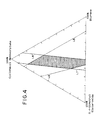
- Figure 4 is a similar graph of the same monomer components as in Figure 3, excepting that the Melt Stress Optic Coefficients are between +500 Brewsters (L7') and -500 Brewsters (L8').
- a representative preferred polymer of the present invention has a composition within the region of the graph bounded by L5, L6, L7', L8' and the perimeter of the graph.
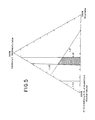
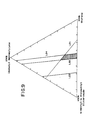
- Figure 6 is a similar graph of the same monomer components as in Figure 5, excepting that the Melt Stress Optic Coefficients of +500 Brewsters (L11') and -500 Brewsters (L12') are provided.
- the invented polymers lie in the region bounded by L9, L10, L12' and the perimeter of the graph.
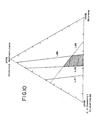
- a representative polymer of the present invention has a composition within the region of the graph bounded by L13, L14, L15, L16, and the perimeter of the graph.
- T g ) 140°C (L17) and higher
- water absorption 0.25 percent (L18) and lower
- C Melt Stress Optic Coefficient
- a representative polymer of the present invention has a composition within the region of the graph bounded by L17, L18, L19, L20, and the perimeter of the graph.
- melt stress optic coefficients are utilized by the present inventors instead of polarizability differences to provide a more accurate prediction of the resulting polymer's birefringent properties.
- the homopolymer melt stress optic coefficient value is calculated based on measurements made from the polymer melt, if available, otherwise it is extrapolated from the calculated melt stress optic coefficients of two or more copolymers with varying ratios of each comonomer. It is required that polymers according to the invention satisfy all of the limitations of melt stress optic coefficient, water absorption and heat distortion. Accordingly, some compositions may be excluded by one property and fail to reach the extremes of another property. For example, the compositions of Figures 5 and 6 are limited by water absorption properties before reaching a maximum positive melt stress optic coefficient.
- Illustrative of the structural units belonging to group a) are moieties formed by the polymerization of inertly N-substituted maleimides, particularly the alkyl, cycloalkyl, aryl and alkaryl N-substituted maleimides and alkyl, cycloalkyl, aryl and alkaryl ring substituted derivatives thereof having up to about 12 carbons in each substituent group.
- structural units derived from glutarimide and inertly substituted glutarimides especially N-substituted glutarimides such as alkyl, cycloalkyl, aryl, and alkaryl N-substituted glutarimides and alkyl, cycloalkyl, aryl and alkaryl ring substituted derivatives thereof.
- Such structural units may be depicted by Formula I for the maleimides and Formula II for the glutarimides: wherein R1, R2 and R3 are independently selected from hydrogen, C1 to C12 alkyl, C6 to C12 cycloalkyl or aryl, and C7 to C12 alkaryl groups.
- R1 and R2 are both hydrogen.
- R1 and R2 are both methyl.
- the glutarimide containing polymers may be prepared by any suitable technique.
- One process involves copolymerization of suitable acrylate or methylacrylate ester containing monomers with copolymerizable monovinylidene aromatic comonomers.
- Glutarimide functionality is introduced by conversion of adjoining acrylate or methacrylate functionality of a precursor polymer through an ammonolysis and cycloglutarimidization reaction.
- the two step process involves reaction of methacrylic or acrylic ester groups with an amine and subsequent elimination of a hydroxylated species.
- Suitable techniques for the introduction of glutarimide functionality into methylmethacrylate polymers were previously taught in United States Patents 3,244,679; 3,284,425; 4,246,374; 4,745,159, and Japanese Laid Open Application 85-233,106. If the glutarimide is formed by heating the methylmethacrylate containing polymer in the presence of an amine, an N-substituted glutarimide may be prepared. Such N-substituted glutarimides possess reduced hydroscopicity.
- amide functionality may be first introduced into the polymers via standard copolymerization of e.g. methacrylamide or other suitable monomer and an acrylic or methacrylic acid or derivative thereof, and the resulting polymer glutarimidized, usually by merely heating the polymer.
- Maleimide containing polymers may be prepared by a post imidization of maleic anhydride containing polymers or by the direct polymerization of the appropriate monomers.
- Group b) structural units include moieties derived from monovinylidene aromatic monomers having from 6 to 20 carbons in the aromatic group, as well as structural units derived from alkyl, cycloalkyl, aryl and aralkyl esters of acrylic and methacrylic acids having from 2 to 14 carbons in the alkyl group, from 6 to 14 carbons in the cycloalkyl or aryl groups and from 7 to 14 carbons in the aralkyl group.
- Preferred group b) structural units are the polymerized form of styrene and the above alkyl-, aryl-, alkaryl- or cycloalkylmethacrylates.
- Highly preferred group b) structural units are the polymerized form of styrene and alkyl, cycloalkyl, aryl and aralkyl esters of methacrylic acid having from 2 to 14 carbons in the alkyl group, from 6 to 14 carbons in the cycloalkyl or aryl groups or from 7 to 14 carbons in the aralkyl group (hereinafter referred to as "higher methacrylate esters”), due to the relatively low water absorption attributable thereto.
- At least some quantity of a monovinylidene aromatic monomer is desired since the monovinylidene aromatic monomer imparts good molding properties to the resulting polymer.
- polymer melt processability and thermal stability are improved by the presence of at least 5 mole percent, preferably at least 8 mole percent monovinylidene aromatic monomer.
- compositions having extremely low levels of methacrylate ester cannot be prepared by the preferred technique of ammonolysis/cycloglutarimidization disclosed herein, due to the isolation of single methacrylate ester moieties between monovinylidene aromatic monomer moieties rendering the same unavailable for cycloglutarimidization.
- the acrylate or methacrylate ester content of the polymers of the present invention must be at least 5, preferably at least 8 mole percent.
- Most highly preferred polymers comprise styrene; a methacrylate ester selected from the group consisting of isopropylmethacrylate, isobutylmethacrylate, neopentylmethacrylate, cyclohexylmethacrylate, phenylmethacrylate, and benzylmethacrylate; and 2,4-dimethylglutarimide or C1 ⁇ 6 alkyl- or cyclohexyl N-substituted 2,4-dimethylglutarimide groups.
- any number of different group a) and b) moieties may be incorporated into the polymers of the present invention in order to achieve desirable polymer properties.
- One or more than one of each of the group a) and b) moieties may be employed such that the resulting copolymer or interpolymer possesses the desired molten stress optic coefficient, water absorption, or glass transition temperature.
- the polymers may be in the block or random polymer form, or graft copolymer form although random copolymers are preferred since large regions or domains in the polymer, such as might occur in certain large domain block copolymers, may affect the polymer's optical properties.
- the contribution to the final molten stress optic coefficient of the copolymer of the present invention attributable to a particular moiety is directly proportional to the molar concentration or molar fraction of such moiety.
- the present invention may be depicted as comprising interpolymerized units corresponding to the following diagram: wherein x, y and z are the respective molar fractions of the components, R independently each occurrence is C2 to C14 alkyl, C6 to C14 cycloalkyl or aryl, or C7-C14 aralkyl, Ar is C6 to C14 aryl, or alkyl- or halo-substituted aryl, R1, R2 and R3 are as previously defined, R4 and R' independently are hydrogen or methyl, and n is zero or one depending on whether maleimide or glutarimide functionality is present.
- terpolymers of styrene, cyclohexylmethacrylate and 2,4-dimethylglutarimide (figures 3 and 4) preferably:
- the degree of conversion of higher methacrylate ester functionality to glutarimide functionality may be controlled so as to attain a relatively low methylmethacrylate residual functionality which is necessary to achieve the reduced water absorption properties required of the present invention.
- the starting resins comprise a higher methacrylate ester and methyl methacrylate in a molar ratio from 5:1 to 1.5:1. Utilization of such polymers containing this range of constituent parts ensures the presence of substantial quantities of higher methacrylate ester functionality in the resulting polymers.
- the starting polymers employed in the present process comprise 10 to 40 mole percent functionality derived from a monovinylidene aromatic monomer, from 10 to 45 mole percent functionality derived from methyl methacrylate, and 40 to 80 mole percent functionality derived from a higher methacrylate ester.
- the ammonolysis and cycloglutarimidization process is conducted according to well known techniques in the art as are disclosed for example in the previously mentioned U.S. Patents 4,246,374 and 4,745,159.
- a most ammonolysis agent is methyl amine.
- R3 is methyl.
- the reaction is conducted in a solvent such as cyclohexanol or a mixture of solvents, such as mixtures of toluene and a C3 to C8 alkanol as disclosed in United States Patent 4,745,159, or in an extruder. Elevated temperatures from 30 to 300°C, more preferably from 100 to 250°C and pressures from atmospheric to 2000 atmospheres (0.1 - 200 MPa) usually are employed.
- Cycloimidization of the resulting polymer may occur simultaneously or concurrently with the ammonolysis process.
- the methacrylamide containing ammonolysis product is merely subjected to elevated temperatures from 30 to 300°C, more preferably 100 to 250°C for a time sufficient to result in loss of the corresponding alcohol upon ring closure.
- the resulting 2,4-dimethylglutarimide containing product is recovered by precipitation, devolatilization, or similar technique to remove any solvent or byproducts. In a vented extruder the product is merely extruded and pelletized.
- An alternative process to the above described ammonolysis and cycloimidization procedure for preparing glutarimide containing polymers is the technique of copolymerization and glutarimidization.
- a methacrylamide containing copolymer is initially prepared by free radical copolymerization. This polymer is readily converted into one containing 2,4-dimethylglutarimide moieties by heating the resulting polymer.
- Preferred residual methylmethacrylate or methacrylamide content of the polymers is less than 2.0 mole percent, more preferably less than 1.0 mole percent, most preferably less than 0.5 mole percent. 13C NMR Analysis may be used to detect residual levels of methylmethacrylate or methacrylamide.
- Maleimide containing polymers may be prepared by direct free radical polymerization of the respective monomers as is well known in the art.
- Highly preferred polymers according to the invention are those having a molten stress optic coefficient greater than or equal to -500 Brewsters but less than or equal to +500 Brewsters. In measuring such values, an accuracy of ⁇ 200 Brewsters is normally expected.
- Glass transition temperatures of the polymers are preferably at least about 145°C. These values are determined on a DuPont 1090 Thermo-analyzer at a heating rate of 20°C/min at the inflection point. Water absorption values are determined after 24 hours immersion at 23°C. In the attached drawings all of the lines are linear models representing the theoretical variation of polymer properties as a function of polymer composition. Actual polymer properties conform to such a linear approximation quite closely. As a general rule a deviation of actual physical properties from the theoretical predicted values up to ⁇ 5 percent may be expected.
- a 2,4-dimethylglutarimide, styrene, and cyclohexyl methacrylate containing polymer was prepared by the techniques of copolymerization and glutarimidization. Accordingly an interpolymer of styrene, cyclohexyl methacrylate, and methacrylamide was prepared.
- styrene 29 g, cyclohexyl methacrylate 225 g, and methacrylamide 122 g were introduced, along with 50 percent based on monomer weight of N,N-dimethylformamide solvent.
- Devolatilization and glutarimidization were effected by heating a thin layer of the polymer on a polytetrafluoroethylene coated tray under reduced pressure (4 Torr; 0.5 kPa) at 255°C for 75 minutes.
- a compression molded plaque (3.2 mm thick) was prepared from the preceding resin and physical properties thereof were tested. Results are contained in Table I.
- a styrene/maleimide/cyclohexylmethacrylate interpolymer was formed by solution polymerization of 3.1 weight percent styrene, 8.0 weight percent maleimide, and 36.5 weight percent cyclohexyl methacrylate in dimethylformamide solvent utilizing a continuous stirred tank reactor of 1.5 liter capacity. Temperature was 100°C and 1,1-bis(t-butylperoxy)cyclohexane catalyst. The resulting polymer had monomer content in mole percent as determined by 13C NMR of styrene 17 percent, cyclohexylmethacrylate 60 percent, and maleimide 23 percent.
- a styrene, isobutyl methacrylate and N-cyclohexyl-2,4-dimethylglutarimide copolymer was prepared by the technique of ammonolysis/cycloglutarimidization. Accordingly, a prepolymer of styrene, isobutyl methacrylate and methyl methacrylate was synthesized by free radical, solution polymerization techniques employing ethylbenzene solvent and 250 parts per million of a free radical initiator. The polymerization was conducted at a temperature of 100°C in a jacketed, glass-lined batch reactor equipped with a condenser, mechanical stirrer, nitrogen atmosphere, steam heat and water cooling capability.
- the polymerization was allowed to proceed to approximately 50 percent conversion, at which time the reaction was cooled and the prepolymer isolated by precipitation with an excess of methanol.
- the prepolymer were collected by filtration at reduced pressure and thoroughly devolatilized to remove solvent at 220°C, 4 Torr (0.5 kPa) for approximately 1 hour.
- the prepolymer was then dissolved in a mixture of toluene and methanol (90/10 by weight) to a 30 percent solid level.
- the mixture was then charged to a 300 milliliter batch reactor designed for high temperatures and pressures.
- the contents of the reactor were thoroughly sparged with nitrogen and evacuated.
- a stoichiometric amount of cyclohexylamine aminating agent relative to ester content was then pressure-fed to the reactor.
- the reactor was heated to 230°C.
- the reactor pressure was maintained at about 500 psig (3500 kPa) for approximately 10 hours. Samples were withdrawn for analysis throughout the run. After reaction completion the reactor contents were isolated by precipitation with an excess of hexane and thoroughly devolatilized in a vacuum oven.
- Example 3 The reaction conditions of Example 3 were substantially repeated employing a prepolymer starting reactant containing only styrene and isobutyl methacrylate.
- the resulting polymer was substantially unaffected by the ammonolysis and cycloglutarimidization procedure and consisted essentially of styrene and unchanged isobutyl methacrylate.
Landscapes
- Chemical & Material Sciences (AREA)
- Organic Chemistry (AREA)
- Health & Medical Sciences (AREA)
- Chemical Kinetics & Catalysis (AREA)
- Medicinal Chemistry (AREA)
- Polymers & Plastics (AREA)
- General Chemical & Material Sciences (AREA)
- Engineering & Computer Science (AREA)
- Manufacturing & Machinery (AREA)
- Addition Polymer Or Copolymer, Post-Treatments, Or Chemical Modifications (AREA)
- Manufacture Of Macromolecular Shaped Articles (AREA)
- Optical Record Carriers And Manufacture Thereof (AREA)
- Graft Or Block Polymers (AREA)
Applications Claiming Priority (2)
| Application Number | Priority Date | Filing Date | Title |
|---|---|---|---|
| US44777089A | 1989-12-08 | 1989-12-08 | |
| US447770 | 1989-12-08 |
Publications (2)
| Publication Number | Publication Date |
|---|---|
| EP0431903A2 true EP0431903A2 (fr) | 1991-06-12 |
| EP0431903A3 EP0431903A3 (en) | 1992-01-22 |
Family
ID=23777678
Family Applications (1)
| Application Number | Title | Priority Date | Filing Date |
|---|---|---|---|
| EP19900313169 Withdrawn EP0431903A3 (en) | 1989-12-08 | 1990-12-05 | Intrinsically low birefringent molding polymers, process for preparation and molded objects therefrom |
Country Status (5)
| Country | Link |
|---|---|
| EP (1) | EP0431903A3 (fr) |
| JP (1) | JPH03195710A (fr) |
| KR (1) | KR910011925A (fr) |
| CN (1) | CN1052312A (fr) |
| CA (1) | CA2031783A1 (fr) |
Cited By (1)
| Publication number | Priority date | Publication date | Assignee | Title |
|---|---|---|---|---|
| WO2010054909A1 (fr) * | 2008-11-14 | 2010-05-20 | Evonik Röhm Gmbh | Copolymère pour la fabrication de corps moulés thermostables à partir de matières moulables ou de verre coulé |
Families Citing this family (7)
| Publication number | Priority date | Publication date | Assignee | Title |
|---|---|---|---|---|
| US6310143B1 (en) * | 1998-12-16 | 2001-10-30 | Mbt Holding Ag | Derivatized polycarboxylate dispersants |
| KR100900859B1 (ko) * | 2003-12-02 | 2009-06-04 | 가부시키가이샤 가네카 | 이미드 수지, 및 그의 제조 방법 및 이용 |
| JPWO2006043409A1 (ja) * | 2004-10-22 | 2008-05-22 | 株式会社カネカ | 高屈折率を有するイミド樹脂及びこれを用いたレンズ用熱可塑性樹脂組成物及びレンズ |
| JP5400296B2 (ja) * | 2005-05-30 | 2014-01-29 | 株式会社カネカ | 樹脂組成物 |
| KR20170027861A (ko) * | 2012-10-19 | 2017-03-10 | 아사히 가세이 케미칼즈 가부시키가이샤 | 메타크릴계 수지를 포함하는 차량 부재용 커버 |
| WO2014092156A1 (fr) * | 2012-12-14 | 2014-06-19 | 学校法人慶應義塾 | Copolymère acrylique, film optique, plaque de polarisation et dispositif d'affichage à cristaux liquides |
| EP3075781A4 (fr) * | 2013-11-29 | 2017-07-19 | Kaneka Corporation | Composition et film de résine optique |
Family Cites Families (5)
| Publication number | Priority date | Publication date | Assignee | Title |
|---|---|---|---|---|
| JPH0629286B2 (ja) * | 1986-01-23 | 1994-04-20 | 三菱レイヨン株式会社 | メタクリルイミド単位含有メタクリル樹脂 |
| CA1274936A (fr) * | 1986-12-25 | 1990-10-02 | Akihiro Watanabe | Copolymere statistique contenant des unites imidiques hexagonales, procede pour sa production et substrat de disque optique fabrique avec ce copolymere |
| JPS6422903A (en) * | 1987-07-20 | 1989-01-25 | Mitsubishi Rayon Co | Production of methacrylimide group-containing polymer |
| US4847327A (en) * | 1987-09-16 | 1989-07-11 | Hoechst Celanese | Surface or electrically active copolymers of poly(4-substituted styrene/N-substituted maleimide) |
| US4874824A (en) * | 1987-11-23 | 1989-10-17 | Rohm And Haas Company | Process for manufacturing low-acid, glutaric-anhydride-containing copolymers |
-
1990
- 1990-11-29 JP JP2326145A patent/JPH03195710A/ja active Pending
- 1990-12-05 EP EP19900313169 patent/EP0431903A3/en not_active Withdrawn
- 1990-12-06 KR KR1019900019986A patent/KR910011925A/ko not_active Withdrawn
- 1990-12-07 CA CA002031783A patent/CA2031783A1/fr not_active Abandoned
- 1990-12-07 CN CN90109726A patent/CN1052312A/zh active Pending
Cited By (1)
| Publication number | Priority date | Publication date | Assignee | Title |
|---|---|---|---|---|
| WO2010054909A1 (fr) * | 2008-11-14 | 2010-05-20 | Evonik Röhm Gmbh | Copolymère pour la fabrication de corps moulés thermostables à partir de matières moulables ou de verre coulé |
Also Published As
| Publication number | Publication date |
|---|---|
| CN1052312A (zh) | 1991-06-19 |
| JPH03195710A (ja) | 1991-08-27 |
| EP0431903A3 (en) | 1992-01-22 |
| KR910011925A (ko) | 1991-08-07 |
| CA2031783A1 (fr) | 1991-06-09 |
Similar Documents
| Publication | Publication Date | Title |
|---|---|---|
| US4785053A (en) | Optical resin material having improved birefringence | |
| EP0621297A2 (fr) | Copolycarbonate de spirobisindane et de bisphénol A, procédé pour sa préparation et components optiques à partir du copolycarbonate | |
| EP0431903A2 (fr) | Polymères à mouler ayant une faible biréfringence intrinsèque, leur procédé de préparation et objets moulés | |
| US4820778A (en) | Random copolymer containing hexagonal imide units, a process for producing the same, and an optical disc substrate made of the random copolymer | |
| EP0097948B1 (fr) | Substrat d'enregistrement de l'information | |
| US5424389A (en) | Polycarbonate copolymer of spirobisindan and bisphenol-A, method of preparing such a copolymer and optical components of such a copolymer | |
| US5218068A (en) | Intrinsically low birefringent molding polymers and optical storage disks therefrom | |
| JP3870670B2 (ja) | 非複屈折性ピックアップレンズ用樹脂組成物及びこれを用いたピックアップレンズ | |
| KR100235784B1 (ko) | 광학재료 | |
| JP2678029B2 (ja) | 高耐熱性低吸湿性メタクリル系共重合体 | |
| WO1989006248A1 (fr) | Polymere de methacrylate faiblement hygroscopique | |
| JPS63301247A (ja) | 光学用の樹脂成形体 | |
| JPS63213506A (ja) | 光学用材料 | |
| JPS63241011A (ja) | 光学用樹脂材料 | |
| US6428872B1 (en) | Preparation of a recording carrier | |
| JPS63156825A (ja) | 光記録媒体用基体 | |
| JP2618252B2 (ja) | 低吸湿性メタクリル系共重合体からなる光学用成形品 | |
| JPS60217216A (ja) | 低ソリ性アクリル系樹脂を基盤とするデイスク盤 | |
| JP2678030B2 (ja) | 良流動性低吸湿性メタクリル系共重合体 | |
| JPS63243114A (ja) | 光学材料 | |
| JPS62192438A (ja) | 光学式情報記録体用基材 | |
| JPS6015194A (ja) | 光学記録用材料 | |
| JPH02179940A (ja) | 光ディスク基板 | |
| JPS62199605A (ja) | 光学用樹脂材料 | |
| JPS6219801A (ja) | 光学部品 |
Legal Events
| Date | Code | Title | Description |
|---|---|---|---|
| PUAI | Public reference made under article 153(3) epc to a published international application that has entered the european phase |
Free format text: ORIGINAL CODE: 0009012 |
|
| AK | Designated contracting states |
Kind code of ref document: A2 Designated state(s): BE DE FR GB IT NL SE |
|
| PUAL | Search report despatched |
Free format text: ORIGINAL CODE: 0009013 |
|
| AK | Designated contracting states |
Kind code of ref document: A3 Designated state(s): BE DE FR GB IT NL SE |
|
| 17P | Request for examination filed |
Effective date: 19920720 |
|
| STAA | Information on the status of an ep patent application or granted ep patent |
Free format text: STATUS: THE APPLICATION HAS BEEN WITHDRAWN |
|
| 18W | Application withdrawn |
Withdrawal date: 19921120 |