EP0432108A2 - Dispositif électronique pour visualiser, reconnaître et localiser des objets, et procédé de fonctionnement pour un tel dispositif - Google Patents
Dispositif électronique pour visualiser, reconnaître et localiser des objets, et procédé de fonctionnement pour un tel dispositif Download PDFInfo
- Publication number
- EP0432108A2 EP0432108A2 EP90830493A EP90830493A EP0432108A2 EP 0432108 A2 EP0432108 A2 EP 0432108A2 EP 90830493 A EP90830493 A EP 90830493A EP 90830493 A EP90830493 A EP 90830493A EP 0432108 A2 EP0432108 A2 EP 0432108A2
- Authority
- EP
- European Patent Office
- Prior art keywords
- features
- objects
- graphic
- camera
- localization
- Prior art date
- Legal status (The legal status is an assumption and is not a legal conclusion. Google has not performed a legal analysis and makes no representation as to the accuracy of the status listed.)
- Withdrawn
Links
Images
Classifications
-
- G—PHYSICS
- G06—COMPUTING OR CALCULATING; COUNTING
- G06V—IMAGE OR VIDEO RECOGNITION OR UNDERSTANDING
- G06V10/00—Arrangements for image or video recognition or understanding
- G06V10/70—Arrangements for image or video recognition or understanding using pattern recognition or machine learning
- G06V10/74—Image or video pattern matching; Proximity measures in feature spaces
-
- G—PHYSICS
- G06—COMPUTING OR CALCULATING; COUNTING
- G06F—ELECTRIC DIGITAL DATA PROCESSING
- G06F18/00—Pattern recognition
- G06F18/40—Software arrangements specially adapted for pattern recognition, e.g. user interfaces or toolboxes therefor
-
- G—PHYSICS
- G06—COMPUTING OR CALCULATING; COUNTING
- G06V—IMAGE OR VIDEO RECOGNITION OR UNDERSTANDING
- G06V2201/00—Indexing scheme relating to image or video recognition or understanding
- G06V2201/06—Recognition of objects for industrial automation
Definitions
- the invention relates to an electronic device for viewing, recognizing and localizing objects, of the type comprising at least one television camera by means of which to generate images, connected by way of a video interface with a monitor, and means for comparing and matching objects imaged by the camera with reference objects; the invention also embraces the relative operating procedure.
- a particularly pressing problem experienced within the field of industry is mirrored in the search for systems by means of which to view a surrounding environment, whether in two or three dimensions, such as can measure up to the improved applications afforded by in-process robotics with the end in view of handling specific operational situations.
- Imaging is accomplished currently using one or more cameras connected to special recognition processing systems capable of effecting a detailed, continuous analysis of an object sighted by the camera, though not an active analysis, i.e. not using a programmed set of selection parameters determining essential features to be isolated and compared.
- the first step in the procedure consists in processing the information provided by the image, according to fixed operating parameters that cannot be altered according to the object or to suit particular operational contingencies, and comparing the recognized object with a reference image following each full processing operation.
- the main object of the present invention is to overcome the difficulties described, and thus to eliminate the attendant drawbacks, by the adoption of an electronic device for viewing, recognizing and localizing objects that features simplicity in image processing and comparison, and versatility and flexibility to a notable degree in its ability to recognize any given object across the widest imaginable variety of applications.
- the comparison in question is an active procedure whereby the images of the scanned objects and preconstituted models of those objects are set one against the other in a series of discrete, guided operations.
- the object of the invention indeed is to create a system for viewing, recognizing and localizing objects wherein analysis of the camera image is effected by processing at a level lower than practised in conventional systems, but guided by an operating program through each processing step using data supplied by a reference model of which only those features essential to the particular application are defined and memorized.
- comparison is geared to the matching only of essential and positively immutable features of the object and its model, rather than of an enormous range of data which for a variety of reasons, quite apart from the identity of the object, might differ ultimately from expectations to a greater or lesser degree.
- the aim is to select and compare only that which is essential, without effecting calculations on irrelevant data, to the end of obtaining results undoubtedly at higher speed, but also of greater reliability, insofar as recognition unequivocally establishes the match between the imaged object and the previously constructed model, rejecting all approximations.
- an electronic device for viewing, recognizing and localizing objects of the type comprising at least one television camera by means of which to generate images, connected through a video interface to a monitor, and means by which reference objects are archived, compared and matched with objects imaged via the camera, which is characterized in that it comprises a microprocessor serving to execute a program for the operation of storage, comparison and matching means that comprise graphic simulation means capable of assigning geometrical features to reference objects with which objects imaged via the camera are compared, and means by which to observe and display graphic and geometrical features of the objects to be recognized and localized according to specifications and parameters established by way of the archived reference models and referred to at successive steps of the operating procedure, and in that the entire procedure is controlled via the operating program by the microprocessor, which is connected to the storage, comparison and matching means by way of a dedicated bus.
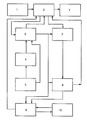
- 1 denotes a normal television camera, for example having a grey scale of 256, which might be utilized in conjunction with other cameras, the maximum number being four in the embodiment described by way of example, connected by way of a video interface 2 with a conventional VDU or monitor 3.
- the video interface will naturally incorporate the necessary analog-digital and digital-analog converters, which are not indicated specifically in the diagram.
- the monitor is preferably a standard RGB colour graphics VDU.
- the group of blocks numbered 4, 5 and 6 denote means for the graphic simulation of reference objects that will be compared ultimately with the objects imaged via the camera 1 during operation.
- These same parameters and specifications which will reflect features essential to the subsequent recognition of a given object, may include thresholds, tolerances and dimensions, elementary geometrical figures into which the image can be split up, windows on areas comprising essential data, and parametric system data such as the specifications of the TV camera, its focusing distance, etc.
- the keyboard 5 also serves to operate a conventional computer aided design (CAD) module 4, utilized to generate, alter and position such elementary geometrical features (circles, straight lines, angles, arcs) as may be essential to a correct identification of the target object; these same geometrical features are written into the memory 6, in association with the stored parameters and specifications aforementioned.
- CAD computer aided design
- the memory 6 constitutes an archival storage medium holding such reference objects as have been defined and constructed in the manner outlined above.
- Block 7 and block 8 respectively denote a contour extraction module and a features extraction module.
- the first of the two blocks i.e. the contour extraction module 7 makes an initial selection of pertinent areas from the digital image provided by the camera, on the basis of data supplied by the memory 6, and applies a gradient vector to these areas.
- an initial rough analysis is made of the grey shades in the image, whereupon the block 7 continues by singling out the characterizing points (vertices) of potential contours, according to the thresholds supplied by the memory 6, and correlating them.
- the features extraction module a runs a curvature analysis on the contours extracted by the first module 7, segmenting and extracting all such geometrical features (straight lines, circles, angles etc.) as correspond to those present in the model, or rather models, archived in the memory 6; thus, the process executed by this module 8 is also guided by the memory 6.
- Block 9 denotes a matcher: in effect, a module that establishes which parts of the object coincide with the memorized reference model following comparison of the image targeted by the camera 1 and processed by the contour extraction and features extraction modules.
- the matcher 9 essentially verifies whether or not the camera image and the reference model can be superimposed, and in the event of the compared data coinciding, the image is rotated and traversed in relation to the model to establish details of the position of the object located and recognized.
- block 10 denotes a protocol conversion unit which translates externally derived commands (from robots or machines with which the device disclosed is associated) into commands intelligible to the viewing and recognition device operating program, and translates response data from the device itself into outgoing commands. Accordingly, this block 10 enables the necessary dialogue between the imaging system, which comprises the cameras and VDU, the comparison and matching system, comprising all of the remaining blocks previously mentioned plus an external microprocessor not illustrated in the diagram (in the interests of simplicity), and the surrounding environment.
- the device according to the present invention may be dcscribed as operating on two-and-a-half levels, in the context of a three dimensional imaging system.
- Two and a half is taken to signify the definition of tolerance and calculation parameters in respect of the distance along the focal axis of the camera to the object, considered in relation to the plane dimensions of the latter.
- the device is characterized in that it executes an active type of graphic simulation, i.e. the comparisons between the models archived in the memory 6 and the images generated by the camera and displayed on the VDU are effected step by step in single matching operations, consisting in discrete superimpositions of the image and the initially constructed model taken from the memory 6.
- an active type of graphic simulation i.e. the comparisons between the models archived in the memory 6 and the images generated by the camera and displayed on the VDU are effected step by step in single matching operations, consisting in discrete superimpositions of the image and the initially constructed model taken from the memory 6.
- the device also comprises a microprocessor not illustrated in the diagram, connected through a dedicated bus to the blocks numbered 4...10, which it controls by way of an operating program permitting dialogue between the processor, the modules connected to the bus, and external devices.
- the device receives protocol commands from the microprocessor and images from the camera, as well as data supplied from the memory 6 describing the reference model (entered from the keyboard 5 and the CAD module 4).
- the outputs from the device reflect the results of comparison displayed on tile monitor 3, plus responses and output data handled in the form of commands by the block denoted 10.
- the relative analog signal is converted by an ADC into a digital signal; thereafter, the digital signal is converted by DAC into an RGB analog signal for transmission to the monitor 3.
- the operator can use the keyboard 5 to generate, modify and position the essential geometrical features enabling a detailed definition of the objects to be identified, whilst observing the procedure on the monitor; needless to say, use might be made of other input devices, such as a mouse, in place of the keyboard 5.
- the memory 6 dialogues not only with the matcher 9, which is the decision-making element, but also with the contour and features extraction modules 7 and 8 respectively, in order to ensure that the entire recognition processing operation is effected with the reference model continuously imposed.
- the first extraction module 7 supplies a plurality of contour points that can be displayed on the monitor 3.
- a suitable indicator incorporated into this same module 7 permits of addressing the video buffer, internally of the relative interface 2, to the end of singling out those areas registering a more pronounced gradient. Further elimination of non-essential data will ultimately reveal the most significant geometrical features (vertices).
- the process is one of highlighting a series of points at which the more superimposable geometrical features of the imaged object and the construct happen to coincide.
- the features extraction module 8 effects a curvature analysis on the contours given by the first extraction module 7, segmenting and isolating those geometrical features (straight lines, angles, circles etc%) best adaptable to the operation of superimposing the object imaged by the camera on those archived in the memory 6.
- the procedure passes to the matcher 9, which is in receipt of the features adopted for reference purposes, that is, of the model supplied by the memory 6, and from the features extraction module 8, those items of data which in the course of the comparisons effected thus far have coincided with the model.
- the device conducts a comparison between image and model, whereupon only those parts which can be faultlessly superimposed on the basis of the selected geometrical and graphic features, and of pin-pointed highlights (windowed features, if any), can qualify as reflecting the image returned by the camera 1.
- the protocol converter 10 will supply those commands which result in display of the definitive image on the monitor 3, utilizing the video interface 2, and commands converted from the definitive data corresponding to the recognized and localized object, destined for the robots or other external equipment connected to the device.
- comparison procedures fall within the capabilities of the software or operating program package used by the device, and will be embodied as a plurality of distinct processing units.
- the electronic device follows a procedure comprising an initial or preparatory operation of simulating objects to be imaged by at least one television camera, for the purposes of recognition and localization, and memorizing the simulated models, and a further operation of processing and comparing the image of an object targeted by the camera for recognition and localization and matching it to a corresponding model.
- the initial simulation operation includes the steps of entering and defining parameters and specifications serving to reflect the graphic and geometrical features of a reference model for the object to be recognized and localized; generating, suitably modifying and positioning the relative geometrical features, in the form of elementary geometrical figures; and memorizing the parameters, specifications and graphic and geometrical features of the reference model thus defined.
- the subsequent processing operation includes the further steps of analyzing and defining the potential contours of an object targeted by the camera for recognition and localization according to the memorized parameters, specifications and features of the reference models and, using these same parameters, specifications and features of the memorized reference models, analyzing the curvature of the defined contours and extracting those geometrical features presented by the image that permit of correlation to memorized features of the reference models; comparing the reference model and the graphic and geometrical features of the object targeted by the camera for recognition and localization; and finally, having established a match, rotating and traversing the image of the object in relation to the reference model to determine its localization.
- the procedure is one whereby the software or operating program, run by hardware consisting in a microprocessor and the other parts mentioned, including the camera and monitor, permits of ef fecting a comparison markedly superior to that enabled by conventional systems, in terms both of speed and of quality.
- the simulation is an intelligent and active process inasmuch as each discrete operation executed by the contour extraction module 7 and features extraction module 8 takes account of the encoded model stored in the memory 6.
- circuitry of the device might vary in a final embodiment, likewise the parametric and programming features of the software utilized.
Landscapes
- Engineering & Computer Science (AREA)
- Theoretical Computer Science (AREA)
- Computer Vision & Pattern Recognition (AREA)
- General Physics & Mathematics (AREA)
- Evolutionary Computation (AREA)
- Artificial Intelligence (AREA)
- Physics & Mathematics (AREA)
- Computing Systems (AREA)
- Databases & Information Systems (AREA)
- General Health & Medical Sciences (AREA)
- Medical Informatics (AREA)
- Software Systems (AREA)
- Health & Medical Sciences (AREA)
- Multimedia (AREA)
- Human Computer Interaction (AREA)
- Life Sciences & Earth Sciences (AREA)
- Bioinformatics & Cheminformatics (AREA)
- Bioinformatics & Computational Biology (AREA)
- Data Mining & Analysis (AREA)
- Evolutionary Biology (AREA)
- General Engineering & Computer Science (AREA)
- Image Processing (AREA)
- Image Analysis (AREA)
- Apparatus For Radiation Diagnosis (AREA)
Applications Claiming Priority (2)
| Application Number | Priority Date | Filing Date | Title |
|---|---|---|---|
| IT04851489A IT1242628B (it) | 1989-11-02 | 1989-11-02 | Dispositivo elettronico di visione riconoscimento e localizzazione di oggetti e relativo procedimento operativo. |
| IT4851489 | 1989-11-02 |
Publications (2)
| Publication Number | Publication Date |
|---|---|
| EP0432108A2 true EP0432108A2 (fr) | 1991-06-12 |
| EP0432108A3 EP0432108A3 (en) | 1993-01-07 |
Family
ID=11267034
Family Applications (1)
| Application Number | Title | Priority Date | Filing Date |
|---|---|---|---|
| EP19900830493 Withdrawn EP0432108A3 (en) | 1989-11-02 | 1990-10-30 | An electronic device for viewing, recognizing and localizing objects, and an operating procedure therefore |
Country Status (2)
| Country | Link |
|---|---|
| EP (1) | EP0432108A3 (fr) |
| IT (1) | IT1242628B (fr) |
Cited By (1)
| Publication number | Priority date | Publication date | Assignee | Title |
|---|---|---|---|---|
| DE102006036345A1 (de) * | 2006-08-03 | 2008-02-07 | Fraunhofer-Gesellschaft zur Förderung der angewandten Forschung e.V. | Verfahren zur Lagebestimmung von Objekten im dreidimensionalen Raum |
Family Cites Families (1)
| Publication number | Priority date | Publication date | Assignee | Title |
|---|---|---|---|---|
| JPS6238904A (ja) * | 1985-08-15 | 1987-02-19 | Fuji Electric Co Ltd | ロボツト用視覚システムにおける学習方法 |
-
1989
- 1989-11-02 IT IT04851489A patent/IT1242628B/it active IP Right Grant
-
1990
- 1990-10-30 EP EP19900830493 patent/EP0432108A3/en not_active Withdrawn
Cited By (2)
| Publication number | Priority date | Publication date | Assignee | Title |
|---|---|---|---|---|
| DE102006036345A1 (de) * | 2006-08-03 | 2008-02-07 | Fraunhofer-Gesellschaft zur Förderung der angewandten Forschung e.V. | Verfahren zur Lagebestimmung von Objekten im dreidimensionalen Raum |
| DE102006036345B4 (de) * | 2006-08-03 | 2008-07-03 | Fraunhofer-Gesellschaft zur Förderung der angewandten Forschung e.V. | Verfahren und Vorrichtung zur Lagebestimmung von Objekten im dreidimensionalen Raum |
Also Published As
| Publication number | Publication date |
|---|---|
| IT8948514A1 (it) | 1991-05-02 |
| IT8948514A0 (it) | 1989-11-02 |
| IT1242628B (it) | 1994-05-16 |
| EP0432108A3 (en) | 1993-01-07 |
Similar Documents
| Publication | Publication Date | Title |
|---|---|---|
| US5471541A (en) | System for determining the pose of an object which utilizes range profiles and synethic profiles derived from a model | |
| US4704694A (en) | Learned part system | |
| EP0233888B1 (fr) | Dispositif de traitement d'images | |
| US6031941A (en) | Three-dimensional model data forming apparatus | |
| US4272756A (en) | Method of pattern recognition and apparatus thereof | |
| US4486775A (en) | Object recognition | |
| EP1223540A2 (fr) | Méthode et appareil pour comparer des objets | |
| EP1477934A2 (fr) | Appareil de traitement d'images | |
| CN108120391A (zh) | 信息处理设备和方法、存储介质和物品制造方法 | |
| US4845765A (en) | Process for the automatic recognition of objects liable to overlap | |
| CN114581632A (zh) | 基于增强现实技术的零件装配误差检测方法、设备和装置 | |
| WO2020141468A1 (fr) | Procédé et système de détection de position d'une zone cible chez un sujet cible | |
| CN117253171B (zh) | 一种风险行为识别方法及系统 | |
| US5625762A (en) | Method for extracting three-dimensional color vector | |
| Sequeira et al. | 3D reconstruction of indoor environments | |
| Devy et al. | Camera calibration from multiple views of a 2D object, using a global nonlinear minimization method | |
| CN114419451B (zh) | 电梯内外识别方法、装置、电子设备及存储介质 | |
| Häusler et al. | Feature-based object recognition and localization in 3D-space, using a single video image | |
| CN121259272A (zh) | 一种孔位检测的方法、系统和机器人 | |
| EP0432108A2 (fr) | Dispositif électronique pour visualiser, reconnaître et localiser des objets, et procédé de fonctionnement pour un tel dispositif | |
| CN116339512A (zh) | 一种基于桌面投影的增强现实辅助装配系统及方法 | |
| JP2002042139A (ja) | 映像認識方法および映像表示装置 | |
| Huang et al. | Reverse engineering of planar parts using machine vision | |
| US5375194A (en) | Method and apparatus for reducing distortion in a graphic pattern by a thinning process | |
| US5430788A (en) | Specific region extraction method of medical image |
Legal Events
| Date | Code | Title | Description |
|---|---|---|---|
| PUAI | Public reference made under article 153(3) epc to a published international application that has entered the european phase |
Free format text: ORIGINAL CODE: 0009012 |
|
| AK | Designated contracting states |
Kind code of ref document: A2 Designated state(s): AT BE CH DE DK ES FR GB GR LI LU NL SE |
|
| PUAL | Search report despatched |
Free format text: ORIGINAL CODE: 0009013 |
|
| AK | Designated contracting states |
Kind code of ref document: A3 Designated state(s): AT BE CH DE DK ES FR GB GR LI LU NL SE |
|
| STAA | Information on the status of an ep patent application or granted ep patent |
Free format text: STATUS: THE APPLICATION IS DEEMED TO BE WITHDRAWN |
|
| 18D | Application deemed to be withdrawn |
Effective date: 19930708 |