EP0432140A2 - Montage d'arbre - Google Patents
Montage d'arbre Download PDFInfo
- Publication number
- EP0432140A2 EP0432140A2 EP91102585A EP91102585A EP0432140A2 EP 0432140 A2 EP0432140 A2 EP 0432140A2 EP 91102585 A EP91102585 A EP 91102585A EP 91102585 A EP91102585 A EP 91102585A EP 0432140 A2 EP0432140 A2 EP 0432140A2
- Authority
- EP
- European Patent Office
- Prior art keywords
- shaft
- eccentric
- stub
- extended
- assembly
- Prior art date
- Legal status (The legal status is an assumption and is not a legal conclusion. Google has not performed a legal analysis and makes no representation as to the accuracy of the status listed.)
- Withdrawn
Links
- 230000000712 assembly Effects 0.000 claims abstract description 20
- 238000000429 assembly Methods 0.000 claims abstract description 20
- 230000000694 effects Effects 0.000 claims abstract description 11
- 230000001105 regulatory effect Effects 0.000 claims abstract description 3
- 230000007246 mechanism Effects 0.000 claims description 29
- 239000012530 fluid Substances 0.000 claims description 19
- 238000012360 testing method Methods 0.000 claims description 12
- 230000033001 locomotion Effects 0.000 claims description 10
- 230000001276 controlling effect Effects 0.000 claims description 4
- 238000004891 communication Methods 0.000 claims description 3
- 239000000969 carrier Substances 0.000 description 3
- 230000008859 change Effects 0.000 description 3
- 238000006073 displacement reaction Methods 0.000 description 2
- 230000006870 function Effects 0.000 description 2
- 230000004048 modification Effects 0.000 description 2
- 238000012986 modification Methods 0.000 description 2
- 230000013707 sensory perception of sound Effects 0.000 description 2
- 238000010276 construction Methods 0.000 description 1
- 238000011161 development Methods 0.000 description 1
- 230000018109 developmental process Effects 0.000 description 1
- 230000009977 dual effect Effects 0.000 description 1
- 230000000717 retained effect Effects 0.000 description 1
Images



Classifications
-
- F—MECHANICAL ENGINEERING; LIGHTING; HEATING; WEAPONS; BLASTING
- F16—ENGINEERING ELEMENTS AND UNITS; GENERAL MEASURES FOR PRODUCING AND MAINTAINING EFFECTIVE FUNCTIONING OF MACHINES OR INSTALLATIONS; THERMAL INSULATION IN GENERAL
- F16C—SHAFTS; FLEXIBLE SHAFTS; ELEMENTS OR CRANKSHAFT MECHANISMS; ROTARY BODIES OTHER THAN GEARING ELEMENTS; BEARINGS
- F16C3/00—Shafts; Axles; Cranks; Eccentrics
- F16C3/04—Crankshafts, eccentric-shafts; Cranks, eccentrics
- F16C3/22—Cranks; Eccentrics
- F16C3/28—Adjustable cranks or eccentrics
-
- F—MECHANICAL ENGINEERING; LIGHTING; HEATING; WEAPONS; BLASTING
- F16—ENGINEERING ELEMENTS AND UNITS; GENERAL MEASURES FOR PRODUCING AND MAINTAINING EFFECTIVE FUNCTIONING OF MACHINES OR INSTALLATIONS; THERMAL INSULATION IN GENERAL
- F16C—SHAFTS; FLEXIBLE SHAFTS; ELEMENTS OR CRANKSHAFT MECHANISMS; ROTARY BODIES OTHER THAN GEARING ELEMENTS; BEARINGS
- F16C3/00—Shafts; Axles; Cranks; Eccentrics
- F16C3/04—Crankshafts, eccentric-shafts; Cranks, eccentrics
- F16C3/18—Eccentric-shafts
-
- G—PHYSICS
- G01—MEASURING; TESTING
- G01M—TESTING STATIC OR DYNAMIC BALANCE OF MACHINES OR STRUCTURES; TESTING OF STRUCTURES OR APPARATUS, NOT OTHERWISE PROVIDED FOR
- G01M13/00—Testing of machine parts
- G01M13/005—Sealing rings
Definitions
- the present invention relates to a shaft assembly that can be used e.g. in a seal testing apparatus.
- the primary object of the present invention is the provision of a shaft assembly that may be controlled to rotate or turn with little or no eccentricity or, alternatively, can be made to eccentrically rotate in an orbit.
- the shaft assembly of the present invention is rotatably supported in a stationary frame of for example a seal testing apparatus.
- the unique shaft assembly comprises an extended hollow shaft having a bearing or support assembly provided at the free ends thereof and a control mechanism for affecting the rotary path of the shaft.
- Each bearing or support assembly includes an apertured support member secured to the free end of the shaft and a stub shaft assembly rotatably mounted to said frame.
- Each stub shaft has a first shaft portion which is received in a support bearing of the frame assembly and a second shaft portion which is eccentrically arranged with respect to the first shaft portion. The eccentric shaft portion of each stub shaft assembly is accommodated in the aperture or bore provided in the support member.
- the aperture or bore in the support member is eccentrically arranged relative to the longitudinal axis of the extended shaft.
- One or both of the stub shaft assemblies may be connected to a motor for operably driving the shaft assembly.
- An operator influenced control mechanism is further provided for controlling the magnitude of shaft displacement.
- an equal series of seal assemblies with their rotating parts to be tested are mounted to the outside diameter of the main shaft.
- the control mechanism operably couples the extended hollow shaft to the rotatably driven stub shaft assembly.
- the control mechanism includes at least one annular piston which is carried within an enclosed space on said shaft and is constrained to move between an initial or minimum position and an extended or maximum position.
- a first spline connection is provided between the piston and the extended shaft while a second spline connection is established between the piston and a control gear fixed to the driven stub shaft.
- the control piston is axially moved, it entails relative angular displacement of the eccentric bore in the support member relative to the eccentric portion of the associated stub shaft.
- the control piston causes the above mentioned relative rotation, the operative or total eccentricity of the extended shaft with respect to the stub shaft varies from zero to a maximum value equal to the vector sum of the eccentricity of the support member and the stub shafts.
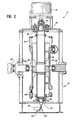
- the testing apparatus 10 includes a support frame 12, a test cylinder 14 within the frame 12 and through which the shaft assembly 16 of this invention passes, a motor 18 for rotating the shaft assembly and a swivel 20.
- the swivel 20 is connected to one end of the shaft assembly 16 and to a source 22 of pressurized hydraulic fluid.
- An operator actuated control valve 24 is arranged between the source of fluid 22 and the swivel 20.
- the test cylinder 14 is supported by ball bushings 26 shown in FIGURE 2, supported on spaced horizontal trunnions 28.
- a mechanism 30 allows the test cylinder 14 to be tilted to test the schematically illustrated mechanical seal assemblies 32 and 34, disposed within the cylinder 14, under varying conditions.
- the rotary shaft assembly 16 of this invention is particularly illustrated in FIGURES 4, 5 and 6 of the drawings.
- the shaft assembly 16 includes an extended shaft 38 having a pair of shaft support assemblies 47 and 49 disposed at opposite ends thereof for mounting the shaft assembly to the frame assembly of the apparatus.
- the extended shaft 38 has a longitudinal axis 39 and is provided with an outside or exterior cylindrical surface 40 and an internal or axial bore 42 extending the length thereof.
- the internal bore 42 opens to an enlarged cylindrical and axially arranged cavity or chamber 44 provided at one end of the shaft 38.
- at least a portion of the cavity 44 is provided with internal gear teeth 46.
- a primary object of this invention is the provision of a tester assembly which may subject mechanical seals to simulated changes in shaft positions and/or orbits.
- the shaft support assemblies 47 and 49 combine with a new and unique control mechanism 92 in order that the orbital or rotary path of the shaft 38 may be varied at the will of the operator to subject the seal assemblies 32 and 34 (FIGURE 2) mounted about the shaft 38 to simulated field conditions.
- each of the shaft support assemblies includes a variable eccentric mechanism which, in combination with the control mechanism 92, imparts the desired degree or magnitude of orbital motion to the shaft 38.
- the control mechanism 92 is effective to adjust the operative effect of the variable eccentric mechanisms whereby achieving the functional equivalent of having to continually replace a multitude of fixed throw eccentrics normally used for imparting various orbital motions to a shaft.
- the operative radius or eccentricity of the variable eccentric mechanism is that which, in a device utilizing fixed throw eccentrics, would normally be effective to impart the observed magnitude of eccentric rotary or orbital movement to the shaft 38.
- the control machanism 92 is capable of effecting a smooth and rapid change in the operative effect said Variable eccentric mechanism will have regarding the orbital path traversed by the rotating shaft 38.
- Each of the shaft support assemblies 47 and 49 includes a bearing carrier, a stub shaft, and means for rotatably supporting each shaft supporting assembly relative to the frame.
- the upper shaft support assembly 47 includes a generally cylindrical carrier 48 which is affixed to one end of the shaft 38.
- the other and lower hearing support 49 is also provided with a generally cylindrical carrier 50 which is affixed to the opposite end of the shaft 38.
- the outside diameters of the carriers 48 and 50 are machined to be concentric with the cylindrical outer surface of the shaft 38.
- Each of the carriers 48 and 50 is provided with a bore 52 and 54, respectively, which is eccentrically arranged relative to the longitudinal axis 39 of the shaft 38.
- the eccentricities of the bores 52 and 54 relative to the longitudinal axis of the shaft are substantially similar. It will be appreciated, however, that the eccentricities of the bores relative to the longitudinal axis of the shaft may be different if a different result is desired.
- each shaft support assembly further includes a stub shaft.
- the first or upper stub shaft 56 is driven by the motor 18 (FIGURE 1).
- the stub shaft 56 is rotatably supported in spaced bearings 58, 60 carried in the eccentric bore 52 of the bearing carrier 48.
- the stub shaft 56 is divided into first, second and third shaft sections 62, 64, and 74, respectively.
- the first shaft section or portion 62 of the stub shaft 56 is accommodated for rotation within the carier 48 and is eccentrically arranged relative to the second shaft portion 64.
- the second portion 64 is rotatably supported in a shaft assembly thrust bearing 66 housed in a vertical height adjustment mechanism 68 (FIGURES 1 and 2) which is supported by the support frame 12 of the apparatus.
- the third section 74 is a depending coaxial extension of shaft portion 64 and extends into the bore 42 of the shaft 38 for reasons hereinafter described.
- a second and lower stub shaft 70 is provided as part of the other shaft support assembly 49. Like stub shaft 56, this second stub shaft 70 is provided with first, second, and third shaft sections or portions 86, 84, and 76, respectively. The first and second stub shafts 56 and 70 may be operably connected such that shaft eccentricity will be adjusted equally end to end. To connect the stub shafts, the extended portions 76 and 74 of the stub shafts 56 and 70 are pinned or otherwise connected as at 72.
- the lower stub shaft 70 is rotatably mounted in spaced hearings 78 and 80 carried in the eccentric aperture 54 of the lower bearing carrier 50 and is rotatably supported by the bearing portion 86 which is received in a radial bearing 82 fixed to the support framework 12 (FIGURE 2) of the apparatus.
- the lower stub shaft is provided with a bore 88 which axially extends therethrough.
- the bore 88 permits the cavity 44 in the main shaft 38 to be in fluidic communication with the swivel 20 (FIGURE 2) which, in the preferred embodiment, is fixed to the lower end of the shaft 38.
- the eccentricity of the stub shaft portions 62 and 84 are substantially similar. It will be appreciated, however, that the eccentricity of these elements can be different if a different effect is desired.
- the magnitude of the eccentricity of the stub shaft portions 62 and 64 is substantially equal to that of the bores 52 and 54 relative to the longitudinal axis 39 of the extended shaft 38.
- the orbital path of travel of the shaft assembly 16 is controlled by a mechanism 92, now to be described.
- the control mechanism serves a dual purpose: first, it controls the orbital path of the rotating shaft assembly; and, second, it operably couples the extended shaft 38 to the driven stub shaft.
- the control mechanism 92 includes an annular fluidically responsive piston 94 which axially moves in the channel 44 between an initial position and an extended position.
- a first spline connection is established between an outer grooved or toothed surface 96 provided on the piston 94 and a complimentary toothed surface 46 provided in the chamber 44.
- a second spline connection is established between an inner grooved or toothed surface 98 of the piston and the outer toothed surface 100 of control gear 102.
- the control gear 102 is affixed or keyed to the extended section 74 of the stub shaft 56.
- at least one of the above mentioned spline connections is required to be helicoidal.
- the interior of the piston 94 is provided with helical gear teeth 98 which engage and mesh with the exterior helical gear teeth 100 of the control gear 102.
- a common control mechanism such as 92, imparts equal degrees of eccentircity to both ends of the shaft assembly 16.
- the provision of two separate control mechanisms for allowing separate control of each shaft support assembly is within the intended scope of this invention. If two control mechanisms were provided, the operative eccentricity of each end of the shaft 38 could be regulated independently. Moreover, using direct mechanical rather than hydraulic force, for controlling the disposition of the control mechanism is within the spirit of the present invention.
- seal cartridges with the same set of mechanical seals, such as previously identified seals 32 and 34, are tested at one time.
- the seals are preferably placed back-to-back in the seal tester to avoid producing high axial thrusts.
- Each seal assembly is assembled about the outside diameter of the shaft assembly 16 and is retained by a clamp 104 or 106 bolted to the end of the test cylinder 14.
- the shaft assembly 16 When the control piston 94 is disposed in its initial position, the shaft assembly 16 will be rotated about an axis which is coincident with the longitudinal axis 39 of shaft 38 such that a minimum circumferential rotary path of travel for the extended shaft 38 is achieved or effected.
- the control piston 94 when the control piston 94 is disposed in its extended position, the shaft assembly 16 will move in an eccentric or orbital path having a maximum circumferential rotary path of travel for the extended shaft 38.
- the helical control gear 102 Since the piston 94 cannot rotate with respect to the shaft, the helical control gear 102 must rotate if the piston 94 is to move. Rotation of the helical control gear will likewise affect rotation of the stub shaft with its eccentric crank portion and, thus, cause a modification or change in the eccentric reltionship between eccentric crank portions 62 and 84 of stub shafts 56 and 70, respectively, and the eccentric bores 52 and 54 of the bearing carriers 48 and 50 mounted on the extended shaft 38. Such a change in the mounting structure for the shaft has an effect on the orbital path of the shaft assembly.
- the total eccentricity of the shaft 38 with respect to the stub shaft 56, 70 is the vector sum of the stub shafts' eccentricity and the carrier's eccentricity.
- the vector sum changes, causing the total eccentricity of the shaft 38 relative to the stub shaft 56, 72 to vary from zero to a maximum value over the total axial travel of the piston 94.
Landscapes
- Engineering & Computer Science (AREA)
- General Engineering & Computer Science (AREA)
- Ocean & Marine Engineering (AREA)
- Mechanical Engineering (AREA)
- Physics & Mathematics (AREA)
- General Physics & Mathematics (AREA)
- Testing Of Devices, Machine Parts, Or Other Structures Thereof (AREA)
- Examining Or Testing Airtightness (AREA)
Applications Claiming Priority (2)
| Application Number | Priority Date | Filing Date | Title |
|---|---|---|---|
| US06/792,416 US4750360A (en) | 1985-10-29 | 1985-10-29 | Mechanical seal tester |
| US792416 | 1997-02-03 |
Related Parent Applications (2)
| Application Number | Title | Priority Date | Filing Date |
|---|---|---|---|
| EP86113980A Division EP0220562B1 (fr) | 1985-10-29 | 1986-10-09 | Appareil d'essai d'un joint mécanique d'étanchéité |
| EP86113980A Division-Into EP0220562B1 (fr) | 1985-10-29 | 1986-10-09 | Appareil d'essai d'un joint mécanique d'étanchéité |
Publications (2)
| Publication Number | Publication Date |
|---|---|
| EP0432140A2 true EP0432140A2 (fr) | 1991-06-12 |
| EP0432140A3 EP0432140A3 (en) | 1991-11-06 |
Family
ID=25156820
Family Applications (2)
| Application Number | Title | Priority Date | Filing Date |
|---|---|---|---|
| EP19910102585 Withdrawn EP0432140A3 (en) | 1985-10-29 | 1986-10-09 | Shaft assembly |
| EP86113980A Expired EP0220562B1 (fr) | 1985-10-29 | 1986-10-09 | Appareil d'essai d'un joint mécanique d'étanchéité |
Family Applications After (1)
| Application Number | Title | Priority Date | Filing Date |
|---|---|---|---|
| EP86113980A Expired EP0220562B1 (fr) | 1985-10-29 | 1986-10-09 | Appareil d'essai d'un joint mécanique d'étanchéité |
Country Status (5)
| Country | Link |
|---|---|
| US (1) | US4750360A (fr) |
| EP (2) | EP0432140A3 (fr) |
| JP (1) | JPS62105025A (fr) |
| CA (1) | CA1283561C (fr) |
| DE (1) | DE3684659D1 (fr) |
Families Citing this family (11)
| Publication number | Priority date | Publication date | Assignee | Title |
|---|---|---|---|---|
| JP2529007B2 (ja) * | 1990-06-20 | 1996-08-28 | 株式会社日立製作所 | メカニカルシ―ルの漏洩検査装置 |
| US5575176A (en) * | 1994-12-30 | 1996-11-19 | Rohrs; Henry W. | Three-dimensional positioning device |
| US6802203B1 (en) | 2002-07-18 | 2004-10-12 | Warn Industries | Rotary seal testing machine |
| DE102006015981B4 (de) * | 2005-08-19 | 2014-02-13 | Siemens Aktiengesellschaft | Verfahren zum Ermitteln des Verhaltens von zum Zwecke der Bewegung eines Werkzeugs oder einer Werkzeugaufnahme im Verbund bewegbaren Maschinenachsen einer mehrachsigen Maschine |
| CN101464203B (zh) * | 2009-01-12 | 2010-06-16 | 浙江大学 | 一种机械密封瞬态启停密封性能试验装置 |
| JP5432634B2 (ja) * | 2009-08-07 | 2014-03-05 | 川崎重工業株式会社 | シール装置用の試験装置 |
| CN102589821B (zh) * | 2012-02-20 | 2014-07-02 | 南京林业大学 | 一种机械密封性能试验装置 |
| CN110491268A (zh) * | 2019-08-16 | 2019-11-22 | 西南石油大学 | 一种用于实验教学的机械密封测试装置及方法 |
| US11125644B2 (en) | 2019-12-24 | 2021-09-21 | Saudi Arabian Oil Company | Mechanical seal testing |
| CN112179690B (zh) * | 2020-09-04 | 2022-08-05 | 沈阳工业大学 | 一种重型压力离心机密封性能测试试验台 |
| CN117705358B (zh) * | 2024-02-05 | 2024-04-16 | 青岛积成电子股份有限公司 | 一种超声波气表密封性检测设备及其使用方法 |
Family Cites Families (16)
| Publication number | Priority date | Publication date | Assignee | Title |
|---|---|---|---|---|
| US321117A (en) * | 1885-06-30 | landis | ||
| US2037051A (en) * | 1935-05-16 | 1936-04-14 | Donald W Smiley | Valve timing compensator for internal combustion engines |
| US2190900A (en) * | 1937-04-05 | 1940-02-20 | Scintilla Ltd | Motion transmitting mechanism |
| DE945799C (de) * | 1953-09-13 | 1956-07-19 | John E Greve | Kurbelantrieb mit verstellbarem Hub |
| US3375730A (en) * | 1965-10-18 | 1968-04-02 | Antonenko Fedor Arsentievich | Crank mechanism with adjustable eccentricity |
| US3375732A (en) * | 1966-05-11 | 1968-04-02 | Fortuna Werke Spezialmaschinfa | Eccentric and means for adjusting the eccentricity thereof |
| US3399582A (en) * | 1967-12-26 | 1968-09-03 | Henry Robert Randall | Shaft adjustment apparatus and power transmission means |
| US3577800A (en) * | 1969-03-03 | 1971-05-04 | Douglas Dynamics | Adjustable eccentric |
| US3798996A (en) * | 1973-03-23 | 1974-03-26 | J Kirschmann | Adjustable eccentric crankshaft |
| FR2258561B1 (fr) * | 1974-01-21 | 1976-10-08 | Renault | |
| CA1022771A (en) * | 1975-04-07 | 1977-12-20 | Nikkiso Co. | Stroke length adjusting devices |
| CA1103960A (fr) * | 1977-11-23 | 1981-06-30 | William J. Glazier | Excentrique a rayon variable |
| SU731335A1 (ru) * | 1977-12-19 | 1980-04-30 | Челябинский Филиал Государственного Союзного Научно-Исследовательского Тракторного Института | Стенд дл испытани торцовых уплотнений |
| IT1093715B (it) * | 1978-03-24 | 1985-07-26 | Alfa Romeo Spa | Variatore di fase della distribuzione per motore alternativo a combustione interna |
| IT1150995B (it) * | 1980-07-31 | 1986-12-17 | Alfa Romeo Spa | Variatore automatico di fase per motore a combustione interna |
| US4538336A (en) * | 1982-12-09 | 1985-09-03 | Michael Oliver | Method of providing infinitely adjustable eccentric motion from a rotary motion |
-
1985
- 1985-10-29 US US06/792,416 patent/US4750360A/en not_active Expired - Fee Related
-
1986
- 1986-10-08 CA CA000520091A patent/CA1283561C/fr not_active Expired - Lifetime
- 1986-10-09 EP EP19910102585 patent/EP0432140A3/en not_active Withdrawn
- 1986-10-09 DE DE8686113980T patent/DE3684659D1/de not_active Expired - Lifetime
- 1986-10-09 EP EP86113980A patent/EP0220562B1/fr not_active Expired
- 1986-10-27 JP JP61255529A patent/JPS62105025A/ja active Pending
Also Published As
| Publication number | Publication date |
|---|---|
| EP0432140A3 (en) | 1991-11-06 |
| US4750360A (en) | 1988-06-14 |
| DE3684659D1 (de) | 1992-05-07 |
| CA1283561C (fr) | 1991-04-30 |
| EP0220562A2 (fr) | 1987-05-06 |
| EP0220562B1 (fr) | 1992-04-01 |
| EP0220562A3 (en) | 1988-04-06 |
| JPS62105025A (ja) | 1987-05-15 |
Similar Documents
| Publication | Publication Date | Title |
|---|---|---|
| US4481835A (en) | Device for continuous adjustment of the vibration amplitude of eccentric elements | |
| US4350491A (en) | Cone-pulley belt-type transmission | |
| CA1059341A (fr) | Mecanisme de transmission excentrique | |
| EP0220562B1 (fr) | Appareil d'essai d'un joint mécanique d'étanchéité | |
| US4275610A (en) | Infinitely variable traction roller transmission | |
| CN1020235C (zh) | 辊筒 | |
| GB1560564A (en) | Vibrator | |
| AU743219B2 (en) | Axial piston variable displacement machine | |
| RU2147702C1 (ru) | Бесступенчатая гидростатическая трансмиссия, имеющая приводные элементы регулятора передаточных отношений, расположенные внутри выходного вала | |
| US20020104393A1 (en) | Variable moment vibrator | |
| US5899112A (en) | Rotary/linear converter | |
| US6520066B2 (en) | Adjusting means for an axial piston machine of inclined-axis construction | |
| US4727761A (en) | Wobble plate engine stabilizer mechanism | |
| US4703682A (en) | Varible displacement piston pump or motor | |
| KR100284868B1 (ko) | 토로이달형 무단 변속기 | |
| US4111061A (en) | Variable eccentric vibration generating mechanism | |
| KR100412254B1 (ko) | 유니버설압연지지대용의폭조절가능한수평로울 | |
| JP2906261B2 (ja) | 無段変速機の遠心油圧補正装置 | |
| US4630494A (en) | Radially oriented nutational traction drive transmission | |
| US5163336A (en) | Vibration device | |
| FI57471C (fi) | Vals med reglerbar nedboejning | |
| KR20000070407A (ko) | 공작 기계에서 사용하기 위한 툴헤드 | |
| SU1279677A1 (ru) | Вибровозбудитель | |
| US3085450A (en) | Transmission | |
| US3818777A (en) | Supports for large diameter drums and drive means to rotate the drums |
Legal Events
| Date | Code | Title | Description |
|---|---|---|---|
| PUAI | Public reference made under article 153(3) epc to a published international application that has entered the european phase |
Free format text: ORIGINAL CODE: 0009012 |
|
| AC | Divisional application: reference to earlier application |
Ref document number: 220562 Country of ref document: EP |
|
| AK | Designated contracting states |
Kind code of ref document: A2 Designated state(s): CH DE FR LI |
|
| PUAL | Search report despatched |
Free format text: ORIGINAL CODE: 0009013 |
|
| AK | Designated contracting states |
Kind code of ref document: A3 Designated state(s): CH DE FR LI |
|
| 17P | Request for examination filed |
Effective date: 19920421 |
|
| STAA | Information on the status of an ep patent application or granted ep patent |
Free format text: STATUS: THE APPLICATION IS DEEMED TO BE WITHDRAWN |
|
| 18D | Application deemed to be withdrawn |
Effective date: 19930503 |