EP0432405A2 - Reifenseitenwände mit erhöhter Stabilität und Verfahren zu ihrer Herstellung - Google Patents
Reifenseitenwände mit erhöhter Stabilität und Verfahren zu ihrer Herstellung Download PDFInfo
- Publication number
- EP0432405A2 EP0432405A2 EP90119701A EP90119701A EP0432405A2 EP 0432405 A2 EP0432405 A2 EP 0432405A2 EP 90119701 A EP90119701 A EP 90119701A EP 90119701 A EP90119701 A EP 90119701A EP 0432405 A2 EP0432405 A2 EP 0432405A2
- Authority
- EP
- European Patent Office
- Prior art keywords
- tire
- side walls
- manufacturing
- same
- vulcanizates
- Prior art date
- Legal status (The legal status is an assumption and is not a legal conclusion. Google has not performed a legal analysis and makes no representation as to the accuracy of the status listed.)
- Granted
Links
Classifications
-
- B—PERFORMING OPERATIONS; TRANSPORTING
- B60—VEHICLES IN GENERAL
- B60C—VEHICLE TYRES; TYRE INFLATION; TYRE CHANGING; CONNECTING VALVES TO INFLATABLE ELASTIC BODIES IN GENERAL; DEVICES OR ARRANGEMENTS RELATED TO TYRES
- B60C1/00—Tyres characterised by the chemical composition or the physical arrangement or mixture of the composition
- B60C1/0025—Compositions of the sidewalls
-
- C—CHEMISTRY; METALLURGY
- C08—ORGANIC MACROMOLECULAR COMPOUNDS; THEIR PREPARATION OR CHEMICAL WORKING-UP; COMPOSITIONS BASED THEREON
- C08K—Use of inorganic or non-macromolecular organic substances as compounding ingredients
- C08K5/00—Use of organic ingredients
- C08K5/36—Sulfur-, selenium-, or tellurium-containing compounds
- C08K5/39—Thiocarbamic acids; Derivatives thereof, e.g. dithiocarbamates
Definitions
- the present invention relates to novel sidewalls of tires, which are characterized by increased long-term stability.
- a motor vehicle tire looks homogeneous on the outside. As the expert knows, this picture is deceptive. Every part of the tire, be it the tread, the sidewall, the shoulder or any other part, has very different requirements with regard to elasticity. Dynamic and abrasion posed. Accordingly, the vulcanization mixtures of the individual tire components sometimes differ considerably with regard to rubber components, vulcanizing agents and fillers.
- the tire sidewall is particularly important in this context. Since the introduction of the radial tires, increased demands have been placed on the function of this tire part. The focus is on maximum flexibility in all driving conditions. That means constantly changing dynamic loads under a wide range of climatic conditions.
- the first way has the disadvantage that the auxiliaries generally have to be dosed higher than their solubility in the rubber.
- the result is efflorescence on the surface with ugly deposits that reduce the desired effectiveness and thus the service life of the tire.
- the same degree of diffusion in the opposite direction can negatively affect the function of the carcass ply.
- the use of the auxiliaries mentioned is not practical owing to their discolouring effect in the production of tires with light-colored side walls.
- EPDM rubbers prevents the migration of the low-molecular auxiliaries mentioned, but when polydienes are combined with EPDM rubbers, there is a considerable drop in mechanical properties due to a lack of covulcanization.
- the aim of the present invention was therefore to find tire sidewalls which, in addition to optimal elastic properties, high mechanical durability and high abrasion resistance, also have increased aging and weathering stability.
- Tire sidewalls have now been found which combine excellent flexibility, outstanding aging and weathering stability with excellent mechanical and dynamic properties without giving rise to discoloration. They show an increased resistance to cracking, which is known to be due to chemical damage to the network structure after many years of use or short-term extreme stress. These new tire sidewalls contain 1,2-dithioalkanediyl bridges with 2 to 6 carbon atoms instead of the usual sulfur bridges. These have the formula
- the invention is based on the discovery that the new bridge members guarantee a network stability superior to conventional sulfur vulcanizates.
- the constant bending stress leads to cooler running temperatures and thus offers a prerequisite for a considerably longer preservation of the initial quality of vehicle tires.
- the lower heat generation is also of considerable importance for a more favorable design of the rolling resistance and thus also for the economy of a tire.
- vulcanizate properties such as tensile strength, elongation at break, tear propagation resistance, but above all the properties attributable to elasticity, in particular the heat build-up, also show superior behavior.
- the starting point of the synthesis for the crosslinking agents to be used according to the invention are alpha, omega-dichloroalkanes.
- the reaction with sodium thiosulfate leads to the bis-multicolored salts in aqueous solution.
- Their reaction with sodium diethyldithiocarbamate or sodium dibenzyldithiocarbamate provides the desired compounds.
- BDBzTE is obtained as a "white" crystalline solid with a melting point of 112 to 13 ° C.
- the vulcanizates are produced in a manner known per se. All of the commonly used chemicals, fillers, plasticizers and resins can be used.
- Anti-aging agents can largely be dispensed with. Ozone protection agents have also often proven to be superfluous.
- Polydienes such as NR are suitable as rubbers for the process according to the invention.
- IR E-SBR.
- VULKANOX R 4010 NA N-isopropyl-N'-phenyl-p-phenylenediamine is an anti-aging and anti-ozone agent which is sold by Bayer AG, D-5090 Leverkusen.
- VULKANOX R 4020 (N-1,3-dimethylbutyl) -N'-phenyl-p-phenylenediamine) is an anti-aging and anti-ozone agent sold by Bayer AG, D-5090 Leverkusen.
- CBS N-cyclohexyl-1-benzothiazole sulfenamide
- VULKAZIT R CZ by Bayer AG, D-5090 Leverkusen.
- the tensile strength and elongation at break were determined in accordance with DIN 53 504.
- the stress value, also called module, at 300% elongation was determined in accordance with DIN 53 504.
- the structural strength was determined according to Pohle (tear propagation resistance) (see S. Boström, Kautschuk-Handbuch, Volume 5, page 123).
- the permanent elongation (tension set) was determined in accordance with DIN 53 518.
- the hardness (Shore A) was determined in accordance with DIN 53 505.
- the resilience (elasticity) was determined in accordance with DIN 53 512.
- the abrasion was determined in accordance with DIN 53 516.
- the additives were added after a 1 minute lead time of the rubber.
- the mixture is expelled 1 minute after the energy maximum of the rotor has been exceeded.
- the crosslinking agents are incorporated on a rolling mill at a rolling temperature of 50 ° C. within 5 minutes.
- the additives were added after a 1 minute lead time of the rubber.
- the mixture is expelled 1 minute after the energy maximum of the rotor has been exceeded.
- the crosslinking agents are incorporated on a rolling mill at a rolling temperature of 50 ° C. within 5 minutes.
- the additives were added after a 1 minute lead time of the rubber.
- the mixture is expelled 1 minute after the maximum energy of the rotor has been exceeded.
- the crosslinking agents are incorporated on a rolling mill at a rolling temperature of 50 ° C. within 5 minutes.
- the additives were added after a 1 minute lead time of the rubber.
- the mixture is expelled 1 minute after the energy maximum of the rotor has been exceeded.
- the crosslinking agents are incorporated on a rolling mill at a rolling temperature of 50 ° C. within 5 minutes.
- the additives were added after a 1 minute lead time of the rubber.
- the mixture is expelled 1 minute after the energy maximum of the rotor has been exceeded.
- the crosslinking agents are incorporated on a rolling mill at a rolling temperature of 50 ° C. within 5 minutes.
- the additives were added after a 1 minute lead time of the rubber.
- the mixture is expelled 1 minute after the energy maximum of the rotor has been exceeded.
- the crosslinking agents are incorporated on a rolling mill at a rolling temperature of 50 ° C. within 5 minutes.
Landscapes
- Chemical & Material Sciences (AREA)
- Polymers & Plastics (AREA)
- Health & Medical Sciences (AREA)
- Mechanical Engineering (AREA)
- Chemical Kinetics & Catalysis (AREA)
- Medicinal Chemistry (AREA)
- Engineering & Computer Science (AREA)
- Organic Chemistry (AREA)
- Tires In General (AREA)
- Compositions Of Macromolecular Compounds (AREA)
- Tyre Moulding (AREA)
- Separation, Recovery Or Treatment Of Waste Materials Containing Plastics (AREA)
- Moulds For Moulding Plastics Or The Like (AREA)
Abstract
- 2.1 Aufgabe der Erfindung ist es, Seitenwände von Reifen zu entwikkeln, die sich durch erhöhte Langzeitstabilität neben optimalen elastischen und mechanischen Eigenschaften auszeichnen.
- 2.2 Es wurde gefunden, daß dies mit Reifenseitenwänden möglich ist, deren Kautschukkomponente mit 1.2-Dithioalkandiyl-Brücken vernetzte Polydienkautschuke sind.
- 2.3 Insbesondere Kraftfahrzeugreifen werden in vorteilhafter Weise mit den neuen Seitenwänden ausgestattet.
Description
- Die vorliegende Erfindung betrifft neuartige Seitenwände von Reifen, die sich durch eine erhöhte Langzeitstabilität auszeichnen.
- Ein Kraftfahrzeugreifen macht auf den ersten Blick äußerlich einen homogenen Eindruck. Dieses Bild täuscht, wie der Fachmann weiß. An jedes Reifenteil, sei es den Laufstreifen, die Seitenwand, die Schulter oder irgend ein anderes Teil, werden höchst unterschiedliche Anforderungen im Hinblick auf Elastizität. Dynamik und Abrieb gestellt. Dementsprechend unterscheiden sich die Vulkanisationsmischungen der einzelnen Reifenbauteile mitunter beträchtlich im Hinblick auf Kautschukkomponenten, Vulkanisationsmittel und Füllstoffe.
- Eine besondere Bedeutung kommt in diesem Zusammenhang der Reifenseitenwand zu. Seit der Einführung der Radialreifen werden an die Funktion dieses Reifenteils erhöhte Anforderungen gestellt. Im Mittelpunkt steht ein Maximum an Flexibilität in allen Fahrzuständen. Das bedeutet ständig wechselnde dynamische Beanspruchungen unter einem breiten Spektrum von klimatischen Bedingungen.
- Um den Anforderungen der enormen Dauerbiegebeanspruchung von Reifenseitenwände zu genügen, gilt es, Vulkanisate mit optimalen elastischen Eigenschaften bei gleichzeitig hoher mechanischer Haltbarkeit und ausreichendem Abriebwiderstand zu entwickeln. Diesen Zielvorgaben kann in der Regel durch Einsatz spezieller Polydienkautschuke wie NR-, BR- sowie auch spezieller SBR-Typen, insbesondere in Form von Verschnitten, entsprochen werden.
- Probleme stellen sich jedoch, wenn eine immer höhere Alterungs-, Ozon- und Witterungsstabilität gefordert wird, um eine längere Lebensdauer der Reifenseitenwände zu garantieren. Zur Lösung dieses Problems werden im wesentlichen zwei Wege beschritten:
- 1. Einsatz von Ozonschutzwachsen, Antioxydantien sowie Antiozonantien vom Typ speziell substituierter p-Phenylendiamine.
- 2. Der verschnittweise Einsatz von EP(D)M-Kautschuken.
- Der erste Weg weist den Nachteil auf, daß die Hilfsstoffe in der Regel höher dosiert werden müssen, als es ihrer Löslichkeit im Kautschuk entspricht. Die Folge sind Ausblühungen an der Oberfläche mit häßlichen Ablagerungen, die die angestrebte Wirksamkeit und damit die Lebensdauer des Reifens reduzieren. Die in gleichem Maße stattfindende Diffusion in Gegenrichtung kann die Karkasslage in ihrer Funktion negativ beeinflussen. Als Folge hiervon besteht die Gefahr, daß Lagetrennungen auftreten können, die ein erhebliches Sicherheitsrisiko darstellen. Der Einsatz der genannten Hilfsstoffe ist darüber hinaus infolge ihrer verfärbenden Wirkung bei der Herstellung von Reifen mit hellfarbigen Seitenwänden nicht praktikabel.
- Mit dem Einsatz von EPDM-Kautschuken wird zwar das Auswandern der genannten niedermolekularen Hilfsstoffe vermieden, aber bei Kombinationen von Polydienen mit EPDM-Kautschuken kommt es infolge mangelnder Covulkanisation zu erheblichen Einbrüchen bei den mechanischen Eigenschaften.
- Ziel der vorliegenden Erfindung war es somit, Reifenseitenwände aufzufinden, die neben optimalen elastischen Eigenschaften, einer hohen mechanischen Haltbarkeit und einem hohen Abriebwiderstand darüber hinaus eine erhöhte Alterungs- und Witterungsstabilität aufweisen.
- Es wurden jetzt Reifenseitenwände gefunden, die ausgezeichnete Flexibilität, herausragende Alterungs-und Witterungsstabilität mit ausgezeichneten mechanischen und dynamischen Eigenschaften verbinden, ohne Verfärbungen zu ergeben. Sie zeigen eine erhöhte Beständigkeit gegenüber Rißbildung, die bekanntlich auf eine chemische Schädigung der Netzwerkstruktur bei langjähriger Nutzung oder kurzzeitige extreme Beanspruchung zurückzuführen ist. Diese neuartigen Reifenseitenwände enthalten anstelle der üblichen Schwefelbrücken 1,2-Dithioalkandiyl-Brücken mit 2 bis 6 C-Atomen. Diese weisen die Formel
- - S - (CH2). - S - auf, wobei n eine ganze Zahl zwischen 2 und 6 ist.
- Die Erfindung beruht auf der Entdeckung, daß die neuen Brückenglieder eine gegenüber konventionellen Schwefel-Vulkanisaten überlegene Netzwerkstabilität garantieren. Die Dauerbiegebeanspruchung führt in diesem Falle zu kühleren Lauftemperaturen und bietet so eine Voraussetzung für einen erheblich verlängerten Erhalt der Ausgangsqualität von Kfz-Reifen. Neben dem Aspekt der Sicherheit ist die geringere Wärmebildung auch für eine günstigere Gestaltung des Rollwiderstandes und damit auch für die Wirtschaftlichkeit eines Reifens von erheblicher Bedeutung.
- Auch die übrigen Vulkanisateigenschaften wie beispielsweise Reißfestigkeit, Reißdehnung, Weiterreißwiderstand, vor allem aber die der Elastizität zuzuordnenden Eigenschaften, insbesondere der heat-build up, zeigen ein überlegenes Verhalten.
- Zwar war es grundsätzlich aus der DE-PS 22 65 382 bekannt, daß man mit Vuikanisationsmittein der allgemeinen Formel B-S-Sx-R-Sx-S-B wobei B ein beliebiger, üblicher Beschleuniger, R ein nahezu beliebiger, organischer Rest und X eine Zahl zwischen 1 und 4 ist, eine Verbesserung der sogenannten Reversion, d. h. der anaeroben Alterung im Vulkanisat erzielen kann; diese Schrift gab aber dem Fachmann keine Anregungen, wie man die Langzeitstabilität von Reifenseitenwänden erhöhen kann. Dies wird an folgenden Einzelheiten deutlich:
- 1. Die meisten der in der DE-OS 22 65 382 genannten Vulkanisationsmittel sind für den erfindungsgemäßen Zweck gar nicht geeignet, da sie den Beanspruchungen eines Dauerbiegetest, inbesondere nach Alterung, nicht standhalten. So fällt die Zahl der erreichbaren Zyklen beim Fatique to failure-Test [vgl. Kautschuk und Gummi, Kunststoffe, 33, 105 (1980)] bei einer schwefelvulkanisierten NR-Qualität von ca. 70 000 Zyklen als Ausgangswert nach einer Woche Lagerung im Umlufttrockenschrank bei 100 C auf Werte von 1 000 bis 5 000 Zyklen. Völlig gleichartig zusammengesetzte Vulkanisate mit den erfindungsgemäßen Netzbrücken erreichen dagegen Ausgangswerte, die etwa zehn Prozent über dem genannten Vergleich liegen und nach entsprechender Alterung immer noch Werte von etwa 35 000 Zyklen erreichen. Ähnliche Befunde gelten für reine SBR-Qualitäten und die Mischungen SBR BR und NR BR.
- 2. Der in der DE-OS 22 65 382 empfohlene zusätzliche Einsatz von Schwefel verschärft wiederum die Probleme der Langzeitstabilität des elastomeren Gebrauchsartikels.
- 3. Unter den zahlreichen bekannten Beschleunigerresten erfüllt ganz besonders der Diethyldithiocarba- moylrest die vielfältigen Anforderungen der Praxis wie Reaktionsgeschwindigkeit. Löslichkeit im Kautschuk, Geruch, Schmelzpunkt und Molekulargewicht.
- Obwohl das Molekulargewicht des Dibenzyldithiocarbamoylrestes eine höhere Dosierung des entsprechenden Vernetzers erforderlich macht, nimmt auch dieser Rest eine Sonderstellung ein, denn das möglicherweise bei der Verarbeitung bzw. Vulkanisation durch Abspaltung entstehende Dibenzylamin bildet kein carcinogenes Nitrosamin (vgl. Druckrey et al., Z. Krebsforschung 69. (1967), 103).
- Die Einführung der erfindungsgemäßen Netzbrücken erfolgt mit Vulkanisationsmitteln der Formeln


- Ausgangspunkt der Synthese für die erfindungsgemäß zu verwendenden Vernetzer sind alpha,omega-Dichloralkane. Die Umsetzung mit Natriumthiosulfat führt in wäßriger Lösung zu den Bis-Buntesalzen. Deren Reaktion mit Natrium-diethyldithiocarbamat bzw. Natrium-dibenzyldithiocarbamat liefert die gewünschten Verbindungen. BDBzTE wird als "weißer" kristalliner Feststoff mit einem Schmelzpunkt von 112 bis 13 °C erhalten.
- [13C-NMR : CH2 (Brücke): 37 ppm, CH2 (Benzylgruppe): 54 und 58 ppm. C (Phenylring): 127 bis 135 ppm.
-

- Die Herstellung der Vulkanisate erfolgt in an sich bekannter Weise. Es können dabei sämtliche der üblicherweise eingesetzten Chemikalien, Füllstoffe, Weichmacher und Harze zum Einsatz kommen.
- Auf Alterungsschutzmittel kann weitgehend verzichtet werden. Auch Ozonschutzmittel erwiesen sich vielfach als überflüssig.
- Als Kautschuke für das erfindungsgemäße Verfahren eignen sich Polydiene wie NR. IR. E-SBR. L-SBR. Vinyl-SBR, cis-BR und Vinyl-BR und deren Verschnitte.
- Infolge der verlängerten Anvulkanisation der erfindungsgemäß einzusetzenden Verbindungen sind beim Einarbeiten der Vernetzungsmittel in die Kautschuke als auch bei den Verfahrensschritten der Verformung auch kurzfristige höhere Wärmebelastungen ohne Schaden möglich.
- Die zusätzliche Verwendung von Schwefel und üblichen Beschleunigern sollte unterbleiben, da damit die Wärmestabilität, vor allem aber die Dauerhaltbarkeit der Seitenwände, negativ beeinflußt werden.
- Die höhere Wärmebelastung des hier beschriebenen Systems gestattet die Anwendung hoher Vulkanisationstemperaturen. Bei Reaktionszeiten bei 180 °C bis zu 30 Minuten werden selbst bei reinem NR keinerlei Einbußen bei den Materialeigenschaften registriert. Sämtliche SBR- und BR-Typen sind deutlich über diese Grenze hinaus belastbar.
- Erläuterungen zum experimentellen Teil Der in den nachfolgenden Versuchen eingesetzte Naturkautschuk (NR) wies nach Vormastikation eine Mooney-Viskosität (DIN) von 50 auf. Ruß N 550 ist ein Ruß vorgegebener Aktivität (vgl. ASTM D 1765). HAR Öl ist ein Gemisch aus Ölen mit einem überwiegenden Anteil aromatischer Kohlenwasserstoffe.
- VULKANOXR 4010 NA (N-Isopropyl-N'-phenyl-p-phenylendiamin) ist ein Alterungs- und Ozonschutzmittel, das von der Fa. Bayer AG, D-5090 Leverkusen vertrieben wird.
- VULKANOXR 4020 (N-1,3-Dimethylbutyl)-N'-phenyl-p-phenylendiamin) ist ein Alterungs- und Ozonschutzmittel, das von der Fa. Bayer AG, D-5090 Leverkusen, vertrieben wird.
- CBS (N-Cyclohexyl-1-benzothiazolsulfenamid) ist ein Vulkanisationsbeschleuniger, der unter dem Warenzeichen VULKAZITR CZ von der Fa. Bayer AG, D-5090 Leverkusen vertrieben wird.
- Die Zugfestigkeit und Bruchdehnung wurden gemäß DIN 53 504 bestimmt.
- Der Spannungswert, auch Modul genannt, bei 300 % Dehnung wurde gemäß DIN 53 504 bestimmt.
- Die Strukturfestigkeit wurde nach Pohle (Weiterreißwiderstand) (vgl. S. Boström, Kautschuk-Handbuch, Band 5, Seite 123) bestimmt.
- Die bleibende Dehnung (Zugverformungsrest) wurde gemäß DIN 53 518 bestimmt.
- Die Härte (Shore A) wurde gemäß DIN 53 505 bestimmt.
- Die Rückprallelastizität (Elast.) wurde gemäß DIN 53 512 bestimmt.
- Der Abrieb wurde gemäß DIN 53 516 bestimmt.
- Die Prüfung der Wärmebildung (heat built-up) erfolgte gemäß DIN 53 533, Teil 3 mit Hilfe des Goodrich-Flexometers, im Versuchsteil wurden folgende erschwerte Bedingungen gewählt:
- Last: 500 N, Starttemperatur: 50 °C, Zeit: 25 Minuten Monsanto Fatigue gemäß Kautschuk und Gummi, Kunststoffe 33, 105 (1980).
- Ozontest gemäß DIN 53 509
- Die mit dem Goodrich Flexometer gemessenen Temperaturen lassen erkennen, daß mit den erfindungsgemäß erhaltenen Vulkanisaten im Vergleich zum Stand der Technik niedrigere Temperaturen erreicht werden.
- Mit Hilfe eines Innenmischers vom Typ GK 2 der Firma Werner und Pfleiderer werden bei einer Rotordrehzahl von 50 UpM sowie einer Manteltemperatur von 40 °C folgende Mischungen bereitet.

- Dabei erfolgte die Zugabe der Zuschlagstoffe nach 1 Minute Vorlaufzeit des Kautschuks. Die Mischung wird 1 Minute nach überschreiten des Energiemaximums des Rotors ausgestoßen.
- Nach 6stündiger Ablagerungszeit werden auf einem Walzwerk bei einer Walztemperatur von 50 °C innerhalb von 5 Minuten die Vernetzungsmittel eingearbeitet.


- Mit Hilfe eines Innenmischers vom Typ GK 2 der Firma Werner und Pfleiderer werden bei einer Rotordrehzahl von 50 UpM sowie einer Manteltemperatur von 40 °C folgende Mischungen bereitet.

- Dabei erfolgte die Zugabe der Zuschlagstoffe nach 1 Minute Vorlaufzeit des Kautschuks. Die Mischung wird 1 Minute nach überschreiten des Energiemaximums des Rotors ausgestoßen.
- Nach 6stündiger Abiagerungszeit werden auf einem Walzwerk bei einer Walztemperatur von 50 °C innerhalb von 5 Minuten die Vernetzungsmittel eingearbeitet.


- Mit Hilfe eines Innenmischers vom Typ GK 2 der Firma Werner und Pfleiderer werden bei einer Rotordrehzahl von 50 UpM sowie einer Manteltemperatur von 40 °C folgende Grundmischungen bereitet:

- Dabei erfolgte die Zugabe der Zuschlagstoffe nach 1 Minute Vorlaufzeit des Kautschuks Die Mischung wird 1 Minute nach überschreiten des Energiemaximums des Rotors ausgestoßen.
- Nach 6stündiger Ablagerungszeit werden auf einem Walzwerk bei einer Walztemperatur von 50 °C innerhalb von 5 Minuten die Vernetzungsmittel eingearbeitet.

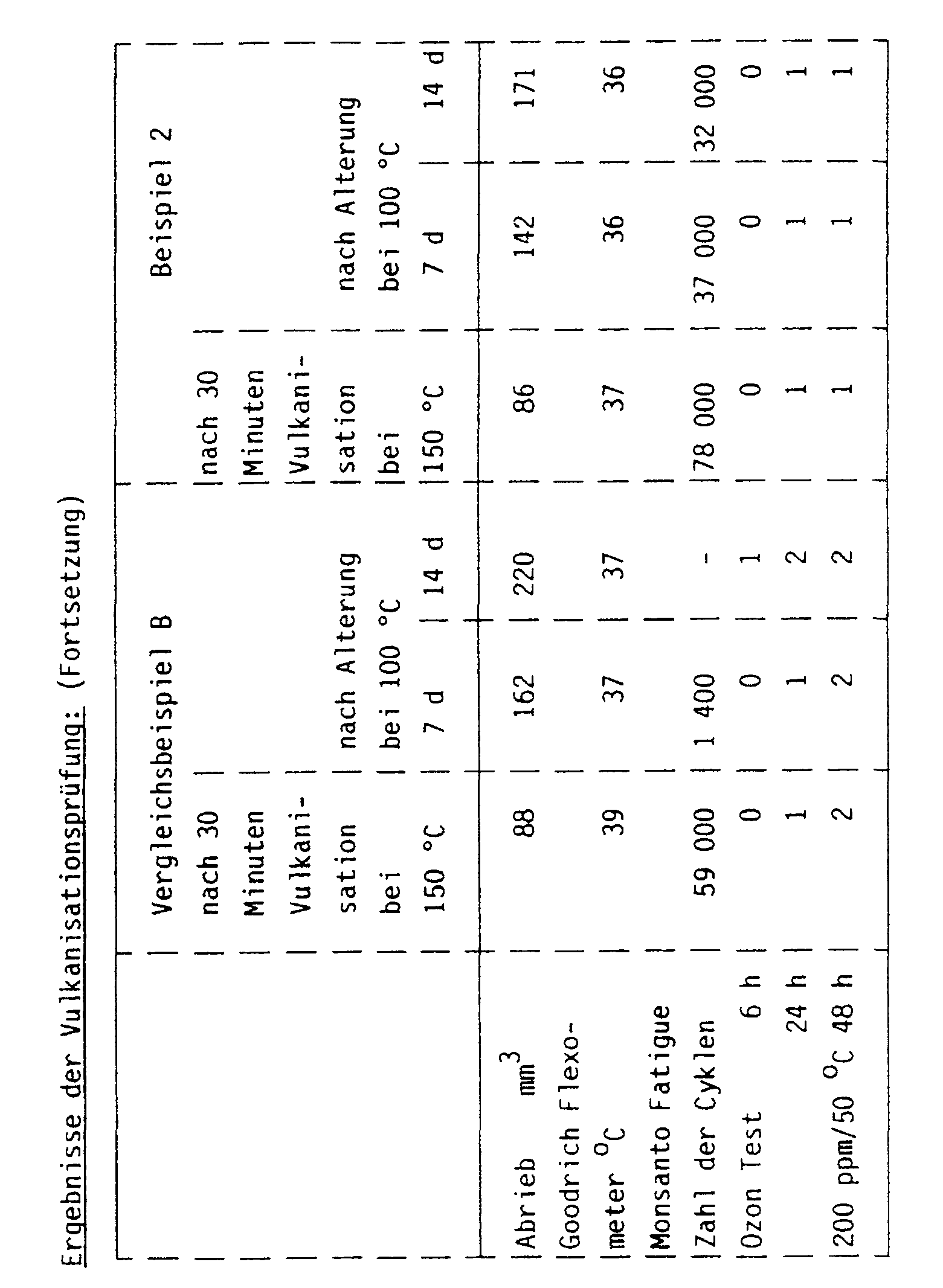
- Mit Hilfe eines Innenmischers vom Typ GK 2 der Firma Werner und Pfleiderer werden bei einer Rotordrehzahl von 50 UpM sowie einer Manteltemperatur von 40 °C folgende Grundmischungen bereitet:

- Dabei erfolgte die Zugabe der Zuschlagstoffe nach 1 Minute Vorlaufzeit des Kautschuks. Die Mischung wird 1 Minute nach überschreiten des Energiemaximums des Rotors ausgestoßen.
- Nach 6stündiger Ablage ungszeit werden auf einem Walzwerk bei einer Walztemperatur von 50 C innerhalb von 5 Minuten die Vernetzungsmittel eingearbeitet.


- Mit Hilfe eines Innenmischers vom Typ GK 2 der Firma Werner und Pflelderer werden bei einer Rotordrehzahl von 50 UpM sowie einer Manteltemperatur von 40 °C folgende Grundmischungen bereitet:

- Dabei erfolgte die Zugabe der Zuschlagstoffe nach 1 Minute Vorlaufzeit des Kautschuks. Die Mischung wird 1 Minute nach überschreiten des Energiemaximums des Rotors ausgestoßen.
- Nach 6stündiger Ablagerungszeit werden auf einem Walzwerk bei einer Walztemperatur von 50 °C innerhalb von 5 Minuten die Vernetzungsmittel eingearbeitet.

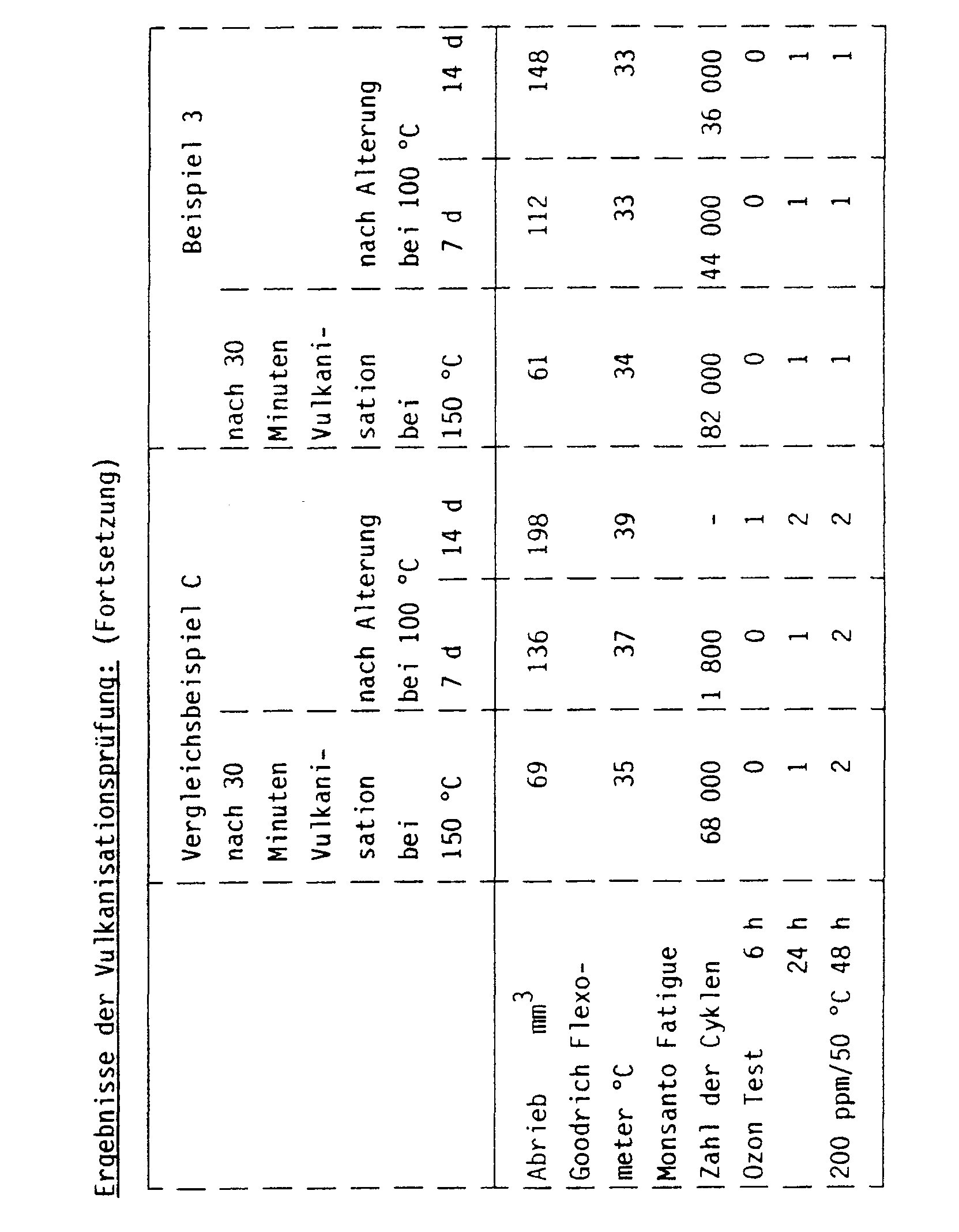
- Mit Hilfe eines Innenmischers vom Typ GK 2 der Firma Werner und Pfleiderer werden bei einer Rotordrehzahl von 50 UpM sowie einer Manteltemperatur von 40 °C folgende Grundmischungen bereitet:

- Dabei erfolgte die Zugabe der Zuschlagstoffe nach 1 Minute Vorlaufzeit des Kautschuks. Die Mischung wird 1 Minute nach überschreiten des Energiemaximums des Rotors ausgestoßen.
- Nach 6stündiger Ablagerungszeit werden auf einem Walzwerk bei einer Walztemperatur von 50 °C innerhalb von 5 Minuten die Vernetzungsmittel eingearbeitet.


Claims (5)
dadurch gekennzeichnet,
daß das Netzwerk durch 1,2-Dithioalkandiyl-Brücken mit 2 bis 6 C-Atomen gebildet wird.
dadurch gekennzeichnet,
daß als Vulkanisationsmittel für die Herstellung der Seitenwandvulkanisate Bisthiocarbamoylverbindungen der allgemeinen Formel

dadurch gekennzeichnet,
daß n die Bedeutung von 2 hat.
dadurch gekennzeichnet,
daß als Vulkanisationsmittel für die Herstellung der Seitenwandvulkanisate 1.2-Bis(N.N-dibenzylthiocar- bamoyldisulfido)-ethan verwendet wird.
Applications Claiming Priority (2)
| Application Number | Priority Date | Filing Date | Title |
|---|---|---|---|
| DE19893941085 DE3941085A1 (de) | 1989-02-28 | 1989-12-13 | Reifenseitenwaende mit erhoehter stabilitaet und verfahren zu ihrer herstellung |
| DE3941085 | 1989-12-13 |
Publications (3)
| Publication Number | Publication Date |
|---|---|
| EP0432405A2 true EP0432405A2 (de) | 1991-06-19 |
| EP0432405A3 EP0432405A3 (en) | 1991-10-30 |
| EP0432405B1 EP0432405B1 (de) | 1995-04-05 |
Family
ID=6395340
Family Applications (1)
| Application Number | Title | Priority Date | Filing Date |
|---|---|---|---|
| EP90119701A Expired - Lifetime EP0432405B1 (de) | 1989-12-13 | 1990-10-15 | Reifenseitenwände mit erhöhter Stabilität und Verfahren zu ihrer Herstellung |
Country Status (5)
| Country | Link |
|---|---|
| EP (1) | EP0432405B1 (de) |
| JP (1) | JP2834585B2 (de) |
| AT (1) | ATE120695T1 (de) |
| DE (1) | DE59008849D1 (de) |
| ES (1) | ES2070237T3 (de) |
Cited By (5)
| Publication number | Priority date | Publication date | Assignee | Title |
|---|---|---|---|---|
| EP0530590A1 (de) * | 1991-08-30 | 1993-03-10 | Hüls Aktiengesellschaft | Verfahren zur Herstellung von Dienkautschuk-Vulkanisaten |
| US6372857B1 (en) | 1999-09-07 | 2002-04-16 | Bayer Aktiengesellschaft | Microgel-containing rubber mixtures with masked bi-functional mercaptans and vulcanization products produced therefrom |
| KR20020037600A (ko) * | 2000-11-15 | 2002-05-22 | 조충환 | 트럭버스용 타이어의 고무 조성물 |
| US6399706B1 (en) | 1999-06-26 | 2002-06-04 | Bayer Aktiengesellschaft | Microgel-containing rubber compounds which comprise sulfur-containing organosilicon compounds |
| US6797780B2 (en) | 2000-11-03 | 2004-09-28 | Rhein Chemie Rheinau Gmbh | Microgel-containing rubber compounds with phosphoryl polysulfides and vulcanizates or shaped articles prepared therefrom |
Families Citing this family (6)
| Publication number | Priority date | Publication date | Assignee | Title |
|---|---|---|---|---|
| WO2001057129A1 (en) * | 2000-02-04 | 2001-08-09 | Bridgestone Corporation | Rubber composition and pneumatic tire made with the same |
| ES2266180T3 (es) * | 2000-03-21 | 2007-03-01 | Flexsys America L.P. | Derivados de pirimidina como estabilizantes de dureza. |
| JP2002144827A (ja) * | 2000-08-31 | 2002-05-22 | Bridgestone Corp | 安全タイヤ |
| US7789119B2 (en) | 2006-10-10 | 2010-09-07 | The Goodyear Tire & Rubber Company | Runflat tire |
| JP5255909B2 (ja) * | 2008-05-27 | 2013-08-07 | 住友ゴム工業株式会社 | ゴム組成物およびランフラットタイヤ |
| JP5563286B2 (ja) * | 2009-12-14 | 2014-07-30 | 住友ゴム工業株式会社 | タイヤ用ゴム組成物及び空気入りタイヤ |
Family Cites Families (2)
| Publication number | Priority date | Publication date | Assignee | Title |
|---|---|---|---|---|
| US3869435A (en) * | 1971-11-19 | 1975-03-04 | Monsanto Co | Method for cross-linking rubber |
| DE59009222D1 (de) * | 1989-02-28 | 1995-07-20 | Huels Chemische Werke Ag | Reifenseitenwände mit erhöhter Stabilität und Verfahren zu ihrer Herstellung. |
-
1990
- 1990-10-15 ES ES90119701T patent/ES2070237T3/es not_active Expired - Lifetime
- 1990-10-15 EP EP90119701A patent/EP0432405B1/de not_active Expired - Lifetime
- 1990-10-15 DE DE59008849T patent/DE59008849D1/de not_active Expired - Fee Related
- 1990-10-15 AT AT90119701T patent/ATE120695T1/de not_active IP Right Cessation
- 1990-12-07 JP JP2400850A patent/JP2834585B2/ja not_active Expired - Fee Related
Cited By (5)
| Publication number | Priority date | Publication date | Assignee | Title |
|---|---|---|---|---|
| EP0530590A1 (de) * | 1991-08-30 | 1993-03-10 | Hüls Aktiengesellschaft | Verfahren zur Herstellung von Dienkautschuk-Vulkanisaten |
| US6399706B1 (en) | 1999-06-26 | 2002-06-04 | Bayer Aktiengesellschaft | Microgel-containing rubber compounds which comprise sulfur-containing organosilicon compounds |
| US6372857B1 (en) | 1999-09-07 | 2002-04-16 | Bayer Aktiengesellschaft | Microgel-containing rubber mixtures with masked bi-functional mercaptans and vulcanization products produced therefrom |
| US6797780B2 (en) | 2000-11-03 | 2004-09-28 | Rhein Chemie Rheinau Gmbh | Microgel-containing rubber compounds with phosphoryl polysulfides and vulcanizates or shaped articles prepared therefrom |
| KR20020037600A (ko) * | 2000-11-15 | 2002-05-22 | 조충환 | 트럭버스용 타이어의 고무 조성물 |
Also Published As
| Publication number | Publication date |
|---|---|
| EP0432405A3 (en) | 1991-10-30 |
| ES2070237T3 (es) | 1995-06-01 |
| JPH0491145A (ja) | 1992-03-24 |
| DE59008849D1 (de) | 1995-05-11 |
| ATE120695T1 (de) | 1995-04-15 |
| JP2834585B2 (ja) | 1998-12-09 |
| EP0432405B1 (de) | 1995-04-05 |
Similar Documents
| Publication | Publication Date | Title |
|---|---|---|
| AT392795B (de) | Form- und vulkanisierbare kautschukmischung | |
| EP2342088B1 (de) | Kautschukmischung für reifen mit verbessertem vulkanisationsmittel | |
| EP0432417B1 (de) | Reifenlaufflächen mit erhöhter Laufleistung und Verfahren zu ihrer Herstellung | |
| EP0530590B1 (de) | Verfahren zur Herstellung von Dienkautschuk-Vulkanisaten | |
| DE60220845T2 (de) | Reifenseitenwand mit verbesserter Biegefestigkeit und Reifenlauffläche mit verbesserter Reissfestigkeit | |
| DE2051243C3 (de) | Gemisch auf der Basis von 1,4 Polybutadien und l,2Dienpolvmerisaten sowie dessen Verwendung | |
| EP0432405B1 (de) | Reifenseitenwände mit erhöhter Stabilität und Verfahren zu ihrer Herstellung | |
| EP1057860A1 (de) | Dienkautschukmischungen für verbesserte Gummi-Formkörper | |
| DE3438290A1 (de) | Bis-(2-ethylamino-4-diethylamino-s-triazin-6- yl)tetrasulfid,verfahren zur herstellung, verwendung und sie enthaltende vulkanisierbare mischungen | |
| DE1570090C3 (de) | Verfahren zur verbesserten S-Vulkanisation von Äthylen-Propylen-Terpolymerisate enthaltenden Elastomerengemischen | |
| EP1120440B1 (de) | Vulkanisationsmittel für ungesättigte Kautschukmischungen | |
| EP1254920A1 (de) | Terpolymere und spezielle Mineralöle enthaltende Kautschukmischungen | |
| EP0747429A1 (de) | Kautschukmischungen enthaltend schwefelhaltige Polyester | |
| EP0385073B1 (de) | Reifenseitenwände mit erhöhter Stabilität und Verfahren zu ihrer Herstellung | |
| EP0385072B1 (de) | Reifenlaufflächen mit erhöhter Laufleistung und Verfahren zu ihrer Herstellung | |
| DE3941085A1 (de) | Reifenseitenwaende mit erhoehter stabilitaet und verfahren zu ihrer herstellung | |
| EP0601303A1 (de) | Polysulfid-Verbindungen und Vulkanisationssysteme | |
| DE1963049C3 (de) | Wärmefeste vulkanisierbare elastomere Polymerisatformmassen | |
| EP0432406A2 (de) | Polysulfidderivate, Verfahren zu ihrer Herstellung und Verwendung zur Vernetzung von Natur- und Synthesekautschuken | |
| EP1589068A1 (de) | Kautschukmischung und Reifen | |
| DE19505354A1 (de) | Verfahren zur Modifizierung von Dienkautschuken | |
| DE4128869A1 (de) | Verfahren zur herstellung von dienkautschuk-vulkanisaten | |
| DE1470874A1 (de) | Verfahren zum Vulkanisieren von russhaltigen Butadien-Styrol-Kautschuk-Mischungen | |
| DE3941118A1 (de) | Reifenlaufflaechen mit erhoehter laufleistung und verfahren zu ihrer herstellung | |
| DE3835198A1 (de) | Verfahren zur herstellung von kautschukvulkanisaten mit verringerten hystereseverlusten und formkoerper aus diesen vulkanisaten |
Legal Events
| Date | Code | Title | Description |
|---|---|---|---|
| PUAI | Public reference made under article 153(3) epc to a published international application that has entered the european phase |
Free format text: ORIGINAL CODE: 0009012 |
|
| 17P | Request for examination filed |
Effective date: 19901217 |
|
| AK | Designated contracting states |
Kind code of ref document: A2 Designated state(s): AT BE CH DE ES FR GB IT LI LU NL SE |
|
| PUAL | Search report despatched |
Free format text: ORIGINAL CODE: 0009013 |
|
| AK | Designated contracting states |
Kind code of ref document: A3 Designated state(s): AT BE CH DE ES FR GB IT LI LU NL SE |
|
| 17Q | First examination report despatched |
Effective date: 19920923 |
|
| GRAA | (expected) grant |
Free format text: ORIGINAL CODE: 0009210 |
|
| AK | Designated contracting states |
Kind code of ref document: B1 Designated state(s): AT BE CH DE ES FR GB IT LI LU NL SE |
|
| REF | Corresponds to: |
Ref document number: 120695 Country of ref document: AT Date of ref document: 19950415 Kind code of ref document: T |
|
| ITF | It: translation for a ep patent filed | ||
| REF | Corresponds to: |
Ref document number: 59008849 Country of ref document: DE Date of ref document: 19950511 |
|
| GBT | Gb: translation of ep patent filed (gb section 77(6)(a)/1977) |
Effective date: 19950419 |
|
| ET | Fr: translation filed | ||
| REG | Reference to a national code |
Ref country code: ES Ref legal event code: FG2A Ref document number: 2070237 Country of ref document: ES Kind code of ref document: T3 |
|
| PLBE | No opposition filed within time limit |
Free format text: ORIGINAL CODE: 0009261 |
|
| STAA | Information on the status of an ep patent application or granted ep patent |
Free format text: STATUS: NO OPPOSITION FILED WITHIN TIME LIMIT |
|
| 26N | No opposition filed | ||
| PGFP | Annual fee paid to national office [announced via postgrant information from national office to epo] |
Ref country code: LU Payment date: 19960901 Year of fee payment: 7 |
|
| PGFP | Annual fee paid to national office [announced via postgrant information from national office to epo] |
Ref country code: SE Payment date: 19960912 Year of fee payment: 7 |
|
| PGFP | Annual fee paid to national office [announced via postgrant information from national office to epo] |
Ref country code: ES Payment date: 19961008 Year of fee payment: 7 |
|
| PGFP | Annual fee paid to national office [announced via postgrant information from national office to epo] |
Ref country code: CH Payment date: 19961023 Year of fee payment: 7 |
|
| PGFP | Annual fee paid to national office [announced via postgrant information from national office to epo] |
Ref country code: BE Payment date: 19961029 Year of fee payment: 7 |
|
| PGFP | Annual fee paid to national office [announced via postgrant information from national office to epo] |
Ref country code: AT Payment date: 19961030 Year of fee payment: 7 |
|
| PGFP | Annual fee paid to national office [announced via postgrant information from national office to epo] |
Ref country code: NL Payment date: 19961031 Year of fee payment: 7 |
|
| REG | Reference to a national code |
Ref country code: CH Ref legal event code: PUE Owner name: HUELS AKTIENGESELLSCHAFT TRANSFER- BAYER AG |
|
| REG | Reference to a national code |
Ref country code: GB Ref legal event code: 732E |
|
| NLS | Nl: assignments of ep-patents |
Owner name: BAYER A.G. |
|
| REG | Reference to a national code |
Ref country code: ES Ref legal event code: PC2A |
|
| REG | Reference to a national code |
Ref country code: FR Ref legal event code: TP |
|
| PG25 | Lapsed in a contracting state [announced via postgrant information from national office to epo] |
Ref country code: LU Free format text: LAPSE BECAUSE OF NON-PAYMENT OF DUE FEES Effective date: 19971015 Ref country code: AT Free format text: LAPSE BECAUSE OF NON-PAYMENT OF DUE FEES Effective date: 19971015 |
|
| PG25 | Lapsed in a contracting state [announced via postgrant information from national office to epo] |
Ref country code: ES Free format text: LAPSE BECAUSE OF THE APPLICANT RENOUNCES Effective date: 19971016 Ref country code: SE Free format text: LAPSE BECAUSE OF NON-PAYMENT OF DUE FEES Effective date: 19971016 |
|
| PG25 | Lapsed in a contracting state [announced via postgrant information from national office to epo] |
Ref country code: BE Free format text: LAPSE BECAUSE OF NON-PAYMENT OF DUE FEES Effective date: 19971031 Ref country code: LI Free format text: LAPSE BECAUSE OF NON-PAYMENT OF DUE FEES Effective date: 19971031 Ref country code: CH Free format text: LAPSE BECAUSE OF NON-PAYMENT OF DUE FEES Effective date: 19971031 |
|
| BERE | Be: lapsed |
Owner name: BAYER A.G. Effective date: 19971031 |
|
| PG25 | Lapsed in a contracting state [announced via postgrant information from national office to epo] |
Ref country code: NL Free format text: LAPSE BECAUSE OF NON-PAYMENT OF DUE FEES Effective date: 19980501 |
|
| REG | Reference to a national code |
Ref country code: CH Ref legal event code: PL |
|
| NLV4 | Nl: lapsed or anulled due to non-payment of the annual fee |
Effective date: 19980501 |
|
| EUG | Se: european patent has lapsed |
Ref document number: 90119701.2 |
|
| REG | Reference to a national code |
Ref country code: ES Ref legal event code: FD2A Effective date: 20001102 |
|
| REG | Reference to a national code |
Ref country code: GB Ref legal event code: IF02 |
|
| PGFP | Annual fee paid to national office [announced via postgrant information from national office to epo] |
Ref country code: FR Payment date: 20051010 Year of fee payment: 16 |
|
| PGFP | Annual fee paid to national office [announced via postgrant information from national office to epo] |
Ref country code: GB Payment date: 20051012 Year of fee payment: 16 |
|
| PGFP | Annual fee paid to national office [announced via postgrant information from national office to epo] |
Ref country code: DE Payment date: 20051014 Year of fee payment: 16 |
|
| PGFP | Annual fee paid to national office [announced via postgrant information from national office to epo] |
Ref country code: IT Payment date: 20061031 Year of fee payment: 17 |
|
| PG25 | Lapsed in a contracting state [announced via postgrant information from national office to epo] |
Ref country code: DE Free format text: LAPSE BECAUSE OF NON-PAYMENT OF DUE FEES Effective date: 20070501 |
|
| GBPC | Gb: european patent ceased through non-payment of renewal fee |
Effective date: 20061015 |
|
| REG | Reference to a national code |
Ref country code: FR Ref legal event code: ST Effective date: 20070629 |
|
| PG25 | Lapsed in a contracting state [announced via postgrant information from national office to epo] |
Ref country code: GB Free format text: LAPSE BECAUSE OF NON-PAYMENT OF DUE FEES Effective date: 20061015 |
|
| PG25 | Lapsed in a contracting state [announced via postgrant information from national office to epo] |
Ref country code: FR Free format text: LAPSE BECAUSE OF NON-PAYMENT OF DUE FEES Effective date: 20061031 |
|
| PG25 | Lapsed in a contracting state [announced via postgrant information from national office to epo] |
Ref country code: IT Free format text: LAPSE BECAUSE OF NON-PAYMENT OF DUE FEES Effective date: 20071015 |