EP0432959A2 - Stangensieb mit Kratzer - Google Patents
Stangensieb mit Kratzer Download PDFInfo
- Publication number
- EP0432959A2 EP0432959A2 EP90313194A EP90313194A EP0432959A2 EP 0432959 A2 EP0432959 A2 EP 0432959A2 EP 90313194 A EP90313194 A EP 90313194A EP 90313194 A EP90313194 A EP 90313194A EP 0432959 A2 EP0432959 A2 EP 0432959A2
- Authority
- EP
- European Patent Office
- Prior art keywords
- rake
- screen
- bars
- solids
- during
- Prior art date
- Legal status (The legal status is an assumption and is not a legal conclusion. Google has not performed a legal analysis and makes no representation as to the accuracy of the status listed.)
- Withdrawn
Links
- 238000012216 screening Methods 0.000 title description 5
- 239000007787 solid Substances 0.000 claims abstract description 51
- 239000007788 liquid Substances 0.000 claims abstract description 26
- 238000011144 upstream manufacturing Methods 0.000 claims description 8
- 230000001154 acute effect Effects 0.000 claims description 2
- 239000012530 fluid Substances 0.000 claims 1
- 239000011343 solid material Substances 0.000 description 5
- 238000010276 construction Methods 0.000 description 4
- 238000012545 processing Methods 0.000 description 3
- 238000013459 approach Methods 0.000 description 2
- 238000012423 maintenance Methods 0.000 description 2
- 238000000034 method Methods 0.000 description 2
- 238000012986 modification Methods 0.000 description 2
- 230000004048 modification Effects 0.000 description 2
- 238000012546 transfer Methods 0.000 description 2
- 238000009825 accumulation Methods 0.000 description 1
- 239000012141 concentrate Substances 0.000 description 1
- 235000013399 edible fruits Nutrition 0.000 description 1
- 230000000694 effects Effects 0.000 description 1
- 238000010616 electrical installation Methods 0.000 description 1
- 235000013305 food Nutrition 0.000 description 1
- 230000005484 gravity Effects 0.000 description 1
- 231100001261 hazardous Toxicity 0.000 description 1
- 239000000463 material Substances 0.000 description 1
- 238000005096 rolling process Methods 0.000 description 1
- 238000000926 separation method Methods 0.000 description 1
- 230000035939 shock Effects 0.000 description 1
- 235000013311 vegetables Nutrition 0.000 description 1
- 238000005406 washing Methods 0.000 description 1
- 239000002699 waste material Substances 0.000 description 1
- 238000004065 wastewater treatment Methods 0.000 description 1
Images


Classifications
-
- E—FIXED CONSTRUCTIONS
- E02—HYDRAULIC ENGINEERING; FOUNDATIONS; SOIL SHIFTING
- E02B—HYDRAULIC ENGINEERING
- E02B8/00—Details of barrages or weirs ; Energy dissipating devices carried by lock or dry-dock gates
- E02B8/02—Sediment base gates; Sand sluices; Structures for retaining arresting waterborne material
- E02B8/023—Arresting devices for waterborne materials
- E02B8/026—Cleaning devices
-
- B—PERFORMING OPERATIONS; TRANSPORTING
- B01—PHYSICAL OR CHEMICAL PROCESSES OR APPARATUS IN GENERAL
- B01D—SEPARATION
- B01D29/00—Filters with filtering elements stationary during filtration, e.g. pressure or suction filters, not covered by groups B01D24/00 - B01D27/00; Filtering elements therefor
- B01D29/01—Filters with filtering elements stationary during filtration, e.g. pressure or suction filters, not covered by groups B01D24/00 - B01D27/00; Filtering elements therefor with flat filtering elements
- B01D29/03—Filters with filtering elements stationary during filtration, e.g. pressure or suction filters, not covered by groups B01D24/00 - B01D27/00; Filtering elements therefor with flat filtering elements self-supporting
-
- B—PERFORMING OPERATIONS; TRANSPORTING
- B01—PHYSICAL OR CHEMICAL PROCESSES OR APPARATUS IN GENERAL
- B01D—SEPARATION
- B01D29/00—Filters with filtering elements stationary during filtration, e.g. pressure or suction filters, not covered by groups B01D24/00 - B01D27/00; Filtering elements therefor
- B01D29/44—Edge filtering elements, i.e. using contiguous impervious surfaces
- B01D29/445—Bar screens
-
- B—PERFORMING OPERATIONS; TRANSPORTING
- B01—PHYSICAL OR CHEMICAL PROCESSES OR APPARATUS IN GENERAL
- B01D—SEPARATION
- B01D29/00—Filters with filtering elements stationary during filtration, e.g. pressure or suction filters, not covered by groups B01D24/00 - B01D27/00; Filtering elements therefor
- B01D29/62—Regenerating the filter material in the filter
- B01D29/64—Regenerating the filter material in the filter by scrapers, brushes, nozzles, or the like, acting on the cake side of the filtering element
- B01D29/6469—Regenerating the filter material in the filter by scrapers, brushes, nozzles, or the like, acting on the cake side of the filtering element scrapers
- B01D29/6484—Regenerating the filter material in the filter by scrapers, brushes, nozzles, or the like, acting on the cake side of the filtering element scrapers with a translatory movement with respect to the filtering element
Definitions
- the present invention relates generally to an apparatus for removing solids from liquid flow streams, and more particularly, to an improved screen and rake apparatus for such purpose.
- Screening devices commonly are used for removing solids from liquid flow streams, such as in waste water treatment systems, food processing lines, and the like.
- Such devices include a bar screen disposed in the liquid flow stream for screening solids and debris from the flow stream and a rake that is cyclically operated for removing the accumulated materials from the screen.
- the screen typically comprises a plurality of closely-spaced bars and the rake includes similarly-spaced teeth-like projections adapted for close interfitting relation between the bars.
- Another object is to provide a solids-removing apparatus as characterized above in which the rake is adapted for effectively removing accumulated solids from the bar screen without binding or undesirable wear of the rake projections and the bars of the screen.
- a further object is to provide a bar screen and rake apparatus of the above kind that is adapted to maintain a predetermined, relatively close spatial relation between the rake projections and bar screen during the raking stroke for effecting substantially complete removal of accumulated solids from the screen without substantial contact therebetween.
- Still another object is to provide a bar screen and rake apparatus of the foregoing type in which the rake is automatically moved outwardly in an arched path from the bar screen during the downward or return stroke of the rake for permitting more efficient and complete engagement and lifting of masses of solid materials that accumulate near the bottom of the flow channel and bar screen.
- Yet another object is to provide a bar screen and rake apparatus of such type which is selectively adaptable for the particular environment within which it is to be used.
- Another object is to provide such a bar screen and rake apparatus which is relatively simple and economical in construction and is adapted for more efficient, dependable, and maintenance free operation.
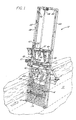
- FIGURE 1 is a perspective of an illustrated bar screen and rake apparatus embodying the present invention disposed in a liquid flow stream;
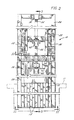
- FIG. 2 is a front elevational view of the illustrated bar screen and rake apparatus;
- FIG. 3 is a vertical section of the illustrated apparatus taken in the plane of line 3-3 in FIG. 2;
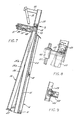
- FIGS. 4-7 are vertical sections, similar to FIG. 3, illustrating operation of the rake of the illustrated apparatus;
- FIG. 8 is an enlarged fragmentary section taken in the plane of line 8-8 in FIG. 7;
- FIG. 9 is a fragmentary section taken in the plane of line 9-9 in FIG. 8;
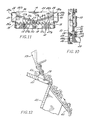
- FIG. 10 is a fragmentary section taken in the plane of line 10-10 in FIG. 2;
- FIG. 11 is a bottom end view of the illustrated bar screen taken in the plane of line 11-11 in FIG. 2; and
- FIG. 12 is a vertical section depicting operation of the wiper device for removing accumulated solids from the rake of the illustrated apparatus.
- a solids removal apparatus 10 embodying the present invention, which is disposed in a flow channel 11 through which a liquid flow stream is passing in the direction of the arrow (FIG. 1).
- the illustrated flow stream may be part of a waste treatment system, a fruit or vegetable washing or processing operation, or other processing line in which the stream carries solid materials that must be separated and removed from the liquid.
- the apparatus 10 comprises a bar screen 12 for separating solids from the moving liquid flow stream and a rake 14 for removing solids that accumulate on the bar screen 12 as a result of the screening process.
- the bar screen 12 may be of a type disclosed in applicant's aforesaid U.S. Patent No. 4,792,394, the disclosure of which is incorporated herein by reference.
- the illustrated bar screen 12 consists of a plurality of flat bars 15 (FIG. 11) disposed in closely-spaced parallel relation between upper and lower support bars 16, 18 (FIG. 3) for defining a plurality of narrow, elongated flow openings therebetween.
- the bar screen 12 is mounted on a pair of support rails 19 in the flow stream, which in turn are affixed to the rear side of a respective pair of upstanding channels 20 disposed on opposite sides of the bar screen 12 (FIGS. 1 and 11).
- the channels 20 in this instance have openings 20 a in opposed relation to each other.
- the bar screen 12 and support channels 20 lie in parallel inclined planes with their upper ends slanted slightly in the downstream direction.
- a dead plate 22 is mounted between the channels 20 immediately above the screen 12 for the purpose of preventing solids from dropping on the downstream side of the screen 12 during the raking and removal process, as will become apparent.
- the bars 15 of the screen 12 each have an upstream relatively flat face 15a disposed at an acute angle ⁇ with respect to the longitudinal axis of the flow channel at the point in which the screen 12 is mounted, and hence, with respect to the direction of travel of the liquid flow stream.
- the leading edge 15 b of one bar is in substantial longitudinal alignment with the trailing edge 15 c of the adjacent bar.
- the rake 14 For removing solids that accumulate on the bar screen 12, the rake 14 includes a lifting plate 25 formed with a series of projections 27 designed for cooperative positioning with respect to the bars 15 (FIG. 11).
- the lifting plate 25 is connected between the lower ends of a pair of upwardly extending linking arms 26, the upper ends of which are connected by a cross brace 28 and supported for translational movement in the channels 20 by a pair of rollers 29.
- the linking arms 26 in this case are L-shaped angles, each having one leg 26 a disposed in a vertical plane adjacent the side of the lifting plate 25 and a second right angle leg 26 b extending inwardly therefrom.
- Opposite ends of the lifting plate 25 are bolted to a respective securement plate 30, which in turn is welded to the linking arm 26 (FIG. 11).
- the rake projections 27 are generally V-shaped, each having a first slanted edge or side 27 a with a slope corresponding to the angle of the upstream faces 15 a of the bars 15 so as to permit positioning of the rake edges 27 a into closely adjacent relation to the upstream faces 15 a of the respective bars.
- the other edge or side 27 b of each projection 27 is substantially vertically oriented. Such arrangement permits positioning of the rake projections 27 between the slanted bars 15 of the screen 12, as depicted in FIG. 11, so that when the rake is moved longitudinally along the bars of the screen, it effectively removes solid materials that have accumulated or are adhering to the surfaces of the bars.
- a ball screw drive 35 For operating the rake 14 during the raking stroke to effect removal of the accumulated solids on the screen 12, a ball screw drive 35 is provided.
- the ball screw 35 is rotatably supported at its upper end by a bearing 36 mounted on a cross brace 38 extending between the upstanding channels 20.
- the ball screw 35 is adapted for operative engagement with a ball nut 40 mounted on the cross brace 28 of the rake 14.
- the lower end thereof is connected through a coupler 41 to a hydraulic motor 42 mounted on a cross brace 44 also connected between the support channels 20. While the hydraulic motor 42 is shown as being connected to the lower end of the ball screw 35, it will be understood that alternatively it could drive the upper end of the screw.
- means are provided for selectively positioning and maintaining the rake projections in predetermined spaced relation to the bars of the screen throughout its upward movement during a raking stroke for preventing continued direct contact therebetween in order to minimize wear and prevent binding.
- movement of the link arms 26 of the rake 14 are guided between respective pairs of guide rollers 48, 49, each being mounted on a hydraulic cylinder 50 located adjacent one side of the rake 14 intermediate the upper and lower ends thereof.
- a support channel 51 is affixed in forwardly extending relation to each of the support channels 20 on the upstream side thereof.
- Each hydraulic cylinder 50 has one end bolted or otherwise affixed to a forward end of the channel 51 and includes a selectively actuatable cylinder rod 52 extending from the other end.
- the rod 52 of each cylinder carries a respective pair of the rollers 48, 49 in closely adjacent relation to each other for receiving therebetween and guiding movement of the inwardly turned leg 26 b of the respective link arm 26.
- the pairs of rollers 48, 49 in this case each are connected to the cylinder rod 52 by an L-shaped flange 54 that is selectively positionable on an end of the rod 52.
- the rollers 48, 49 can be located so as to guide movement of the rake 14, and hence the lifting plate 25 thereof, relative to the screen 12 so that the rake projections 27 are maintained in relatively closely spaced relation to the bars 15 of the screen during the upward raking stroke (FIGS. 3 and 4).
- the projections 27 may be maintained with relatively small spacing, such as a separation of between about .005 to .020 inches between the inclined edges 27 a of the rake projections and the adjacent upstream faces 15 a of the bars.
- Such spacing has been found to enable substantially complete removal of solids from the screen during the raking stroke, including even relatively fine gauge paper and the like having thicknesses as low as .006 inches, while preventing continued contact, engagement or binding between the projections and the bars. Occasional contact that might occur between one or more of the teeth and the bars of the screen due to turbulence about the screen or debris striking the rake is limited and does not result in significant wear.
- a wiper blade 58 is provided adjacent to desired discharge location, as best shown in FIGS. 3, 4 and 12.
- the wiper blade 58 is supported at opposed ends by arms 59 pivotally mounted on supports 60 extending forwardly of the channels 20.
- the wiper blade 58 and arms 59 normally are located in a downwardly pivoted or inactive position (FIG. 3).
- an appropriate return spring may be provided for urging the arms to such inactive position.
- a downwardly inclined guide plate 62 in this instance is mounted at the upper end of the dead plate 22 for directing the ejected solids (FIG. 12).
- the rake 14 Upon lowering of the rake 14 at the commencement of the return stroke through operation of the hydraulic motor 42 in the reverse direction, the rake will pivot 14 in a clockwise direction to its original position, shown in FIG. 3, by gravity.
- means are provided during the downward or return movement of the rake for pivoting the rake outwardly away from the screen, and thus, moving the lifting plate thereof progressively outwardly in an arced path for permitting more efficient engagement of debris which concentrates near the bottom of the screen.
- a switch 65 mounted on one of the support channels 20 is engaged by the rake 14 during downward movement, and in response thereto, the hydraulic cylinders 50 are actuated to retract their cylinder rods 52 and thereby pivot the rake 14 about the upper rollers 29 away from the screen 12 in the upstream direction.
- the lower end of the rake 14 comprises only the lifting plate 25, without support rollers, it is relatively light in weight, and as a result, can be positioned relative to the screen 12 through actuation of the hydraulic cylinders 50 with relative ease. Because the pivot angle between the rake 14 and screen 12 increases during downward movement of the rake, the lower end of the rake is moved in a progressively widening arc so as to move around masses of solid materials and debris which accumulate near the bottom of the rake.
- the hydraulic cylinders 50 may be actuated in the reverse direction to extend the rods 52 and move the lower end of the rake to a ready position for the next raking stroke in closely spaced relation to the screen 14. It will be appreciated that hydraulic actuation of the rake 14, motor 42 and the pivoting hydraulic cylinders 50 permits relatively smooth movement of the rake 14 without sudden shock.
- the hydraulic pump for the motor 42 and pivoting cylinders 50 also may be remotely located so as to eliminate potentially hazardous electrical installations near the flow stream.
- the rake 14 In operation of the solids removal apparatus 10, prior to commencement of the upward raking stroke, the rake 14 will be located in a ready position near the bottom of the screen 12 with the rake projections 27 in closely spaced relation to the bars 15 of the screen 12 as established by the extended position of the hydraulic cylinder rods 52 and the rollers 48, 49 carried thereby. Operation of the hydraulic motor 42 will raise the rake 14, causing the lifting plate 25 thereof to engage and remove solids accumulated on the screen 12. Since the pivoting cylinder rollers 48, 49 guide lifting movement of the rake 14, the rake projections 27 may be maintained in relatively closely spaced relation to the bars 15 of the screen during the raking stroke so as to prevent continued contact therebetween, and thereby, prevent excessive wear.
- the switch 47 Upon reaching the end of the return stroke, the switch 47 is actuated to terminate operation of the hydraulic motor 42 and cause the pivoting hydraulic cylinders 50 to move their cylinder rods 52 and the rollers 48, 49 carried thereby to their extended position returning the rake 14 to its ready position in closely adjacent relation to the screen 12.
- the frequency of operation of the rake 14 can be controlled automatically by known means, depending upon the levels and the type and content of solids in the liquid flow stream.
- the operation of the rake 14 is also easily adaptable for field adjustment.
- An override switch also may be provided to interrupt the raking stroke in the event an obstruction or excessive load is incurred during the raking stroke, or alternatively, to actuate the positioning cylinders 50 to move the rake 14 away from the screen 12 to permit clearance of the obstruction.
- the bar screen and rake apparatus of the present invention is adaptable for more effective and complete removal of solids from liquid flow streams. This is effected without continued contact between the rake projections and bar screen, and hence, without binding or excessive wear to the rake projections and the bars. Moreover, on the downward return stroke of the rake, the lifting plate is automatically moved in an outwardly arced path from the bar screen for permitting complete engagement of solids accumulating near the bottom of the screen.
- the bar screen and rake apparatus also is relatively simple and economical in construction, is adapted for efficient, dependable and maintenance free operation, and lends itself to selected adaptability for the particular environment within which it is to be used.
Landscapes
- Chemical & Material Sciences (AREA)
- Chemical Kinetics & Catalysis (AREA)
- Engineering & Computer Science (AREA)
- General Engineering & Computer Science (AREA)
- Mechanical Engineering (AREA)
- Civil Engineering (AREA)
- Structural Engineering (AREA)
- Filtration Of Liquid (AREA)
Applications Claiming Priority (2)
| Application Number | Priority Date | Filing Date | Title |
|---|---|---|---|
| US451202 | 1989-12-14 | ||
| US07/451,202 US5032263A (en) | 1989-12-14 | 1989-12-14 | Bar screen and rake apparatus |
Publications (2)
| Publication Number | Publication Date |
|---|---|
| EP0432959A2 true EP0432959A2 (de) | 1991-06-19 |
| EP0432959A3 EP0432959A3 (en) | 1991-10-30 |
Family
ID=23791221
Family Applications (1)
| Application Number | Title | Priority Date | Filing Date |
|---|---|---|---|
| EP19900313194 Withdrawn EP0432959A3 (en) | 1989-12-14 | 1990-12-05 | Bar screening apparatus with improved rake |
Country Status (5)
| Country | Link |
|---|---|
| US (1) | US5032263A (de) |
| EP (1) | EP0432959A3 (de) |
| JP (1) | JPH04118411A (de) |
| CA (1) | CA2031794A1 (de) |
| PL (1) | PL288246A1 (de) |
Cited By (2)
| Publication number | Priority date | Publication date | Assignee | Title |
|---|---|---|---|---|
| FR2678521A1 (fr) * | 1991-07-05 | 1993-01-08 | Huarte Frances Domingo | Dispositif pour le nettoyage de grilles filtrantes dans des courants d'eau. |
| WO1998050132A1 (en) * | 1997-05-06 | 1998-11-12 | Seidl, Gerald | Bar screen with rotating rakes |
Families Citing this family (14)
| Publication number | Priority date | Publication date | Assignee | Title |
|---|---|---|---|---|
| US5246573A (en) * | 1991-06-28 | 1993-09-21 | Fmc Corporation | Cog rake bar screen |
| US5534140A (en) * | 1994-03-17 | 1996-07-09 | Envirex, Inc. | Bar screen having compound fine screen bar rack |
| US5730862A (en) * | 1994-10-17 | 1998-03-24 | Mahr; Gernot | Bar screen with rotating rakes |
| US5968350A (en) * | 1998-07-15 | 1999-10-19 | Carold Breton | Device for cleaning trash racks |
| US6719912B2 (en) * | 2001-02-21 | 2004-04-13 | Headworks, Inc. | Bar screen system with emergency discharge doors |
| NZ513379A (en) * | 2001-08-07 | 2004-03-26 | Power Glides Screens Ltd | Suspension screen raking system (NO.2) |
| AU2002343509A1 (en) * | 2001-10-12 | 2003-04-22 | Enviro-Care Company | Debris removal system |
| AU2003277140A1 (en) * | 2002-09-28 | 2004-04-19 | Enviro-Care Company, Inc. | Debris removal and method of using same |
| US7220361B2 (en) * | 2003-08-11 | 2007-05-22 | Headworks, Inc. | Torque-limited drive system, method, and apparatus for a fluid screening system |
| US7147784B2 (en) * | 2003-08-11 | 2006-12-12 | Headworks, Inc. | Hydraulic or pneumatic drive system, method, and apparatus for a fluid screening system |
| WO2008035990A2 (en) * | 2006-09-19 | 2008-03-27 | Power-Glides Screens Limited | Screening apparatus |
| US20100320158A1 (en) * | 2009-06-19 | 2010-12-23 | Brian Mahas | Separator separating chips and other material from coolant and method |
| US11633680B2 (en) * | 2020-07-23 | 2023-04-25 | Parkson Corporation | Bar screen filter apparatus and method |
| ES2909464B2 (es) * | 2020-11-05 | 2023-02-20 | Deyma La Mancha S L | Dispositivo de desbaste en pozos de gruesos, de una estación depuradora de aguas residuales |
Family Cites Families (18)
| Publication number | Priority date | Publication date | Assignee | Title |
|---|---|---|---|---|
| DE133221C (de) * | ||||
| CH42141A (de) * | 1907-10-26 | 1909-01-02 | Wilhelm Horstmeier | Einrichtung zur Abscheidung von in Wasserläufen mitgeführten festen Körpern |
| GB190816059A (en) * | 1908-07-29 | 1909-02-25 | Elijah Sutcliffe Law | Improved Apparatus for Clearing the Screens Employed in Sewage Works. |
| US2033653A (en) * | 1933-06-08 | 1936-03-10 | Schlapak Rudolph | Sluice rack cleaner |
| US2335573A (en) * | 1940-09-21 | 1943-11-30 | Dorr Co | Bar screen cleaning mechanism |
| FR2350433A1 (fr) * | 1976-05-07 | 1977-12-02 | Pous Georges | Dispositif de nettoyage pour une grille de retenue des dechets a l'entree d'un ouvrage hydraulique |
| FR2398026A1 (fr) * | 1977-07-19 | 1979-02-16 | Menard Jacques | Degrilleur automatique |
| SU685750A1 (ru) * | 1977-08-08 | 1979-09-15 | Кубанский Государственный Проектный И Научно-Исследовательский Институт "Кубаньгипроводхоз" | Устройство дл очистки вертикальной сороудерживающей решетки |
| US4472273A (en) * | 1978-11-20 | 1984-09-18 | Tadashi Hagihara | Filter lift system |
| US4265750A (en) * | 1979-08-01 | 1981-05-05 | Gabriel Meunier | Bar screen filtering device |
| FR2474897A1 (fr) * | 1980-02-06 | 1981-08-07 | Perrier Materiel | Dispositif pour reduire l'usure des dents de degrilleur |
| US4289619A (en) * | 1980-08-11 | 1981-09-15 | Sampson Milo J | Material handling apparatus |
| US4792394A (en) * | 1985-10-04 | 1988-12-20 | Rudz Enterprises, Inc. | Bar screening apparatus |
| US4725366A (en) * | 1986-04-21 | 1988-02-16 | Dresser Industries, Inc. | Rake movement speed control |
| US4780199A (en) * | 1987-09-23 | 1988-10-25 | Ezzell John E | Bar screen cleaner |
| US4851114A (en) * | 1988-02-10 | 1989-07-25 | Minichello Joseph R | Cleaning apparatus for bar screen |
| US4857182A (en) * | 1988-03-16 | 1989-08-15 | Infilico Degremont Inc. | Protection devices for bar screens |
| US4917796A (en) * | 1988-09-01 | 1990-04-17 | Rudz Enterprises, Inc. | Lift with automated dump |
-
1989
- 1989-12-14 US US07/451,202 patent/US5032263A/en not_active Expired - Lifetime
-
1990
- 1990-12-05 EP EP19900313194 patent/EP0432959A3/en not_active Withdrawn
- 1990-12-07 CA CA002031794A patent/CA2031794A1/en not_active Abandoned
- 1990-12-13 PL PL28824690A patent/PL288246A1/xx unknown
- 1990-12-14 JP JP2402502A patent/JPH04118411A/ja active Pending
Cited By (2)
| Publication number | Priority date | Publication date | Assignee | Title |
|---|---|---|---|---|
| FR2678521A1 (fr) * | 1991-07-05 | 1993-01-08 | Huarte Frances Domingo | Dispositif pour le nettoyage de grilles filtrantes dans des courants d'eau. |
| WO1998050132A1 (en) * | 1997-05-06 | 1998-11-12 | Seidl, Gerald | Bar screen with rotating rakes |
Also Published As
| Publication number | Publication date |
|---|---|
| PL288246A1 (en) | 1991-10-07 |
| CA2031794A1 (en) | 1991-06-15 |
| EP0432959A3 (en) | 1991-10-30 |
| JPH04118411A (ja) | 1992-04-20 |
| US5032263A (en) | 1991-07-16 |
Similar Documents
| Publication | Publication Date | Title |
|---|---|---|
| US5032263A (en) | Bar screen and rake apparatus | |
| US4792394A (en) | Bar screening apparatus | |
| US5571406A (en) | Roving bar screen | |
| US4780199A (en) | Bar screen cleaner | |
| US5032262A (en) | Device in rinsing screens | |
| CA2277087A1 (en) | Gravity screen with burden removal and pore-cleaning means | |
| WO1998030311A9 (en) | Gravity screen with burden removal and pore-cleaning means | |
| US5051174A (en) | Bar screen rake apparatus | |
| US6896820B2 (en) | Debris removal system | |
| US2963156A (en) | Method of and apparatus for cleaning screens | |
| WO2008035990A9 (en) | Screening apparatus | |
| US4055497A (en) | Hold-down mechanism for scraper conveyor and settling tank | |
| US7481920B2 (en) | Fine-screened grid | |
| EP0076240A1 (de) | Einrichtung für längliche Absetzbecken | |
| US4857193A (en) | Floating chicane system for liquid-solid separation equipment | |
| US7207431B1 (en) | Conveyor belt drip pan assembly | |
| AU599051B2 (en) | Improved bar screening apparatus | |
| JP2002504637A (ja) | 分離グリッド | |
| US20050000884A1 (en) | Suspension screen raking system | |
| KR950003409B1 (ko) | 바아스크리닝장치 | |
| DE19535901C1 (de) | Verfahren zum störungsfreien Reinigen von Stabrechen | |
| RU2059050C1 (ru) | Устройство для очистки от твердых включений потока сточных вод в каналах | |
| GB2044624A (en) | Skip raked bar screen | |
| KR102859837B1 (ko) | 낙하물 제거수단을 갖는 컨베이어 장치 | |
| CN219839109U (zh) | 一种银耳多糖刮板式自动收料系统 |
Legal Events
| Date | Code | Title | Description |
|---|---|---|---|
| PUAI | Public reference made under article 153(3) epc to a published international application that has entered the european phase |
Free format text: ORIGINAL CODE: 0009012 |
|
| AK | Designated contracting states |
Kind code of ref document: A2 Designated state(s): DE ES FR GB IT NL |
|
| PUAL | Search report despatched |
Free format text: ORIGINAL CODE: 0009013 |
|
| AK | Designated contracting states |
Kind code of ref document: A3 Designated state(s): DE ES FR GB IT NL |
|
| 17P | Request for examination filed |
Effective date: 19920424 |
|
| STAA | Information on the status of an ep patent application or granted ep patent |
Free format text: STATUS: THE APPLICATION HAS BEEN WITHDRAWN |
|
| 18W | Application withdrawn |
Withdrawal date: 19930115 |