EP0433049A2 - Système indicateur à plusieurs positions - Google Patents
Système indicateur à plusieurs positions Download PDFInfo
- Publication number
- EP0433049A2 EP0433049A2 EP90313527A EP90313527A EP0433049A2 EP 0433049 A2 EP0433049 A2 EP 0433049A2 EP 90313527 A EP90313527 A EP 90313527A EP 90313527 A EP90313527 A EP 90313527A EP 0433049 A2 EP0433049 A2 EP 0433049A2
- Authority
- EP
- European Patent Office
- Prior art keywords
- multistation
- languages
- unit
- active
- passive
- Prior art date
- Legal status (The legal status is an assumption and is not a legal conclusion. Google has not performed a legal analysis and makes no representation as to the accuracy of the status listed.)
- Withdrawn
Links
Images

Classifications
-
- G—PHYSICS
- G08—SIGNALLING
- G08B—SIGNALLING SYSTEMS, e.g. PERSONAL CALLING SYSTEMS; ORDER TELEGRAPHS; ALARM SYSTEMS
- G08B5/00—Visible signalling systems, e.g. visible personal calling systems or remote indication of seats occupied
- G08B5/22—Visible signalling systems, e.g. visible personal calling systems or remote indication of seats occupied using electric transmission; using electromagnetic transmission
- G08B5/36—Visible signalling systems, e.g. visible personal calling systems or remote indication of seats occupied using electric transmission; using electromagnetic transmission using visible light sources
-
- H—ELECTRICITY
- H04—ELECTRIC COMMUNICATION TECHNIQUE
- H04M—TELEPHONIC COMMUNICATION
- H04M3/00—Automatic or semi-automatic exchanges
- H04M3/42—Systems providing special services or facilities to subscribers
- H04M3/56—Arrangements for connecting several subscribers to a common circuit, i.e. affording conference facilities
- H04M3/568—Arrangements for connecting several subscribers to a common circuit, i.e. affording conference facilities audio processing specific to telephonic conferencing, e.g. spatial distribution, mixing of participants
-
- H—ELECTRICITY
- H04—ELECTRIC COMMUNICATION TECHNIQUE
- H04M—TELEPHONIC COMMUNICATION
- H04M2203/00—Aspects of automatic or semi-automatic exchanges
- H04M2203/25—Aspects of automatic or semi-automatic exchanges related to user interface aspects of the telephonic communication service
- H04M2203/251—Aspects of automatic or semi-automatic exchanges related to user interface aspects of the telephonic communication service where a voice mode or a visual mode can be used interchangeably
- H04M2203/252—Aspects of automatic or semi-automatic exchanges related to user interface aspects of the telephonic communication service where a voice mode or a visual mode can be used interchangeably where a voice mode is enhanced with visual information
Definitions
- This invention relates to a multistation indicator system more particularly but not exclusively to a relay indicator system for use by simultaneous language interpreters at international conferences where a large number of languages require to be interpreted.
- 'relay' is used to indicate that the 'passive' language i.e. the language which is being interpreted may be relayed from an 'active' language i.e. the language in which it is being interpreted to another 'active' language. For example, if the passive language is Dutch this may be interpreted into English or French and a German interpreter who does not know Dutch can relay from either English or French into German to enable the German listener to follow the speech in Dutch.
- An aim of the present invention is to overcome the above described disadvantages and provide a multistation indicator system which shows the current availability and location of interpreters of each language.
- a multistation indicator system comprising a plurality of multistation display units with a visual display for each station, each unit being connected to the other units in the system, a power supply to each unit to activate the visual displays of the various stations and switching means associated with each display unit to indicate which stations of the multistations are active.
- the stations of the multistation unit are identified along two axes of the unit i.e. an 'x' and 'y' axis with the names of 'passive' and 'active' languages.
- the multistation display unit is formed as a matrix of the 'passive' and 'active' lanaguages light indicating means at the coordinates showing which languages are being interpreted.
- switching means are provided to operate the station light coordinate of the language being interpreted by the interpreter in the booth where the multistation display unit is located.
- an electronic circuit comprising a plurality of display units each having a visual warning lamp, said lamps being connected in parallel in pairs with a power supply of 10 to 15 volts to all display units, two counters controlled by a common clock connected by a co-axial synchronising cable and one extra cable.
- the scanning frequency of the electronic circuit is between 10 to 15 Khz or less, it can be connected by a low loss four core cable, one wire of the cable carrying intelligence information from each display unit.
- a manual scanning switch is provided to locate a lamp or circuit failure on each display unit.
- the multistation visual display unit 1, shown in Fig. 1, comprises a pattern of 40 stations 2 formed as a matrix, the 'x' axis 3 is designated with the passive languages being interpreted in the various interpreters' booths (not shown). In the embodiment shown there are eight languages English, French, German, Spanish, Italian, Portuguese, Dutch and Danish while the 'y' axis 4 is designated with the 'active' languages into which the 'passive' languages are interpreted viz English, French, German, Spanish and Italian.
- Each station 2 of the matrix is provided with visual indicating means which may be small lights 5 such as LED's (Light Emitting Diodes) which indicate the location i.e. the booth where the interpreter of the passive language is situated.
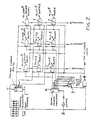
- the electronic circuit diagram illustrated in Fig. 2 shows a preferred embodiment of a language routing display system having nine visual display units 1 arranged in a matrix to represent interpreters 'Booth 1' 'Booth 5' and 'Booth 8'.
- Two decade ring counter IC's 6 and 7 are employed to operate a plurality of lamps represented by LED's 5, counter 6 is allocated for language requirements while counter 7 is used for booth identification. Ring counter 6 is driven by an external clock pulse 8 while counter 7 has its clock output connected to output 0 of ring counter 6. Both counters are thus under the influence of the clock frequency, but counter 7 is driven at a tenth of the speed of counter 6.
- the decade outputs of each counter are used to control the LED's 5 arranged in the matrix providing eight rows of eight LED's.
- the horizontal LED's are allocated to the booths while the vertical rows of LED's are allocated to the languages.
- Switching means 9 are incorporated in the circuits to utilise the scanning sequence and provide selective intelligence which can be altered as desired to suit changing requirements in the respective booth. For example, if 'Booth 3' is required to work from languages 3 and 4 the LED's 3 and 4 of the matrix will be illuminated on row 3 in all booths.
- a positive output from the gate requires that each input receives a simultaneous positive voltage.
- input 1 of a triple gate is connected to output 2 of counter 7 and if input 2 of the same triple gate is connected to output 3 of counter 6 it is only necessary to make the third input gate positive for the gate to activate the driver and light the LED. This can only happen at one instant when the appropriate outputs of the counters coincide and the third input gate is made positive.
- Each scanning sequence will pass through an 'enable' condition for each LED, but when this condition occurs the activation is dependent upon the state of the triple input gate 3.
- the third gate one for each LED, provides the intelligence for the whole system. The information is obtained from an integration of the booth and language appropriately set up by switches controlled by an interpreter.
- the language routing display system is designed to work inside interpreters' booths simultaneously in conjunction with, but entirely separate from, the other equipment that the interpreters require for their work.
- the system is designed to provide a means whereby each booth instantly knows the distribution of 'passive' operating languages in each of the other booths. This is particularly relevant where a large number of languages is spoken on the conference floor.
- each multistation visual display unit In operation the switches on each multistation visual display unit are set in each booth by the interpreters to indicate all the 'passive' languages available from the team of interpreters working in the booth. This information together with any changes is transmitted to all the display units in the system.
- the number of interpreters in each booth will vary according to the number of languages being spoken at the conference or meeting. There will always be a minimum of two but this may rise to three if the number of languages exceeds six and can even increase to four in some booths in the case of a large number of 'rare' languages being spoken at the conference.
- the difference between 'active' and 'passive' languages is that the active language is the language into which each booth interprets i.e. one language per booth each booth interpreting into English (booth 1) into French (booth 2), into German (booth 3), into Italian (booth 4) and so on.
- the passive languages are those from which each booth interprets, which may well be a greater number than the active languages. This would mean if a language is passive but not active, that the language may be spoken on the floor of the conference and will be interpreted into the active languages, but there will not be any interpretation into that language.
- the multistation indicator system of the present invention would reduce the risk of 'double relay' i.e. when the German interpreter who is taking the Dutch interpretation from the English channel does not realise that one interpreter has left the English booth or may simply be resting, so that his or her colleague is now taking Dutch from the French booth, he or she will be listening to a twice-removed interpretation from Dutch into French and then into English. This is detrimental to the quality and accuracy of the interpretation as well as causing a delay for the listener.
- any interpreter can choose the relay for such a language from the booth he or she prefers. For example, someone may prefer to take Spanish relay from the Italian booth if it is available there, rather than from the French or English booth.
Landscapes
- Engineering & Computer Science (AREA)
- Physics & Mathematics (AREA)
- Multimedia (AREA)
- Electromagnetism (AREA)
- General Physics & Mathematics (AREA)
- Signal Processing (AREA)
- Audible And Visible Signals (AREA)
Applications Claiming Priority (2)
| Application Number | Priority Date | Filing Date | Title |
|---|---|---|---|
| GB898928047A GB8928047D0 (en) | 1989-12-12 | 1989-12-12 | Multistation indicator system |
| GB8928047 | 1989-12-12 |
Publications (2)
| Publication Number | Publication Date |
|---|---|
| EP0433049A2 true EP0433049A2 (fr) | 1991-06-19 |
| EP0433049A3 EP0433049A3 (en) | 1992-05-27 |
Family
ID=10667817
Family Applications (1)
| Application Number | Title | Priority Date | Filing Date |
|---|---|---|---|
| EP19900313527 Withdrawn EP0433049A3 (en) | 1989-12-12 | 1990-12-12 | Multistation indicator system |
Country Status (2)
| Country | Link |
|---|---|
| EP (1) | EP0433049A3 (fr) |
| GB (1) | GB8928047D0 (fr) |
Cited By (2)
| Publication number | Priority date | Publication date | Assignee | Title |
|---|---|---|---|---|
| BE1022378B1 (nl) * | 2014-12-23 | 2016-03-18 | Televic Conference Nv | Centrale Eenheid voor een Conferentiesysteem |
| BE1023263B1 (nl) * | 2015-12-22 | 2017-01-17 | Televic Education Nv | Conferentiesysteem voor het opleiden van tolken |
Family Cites Families (2)
| Publication number | Priority date | Publication date | Assignee | Title |
|---|---|---|---|---|
| BE438926A (fr) * | ||||
| US3962698A (en) * | 1974-11-20 | 1976-06-08 | Don N. Hunt | Visual display and remote control panel system |
-
1989
- 1989-12-12 GB GB898928047A patent/GB8928047D0/en active Pending
-
1990
- 1990-12-12 EP EP19900313527 patent/EP0433049A3/en not_active Withdrawn
Cited By (5)
| Publication number | Priority date | Publication date | Assignee | Title |
|---|---|---|---|---|
| BE1022378B1 (nl) * | 2014-12-23 | 2016-03-18 | Televic Conference Nv | Centrale Eenheid voor een Conferentiesysteem |
| WO2016102642A1 (fr) * | 2014-12-23 | 2016-06-30 | Televic Conference Nv | Unité centrale pour un système de conférence |
| US10523819B2 (en) | 2014-12-23 | 2019-12-31 | Televic Conference Nv | Central unit for a conferencing system |
| BE1023263B1 (nl) * | 2015-12-22 | 2017-01-17 | Televic Education Nv | Conferentiesysteem voor het opleiden van tolken |
| WO2017106939A1 (fr) * | 2015-12-22 | 2017-06-29 | Televic Education Nv | Système de conférence pour la formation d'interprètes |
Also Published As
| Publication number | Publication date |
|---|---|
| GB8928047D0 (en) | 1990-02-14 |
| EP0433049A3 (en) | 1992-05-27 |
Similar Documents
| Publication | Publication Date | Title |
|---|---|---|
| US5263869A (en) | Interactive group communication system | |
| US4538993A (en) | Computer teaching system | |
| US4907146A (en) | Interactive video network between one master computer and a plurality of slave computers | |
| US4056805A (en) | Programmable electronic visual display systems | |
| US4497391A (en) | Modular operational elevator control system | |
| JP2000020042A (ja) | 映像表示システム | |
| US5646816A (en) | Identification icon indicia for plug-in units of a power distribution system | |
| US4843386A (en) | Remote control unit with hierarchical selection | |
| GB2182473A (en) | Display control apparatus for elevator | |
| US6067619A (en) | Apparatus and method for configuring a computer networking device | |
| US5450323A (en) | Command system with interactive command sources, enabling any number of heterogeneous systems to be accessed | |
| EP0433049A2 (fr) | Système indicateur à plusieurs positions | |
| US4509046A (en) | Indicating method and apparatus for digitizer menu portions | |
| US4149041A (en) | Telephone apparatus | |
| US2268240A (en) | Airplane describing system | |
| US3506965A (en) | Programming control system | |
| GB1016557A (en) | Improvements in or relating to devices for assembling in an instruction register an instruction word to be supplied to an apparatus controlled by logic-circuits,and a method of so assembling a word | |
| KR100377918B1 (ko) | 열차운행 중앙집중제어 안내시스템 | |
| US3750137A (en) | Electronic conference monitoring system | |
| US3812487A (en) | Monitoring and display apparatus | |
| ES2170212T3 (es) | Sistemas de servicios de comunicacion personal. | |
| AU1195383A (en) | Apparatus for automatically putting printed board assemblies into operation | |
| JPH0345059A (ja) | 局状態表示データ選択方式 | |
| US2842618A (en) | Simultaneous viewing and communication system | |
| JPH01115236A (ja) | アドレス設定方式 |
Legal Events
| Date | Code | Title | Description |
|---|---|---|---|
| PUAI | Public reference made under article 153(3) epc to a published international application that has entered the european phase |
Free format text: ORIGINAL CODE: 0009012 |
|
| AK | Designated contracting states |
Kind code of ref document: A2 Designated state(s): BE CH DE FR GB LI LU NL |
|
| PUAL | Search report despatched |
Free format text: ORIGINAL CODE: 0009013 |
|
| AK | Designated contracting states |
Kind code of ref document: A3 Designated state(s): BE CH DE FR GB LI LU NL |
|
| 17P | Request for examination filed |
Effective date: 19921125 |
|
| 17Q | First examination report despatched |
Effective date: 19950303 |
|
| GRAG | Despatch of communication of intention to grant |
Free format text: ORIGINAL CODE: EPIDOS AGRA |
|
| GRAG | Despatch of communication of intention to grant |
Free format text: ORIGINAL CODE: EPIDOS AGRA |
|
| GRAH | Despatch of communication of intention to grant a patent |
Free format text: ORIGINAL CODE: EPIDOS IGRA |
|
| STAA | Information on the status of an ep patent application or granted ep patent |
Free format text: STATUS: THE APPLICATION IS DEEMED TO BE WITHDRAWN |
|
| 18D | Application deemed to be withdrawn |
Effective date: 19990727 |