EP0433616A2 - Verwendung heterocyclischer Thiocyanate als Mikrobiozide und solche Mikrobiozide enthaltende Mittel - Google Patents
Verwendung heterocyclischer Thiocyanate als Mikrobiozide und solche Mikrobiozide enthaltende Mittel Download PDFInfo
- Publication number
- EP0433616A2 EP0433616A2 EP90120673A EP90120673A EP0433616A2 EP 0433616 A2 EP0433616 A2 EP 0433616A2 EP 90120673 A EP90120673 A EP 90120673A EP 90120673 A EP90120673 A EP 90120673A EP 0433616 A2 EP0433616 A2 EP 0433616A2
- Authority
- EP
- European Patent Office
- Prior art keywords
- thiocyanates
- microbicides
- heterocyclic
- activity
- dithiocyanato
- Prior art date
- Legal status (The legal status is an assumption and is not a legal conclusion. Google has not performed a legal analysis and makes no representation as to the accuracy of the status listed.)
- Withdrawn
Links
Images

Classifications
-
- C—CHEMISTRY; METALLURGY
- C07—ORGANIC CHEMISTRY
- C07D—HETEROCYCLIC COMPOUNDS
- C07D285/00—Heterocyclic compounds containing rings having nitrogen and sulfur atoms as the only ring hetero atoms, not provided for by groups C07D275/00 - C07D283/00
- C07D285/01—Five-membered rings
- C07D285/02—Thiadiazoles; Hydrogenated thiadiazoles
- C07D285/04—Thiadiazoles; Hydrogenated thiadiazoles not condensed with other rings
- C07D285/08—1,2,4-Thiadiazoles; Hydrogenated 1,2,4-thiadiazoles
-
- A—HUMAN NECESSITIES
- A01—AGRICULTURE; FORESTRY; ANIMAL HUSBANDRY; HUNTING; TRAPPING; FISHING
- A01N—PRESERVATION OF BODIES OF HUMANS OR ANIMALS OR PLANTS OR PARTS THEREOF; BIOCIDES, e.g. AS DISINFECTANTS, AS PESTICIDES OR AS HERBICIDES; PEST REPELLANTS OR ATTRACTANTS; PLANT GROWTH REGULATORS
- A01N43/00—Biocides, pest repellants or attractants, or plant growth regulators containing heterocyclic compounds
- A01N43/48—Biocides, pest repellants or attractants, or plant growth regulators containing heterocyclic compounds having rings with two nitrogen atoms as the only ring hetero atoms
- A01N43/60—1,4-Diazines; Hydrogenated 1,4-diazines
-
- A—HUMAN NECESSITIES
- A01—AGRICULTURE; FORESTRY; ANIMAL HUSBANDRY; HUNTING; TRAPPING; FISHING
- A01N—PRESERVATION OF BODIES OF HUMANS OR ANIMALS OR PLANTS OR PARTS THEREOF; BIOCIDES, e.g. AS DISINFECTANTS, AS PESTICIDES OR AS HERBICIDES; PEST REPELLANTS OR ATTRACTANTS; PLANT GROWTH REGULATORS
- A01N43/00—Biocides, pest repellants or attractants, or plant growth regulators containing heterocyclic compounds
- A01N43/64—Biocides, pest repellants or attractants, or plant growth regulators containing heterocyclic compounds having rings with three nitrogen atoms as the only ring hetero atoms
- A01N43/66—1,3,5-Triazines, not hydrogenated and not substituted at the ring nitrogen atoms
-
- A—HUMAN NECESSITIES
- A01—AGRICULTURE; FORESTRY; ANIMAL HUSBANDRY; HUNTING; TRAPPING; FISHING
- A01N—PRESERVATION OF BODIES OF HUMANS OR ANIMALS OR PLANTS OR PARTS THEREOF; BIOCIDES, e.g. AS DISINFECTANTS, AS PESTICIDES OR AS HERBICIDES; PEST REPELLANTS OR ATTRACTANTS; PLANT GROWTH REGULATORS
- A01N43/00—Biocides, pest repellants or attractants, or plant growth regulators containing heterocyclic compounds
- A01N43/72—Biocides, pest repellants or attractants, or plant growth regulators containing heterocyclic compounds having rings with nitrogen atoms and oxygen or sulfur atoms as ring hetero atoms
- A01N43/74—Biocides, pest repellants or attractants, or plant growth regulators containing heterocyclic compounds having rings with nitrogen atoms and oxygen or sulfur atoms as ring hetero atoms five-membered rings with one nitrogen atom and either one oxygen atom or one sulfur atom in positions 1,3
- A01N43/78—1,3-Thiazoles; Hydrogenated 1,3-thiazoles
-
- A—HUMAN NECESSITIES
- A01—AGRICULTURE; FORESTRY; ANIMAL HUSBANDRY; HUNTING; TRAPPING; FISHING
- A01N—PRESERVATION OF BODIES OF HUMANS OR ANIMALS OR PLANTS OR PARTS THEREOF; BIOCIDES, e.g. AS DISINFECTANTS, AS PESTICIDES OR AS HERBICIDES; PEST REPELLANTS OR ATTRACTANTS; PLANT GROWTH REGULATORS
- A01N43/00—Biocides, pest repellants or attractants, or plant growth regulators containing heterocyclic compounds
- A01N43/72—Biocides, pest repellants or attractants, or plant growth regulators containing heterocyclic compounds having rings with nitrogen atoms and oxygen or sulfur atoms as ring hetero atoms
- A01N43/82—Biocides, pest repellants or attractants, or plant growth regulators containing heterocyclic compounds having rings with nitrogen atoms and oxygen or sulfur atoms as ring hetero atoms five-membered rings with three ring hetero atoms
-
- C—CHEMISTRY; METALLURGY
- C07—ORGANIC CHEMISTRY
- C07D—HETEROCYCLIC COMPOUNDS
- C07D241/00—Heterocyclic compounds containing 1,4-diazine or hydrogenated 1,4-diazine rings
- C07D241/36—Heterocyclic compounds containing 1,4-diazine or hydrogenated 1,4-diazine rings condensed with carbocyclic rings or ring systems
- C07D241/38—Heterocyclic compounds containing 1,4-diazine or hydrogenated 1,4-diazine rings condensed with carbocyclic rings or ring systems with only hydrogen or carbon atoms directly attached to the ring nitrogen atoms
- C07D241/40—Benzopyrazines
- C07D241/44—Benzopyrazines with hetero atoms or with carbon atoms having three bonds to hetero atoms with at the most one bond to halogen, e.g. ester or nitrile radicals, directly attached to carbon atoms of the hetero ring
-
- C—CHEMISTRY; METALLURGY
- C07—ORGANIC CHEMISTRY
- C07D—HETEROCYCLIC COMPOUNDS
- C07D251/00—Heterocyclic compounds containing 1,3,5-triazine rings
- C07D251/02—Heterocyclic compounds containing 1,3,5-triazine rings not condensed with other rings
- C07D251/12—Heterocyclic compounds containing 1,3,5-triazine rings not condensed with other rings having three double bonds between ring members or between ring members and non-ring members
- C07D251/26—Heterocyclic compounds containing 1,3,5-triazine rings not condensed with other rings having three double bonds between ring members or between ring members and non-ring members with only hetero atoms directly attached to ring carbon atoms
- C07D251/40—Nitrogen atoms
- C07D251/42—One nitrogen atom
- C07D251/46—One nitrogen atom with oxygen or sulfur atoms attached to the two other ring carbon atoms
-
- C—CHEMISTRY; METALLURGY
- C07—ORGANIC CHEMISTRY
- C07D—HETEROCYCLIC COMPOUNDS
- C07D277/00—Heterocyclic compounds containing 1,3-thiazole or hydrogenated 1,3-thiazole rings
- C07D277/60—Heterocyclic compounds containing 1,3-thiazole or hydrogenated 1,3-thiazole rings condensed with carbocyclic rings or ring systems
- C07D277/62—Benzothiazoles
- C07D277/68—Benzothiazoles with hetero atoms or with carbon atoms having three bonds to hetero atoms with at the most one bond to halogen, e.g. ester or nitrile radicals, directly attached in position 2
- C07D277/70—Sulfur atoms
- C07D277/74—Sulfur atoms substituted by carbon atoms
-
- C—CHEMISTRY; METALLURGY
- C07—ORGANIC CHEMISTRY
- C07D—HETEROCYCLIC COMPOUNDS
- C07D285/00—Heterocyclic compounds containing rings having nitrogen and sulfur atoms as the only ring hetero atoms, not provided for by groups C07D275/00 - C07D283/00
- C07D285/01—Five-membered rings
- C07D285/02—Thiadiazoles; Hydrogenated thiadiazoles
- C07D285/04—Thiadiazoles; Hydrogenated thiadiazoles not condensed with other rings
- C07D285/12—1,3,4-Thiadiazoles; Hydrogenated 1,3,4-thiadiazoles
- C07D285/125—1,3,4-Thiadiazoles; Hydrogenated 1,3,4-thiadiazoles with oxygen, sulfur or nitrogen atoms, directly attached to ring carbon atoms, the nitrogen atoms not forming part of a nitro radical
Definitions
- the invention is directed to the use of heterocyclic thiocyanates of the formulas as microbicides and agents containing such microbicides.
- Methylene bisthiocyanate of the formula NCS-CH2-SCN has long been known as an effective microbicide with a broad spectrum of activity, which is particularly suitable for water treatment, preferably in the paper industry.
- microbiocidal agents containing methylene bisthiocyanate have also been proposed - cf. DE-OS 37 18 661 and the documents cited therein. Although methylene bisthiocyanate has a high microbicidal activity, higher homologs, such as ethylene bisthiocyanate, are orders of magnitude less effective.
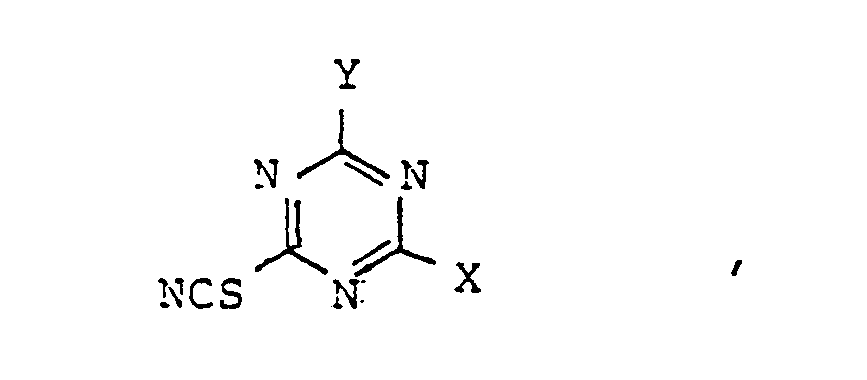
- X is a thiocyanato, alkyl, alkylamino or dialkylamino group
- Y is an alkyl, alkylamino or dialkylamino group
- 1,3,4-thiadiazoles substituted in the 2,5-position have become known as microbicides, the substituents are not thiocyanato groups, but rather haloalkyl, alkylsulfinyl or. Alkylsulfonyl groups - cf. DE-OS 37 22 320.
- the task was to find heterocyclic thiocyanates which can be used as microbicides with high activity and a broad spectrum of activity.
- heterocyclic thiocyanates of the formulas was found as microbicides.
- Microbicidal agents were also found, which are characterized in that they contain at least one of the microbicidally active heterocyclic thiocyanates of the formulas (I) to (V) of claim 1 dissolved or suspended in an aqueous or organic carrier.
- the thiocyanates of the formulas (I) to (V) have both a high microbicidal activity against individual microorganisms, such as bacteria, fungi and algae, and a broad spectrum of activity.
- the heterocyclic thiocyanates (I) to (IV) can be prepared in a similar manner to 2-thiocyanatobenzothiazole (V) - cf. DE-AS 11 95 743.
- the mercapto compounds on which the thiocyanates (I) to (V) are based are reacted with cyanogen chloride in the form of a water-soluble salt, preferably an alkali salt, and after the reaction has ended, the thiocyanates (I) to (V) are removed from the chloride , preferably alkali chloride, separated.
- the reaction can be carried out in an aqueous or aqueous-organic reaction medium, preferably in water as the sole solvent for the reactants.
- the reaction medium can form a homogeneous phase or a two-phase system (eg water / organic solvent).
- the reaction takes place at temperatures in the range from 0 to 60.degree. C., preferably 5 to 30.degree. C., it being possible, if necessary, to maintain a moderate excess pressure in order to avoid losses of cyanogen chloride.
- an aqueous solution of the mercaptide is reacted with an aqueous solution of the cyanogen chloride, the heterocyclic thiocyanate precipitating and then being separated from the aqueous phase containing the chloride by solid-liquid phase separation - see Examples 1 to 4.
- the preparation of 3, 5-dithiocyanato-1,2,4-thiadiazole from the corresponding mercapto compound and cyanogen bromide is from Svensk Kem. Tid 56, pp. 207-209 (1944).
- microbicidal effect can be determined on the basis of the so-called time kill test (cf. American Petrol Institute, RP 38 2nd ed., Dec. 1985). This test is the basis for the examinations in Example 5.
- the heterocyclic thiocyanates of formulas (I) to (V) can be used either directly or in the form of microbicidal agents to kill microorganisms.
- at least one of the microbicides of the formulas (I) to (V) according to the invention is dissolved or suspended in an aqueous or organic liquid carrier.
- Such agents can additionally contain one or more biocides from the same class of substances, i.e. thiocyanates, or other classes of substances compatible with thiocyanates, such as quaternary ammonium compounds, dithiocarbamic acid esters, aldehydes, 1, 3. 5-tris (2-hydroxyethyl) hexahydro-s-triazine.
- the microbiocidal agents can contain system-compatible auxiliaries, for example dipolar organic solubilizers in the case of microbicide solutions or suspension aids in the case of microbicide suspensions, for example xanthan or other polysaccharides and / or polyvinyl alcohol and polyvinylpyrrolidone.
- auxiliaries for example dipolar organic solubilizers in the case of microbicide solutions or suspension aids in the case of microbicide suspensions, for example xanthan or other polysaccharides and / or polyvinyl alcohol and polyvinylpyrrolidone.
- the solid and liquid constituents are converted into a solution or a suspension in a manner known per se with stirring and, if appropriate, a moderate increase in temperature.
- the agents can preferably be used in water treatment to combat bacteria, fungi and algae, but also to combat these germs in technical materials, such as. B. synthetic resin dispersions can be used.
- Example 5 Determination of the microbiocidal action in the time kill test
- Figure 1/1 shows the ratio of the number of germs to the kill rate. From this it becomes clear that a killing rate increased from 99.9% to 100% corresponds to a significant improvement in effectiveness.
- the table shows the biocidal activity of the heterocyclic thiocyanates of the formulas (I) to (V) according to the invention against various germs from the group fungi and bacteria.
- the kill rate compared to the test germs is given, the application concentration of the biocides being 10 to 50 ppm.
- the biocides were added as a solution in dimethylformamide to the enriched germ suspension (40 ml), which contained 8.5 g NaCl / l.
- the algicidal activity of the thiocyanates (I) to (V) according to the invention was determined by treating a test suspension containing Chlorella vulgaris.
- the test suspension was obtained by adding 1 ml of standardized algae suspension in 200 ml of nutrient solution and stirring for 10 days and lighting for 12 hours / day. After addition of the active substance to be tested to the test suspension and further stirring, the green color of the chlorophyll disappears within the time given in the table, despite the irradiation (12 hours per day) maintaining the test suspension; while the color of the drug-free comparative sample deepens!
Landscapes
- Organic Chemistry (AREA)
- Chemical & Material Sciences (AREA)
- Life Sciences & Earth Sciences (AREA)
- Dentistry (AREA)
- Health & Medical Sciences (AREA)
- Engineering & Computer Science (AREA)
- Plant Pathology (AREA)
- General Health & Medical Sciences (AREA)
- Wood Science & Technology (AREA)
- Zoology (AREA)
- Environmental Sciences (AREA)
- Pest Control & Pesticides (AREA)
- Agronomy & Crop Science (AREA)
- Agricultural Chemicals And Associated Chemicals (AREA)
Abstract
2, 4-Dithiocyanato-6-amino-1,3,5-triazin (I),
3, 5-Dithiocyanato-1,2,4-thiadiazol (II),
2, 5-Dithiocyanato-1,3,4-thiadiazol (III) und
2,3-Dithiocyanatochinoxalin (IV) sowie
2-Thiocyanatobenzthiazol (V) als Mikrobiozide, welche eine hohe Aktivität und ein breites Wirkungsspektrum aufweisen. Die Thiocyanate (I) bis (V) sind insbesondere zur Bekämpfung von Bakterien, Pilzen und Algen geeignet. Die Erfindung betrifft ferner Mikrobiozide der Formeln (I) bis (V) enthaltende Mittel.
Description
- Die Erfindung richtet sich auf die Verwendung heterocyclischer Thiocyanate der Formeln

als Mikrobiozid und solche Mikrobiozide enthaltende Mittel. - Methylenbisthiocyanat der Formel NCS-CH₂-SCN ist seit langem als wirksames Mikrobiozid mit breitem Wirkungsspektrum bekannt, das sich insbesondere für die Wasserbehandlung, vorzugsweise in der Papierindustrie, eignet.
- Auch wurden zahlreiche Methylenbisthiocyanat enthaltende, mikrobiozide Mittel vorgeschlagen - vgl. DE-OS 37 18 661 und die dort zitierten Dokumente. Obgleich Methylenbisthiocyanat eine hohe mikrobiozide Wirksamkeit aufweist, sind höhere Homologe, etwa Ethylenbisthiocyanat, um Größenordnungen schwächer wirksam.
- Es hat nicht an Versuchen gefehlt, weitere mikrobiozid wirksame Stoffe mit Thiocyanatsubstituenten aufzufinden. So weisen heterocyclische Thiocyanate mit einer s-Triazinstruktur - vgl. DE-PS 10 70 636 der allgemeinen Formel
worin X eine Thiocyanato-, Alkyl-, Alkylamino- oder Dialkylaminogruppe und Y eine Alkyl-, Alkylamino- oder Dialkylaminogruppe bedeuten, zwar eine gewisse Wirksamkeit gegen Mikroorganismen auf, aber die Aktivität und die Breite des Wirkungsspektrums reichen bei weitem nicht an die Wirksamkeit von Methylenbisthiocyanat heran. Ähnliches gilt für viele andere aromatische und heteroaromatische Verbindungen mit einem oder zwei Thiocyanatsubstituenten. - Zwar sind in 2,5-Stellung substituierte 1,3,4-Thiadiazole als Mikrobiozide bekannt geworden, bei den Substituenten handelt es sich aber nicht um Thiocyanatogruppen, sondern um Halogenalkyl-, Alkylsulfinyl-bzw. Alkylsulfonylgruppen - vgl. DE-OS 37 22 320.
- Es bestand die Aufgabe, heterocyclische Thiocyanate aufzufinden, welche als Mikrobiozide mit hoher Aktivität und breitem Wirkungsspektrum Verwendung finden können.
- Gefunden wurde die Verwendung heterocyclischer Thiocyanate der Formeln

als Mikrobiozide.
- Gefunden wurden ferner mikrobiozide Mittel, welche dadurch gekennzeichnet sind, daß sie mindestens eines der mikrobiozid wirksamen heterocyclischen Thiocyanate der Formeln (I) bis (V) des Anspruchs 1 in einem wäßrigen oder organischen Trägerstoff gelöst oder suspendiert enthalten.
- Es konnte nicht erwartet werden, daß die Thiocyanate der Formeln (I) bis (V) sowohl eine hohe mikrobiozide Aktivität gegen einzelne Mikroorganismen, wie Bakterien, Pilzen und Algen, als auch ein breites Wirkungsspektrum aufweisen.
- Die heterocyclischen Thiocyanate (I) bis (IV) lassen sich in ähnlicher Weise herstellen wie 2-Thiocyanatobenzthiazol (V) - vgl. DE-AS 11 95 743. Die den Thiocyanaten (I) bis (V) zugrundeliegenden Mercaptoverbindungen werden in Form eines wasserlöslichen Salzes, vorzugsweise Alkalisalzes, mit Chlorcyan umgesetzt, und nach beendeter Umsetzung werden die Thiocyanate (I) bis (V) von dem Chlorid, vorzugsweise Alkalichlorid, abgetrennt. Die Umsetzung kann in einem wäßrigen oder wäßrigorganischen Reaktionsmedium, vorzugsweise in Wasser als alleinigem Lösungsmittel für die Reaktionspartner, durchgeführt werden. Das Reaktionsmedium kann eine homogene Phase oder ein Zweiphasensystem (z.B. Wasser/ organisches Lösungsmittel) bilden. Im allgemeinen erfolgt die Umsetzung bei Temperaturen im Bereich von 0 bis 60 °C, vorzugsweise 5 bis 30 °C, wobei, sofern erforderlich, auch ein mäßiger Überdruck aufrechterhalten werden kann, um Chlorcyanverluste zu vermeiden. Gemäß einer besonders bevorzugten Ausführungsform wird eine wäßrige Lösung des Mercaptids mit einer wäßrigen Lösung des Chlorcyans umgesetzt, wobei das heterocyclische Thiocyanat ausfällt und anschließend durch Fest-Flüssig-Phasentrennung von der das Chlorid enthaltenden wäßrigen Phase abgetrennt wird - siehe Beispiele 1 bis 4. Die Herstellung von 3, 5-Dithiocyanato-1,2,4-thiadiazol aus der entsprechenden Mercaptoverbindung und Bromcyan ist aus Svensk Kem. Tid 56, S. 207-209 (1944) bekannt.
- Die Bestimmung der mikrobioziden Wirkung kann in Anlehnung an den sogenannten Time-Kill-Test durchgeführt werden (vgl. American Petrol Institut, RP 38 2nd ed., Dec. 1985). Dieser Test liegt den Untersuchungen des Beispiels 5 zugrunde.
- Die heterocyclischen Thiocyanate der Formeln (I) bis (V) können entweder direkt oder in Form von mikrobioziden Mitteln zur Abtötung von Mikroorganismen verwendet werden. Zur Herstellung der mikrobioziden Mittel wird mindestens eines der erfindungsgemäßen Mikrobiozide der Formeln (I) bis (V) in einem wäßrigen oder organischen flüssigen Trägerstoff, gelöst oder suspendiert. Solche Mittel können zusätzlich ein oder mehrere Biozide aus der gleichen Stoffklasse, also der Thiocyanate, oder anderen mit Thiocyanaten verträglichen Stoffklassen, wie beispielsweise der quaternären Ammoniumverbindungen, Dithiocarbaminsäureester, Aldehyde, 1 ,3. 5-Tris(2-hydroxyethyl)hexahydro-s-triazin, enthalten. Als weitere Bestandteile können die mikrobioziden Mittel systemverträgliche Hilfsstoffe enthalten, etwa dipolare organische Lösungsvermittler im Falle von Mikrobiozid-Lösungen oder Suspensionshilfsmittel im Falle von Mikrobiozid-Suspensionen, beispielsweise Xanthan oder andere Polysaccharide und/oder Polyvinylalkohol sowie Polyvinylpyrrolidon. Zur Herstellung der mikrobioziden Mittel werden die festen und flüssigen Bestandteile in an sich bekannter Weise unter Rühren und ggf. mäßiger Temperaturerhöhung in eine Lösung bzw. eine Suspension überführt. Die Mittel können vorzugsweise in der Wasserbehandlung zur Bekämpfung von Bakterien, Pilzen und Algen, aber auch zur Bekämpfung dieser Keime in technischen Materialen, wie z. B. Kunstharzdispersionen, eingesetzt werden. Die algizide Wirkung der heterocyclischen Thiocyanate wurde an Chlorella vulgaris nachgewiesen.
- Die nachfolgenden Beispiele verdeutlichen die Erfindung.
-

- 184,5 g (3,0 Mol) Chlorcyan werden in 800 ml Wasser von 5-10 °C in einem Kolben vorgelegt; dazu läßt man eine konz. wäßrige Lösung von 290 g (1,5 Mol) 2, 5-Dimercapto-1,3,4-thiadiazol-Dinatriumsalz zutropfen. Man rührt 30 Min. bei etwa 20 °C nach, saugt das ausgefallene schwach beige gefärbte Produkt ab, wäscht mit Wasser und trocknet. Ausbeute: 295 g (98 % d. Th. ) , Schmelzpunkt 162 °C.

-

- Die Synthese erfolgt analog der unter Beispiel 1 gegebenen Vorschrift.

-

- 123 g (2,0 Mol) Chlorcyan werden in 500 ml Wasser in einem Kolben vorgelegt, bei 5-10 °c 236 g (1 ,0 Mol) Dikaliumdithioammelid in wäßriger Lösung zugetropft und 45 Min. bei 20 °C nachgerührt. Das ausgefallene Produkt wird abgesaugt, mit Wasser chloridfrei gewaschen und getrocknet. Farbloses Pulver. Ausbeute 195 g (93 % d. Th.)

-

- 12,3 g (0,2 Mol) Chlorcyan werden in 50 ml Wasser vorgelegt und bei 5-10 °C 23,8 g (0,1 Mol) 2,3-Dimercaptochinoxalin-Dinatriumsalz zugetropft. Man rührt 30 Min. bei 20-30 °C nach, filtriert und trocknet den Rückstand. Schwach gefärbtes Pulver. Ausbeute 21,2 g (87 % d. Th.)

- Bei diesem in Anlehnung an die Empfehlungen des American Petroleums Instituts (API, RP 38 2nd ed., Dec. 1965) durchgeführten Test wird eine hoch angereicherte Keimsuspension (Keimzahl 10⁶-10⁸) mit der gewünschten Menge Biozid versetzt und 24 h bei 25 °C bebrütet. Anschließend wird eine geometrische Verdünnungsreihe bis 6 durchgeführt; je 1 ml wird mit 10 ml Nähragar auf Platten vermischt und 48 h bei 37 °C bebrütet. Aus der Auszählung der Kolonien wird die Abtötungsrate berechnet.

- Die Figur 1/1 zeigt das Verhältnis von Keimzahl zur Abtötungsrate. Hieraus wird deutlich, daß auch eine von 99,9 % auf 100 % gesteigerte Abtötungsrate einer bedeutenden Wirkungsverbesserung entspricht.
- Der Tabelle ist die biozide Wirksamkeit der erfindungsgemäßen heterocyclischen Thiocyanate der Formeln (I) bis (V) gegen verschiedene Keime aus der Gruppe Pilze und Bakterien zu entnehmen. Angegeben ist die Abtötungsrate gegenüber den Testkeimen, wobei die Anwendungskonzentration der Biozide 10 bis 50 ppm betrug. Die Biozide wurden als Lösung in Dimethylformamid der angereicherten Keimsuspension (40 ml), welche 8,5 g NaCl/l enthielt, zugesetzt.

- Die Bestimmung der algiziden Wirkung der erfindungsgemäßen Thiocyanate (I) bis (V) erfolgte durch Behandlung einer Chlorella vulgaris enthaltenden Testsuspension. Die Testsuspension wurde erhalten durch Zugabe von 1 ml standardisierter Algensuspension in 200 ml Nährlösung und 10tägiges Rühren und 12 Std./ Tag Beleuchtung. Nach Zugabe des zu prüfenden Wirkstoffs zur Testsuspenion und weiterem Rühren verschwindet trotzt Aufrechterhaltung der Bestrahlung (12 Stunden pro Tag) der Testsuspension die grüne Farbe des Chlorophylls innerhalb der in der Tabelle angegebenen Zeit; während sich die Farbe der wirkstofffreien Vergleichsprobe vertieft!

Claims (2)
- Verwendung heterocyclischer Thiocyanate der Formeln

- Mikrobiozide Mittel,
dadurch gekennzeichnet,
daß sie mindestens eines der mikrobiozid wirksamen heterocyclischen Thiocyanate der Formeln (I) bis (V) des Anspruchs 1 in einem wäßrigen oder organischen Trägerstoff gelöst oder suspendiert enthalten.
Applications Claiming Priority (2)
| Application Number | Priority Date | Filing Date | Title |
|---|---|---|---|
| DE3942433 | 1989-12-22 | ||
| DE19893942433 DE3942433A1 (de) | 1989-12-22 | 1989-12-22 | Heterocyclische thiocyanate, verfahren zu ihrer herstellung und verwendung als mikrobiozide |
Publications (2)
| Publication Number | Publication Date |
|---|---|
| EP0433616A2 true EP0433616A2 (de) | 1991-06-26 |
| EP0433616A3 EP0433616A3 (en) | 1993-03-03 |
Family
ID=6396106
Family Applications (1)
| Application Number | Title | Priority Date | Filing Date |
|---|---|---|---|
| EP19900120673 Withdrawn EP0433616A3 (en) | 1989-12-22 | 1990-10-29 | Use of heterocyclic thiocyanates as microbicides and agents containing such microbicides |
Country Status (2)
| Country | Link |
|---|---|
| EP (1) | EP0433616A3 (de) |
| DE (1) | DE3942433A1 (de) |
Cited By (4)
| Publication number | Priority date | Publication date | Assignee | Title |
|---|---|---|---|---|
| US5491155A (en) * | 1994-12-21 | 1996-02-13 | The Dow Chemical Company | Substituted thiadiazoles, compositions containing them and their use as antimicrobial and marine antifouling agents |
| WO1996019467A1 (en) * | 1994-12-21 | 1996-06-27 | The Dow Chemical Company | Substituted thiadiazoles, compositions containing them and their use as antimicrobial and marine antifouling agents |
| WO1998001035A1 (en) * | 1996-07-10 | 1998-01-15 | The Dow Chemical Company | The use of 5-alkyl-1,3,4-oxadiazol(and thiadiazol)-2-thiomethylthiocyanates as marine antifouling agents |
| WO2004075907A3 (de) * | 2003-02-27 | 2005-01-13 | Univ Ernst Moritz Arndt | Gesundheitsfördernde zusammensetzungen aus lipidhaltigen pilzen und thiocyanaten |
Family Cites Families (8)
| Publication number | Priority date | Publication date | Assignee | Title |
|---|---|---|---|---|
| US2285410A (en) * | 1941-02-27 | 1942-06-09 | Du Pont | Pest control |
| DE1053856B (de) * | 1957-03-12 | 1959-03-26 | Degussa | Verfahren zur Bekaempfung von Fungi |
| BE565474A (de) * | 1957-03-12 | |||
| NL111024C (de) * | 1958-07-10 | 1900-01-01 | ||
| DE1111641B (de) * | 1958-07-24 | 1961-07-27 | Degussa | Verfahren zur Herstellung von Rhodantriazinen |
| GB967469A (en) * | 1961-11-03 | 1964-08-19 | Degussa | Heterocyclic thiocyanates and their use as plant fungicides |
| GB1017273A (en) * | 1961-11-03 | 1966-01-19 | Shell Res Ltd | Novel pesticidal compositions |
| US3888869A (en) * | 1973-08-13 | 1975-06-10 | Dow Chemical Co | Bis (thiocyanomethylthio) thiadiazoles |
-
1989
- 1989-12-22 DE DE19893942433 patent/DE3942433A1/de not_active Withdrawn
-
1990
- 1990-10-29 EP EP19900120673 patent/EP0433616A3/de not_active Withdrawn
Cited By (4)
| Publication number | Priority date | Publication date | Assignee | Title |
|---|---|---|---|---|
| US5491155A (en) * | 1994-12-21 | 1996-02-13 | The Dow Chemical Company | Substituted thiadiazoles, compositions containing them and their use as antimicrobial and marine antifouling agents |
| WO1996019467A1 (en) * | 1994-12-21 | 1996-06-27 | The Dow Chemical Company | Substituted thiadiazoles, compositions containing them and their use as antimicrobial and marine antifouling agents |
| WO1998001035A1 (en) * | 1996-07-10 | 1998-01-15 | The Dow Chemical Company | The use of 5-alkyl-1,3,4-oxadiazol(and thiadiazol)-2-thiomethylthiocyanates as marine antifouling agents |
| WO2004075907A3 (de) * | 2003-02-27 | 2005-01-13 | Univ Ernst Moritz Arndt | Gesundheitsfördernde zusammensetzungen aus lipidhaltigen pilzen und thiocyanaten |
Also Published As
| Publication number | Publication date |
|---|---|
| DE3942433A1 (de) | 1991-06-27 |
| EP0433616A3 (en) | 1993-03-03 |
Similar Documents
| Publication | Publication Date | Title |
|---|---|---|
| DE69028461T2 (de) | Triazin-derivate und unkrautvertilgungsmittel daraus | |
| DE2703542C2 (de) | Thiazolylzimtsäurenitrile, Insektenbekämpfungsmittel enthaltend diese Verbindungen sowie Verfahren zu ihrer Herstellung | |
| DE2737298C2 (de) | Verwendung von 4(1H)-Oxo-3-chinolincarbonsäure-Derivaten bei der Bekämpfung pflanzenpathogener Bakterien | |
| DE3234624A1 (de) | Fungizide mittel | |
| DE68905294T2 (de) | Antimikrobische zusammensetzung und verfahren zu deren verwendung. | |
| EP0433616A2 (de) | Verwendung heterocyclischer Thiocyanate als Mikrobiozide und solche Mikrobiozide enthaltende Mittel | |
| DE2133049A1 (de) | Heterocyclische Verbindungen,Verfahren zu deren Herstellung sowie deren Verwendung | |
| DE2810067C2 (de) | Quartäre Ammoniumsalze und diese enthaltendes fungizides Mittel | |
| DE3218176A1 (de) | Jodpropargylammoniumsalze, verfahren zu ihrer herstellung und ihre verwendung als schaedlingsbekaempfungsmittel | |
| AT334134B (de) | Bekampfung von pilzschadlingen | |
| DE2920182A1 (de) | Salze von thiazolyliden-oxo-propionitrilen, insektizide mittel enthaltend diese salze sowie verfahren zu ihrer herstellung | |
| DE1955894A1 (de) | Herbizides und insektizides Mittel | |
| EP0081679B1 (de) | Substituierte Benzylimidazoliumsalze und diese enthaltende Mikrobizide | |
| DE2935578C2 (de) | ||
| DE3102907A1 (de) | "benzoxazolonderivate, verfahren zur herstellung derselben sowie zubereitungen, die diese derivate enthalten" | |
| DE2504548A1 (de) | 2,3-dicyan-5,6-dihydro-p-dithiine, insbesondere mit fungizider wirkung | |
| DE2457599A1 (de) | Pyran-derivate und ihre verwendung als herbicide | |
| DE4142128C2 (de) | Verfahren zur Herstellung von Verbindungen mit einer oder mehreren Thiocyanatomethylthio-Gruppierungen | |
| DE1914015C3 (de) | a-ChloM-tertbutylamino-e-cyclopropylamino-s-triazin und dieses enthaltende Mittel zur Bekämpfung von Unkräutern | |
| DE2020595C3 (de) | l-Aryl-3-(2-chlorallyl)-thioharnstoffe, Verfahren zu ihrer Herstellung und deren Verwendung als Mikrobizide | |
| DE2518542A1 (de) | Biocides mittel | |
| DE2729672A1 (de) | Germicide herbicide fuer landwirtschaft und gartenbau | |
| EP0291800B1 (de) | Neue Cyanhydrin-Iodpropargylether, Verfahren zu ihrer Herstellung und ihre Verwendung als Mikrobizide | |
| DE2009117C (de) | Substituierte N Phenyl NT methyl NP propargyloxyharnstofle | |
| DE2748450B2 (de) | Neue Benzoyl-N'-trichloräthyUdenhydrazine und neue fungizide Zubereitungen |
Legal Events
| Date | Code | Title | Description |
|---|---|---|---|
| PUAI | Public reference made under article 153(3) epc to a published international application that has entered the european phase |
Free format text: ORIGINAL CODE: 0009012 |
|
| 17P | Request for examination filed |
Effective date: 19901029 |
|
| AK | Designated contracting states |
Kind code of ref document: A2 Designated state(s): AT BE DE FR GB LU NL |
|
| PUAL | Search report despatched |
Free format text: ORIGINAL CODE: 0009013 |
|
| AK | Designated contracting states |
Kind code of ref document: A3 Designated state(s): AT BE DE FR GB LU NL |
|
| 17Q | First examination report despatched |
Effective date: 19950421 |
|
| STAA | Information on the status of an ep patent application or granted ep patent |
Free format text: STATUS: THE APPLICATION HAS BEEN WITHDRAWN |
|
| 18W | Application withdrawn |
Withdrawal date: 19950902 |