EP0434262A2 - Dérivé de phénol et son usage dans l'analyse colorimétrique d'ions métalliques - Google Patents
Dérivé de phénol et son usage dans l'analyse colorimétrique d'ions métalliques Download PDFInfo
- Publication number
- EP0434262A2 EP0434262A2 EP90313249A EP90313249A EP0434262A2 EP 0434262 A2 EP0434262 A2 EP 0434262A2 EP 90313249 A EP90313249 A EP 90313249A EP 90313249 A EP90313249 A EP 90313249A EP 0434262 A2 EP0434262 A2 EP 0434262A2
- Authority
- EP
- European Patent Office
- Prior art keywords
- salt
- metal ions
- group
- measurement
- formula
- Prior art date
- Legal status (The legal status is an assumption and is not a legal conclusion. Google has not performed a legal analysis and makes no representation as to the accuracy of the status listed.)
- Granted
Links
- 0 C*c(cc(cc1C)C(c2ccccc2C(O)=O)=O)c1O Chemical compound C*c(cc(cc1C)C(c2ccccc2C(O)=O)=O)c1O 0.000 description 2
- UQTDVIORTKZLDD-UHFFFAOYSA-N Cc1cc(C(c(cccc2)c2S)=O)c(C)c(C)c1O Chemical compound Cc1cc(C(c(cccc2)c2S)=O)c(C)c(C)c1O UQTDVIORTKZLDD-UHFFFAOYSA-N 0.000 description 1
Images




Classifications
-
- C—CHEMISTRY; METALLURGY
- C07—ORGANIC CHEMISTRY
- C07C—ACYCLIC OR CARBOCYCLIC COMPOUNDS
- C07C309/00—Sulfonic acids; Halides, esters, or anhydrides thereof
- C07C309/01—Sulfonic acids
- C07C309/28—Sulfonic acids having sulfo groups bound to carbon atoms of six-membered aromatic rings of a carbon skeleton
- C07C309/45—Sulfonic acids having sulfo groups bound to carbon atoms of six-membered aromatic rings of a carbon skeleton containing nitrogen atoms, not being part of nitro or nitroso groups, bound to the carbon skeleton
- C07C309/52—Sulfonic acids having sulfo groups bound to carbon atoms of six-membered aromatic rings of a carbon skeleton containing nitrogen atoms, not being part of nitro or nitroso groups, bound to the carbon skeleton the carbon skeleton being further substituted by doubly-bound oxygen atoms
-
- G—PHYSICS
- G01—MEASURING; TESTING
- G01N—INVESTIGATING OR ANALYSING MATERIALS BY DETERMINING THEIR CHEMICAL OR PHYSICAL PROPERTIES
- G01N33/00—Investigating or analysing materials by specific methods not covered by groups G01N1/00 - G01N31/00
- G01N33/48—Biological material, e.g. blood, urine; Haemocytometers
- G01N33/50—Chemical analysis of biological material, e.g. blood, urine; Testing involving biospecific ligand binding methods; Immunological testing
- G01N33/84—Chemical analysis of biological material, e.g. blood, urine; Testing involving biospecific ligand binding methods; Immunological testing involving inorganic compounds or pH
Definitions
- This invention relates to a phenol derivative or a salt thereof, which can be utilized as an agent for adjusting sensitivity at the time of measurement in a method for a colorimetric analysis of metal ions by use of a chelating reagent; and a process for using said phenol derivative or salt thereof as an agent for adjusting sensitivity for a colorimetric analysis of metal ions.
- Methods for a colorimetric analysis of metal ions by use of a chelating reagent capable of forming a chelate with metal ions to develop a color have a relatively high precision and require only easy operations. Therefore, they are widely utilized in the fields of water quality analysis, clinical chemical analysis, etc.
- the chelating reagent used for such a purpose is required to have a high specificity, a large chelate formation constant, etc. Accordingly, usable chelating reagents are limited as a matter of course, depending on the kind of metal ion.
- chelating reagent such as phthalein complexone (OCPC), Methylxylenol Blue (MXB), Methylthymol Blue (MTB), etc.
- chelating reagents such as Xylylazo Violet (XB-I), etc.
- the molecular extinction coefficient ( ⁇ ) of a chelate formed by the reaction of any of the above-exemplified chelating reagents with metal ions (hereinafter abbreviated as "color forming sensitivity”) has a relatively high value. Therefore, in the case of carrying out measurement for a sample containing a high concentration of metal ions to be measured, for example, the case of measuring calcium or magnesium in serum, the problem 1 or 2 described below is caused, resulting in low reliability on the analysis result, unless color forming sensitivity at the time of measurement is adjusted by some method.
- the calibration range for analysis is narrowed unless the total amount of reagent solution used for the measurement is increased to some extent.
- a method for adjusting the color forming sensitivity in such a measurement as described above there are known, for example, a method of placing, in a reaction system, citric acid, tartaric acid or the like, which reacts with metal ions to form a colorless chelate, and a method using a carbonate buffer solution as a buffer solution for measurement.
- the former method is disadvantageous in that the reliability of measured values is lowered because the constant of chelate formation by citric acid or the like and the constant of chelate formation by a chelating reagent vary greatly with temperature.
- the latter method has, for example, the following disadvantages.
- the concentration of the buffer should be high for preventing the pH from being lowered by the absorption of carbon dioxide in the air, but when it is too high, the color forming sensitivity is greatly lowered, so that the measurement is hindered.
- the buffer solution has a buffer capacity only in a narrow pH range, and therefore the kind of usable chelating reagent is limited.
- the present invention was made in consideration of such conditions and is intended to provide a phenol derivative or a salt thereof, which is similar to a chelating reagent used, in the degree of change of the constant of chelate formation with temperature, and forms a colorless chelate with metal ions; and a process for a colorimetric analysis of metal ions by use of said phenol derivative or salt thereof as an agent for adjusting color forming sensitivity.
- the present invention provides a phenol derivative of the formula [I], or a salt thereof: wherein R1 is a hydroxyl group, a halogen atom, an alkyl group which may have one or more substituents, an aryl group which may have one or more substituents, or a heterocyclic group which may have one or more substituents; R2 to R4 are independently a hydrogen atom, a lower alkyl group, a lower alkoxy group or a halogen atom.
- the present invention also provides a process for using the phenol derivative of the formula [I] or a salt thereof as a color forming sensitivity adjusting agent in a colorimetric analysis of metal ions.
- the present invention provides a process for producing the phenol derivatives of the formula [I].
- Fig. 1 shows calibration curves obtained in Example 2 and Comparative Examples 1 and 2.
- Fig. 2 shows calibration curves obtained in Example 3 and Comparative Example 3.
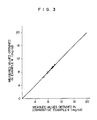
- Fig. 3 shows correlation diagram prepared on the basis of measured values obtained by Example 4 and Comparative Example 4.
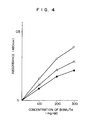
- Fig. 4 and Fig. 5 show calibration curves obtained in Example 5.
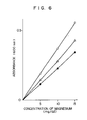
- Fig. 6 and Fig. 7 show calibration curves obtained in Example 6.
- the present inventors investigated in search of a method which permits proper adjustment of the color forming sensitivity of various chelating reagents. Consequently, the present inventors found that when the phenol derivative of the above formula [I] or a salt thereof is properly present in a reagent solution during measurement, the color forming sensitivity of various chelating reagents can be properly adjusted with substantially no influence of measurement conditions such as temperature change, whereby the present invention was accomplished.
- the phenol derivative of this invention is represented by the following formula: wherein R1 is a hydroxyl group, a halogen atom, an alkyl group which may have one or more substituents, an aryl group which may have one or more substituents, or a heterocyclic group which may have one or more substituents; R2 to R4 are independently a hydrogen atom, a lower alkyl group, a lower alkoxy group or a halogen atom.
- the halogen atom includes, for example, iodine, chlorine, bromine and fluorine.
- the alkyl group of the alkyl group which may have one or more substituents includes, for example methyl group, ethyl group, propyl group and butyl group (which may be either linear or branched), and the substituents include, for example, halogen atoms (e.g. iodine, chlorine, bromine and fluorine), hydroxyl group, carboxyl group and sulfonic group.
- the aryl group of the aryl group which may have one or more substituents include, for example, phenyl group and naphthyl group, and the substituents include, for example, hydroxyl group, carboxyl group, sulfonic group, alkyl groups (e.g. methyl group, ethyl group, propyl group and butyl group) which may be either linear or branched, and halogen atoms (e.g. iodine, chlorine, bromine and fluorine).
- substituents include, for example, hydroxyl group, carboxyl group, sulfonic group, alkyl groups (e.g. methyl group, ethyl group, propyl group and butyl group) which may be either linear or branched, and halogen atoms (e.g. iodine, chlorine, bromine and fluorine).
- the heterocyclic group of the heterocyclic group which may have one or more substituents includes, for example, pyridyl group, piperazino group, piperidino group, imidazolyl group and morpholino group, and the substituents include, for example, hydroxyl group, carboxyl group, sulfonic group, alkyl groups (e.g. methyl group, ethyl group, propyl group and butyl group) which may be either linear or branched, and halogen atoms (e.g. iodine, chlorine, bromine and fluorine).
- substituents include, for example, hydroxyl group, carboxyl group, sulfonic group, alkyl groups (e.g. methyl group, ethyl group, propyl group and butyl group) which may be either linear or branched, and halogen atoms (e.g. iodine, chlorine, bromine and fluorine).
- atom or the group which R2 to R4 independently represent there can be exemplified hydrogen atom, lower alkyl groups (e.g. methyl group, ethyl group, propyl group and butyl group) which may be either linear or branched, lower alkoxy groups (e.g. methoxy group, ethoxy group, propoxy group and butoxy group) which may be either linear or branched, and halogen atoms (e.g. iodine, chlorine, bromine and fluorine).
- lower alkyl groups e.g. methyl group, ethyl group, propyl group and butyl group
- lower alkoxy groups e.g. methoxy group, ethoxy group, propoxy group and butoxy group
- halogen atoms e.g. iodine, chlorine, bromine and fluorine
- the phenol derivative of the formula [I] may be in the form of a salt with ammonia, an alkali metal (e.g. sodium or potassium), an organic amine (e.g. tris(hydroxymethyl)aminomethane, triethanolamine or monoethanolamine), or the like.
- an alkali metal e.g. sodium or potassium
- an organic amine e.g. tris(hydroxymethyl)aminomethane, triethanolamine or monoethanolamine
- the phenol derivative of the formula [I] can easily be synthesized in the following manner.
- a carboxylic acid anhydride such as sulfobenzoic anhydride, phthalic anhydride, acetic anhydride or the like is subjected to condensation reaction with 0.5 to 1.5 moles of a phenol compound of the formula: wherein R2 to R4 are as defined above, at room temperature to 130°C in a solvent such as nitrobenzene, a halogenated hydrocarbon (e.g. 1,2-dichloroethane or chloroform) or the like, in the presence of a Lewis acid catalyst such as zinc chloride, aluminum chloride, fluoromethanesulfonic acid or the like. Then, the reaction product is condensed with iminodiacetic acid and formaldehyde under acidic conditions.
- a carboxylic acid anhydride such as sulfobenzoic anhydride, phthalic anhydride, acetic anhydride or the like is subjected to condensation reaction with 0.5 to 1.5 moles of a phenol compound of the formula: wherein R
- phenol compound of the formula: wherein R2 to R4 are as defined above a commercial one may be used. When not commercially available, the phenol compound may be properly synthesized by a conventional method.
- the phenol derivatives of the formula [I] or a salt thereof can be used as an agent for adjusting color forming sensitivity in a colorimetric analysis of metal ions.
- a metal ion which can form a color by reacting with a chelating agent When a metal ion which can form a color by reacting with a chelating agent is added to a solution containing both the chelating agent and the compound of the present invention, the metal ion reacts with the chelating agent and the compound of the present invention to form chelates individually.
- the forming ratio of the individual chelates is proportional to the ratio of the chelating agent and the compound of the present invention in the solution. Therefore, by changing the ratio of the compound of the present invention to the chelating agent in the solution, the forming ratio of the chelate obtained from the chelating agent and the metal ion (colored chelate) is changed, so that the color forming sensitivity of the chelating agent and the metal ion is regarded as changed (i.e. apparent color forming sensitivity changes).
- the process of the present invention applys this phenomenon.
- the compound of the present invention is effective as an agent for adjusting color forming sensitivity of the chelating agent which forms a colored chelate by reacting with the metal ion.
- the chelating reagent, a buffer, and optionally an antiseptic, a surfactant, etc., which are added to the reagent solution for analysis, are properly selected from those used in conventional methods, and are added in conventional concentration ranges. It is sufficient that the pH, temperature, reaction time and the like at the time of measurement are determined in accordance with a conventional method.
- the chelating reagent includes, for example, phthalein complexone (OCPC), Methylxylenol Blue (MXB), Methylthymol Blue (MTB) and Xylylazo Violet (XB-I).
- the buffer includes, for example, monoethanolamine and boric acid.
- the phenol derivative of the formula [I] or a salt thereof which is used in the analytical process of the present invention, there may be used either one of or a proper combination of two or more of phenol derivatives of the formula [I] or salt thereof.
- the concentration of the phenol derivative of the formula [I] or a salt thereof in the reagent solution for analysis is not critical and may be properly determined depending on the color forming sensitivity of the chelating reagent used and a desired calibration range. For example, when calcium in serum is measured by using phthalein complexone as the chelating reagent, said concentration is properly chosen in the range of usually 0.2 to 10 times, preferably 0.5 to 2 times, the molar concentration of phthalein complexone used.
- Methylxylenol Blue as the chelating reagent, said concentration is properly chosen in the range of usually 0.2 to 10 times, preferably 0.5 to 2 times, the molar concentration of Methylxylenol Blue used.
- any metal ions can be exemplified without a particular limitation so long as they can be measured by use of the above-exemplified chelating reagents.
- metal ions are ions of alkaline earth metals such as magnesium (Mg), calcium (Ca), strontium (Sr), barium (Ba), etc.; heavy metals such as indium (In), thorium (Th), bismuth (Bi), cadmium (Cd), mercury (Hg), cobalt (Co), ion (Fe), lead (Pb), zinc (Zn), etc.; and rare earth elements such as lanthanum (La), scandium (Sc), yttrium (Y), etc.
- Mg magnesium
- Ca calcium
- Ba barium
- heavy metals such as indium (In), thorium (Th), bismuth (Bi), cadmium (Cd), mercury (Hg), cobalt (Co), ion (Fe), lead (Pb), zinc (Z
- the process of the present invention can be widely utilized in the fields of water quality analysis, clinical chemical analysis, etc.
- samples to which said process is applicable there can be exemplified living body fluids (e.g. plasma, serum and urine), and industrial drain or waste water.
- Fig. 1 is a graph obtained by plotting absorbance (OD 570 nm ) on the axis of ordinate corresponding to individual calcium concentrations on the axis of abscissa.
- Fig. 1 is a graph obtained by plotting absorbance (OD 570 nm ) on the axis of ordinate corresponding to individual calcium concentrations on the axis of abscissa.
- Example 2 The same samples as in Example 2 were used.
- Example 2 The same samples as in Example 2 were used.
- the color forming sensitivity can be adjusted by adding sodium 2-[3-[N,N-bis(carboxymethyl)aminomethyl]-4-hydroxy-2,5-dimethylbenzoyl]benzenesulfonate which is a phenol derivative of the present invention.
- Table 1 shows the results of carrying out measurement at two measuring temperatures by using each of the color producing solutions described in Example 2, Comparative Example 1 and Comparative Example 2 and each of two samples, i.e., a calcium solution having a concentration of 100 mg/dl (a standard solution) and fresh human serum.
- Example 2 The same samples as in Example 2 were used.
- Fig. 2 is a graph obtained by plotting absorbance (OD 610nm ) on the axis of ordinate corresponding to individual calcium concentrations on the axis of abscissa.
- Example 2 The same samples as in Example 2 were used.
- Fig. 2 The measurement results thus obtained are also shown in Fig. 2.
- - ⁇ - shows the results of measurement using the color producing solution containing 0.0125% of Methylxylenol Blue
- - ⁇ - the results of measurement using the color producing solution containing 0.01% of Methylxylenol Blue
- - ⁇ - the results of measurement using the color producing solution containing 0.0075% of Methylxylenol Blue.
- Example 1 was used.
- Fig. 3 shows a correlational diagram prepared on the basis of measured values obtained in Example 4 and Comparative Example 4.
- the correlation coefficient and the regression line formula obtained by statistical processing of the measured values were as follows: wherein
- Fig. 4 is a graph obtained by plotting absorbance on the axis of ordinate corresponding to individual bismuth concentrations (mg/d1) on the axis of abscissa.
- Fig. 4 is a graph obtained by plotting absorbance on the axis of ordinate corresponding to individual bismuth concentrations (mg/d1) on the axis of abscissa.
- - ⁇ - shows the results of measurement using a color producing solution containing 0.02% of Methylxylenol Blue alone
- - ⁇ - the results of measurement using a color producing solution containing 0.0133% of Methylxylenol Blue and 0.0067% of sodium 2-[3-[N,N-bis(carboxymethyl)aminomethyl]-4-hydroxy-2,5-dimethylbenzoyl]benzenesulfonate
- - ⁇ - the results of measurement using a color producing solution containing 0.01% of Methylxylenol Blue and 0.01% of sodium 2-[3-[N,N-bis(carboxymethyl)aminomethyl]-4-hydroxy-2,5-dimethylbenzoyl]benzenesulfonate.
- Fig.5 is a graph obtained by plotting absorbance on the axis of ordinate corresponding to individual yttrium concentrations (mg/dl) on the axis of abscissa.
- - ⁇ - shows the results of measurement using the color producing solution containing 0.02% of Methylxylenol Blue alone
- - ⁇ - the results of measurement using the color producing solution containing 0.0133% of Methylxylenol Blue and 0.0067% of sodium 2-[3-[N,N-bis(carboxymethyl)aminomethyl]-4-hydroxy-2,5-dimethylbenzoyl]benzenesulfonate
- - ⁇ - the results of measurement using the color producing solution containing 0.01% of Methylxylenol Blue and 0.01% of sodium 2-[3-[N,N-bis(carboxymethyl)aminomethyl]-4-hydroxy-2,5-dimethylbenzoyl ]benzenesulfon
- the measurement sensitivity can be adjusted by adding sodium 2-[3-[N,N-bis(carboxymethyl)aminomethyl]-4-hydroxy-2,5-dimethylbenzoyl]benzenesulfonate which is a phenol derivative of the present invention.
- Fig. 6 is a graph obtained by plotting absorbance on the axis of ordinate corresponding to individual magnesium concentrations (mg/dl) on the axis of abscissa.
- Fig. 6 is a graph obtained by plotting absorbance on the axis of ordinate corresponding to individual magnesium concentrations (mg/dl) on the axis of abscissa.
- Fig. 7 is a graph obtained by plotting absorbance on the axis of ordinate corresponding to individual strontium concentrations (mg/dl) on the axis of abscissa.
- - ⁇ - shows the results of measurement using the color producing solution containing 0.02% of Methylxylenol Blue alone
- - ⁇ - the results of measurement using the color producing solution containing 0.0133% of Methylxylenol Blue and 0.0067% of sodium 2-[3-[N,N-bis(carboxymethyl)aminomethyl]-4-hydroxy-2,5-dimethylbenzoyl]benzenesulfonate
- - ⁇ - the results of measurement using the color producing solution containing 0.01% of Methylxylenol Blue and 0.01% of sodium 2-[3-[N,N-bis(carboxymethyl)aminomethyl]-4-hydroxy-2,5-dimethylbenzoyl]benzenesulfonate.
- the measurement sensitivity can be adjusted by adding sodium 2-[3-[N,N-bis(carboxymethyl)aminomethyl]-4-hydroxy-2,5-dimethylbenzoyl]benzenesulfonate which is a phenol derivative of the present invention.
- the present invention provides a process for a colorimetric analysis of metal ions by use of a chelating reagent, which is characterized in that it makes it possible to lower the measurement sensitivity without narrowing the calibration range, and that it hardly produces measurement errors due to measuring temperature, as compared with conventional methods.
- the present invention contributes greatly to the art.
Landscapes
- Chemical & Material Sciences (AREA)
- Health & Medical Sciences (AREA)
- Life Sciences & Earth Sciences (AREA)
- Engineering & Computer Science (AREA)
- Organic Chemistry (AREA)
- Molecular Biology (AREA)
- Immunology (AREA)
- Biomedical Technology (AREA)
- Urology & Nephrology (AREA)
- Hematology (AREA)
- Food Science & Technology (AREA)
- Analytical Chemistry (AREA)
- Inorganic Chemistry (AREA)
- Cell Biology (AREA)
- Biotechnology (AREA)
- Medicinal Chemistry (AREA)
- Physics & Mathematics (AREA)
- Microbiology (AREA)
- Biochemistry (AREA)
- General Health & Medical Sciences (AREA)
- General Physics & Mathematics (AREA)
- Pathology (AREA)
- Investigating Or Analyzing Non-Biological Materials By The Use Of Chemical Means (AREA)
- Investigating Or Analysing Biological Materials (AREA)
Applications Claiming Priority (2)
| Application Number | Priority Date | Filing Date | Title |
|---|---|---|---|
| JP318285/89 | 1989-12-07 | ||
| JP31828589 | 1989-12-07 |
Publications (3)
| Publication Number | Publication Date |
|---|---|
| EP0434262A2 true EP0434262A2 (fr) | 1991-06-26 |
| EP0434262A3 EP0434262A3 (en) | 1991-11-06 |
| EP0434262B1 EP0434262B1 (fr) | 1995-05-03 |
Family
ID=18097501
Family Applications (1)
| Application Number | Title | Priority Date | Filing Date |
|---|---|---|---|
| EP90313249A Expired - Lifetime EP0434262B1 (fr) | 1989-12-07 | 1990-12-06 | Dérivé de phénol et son usage dans l'analyse colorimétrique d'ions métalliques |
Country Status (5)
| Country | Link |
|---|---|
| US (1) | US5376552A (fr) |
| EP (1) | EP0434262B1 (fr) |
| AT (1) | ATE122032T1 (fr) |
| DE (1) | DE69019127T2 (fr) |
| ES (1) | ES2071789T3 (fr) |
Families Citing this family (4)
| Publication number | Priority date | Publication date | Assignee | Title |
|---|---|---|---|---|
| JP2634759B2 (ja) * | 1993-08-02 | 1997-07-30 | 前田 浩志 | 愛玩動物尿症病の体外診断方法 |
| WO2000008461A1 (fr) | 1998-08-07 | 2000-02-17 | Kinetek Pharmaceuticals, Inc. | Dosage spectrophotometrique aux fins de la determination du vanadium total et des etats d'oxydation +iv et +v du vanadium |
| AU2007209853B2 (en) * | 2006-01-30 | 2012-07-12 | University Of North Dakota | Divalent metal ion sensors and binders |
| WO2021215204A1 (fr) * | 2020-04-23 | 2021-10-28 | 株式会社ユカシカド | Papier d'essai destiné à la mesure de minéraux dans l'urine |
Family Cites Families (10)
| Publication number | Priority date | Publication date | Assignee | Title |
|---|---|---|---|---|
| US3754865A (en) * | 1972-01-05 | 1973-08-28 | Pierce Chemical Co | Colorimetric determination of calcium in biologic fluids |
| SU525666A1 (ru) * | 1975-04-18 | 1976-08-25 | Предприятие П/Я А-7815 | Бис-/карбоксиметил/-аминометилпроизводные фенолкарбоновых кислот, как маскирующие агенты |
| SU734194A1 (ru) * | 1977-10-04 | 1980-05-15 | Институт химии Уральского научного центра АН СССР | 3-Метокси-4-окси-5-( -дикарбоксиметил)-аминометилбензофенон в качестве комплексообразующего вещества |
| CA1205028A (fr) * | 1981-07-01 | 1986-05-27 | Jerald C. Hinshaw | Chelates fluorescents et reactifs de liaison specifique marques prepares a partir desdits chelates |
| JPS5853758A (ja) * | 1981-09-28 | 1983-03-30 | Wako Pure Chem Ind Ltd | マグネシウム測定試薬 |
| JPS6069557A (ja) * | 1983-09-26 | 1985-04-20 | Wako Pure Chem Ind Ltd | 不飽和鉄結合能の測定方法 |
| US5221626A (en) * | 1983-12-02 | 1993-06-22 | Wako Pure Chemical Industries Ltd. | Colorimetrically measuring method of zinc |
| CA1332116C (fr) * | 1987-10-14 | 1994-09-27 | Shintaro Washizu | Materiau d'imagerie et methode d'enregistrement d'images utilisant ce materiau |
| DE3907284C2 (de) * | 1988-03-08 | 1997-09-18 | Fuji Photo Film Co Ltd | Bildaufzeichnungsmaterial und Bildaufzeichnungsverfahren unter Verwendung desselben |
| SE461117B (sv) * | 1988-03-21 | 1990-01-08 | Jouko J Kankare | Foerfarande foer bestaemning av koncentrationen av en luminiscerande lantanid foerening |
-
1990
- 1990-12-06 ES ES90313249T patent/ES2071789T3/es not_active Expired - Lifetime
- 1990-12-06 EP EP90313249A patent/EP0434262B1/fr not_active Expired - Lifetime
- 1990-12-06 AT AT90313249T patent/ATE122032T1/de not_active IP Right Cessation
- 1990-12-06 DE DE69019127T patent/DE69019127T2/de not_active Expired - Fee Related
-
1992
- 1992-11-02 US US07/970,643 patent/US5376552A/en not_active Expired - Fee Related
Also Published As
| Publication number | Publication date |
|---|---|
| DE69019127D1 (de) | 1995-06-08 |
| ES2071789T3 (es) | 1995-07-01 |
| DE69019127T2 (de) | 1995-12-21 |
| EP0434262B1 (fr) | 1995-05-03 |
| US5376552A (en) | 1994-12-27 |
| EP0434262A3 (en) | 1991-11-06 |
| ATE122032T1 (de) | 1995-05-15 |
Similar Documents
| Publication | Publication Date | Title |
|---|---|---|
| US4978615A (en) | Method for the determination of the compound having mercapto group | |
| EP0287327B1 (fr) | Composés pour la détermination de cations | |
| US4177109A (en) | γ-glutamyl-p-aminoanilide derivatives for measuring activity of γ-glutamyl transpeptidase | |
| EP0656005B1 (fr) | Traceur, conjugues, dosages, materiels de dosage, chimioluminescents biotinyles | |
| US4871678A (en) | Agent and process for the determination of calcium | |
| CA1309930C (fr) | Reactif et methode de determination de cations | |
| EP0476456A2 (fr) | Sels subsitués de 2-thiazolyl-tétrazolium comme indicateurs | |
| EP0434262A2 (fr) | Dérivé de phénol et son usage dans l'analyse colorimétrique d'ions métalliques | |
| CA2423328C (fr) | Compose cepheme et reactif de detection de beta-lactamase a large spectre, contenant ces composes | |
| US4754025A (en) | Glucosamine derivatives and reagent for assaying N-acetyl-β-D-glucosaminidase using the same as substrate | |
| CN113637048A (zh) | 一种γ-谷氨酰转肽酶的双光子荧光探针及其制备方法和应用 | |
| US5043269A (en) | Chromogenic substrate to peroxidase enzymes | |
| Kuroda et al. | New phenylboronic acid derivatives as enhancers of the luminol–H2O2–horseradish peroxidase chemiluminescence reaction | |
| US5262330A (en) | Colorimetric methods and reagents for the assay of calcium in a test sample | |
| CN110981857B (zh) | 一种超灵敏亚铁离子荧光探针、制备方法与应用 | |
| KR890004092B1 (ko) | 과산화수소, 과산화염-작용화합물 및 과산화효소의 결정을 위한 방법 및 시약조성물 | |
| EP0476457B1 (fr) | Sels de 2-benzothiazolyl-tétrazolium comme indicateurs | |
| JPH07117545B2 (ja) | 検査試料中のリチウム検定のための比色法と試薬 | |
| US4290771A (en) | Diagnostic agent for the detection of urobilinogen | |
| US5300637A (en) | 2-benzothiazolyl tetrazolium salt indicators | |
| CN118530244A (zh) | 一种汞离子检测荧光探针及其制备方法和应用 | |
| US7858383B2 (en) | Chromoionophore and method of determining sodium ions | |
| JP3251938B2 (ja) | 新規なフェノール誘導体及びこれを感度調整剤として用いた金属イオンの比色分析方法 | |
| CN114957180A (zh) | 一种基于双激发波长荧光分析法识别pH值的荧光探针及其制备方法和应用 | |
| US4273715A (en) | N-(hydroxyalkyl)-7-hydroxycoumarin-3-carboxamides |
Legal Events
| Date | Code | Title | Description |
|---|---|---|---|
| PUAI | Public reference made under article 153(3) epc to a published international application that has entered the european phase |
Free format text: ORIGINAL CODE: 0009012 |
|
| AK | Designated contracting states |
Kind code of ref document: A2 Designated state(s): AT BE CH DE DK ES FR GB GR IT LI LU NL SE |
|
| PUAL | Search report despatched |
Free format text: ORIGINAL CODE: 0009013 |
|
| AK | Designated contracting states |
Kind code of ref document: A3 Designated state(s): AT BE CH DE DK ES FR GB GR IT LI LU NL SE |
|
| 17P | Request for examination filed |
Effective date: 19920318 |
|
| 17Q | First examination report despatched |
Effective date: 19930805 |
|
| GRAA | (expected) grant |
Free format text: ORIGINAL CODE: 0009210 |
|
| AK | Designated contracting states |
Kind code of ref document: B1 Designated state(s): AT BE CH DE DK ES FR GB GR IT LI LU NL SE |
|
| PG25 | Lapsed in a contracting state [announced via postgrant information from national office to epo] |
Ref country code: NL Free format text: LAPSE BECAUSE OF NON-PAYMENT OF DUE FEES Effective date: 19950503 Ref country code: LI Effective date: 19950503 Ref country code: GR Free format text: LAPSE BECAUSE OF FAILURE TO SUBMIT A TRANSLATION OF THE DESCRIPTION OR TO PAY THE FEE WITHIN THE PRESCRIBED TIME-LIMIT Effective date: 19950503 Ref country code: DK Effective date: 19950503 Ref country code: CH Effective date: 19950503 Ref country code: BE Effective date: 19950503 Ref country code: AT Effective date: 19950503 |
|
| REF | Corresponds to: |
Ref document number: 122032 Country of ref document: AT Date of ref document: 19950515 Kind code of ref document: T |
|
| ITF | It: translation for a ep patent filed | ||
| REF | Corresponds to: |
Ref document number: 69019127 Country of ref document: DE Date of ref document: 19950608 |
|
| REG | Reference to a national code |
Ref country code: ES Ref legal event code: FG2A Ref document number: 2071789 Country of ref document: ES Kind code of ref document: T3 |
|
| PG25 | Lapsed in a contracting state [announced via postgrant information from national office to epo] |
Ref country code: SE Effective date: 19950803 |
|
| ET | Fr: translation filed | ||
| REG | Reference to a national code |
Ref country code: CH Ref legal event code: PL |
|
| NLV1 | Nl: lapsed or annulled due to failure to fulfill the requirements of art. 29p and 29m of the patents act | ||
| PG25 | Lapsed in a contracting state [announced via postgrant information from national office to epo] |
Ref country code: GB Effective date: 19951206 |
|
| PG25 | Lapsed in a contracting state [announced via postgrant information from national office to epo] |
Ref country code: LU Free format text: LAPSE BECAUSE OF NON-PAYMENT OF DUE FEES Effective date: 19951231 |
|
| PLBE | No opposition filed within time limit |
Free format text: ORIGINAL CODE: 0009261 |
|
| STAA | Information on the status of an ep patent application or granted ep patent |
Free format text: STATUS: NO OPPOSITION FILED WITHIN TIME LIMIT |
|
| 26N | No opposition filed | ||
| GBPC | Gb: european patent ceased through non-payment of renewal fee |
Effective date: 19951206 |
|
| PG25 | Lapsed in a contracting state [announced via postgrant information from national office to epo] |
Ref country code: FR Effective date: 19960830 |
|
| PG25 | Lapsed in a contracting state [announced via postgrant information from national office to epo] |
Ref country code: DE Effective date: 19960903 |
|
| REG | Reference to a national code |
Ref country code: FR Ref legal event code: ST |
|
| PG25 | Lapsed in a contracting state [announced via postgrant information from national office to epo] |
Ref country code: ES Free format text: LAPSE BECAUSE OF NON-PAYMENT OF DUE FEES Effective date: 19961207 |
|
| REG | Reference to a national code |
Ref country code: ES Ref legal event code: FD2A Effective date: 19970113 |
|
| PG25 | Lapsed in a contracting state [announced via postgrant information from national office to epo] |
Ref country code: IT Free format text: LAPSE BECAUSE OF NON-PAYMENT OF DUE FEES Effective date: 20051206 |