EP0434450B1 - Nucléosides thérapeutiques - Google Patents
Nucléosides thérapeutiques Download PDFInfo
- Publication number
- EP0434450B1 EP0434450B1 EP90314089A EP90314089A EP0434450B1 EP 0434450 B1 EP0434450 B1 EP 0434450B1 EP 90314089 A EP90314089 A EP 90314089A EP 90314089 A EP90314089 A EP 90314089A EP 0434450 B1 EP0434450 B1 EP 0434450B1
- Authority
- EP
- European Patent Office
- Prior art keywords
- compound
- formula
- amino
- methanol
- ester
- Prior art date
- Legal status (The legal status is an assumption and is not a legal conclusion. Google has not performed a legal analysis and makes no representation as to the accuracy of the status listed.)
- Expired - Lifetime
Links
- 0 *c(nc(N)nc1*)c1[N+]([O-])=O Chemical compound *c(nc(N)nc1*)c1[N+]([O-])=O 0.000 description 6
Classifications
-
- C—CHEMISTRY; METALLURGY
- C07—ORGANIC CHEMISTRY
- C07D—HETEROCYCLIC COMPOUNDS
- C07D239/00—Heterocyclic compounds containing 1,3-diazine or hydrogenated 1,3-diazine rings
- C07D239/02—Heterocyclic compounds containing 1,3-diazine or hydrogenated 1,3-diazine rings not condensed with other rings
- C07D239/24—Heterocyclic compounds containing 1,3-diazine or hydrogenated 1,3-diazine rings not condensed with other rings having three or more double bonds between ring members or between ring members and non-ring members
- C07D239/28—Heterocyclic compounds containing 1,3-diazine or hydrogenated 1,3-diazine rings not condensed with other rings having three or more double bonds between ring members or between ring members and non-ring members with hetero atoms or with carbon atoms having three bonds to hetero atoms with at the most one bond to halogen, directly attached to ring carbon atoms
- C07D239/32—One oxygen, sulfur or nitrogen atom
- C07D239/42—One nitrogen atom
-
- A—HUMAN NECESSITIES
- A61—MEDICAL OR VETERINARY SCIENCE; HYGIENE
- A61P—SPECIFIC THERAPEUTIC ACTIVITY OF CHEMICAL COMPOUNDS OR MEDICINAL PREPARATIONS
- A61P31/00—Antiinfectives, i.e. antibiotics, antiseptics, chemotherapeutics
-
- A—HUMAN NECESSITIES
- A61—MEDICAL OR VETERINARY SCIENCE; HYGIENE
- A61P—SPECIFIC THERAPEUTIC ACTIVITY OF CHEMICAL COMPOUNDS OR MEDICINAL PREPARATIONS
- A61P31/00—Antiinfectives, i.e. antibiotics, antiseptics, chemotherapeutics
- A61P31/12—Antivirals
-
- A—HUMAN NECESSITIES
- A61—MEDICAL OR VETERINARY SCIENCE; HYGIENE
- A61P—SPECIFIC THERAPEUTIC ACTIVITY OF CHEMICAL COMPOUNDS OR MEDICINAL PREPARATIONS
- A61P31/00—Antiinfectives, i.e. antibiotics, antiseptics, chemotherapeutics
- A61P31/12—Antivirals
- A61P31/14—Antivirals for RNA viruses
- A61P31/18—Antivirals for RNA viruses for HIV
-
- A—HUMAN NECESSITIES
- A61—MEDICAL OR VETERINARY SCIENCE; HYGIENE
- A61P—SPECIFIC THERAPEUTIC ACTIVITY OF CHEMICAL COMPOUNDS OR MEDICINAL PREPARATIONS
- A61P31/00—Antiinfectives, i.e. antibiotics, antiseptics, chemotherapeutics
- A61P31/12—Antivirals
- A61P31/20—Antivirals for DNA viruses
-
- A—HUMAN NECESSITIES
- A61—MEDICAL OR VETERINARY SCIENCE; HYGIENE
- A61P—SPECIFIC THERAPEUTIC ACTIVITY OF CHEMICAL COMPOUNDS OR MEDICINAL PREPARATIONS
- A61P37/00—Drugs for immunological or allergic disorders
-
- A—HUMAN NECESSITIES
- A61—MEDICAL OR VETERINARY SCIENCE; HYGIENE
- A61P—SPECIFIC THERAPEUTIC ACTIVITY OF CHEMICAL COMPOUNDS OR MEDICINAL PREPARATIONS
- A61P37/00—Drugs for immunological or allergic disorders
- A61P37/02—Immunomodulators
- A61P37/04—Immunostimulants
-
- C—CHEMISTRY; METALLURGY
- C07—ORGANIC CHEMISTRY
- C07C—ACYCLIC OR CARBOCYCLIC COMPOUNDS
- C07C215/00—Compounds containing amino and hydroxy groups bound to the same carbon skeleton
- C07C215/42—Compounds containing amino and hydroxy groups bound to the same carbon skeleton having amino groups or hydroxy groups bound to carbon atoms of rings other than six-membered aromatic rings of the same carbon skeleton
-
- C—CHEMISTRY; METALLURGY
- C07—ORGANIC CHEMISTRY
- C07D—HETEROCYCLIC COMPOUNDS
- C07D239/00—Heterocyclic compounds containing 1,3-diazine or hydrogenated 1,3-diazine rings
- C07D239/02—Heterocyclic compounds containing 1,3-diazine or hydrogenated 1,3-diazine rings not condensed with other rings
- C07D239/24—Heterocyclic compounds containing 1,3-diazine or hydrogenated 1,3-diazine rings not condensed with other rings having three or more double bonds between ring members or between ring members and non-ring members
- C07D239/28—Heterocyclic compounds containing 1,3-diazine or hydrogenated 1,3-diazine rings not condensed with other rings having three or more double bonds between ring members or between ring members and non-ring members with hetero atoms or with carbon atoms having three bonds to hetero atoms with at the most one bond to halogen, directly attached to ring carbon atoms
- C07D239/46—Two or more oxygen, sulphur or nitrogen atoms
- C07D239/47—One nitrogen atom and one oxygen or sulfur atom, e.g. cytosine
-
- C—CHEMISTRY; METALLURGY
- C07—ORGANIC CHEMISTRY
- C07D—HETEROCYCLIC COMPOUNDS
- C07D239/00—Heterocyclic compounds containing 1,3-diazine or hydrogenated 1,3-diazine rings
- C07D239/02—Heterocyclic compounds containing 1,3-diazine or hydrogenated 1,3-diazine rings not condensed with other rings
- C07D239/24—Heterocyclic compounds containing 1,3-diazine or hydrogenated 1,3-diazine rings not condensed with other rings having three or more double bonds between ring members or between ring members and non-ring members
- C07D239/28—Heterocyclic compounds containing 1,3-diazine or hydrogenated 1,3-diazine rings not condensed with other rings having three or more double bonds between ring members or between ring members and non-ring members with hetero atoms or with carbon atoms having three bonds to hetero atoms with at the most one bond to halogen, directly attached to ring carbon atoms
- C07D239/46—Two or more oxygen, sulphur or nitrogen atoms
- C07D239/48—Two nitrogen atoms
-
- C—CHEMISTRY; METALLURGY
- C07—ORGANIC CHEMISTRY
- C07D—HETEROCYCLIC COMPOUNDS
- C07D239/00—Heterocyclic compounds containing 1,3-diazine or hydrogenated 1,3-diazine rings
- C07D239/02—Heterocyclic compounds containing 1,3-diazine or hydrogenated 1,3-diazine rings not condensed with other rings
- C07D239/24—Heterocyclic compounds containing 1,3-diazine or hydrogenated 1,3-diazine rings not condensed with other rings having three or more double bonds between ring members or between ring members and non-ring members
- C07D239/28—Heterocyclic compounds containing 1,3-diazine or hydrogenated 1,3-diazine rings not condensed with other rings having three or more double bonds between ring members or between ring members and non-ring members with hetero atoms or with carbon atoms having three bonds to hetero atoms with at the most one bond to halogen, directly attached to ring carbon atoms
- C07D239/46—Two or more oxygen, sulphur or nitrogen atoms
- C07D239/50—Three nitrogen atoms
-
- C—CHEMISTRY; METALLURGY
- C07—ORGANIC CHEMISTRY
- C07D—HETEROCYCLIC COMPOUNDS
- C07D473/00—Heterocyclic compounds containing purine ring systems
-
- C—CHEMISTRY; METALLURGY
- C07—ORGANIC CHEMISTRY
- C07F—ACYCLIC, CARBOCYCLIC OR HETEROCYCLIC COMPOUNDS CONTAINING ELEMENTS OTHER THAN CARBON, HYDROGEN, HALOGEN, OXYGEN, NITROGEN, SULFUR, SELENIUM OR TELLURIUM
- C07F9/00—Compounds containing elements of Groups 5 or 15 of the Periodic Table
- C07F9/02—Phosphorus compounds
- C07F9/547—Heterocyclic compounds, e.g. containing phosphorus as a ring hetero atom
- C07F9/6561—Heterocyclic compounds, e.g. containing phosphorus as a ring hetero atom containing systems of two or more relevant hetero rings condensed among themselves or condensed with a common carbocyclic ring or ring system, with or without other non-condensed hetero rings
- C07F9/65616—Heterocyclic compounds, e.g. containing phosphorus as a ring hetero atom containing systems of two or more relevant hetero rings condensed among themselves or condensed with a common carbocyclic ring or ring system, with or without other non-condensed hetero rings containing the ring system having three or more than three double bonds between ring members or between ring members and non-ring members, e.g. purine or analogs
-
- C—CHEMISTRY; METALLURGY
- C07—ORGANIC CHEMISTRY
- C07C—ACYCLIC OR CARBOCYCLIC COMPOUNDS
- C07C2601/00—Systems containing only non-condensed rings
- C07C2601/06—Systems containing only non-condensed rings with a five-membered ring
- C07C2601/10—Systems containing only non-condensed rings with a five-membered ring the ring being unsaturated
Definitions
- the present invention relates to purine nucleoside analogues containing an unsaturated carbocyclic ring in place of the sugar residue, pharmaceutically acceptable derivatives thereof, and their use in medical therapy, particularly for the treatment of certain viral infections.
- AIDS immunodeficiency syndrome
- T-cells AIDS-associated T-cells
- helper-inducer subset bearing the OKT 4 surface marker
- HIV Human immunodeficiency virus
- hepatitis B virus is another viral pathogen of major consequence. It is most common in Asian countries, and prevalent in Sub-Saharan Africa. The virus is etiologically associated with primary hepatocellular carcinoma.
- the large reservoir of persistently infected carriers estimated at 220 million worldwide, will receive no benefit from vaccination and will continue at high risk for HBV-induced liver disease.
- This carrier population serves as the source of infection of susceptible individuals perpetuating the incidence of disease particularly in endemic areas or high-risk groups such as IV drug abusers and homosexuals. Thus, there is a great need for effective antiviral agents, both to control the chronic infection and reduce progression to hepatocellular carcinoma.
- FR-A-2626002 discloses certain optically-active isomers of carbocyclic purine nucleosides, including carbovir, and their use in the treatment of HIV virus.
- EP-A-366385 discloses amino acid esters of the carbocyclic purine nucleoside carbovir.
- EP-B-349242 discloses certain 6-substituted purine carbocyclic nucleosides and their use in medical therapy particularly in the treatment of HIV and HBV infections.
- nucleosides include the compounds ( ⁇ )- cis -4-[2-amino-6-(cyclopropylamino)-9H-purin-9-yl]-2-cyclopentene-1-methanol and ( ⁇ )- cis -4-[2-amino-6-(cyclopropylmethylamino)-9H-purin-9-yl]-2-cyclopentene-1-methanol, i.e. each in the form of a racemic mixture of their relevant enantiomers.
- the individual isolated enantiomers of the two compounds mentioned above and their pharmaceutical derivatives have advantageous antiviral activity, particularly against HIV and HBV infections, coupled with low cytotoxicity and/or are useful as intermediates for the preparation of compounds having such activity.
- enantiomeric compounds of the general formula wherein R represents a cyclopropylamino or N-cyclopropyl-N-methyl amino group and A represents the 2-cyclopentene-1-methanol-4-yl group in the (1S,4R) configuration
- derivatives for example, esters, salts and salts of esters
- the said compounds and their derivatives each being in the form of an enantiomer substantially free (for example to the extent of less than 10% w/w, preferably less than 5%w/w) of the corresponding enantiomer.
- Compounds 1) and 2) above hereinafter referred to as the (1S,4R) enantiomeric compounds of formula (I), with a negative (-) optical rotation, have been found to have especially potent activity against HIV and HBV infections, and these compounds and their pharmaceutically acceptable derivatives represent preferred embodiments of the present invention.
- the compounds have the further advantage that, upon administration, they are capable of penetrating the blood-brain barrier to provide high levels of the compounds or active metabolites thereof in the central nervous system where manifestations of HIV infections are particularly debilitating.
- Compound 1) above is especially preferred in view of its exceptionally potent activity against HIV and HBV infections.
- the compound has also been found to have significantly lower toxicity against bone marrow progenitor cells than 3'-azido-3'-deoxythymidine (zidovudine) referred to above.
- the antiviral compounds according to the invention are especially useful for the treatment of AIDS and related clinical conditions such as AIDS-related complex (ARC), progressive generalized lymphadenopathy (PGL), AIDS-related neurological conditions, such as multiple sclerosis or tropical paraparesis, and anti-HIV antibody-positive and HIV-positive conditions for example in asymptomatic patients, and thrombocytopenic purpura.
- the compounds may also be used in the treatment or prevention of psoriasis.
- a pharmaceutically acceptable derivative in relation to the (1S,4R) enantiomeric compounds of formula (I) is meant any pharmaceutically acceptable salt, ester or salt of such ester, of a (1S,4R) enantiomeric compounds of formula (I).
- esters of the (1S,4R) enantiomeric compounds of formula (I) include carboxylic acid esters in which the non-carbonyl moiety of the ester grouping is selected from straight or branched chain alkyl, e.g. n-propyl, t-butyl, n-butyl, alkoxyalkyl (e.g. methoxymethyl), aralkyl (e.g. benzyl), aryloxyalkyl (e.g. phenoxymethyl), aryl (e.g.
- phenyl optionally substituted by halogen, C 1-4 alkyl or C 1-4 alkoxy or amino
- sulfonate esters such as alkyl- or aralkylsulfonyl (e.g. methanesulfonyl); amino acid esters (e.g. L-valyl or L-isoleucyl); and mono-, di- or tri-phosphate esters.
- the phosphate esters of compounds of formula (I) may be further esterified by, for example, a C 1-20 alcohol or reactive derivative thereof, or by a 2,3-di(C 6-24 )acyl glycerol, for example 2,3-bis-(hexanoyloxy)propyl hydrogen phosphate and 2,3-bis-(hexadecanyloxy)propyl hydrogen phosphate derivatives.
- the present invention further includes such derivatives of the racemic compounds of formula (I).
- any alkyl moiety present advantageously contains 1 to 18 carbon atoms, particularly 1 to 4 carbon atoms.
- Any aryl moiety present in such esters advantageously comprises a phenyl group.
- Pharmaceutically acceptable acid addition salts of the (1S,4R) enantiomeric compounds of formula (I) include mono- or di- basic salts with the appropriate acid for example organic carboxylic acids such as acetic, lactic, tartaric, malic, isethionic, lactobionic and succinic acids; organic sulfonic acids such as methanesulfonic, ethanesulfonic, benzenesulfonic and p-toluenesulfonic acids and inorganic acids such as hydrochloric, sulfuric, phosphoric and sulphate methanesulphonate sulfamic acids.
- the hydrochloric acid salts ie. the mono- and dihydrochlorides are particularly preferred.
- antiviral compounds according to the invention may be employed in combination with other therapeutic agents for the treatment of the above infections or conditions.
- further therapeutic agents include agents that are effective for the treatment of viral infections or associated conditions such as 3'-azido-3'-deoxythymidine (zidovudine), 2',3'-dideoxynucleosides such as 2,3-dideoxycytidine, 2',3'-dideoxyadenosine and 2' ,3'-dideoxyinosine, acyclic nucleosides (e.g.
- interferons such as ⁇ -interferon
- renal excretion inhibitors such as probenicid
- nucleoside transport inhibitors such as dipyridamole, dilazep, mio-, lido- or soluflazine, or hexobendine
- immunomodulators such as interleukin II and granulocyte macrophage colony stimulating factors, soluble CD 4 or genetically engineered derivatives thereof, and phosphonoformic acid.
- the component compounds of such combination therapy may be administered simultaneously, in either separate or combined formulations, or at different times, e.g. sequentially such that a combined effect is achieved.
- the antiviral compounds according to the invention may be administered for therapy by any suitable route including oral, rectal, nasal, topical (including buccal and sublingual), vaginal and parenteral (including subcutaneous, intramuscular, intravenous and intradermal). It will be appreciated that the preferred route will vary with the condition and age of the recipient, the nature of the infection and the chosen active ingredient.
- a suitable dose for each of the above-mentioned conditions will be in the range of 3.0 to 120 mg per kilogram body weight of the recipient (e.g. a human) per day, preferably in the range of 6 to 90 mg per kilogram body weight per day and most preferably in the range 15 to 60 mg per kilogram body weight per day.
- the desired dose is preferably presented as two, three, four, five, six or more sub-doses administered at appropriate intervals throughout the day. These sub-doses may be administered in unit dosage forms, for example, containing 10 to 1500 mg, preferably 20 to 1000 mg, and most preferably 50 to 700 mg of active ingredient per unit dosage form.
- the active ingredient should be administered to achieve peak plasma concentrations of the active compound of from 1 to 75 ⁇ M, preferably 2 to 50 ⁇ M, most preferably about 3 to 30 ⁇ M. This may be achieved, for example, by the intravenous injection of a 0.1 to 5% solution of the active ingredient, optionally in saline or orally administered as a bolus containing 1 to 100 mg/kg of the active ingredient Desirable blood levels may be maintained by a continuous infusion to provide 0.01 to 5.0 mg/kg/hour or by intermittent infusions containing 0.4 to 15 mg/kg of the active ingredient.
- the formulations of the present invention comprise at least one active ingredient, as defined above, together with at least one pharmaceutically acceptable carrier or excipient.
- Formulations include those adapted for oral, rectal, nasal, topical (including buccal and sublingual), vaginal or parenteral (including subcutaneous, intramuscular, intravenous and intradermal) administration.
- the formulations may conveniently be presented in unit dosage form and may be prepared by any methods well known in the art of pharmacy Such methods include the step of bringing into association the active ingredient with the carrier which constitutes one or more accessory ingredients.
- the formulations are prepared by uniformly and intimately bringing into association the active ingredient with liquid carriers or finely divided solid carriers or both, and then if necessary shaping the product.
- Formulations of the present invention adapted for oral administration may be presented as discrete units such as capsules or tablets each containing a predetermined amount of the active ingredient; as a powder or granules; as a solution or a suspension in an aqueous or non-aqueous liquid; or as an oil-in-water liquid emulsion or a water-in-oil liquid emulsion.
- the active ingredient may also be presented as a bolus, electuary or paste.
- a tablet may be made by compression or moulding, optionally with one or more accessory ingredients.
- Compressed tablets may be prepared by compressing in a suitable machine the active ingredient in a free-flowing form such as a powder or granules, optionally mixed with a binder (e.g. povidone, gelatin, hydroxypropylmethyl cellulose), lubricant, inert diluent, preservative, disintegrant (e.g. sodium starch glycollate, cross-linked povidone, cross-linked sodium carboxymethyl cellulose) surface-active or dispersing agent.
- a binder e.g. povidone, gelatin, hydroxypropylmethyl cellulose
- lubricant e.g. sodium starch glycollate, cross-linked povidone, cross-linked sodium carboxymethyl cellulose
- preservative e.g. sodium starch glycollate, cross-linked povidone, cross-linked sodium carboxymethyl cellulose
- Moulded tablets may be made by moulding in a suitable machine a mixture of the powdered compound moistened with an inert liquid diluent.
- the tablets may optionally be coated or scored and may be formulated so as to provide slow or controlled release of the active ingredient therein using, for example, hydroxypropylmethyl cellulose in varying proportions to provide the desired release profile.
- Tablets may optionally be provided with an enteric coating, to provide release in parts of the gut other than the stomach.
- Formulations adapted for topical administration in the mouth include lozenges comprising the active ingredient in a flavored basis, usually sucrose and acacia or tragacanth; pastilles comprising the active ingredient in an inert basis such as gelatin and glycerin, or sucrose and acacia; and mouthwashes comprising the active ingredient in a suitable liquid carrier.
- Formulations adapted for rectal administration may be presented as a suppository with a suitable base comprising for example cocoa butter or a salicylate.
- Formulations adapted for vaginal administration may be presented as pessaries, tampons, creams, gels, pastes, foams or spray formulations containing in addition to the active ingredient such carriers as are known in the art to be appropriate.
- Formulations adapted for parenteral administration include aqueous and non-aqueous isotonic sterile injection solutions which may contain anti-oxidants, buffers, bacteriostats and solutes which render the formulation isotonic with the blood of the intended recipient; and aqueous and non-aqueous sterile suspensions which may include suspending agents and thickening agents.
- the formulations may be presented in unit-dose or multidose sealed containers, for example, ampules and vials, and may be stored in a freeze-dried (lyophilized) condition requiring only the addition of the sterile liquid carrier, for example water for injections, immediately prior to use.
- Extemporaneous injection solutions and suspensions may be prepared from sterile powders, granules and tablets of the kind previously described.
- Preferred unit dosage formulations are those containing a daily dose or unit, daily sub-dose, as herein above recited, or an appropriate fraction thereof, of an active ingredient.
- formulations of this invention may include other agents conventional in the art having regard to the type of formulation in question, for example, those suitable for oral administration may include such further agents as thickeners and flavoring agents.
- the present invention further includes the following process for the preparation of enantiomeric compounds of formula (I) above and derivatives thereof.
- the enantiomeric starting materials and precursors for such materials which are employed as described below in relation to the process are each in the form of an enantiomer substantially free (e.g. to the extent referred to above in relation to compounds of formula (I)) of the other enantiomer.
- the process according to the invention comprises either:
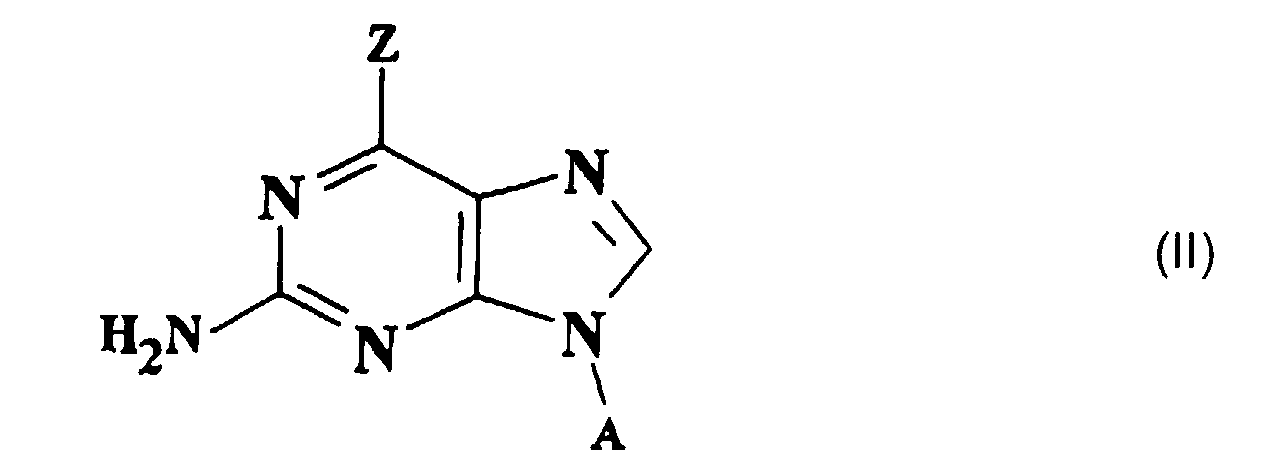
- Process A) may be carried out in conventional manner, for example, by treatment of a compound of formula (II) in which Z represents a leaving group (e.g. a halo such as a chloro group) with an appropriate amine, i.e.cyclopropylamine or N-cyclopropyl-N-methylamine, preferably in an excess to introduce the amino R group as defined above, advantageously at reflux or at a temperature greater than 50°C, preferably in the presence of an organic solvent, for example methanol or ethanol.
- Z represents a leaving group
- an appropriate amine i.e.cyclopropylamine or N-cyclopropyl-N-methylamine
- Process B) may be carried out, for example, by reacting a compound of formula (III) with formic acid or a reactive formic acid derivative (e.g. triethylorthoformate or diethoxymethyl acetate) optionally with a co-solvent such as a dimethylacetamide or dimethylformamide at an elevated temperature preferably at 75-90°C.
- a reactive formic acid derivative e.g. triethylorthoformate or diethoxymethyl acetate
- a co-solvent such as a dimethylacetamide or dimethylformamide
- This reaction conveniently effected by the addition of slightly more than equivalent of a strong anhydrous acid, e.g. with 1.1 equivalents of ethanesulfonic acid per equivalent of compound of formula (III), in which case lower temperatures (e.g. 25°C) are used.
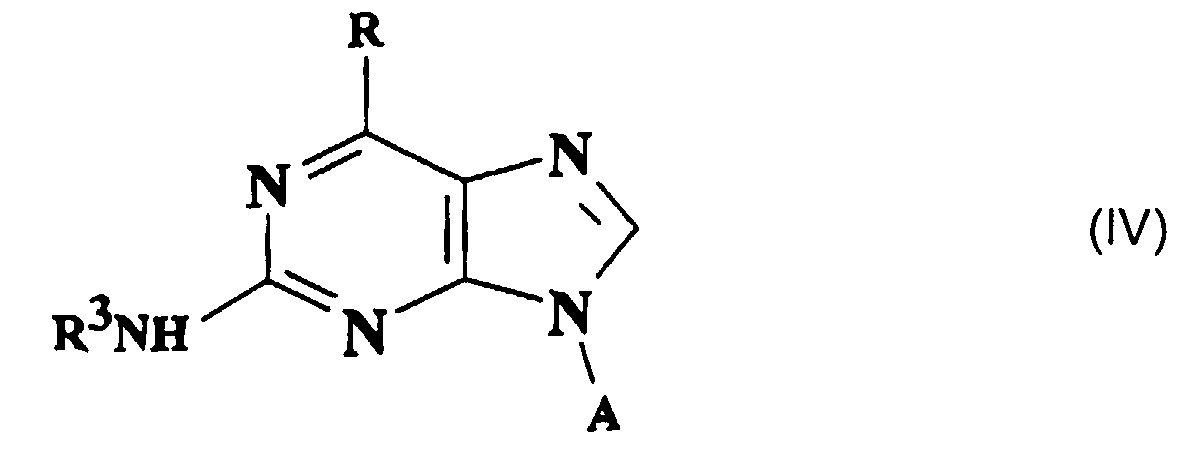
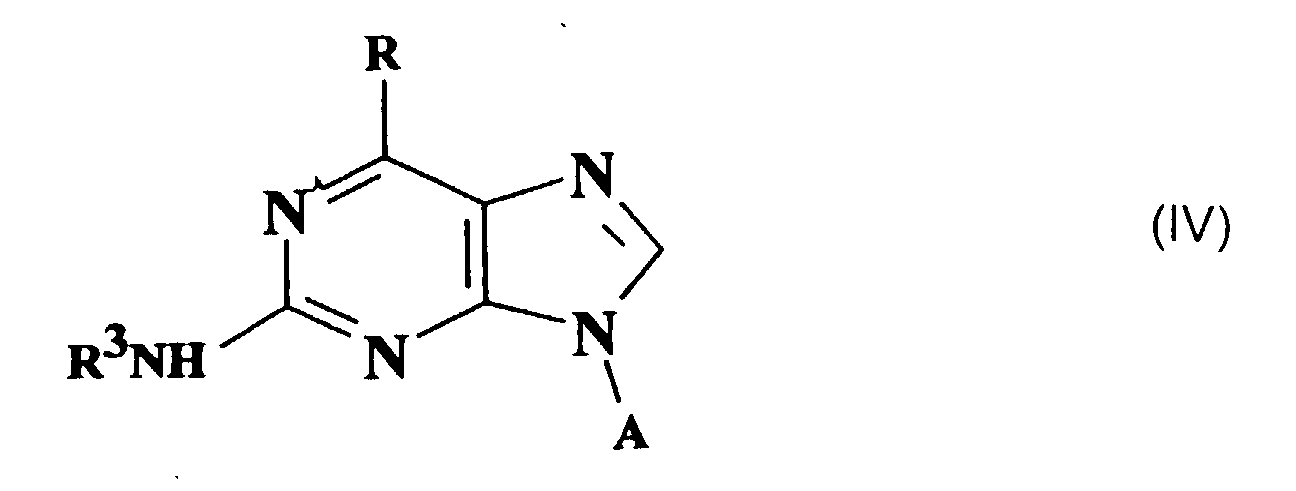
- Process C) may be carried out, for example, by reacting an enantiomeric compound of formula (IV) with an acidic agent, for example, dilute aqueous hydrochloric acid.
- an acidic agent for example, dilute aqueous hydrochloric acid.
- the compounds of formula (II) employed as starting materials process A) may be prepared for example, in an analogous manner to process B), i.e. by reacting a corresponding enantiomeric compound of formula (V) (wherein A, Z, R 2 and R 3 are as hereinbefore defined) or a derivative thereof with an agent serving to effect formation of the imidazole ring in the desired compound of formula (II) and to effect removal of the R 3 amino protecting group.
- the reaction may be carried out using those agents and conditions described above for process B).
- the compounds of formula (III) employed as starting materials in process B) may be prepared for example by treating an enantiomeric compound of formula (V) above with an agent or conditions serving to convert the precursor group Z to the desired R group, in an analogous manner to that described for process A).
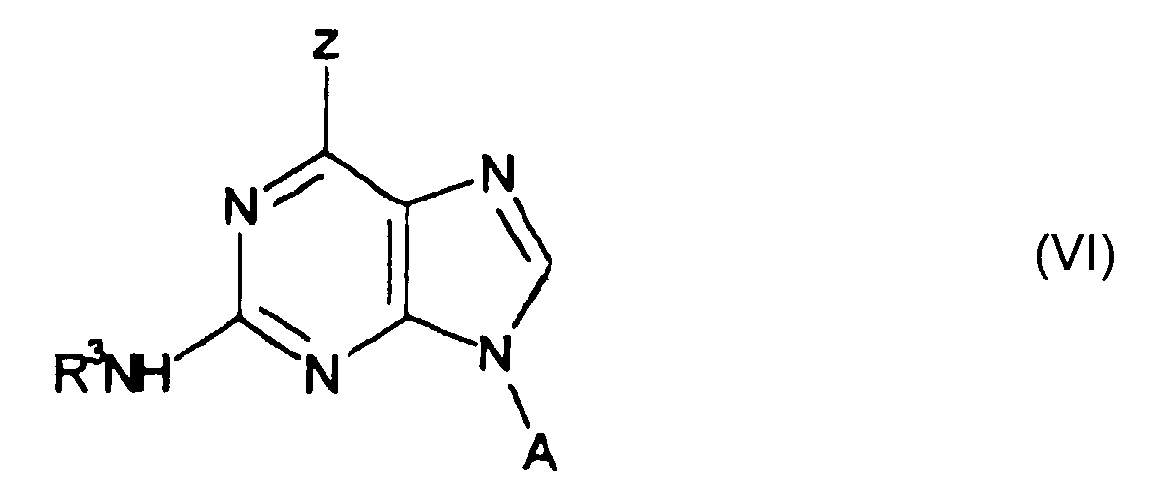
- the compounds of formula (IV) referred to above may be prepared, for example, by reacting an enantiomeric compound of formula (VI) (wherein A, Z and R 3 are hereinbefore defined) with an agent or under conditions serving to convert the precursor group Z to the desired R group, i.e. in an analogous manner to that described for process A).
- the compounds of formula (VI) above may be prepared for example by reacting an enantiomeric compound of formula (V) above with an agent serving to effect formation of the imidazole ring in the desired compound of formula (VI), for example by treatment with formic acid or a reactive formic acid derivative, as described above in relation to process B).
- the enantiomeric compounds of formula (V) employed as starting materials as described above may be prepared for example by reacting a compound of formula (VII) (wherein Z, R 2 and R 3 are as hereinbefore defined and R 4 represents a leaving group, e.g. a halo such as a chloro group) or a derivative thereof with an enantiomeric compound of formula (VIIIA) or (VIIIB) or a derivative thereof
- the last-mentioned reaction is advantageously effected in the presence of a base such as a tertiary amine for example triethylamine or trimethylamine advantageously in an organic solvent such as dimethoxyethane or ethanol.
- a base such as a tertiary amine for example triethylamine or trimethylamine advantageously in an organic solvent such as dimethoxyethane or ethanol.
- the compounds of formula (VIIIA) or (VIIIB) having the appropriate enantiomeric configuration can be obtained by complexing the corresponding racemic compound, i.e. ( ⁇ )-4-amino-2-cyclopentene-1-methanol with an optically active carboxylic acid (for example dibenzoyl-D-tartaric acid) and then fractional crystallisation of resulting diastereomeric salts.
- an optically active carboxylic acid for example dibenzoyl-D-tartaric acid
- enzymatic resolution may be employed as described for example in J.Med.Chem. 1987 30, 746 and J.Med.Chem., 1985 28 1385.
- the compounds of formula (VII) employed as starting materials above may be prepared in a conventional manner for example by reducing a compound of formula (IX) (wherein Z, R 3 and R 4 are as hereinbefore defined) to effect conversion of the NO 2 group to an NH 2 group and optionally converting the resulting NH 2 group to a formamido group, for example, by treatment with formic acid/acetic anhydride.
- a compound of formula (IX) wherein Z, R 3 and R 4 are as hereinbefore defined
- the compounds of formula (IX) may be prepared in conventional manner. Those compounds in which Z represents a halo, for example chloro group may be prepared for example by halogenating, for example using phosphorus oxychloride, a corresponding compound of formula (X) (wherein R 3 and R 4 are as hereinbefore defined).
- the compounds of formula (X) may also be prepared in conventional manner, for example by reaction of a compound of formula (Xl) (wherein R 4 is as hereinbefore defined) with an appropriate agent serving to introduce the amino protecting group, for example by reaction with an appropriate carboxylic acid or a functional equivalent thereof e.g. isobutyric anhydride.
- the compound of formula (Xl) may be prepared by nitration of a corresponding compound of formula (XII) (wherein R 4 is as hereinbefore defined).
- a compound of formula (I) may generally be converted into an ester thereof by reaction with an appropriate esterifying agent, e.g. an acid halide or anhydride.
- the compound of formula (I), including esters thereof, may be converted into salts thereof in conventional manner, for example, by treatment with an appropriate acid.
- An ester or salt of a compound of formula (I) may be converted into the parent compound, for example by hydrolysis.
- the 0-monophosphate of a compound of formula (I) may be prepared by treating the parent with an appropriate phosphorylating agent, e.g. phosphorus oxychloride as in M.Yoshikawa, T.Kato and T.Takenishi, Bulletin Chem. Soc. Japan , 1969, 42, 3505.
- an appropriate phosphorylating agent e.g. phosphorus oxychloride as in M.Yoshikawa, T.Kato and T.Takenishi, Bulletin Chem. Soc. Japan , 1969, 42, 3505.
- the corresponding 0-di- and 0- triphosphates may be prepared by methods described in "Nucleotide Analogs" by K.H.Sheit, John Wiley and Sons, New York 1980, pp. 211-215 and in D.E.Hoard and D.G.Ott, J.Amer.Chem.Soc. 1965, 87, 1785, e.g.
- the parent compound of formula (I) may be treated with an appropriate di-alkanoyl phosphatidyl choline derivative in the presence of an appropriate phospholipase for example phospholipase D, as described in S.Shuto et al, Nucleic Acid Research, 1988, 20, page 35 or by reaction of a compound of formula (I) with an appropriate phosphorylating agent such as phosphorus oxychloride followed by work-up with an appropriate alcohol as described in A.Rosowsky & S.Kim, Nucleic Acid Chemistry, Part 3, L.B.Townsend & R.S.Tipson (Editors), John Wiley & Sons, New York, 1986, 255.
- an appropriate phospholipase for example phospholipase D
- the enantiomers of the compounds of formula (I) may be resolved or isolated in conventional manner, e.g. by chromatographic separation of diastereomeric esters prepared by acylation of the hydroxyl on the cyclopentenyl moiety with appropriate optically active carboxylic acid derivatives as, e.g., with naproxen (J. Org. Chem. 1986 51, 1287).
- Examples are intended for illustration of the invention.
- optical rotations were assigned with respect to the sodium D line (589nm) at 20°C.
- active ingredient' as used in Examples A to G means an antiviral compound according to the invention, especially compound 1) above.
- the chloroform filtrate-wash was concentrated and chromatographed on a silica gel column. Additional pyrimidine starting material was eluted with 2.5% methanol-chloroform. The title compound was eluted with 3.5% methanol-chloroform as an off-white solid foam (15.90 g, 91%).
- Example 2 The title compound of Example 2 (11.67 g) was suspended in ethanol (235 mL), glacial acetic acid (30 mL), and water 235 mL). The mixture was heated to reflux under nitrogen. Zinc dust (13.5 g) was added in small portions over 30 minutes during which time the compound dissolved. The reaction was heated an additional 20 minutes, and then the excess zinc was filtered off from the hot solution, and it was washed with ethanol. The filtrates were evaporated, and the residue was purified on a silica gel column eluting with chloroform (1 L) and chloroform:methanol/4:1 (1.8 L).
- Example 3 The title compound of Example 3 (about 9.7 g) was dissolved in diethoxymethyl acetate (100 g), and refluxed for two days. The solvent was removed under high vacuum at 50°C, and dioxane (40 mL) and 0.5 N HCI (60 mL) was added.
- Example 4 The title compound of Example 4 (0.50 g) was dissolved in ethanol (40 mL), and cyclopropylamine (0.65 mL, 5 equivalent) was added. The reaction was refluxed under nitrogen for 6 hours. An additional 0.65 mL of cyclopropylamine was added, and the reaction refluxed for an additional 5.5 hours. The solvents were evaporated, and chloroform (25 mL) and saturated sodium bicarbonate solution (5 mL) was added. The aqueous layer was extracted several times with CHCl3 to obtain the crude product.
- Example 5 The title compound of Example 5 (0.600 g, 2.00 mmol) was dissolved in 1,3-dimethyl-314,5,6-tetrahydro-2-(1 H )-pyrimidinone (Aldrich, 12 mL). Phosphoryl chloride (0.76 mL, 8.0 mmol) was added to the stirred, cooled (-10°C) solution. After 3 minutes, cold water (100 mL) was added and the resulting solution neutralized with 3M ammonium hydroxide. The neutralized solution was diluted to 1 liter with water and applied to a 2.5 x 20 cm column of DEAE Sephadex A25 (Pharmacia) which had been preequilibrated with 50 mM ammonium bicarbonate.
- Phosphoryl chloride (0.76 mL, 8.0 mmol) was added to the stirred, cooled (-10°C) solution. After 3 minutes, cold water (100 mL) was added and the resulting solution neutralized with 3M ammonium hydrox
- the column was first washed with 4 liters of 50 mM ammonium bicarbonate.
- the 0-monophosphate of ( ⁇ )- cis -4-[2-amino-6-cyclopropylamino)-9H-purin-9-yl]-2-cyclopentene-1-methanol was then eluted with a 2-liter gradient of 50 to 300 mM ammonium bicarbonate.
- the fractions containing nucleotide i.e. the above 0-monophosphate
- Example 7 The title compound of Example 7 (0.35 g, 1.2 mmol) was dissolved in 1 ,3-dimethyl-3,4,5,6-tetrahydro-2-(1 H)-pyrimidinone (Aldrich, 5 mL). Phosphoryl chloride (Aldrich, 0.43 mL, 4.6 mmol) was added to the stirred, cooled (-10°C) solution. After 3 minutes, cold water (20 mL) was added and the resulting solution neutralized with 3 M ammonium hydroxide.
- Phosphoryl chloride Aldrich, 0.43 mL, 4.6 mmol
- Example 7 Ion exchange chromatography as described in Example 7 gave the nucleotide as the diammonium salt after evaporation of water, white powder (95% yield, quantitated by UV); HPLC analysis as in Example 7 shows one peak; UV ⁇ max nM (0.1 M HCl):254, 297; (pH 7 phosphate buffer):259, 284; (0.1 M NaOH):259, 284.
- Example 6 The title compound of Example 6, (2.00 g, 6.50 mmol) was dissolved in 1,3-dimethyl-3,4,5,6-tetrahydro-2(1H)-pyrimidinone (Aldrich, 20 mL). Phosphoryl chloride (2.28 mL, 24.0 mmol) was added to the stirred, cooled (-10°C) solution. After 3 minutes, cold water (80 mL) was added. The solution was extracted with chloroform (3 x 80 mL). The aqueous layer was diluted with ethanol (400 mL) and the pH adjusted to 6 with saturated aqueous NaOH. The precipitated inorganic salts were filtered off.
- Phosphoryl chloride (2.28 mL, 24.0 mmol) was added to the stirred, cooled (-10°C) solution. After 3 minutes, cold water (80 mL) was added. The solution was extracted with chloroform (3 x 80 mL). The aqueous layer was diluted with ethanol (
- Example 7 After incubation at 37 °C for 10 days, HPLC analysis as described in Example 7 showed that 50% of the starting nucleotide had been dephosphorylated to the nucleoside. These were separated on a 5 x 14 cm column of DEAE Sephadex A25 (Pharmacia) which had been preequilibrated with 50 mM ammonium bicarbonate. The title compound was eluted with 2 liters of 50 mM ammonium bicarbonate. Evaporation of water gave white powder which was dissolved in methanol, adsorbed on silica gel, and applied to a silica gel column. Title compound was eluted with methanol:chloroform/1:9 as a colorless glass.
- N -(5-Amino-4,6-dichloropyrimidin-2-yl)acetamide ( J Org Chem. 1975 , 40, 3141) was formylated by addition of 96% formic acid (20 mL) to a solution of (0.75 g, 3.4 mmoles) dissolved in acetic anhydride (20 mL). The resulting solution was stirred at 25°C for one hour and then evaporated to give N -(4,6-dichloro-5-formamido-2-pyrimidinyl)acetamide as tan powder (0.77 g, 91%); structure confirmed by 1 H-NMR and mass spectrum.
- Example 12 The title compound of Example 12 (0.91 g, 2.79 mmol) was dissolved in dry DMF (1 mL). Triethylorthoformate (10 mL) and ethane sulfonic acid (0.29 mL, 3.4 mmol) were added and the solution heated at 65°C for 24 hours. The solution was evaporated to a syrup. The syrup was dissolved in 1 N HCI (15 mL) and stirred for three hours. The pH was adjusted to 7 with 5N sodium hydroxide and the resulting mixture (oil formed) was extracted with i-propanol:chloroform/1:3 (3 x 100 mL). The combined organic layers were dried (MgSO4) and evaporated to a red glass (0.93 g).
- Example 14 The title compound of Example 14 (1.15 g, 3.53 mmol) was gently refluxed in diethoxylmethyl acetate (45 mL) under nitrogen for 3.5 hours. The resulting pale yellow solution was concentrated at 0.5 mm Hg to a yellow syrup. The syrup was stirred in 1 N HCI (50 mL) for 1.0 hour. This solution was neutralized with sodium bicarbonate and evaporated to dryness. The residual solids were extracted with methanol and the methanol-soluble material applied to a silica gel column.
- Example 20 The title compound of Example 20 (10.0g, 38.37 mmol) was heated to reflux in phosphorus oxychloride (200ml) and N,N-diethylaniline (3-4 drops) for 5 hours under nitrogen. The solution was then cooled to room temperature, concentrated to dryness, and the syrup was dissolved in cold ( ⁇ -10°C) methylene chloride (200ml). The organic layer was treated with saturated aqueous sodium bicarbonate (100ml) with vigorous stirring, and the temperature was kept below 5°C as solid sodium bicarbonate was added portionwise to elevate the pH to between 5 and 7. The layers were separated and the aqueous phase was extracted with methylene chloride.
- Example 21 The title compound of Example 21 (6.77g, 24.26 mmol) was placed in a Parr bottle containing 220ml absolute EtOH and 10.0g (wet) Raney nickel catalyst that had been previously shaken under hydrogen (40psi) for 10 minutes. The mixture was shaken under hydrogen (40psi) for an hour, filtered over celite, and the filtrate was concentrated to a yellow-white solid that was dried under vacuum overnight. This solid was stirred in 1,2-dichloroethane (250ml) at 0°C. Acetic anhydride (30ml) was added, followed by formic acid (30ml) dropwise under nitrogen.
- 1,2-dichloroethane 250ml
- Acetic anhydride (30ml) was added, followed by formic acid (30ml) dropwise under nitrogen.
- (+)-(1 R ,4 S )- cis -N-[4-chloro-5-formamido-6- ⁇ [4-(hydroxymethyl)-2-cyclopentene-1-yl]amino ⁇ -2-pyrimidinyl]isobutyramide (1.949g, 5.44mmol) prepared as described in Example 23, was stirred with triethylorthoformate (30ml) in an ice-water bath while concentrated hydrochloric acid (2.0ml) was added dropwise over two minutes. The resulting clear solution was stirred at ambient temperature overnight.
- Tributylammonium pyrophosphate (made by exchanging the salt of tetrasodium pyrophosphate for hydrogen on an ion-exchange resin, then neutralizing with tributylamine and drying, 2.4 mmol) was added, stirred for 18 hours at room temperature, then 50 ml of water was added. Both 0-diphosphate and 0-triphosphate were formed since the tributylammonium pyrophosphate contained orthophosphate impurity.
- reaction products were separated by DEAE Sephadex ion exchange chromatography in a 2.5 x 18 cm column of DEAE Sephadex A25 (Pharmacia) which had been equilibrated with 50 mM ammonium bicarbonate (ABC).
- the column was washed with 1 L of 100 mM ABC then with a 2 L linear gradient of 100 to 800 mM ABC to elute the to elute the title compound followed by the triphosphate as described in more detail in Example 29.
- the fractions containing diphosphate were combined, dried in vacuo, redissolved in water then repeated twice to yield the ammonium salt of the title compound (0.032 mmol, 6 % yield).
- formulations A, B and C are prepared by wet granulation of the ingredients with a solution of povidone, followed by addition of magnesium stearate and compression.
- Formulation A mg/tablet mg/tablet (a) Active ingredient 250 250 (b) Lactose B.P. 210 26 (c) Povidone B.P. 15 9 (d) Sodium Starch Glycollate 20 12 (e) Magnesium Stearate 5 3 500 300
- Formulation B mg/tablet mg/tablet (a) Active ingredient 250 250 (b) Lactose 150 - (c) Avicel PH 101 60 26 (d) Povidone B.P. 15 9 (e) Sodium Starch Glycollate 20 12 (f) Magnesium Stearate 5 3 500 300 Formulation C mg/tablet Active ingredient 100 Lactose 200 Starch 50 Povidone 5 Magnesium stearate 4 359
- the following formulations, D and E are prepared by direct compression of the admixed ingredients.
- the lactose in formulation E is of the direct compression type (Dairy Crest - 'Zeparox').
- Formulation D mg/tablet Active ingredient 250 Pregelatinised Starch NF15 150 400
- Formulation E mg/tablet Active ingredient 250 Lactose 150
- Avicel 100 500 Formulation F (Controlled Release Formulation)
- the formulation is prepared by wet granulation of the ingredients (below) with a solution of povidone followed by the addition of magnesium stearate and compression.
- mg/tablet (a) Active ingredient 500 (b) Hydroxypropylmethylcellulose (Methocel K4M Premium) 112 (c) Lactose B.P. 53 (d) Povidone B.P. 28 (e) Magnesium Stearate 7 700
- Drug release takes place over a period of about 6-8 hours and is complete after 12 hours.
- a capsule formulation is prepared by admixing the ingredients of Formulation D in Example A above and filling into a two-part hard gelatin capsule.
- Formulation B (infra) is prepared in a similar manner.
- Formulation B mg/capsule (a) Active ingredient 250 (b) Lactose B.P. 143 (c) Sodium Starch Glycollate 25 (d) Magnesium Stearate 2 420
- Formulation C mg/capsule (a) Active ingredient 250 (b) Macrogol 4000 B.P. 350 600
- Capsules of formulation C are prepared by melting the Macrogol 4000 BP, dispersing the active ingredient in the melt and filling the melt into a two-part hard gelatin capsule.
- Formulation D mg/capsule Active ingredient 250 Lecithin 100 Arachis Oil 100 450
- Capsules of formulation D are prepared by dispersing the active ingredient in the lecithin and arachis oil and filling the dispersion into soft, elastic gelatin capsules.
- Formulation E Controlled Release Capsule
- the following controlled release capsule formulation is prepared by extruding ingredients a, b and c using an extruder, followed by spheronisation of the extrudate and drying. The dried pellets are then coated with release-controlling membrane (d) and filled into a two-piece, hard gelatin capsule.
- mg/capsule (a) Active ingredient 250 (b) Microcrystalline Cellulose 125 (c) Lactose B.P. 125 (d) Ethyl Cellulose 13 513
- Injectable Formulation A Active ingredient 0.200 9 Hydrochloric acid solution, 0.1M, or Sodium hydroxide solution, 0.1M q.s. to pH 4.0 to 7.0 Sterile water q.s. to 10 ml
- the active ingredient is dissolved in most of the water (35°-40°C) and the pH adjusted to between 4.0 and 7 0 with the hydrochloric acid or the sodium hydroxide as appropriate.
- the batch is then made up to volume with the water and filtered through a sterile micropore filter into a sterile 10 ml amber glass vial (type 1) and sealed with sterile closures and overseals.
- Formulation B Active ingredient 0.125 g Sterile, pyrogen-free, pH 7 phosphate buffer q.s. to 25 ml
- Intramuscular iniection Active ingredient 0.20 g Benzyl Alcohol 0.10 g Glycofurol 75 1.45 g Water for injection q.s. to 3.00 ml
- the active ingredient is dissolved in the glycofurol.
- the benzyl alcohol is then added and dissolved, and water added to 3 ml.
- the mixture is then filtered through a sterile micropore filter and sealed in sterile 3 ml amber glass vials (type 1).
- the active ingredient is dissolved in a mixture of the glycerol and most of the purified water.
- An aqueous solution of the sodium benzoate is then added to the solution, followed by addition of the sorbitol solution and finally the flavor.
- the volume is made up with purified water and mixed well.
- Witepsol H15 is melted in a steam-jacketed pan at 45°C maximum.
- the active ingredient is sifted through a 200 ⁇ m sieve and added to the molten base with mixing, using a silverson fitted with a cutting head, until a smooth dispersion is achieved. Maintaining the mixture at 45°C, the remaining Witepsol H15 is added to the suspension and stirred to ensure a homogenous mix.
- the entire suspension is passed through a 250 ⁇ m stainless steel screen and, with continuous stirring, is allowed to cool to 40°C. At a temperature of 38°C to 40°C, 2.02 g of the mixture is filled into suitable, 2 ml plastic molds. The suppositories are allowed to cool to room temperature.
- Pessaries mg/pessary Active ingredient 250 Anhydrate Dextrose 380 Potato Starch 363 Magnesium Stearate 7 1000
- the human HBV producer cell line of HepG2,2.2.15 described and characterised by Sells et al., PNAS 84: 1005, 1987 and J.Virol 62: 2836, 1988 has been shown . to share many characteristics of the HBV chronically infected hepatocyte. It is infectious as demonstrated by the ability to cause disease in chimpanzees.
- test compounds for anti-HBV activity monolayer cultures were treated with the test compound: 50-200 ⁇ M for ten days.
- Supernatant media containing extracellular virion DNA were harvested on days three, six and ten, treated with proteinase K (1 mg/mL) and sodium dodecyl sulfate (1%), and incubated at 50°C for one hour.
- DNA was extracted with equal volumes of phenol followed by chloroform and then precipitated by ammonium acetate and propanol.
- the DNA precipitate was dissolved and collected on nitrocellulose using the procedure of Schleicher and Schuell (S&S, 10 Optical Ave., Keene, NH 03431, Publication #700, 1987), and treated as described by Southern, 3.Mol.Biol., 98, 503, 1975. Cells were harvested and the intracellular DNA was obtained after cell lysis with guanidine isothiocyanate. The intracellular DNA was handled in the same manner as the extracellular DNA. After precipitation by ammonium acetate and propanol, the intracellular DNA precipitate was dissolved, cut by restriction endonuclease, Hind III, applied to agarose gel and then treated as described by Southern to determine the quantity of replicative intermediate forms. The antiviral effect of the drug was determined by measuring at least a 100-fold reduction of the amount of Dane particles extruded into the culture medium and a similar decrease in the intracellular replicative intermediates.
Landscapes
- Chemical & Material Sciences (AREA)
- Organic Chemistry (AREA)
- Health & Medical Sciences (AREA)
- Life Sciences & Earth Sciences (AREA)
- General Health & Medical Sciences (AREA)
- Veterinary Medicine (AREA)
- Nuclear Medicine, Radiotherapy & Molecular Imaging (AREA)
- Public Health (AREA)
- Animal Behavior & Ethology (AREA)
- Chemical Kinetics & Catalysis (AREA)
- General Chemical & Material Sciences (AREA)
- Medicinal Chemistry (AREA)
- Pharmacology & Pharmacy (AREA)
- Virology (AREA)
- Immunology (AREA)
- Oncology (AREA)
- Communicable Diseases (AREA)
- Molecular Biology (AREA)
- Engineering & Computer Science (AREA)
- Bioinformatics & Cheminformatics (AREA)
- Biotechnology (AREA)
- AIDS & HIV (AREA)
- Tropical Medicine & Parasitology (AREA)
- Biochemistry (AREA)
- Pharmaceuticals Containing Other Organic And Inorganic Compounds (AREA)
- Organic Low-Molecular-Weight Compounds And Preparation Thereof (AREA)
- Acyclic And Carbocyclic Compounds In Medicinal Compositions (AREA)
Claims (23)
- Procédé de préparation de composés énantiomères de la formule générale :[dans laquelle R représente un groupe cyclopropylamino ou N-cyclopropyl-N-méthylamino et A représente le groupe 2-cyclopentène-1-méthanol-4-yle dans la configuration (1S,4R)], lesdits composés étant sous la forme d'un énantiomère essentiellement exempt de l'énantiomère correspondant, lequel procédé comprend :
 A) le traitement d'un composé énantiomère de formule (II) :[dans laquelle A est tel que défini précédemment et Z représente un groupe précurseur pour ledit groupe R tel que défini dans la formule (I)] avec un agent ou sous des conditions servant à convertir le groupe Z précurseur en le groupe R désiré; ou
 B) la réaction d'un composé énantiomère de formule (III):(dans laquelle A et R sont tels que définis précédemment, R2 représente de l'hydrogène ou un groupe formyle et R3 représente un groupe de protection d'amino) avec un agent servant à effectuer la formation du cycle imidazole dans le composé de formule (I) désiré et à effectuer la séparation du groupe de protection d'amino R3; ou
 C) la réaction d'un composé énantiomère de formule (IV) :(dans laquelle A et R sont tels que définis précédemment et R3 est un groupe de protection d'amino) avec un agent servant à effectuer la séparation du groupe de protection d'amino R3, et éventuellement la réalisation d'une des conversions suivantes ou des deux dans un ordre désiré quelconque :
 i) lorsqu'un composé de formule (I) est formé, la conversion dudit composé en un sel, ester ou sel de cet ester pharmaceutiquement acceptable de celui-ci; ouii) lorsqu'un sel, ester ou sel de cet ester pharmaceutiquement acceptable d'un composé de formule (I) est formé, la conversion dudit sel, ester ou sel de cet ester pharmaceutiquement acceptable en le composé apparenté de formule (I) ou en un autre sel, ester ou sel de cet ester pharmaceutiquement acceptable de ce type, dans lequel ledit ester est choisi parmi les esters d'acide carboxylique dans lesquels le fragment non carbonylé du groupement ester est choisi parmi les groupes alkyle en C1-18 à chaíne droite ou ramifiée, alcoxy(C1-18)alkyle en C1-18, aralkyle en C1-18, aryloxy(C1-18)alkyle en C1-18 et aryle, les esters de sulfonate choisis parmi les groupes alkyl(C1-18)- et aralkyl(C1-18)sulfonyle, les esters d'acide aminé et les esters de mono-, di- et triphosphate.
- Procédé suivant la revendication 1 pour la préparation de sels, esters et sels d'esters pharmaceutiquement acceptables des composés énantiomères (1S,4R) de formule (I), dans lequel ledit ester est tel que défini à la revendication 1.
- Procédé suivant l'une ou l'autre des revendications 1 et 2, dans lequel le composé énantiomère de formule (I) préparé est exempt de l'énantiomère correspond dans la mesure où moins de 10% en poids/poids de l'énantiomère correspondant sont présents.
- Procédé suivant l'une ou l'autre des revendications 1 et 2, dans lequel le composé énantiomère de formule (I) préparé est exempt de l'énantiomère correspond dans la mesure où moins de 5% en poids/poids de l'énantiomère correspondant sont présents.
- (1S,4R)-cis-4-[2-amino-6-(cyclopropylamino)-9H-purin-9-yl]-2-cyclopentène-1-méthanol essentiellement exempt de l'énantiomère correspondant.
- (1S,4R)-cis-4-[2-amino-6-(N-cyclopropyl-N-méthylamino)-9H-purin-9-yl]-2-cyclopentène-1-méthanol essentiellement exempt de l'énantiomère correspondant.
- Composé énantiomère suivant l'une ou l'autre des revendications 5 et 6, exempt de l'énantiomère correspondant dans la mesure où moins de 10% en poids/poids de l'énantiomère correspondant sont présents.
- Composé énantiomère suivant l'une quelconque des revendications 5 à 7, exempt de l'énantiomère correspondant dans la mesure où moins de 5% en poids/poids de l'énantiomère correspondant sont présents.
- (1S,4R)-cis-4-[2-amino-6-(cyclopropylamino)-9H-purin-9-yl]-2-cyclopentène-1-méthanol suivant la revendication 5, exempt de l'énantiomère correspondant.
- (1S,4R)-cis-4-[2-amino-6-(N-cyclopropyl-N-méthylamino)-9H-purin-9-yl]-2-cyclopentène-1-méthanol suivant la revendication 6, exempt de l'énantiomère correspondant.
- Sel, ester ou sel de cet ester pharmaceutiquement acceptable d'un composé suivant l'une quelconque des revendications 5 à 10, dans lequel ledit ester est choisi parmi les esters d'acide carboxylique, dans lesquels le fragment non carbonylé du groupement ester est choisi parmi les groupes alkyle en C1-18 à chaíne droite ou ramifiée, alcoxy-(C1-18) alkyle en C1-18, aralkyle en C1-18, aryloxyalkyle en C1-18 et aryle, les esters de sulfonate choisis parmi les groupes alkyl(C1-18)- et aralkyl(C1-18)sulfonyle, les esters d'acide aminé et les esters de mono-, di- et triphosphate.
- Formulation pharmaceutique comprenant un composé suivant l'une quelconque des revendications 5 à 11, en même temps qu'avec au moins un support ou excipient pharmaceutiquement acceptable.
- Formulation pharmaceutique suivant la revendication 12, adaptée pour l'administration orale.
- Formulation pharmaceutique suivant la revendication 12, adaptée pour l'administration parentérale.
- Composé suivant l'une quelconque des revendications 5 à 17, destiné à être utilisé en thérapie médicale.
- Utilisation d'un composé suivant l'une quelconque des revendications 5 à 11, dans la fabrication d'un médicament pour le traitement ou la prophylaxie d'une infection rétrovirale.
- Utilisation d'un composé suivant l'une quelconque des revendications 5 à 11, dans la fabrication d'un médicament pour le traitement ou la prophylaxie d'une infection par le virus d'immunodéficience humaine (VIH).
- Utilisation d'un composé suivant l'une quelconque des revendications 5 à 11, dans la fabrication d'un médicament pour le traitement ou la prophylaxie d'une infection virale par le virus de l'hépatite B.
- Utilisation suivant l'une quelconque des revendications 16 et 18, dans laquelle le médicament est sous la forme d'une quantité de dosage dans la gamme de 3,0 à 120 mg par kg de poids de corps du receveur par jour.
- Composés énantiomères de formule (IV) :(dans laquelle A et R sont tels que définis à la revendication 1 et R3 représente un groupe alcanoyle en C1-6).
- Composé suivant la revendication 20, qui est le (1R,4S)-cis-N-[6-(cyclopropylamino)-9-(4-(hydroxyméthyl)-2-cyclopentén-1 -yl)-9H-purin-2-yl]isobutyramide essentiellement exempt de l'énantiomère (1S,4R) correspondant.
- Composés énantiomères de formule (VI) :(dans laquelle A est tel que défini à la revendication 1, Z représente un groupe halo et R3 représente un groupe alcanoyle en C1-6).
- Composé suivant la revendication 22, qui est le (1S,4R)-cis-N-[6-chloro-9-(4-(hydroxyméthyl)-2-cyclopentén-1-yl)-9H-purin-2-yl]isobutyramide essentiellement exempt de l'énantiomère (1R,4S) correspondant.
Priority Applications (2)
| Application Number | Priority Date | Filing Date | Title |
|---|---|---|---|
| EP99103525A EP0921121A1 (fr) | 1989-12-22 | 1990-12-21 | Intermédiaires de nucléosides thérapeutiques |
| EP99103526A EP0921114A1 (fr) | 1989-12-22 | 1990-12-21 | Intermédiaires de nucléosides thérapeutiques |
Applications Claiming Priority (2)
| Application Number | Priority Date | Filing Date | Title |
|---|---|---|---|
| US07/455,201 US5034394A (en) | 1988-06-27 | 1989-12-22 | Therapeutic nucleosides |
| US455201 | 1989-12-22 |
Related Child Applications (4)
| Application Number | Title | Priority Date | Filing Date |
|---|---|---|---|
| EP99103525A Division EP0921121A1 (fr) | 1989-12-22 | 1990-12-21 | Intermédiaires de nucléosides thérapeutiques |
| EP99103526A Division EP0921114A1 (fr) | 1989-12-22 | 1990-12-21 | Intermédiaires de nucléosides thérapeutiques |
| EP99103525.4 Division-Into | 1999-02-24 | ||
| EP99103526.2 Division-Into | 1999-02-24 |
Publications (3)
| Publication Number | Publication Date |
|---|---|
| EP0434450A2 EP0434450A2 (fr) | 1991-06-26 |
| EP0434450A3 EP0434450A3 (en) | 1992-07-08 |
| EP0434450B1 true EP0434450B1 (fr) | 1999-07-07 |
Family
ID=23807819
Family Applications (3)
| Application Number | Title | Priority Date | Filing Date |
|---|---|---|---|
| EP99103525A Withdrawn EP0921121A1 (fr) | 1989-12-22 | 1990-12-21 | Intermédiaires de nucléosides thérapeutiques |
| EP99103526A Withdrawn EP0921114A1 (fr) | 1989-12-22 | 1990-12-21 | Intermédiaires de nucléosides thérapeutiques |
| EP90314089A Expired - Lifetime EP0434450B1 (fr) | 1989-12-22 | 1990-12-21 | Nucléosides thérapeutiques |
Family Applications Before (2)
| Application Number | Title | Priority Date | Filing Date |
|---|---|---|---|
| EP99103525A Withdrawn EP0921121A1 (fr) | 1989-12-22 | 1990-12-21 | Intermédiaires de nucléosides thérapeutiques |
| EP99103526A Withdrawn EP0921114A1 (fr) | 1989-12-22 | 1990-12-21 | Intermédiaires de nucléosides thérapeutiques |
Country Status (29)
| Country | Link |
|---|---|
| EP (3) | EP0921121A1 (fr) |
| JP (2) | JPH11158160A (fr) |
| CN (1) | CN1028106C (fr) |
| AP (1) | AP196A (fr) |
| AT (1) | ATE181917T1 (fr) |
| AU (1) | AU633672B2 (fr) |
| CA (1) | CA2033044C (fr) |
| CY (1) | CY2145B1 (fr) |
| CZ (1) | CZ283481B6 (fr) |
| DE (2) | DE19975058I1 (fr) |
| DK (1) | DK0434450T3 (fr) |
| ES (1) | ES2133138T3 (fr) |
| FI (1) | FI106461B (fr) |
| GR (1) | GR3031100T3 (fr) |
| HU (3) | HU219454B (fr) |
| IE (3) | IE990826A1 (fr) |
| IL (1) | IL96748A (fr) |
| LU (1) | LU90426I2 (fr) |
| MX (1) | MX9203215A (fr) |
| MY (1) | MY104575A (fr) |
| NL (1) | NL990028I2 (fr) |
| NZ (1) | NZ236593A (fr) |
| PL (1) | PL167097B1 (fr) |
| PT (1) | PT96321B (fr) |
| RU (2) | RU2068849C1 (fr) |
| SG (1) | SG49685A1 (fr) |
| SK (2) | SK280216B6 (fr) |
| TW (2) | TW473466B (fr) |
| ZA (1) | ZA9010365B (fr) |
Cited By (4)
| Publication number | Priority date | Publication date | Assignee | Title |
|---|---|---|---|---|
| US6780635B2 (en) | 2001-12-27 | 2004-08-24 | Council Of Scientific And Industrial Research | Process for the preparation of optically active azabicyclo heptanone derivatives |
| EP2514750A1 (fr) | 2007-06-18 | 2012-10-24 | Sunshine Lake Pharma Co., Ltd | Thiazolyl-dihydropyrimidines a substitution bromo-phenyle |
| WO2015049623A1 (fr) | 2013-10-03 | 2015-04-09 | Lupin Limited | Monohydrate de chlorhydrate d'abacavir de forme cristalline et procédé pour sa préparation |
| EP2899193B1 (fr) | 2008-01-21 | 2018-03-14 | Esteve Química, S.A. | Forme cristalline d'abacavir qui est essentiellement exempte de solvant |
Families Citing this family (55)
| Publication number | Priority date | Publication date | Assignee | Title |
|---|---|---|---|---|
| OA09031A (en) * | 1988-01-20 | 1991-03-31 | Univ Minnesota | Dideoxydidehydrocarbocyclic nucleosides |
| CA2001401A1 (fr) * | 1988-10-25 | 1990-04-25 | Claude Piantadosi | Derives d'ether ou d'ester lipidique contenant une amine quaternaire et composes therapeutiques |
| GB9108376D0 (en) * | 1991-04-19 | 1991-06-05 | Enzymatix Ltd | Cyclopentenes |
| GB9204015D0 (en) * | 1992-02-25 | 1992-04-08 | Wellcome Found | Therapeutic nucleosides |
| GB9205071D0 (en) * | 1992-03-09 | 1992-04-22 | Wellcome Found | Therapeutic nucleosides |
| EP0702556B1 (fr) * | 1993-06-10 | 2002-10-23 | Wake Forest University | (phospho)lipides contre l'infection a virus de l'hepatite b |
| GB9402161D0 (en) | 1994-02-04 | 1994-03-30 | Wellcome Found | Chloropyrimidine intermediates |
| GB9417249D0 (en) * | 1994-08-26 | 1994-10-19 | Wellcome Found | A novel salt |
| US7135584B2 (en) | 1995-08-07 | 2006-11-14 | Wake Forest University | Lipid analogs for treating viral infections |
| AU3216695A (en) | 1994-08-29 | 1996-03-22 | University Of North Carolina At Chapel Hill, The | Lipid analogs for treating viral infections |
| US5977061A (en) * | 1995-04-21 | 1999-11-02 | Institute Of Organic Chemistry And Biochemistry Of The Academy Of Sciences Of The Czech Republic | N6 - substituted nucleotide analagues and their use |
| GB9600142D0 (en) * | 1996-01-05 | 1996-03-06 | Wellcome Found | Chemical compounds |
| CA2262765A1 (fr) * | 1996-06-25 | 1997-12-31 | Glaxo Group Limited | Combinaisons a base de vx478, zidovudine et/ou 1592u89 prevues pour etre utilisees dans le traitement du vih |
| KR20000022226A (ko) * | 1996-06-25 | 2000-04-25 | 그레이엄 브레레톤;레슬리 에드워즈 | Hiv 치료에 사용하기 위한 vx478, 지도부딘, ftc 및(또는) 3tc를 포함하는 배합물 |
| US5866702A (en) * | 1996-08-02 | 1999-02-02 | Cv Therapeutics, Incorporation | Purine inhibitors of cyclin dependent kinase 2 |
| SK285228B6 (sk) * | 1997-05-13 | 2006-09-07 | Lonza Ag | Spôsob výroby racemického alebo opticky aktívnehoderivátu 4-(hydroxymetyl)-2-cyklopenténu a racemicky N-butyryl-1-amino-4- (hydroxymetyl)-2-cyklopentén |
| AU769660B2 (en) * | 1997-05-17 | 2004-01-29 | Glaxo Group Limited | Carbocyclic nucleoside hemisulfate and its use in treating viral infections |
| GB9709945D0 (en) * | 1997-05-17 | 1997-07-09 | Glaxo Group Ltd | A novel salt |
| GB9721780D0 (en) * | 1997-10-14 | 1997-12-10 | Glaxo Group Ltd | Process for the synthesis of chloropurine intermediates |
| AU2702899A (en) * | 1997-10-24 | 1999-05-17 | Glaxo Group Limited | Process for preparing a chiral nucleoside analogue |
| AU5653498A (en) * | 1997-11-12 | 1999-05-31 | Glaxo Group Limited | Process for preparing a chiral nucleoside analogue |
| CZ298102B6 (cs) * | 1997-11-27 | 2007-06-20 | Lonza Ag | Zpusob výroby aminoalkoholu |
| YU44900A (sh) | 1998-01-31 | 2003-01-31 | Glaxo Group Limited | Derivati 2-(purin-9-il)tetrahidrofuran-3,4-diola |
| GB9802472D0 (en) * | 1998-02-06 | 1998-04-01 | Glaxo Group Ltd | Pharmaceutical compositions |
| GB9820417D0 (en) * | 1998-09-18 | 1998-11-11 | Glaxo Group Ltd | Antiviral combinations |
| GB9821058D0 (en) | 1998-09-28 | 1998-11-18 | Univ Cardiff | Chemical compound |
| US6433170B1 (en) | 1998-10-30 | 2002-08-13 | Lonza Group | Method for producing 4-[2',5'-diamino-6'-halopyrimidine-4'-yl)amino]- cyclopent-2-enylmethanols |
| WO2000026193A1 (fr) * | 1998-10-30 | 2000-05-11 | Lonza Ag | Procede de production de 4- [(2',5'- diamino-6'- halopyrimidin- 4'-yl)amino]- cyclopent-2- enylmethanols |
| GB9903091D0 (en) * | 1999-02-12 | 1999-03-31 | Glaxo Group Ltd | Therapeutic nucleoside compound |
| US7026469B2 (en) | 2000-10-19 | 2006-04-11 | Wake Forest University School Of Medicine | Compositions and methods of double-targeting virus infections and cancer cells |
| PE20010915A1 (es) * | 1999-12-10 | 2001-09-29 | Glaxo Group Ltd | Analogos de (1s, cis)-4-(2-amino-9h-purin-9-il)-2-ciclopenten-1-metanol para uso en el tratamiento de infecciones virales |
| JP2003516408A (ja) * | 1999-12-10 | 2003-05-13 | グラクソ グループ リミテッド | 抗ウィルス薬としての(1R,シス)−4−[4−アミノ−7H−ピロロ(2,3−d)ピリミジン−7−イル]−2−シクロペンテン−1−メタノール類縁物 |
| DE10042655A1 (de) * | 2000-08-31 | 2002-03-14 | Aventis Pharma Gmbh | Verfahren zur Herstellung von Inhibitoren der Zell-Adhäsion |
| US7309696B2 (en) | 2000-10-19 | 2007-12-18 | Wake Forest University | Compositions and methods for targeting cancer cells |
| BRPI0210746B8 (pt) | 2001-06-29 | 2021-05-25 | Inst Of Organic Chemistry And Biochemistry Ascr | derivados de 6-'2-(fosfonometóxi)alcóxi-pirimidina e seu método de preparação |
| MY169670A (en) | 2003-09-03 | 2019-05-08 | Tibotec Pharm Ltd | Combinations of a pyrimidine containing nnrti with rt inhibitors |
| US7550261B2 (en) | 2001-08-21 | 2009-06-23 | Smithkline Beecham Corporation | Method of screening for drug hypersensitivity reaction |
| ES2425115T3 (es) * | 2001-08-21 | 2013-10-11 | Viiv Healthcare Uk Limited | Método de cribado para la reacción de hipersensibilidad a un fármaco |
| MXPA04001917A (es) | 2001-08-31 | 2004-06-15 | Thomson Licensing Sa | Contador de secuencia para una corriente audio-visual. |
| BR0311141A (pt) * | 2002-06-27 | 2005-06-07 | Medivir Ab | Interação sinergìstica de abacavir e alovudine |
| RU2233842C1 (ru) * | 2003-01-13 | 2004-08-10 | Петров Владимир Иванович | Производные пурина, обладающие противовирусной активностью |
| NZ543864A (en) | 2003-06-16 | 2009-10-30 | Leuven K U Res & Dev | Pyrimidine compounds having phosphonate groups as antiviral nucleotide analogs |
| GB0320738D0 (en) | 2003-09-04 | 2003-10-08 | Glaxo Group Ltd | Novel process |
| EP1857458A1 (fr) * | 2006-05-05 | 2007-11-21 | SOLMAG S.p.A. | Procédé de préparation de l'abacavir |
| EP1905772A1 (fr) * | 2006-09-28 | 2008-04-02 | Esteve Quimica, S.A. | Procédé de préparation de l'abacavir |
| AU2007301934A1 (en) * | 2006-09-28 | 2008-04-03 | Esteve Quimica, S.A. | Process for the preparation of abacavir |
| EP1939196A1 (fr) * | 2006-12-21 | 2008-07-02 | Esteve Quimica, S.A. | Procédé de préparation d'abacavir |
| TWI444384B (zh) | 2008-02-20 | 2014-07-11 | Gilead Sciences Inc | 核苷酸類似物及其在治療惡性腫瘤上的用途 |
| KR101669297B1 (ko) * | 2008-09-09 | 2016-10-25 | 아스트라제네카 아베 | [1S-[1-알파,2-알파,3-베타(1S*,2R*),5-베타]]-3-[7-[2-(3,4-디플루오로페닐)-사이클로프로필아미노]-5-(프로필티오)-3H-1,2,3-트리아졸로[4,5-d]피리미딘-3-일]-5-(2-하이드록시에톡시)사이클로펜탄-1,2-디올의 제조 방법 및 그 중간체 |
| CA2862006C (fr) * | 2012-01-03 | 2016-10-25 | Cellceutix Corporation | Nucleosides carbocycliques et leur utilisation pharmaceutique et leurs compositions |
| EP2962693B1 (fr) | 2013-02-27 | 2019-01-09 | Kyoto University | Composition pharmaceutique comprenant l'abacavir pour le traitement d'un cancer |
| CN104558035B (zh) * | 2013-10-22 | 2017-12-19 | 连云港恒运药业有限公司 | 一种替诺福韦前药的纯化方法 |
| CN104788451A (zh) * | 2014-01-21 | 2015-07-22 | 浙江九洲药业股份有限公司 | 一种阿巴卡韦的制备方法 |
| CN109239253B (zh) * | 2018-09-21 | 2021-07-09 | 江苏威奇达药业有限公司 | 一种阿巴卡韦的杂质的高效液相检测方法 |
| WO2021209563A1 (fr) | 2020-04-16 | 2021-10-21 | Som Innovation Biotech, S.A. | Composés destinés à être utilisés dans le traitement d'infections virales par un coronavirus associé au syndrome respiratoire |
Family Cites Families (6)
| Publication number | Priority date | Publication date | Assignee | Title |
|---|---|---|---|---|
| IL84842A0 (en) * | 1986-12-24 | 1988-06-30 | Lilly Co Eli | Immunoglobulin conjugates |
| OA09031A (en) * | 1988-01-20 | 1991-03-31 | Univ Minnesota | Dideoxydidehydrocarbocyclic nucleosides |
| GB8815265D0 (en) * | 1988-06-27 | 1988-08-03 | Wellcome Found | Therapeutic nucleosides |
| EP0366385B1 (fr) * | 1988-10-24 | 1993-06-09 | The Wellcome Foundation Limited | Dérivés de guanine ayant une activité anti-virale et leurs sels pharmaceutiquement acceptables |
| NZ233197A (en) * | 1989-04-13 | 1991-11-26 | Richard Thomas Walker | Aromatically substituted nucleotide derivatives, intermediates therefor and pharmaceutical compositions |
| US4939252A (en) * | 1989-04-20 | 1990-07-03 | Hoffmann-La Roche Inc. | Novel intermediates for the preparation of Carbovir |
-
1990
- 1990-12-20 MY MYPI90002230A patent/MY104575A/en unknown
- 1990-12-21 IL IL9674890A patent/IL96748A/en not_active IP Right Cessation
- 1990-12-21 IE IE19990826A patent/IE990826A1/en unknown
- 1990-12-21 DE DE1990633197 patent/DE19975058I1/de active Pending
- 1990-12-21 PT PT96321A patent/PT96321B/pt not_active IP Right Cessation
- 1990-12-21 CZ CS906583A patent/CZ283481B6/cs not_active IP Right Cessation
- 1990-12-21 AU AU68419/90A patent/AU633672B2/en not_active Expired
- 1990-12-21 ZA ZA9010365A patent/ZA9010365B/xx unknown
- 1990-12-21 HU HU407/90A patent/HU219454B/hu unknown
- 1990-12-21 HU HU9902543A patent/HU220630B1/hu unknown
- 1990-12-21 EP EP99103525A patent/EP0921121A1/fr not_active Withdrawn
- 1990-12-21 FI FI906367A patent/FI106461B/fi active Protection Beyond IP Right Term
- 1990-12-21 NZ NZ236593A patent/NZ236593A/en unknown
- 1990-12-21 RU SU904894161A patent/RU2068849C1/ru active
- 1990-12-21 SG SG1996004082A patent/SG49685A1/en unknown
- 1990-12-21 DE DE69033197T patent/DE69033197T2/de not_active Expired - Lifetime
- 1990-12-21 PL PL90288403A patent/PL167097B1/pl unknown
- 1990-12-21 CA CA002033044A patent/CA2033044C/fr not_active Expired - Lifetime
- 1990-12-21 DK DK90314089T patent/DK0434450T3/da active
- 1990-12-21 IE IE465290A patent/IE904652A1/en not_active IP Right Cessation
- 1990-12-21 IE IE19990825A patent/IE990825A1/en unknown
- 1990-12-21 AT AT90314089T patent/ATE181917T1/de active
- 1990-12-21 HU HU9902539A patent/HU220067B/hu unknown
- 1990-12-21 AP APAP/P/1990/000234A patent/AP196A/en active
- 1990-12-21 EP EP99103526A patent/EP0921114A1/fr not_active Withdrawn
- 1990-12-21 EP EP90314089A patent/EP0434450B1/fr not_active Expired - Lifetime
- 1990-12-21 ES ES90314089T patent/ES2133138T3/es not_active Expired - Lifetime
- 1990-12-21 CN CN91100671A patent/CN1028106C/zh not_active Expired - Lifetime
- 1990-12-21 SK SK6583-90A patent/SK280216B6/sk not_active IP Right Cessation
-
1991
- 1991-04-09 TW TW088111311A patent/TW473466B/zh not_active IP Right Cessation
- 1991-04-09 TW TW080102699A patent/TW371660B/zh not_active IP Right Cessation
-
1992
- 1992-06-04 RU SU925011830A patent/RU2091386C1/ru active
- 1992-06-24 MX MX9203215A patent/MX9203215A/es active IP Right Grant
- 1992-08-10 SK SK2470-92A patent/SK280000B6/sk not_active IP Right Cessation
-
1998
- 1998-09-28 JP JP10273408A patent/JPH11158160A/ja active Pending
-
1999
- 1999-05-06 JP JP11126185A patent/JPH11343292A/ja active Pending
- 1999-08-06 LU LU90426C patent/LU90426I2/fr unknown
- 1999-08-26 GR GR990402183T patent/GR3031100T3/el unknown
- 1999-09-14 NL NL990028C patent/NL990028I2/nl unknown
- 1999-12-09 CY CY9900044A patent/CY2145B1/xx unknown
Cited By (4)
| Publication number | Priority date | Publication date | Assignee | Title |
|---|---|---|---|---|
| US6780635B2 (en) | 2001-12-27 | 2004-08-24 | Council Of Scientific And Industrial Research | Process for the preparation of optically active azabicyclo heptanone derivatives |
| EP2514750A1 (fr) | 2007-06-18 | 2012-10-24 | Sunshine Lake Pharma Co., Ltd | Thiazolyl-dihydropyrimidines a substitution bromo-phenyle |
| EP2899193B1 (fr) | 2008-01-21 | 2018-03-14 | Esteve Química, S.A. | Forme cristalline d'abacavir qui est essentiellement exempte de solvant |
| WO2015049623A1 (fr) | 2013-10-03 | 2015-04-09 | Lupin Limited | Monohydrate de chlorhydrate d'abacavir de forme cristalline et procédé pour sa préparation |
Also Published As
Similar Documents
| Publication | Publication Date | Title |
|---|---|---|
| US5206435A (en) | 4-amino-2-cyclopentene-1-methanol | |
| CA2033044C (fr) | Nucleosides carbocycliques composes d'une base purique substituee en position 6 | |
| FI93546C (fi) | Menetelmä terapeuttisesti käyttökelpoisten dideoksikarbosyklisten nukleosidianalogien valmistamiseksi | |
| EP0361831B1 (fr) | Mélange antiviral de nucléosides | |
| EP0366385B1 (fr) | Dérivés de guanine ayant une activité anti-virale et leurs sels pharmaceutiquement acceptables | |
| EP0479822B1 (fr) | Nucleosides therapeutiques | |
| HK1009600B (en) | Therapeutic nucleosides | |
| KR100192994B1 (ko) | 치료용 뉴클레오시드 | |
| HK1019591A (en) | Intermediates to therapeutic nucleosides | |
| FI105813B (fi) | Enantiomeerisia välituotteita | |
| HU211577A9 (hu) | Terápiás nukleozidok Az átmeneti oltalom az 1 -20. igénypontokra vonatkozik. |
Legal Events
| Date | Code | Title | Description |
|---|---|---|---|
| PUAI | Public reference made under article 153(3) epc to a published international application that has entered the european phase |
Free format text: ORIGINAL CODE: 0009012 |
|
| 17P | Request for examination filed |
Effective date: 19901231 |
|
| AK | Designated contracting states |
Kind code of ref document: A2 Designated state(s): AT BE CH DE DK ES FR GB GR IT LI LU NL SE |
|
| PUAL | Search report despatched |
Free format text: ORIGINAL CODE: 0009013 |
|
| AK | Designated contracting states |
Kind code of ref document: A3 Designated state(s): AT BE CH DE DK ES FR GB GR IT LI LU NL SE |
|
| 17Q | First examination report despatched |
Effective date: 19941205 |
|
| RAP1 | Party data changed (applicant data changed or rights of an application transferred) |
Owner name: THE WELLCOME FOUNDATION LIMITED |
|
| GRAG | Despatch of communication of intention to grant |
Free format text: ORIGINAL CODE: EPIDOS AGRA |
|
| GRAG | Despatch of communication of intention to grant |
Free format text: ORIGINAL CODE: EPIDOS AGRA |
|
| GRAG | Despatch of communication of intention to grant |
Free format text: ORIGINAL CODE: EPIDOS AGRA |
|
| GRAH | Despatch of communication of intention to grant a patent |
Free format text: ORIGINAL CODE: EPIDOS IGRA |
|
| GRAH | Despatch of communication of intention to grant a patent |
Free format text: ORIGINAL CODE: EPIDOS IGRA |
|
| GRAA | (expected) grant |
Free format text: ORIGINAL CODE: 0009210 |
|
| AK | Designated contracting states |
Kind code of ref document: B1 Designated state(s): AT BE CH DE DK ES FR GB GR IT LI LU NL SE |
|
| REF | Corresponds to: |
Ref document number: 181917 Country of ref document: AT Date of ref document: 19990715 Kind code of ref document: T |
|
| REG | Reference to a national code |
Ref country code: CH Ref legal event code: NV Representative=s name: BRAUN & PARTNER PATENT-, MARKEN-, RECHTSANWAELTE Ref country code: CH Ref legal event code: EP |
|
| REF | Corresponds to: |
Ref document number: 69033197 Country of ref document: DE Date of ref document: 19990812 |
|
| REG | Reference to a national code |
Ref country code: CH Ref legal event code: SPCF Free format text: CHSPCFOICM-NO 55048/19990628, 55049/19990628, 19990804 |
|
| REG | Reference to a national code |
Ref country code: GB Ref legal event code: CTFF Free format text: GBCTFFSPC/GB99/032, 19990806 Ref country code: ES Ref legal event code: FG2A Ref document number: 2133138 Country of ref document: ES Kind code of ref document: T3 |
|
| REG | Reference to a national code |
Ref country code: DE Ref legal event code: V448 Ref document number: 69033197 Country of ref document: DE Free format text: PRODUCT NAME: ZIAGEN-ABACAVIR SULFATE; REGISTRATION NO/DATE: EU/1/99/112/001, EU/1/99/112/002; 19990708 Spc suppl protection certif: 199 75 058 Filing date: 19990902 |
|
| REG | Reference to a national code |
Ref country code: FR Ref legal event code: CP Free format text: PRODUCT NAME: ABACAVIR SULFATE; NAT. REGISTRATION NO/DATE: EU/1/99/112/001 19990708; FIRST REGISTRATION: LI - 55048 19990628 Spc suppl protection certif: 99C0033 Filing date: 19990913 |
|
| ITF | It: translation for a ep patent filed | ||
| ET | Fr: translation filed | ||
| REG | Reference to a national code |
Ref country code: LU Ref legal event code: CCP Free format text: LUCCP 90426, EXPIRES: 20140628 |
|
| MED | It: supplementary protection certificate for pharmaceutical products: no action taken |
Free format text: CCP 675, 19991011; THE WELLCOME FOUNDATION LIMITED |
|
| REG | Reference to a national code |
Ref country code: FR Ref legal event code: CR Free format text: FRCR 99C0033, 19990913 |
|
| REG | Reference to a national code |
Ref country code: SE Ref legal event code: SPCF Free format text: 9990025, 990708 |
|
| REG | Reference to a national code |
Ref country code: GB Ref legal event code: CTFG Free format text: GBCTFGSPC/GB99/032, 19991221, EXPIRES: 20140627 |
|
| REG | Reference to a national code |
Ref country code: DK Ref legal event code: T3 |
|
| CCPV | Be: grant of a complementary protection certificate |
Free format text: 099C0033, EXPIRES: 20140628 |
|
| REG | Reference to a national code |
Ref country code: NL Ref legal event code: KC1 Free format text: NLKC1 990028, 20101221, EXPIRES: 20140707 |
|
| REG | Reference to a national code |
Ref country code: AT Ref legal event code: ESZA Ref document number: 90314089 Country of ref document: AT Kind code of ref document: T Free format text: PRODUCT NAME: 'ABACAVIR'', GEGEBENENFALLS IN FORM EINES PHARMAZEUTISCH ANNEHMBAREN SALZES ODER DERIVATS, EINSCHLIESSLICH ABACAVIR-SULFAT Spc suppl protection certif: SZ 33/1999 Filing date: 19990825 |
|
| PLBE | No opposition filed within time limit |
Free format text: ORIGINAL CODE: 0009261 |
|
| STAA | Information on the status of an ep patent application or granted ep patent |
Free format text: STATUS: NO OPPOSITION FILED WITHIN TIME LIMIT |
|
| REG | Reference to a national code |
Ref country code: FR Ref legal event code: CY Free format text: FRCY 99C0033, 19990913, EXPIRES: 20140628 |
|
| REG | Reference to a national code |
Ref country code: FR Ref legal event code: CP |
|
| 26N | No opposition filed | ||
| REG | Reference to a national code |
Ref country code: DE Ref legal event code: 8364 Ref document number: 69033197 Country of ref document: DE Kind code of ref document: A |
|
| REG | Reference to a national code |
Ref country code: SE Ref legal event code: SPCG Free format text: 9990025, 20101222, EXPIRES: 20140707 |
|
| REG | Reference to a national code |
Ref country code: CH Ref legal event code: SPCG Free format text: OICM-NO 55048/28.06.1999, 55049/28.06.1999, 04.08.1999, EXPIRES: 28.06.2014 |
|
| REG | Reference to a national code |
Ref country code: GB Ref legal event code: IF02 |
|
| REG | Reference to a national code |
Ref country code: AT Ref legal event code: EEZF Ref document number: 181917 Country of ref document: AT Kind code of ref document: T Free format text: PRODUCT NAME: 'ABACAVIR'', GEGEBENENFALLS IN FORM EINES PHARMAZEUTISCH ANNEHMBAREN SALZES ODER DERIVATS, EINSCHLIESSLICH ABACAVIR-SULFAT Spc suppl protection certif: SZ 33/1999 Filing date: 19990825 Extension date: 20140628 Effective date: 20030221 |
|
| REG | Reference to a national code |
Ref country code: AT Ref legal event code: UEP Ref document number: 181917 Country of ref document: AT Kind code of ref document: T |
|
| REG | Reference to a national code |
Ref country code: DE Ref legal event code: V484 Ref document number: 69033197 Country of ref document: DE Free format text: PRODUCT NAME: ZIAGEN-ABACAVIR SULFATE; REGISTRATION NO/DATE: EU/1/99/112/001, EU/1/99/112/002; 19990708 Spc suppl protection certif: 199 75 058 Filing date: 19990902 |
|
| REG | Reference to a national code |
Ref country code: DE Ref legal event code: V457 Ref document number: 69033197 Country of ref document: DE Free format text: PRODUCT NAME: ZIAGEN-ABACAVIR SULFATE; REGISTRATION NO/DATE: EU/1/99/112/001, EU/1/99/112/002; 19990708 Spc suppl protection certif: 199 75 058 Filing date: 19990902 |
|
| REG | Reference to a national code |
Ref country code: CH Ref legal event code: SPCN Spc suppl protection certif: C00434450/01 Representative=s name: BRAUNPAT BRAUN EDER AG, CH |
|
| PGFP | Annual fee paid to national office [announced via postgrant information from national office to epo] |
Ref country code: CH Payment date: 20091026 Year of fee payment: 20 Ref country code: ES Payment date: 20091217 Year of fee payment: 20 Ref country code: LU Payment date: 20091020 Year of fee payment: 20 Ref country code: SE Payment date: 20091204 Year of fee payment: 20 Ref country code: DK Payment date: 20091111 Year of fee payment: 20 Ref country code: AT Payment date: 20091106 Year of fee payment: 20 |
|
| PGFP | Annual fee paid to national office [announced via postgrant information from national office to epo] |
Ref country code: NL Payment date: 20091222 Year of fee payment: 20 |
|
| PGFP | Annual fee paid to national office [announced via postgrant information from national office to epo] |
Ref country code: IT Payment date: 20091216 Year of fee payment: 20 Ref country code: GB Payment date: 20091106 Year of fee payment: 20 Ref country code: FR Payment date: 20091215 Year of fee payment: 20 |
|
| PGFP | Annual fee paid to national office [announced via postgrant information from national office to epo] |
Ref country code: BE Payment date: 20091208 Year of fee payment: 20 Ref country code: DE Payment date: 20091230 Year of fee payment: 20 Ref country code: GR Payment date: 20091009 Year of fee payment: 20 |
|
| REG | Reference to a national code |
Ref country code: NL Ref legal event code: V4 Effective date: 20101221 |
|
| BE20 | Be: patent expired |
Owner name: THE *WELLCOME FOUNDATION LTD Effective date: 20101221 |
|
| REG | Reference to a national code |
Ref country code: CH Ref legal event code: PL |
|
| REG | Reference to a national code |
Ref country code: GB Ref legal event code: CTFE Free format text: PRODUCT NAME: ABACAVIR, OPTIONALLY IN THE FORM OF A PHARMACEUTICALLY ACCEPTABLE SALT OR DERIVATIVE INCLUDING ABACAVIR SULPHATE; REGISTERED: CH CH 55048 001 19990628; CH CH 55049 002 19990628; UK EU/1/99/112/001 19990708; UK EU/1/99/112/002 19990708 Spc suppl protection certif: SPC/GB99/032 Filing date: 19990806 Expiry date: 20101221 Extension date: 20140627 |
|
| REG | Reference to a national code |
Ref country code: GB Ref legal event code: PE20 Expiry date: 20101220 |
|
| REG | Reference to a national code |
Ref country code: DK Ref legal event code: EUP |
|
| EUG | Se: european patent has lapsed | ||
| REG | Reference to a national code |
Ref country code: AT Ref legal event code: EELA Ref document number: 181917 Country of ref document: AT Kind code of ref document: T |
|
| PG25 | Lapsed in a contracting state [announced via postgrant information from national office to epo] |
Ref country code: NL Free format text: LAPSE BECAUSE OF EXPIRATION OF PROTECTION Effective date: 20101221 Ref country code: GB Free format text: LAPSE BECAUSE OF EXPIRATION OF PROTECTION Effective date: 20101220 |
|
| REG | Reference to a national code |
Ref country code: DE Ref legal event code: R081 Ref document number: 69033197 Country of ref document: DE Owner name: VIIV HEALTHCARE UK LIMITED, TW8 9GS BRENTFORD, GB Free format text: FORMER OWNER: THE WELLCOME FOUNDATION LTD., GREENFORD, MIDDLESEX, GB Spc suppl protection certif: 19975058 Filing date: 19990902 Expiry date: 20101222 Extension date: 20140628 Ref country code: DE Ref legal event code: R082 Ref document number: 69033197 Country of ref document: DE Free format text: PRODUCT NAME: ABACAVIR, GEGEBENENFALLS IN DER FORM EINES PHARMAZEUTISCH VERTRAEGLICHEN SALZES, PHARMAZEUTISCH VERTRAEGLICHEN ESTERS ODER EINES PHARMAZEUTISCH VERTRAEGLICHEN SALZES EINES SOLCHEN ESTERS; NAT. REGISTRATION NO/DATE: EU/1/99/112/001-002 19990708 FIRST REGISTRATION: CH CH 55048 01 CH 55049 01 19990628 Spc suppl protection certif: 19975058 Filing date: 19990902 Expiry date: 20101222 Representative=s name: HOFFMANN - EITLE, DE Extension date: 20140628 |
|
| REG | Reference to a national code |
Ref country code: FR Ref legal event code: SPCT Owner name: VIIV HEALTHCARE UK LIMITED, GB Free format text: PRODUCT NAME: ABACAVIR SULFATE; NAT. REGISTRATION NO/DATE: EU/1/99/112/001 19990708; FIRST REGISTRATION: 55048 19990628 Spc suppl protection certif: 99C0033 Filing date: 19990913 |
|
| REG | Reference to a national code |
Ref country code: NL Ref legal event code: SPCT Owner name: VIIV HEALTHCARE UK LIMITED Free format text: PRODUCT NAME: ABACAVIR, DESGEWENST IN DE VORM VAN EEN FARMACEUTISCH AANVAARDBAAR ZOUT EN/OF VAN EEN FARMACEUTISCH AANVAARDBAAR ESTER, IN HET BIJZONDER ABACAVIR SULFAAT; REGISTRATION NO/DATE: EU/1/99/112/001-002 19990708 Spc suppl protection certif: C990028 Filing date: 19990914 Expiry date: 20101221 Extension date: 20140707 Effective date: 20120418 |
|
| REG | Reference to a national code |
Ref country code: CH Ref legal event code: SPCM Owner name: VIIV HEALTHCARE UK LIMITED, GB Free format text: FORMER OWNER: THE WELLCOME FOUNDATION LIMITED, GB Spc suppl protection certif: C00434450/01 |
|
| REG | Reference to a national code |
Ref country code: FR Ref legal event code: TP Owner name: VIIV HEALTHCARE UK LIMITED, GB Effective date: 20120418 |
|
| REG | Reference to a national code |
Ref country code: AT Ref legal event code: SPCT Ref document number: 181917 Country of ref document: AT Kind code of ref document: T Owner name: VIIV HEALTHCARE UK LIMITED, GB Free format text: PRODUCT NAME: ''ABACAVIR'', GEGEBENENFALLS IN FORM EINES PHARMAZEUTISCH ANNEHMBAREN SALZES ODER DERIVATS, EINSCHLIESSLICH ABACAVIR-SULFAT.; NAT. REGISTRATION NO/DATE: EU/1/99/112/001 EU/1/99/112/002 19990708; FIRST REGISTRATION: LI 55048 001, 55049 002 19990628 Spc suppl protection certif: 33/1999 Filing date: 19990825 Expiry date: 20101221 Extension date: 20140628 Effective date: 20120926 |
|
| PG25 | Lapsed in a contracting state [announced via postgrant information from national office to epo] |
Ref country code: DE Free format text: LAPSE BECAUSE OF EXPIRATION OF PROTECTION Effective date: 20101221 |
|
| REG | Reference to a national code |
Ref country code: ES Ref legal event code: FD2A Effective date: 20130718 |
|
| REG | Reference to a national code |
Ref country code: DE Ref legal event code: R071 Ref document number: 69033197 Country of ref document: DE Free format text: PRODUCT NAME: ABACAVIR, GEGEBENENFALLS IN DER FORM EINES PHARMAZEUTISCH VERTRAEGLICHEN SALZES, PHARMAZEUTISCH VERTRAEGLICHEN ESTERS ODER EINES PHARMAZEUTISCH VERTRAEGLICHEN SALZES EINES SOLCHEN ESTERS; NAT. REGISTRATION NO/DATE: EU/1/99/112/001-002 19990708 FIRST REGISTRATION: CH CH 55048 01 CH 55049 01 19990628 Spc suppl protection certif: 19975058 Filing date: 19990902 Expiry date: 20101222 Extension date: 20140628 |
|
| REG | Reference to a national code |
Ref country code: CH Ref legal event code: SPCL Spc suppl protection certif: C00434450/01 Ref country code: BE Ref legal event code: CCRE Owner name: *VIIV HEALTHCARE UK LTD Free format text: PRODUCT NAME: ABACAVIR SULFATE; NATL. REGISTRATION NO/DATE: EU/1/99/112/001 19990708; FIRST REGISTRATION: CH 55048 19990628 Spc suppl protection certif: 1999C0033 Filing date: 19990902 Extension date: 20140628 Effective date: 20140628 |
|
| REG | Reference to a national code |
Ref country code: NL Ref legal event code: SPCX Free format text: PRODUCT NAME: ABACAVIR, DESGEWENST IN DE VORM VAN EEN FARMACEUTISCH AANVAARDBAAR ZOUT EN/OF VAN EEN FARMACEUTISCH AANVAARDBAAR ESTER, IN HET BIJZONDER ABACAVIR SULFAAT; REGISTRATION NO/DATE: EU/1/99/112/001-002 19990708 Spc suppl protection certif: 990028 Filing date: 19990914 Expiry date: 20101221 Extension date: 20140707 |
|
| REG | Reference to a national code |
Ref country code: GB Ref legal event code: SPCE Free format text: PRODUCT NAME: ABACAVIR, OPTIONALLY IN THE FORM OF A PHARMACEUTICALLY ACCEPTABLE SALT OR DERIVATIVE INCLUDING ABACAVIR SULPHATE; REGISTERED: CH CH 55048 001 19990628; CH CH 55049 002 19990628; UK EU/1/99/112/001 19990708; UK EU/1/99/112/002 19990708 Spc suppl protection certif: SPC/GB99/032 Filing date: 19990806 Expiry date: 20101221 Extension date: 20140627 |
|
| REG | Reference to a national code |
Ref country code: DE Ref legal event code: R071 Ref document number: 69033197 Country of ref document: DE Free format text: PRODUCT NAME: ABACAVIR, GEGEBENENFALLS IN DER FORM EINES PHARMAZEUTISCH VERTRAEGLICHEN SALZES, PHARMAZEUTISCH VERTRAEGLICHEN ESTERS ODER EINES PHARMAZEUTISCH VERTRAEGLICHEN SALZES EINES SOLCHEN ESTERS; NAT. REGISTRATION NO/DATE: EU/1/99/112/001-002 19990708 FIRST REGISTRATION: CH CH 55048 01 CH 55049 01 19990628 Spc suppl protection certif: 19975058 Filing date: 19990902 Expiry date: 20101222 Extension date: 20140628 Effective date: 20140629 |
|
| REG | Reference to a national code |
Ref country code: AT Ref legal event code: SPCX Ref document number: 181917 Country of ref document: AT Kind code of ref document: T Free format text: PRODUCT NAME: ''ABACAVIR'', GEGEBENENFALLS IN FORM EINES PHARMAZEUTISCH ANNEHMBAREN SALZES ODER DERIVATS, EINSCHLIESSLICH ABACAVIR-SULFAT.; NAT. REGISTRATION NO/DATE: EU/1/99/112/001 EU/1/99/112/002 19990708; FIRST REGISTRATION: LI 55048 001, 55049 002 19990628 Spc suppl protection certif: 33/1999 Filing date: 19990825 Expiry date: 20101221 Extension date: 20140628 Effective date: 20140628 |
|
| REG | Reference to a national code |
Ref country code: GR Ref legal event code: MA Ref document number: 990402183 Country of ref document: GR Effective date: 20101222 |
|
| REG | Reference to a national code |
Ref country code: CH Ref legal event code: SPCN Free format text: VERTRERLOESCHUNG Spc suppl protection certif: C00434450/01 |