EP0435009A2 - Verbindungsverfahren für Halbleiterpackung, Verbindungsdrähte für Halbleiterpackung und Halbleiteranordnungen - Google Patents
Verbindungsverfahren für Halbleiterpackung, Verbindungsdrähte für Halbleiterpackung und Halbleiteranordnungen Download PDFInfo
- Publication number
- EP0435009A2 EP0435009A2 EP90122822A EP90122822A EP0435009A2 EP 0435009 A2 EP0435009 A2 EP 0435009A2 EP 90122822 A EP90122822 A EP 90122822A EP 90122822 A EP90122822 A EP 90122822A EP 0435009 A2 EP0435009 A2 EP 0435009A2
- Authority
- EP
- European Patent Office
- Prior art keywords
- alloy
- semiconductor package
- wire
- ball
- substrate
- Prior art date
- Legal status (The legal status is an assumption and is not a legal conclusion. Google has not performed a legal analysis and makes no representation as to the accuracy of the status listed.)
- Granted
Links
Images
Classifications
-
- B—PERFORMING OPERATIONS; TRANSPORTING
- B23—MACHINE TOOLS; METAL-WORKING NOT OTHERWISE PROVIDED FOR
- B23K—SOLDERING OR UNSOLDERING; WELDING; CLADDING OR PLATING BY SOLDERING OR WELDING; CUTTING BY APPLYING HEAT LOCALLY, e.g. FLAME CUTTING; WORKING BY LASER BEAM
- B23K35/00—Rods, electrodes, materials, or media, for use in soldering, welding, or cutting
- B23K35/22—Rods, electrodes, materials, or media, for use in soldering, welding, or cutting characterised by the composition or nature of the material
- B23K35/24—Selection of soldering or welding materials proper
- B23K35/26—Selection of soldering or welding materials proper with the principal constituent melting at less than 400°C
- B23K35/262—Sn as the principal constituent
-
- B—PERFORMING OPERATIONS; TRANSPORTING
- B23—MACHINE TOOLS; METAL-WORKING NOT OTHERWISE PROVIDED FOR
- B23K—SOLDERING OR UNSOLDERING; WELDING; CLADDING OR PLATING BY SOLDERING OR WELDING; CUTTING BY APPLYING HEAT LOCALLY, e.g. FLAME CUTTING; WORKING BY LASER BEAM
- B23K35/00—Rods, electrodes, materials, or media, for use in soldering, welding, or cutting
- B23K35/22—Rods, electrodes, materials, or media, for use in soldering, welding, or cutting characterised by the composition or nature of the material
- B23K35/24—Selection of soldering or welding materials proper
- B23K35/26—Selection of soldering or welding materials proper with the principal constituent melting at less than 400°C
- B23K35/268—Pb as the principal constituent
-
- B—PERFORMING OPERATIONS; TRANSPORTING
- B23—MACHINE TOOLS; METAL-WORKING NOT OTHERWISE PROVIDED FOR
- B23K—SOLDERING OR UNSOLDERING; WELDING; CLADDING OR PLATING BY SOLDERING OR WELDING; CUTTING BY APPLYING HEAT LOCALLY, e.g. FLAME CUTTING; WORKING BY LASER BEAM
- B23K35/00—Rods, electrodes, materials, or media, for use in soldering, welding, or cutting
- B23K35/22—Rods, electrodes, materials, or media, for use in soldering, welding, or cutting characterised by the composition or nature of the material
- B23K35/36—Selection of non-metallic compositions, e.g. coatings or fluxes; Selection of soldering or welding materials, conjoint with selection of non-metallic compositions, both selections being of interest
- B23K35/3601—Selection of non-metallic compositions, e.g. coatings or fluxes; Selection of soldering or welding materials, conjoint with selection of non-metallic compositions, both selections being of interest with inorganic compounds as principal constituents
-
- H—ELECTRICITY
- H10—SEMICONDUCTOR DEVICES; ELECTRIC SOLID-STATE DEVICES NOT OTHERWISE PROVIDED FOR
- H10W—GENERIC PACKAGES, INTERCONNECTIONS, CONNECTORS OR OTHER CONSTRUCTIONAL DETAILS OF DEVICES COVERED BY CLASS H10
- H10W72/00—Interconnections or connectors in packages
- H10W72/071—Connecting or disconnecting
- H10W72/077—Connecting of TAB connectors
-
- H—ELECTRICITY
- H10—SEMICONDUCTOR DEVICES; ELECTRIC SOLID-STATE DEVICES NOT OTHERWISE PROVIDED FOR
- H10W—GENERIC PACKAGES, INTERCONNECTIONS, CONNECTORS OR OTHER CONSTRUCTIONAL DETAILS OF DEVICES COVERED BY CLASS H10
- H10W72/00—Interconnections or connectors in packages
- H10W72/01—Manufacture or treatment
- H10W72/012—Manufacture or treatment of bump connectors, dummy bumps or thermal bumps
- H10W72/01221—Manufacture or treatment of bump connectors, dummy bumps or thermal bumps using local deposition
- H10W72/01225—Manufacture or treatment of bump connectors, dummy bumps or thermal bumps using local deposition in solid form, e.g. by using a powder or by stud bumping
-
- H—ELECTRICITY
- H10—SEMICONDUCTOR DEVICES; ELECTRIC SOLID-STATE DEVICES NOT OTHERWISE PROVIDED FOR
- H10W—GENERIC PACKAGES, INTERCONNECTIONS, CONNECTORS OR OTHER CONSTRUCTIONAL DETAILS OF DEVICES COVERED BY CLASS H10
- H10W72/00—Interconnections or connectors in packages
- H10W72/01—Manufacture or treatment
- H10W72/015—Manufacture or treatment of bond wires
- H10W72/01551—Changing the shapes of bond wires
-
- H—ELECTRICITY
- H10—SEMICONDUCTOR DEVICES; ELECTRIC SOLID-STATE DEVICES NOT OTHERWISE PROVIDED FOR
- H10W—GENERIC PACKAGES, INTERCONNECTIONS, CONNECTORS OR OTHER CONSTRUCTIONAL DETAILS OF DEVICES COVERED BY CLASS H10
- H10W72/00—Interconnections or connectors in packages
- H10W72/071—Connecting or disconnecting
- H10W72/0711—Apparatus therefor
- H10W72/07141—Means for applying energy, e.g. ovens or lasers
-
- H—ELECTRICITY
- H10—SEMICONDUCTOR DEVICES; ELECTRIC SOLID-STATE DEVICES NOT OTHERWISE PROVIDED FOR
- H10W—GENERIC PACKAGES, INTERCONNECTIONS, CONNECTORS OR OTHER CONSTRUCTIONAL DETAILS OF DEVICES COVERED BY CLASS H10
- H10W72/00—Interconnections or connectors in packages
- H10W72/071—Connecting or disconnecting
- H10W72/072—Connecting or disconnecting of bump connectors
-
- H—ELECTRICITY
- H10—SEMICONDUCTOR DEVICES; ELECTRIC SOLID-STATE DEVICES NOT OTHERWISE PROVIDED FOR
- H10W—GENERIC PACKAGES, INTERCONNECTIONS, CONNECTORS OR OTHER CONSTRUCTIONAL DETAILS OF DEVICES COVERED BY CLASS H10
- H10W72/00—Interconnections or connectors in packages
- H10W72/071—Connecting or disconnecting
- H10W72/072—Connecting or disconnecting of bump connectors
- H10W72/07231—Techniques
- H10W72/07236—Soldering or alloying
-
- H—ELECTRICITY
- H10—SEMICONDUCTOR DEVICES; ELECTRIC SOLID-STATE DEVICES NOT OTHERWISE PROVIDED FOR
- H10W—GENERIC PACKAGES, INTERCONNECTIONS, CONNECTORS OR OTHER CONSTRUCTIONAL DETAILS OF DEVICES COVERED BY CLASS H10
- H10W72/00—Interconnections or connectors in packages
- H10W72/071—Connecting or disconnecting
- H10W72/075—Connecting or disconnecting of bond wires
- H10W72/07511—Treating the bonding area before connecting, e.g. by applying flux or cleaning
-
- H—ELECTRICITY
- H10—SEMICONDUCTOR DEVICES; ELECTRIC SOLID-STATE DEVICES NOT OTHERWISE PROVIDED FOR
- H10W—GENERIC PACKAGES, INTERCONNECTIONS, CONNECTORS OR OTHER CONSTRUCTIONAL DETAILS OF DEVICES COVERED BY CLASS H10
- H10W72/00—Interconnections or connectors in packages
- H10W72/20—Bump connectors, e.g. solder bumps or copper pillars; Dummy bumps; Thermal bumps
- H10W72/241—Dispositions, e.g. layouts
-
- H—ELECTRICITY
- H10—SEMICONDUCTOR DEVICES; ELECTRIC SOLID-STATE DEVICES NOT OTHERWISE PROVIDED FOR
- H10W—GENERIC PACKAGES, INTERCONNECTIONS, CONNECTORS OR OTHER CONSTRUCTIONAL DETAILS OF DEVICES COVERED BY CLASS H10
- H10W72/00—Interconnections or connectors in packages
- H10W72/20—Bump connectors, e.g. solder bumps or copper pillars; Dummy bumps; Thermal bumps
- H10W72/251—Materials
-
- H—ELECTRICITY
- H10—SEMICONDUCTOR DEVICES; ELECTRIC SOLID-STATE DEVICES NOT OTHERWISE PROVIDED FOR
- H10W—GENERIC PACKAGES, INTERCONNECTIONS, CONNECTORS OR OTHER CONSTRUCTIONAL DETAILS OF DEVICES COVERED BY CLASS H10
- H10W72/00—Interconnections or connectors in packages
- H10W72/20—Bump connectors, e.g. solder bumps or copper pillars; Dummy bumps; Thermal bumps
- H10W72/251—Materials
- H10W72/252—Materials comprising solid metals or solid metalloids, e.g. PbSn, Ag or Cu
-
- H—ELECTRICITY
- H10—SEMICONDUCTOR DEVICES; ELECTRIC SOLID-STATE DEVICES NOT OTHERWISE PROVIDED FOR
- H10W—GENERIC PACKAGES, INTERCONNECTIONS, CONNECTORS OR OTHER CONSTRUCTIONAL DETAILS OF DEVICES COVERED BY CLASS H10
- H10W72/00—Interconnections or connectors in packages
- H10W72/701—Tape-automated bond [TAB] connectors
-
- H—ELECTRICITY
- H10—SEMICONDUCTOR DEVICES; ELECTRIC SOLID-STATE DEVICES NOT OTHERWISE PROVIDED FOR
- H10W—GENERIC PACKAGES, INTERCONNECTIONS, CONNECTORS OR OTHER CONSTRUCTIONAL DETAILS OF DEVICES COVERED BY CLASS H10
- H10W72/00—Interconnections or connectors in packages
- H10W72/90—Bond pads, in general
- H10W72/951—Materials of bond pads
- H10W72/952—Materials of bond pads comprising metals or metalloids, e.g. PbSn, Ag or Cu
-
- H—ELECTRICITY
- H10—SEMICONDUCTOR DEVICES; ELECTRIC SOLID-STATE DEVICES NOT OTHERWISE PROVIDED FOR
- H10W—GENERIC PACKAGES, INTERCONNECTIONS, CONNECTORS OR OTHER CONSTRUCTIONAL DETAILS OF DEVICES COVERED BY CLASS H10
- H10W90/00—Package configurations
-
- H—ELECTRICITY
- H10—SEMICONDUCTOR DEVICES; ELECTRIC SOLID-STATE DEVICES NOT OTHERWISE PROVIDED FOR
- H10W—GENERIC PACKAGES, INTERCONNECTIONS, CONNECTORS OR OTHER CONSTRUCTIONAL DETAILS OF DEVICES COVERED BY CLASS H10
- H10W90/00—Package configurations
- H10W90/701—Package configurations characterised by the relative positions of pads or connectors relative to package parts
- H10W90/721—Package configurations characterised by the relative positions of pads or connectors relative to package parts of bump connectors
- H10W90/724—Package configurations characterised by the relative positions of pads or connectors relative to package parts of bump connectors between a chip and a stacked insulating package substrate, interposer or RDL
-
- Y—GENERAL TAGGING OF NEW TECHNOLOGICAL DEVELOPMENTS; GENERAL TAGGING OF CROSS-SECTIONAL TECHNOLOGIES SPANNING OVER SEVERAL SECTIONS OF THE IPC; TECHNICAL SUBJECTS COVERED BY FORMER USPC CROSS-REFERENCE ART COLLECTIONS [XRACs] AND DIGESTS
- Y10—TECHNICAL SUBJECTS COVERED BY FORMER USPC
- Y10T—TECHNICAL SUBJECTS COVERED BY FORMER US CLASSIFICATION
- Y10T428/00—Stock material or miscellaneous articles
- Y10T428/12—All metal or with adjacent metals
- Y10T428/12493—Composite; i.e., plural, adjacent, spatially distinct metal components [e.g., layers, joint, etc.]
- Y10T428/12701—Pb-base component
Definitions
- the present invention relates to a semiconductor package connecting method and, more specifically, to a method of connecting a semiconductor package, such as a semiconductor chip, to a substrate by a wireless bonding process, particularly, a flip chip bonding process or a tape carrier bonding process, connecting wires for such a purpose, and semiconductor devices fabricated by a process employing such a connecting method.
- a wireless bonding process particularly, a flip chip bonding process or a tape carrier bonding process
- a semiconductor package connecting method using bumps formed by a wire bonder and connecting materials for such a semiconductor package connecting method are disclosed in Japanese Patent Laid- open No. 63-301535.
- This known semiconductor package connecting method uses a fine alloy wire produced by quench solidifying an alloy containing Pb, Sn or In as a principal element. The tip of the alloy wire is heated to form a ball, the ball is attached to the wiring line of a semiconductor package or a substrate, and then the alloy wire is pulled off the ball to form a bump electrode on the wiring line. The semiconductor package and the substrate are connected by means of such bump electrodes.
- aluminum alloys such as Al-Si and AI-Cu-Si
- Al-Si and AI-Cu-Si have become used widely as wiring materials for semiconductor chips for their capability of suppressing electromigration and of improving the reliability of semiconductor chips.
- the aluminum alloy wiring line In attaching the ball directly to the aluminum alloy wiring line of a semiconductor package of a substrate by this known semiconductor package connecting method, the aluminum alloy wiring line must be heated in a flux containing CuCl 2 , ZnCI 2 , NH4.Cl, SnCI 2 or HCI to remove an oxide covering the surface of the aluminum alloy wiring line, which requires an additional process and time and increases the cost of the semiconductor device.
- a semiconductor package connecting method comprises steps of forming a ball of a Brinell hardness number of 6 (hereinafter referred to as "H s 6") or higher by heating the tip of a fine alloy wire produced by quench solidifying an alloy containing Pb, Sn or In as a principal element, pulling the alloy wire off the ball with the ball attached to an aluminum alloy wiring line of a semiconductor package or a substrate to form a bump electrode on the aluminum alloy wiring line, and connecting the semiconductor package to the substrate with such bump electrodes.
- H s 6 Brinell hardness number of 6
- a semiconductor package connecting material is a fine wire produced by quench solidifying an alloy containing Pb, Sn or In as a principal element, and one or some of additive elements, and capable of forming a ball of H B of 6 or higher when its tip is heated.
- the alloy forming the fine wire contains one or some of additive elements among Be, B, C, Mg, Al, Si, P, Ca, Ti, V, Cr, Mn, Fe, Co, Ni, Cu, Zn, Ga, Ge, Se, Zr, Nb, Mo, Pd, Ag, Cd, In, Sn, Pb, Sb, Te, Ir, Pt, Au, TI and Bi.
- additive elements among Be, B, C, Mg, Al, Si, P, Ca, Ti, V, Cr, Mn, Fe, Co, Ni, Cu, Zn, Ga, Ge, Se, Zr, Nb, Mo, Pd, Ag, Cd, In, Sn, Pb, Sb, Te, Ir, Pt, Au, TI and Bi.
- a semiconductor device comprises semiconductor packages electrically connected to a substrate by means of bump electrodes formed by heating the tip of a fine alloy wire produced by quench solidifying an alloy containing Pb, Sn or In as a principal element, wherein the wiring lines of the semiconductor packages or the substrate are formed of an aluminum alloy, and balls serving as the bump electrodes has a hardness of H B 6 or higher.
- the alloy forming the fine wire consists of a principal element and one or some of additive elements among Be, B, C, Mg, Al, Si, P, Ca, Ti, V, Cr, Mn, Fe, Co, Ni, Cu, Zn, Ga, Ge, Se, Zr, Nb, Mo, Pd, Ag, Cd, In, Sn, Pb, Sb, Te, Ir, Pt, Au, TI and Bi.
- additive elements among Be, B, C, Mg, Al, Si, P, Ca, Ti, V, Cr, Mn, Fe, Co, Ni, Cu, Zn, Ga, Ge, Se, Zr, Nb, Mo, Pd, Ag, Cd, In, Sn, Pb, Sb, Te, Ir, Pt, Au, TI and Bi.
- the ball of the alloy of a hardness of H B 6 or higher destroys an oxide film of a hardness on the order of H s 6 and covering the surface of the aluminum alloy wiring line, and the ball and the aluminum alloy wiring line are bonded metallurgically by the diffusion between the fresh ball and the fresh surface of the aluminum alloy wiring line.
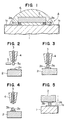
- a semiconductor device A is of a so-called flip-chip mount type constructed by disposing a semiconductor chip (semiconductor package) 2 in the central area of the upper surface of a substrate 1, electrically connecting the aluminum alloy wiring lines 2a, i.e., wiring lines of an AI-Si alloy or an AI-Cu-Si alloy, of the semiconductor chip 2 to those of the wiring lines 1a, i.e., Cu lines plated with Sn or Au, arranged on the upper surface of the substrate 1 with bump contacts 3b, and sealing the semiconductor chip 2 and part of the wiring lines 1 a of the substrate 1 with a protective resin 6, such as a silicone resin.
- the bump contacts 3b are formed previously by bonding balls 3a formed by heating the tip of an alloy wire 3, i.e., a connecting material, to the alloy wiring lines 2a of the semiconductor chip 2 through a procedure shown in Figs. 2 to 5.
- the alloy wire 3 is formed of an alloy consisting of Pb, Sn or In as a principal element, and additive elements and produced by a quench solidifying process.
- the alloy wire 3 may contain one or some additive elements among Be, B, C, Mg, Al, Si, P, Ca, Ti, V, Cr, Mn, Fe, Co, Ni, Cu, Zn, Ga, Ge, Se, Zr, Nb, Mo, Pd, Ag, Cd, Sb, Te, Ir, Pt, Au, TI and Bi.
- An alloy not containing Pb, Sn or In as the principal element may contain Pb, Sn or In as an additive element.
- the alloy wire 3 thus produced is passed through a capillary tube 4, and then the tip of the alloy wire 3 is heated with an electric torch 5 to form a ball 3a having a hardness of H B 6 or higher. Then, as shown in Fig. 3, the capillary tube 4 is lowered to attach the ball 3a formed at the tip of the alloy wire 3 to the aluminum alloy wiring line 2a formed on the semiconductor chip 3.
- the ball 3a having a hardness of H B 6 or higher destroys an oxide film coating the surface of the aluminum alloy wiring line 2a having a hardness on the order of H B 12, and the ball 3a is bonded directly to the aluminum alloy wiring line 2a by the diffusion between the new surface of the ball 3a and the new surface of the aluminum alloy wiring line 2a.
- the capillary 4 is raised to separate the ball 3a from the alloy wire 3 to leave the ball 3a as a bump contact 3b on the aluminum alloy wiring line 2a.
- the tip of the alloy wire 3 namely, the ball 3a is heated, the unequilibrated phase disappears and the crystal grains grow large in the junction of the alloy wire 3 and the ball 3a to reduce the tensile strength of the junction, so that the junction yields and breaks readily when the alloy wire 3 is raised by the capillary.
- semiconductor chip 2 is placed on the substrate 1 with the bump contacts 3b attached to the aluminum alloy wiring lines 2a in contact with the wiring lines 1a of the substrate 1, and then heat and pressure are applied to the bump contact 3b to connect electrically the aluminum alloy wiring lines 2a of the semiconductor chip 2 and the wiring lines 1a of the substrate and also to bond the semiconductor chip 2 to the substrate 1.
- the sphericity of the balls 3b can be improved by heating the balls 3b in the atmosphere of a flux of a chloride or an iodide before placing the balls 3b in contact with the wiring lines 1 a of the substrate 1, the balls 3b may be attached to the wiring lines 1 a without causing then to reflow.
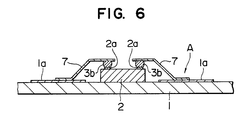
- Fig. 6 shows a semiconductor device A in another embodiment according to the present invention
- This semiconductor device a is of a so-called tape carrier bonding type, in which bump contacts 3b are formed on the aluminum alloy wiring lines 2a of a semiconductor chip 2, film leads 7 formed for example, by plating strips of a Cu foil with Sn or Au are bonded to the bump contacts 3b and the wiring lines 1a of a substrate 1.
- the aluminum alloy wiring lines 2a are formed on the semiconductor chip 2 and the balls 3a are bonded to the aluminum alloy wiring lines 2a as the bump contacts 3b.
- the wiring lines 1a of the substrate 1 may be formed of an aluminum alloy and the balls 3a may be bonded to the wiring lines 1 a of the substrate 1 as the bump contacts 3b.
- Tables 1 to 27 show the properties of alloys in comparison with those of controls in terms of the respective compositions of alloys forming alloy wires, the ball forming property of the alloy wires, the hardness of balls formed by heating the alloy wires, and the capability of bonding to the Al-Si alloy wiring lines.
- the ball forming property is evaluated by the shape of a ball formed by arc discharge between the tip of sample alloy wire passed through a ceramic capillary tube and an electrode disposed near the tip of the sample alloy wire in an argon gas atmosphere containing 5 % in volume hydrogen gas.
- a circular mark indicates that the ball has satisfactory sphericity and smooth surface morphology.
- the present invention has the following advantages.
- the ball of a hardness of H B 6 or higher formed on the tip of the alloy wire produced by drawing a quench solidified alloy destroys an oxide film coating the surface of the aluminum alloy wiring line, and the ball and the aluminum alloy wiring line are bonded together metallurgically by mutual diffusion between the new surface of the aluminum alloy wiring line and the new surface of the ball, and hence the ball formed on the tip of the alloy wire can be directly joined as a bump contact to the aluminum alloy wiring line.
- the present invention enables the omission of a step of removing the oxide film coating the surface of the aluminum alloy wiring line, which reduces time and cost for assembling the semiconductor device.
Landscapes
- Engineering & Computer Science (AREA)
- Mechanical Engineering (AREA)
- Chemical & Material Sciences (AREA)
- Inorganic Chemistry (AREA)
- Wire Bonding (AREA)
- Electric Connection Of Electric Components To Printed Circuits (AREA)
- Peptides Or Proteins (AREA)
- Inorganic Compounds Of Heavy Metals (AREA)
Applications Claiming Priority (6)
| Application Number | Priority Date | Filing Date | Title |
|---|---|---|---|
| JP340132/89 | 1989-12-27 | ||
| JP34013289 | 1989-12-27 | ||
| JP171991/90 | 1990-06-29 | ||
| JP17199190 | 1990-06-29 | ||
| JP22272990 | 1990-08-24 | ||
| JP222729/90 | 1990-08-24 |
Publications (3)
| Publication Number | Publication Date |
|---|---|
| EP0435009A2 true EP0435009A2 (de) | 1991-07-03 |
| EP0435009A3 EP0435009A3 (en) | 1991-09-25 |
| EP0435009B1 EP0435009B1 (de) | 1999-01-07 |
Family
ID=27323563
Family Applications (1)
| Application Number | Title | Priority Date | Filing Date |
|---|---|---|---|
| EP90122822A Expired - Lifetime EP0435009B1 (de) | 1989-12-27 | 1990-11-29 | Verbindungsverfahren für Halbleiterpackung und Verbindungsdrähte für Halbleiterpackung |
Country Status (7)
| Country | Link |
|---|---|
| US (2) | US5366692A (de) |
| EP (1) | EP0435009B1 (de) |
| JP (1) | JP2891432B2 (de) |
| AU (1) | AU643721B2 (de) |
| CA (1) | CA2031111A1 (de) |
| DE (1) | DE69032879T2 (de) |
| SG (1) | SG46506A1 (de) |
Cited By (6)
| Publication number | Priority date | Publication date | Assignee | Title |
|---|---|---|---|---|
| EP0589748A1 (de) * | 1992-09-25 | 1994-03-30 | Thomson-Csf | Verfahren zur Vorbereitung der Montage eines Chips auf einem Substrat und gemäss diesem Verfahren behandelter Chip |
| WO1994018699A1 (en) * | 1993-02-09 | 1994-08-18 | National Semiconductor Corporation | Method of bonding semiconductor chips to a substrate |
| CN1076998C (zh) * | 1996-10-17 | 2002-01-02 | 松下电器产业株式会社 | 软钎料及使用该软钎料的电子器件 |
| DE19816671C2 (de) * | 1997-04-16 | 2003-09-18 | Fuji Electric Co Ltd | Verwendung von Legierungen als bleifreie Lötmittel-Legierungen |
| EP1977022A4 (de) * | 2005-12-13 | 2008-12-31 | Indium Corp America | Bleifreie lotlegierungen und lötverbindungen davon mit verbesserter fallschlagzähigkeit |
| US7749336B2 (en) | 2005-08-30 | 2010-07-06 | Indium Corporation Of America | Technique for increasing the compliance of tin-indium solders |
Families Citing this family (28)
| Publication number | Priority date | Publication date | Assignee | Title |
|---|---|---|---|---|
| GB2201545B (en) * | 1987-01-30 | 1991-09-11 | Tanaka Electronics Ind | Method for connecting semiconductor material |
| JP2891432B2 (ja) * | 1989-12-27 | 1999-05-17 | 田中電子工業株式会社 | 半導体材料の接続方法,それに用いる接続材料及び半導体装置 |
| JP3337049B2 (ja) * | 1995-05-17 | 2002-10-21 | 田中電子工業株式会社 | ボンディング用金線 |
| US5985692A (en) * | 1995-06-07 | 1999-11-16 | Microunit Systems Engineering, Inc. | Process for flip-chip bonding a semiconductor die having gold bump electrodes |
| JP3238051B2 (ja) * | 1995-08-25 | 2001-12-10 | 京セラ株式会社 | ろう材 |
| US5686318A (en) | 1995-12-22 | 1997-11-11 | Micron Technology, Inc. | Method of forming a die-to-insert permanent connection |
| US5776824A (en) * | 1995-12-22 | 1998-07-07 | Micron Technology, Inc. | Method for producing laminated film/metal structures for known good die ("KG") applications |
| US6404063B2 (en) | 1995-12-22 | 2002-06-11 | Micron Technology, Inc. | Die-to-insert permanent connection and method of forming |
| US6371361B1 (en) * | 1996-02-09 | 2002-04-16 | Matsushita Electric Industrial Co., Ltd. | Soldering alloy, cream solder and soldering method |
| US5731244A (en) | 1996-05-28 | 1998-03-24 | Micron Technology, Inc. | Laser wire bonding for wire embedded dielectrics to integrated circuits |
| US5821494A (en) * | 1996-09-27 | 1998-10-13 | International Business Machines Corporation | Method of electrical connection between head transducer and suspension by solder wire bumping at slider level and laser reflow |
| US6635514B1 (en) * | 1996-12-12 | 2003-10-21 | Tessera, Inc. | Compliant package with conductive elastomeric posts |
| US5885893A (en) * | 1997-06-09 | 1999-03-23 | Highlight Optoelectronics, Inc. | Impact-free wire bonding of microelectronic devices |
| US6165888A (en) * | 1997-10-02 | 2000-12-26 | Motorola, Inc. | Two step wire bond process |
| US6656422B2 (en) * | 1998-03-30 | 2003-12-02 | Yamatake Corporation | Die-bonding solder materials |
| JPH11340005A (ja) * | 1998-05-28 | 1999-12-10 | Murata Mfg Co Ltd | チップ型電子部品 |
| FR2786656B1 (fr) * | 1998-11-27 | 2001-01-26 | Alstom Technology | Composant electronique de puissance comportant des moyens de refroidissement |
| JP3414342B2 (ja) * | 1999-11-25 | 2003-06-09 | 日本電気株式会社 | 集積回路チップの実装構造および実装方法 |
| JP2003518743A (ja) * | 1999-12-21 | 2003-06-10 | アドバンスト・マイクロ・ディバイシズ・インコーポレイテッド | 信頼性のあるフリップチップ接続のためのはんだによる有機パッケージ |
| US20030001286A1 (en) * | 2000-01-28 | 2003-01-02 | Ryoichi Kajiwara | Semiconductor package and flip chip bonding method therein |
| JP4174174B2 (ja) * | 2000-09-19 | 2008-10-29 | 株式会社ルネサステクノロジ | 半導体装置およびその製造方法並びに半導体装置実装構造体 |
| US20030183948A1 (en) * | 2002-04-01 | 2003-10-02 | Tham Yew Fei | Golden unit |
| JP2005259915A (ja) * | 2004-03-10 | 2005-09-22 | Nec Electronics Corp | 半導体装置およびその製造方法 |
| US8247272B2 (en) * | 2007-12-27 | 2012-08-21 | United Test And Assembly Center Ltd. | Copper on organic solderability preservative (OSP) interconnect and enhanced wire bonding process |
| DE102008054415A1 (de) * | 2008-12-09 | 2010-06-10 | Robert Bosch Gmbh | Anordnung zweier Substrate mit einer SLID-Bondverbindung und Verfahren zur Herstellung einer solchen Anordnung |
| EP2362432B1 (de) * | 2010-02-25 | 2017-06-07 | Saint-Augustin Canada Electric Inc. | Solarzellenanordnung |
| TWI395313B (zh) | 2012-11-07 | 2013-05-01 | 樂金股份有限公司 | 銲球凸塊結構及其形成方法 |
| JP2014151364A (ja) * | 2013-02-13 | 2014-08-25 | Toyota Industries Corp | はんだ及びダイボンド構造 |
Family Cites Families (24)
| Publication number | Priority date | Publication date | Assignee | Title |
|---|---|---|---|---|
| US2298237A (en) * | 1941-03-07 | 1942-10-06 | American Smelting Refining | Lead base coating alloy |
| US3644115A (en) * | 1970-03-23 | 1972-02-22 | Tatsuta Densen Kk | Soldering filler metal |
| US3744121A (en) * | 1970-08-15 | 1973-07-10 | Asahi Glass Co Ltd | Process for soldering difficultly solderable metals, such as si, ge, al, ti, zr and ta |
| US4106930A (en) * | 1972-02-19 | 1978-08-15 | Asahi Glass Company, Ltd. | Solder alloys for soldering difficultly solderable material |
| JPS54160525A (en) * | 1978-06-09 | 1979-12-19 | Sadaji Nagabori | Lead alloy for molten plating |
| US5223321A (en) * | 1981-07-17 | 1993-06-29 | British Telecommunications Plc | Tape-automated bonding of integrated circuits |
| US4588657A (en) * | 1984-11-01 | 1986-05-13 | Rca Corporation | Solder composition |
| US4622205A (en) * | 1985-04-12 | 1986-11-11 | Ibm Corporation | Electromigration lifetime increase of lead base alloys |
| US4670217A (en) * | 1985-07-26 | 1987-06-02 | J. W. Harris Company | Solder composition |
| US4654275A (en) * | 1985-11-27 | 1987-03-31 | Allied Corporation | Storage life of Pb-In-Ag solder foil by Sn addition |
| US4734256A (en) * | 1986-04-21 | 1988-03-29 | Allied-Signal Inc. | Wetting of low melting temperature solders by surface active additions |
| US5134460A (en) * | 1986-08-11 | 1992-07-28 | International Business Machines Corporation | Aluminum bump, reworkable bump, and titanium nitride structure for tab bonding |
| DE3785720T2 (de) * | 1986-09-25 | 1993-08-12 | Toshiba Kawasaki Kk | Verfahren zum herstellen eines filmtraegers. |
| GB2201545B (en) * | 1987-01-30 | 1991-09-11 | Tanaka Electronics Ind | Method for connecting semiconductor material |
| JPS63301535A (ja) * | 1987-01-30 | 1988-12-08 | Tanaka Electron Ind Co Ltd | 半導体材料の接続方法及びそれに用いる接続材料 |
| US4993622A (en) * | 1987-04-28 | 1991-02-19 | Texas Instruments Incorporated | Semiconductor integrated circuit chip interconnections and methods |
| EP0288776A3 (de) * | 1987-04-28 | 1989-03-22 | Texas Instruments Incorporated | Verbindung eines Goldlegierungs-Drahtes mit einem Kontaktfleck, bestehend aus kupferdotiertem Aluminium, einer Halbleiterschaltung |
| US5019891A (en) * | 1988-01-20 | 1991-05-28 | Hitachi, Ltd. | Semiconductor device and method of fabricating the same |
| US4876221A (en) * | 1988-05-03 | 1989-10-24 | Matsushita Electric Industrial Co., Ltd. | Bonding method |
| US4950623A (en) * | 1988-08-02 | 1990-08-21 | Microelectronics Center Of North Carolina | Method of building solder bumps |
| US5066614A (en) * | 1988-11-21 | 1991-11-19 | Honeywell Inc. | Method of manufacturing a leadframe having conductive elements preformed with solder bumps |
| US5071787A (en) * | 1989-03-14 | 1991-12-10 | Kabushiki Kaisha Toshiba | Semiconductor device utilizing a face-down bonding and a method for manufacturing the same |
| US5011658A (en) * | 1989-05-31 | 1991-04-30 | International Business Machines Corporation | Copper doped low melt solder for component assembly and rework |
| JP2891432B2 (ja) * | 1989-12-27 | 1999-05-17 | 田中電子工業株式会社 | 半導体材料の接続方法,それに用いる接続材料及び半導体装置 |
-
1990
- 1990-11-09 JP JP2304509A patent/JP2891432B2/ja not_active Expired - Lifetime
- 1990-11-28 US US07/618,900 patent/US5366692A/en not_active Expired - Fee Related
- 1990-11-29 CA CA002031111A patent/CA2031111A1/en not_active Abandoned
- 1990-11-29 SG SG1996005329A patent/SG46506A1/en unknown
- 1990-11-29 EP EP90122822A patent/EP0435009B1/de not_active Expired - Lifetime
- 1990-11-29 DE DE69032879T patent/DE69032879T2/de not_active Expired - Fee Related
- 1990-12-17 AU AU68124/90A patent/AU643721B2/en not_active Ceased
-
1994
- 1994-07-29 US US08/282,020 patent/US5550407A/en not_active Expired - Fee Related
Cited By (9)
| Publication number | Priority date | Publication date | Assignee | Title |
|---|---|---|---|---|
| EP0589748A1 (de) * | 1992-09-25 | 1994-03-30 | Thomson-Csf | Verfahren zur Vorbereitung der Montage eines Chips auf einem Substrat und gemäss diesem Verfahren behandelter Chip |
| FR2696279A1 (fr) * | 1992-09-25 | 1994-04-01 | Thomson Csf | Procédé pour permettre le montage d'une puce sur un substrat et puce préparée selon le procédé. |
| US5438020A (en) * | 1992-09-25 | 1995-08-01 | Thomson-Csf | Process for flip-chip bonding a semiconductor chip using wire leads |
| WO1994018699A1 (en) * | 1993-02-09 | 1994-08-18 | National Semiconductor Corporation | Method of bonding semiconductor chips to a substrate |
| CN1076998C (zh) * | 1996-10-17 | 2002-01-02 | 松下电器产业株式会社 | 软钎料及使用该软钎料的电子器件 |
| DE19816671C2 (de) * | 1997-04-16 | 2003-09-18 | Fuji Electric Co Ltd | Verwendung von Legierungen als bleifreie Lötmittel-Legierungen |
| US7749336B2 (en) | 2005-08-30 | 2010-07-06 | Indium Corporation Of America | Technique for increasing the compliance of tin-indium solders |
| EP1977022A4 (de) * | 2005-12-13 | 2008-12-31 | Indium Corp America | Bleifreie lotlegierungen und lötverbindungen davon mit verbesserter fallschlagzähigkeit |
| US9260768B2 (en) | 2005-12-13 | 2016-02-16 | Indium Corporation | Lead-free solder alloys and solder joints thereof with improved drop impact resistance |
Also Published As
| Publication number | Publication date |
|---|---|
| DE69032879D1 (de) | 1999-02-18 |
| JP2891432B2 (ja) | 1999-05-17 |
| EP0435009A3 (en) | 1991-09-25 |
| DE69032879T2 (de) | 1999-09-16 |
| JPH04174527A (ja) | 1992-06-22 |
| SG46506A1 (en) | 1998-02-20 |
| US5366692A (en) | 1994-11-22 |
| CA2031111A1 (en) | 1991-06-28 |
| EP0435009B1 (de) | 1999-01-07 |
| AU643721B2 (en) | 1993-11-25 |
| AU6812490A (en) | 1991-07-04 |
| US5550407A (en) | 1996-08-27 |
Similar Documents
| Publication | Publication Date | Title |
|---|---|---|
| EP0435009B1 (de) | Verbindungsverfahren für Halbleiterpackung und Verbindungsdrähte für Halbleiterpackung | |
| US7501337B2 (en) | Dual metal stud bumping for flip chip applications | |
| KR100548114B1 (ko) | 땜납 박 및 반도체 장치 및 전자 장치 | |
| JPS6148543A (ja) | 半導体素子結線用銅合金線 | |
| JP2002124533A (ja) | 電極材料、半導体装置及び実装装置 | |
| US5249732A (en) | Method of bonding semiconductor chips to a substrate | |
| JP2737953B2 (ja) | 金バンプ用金合金細線 | |
| JP4432541B2 (ja) | 電子機器 | |
| JP2007142271A (ja) | バンプ材料および接合構造 | |
| US20050133571A1 (en) | Flip-chip solder bump formation using a wirebonder apparatus | |
| JPS60134444A (ja) | バンプ電極形成方法 | |
| JP2824302B2 (ja) | 半田ボールの形成方法 | |
| JPH07122564A (ja) | バンプ形成方法 | |
| JP2911005B2 (ja) | バンプ電極の処理方法 | |
| JP3086126B2 (ja) | バンプ用微小金ボール | |
| JP3091076B2 (ja) | バンプ用微小金ボール | |
| JPH07122562A (ja) | バンプ形成方法及びワイヤボンディング方法並びにバンプ構造及びワイヤボンディング構造 | |
| JPH0565052B2 (de) | ||
| JPH07201867A (ja) | バンプ形成用Pd合金ワイヤ及びそのPd合金ワイヤを用いたバンプ形成方法並びに半導体装置 | |
| JPH06196522A (ja) | 金属ワイヤにおけるボールの形成方法 | |
| JPH0465534B2 (de) | ||
| JPH0565051B2 (de) | ||
| JP2003309142A (ja) | 半導体装置及びその搭載方法 | |
| JPH09181099A (ja) | 半導体素子接合用ダイボンド材 | |
| JPH1116916A (ja) | バンプ電極形成方法 |
Legal Events
| Date | Code | Title | Description |
|---|---|---|---|
| PUAI | Public reference made under article 153(3) epc to a published international application that has entered the european phase |
Free format text: ORIGINAL CODE: 0009012 |
|
| AK | Designated contracting states |
Kind code of ref document: A2 Designated state(s): DE FR GB NL SE |
|
| PUAL | Search report despatched |
Free format text: ORIGINAL CODE: 0009013 |
|
| AK | Designated contracting states |
Kind code of ref document: A3 Designated state(s): DE FR GB NL SE |
|
| RHK1 | Main classification (correction) |
Ipc: H01L 21/60 |
|
| 17P | Request for examination filed |
Effective date: 19911206 |
|
| 17Q | First examination report despatched |
Effective date: 19940725 |
|
| GRAG | Despatch of communication of intention to grant |
Free format text: ORIGINAL CODE: EPIDOS AGRA |
|
| GRAG | Despatch of communication of intention to grant |
Free format text: ORIGINAL CODE: EPIDOS AGRA |
|
| GRAH | Despatch of communication of intention to grant a patent |
Free format text: ORIGINAL CODE: EPIDOS IGRA |
|
| GRAH | Despatch of communication of intention to grant a patent |
Free format text: ORIGINAL CODE: EPIDOS IGRA |
|
| GRAA | (expected) grant |
Free format text: ORIGINAL CODE: 0009210 |
|
| AK | Designated contracting states |
Kind code of ref document: B1 Designated state(s): DE FR GB NL SE |
|
| PG25 | Lapsed in a contracting state [announced via postgrant information from national office to epo] |
Ref country code: SE Free format text: THE PATENT HAS BEEN ANNULLED BY A DECISION OF A NATIONAL AUTHORITY Effective date: 19990107 Ref country code: NL Free format text: LAPSE BECAUSE OF FAILURE TO SUBMIT A TRANSLATION OF THE DESCRIPTION OR TO PAY THE FEE WITHIN THE PRESCRIBED TIME-LIMIT Effective date: 19990107 Ref country code: FR Free format text: LAPSE BECAUSE OF FAILURE TO SUBMIT A TRANSLATION OF THE DESCRIPTION OR TO PAY THE FEE WITHIN THE PRESCRIBED TIME-LIMIT Effective date: 19990107 |
|
| REF | Corresponds to: |
Ref document number: 69032879 Country of ref document: DE Date of ref document: 19990218 |
|
| NLV1 | Nl: lapsed or annulled due to failure to fulfill the requirements of art. 29p and 29m of the patents act | ||
| EN | Fr: translation not filed | ||
| PLBE | No opposition filed within time limit |
Free format text: ORIGINAL CODE: 0009261 |
|
| STAA | Information on the status of an ep patent application or granted ep patent |
Free format text: STATUS: NO OPPOSITION FILED WITHIN TIME LIMIT |
|
| 26N | No opposition filed | ||
| PGFP | Annual fee paid to national office [announced via postgrant information from national office to epo] |
Ref country code: GB Payment date: 20001107 Year of fee payment: 11 |
|
| PGFP | Annual fee paid to national office [announced via postgrant information from national office to epo] |
Ref country code: DE Payment date: 20001127 Year of fee payment: 11 |
|
| PG25 | Lapsed in a contracting state [announced via postgrant information from national office to epo] |
Ref country code: GB Free format text: LAPSE BECAUSE OF NON-PAYMENT OF DUE FEES Effective date: 20011129 |
|
| REG | Reference to a national code |
Ref country code: GB Ref legal event code: IF02 |
|
| PG25 | Lapsed in a contracting state [announced via postgrant information from national office to epo] |
Ref country code: DE Free format text: LAPSE BECAUSE OF NON-PAYMENT OF DUE FEES Effective date: 20020702 |
|
| GBPC | Gb: european patent ceased through non-payment of renewal fee |
Effective date: 20011129 |