EP0435017A2 - Procédé d'amélioration de la résistance au feu de mousses par l'imprégnation de particules minérales - Google Patents
Procédé d'amélioration de la résistance au feu de mousses par l'imprégnation de particules minérales Download PDFInfo
- Publication number
- EP0435017A2 EP0435017A2 EP90123059A EP90123059A EP0435017A2 EP 0435017 A2 EP0435017 A2 EP 0435017A2 EP 90123059 A EP90123059 A EP 90123059A EP 90123059 A EP90123059 A EP 90123059A EP 0435017 A2 EP0435017 A2 EP 0435017A2
- Authority
- EP
- European Patent Office
- Prior art keywords
- foam
- gel
- foam product
- inorganic particles
- product
- Prior art date
- Legal status (The legal status is an assumption and is not a legal conclusion. Google has not performed a legal analysis and makes no representation as to the accuracy of the status listed.)
- Withdrawn
Links
Images
Classifications
-
- C—CHEMISTRY; METALLURGY
- C08—ORGANIC MACROMOLECULAR COMPOUNDS; THEIR PREPARATION OR CHEMICAL WORKING-UP; COMPOSITIONS BASED THEREON
- C08J—WORKING-UP; GENERAL PROCESSES OF COMPOUNDING; AFTER-TREATMENT NOT COVERED BY SUBCLASSES C08B, C08C, C08F, C08G or C08H
- C08J9/00—Working-up of macromolecular substances to porous or cellular articles or materials; After-treatment thereof
- C08J9/36—After-treatment
- C08J9/40—Impregnation
-
- C—CHEMISTRY; METALLURGY
- C08—ORGANIC MACROMOLECULAR COMPOUNDS; THEIR PREPARATION OR CHEMICAL WORKING-UP; COMPOSITIONS BASED THEREON
- C08J—WORKING-UP; GENERAL PROCESSES OF COMPOUNDING; AFTER-TREATMENT NOT COVERED BY SUBCLASSES C08B, C08C, C08F, C08G or C08H
- C08J2379/00—Characterised by the use of macromolecular compounds obtained by reactions forming in the main chain of the macromolecule a linkage containing nitrogen with or without oxygen, or carbon only, not provided for in groups C08J2361/00 - C08J2377/00
- C08J2379/04—Polycondensates having nitrogen-containing heterocyclic rings in the main chain; Polyhydrazides; Polyamide acids or similar polyimide precursors
- C08J2379/08—Polyimides; Polyester-imides; Polyamide-imides; Polyamide acids or similar polyimide precursors
-
- Y—GENERAL TAGGING OF NEW TECHNOLOGICAL DEVELOPMENTS; GENERAL TAGGING OF CROSS-SECTIONAL TECHNOLOGIES SPANNING OVER SEVERAL SECTIONS OF THE IPC; TECHNICAL SUBJECTS COVERED BY FORMER USPC CROSS-REFERENCE ART COLLECTIONS [XRACs] AND DIGESTS
- Y10—TECHNICAL SUBJECTS COVERED BY FORMER USPC
- Y10S—TECHNICAL SUBJECTS COVERED BY FORMER USPC CROSS-REFERENCE ART COLLECTIONS [XRACs] AND DIGESTS
- Y10S521/00—Synthetic resins or natural rubbers -- part of the class 520 series
- Y10S521/907—Nonurethane flameproofed cellular product
-
- Y—GENERAL TAGGING OF NEW TECHNOLOGICAL DEVELOPMENTS; GENERAL TAGGING OF CROSS-SECTIONAL TECHNOLOGIES SPANNING OVER SEVERAL SECTIONS OF THE IPC; TECHNICAL SUBJECTS COVERED BY FORMER USPC CROSS-REFERENCE ART COLLECTIONS [XRACs] AND DIGESTS
- Y10—TECHNICAL SUBJECTS COVERED BY FORMER USPC
- Y10S—TECHNICAL SUBJECTS COVERED BY FORMER USPC CROSS-REFERENCE ART COLLECTIONS [XRACs] AND DIGESTS
- Y10S521/00—Synthetic resins or natural rubbers -- part of the class 520 series
- Y10S521/918—Physical aftertreatment of a cellular product
Definitions
- This invention relates in general to foam products and, more specifically, to methods of improving the flame resistance of foam products.
- Foamed plastics have long been used in a variety of thermal insulation applications. Some, such as polystyrene, melt at moderately elevated temperatures so are used only at approximately room temperature or below, such as in insulation of coolers or refrigerators. Others, such as polyimides, have excellent resistance to high temperatures and may be used in high temperature applications. In cases where the insulation must resist direct exposure to flame, the insulation generally required cover layers of metal, asbestos or the like which are heavy and present other problems.
- inorganic materials in the micron particle size range such as vermiculite are known to have excellent thermal insulating capabilities.
- these materials have been difficult to handle and employ in insulation. Generally, they have only been used when enclosed, typically in a reservoir-type enclosure.
- many particle materials are rather transparent in the infra-red portion of the spectrum, compromising the otherwise good thermal insulating properties where large temperature differences exist across the particle mass.
- preparing insulation by a method which basically comprises forming a stable suspension or gel of a suitable very finely divided inorganic material in a liquid, placing a suitable open-cell foam shape in the gel until all of the interstices are filled with the gel, then removing the shape and drying it to remove the liquid, leaving the micron particles uniformly dispersed throughout the foam.
- the suspension or gel has the property of preventing settling and maintaining uniform dispersion of the particles while remaining capable of easily flowing throughout the foam cells and wetting the cell walls.
- Any suitable liquid such as water or a polar organic liquid may be used in forming the gel.
- Water is generally preferred for convenience, ready availability and low cost.
- the particles may be any suitable non-metallic inorganic particles having the desired insulating properties and which are gel forming and insoluble in water and polar organic liquids.
- Typical inorganic materials would include vermiculite, perlite, mica, certain volcanic ash, mixtures thereof, etc. While any suitable particle size may be used, we prefer particles in the 10 to 40 nanometer diameter range.
- One particularly desirable inorganic material composition is marketed by the W.R. Grace Corporation, Cambridge, MA, 02140 under the "Microlite” design ation. This material is furnished in two particle size ranges in stable water gels consisting of 7.5% or 15% solids which are uniformly dispersed. We prefer the "Type 903" because 50% of the particles are below 25.2 nanometers. This material is supplied in a stable water gel conatining 7.5% solids.
- the particles because of their anionic dispersion, adhere tightly to many surfaces, most especially polyimide foam cells, and do not dust off easily during handling.
- titanium dioxide does not adversely affect the suspension properties of the gel.
- the titanium dioxide serves to opacify the foam/oxide product to infra-red radiation, reducing the amount of heat transferred across the insulation.
- the particles size of the titanium dioxide is in the 10 to 80 nanometer range. It is preferable to use from about 0.1 to 10.0 weight percent titanium dioxide in the inorganic particle mixture, based on the total weight of the inorganic particles in the mix.
- any suitable open-cell, flexible synthetic resin foam may be treated by this method, but it works best with temperature resistant foams.
- foams may typically be formed from polyimides, polyurethanes, and other polymer foams.
- cellulose sponge when treated by this method becomes an excellent low-cost thermal insulation and is highly fire-resistant.
- the use of this method on polyurethane foam also has a most beneficial effect.
- the gel may be introduced into the foam cells in any suitable manner. We have found it most convenient to simply gently submerge the foam in the gel for a period sufficient to allow the gel to fully fill the cells concurrent with hand rolling of the foam to alternately compress and release the foam. Another method is to place the gel container containing the foam in a pressure vessel or autoclave where the pressure is cycled using compressed air, thereby forcing the gel into the foam cells. The foam is then removed from the gel and passed through pinch rolls to leave an exact pre-determinated amount of gel in the foam interstices, and thereby the desired amount of inorganic particles. The filled wet foam is then dried, such as by heating in a conventional thermal oven. The foam insulation is then ready for use or any suitable post-treatment.
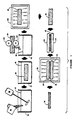
- the first step is to pour the finely divided inorganic particles from a container 10 into a suitable liquid 12, such as water, in a container 14, then stirring using a conventional mixer 16 until a uniform suspension or gel is formed.
- a suitable liquid 12 such as water
- this step has been taken by the supplier.
- a sheet of open-cell flexible foam 18 is then submerged in the liquid 12 until all foam interstices are filled with the gel, generally indicated by cassation of air bubbles emitting from the foam.
- a simple hand roller moved across the foam in the liquid is effective in reducing the time necessary to complete filling the cells.
- Typical polyimide foams include the open-celled foams disclosed by gagliani et al. in U.S. Patents 4,426,463, 4,439,381 and 4,506,038, by Long et al. in U.S. Patent 4,518,717 and by shulman et al. in U.S. Patent 4,467,597.
- the foam may incorporate any suitable additives, such as surfactants to improve uniformity of cell structure, blowing agents, fillers, reinforcements, or other agents as desired.
- Typical surfactants include BRIJ-78 from ICI Corp., FSN and Zonyl from E.I.DuPont de Nemours & Co, L5302 and L5430 from Union Carbide Corp., 190 and 193 from Dow Corning Corp. and FC 430 from Minnesota Mining and Manufacturing Co. While any suitable concentration may be used, generally from about 0,5 to 2 wt% (based on the weight of the liquid foam precursor) is preferred.
- Typical foam fillers include glass microballoons, fiber of glass, graphite, Kevlar aramids, ceramics or the like, fluorocarbon powders, etc.
- the foam may then be run through the nip between spaced rollers 20.
- the spacing between the rollers is adjusted to leave the selected amount of gel in the foam. Excess gel is allowed to fall back into container 14.
- this step may be eliminated. While the rollers as shown are preferred for ease and convenience, other methods may be used to squeeze out excess gel, such as compression between two opposing platens.
- the foam is dried in an oven 22 leaving the finely divided inorganic particles uniformly dispersed throughout the foam cells.
- Any suitable method may be used to dry the foam, including simply air drying at room temperature.
- a conventional circulating air thermal oven is preferred for speed and simplicity.
- the sheet of inorganic particle impregnated foam 18 Upon removal from the oven, the sheet of inorganic particle impregnated foam 18 is ready for use in high-temperature insulation applications.
- the flexibility of the foam has not been compromised. For many such applications, further post-treatment of the foam may be beneficial.
- foam of higher density and greater strength may be desired with at least some of the open cells closed.
- the foam 18 may be squeezed to a lesser thickness between a pair of opposed compression tools 24.
- the assembly of tools and foam is then placed in a suitable oven 26 and heated to the stabilization temperature of the foam, at which temperature the foam is set in the new shape.
- Any suitable oven may be used, such as a conventional circulating air thermal oven.
- foam density can be increased as much as 1500 percent without significantly degrading its thermal resistance.
- the densification step improves flame resistance and rigidity. Also, densification tends to collapse the cells in the foam, effectively trapping the inorganic particles in the foam.
- the dimensions of the final foam shape are stabilized by the densification step so that the final product closely fits the dimensions of the tooling. This permits the production of highly accurate parts using inexpensive tooling.
- compression tools 24 may have any of a variety of suitable shapes. For example, one could be concave and the other correspondingly convex, producing a final foam product having a curved shape. Or, the face of one or both tools 24 could be configured to produce a corresponding surface pattern on the final foam sheet.
- Complex shapes, such as distorted tubes can be made by laying up the assembly components on a mold surface prior to full drying in oven 22, then heating to dry and set the foam to fit the mold. Alternatively, a plurality of thin pliable dried sheets can be assembled on a curved mold in place of compression tools 24 and heated and compressed to produce a complex final stabilized foam product.
- Face sheets or other articles may be bonded to foam 18 during the densification and stabilization step.
- a sheet of material such as a fiberglass fabric or the like having a heat activated adhesive on one side could be placed on foam 18 with the adhesive contacting the foam just prior to placing the foam between compression tools 24.
- the final product is a sheet of foam insulation having an accurate shape and outstanding resistance to high temperatures and direct flame contact.
- the products may be further adhesively bonded together into thicker or more complex products.
- the foam is immersed in a pan containing a soupy gel of Type 903 "Microlite" as furnished by W.R. Grace Co.
- the foam is gently rolled with a hand roller while in the gel until it is loaded with gel.
- the foam is then removed from the gel and passed through pinch rolls set about 3/16 inch apart which removes much of the trapped gel.
- the flexible foam is then dried for about 1 hour at about 250°F in a conventional thermal oven.
- the product is a flexible foam which is highly resistant to direct flame when placed over a bunsen burner, when compared with a similar piece of untreated foam.
- the inorganic particles adhere tightly to the foam and do not dust off during handling.
- a sheet of the 1/1-inch thick foam made by the mothod of Example I is placed between two flat, mold-release coated, platens and compressed to a thickness of about .25 inch.
- the assembly of platen and foam is placen in a thermal oven and heated to about 550°F for about 30 minutes. At the end of this time, the foam thickness has been stabilized to 0,25 inch.
- the assembly is removed from the oven and cooled to room temperature.
- the foam is removed from the platens and found to have an increased density and resistance to flame when compared to the product of Example I, to have a greater rigidity and to be dimensionally stable.
- Example II The method of Example II is repeated except that the two platens have corresponding, parallel, convex and concave shapes.
- a face sheet is prepared by dusting a sheet of fiberglass fabric with Skybond unadulterated prepolymer powder, then placing the foam against the dusted surface. This laminate is then placed between the curved platens, which are brought together to a spacing of about .2 inch. The assembly is placed in a thermal oven and heated to about 550°F for about 30 minutes. Upon removal from the oven, cooling to room temperature and removal from the platens, a dimentsionally stable foam sheet having surfaces corresponding to the platen surface and having the face sheet well bonded to one surface results.
- a gel is used as in Example I above.
- Flexible polyimide foam 1-inch thick and 12-inches square manufactured by Imitech Division of Ethyl Corp. is immersed in the gel, removed, and squeezed out as described in Example I.
- the sample is thoroughly dried and at this point.
- the foam remains flexible, and may be used in products. It's flame resistance has been greatly enhanced by the process.
- the sample is then placed between two aluminum tooling plates having Teflon coated fiberglass as mold releases. The two plates are forced together to reduce the thickness of the foam to about 1/4-inch.
- the assembly is then heated to about 425°F for about 1 hour.
- the resulting product accurately matches the tooling, has reduced cell size, increased density, and has greatly improved flame resistance when exposed to a bunsen burner flame, as compared to the untreated foam.
- the organic particles adhere tightly and do not dust off during handling.
- An excellent dispersion of highly insulating particles is produced on cell walls, improving thermal insulating characteristics of the foam in Examples V(a-d).
- Example V(e) The sodium chloride of Example V(e) does not form a gel but dissolves in the water, producing a fine, powdery, poorly adherent film over the cell walls, doing very little to improve foam insulating properties. This coating will tend to leach out of the foam if used in moist applications and will dissolve if the foam becomes wet.
- the aluminium powder of Example V(f) produces a poorly dispersed gel and, when applied to foam interstices, reduces foam insulating qualities.
- Melamine foam may be obtained from BASF AG D-7600 Ludwigshafen, FRG. This foam, type Basotect V3012, has a specific gravity of approximately 0.011. Impregnation of the foam is made according to the method outlined by Example. The foam is gently squeezed through pinch rolls set to provide a specific gravitiy of about 0.020 after thorough driving. The foam after this treatment is highly resistant to direct flame when placed over a Bunsen burner when compared with similar piece of untreated foam. By the nature of the materials used, the inorganic particles adhere tightly to the foam and do not dust off during handling.
- the invention relates to a method of improving the flame resistance of foams, such as open cell polyimide foams, through the introduction of finely divided non-metallic inorganic particles which are gel forming and insoluble in water and polar organic liquids into the foam cells.
- foams such as open cell polyimide foams
- a stable liquid suspension or gel, preferably aqueous is prepared using these particles.
- An opacifier such as finely divided titanium dioxide or tin oxide may also be added.
- An open cell foam product is placed in the gel until the cells fill with the gel. Excess gel is removed and the foam is dried, leaving the particles trapped in the cells.
- the foam may be post treated, such as by compression at the stabilizing temperature, resulting in a densified foam which further mechanically traps the particles and further improves the flame resistance.
Landscapes
- Chemical & Material Sciences (AREA)
- Engineering & Computer Science (AREA)
- Materials Engineering (AREA)
- Health & Medical Sciences (AREA)
- Chemical Kinetics & Catalysis (AREA)
- Medicinal Chemistry (AREA)
- Polymers & Plastics (AREA)
- Organic Chemistry (AREA)
- Manufacture Of Porous Articles, And Recovery And Treatment Of Waste Products (AREA)
- Compositions Of Macromolecular Compounds (AREA)
Applications Claiming Priority (2)
| Application Number | Priority Date | Filing Date | Title |
|---|---|---|---|
| US07/448,540 US4962132A (en) | 1989-06-30 | 1989-12-11 | Method of improving foam fire resistance through the introduction of inorganic particles thereinto |
| US448540 | 1989-12-11 |
Publications (2)
| Publication Number | Publication Date |
|---|---|
| EP0435017A2 true EP0435017A2 (fr) | 1991-07-03 |
| EP0435017A3 EP0435017A3 (en) | 1991-10-16 |
Family
ID=23780712
Family Applications (1)
| Application Number | Title | Priority Date | Filing Date |
|---|---|---|---|
| EP19900123059 Withdrawn EP0435017A3 (en) | 1989-12-11 | 1990-12-01 | A method of improving foam fire resistance through the introduction of inorganic particles thereinto |
Country Status (2)
| Country | Link |
|---|---|
| US (1) | US4962132A (fr) |
| EP (1) | EP0435017A3 (fr) |
Cited By (2)
| Publication number | Priority date | Publication date | Assignee | Title |
|---|---|---|---|---|
| WO1999038663A1 (fr) * | 1998-02-02 | 1999-08-05 | Infra-Folienkabel Gmbh | Procede pour produire des plaques de materiaux de construction au moyen de platre, et plaques de materiaux de construction produites selon ledit procede |
| WO2005103107A1 (fr) * | 2004-04-20 | 2005-11-03 | Basf Aktiengesellschaft | Substances alveolaires a alveoles ouvertes, leur procede de production, et leur utilisation |
Families Citing this family (2)
| Publication number | Priority date | Publication date | Assignee | Title |
|---|---|---|---|---|
| US6197415B1 (en) * | 1999-01-22 | 2001-03-06 | Frisby Technologies, Inc. | Gel-coated materials with increased flame retardancy |
| CN111040161B (zh) * | 2019-12-30 | 2022-11-15 | 江苏中科聚合新材料产业技术研究院有限公司 | 一种隔热保温聚酰亚胺泡沫材料及其制备方法 |
Family Cites Families (9)
| Publication number | Priority date | Publication date | Assignee | Title |
|---|---|---|---|---|
| GB1314704A (en) * | 1970-06-08 | 1973-04-26 | Nalco Chemical Co | Process for reinforcing foam rubber and product produced thereby |
| BE785640A (fr) * | 1971-06-30 | 1972-10-16 | Watanabe Hisashi | Materiau en matiere plastique expansee dont les cellules contiennent duciment durci et procede pour le fabriquer |
| GB1519626A (en) * | 1975-07-16 | 1978-08-02 | Giesemann H | Shaped articles of foam plastics and a process for their production |
| US4518717A (en) * | 1983-11-07 | 1985-05-21 | Long John V | Low density, modified polyimide foams and methods of making same |
| EP0152491A1 (fr) * | 1983-12-07 | 1985-08-28 | John Albert Avery Bradbury | Procédé de production d'objets composés en matières mousseuses |
| JPS60221425A (ja) * | 1984-04-18 | 1985-11-06 | Nitto Electric Ind Co Ltd | 球状多孔性ポリイミド粉体 |
| GB8427796D0 (en) * | 1984-11-02 | 1984-12-12 | Declon Ltd | Gel impregnated foam filter element |
| NL8601893A (nl) * | 1986-07-22 | 1988-02-16 | Stamicarbon | Bereiding van hoog-moleculair polytetramethyleenadipamide. |
| EP0258189B1 (fr) * | 1986-08-28 | 1992-01-22 | Ciba-Geigy Ag | Structures à nid d'abeille traitées au silicate |
-
1989
- 1989-12-11 US US07/448,540 patent/US4962132A/en not_active Expired - Fee Related
-
1990
- 1990-12-01 EP EP19900123059 patent/EP0435017A3/en not_active Withdrawn
Cited By (2)
| Publication number | Priority date | Publication date | Assignee | Title |
|---|---|---|---|---|
| WO1999038663A1 (fr) * | 1998-02-02 | 1999-08-05 | Infra-Folienkabel Gmbh | Procede pour produire des plaques de materiaux de construction au moyen de platre, et plaques de materiaux de construction produites selon ledit procede |
| WO2005103107A1 (fr) * | 2004-04-20 | 2005-11-03 | Basf Aktiengesellschaft | Substances alveolaires a alveoles ouvertes, leur procede de production, et leur utilisation |
Also Published As
| Publication number | Publication date |
|---|---|
| US4962132A (en) | 1990-10-09 |
| EP0435017A3 (en) | 1991-10-16 |
Similar Documents
| Publication | Publication Date | Title |
|---|---|---|
| US5047436A (en) | Method of improving foam fire resistance through the introduction of inorganic particles thereinto | |
| US5000813A (en) | Method of improving foam fire resistance through the introduction of metal oxides thereinto | |
| US4366202A (en) | Ceramic/organic web | |
| US5338594A (en) | Foam filled honeycomb and methods for their production | |
| US5188879A (en) | Polyimide foam filled structures | |
| US5135959A (en) | Method of impregnating reticulated foam with polymide foam and products thereof | |
| US4067956A (en) | Reticulated anisotropic porous vitreous carbon | |
| US4179540A (en) | Fabrication of foamed articles | |
| US4361453A (en) | Methods of preparing polyimides and artifacts composed thereof | |
| FI69828B (fi) | Styv oorganisk skumprodukt foer anvaendning som isoleringsmaterial och eldskyddande material foerfarande foer dess framstaellning och i foerfarandet anvaendbar aemne | |
| US3756839A (en) | Cate foams method for improving the cellular structure of rigid low density sili | |
| US3408180A (en) | Method of producing an inorganic foam and product | |
| US4127547A (en) | Hydrogel dough composition for fabrication of foamed articles | |
| US4647500A (en) | High temperature flame and heat resistant foamed plastics | |
| US4962132A (en) | Method of improving foam fire resistance through the introduction of inorganic particles thereinto | |
| US4935452A (en) | Method of improving foam fire resistance through the introduction of metal oxides thereinto | |
| US4988739A (en) | Method of improving foam fire resistance through the introduction of metal oxides thereinto | |
| EP0384256A1 (fr) | Procédé pour la fabrication de corps isolés poreux en mousse de polyimide, renforcés de particules anorganiques | |
| US5011558A (en) | Method of improving foam fire resistance through the introduction of inorganic particles thereinto | |
| US3379658A (en) | Porous film and method of making | |
| JPS6023132B2 (ja) | 連続気泡ポリオレフイン発泡体の製造方法 | |
| JPH07502704A (ja) | フルオロ重合体複合体製造用の予備融合方法 | |
| US4980102A (en) | Method of manufacturing polyimide foam shapes having improved density and cell size uniformity | |
| US4923651A (en) | Method of manufacturing polyimide foam shapes having improved density and cell size uniformity | |
| US5192810A (en) | Method and apparatus for manufacturing dimpled structures from elastic cloth |
Legal Events
| Date | Code | Title | Description |
|---|---|---|---|
| PUAI | Public reference made under article 153(3) epc to a published international application that has entered the european phase |
Free format text: ORIGINAL CODE: 0009012 |
|
| AK | Designated contracting states |
Kind code of ref document: A2 Designated state(s): AT BE CH DE DK ES FR GB GR IT LI LU NL SE |
|
| PUAL | Search report despatched |
Free format text: ORIGINAL CODE: 0009013 |
|
| AK | Designated contracting states |
Kind code of ref document: A3 Designated state(s): AT BE CH DE DK ES FR GB GR IT LI LU NL SE |
|
| 17P | Request for examination filed |
Effective date: 19920331 |
|
| 17Q | First examination report despatched |
Effective date: 19940211 |
|
| STAA | Information on the status of an ep patent application or granted ep patent |
Free format text: STATUS: THE APPLICATION HAS BEEN WITHDRAWN |
|
| 18W | Application withdrawn |
Withdrawal date: 19940528 |