EP0435327A2 - Interferometrisches Spektrophotometer - Google Patents
Interferometrisches Spektrophotometer Download PDFInfo
- Publication number
- EP0435327A2 EP0435327A2 EP90125695A EP90125695A EP0435327A2 EP 0435327 A2 EP0435327 A2 EP 0435327A2 EP 90125695 A EP90125695 A EP 90125695A EP 90125695 A EP90125695 A EP 90125695A EP 0435327 A2 EP0435327 A2 EP 0435327A2
- Authority
- EP
- European Patent Office
- Prior art keywords
- movable mirror
- mirror
- beam splitter
- interference
- value
- Prior art date
- Legal status (The legal status is an assumption and is not a legal conclusion. Google has not performed a legal analysis and makes no representation as to the accuracy of the status listed.)
- Granted
Links
Images




Classifications
-
- G—PHYSICS
- G01—MEASURING; TESTING
- G01J—MEASUREMENT OF INTENSITY, VELOCITY, SPECTRAL CONTENT, POLARISATION, PHASE OR PULSE CHARACTERISTICS OF INFRARED, VISIBLE OR ULTRAVIOLET LIGHT; COLORIMETRY; RADIATION PYROMETRY
- G01J3/00—Spectrometry; Spectrophotometry; Monochromators; Measuring colours
- G01J3/28—Investigating the spectrum
- G01J3/45—Interferometric spectrometry
- G01J3/453—Interferometric spectrometry by correlation of the amplitudes
- G01J3/4535—Devices with moving mirror
-
- G—PHYSICS
- G01—MEASURING; TESTING
- G01J—MEASUREMENT OF INTENSITY, VELOCITY, SPECTRAL CONTENT, POLARISATION, PHASE OR PULSE CHARACTERISTICS OF INFRARED, VISIBLE OR ULTRAVIOLET LIGHT; COLORIMETRY; RADIATION PYROMETRY
- G01J3/00—Spectrometry; Spectrophotometry; Monochromators; Measuring colours
- G01J3/28—Investigating the spectrum
- G01J3/45—Interferometric spectrometry
- G01J3/453—Interferometric spectrometry by correlation of the amplitudes
-
- G—PHYSICS
- G01—MEASURING; TESTING
- G01N—INVESTIGATING OR ANALYSING MATERIALS BY DETERMINING THEIR CHEMICAL OR PHYSICAL PROPERTIES
- G01N21/00—Investigating or analysing materials by the use of optical means, i.e. using sub-millimetre waves, infrared, visible or ultraviolet light
- G01N21/17—Systems in which incident light is modified in accordance with the properties of the material investigated
- G01N21/25—Colour; Spectral properties, i.e. comparison of effect of material on the light at two or more different wavelengths or wavelength bands
- G01N21/31—Investigating relative effect of material at wavelengths characteristic of specific elements or molecules, e.g. atomic absorption spectrometry
- G01N21/35—Investigating relative effect of material at wavelengths characteristic of specific elements or molecules, e.g. atomic absorption spectrometry using infrared light
- G01N2021/3595—Investigating relative effect of material at wavelengths characteristic of specific elements or molecules, e.g. atomic absorption spectrometry using infrared light using FTIR
Definitions
- the present invention relates to an interference spectrophotometer such as a Fourier transform infrared spectrophotometer.
- Interference spectrophotometers such as Fourier transform infrared (FT IR) spectrophotometers are used to make qualitative and quantitative analyses of various substances including organic and inorganic substances as well as high-molecular materials and semiconductor materials.
- FT IR Fourier transform infrared
- An interference spectrophotometer has a main interferometer for investigating samples and a control interferometer for starting collection of data from the main interferometer and for stabilizing the speed at which the movable mirror is slided.
- the control interferometer provides quadrature control to detect the position of the movable mirror.
- a phase plate such as a ⁇ /8 plate is installed between the beam splitter and the fixed mirror.
- Interference signals meeting at the beam splitter are separated into P waves and S waves by a polarizing beam splitter.
- the polarized components are detected by their respective detectors, and the position of the movable mirror is determined from the phase relation between the output signals from the detectors and from the wave number.
- the novel instrument monitors the total count obtained by an up/down counter by providing quadrature control, whereby the disturbance of sliding movement of the movable mirror is detected with sensitivities of the order of the wavelength of the control interferometer.
- This spectrophotometer comprises a main interferometer 100, a control interferometer 102, a sliding controller 20, an analog-to-digital converter 48, an up/down counter 82, a first memory 106 holding data, a second memory 108 storing accumulated data, and a decision part 110.
- the main interferometer 100 shares a beam splitter, a fixed mirror, and a movable mirror with the control interferometer 102. Sliding movement of the movable mirror is controlled by the sliding controller 20. Data obtained by the main interferometer 100 is converted into digital form by the A/D converter 48. Data obtained by one scan of the movable mirror is held in the first memory 106.
- the up/down counter 82 receives the output signals from two detectors used for quadrature control, the detectors being included in the control interferometer 102.
- the decision part 110 causes the converter 48 to convert its input analog signal into digital form when the value of the up/down counter 82 varies. After the A/D conversion, the decision part 110 checks the counter's value.
- the decision part 110 determines that the sliding movement of the movable mirror was abnormal. If the sliding movement of the mirror is judged to be normal by the decision part 110, then it adds the data held in the memory 106 to the data stored in the memory 108. If the sliding movement of the mirror is regarded as abnormal, then the decision part does not accumulate the data but discards the data held in the memory 106.
- the up/down counter 82 which receives quadrature control signals is incremented or decremented whenever the movable mirror moves a distance of ⁇ /2, where ⁇ is wavelength and 632.8 nm for a He-Ne laser. It takes several microseconds to read the output signal from the A/D converter 48 and to execute the algorithm stored in the first memory 106. If the speed of the sliding mirror is appropriate, the analog signal applied to the converter 48 is converted into digital form when the value obtained by the counter 82 is varied, i.e., at a sampling point. After this A/D conversion, the counter's value should agree with the count value obtained prior to the A/D conversion. If they do not agree, it follows that the movable mirror did not move correctly. That is, the mirror moved in the correct direction but too fast, or it moved in the reverse direction. In either case, an error in the movement can be detected with sensitivities of the order of 1 ⁇ m by this method.
- a Fourier transform infrared spectrophotometer according to the invention.
- This instrument includes a beam splitter 2 acting also as a compensator, a fixed mirror 4, and a movable mirror 6.
- the splitter 2 is inclined at 45° to the normal to the fixed mirror 4 and also to the normal to the movable mirror 6.
- the fixed mirror 4 is mounted on a block 8.
- Piezoelectric actuators 10a and 10b are also mounted on the block 8.
- the direction of the normal to the fixed mirror 4 can be changed by varying the voltages applied to the actuators 10a and 10b.
- Power amplifiers 12a and 12b apply the voltages to the actuators 10a and 10b, respectively.
- the movable mirror 6 is carried on a sliding mechanism 14 having a linear motor 16 which moves the mirror 6 toward and away from the beam splitter 2.
- This motor 16 is supplied with electrical current from a power amplifier 18.
- a sliding controller 20 controls the linear motor 16 via the power amplifier 18.
- An infrared radiation source 22 cooperates with the beam splitter 2, the fixed mirror 4, and the movable mirror 6 to constitute a main interferometer, thus forming an infrared spectrophotometric system.
- Infrared radiation emanating from the IR radiation source 22 passes to the beam splitter 2 via a converging mirror 24, an aperture 26, and a collimator mirror 28. Then, the radiation is modulated by this interferometer.
- the modulated radiation passes through a sample chamber 34 via a mirror 30 and a second converging mirror 32, is reflected off an ellipsoidal mirror 36, and falls on an infrared detector 38, where the radiation is converted into an electrical signal.
- the output signal from the detector 38 is amplified by a preamplifier 40.
- a filter 42, an automatic gain control amplifier 44, a sample-and-hold amplifier 46, and an analog-to-digital converter 48 are connected in series with the preamplifier 40.
- the A/D converter 48 acts to convert sampled signals into digital
- a He-Ne laser 50 is installed to form a light source for a control interferometer.
- a concave or convex lens 52 increases the angle of divergence of the laser beam from the laser 50.
- Laser beam reflected off the lens 52 is caused to enter the beam splitter 2 by a half mirror 54.
- the beam is then reflected off the beam splitter 2 and off the fixed mirror 4, and returns to the splitter 2.
- a ⁇ /8 plate 56 is located between the beam splitter 2 and the fixed mirror 4 to convert this returning beam from linearly polarized light into circularly polarized light.
- the ⁇ /8 plate 56 is so placed that its axis of polarization is inclined at 45° to the plane of polarization of the incident laser beam.
- a polarizing beam splitter 60 is mounted to divide the interference light into two polarized components, or P waves and S waves, after the interference light is modulated by this interferometer and reflected off the half mirror 58.
- a quarter photodiode 62 that is a detector receives the polarized component passed through the polarizing beam splitter 60.
- Another quarter photodiode 64 receives the other polarized component reflected off the splitter 60 and detects the polarized component.
- each of the photodiodes 62 and 64 is split into four light-receiving elements R, R', H, and V.
- Each photodiode is formed on a single semiconductor chip to prevent offset voltages or bias voltages from being developed between its light-receiving elements.
- the light-receiving elements of the photodiode 62 are connected with their respective preamplifiers 66.
- the light-receiving elements of the photodiode 64 are connected with their respective preamplifiers 68.
- the light-receiving element R of the four elements of either the photodiode 62 or 64 is used as a reference element.
- the output signal from the reference element R, the output signal from the element H laterally adjacent to the element R, and the output signal from the element V vertically adjacent to the element R are applied to a phase comparison and processing unit 72 via their respective preamplifiers 66 and via their respective waveform shapers 70.
- the waveform shapers 70 change input signals into pulse trains.
- the output signal from the phase comparison and processing unit 72 is sent to the power amplifiers 12a and 12b.
- the output signals from the four light-receiving elements of the photodiode 62 are applied to a current-summing amplifier 74 via their respective preamplifiers 66.
- the output signals from the four light-receiving elements of the photodiode 64 are supplied to another current-summing amplifier 76 via their respective preamplifiers 68.
- Waveform shapers 78 and 80 which change input signals into pulse trains are connected with the summing amplifiers 74 and 76, respectively.
- An up/down counter 82 receives the output pulses from the waveform shapers 78 and 80. The up/down counter 82 determines whether it is incremented or decremented, depending on the relationship between the phases of the two input signals. The counter 82 counts the number of input pulses and sends it along a CPU bus line 84.
- the output signal from the waveform shaper 78 is also sent to the sliding controller 20, to the sample-and-hold amplifier 46, and to the A/D converter 48.
- An MPU 86, a memory 88 storing programs, a memory 90 storing data, an external storage 92, a CRT 94, a plotter 96, the automatic gain control amplifier 44, the A/D converter 48, and the up/down counter 82 are connected with the CPU bus line 84.
- the memories 106, 108, and the decision part 110 shown in Fig. 1 are realized by the memory 90 storing data, the memory 88 storing programs, and the MPU 86. The operation of this instrument is next described.
- the interference laser beams which are divided by the polarizing beam splitter 60 and out of phase with each other are received by the photodiodes 62 and 64, respectively.
- the waveforms of the output signals from the photodiodes 62 and 64 are modified to produce pulse signals. These pulse signals are accepted as two inputs a and b to the up/down counter 82.
- This counter 82 determines whether it is incremented or decremented, depending on the relation of the phases of the input signals. In particular, when the movable mirror 6 is moving toward the beam splitter 2, one signal a leads the other signal b by a phase of 90°, as shown in Fig. 8.
- the signal a lags the signal b by a phase of 90°.
- the number of input pulses counted by the up/down counter 82 depends on the position of the movable mirror 6.
- the output signal from the counter 82 is fed via the bus line 84 to the MPU 86, which detects abnormal vibration of the movable mirror if it occurs. Also, the output signal from the counter 82 is used when an interferogram is integrated in infrared spectroscopy.
- the sliding controller 20 controls the voltage applied to the linear motor 16 via the power amplifier 18 in such a way that the frequency of the output signal from the photodiode 62 is kept constant.
- the signal a from the waveform shaper 78 is also employed by the sample-and-hold amplifier 46 as a sampling signal.
- the signal a is used as a start signal for causing the A/D converter 48 to start its analog-to-digital conversion.
- the output signal r from the reference light-receiving element R of the four-split photodiode 62 and the output signal h from other light-receiving element H or the output signal v from the element V are in phase.
- the interference conditions are inferior, they are out of phase.
- the output signals from the three elements R, H, V of the four-split photodiode 62 are amplified, modified in waveform, and applied to the phase comparison and processing unit 72.
- This processing unit 72 produces a voltage indicating a vertical or horizontal shift.
- This voltage from the unit 72 controls the voltages applied to the piezoelectric actuators 10a and 10b via the power amplifiers 12a and 12b, respectively. In this way, the conditions of the interferometer is stabilized in such a manner that the output signals from plural light-receiving elements of the four-split photodiode 62 are put in phase.
- This signal is supplied to the preamplifier 40, the filter 42, and the automatic gain control amplifier 44 in this order.
- the output signal from the amplifier 44 is sampled by the sample-and-hold amplifier 46 and converted into digital form by the A/D converter 48.
- the output signal from the A/D converter 48 is sent along the bus line 84.
- an interferogram is created.
- the A/D converter 48 is started to convert its input analog signal into digital form in response to the signal a which is an interference signal produced from the control interferometer.
- the present position of the movable mirror 6 is detected on a real-time basis by quadrature control. This signal indicating the present position is produced by the up/down counter 82 and constantly monitored by the MPU 86 to know the starting point and the end point of collection of data from the interferogram. Data is collected in two opposite directions of the movable mirror 6.
- Figs. 3-8 The manner in which infrared spectroscopy is effected is next described by referring to Figs. 3-8.
- the initial value A of up/down count, the final value B of the up/down count, the number of accumulative operations C, and the permissible number of errors D are set.
- the number of errors E and the present value of accumulation F are set to 0 (step 1).
- the up/down counter is reset at the position of center of burst.
- the initial value and the final value of the up/down count are determined by wave number division. Examples of them are shown in the table below.
- the user can select wave number division as a parameter.
- the number of permissible errors indicates how many times data obtained by one series of samplings can be discarded. This number is preferably set to 2 or 3.
- the MPU 86 specifies the direction of sliding movement of the movable mirror through the sliding controller 20, and the mirror is started to be slided at a constant speed (step 2).
- the up/down counter is decremented.
- the counter is incremented.
- a direction parameter X is set to -1 when the mirror is moved in the reverse direction and to +1 when the mirror is moved in the forward direction (step 3).
- the MPU 86 constantly monitors the value of the up/down counter 82 and waits until the present value G of the counter reaches the initial value A of up/down count (steps 4 and 5).
- the direction of sliding movement of the movable mirror is reversed (step 6 and 7).
- the MPU waits until the mirror arrives at the starting position for measurement (steps 8 and 9).
- the movable mirror is moved from point a to point d in Fig. 7.
- analog-to-digital conversion is carried out (step 10).
- the obtained data is added to the file of data about the interferogram (step 11).
- analog-to-digital conversion is effected on leading edges of the signal a which is derived by shaping the waveform of the output signal from the detector 62.
- the up/down counter 82 is incremented or decremented also on the leading edges of the signal a .
- the A/D converter delivers a signal indicating the end of A/D conversion.
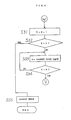
- step 31 the counter's value is read, and a check is performed to see whether the read value agrees with the initial value A (steps 13 and 14). If they do not agree, it follows that an error has occurred. Control then goes to step 31. If they agree, the condition is regarded as normal, and control proceeds to step 15.
- the MPU waits until the counter's value varies (step 16). A check is made to ascertain whether the mirror has reached the next point for measurement by checking the counter's value. If the mirror moved in the forward direction, the next point is A + 1. If the mirror moved in the reverse direction, the next point is A -1 (step 17). If the mirror has reached a point other than the next point for measurement, then an error has taken place. Control goes to step 31. If the mirror has reached the next point for measurement, then the count value A is replaced by A + X (step 18). Control returns to step 10. where A/D conversion is carried out.
- Steps 10-18 are repeatedly performed until the count value A reaches the final value B of up/down count. At this time, all the measurements in all the points in one scan are completed. Data is collected while the movable mirror is in region e in Fig. 7. Control goes from step 12 to step 19 to accumulate data. More specifically, file of data obtained by one scan is added to the file of accumulation, for accumulating data (step 19). The number of accumulative operations F is incremented (step 20).
- step 22 the number of errors E is reset to 0 (step 22).
- step 22 The direction of sliding movement of the movable mirror is reversed, and the initial value A and the final value B used for the previous scan are interchanged with each other (steps 23-26). Control goes back to step 8.
- step 8 The same process is repeated with the direction of sliding movement of the movable mirror reversed. This process corresponds to the process subsequent to point f in Fig. 7.
- step 21 If the number of accumulative operations reaches a preset number of accumulative operations C (step 21), then Fourier transformation is made (step 27). If necessary, transmissivity and absorbance are calculated (step 28). Then, the calculated values are displayed (step 29). The sliding movement of the movable mirror is brought into a stop (step 30).
- step 14 or 17 If the result of the decision made in step 14 or 17 is that an error has occurred, the number of errors E is incremented (step 31). If the number of errors does not reach the permissible value D, the mirror is slided up to the final point of sampling (steps 32-34). Control goes to step 23. The direction of movement of the movable mirror is reversed, and similar measurements are made.
- step 35 If the result of decision made in step 32 is that the number of errors E has reached the permissible value D, then notation indicating an error in the sliding movement is displayed (step 35). Thus, the measurement is ended.
- phase plate consists of the ⁇ /8 plate 56. Instead, other phase plate such as a ⁇ /4 plate or ⁇ /2 plate may be used.
- the phase plate 56 may be installed between the mirror plate 6 and the beam splitter 2.
- analog data is converted into digital form when the count value of the up/down counter used for quadrature control is varied.
- the counter's value is checked. If it is different from the count value obtained when analog-to-digital conversion was started, then the sliding movement of the movable mirror is judged to be abnormal. Therefore, an error in the sliding movement can be detected with sensitivities of the order of the wavelength of the light source of the control interferometer without adding further function of detecting abnormal sliding movement of the movable mirror.
- data can be obtained precisely by accumulation by realizing coherent addition.
Landscapes
- Physics & Mathematics (AREA)
- Spectroscopy & Molecular Physics (AREA)
- General Physics & Mathematics (AREA)
- Spectrometry And Color Measurement (AREA)
Applications Claiming Priority (2)
| Application Number | Priority Date | Filing Date | Title |
|---|---|---|---|
| JP34237189A JPH063401B2 (ja) | 1989-12-29 | 1989-12-29 | 干渉分光光度計 |
| JP342371/89 | 1989-12-29 |
Publications (3)
| Publication Number | Publication Date |
|---|---|
| EP0435327A2 true EP0435327A2 (de) | 1991-07-03 |
| EP0435327A3 EP0435327A3 (en) | 1992-01-29 |
| EP0435327B1 EP0435327B1 (de) | 1994-09-21 |
Family
ID=18353214
Family Applications (1)
| Application Number | Title | Priority Date | Filing Date |
|---|---|---|---|
| EP19900125695 Expired - Lifetime EP0435327B1 (de) | 1989-12-29 | 1990-12-28 | Interferometrisches Spektrophotometer |
Country Status (6)
| Country | Link |
|---|---|
| US (1) | US5114232A (de) |
| EP (1) | EP0435327B1 (de) |
| JP (1) | JPH063401B2 (de) |
| CN (1) | CN1023729C (de) |
| CA (1) | CA2033451C (de) |
| DE (1) | DE69012768T2 (de) |
Cited By (2)
| Publication number | Priority date | Publication date | Assignee | Title |
|---|---|---|---|---|
| FR2716716A1 (fr) * | 1994-02-28 | 1995-09-01 | Ando Electric | Ondemètre optique. |
| CN1039257C (zh) * | 1992-08-28 | 1998-07-22 | 云南大学 | 高光谱分辨光学多道分析仪 |
Families Citing this family (6)
| Publication number | Priority date | Publication date | Assignee | Title |
|---|---|---|---|---|
| DE4113842A1 (de) * | 1991-04-27 | 1992-11-05 | Deutsche Forsch Luft Raumfahrt | Verfahren und einrichtung zur messung und bestimmung einer wegdifferenz in interferometern nach michelson |
| CN100365398C (zh) * | 2004-01-05 | 2008-01-30 | 浙江大学三色仪器有限公司 | 一种测量空间光强分布用的反光镜 |
| JP4830815B2 (ja) * | 2006-11-28 | 2011-12-07 | 株式会社島津製作所 | フーリエ変換型赤外分光光度計 |
| PL2634551T3 (pl) * | 2010-10-28 | 2021-11-02 | Foss Analytical A/S | Interferometr i analizator spektroskopowy z transformacją fouriera |
| JP5835327B2 (ja) * | 2011-07-13 | 2015-12-24 | コニカミノルタ株式会社 | 干渉計およびそれを備えた分光器 |
| US10190911B2 (en) * | 2014-04-25 | 2019-01-29 | X-Rite, Inc. | Targeting system for color measurement device |
Family Cites Families (6)
| Publication number | Priority date | Publication date | Assignee | Title |
|---|---|---|---|---|
| US4511986A (en) * | 1982-08-30 | 1985-04-16 | International Business Machines | Method and apparatus for simultaneously recording multiple FT-IR signals |
| US4480914A (en) * | 1982-09-13 | 1984-11-06 | The Foxboro Company | Vibration compensating interferometer mirror drive system |
| CA1210608A (en) * | 1983-03-04 | 1986-09-02 | Jack G. Kisslinger | Interferometer spectrophotometer |
| JPS61501875A (ja) * | 1984-04-13 | 1986-08-28 | ベツクマン インスツルメンツ インコ−ポレ−テツド | ミラ−整列制御装置および制御されたレ−ザ干渉計におけるirビ−ム最大化装置 |
| US4799001A (en) * | 1987-07-23 | 1989-01-17 | Nicolet Corporation | Start of scan circuit for FTIR spectrometer |
| US4847878A (en) * | 1988-03-31 | 1989-07-11 | Nicolet Instrument Corporation | Method and apparatus for determining mirror position in a fourier-transform infrared spectrometer |
-
1989
- 1989-12-29 JP JP34237189A patent/JPH063401B2/ja not_active Expired - Lifetime
-
1990
- 1990-12-28 US US07/635,023 patent/US5114232A/en not_active Expired - Lifetime
- 1990-12-28 DE DE69012768T patent/DE69012768T2/de not_active Expired - Lifetime
- 1990-12-28 EP EP19900125695 patent/EP0435327B1/de not_active Expired - Lifetime
- 1990-12-29 CN CN90110258A patent/CN1023729C/zh not_active Expired - Lifetime
- 1990-12-31 CA CA 2033451 patent/CA2033451C/en not_active Expired - Lifetime
Cited By (2)
| Publication number | Priority date | Publication date | Assignee | Title |
|---|---|---|---|---|
| CN1039257C (zh) * | 1992-08-28 | 1998-07-22 | 云南大学 | 高光谱分辨光学多道分析仪 |
| FR2716716A1 (fr) * | 1994-02-28 | 1995-09-01 | Ando Electric | Ondemètre optique. |
Also Published As
| Publication number | Publication date |
|---|---|
| EP0435327B1 (de) | 1994-09-21 |
| CN1023729C (zh) | 1994-02-09 |
| EP0435327A3 (en) | 1992-01-29 |
| DE69012768T2 (de) | 1995-05-18 |
| CN1052945A (zh) | 1991-07-10 |
| JPH03202728A (ja) | 1991-09-04 |
| DE69012768D1 (de) | 1994-10-27 |
| JPH063401B2 (ja) | 1994-01-12 |
| CA2033451A1 (en) | 1991-06-30 |
| US5114232A (en) | 1992-05-19 |
| CA2033451C (en) | 1998-06-02 |
Similar Documents
| Publication | Publication Date | Title |
|---|---|---|
| US4711573A (en) | Dynamic mirror alignment control | |
| DE112018007955B4 (de) | Vorrichtung zur Messung der Position eines beweglichen Spiegels eines Interferometers und Fouriertransform-Infrarotspektrometer | |
| JP2004251916A (ja) | 走査モノクロメータ | |
| CA2033451C (en) | Interference spectrophotometer | |
| US4997280A (en) | Spectrophotometric instrument with rapid scanning distortion correction | |
| US6683686B2 (en) | Temporally resolved wavelength measurement method and apparatus | |
| GB1395800A (en) | Method and system for inspecting the surface quality of a workpiece | |
| EP4256367B1 (de) | Vorrichtung und verfahren für dualkammabstandsmetrologie mit multiphotonendetektion | |
| JPH07119564B2 (ja) | 二光束干渉計 | |
| US5039222A (en) | Apparatus and method for producing fourier transform spectra for a test object in fourier transform spectrographs | |
| DE4105509C2 (de) | Streulichtmeßanordnung zur Untersuchung der Oberflächenrauheit | |
| US4732482A (en) | Method and apparatus for reducing the data rate in Fourier spectroscopy | |
| JP3795257B2 (ja) | 測長装置および測長補正装置 | |
| EP0179895A1 (de) | Verfahren zur steuerung der ausrichtung eines spiegels und zur maximalwerterhöhung der infrarot-bündelenergie in einem lasergesteuerten interferometer | |
| JP2858630B2 (ja) | Ftirの移動鏡制御装置 | |
| JPH0315686B2 (de) | ||
| US6304332B1 (en) | Precision grating period measurement arrangement | |
| SU1681171A1 (ru) | Фурье-спектрометр | |
| During | Real-time optical measurement of position | |
| JPS61148330A (ja) | フ−リエ変換型分光光度計 | |
| JPH09269206A (ja) | レーザ測長器 | |
| JPS61102526A (ja) | フ−リエ変換赤外分光光度計 | |
| Van Workum et al. | Laser Wavefront Analyzer for Diagnosing High-Energy Lasers | |
| CN112782102A (zh) | 一种多反射干涉仪及多反射干涉分光方法 | |
| JPH0449885B2 (de) |
Legal Events
| Date | Code | Title | Description |
|---|---|---|---|
| PUAI | Public reference made under article 153(3) epc to a published international application that has entered the european phase |
Free format text: ORIGINAL CODE: 0009012 |
|
| 17P | Request for examination filed |
Effective date: 19901228 |
|
| AK | Designated contracting states |
Kind code of ref document: A2 Designated state(s): DE GB |
|
| PUAL | Search report despatched |
Free format text: ORIGINAL CODE: 0009013 |
|
| AK | Designated contracting states |
Kind code of ref document: A3 Designated state(s): DE GB |
|
| 17Q | First examination report despatched |
Effective date: 19930623 |
|
| GRAA | (expected) grant |
Free format text: ORIGINAL CODE: 0009210 |
|
| AK | Designated contracting states |
Kind code of ref document: B1 Designated state(s): DE GB |
|
| REF | Corresponds to: |
Ref document number: 69012768 Country of ref document: DE Date of ref document: 19941027 |
|
| PLBE | No opposition filed within time limit |
Free format text: ORIGINAL CODE: 0009261 |
|
| STAA | Information on the status of an ep patent application or granted ep patent |
Free format text: STATUS: NO OPPOSITION FILED WITHIN TIME LIMIT |
|
| 26N | No opposition filed | ||
| REG | Reference to a national code |
Ref country code: GB Ref legal event code: IF02 |
|
| PGFP | Annual fee paid to national office [announced via postgrant information from national office to epo] |
Ref country code: GB Payment date: 20091223 Year of fee payment: 20 |
|
| PGFP | Annual fee paid to national office [announced via postgrant information from national office to epo] |
Ref country code: DE Payment date: 20091224 Year of fee payment: 20 |
|
| REG | Reference to a national code |
Ref country code: GB Ref legal event code: PE20 Expiry date: 20101227 |
|
| PG25 | Lapsed in a contracting state [announced via postgrant information from national office to epo] |
Ref country code: GB Free format text: LAPSE BECAUSE OF EXPIRATION OF PROTECTION Effective date: 20101227 |
|
| PG25 | Lapsed in a contracting state [announced via postgrant information from national office to epo] |
Ref country code: DE Free format text: LAPSE BECAUSE OF EXPIRATION OF PROTECTION Effective date: 20101228 |