EP0435536A2 - Adhering an ink jet recording head using photopolymerisable adhesive - Google Patents
Adhering an ink jet recording head using photopolymerisable adhesive Download PDFInfo
- Publication number
- EP0435536A2 EP0435536A2 EP90313716A EP90313716A EP0435536A2 EP 0435536 A2 EP0435536 A2 EP 0435536A2 EP 90313716 A EP90313716 A EP 90313716A EP 90313716 A EP90313716 A EP 90313716A EP 0435536 A2 EP0435536 A2 EP 0435536A2
- Authority
- EP
- European Patent Office
- Prior art keywords
- acrylate
- methacrylate
- adhesive according
- adhesive
- epoxy resin
- Prior art date
- Legal status (The legal status is an assumption and is not a legal conclusion. Google has not performed a legal analysis and makes no representation as to the accuracy of the status listed.)
- Granted
Links
- 239000000853 adhesive Substances 0.000 title claims abstract description 94
- 230000001070 adhesive effect Effects 0.000 title claims abstract description 94
- NIXOWILDQLNWCW-UHFFFAOYSA-M Acrylate Chemical compound [O-]C(=O)C=C NIXOWILDQLNWCW-UHFFFAOYSA-M 0.000 claims abstract description 31
- 239000003822 epoxy resin Substances 0.000 claims abstract description 27
- 229920000647 polyepoxide Polymers 0.000 claims abstract description 27
- 239000004925 Acrylic resin Substances 0.000 claims abstract description 19
- 229920000178 Acrylic resin Polymers 0.000 claims abstract description 19
- CERQOIWHTDAKMF-UHFFFAOYSA-M Methacrylate Chemical compound CC(=C)C([O-])=O CERQOIWHTDAKMF-UHFFFAOYSA-M 0.000 claims abstract description 19
- UHESRSKEBRADOO-UHFFFAOYSA-N ethyl carbamate;prop-2-enoic acid Chemical compound OC(=O)C=C.CCOC(N)=O UHESRSKEBRADOO-UHFFFAOYSA-N 0.000 claims abstract description 18
- 229920003986 novolac Polymers 0.000 claims abstract description 15
- IISBACLAFKSPIT-UHFFFAOYSA-N bisphenol A Chemical compound C=1C=C(O)C=CC=1C(C)(C)C1=CC=C(O)C=C1 IISBACLAFKSPIT-UHFFFAOYSA-N 0.000 claims abstract description 10
- LFQSCWFLJHTTHZ-UHFFFAOYSA-N Ethanol Chemical compound CCO LFQSCWFLJHTTHZ-UHFFFAOYSA-N 0.000 claims abstract description 9
- 229930185605 Bisphenol Natural products 0.000 claims abstract description 8
- WVDDGKGOMKODPV-UHFFFAOYSA-N Benzyl alcohol Chemical compound OCC1=CC=CC=C1 WVDDGKGOMKODPV-UHFFFAOYSA-N 0.000 claims abstract description 7
- 125000003178 carboxy group Chemical group [H]OC(*)=O 0.000 claims abstract description 7
- 230000009477 glass transition Effects 0.000 claims abstract description 6
- 125000000217 alkyl group Chemical group 0.000 claims abstract description 5
- 125000004432 carbon atom Chemical group C* 0.000 claims abstract description 5
- 125000004435 hydrogen atom Chemical group [H]* 0.000 claims abstract description 5
- 239000007788 liquid Substances 0.000 claims description 39
- 239000000178 monomer Substances 0.000 claims description 17
- YXFVVABEGXRONW-UHFFFAOYSA-N Toluene Chemical compound CC1=CC=CC=C1 YXFVVABEGXRONW-UHFFFAOYSA-N 0.000 claims description 12
- 239000000463 material Substances 0.000 claims description 10
- 239000000203 mixture Substances 0.000 claims description 10
- NIXOWILDQLNWCW-UHFFFAOYSA-N acrylic acid group Chemical group C(C=C)(=O)O NIXOWILDQLNWCW-UHFFFAOYSA-N 0.000 claims description 8
- 150000002148 esters Chemical class 0.000 claims description 8
- 125000005442 diisocyanate group Chemical group 0.000 claims description 7
- VVQNEPGJFQJSBK-UHFFFAOYSA-N Methyl methacrylate Chemical compound COC(=O)C(C)=C VVQNEPGJFQJSBK-UHFFFAOYSA-N 0.000 claims description 6
- ZMANZCXQSJIPKH-UHFFFAOYSA-N Triethylamine Chemical compound CCN(CC)CC ZMANZCXQSJIPKH-UHFFFAOYSA-N 0.000 claims description 6
- LYCAIKOWRPUZTN-UHFFFAOYSA-N Ethylene glycol Chemical group OCCO LYCAIKOWRPUZTN-UHFFFAOYSA-N 0.000 claims description 5
- WOBHKFSMXKNTIM-UHFFFAOYSA-N Hydroxyethyl methacrylate Chemical compound CC(=C)C(=O)OCCO WOBHKFSMXKNTIM-UHFFFAOYSA-N 0.000 claims description 5
- 239000002253 acid Substances 0.000 claims description 5
- 125000002887 hydroxy group Chemical group [H]O* 0.000 claims description 5
- PUPZLCDOIYMWBV-UHFFFAOYSA-N (+/-)-1,3-Butanediol Chemical compound CC(O)CCO PUPZLCDOIYMWBV-UHFFFAOYSA-N 0.000 claims description 4
- HZAXFHJVJLSVMW-UHFFFAOYSA-N 2-Aminoethan-1-ol Chemical compound NCCO HZAXFHJVJLSVMW-UHFFFAOYSA-N 0.000 claims description 4
- OMIGHNLMNHATMP-UHFFFAOYSA-N 2-hydroxyethyl prop-2-enoate Chemical compound OCCOC(=O)C=C OMIGHNLMNHATMP-UHFFFAOYSA-N 0.000 claims description 4
- VHSHLMUCYSAUQU-UHFFFAOYSA-N 2-hydroxypropyl methacrylate Chemical compound CC(O)COC(=O)C(C)=C VHSHLMUCYSAUQU-UHFFFAOYSA-N 0.000 claims description 4
- QTWJRLJHJPIABL-UHFFFAOYSA-N 2-methylphenol;3-methylphenol;4-methylphenol Chemical compound CC1=CC=C(O)C=C1.CC1=CC=CC(O)=C1.CC1=CC=CC=C1O QTWJRLJHJPIABL-UHFFFAOYSA-N 0.000 claims description 4
- CTQNGGLPUBDAKN-UHFFFAOYSA-N O-Xylene Chemical compound CC1=CC=CC=C1C CTQNGGLPUBDAKN-UHFFFAOYSA-N 0.000 claims description 4
- WERYXYBDKMZEQL-UHFFFAOYSA-N butane-1,4-diol Chemical compound OCCCCO WERYXYBDKMZEQL-UHFFFAOYSA-N 0.000 claims description 4
- 238000009833 condensation Methods 0.000 claims description 4
- 230000005494 condensation Effects 0.000 claims description 4
- 229930003836 cresol Natural products 0.000 claims description 4
- 238000001035 drying Methods 0.000 claims description 4
- XNGIFLGASWRNHJ-UHFFFAOYSA-N phthalic acid Chemical compound OC(=O)C1=CC=CC=C1C(O)=O XNGIFLGASWRNHJ-UHFFFAOYSA-N 0.000 claims description 4
- 239000002904 solvent Substances 0.000 claims description 4
- MUTNCGKQJGXKEM-UHFFFAOYSA-N tamibarotene Chemical compound C=1C=C2C(C)(C)CCC(C)(C)C2=CC=1NC(=O)C1=CC=C(C(O)=O)C=C1 MUTNCGKQJGXKEM-UHFFFAOYSA-N 0.000 claims description 4
- 239000008096 xylene Substances 0.000 claims description 4
- JKNCOURZONDCGV-UHFFFAOYSA-N 2-(dimethylamino)ethyl 2-methylprop-2-enoate Chemical compound CN(C)CCOC(=O)C(C)=C JKNCOURZONDCGV-UHFFFAOYSA-N 0.000 claims description 3
- NDWUBGAGUCISDV-UHFFFAOYSA-N 4-hydroxybutyl prop-2-enoate Chemical compound OCCCCOC(=O)C=C NDWUBGAGUCISDV-UHFFFAOYSA-N 0.000 claims description 3
- CERQOIWHTDAKMF-UHFFFAOYSA-N Methacrylic acid Chemical compound CC(=C)C(O)=O CERQOIWHTDAKMF-UHFFFAOYSA-N 0.000 claims description 3
- CNCOEDDPFOAUMB-UHFFFAOYSA-N N-Methylolacrylamide Chemical compound OCNC(=O)C=C CNCOEDDPFOAUMB-UHFFFAOYSA-N 0.000 claims description 3
- ISWSIDIOOBJBQZ-UHFFFAOYSA-N Phenol Chemical compound OC1=CC=CC=C1 ISWSIDIOOBJBQZ-UHFFFAOYSA-N 0.000 claims description 3
- GCTPMLUUWLLESL-UHFFFAOYSA-N benzyl prop-2-enoate Chemical compound C=CC(=O)OCC1=CC=CC=C1 GCTPMLUUWLLESL-UHFFFAOYSA-N 0.000 claims description 3
- 239000004841 bisphenol A epoxy resin Substances 0.000 claims description 3
- 239000004842 bisphenol F epoxy resin Substances 0.000 claims description 3
- 239000003960 organic solvent Substances 0.000 claims description 3
- PSGCQDPCAWOCSH-UHFFFAOYSA-N (4,7,7-trimethyl-3-bicyclo[2.2.1]heptanyl) prop-2-enoate Chemical compound C1CC2(C)C(OC(=O)C=C)CC1C2(C)C PSGCQDPCAWOCSH-UHFFFAOYSA-N 0.000 claims description 2
- HUDYANRNMZDQGA-UHFFFAOYSA-N 1-[4-(dimethylamino)phenyl]ethanone Chemical compound CN(C)C1=CC=C(C(C)=O)C=C1 HUDYANRNMZDQGA-UHFFFAOYSA-N 0.000 claims description 2
- RSNDTPFSMDVWCS-UHFFFAOYSA-N 2-(butoxymethyl)prop-2-enamide Chemical compound CCCCOCC(=C)C(N)=O RSNDTPFSMDVWCS-UHFFFAOYSA-N 0.000 claims description 2
- SJIXRGNQPBQWMK-UHFFFAOYSA-N 2-(diethylamino)ethyl 2-methylprop-2-enoate Chemical compound CCN(CC)CCOC(=O)C(C)=C SJIXRGNQPBQWMK-UHFFFAOYSA-N 0.000 claims description 2
- KJSGODDTWRXQRH-UHFFFAOYSA-N 2-(dimethylamino)ethyl benzoate Chemical compound CN(C)CCOC(=O)C1=CC=CC=C1 KJSGODDTWRXQRH-UHFFFAOYSA-N 0.000 claims description 2
- RZVINYQDSSQUKO-UHFFFAOYSA-N 2-phenoxyethyl prop-2-enoate Chemical compound C=CC(=O)OCCOC1=CC=CC=C1 RZVINYQDSSQUKO-UHFFFAOYSA-N 0.000 claims description 2
- RDFQSFOGKVZWKF-UHFFFAOYSA-N 3-hydroxy-2,2-dimethylpropanoic acid Chemical compound OCC(C)(C)C(O)=O RDFQSFOGKVZWKF-UHFFFAOYSA-N 0.000 claims description 2
- VPWNQTHUCYMVMZ-UHFFFAOYSA-N 4,4'-sulfonyldiphenol Chemical compound C1=CC(O)=CC=C1S(=O)(=O)C1=CC=C(O)C=C1 VPWNQTHUCYMVMZ-UHFFFAOYSA-N 0.000 claims description 2
- NTIZESTWPVYFNL-UHFFFAOYSA-N Methyl isobutyl ketone Chemical compound CC(C)CC(C)=O NTIZESTWPVYFNL-UHFFFAOYSA-N 0.000 claims description 2
- UIHCLUNTQKBZGK-UHFFFAOYSA-N Methyl isobutyl ketone Natural products CCC(C)C(C)=O UIHCLUNTQKBZGK-UHFFFAOYSA-N 0.000 claims description 2
- SECXISVLQFMRJM-UHFFFAOYSA-N N-Methylpyrrolidone Chemical compound CN1CCCC1=O SECXISVLQFMRJM-UHFFFAOYSA-N 0.000 claims description 2
- AKNUHUCEWALCOI-UHFFFAOYSA-N N-ethyldiethanolamine Chemical compound OCCN(CC)CCO AKNUHUCEWALCOI-UHFFFAOYSA-N 0.000 claims description 2
- OFSAUHSCHWRZKM-UHFFFAOYSA-N Padimate A Chemical compound CC(C)CCOC(=O)C1=CC=C(N(C)C)C=C1 OFSAUHSCHWRZKM-UHFFFAOYSA-N 0.000 claims description 2
- KDYFGRWQOYBRFD-UHFFFAOYSA-N Succinic acid Natural products OC(=O)CCC(O)=O KDYFGRWQOYBRFD-UHFFFAOYSA-N 0.000 claims description 2
- ZJCCRDAZUWHFQH-UHFFFAOYSA-N Trimethylolpropane Chemical compound CCC(CO)(CO)CO ZJCCRDAZUWHFQH-UHFFFAOYSA-N 0.000 claims description 2
- IAXXETNIOYFMLW-COPLHBTASA-N [(1s,3s,4s)-4,7,7-trimethyl-3-bicyclo[2.2.1]heptanyl] 2-methylprop-2-enoate Chemical compound C1C[C@]2(C)[C@@H](OC(=O)C(=C)C)C[C@H]1C2(C)C IAXXETNIOYFMLW-COPLHBTASA-N 0.000 claims description 2
- 125000003282 alkyl amino group Chemical group 0.000 claims description 2
- 150000001412 amines Chemical class 0.000 claims description 2
- VYHBFRJRBHMIQZ-UHFFFAOYSA-N bis[4-(diethylamino)phenyl]methanone Chemical compound C1=CC(N(CC)CC)=CC=C1C(=O)C1=CC=C(N(CC)CC)C=C1 VYHBFRJRBHMIQZ-UHFFFAOYSA-N 0.000 claims description 2
- HQABUPZFAYXKJW-UHFFFAOYSA-N butan-1-amine Chemical compound CCCCN HQABUPZFAYXKJW-UHFFFAOYSA-N 0.000 claims description 2
- KDYFGRWQOYBRFD-NUQCWPJISA-N butanedioic acid Chemical compound O[14C](=O)CC[14C](O)=O KDYFGRWQOYBRFD-NUQCWPJISA-N 0.000 claims description 2
- 150000001875 compounds Chemical class 0.000 claims description 2
- OIWOHHBRDFKZNC-UHFFFAOYSA-N cyclohexyl 2-methylprop-2-enoate Chemical compound CC(=C)C(=O)OC1CCCCC1 OIWOHHBRDFKZNC-UHFFFAOYSA-N 0.000 claims description 2
- 125000004386 diacrylate group Chemical group 0.000 claims description 2
- AQNSVANSEBPSMK-UHFFFAOYSA-N dicyclopentenyl methacrylate Chemical compound C12CC=CC2C2CC(OC(=O)C(=C)C)C1C2.C12C=CCC2C2CC(OC(=O)C(=C)C)C1C2 AQNSVANSEBPSMK-UHFFFAOYSA-N 0.000 claims description 2
- SUPCQIBBMFXVTL-UHFFFAOYSA-N ethyl 2-methylprop-2-enoate Chemical compound CCOC(=O)C(C)=C SUPCQIBBMFXVTL-UHFFFAOYSA-N 0.000 claims description 2
- XXMIOPMDWAUFGU-UHFFFAOYSA-N hexane-1,6-diol Chemical compound OCCCCCCO XXMIOPMDWAUFGU-UHFFFAOYSA-N 0.000 claims description 2
- 229940119545 isobornyl methacrylate Drugs 0.000 claims description 2
- YDKNBNOOCSNPNS-UHFFFAOYSA-N methyl 1,3-benzoxazole-2-carboxylate Chemical compound C1=CC=C2OC(C(=O)OC)=NC2=C1 YDKNBNOOCSNPNS-UHFFFAOYSA-N 0.000 claims description 2
- SLCVBVWXLSEKPL-UHFFFAOYSA-N neopentyl glycol Chemical compound OCC(C)(C)CO SLCVBVWXLSEKPL-UHFFFAOYSA-N 0.000 claims description 2
- 229940117969 neopentyl glycol Drugs 0.000 claims description 2
- FZUGPQWGEGAKET-UHFFFAOYSA-N parbenate Chemical compound CCOC(=O)C1=CC=C(N(C)C)C=C1 FZUGPQWGEGAKET-UHFFFAOYSA-N 0.000 claims description 2
- WXZMFSXDPGVJKK-UHFFFAOYSA-N pentaerythritol Chemical compound OCC(CO)(CO)CO WXZMFSXDPGVJKK-UHFFFAOYSA-N 0.000 claims description 2
- 229940068918 polyethylene glycol 400 Drugs 0.000 claims description 2
- RUOJZAUFBMNUDX-UHFFFAOYSA-N propylene carbonate Chemical compound CC1COC(=O)O1 RUOJZAUFBMNUDX-UHFFFAOYSA-N 0.000 claims description 2
- SJMYWORNLPSJQO-UHFFFAOYSA-N tert-butyl 2-methylprop-2-enoate Chemical compound CC(=C)C(=O)OC(C)(C)C SJMYWORNLPSJQO-UHFFFAOYSA-N 0.000 claims description 2
- 230000004913 activation Effects 0.000 abstract description 5
- 238000007599 discharging Methods 0.000 abstract description 4
- 230000009471 action Effects 0.000 abstract description 3
- 239000000976 ink Substances 0.000 description 64
- 239000000758 substrate Substances 0.000 description 32
- 238000000034 method Methods 0.000 description 23
- 239000010408 film Substances 0.000 description 18
- 238000006243 chemical reaction Methods 0.000 description 14
- 238000010276 construction Methods 0.000 description 9
- 229920005989 resin Polymers 0.000 description 9
- 239000011347 resin Substances 0.000 description 9
- 239000004593 Epoxy Substances 0.000 description 6
- 230000015572 biosynthetic process Effects 0.000 description 5
- 230000008569 process Effects 0.000 description 5
- OWYWGLHRNBIFJP-UHFFFAOYSA-N Ipazine Chemical compound CCN(CC)C1=NC(Cl)=NC(NC(C)C)=N1 OWYWGLHRNBIFJP-UHFFFAOYSA-N 0.000 description 4
- -1 aromatic alcohols Chemical class 0.000 description 4
- 239000012965 benzophenone Substances 0.000 description 4
- 230000000694 effects Effects 0.000 description 4
- 239000011521 glass Substances 0.000 description 4
- LNEPOXFFQSENCJ-UHFFFAOYSA-N haloperidol Chemical compound C1CC(O)(C=2C=CC(Cl)=CC=2)CCN1CCCC(=O)C1=CC=C(F)C=C1 LNEPOXFFQSENCJ-UHFFFAOYSA-N 0.000 description 4
- 238000004519 manufacturing process Methods 0.000 description 4
- 238000003786 synthesis reaction Methods 0.000 description 4
- KWVGIHKZDCUPEU-UHFFFAOYSA-N 2,2-dimethoxy-2-phenylacetophenone Chemical compound C=1C=CC=CC=1C(OC)(OC)C(=O)C1=CC=CC=C1 KWVGIHKZDCUPEU-UHFFFAOYSA-N 0.000 description 3
- ZWEHNKRNPOVVGH-UHFFFAOYSA-N 2-Butanone Chemical compound CCC(C)=O ZWEHNKRNPOVVGH-UHFFFAOYSA-N 0.000 description 3
- 150000001298 alcohols Chemical class 0.000 description 3
- RWCCWEUUXYIKHB-UHFFFAOYSA-N benzophenone Chemical compound C=1C=CC=CC=1C(=O)C1=CC=CC=C1 RWCCWEUUXYIKHB-UHFFFAOYSA-N 0.000 description 3
- 238000009835 boiling Methods 0.000 description 3
- 239000011248 coating agent Substances 0.000 description 3
- 238000000576 coating method Methods 0.000 description 3
- 239000003086 colorant Substances 0.000 description 3
- 230000000052 comparative effect Effects 0.000 description 3
- 125000000524 functional group Chemical group 0.000 description 3
- 238000010030 laminating Methods 0.000 description 3
- 239000007791 liquid phase Substances 0.000 description 3
- 239000011342 resin composition Substances 0.000 description 3
- XLYOFNOQVPJJNP-UHFFFAOYSA-N water Substances O XLYOFNOQVPJJNP-UHFFFAOYSA-N 0.000 description 3
- QNODIIQQMGDSEF-UHFFFAOYSA-N (1-hydroxycyclohexyl)-phenylmethanone Chemical compound C=1C=CC=CC=1C(=O)C1(O)CCCCC1 QNODIIQQMGDSEF-UHFFFAOYSA-N 0.000 description 2
- SMZOUWXMTYCWNB-UHFFFAOYSA-N 2-(2-methoxy-5-methylphenyl)ethanamine Chemical compound COC1=CC=C(C)C=C1CCN SMZOUWXMTYCWNB-UHFFFAOYSA-N 0.000 description 2
- SVONRAPFKPVNKG-UHFFFAOYSA-N 2-ethoxyethyl acetate Chemical compound CCOCCOC(C)=O SVONRAPFKPVNKG-UHFFFAOYSA-N 0.000 description 2
- XMLYCEVDHLAQEL-UHFFFAOYSA-N 2-hydroxy-2-methyl-1-phenylpropan-1-one Chemical compound CC(C)(O)C(=O)C1=CC=CC=C1 XMLYCEVDHLAQEL-UHFFFAOYSA-N 0.000 description 2
- VYPSYNLAJGMNEJ-UHFFFAOYSA-N Silicium dioxide Chemical compound O=[Si]=O VYPSYNLAJGMNEJ-UHFFFAOYSA-N 0.000 description 2
- 125000003647 acryloyl group Chemical group O=C([*])C([H])=C([H])[H] 0.000 description 2
- 239000000654 additive Substances 0.000 description 2
- 230000008859 change Effects 0.000 description 2
- 230000008602 contraction Effects 0.000 description 2
- 238000007796 conventional method Methods 0.000 description 2
- 238000007334 copolymerization reaction Methods 0.000 description 2
- 230000001351 cycling effect Effects 0.000 description 2
- 230000003247 decreasing effect Effects 0.000 description 2
- 238000009472 formulation Methods 0.000 description 2
- QSHDDOUJBYECFT-UHFFFAOYSA-N mercury Chemical compound [Hg] QSHDDOUJBYECFT-UHFFFAOYSA-N 0.000 description 2
- 229910052751 metal Inorganic materials 0.000 description 2
- 239000002184 metal Substances 0.000 description 2
- LUCXVPAZUDVVBT-UHFFFAOYSA-N methyl-[3-(2-methylphenoxy)-3-phenylpropyl]azanium;chloride Chemical compound Cl.C=1C=CC=CC=1C(CCNC)OC1=CC=CC=C1C LUCXVPAZUDVVBT-UHFFFAOYSA-N 0.000 description 2
- 230000003287 optical effect Effects 0.000 description 2
- 239000000049 pigment Substances 0.000 description 2
- 238000006116 polymerization reaction Methods 0.000 description 2
- 238000011084 recovery Methods 0.000 description 2
- 230000004044 response Effects 0.000 description 2
- 239000007787 solid Substances 0.000 description 2
- NHGXDBSUJJNIRV-UHFFFAOYSA-M tetrabutylammonium chloride Chemical compound [Cl-].CCCC[N+](CCCC)(CCCC)CCCC NHGXDBSUJJNIRV-UHFFFAOYSA-M 0.000 description 2
- 239000010409 thin film Substances 0.000 description 2
- IITFWTDHYKALLL-UHFFFAOYSA-N (4,4-dihydroxycyclohexyl)-phenylmethanone Chemical compound C1(=CC=CC=C1)C(=O)C1CCC(CC1)(O)O IITFWTDHYKALLL-UHFFFAOYSA-N 0.000 description 1
- MSAHTMIQULFMRG-UHFFFAOYSA-N 1,2-diphenyl-2-propan-2-yloxyethanone Chemical compound C=1C=CC=CC=1C(OC(C)C)C(=O)C1=CC=CC=C1 MSAHTMIQULFMRG-UHFFFAOYSA-N 0.000 description 1
- DKEGCUDAFWNSSO-UHFFFAOYSA-N 1,8-dibromooctane Chemical compound BrCCCCCCCCBr DKEGCUDAFWNSSO-UHFFFAOYSA-N 0.000 description 1
- IMDHDEPPVWETOI-UHFFFAOYSA-N 1-(4-tert-butylphenyl)-2,2,2-trichloroethanone Chemical compound CC(C)(C)C1=CC=C(C(=O)C(Cl)(Cl)Cl)C=C1 IMDHDEPPVWETOI-UHFFFAOYSA-N 0.000 description 1
- VMCRQYHCDSXNLW-UHFFFAOYSA-N 1-(4-tert-butylphenyl)-2,2-dichloroethanone Chemical compound CC(C)(C)C1=CC=C(C(=O)C(Cl)Cl)C=C1 VMCRQYHCDSXNLW-UHFFFAOYSA-N 0.000 description 1
- HECLRDQVFMWTQS-RGOKHQFPSA-N 1755-01-7 Chemical compound C1[C@H]2[C@@H]3CC=C[C@@H]3[C@@H]1C=C2 HECLRDQVFMWTQS-RGOKHQFPSA-N 0.000 description 1
- PIZHFBODNLEQBL-UHFFFAOYSA-N 2,2-diethoxy-1-phenylethanone Chemical compound CCOC(OCC)C(=O)C1=CC=CC=C1 PIZHFBODNLEQBL-UHFFFAOYSA-N 0.000 description 1
- LCHAFMWSFCONOO-UHFFFAOYSA-N 2,4-dimethylthioxanthen-9-one Chemical compound C1=CC=C2C(=O)C3=CC(C)=CC(C)=C3SC2=C1 LCHAFMWSFCONOO-UHFFFAOYSA-N 0.000 description 1
- UMLWXYJZDNNBTD-UHFFFAOYSA-N 2-(dimethylamino)-1-phenylethanone Chemical compound CN(C)CC(=O)C1=CC=CC=C1 UMLWXYJZDNNBTD-UHFFFAOYSA-N 0.000 description 1
- XNWFRZJHXBZDAG-UHFFFAOYSA-N 2-METHOXYETHANOL Chemical compound COCCO XNWFRZJHXBZDAG-UHFFFAOYSA-N 0.000 description 1
- TXBCBTDQIULDIA-UHFFFAOYSA-N 2-[[3-hydroxy-2,2-bis(hydroxymethyl)propoxy]methyl]-2-(hydroxymethyl)propane-1,3-diol Chemical compound OCC(CO)(CO)COCC(CO)(CO)CO TXBCBTDQIULDIA-UHFFFAOYSA-N 0.000 description 1
- DZZAHLOABNWIFA-UHFFFAOYSA-N 2-butoxy-1,2-diphenylethanone Chemical compound C=1C=CC=CC=1C(OCCCC)C(=O)C1=CC=CC=C1 DZZAHLOABNWIFA-UHFFFAOYSA-N 0.000 description 1
- NQBXSWAWVZHKBZ-UHFFFAOYSA-N 2-butoxyethyl acetate Chemical compound CCCCOCCOC(C)=O NQBXSWAWVZHKBZ-UHFFFAOYSA-N 0.000 description 1
- KMNCBSZOIQAUFX-UHFFFAOYSA-N 2-ethoxy-1,2-diphenylethanone Chemical compound C=1C=CC=CC=1C(OCC)C(=O)C1=CC=CC=C1 KMNCBSZOIQAUFX-UHFFFAOYSA-N 0.000 description 1
- SJEBAWHUJDUKQK-UHFFFAOYSA-N 2-ethylanthraquinone Chemical compound C1=CC=C2C(=O)C3=CC(CC)=CC=C3C(=O)C2=C1 SJEBAWHUJDUKQK-UHFFFAOYSA-N 0.000 description 1
- QPXVRLXJHPTCPW-UHFFFAOYSA-N 2-hydroxy-2-methyl-1-(4-propan-2-ylphenyl)propan-1-one Chemical compound CC(C)C1=CC=C(C(=O)C(C)(C)O)C=C1 QPXVRLXJHPTCPW-UHFFFAOYSA-N 0.000 description 1
- GWZMWHWAWHPNHN-UHFFFAOYSA-N 2-hydroxypropyl prop-2-enoate Chemical compound CC(O)COC(=O)C=C GWZMWHWAWHPNHN-UHFFFAOYSA-N 0.000 description 1
- BQZJOQXSCSZQPS-UHFFFAOYSA-N 2-methoxy-1,2-diphenylethanone Chemical compound C=1C=CC=CC=1C(OC)C(=O)C1=CC=CC=C1 BQZJOQXSCSZQPS-UHFFFAOYSA-N 0.000 description 1
- YTPSFXZMJKMUJE-UHFFFAOYSA-N 2-tert-butylanthracene-9,10-dione Chemical compound C1=CC=C2C(=O)C3=CC(C(C)(C)C)=CC=C3C(=O)C2=C1 YTPSFXZMJKMUJE-UHFFFAOYSA-N 0.000 description 1
- UPMLOUAZCHDJJD-UHFFFAOYSA-N 4,4'-Diphenylmethane Diisocyanate Chemical compound C1=CC(N=C=O)=CC=C1CC1=CC=C(N=C=O)C=C1 UPMLOUAZCHDJJD-UHFFFAOYSA-N 0.000 description 1
- LCGLNKUTAGEVQW-UHFFFAOYSA-N Dimethyl ether Chemical compound COC LCGLNKUTAGEVQW-UHFFFAOYSA-N 0.000 description 1
- JOYRKODLDBILNP-UHFFFAOYSA-N Ethyl urethane Chemical compound CCOC(N)=O JOYRKODLDBILNP-UHFFFAOYSA-N 0.000 description 1
- 239000004606 Fillers/Extenders Substances 0.000 description 1
- 239000004698 Polyethylene Substances 0.000 description 1
- 239000006087 Silane Coupling Agent Substances 0.000 description 1
- 244000028419 Styrax benzoin Species 0.000 description 1
- 235000000126 Styrax benzoin Nutrition 0.000 description 1
- 235000008411 Sumatra benzointree Nutrition 0.000 description 1
- UKLDJPRMSDWDSL-UHFFFAOYSA-L [dibutyl(dodecanoyloxy)stannyl] dodecanoate Chemical compound CCCCCCCCCCCC(=O)O[Sn](CCCC)(CCCC)OC(=O)CCCCCCCCCCC UKLDJPRMSDWDSL-UHFFFAOYSA-L 0.000 description 1
- 150000008062 acetophenones Chemical class 0.000 description 1
- 125000005396 acrylic acid ester group Chemical group 0.000 description 1
- PNEYBMLMFCGWSK-UHFFFAOYSA-N aluminium oxide Inorganic materials [O-2].[O-2].[O-2].[Al+3].[Al+3] PNEYBMLMFCGWSK-UHFFFAOYSA-N 0.000 description 1
- 150000004056 anthraquinones Chemical class 0.000 description 1
- QVGXLLKOCUKJST-UHFFFAOYSA-N atomic oxygen Chemical compound [O] QVGXLLKOCUKJST-UHFFFAOYSA-N 0.000 description 1
- WURBFLDFSFBTLW-UHFFFAOYSA-N benzil Chemical compound C=1C=CC=CC=1C(=O)C(=O)C1=CC=CC=C1 WURBFLDFSFBTLW-UHFFFAOYSA-N 0.000 description 1
- 229960002130 benzoin Drugs 0.000 description 1
- 150000008366 benzophenones Chemical class 0.000 description 1
- ZNAAXKXXDQLJIX-UHFFFAOYSA-N bis(2-cyclohexyl-3-hydroxyphenyl)methanone Chemical compound C1CCCCC1C=1C(O)=CC=CC=1C(=O)C1=CC=CC(O)=C1C1CCCCC1 ZNAAXKXXDQLJIX-UHFFFAOYSA-N 0.000 description 1
- 239000003054 catalyst Substances 0.000 description 1
- 239000004927 clay Substances 0.000 description 1
- 229910052570 clay Inorganic materials 0.000 description 1
- 238000004140 cleaning Methods 0.000 description 1
- 238000004132 cross linking Methods 0.000 description 1
- 230000002950 deficient Effects 0.000 description 1
- 230000000593 degrading effect Effects 0.000 description 1
- ISAOCJYIOMOJEB-UHFFFAOYSA-N desyl alcohol Natural products C=1C=CC=CC=1C(O)C(=O)C1=CC=CC=C1 ISAOCJYIOMOJEB-UHFFFAOYSA-N 0.000 description 1
- 239000012975 dibutyltin dilaurate Substances 0.000 description 1
- 239000003085 diluting agent Substances 0.000 description 1
- 239000000975 dye Substances 0.000 description 1
- 229940031098 ethanolamine Drugs 0.000 description 1
- 238000001704 evaporation Methods 0.000 description 1
- 230000008020 evaporation Effects 0.000 description 1
- 239000003063 flame retardant Substances 0.000 description 1
- 239000005357 flat glass Substances 0.000 description 1
- 238000010528 free radical solution polymerization reaction Methods 0.000 description 1
- 235000019382 gum benzoic Nutrition 0.000 description 1
- 238000010438 heat treatment Methods 0.000 description 1
- 125000000687 hydroquinonyl group Chemical class C1(O)=C(C=C(O)C=C1)* 0.000 description 1
- 238000007654 immersion Methods 0.000 description 1
- 238000009863 impact test Methods 0.000 description 1
- 230000005764 inhibitory process Effects 0.000 description 1
- IQPQWNKOIGAROB-UHFFFAOYSA-N isocyanate group Chemical group [N-]=C=O IQPQWNKOIGAROB-UHFFFAOYSA-N 0.000 description 1
- 238000005304 joining Methods 0.000 description 1
- 238000002844 melting Methods 0.000 description 1
- 150000002739 metals Chemical class 0.000 description 1
- 125000005641 methacryl group Chemical group 0.000 description 1
- AYLRODJJLADBOB-QMMMGPOBSA-N methyl (2s)-2,6-diisocyanatohexanoate Chemical compound COC(=O)[C@@H](N=C=O)CCCCN=C=O AYLRODJJLADBOB-QMMMGPOBSA-N 0.000 description 1
- 229910052760 oxygen Inorganic materials 0.000 description 1
- 239000001301 oxygen Substances 0.000 description 1
- 239000012071 phase Substances 0.000 description 1
- 229920000573 polyethylene Polymers 0.000 description 1
- 229920000139 polyethylene terephthalate Polymers 0.000 description 1
- 239000005020 polyethylene terephthalate Substances 0.000 description 1
- 229920000642 polymer Polymers 0.000 description 1
- 230000000379 polymerizing effect Effects 0.000 description 1
- 238000011417 postcuring Methods 0.000 description 1
- 238000003825 pressing Methods 0.000 description 1
- LFULEKSKNZEWOE-UHFFFAOYSA-N propanil Chemical compound CCC(=O)NC1=CC=C(Cl)C(Cl)=C1 LFULEKSKNZEWOE-UHFFFAOYSA-N 0.000 description 1
- 230000004043 responsiveness Effects 0.000 description 1
- 239000011369 resultant mixture Substances 0.000 description 1
- 230000000717 retained effect Effects 0.000 description 1
- 238000007650 screen-printing Methods 0.000 description 1
- 239000004065 semiconductor Substances 0.000 description 1
- 230000035945 sensitivity Effects 0.000 description 1
- 238000000926 separation method Methods 0.000 description 1
- 239000000377 silicon dioxide Substances 0.000 description 1
- 239000007790 solid phase Substances 0.000 description 1
- 239000003381 stabilizer Substances 0.000 description 1
- 239000000126 substance Substances 0.000 description 1
- 230000002195 synergetic effect Effects 0.000 description 1
- 239000000454 talc Substances 0.000 description 1
- 229910052623 talc Inorganic materials 0.000 description 1
- 230000007704 transition Effects 0.000 description 1
Images

Classifications
-
- C—CHEMISTRY; METALLURGY
- C08—ORGANIC MACROMOLECULAR COMPOUNDS; THEIR PREPARATION OR CHEMICAL WORKING-UP; COMPOSITIONS BASED THEREON
- C08F—MACROMOLECULAR COMPOUNDS OBTAINED BY REACTIONS ONLY INVOLVING CARBON-TO-CARBON UNSATURATED BONDS
- C08F299/00—Macromolecular compounds obtained by interreacting polymers involving only carbon-to-carbon unsaturated bond reactions, in the absence of non-macromolecular monomers
- C08F299/02—Macromolecular compounds obtained by interreacting polymers involving only carbon-to-carbon unsaturated bond reactions, in the absence of non-macromolecular monomers from unsaturated polycondensates
- C08F299/06—Macromolecular compounds obtained by interreacting polymers involving only carbon-to-carbon unsaturated bond reactions, in the absence of non-macromolecular monomers from unsaturated polycondensates from polyurethanes
- C08F299/065—Macromolecular compounds obtained by interreacting polymers involving only carbon-to-carbon unsaturated bond reactions, in the absence of non-macromolecular monomers from unsaturated polycondensates from polyurethanes from polyurethanes with side or terminal unsaturations
-
- C—CHEMISTRY; METALLURGY
- C08—ORGANIC MACROMOLECULAR COMPOUNDS; THEIR PREPARATION OR CHEMICAL WORKING-UP; COMPOSITIONS BASED THEREON
- C08F—MACROMOLECULAR COMPOUNDS OBTAINED BY REACTIONS ONLY INVOLVING CARBON-TO-CARBON UNSATURATED BONDS
- C08F299/00—Macromolecular compounds obtained by interreacting polymers involving only carbon-to-carbon unsaturated bond reactions, in the absence of non-macromolecular monomers
- C08F299/02—Macromolecular compounds obtained by interreacting polymers involving only carbon-to-carbon unsaturated bond reactions, in the absence of non-macromolecular monomers from unsaturated polycondensates
- C08F299/026—Macromolecular compounds obtained by interreacting polymers involving only carbon-to-carbon unsaturated bond reactions, in the absence of non-macromolecular monomers from unsaturated polycondensates from the reaction products of polyepoxides and unsaturated monocarboxylic acids, their anhydrides, halogenides or esters with low molecular weight
Definitions
- the present invention relates to a photopolymerizable adhesive for adhering a minute portion and an ink jet recording head using the same. More particularly, the present invention is concerned with a photopolymerizable adhesive for adhering one member having a minute portion (e.g., convex portion or concave portion) to the other member.
- a minute portion e.g., convex portion or concave portion
- the photopolymerizable adhesive can advantageously be used for forming a liquid path in which liquid (particularly, ink) generally is presence, for a path in which liquid passes and for a junction portion between the paths.
- the photopolymerizable adhesive is effectively used for forming an ink jet recording head.
- an adhesive for forming a desired space by laminating two members having a minute portion is widely used in various fields.
- U.S. Patent Nos. 4,330,787 and 4,334,234 disclose that a cover plate having a recess portion for the liquid path is adhered is a substrate providing a discharge energy generation element.
- U.S. Patent No. 4,330,787 discloses a recording head formed by adhering a member having a minute portion such as an orifice plate providing a discharge port, that is, an assembled head formed by adhering other structural member to a substrate.
- the liquid path has a minute portion having an average radius or one side of polygon of about 5 ⁇ m to about 200 ⁇ m and a discharge port having an average radius or one side of polygon of about 15 ⁇ m to about 100 ⁇ m is used. Since such a minute portion structure has a significant effect on fluidity of liquid and discharge state, it is known that the minute portion is required to be accurately formed with respect to desired dimensions. Therefore, it is necessary to form the minute portion structure by utilizing, as a typical material the photosensitive resin as a mold or a structural element.
- the present inventors have found problems to be solved with respect to the above-mentioned conventional methods (1) to (4).
- a film-thickness of a dry film is restricted, that is, when the dry film is a photosensitive layer having a thickness of 10 ⁇ m or less, production of the dry film cannot be conducted, in practice. Further, the conventional dry films do not have satisfactory properties as adhesive of which adhesive strength is high, which does not affect the shape of a minute portion or exhibit high durability.
- the present inventors have developed an adhesive most suitable for adhering a minute portion.
- One object of the present invention is to provide a photopolymerizable adhesive for adhering a minute portion, even when a coating is thin, maintaining a high adhesive strength without injuring the shape of a minute portion.
- Another object of the present invention is to provide a photopolymerizable adhesive which exhibits stable adhesiveness for a long period of time, even when the photopolymerizable adhesive is continuously exposed to liquid such as ink, while maintaining desired fluidity and discharge characteristics.
- Still another object of the present invention is to provide a photopolymerizable adhesive having excellent recording characteristics such that the pohotopolymerizable adhesive exhibits excellent response properties to recording signals in an ink jet recording apparatus for discharging liquid with heat energy as a discharge energy.
- a further object of the present invention is to provide an ink jet recording head formed by using the above photopolymerizable adhesive, particularly when a liquid path is a layer cured with a photosensitive resin.
- a still further object of the present invention is to provide an ink jet recording apparatus in which when the above photopolymerizable adhesive is used, stable recording is performed to a recording medium capable of relatively moving to the recording head in response to information from a host or an integral recording information generator.
- a furthermore object of the present invention is to provide a photopolymerizable adhesive which is effective for one of a plurality of junction members made of resin and both of them made of resins.
- a photopolymerizable adhesive comprising:
- an article formed by adhering a minute portion using the above photopolymerizable adhesive and provided an ink jet recording apparatus having the above ink jet recording head.
- the photocurable adhesive of the present invention has excellent properties such that when the photopolymerizable adhesive is coated on a specific surface of a part of a complicated shape, it does not flow to an unnecessary portion and when the part is a thin film having a thickness of 1 to 5 ⁇ m, the adhesive strength is high, and further the photopolymerizable adhesive is not affected by ink. Therefore, by the use of the photopolymerizable adhesive of the present invention, both of requirements in a process for adhering a minute portion and reliability in a structural member can be satisfactory.
- the photopolymerizable adhesive of the present invention is an epoch-making adhesive for producing an ink jet head.
- the photopolymerizable adhesive contains a photopolymerizable oligomer. Therefore, by optical action, a first and second junction members one of which has a transparent member are tightly jointed and the desired minute arrangement can be obtained without disturbing the shape of the minute portion (concave portion or other concave and convex portions) is formed on at least one or both of the first and second junction members.
- the photopolymerizable adhesive of the present invention can be used also for adhering an orifice plate as a structural member for ink jet head.
- the photopolymerizable adhesive of the present invention can widely be used in various fields for forming a minute portion structure, such as channels, convex portions arranged in a space at intervals, holes or through-holes.
- a minute portion structure such as channels, convex portions arranged in a space at intervals, holes or through-holes.
- a photopolymerizable adhesive for an ink jet recording head which comprises:
- the acrylic resin (A) to be used in the present invention exhibits properties for disappearing the fluidity immediately after coating the adhesive and improves workability. Further, the shrinkage generated by the reaction of a photopolymerizable oligomer which has a polymerization properties can be decreased, and by virtue of functional groups in the acrylic resin, the adhesiveness can be increased.
- Examples of monomers for preparing such an acrylic resin include methyl methacrylate, ethyl methacrylate, t-butylmethacrylate, dicyclopentenyl acrylate, dicyclopentenyl methacrylate, tricyclodecane methacrylate, tricyclodecaneoxyethyl methacrylate, isobornyl acrylate, isobornyl methacrylate, tetrahydrofurfuryl acrylate, cyclohexyl methacrylate, dimethylaminoethyl methacrylate, benzyl acrylate and the like.
- Examples of monomers having carboxyl groups ( ⁇ COOH) include acrylic acid, methacrylic acid, monoacrylic acid ester of succinic acid, monoacrylic acid ester of phthalic acid and the like.
- Examples of monomers having hydroxyl groups include 2-hydroxyethyl acrylate, 2-hydroxyethyl methacrylate, 2-hydroxy propyl methacrylate, 4-hydroxybutyl acrylate and the like.
- Examples of monomers having groups represented by the formula: ⁇ NHCH2OR (wherein R represents a hydrogen atom or an alkyl group having 1 to 4 carbon atoms) include N-methylolacrylamide, butoxymethylacrylamide and the like.
- the acrylic resin (A) may be obtained, for example by polymerizing properly monomers as mentioned above.
- the amount of an acrylic monomer having the above-mentioned functional groups in the acrylic resin (A) is preferably in the range of 20% or less, regardless of polymerization type such as random copolymerization and graft copolymerization. When the amount of the acrylic monomer having a functional group is more than 20%, resistance to water tends to be poor.
- the number average molecular weight of the acrylic resin (A) is in the range of 3,000 to 200,000, and the glass transition temperature of the acrylic resin (A) is more than at least 70°C. When the number average molecular weight and the glass transition temperature of the acrylic resin (A) is out of the above-mentioned range, sufficient coating properties or sufficient resistance to water cannot be obtained.
- the photopolymerizable oligomer (B) to be used in the present invention is an oligomer containing at least one member selected from the group consisting of (a) an acrylate or a methacrylate of a novolak epoxy resin, (b) an acrylate or a methacrylate of a bisphenol epoxy resin, and (c) an urethane acrylate of aromatic alcohol or cycloaliphatic alcohol.
- novolak epoxy resins used for an acrylate or a methacrylate of component (a) both phenol novolak epoxy resin and cresol novolak epoxy resin may be used.
- each of the epoxy resins has a condensation degree up to about 10, the difference in performance is not remarkable.
- the condensation degree is preferably in the range of 2 to 7.
- EOCN-102 epoxy equivalent of 205 to 230
- trade name of EOCN-1020 epoxy equivalent of 93 to 205
- trade name of EPPN-201 epoxy equivalent of 180 to 205 which are manufactured and sold by Nippon Kayaku Co., Ltd., Japan
- the bisphenol epoxy resins used as an acrylate or a methacrylate of skelton of component (b) there may be used a material having a bisphenol A epoxy resins, a bisphenol S epoxy resin, a bisphenol F epoxy resin and the like.
- cycloaliphatic alcohols and aromatic alcohols used as a urethane acrylate of component (c) there may be used materials having a structure represented by the following formula.
- divalent alcohols materials (3), (5) and (6) each having a skelton of dicyclopentadiene have extremely excellent performance for the objects of the present invention.
- diisocyanate and acrylic monomer having hydroxyl groups By reacting these divalent alcohols with diisocyanate and acrylic monomer having hydroxyl groups, an urethane acrylate having a terminal acryloyl groups can be obtained.
- the urethane acrylate is synthesized as it has typically a structure represented by the following formula: M-DI-AL-DI-M wherein AL, DI and M represent a divalent alcohol, diisocyanate and an acrylic monomer having a hydroxyl group, respectively.
- the urethane acrylate generally have a recurring structure, such as M-DI-AL-DI-AL-DI-AL... AL-DI-M.
- urethane acrylates have such a recurring structure.
- the urethane acrylate having structure of formula (I) is preferred.
- the urethane acrylate has an urethane linkage and the molecular weight between crosslinking points is restricted to the minimum.
- half-urethane compound represented by formula M-DI is synthesized by reacting component M with component DI, and then, is further reacted with component AL.
- diisocyanate used for producing the urethane acrylate (c) there may be mentioned tolyrene diisocyanate, diphenylmethane diisocyanate, heramethylene diisocyanate, isophoron diisocyanate, lysine diisocyanate and the like.
- the acrylic monomers having hydroxyl groups which is represented mark M in the above formula (1), include 2-hydroxyethyl acrylate, 2-hydroxyethyl methacrylate, 2-hydroxypropyl acrylate, 2-hydroxypropyl methacrylate, 3-chloro-2-hydroxy acrylate, 4-hydroxybutyl acrylate and the like.
- the photoinitiator (C) to be used in the present invention there is no limitation as long as materials have a solubility to the above-mentioned components, radicals are generated by applying activation energy rays, such as an ultraviolet ray, and the materials are difficult to react in the dark.
- photoinitiators include benzil; benzoin alkyl ethers, such as benzoin isobutyl ether, benzoin isopropyl ether, benzoin-n-butyl ether, benzoin ethyl ether and benzoin methyl ether; benzophenones, such as benzophenone, benzophenone methyl ether; anthraquinones, such as 2-ethylanthraquinone and 2-t-butylanthraquinone; thioxanthones, such as 2,4-dimethylthioxanthone and 2-4-isopropylthioxanthone; acetophenones, such as 2,2-dimethoxy-2-phenylacetophenone, ⁇ , ⁇ -dichloro-4-phenoxyacetophenone, p-t-butyltrichloroacetophenone, p-t-butyldichloroacetophenone and 2,2-diethoxyaceto
- the adhesive of the present invention the characteristics of these essential components exert synergistic effect. Therefore, the adhesive is suitable for the production of an ink jet head.
- the adhesive of the present invention the objects of the present invention can be attained.
- amines or materials having alkylamine groups may be used as sensitizer in addition to the photoinitiator. Therefore, the sensitivity can be increased and the oxygen inhibition can be decreased.
- sensitizers examples include ethanol amine, ethyl-4-dimethylaminobenzoate, 2-(dimethylamino)ethylbenzoate, p-dimethylaminobenzoic acid-n-amylester, p-dimethylaminobenzoic acid isoamylester, n-butylamine, triethylamine, diethylaminoethyl methacrylate, 4,4-bis(diethylamino)benzophenone, 4-dimethylaminoacetophenone, N-ethyldiethanolamine and the like.
- the amounts ratio with respect to the acrylic resin (A), photopolymerizable oligomer (B) and photoinitiator (C), which are contained in the photopolymerizable adhesive as essential components, are as follows.
- the ratios of (A) to (B) is preferably in the range of 100: 80 to 100: 250 (weight ratio) and the ratio of [(A) + (B)] to (C) is preferably in the range of from 100: 3 to 100: 10 (weight ratio).
- the photopolymerizable oligomer (C) contains at least one of ester of component (a) and/or ester of component (b), and acrylate of component (c).
- the amount ratio of oligomer E to oligomer U is preferably in the range of 70: 30 to 50: 50 (weight ratio), wherein oligomer E contains at least one of components (a) and (b) and oligomer U contains component (c).
- the oligomer E is used preferably in an amount of 50% by weight or more.
- the amount of oligomer U is in the range of 30% to 50% by weight, it works best.
- low-viscosity monomers reactive diluent
- the monomers may be arbitrarily selected and used.
- low-density monomers examples include 1,3-butanediol di(meth)acrylate, 1,4-butanediol di(meth)acrylate, 1,6-hexanediol di(meth)acrylate, neopentylglycol di(meth)acrylate, polyethyleneglycol 400 diacrylate, hydroxy pivalic acid ester neopentylglycol diacrylate, dicyclopentenyl dioxyethyl(meth)acrylate, trimethylolpropane tri(meth)acrylate, pentaerythritol tri(meth)acrylate, dipentaerythritol hexacrylate, 2-hydroxyethyl acrylate, tetrahydrofurfuryl acrylate, phenoxyethyl acrylate and so on. These low-viscosity monomers may be used in an amount of 5 parts by weight to 30 parts by weight, based on 100 parts by weight of the
- the following additives may be optionally added to the photopolymerizable adhesive of the present invention.
- the additives there may be mentioned, for example, hydroquinones for suppressing dark reaction stabilizers, such as paramethoxyphenols; colorants, such as dyes and pigments; extender pigments, such as silica, talc, alumina and clay; fire retardant, silane coupling agent for improving adhesiveness.
- the resin composition of the present invention When the resin composition of the present invention is used as a thin film having a thickness of 10 ⁇ m or less, it is preferred that the resin composition is dissolved in relatively slow-drying organic solvent.
- the slow-drying organic solvents include ethylene glycol derivatives, such as ethyl cellosolve acetate and butyl cellosolve acetate, methyl isobutyl ketone, toluene, xylene, N-methylpyrolidone, propylene carbonate and the like.
- the resin composition of the present invention may be used for a photosensitive layer having a thickness of 5 ⁇ m to 100 ⁇ m, which layer is so-called photosensitive dry film.
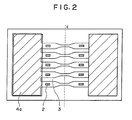
- Substrate 1a having discharge energy generating element 2, liquid path wall 3 and ink liquid chamber 4a as shown in Fig. 2 and activation energy rays penetrable substrate 1b having ink liquid chamber 4b (in which recording liquid is stored, as shown in Figs. 3A and 3B, are prepared.
- the photopolymerizable adhesive of the present invention is dissolved in an appropriate solvent to prepare a liquid adhesive.
- the resultant adhesive has, for example, a viscosity of about 100 cps and a solid content of about 30% by weight.
- substrate 1b is dried at about 80°C for about 20 minutes.
- the resultant substrate 1b is registered and melt-bonded under pressure on a hot plate with substrate 1a.
- using a ultraviolet-ray-exposure device the substrate is exposed to ultraviolet rays from above and cured.
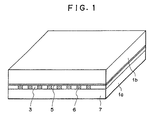
- Fig. 1 is a typical diagrammatic perspective view showing an ink jet head produced by the above-mentioned process.
- the present adhesive is dissolved in methyl ethyl ketone to prepare a liquid adhesive.
- the prepared liquid adhesive is coated on a polyethylene terephthalate made film having a thickness of about 25 ⁇ m so that the thickness of the resultant film becomes about 5 ⁇ m.
- a polyethylene made film having a thickness of 50 ⁇ m is laminated to a photosensitive layer, to thereby prepare a dry film sandwiched between two films.
- the thus prepared dry film is laminated to substrate 1b in application method 1, and then, the photosensitive layer on the ink liquid room is cut off with a cutter.
- the resultant substrate 1b is registered with substrate 1a, melt-bonded under pressure on a hot plate.
- the substrate is exposed to a ultraviolet ray from above and cured.
- the film path wall of substrate 1a adheres to substrate 1b at the same time the flow path formed to a nozzle.
- the fluidity of the present adhesive is suppressed, so that hanging down of the adhesive from the flow path wall can be reduced to a minimum.
- the photopolymerizable adhesive of the present invention is useful for producing, particularly, an ink jet head.
- the advantages of the present adhesive are as follows.
- Methyl methacrylate, methacrylic acid, and 2-hydroxypropylmethacrylate in weight ratios of 85: 5 : 10 were subjected to solution polymerization in a mixture solvent of xylene and methyl cellosolve in a weight ratio of 50: 50, to thereby obtain a linear polymer (hereinafter referred to as "LP-1") having a number average molecular weight (Mn) of about 40,000, a weight average molecular weight (Mw) of about 130,000 and a glas transition temperature (Tg) of 80°C.
- LP-1 linear polymer having a number average molecular weight (Mn) of about 40,000, a weight average molecular weight (Mw) of about 130,000 and a glas transition temperature (Tg) of 80°C.
- Cresol novolak epoxy resin (trade name of EOCN-102, manufactured and sold by Nippon Kayaku Co., Ltd., Japan, and having epoxy equivalent of from 205 to 230, was dissolved in xylene. Then, using tetrabutylammonium chloride as a catalyst, acrylic acid was dropwise added to the resultant mixture solution of 80°C to advance a reaction, to thereby obtain an acrylic acid ester of an epoxy resin (hereinafter referred to as "EPA-1").
- EPA-1 acrylic acid ester of an epoxy resin
- substrate 1a having a heater as a discharge energy generated element and a flow path wall which is preferably a cured layer wall of a photosensitive resin and substrate 1b of top plate glass (or transparent resin) having concave portions for ink liquid room were prepared.
- the adhesive composition of Example 1 was wet-coated so as to have a film thickness of 3.5 ⁇ m by means of a roll coater. Then, the resultant composition was dried in an oven of 80°C for 5 minutes to remove the solvent.
- substrate 1a and top board glass 1b were registered and the temperature was increased up to 80°C to conduct a melt-bonding.
- the resultant substrate was exposed to ultraviolet rays to cure the adhesive from above.
- the ultraviolet ray used is a ultra high-pressure mercury vapor lamp.
- the energy strength of the ultraviolet rays was 10 mW/cm2 in the neighborhood of 365 nm and the exposure time was 4 minutes.
- ultraviolet-ray-exposure was conducted for 6 minutes for post-curing.
- the laminated substrate was cut off by means of slicing machine for semiconductor at the position of the center line represented mark C shown in Figs. 2 and 3. As shown in Fig. 1, two pieces of ink jet nozzle were obtained.
- temperature cycling test was conducted. The temperature was varied up and down with 10 cycles between -15°C and 80°C.
- Each of 10 pieces of heads was immersed in a mixture solution of ethylene glycol and water in a weight ratio of 50: 50 at 80°C for 300 hours.
- Adhesives were prepared in formulations indicated in Tables 2 to 5 and ink jet nozzles were produced in the same manner as in Example 1.
- Example 7 Substantially the same procedure as in Example 1 was repeated except that commercially available ultraviolet ray curable adhesive shown in Table 7 was used instead of the adhesive of the present invention, to thereby produce ink jet nozzles.
- the present invention brings about excellent effects without degrading the characteristics particularly in a type of recording head in which ink is discharged by sudden state change caused by thermal energy generated by electrothermal converted elements and optical energy and recording apparatus proposed by Canon Inc., among the ink jet recording systems.
- the liquid (ink) is discharged through a discharge opening to thereby form at least one droplet.
- the driving signal is in the form of pulse
- the growth and contraction of the bubble appropriately will take place on the spot and therefore, discharge of the liquid (ink) excellent particularly in responsiveness can be accomplished, and this is more preferable.
- this driving signal in the form of pulse one as described in U.S. Patent No. 4,463,359 or U.S. Patent No. 4,345,262 is suitable. More excellent recording can be accomplished if the conditions described in U.S. Patent No. 4,313,124 which discloses an invention relating to the temperature rise rate of said heat-acting surface are adopted.
- the construction of the recording head besides the construction comprising a combination of discharge ports, liquid paths and electro-thermal conversion members as disclosed in the above-mentioned patents (straight liquid flow-paths or right-angled liquid flow paths), the construction using U.S. Patent No. 4,558,333 and U.S. Patent No. 4,459,600 which disclose a construction in which the heat-acting portion is disposed in a bent area is also covered by the present invention.
- the present invention will also be effective if it adopts a construction based on Japanese Laid-Open Patent Application No.
- 59-123670 which discloses a construction in which a slit common to a plurality of electro-thermal conversion members is the discharge portion of the electro-thermal conversion members or Japanese Laid-Open Patent Application No. 59-138461 which discloses a construction in which an opening for absorbing the pressure wave of heat energy corresponds to a discharge portion.
- the present invention is effective paticularly for the full line type recording head having a length corresponding to the width of the largest recording medium and a number of liquid paths can be formed without an disturbance.
- the present invention is effective for a case where use is made of an interchangeable chip type recording head which enables the electrical connection to an apparatus body or the supply of ink from the apparatus body to be accomplished by being mounted on the apparatus body or a recording head of the cartridge type in which a cartridge is integrally provided in the recording head itself.
- the present invention is preferable because the recovery means can surely operate.
- they include capping means, cleaning means and pressing or suction means for the recording head, and preheating means provided by electro-thermal conversion members or a heating element discrete therefrom or a combination of these, and it is also effective for accomplishing stable recording to perform a preliminary discharge mode in which discharge discrete from that for recording is effected.
- the recording mode of the recording apparatus is not limited to a recording mode only in the main color such as black, but the present invention is also very effective for an apparatus provided with at least one of different plural colors or full color by mixed colors although the recording head may be constructed as a unit or provided by a combination of a plurality of heads.
- liquid ink has been described as being used, but in the present invention, use may also be made of ink which is in liquid phase at room temperature or ink which is softened at room temperature.
- ink jet apparatus it is usual to effect temperature adjustment of the ink itself within the range of 30°C to 70°C and effect temperature control so that the viscosity of the ink may be within a stable discharge range and therefore, the ink may be one which forms the liquid phase when the recording signal used is imparted.
- the temperature rise by heat energy may be prevented by being positively used as the energy for the phase change of the ink from the solid phase to the liquid phase, or ink which solidifies when it is left as it is may be used with a view to prevent the evaporation of the ink, and in any case, the use of ink having the nature of being liquefied only by heat energy, such as ink which is liquefied by the application of heat energy conforming to a recording signal and is discharged in the form of ink liquid or ink which already begins to solidify at a point of time whereat it arrives at a recording medium is also applicable to the present invention.
- the ink may be in a form opposed to electro-thermal conversion members in the state as described in Japanese Laid-Open Patent Application No. 54-56847 or Japanese Laid-Open Patent Application No. 60-71260 wherein the ink is retained as liquid or solid in the recesses of a porous sheet or through-holes.
- the present invention what is most effective for the above-described kinds of inks is what executes the above-described film boiling system.
Landscapes
- Chemical & Material Sciences (AREA)
- Health & Medical Sciences (AREA)
- Chemical Kinetics & Catalysis (AREA)
- Medicinal Chemistry (AREA)
- Polymers & Plastics (AREA)
- Organic Chemistry (AREA)
- Adhesives Or Adhesive Processes (AREA)
- Particle Formation And Scattering Control In Inkjet Printers (AREA)
- Macromonomer-Based Addition Polymer (AREA)
Abstract
Description
- The present invention relates to a photopolymerizable adhesive for adhering a minute portion and an ink jet recording head using the same. More particularly, the present invention is concerned with a photopolymerizable adhesive for adhering one member having a minute portion (e.g., convex portion or concave portion) to the other member.
- The photopolymerizable adhesive can advantageously be used for forming a liquid path in which liquid (particularly, ink) generally is presence, for a path in which liquid passes and for a junction portion between the paths. Particularly, the photopolymerizable adhesive is effectively used for forming an ink jet recording head.
- In general, an adhesive for forming a desired space by laminating two members having a minute portion, such as convex portion or concave portion, is widely used in various fields.
- Further, many kinds of articles having a photosensitive resin or photocured glass as a structural member are also known. Among them, an ink jet recording head formed by utilizing precise formation of the minute portion is disclosed in U.S. Patent Nos. 4,417,251 and 4,558,333.
- This technique is extremely effective and hence it has been put in practice.
- It is disclosed in British Patent No. 2158777 (registered April 20, 1988) and U.S. Patent Application S.N. 711,181 (filed March 13, 1985) to form a liquid path by adhering a cover member to a substrate having a concave portion for the liquid path. These references disclose a technic in which when the cover member is adhered to the substrate with an adhesive, a joint area is adjusted to solve the problems of the adhesive.
- On the other hand, U.S. Patent Nos. 4,330,787 and 4,334,234 disclose that a cover plate having a recess portion for the liquid path is adhered is a substrate providing a discharge energy generation element. Particularly, U.S. Patent No. 4,330,787 discloses a recording head formed by adhering a member having a minute portion such as an orifice plate providing a discharge port, that is, an assembled head formed by adhering other structural member to a substrate.
- Generally, the liquid path has a minute portion having an average radius or one side of polygon of about 5 µm to about 200 µm and a discharge port having an average radius or one side of polygon of about 15 µm to about 100 µm is used. Since such a minute portion structure has a significant effect on fluidity of liquid and discharge state, it is known that the minute portion is required to be accurately formed with respect to desired dimensions. Therefore, it is necessary to form the minute portion structure by utilizing, as a typical material the photosensitive resin as a mold or a structural element.
- Conventionally the following methods for producing an ink jet head, which has a process for laminating two substrates have been put in practice.
- (1) A method in which an adhesive is subjected to screen printing.
- (2) A method in which liquid type ultraviolet rays cured resin is coated to the substrate.
- (3) A method in which a dry film for printed board is used as an adhesive.
- (4) A method in which metal having a low-melting point is subjected to metallizing, followed by diffused junction.
- The present inventors have found problems to be solved with respect to the above-mentioned conventional methods (1) to (4).
- However, although the above-mentioned conventional methods (1)-(4) are unsatisfactory, they have been put in practice.
- The problems of methods (1) to (4) are as follows.
- In method (1), a sufficient precision cannot be obtained in view of resolution and film thickness.
- In method (2), since a material has fluidity, an adhesive flows to an unrequired portion and cured thereat even if, for example the adhesive is ultraviolet cured. Accordingly, the adhesive flows out to the flow path, so that variations in flow path resistance and a direction of discharge may occur. Therefore, this method is undesirable for mass-production, and when a head having high density multi-discharge ports and the liquid path in which more than sixty liquid paths are formed, defective articles may be produced.
- In method (3), a film-thickness of a dry film is restricted, that is, when the dry film is a photosensitive layer having a thickness of 10 µm or less, production of the dry film cannot be conducted, in practice. Further, the conventional dry films do not have satisfactory properties as adhesive of which adhesive strength is high, which does not affect the shape of a minute portion or exhibit high durability.
- In method (4), it is only useful for junction of metals. Further, this method cannot be used in case where heads are made of resin.
- From the foregoing, the present inventors have developed an adhesive most suitable for adhering a minute portion.
- One object of the present invention is to provide a photopolymerizable adhesive for adhering a minute portion, even when a coating is thin, maintaining a high adhesive strength without injuring the shape of a minute portion.
- Another object of the present invention is to provide a photopolymerizable adhesive which exhibits stable adhesiveness for a long period of time, even when the photopolymerizable adhesive is continuously exposed to liquid such as ink, while maintaining desired fluidity and discharge characteristics.
- Still another object of the present invention is to provide a photopolymerizable adhesive having excellent recording characteristics such that the pohotopolymerizable adhesive exhibits excellent response properties to recording signals in an ink jet recording apparatus for discharging liquid with heat energy as a discharge energy.
- A further object of the present invention is to provide an ink jet recording head formed by using the above photopolymerizable adhesive, particularly when a liquid path is a layer cured with a photosensitive resin.
- A still further object of the present invention is to provide an ink jet recording apparatus in which when the above photopolymerizable adhesive is used, stable recording is performed to a recording medium capable of relatively moving to the recording head in response to information from a host or an integral recording information generator.
- A furthermore object of the present invention is to provide a photopolymerizable adhesive which is effective for one of a plurality of junction members made of resin and both of them made of resins.
- According to the present invention, there is provided a photopolymerizable adhesive comprising:
- (A) an acrylic resin having groups represented by the formulae: ―COOH, ―OH and ―NHCH₂OR (wherein R represents a hydrogen atom or an alkyl group having 1 to 4 carbon atoms), a number average molecular weight of 3,000 to 200,000 and a glass transition temperature of at least 70°C;
- (B) a photopolymerizable oligomer containing at least one member selected from the group consisting of (a) an acrylate or a methacrylate of a novolak, epoxy resin, (b) an acrylate or a methacrylate of a bisphenol epoxy resin and (c) an urethane acrylate of aromatic alcohol or cycloaliphatic alcohol; and
- (C) a photoinitiator capable of discharging radicals with the action of activation energy rays.
- According to the present invention, there is further provided an article formed by adhering a minute portion using the above photopolymerizable adhesive and provided an ink jet recording apparatus having the above ink jet recording head.
- The photocurable adhesive of the present invention has excellent properties such that when the photopolymerizable adhesive is coated on a specific surface of a part of a complicated shape, it does not flow to an unnecessary portion and when the part is a thin film having a thickness of 1 to 5 µm, the adhesive strength is high, and further the photopolymerizable adhesive is not affected by ink. Therefore, by the use of the photopolymerizable adhesive of the present invention, both of requirements in a process for adhering a minute portion and reliability in a structural member can be satisfactory. Particularly, the photopolymerizable adhesive of the present invention is an epoch-making adhesive for producing an ink jet head.
- In the present invention, the photopolymerizable adhesive contains a photopolymerizable oligomer. Therefore, by optical action, a first and second junction members one of which has a transparent member are tightly jointed and the desired minute arrangement can be obtained without disturbing the shape of the minute portion (concave portion or other concave and convex portions) is formed on at least one or both of the first and second junction members.
- Particularly, it is possible to remove the unnecessary resistance regarding fluidity of durable ink of the ink jet recording head which is exposed to obtain good discharge.
- The photopolymerizable adhesive of the present invention can be used also for adhering an orifice plate as a structural member for ink jet head.
- In the drawings:
- Fig. 1 is a perspective view showing an ink jet head produced by using the photopolymerizable adhesive of the present invention.
- Fig. 2 is a plan view showing a substrate for the ink jet head.
- Figs. 3A and 3B are a plan view and a front view, respectively, showing substrates for laminating with the substrate as shown in Fig. 2.
- The photopolymerizable adhesive of the present invention can widely be used in various fields for forming a minute portion structure, such as channels, convex portions arranged in a space at intervals, holes or through-holes. The preferred embodiments of an ink jet recording head and an ink jet recording apparatus produced by using the photopolymerizable adhesive of the present invention are explained below.
- In one aspect of the present invention there is provided a photopolymerizable adhesive for an ink jet recording head, which comprises:
- (A) an acrylic resin having groups represented by the formulae: ―COOH, ―OH and ―NHCH₂OR (wherein R represents a hydrogen atom or an alkyl group having 1 to 4 carbon atoms), a number average molecular weight of 3,000 to 200,000 and a glass transition temperature of at least 70°C;
- (B) a photopolymerizable oligomer containing at least one member selected from the group consisting of (a) an acrylate or a methacrylate of a novolak epoxy resin, (b) an acrylate or a methacrylate of a bisphenol epoxy resin, and (c) an urethane acrylate of aromatic alcohol or cycloaliphatic alcohol; and
- (C) a photoinitiator capable of discharging radicals with the action of activation energy rays.
- The present invention will be explained below in detail.
- (A) An acrylic resin:
- The acrylic resin (A) to be used in the present invention exhibits properties for disappearing the fluidity immediately after coating the adhesive and improves workability. Further, the shrinkage generated by the reaction of a photopolymerizable oligomer which has a polymerization properties can be decreased, and by virtue of functional groups in the acrylic resin, the adhesiveness can be increased. Examples of monomers for preparing such an acrylic resin include methyl methacrylate, ethyl methacrylate, t-butylmethacrylate, dicyclopentenyl acrylate, dicyclopentenyl methacrylate, tricyclodecane methacrylate, tricyclodecaneoxyethyl methacrylate, isobornyl acrylate, isobornyl methacrylate, tetrahydrofurfuryl acrylate, cyclohexyl methacrylate, dimethylaminoethyl methacrylate, benzyl acrylate and the like.
- Examples of monomers having carboxyl groups (―COOH) include acrylic acid, methacrylic acid, monoacrylic acid ester of succinic acid, monoacrylic acid ester of phthalic acid and the like.
- Examples of monomers having hydroxyl groups (―OH) include 2-hydroxyethyl acrylate, 2-hydroxyethyl methacrylate, 2-hydroxy propyl methacrylate, 4-hydroxybutyl acrylate and the like.
- Examples of monomers having groups represented by the formula: ―NHCH₂OR (wherein R represents a hydrogen atom or an alkyl group having 1 to 4 carbon atoms) include N-methylolacrylamide, butoxymethylacrylamide and the like.
- In the present invention, the acrylic resin (A) may be obtained, for example by polymerizing properly monomers as mentioned above. The amount of an acrylic monomer having the above-mentioned functional groups in the acrylic resin (A) is preferably in the range of 20% or less, regardless of polymerization type such as random copolymerization and graft copolymerization. When the amount of the acrylic monomer having a functional group is more than 20%, resistance to water tends to be poor.
- The number average molecular weight of the acrylic resin (A) is in the range of 3,000 to 200,000, and the glass transition temperature of the acrylic resin (A) is more than at least 70°C. When the number average molecular weight and the glass transition temperature of the acrylic resin (A) is out of the above-mentioned range, sufficient coating properties or sufficient resistance to water cannot be obtained.
- (B) A photopolymerizable oligomer:
- The photopolymerizable oligomer (B) to be used in the present invention is an oligomer containing at least one member selected from the group consisting of (a) an acrylate or a methacrylate of a novolak epoxy resin, (b) an acrylate or a methacrylate of a bisphenol epoxy resin, and (c) an urethane acrylate of aromatic alcohol or cycloaliphatic alcohol.
- As novolak epoxy resins used for an acrylate or a methacrylate of component (a), both phenol novolak epoxy resin and cresol novolak epoxy resin may be used. When each of the epoxy resins has a condensation degree up to about 10, the difference in performance is not remarkable.
- However, while an optimal degree of condensation is not specified, from the viewpoint of the synthetic reaction, the condensation degree is preferably in the range of 2 to 7.
- As examples of the commercially available novolak epoxy resins, there may be used trade name of EOCN-102 (epoxy equivalent of 205 to 230), trade name of EOCN-1020 (epoxy equivalent of 93 to 205) and trade name of EPPN-201 (epoxy equivalent of 180 to 205) which are manufactured and sold by Nippon Kayaku Co., Ltd., Japan) and the like.
- As the bisphenol epoxy resins used as an acrylate or a methacrylate of skelton of component (b), there may be used a material having a bisphenol A epoxy resins, a bisphenol S epoxy resin, a bisphenol F epoxy resin and the like.
- As the cycloaliphatic alcohols and aromatic alcohols used as a urethane acrylate of component (c), there may be used materials having a structure represented by the following formula.

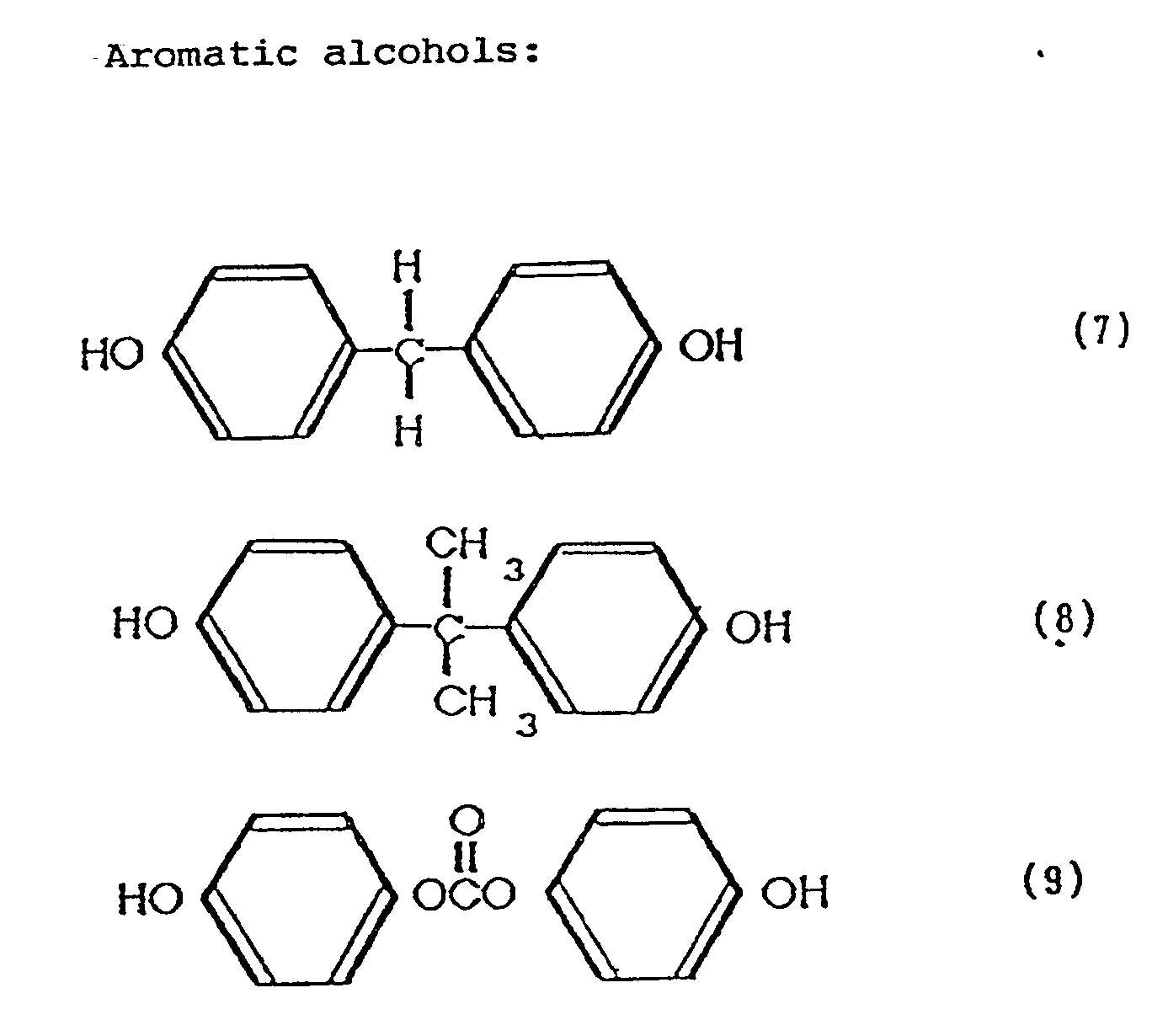
- Of these divalent alcohols, materials (3), (5) and (6) each having a skelton of dicyclopentadiene have extremely excellent performance for the objects of the present invention. By reacting these divalent alcohols with diisocyanate and acrylic monomer having hydroxyl groups, an urethane acrylate having a terminal acryloyl groups can be obtained.
- In the present invention, the urethane acrylate is synthesized as it has typically a structure represented by the following formula:

- The urethane acrylate generally have a recurring structure, such as

- Many of commercially available urethane acrylates have such a recurring structure. However, in the present invention, the urethane acrylate having structure of formula (I) is preferred. Further, it is preferred that the urethane acrylate has an urethane linkage and the molecular weight between crosslinking points is restricted to the minimum. To obtain such a structure, half-urethane compound represented by formula M-DI is synthesized by reacting component M with component DI, and then, is further reacted with component AL.
- As the diisocyanate used for producing the urethane acrylate (c), there may be mentioned tolyrene diisocyanate, diphenylmethane diisocyanate, heramethylene diisocyanate, isophoron diisocyanate, lysine diisocyanate and the like.
- The acrylic monomers having hydroxyl groups, which is represented mark M in the above formula (1), include 2-hydroxyethyl acrylate, 2-hydroxyethyl methacrylate, 2-hydroxypropyl acrylate, 2-hydroxypropyl methacrylate, 3-chloro-2-hydroxy acrylate, 4-hydroxybutyl acrylate and the like.
- (C) A photoinitiator:
- As the photoinitiator (C) to be used in the present invention, there is no limitation as long as materials have a solubility to the above-mentioned components, radicals are generated by applying activation energy rays, such as an ultraviolet ray, and the materials are difficult to react in the dark. Examples of photoinitiators include benzil; benzoin alkyl ethers, such as benzoin isobutyl ether, benzoin isopropyl ether, benzoin-n-butyl ether, benzoin ethyl ether and benzoin methyl ether; benzophenones, such as benzophenone, benzophenone methyl ether; anthraquinones, such as 2-ethylanthraquinone and 2-t-butylanthraquinone; thioxanthones, such as 2,4-dimethylthioxanthone and 2-4-isopropylthioxanthone; acetophenones, such as 2,2-dimethoxy-2-phenylacetophenone, α,α-dichloro-4-phenoxyacetophenone, p-t-butyltrichloroacetophenone, p-t-butyldichloroacetophenone and 2,2-diethoxyacetophenone; or hydroxycyclohexylphenylketone (trade name of Irgacure 184, manufactured and sold by Ciba Geigy Corp.,), benzyldimethylketal (trade name of Irgacure 651, manufactured and sold by Ciba Geigy Corp.,), 1-(4-isopropylphenyl)-2-hydroxy-2-methylpropane-1-one (trade name of DAROCURE1116, manufactured and sold by MERCK), 2-hydroxy-2-methyl-1-phenyl-propane-1-on (trade name of DAROCURE 1173, manufactured and sold by MERCK) and others.
- In the adhesive of the present invention, the characteristics of these essential components exert synergistic effect. Therefore, the adhesive is suitable for the production of an ink jet head. By the use of the adhesive of the present invention, the objects of the present invention can be attained.
- In the present invention, amines or materials having alkylamine groups may be used as sensitizer in addition to the photoinitiator. Therefore, the sensitivity can be increased and the oxygen inhibition can be decreased.
- Examples of the sensitizers include ethanol amine, ethyl-4-dimethylaminobenzoate, 2-(dimethylamino)ethylbenzoate, p-dimethylaminobenzoic acid-n-amylester, p-dimethylaminobenzoic acid isoamylester, n-butylamine, triethylamine, diethylaminoethyl methacrylate, 4,4-bis(diethylamino)benzophenone, 4-dimethylaminoacetophenone, N-ethyldiethanolamine and the like.
- The amounts ratio with respect to the acrylic resin (A), photopolymerizable oligomer (B) and photoinitiator (C), which are contained in the photopolymerizable adhesive as essential components, are as follows. The ratios of (A) to (B) is preferably in the range of 100: 80 to 100: 250 (weight ratio) and the ratio of [(A) + (B)] to (C) is preferably in the range of from 100: 3 to 100: 10 (weight ratio).
- The photopolymerizable oligomer (C) contains at least one of ester of component (a) and/or ester of component (b), and acrylate of component (c). The amount ratio of oligomer E to oligomer U is preferably in the range of 70: 30 to 50: 50 (weight ratio), wherein oligomer E contains at least one of components (a) and (b) and oligomer U contains component (c). In the present invention, the oligomer E is used preferably in an amount of 50% by weight or more. On the other hand, when the amount of oligomer U is in the range of 30% to 50% by weight, it works best.
- Further, low-viscosity monomers (reactive diluent) which are not necessarily in the present invention, but, if desired, the monomers may be arbitrarily selected and used.
- Examples of the low-density monomers include 1,3-butanediol di(meth)acrylate, 1,4-butanediol di(meth)acrylate, 1,6-hexanediol di(meth)acrylate, neopentylglycol di(meth)acrylate, polyethyleneglycol 400 diacrylate, hydroxy pivalic acid ester neopentylglycol diacrylate, dicyclopentenyl dioxyethyl(meth)acrylate, trimethylolpropane tri(meth)acrylate, pentaerythritol tri(meth)acrylate, dipentaerythritol hexacrylate, 2-hydroxyethyl acrylate, tetrahydrofurfuryl acrylate, phenoxyethyl acrylate and so on. These low-viscosity monomers may be used in an amount of 5 parts by weight to 30 parts by weight, based on 100 parts by weight of the total amount of the oligomer E and the oligomer U.
- If desired, the following additives may be optionally added to the photopolymerizable adhesive of the present invention. As the additives, there may be mentioned, for example, hydroquinones for suppressing dark reaction stabilizers, such as paramethoxyphenols; colorants, such as dyes and pigments; extender pigments, such as silica, talc, alumina and clay; fire retardant, silane coupling agent for improving adhesiveness.
- When the resin composition of the present invention is used as a thin film having a thickness of 10 µm or less, it is preferred that the resin composition is dissolved in relatively slow-drying organic solvent. Examples of the slow-drying organic solvents include ethylene glycol derivatives, such as ethyl cellosolve acetate and butyl cellosolve acetate, methyl isobutyl ketone, toluene, xylene, N-methylpyrolidone, propylene carbonate and the like. Further, the resin composition of the present invention may be used for a photosensitive layer having a thickness of 5 µm to 100 µm, which layer is so-called photosensitive dry film.
- The methods for producing an ink jet nozzle by using the photopolymerizable adhesive of the present invention are explained below.
- Substrate 1a having discharge
energy generating element 2,liquid path wall 3 and ink liquid chamber 4a as shown in Fig. 2 and activation energy rayspenetrable substrate 1b having inkliquid chamber 4b (in which recording liquid is stored, as shown in Figs. 3A and 3B, are prepared. The photopolymerizable adhesive of the present invention is dissolved in an appropriate solvent to prepare a liquid adhesive. The resultant adhesive has, for example, a viscosity of about 100 cps and a solid content of about 30% by weight. Thus prepared liquid adhesive is coated on the surface ofsubstrate 1b by means of a roll coater so as to have thickness of the film of about 6 µm. Then,substrate 1b is dried at about 80°C for about 20 minutes. Theresultant substrate 1b is registered and melt-bonded under pressure on a hot plate with substrate 1a. Then, using a ultraviolet-ray-exposure device, the substrate is exposed to ultraviolet rays from above and cured. - Thus, the flow path wall of substrate 1a is jointed to
substrate 1b at the same time the flow path is formed as a nozzle or a head. Two substrates are jointed. In the above-mentioned sequence process, the fluidity of the present adhesive is suppressed, so that hanging down of the adhesive from the flow path wall can be reduced to a minimum. Fig. 1 is a typical diagrammatic perspective view showing an ink jet head produced by the above-mentioned process. - The present adhesive is dissolved in methyl ethyl ketone to prepare a liquid adhesive. The prepared liquid adhesive is coated on a polyethylene terephthalate made film having a thickness of about 25 µm so that the thickness of the resultant film becomes about 5 µm. On the other hand, a polyethylene made film having a thickness of 50 µm is laminated to a photosensitive layer, to thereby prepare a dry film sandwiched between two films. The thus prepared dry film is laminated to
substrate 1b in application method 1, and then, the photosensitive layer on the ink liquid room is cut off with a cutter. Theresultant substrate 1b is registered with substrate 1a, melt-bonded under pressure on a hot plate. - Using a ultraviolet-ray-exposure device, the substrate is exposed to a ultraviolet ray from above and cured.
- Thus, the film path wall of substrate 1a adheres to
substrate 1b at the same time the flow path formed to a nozzle. In the above-mentioned sequence process, the fluidity of the present adhesive is suppressed, so that hanging down of the adhesive from the flow path wall can be reduced to a minimum. - Accordingly, the photopolymerizable adhesive of the present invention is useful for producing, particularly, an ink jet head. The advantages of the present adhesive are as follows.
- (1) Joining of a minute portion of a substrate can easily be conducted, so that a good ink jet recording head capable of flying droplets in a straight line can be obtained.
- (2) A multi-nozzle ink jet recording head can easily be produced.
- (3) The mass-production of an ink jet recording nozzle can be attained.
- (4) The durability of the ink jet recording nozzle can be improved and the reliability of a system can be increased.
- The present invention will be described in more detail with reference to the following Synthesis Examples, Examples and Comparative Examples, which should not be construed as limiting the scope of the present invention.
- Methyl methacrylate, methacrylic acid, and 2-hydroxypropylmethacrylate in weight ratios of 85: 5 : 10 were subjected to solution polymerization in a mixture solvent of xylene and methyl cellosolve in a weight ratio of 50: 50, to thereby obtain a linear polymer (hereinafter referred to as "LP-1") having a number average molecular weight (Mn) of about 40,000, a weight average molecular weight (Mw) of about 130,000 and a glas transition temperature (Tg) of 80°C.
- Cresol novolak epoxy resin (trade name of EOCN-102, manufactured and sold by Nippon Kayaku Co., Ltd., Japan, and having epoxy equivalent of from 205 to 230, was dissolved in xylene. Then, using tetrabutylammonium chloride as a catalyst, acrylic acid was dropwise added to the resultant mixture solution of 80°C to advance a reaction, to thereby obtain an acrylic acid ester of an epoxy resin (hereinafter referred to as "EPA-1").
- To toluene solution of trylene diisocyanate was dropwise added 2-hydroxyethyl methacrylate so as to have a ratio of the number of moles of NCO groups to the number of moles of OA group of 1: 0.5 to advance a reaction. Thus, a compound having isocyanate groups and acryloyl groups was obtained. Then, to the solution was added toluene solution of hydrogenated bisphenol A (manufactured and sold by Kyoeisha Chemical Co., Ltd., Japan) and the reaction was conducted at 70°C for 4 hours. Then, to the resultant solution was added dibutyltindilaurate and the reaction was conducted for 3 hours, to thereby obtain an urethane acrylate (hereinafter, referred to as UA-1) of hydrogenated bisphenol A.
- An adhesive of the formulation indicated in Table 1 was prepared.

- As shown in Fig. 1, substrate 1a having a heater as a discharge energy generated element and a flow path wall which is preferably a cured layer wall of a photosensitive resin and
substrate 1b of top plate glass (or transparent resin) having concave portions for ink liquid room were prepared. On the junction side oftop board glass 1b or on the surface of nozzle side, the adhesive composition of Example 1 was wet-coated so as to have a film thickness of 3.5 µm by means of a roll coater. Then, the resultant composition was dried in an oven of 80°C for 5 minutes to remove the solvent. - Then, substrate 1a and
top board glass 1b were registered and the temperature was increased up to 80°C to conduct a melt-bonding. The resultant substrate was exposed to ultraviolet rays to cure the adhesive from above. The ultraviolet ray used is a ultra high-pressure mercury vapor lamp. The energy strength of the ultraviolet rays was 10 mW/cm² in the neighborhood of 365 nm and the exposure time was 4 minutes. After adhering, by means of an ultra high-pressure mercury vapor lamp having an energy strength of 55 mW/cm² in the neighborhood of 365 nm, ultraviolet-ray-exposure was conducted for 6 minutes for post-curing. Thus, the adhesive of substrate 1a andtop board glass 1b was terminated. The laminated substrate was cut off by means of slicing machine for semiconductor at the position of the center line represented mark C shown in Figs. 2 and 3. As shown in Fig. 1, two pieces of ink jet nozzle were obtained. - 30 pieces of ink jet heads were produced in the same manner as in Example 1 and the following reliability tests were conducted.
- (1) Temperature cycling test:
- Using 10 pieces of heads, temperature cycling test was conducted. The temperature was varied up and down with 10 cycles between -15°C and 80°C.
- (2) Drop impact test:
- Each of 10 pieces of head was dropped down from 60 cm-high place.
- (3) Ink immersion test:
- Each of 10 pieces of heads was immersed in a mixture solution of ethylene glycol and water in a weight ratio of 50: 50 at 80°C for 300 hours.
- As a result, in the above tests (1) to (3), peeling and separation in the junction portions were not observed.
- Adhesives were prepared in formulations indicated in Tables 2 to 5 and ink jet nozzles were produced in the same manner as in Example 1.
- Substantially the same procedure as in Example 1 was repeated except that commercially available ultraviolet ray curable adhesive shown in Table 7 was used instead of the adhesive of the present invention, to thereby produce ink jet nozzles.
- Reliability tests were conducted in the same manner as mentioned above with respect the ink jet nozzles produced in Examples 2 to 6 and Comparative Examples 1 to 4. The result are shown in Table 8.


-
- BP:
- benzophenone
- DAA:
- dimethylaminoacetophenone
- Irgacure 651:
- benzyldimethylketol (manufactured and sold by Ciba Geigy Corp.)
- Irgacure 184:
- dihydroxycyclohexyl phenyl ketone (manufactured and sold by Ciba Geigy Corp.)
- ECA:
- ethylcellosolve acetate
- MMA:
- methylmethacrylate
- TCDMA:
- tricyclodecane methacrylate
- AA:
- acrylate
- DCPA:
- dicyclopentenyl acrylate
- DMA:
- dimethylaminoethyl methacrylate
- BZA:
- benzyl acrylate
- N-MAN:
- N-methylolacrylamide
- 2-HEMA:
- 2-hydroxyethyl methacrylate
- MMA:
- methacryl acid
- Epikoto-152:
- phenolic novolak epoxy resin (manufactured and sold by Yuka Shell Epoxy Kabushiki Kaisha, Japan)
- Epikoto-828:
- bisphenol A epoxy resin (manufactured and solve by Yuka Shell Epoxy Kabushiki Kaisha, Japan)
- Epicron 830F:
- bisphenol F epoxy resin (manufactured and sold by Dainippon Ink & Chemicals Inc. Japan)
-
- EOCN-1025:
- cresol novolak epoxy resin (manufactured and sold by Nippon Kayaku Co. Ltd., Japan)
- The present invention brings about excellent effects without degrading the characteristics particularly in a type of recording head in which ink is discharged by sudden state change caused by thermal energy generated by electrothermal converted elements and optical energy and recording apparatus proposed by Canon Inc., among the ink jet recording systems.
- As regards the typical construction and principle thereof, use may preferably be made of the basic principles disclosed for example, U.S. Patent No. 4,723,129 and U.S. Patent No. 4,740,796. This system is applicable to both of the so-called on-demand type and the so-called continuous type, and particularly in the case of the on-demand type, the present invention is effective because at least one driving signal corresponding to recording information and providing a rapid temperature rise exceeding nuclear boiling is applied to electro-thermal conversion members disposed correspondingly to a sheet or liquid paths retaining liquid (ink) therein, whereby heat energy is generated in the electro-thermal conversion elements and film boiling is caused on the heat-acting surface of the recording head with a result that a bubble in the liquid (ink) corresponding at one to one to said driving signal can be formed. By the growth and contraction of this bubble, the liquid (ink) is discharged through a discharge opening to thereby form at least one droplet. If the driving signal is in the form of pulse, the growth and contraction of the bubble appropriately will take place on the spot and therefore, discharge of the liquid (ink) excellent particularly in responsiveness can be accomplished, and this is more preferable. As this driving signal in the form of pulse, one as described in U.S. Patent No. 4,463,359 or U.S. Patent No. 4,345,262 is suitable. More excellent recording can be accomplished if the conditions described in U.S. Patent No. 4,313,124 which discloses an invention relating to the temperature rise rate of said heat-acting surface are adopted.
- As regards the construction of the recording head, besides the construction comprising a combination of discharge ports, liquid paths and electro-thermal conversion members as disclosed in the above-mentioned patents (straight liquid flow-paths or right-angled liquid flow paths), the construction using U.S. Patent No. 4,558,333 and U.S. Patent No. 4,459,600 which disclose a construction in which the heat-acting portion is disposed in a bent area is also covered by the present invention. In addition, the present invention will also be effective if it adopts a construction based on Japanese Laid-Open Patent Application No. 59-123670 which discloses a construction in which a slit common to a plurality of electro-thermal conversion members is the discharge portion of the electro-thermal conversion members or Japanese Laid-Open Patent Application No. 59-138461 which discloses a construction in which an opening for absorbing the pressure wave of heat energy corresponds to a discharge portion.
- Further, the present invention is effective paticularly for the full line type recording head having a length corresponding to the width of the largest recording medium and a number of liquid paths can be formed without an disturbance.
- In addition, the present invention is effective for a case where use is made of an interchangeable chip type recording head which enables the electrical connection to an apparatus body or the supply of ink from the apparatus body to be accomplished by being mounted on the apparatus body or a recording head of the cartridge type in which a cartridge is integrally provided in the recording head itself.
- Also, to the apparatus is added with recovery means, preliminary auxiliary means, and the like for the recording head which is provided as the construction of the recording apparatus of the present invention, the present invention is preferable because the recovery means can surely operate. Specifically mentioning these, they include capping means, cleaning means and pressing or suction means for the recording head, and preheating means provided by electro-thermal conversion members or a heating element discrete therefrom or a combination of these, and it is also effective for accomplishing stable recording to perform a preliminary discharge mode in which discharge discrete from that for recording is effected.
- Further, the recording mode of the recording apparatus is not limited to a recording mode only in the main color such as black, but the present invention is also very effective for an apparatus provided with at least one of different plural colors or full color by mixed colors although the recording head may be constructed as a unit or provided by a combination of a plurality of heads.
- In the embodiments of the present invention described above, liquid ink has been described as being used, but in the present invention, use may also be made of ink which is in liquid phase at room temperature or ink which is softened at room temperature. In the above-described ink jet apparatus, it is usual to effect temperature adjustment of the ink itself within the range of 30°C to 70°C and effect temperature control so that the viscosity of the ink may be within a stable discharge range and therefore, the ink may be one which forms the liquid phase when the recording signal used is imparted. In addition, the temperature rise by heat energy may be prevented by being positively used as the energy for the phase change of the ink from the solid phase to the liquid phase, or ink which solidifies when it is left as it is may be used with a view to prevent the evaporation of the ink, and in any case, the use of ink having the nature of being liquefied only by heat energy, such as ink which is liquefied by the application of heat energy conforming to a recording signal and is discharged in the form of ink liquid or ink which already begins to solidify at a point of time whereat it arrives at a recording medium is also applicable to the present invention. In such a case, the ink may be in a form opposed to electro-thermal conversion members in the state as described in Japanese Laid-Open Patent Application No. 54-56847 or Japanese Laid-Open Patent Application No. 60-71260 wherein the ink is retained as liquid or solid in the recesses of a porous sheet or through-holes. In the present invention, what is most effective for the above-described kinds of inks is what executes the above-described film boiling system.

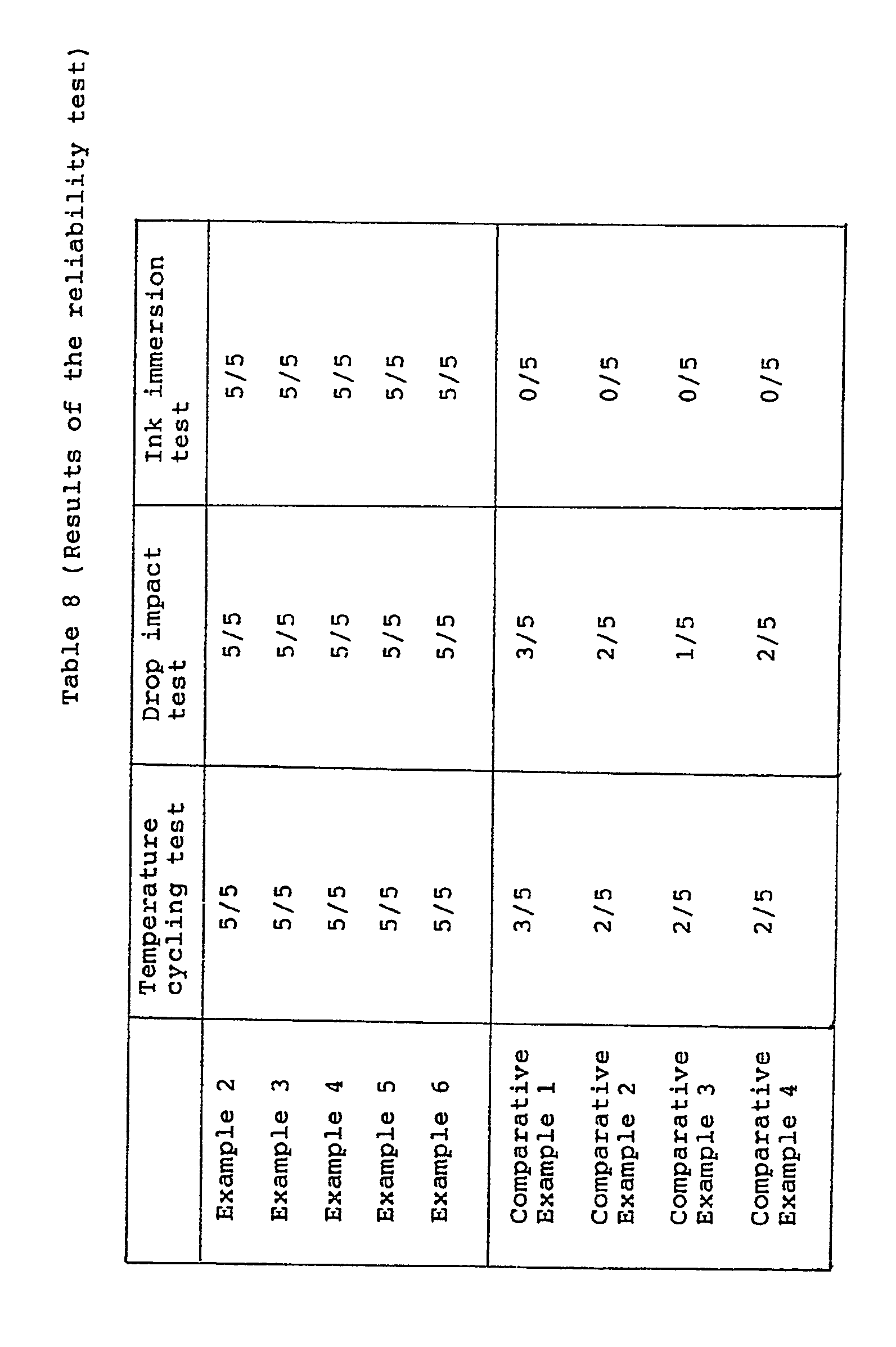
Claims (27)
- A photopolymerizable adhesive comprising:(a) an acrylic resin;(b) a photopolymerizable oligomer; and(c) a photoinitiator.
- An adhesive according to claim 1, wherein the acrylic resin has groups represented by the formulae: ―COOH, ―OH and ―NHCH₂OR (wherein R represents a hydrogen atom or an alkyl group having 1 to 4 carbon atoms), a number average molecular weight of 3,000 to 200,000 and a glass transition temperature of at least 70°C.
- An adhesive according to claim 1 or 2, wherein the acrylic resin contains units derived from methylmethacrylate, ethyl methacrylate, t-butyl-methacrylate, dicyclopentenyl methacrylate, tricyclodecane methacrylate, tricyclodecaneoxyethyl methacrylate, isobornyl acrylate, isobornyl methacrylate, tetrahydrofurfuryl acrylate, cyclohexyl methacrylate, dimethylaminoethyl methacrylate, benzyl acrylate.
- An adhesive according to any preceding claim, wherein the acrylic resin contains units derived from methacrylic acid, a monoacrylic acid ester of succinic acid, or a monacrylic acid ester of phthalic acid.
- An adhesive according to any preceding claim, wherein the acrylic resin includes units derived from 2-hydroethyl acrylate, 2-hydroxyethyl methacrylate, 2-hydroxy propyl methacrylate and 4-hydroxybutyl acrylate.
- An adhesive according to any preceding claim, wherein the acrylic resin comprises units derived from N-methylolacrylamide or butoxymethylacrylamide.
- An adhesive according to any of claims 2 to 6, wherein the amount or total amount of the monomers having ―COOH, ―OH and ―NHCH₂OR units is 20% or less.
- An adhesive according to any preceding claim, wherein the photopolymerizable oligomer is an acrylate or a methacrylate of a novolak epoxy resin.
- An adhesive according to claim 8, wherein the novolak epoxy resin is a phenol or cresol novolak epoxy resin having a condensation degree of 2 to 7.
- An adhesive according to any preceding claim, wherein the photopolymerizable oligomer is an acrylate or a methacrylate of a bisphenol epoxy resin.
- An adhesive according to any preceding claim, wherein the bisphenol epoxy resin is a bisphenol A epoxy resin, a bisphenol S epoxy resin or a bisphenol F epoxy resin.
- An adhesive according to any preceding claim, wherein the photopolymerizable oligomer is a urethane acrylate of an aromatic alcohol or a cycloaliphatic alcohol.
- An adhesive according to claim 12, wherein the cycloaliphatic alcohol or aromatic alcohol residue of the urethane acrylate is a material having any of the formulae 1 to 9 in the description.
- An adhesive according to claim 12 or 13, in which the urethane acrylate has a structure represented by the formula:

- An adhesive according to claim 12 or 13, wherein the urethane acrylate is of a recurring structure such as:

- An adhesive according to any preceding claim, wherein the photoinitiator is any of the compounds mentioned in the description.
- An adhesive according to any preceding claim, wherein there is further present a sensitizer which is an amine or a material having alkylamine groups.
- An adhesive according to any preceding claim, wherein the sensitizer includes ethanolamine, ethyl-4-dimethylaminobenzoate, 2-(dimethylamino)ethylbenzoate, p-dimethylaminobenzoic acid-n-amylester, p-dimethylaminobenzoic acid isoamylester, n-butylamine, triethylamine, diethylaminoethyl methacrylate, 4,4-bis(diethylamino)benzophenone, and/or 4-dimethylaminoacetophenone and N-ethyldiethanolamine.
- An adhesive according to any preceding claim, wherein the ratio by weight of the components (A) to (B) is from 100: 80 to 100: 250 and the ratio of the sum of the weights of the individual components (A) and (B) to the weight of component (C) is in the range from 100: 3 to 100: 10.
- An adhesive according to any preceding claim, wherein the photopolimerizable oligomer comprises an oligomer E which contains at least one of (A) an acrylate or a methacrylate of a novolak epoxy resin and (B) an acrylate or a methacrylate of a bisphenol epoxy resin and further contains an oligomer U which is (C) a urethane acrylate of an aromatic alcohol or cycloaliphatic alcohol, the proportion of the oligomer U being preferably from 30 to 50% by weight.
- An adhesive according to claim 20 further comprising 5 to 30 parts by weight based on a 100 parts by weight of the total amount of the oligomer E and the oligomer U of a monomer selected from 1,3-butanediol di(meth)acrylate, 1,4-butanediol di(meth) acrylate, 1,6-hexanediol di(meth)acrylate, neopentylglycol di(meth)acrylate, polyethyleneglycol 400 diacrylate, hydroxy pivalic acid ester neopentylglycol diacrylate, dicyclopentenyl dioxyethyl(meth)acrylate, trimethylolpropane tri(meth)acrylate, pentaerythritol tri(meth)acrylate, diepentaerythritol hexacrylate, 2-hydroxyethyl acrylate, tetrahydrofurfuryl acrylate and phenoxyethyl acrylate.
- An adhesive composition comprising a photopolymerizable adhesive according to any of claims 1 to 21 in solution in a slow-drying organic solvent.
- A composition according to claim 22, wherein the slow-drying solvent is an ethylene glycol derivative, methyl isobutyl ketone, toluene, xylene, N-methyl-pyrolidone, or propylene carbonate.
- The use of a photopolymerizable adhesive as claimed in any of claims 1 to 21 or a composition as claimed in claim 22 or 23 to form an ink jet nozzle of an ink jet recording head.
- An ink jet recording head produced using a photopolymerizable adhesive according to any of claims 1 to 21 or a composition according to claim 22 or 23, wherein the photopolymerizable adhesive is disposed at a junction portion between a first member which has concave portions on at least one surface thereof and a second member, wherein the first member adheres to the second member so as to form a plurality of liquid paths, and wherein at least one of said first and second members has a penetrability.
- A recording head according to claim 25, wherein each of said plurality of liquid parts has an electrothermal energy converter in which ink supply to the liquid part can be discharged by forming bubbles as a result of heat energy generated by said converter.
- Ink jet recording apparatus having an ink jet recording head according to claim 25 or 26, wherein there is provided means for effecting ink jet recording by bringing about relative movement between the ink jet recording head and a recording medium, means for supplying a driving signal to the recording head and means for supplying electrical energy to the electrothermal energy converter to bring about development of bubbles in the ink so as to discharge the ink in a pattern corresponding to the information to be recorded.
Applications Claiming Priority (3)
| Application Number | Priority Date | Filing Date | Title |
|---|---|---|---|
| JP32275189 | 1989-12-14 | ||
| JP322751/89 | 1989-12-14 | ||
| JP1322751A JP2683435B2 (en) | 1989-12-14 | 1989-12-14 | Adhesive for inkjet nozzle manufacturing |
Publications (3)
| Publication Number | Publication Date |
|---|---|
| EP0435536A2 true EP0435536A2 (en) | 1991-07-03 |
| EP0435536A3 EP0435536A3 (en) | 1991-12-27 |
| EP0435536B1 EP0435536B1 (en) | 1999-07-14 |
Family
ID=18147236
Family Applications (1)
| Application Number | Title | Priority Date | Filing Date |
|---|---|---|---|
| EP90313716A Expired - Lifetime EP0435536B1 (en) | 1989-12-14 | 1990-12-14 | Adhering an ink jet recording head using photopolymerisable adhesive |
Country Status (4)
| Country | Link |
|---|---|
| US (1) | US5484823A (en) |
| EP (1) | EP0435536B1 (en) |
| JP (1) | JP2683435B2 (en) |
| DE (1) | DE69033208T2 (en) |
Cited By (1)
| Publication number | Priority date | Publication date | Assignee | Title |
|---|---|---|---|---|
| WO1997035837A1 (en) * | 1996-03-25 | 1997-10-02 | Nordic Synthesis Ab | Liquid photo initiators |
Families Citing this family (9)
| Publication number | Priority date | Publication date | Assignee | Title |
|---|---|---|---|---|
| US6054034A (en) * | 1990-02-28 | 2000-04-25 | Aclara Biosciences, Inc. | Acrylic microchannels and their use in electrophoretic applications |
| JPH10180403A (en) * | 1996-12-26 | 1998-07-07 | Sumitomo Bakelite Co Ltd | Resin composition, permanent resist resin composition, and hardened resin thereof |
| JP3728210B2 (en) * | 2001-02-23 | 2005-12-21 | キヤノン株式会社 | Ink jet head, manufacturing method thereof, and ink jet recording apparatus |
| DE102004060285A1 (en) * | 2004-12-15 | 2006-06-29 | Degussa Ag | Radiation curable compositions, a process for their preparation and their use |
| TW200710570A (en) | 2005-05-31 | 2007-03-16 | Taiyo Ink Mfg Co Ltd | Composition for forming adhesive pattern, multilayer structure obtained by using same, and method for producing such multilayer structure |
| JP2005324557A (en) * | 2005-06-27 | 2005-11-24 | Fuji Photo Film Co Ltd | Manufacturing method of inkjet printer head |
| KR20090062012A (en) * | 2007-12-12 | 2009-06-17 | 삼성전자주식회사 | Inkjet Head and Manufacturing Method Thereof |
| CN101608107B (en) * | 2008-06-16 | 2013-06-05 | 华东理工大学 | Binding agent composition and anisotropic conductive binding agent containing same |
| DE102011114559B4 (en) * | 2011-09-30 | 2020-06-18 | Osram Opto Semiconductors Gmbh | Optoelectronic component comprising an adhesive layer, method for producing an adhesive layer in an optoelectronic component and use of an adhesive for forming adhesive layers in optoelectronic components |
Family Cites Families (26)
| Publication number | Priority date | Publication date | Assignee | Title |
|---|---|---|---|---|
| US4098918A (en) * | 1973-02-05 | 1978-07-04 | Ppg Industries, Inc. | Method of polymerizing non-linear urethane diacrylates using radiation |
| CA1127227A (en) * | 1977-10-03 | 1982-07-06 | Ichiro Endo | Liquid jet recording process and apparatus therefor |
| JPS5936879B2 (en) * | 1977-10-14 | 1984-09-06 | キヤノン株式会社 | Thermal transfer recording medium |
| US4330787A (en) * | 1978-10-31 | 1982-05-18 | Canon Kabushiki Kaisha | Liquid jet recording device |
| US4345262A (en) * | 1979-02-19 | 1982-08-17 | Canon Kabushiki Kaisha | Ink jet recording method |
| US4334234A (en) * | 1979-04-02 | 1982-06-08 | Canon Kabushiki Kaisha | Liquid droplet forming apparatus |
| US4463359A (en) * | 1979-04-02 | 1984-07-31 | Canon Kabushiki Kaisha | Droplet generating method and apparatus thereof |
| US4313124A (en) * | 1979-05-18 | 1982-01-26 | Canon Kabushiki Kaisha | Liquid jet recording process and liquid jet recording head |
| US4417251A (en) * | 1980-03-06 | 1983-11-22 | Canon Kabushiki Kaisha | Ink jet head |
| US4558333A (en) * | 1981-07-09 | 1985-12-10 | Canon Kabushiki Kaisha | Liquid jet recording head |
| JPS59123670A (en) * | 1982-12-28 | 1984-07-17 | Canon Inc | Ink jet head |
| JPS59138461A (en) * | 1983-01-28 | 1984-08-08 | Canon Inc | liquid jet recording device |
| JPS6071260A (en) * | 1983-09-28 | 1985-04-23 | Erumu:Kk | Recorder |
| JPS60206657A (en) * | 1984-03-31 | 1985-10-18 | Canon Inc | Liquid jet recording head |
| DE3522006A1 (en) * | 1985-06-20 | 1987-01-02 | Bayer Ag | (METH) ACRYLIC ACID DERIVATIVES OF TRICYCLODECANES AND THEIR USE |
| US4688052A (en) * | 1985-07-13 | 1987-08-18 | Canon Kabushiki Kaisha | Liquid jet recording head having a layer of a resin composition curable with an active energy ray |
| JPS6216147A (en) * | 1985-07-13 | 1987-01-24 | Canon Inc | Liquid jet recording head |
| US4688053A (en) * | 1985-07-13 | 1987-08-18 | Canon Kabushiki Kaisha | Liquid jet recording head having a layer of a resin composition curable with an active energy ray |
| US4688056A (en) * | 1985-07-13 | 1987-08-18 | Canon Kabushiki Kaisha | Liquid jet recording head having a layer of a resin composition curable with an active energy ray |
| CA1292011C (en) * | 1985-10-25 | 1991-11-12 | Susan S. Romm | Storage stable (meth)acrylate plastisols |
| DE3639266A1 (en) * | 1985-12-27 | 1987-07-02 | Fsk K K | ADHESIVE FILM |
| JPH0686505B2 (en) * | 1986-03-10 | 1994-11-02 | キヤノン株式会社 | Active energy ray curable resin composition |
| JPH0686504B2 (en) * | 1986-03-10 | 1994-11-02 | キヤノン株式会社 | Active energy ray curable resin composition |
| JPH0698759B2 (en) * | 1986-10-13 | 1994-12-07 | キヤノン株式会社 | Liquid jet recording head |
| JPH0698760B2 (en) * | 1986-10-13 | 1994-12-07 | キヤノン株式会社 | Liquid jet recording head |
| JP2815887B2 (en) * | 1989-02-16 | 1998-10-27 | 株式会社リコー | Thermal head |
-
1989
- 1989-12-14 JP JP1322751A patent/JP2683435B2/en not_active Expired - Fee Related
-
1990
- 1990-12-14 EP EP90313716A patent/EP0435536B1/en not_active Expired - Lifetime
- 1990-12-14 DE DE69033208T patent/DE69033208T2/en not_active Expired - Fee Related
-
1994
- 1994-08-29 US US08/296,182 patent/US5484823A/en not_active Expired - Lifetime
Cited By (1)
| Publication number | Priority date | Publication date | Assignee | Title |
|---|---|---|---|---|
| WO1997035837A1 (en) * | 1996-03-25 | 1997-10-02 | Nordic Synthesis Ab | Liquid photo initiators |
Also Published As
| Publication number | Publication date |
|---|---|
| US5484823A (en) | 1996-01-16 |
| DE69033208T2 (en) | 1999-12-09 |
| EP0435536B1 (en) | 1999-07-14 |
| EP0435536A3 (en) | 1991-12-27 |
| JPH03185086A (en) | 1991-08-13 |
| DE69033208D1 (en) | 1999-08-19 |
| JP2683435B2 (en) | 1997-11-26 |
Similar Documents
| Publication | Publication Date | Title |
|---|---|---|
| US4688053A (en) | Liquid jet recording head having a layer of a resin composition curable with an active energy ray | |
| US4688052A (en) | Liquid jet recording head having a layer of a resin composition curable with an active energy ray | |
| EP0209803B1 (en) | Liquid jet recording head | |
| KR101635801B1 (en) | (meth)acrylate compound, resin composition containing the same, cured product of the resin composition and energy ray-curable resin composition for optical lens sheet and cured product thereof | |
| CN111886300B (en) | Curable composition for inkjet printing, cured product thereof, and electronic component having cured product | |
| US4688054A (en) | Liquid jet recording head | |
| JP2573661B2 (en) | Photosensitive adhesive | |
| EP0435536B1 (en) | Adhering an ink jet recording head using photopolymerisable adhesive | |
| JPS61278577A (en) | UV curable ink composition | |
| JPH09183928A (en) | Ultraviolet-curable resin composition for ink jet recording system and cured product thereof | |
| US4688055A (en) | Liquid jet recording head having a layer of a resin composition curable with an active energy ray | |
| EP0333169A2 (en) | Liquid jet recording head | |
| US5043363A (en) | Active energy ray-curing resin composition | |
| WO2001055790A1 (en) | Photocurable resin compositions | |
| US6364465B1 (en) | Ink jet heads having photoresist layer containing poly (amic acid) | |
| EP0265034B1 (en) | Liquid jet recording head | |
| CA2465397C (en) | Resin composition | |
| JPH0698760B2 (en) | Liquid jet recording head | |
| JPS624719A (en) | Actinic energy ray-curable resin composition | |
| US6015651A (en) | Solder resist ink composition of a novolak-epoxy resin | |
| JPH04345609A (en) | Resin composition, ultraviolet-curable resin composition for color filter protecting film and its cured product | |
| JP3468311B2 (en) | Polymerizable resin compositions and articles having their cured films | |
| JP2549425B2 (en) | Active energy ray curable resin composition | |
| US5571659A (en) | Liquid jet recording head and recording apparatus using same | |
| JP2859761B2 (en) | Radiation-curable resin composition and cured product thereof |
Legal Events
| Date | Code | Title | Description |
|---|---|---|---|
| PUAI | Public reference made under article 153(3) epc to a published international application that has entered the european phase |
Free format text: ORIGINAL CODE: 0009012 |
|
| 17P | Request for examination filed |
Effective date: 19901227 |
|
| AK | Designated contracting states |
Kind code of ref document: A2 Designated state(s): DE FR GB IT |
|
| PUAL | Search report despatched |
Free format text: ORIGINAL CODE: 0009013 |
|
| AK | Designated contracting states |
Kind code of ref document: A3 Designated state(s): DE FR GB IT |
|
| 17Q | First examination report despatched |
Effective date: 19930305 |
|
| GRAG | Despatch of communication of intention to grant |
Free format text: ORIGINAL CODE: EPIDOS AGRA |
|
| GRAG | Despatch of communication of intention to grant |
Free format text: ORIGINAL CODE: EPIDOS AGRA |
|
| GRAG | Despatch of communication of intention to grant |
Free format text: ORIGINAL CODE: EPIDOS AGRA |
|
| GRAH | Despatch of communication of intention to grant a patent |
Free format text: ORIGINAL CODE: EPIDOS IGRA |
|
| GRAH | Despatch of communication of intention to grant a patent |
Free format text: ORIGINAL CODE: EPIDOS IGRA |
|
| GRAA | (expected) grant |
Free format text: ORIGINAL CODE: 0009210 |
|
| AK | Designated contracting states |
Kind code of ref document: B1 Designated state(s): DE FR GB IT |
|
| REF | Corresponds to: |
Ref document number: 69033208 Country of ref document: DE Date of ref document: 19990819 |
|
| ET | Fr: translation filed | ||
| ITF | It: translation for a ep patent filed | ||
| PLBE | No opposition filed within time limit |
Free format text: ORIGINAL CODE: 0009261 |
|
| STAA | Information on the status of an ep patent application or granted ep patent |
Free format text: STATUS: NO OPPOSITION FILED WITHIN TIME LIMIT |
|
| 26N | No opposition filed | ||
| REG | Reference to a national code |
Ref country code: GB Ref legal event code: IF02 |
|
| PGFP | Annual fee paid to national office [announced via postgrant information from national office to epo] |
Ref country code: IT Payment date: 20081220 Year of fee payment: 19 |
|
| PGFP | Annual fee paid to national office [announced via postgrant information from national office to epo] |
Ref country code: DE Payment date: 20081231 Year of fee payment: 19 |
|
| PGFP | Annual fee paid to national office [announced via postgrant information from national office to epo] |
Ref country code: GB Payment date: 20081224 Year of fee payment: 19 |
|
| PGFP | Annual fee paid to national office [announced via postgrant information from national office to epo] |
Ref country code: FR Payment date: 20081222 Year of fee payment: 19 |
|
| GBPC | Gb: european patent ceased through non-payment of renewal fee |
Effective date: 20091214 |
|
| REG | Reference to a national code |
Ref country code: FR Ref legal event code: ST Effective date: 20100831 |
|
| PG25 | Lapsed in a contracting state [announced via postgrant information from national office to epo] |
Ref country code: FR Free format text: LAPSE BECAUSE OF NON-PAYMENT OF DUE FEES Effective date: 20091231 |
|
| PG25 | Lapsed in a contracting state [announced via postgrant information from national office to epo] |
Ref country code: DE Free format text: LAPSE BECAUSE OF NON-PAYMENT OF DUE FEES Effective date: 20100701 |
|
| PG25 | Lapsed in a contracting state [announced via postgrant information from national office to epo] |
Ref country code: GB Free format text: LAPSE BECAUSE OF NON-PAYMENT OF DUE FEES Effective date: 20091214 |
|
| PG25 | Lapsed in a contracting state [announced via postgrant information from national office to epo] |
Ref country code: IT Free format text: LAPSE BECAUSE OF NON-PAYMENT OF DUE FEES Effective date: 20091214 |