EP0436227B1 - Polyaramidfaserdaune - Google Patents
Polyaramidfaserdaune Download PDFInfo
- Publication number
- EP0436227B1 EP0436227B1 EP90125614A EP90125614A EP0436227B1 EP 0436227 B1 EP0436227 B1 EP 0436227B1 EP 90125614 A EP90125614 A EP 90125614A EP 90125614 A EP90125614 A EP 90125614A EP 0436227 B1 EP0436227 B1 EP 0436227B1
- Authority
- EP
- European Patent Office
- Prior art keywords
- fluff
- balls
- aramid
- fibers
- less
- Prior art date
- Legal status (The legal status is an assumption and is not a legal conclusion. Google has not performed a legal analysis and makes no representation as to the accuracy of the status listed.)
- Expired - Lifetime
Links
- 239000004760 aramid Substances 0.000 title claims description 28
- 229920003235 aromatic polyamide Polymers 0.000 title claims description 22
- 239000000835 fiber Substances 0.000 claims description 53
- 229920006231 aramid fiber Polymers 0.000 claims description 27
- -1 poly(p-phenylene terephthalamide) Polymers 0.000 claims description 16
- 229920001169 thermoplastic Polymers 0.000 claims description 11
- 239000004416 thermosoftening plastic Substances 0.000 claims description 11
- 239000000203 mixture Substances 0.000 claims description 8
- 239000004744 fabric Substances 0.000 claims description 6
- 229920000889 poly(m-phenylene isophthalamide) Polymers 0.000 claims description 4
- 229920003366 poly(p-phenylene terephthalamide) Polymers 0.000 claims description 4
- 239000002250 absorbent Substances 0.000 claims description 3
- 229940117958 vinyl acetate Drugs 0.000 claims description 2
- 230000001747 exhibiting effect Effects 0.000 claims 2
- 239000000945 filler Substances 0.000 claims 1
- 239000000463 material Substances 0.000 description 13
- 238000012360 testing method Methods 0.000 description 13
- 238000001625 only para-hydrogen spectroscopy Methods 0.000 description 11
- 239000000443 aerosol Substances 0.000 description 9
- 230000035699 permeability Effects 0.000 description 9
- 238000001914 filtration Methods 0.000 description 8
- 238000009413 insulation Methods 0.000 description 8
- XLYOFNOQVPJJNP-UHFFFAOYSA-N water Substances O XLYOFNOQVPJJNP-UHFFFAOYSA-N 0.000 description 7
- 238000000034 method Methods 0.000 description 6
- 230000001681 protective effect Effects 0.000 description 6
- 230000015572 biosynthetic process Effects 0.000 description 5
- 238000002788 crimping Methods 0.000 description 5
- 239000002202 Polyethylene glycol Substances 0.000 description 4
- 239000000654 additive Substances 0.000 description 4
- 239000011230 binding agent Substances 0.000 description 4
- 238000000227 grinding Methods 0.000 description 4
- 239000007788 liquid Substances 0.000 description 4
- 229920001223 polyethylene glycol Polymers 0.000 description 4
- HEMHJVSKTPXQMS-UHFFFAOYSA-M Sodium hydroxide Chemical compound [OH-].[Na+] HEMHJVSKTPXQMS-UHFFFAOYSA-M 0.000 description 3
- 238000010521 absorption reaction Methods 0.000 description 3
- 230000007423 decrease Effects 0.000 description 3
- 238000003801 milling Methods 0.000 description 3
- 239000002245 particle Substances 0.000 description 3
- 238000012545 processing Methods 0.000 description 3
- IJGRMHOSHXDMSA-UHFFFAOYSA-N Atomic nitrogen Chemical compound N#N IJGRMHOSHXDMSA-UHFFFAOYSA-N 0.000 description 2
- QAOWNCQODCNURD-UHFFFAOYSA-N Sulfuric acid Chemical compound OS(O)(=O)=O QAOWNCQODCNURD-UHFFFAOYSA-N 0.000 description 2
- 230000002745 absorbent Effects 0.000 description 2
- 230000000996 additive effect Effects 0.000 description 2
- 230000000903 blocking effect Effects 0.000 description 2
- 229920001577 copolymer Polymers 0.000 description 2
- 238000001035 drying Methods 0.000 description 2
- 239000002657 fibrous material Substances 0.000 description 2
- 238000005259 measurement Methods 0.000 description 2
- 229920000728 polyester Polymers 0.000 description 2
- 238000009987 spinning Methods 0.000 description 2
- 239000007858 starting material Substances 0.000 description 2
- VEXZGXHMUGYJMC-UHFFFAOYSA-M Chloride anion Chemical compound [Cl-] VEXZGXHMUGYJMC-UHFFFAOYSA-M 0.000 description 1
- 229920000271 Kevlar® Polymers 0.000 description 1
- 229920000784 Nomex Polymers 0.000 description 1
- 239000004952 Polyamide Substances 0.000 description 1
- 150000001408 amides Chemical class 0.000 description 1
- 125000003118 aryl group Chemical group 0.000 description 1
- 230000005540 biological transmission Effects 0.000 description 1
- 239000003795 chemical substances by application Substances 0.000 description 1
- 150000001805 chlorine compounds Chemical group 0.000 description 1
- 230000006835 compression Effects 0.000 description 1
- 238000007906 compression Methods 0.000 description 1
- 230000001143 conditioned effect Effects 0.000 description 1
- 239000013256 coordination polymer Substances 0.000 description 1
- 238000002425 crystallisation Methods 0.000 description 1
- 230000008025 crystallization Effects 0.000 description 1
- 238000005520 cutting process Methods 0.000 description 1
- 238000000151 deposition Methods 0.000 description 1
- 125000004427 diamine group Chemical group 0.000 description 1
- 150000004985 diamines Chemical class 0.000 description 1
- 238000000578 dry spinning Methods 0.000 description 1
- 230000000694 effects Effects 0.000 description 1
- 238000005516 engineering process Methods 0.000 description 1
- 238000011156 evaluation Methods 0.000 description 1
- 238000011049 filling Methods 0.000 description 1
- 230000009970 fire resistant effect Effects 0.000 description 1
- 239000007789 gas Substances 0.000 description 1
- 230000005484 gravity Effects 0.000 description 1
- 239000011229 interlayer Substances 0.000 description 1
- 239000004761 kevlar Substances 0.000 description 1
- 239000010410 layer Substances 0.000 description 1
- 238000004519 manufacturing process Methods 0.000 description 1
- 108700005457 microfibrillar Proteins 0.000 description 1
- 239000011268 mixed slurry Substances 0.000 description 1
- 238000002156 mixing Methods 0.000 description 1
- 229910052757 nitrogen Inorganic materials 0.000 description 1
- 239000004763 nomex Substances 0.000 description 1
- 239000004745 nonwoven fabric Substances 0.000 description 1
- 229920002647 polyamide Polymers 0.000 description 1
- 229920000642 polymer Polymers 0.000 description 1
- 229920000098 polyolefin Polymers 0.000 description 1
- 239000011148 porous material Substances 0.000 description 1
- 238000007670 refining Methods 0.000 description 1
- 230000002787 reinforcement Effects 0.000 description 1
- 238000011160 research Methods 0.000 description 1
- 239000007787 solid Substances 0.000 description 1
- 238000001179 sorption measurement Methods 0.000 description 1
- 238000010998 test method Methods 0.000 description 1
- 238000012546 transfer Methods 0.000 description 1
Images


Classifications
-
- D—TEXTILES; PAPER
- D01—NATURAL OR MAN-MADE THREADS OR FIBRES; SPINNING
- D01G—PRELIMINARY TREATMENT OF FIBRES, e.g. FOR SPINNING
- D01G5/00—Separating, e.g. sorting, fibres
-
- D—TEXTILES; PAPER
- D01—NATURAL OR MAN-MADE THREADS OR FIBRES; SPINNING
- D01G—PRELIMINARY TREATMENT OF FIBRES, e.g. FOR SPINNING
- D01G1/00—Severing continuous filaments or long fibres, e.g. stapling
-
- D—TEXTILES; PAPER
- D04—BRAIDING; LACE-MAKING; KNITTING; TRIMMINGS; NON-WOVEN FABRICS
- D04H—MAKING TEXTILE FABRICS, e.g. FROM FIBRES OR FILAMENTARY MATERIAL; FABRICS MADE BY SUCH PROCESSES OR APPARATUS, e.g. FELTS, NON-WOVEN FABRICS; COTTON-WOOL; WADDING ; NON-WOVEN FABRICS FROM STAPLE FIBRES, FILAMENTS OR YARNS, BONDED WITH AT LEAST ONE WEB-LIKE MATERIAL DURING THEIR CONSOLIDATION
- D04H1/00—Non-woven fabrics formed wholly or mainly of staple fibres or like relatively short fibres
- D04H1/40—Non-woven fabrics formed wholly or mainly of staple fibres or like relatively short fibres from fleeces or layers composed of fibres without existing or potential cohesive properties
- D04H1/42—Non-woven fabrics formed wholly or mainly of staple fibres or like relatively short fibres from fleeces or layers composed of fibres without existing or potential cohesive properties characterised by the use of certain kinds of fibres insofar as this use has no preponderant influence on the consolidation of the fleece
-
- D—TEXTILES; PAPER
- D04—BRAIDING; LACE-MAKING; KNITTING; TRIMMINGS; NON-WOVEN FABRICS
- D04H—MAKING TEXTILE FABRICS, e.g. FROM FIBRES OR FILAMENTARY MATERIAL; FABRICS MADE BY SUCH PROCESSES OR APPARATUS, e.g. FELTS, NON-WOVEN FABRICS; COTTON-WOOL; WADDING ; NON-WOVEN FABRICS FROM STAPLE FIBRES, FILAMENTS OR YARNS, BONDED WITH AT LEAST ONE WEB-LIKE MATERIAL DURING THEIR CONSOLIDATION
- D04H1/00—Non-woven fabrics formed wholly or mainly of staple fibres or like relatively short fibres
- D04H1/40—Non-woven fabrics formed wholly or mainly of staple fibres or like relatively short fibres from fleeces or layers composed of fibres without existing or potential cohesive properties
- D04H1/42—Non-woven fabrics formed wholly or mainly of staple fibres or like relatively short fibres from fleeces or layers composed of fibres without existing or potential cohesive properties characterised by the use of certain kinds of fibres insofar as this use has no preponderant influence on the consolidation of the fleece
- D04H1/4326—Condensation or reaction polymers
- D04H1/4334—Polyamides
- D04H1/4342—Aromatic polyamides
-
- D—TEXTILES; PAPER
- D04—BRAIDING; LACE-MAKING; KNITTING; TRIMMINGS; NON-WOVEN FABRICS
- D04H—MAKING TEXTILE FABRICS, e.g. FROM FIBRES OR FILAMENTARY MATERIAL; FABRICS MADE BY SUCH PROCESSES OR APPARATUS, e.g. FELTS, NON-WOVEN FABRICS; COTTON-WOOL; WADDING ; NON-WOVEN FABRICS FROM STAPLE FIBRES, FILAMENTS OR YARNS, BONDED WITH AT LEAST ONE WEB-LIKE MATERIAL DURING THEIR CONSOLIDATION
- D04H1/00—Non-woven fabrics formed wholly or mainly of staple fibres or like relatively short fibres
- D04H1/70—Non-woven fabrics formed wholly or mainly of staple fibres or like relatively short fibres characterised by the method of forming fleeces or layers, e.g. reorientation of fibres
- D04H1/72—Non-woven fabrics formed wholly or mainly of staple fibres or like relatively short fibres characterised by the method of forming fleeces or layers, e.g. reorientation of fibres the fibres being randomly arranged
- D04H1/732—Non-woven fabrics formed wholly or mainly of staple fibres or like relatively short fibres characterised by the method of forming fleeces or layers, e.g. reorientation of fibres the fibres being randomly arranged by fluid current, e.g. air-lay
-
- Y—GENERAL TAGGING OF NEW TECHNOLOGICAL DEVELOPMENTS; GENERAL TAGGING OF CROSS-SECTIONAL TECHNOLOGIES SPANNING OVER SEVERAL SECTIONS OF THE IPC; TECHNICAL SUBJECTS COVERED BY FORMER USPC CROSS-REFERENCE ART COLLECTIONS [XRACs] AND DIGESTS
- Y10—TECHNICAL SUBJECTS COVERED BY FORMER USPC
- Y10T—TECHNICAL SUBJECTS COVERED BY FORMER US CLASSIFICATION
- Y10T428/00—Stock material or miscellaneous articles
- Y10T428/23—Sheet including cover or casing
-
- Y—GENERAL TAGGING OF NEW TECHNOLOGICAL DEVELOPMENTS; GENERAL TAGGING OF CROSS-SECTIONAL TECHNOLOGIES SPANNING OVER SEVERAL SECTIONS OF THE IPC; TECHNICAL SUBJECTS COVERED BY FORMER USPC CROSS-REFERENCE ART COLLECTIONS [XRACs] AND DIGESTS
- Y10—TECHNICAL SUBJECTS COVERED BY FORMER USPC
- Y10T—TECHNICAL SUBJECTS COVERED BY FORMER US CLASSIFICATION
- Y10T428/00—Stock material or miscellaneous articles
- Y10T428/23—Sheet including cover or casing
- Y10T428/237—Noninterengaged fibered material encased [e.g., mat, batt, etc.]
-
- Y—GENERAL TAGGING OF NEW TECHNOLOGICAL DEVELOPMENTS; GENERAL TAGGING OF CROSS-SECTIONAL TECHNOLOGIES SPANNING OVER SEVERAL SECTIONS OF THE IPC; TECHNICAL SUBJECTS COVERED BY FORMER USPC CROSS-REFERENCE ART COLLECTIONS [XRACs] AND DIGESTS
- Y10—TECHNICAL SUBJECTS COVERED BY FORMER USPC
- Y10T—TECHNICAL SUBJECTS COVERED BY FORMER US CLASSIFICATION
- Y10T428/00—Stock material or miscellaneous articles
- Y10T428/29—Coated or structually defined flake, particle, cell, strand, strand portion, rod, filament, macroscopic fiber or mass thereof
- Y10T428/2913—Rod, strand, filament or fiber
- Y10T428/2922—Nonlinear [e.g., crimped, coiled, etc.]
-
- Y—GENERAL TAGGING OF NEW TECHNOLOGICAL DEVELOPMENTS; GENERAL TAGGING OF CROSS-SECTIONAL TECHNOLOGIES SPANNING OVER SEVERAL SECTIONS OF THE IPC; TECHNICAL SUBJECTS COVERED BY FORMER USPC CROSS-REFERENCE ART COLLECTIONS [XRACs] AND DIGESTS
- Y10—TECHNICAL SUBJECTS COVERED BY FORMER USPC
- Y10T—TECHNICAL SUBJECTS COVERED BY FORMER US CLASSIFICATION
- Y10T428/00—Stock material or miscellaneous articles
- Y10T428/29—Coated or structually defined flake, particle, cell, strand, strand portion, rod, filament, macroscopic fiber or mass thereof
- Y10T428/2913—Rod, strand, filament or fiber
- Y10T428/2933—Coated or with bond, impregnation or core
- Y10T428/2964—Artificial fiber or filament
- Y10T428/2967—Synthetic resin or polymer
- Y10T428/2969—Polyamide, polyimide or polyester
-
- Y—GENERAL TAGGING OF NEW TECHNOLOGICAL DEVELOPMENTS; GENERAL TAGGING OF CROSS-SECTIONAL TECHNOLOGIES SPANNING OVER SEVERAL SECTIONS OF THE IPC; TECHNICAL SUBJECTS COVERED BY FORMER USPC CROSS-REFERENCE ART COLLECTIONS [XRACs] AND DIGESTS
- Y10—TECHNICAL SUBJECTS COVERED BY FORMER USPC
- Y10T—TECHNICAL SUBJECTS COVERED BY FORMER US CLASSIFICATION
- Y10T442/00—Fabric [woven, knitted, or nonwoven textile or cloth, etc.]
- Y10T442/60—Nonwoven fabric [i.e., nonwoven strand or fiber material]
- Y10T442/608—Including strand or fiber material which is of specific structural definition
- Y10T442/627—Strand or fiber material is specified as non-linear [e.g., crimped, coiled, etc.]
- Y10T442/632—A single nonwoven layer comprising non-linear synthetic polymeric strand or fiber material and strand or fiber material not specified as non-linear
Definitions
- This invention relates to fluff balls of aramid fibers having extremely low density.
- the fluff ball product of this invention is useful by virtue of its very high absorbency, resiliency, heat and flame resistance, insulative properties, and the like.
- the present invention provides an aramid fiber with an extended length of 0.4 to 3.0 cm and having at least two out-of-plane crimps along its length; and a mass of such fibers having such crimps and having a density of less than 0.08 g/cc at a load of 0.26 N/cm2 (0.37 psi).
- the fibers in the fluff of this invention are not appreciably fibrillated and have a specific surface area which is similar to the specific surface area of uncrimped staple fibers before fluff formation (about 0.1 to 0.4 m2/g).
- the present invention provides a fluff of aramid fibers wherein the density is less that 0.08 g/cc at a load of 0.26 N/cm2 and wherein there are, included in the fluff, distinct balls of aramid fibers having a diameter of less than 10mm and, usually, less than 5mm. There are, from 1 to 25 balls per milligram of fluff.
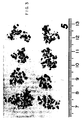
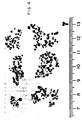
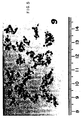
- Figs. 1 - 5 are photographs of the fluff of this invention with several degrees of ball formation. To provide a perspective on size, the Figs. each include a scale indicating centimeters.
- the fibers of this invention are made from aramids.
- a mass of such fibers is termed a fluff.
- aramid is meant a polyamide wherein at least 85% of the amide linkages are attached directly to two aromatic rings.
- Suitable aramid fibers are described in Man-Made Fibers - Science and Technology, Volume 2, Section titled Fiber-Forming Aromatic Polyamides, page 297, W. Black et al., Interscience Publishers, 1968.
- Aramid fibers are, also, disclosed in U.S. Patents 4,172,938; 3,869,429; 3,819,587; 3,673,143; 3,354,127; and 3,094,511.
- Additives can be used with the aramid and, in fact, it has been found that up to as much as 10 percent, by weight, of other polymeric material can be blended with the aramid or that copolymers can be used having as much as 10 percent of other diamine substituted for the diamine of the aramid or as much as 10 percent of other diacid chloride substituted for the diacid chloride of the aramid.
- the fibers of this invention are from about 0.4 to about 3 centimeters long. It has been found that fibers with a length of less than 0.4 centimeters cannot be properly crimped and, therefore, do not exhibit proper fluffing qualities. As to the upper extreme, it has been found that fibers longer than about 3 centimeters become entangled into ropelike structures and cannot be adequately processed.
- the preferred fiber lengths for this invention are from about 0.5 to about 2.0 centimeters because within that range the individual fiber crimping appears to be easily and efficiently performed and the fluff product exhibits a uniformly and surprisingly low density.
- the diameter of fibers is usually characterized as a linear density termed denier or dtex.
- the denier of fibers eligible for use in this invention is from about 0.5 to 5 den (0.51 to 5.5 dtex), or, perhaps, slightly higher.
- fibers of higher denier yield fluff with fewer and larger fluff balls.
- very high denier such as about 10 den (11 dtex)
- the fluff becomes undesirably stiff and wire-like and loses its absorptive capacity and resilience.
- the fluff of high denier fibers can find use in insulation batting and filter media, and the like.
- the fluff of this invention is, generally, made from fibers which have been spun using a so-called air gap spinning process. It is possible that fibers made by other means could be used so long as they are tough enough not to break or fibrillate under the forces of crimping and they are sufficiently oriented and crystallized not to be materially elongated in the crimping mill.
- aramids could be wet spun as taught in U.S. Patent 3,819,587. Such fibers are advantageously spun with high orientation and crystallization and can be used as-spun. Fibers wet spun from isotropic dopes and drawn to develop orientation and crystallinity, as taught in U.S. Patent 3,673,143, are also useful.
- the air gap (dry-jet) spinning is as taught in U.S. 3,767,756. Dry spinning with subsequent drawing to develop orientation and crystallinity, as taught in U.S. 3,094,511, is another useful method for making the feed fibers of this invention.
- the aramid fibers are spun as a continuous yarn and the yarn is cut to the desired length for further processing in accordance with this invention.
- the cut fibers known as staple, exhibit a specific surface area of about 0.2 m2/g and a density, in a mass, of about 0.2 to 0.3 g/cc.
- the staple is then subjected to the action of a turbulent air grinding mill having a multitude of radially disposed grinding stations including thick blades with essentially flat surfaces spaced further apart than the thickness of the fibers and surrounded by a jacket stator with raised ridges;--the gap between the ridges and the flat surfaces of the blades being about 0.5 to 4 mils (0.013 to 0.102 mmm).
- the effect of the sharpness of the jacket ridges and the blade edges has not been studied, but it is believed that a fluff with a greater number and smaller size fluff balls is obtained when those ridges and edges are more sharp.
- a Model III Ultra-Rotor mill as sold by Jackering GmbH & Co. KG, of West Germany, is suitable for use in the practice of this invention.
- This mill contains a plurality of milling sections (that is, blades) mounted on a rotor in a surrounding single cylindrical stator with rilled walls common to all milling sections.
- the mill has a gravity feed port leading to the bottom section of the rotor. Additionally, three air vents are equally distributed around the bottom of the cylinder surface. An outlet is located on the top of the surrounding stator.
- a detailed description of a similar mill is in United States Patent Number 4,747,550 issued May 31, 1988.
- the fibers are struck by blades of the grinding machine and are crimped at the points of contact. When an individual fiber has been struck several times and has been crimped accordingly, it is believed that, at that time, the fiber commences to form into a small ball.
- An important element of this invention and an element which, it is believed, makes the fibers of this invention patentable, is the fact that the fibers are crimped at random angles around the fiber axis and, thereby, are caused to become three-dimensional bodies which entangle readily with adjacent crimped fibers. It is, also, important that the fibers, while crimped, are not significantly fibrillated.
- the specific surface area of the crimped fibers of this invention is substantially the same as the specific surface area of the staple fiber starting material.
- the specific surface area of aramid staple and of the fluff product of this invention is about 0.2 m2/g; and the specific surface area of microfibrillar pulp made by refining that aramid staple, is generally greater than 5 and often as much as 10 m2/g.
- the density of the staple starting material in practice of this invention decreases as the staple is opened and crimped.
- the density then increases as the number of fluff balls increases and the size of the fluff balls decreases. It is believed that crimping causes a decrease in the density and that formation of fluff balls causes an increase in the density.
- crimping causes a decrease in the density and that formation of fluff balls causes an increase in the density.
- Fig. 1 represents only a single pass through the mill, while Figs. 2, 3, 4, and 5 represent 3, 5, 7, and 9 passes, respectively, through the mill. After each pass, the fluff balls appear to include more of the fluff and to be slightly more compact.
- any fluff having a density of less than 0.08 g/cc is useful, whether it contains fluff balls or not. It has, also, been ascertained that fluff having a density of less than 0.06 g/cc is especially useful for insulation and absorption applications. Fluff containing a large number of fluff balls and a density of greater than 0.06 g/cc is especially useful in cushion applications where resilience and re-fluffing are important. The larger the percentage of fiber material entangled into fluff balls, the more refluffable the mass becomes.
- the fluff of this invention can be identified as an aramid fiber product which has a density of less than 0.08 g/cc and contains at least one fluff ball per milligram of fluff.
- the presence of fluff balls aids in pneumatic conveying of the mass and assures a majority of the fibers have an out-of-plane crimp.
- the fluff of this invention is useful in a wide range of products including, as a few examples, filter media, high temperature insulation, resilient filling, absorbency applications, fire blocking, and reinforcement.
- the highly balled fluff is preferred for the resiliency applications, such as fire resistant cushioning uses and the fluff at near the minimum density is preferred for the insulation and absorption uses.
- the fluff can be combined with other materials, either before or after the fluffing process, to obtain the benefits of the other materials in combination with the benefits of the fluff of this invention.
- the fluff of this invention can be combined with fibrid binder material.
- fibrid binder material United States 2,999,788 contains a description of suitable fibrid materials.
- Suitable fibrid binder materials are generally aramids and, specifically, can be poly(m-phenylene isophthalamide) and poly(p-phenylene terephthalamide), and copolymers including the components of those polymers, and the like.
- Self-coherent sheet structures with useful filtration, fire-blocking, wicking, and insulative properties are made by wet-laying a well mixed slurry of fibrids and the fluff of this invention.
- the percent fibrids is important with respect to the density, flexibility and strength of the sheet obtained. Sheets with less than about 1 percent fibrids have insufficient cohesiveness, as-made, to be practically handled. Preferably, at least about 3 percent fibrid material is used in order to obtain readily handleable sheets. Sheets containing more than about 50% fibrids are boardy and have low air permeability making them inferior for insulation and filtration uses. Preferably, the fibrid level is less than about 30% in order to yield sheets of superior insulation, permeability and absorption.
- Small, single, wet-layed sheets can be made by depositing the fibrid/fluff mixture on a screen.
- Continuous roll goods are made using a Fourdrinier paper making machine or, preferably, using a rotoformer machine.
- Especially preferred structures for insulation and flame blocking are made on a rotoforming machine and dried on a thru-drier such as sold by Honeycomb Systems, Inc., Biddeford, Maine, USA. Thru-drying or ambient drying is preferred to hot rolls so as to maintain high porosity, high permeability, and low density.
- the aramid fluff can be mixed with a thermoplastic staple or short-fiber pulp and wet laid or dry laid and then thermally bonded to make a light weight, permeable mat of low density.
- the aramid fiber fluff should constitute at least 20 weight percent and the thermoplastic fibers should be no more than 80 weight percent of the product. It is preferred that the aramid fiber fluff should be 20 to 80 weight percent of the product.
- the non-bonded mat can be draped around geometrically curved shapes, such as hemispheres or cylinders, to form shaped structures useful, for example, as hot gas filters.
- thermoplastic staple can be run through the mill to form a thermoplastic fluff prior to mixing with the aramid fluff of this invention and formed into mats as above. Such mats have very high air permeability after thermal bonding and are especially useful as filtration fabrics where high air-flow is desired.
- the aramid feed staple and thermoplastic feed staple can be combined and jointly run through the mill to provide well mixed fluff mixtures which can be formed into useful mats by wet or dry laying methods.
- the fluff ball of this invention is evaluated by means of density, absorbency, compression under load, specific fluff ball count and size, and flame and thermal tests. Test methods for such evaluations are set out below.
- Density of the fluff ball is determined as a function of a pressure which is applied to the fiber fluff under test. To determine density, a known weight of fiber fluff is placed under a known pressure and the volume of the fluff is determined.
- an outer cylinder having an internal diameter of 6.9 centimeters and about 10 inches long was stood on its end as a fluff reservoir; and an inner cylinder having an outside diameter of about 6.35 cm (2 1/2 inches) and a plate of 6.83 cm (2 11/16 inches) diameter welded onto the bottom end was used as a plunger inside the outer cylinder.
- the plate had an area of 36.17 cm2 (5.7 in2).
- Basis weight of a fibrous article is obtained under ambient conditions by cutting from the sample a rectangular or square section having edges no smaller than 7.62 cm (3 inches) and no larger than 25.4 cm (10 inches). The section is weighed and the basis weight, in ounces/square yard, is calculated. Density of a fibrous article is determined using the basis weight and the sample thickness.
- the fluff ball was determined from nitrogen adsorption by the method of Baunner, Emmet, and Teller (BET) using a Model 2100 Surface Area Pore Volume Analyzer sold by Micromeritics Instruments Corp., Norcross, Georgia, USA. The fluff was conditioned for the test by exposing it to a vacuum of less than 0.1 torr for about 16 hours at about 80°C.
- Air Permeability Air permeability of a fibrous article is determined under ambient conditions using a Fabric Permeability Machine sold by Frazier Precision Instrument Co., Gaithersburg, Maryland, USA. In conducting the test, air flow measurements are taken using a pressure differential of about 1.27 cm (0.5 inches) of water at 5 different regions of a sample, and the measurements are averaged.
- Filtration efficiency is determined by producing an aerosol and determining the efficiency with which the aerosol can be filtered by the filter media under test.
- the aerosol is made of polyethylene glycol (400MW) with a median particle size of about 1 micron at a concentration of about 0.8 grams per standard cubic foot (0.02 g/dm3).
- a Laskin Nozzle is used to generate the aerosol. Laskin Nozzles are described in "Studies of Portable Air-Operated Aerosol Generators", Echols and Young, NRL Report 5929 (July, 1963); and use of Laskin Nozzles is described in American Industrial Hygiene Association Journal, Hinds, Macher, and First, Vol. 44, July, 1983, pp495-500.
- the aerosol is conducted through a conduit at a rate of 41.0 dm3 (1.4 standard cubic feet) per minute and through a filter of 20.25 cm2 (3.14 square inches) placed in the path of the aerosol. Samples are taken before and after the filter over a 30 minute time period. The efficiency is calculated as follows: Fluff Ball Count and Size. To make a fluff ball count and determine the ball size, the number of fluff balls in a small sample are actually counted and measured.
- a small, weighed, portion of fluff is thinly spread onto a small (75mm x 50mm) microscope slide and gently covered with a second slide.
- a photograph is made of the fluff at any convenient enlargement and the fluff balls are counted and sized.
- a correctly exposed photograph will cause the fluff balls to show in dark contrast to the non-balled fibers.
- the Figs. are examples of this procedure.
- Thermal protective performance is a measure of the heat transfer through a fabric under particular conditions in order to determine the degree of protection provided by the fabric against burns. The test is conducted in accordance with ASTM D 4108 is described in Chapter 5 of the NFPA 1971 Standard on Protective Clothing for Structural Fire Fighting (1986 Edition).
- the thermal resistance test is a measure of thermal transmission through flat specimens; and is conducted in accordance with ASTM C 518-85.
- the testing apparatus used for tests reported in this specification was a Dynatech Rapid-k apparatus sold by Holometrics, Inc. Cambridge, Massachusetts, USA.
- EXAMPLE 1 a commercially available aramid fiber was processed into the fluff and fluff balls of this invention.
- Poly(p-phenylene terephthalamide) staple having a length, of 0.625 centimeter and a denier of 1.5 den (1.65 dtex) was fed through a multi-station rotor mill operated at 1200 rpm with a clearance of 0.5 to 1 millimeters.
- the mill was a Model III Ultra-Rotor, sold by Jackering GmbH & Co., KG, West Germany.
- socks stuffed with a commercially available polyolefin absorbent fiber such as "Tywik”, sold by E. I. du Pont de Nemours & Co., were found to absorb up to ten times their weight of water while the socks stuffed with the fluff of this invention absorbed at least twelve times their weight.
- absorbed liquid can be squeezed from the socks of this invention and the socks can be used repeatedly while socks filled with other absorbent materials do not recover sufficient absorbency, after removal of absorbed liquid, to be repeatedly useful.
- Socks filled with the fluff of this invention recover absorbency because the fluff of this invention is so resilient that it springs back to its original fluffed quality after being squeezed to remove absorbed liquid.
- EXAMPLE 3 the same staple from Example 2 was used with the same mill from Example 1 except that two of the vents were opened slightly. The fluff obtained exhibited a density of 0.045 g/cc and a fluff ball count of 6.1 balls/milligrams after one cycle.
- the mat exhibited an air permeability of 31.09 m3min./m2 (102 cfm/square foot) and a surface area of 2.3 square meters per gram.
- the filtration efficiency was found to be about 70% for a polyethylene glycol (PEG) aerosol of about 1 micron median particle size.
- the mat exhibited a thermal protective performance value of 24.0 cal/cm2 (4.9 cal/cm2/OPSY).
- a similar blend of materials made into a spunlaced fabric with 128.8 g/m2 (3.8 OPSY) has been reported, in Research Disclosure number 2215, October, 1982, to exhibit a thermal protective performance value of 12.3 cal/cm2 (3.2 cal/cm2/OPSY).
- fluff of the same material as was used in Example 2 was prepared by the same method as in Example 2 except that the three vents were open slightly One cycle was used and the fluff had a density of 0.039 g/cc and a fluff ball count of 5.1 balls/milligram.
- the pad had a basis weight of 190 g/m2 (5.6 OPSY), a thickness of 4.47 mm (176 mils), a density of 432 kg/m3 (2.7 pounds per cubic foot), and an air permeability of 62.18 m3min./m2 (244 cfm/square foot).
- the filtration efficiency was about 85% for a PEG aerosol of about 1 micron median particle size.
- EXAMPLE 5 In this example, a commercially available aramid fiber was processed into the fluff and fluff balls of this invention.
- Poly(meta-phenylene isophthalamide) staple having a length of 0.25 inch (0.625 centimeter) and a denier of 2.2 dtex (2.0 den) was fed through a multi-station rotor mill operated at 1200 rpm with a clearance of 0.5 to 1 millimeters.
- the aramid fiber product was identified as an aramid fiber bearing the trademark, "Nomex", Type E-20, sold by E. I. du Pont de Nemours & Co., Wilmington, DE. The mill was the same as that used in Example 1, above.
- the pad exhibited a thermal resistance of 7.90 x 10 ⁇ 5 hr m2-K°/J-cm (4.1 hr-ft2-F°/BTU-in).
- a commercially-available needled felt of poly(meta-phenylene isophthalamide) staple exhibits a thermal resistance of 7.90 x 10 ⁇ 5 hr m2-K°/J-cm (4.1 hr-ft2-F°/BTU-in) but at a density of 46.4 kg/cm3 (2.9 pounds/cubic foot).
- EXAMPLE 7 In this example, two different fluffs were combined to make a burn resistant pad.
- Example 6 Sixty grams of the fluff of Example 6 were combined with 7.5 grams of the fluff of Example 4 and 7.5 grams of the fibrids of Example 5. The fluff and fibrid combination was vigorously mixed with about 1.8 liters of water and that was wet-layed on the sheet forming device of Example 4. The wet sheet was dried in a vacuum oven at 160°C. The product exhibited a density of 11.27 kg/m2 (2.31 pounds per square foot). The pad had a basis weight of 898.4 g/m2 (26.5 OPSY) and a thickness of 24.38 mm (0.96 inch).
- the mat exhibited a thermal protective performance value of 145 cal/cm2 (5.43 cal/cm2/OPSY).
- this mat was sandwiched as an interlayer between layers of a poly(meta-phenylene isophthalamide) shell to simulate the interliner of a fireman's turnout coat.
- Thermal protection performance for the sandwich was 426 J/cm2/g/m2 (3.0 cal/cm2/OPSY), as compared with a value of 369.2 J/cm2/g/m2 (2.6 cal/cm2/OPSY) for a commercial interliner of poly(meta-phenylene isophthalamide).
Landscapes
- Engineering & Computer Science (AREA)
- Textile Engineering (AREA)
- Chemical & Material Sciences (AREA)
- Chemical Kinetics & Catalysis (AREA)
- Artificial Filaments (AREA)
- Nonwoven Fabrics (AREA)
- Undergarments, Swaddling Clothes, Handkerchiefs Or Underwear Materials (AREA)
Claims (13)
- Aramidfaser-Flauschbällchen, umfassend Aramidfasern mit einer gedehnten Länge von 0,4 bis 3 cm und mit wenigstens zwei aus der Ebene herausragenden Kräuselungen entlang ihrer Länge, wobei die Flauschbällchen eine Dichte von weniger als 0,08 g/cc bei einer Belastung von 0,26 N/cm² und eine spezifische Oberfläche von weniger als etwa 5,0 m²/g aufweisen, worin mehr als 1 und weniger als 25 Flauschbällchen pro mg Aramidfaser einen Durchmesser von weniger als 10 mm aufweisen.
- Flausch nach Anspruch 1, bei dem die Dichte weniger als 0,06 g/cc beträgt.
- Flauschbällchen nach Anspruch 1, bei dem die spezifische Oberfläche 0,03 bis 3 m²/g beträgt.
- Flauschbällchen nach Anspruch 1, bei dem die Bällchen einen Durchmesser von weniger als 5 mm besitzen.
- Aramidfaser-Flauschbällchen nach Anspruch 1, bei dem die Aramidfasern ausgewählt werden aus der Gruppe, bestehend aus Poly(p-phenylenterephthalamid), Poly(m-phenylenisophthalamid) und aus Gemischen von Poly(p-phenylen-terephthalamid) und Poly(m-phenylenisophthalamid).
- Aramidfaser-Flauschbällchen nach Anspruch 1, worin der Flausch gleichmäßig kombiniert ist mit thermoplastischen Fasern, so daß die Kombination wenigstens 20 Gew.-% Aramid-Flauschbällchen und nicht mehr als 80 Gew.-% thermoplastische Fasern aufweist.
- Flauschbällchen nach Anspruch 6, worin die thermoplastischen Fasern wärmegebunden worden sind.
- Aramidfaser-Flauschbällchen nach Anspruch 6, worin die thermoplastischen Fasern Poly-(Vinylchlorid-Covinylacetat) sind.
- Kombination nach Anspruch 6, worin die Flauschbällchen 20 bis 80 Gew.-% der Kombination betragen.
- Aramidfaser-Flauschbällchen nach Anspruch 1, worin der Flausch gleichmäßig kombiniert ist mit Aramidfibriden, so daß die Kombination wenigstens 70 Gew.-% Aramid-Flauschbällchen und nicht mehr als 30 Gew.-% Aramidfibride aufweist.
- Aramidfaser-Flauschbällchen nach Anspruch 10, worin die Aramidfibride Poly(m-phenylenisophthalamid) sind.
- Kombination nach Anspruch 10, worin die Flauschbällchen 70-97 Gew.-% der Kombination ausmachen.
- Wiederverwendbare flüssigkeitsabsorbierende Einlegesohle, umfassend einen porösen Stoffüberzug und einen Füllstoff aus Aramid-Flauschbällchen, umfassend Aramidfasern mit einer gedehnten Länge von 0,4 bis 3 cm und wenigstens zwei aus der Ebene herausragenden Kräuselungen entlang ihrer Länge, wobei der Flausch eine Dichte von weniger als 0,08 g/cc bei einer Belastung von 0,26 N/cm² und eine spezifische Oberfläche von weniger als etwa 5,0 m²/g aufweist, worin mehr als 1 und weniger als 25 Flauschbällchen pro mg Aramidfaser einen Durchmesser von weniger als 10 mm aufweisen.
Applications Claiming Priority (2)
| Application Number | Priority Date | Filing Date | Title |
|---|---|---|---|
| US07/460,256 US4957794A (en) | 1990-01-02 | 1990-01-02 | Aramid fluff |
| US460256 | 1990-01-02 |
Publications (2)
| Publication Number | Publication Date |
|---|---|
| EP0436227A1 EP0436227A1 (de) | 1991-07-10 |
| EP0436227B1 true EP0436227B1 (de) | 1995-04-19 |
Family
ID=23827972
Family Applications (1)
| Application Number | Title | Priority Date | Filing Date |
|---|---|---|---|
| EP90125614A Expired - Lifetime EP0436227B1 (de) | 1990-01-02 | 1990-12-28 | Polyaramidfaserdaune |
Country Status (5)
| Country | Link |
|---|---|
| US (1) | US4957794A (de) |
| EP (1) | EP0436227B1 (de) |
| JP (1) | JP2883451B2 (de) |
| CA (1) | CA2032790C (de) |
| DE (1) | DE69018802T2 (de) |
Families Citing this family (16)
| Publication number | Priority date | Publication date | Assignee | Title |
|---|---|---|---|---|
| US5171402A (en) * | 1990-02-28 | 1992-12-15 | E. I. Du Pont De Nemours And Company | Dispersible aramid pulp |
| US5084136A (en) * | 1990-02-28 | 1992-01-28 | E. I. Du Pont De Nemours And Company | Dispersible aramid pulp |
| US5482773A (en) * | 1991-07-01 | 1996-01-09 | E. I. Du Pont De Nemours And Company | Activated carbon-containing fibrids |
| US5320892A (en) * | 1993-02-22 | 1994-06-14 | E. I. Du Pont De Nemours And Company | Tough layered papers with improved surface adhesion |
| US5391415A (en) * | 1993-09-30 | 1995-02-21 | E. I. Du Pont De Nemours And Company | Article for absorbing oils |
| US5429783A (en) * | 1994-04-19 | 1995-07-04 | E. I. Du Pont De Nemours And Company | Making fiberballs |
| AU6222300A (en) | 1999-09-23 | 2001-04-24 | E.I. Du Pont De Nemours And Company | A cardable fiber blend and a moldable fiber batt and the process for making a moldable fiber batt |
| US7694779B2 (en) * | 2003-08-25 | 2010-04-13 | Takayasu Co., Ltd. | Sound absorbing material |
| WO2006009539A1 (en) * | 2004-06-16 | 2006-01-26 | E.I. Dupont De Nemours And Company | Lightweight acoustic and thermal insulation fluff and systems made thereof |
| US7937924B2 (en) * | 2005-11-16 | 2011-05-10 | Lorica International, Inc. | Fire retardant compositions and methods and apparatuses for making the same |
| US8850784B2 (en) | 2005-11-16 | 2014-10-07 | Lorica International Corporation | Fire retardant compositions and methods and apparatuses for making the same |
| US8117815B2 (en) * | 2005-11-16 | 2012-02-21 | Ladama, Llc | Fire retardant compositions and methods and apparatuses for making the same |
| WO2009064130A2 (en) * | 2007-11-14 | 2009-05-22 | Kolon Industries, Inc. | Aramid nonwoven fabric and preparation method therefor |
| DE102010022186A1 (de) | 2010-05-21 | 2011-11-24 | Hans Korte | Faserverstärkte Thermoplastverbundwerkstoffe |
| EP2471641A1 (de) * | 2010-12-28 | 2012-07-04 | HD kunststoffe & Kunststofferzeugnisse GmbH | Verfahren zur Herstellung von rieselfähigen Teilchen aus Polymerfasern |
| EP2992140B1 (de) * | 2013-05-03 | 2017-04-19 | Teijin Aramid B.V. | Krümel aus zellstoff |
Family Cites Families (10)
| Publication number | Priority date | Publication date | Assignee | Title |
|---|---|---|---|---|
| US3922756A (en) * | 1974-08-26 | 1975-12-02 | Toray Industries | Apparatus for making filler materials |
| US4618531A (en) * | 1985-05-15 | 1986-10-21 | E. I. Du Pont De Nemours And Company | Polyester fiberfill and process |
| US4794038A (en) * | 1985-05-15 | 1988-12-27 | E. I. Du Pont De Nemours And Company | Polyester fiberfill |
| JPS57205564A (en) * | 1981-06-08 | 1982-12-16 | Kuraray Co | Padding matirial and method |
| DE3543370A1 (de) * | 1985-12-07 | 1987-06-11 | Jackering Altenburger Masch | Muehle mit mehreren mahlstufen |
| FR2592403A1 (fr) * | 1985-12-31 | 1987-07-03 | Huet Andre Ets | Procede de fabrication d'un materiau en fibres synthetiques, et le materiau obtenu. |
| JPH0762297B2 (ja) * | 1986-08-12 | 1995-07-05 | 日本エクスラン工業株式会社 | 球状繊維塊の製造法 |
| CA1303837C (en) * | 1987-01-12 | 1992-06-23 | Gunter Tesch | Fiber containing aggregat and process for its preparation |
| DE3700680A1 (de) * | 1987-01-12 | 1988-07-21 | Breveteam Sa | Faserkugeln enthaltendes fuellgut, insbesondere fuer decken oder als polstermaterial |
| ATE124731T1 (de) * | 1988-11-30 | 1995-07-15 | Dow Chemical Co | Nichtlineare aromatische polyamidfaser oder fasereinheit und verfahren zur herstellung. |
-
1990
- 1990-01-02 US US07/460,256 patent/US4957794A/en not_active Expired - Lifetime
- 1990-12-20 CA CA002032790A patent/CA2032790C/en not_active Expired - Fee Related
- 1990-12-28 DE DE69018802T patent/DE69018802T2/de not_active Expired - Fee Related
- 1990-12-28 EP EP90125614A patent/EP0436227B1/de not_active Expired - Lifetime
-
1991
- 1991-01-04 JP JP3009985A patent/JP2883451B2/ja not_active Expired - Lifetime
Also Published As
| Publication number | Publication date |
|---|---|
| CA2032790A1 (en) | 1991-07-03 |
| JP2883451B2 (ja) | 1999-04-19 |
| DE69018802D1 (de) | 1995-05-24 |
| US4957794A (en) | 1990-09-18 |
| CA2032790C (en) | 2000-10-03 |
| DE69018802T2 (de) | 1995-10-12 |
| EP0436227A1 (de) | 1991-07-10 |
| JPH04214406A (ja) | 1992-08-05 |
Similar Documents
| Publication | Publication Date | Title |
|---|---|---|
| EP0436227B1 (de) | Polyaramidfaserdaune | |
| US4921645A (en) | Process of forming microwebs and nonwoven materials containing microwebs | |
| US4612237A (en) | Hydraulically entangled PTFE/glass filter felt | |
| EP0590307B1 (de) | Faseriger verschleissfester Verbundvliesstoff | |
| EP0092819B1 (de) | Filtermedium und Verfahren zu seiner Herstellung | |
| EP0595899B1 (de) | Blutfilter | |
| US5350620A (en) | Filtration media comprising non-charged meltblown fibers and electrically charged staple fibers | |
| EP2167006B1 (de) | Fasergebilde und verfahren zu ihrer herstellung | |
| CA2116609C (en) | Adsorbent fibrous nonwoven composite structure | |
| US20230330451A1 (en) | Filter media, composites, and face mask systems using same | |
| CA1277577C (en) | Adsorptive fiber sheet | |
| EP0760027B1 (de) | Thermisch isolierende mehrschichtige vliesstoffe | |
| JPH02191755A (ja) | フイルター用フエルト | |
| US4031283A (en) | Polytetrafluoroethylene felt | |
| US20040116027A1 (en) | High stretch recovery non-woven fabric and process for preparing | |
| EP0722357B1 (de) | Hochwirksame filtergewebe für die filtration von heissen gasen | |
| US6120643A (en) | Aramid and glass fiber absorbent papers | |
| JPH0568823A (ja) | 濾 材 | |
| JP2024151790A (ja) | エアフィルタ及びエアフィルタの製造方法 | |
| JPH02258007A (ja) | フイルター用紙 | |
| JPH02300398A (ja) | 嵩高紙 | |
| JP2000202235A (ja) | 悪臭ガス除去用シ―ト状物 | |
| JPH02307423A (ja) | ワイパー用紙 | |
| WO2026075200A1 (ja) | シート状中綿 | |
| JPH0371157B2 (de) |
Legal Events
| Date | Code | Title | Description |
|---|---|---|---|
| PUAI | Public reference made under article 153(3) epc to a published international application that has entered the european phase |
Free format text: ORIGINAL CODE: 0009012 |
|
| AK | Designated contracting states |
Kind code of ref document: A1 Designated state(s): DE GB NL |
|
| 17P | Request for examination filed |
Effective date: 19911105 |
|
| 17Q | First examination report despatched |
Effective date: 19931118 |
|
| GRAA | (expected) grant |
Free format text: ORIGINAL CODE: 0009210 |
|
| AK | Designated contracting states |
Kind code of ref document: B1 Designated state(s): DE GB NL |
|
| REF | Corresponds to: |
Ref document number: 69018802 Country of ref document: DE Date of ref document: 19950524 |
|
| PLBE | No opposition filed within time limit |
Free format text: ORIGINAL CODE: 0009261 |
|
| STAA | Information on the status of an ep patent application or granted ep patent |
Free format text: STATUS: NO OPPOSITION FILED WITHIN TIME LIMIT |
|
| 26N | No opposition filed | ||
| REG | Reference to a national code |
Ref country code: GB Ref legal event code: IF02 |
|
| PGFP | Annual fee paid to national office [announced via postgrant information from national office to epo] |
Ref country code: NL Payment date: 20071203 Year of fee payment: 18 |
|
| PGFP | Annual fee paid to national office [announced via postgrant information from national office to epo] |
Ref country code: GB Payment date: 20071227 Year of fee payment: 18 |
|
| PGFP | Annual fee paid to national office [announced via postgrant information from national office to epo] |
Ref country code: DE Payment date: 20071220 Year of fee payment: 18 |
|
| GBPC | Gb: european patent ceased through non-payment of renewal fee |
Effective date: 20081228 |
|
| NLV4 | Nl: lapsed or anulled due to non-payment of the annual fee |
Effective date: 20090701 |
|
| PG25 | Lapsed in a contracting state [announced via postgrant information from national office to epo] |
Ref country code: DE Free format text: LAPSE BECAUSE OF NON-PAYMENT OF DUE FEES Effective date: 20090701 |
|
| PG25 | Lapsed in a contracting state [announced via postgrant information from national office to epo] |
Ref country code: GB Free format text: LAPSE BECAUSE OF NON-PAYMENT OF DUE FEES Effective date: 20081228 Ref country code: NL Free format text: LAPSE BECAUSE OF NON-PAYMENT OF DUE FEES Effective date: 20090701 |