EP0436752B1 - Dispositif pour l'extraction des signaux optiques interférents - Google Patents
Dispositif pour l'extraction des signaux optiques interférents Download PDFInfo
- Publication number
- EP0436752B1 EP0436752B1 EP19900100310 EP90100310A EP0436752B1 EP 0436752 B1 EP0436752 B1 EP 0436752B1 EP 19900100310 EP19900100310 EP 19900100310 EP 90100310 A EP90100310 A EP 90100310A EP 0436752 B1 EP0436752 B1 EP 0436752B1
- Authority
- EP
- European Patent Office
- Prior art keywords
- optical
- signal
- light
- interference signal
- optical interference
- Prior art date
- Legal status (The legal status is an assumption and is not a legal conclusion. Google has not performed a legal analysis and makes no representation as to the accuracy of the status listed.)
- Expired - Lifetime
Links
- 230000003287 optical effect Effects 0.000 title claims description 156
- 230000015654 memory Effects 0.000 claims description 17
- 238000001228 spectrum Methods 0.000 claims description 15
- 238000005070 sampling Methods 0.000 claims description 8
- 238000012935 Averaging Methods 0.000 claims 2
- 230000014509 gene expression Effects 0.000 description 9
- 238000010586 diagram Methods 0.000 description 7
- 230000003595 spectral effect Effects 0.000 description 4
- 230000005540 biological transmission Effects 0.000 description 2
- 238000006243 chemical reaction Methods 0.000 description 2
- 238000012986 modification Methods 0.000 description 2
- 230000004048 modification Effects 0.000 description 2
- 238000010183 spectrum analysis Methods 0.000 description 2
- 230000009466 transformation Effects 0.000 description 2
- 230000002238 attenuated effect Effects 0.000 description 1
- 238000010276 construction Methods 0.000 description 1
- 238000000034 method Methods 0.000 description 1
- 230000006641 stabilisation Effects 0.000 description 1
- 238000011105 stabilization Methods 0.000 description 1
- 238000010408 sweeping Methods 0.000 description 1
Images



Classifications
-
- G—PHYSICS
- G01—MEASURING; TESTING
- G01J—MEASUREMENT OF INTENSITY, VELOCITY, SPECTRAL CONTENT, POLARISATION, PHASE OR PULSE CHARACTERISTICS OF INFRARED, VISIBLE OR ULTRAVIOLET LIGHT; COLORIMETRY; RADIATION PYROMETRY
- G01J3/00—Spectrometry; Spectrophotometry; Monochromators; Measuring colours
- G01J3/28—Investigating the spectrum
- G01J3/45—Interferometric spectrometry
- G01J3/453—Interferometric spectrometry by correlation of the amplitudes
Definitions
- the present invention relates to an optical interference signal extractor for use in measuring the spectral distribution of light.
- Fig. 1 shows a conventional optical interference signal extractor.
- Reference numeral 10 indicates a light source for emitting light 11 to be measured and 20 an optical interferometer capable of sweeping an optical path difference, that is, capable of continuously changing an optical path difference.
- the optical interferometer 20 is shown to be a Michelson interferometer but may also be a Fabry-Perot interferometer.
- the Michelson interferometer 20 comprises a half mirror or semitransparent mirror 21 for splitting and combining light, a fixed mirror 22 for forming a fixed optical path 24, and a movable mirror 23 for forming a variable optical path 25.
- the light 11 emitted from the light source 10 is split by the half mirror 21 to the fixed optical path 24 and the variable optical path 25, and light from the former and light from the latter are coupled together or combined by the half mirror 21 into a beam of light, which is converted by a photodetector 30 into an electric signal SA.
- the light having passed through the fixed optical path 24 and the light having passed through the variable optical path 25 have a phase difference owing to the optical path difference, and hence interfere with each other when they are coupled together by the half mirror 21.
- the interference of light varies as the movable mirror 23 moves.
- the intensity of the interference light from the optical interferometer 20 repeatedly varies corresponding to interference fringes as the movable mirror 23 moves.
- the intensity variation of the interference light corresponding to the distance of movement ⁇ l of the movable mirror 23 from the position where the optical path difference is zero is measured by conversion into the level of an electric signal by the photodetector 30, whereby such an optical interference signal SA as shown in Fig. 2 can be obtained.
- the movement of the movable mirror 23 for the distance ⁇ l causes an optical path difference of 2 ⁇ l, but in the following description, the distance of movement ⁇ l may sometimes be referred to as the optical path difference for the sake of simplicity.
- the spectral distribution of the light to be measured 11 can be obtained.
- time t corresponding to the distance of its movement may be represented on the abscissa in Fig. 2.
- Fig. 2 shows the waveform of the interference signal SA when the optical power of the light to be measured 11 is stable.
- the optical power (indicated by SB in Fig. 2) of the light 11 is stable, an interference signal of a good SN ratio can be obtained.
- the optical power SB of the light 11 fluctuates as depicted in Fig. 3, the SN ratio of the interference signal SA becomes poor, and the results of its frequency analysis contain, as spectral, also high-order modulation components resulting from the fluctuation in the optical power of the light 11, making it impossible to accurately measure the wavelength distribution in the light 11.
- optical interference signal extractor shown in Fig. 1 and explained above is disclosed in the document "J.E.E. Journal of Electronic Engineering", Vol. 23, No. 236, August 1986, page 58-60; N. Arakawa.
- this prior art further comprises a reference light source for emitting reference light of a narrow spectrum which is applied to said optical interferometer together with the light to be measured.
- a second photodetector is used for converting reference interference light emitted from the interferometer to an electrical signal, and a multiplier multiplies the frequeny of the output signal of the second photodetector to a desired frequency and applies the latter as a sampling clock to an A-D converter used for converting the output signal from photodetector 30 into a digital signal for further signal processing.
- the document FR-A-2 621 753 discloses a transmitter-receiver system designed such as to compensate for any attenuation the transmitted signal is subjected to in the transmission path between the transmitter and the receiver.
- any uncertain DC component of the signal to be transmitted is removed and a known DC component added instead.
- the sum of the AC component and the known DC component is transmitted to the receiver.
- the AC component and the DC component, each attenuated by the same factor in the transmission path, are separated from each other and the AC component is amplified by an amplifier whose gain is controlled by the DC component. Provided the gain of the amplifier is inversely proportional to the DC component, the attenuation factor in the AC component will be removed.
- the power signal may be obtained either by applying the optical interference signal to a low-pass filter or by directly converting the light to be measured into an electric signal through use of a second photodetector.
- Fig. 4 illustrates in block form an embodiment of the present invention.
- the parts corresponding to those in Fig. 1 are identified by the same reference numerals, and since the arrangement of the optical interferometer 20, which is an optical system for measuring the light 11 from the light source 10, is exactly the same as shown in Fig. 1, no description will be given of the optical interferometer 20.
- the optical interference signal SA from the photodetector 30 is branched to a low-pass filter 40, wherein a low-frequency component SB of the optical interference signal SA is extracted.
- the low-frequency component SB of the optical interference signal SA is a DC-like optical power signal SB of the light 11 containing a low-frequency variation component. That is, where the light source 10 is being excited by the commercial power line, a noise of 50 or 60 Hz, or 100 or 120 Hz gets mixed in the optical interference signal SA. Also in the case of DC lighting, a fluctuation in the DC power source voltage bring about a low-frequency optical power variation.
- the optical power signal SB containing this optical power variation as a noise component is extracted by the low-pass filter 40 and is applied to an arithmetic unit 50.
- the optical interference signal SA from the photodetector 30 is also provided to the arithmetic unit 50, wherein it is divided by the optical power signal SB, obtaining an optical interference signal SC with no noise component.
- coherency which represents interference light components at wavelengths except ⁇ 0 and varies with the distance of movement ⁇ l of the movable mirror 23.
- 2 ⁇ l/ ⁇ 0 is called a fringe frequency.
- the fluctuation component ⁇ I(t) modulates the amplitude of the optical interference signal as is evident from Expression (3), so that even if the frequency of the fluctuation component ⁇ I(t) (taken as f n ) is sufficiently lower than the fringe frequency f F , spectra of f F ⁇ f n and f F ⁇ 2f n , for example, appear as noise in the vicinity of the fringe frequency f F in the frequency band to be measured. Consequently, the waveform of the optical interference signal SA, which is actually detected by the photodetector 30, contains noise components as depicted in Fig. 3. In the embodiment shown in Fig.
- the output signal SC of the computing element 50 is free from the influence of the power fluctuation of the input light 11 as is evident from Expression (4), its waveform is substantially the same as that of the optical interference signal shown in Fig. 2 which is provided when the power of the input light 11 undergoes no fluctuation. Consequently, an accurate spectrum of the input light 11 can be obtained by a frequency analysis of the output signal SC of the arithmetic unit 50 through the fast Fourier transformation, for instance.
- the cut-off frequency of the low-pass filter 40 to be lower than the band of the fringe frequency corresponding to the spectrum measuring band, all noises attributable to fluctuation components lower than the above-mentioned cut-off frequency can be removed from the optical interference signal SA.
- the optical power signal SB corresponding to the power of the incident light 11 is extracted by the low-pass filter 40 from the optical interference signal SA which is the output of the photodetector 30, the power of the light 11 from the light source 10 may also be detected directly as the optical power signal SB.
- An embodiment therefor is depicted in Fig. 5, in which the light 11 emitted from the light source 10 is split by a half mirror 12 into light which passes through the half mirror 12 and is then incident to the optical interferometer 20 and light which is reflected by the half mirror 12 and is then incident to a second photodetector 41.
- the power signal SB corresponding to the power of the light 11 is detected by the second photodetector 41 and is provided to the arithmetic unit 50 for the division SA/SB.
- the other parts of this embodiment are the same as those in the Fig. 4 embodiment and no description will be given of them for the sake of simplicity.
- all noises attributable to fluctuation components in the entire frequency band contained in the light 11 can be removed from the optical interference signal SA.
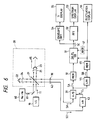
- Fig. 6 illustrates a modified form of the embodiment shown in Fig. 4.
- the optical interference signal SA is obtained at the output of the photodetector 30 as the movable mirror 23 of the optical interferometer 20 moves at a constant speed, but if the moving speed of the movable mirror 23 varies, the fringe frequency of the optical interference signal SA also fluctuates accordingly and no accurate results of spectrum analysis can be obtained.
- reference light which has a line spectrum of a stable wavelength, such as laser light, is applied to the optical interferometer 20, together with the light to be measured, and a reference optical interference signal is derived from reference interference light which is emitted from the optical interferometer 20.
- the optical interference signal of the light to be measured is sampled by a clock of the fringe frequency of the reference optical interference signal or a frequency N times higher than the fringe frequency, by which samples of the optical interference signal corresponding to the distance of movement of the movable mirror 23 are successively generated without being affected by the variation in the moving speed of the movable mirror 23.
- a reference light source 60 is provided in addition to the light source 10 and reference light 61 emitted from the reference light source 60 is applied to the optical interferometer 20, together with the light to be measured 11, as shown in Fig. 6.
- the reference light source 60 is one that is stable in wavelength and has a narrow spectrum characteristic, such as a He-Ne laser.
- the reference light 61 is also split to the fixed optical path 24 and the variable optical path 25 and both rays of light therefrom are combined by the half mirror 21 into reference interference light, which is received by a photodetector 42 for conversion into an electric signal.
- the amplitude of a reference optical interference signal SD which is provided from the photodetector 42 varies sinusoidally with a constant period, i.e. a constant fringe frequency, with respect to the distance of movement ⁇ l of the movable mirror 23.
- the reference optical interference signal SD has a peak for each fixed distance of movement of the movable mirror 23. Where the moving speed of the movable mirror 23 changes, the position of the peak also changes correspondingly on the time axis.
- the reference optical interference signal SD is provided to an N-multiplier 43, from which an N-multiplied signal is applied as a sampling clock CL to an A-D converter 31, wherein the level of the optical interference signal SA of the light to be measured 11 from the photodetector 30 is converted to a digital value for each sampling clock CL.
- the value of N of the N-multiplier 43 is selected such that the frequency of the sampling clock CL is more than twice higher than the fringe frequency of the optical interference signal SA.
- the sample data available from the A-D converter 31 is provided to a memory 32, in which sample data of one sweep of the movable mirror 23 is written in association with the sweep.
- the sample data from the A-D converter 31 is provided also to a digital low-pass filter 44, by which a low-frequency component containing the DC component and the fluctuation component of the power of the input light 11 is extracted as the optical power signal SB, and data about the optical power signal SB of one sweep of the movable mirror 23 is also written into a memory 45.
- the data SA and SB are read out of the memories 32 and 45 and provided to an arithmetic unit 51, wherein the division SA/SB described above with regard to Fig. 4 is performed to obtain the optical interference signal data SC from which the fluctuation component has been removed.
- the data SC thus obtained may be subjected to, for example, a spectrum analysis by an FFT analyzer 52, by which the spectrum of the input light 11 can be obtained.
- the optical interference signal SC obtained by the division SA/SB does not include the term of the power I B of the input light 11 as seen from Expression (4), and consequently, the spectral component obtained through frequency analysis of the result of the division SA/SB has been normalized by the power I B of the input light 11 and is unrelated to the power level of the input light 11. That is, if the spectrum distribution of the input light 11 remains unchanged, spectra of the same amplitudes are obtained irrespective of the magnitude of the power of the input light 11, and the results of analysis do not contain information about the power level of the input light 11.
- the arithmetic unit 51 multiplies the result of the division SA/SB by the power level P0 of the input light 11 as a coefficient so as to obtain a spectrum of an amplitude proportional to the power of the input light 11. Consequently, the output data SC of the arithmetic unit 51 assumes a value proportional to the power level P0 of the input light 11, and the amplitude of the spectrum obtained by the frequency analysis of the data SC becomes also proportional to the power level P0.
- the coefficient P0 that is used here is one of the data written in the memory 45, preferably, that data SB of a series of data stored in the memory 45 for one sweep which corresponds to the center position of the sweep.
- the movable mirror 23 of the optical interferometer 20 is moved for a distance from - ⁇ l to + ⁇ l in terms of the optical path difference between the fixed and movable optical paths 24 and 25, and the optical power data SB at an address corresponding to the vicinity of the position where the optical path difference is zero is read out of the memory 45 and is used as the coefficient P0.
- the optical power data SB in a predetermined number of periods before and after the position of zero optical path difference are read out of the memory 45 and averaged by an averager 47 indicated by the broken line in Fig. 6, and the resulting average is used as the coefficient P0. In this instance, the coefficient P0 is less affected by the fluctuation component contained in the optical power.
- the computing element 51 outputs the optical interference signal SC from which the noise component has been removed.
- the optical spectrum of the light 11 to be measured can be displayed on a display 53.
- an envelope detector 54 is provided, by which a variation in the amplitude of the optical interference signal SC, that is, the coherency ⁇ in Expression (4), is detected.
- the coherency ⁇ By displaying the coherency ⁇ on a display 55 with the optical path difference ⁇ l represented on the abscissa, the coherency of the light 11 being measured can be displayed.
- fluctuations of the light 11 can be observed by displaying on a display 56 the optical power signal data SB read out of the memory 45.
- Fig. 7 illustrates another modification of the Fig. 4 embodiment, in which the method of employing the reference light 61 is applied to the Fig. 5 embodiment as is the case with the Fig. 6 embodiment.
- the parts corresponding to those in Figs. 5 and 6 are identified by the same reference numerals and characters.
- a portion of the light 11 emitted from the light source 10 is reflected by the half mirror 12 to the photodetector 41, wherein the power of the light 11 is converted to the electric signal SB, which is applied to an A-D converter 46.
- the A-D converter 46 converts the level of the optical power signal SB into a digital value upon each application thereto of the sampling clock CL derived by the N-multiplier 43 from the optical interference signal SD of the reference light 61.
- the output data of the A-D converter 46 is written into the memory 45 in association with the sweep of the movable mirror 23.
- an optical interference signal free from the fluctuation component can be obtained.
Landscapes
- Physics & Mathematics (AREA)
- Spectroscopy & Molecular Physics (AREA)
- General Physics & Mathematics (AREA)
- Spectrometry And Color Measurement (AREA)
- Instruments For Measurement Of Length By Optical Means (AREA)
Claims (10)
- Extracteur de signal d'interférence optique comprenant :
un interféromètre optique (20) qui reçoit de la lumière à mesurer et qui sort de la lumière d'interférence de ladite lumière à mesurer, et dans lequel une différence de trajet optique peut être balayée ; et,
un moyen générateur de signaux d'interférence optique (30) qui reçoit ladite lumière d'interférence incidente issue dudit interféromètre optique et qui sort un premier signal d'interférence optique qui est un signal électrique correspondant à l'intensité de ladite lumière d'interférence ; caractérisé par :
un moyen d'extraction de signal de puissance optique (40 ; 41) pour produire un signal de puissance optique correspondant à la puissance de ladite lumière à mesurer ; et,
un moyen arithmétique (50) pour diviser ledit premier signal d'interférence optique issu dudit moyen générateur de signaux d'interférence optique par ledit signal de puissance optique issu dudit moyen d'extraction de signal de puissance optique et pour sortir le résultat de ladite division sous forme d'un second signal d'interférence optique. - Extracteur de signal d'interférence optique selon la revendication 1, dans lequel ledit moyen d'extraction de signal de puissance optique comprend un filtre passe-bas (40) connecté audit moyen générateur de signaux d'interférence optique (30) et qui a une fréquence de coupure prédéterminée.
- Extracteur de signal d'interférence optique selon la revendication 1, dans lequel ledit moyen d'extraction de signal optique comprend un photodétecteur (41) qui reçoit une partie de ladite lumière à mesurer et qui détecte et qui sort sa puissance sous forme dudit signal de puissance optique.
- Extracteur de signal d'interférence optique selon la revendication 1, dans lequel ledit moyen générateur de signaux d'interférence optique comprend un premier photodétecteur (30) qui reçoit et qui convertit ladite lumière d'interférence en un signal électrique ; un convertisseur A/D (d'analogique en numérique) (31) qui convertit la sortie dudit premier photodétecteur en un signal numérique et qui la sort sous forme dudit premier signal d'interférence optique ; une source de lumière de référence (60) pour émettre une lumière de référence d'un spectre étroit qui est appliquée audit interféromètre optique (20), en même temps que ladite lumière à mesurer ; un second photodétecteur (42) pour convertir ladite lumière d'interférence de référence émise par ledit interféromètre optique en un signal électrique en fonction de ladite lumière de référence ; et un multiplieur (43) qui multiplie la fréquence du signal de sortie dudit second photodétecteur jusqu'à une fréquence souhaitée et qui applique la sortie multipliée, comme signal d'horloge d'échantillonnage, audit convertisseur A/D ; et dans lequel ledit moyen d'extraction de signal de puissance optique comprend un filtre passe-bas numérique (44), qui est alimenté avec la sortie dudit convertisseur A/D et qui a une fréquence de coupure prédéterminée, pour extraire ledit signal de puissance optique sous forme numérique.
- Extracteur de signal d'interférence optique selon la revendication 4, dans lequel ledit moyen arithmétique comprend : une première mémoire (32) pour mémoriser ledit premier signal d'interférence optique sorti dudit convertisseur A/D (31) ; une seconde mémoire (45) pour mémoriser ledit signal de puissance optique sorti dudit filtre passe-bas numérique (44) ; et un moyen diviseur (51) alimenté avec ledit premier signal d'interférence optique et ledit signal de puissance optique, lus dans lesdites première et seconde mémoires, pour diviser ledit premier signal d'interférence optique par ledit signal de puissance optique.
- Extracteur de signal d'interférence optique selon la revendication 1, dans lequel ledit moyen générateur de signaux d'interférence optique comprend un premier photodétecteur (30) qui reçoit et qui convertit ladite lumière d'interférence en un signal électrique ; un premier convertisseur A/D (31) pour convertir la sortie dudit premier photodétecteur en un signal numérique pour sortie sous forme dudit premier signal d'interférence optique ; une source de lumière de référence (60) pour émettre une lumière de référence d'un spectre étroit qui est appliquée audit interféromètre optique (20), en même temps que ladite lumière à mesurer ; un second photodétecteur (42) pour convertir ladite lumière d'interférence de référence émise par ledit interféromètre optique en un signal électrique en fonction de ladite lumière de référence ; et un multiplieur (43) qui multiplie la fréquence du signal de sortie dudit second photodétecteur jusqu'à une fréquence souhaitée et qui applique la sortie multipliée, comme signal d'horloge d'échantillonnage, audit premier convertisseur A/D ; et dans lequel ledit moyen d'extraction de signal de puissance optique comprend : un troisième photodétecteur (41) qui reçoit une partie de ladite lumière à mesurer, qui détecte sa puissance et qui sort la puissance détectée comme signal de puissance optique ; et un second convertisseur A/D (46) connecté à la sortie dudit troisième photodétecteur, pour convertir ledit signal de puissance optique en un signal de puissance optique numérique lors de chaque application dudit signal d'horloge d'échantillonnage issu dudit multiplieur.
- Extracteur de signal d'interférence optique selon la revendication 6, dans lequel ledit moyen arithmétique comprend : une première mémoire (32) pour mémoriser ledit premier signal d'interférence optique sorti dudit premier convertisseur A/D ; une seconde mémoire (45) pour mémoriser ledit signal de puissance optique sorti dudit second convertisseur A/D ; et un moyen diviseur (51) alimenté avec ledit premier signal d'interférence optique et ledit signal de puissance optique, lus dans lesdites première et seconde mémoires, pour diviser ledit premier signal d'interférence optique par ledit signal de puissance optique.
- Extracteur de signal d'interférence optique selon la revendication 5 ou 7, dans lequel ledit moyen arithmétique comprend un moyen multiplicateur (51) par lequel la sortie divisée dudit moyen de division (51) est multipliée par l'une des données échantillons dudit signal de puissance optique lue dans ladite seconde mémoire (45), en tant que coefficient constant, la sortie multipliée dudit moyen multiplicateur étant sortie comme second signal d'interférence optique.
- Extracteur de signal d'interférence optique selon la revendication 5 ou 7, dans lequel ledit moyen arithmétique comprend un moyen : un moyen de calcul de moyenne (47) pour faire la moyenne d'une pluralité de données échantillons dudit signal de puissance optique lues dans ladite seconde mémoire (45) et pour délivrer, comme coefficient constant, la sortie dont il est fait la moyenne ; et un moyen multiplicateur (51) pour multiplier ledit coefficient constant et ladite sortie divisée dudit moyen diviseur et pour délivrer la sortie multipliée comme second signal d'interférence optique.
- Extracteur de signal d'interférence optique selon la revendication 2, 4, ou 5, dans lequel la fréquence de coupure dudit filtre passe-bas (40 ; 44) est inférieure à une bande de fréquences pour mesurer ledit signal d'interférence optique correspondant à une région de longueur d'onde pour mesurer ladite lumière à mesurer.
Priority Applications (2)
| Application Number | Priority Date | Filing Date | Title |
|---|---|---|---|
| DE1990612083 DE69012083T2 (de) | 1990-01-08 | 1990-01-08 | Trennanordnung für optische Interferenzsignale. |
| EP19900100310 EP0436752B1 (fr) | 1990-01-08 | 1990-01-08 | Dispositif pour l'extraction des signaux optiques interférents |
Applications Claiming Priority (1)
| Application Number | Priority Date | Filing Date | Title |
|---|---|---|---|
| EP19900100310 EP0436752B1 (fr) | 1990-01-08 | 1990-01-08 | Dispositif pour l'extraction des signaux optiques interférents |
Publications (2)
| Publication Number | Publication Date |
|---|---|
| EP0436752A1 EP0436752A1 (fr) | 1991-07-17 |
| EP0436752B1 true EP0436752B1 (fr) | 1994-08-31 |
Family
ID=8203468
Family Applications (1)
| Application Number | Title | Priority Date | Filing Date |
|---|---|---|---|
| EP19900100310 Expired - Lifetime EP0436752B1 (fr) | 1990-01-08 | 1990-01-08 | Dispositif pour l'extraction des signaux optiques interférents |
Country Status (2)
| Country | Link |
|---|---|
| EP (1) | EP0436752B1 (fr) |
| DE (1) | DE69012083T2 (fr) |
Families Citing this family (4)
| Publication number | Priority date | Publication date | Assignee | Title |
|---|---|---|---|---|
| JPH0719965A (ja) * | 1993-06-30 | 1995-01-20 | Ando Electric Co Ltd | 光波長計 |
| RU2217710C1 (ru) * | 2002-05-13 | 2003-11-27 | Институт физики им. Л.В.Киренского СО РАН | Способ измерения корреляционной функции световых потоков и устройство для его осуществления |
| US9025156B2 (en) * | 2009-12-14 | 2015-05-05 | Konica Minolta Holdings, Inc. | Interferometer and fourier spectrometer using same |
| CN120651356B (zh) * | 2025-07-14 | 2026-04-21 | 上海拜安实业有限公司 | 一种干涉型光谱分析装置及分析方法 |
Family Cites Families (1)
| Publication number | Priority date | Publication date | Assignee | Title |
|---|---|---|---|---|
| FR2621753B1 (fr) * | 1987-10-13 | 1995-03-10 | Thomson Csf | Dispositif de commande automatique de gain et recepteur comportant un tel dispositif |
-
1990
- 1990-01-08 EP EP19900100310 patent/EP0436752B1/fr not_active Expired - Lifetime
- 1990-01-08 DE DE1990612083 patent/DE69012083T2/de not_active Expired - Fee Related
Also Published As
| Publication number | Publication date |
|---|---|
| EP0436752A1 (fr) | 1991-07-17 |
| DE69012083D1 (de) | 1994-10-06 |
| DE69012083T2 (de) | 1995-01-26 |
Similar Documents
| Publication | Publication Date | Title |
|---|---|---|
| US5110211A (en) | Optical interference signal extractor with device for reduced noise from optical light power variation | |
| KR0163627B1 (ko) | 광열변위계측에 의한 시료평가방법 | |
| EP0193742B1 (fr) | Interférométrie avec une longueur d'ondes variable et interféromètre avec diode à laser | |
| US4225233A (en) | Rapid scan spectrophotometer | |
| GB1510827A (en) | Method of and apparatus for analyzing light | |
| US4549806A (en) | Method and apparatus measuring absolute rotation | |
| EP0726471A2 (fr) | Dispositif électrono-optique pour mesurer la tension | |
| JP2744742B2 (ja) | ガス濃度測定方法およびその測定装置 | |
| US4975635A (en) | Voltage detector using a sampling type high-speed photodetector | |
| US3286582A (en) | Interference technique and apparatus for spectrum analysis | |
| EP0436752B1 (fr) | Dispositif pour l'extraction des signaux optiques interférents | |
| CN113607277A (zh) | 一种窄线宽激光器线宽测量系统及其调解方法 | |
| JP2784468B2 (ja) | 光干渉信号抽出装置 | |
| CN115655663B (zh) | 全光纤结构激光器的线宽测量方法及系统 | |
| JP3352543B2 (ja) | 電圧測定装置 | |
| JPH06186337A (ja) | レーザ測距装置 | |
| JP2714644B2 (ja) | 光スペクトラムアナライザ | |
| JP2889248B2 (ja) | 光スペクトラムアナライザ用光干渉計 | |
| Biscardi et al. | Effects of rf sidebands on spectral reproducibility for infrared synchrotron radiation | |
| JPS60202329A (ja) | 波長可変レーザを用いた吸収分光分析装置 | |
| JP3230565B2 (ja) | 光スペクトラムアナライザ | |
| US4909628A (en) | Optical heterodyne detector | |
| EP0737843A2 (fr) | Procédé et appareil d'observation de cohérence par le bruit d'interférence | |
| SU1732291A1 (ru) | Способ определени фазовой скорости поверхностной электромагнитной волны | |
| RU2149354C1 (ru) | Способ измерения перемещений |
Legal Events
| Date | Code | Title | Description |
|---|---|---|---|
| PUAI | Public reference made under article 153(3) epc to a published international application that has entered the european phase |
Free format text: ORIGINAL CODE: 0009012 |
|
| 17P | Request for examination filed |
Effective date: 19900108 |
|
| AK | Designated contracting states |
Kind code of ref document: A1 Designated state(s): DE FR GB IT NL |
|
| 17Q | First examination report despatched |
Effective date: 19930318 |
|
| GRAA | (expected) grant |
Free format text: ORIGINAL CODE: 0009210 |
|
| AK | Designated contracting states |
Kind code of ref document: B1 Designated state(s): DE |
|
| REF | Corresponds to: |
Ref document number: 69012083 Country of ref document: DE Date of ref document: 19941006 |
|
| EN | Fr: translation not filed | ||
| PLBE | No opposition filed within time limit |
Free format text: ORIGINAL CODE: 0009261 |
|
| STAA | Information on the status of an ep patent application or granted ep patent |
Free format text: STATUS: NO OPPOSITION FILED WITHIN TIME LIMIT |
|
| 26N | No opposition filed | ||
| PGFP | Annual fee paid to national office [announced via postgrant information from national office to epo] |
Ref country code: DE Payment date: 20080104 Year of fee payment: 19 |
|
| PG25 | Lapsed in a contracting state [announced via postgrant information from national office to epo] |
Ref country code: DE Free format text: LAPSE BECAUSE OF NON-PAYMENT OF DUE FEES Effective date: 20090801 |