EP0437252A2 - Procédé et appareil d'utilisation de l'indice de fluidité logarithmique pour contrôler la rhéologie et les propriétés physiques des polymères - Google Patents
Procédé et appareil d'utilisation de l'indice de fluidité logarithmique pour contrôler la rhéologie et les propriétés physiques des polymères Download PDFInfo
- Publication number
- EP0437252A2 EP0437252A2 EP91100238A EP91100238A EP0437252A2 EP 0437252 A2 EP0437252 A2 EP 0437252A2 EP 91100238 A EP91100238 A EP 91100238A EP 91100238 A EP91100238 A EP 91100238A EP 0437252 A2 EP0437252 A2 EP 0437252A2
- Authority
- EP
- European Patent Office
- Prior art keywords
- capillary
- controlled
- polymer
- molten polymer
- rate
- Prior art date
- Legal status (The legal status is an assumption and is not a legal conclusion. Google has not performed a legal analysis and makes no representation as to the accuracy of the status listed.)
- Withdrawn
Links
Images

Classifications
-
- C—CHEMISTRY; METALLURGY
- C08—ORGANIC MACROMOLECULAR COMPOUNDS; THEIR PREPARATION OR CHEMICAL WORKING-UP; COMPOSITIONS BASED THEREON
- C08J—WORKING-UP; GENERAL PROCESSES OF COMPOUNDING; AFTER-TREATMENT NOT COVERED BY SUBCLASSES C08B, C08C, C08F, C08G or C08H
- C08J3/00—Processes of treating or compounding macromolecular substances
-
- G—PHYSICS
- G01—MEASURING; TESTING
- G01N—INVESTIGATING OR ANALYSING MATERIALS BY DETERMINING THEIR CHEMICAL OR PHYSICAL PROPERTIES
- G01N11/00—Investigating flow properties of materials, e.g. viscosity, plasticity; Analysing materials by determining flow properties
-
- G—PHYSICS
- G01—MEASURING; TESTING
- G01N—INVESTIGATING OR ANALYSING MATERIALS BY DETERMINING THEIR CHEMICAL OR PHYSICAL PROPERTIES
- G01N11/00—Investigating flow properties of materials, e.g. viscosity, plasticity; Analysing materials by determining flow properties
- G01N11/02—Investigating flow properties of materials, e.g. viscosity, plasticity; Analysing materials by determining flow properties by measuring flow of the material
- G01N11/04—Investigating flow properties of materials, e.g. viscosity, plasticity; Analysing materials by determining flow properties by measuring flow of the material through a restricted passage, e.g. tube, aperture
-
- C—CHEMISTRY; METALLURGY
- C08—ORGANIC MACROMOLECULAR COMPOUNDS; THEIR PREPARATION OR CHEMICAL WORKING-UP; COMPOSITIONS BASED THEREON
- C08J—WORKING-UP; GENERAL PROCESSES OF COMPOUNDING; AFTER-TREATMENT NOT COVERED BY SUBCLASSES C08B, C08C, C08F, C08G or C08H
- C08J2377/00—Characterised by the use of polyamides obtained by reactions forming a carboxylic amide link in the main chain; Derivatives of such polymers
-
- Y—GENERAL TAGGING OF NEW TECHNOLOGICAL DEVELOPMENTS; GENERAL TAGGING OF CROSS-SECTIONAL TECHNOLOGIES SPANNING OVER SEVERAL SECTIONS OF THE IPC; TECHNICAL SUBJECTS COVERED BY FORMER USPC CROSS-REFERENCE ART COLLECTIONS [XRACs] AND DIGESTS
- Y10—TECHNICAL SUBJECTS COVERED BY FORMER USPC
- Y10T—TECHNICAL SUBJECTS COVERED BY FORMER US CLASSIFICATION
- Y10T137/00—Fluid handling
- Y10T137/0318—Processes
- Y10T137/0324—With control of flow by a condition or characteristic of a fluid
- Y10T137/0329—Mixing of plural fluids of diverse characteristics or conditions
- Y10T137/0335—Controlled by consistency of mixture
-
- Y—GENERAL TAGGING OF NEW TECHNOLOGICAL DEVELOPMENTS; GENERAL TAGGING OF CROSS-SECTIONAL TECHNOLOGIES SPANNING OVER SEVERAL SECTIONS OF THE IPC; TECHNICAL SUBJECTS COVERED BY FORMER USPC CROSS-REFERENCE ART COLLECTIONS [XRACs] AND DIGESTS
- Y10—TECHNICAL SUBJECTS COVERED BY FORMER USPC
- Y10T—TECHNICAL SUBJECTS COVERED BY FORMER US CLASSIFICATION
- Y10T137/00—Fluid handling
- Y10T137/2496—Self-proportioning or correlating systems
- Y10T137/2499—Mixture condition maintaining or sensing
- Y10T137/2506—By viscosity or consistency
Definitions
- the present invention relates generally to the on-line determination of the Flow Behavior Index of a molten polymer and the use of this Index to determine and control various properties of the polymer such as the level of branching and the molecular weight distribution.
- On-line viscometers which divert a portion of a melted polymer stream through an instrument which measures, at a given temperature, the pressure drop across a restriction in the flow path under a particular initial pressure or at a particular flow rate. Using these values, the viscosity of the polymer may be calculated.
- the FBI may be determined by successively diverting more than one small quantity of the molten polymer from its path to a capillary of known length and diameter, moving each small quantity through the capillary at a different controlled rate and at a constant temperature, measuring the pressure drop across the capillary at each controlled rate, using the controlled rates, pressure drops, capillary length and diameter to calculate shear rate and shear stress, and comparing shear rate and shear stress to determine the FBI.
- the FBI may be defined using such data as the slope of a best-fit straight line through the data points of shear stress plotted as a function of shear rate on a log-log graph.
- Comparing the FBI with known values for a given polymer provides an indication of the level of branching in the polymer or its molecular weight distribution. To the extent that this level is outside desired limits, a correction can be made either by altering the rheological properties of the polymer stream by varying polymer process conditions such as temperature or by mixing in additives to the polymer itself.
- the FBI can be used to determine and control certain physical properties such as branching level, molecular weight distribution, and what is sometimes known as "shear-thinning", i.e. the change in viscosity as a function of shear rate.
- a first embodiment of the present invention relates to a process to specifically determine the FBI of a molten polymer moving at a controlled temperature along a prescribed path. This process comprises the sequential steps of:
- the FBI can be determined and controlled by varying the rheological properties of the molten polymer being processed.
- a further embodiment relates to a process for using the FBI to control to within certain predefined limits a physical property of a molten polymer having certain rheological properties, said polymer moving at a controlled temperature along a prescribed path, comprising the sequential steps of:
- a still further embodiment of the invention involves an apparatus for determining the FBI of a molten polymer moving in a process at a controlled temperature along a prescribed path, the apparatus comprising:
- Figure 1 is a schematic of a polymer process showing on-line measurement of polymer viscosity and which is also capable of determining the FBI of the polymer.
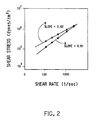
- Figure 2 is a graph showing the relationship between shear rate in reciprocal seconds and shear stress in dynes/cm2 for two nylon 6,6 polymers with different branching levels, the slope of each line shown being the FBI for that polymer.
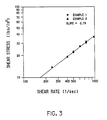
- Figure 3 is a graph showing the relationship between shear rate in reciprocal seconds and shear stress in lbs/in2 for two different nylon 6,6 polymers with virtually identical branching levels.
- This invention involves an advancement over the on-line measurement of the viscosity of a molten polymer stream moving along a prescribed path at a controlled process temperature.
- Customarily viscosity is measured by diverting a small quantity of the molten polymer from the polymer stream, and forcing it, by for example a pump, through a capillary of known length and diameter at a constant temperature and at a controlled rate. By measuring the pressure drop across the capillary at the controlled rate and constant temperature, the viscosity can be calculated and appropriate adjustments made.
- the process operator can vary the rheological properties of the polymer stream to bring the FBI to within predefined, desired limits and to subsequently maintain it in such range. Since the FBI is a rheological property of the molten polymer, it can be controlled by making adjustments used to control other rheological properties such as viscosity. Such methods include varying the controlled temperature of the polymer stream, the FBI being inversely related to the temperature of the molten polymer, and the mixing of additives with the molten polymer. Useful additives may include well-known chain terminators and branching agents. In this manner the FBI itself may be used to monitor and control polymer rheology.
- the FBI may be used as a means for controlling those physical properties which correlate well with rheological properties.
- One such physical property is the level of branching of the polymer. Branching, which may or may not involve cross-linking of the polymer molecules, must be controlled as it can impact such properties as dyeability and spinning behavior when the molten polymer is spun into synthetic fibers. Branching can be an indicator of the level of impurities in the polymer, in which case purification of the polymer may be required to make a suitable correction, but branching may also be caused by process conditions such as temperature fluctuations. It is desirable to monitor and control process-related branching so as to maintain a uniform degree of branching from lot-to-lot of polymer. This is often done by the use of small quantities of branching agents.
- High levels of branching tend to reduce the FBI, so that on-line readings showing an unacceptably low FBI or a diminishing FBI nay be an indication of increased branching. Conversely, high FBI or increasing FBI may be an indication of decreased or insufficient branching.
- the level of branching may then be altered by changing the controlled temperature of the molten polymer, a change which also alters the polymer's rheology and adjusts the FBI.
- additives may be mixed into the molten polymer to vary the rheological properties of the melt and return the branching level to the normal predefined limits.
- Such additives include branching agents, such as bis-hexamethyl methylene triamine (BHMT), and other additives generally referred to as controlled rheology agents. A more complete discussion of such agents may be found in Modern Plastics Mid-October Encyclopedia, , Issue No. 90, page 98, which is hereby incorporated by reference into this disclosure.
- An additional property which can be monitored and adjusted due to its correlation with FBI is the molecular weight distribution of the polymer.
- broad or narrow ranges of molecular weight distribution are often desirable.
- Polymer properties such as shear viscosity, extensional viscosity, intrinisic viscosity, extrudate swell, melting and crystallization temperatures, flexural modulus, impact strength, and tensile stress have all been correlated with molecular weight distribution; hence control of the polymer's molecular weight distribu-tion can provide a means to monitor and control such properties. Since the FBI varies with changes in molecular weight distribution, with this invention molecular weight distribution can now be monitored on-line for deviations from established limits.
- Such deviations can then be corrected by mixing additives such as chain terminators and other controlled rheology agents into the molten polymer stream.
- Control of molecular weight distribution is particularly important when working with polymers formed by addition reactions, such as polyethylene and polypropylene.
- additives like peroxides may be mixed with the molten polymer to act as chain terminators and thus control molecular weight distribution.
- the processes of this invention are thought to be useful when working with all types of polymers, including but not limited to polyolefins, polyamides, polyesters, and copolymers thereof. Similarly, the processes are not limited by the use to be made of the molten polymer stream. It is expected that the techniques described herein will have value as a polymer process control tool in any application where rheological properties may be measured and where polymer uniformity is important.
- the apparatus of this invention is an apparatus for determining the FBI of a molten polymer moving at a controlled temperature along a prescribed path.
- the apparatus is comprised of:
- the preferred means for measuring the pressure drop across the capillary at each controlled rate is a viscometer, and the preferred means for moving each small quantity through the capillary at a different controlled rate (and at a constant temperature) is a variable-speed drive connected to a pump.
- molten polymer from a source not shown is delivered through pipe 11 on its way to one or more meter pumps 12 and then, for example, to spinnerets for extruding polymeric filaments.
- a small portion of the polymer is diverted through pipe 13 to viscometer pump 14 which forces the polymer at a controlled rate through capillary 15.
- Thermocouple 16 detects the temperature of the polymer at the capillary and pressure sensors 17 and 18 detect the polymer pressures before and after the capillary, respectively. They transmit their readings to element 19 within computer 27 which determines the difference in pressure across the capillary.
- the shear rate is calculated by computer element 22 from Equation #2 below. Since the pump speed is directly proportional to the capillary throughput of a polymer at constant temperature, the computer can also readily determine the throughput through the capillary from the pump speed 21. The throughput can, in turn, be used to compute the shear rate as shown in Equation #3 below.
- Pipe 13, pump 14, capillary 15 and return pipe 24 should be maintained at constant temperature by suitable insulation and electrical heating.
- the accuracy of the measurement may be improved by installing one or more static mixers in pipe 13.
- the speed of the pump can be varied between 5 and 40 RPM, thereby getting a 8X increase in shear rate. This may be done manually, preferably in increments of 5 RPM. This can also be done by a programmable logic controller (such as an Allan Bradley PLC 3) or by a Honeywell Distributed Control System TDC 3000.
- the data are used to calculate a Flow Behavior Index, which for non-Newtonian flow is:
- the shear rate ⁇ is calculated by:
- the shear stress ( ⁇ w ) may then be plotted as a function of shear rate ( ⁇ ) on a log-log graph with the slope of the resulting best-fit straight line being the FBI.
- Figure 2 shows two plots of shear stress in dynes per square centimeter on the vertical axis and shear rate in sec. ⁇ 1 on the horizontal axis, both on logarithmic scales.
- Control Plot A having a slope (i.e. FBI) of 0.81, shows data points for a nylon 6,6 polymer with essentially no branching.
- Plot B having a slope (i.e. FBI) of 0.62, shows values for the same nylon 6,6 polymer with substantial branching caused by the addition of the branching agent BHMT to the polymer in concentrations of 15 mg/106 g. This demonstrates the use of the FBI to monitor branching levels.
- the process and apparatus of this invention can also detect undesirable effects of additives such as improper dispersion of delustering or coloring pigments, undesirable reactions of additives with the polymer, etc., which cannot be thoroughly characterized by a viscosity measurement made at only one shear rate.
- coloring pigments can significantly affect the rheological properties of polymers, including particulary nylon 6,6.
- FBI values for such pigmented polymers are correspondingly changed, and the FBI values can be significantly higher than those for the same polymer without pigment.
- FBI levels indicating acceptable levels of pigment and proper pigment dispersion can be determined, thus permitting on-line monitoring and control of polymer pigmentation using the methods and apparata of this invention.
- the effect of delustering pigments may be similarly monitored and controlled.
- Copolymers may also be characterized more thoroughly and accurately, particularly for completeness of blending of melt-blend copolymers.
- the present device may also activate corrective control of the polymer process by determining whether the slope of the plot deviates from a desired condition, feeding the signal into an additional controller 23 which receives a signal (Honeywell Distributed Control System or equivalent) 25 and sends a further signal 26 to make a correction to the polymer-making process, such as polymer temperature.
- a signal Honeywell Distributed Control System or equivalent
- An additional signal may also be sent to the flake makeup process.
- Example 1 A nylon 6,6 polymer in flake form was melted in a screw-melter and flowed through a transfer line at a controlled temperature of 290°C to a spinning machine for extrusion into filaments.
- a 1S-3C Zenith gear pump was used, and the pump speeds were varied from 10 RPM to 40 RPM.
- Example 2 A similar evaluation was made on a second nylon 6,6 polymer also being transferred from a screw melter to a spinning machine.
- a 1S-5C viscometer pump was used and the capillary again had a length of 0.5 inches (1.27 cm) and a diameter of 0.093 inches (0.236 cm).
- the throughputs were determined and pressure drops were measured.
- Shear rate and shear stress values were again calculated as shown below: When plotted on a log-log graph (see Figure 3), the slope of the best fit straight line through these data points also gave an FBI value of 0.74, indicating comparable rheological properties, and comparable branching levels to the polymer evaluated in Example 1.
- Example 3 A nylon 6,6 polymer flake was again melted in a screw melter and transferred at 290°C to a spinning machine.
- the FBI was calculated on-line as in the previous examples and determined to be 0.74.
- the polymer melt temperature was then reduced to 282°C.
- the FBI value for the polymer being transferred at this lower temperature increased to 0.84 indicating virtually no branching.
- the polymer temperature at the capillary was maintained at 290°C indicating that the FBI change was attributable to changing rheology of the polymer caused by reduced branch content.
- Example 4 A first nylon 6,6 polymer flake was again melted in a crew-melter and transferred to a spinning machine as in previous examples.
- the FBI was calculated on-line as in previous examples and found to be 0.74, indicating a modest level of branching and/or impurities.
- a second polymer made using adipic acid having reduced levels of impurities was then introduced into the transfer line and the FBI was determined to be 0.78 indicating a reduced level of impurities and/or branching.
Landscapes
- Chemical & Material Sciences (AREA)
- Health & Medical Sciences (AREA)
- Immunology (AREA)
- Biochemistry (AREA)
- Pathology (AREA)
- General Physics & Mathematics (AREA)
- Physics & Mathematics (AREA)
- Life Sciences & Earth Sciences (AREA)
- Analytical Chemistry (AREA)
- General Health & Medical Sciences (AREA)
- Medicinal Chemistry (AREA)
- Organic Chemistry (AREA)
- Chemical Kinetics & Catalysis (AREA)
- Polymers & Plastics (AREA)
- Extrusion Moulding Of Plastics Or The Like (AREA)
- Processing And Handling Of Plastics And Other Materials For Molding In General (AREA)
- Compositions Of Macromolecular Compounds (AREA)
Applications Claiming Priority (2)
| Application Number | Priority Date | Filing Date | Title |
|---|---|---|---|
| US463897 | 1990-01-09 | ||
| US07/463,897 US4992487A (en) | 1990-01-09 | 1990-01-09 | Method for determining flow behavior index and using index to control polymer rheology and physical properties |
Publications (2)
| Publication Number | Publication Date |
|---|---|
| EP0437252A2 true EP0437252A2 (fr) | 1991-07-17 |
| EP0437252A3 EP0437252A3 (en) | 1992-01-29 |
Family
ID=23841726
Family Applications (1)
| Application Number | Title | Priority Date | Filing Date |
|---|---|---|---|
| EP19910100238 Withdrawn EP0437252A3 (en) | 1990-01-09 | 1991-01-09 | Method and apparatus for using flow behavior index to control polymer rheology and physical properties |
Country Status (6)
| Country | Link |
|---|---|
| US (1) | US4992487A (fr) |
| EP (1) | EP0437252A3 (fr) |
| JP (1) | JPH04212042A (fr) |
| KR (1) | KR910014692A (fr) |
| AU (1) | AU642946B2 (fr) |
| CA (1) | CA2033600A1 (fr) |
Cited By (1)
| Publication number | Priority date | Publication date | Assignee | Title |
|---|---|---|---|---|
| WO1996001567A3 (fr) * | 1994-07-07 | 1996-06-13 | Kraft Jacobs Suchard R & D Inc | Procede de production en continu de fromages fondus |
Families Citing this family (13)
| Publication number | Priority date | Publication date | Assignee | Title |
|---|---|---|---|---|
| WO1992015858A1 (fr) * | 1991-03-11 | 1992-09-17 | Exxon Chemical Patents Inc. | Controle de procede de fabrication et verification des caracteristiques du produit |
| US5347852A (en) * | 1993-03-11 | 1994-09-20 | Rheometrics, Inc. | On-line rheological measurements for process control |
| US5718852A (en) * | 1994-05-10 | 1998-02-17 | The Clorox Company | Process controlling a blow molding machine |
| FR2728345A1 (fr) * | 1994-12-16 | 1996-06-21 | Renault | Rheometre pour presse a injecter |
| WO1997022869A1 (fr) * | 1995-12-19 | 1997-06-26 | The Dow Chemical Company | Procede et appareil pour determiner les proprietes physiques d'un gaz par des injections de gaz commandees |
| US5916599A (en) * | 1996-11-14 | 1999-06-29 | Illinois Institute Of Technology | Apparatus for generating generally uniform compression in high-viscosity liquids |
| US5847267A (en) * | 1997-06-20 | 1998-12-08 | Phillips Petroleum Company | Process to obtain dynamic shear modulus components of a polymer by using steady-state-flow data |
| US5974866A (en) | 1997-08-29 | 1999-11-02 | General Electric Company | On-line rheometer device |
| US6196058B1 (en) * | 1998-03-12 | 2001-03-06 | Consolidated Papers, Inc. | On-line viscosity measurement system |
| GB0002192D0 (en) * | 2000-01-31 | 2000-03-22 | Borealis Polymers Oy | Rheometry |
| CN1959372B (zh) * | 2006-11-28 | 2011-01-05 | 中北大学 | 超临界流体-聚合物体系流变性能测定仪 |
| US10899059B2 (en) * | 2017-05-12 | 2021-01-26 | Kuraray Europe Gmbh | Method for producing films based on plasticized polyvinyl acetal having a predefined viscosity |
| CN110057717B (zh) * | 2019-04-19 | 2021-06-11 | 深圳大学 | 基于特征尺寸的高聚物熔体粘流活化能模型的建立方法 |
Family Cites Families (12)
| Publication number | Priority date | Publication date | Assignee | Title |
|---|---|---|---|---|
| US3138950A (en) * | 1961-03-20 | 1964-06-30 | Phillips Petroleum Co | Apparatus for concurrent measurement of polymer melt viscosities at high and low shear rates |
| FR1474354A (fr) * | 1966-03-29 | 1967-03-24 | Hoechst Ag | Procédé et appareil pour mesurer la viscosité et l'indice d'écoulement |
| US3559464A (en) * | 1969-11-13 | 1971-02-02 | Exxon Research Engineering Co | Rheometer for continuous monitoring of a plastic |
| NL152378B (nl) * | 1973-05-04 | 1977-02-15 | Itt | Inrichting voor het regelen van de viscositeit van een vloeistof. |
| UST960004I4 (en) * | 1974-05-14 | 1977-07-05 | Apparatus for concurrent measurement of polymer melt | |
| DE2751225C3 (de) * | 1977-11-16 | 1981-08-13 | Werner & Pfleiderer, 7000 Stuttgart | Vorrichtung mit einer nach dem Siebpaket eines Schneckenextruders angeordneten Schmelzindex-Meßeinrichtung und Verfahren zum Regeln der Viskosität von aufgeschmolzenem und auszuformendem Kunststoff |
| US4241602A (en) * | 1979-04-20 | 1980-12-30 | Seismograph Service Corporation | Rheometer |
| ATE48317T1 (de) * | 1984-07-17 | 1989-12-15 | Rhe Haendel Engineering Gmbh | Verfahren zur viskositaetsmessung von kunstharzen und vorrichtung zur durchfuehrung des verfahrens. |
| US4726219A (en) * | 1986-02-13 | 1988-02-23 | Atlantic Richfield Company | Method and system for determining fluid pressures in wellbores and tubular conduits |
| US4792908A (en) * | 1986-03-25 | 1988-12-20 | The Firestone Tire & Rubber Company | Method for controlling the mooney viscosity of compounded rubber formulations |
| DE3610159A1 (de) * | 1986-03-26 | 1987-10-01 | Werner & Pfleiderer | Vorrichtung und verfahren zur herstellung eines kunststoffes mit definierten eigenschaften, insbesondere eines polypropylens mit definierter molekularstruktur |
| US4817416A (en) * | 1988-06-13 | 1989-04-04 | Rheometrics, Inc. | On-line rheological measurements |
-
1990
- 1990-01-09 US US07/463,897 patent/US4992487A/en not_active Expired - Fee Related
-
1991
- 1991-01-03 AU AU68633/91A patent/AU642946B2/en not_active Ceased
- 1991-01-04 CA CA002033600A patent/CA2033600A1/fr not_active Abandoned
- 1991-01-08 KR KR1019910000150A patent/KR910014692A/ko not_active Withdrawn
- 1991-01-09 EP EP19910100238 patent/EP0437252A3/en not_active Withdrawn
- 1991-01-09 JP JP3011652A patent/JPH04212042A/ja active Pending
Cited By (2)
| Publication number | Priority date | Publication date | Assignee | Title |
|---|---|---|---|---|
| WO1996001567A3 (fr) * | 1994-07-07 | 1996-06-13 | Kraft Jacobs Suchard R & D Inc | Procede de production en continu de fromages fondus |
| US5853786A (en) * | 1994-07-07 | 1998-12-29 | Kraft Foods, Inc. | Process for continuous production of processed cheese |
Also Published As
| Publication number | Publication date |
|---|---|
| CA2033600A1 (fr) | 1991-07-10 |
| EP0437252A3 (en) | 1992-01-29 |
| US4992487A (en) | 1991-02-12 |
| KR910014692A (ko) | 1991-08-31 |
| AU6863391A (en) | 1991-07-11 |
| JPH04212042A (ja) | 1992-08-03 |
| AU642946B2 (en) | 1993-11-04 |
Similar Documents
| Publication | Publication Date | Title |
|---|---|---|
| US4992487A (en) | Method for determining flow behavior index and using index to control polymer rheology and physical properties | |
| US6405579B1 (en) | Scaleless on-line rheometer device | |
| US4684488A (en) | Method and apparatus for controlled supply of color concentrates into an extruder to obtain a plastic product of desired coloration | |
| US3551943A (en) | Controlled degradation | |
| US4230615A (en) | Process for controlled mixing in a high intensity mixer | |
| US6691558B1 (en) | In-line rheometer device and method | |
| CA2510551A1 (fr) | Methode de production de profiles en matiere thermoplastique | |
| US4449395A (en) | Pheological measurement method and apparatus | |
| US5014545A (en) | Apparatus for determining flow behavior index | |
| Pliskin | Observations of die swell behavior of filled elastomers measured automatically with a new “die swell tester” | |
| AU638323B2 (en) | Process for modifying polyamide dyeability using co-fed polyamide flake | |
| US5652376A (en) | Method of measuring yield stress | |
| US5202395A (en) | Manufacturing process control and product characterization | |
| CA1311866C (fr) | Mode de controle de procedes de greffage | |
| US6182503B1 (en) | On-line rheological measurement for process control | |
| CA2389762A1 (fr) | Dispositif pour determiner l'etat de marche d'une extrudeuse | |
| US4954302A (en) | Process for controlling quality of yarns | |
| Henderson et al. | Effects of die temperature on extrudate swell in screw extrusion | |
| EP3998469A1 (fr) | Dispositif de mesure des propriétés rhéologiques d'un matériau à viscosité élevée et procédé de mesure correspondant | |
| AU628891B2 (en) | Process and apparatus for modifying polyamide dyeability or amine end content | |
| Dealy et al. | On-Line Measurement of Rheological Properties | |
| Kelly et al. | In process monitoring of polymer batch to batch variation in injection moulding | |
| JPS60137609A (ja) | ゴム,プラスチツク等の混練物品の製造方法 | |
| Vismara et al. | Lubricant behavior in rigid PVC rheology | |
| SU1636765A1 (ru) | Способ определени технологической негомогенности термопластичных полимерных материалов |
Legal Events
| Date | Code | Title | Description |
|---|---|---|---|
| PUAI | Public reference made under article 153(3) epc to a published international application that has entered the european phase |
Free format text: ORIGINAL CODE: 0009012 |
|
| AK | Designated contracting states |
Kind code of ref document: A2 Designated state(s): DE GB NL |
|
| PUAL | Search report despatched |
Free format text: ORIGINAL CODE: 0009013 |
|
| AK | Designated contracting states |
Kind code of ref document: A3 Designated state(s): DE GB NL |
|
| 17P | Request for examination filed |
Effective date: 19920624 |
|
| 17Q | First examination report despatched |
Effective date: 19940801 |
|
| STAA | Information on the status of an ep patent application or granted ep patent |
Free format text: STATUS: THE APPLICATION IS DEEMED TO BE WITHDRAWN |
|
| 18D | Application deemed to be withdrawn |
Effective date: 19950214 |