EP0437324A2 - Zement und Herstellung desselben sowie daraus hergestellter Beton - Google Patents
Zement und Herstellung desselben sowie daraus hergestellter Beton Download PDFInfo
- Publication number
- EP0437324A2 EP0437324A2 EP91300059A EP91300059A EP0437324A2 EP 0437324 A2 EP0437324 A2 EP 0437324A2 EP 91300059 A EP91300059 A EP 91300059A EP 91300059 A EP91300059 A EP 91300059A EP 0437324 A2 EP0437324 A2 EP 0437324A2
- Authority
- EP
- European Patent Office
- Prior art keywords
- cement
- particles
- sphered
- spherical
- concrete
- Prior art date
- Legal status (The legal status is an assumption and is not a legal conclusion. Google has not performed a legal analysis and makes no representation as to the accuracy of the status listed.)
- Ceased
Links
Images




Classifications
-
- C—CHEMISTRY; METALLURGY
- C04—CEMENTS; CONCRETE; ARTIFICIAL STONE; CERAMICS; REFRACTORIES
- C04B—LIME, MAGNESIA; SLAG; CEMENTS; COMPOSITIONS THEREOF, e.g. MORTARS, CONCRETE OR LIKE BUILDING MATERIALS; ARTIFICIAL STONE; CERAMICS; REFRACTORIES; TREATMENT OF NATURAL STONE
- C04B20/00—Use of materials as fillers for mortars, concrete or artificial stone according to more than one of groups C04B14/00 - C04B18/00 and characterised by shape or grain distribution; Treatment of materials according to more than one of the groups C04B14/00 - C04B18/00 specially adapted to enhance their filling properties in mortars, concrete or artificial stone; Expanding or defibrillating materials
- C04B20/10—Coating or impregnating
- C04B20/1055—Coating or impregnating with inorganic materials
- C04B20/1077—Cements, e.g. waterglass
-
- C—CHEMISTRY; METALLURGY
- C04—CEMENTS; CONCRETE; ARTIFICIAL STONE; CERAMICS; REFRACTORIES
- C04B—LIME, MAGNESIA; SLAG; CEMENTS; COMPOSITIONS THEREOF, e.g. MORTARS, CONCRETE OR LIKE BUILDING MATERIALS; ARTIFICIAL STONE; CERAMICS; REFRACTORIES; TREATMENT OF NATURAL STONE
- C04B7/00—Hydraulic cements
- C04B7/36—Manufacture of hydraulic cements in general
- C04B7/368—Obtaining spherical cement particles
-
- C—CHEMISTRY; METALLURGY
- C04—CEMENTS; CONCRETE; ARTIFICIAL STONE; CERAMICS; REFRACTORIES
- C04B—LIME, MAGNESIA; SLAG; CEMENTS; COMPOSITIONS THEREOF, e.g. MORTARS, CONCRETE OR LIKE BUILDING MATERIALS; ARTIFICIAL STONE; CERAMICS; REFRACTORIES; TREATMENT OF NATURAL STONE
- C04B7/00—Hydraulic cements
- C04B7/36—Manufacture of hydraulic cements in general
- C04B7/48—Clinker treatment
- C04B7/52—Grinding ; After-treatment of ground cement
-
- C—CHEMISTRY; METALLURGY
- C04—CEMENTS; CONCRETE; ARTIFICIAL STONE; CERAMICS; REFRACTORIES
- C04B—LIME, MAGNESIA; SLAG; CEMENTS; COMPOSITIONS THEREOF, e.g. MORTARS, CONCRETE OR LIKE BUILDING MATERIALS; ARTIFICIAL STONE; CERAMICS; REFRACTORIES; TREATMENT OF NATURAL STONE
- C04B2111/00—Mortars, concrete or artificial stone or mixtures to prepare them, characterised by specific function, property or use
- C04B2111/00034—Physico-chemical characteristics of the mixtures
- C04B2111/00068—Mortar or concrete mixtures with an unusual water/cement ratio
-
- Y—GENERAL TAGGING OF NEW TECHNOLOGICAL DEVELOPMENTS; GENERAL TAGGING OF CROSS-SECTIONAL TECHNOLOGIES SPANNING OVER SEVERAL SECTIONS OF THE IPC; TECHNICAL SUBJECTS COVERED BY FORMER USPC CROSS-REFERENCE ART COLLECTIONS [XRACs] AND DIGESTS
- Y02—TECHNOLOGIES OR APPLICATIONS FOR MITIGATION OR ADAPTATION AGAINST CLIMATE CHANGE
- Y02W—CLIMATE CHANGE MITIGATION TECHNOLOGIES RELATED TO WASTEWATER TREATMENT OR WASTE MANAGEMENT
- Y02W30/00—Technologies for solid waste management
- Y02W30/50—Reuse, recycling or recovery technologies
- Y02W30/91—Use of waste materials as fillers for mortars or concrete
Definitions
- the present invention relates to cement products and a method of producing the same, and a composition for producing a cement product, as well as a mass concrete and a method of producing the same. More particularly, the present invention relates to a high-strength sphered cement product and a method of producing the same, and a composition for producing a high-strength cement product, as well as a low-hydration heat mass concrete and a method of producing the same.
- the water-reducing agent is used to lower the water-cement ratio to obtain a high-strength concrete product or a highly durable concrete product.
- This is produced by adding a super-setting retarder to ordinary ready-mixed concrete. Utilizing the super-retardation of set, this concrete is used to suppress the occurrence of cold joint, lower the slump loss, reduce the heat of hydration and eliminate the need for work at night, which would otherwise accompany continuous placing of concrete. However, since the period of time during which the strength of the concrete is developed varies with environmental conditions, control thereof is difficult.
- This is produced with the water-cement ratio reduced to a low level and by adding a fluidizing agent and a high-performance water reducing agent and is used, e.g., for the construction of skyscrapers and nuclear power plants.
- silica fume as an admixture is under investigation.
- this concrete is still far from a practical application as ready-mixed concrete because of large variations in the strength, slump, slump flow, etc.
- mass concrete is used in the form of large masses to construct large-sized buildings and civil engineering structures, for example, skyscrapers, dams or nuclear power plants.
- Mass concrete is generally defined such that the minimum dimension of the cross-section of a mass concrete member is not smaller than 80 cm and the difference between the highest temperature inside the concrete due to the heat of hydration and the ambient atmospheric temperature is 25°C or higher.
- the present invention provides a cement product which is obtained by curing a mixture of aggregate, water, and a spherical cement consisting essentially of cement clinker fine spherical particles the outer peripheral surface of which has been made spherical by grinding and/or fusion, preferably at least 60 wt% of the particles having a diameter of from 3.9 to 30.0 ⁇ m.
- the present invention also provides a method of producing a cement product by curing the above-described mixture, and further provides a composition for producing a cement product, namely the mixture described above.
- the present invention provides a method of producing a low-hydration heat mass concrete by employing a mixture of aggregate, water, and a cement consisting essentially of cement clinker fine particles the outer peripheral surface of which has been made spherical by grinding and/or fusion; and the mass concrete thus produced.
- the invention provides a cement for producing said low-hydration heat mass concrete, which comprises said cement consisting essentially of said spherical cement clinker fine particles, at least 60 wt% of the particles having said diameter of from 3.9 to 30.0 ⁇ m.
- the present invention provides a method of producing a high-strength cement product by curing a mixture of aggregate, water,and a spherical particled cement consisting essentially of cement clinker fine particles the outer peripheral surface of which is made spherical by grinding and/or fusion, at least 80 wt% of the particles having a diamter of from 3.9 to 9.0 ⁇ m; and the cement product thus produced.
- the spherical cement particles preferably have the diameter of from 3.9 to 30.0 ⁇ m in order to give excellent fluidity to the resulting cement mortar or ready-mixed concrete, and it is preferable that at least 60 wt % of the shered cement used has a diameter within this range.
- the spherical cement particles may be each homogenously covered with a coating of fine particles, for example, of fine cement, silica fume (fine powder) or fluidizing agent, etc.; the coated cement particles become vigorously reactive or show a different surface reactivity and hence exhibit various advantageous effects.
- the reaction e.g. pozzolanic reaction
- the reaction of the cement with the coating can be uniformly carried out, so that it is possible to stabilize the quality (e.g., strength and slump) of the resulting concrete.
- the sphered cement that is employed in the present invention may be obtained by grinding cement clinker fine particles into spherical particles by a high speed impact treatment method.
- the sphered cement may be obtained by sphering cement clinker fine particles by a mechanochemical surface fusion method.
- the sphered cement may be an "encapsulated" sphered cement that is obtained by attaching fine cement powder, silica fume or other pulverized admixture (e.g., blast-furnace slag, fly ash, calcium sulfoalminate, or other pulverized water-reducing agent or retarder) to the surface of spherical cement particles.
- encapsulated cement is preferably produced by a known high speed impact treatment method (wherein fine particles of a material are subjected to a rotational impact caused by a high-speed air stream within an impact chamber that is defined by a ring-shaped space, thereby sphering the fine particles).
- the encapsulated sphered cement thus obtained, it is also preferable that at least 60 wt% thereof has a diameter of from 3.9 to 30.0 ⁇ m, for the production of cement mortar or ready-mixed concrete, to provide a high-strength concrete product. If the diameter exceeds 30.0 ⁇ m, the filling property is reduced, and unreacted parts remain inside the sphered cement particles during the hydration reaction, which has an adverse effect on the development of strength. If the diameter is less than 3.9 ⁇ m, the proportion of fine powder increases and hence the aggregating property increases, so that no great improvement can be expected in the fluidity of mortar or ready-mixed concrete produced from such a sphered cement.
- Cement is produced according to a typical conventional manufacturing method, by mixing together raw materials, that is, limestone, clay, silica rock and iron oxide in appropriate proportions, pulverizing the mixture, feeding the pulverized mixture through a preheater to a rotary kiln where it is calcined at a high temperature of about 1450°C to obtain cement clinker, which is then rapidly cooled in a cooler before being pulverized in a finishing mill (tube mill), thereby obtaining fine cement particles having a diameter of from 1 to 90 ⁇ m.
- the pulverized cement clinker has a particle diameter of not greater than 90 ⁇ m, but the fine particles of cement clinker have a square outer shape, although somewhat rounded off.
- the cement clinker powder (fine particles) may be treated for several minutes in, for example, a commercially available high speed impact treatment apparatus (e.g., Nara-Hybridization system made by Nara Machine Co., Ltd.) to prepare sphered cement (spherical cement fine particles) having the outer peripheral surface further rounded off, and the resulting sphered cement is used as a compounding cement.
- a commercially available high speed impact treatment apparatus e.g., Nara-Hybridization system made by Nara Machine Co., Ltd.
- sphered cement spherical cement fine particles having the outer peripheral surface further rounded off
- the resulting sphered cement is used as a compounding cement.
- it is necessary that at least 60 wt% of the sphered cement used has a diameter of from 3.9 to 30.0 ⁇ m, as stated above.
- fine cement causes a rapid catalytic reaction with water and sets quickly because of a relatively large specific surface area, but there is a lowering in the fluidity.
- Ordinary cements for example, ordinary Portland cement, have a considerably large specific surface area because the outer shape of the cement particles is cuboid or square, as described above, and fine powder also intermingles therewith. Accordingly, the area of contact with water is large and hence a setting reaction takes place rapidly. For this reason, the fluidity is inferior, and heat of hydration is rapidly generated. Therefore when mass concrete is placed using such ordinary cement, a large temperature difference occurs between the ambient atmospheric temperature and the concrete, which may cause cracking in the concrete.
- the sphered cement according to the present invention eliminates such a problem: the sphered cement involves no rapid generation of hydration heat and hence enables prevention of the occurrence of cracking in placing of concrete.
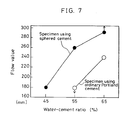
- the water-cement ratio can be lowered, for the same water content a mortar of the sphered cement has a much larger flow value than that of a mortar of ordinary Portland cement. For the same flow value, the former enables 10% or more reduction in the water content.
- the sphered cement, aggregate and water should be mixed together in the ratios 1:2.5 to 8.0:0.17 to 0.75.
- the sphered cement is preferably comprised of approximately spherical cement particles which have many fine cement particles adsorptively fixed on recesses and projections on the surface thereof, particularly, in the recesses, so as to form spherical particles with minimal unevenness as a whole.
- a product made from the mixture containing the sphered cement has a much higher strength than that of a product made from the mixture containing ordinary Portland cement.
- the low-hydration heat mass concrete comprises the sphered cement in a mass concrete composition
- the above-described sphered cement may be obtained by sphering fine cement particles by a mechanochemical surface fusion method.
- the reaction of the cement with the additive or the admixture can be performed uniformly, and it is therefore possible to stabilize the quality (strength, slump, etc.) of the resulting concrete.
- At least 80 wt% of the sphered cement used has a diameter of from 3.9 to 9.0 ⁇ m, particularly preferably, from 5.0 to 7.0 ⁇ m.
- 3CaO ⁇ SiO2 particles which constitute the main component of cement, participate in the hydration reaction only to a depth of about 3.5 ⁇ m from the surface thereof even at the age of 6 months.
- a sphered cement having a diameter of from 3.9 to 9.0 ⁇ m, particularly preferably from 5.0 to 7.0 ⁇ m.
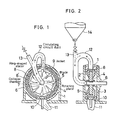
- Figs. 1 and 2 show the structure of the essential part of a high speed impact treatment apparatus.
- Fig. 1 is a sectional front view of the impact treatment apparatus, and Fig. 2 is a sectional side view thereof;
- Reference numeral 1 denotes a casing, 2 a front cover, 3 a rear cover, 4 a rotating plate, 5 blades, 6 a rotating shaft, 7 a ring-shaped impact chamber, 8 a ring-shaped stator, 9 a jacket, 10 a sphered cement discharge valve, 11 a sphered cement discharge chute, 12 a circulating circuit duct, 13 a supply chute for fine cement particles as a raw material, and 14 a hopper for feeding cement to chute 13.
- cement from the hopper 14 is supplied as a raw material to the ring-shaped impact chamber 7 through the cement chute 13. Fine particles of cement are subjected to a rotational impact in an impact chamber that is defined by a ring-shaped space, thereby making the particles spherical.
- the fine cement particles are rotated and scattered at high speed by the rotation of the rotating plate 4 and the blades 5 attached thereto. While rotating, the fine cement particles collide against the blades 5 and the surface of a large number of triangular grooves 8′, which are provided in the surface of the ring-shaped stator 8.
- the colliding cement particles enter the circulating circuit duct 12 that opens at one end thereof into the collision chamber 7, and after circulating through the duct 12, the cement particles are introduced into the collision chamber 7 again from the other end opening of the duct 12.
- the cement particles are subjected to the rotational impact a multiplicity of times in response to the rotation of the rotating plate 4 until the desired spherical shape is obtained.
- the number of revolutions of the rotating plate 4 is from 4,000 to 16,000 rpm, and the processing time is from 3 to 20 minutes.
- the discharge valve 10 is lowered so as to be open, thereby the sphered cement particles being taken out from the chute 11.
- a surface treatment of the sphered cement for example, coating of a chemical admixture, can be homogeneously and reliably effected by introducing a cooling or heating medium to the inside of the jacket 9, so as to cause the fine cement particles to have their outer peripheral surface further rounded off.
- Fig. 6 schematically shows a process in which cement clinker is ground and formed into spherical cement.
- polyhedroid cement clinker particles are cast into the apparatus of Figs. 1 - 2, and angular portions of the cement clinker particles are cut off so as to generate fine powder in the step shown in Fig. 6(b).
- the rounded cement clinker particles come into sliding contact with the surface of the ring-shaped stator while rotating in the appratus.
- fine powder is adsorbed on the surface of the rounded cement clinker particles, particularly into recesses in the surface thereof, in such a manner as to fill the recesses.
- much fine cement clinker powder 23 is adsorbed on the surface of rounded cement fine particle bodies 20′, particularly into recesses in the surface thereof, thus forming sphered cement particles 20 having the recesses filled with the fine cement clinker powder 23, as shown in Fig. 6(d).
- Cement clinker fine particles with a diameter of from 1 to 90 ⁇ m which are led out from a finishing mill (tube mill) in the conventional cement manufacturing process, are supplied to a Nara Hybridizer (trade name; manufactured by Nara Machine Co., Ltd), which is a commercially available high speed impact treatment apparatus, and processed therein for 3 to 20 minutes to produce spherical cement particles, wherein fine cement clinker powder 23 is adsorptively fixed in recesses in the surface layer of each approximately spherical cement particle body 20′ to form a composite cement particle which as a whole is nearly spherical, as shown in section in Fig. 5. Since such composite cement particles have fine cement powder which compacted in the recesses of the central cement particles, the composite cement has a considerably uniform and narrow particle size distribution.
- the substantially spherical cement particles may be made by various other known methods and apparatus, for example, a mechanochemical surface fusion method that employs an Angmill (trade name for an improved model of mechanical dry pulverizer, manufactured by Hosokawa Micron K.K., Japan), or a Cryptron System (trade name for an improved model of mechanical pulverizer, manufactured by Kawasaki Heavy Industry Co., Ltd, Japan).
- Angmill trade name for an improved model of mechanical dry pulverizer, manufactured by Hosokawa Micron K.K., Japan
- Cryptron System trade name for an improved model of mechanical pulverizer, manufactured by Kawasaki Heavy Industry Co., Ltd, Japan.
- the sphered cement that is obtained by the above-described sphering process has a particle diameter of from 1 to 30 ⁇ m and also has a homogeneous spherical surface. Accordingly, it exhibits an excellent bearing effect and considerably high fluidity and provides superior workability. As a result, a cement paste containing the sphered cement exhibits superior fluidity and castability.
- the use of this sphered cement for self-levelling concrete is very effective because it gives excellent fluidity to the resulting concrete.
- an additive chemical admixture
- an admixture may be uniformly attached to the surface of the sphered cement particles.
- 5 to 30% of silica fume may be added to cement particles which have been sphered by high speed impact treatment method. This is seen in section in Fig. 3; a layer of silica fume ultrafine particles 21 is attached all over the spherical surface of each sphered cement particle 20 to form an encapsulated sphered cement particle.
- the term "fume” refers to particles of size 0.1-1.0 ⁇ m diameter resulting from a chemical process.
- the encapsulated sphered cement enables a uniform reaction (pozzolanic reaction) of the cement with the silica fumes, so that it is possible to stabilize the quality (strength, slump, etc.) of high-strength concrete mixed with silica fume, which has heretofore given rise to a problem.
- the use of such encapsulated sphered cement enables reliable and easy control of the hydration reaction.
- Fig. 4 shows a cement composite material which comprises a silica fume particle 21 as a central or mother particle and cement clinker ultrafine particles 22 as peripheral or child particles.
- the cement composite material which comprises ultrafine cement particles, enables a uniform reaction of the cement with the silica fume and therefore makes it possible to produce an ultrahigh-strength concrete.
- cement clinker in the form of ultrafine particles which is used for this purpose, can be obtained as a by-product of the production of sphered cement clinker fine particles by the high speed impact treatment apparatus, by further classifying the remaining fine particles after the classification of the sphered cement clinker particles.
- Fig. 7 shows the results of a comparative experiment on the fluidity (flow value) of a mortar containing a sphered cement according to the present invention and a mortar containing a conventional sphered cement according to the present invention and a mortar containing conventional Portland cement (not containing any sphered cement).
- the sphered cement used in this experiment was produced by the high speed impact treatment method, 77.1 wt% of the sphered cement having a diameter of from 3.9 to 30.0 ⁇ m (average particle diameter: 11.34 ⁇ m).
- the specimens were prepared according to the testing method specified in JIS R 5201, with the water-cement ratio being variously changed, and the flow test was then conducted thereon.
- the initial hydration characteristics were examined in regard to a mixture consisting essentially of 1 part by weight of sphered cement produced by the high speed impact treatment apparatus, at least 60 wt% of the sphered cement having a diameter of from 3.9 to 30.0 ⁇ m, and 0.4 parts by weight of water.
- the ambient atmospheric temperature during this experiment was 20°C.
- the rate of generation of cement hydration heat and the integrated calorific value were measured at each hydration time. The results of the measurement are shown in Figs. 8 and 9.
- the calorific value of the mixture containing the sphered cement was lower than that of the mixture containing ordinary Portland cement, i.e., the former was about 75% of the latter.
- Fig. 10 shows the compressive strength of mass concrete products at each age.
- a high-strength cement product was made from the sphered cement of the present invention as follows.
- the flow value of the resultant mixture was 260 mm.
- the mixture was cured in a formwork. After 7 days, its compressive strength was 300 kgf/cm2, and after 28 days, it was 558 kgf/cm2. The results show that the compressive strength was increased by 27% in comparison to a concrete product using ordinary Portland cement.
- the sphered cement required only about 50 to 86% of the water content needed for the ordinary Portland cement.
- the sphered cement according to the present invention comprises spherical fine particles with a homogeneous spherical surface and therefore exhibits an excellent bearing effect and is capable of giving considerably high fluidity to a mixture containing the sphered cement, thus providing a mixture of good workability.
- a composition for producing a cement product which contains the sphered cement, has superior fluidity and therefore facilitates casting and is particularly advantageously used for self-levelling concrete.
- the sphered cement enables casting and filling to be effected even more densely, it is possible to produce a high-strength concrete product.
- the sphered cement of the present invention may have an admixture uniformly attached to the surface of the cement particles, and this cement structure enables the reaction with the admixture to proceed uniformly and completely. It is therefore possible to provide a cement product which has a uniform structure and excellent characteristics.
- the present invention enables production of mass concrete which involves no rapid generation of hydration heat and which is therefore free from cracks and exhibits superior strength.
- the present invention enables the hydration reaction of the cement to be thoroughly accomplished, a high-strength cement product can be produced stably at all times with a minimum required amount of cement composition.
- the flow value can be increased with the water-cement ratio being lowered, the excellent fluidity can be ensured and the castability is also improved.
Landscapes
- Chemical & Material Sciences (AREA)
- Engineering & Computer Science (AREA)
- Ceramic Engineering (AREA)
- Materials Engineering (AREA)
- Structural Engineering (AREA)
- Organic Chemistry (AREA)
- Inorganic Chemistry (AREA)
- Curing Cements, Concrete, And Artificial Stone (AREA)
Applications Claiming Priority (8)
| Application Number | Priority Date | Filing Date | Title |
|---|---|---|---|
| JP232190A JP2879113B2 (ja) | 1990-01-09 | 1990-01-09 | 高強度セメント硬化物製造用組成物 |
| JP2002323A JP2869489B2 (ja) | 1990-01-09 | 1990-01-09 | 球状化セメント硬化物及びその製造方法並びにその製造用組成物 |
| JP232090A JP2873384B2 (ja) | 1990-01-09 | 1990-01-09 | 高強度セメント硬化物の製造方法 |
| JP2323/90 | 1990-01-09 | ||
| JP2321/90 | 1990-01-09 | ||
| JP232290A JP2867054B2 (ja) | 1990-01-09 | 1990-01-09 | 低水加熱マスコンクリートの製造方法及び低水和燃マスコンクリート並びに低水和燃マスコンクリート製造用セメント |
| JP2322/90 | 1990-01-09 | ||
| JP2320/90 | 1990-01-09 |
Publications (2)
| Publication Number | Publication Date |
|---|---|
| EP0437324A2 true EP0437324A2 (de) | 1991-07-17 |
| EP0437324A3 EP0437324A3 (en) | 1993-03-10 |
Family
ID=27453604
Family Applications (1)
| Application Number | Title | Priority Date | Filing Date |
|---|---|---|---|
| EP19910300059 Ceased EP0437324A3 (en) | 1990-01-09 | 1991-01-04 | Cement and production thereof and concrete made therefrom |
Country Status (3)
| Country | Link |
|---|---|
| EP (1) | EP0437324A3 (de) |
| CN (1) | CN1053223A (de) |
| CA (1) | CA2029068A1 (de) |
Cited By (11)
| Publication number | Priority date | Publication date | Assignee | Title |
|---|---|---|---|---|
| EP0534385A1 (de) * | 1991-09-25 | 1993-03-31 | Takenaka Corporation | Hydraulische Substanz |
| EP0548081A4 (en) * | 1990-05-18 | 1993-07-28 | E. Khashoggi Industries | Hydraulically bonded cement compositions and their methods of manufacture and use |
| EP0609868A3 (de) * | 1993-02-03 | 1995-02-15 | Asahi Glass Co Ltd | Monolithische fenerfeste Pulvermischung. |
| EP0513367B1 (de) * | 1990-11-05 | 1996-06-12 | Mitsubishi Materials Corporation | Sphärische hydraulische substanz und ihre herstellung |
| US5637412A (en) * | 1990-05-18 | 1997-06-10 | E. Khashoggi Industries | Compressed hydraulically bonded composite articles |
| WO2010037903A1 (en) * | 2008-10-01 | 2010-04-08 | Kautar Oy | Structured binding agent composition |
| WO2011070236A1 (en) | 2009-12-07 | 2011-06-16 | Kautar Oy | Solids composition of concrete or mortar containing porous granules |
| WO2014008146A1 (en) * | 2012-07-02 | 2014-01-09 | E. I. Du Pont De Nemours And Company | Modified filler particle |
| WO2014008149A1 (en) * | 2012-07-02 | 2014-01-09 | E. I. Du Pont De Nemours And Company | Process for manufacturing a filled polymeric materials with modified filler particles |
| CN104258929A (zh) * | 2014-09-17 | 2015-01-07 | 中国科学院上海高等研究院 | 一种粉磨设备 |
| CN119330649A (zh) * | 2024-10-18 | 2025-01-21 | 四川大学 | 一种满足低品位热能温差发电要求的热电水泥基 |
Families Citing this family (1)
| Publication number | Priority date | Publication date | Assignee | Title |
|---|---|---|---|---|
| KR20170080628A (ko) * | 2014-10-31 | 2017-07-10 | 다우 글로벌 테크놀로지스 엘엘씨 | 시멘트 혼화제에 사용하기 위한 합성 수분 보유제 및 유동성 개질제 |
Family Cites Families (2)
| Publication number | Priority date | Publication date | Assignee | Title |
|---|---|---|---|---|
| US4160674A (en) * | 1978-01-30 | 1979-07-10 | Lone Star Industries | Early high-strength portland cement and method of manufacture |
| DE3627283A1 (de) * | 1986-08-12 | 1988-02-18 | Artur Richard Greul | Verfahren zur ultrafeinmahlung von stoffen vorzugsweise zementmehl |
-
1990
- 1990-10-31 CA CA 2029068 patent/CA2029068A1/en not_active Abandoned
- 1990-11-07 CN CN90109752A patent/CN1053223A/zh active Pending
-
1991
- 1991-01-04 EP EP19910300059 patent/EP0437324A3/en not_active Ceased
Cited By (16)
| Publication number | Priority date | Publication date | Assignee | Title |
|---|---|---|---|---|
| EP0548081A4 (en) * | 1990-05-18 | 1993-07-28 | E. Khashoggi Industries | Hydraulically bonded cement compositions and their methods of manufacture and use |
| US5358676A (en) * | 1990-05-18 | 1994-10-25 | E. Khashoggi Industries | Methods of manufacture and use for hydraulically bonded cement |
| US5637412A (en) * | 1990-05-18 | 1997-06-10 | E. Khashoggi Industries | Compressed hydraulically bonded composite articles |
| EP0513367B1 (de) * | 1990-11-05 | 1996-06-12 | Mitsubishi Materials Corporation | Sphärische hydraulische substanz und ihre herstellung |
| EP0534385A1 (de) * | 1991-09-25 | 1993-03-31 | Takenaka Corporation | Hydraulische Substanz |
| EP0609868A3 (de) * | 1993-02-03 | 1995-02-15 | Asahi Glass Co Ltd | Monolithische fenerfeste Pulvermischung. |
| US5512523A (en) * | 1993-02-03 | 1996-04-30 | Asahi Glass Company Ltd. | Monolithic refractory powder mixture |
| RU2526920C2 (ru) * | 2008-10-01 | 2014-08-27 | Каутар Ой | Структурированная композиция связующего агента |
| WO2010037903A1 (en) * | 2008-10-01 | 2010-04-08 | Kautar Oy | Structured binding agent composition |
| WO2011070236A1 (en) | 2009-12-07 | 2011-06-16 | Kautar Oy | Solids composition of concrete or mortar containing porous granules |
| RU2543016C2 (ru) * | 2009-12-07 | 2015-02-27 | Каутар Ой | Сухая композиция бетона или строительного раствора, содержащая пористые гранулы |
| WO2014008146A1 (en) * | 2012-07-02 | 2014-01-09 | E. I. Du Pont De Nemours And Company | Modified filler particle |
| WO2014008235A1 (en) * | 2012-07-02 | 2014-01-09 | E. I. Du Pont De Nemours And Company | Process for manufacturing filled polymeric materials with modified filler particles |
| WO2014008149A1 (en) * | 2012-07-02 | 2014-01-09 | E. I. Du Pont De Nemours And Company | Process for manufacturing a filled polymeric materials with modified filler particles |
| CN104258929A (zh) * | 2014-09-17 | 2015-01-07 | 中国科学院上海高等研究院 | 一种粉磨设备 |
| CN119330649A (zh) * | 2024-10-18 | 2025-01-21 | 四川大学 | 一种满足低品位热能温差发电要求的热电水泥基 |
Also Published As
| Publication number | Publication date |
|---|---|
| CA2029068A1 (en) | 1991-07-10 |
| CN1053223A (zh) | 1991-07-24 |
| EP0437324A3 (en) | 1993-03-10 |
Similar Documents
| Publication | Publication Date | Title |
|---|---|---|
| JP3272360B2 (ja) | セメントの製造方法 | |
| KR0182591B1 (ko) | 규산질 회분을 포함하는 고내구성의 시멘트 제품 | |
| US4336069A (en) | High strength aggregate for concrete | |
| US5236501A (en) | Method for producing a cementitious composition in powder form | |
| CN109455966B (zh) | 混凝土掺合料及其制备方法以及混凝土 | |
| JP3230390B2 (ja) | セメント組成物の製造方法 | |
| Droll | Influence of additions on ultra high performance concretes–grain size optimisation | |
| EP4304823A1 (de) | Verfahren zur herstellung von leichtbetonmischungen unter verwendung von leichtzuschlägen | |
| CA2029068A1 (en) | Cement product and method of producing the same and composition for producing cement product as well as mass concrete and method of producing the same together with cement for producing mass concret | |
| JP2004203733A (ja) | モルタル・コンクリートの製造方法、及びモルタル・コンクリートの製造に用いられるセメント | |
| JP3267091B2 (ja) | セメント組成物 | |
| JP2869489B2 (ja) | 球状化セメント硬化物及びその製造方法並びにその製造用組成物 | |
| JP2645364B2 (ja) | 球状化セメント | |
| JPH11314947A (ja) | セメント組成物 | |
| JPH06115998A (ja) | 水硬性組成物の製造方法 | |
| JP2873384B2 (ja) | 高強度セメント硬化物の製造方法 | |
| KR100698759B1 (ko) | 초고강도 콘크리트용 시멘트 결합재 조성물 및 그 제조방법 | |
| CN114751670A (zh) | 一种高性能混凝土掺合料及其制备方法 | |
| JPH02311338A (ja) | コンポジット型球状化セメントの製造方法 | |
| JP2879113B2 (ja) | 高強度セメント硬化物製造用組成物 | |
| JP3662049B2 (ja) | コンクリート組成物 | |
| JPH07277785A (ja) | 水硬性組成物 | |
| Yusuf et al. | The effect of plastiment-vz on the compressive strength and flexural strength of lightweight concrete using aluminium powder | |
| JP3193172B2 (ja) | 球状化セメントの製造方法 | |
| JP2867054B2 (ja) | 低水加熱マスコンクリートの製造方法及び低水和燃マスコンクリート並びに低水和燃マスコンクリート製造用セメント |
Legal Events
| Date | Code | Title | Description |
|---|---|---|---|
| PUAI | Public reference made under article 153(3) epc to a published international application that has entered the european phase |
Free format text: ORIGINAL CODE: 0009012 |
|
| AK | Designated contracting states |
Kind code of ref document: A2 Designated state(s): DE FR GB |
|
| PUAL | Search report despatched |
Free format text: ORIGINAL CODE: 0009013 |
|
| AK | Designated contracting states |
Kind code of ref document: A3 Designated state(s): DE FR GB |
|
| 17P | Request for examination filed |
Effective date: 19930827 |
|
| 17Q | First examination report despatched |
Effective date: 19940824 |
|
| STAA | Information on the status of an ep patent application or granted ep patent |
Free format text: STATUS: THE APPLICATION HAS BEEN REFUSED |
|
| 18R | Application refused |
Effective date: 19950222 |