EP0437618B1 - Procede de dephosphoration d'une fonte liquide contenant du chrome avec abaissement de la perte de chrome par oxydation - Google Patents
Procede de dephosphoration d'une fonte liquide contenant du chrome avec abaissement de la perte de chrome par oxydation Download PDFInfo
- Publication number
- EP0437618B1 EP0437618B1 EP90909850A EP90909850A EP0437618B1 EP 0437618 B1 EP0437618 B1 EP 0437618B1 EP 90909850 A EP90909850 A EP 90909850A EP 90909850 A EP90909850 A EP 90909850A EP 0437618 B1 EP0437618 B1 EP 0437618B1
- Authority
- EP
- European Patent Office
- Prior art keywords
- chromium
- caf2
- cao
- pig iron
- molten pig
- Prior art date
- Legal status (The legal status is an assumption and is not a legal conclusion. Google has not performed a legal analysis and makes no representation as to the accuracy of the status listed.)
- Expired - Lifetime
Links
- 239000011651 chromium Substances 0.000 title claims abstract description 125
- 229910052804 chromium Inorganic materials 0.000 title claims abstract description 123
- VYZAMTAEIAYCRO-UHFFFAOYSA-N Chromium Chemical compound [Cr] VYZAMTAEIAYCRO-UHFFFAOYSA-N 0.000 title claims abstract description 121
- 238000000034 method Methods 0.000 title claims abstract description 51
- 230000003647 oxidation Effects 0.000 title claims abstract description 27
- 238000007254 oxidation reaction Methods 0.000 title claims abstract description 27
- 229910052751 metal Inorganic materials 0.000 title abstract description 24
- 239000002184 metal Substances 0.000 title abstract description 24
- WUKWITHWXAAZEY-UHFFFAOYSA-L calcium difluoride Chemical compound [F-].[F-].[Ca+2] WUKWITHWXAAZEY-UHFFFAOYSA-L 0.000 claims abstract description 84
- 229910001634 calcium fluoride Inorganic materials 0.000 claims abstract description 78
- QVGXLLKOCUKJST-UHFFFAOYSA-N atomic oxygen Chemical compound [O] QVGXLLKOCUKJST-UHFFFAOYSA-N 0.000 claims abstract description 51
- 230000004907 flux Effects 0.000 claims abstract description 51
- 229910052760 oxygen Inorganic materials 0.000 claims abstract description 51
- 239000001301 oxygen Substances 0.000 claims abstract description 51
- 239000007789 gas Substances 0.000 claims abstract description 28
- ODINCKMPIJJUCX-UHFFFAOYSA-N Calcium oxide Chemical compound [Ca]=O ODINCKMPIJJUCX-UHFFFAOYSA-N 0.000 claims description 143
- 229910000805 Pig iron Inorganic materials 0.000 claims description 81
- 239000000292 calcium oxide Substances 0.000 claims description 71
- 235000012255 calcium oxide Nutrition 0.000 claims description 71
- 239000000203 mixture Substances 0.000 claims description 21
- VYPSYNLAJGMNEJ-UHFFFAOYSA-N Silicium dioxide Chemical compound O=[Si]=O VYPSYNLAJGMNEJ-UHFFFAOYSA-N 0.000 claims description 20
- UQSXHKLRYXJYBZ-UHFFFAOYSA-N Iron oxide Chemical compound [Fe]=O UQSXHKLRYXJYBZ-UHFFFAOYSA-N 0.000 claims description 16
- 229910052698 phosphorus Inorganic materials 0.000 claims description 15
- OAICVXFJPJFONN-UHFFFAOYSA-N Phosphorus Chemical compound [P] OAICVXFJPJFONN-UHFFFAOYSA-N 0.000 claims description 14
- 239000011574 phosphorus Substances 0.000 claims description 14
- 229910052681 coesite Inorganic materials 0.000 claims description 10
- 229910052906 cristobalite Inorganic materials 0.000 claims description 10
- 230000001590 oxidative effect Effects 0.000 claims description 10
- 239000000377 silicon dioxide Substances 0.000 claims description 10
- 235000012239 silicon dioxide Nutrition 0.000 claims description 10
- 229910052682 stishovite Inorganic materials 0.000 claims description 10
- 229910052905 tridymite Inorganic materials 0.000 claims description 10
- 239000010436 fluorite Substances 0.000 claims description 9
- XEEYBQQBJWHFJM-UHFFFAOYSA-N iron Substances [Fe] XEEYBQQBJWHFJM-UHFFFAOYSA-N 0.000 claims description 9
- 239000012535 impurity Substances 0.000 claims 1
- 239000008247 solid mixture Substances 0.000 abstract description 2
- 238000007664 blowing Methods 0.000 abstract 1
- 239000002893 slag Substances 0.000 description 17
- 239000007787 solid Substances 0.000 description 13
- 238000002474 experimental method Methods 0.000 description 11
- PUZPDOWCWNUUKD-UHFFFAOYSA-M sodium fluoride Chemical compound [F-].[Na+] PUZPDOWCWNUUKD-UHFFFAOYSA-M 0.000 description 9
- 239000012159 carrier gas Substances 0.000 description 7
- 238000006243 chemical reaction Methods 0.000 description 7
- 238000002347 injection Methods 0.000 description 7
- 239000007924 injection Substances 0.000 description 7
- XKRFYHLGVUSROY-UHFFFAOYSA-N Argon Chemical compound [Ar] XKRFYHLGVUSROY-UHFFFAOYSA-N 0.000 description 6
- 229910052799 carbon Inorganic materials 0.000 description 6
- 239000000463 material Substances 0.000 description 5
- 229910001392 phosphorus oxide Inorganic materials 0.000 description 5
- 238000007670 refining Methods 0.000 description 5
- VSAISIQCTGDGPU-UHFFFAOYSA-N tetraphosphorus hexaoxide Chemical compound O1P(O2)OP3OP1OP2O3 VSAISIQCTGDGPU-UHFFFAOYSA-N 0.000 description 5
- OKTJSMMVPCPJKN-UHFFFAOYSA-N Carbon Chemical compound [C] OKTJSMMVPCPJKN-UHFFFAOYSA-N 0.000 description 4
- MYMOFIZGZYHOMD-UHFFFAOYSA-N Dioxygen Chemical compound O=O MYMOFIZGZYHOMD-UHFFFAOYSA-N 0.000 description 4
- 239000003795 chemical substances by application Substances 0.000 description 4
- 229910001882 dioxygen Inorganic materials 0.000 description 4
- 238000002844 melting Methods 0.000 description 4
- 230000008018 melting Effects 0.000 description 4
- 238000012545 processing Methods 0.000 description 4
- 239000011819 refractory material Substances 0.000 description 4
- 229910052786 argon Inorganic materials 0.000 description 3
- 229910001626 barium chloride Inorganic materials 0.000 description 3
- 230000015572 biosynthetic process Effects 0.000 description 3
- 239000003575 carbonaceous material Substances 0.000 description 3
- 230000000052 comparative effect Effects 0.000 description 3
- 238000006477 desulfuration reaction Methods 0.000 description 3
- 230000023556 desulfurization Effects 0.000 description 3
- 230000000694 effects Effects 0.000 description 3
- BHEPBYXIRTUNPN-UHFFFAOYSA-N hydridophosphorus(.) (triplet) Chemical compound [PH] BHEPBYXIRTUNPN-UHFFFAOYSA-N 0.000 description 3
- 229910052742 iron Inorganic materials 0.000 description 3
- 239000000126 substance Substances 0.000 description 3
- 235000019738 Limestone Nutrition 0.000 description 2
- 230000002411 adverse Effects 0.000 description 2
- 229910052784 alkaline earth metal Inorganic materials 0.000 description 2
- WDIHJSXYQDMJHN-UHFFFAOYSA-L barium chloride Chemical compound [Cl-].[Cl-].[Ba+2] WDIHJSXYQDMJHN-UHFFFAOYSA-L 0.000 description 2
- 238000001816 cooling Methods 0.000 description 2
- 238000009472 formulation Methods 0.000 description 2
- 239000006028 limestone Substances 0.000 description 2
- 238000002360 preparation method Methods 0.000 description 2
- 229910001220 stainless steel Inorganic materials 0.000 description 2
- 239000010935 stainless steel Substances 0.000 description 2
- 229910052717 sulfur Inorganic materials 0.000 description 2
- 229910014813 CaC2 Inorganic materials 0.000 description 1
- 229910000604 Ferrochrome Inorganic materials 0.000 description 1
- 229910052581 Si3N4 Inorganic materials 0.000 description 1
- XUIMIQQOPSSXEZ-UHFFFAOYSA-N Silicon Chemical compound [Si] XUIMIQQOPSSXEZ-UHFFFAOYSA-N 0.000 description 1
- NINIDFKCEFEMDL-UHFFFAOYSA-N Sulfur Chemical compound [S] NINIDFKCEFEMDL-UHFFFAOYSA-N 0.000 description 1
- WGLPBDUCMAPZCE-UHFFFAOYSA-N Trioxochromium Chemical compound O=[Cr](=O)=O WGLPBDUCMAPZCE-UHFFFAOYSA-N 0.000 description 1
- 239000003513 alkali Substances 0.000 description 1
- 229910000288 alkali metal carbonate Inorganic materials 0.000 description 1
- 150000008041 alkali metal carbonates Chemical class 0.000 description 1
- 150000001342 alkaline earth metals Chemical class 0.000 description 1
- 238000013459 approach Methods 0.000 description 1
- 150000004649 carbonic acid derivatives Chemical class 0.000 description 1
- 229910010293 ceramic material Inorganic materials 0.000 description 1
- 150000003841 chloride salts Chemical class 0.000 description 1
- 229910000423 chromium oxide Inorganic materials 0.000 description 1
- 239000000571 coke Substances 0.000 description 1
- 238000002485 combustion reaction Methods 0.000 description 1
- 230000007423 decrease Effects 0.000 description 1
- 230000001419 dependent effect Effects 0.000 description 1
- 238000005516 engineering process Methods 0.000 description 1
- 235000000396 iron Nutrition 0.000 description 1
- 239000000155 melt Substances 0.000 description 1
- -1 or their oxides Chemical class 0.000 description 1
- 239000007800 oxidant agent Substances 0.000 description 1
- 239000012071 phase Substances 0.000 description 1
- 229910052710 silicon Inorganic materials 0.000 description 1
- 239000010703 silicon Substances 0.000 description 1
- 238000009751 slip forming Methods 0.000 description 1
- 239000007790 solid phase Substances 0.000 description 1
- 238000003756 stirring Methods 0.000 description 1
- 239000011593 sulfur Substances 0.000 description 1
Images


Classifications
-
- C—CHEMISTRY; METALLURGY
- C21—METALLURGY OF IRON
- C21C—PROCESSING OF PIG-IRON, e.g. REFINING, MANUFACTURE OF WROUGHT-IRON OR STEEL; TREATMENT IN MOLTEN STATE OF FERROUS ALLOYS
- C21C5/00—Manufacture of carbon-steel, e.g. plain mild steel, medium carbon steel or cast steel or stainless steel
- C21C5/005—Manufacture of stainless steel
-
- C—CHEMISTRY; METALLURGY
- C21—METALLURGY OF IRON
- C21C—PROCESSING OF PIG-IRON, e.g. REFINING, MANUFACTURE OF WROUGHT-IRON OR STEEL; TREATMENT IN MOLTEN STATE OF FERROUS ALLOYS
- C21C1/00—Refining of pig-iron; Cast iron
- C21C1/02—Dephosphorising or desulfurising
Definitions
- the invention relates to a method for the dephosphorization of chromium-containing molten pig (high carbon) iron with a reduced oxidation loss of chromium.
- chromium-containing molten pig iron is processed by a known oxidation dephosphorization method which is effective for the dephosphorization of ordinary molten pig iron substantially free from chromium, the chromium contained is preferentially oxidized, posing such problems that the slag formed is solidified to retard the dephosphorization reaction and that the basicity of the slag is lowered to adversely affect the dephosphorization.
- JP B 61-149,422 proposes a method wherein a flux of NaF-CaO series containing from 30 to 70 % by weight of NaF is blown into chromium-containing molten pig iron by means of a non-oxidizing gas. This method, however, consumes a quantity of the expensive NaF-containing flux.
- JP B 57-32,688 teaches that when an alkali metal carbonate such as LiCO3 is caused to contact with chromium-containing molten pig iron which contains carbon ( C ) more than a certain amount, the dephosphorization of the chromium-containing molten pig iron proceeds. This method again requires an expensive dephosphorizing agent.
- JP B 61-403 discloses a method for the dephosphorization of chromium-containing molten pig iron wherein a flux of BaO-BaCl2 series is used.
- the BaO used therein is again an expensive alkaline substance.
- chromium oxide as the oxygen source for the dephosphorization, for the reason that use of iron oxide or gaseous oxygen for that purpose will oxidize chromium.
- JP B 63-481 teaches that when a slag comprising from 10 to 40 % by weight of CaO, from 5 to 40 % by weight of FeO, from 40 to 80 % by weight of CaF2 and not more than 10 % by weight of SiO2 is contacted and stirred with chromium-containing molten pig iron having an Si content of not higher than 0.2 % and a C content of at least 4 %, the dephosphorization of the chromium-containing molten pig iron proceeds.
- An object of the invention is to solve the above discussed problems associated with the prior art methods for the dephosphorization of chromium-containing molten pig iron. More particularly, an object of the invention is to provide a method for the dephosphorization of chromium-containing molten pig iron wherein inexpensive materials of CaO series are used as in the dephosphorization of ordinary molten pig iron and an oxygen gas is as the oxygen source required for the dephosphorization is supplied into the chromium-containing molten pig iron under such conditions that they may unexpectedly cause the desired dephosphorization to properly proceed while suppressing the undesired oxidation of chromium.
- the invention provides a method for the dephosphorization of chromium-containing molten pig iron as set forth in claim 1.
- a solid-gas mixture formulated so that it may have the composition and oxidizing condition as prescribed above and to inject the solid-gas mixture into the chromium-containing molten pig iron from a location below a surface level of the chromium-containing molten pig iron.
- the injection may be carried out through a nozzle or nozzles provided on the bottom or side walls of a vessel containing the chromium-containing molten pig iron.
- a nozzle or nozzles protected by a refractory material may be submerged in the chromium-containing molten pig iron, and through such nozzle or nozzles the solid-gas mixture may be injected into the chromium-containing molten pig iron.
- the chromium-containing molten pig iron which can be treated herein has a chromium content of at least 3 % by weight, usually at least 8 % by weight, and normally contains in addition to phosphorous ( P )considerably high concentrations of carbon ( C ) and sulfur ( S ).
- the particulate flux used herein is formulated so that it comprises CaO and CaF2 with a weight ratio of CaO to CaF2 (CaO/CaF2) of not lower than 4/6.
- the oxygen source necessary to oxidize the phosphorus dissolved in the chromium-containing molten pig iron to phosphorus oxide is supplied by the solid-gas mixture.
- the oxygen source may be supplied solely by a gas phase of the solid-gas mixture.
- the oxygen gas contained in the gas-solid mixture can be a whole oxygen source for the dephosphorization.
- oxidation of chromium does not substantially proceed in spite of the fact that oxygen gas is fed into chromium-containing molten pig iron. This is contrary to the prior art prejudice discussed above.
- a part of the oxygen source to oxidize phosphorous ( P ) in the chromium-containing molten pig iron may be supplied by the particulate flux that is a solid phase of the solid-gas mixture.
- the particulate flux may be incorporated with particulate iron oxide which, when fed into the chromium containing molten pig iron, may act as the oxygen source to oxidize phosphorus ( P ).
- the flux comprises at least 70 % by weight of CaO and CaF2 in sum, and thus, correspondingly up to 30 % by weight of particulate iron oxide.
- the solid-gas mixture should have a ⁇ O2/(CaO + CaF2) ratio within the range of from 20 to 120 Nl/kg wherein ⁇ O2 is a sum of an amount of oxygen in Nl contained in said oxygen-containing gas and an amount of oxygen in Nl which will be generated when the iron oxide contained in said flux is decomposed to Fe and O2.
- the particulate flux used herein may be formulated from industrial grade quick lime and naturally occurring fluorite.
- Fluorite usable herein may contain at least 5 % by weight of SiO2 so far as it contains at least 70 % by weight of CaF2. While it has been generally considered in the art that SiO2 lowers the basicity of the slag, and in consequence, adversely affects the dephosphorization, in the method according to the invention use can be advantageously made of inexpensive, low grade fluorite having a relatively high SiO2 content.
- the method for the dephosphorization of chromium-containing molten pig iron according to the invention wherein an oxygen-containing gas is injected into chromium-containing molten pig iron, if a particulate flux is dispersed in and concurrently injected together with the oxygen-containing gas into the chromium-containing molten pig iron under the conditions prescribed herein, the desired dephosphorization proceeds while suppressing the undesired oxidation of chromium. Even in a case where the molten pig iron has a considerably high chromium content, the method according to the invention is not suffered from substantial oxidation loss of chromium.
- the amount of the flux supplied to the reaction sites may be such that it can continuously fix the continuously formed phosphorus oxide.
- the method according to the invention ensures effective dephosphorization using much less amount of the flux with a reduced proportion of CaF2 when compared with the prior art dephosphorization methods wherein a large amount of flux is supplied on the surface of the molten metal.
- the slag formed in the method according to the invention is frequently in the semi-molten condition so that it does not impair refractories used in the refining vessel.
- the desulfurization of the chromium-containing molten pig iron proceeds as well.
- the content can be heated at a rate of 30 °C./min.by application of a high frequency power to the high frequency coil.
- the temperature of chromium-containing molten pig iron was controlled in the range from 1470 to 1500 °C. by application of a high frequency power.
- chromium-containing molten pig iron 300 kg was prepared and a flux of CaO-CaF2 series was directly injected into the chromium-containing molten pig iron through the injection nozzle by means of an oxygen-containing carrier gas.
- the chromium concentration of the molten pig iron, the CaO/CaF2 ratio of the flux and the oxidizing condition that is the O2/(CaO + CaF2) ratio of the solid-gas mixture were varied as described below.
- a new nozzle port defined by a solidified product was formed by cooling effect of the injected particulate flux and inhibited loss of nozzle due to melting.
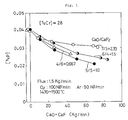
- Fig. 1 shows graphs of the phosphorus content of the metal after the treatment plotted against the total amount (kg/ton) of the injected (CaO + CaF2), when a flux consisting essentially of CaO and CaF2 with the indicated CaO/CaF2 ratio carried by a mixed gas of oxygen and argon was injected into chromium-containing molten pig iron having a chromium content of 28 %, a carbon content of 6 % and a phosphorus content of 0.04 %.
- the feed rate of the carrier gas was kept constant with 100 Nl/min. of O2 and 50 Nl/min. of Ar.
- the feed rate of the flux was also kept constant at 1.5 kg/min.
- the abscissa indicates the total amount (kg/ton) of the injected (CaO + CaF2) which is proportional, in these experiments, to the time of injection under the constant conditions mentioned above.
- the temperature of the metal was maintained within the range of from 1470 to 1500 °C.
- Fig. 1 reveals that the dephosphorization of chromium-containing molten pig iron satisfactorily proceeds in spite of the fact that the chromium-containing molten pig iron has a chromium content as high as 28 %. This is unexpected in view of the prior art prejudice that the oxidation dephosphorization of chromium-containing molten pig iron with a flux of CaO-CaF2 series would become impossible as the chromium content approaches about 30 %. Furthermore, it is noted from Fig.
- Fig. 2 depicts the behavior of phosphorus when a flux consisting essentially of CaO and CaF2 with a CaO/CaF2 ratio of 5/5 was injected into the same chromium-containing molten pig iron having a chromium content of 28 % as used in the experiments of Fig. 1 using various O2/(CaO + CaF2) ratios indicated in Fig. 2. It can be understood from Fig. 2 that while the dephosphorization does not satisfactorily proceed if the O2/(CaO + CaF2) ratio is as low as 5.9 Nl/kg as shown by blank circles ⁇ , the dephosphorization satisfactorily proceeds as this ratio exceeds a certain value (about 35 Nl/kg as shown by blank triangles ⁇ . This indicates that it is necessary to continuously supply at least a certain amount of oxygen into the molten hot metal.
- Fig. 3 shows the % dephosphorization when 67-73 kg/ton of a flux consisting essentially of CaO and CaF2 with a CaO/CaF2 ratio of 5/5 was injected into the same chromium-containing molten pig iron with varied O2/(CaO + CaF2) ratios as in the experiments of Fig. 2.
- the % dephosphorization is maximum where the O2/(CaO + CaF2) ratio is about 35 Nl/kg.
- the percentage of dephosphorization is not further enhanced even if the oxidizing power is further increased by increasing the O2/(CaO + CaF2) ratio, indicating that there is an appropriate range for the O2/(CaO + CaF2) ratio.
- the optimum oxidation condition can be represented by an O2/(CaO + CaF2) ratio of about 35 Nl/kg or higher.
- the optimum oxidation condition may vary depending upon particular processing parameters concerned including, for example, conditions of stirring the molten hot metal, configuration of the refining vessel, manner of injecting the solid-gas mixture, feeding rate of the flux, and fluidity of the slag formed. Accordingly, a particular O2/(CaO + CaF2) ratio employed should be appropriately selected depending upon particular processing parameters concerned.
- the O2/(CaO + CaF2) ratio may be within the range between 20 Nl/kg and 120 Nl/kg.
- gaseous oxygen was used as a sole oxygen source for the dephosphorization purpose
- a solid oxygen source may be used in addition to the gaseous oxygen source by incorporating the particulate flux with an appropriate amount of the solid oxygen source such as mill scale and iron ores.
- the ⁇ O2/(CaO + CaF2) ratio selected within the range of from 20 to 120 Nl/kg wherein ⁇ O2 is a sum of an amount of O2 in Nl contained in the carrier gas and an amount of oxygen in Nl which will be generated when the iron oxide (the solid oxygen source such as mill scale and iron ores) contained in the flux is decomposed to Fe and O2.
- the solid oxygen source substantially lowers the temperature of the molten hot metal, and is disadvantageous from the viewpoint of heat compensation.
- the solid oxygen source invites a larger oxidation loss of chromium than the gaseous oxygen source.
- any solid oxygen source it should be incorporated in the particulate flux in such a restricted amount that the weight of the solid oxygen source does not exceeds 30 % by weight based on the combined weight of the particulate flux and the solid oxygen source.
- No solid oxygen source should preferably be used, if the case allows.
- Fig. 4 depicts the behavior of phosphorus ( P ) when a flux consisting essentially of CaO and CaF2 with a CaO/CaF2 ratio of 5/5 was injected into chromium-containing molten pig iron maintained at a temperature of from 1470 to 1500 °C. and having the indicated chromium content by the method according to the invention.
- the feed rate of (CaO + CaF2) was about 1.5 kg/min., and the flow rate of O2 was within the range of from 100 to 170 Nl/min.
- Fig. 4 reveals that chromium-containing molten pig iron having a chromium content of about 8 % can be readily dephosphorized by the method according to the invention. Chromium-containing molten pig iron having a chromium content as high as about 28 % can also be effectively dephosphorized by the method according to the invention.
- Table 1 shows changes in components Cr , P , S and C of metal before and after treatment in Examples similar to the experiments illustrated above.
- the feed rate of (CaO + CaF2) was about 1.5 kg/min.
- the flow rate of O2 was about 100 Nl/min.
- the O2/(CaO + CaF2) ratio was maintained at an approximately constant value of about 66.7 Nl/kg.
- chromium-containing molten pig iron having a chromium content of about 28 % was dephosphorized in Comparative Example according to a prior art method, in which the chromium-containing molten pig iron was stirred in a 300 kg high frequency electric furnace with argon and the flux was added on the surface of the molten pig iron. Results are shown in Table 1.
- the invention is further illustrated by Examples in which 5 ton of chromium-containing molten pig iron was treated by the method according to the invention.
- the formulation (in % by weight) of the injected particulate fluxes is shown in Table 2.
- Flux I contained 10 % by weight of mill scale.
- Flux II contained 15 % by weight of limestone. Pulverized naturally occurring fluorite was used as such in Flux I and II as the CaF2 source. Analysis of the fluorite is shown in Table 3. It contained 13.6 % by weight of SiO2 addition to about 80 % by weight of CaF2. Both Flux I and II had a CaO/CaF2 ratio within the range of from 1.2 to 1.3.
- a refining vessel equipped with an injection nozzle on its side wall was charged with 5 ton of chromium-containing molten pig iron, and Flux I or II was injected into the molten hot metal through the nozzle by means of a carrier gas containing gaseous oxygen.
- the nozzle had a nozzle port at a level about 25 cm below the surface of the molten hot metal and obliquely inclined downwards in a direction towards approximately the center of the bottom of the vessel.
- the carrier gas was a mixture of argon and oxygen gases.
- chromium-containing molten pig iron can be effectively dephosphorized without substantial oxidation loss of chromium using an inexpensive flux in a reduced amount (the amount of CaF2 used is also reduced).
- the slag formed can be in the semi-molten condition, and thus, melting loss of refractory is small.
- Chromium-containing molten pig iron having a chromium content as high as about 30 %, the dephosphorization of which has heretofore been considered impossible with a flux of CaO-CaF2 series can also dephosphorized by the method according to the invention.
- reduction in temperature of the metal during treatment is small in the method according to the invention, since gaseous oxygen is used as the oxygen source.
Landscapes
- Chemical & Material Sciences (AREA)
- Engineering & Computer Science (AREA)
- Materials Engineering (AREA)
- Metallurgy (AREA)
- Organic Chemistry (AREA)
- Manufacturing & Machinery (AREA)
- Refinement Of Pig-Iron, Manufacture Of Cast Iron, And Steel Manufacture Other Than In Revolving Furnaces (AREA)
- Treatment Of Steel In Its Molten State (AREA)
Abstract
Claims (6)
- Procédé de déphosphoration de fonte brute fondue contenant du chrome ayant un contenu en chrome d' au moins 3 % en poids avec une perte réduite par oxydation de chrome, consistant à ajouter une source d'oxygène pour oxyder le phosphore (P) contenu dans la fonte brute fondue contenant du chrome et un flux particulaire de CaO-CaF₂ en série, caractérisé en ce gu'un mélange solide/gaz d'un flux particulaire dispersé dans un gaz contenant de l'oxygène est injecté dans la fonte brute fondue contenant du chrome à partir d'un emplacement situé en-dessous du niveau de la surface de la fonte brute fondue contenant du chrome, ce flux contenant au moins 70 % en poids de CaO et de CaF₂ au total avec un rapport pondéral entre CaO et CaF₂ (CaO/CaF₂) non inférieur à 4/6, le reste étant constitué d' oxyde de fer et d'impuretés inévitables, le mélange solide/gaz ayant un rapport ΣO₂/(CaO+CaF₂) dans la plage allant de 20 à 120 N1/kg où ΣO₂ est la somme de la quantité d'oxygène dans N1 contenue dans le gaz contenant de l'oxygène et une quantité d'oxygène dans N1 qui sera produite quand l'oxyde de fer contenu dans le flux est décomposé en Fe et O₂.
- Procédé de déphosphoration de fonte brute fondue contenant du chrome selon la revendication 1, dans lequel le rapport pondéral entre CaO et CaF₂ (CaO/CaF₂) dans le flux est compris dans la plage située entre 7/3 et 4/6.
- Procédé de déphosphoration de fonte brute fondue contenant du chrome selon la revendication 1 ou 2, dans lequel la fonte brute fondue contenant du chrome a un contenu en chrome compris entre 8 et 30 % en poids.
- Procédé de déphosphoration de fonte brute fondue contenant du chrome selon la revendication 1, 2 ou 3 dans lequel le mélange solide/gaz est injecté dans la fonte brute fondue contenant du chrome par l'intermédiaire d'une ou plusieurs buses prévues sur une ou plusieurs parties de fond ou latérales d'un creuset contenant la fonte brute fondue contenant du chrome.
- Procédé de déphosphoration de fonte brute fondue contenant du chrome selon la revendication 1, 2, 3 ou 4, dans lequel le flux particulaire est formulé à partir de chaux vive et d'un fluorite se produisant naturellement contenant au moins 70 % en poids de CaF₂ et au moins 5 % en poids de SiO₂.
- Procédé de déphosphoration de fonte brute fondue contenant du chrome selon l'une quelconque des revendications 1 à 5, dans lequel la source d'oxygène pour oxyder le phosphore consiste en oxygène gazeux contenu dans le gaz contenant de l'oxygène.
Applications Claiming Priority (3)
| Application Number | Priority Date | Filing Date | Title |
|---|---|---|---|
| JP17642489 | 1989-07-08 | ||
| JP176424/89 | 1989-07-08 | ||
| PCT/JP1990/000842 WO1991000928A1 (fr) | 1989-07-08 | 1990-06-28 | Procede de dephosphoration d'une fonte liquide contenant du chrome avec abaissement de la perte de chrome par oxydation |
Publications (3)
| Publication Number | Publication Date |
|---|---|
| EP0437618A1 EP0437618A1 (fr) | 1991-07-24 |
| EP0437618A4 EP0437618A4 (en) | 1992-04-01 |
| EP0437618B1 true EP0437618B1 (fr) | 1995-10-04 |
Family
ID=16013458
Family Applications (1)
| Application Number | Title | Priority Date | Filing Date |
|---|---|---|---|
| EP90909850A Expired - Lifetime EP0437618B1 (fr) | 1989-07-08 | 1990-06-28 | Procede de dephosphoration d'une fonte liquide contenant du chrome avec abaissement de la perte de chrome par oxydation |
Country Status (7)
| Country | Link |
|---|---|
| US (1) | US5156671A (fr) |
| EP (1) | EP0437618B1 (fr) |
| JP (1) | JP2684113B2 (fr) |
| KR (1) | KR0129035B1 (fr) |
| CA (1) | CA2035886C (fr) |
| DE (1) | DE69022839T2 (fr) |
| WO (1) | WO1991000928A1 (fr) |
Families Citing this family (1)
| Publication number | Priority date | Publication date | Assignee | Title |
|---|---|---|---|---|
| KR100910470B1 (ko) * | 2001-12-14 | 2009-08-04 | 주식회사 포스코 | 전로조업에서의 용강탈린방법 |
Citations (1)
| Publication number | Priority date | Publication date | Assignee | Title |
|---|---|---|---|---|
| JPS565910A (en) * | 1979-06-29 | 1981-01-22 | Nisshin Steel Co Ltd | Dephosphorizing method of pig iron containing chromium |
Family Cites Families (2)
| Publication number | Priority date | Publication date | Assignee | Title |
|---|---|---|---|---|
| JPS5713110A (en) * | 1980-06-28 | 1982-01-23 | Kawasaki Steel Corp | Dephosphorization treatment of molten iron |
| JPS5770219A (en) * | 1980-10-21 | 1982-04-30 | Nisshin Steel Co Ltd | Method for dephosphorizing, desulfurizing and denitrifying iron alloy |
-
1990
- 1990-06-28 EP EP90909850A patent/EP0437618B1/fr not_active Expired - Lifetime
- 1990-06-28 CA CA002035886A patent/CA2035886C/fr not_active Expired - Fee Related
- 1990-06-28 US US07/651,384 patent/US5156671A/en not_active Expired - Fee Related
- 1990-06-28 JP JP2168421A patent/JP2684113B2/ja not_active Expired - Lifetime
- 1990-06-28 WO PCT/JP1990/000842 patent/WO1991000928A1/fr not_active Ceased
- 1990-06-28 DE DE69022839T patent/DE69022839T2/de not_active Expired - Fee Related
-
1991
- 1991-03-06 KR KR1019910700249A patent/KR0129035B1/ko not_active Expired - Fee Related
Patent Citations (1)
| Publication number | Priority date | Publication date | Assignee | Title |
|---|---|---|---|---|
| JPS565910A (en) * | 1979-06-29 | 1981-01-22 | Nisshin Steel Co Ltd | Dephosphorizing method of pig iron containing chromium |
Also Published As
| Publication number | Publication date |
|---|---|
| CA2035886C (fr) | 2000-10-17 |
| US5156671A (en) | 1992-10-20 |
| KR920701486A (ko) | 1992-08-11 |
| DE69022839T2 (de) | 1996-05-30 |
| EP0437618A1 (fr) | 1991-07-24 |
| JP2684113B2 (ja) | 1997-12-03 |
| EP0437618A4 (en) | 1992-04-01 |
| DE69022839D1 (de) | 1995-11-09 |
| JPH03130315A (ja) | 1991-06-04 |
| WO1991000928A1 (fr) | 1991-01-24 |
| KR0129035B1 (ko) | 1998-04-16 |
| CA2035886A1 (fr) | 1991-01-09 |
Similar Documents
| Publication | Publication Date | Title |
|---|---|---|
| EP0328677B1 (fr) | Procede et four de reduction par fusion d'une matiere de depart au chrome | |
| US4295882A (en) | Steel making process | |
| EP0331751B1 (fr) | PROCEDE DE DECARBURISATION DE FONTE BRUTE A HAUTE TENEUR EN Cr | |
| EP0437618B1 (fr) | Procede de dephosphoration d'une fonte liquide contenant du chrome avec abaissement de la perte de chrome par oxydation | |
| KR100802639B1 (ko) | 강철의 직접 합금 방법 | |
| KR910009960B1 (ko) | 전기로의 용융환원법 | |
| EP0360954B1 (fr) | Procédé de fusion de matériaux froids contenant du fer | |
| US4242126A (en) | Process for the treatment of iron melts and for increasing the scrap portion in the converter | |
| EP0073274B1 (fr) | Procédé pour la désiliciation préliminaire de fer fondu par insufflation d'oxygène gazeux | |
| EP0115271B1 (fr) | Procédé de fabrication d'acier utilisant du carbure de calcium comme source de chaleur auxiliaire | |
| KR920004673B1 (ko) | 스크랩철, 해면철 및 고상선철등을 용해시키기 위한 공정 | |
| EP0015396B1 (fr) | Procédé pour l'augmentation de la durabilité des revêtements réfractaires des convertisseurs à garniture basique | |
| US4752327A (en) | Dephosphorization process for manganese alloys | |
| JPS6121285B2 (fr) | ||
| US3304172A (en) | Process for the manufacture of low phosphorus pig iron | |
| EP0104841B1 (fr) | Déphosphoration du fer | |
| SU729251A1 (ru) | Способ выплавки стали в подовом сталеплавильном агрегате | |
| CA1075012A (fr) | Procede de dephosphoration de la fonte grise coulee | |
| SU1071645A1 (ru) | Способ производства стали | |
| JP3718263B2 (ja) | 溶銑の予備処理方法 | |
| GB2052563A (en) | Process for the Treatment of Molten Iron with Increased Scrap Content | |
| JPH024938A (ja) | 中炭素および低炭素フェロマンガンの製造方法 | |
| JPH09241716A (ja) | ステンレス鋼用電気アーク炉溶銑の脱硫方法 | |
| JPH0243802B2 (fr) | ||
| JPH0568532B2 (fr) |
Legal Events
| Date | Code | Title | Description |
|---|---|---|---|
| PUAI | Public reference made under article 153(3) epc to a published international application that has entered the european phase |
Free format text: ORIGINAL CODE: 0009012 |
|
| 17P | Request for examination filed |
Effective date: 19910306 |
|
| AK | Designated contracting states |
Kind code of ref document: A1 Designated state(s): DE GB |
|
| A4 | Supplementary search report drawn up and despatched |
Effective date: 19920207 |
|
| AK | Designated contracting states |
Kind code of ref document: A4 Designated state(s): DE GB |
|
| 17Q | First examination report despatched |
Effective date: 19931103 |
|
| GRAA | (expected) grant |
Free format text: ORIGINAL CODE: 0009210 |
|
| AK | Designated contracting states |
Kind code of ref document: B1 Designated state(s): DE GB |
|
| REF | Corresponds to: |
Ref document number: 69022839 Country of ref document: DE Date of ref document: 19951109 |
|
| PLBE | No opposition filed within time limit |
Free format text: ORIGINAL CODE: 0009261 |
|
| STAA | Information on the status of an ep patent application or granted ep patent |
Free format text: STATUS: NO OPPOSITION FILED WITHIN TIME LIMIT |
|
| 26N | No opposition filed | ||
| PGFP | Annual fee paid to national office [announced via postgrant information from national office to epo] |
Ref country code: DE Payment date: 20010618 Year of fee payment: 12 |
|
| PGFP | Annual fee paid to national office [announced via postgrant information from national office to epo] |
Ref country code: GB Payment date: 20010627 Year of fee payment: 12 |
|
| REG | Reference to a national code |
Ref country code: GB Ref legal event code: IF02 |
|
| PG25 | Lapsed in a contracting state [announced via postgrant information from national office to epo] |
Ref country code: GB Free format text: LAPSE BECAUSE OF NON-PAYMENT OF DUE FEES Effective date: 20020628 |
|
| PG25 | Lapsed in a contracting state [announced via postgrant information from national office to epo] |
Ref country code: DE Free format text: LAPSE BECAUSE OF NON-PAYMENT OF DUE FEES Effective date: 20030101 |
|
| GBPC | Gb: european patent ceased through non-payment of renewal fee |
Effective date: 20020628 |