EP0438259A1 - Conjugués de polymères biologiquement stables et polynucléotides pour le traitement du lupus erythematosus systémique - Google Patents
Conjugués de polymères biologiquement stables et polynucléotides pour le traitement du lupus erythematosus systémique Download PDFInfo
- Publication number
- EP0438259A1 EP0438259A1 EP91300262A EP91300262A EP0438259A1 EP 0438259 A1 EP0438259 A1 EP 0438259A1 EP 91300262 A EP91300262 A EP 91300262A EP 91300262 A EP91300262 A EP 91300262A EP 0438259 A1 EP0438259 A1 EP 0438259A1
- Authority
- EP
- European Patent Office
- Prior art keywords
- conjugate
- poly
- duplexes
- polymer
- polynucleotide
- Prior art date
- Legal status (The legal status is an assumption and is not a legal conclusion. Google has not performed a legal analysis and makes no representation as to the accuracy of the status listed.)
- Granted
Links
- 102000040430 polynucleotide Human genes 0.000 title claims abstract description 54
- 108091033319 polynucleotide Proteins 0.000 title claims abstract description 54
- 239000002157 polynucleotide Substances 0.000 title claims abstract description 54
- 229920000642 polymer Polymers 0.000 title claims abstract description 43
- 201000000596 systemic lupus erythematosus Diseases 0.000 title claims description 3
- 230000027455 binding Effects 0.000 claims abstract description 22
- 229920001577 copolymer Polymers 0.000 claims abstract description 10
- 238000006243 chemical reaction Methods 0.000 claims abstract description 9
- 206010025135 lupus erythematosus Diseases 0.000 claims abstract description 7
- 125000000524 functional group Chemical group 0.000 claims abstract description 6
- KDXKERNSBIXSRK-RXMQYKEDSA-N D-lysine Chemical compound NCCCC[C@@H](N)C(O)=O KDXKERNSBIXSRK-RXMQYKEDSA-N 0.000 claims abstract description 5
- WHUUTDBJXJRKMK-GSVOUGTGSA-N D-glutamic acid Chemical compound OC(=O)[C@H](N)CCC(O)=O WHUUTDBJXJRKMK-GSVOUGTGSA-N 0.000 claims abstract description 4
- 229930182847 D-glutamic acid Natural products 0.000 claims abstract description 3
- 230000009885 systemic effect Effects 0.000 claims abstract 2
- 108020004414 DNA Proteins 0.000 claims description 59
- 102000053602 DNA Human genes 0.000 claims description 21
- 239000000203 mixture Substances 0.000 claims description 17
- 238000000034 method Methods 0.000 claims description 14
- 125000003277 amino group Chemical group 0.000 claims description 11
- 125000003729 nucleotide group Chemical group 0.000 claims description 10
- 239000002773 nucleotide Substances 0.000 claims description 9
- 230000000295 complement effect Effects 0.000 claims description 7
- 238000000137 annealing Methods 0.000 claims description 5
- 239000003795 chemical substances by application Substances 0.000 claims description 4
- 239000008194 pharmaceutical composition Substances 0.000 claims description 2
- YRITVODHCMDVSY-VEGPOJNRSA-N [(2r,3s,5r)-5-(6-aminopurin-9-yl)-2-(phosphonooxymethyl)oxolan-3-yl] [(2r,3s)-3-hydroxy-5-(5-methyl-2,4-dioxopyrimidin-1-yl)oxolan-2-yl]methyl hydrogen phosphate Chemical compound O=C1NC(=O)C(C)=CN1C1O[C@H](COP(O)(=O)O[C@@H]2[C@H](O[C@H](C2)N2C3=NC=NC(N)=C3N=C2)COP(O)(O)=O)[C@@H](O)C1 YRITVODHCMDVSY-VEGPOJNRSA-N 0.000 claims 1
- XPAOKCSHUNYPBS-XSBNNCSWSA-N [(2r,3s,5r)-5-(6-aminopurin-9-yl)-3-hydroxyoxolan-2-yl]methyl [(2r,3r,5s)-3-(hydroxymethyl)-5-(5-methyl-2,4-dioxopyrimidin-1-yl)oxolan-2-yl] hydrogen phosphate Chemical compound O=C1NC(=O)C(C)=CN1[C@H]1O[C@H](OP(O)(=O)OC[C@@H]2[C@H](C[C@@H](O2)N2C3=NC=NC(N)=C3N=C2)O)[C@@H](CO)C1 XPAOKCSHUNYPBS-XSBNNCSWSA-N 0.000 claims 1
- 239000013256 coordination polymer Substances 0.000 claims 1
- 108091034117 Oligonucleotide Proteins 0.000 description 28
- 241000699670 Mus sp. Species 0.000 description 27
- JLCPHMBAVCMARE-UHFFFAOYSA-N [3-[[3-[[3-[[3-[[3-[[3-[[3-[[3-[[3-[[3-[[3-[[5-(2-amino-6-oxo-1H-purin-9-yl)-3-[[3-[[3-[[3-[[3-[[3-[[5-(2-amino-6-oxo-1H-purin-9-yl)-3-[[5-(2-amino-6-oxo-1H-purin-9-yl)-3-hydroxyoxolan-2-yl]methoxy-hydroxyphosphoryl]oxyoxolan-2-yl]methoxy-hydroxyphosphoryl]oxy-5-(5-methyl-2,4-dioxopyrimidin-1-yl)oxolan-2-yl]methoxy-hydroxyphosphoryl]oxy-5-(6-aminopurin-9-yl)oxolan-2-yl]methoxy-hydroxyphosphoryl]oxy-5-(6-aminopurin-9-yl)oxolan-2-yl]methoxy-hydroxyphosphoryl]oxy-5-(6-aminopurin-9-yl)oxolan-2-yl]methoxy-hydroxyphosphoryl]oxy-5-(6-aminopurin-9-yl)oxolan-2-yl]methoxy-hydroxyphosphoryl]oxyoxolan-2-yl]methoxy-hydroxyphosphoryl]oxy-5-(5-methyl-2,4-dioxopyrimidin-1-yl)oxolan-2-yl]methoxy-hydroxyphosphoryl]oxy-5-(4-amino-2-oxopyrimidin-1-yl)oxolan-2-yl]methoxy-hydroxyphosphoryl]oxy-5-(5-methyl-2,4-dioxopyrimidin-1-yl)oxolan-2-yl]methoxy-hydroxyphosphoryl]oxy-5-(5-methyl-2,4-dioxopyrimidin-1-yl)oxolan-2-yl]methoxy-hydroxyphosphoryl]oxy-5-(6-aminopurin-9-yl)oxolan-2-yl]methoxy-hydroxyphosphoryl]oxy-5-(6-aminopurin-9-yl)oxolan-2-yl]methoxy-hydroxyphosphoryl]oxy-5-(4-amino-2-oxopyrimidin-1-yl)oxolan-2-yl]methoxy-hydroxyphosphoryl]oxy-5-(4-amino-2-oxopyrimidin-1-yl)oxolan-2-yl]methoxy-hydroxyphosphoryl]oxy-5-(4-amino-2-oxopyrimidin-1-yl)oxolan-2-yl]methoxy-hydroxyphosphoryl]oxy-5-(6-aminopurin-9-yl)oxolan-2-yl]methoxy-hydroxyphosphoryl]oxy-5-(4-amino-2-oxopyrimidin-1-yl)oxolan-2-yl]methyl [5-(6-aminopurin-9-yl)-2-(hydroxymethyl)oxolan-3-yl] hydrogen phosphate Polymers Cc1cn(C2CC(OP(O)(=O)OCC3OC(CC3OP(O)(=O)OCC3OC(CC3O)n3cnc4c3nc(N)[nH]c4=O)n3cnc4c3nc(N)[nH]c4=O)C(COP(O)(=O)OC3CC(OC3COP(O)(=O)OC3CC(OC3COP(O)(=O)OC3CC(OC3COP(O)(=O)OC3CC(OC3COP(O)(=O)OC3CC(OC3COP(O)(=O)OC3CC(OC3COP(O)(=O)OC3CC(OC3COP(O)(=O)OC3CC(OC3COP(O)(=O)OC3CC(OC3COP(O)(=O)OC3CC(OC3COP(O)(=O)OC3CC(OC3COP(O)(=O)OC3CC(OC3COP(O)(=O)OC3CC(OC3COP(O)(=O)OC3CC(OC3COP(O)(=O)OC3CC(OC3COP(O)(=O)OC3CC(OC3COP(O)(=O)OC3CC(OC3CO)n3cnc4c(N)ncnc34)n3ccc(N)nc3=O)n3cnc4c(N)ncnc34)n3ccc(N)nc3=O)n3ccc(N)nc3=O)n3ccc(N)nc3=O)n3cnc4c(N)ncnc34)n3cnc4c(N)ncnc34)n3cc(C)c(=O)[nH]c3=O)n3cc(C)c(=O)[nH]c3=O)n3ccc(N)nc3=O)n3cc(C)c(=O)[nH]c3=O)n3cnc4c3nc(N)[nH]c4=O)n3cnc4c(N)ncnc34)n3cnc4c(N)ncnc34)n3cnc4c(N)ncnc34)n3cnc4c(N)ncnc34)O2)c(=O)[nH]c1=O JLCPHMBAVCMARE-UHFFFAOYSA-N 0.000 description 15
- 238000012360 testing method Methods 0.000 description 14
- FAPWRFPIFSIZLT-UHFFFAOYSA-M Sodium chloride Chemical compound [Na+].[Cl-] FAPWRFPIFSIZLT-UHFFFAOYSA-M 0.000 description 13
- 238000003556 assay Methods 0.000 description 11
- 241000699666 Mus <mouse, genus> Species 0.000 description 10
- LOKCTEFSRHRXRJ-UHFFFAOYSA-I dipotassium trisodium dihydrogen phosphate hydrogen phosphate dichloride Chemical compound P(=O)(O)(O)[O-].[K+].P(=O)(O)([O-])[O-].[Na+].[Na+].[Cl-].[K+].[Cl-].[Na+] LOKCTEFSRHRXRJ-UHFFFAOYSA-I 0.000 description 10
- 239000002953 phosphate buffered saline Substances 0.000 description 10
- 239000011780 sodium chloride Substances 0.000 description 9
- 239000000427 antigen Substances 0.000 description 8
- 238000010168 coupling process Methods 0.000 description 8
- 238000005859 coupling reaction Methods 0.000 description 8
- 239000002777 nucleoside Substances 0.000 description 8
- 241001465754 Metazoa Species 0.000 description 7
- 102000036639 antigens Human genes 0.000 description 7
- 108091007433 antigens Proteins 0.000 description 7
- 230000008878 coupling Effects 0.000 description 7
- 238000000502 dialysis Methods 0.000 description 7
- -1 dimethylsilyl group Chemical group 0.000 description 7
- 239000000243 solution Substances 0.000 description 7
- 238000001142 circular dichroism spectrum Methods 0.000 description 6
- 230000006058 immune tolerance Effects 0.000 description 6
- 125000003835 nucleoside group Chemical group 0.000 description 6
- 238000003752 polymerase chain reaction Methods 0.000 description 6
- 210000004989 spleen cell Anatomy 0.000 description 6
- 238000003786 synthesis reaction Methods 0.000 description 6
- 108060003951 Immunoglobulin Proteins 0.000 description 5
- 230000015572 biosynthetic process Effects 0.000 description 5
- 150000002009 diols Chemical group 0.000 description 5
- 239000003814 drug Substances 0.000 description 5
- 238000002474 experimental method Methods 0.000 description 5
- 102000018358 immunoglobulin Human genes 0.000 description 5
- 239000000463 material Substances 0.000 description 5
- 230000009257 reactivity Effects 0.000 description 5
- 238000001228 spectrum Methods 0.000 description 5
- XLYOFNOQVPJJNP-UHFFFAOYSA-N water Substances O XLYOFNOQVPJJNP-UHFFFAOYSA-N 0.000 description 5
- 208000023275 Autoimmune disease Diseases 0.000 description 4
- 238000002965 ELISA Methods 0.000 description 4
- SXRSQZLOMIGNAQ-UHFFFAOYSA-N Glutaraldehyde Chemical compound O=CCCCC=O SXRSQZLOMIGNAQ-UHFFFAOYSA-N 0.000 description 4
- 238000002835 absorbance Methods 0.000 description 4
- 244000309466 calf Species 0.000 description 4
- 210000004027 cell Anatomy 0.000 description 4
- 201000010099 disease Diseases 0.000 description 4
- 208000037265 diseases, disorders, signs and symptoms Diseases 0.000 description 4
- 230000000694 effects Effects 0.000 description 4
- 238000005227 gel permeation chromatography Methods 0.000 description 4
- 125000002887 hydroxy group Chemical group [H]O* 0.000 description 4
- KHIWWQKSHDUIBK-UHFFFAOYSA-N periodic acid Chemical compound OI(=O)(=O)=O KHIWWQKSHDUIBK-UHFFFAOYSA-N 0.000 description 4
- 239000013612 plasmid Substances 0.000 description 4
- 239000000047 product Substances 0.000 description 4
- 125000000548 ribosyl group Chemical group C1([C@H](O)[C@H](O)[C@H](O1)CO)* 0.000 description 4
- JQWHASGSAFIOCM-UHFFFAOYSA-M sodium periodate Chemical compound [Na+].[O-]I(=O)(=O)=O JQWHASGSAFIOCM-UHFFFAOYSA-M 0.000 description 4
- 210000001541 thymus gland Anatomy 0.000 description 4
- 125000001917 2,4-dinitrophenyl group Chemical group [H]C1=C([H])C(=C([H])C(=C1*)[N+]([O-])=O)[N+]([O-])=O 0.000 description 3
- 108091092742 A-DNA Proteins 0.000 description 3
- 102000004190 Enzymes Human genes 0.000 description 3
- 108090000790 Enzymes Proteins 0.000 description 3
- PYMYPHUHKUWMLA-LMVFSUKVSA-N Ribose Natural products OC[C@@H](O)[C@@H](O)[C@@H](O)C=O PYMYPHUHKUWMLA-LMVFSUKVSA-N 0.000 description 3
- 108091027569 Z-DNA Proteins 0.000 description 3
- 150000001299 aldehydes Chemical group 0.000 description 3
- HMFHBZSHGGEWLO-UHFFFAOYSA-N alpha-D-Furanose-Ribose Natural products OCC1OC(O)C(O)C1O HMFHBZSHGGEWLO-UHFFFAOYSA-N 0.000 description 3
- 230000003172 anti-dna Effects 0.000 description 3
- 239000007859 condensation product Substances 0.000 description 3
- 230000021615 conjugation Effects 0.000 description 3
- 238000004132 cross linking Methods 0.000 description 3
- 239000000539 dimer Substances 0.000 description 3
- 229940079593 drug Drugs 0.000 description 3
- 239000012537 formulation buffer Substances 0.000 description 3
- 239000000499 gel Substances 0.000 description 3
- 238000004519 manufacturing process Methods 0.000 description 3
- 238000010369 molecular cloning Methods 0.000 description 3
- 125000004573 morpholin-4-yl group Chemical group N1(CCOCC1)* 0.000 description 3
- 238000010172 mouse model Methods 0.000 description 3
- 102000039446 nucleic acids Human genes 0.000 description 3
- 108020004707 nucleic acids Proteins 0.000 description 3
- 150000007523 nucleic acids Chemical class 0.000 description 3
- 150000003833 nucleoside derivatives Chemical class 0.000 description 3
- 239000011541 reaction mixture Substances 0.000 description 3
- 230000000405 serological effect Effects 0.000 description 3
- 239000001509 sodium citrate Substances 0.000 description 3
- NLJMYIDDQXHKNR-UHFFFAOYSA-K sodium citrate Chemical compound O.O.[Na+].[Na+].[Na+].[O-]C(=O)CC(O)(CC([O-])=O)C([O-])=O NLJMYIDDQXHKNR-UHFFFAOYSA-K 0.000 description 3
- BEOOHQFXGBMRKU-UHFFFAOYSA-N sodium cyanoborohydride Chemical compound [Na+].[B-]C#N BEOOHQFXGBMRKU-UHFFFAOYSA-N 0.000 description 3
- 239000007787 solid Substances 0.000 description 3
- 239000000758 substrate Substances 0.000 description 3
- 230000003614 tolerogenic effect Effects 0.000 description 3
- 239000003656 tris buffered saline Substances 0.000 description 3
- LLXVXPPXELIDGQ-UHFFFAOYSA-N (2,5-dioxopyrrolidin-1-yl) 3-(2,5-dioxopyrrol-1-yl)benzoate Chemical compound C=1C=CC(N2C(C=CC2=O)=O)=CC=1C(=O)ON1C(=O)CCC1=O LLXVXPPXELIDGQ-UHFFFAOYSA-N 0.000 description 2
- 102000002260 Alkaline Phosphatase Human genes 0.000 description 2
- 108020004774 Alkaline Phosphatase Proteins 0.000 description 2
- IJGRMHOSHXDMSA-UHFFFAOYSA-N Atomic nitrogen Chemical compound N#N IJGRMHOSHXDMSA-UHFFFAOYSA-N 0.000 description 2
- 241000972773 Aulopiformes Species 0.000 description 2
- 241000283707 Capra Species 0.000 description 2
- CMSMOCZEIVJLDB-UHFFFAOYSA-N Cyclophosphamide Chemical compound ClCCN(CCCl)P1(=O)NCCCO1 CMSMOCZEIVJLDB-UHFFFAOYSA-N 0.000 description 2
- 239000004743 Polypropylene Substances 0.000 description 2
- 229920001213 Polysorbate 20 Polymers 0.000 description 2
- WCUXLLCKKVVCTQ-UHFFFAOYSA-M Potassium chloride Chemical compound [Cl-].[K+] WCUXLLCKKVVCTQ-UHFFFAOYSA-M 0.000 description 2
- 229920005654 Sephadex Polymers 0.000 description 2
- 239000012507 Sephadex™ Substances 0.000 description 2
- 239000007983 Tris buffer Substances 0.000 description 2
- 239000011543 agarose gel Substances 0.000 description 2
- 125000003282 alkyl amino group Chemical group 0.000 description 2
- 238000004458 analytical method Methods 0.000 description 2
- 239000007864 aqueous solution Substances 0.000 description 2
- 230000001363 autoimmune Effects 0.000 description 2
- 125000002277 benzylpenicilloyl group Chemical group C(=O)(O)[C@@H]1N[C@H](SC1(C)C)[C@@H](C(=O)*)NC(CC1=CC=CC=C1)=O 0.000 description 2
- 239000000872 buffer Substances 0.000 description 2
- 230000008859 change Effects 0.000 description 2
- 239000003638 chemical reducing agent Substances 0.000 description 2
- 230000005494 condensation Effects 0.000 description 2
- 238000006482 condensation reaction Methods 0.000 description 2
- 239000003431 cross linking reagent Substances 0.000 description 2
- 229960004397 cyclophosphamide Drugs 0.000 description 2
- 238000011161 development Methods 0.000 description 2
- 238000010790 dilution Methods 0.000 description 2
- 239000012895 dilution Substances 0.000 description 2
- ZPWVASYFFYYZEW-UHFFFAOYSA-L dipotassium hydrogen phosphate Chemical compound [K+].[K+].OP([O-])([O-])=O ZPWVASYFFYYZEW-UHFFFAOYSA-L 0.000 description 2
- 229910000396 dipotassium phosphate Inorganic materials 0.000 description 2
- 235000019797 dipotassium phosphate Nutrition 0.000 description 2
- BNIILDVGGAEEIG-UHFFFAOYSA-L disodium hydrogen phosphate Chemical compound [Na+].[Na+].OP([O-])([O-])=O BNIILDVGGAEEIG-UHFFFAOYSA-L 0.000 description 2
- 230000006870 function Effects 0.000 description 2
- 238000004128 high performance liquid chromatography Methods 0.000 description 2
- 210000000987 immune system Anatomy 0.000 description 2
- 229940072221 immunoglobulins Drugs 0.000 description 2
- 238000000338 in vitro Methods 0.000 description 2
- 230000005764 inhibitory process Effects 0.000 description 2
- 238000002347 injection Methods 0.000 description 2
- 239000007924 injection Substances 0.000 description 2
- 108010045069 keyhole-limpet hemocyanin Proteins 0.000 description 2
- 210000003734 kidney Anatomy 0.000 description 2
- 125000005647 linker group Chemical group 0.000 description 2
- 244000005700 microbiome Species 0.000 description 2
- 238000002264 polyacrylamide gel electrophoresis Methods 0.000 description 2
- 239000000256 polyoxyethylene sorbitan monolaurate Substances 0.000 description 2
- 235000010486 polyoxyethylene sorbitan monolaurate Nutrition 0.000 description 2
- 229920001155 polypropylene Polymers 0.000 description 2
- 238000002360 preparation method Methods 0.000 description 2
- 108090000623 proteins and genes Proteins 0.000 description 2
- 238000006722 reduction reaction Methods 0.000 description 2
- 239000002342 ribonucleoside Substances 0.000 description 2
- 235000019515 salmon Nutrition 0.000 description 2
- 230000028327 secretion Effects 0.000 description 2
- 239000012279 sodium borohydride Substances 0.000 description 2
- 229910000033 sodium borohydride Inorganic materials 0.000 description 2
- 238000010561 standard procedure Methods 0.000 description 2
- 238000003756 stirring Methods 0.000 description 2
- 239000006228 supernatant Substances 0.000 description 2
- 230000001225 therapeutic effect Effects 0.000 description 2
- 230000009466 transformation Effects 0.000 description 2
- 239000013638 trimer Substances 0.000 description 2
- LENZDBCJOHFCAS-UHFFFAOYSA-N tris Chemical compound OCC(N)(CO)CO LENZDBCJOHFCAS-UHFFFAOYSA-N 0.000 description 2
- YQKSRXKUVVMWPH-UHFFFAOYSA-N 1-(hydroxymethyl)cyclopentane-1,2-diol Chemical compound OCC1(O)CCCC1O YQKSRXKUVVMWPH-UHFFFAOYSA-N 0.000 description 1
- KMEMIMRPZGDOMG-UHFFFAOYSA-N 2-cyanoethoxyphosphonamidous acid Chemical class NP(O)OCCC#N KMEMIMRPZGDOMG-UHFFFAOYSA-N 0.000 description 1
- QWTBDIBOOIAZEF-UHFFFAOYSA-N 3-[chloro-[di(propan-2-yl)amino]phosphanyl]oxypropanenitrile Chemical compound CC(C)N(C(C)C)P(Cl)OCCC#N QWTBDIBOOIAZEF-UHFFFAOYSA-N 0.000 description 1
- ALYNCZNDIQEVRV-UHFFFAOYSA-N 4-aminobenzoic acid Chemical compound NC1=CC=C(C(O)=O)C=C1 ALYNCZNDIQEVRV-UHFFFAOYSA-N 0.000 description 1
- 108700032051 Ambrosia artemisiifolia Amb a I Proteins 0.000 description 1
- DWRXFEITVBNRMK-UHFFFAOYSA-N Beta-D-1-Arabinofuranosylthymine Natural products O=C1NC(=O)C(C)=CN1C1C(O)C(O)C(CO)O1 DWRXFEITVBNRMK-UHFFFAOYSA-N 0.000 description 1
- 108091003079 Bovine Serum Albumin Proteins 0.000 description 1
- 241000700198 Cavia Species 0.000 description 1
- 102100034330 Chromaffin granule amine transporter Human genes 0.000 description 1
- 208000035473 Communicable disease Diseases 0.000 description 1
- 239000004971 Cross linker Substances 0.000 description 1
- HMFHBZSHGGEWLO-SOOFDHNKSA-N D-ribofuranose Chemical compound OC[C@H]1OC(O)[C@H](O)[C@@H]1O HMFHBZSHGGEWLO-SOOFDHNKSA-N 0.000 description 1
- 102000012410 DNA Ligases Human genes 0.000 description 1
- 108010061982 DNA Ligases Proteins 0.000 description 1
- 230000004543 DNA replication Effects 0.000 description 1
- 230000004568 DNA-binding Effects 0.000 description 1
- ZNZYKNKBJPZETN-WELNAUFTSA-N Dialdehyde 11678 Chemical compound N1C2=CC=CC=C2C2=C1[C@H](C[C@H](/C(=C/O)C(=O)OC)[C@@H](C=C)C=O)NCC2 ZNZYKNKBJPZETN-WELNAUFTSA-N 0.000 description 1
- 241000588724 Escherichia coli Species 0.000 description 1
- KRHYYFGTRYWZRS-UHFFFAOYSA-M Fluoride anion Chemical compound [F-] KRHYYFGTRYWZRS-UHFFFAOYSA-M 0.000 description 1
- 206010018364 Glomerulonephritis Diseases 0.000 description 1
- WQZGKKKJIJFFOK-GASJEMHNSA-N Glucose Chemical compound OC[C@H]1OC(O)[C@H](O)[C@@H](O)[C@@H]1O WQZGKKKJIJFFOK-GASJEMHNSA-N 0.000 description 1
- WHUUTDBJXJRKMK-UHFFFAOYSA-N Glutamic acid Natural products OC(=O)C(N)CCC(O)=O WHUUTDBJXJRKMK-UHFFFAOYSA-N 0.000 description 1
- 208000032843 Hemorrhage Diseases 0.000 description 1
- 241000282412 Homo Species 0.000 description 1
- 101000641221 Homo sapiens Chromaffin granule amine transporter Proteins 0.000 description 1
- 102000003960 Ligases Human genes 0.000 description 1
- 108090000364 Ligases Proteins 0.000 description 1
- 239000004472 Lysine Substances 0.000 description 1
- KDXKERNSBIXSRK-UHFFFAOYSA-N Lysine Natural products NCCCCC(N)C(O)=O KDXKERNSBIXSRK-UHFFFAOYSA-N 0.000 description 1
- 101000771663 Mus musculus WD repeat and FYVE domain-containing protein 3 Proteins 0.000 description 1
- 101710163270 Nuclease Proteins 0.000 description 1
- 229910019142 PO4 Inorganic materials 0.000 description 1
- 241001494479 Pecora Species 0.000 description 1
- 239000002202 Polyethylene glycol Substances 0.000 description 1
- 108010021757 Polynucleotide 5'-Hydroxyl-Kinase Proteins 0.000 description 1
- 102000008422 Polynucleotide 5'-hydroxyl-kinase Human genes 0.000 description 1
- 239000004793 Polystyrene Substances 0.000 description 1
- 239000004372 Polyvinyl alcohol Substances 0.000 description 1
- 239000012506 Sephacryl® Substances 0.000 description 1
- XSTXAVWGXDQKEL-UHFFFAOYSA-N Trichloroethylene Chemical compound ClC=C(Cl)Cl XSTXAVWGXDQKEL-UHFFFAOYSA-N 0.000 description 1
- UATJOMSPNYCXIX-UHFFFAOYSA-N Trinitrobenzene Chemical compound [O-][N+](=O)C1=CC([N+]([O-])=O)=CC([N+]([O-])=O)=C1 UATJOMSPNYCXIX-UHFFFAOYSA-N 0.000 description 1
- XSQUKJJJFZCRTK-UHFFFAOYSA-N Urea Chemical compound NC(N)=O XSQUKJJJFZCRTK-UHFFFAOYSA-N 0.000 description 1
- 239000002253 acid Substances 0.000 description 1
- 238000005903 acid hydrolysis reaction Methods 0.000 description 1
- 125000002015 acyclic group Chemical group 0.000 description 1
- 239000000654 additive Substances 0.000 description 1
- 230000000996 additive effect Effects 0.000 description 1
- OIRDTQYFTABQOQ-KQYNXXCUSA-N adenosine Chemical compound C1=NC=2C(N)=NC=NC=2N1[C@@H]1O[C@H](CO)[C@@H](O)[C@H]1O OIRDTQYFTABQOQ-KQYNXXCUSA-N 0.000 description 1
- 229960005305 adenosine Drugs 0.000 description 1
- 150000003973 alkyl amines Chemical class 0.000 description 1
- 150000001412 amines Chemical class 0.000 description 1
- 235000001014 amino acid Nutrition 0.000 description 1
- 150000001413 amino acids Chemical class 0.000 description 1
- 229940064734 aminobenzoate Drugs 0.000 description 1
- BFNBIHQBYMNNAN-UHFFFAOYSA-N ammonium sulfate Chemical class N.N.OS(O)(=O)=O BFNBIHQBYMNNAN-UHFFFAOYSA-N 0.000 description 1
- AVKUERGKIZMTKX-NJBDSQKTSA-N ampicillin Chemical compound C1([C@@H](N)C(=O)N[C@H]2[C@H]3SC([C@@H](N3C2=O)C(O)=O)(C)C)=CC=CC=C1 AVKUERGKIZMTKX-NJBDSQKTSA-N 0.000 description 1
- 229960000723 ampicillin Drugs 0.000 description 1
- 239000012491 analyte Substances 0.000 description 1
- 230000005875 antibody response Effects 0.000 description 1
- 238000013459 approach Methods 0.000 description 1
- 239000008365 aqueous carrier Substances 0.000 description 1
- 210000003719 b-lymphocyte Anatomy 0.000 description 1
- 239000011324 bead Substances 0.000 description 1
- 230000009286 beneficial effect Effects 0.000 description 1
- 230000008901 benefit Effects 0.000 description 1
- 238000007068 beta-elimination reaction Methods 0.000 description 1
- 230000001588 bifunctional effect Effects 0.000 description 1
- 230000004071 biological effect Effects 0.000 description 1
- 229920001222 biopolymer Polymers 0.000 description 1
- 208000034158 bleeding Diseases 0.000 description 1
- 231100000319 bleeding Toxicity 0.000 description 1
- 230000000740 bleeding effect Effects 0.000 description 1
- 230000000903 blocking effect Effects 0.000 description 1
- 230000037396 body weight Effects 0.000 description 1
- 229940098773 bovine serum albumin Drugs 0.000 description 1
- 239000004202 carbamide Substances 0.000 description 1
- 239000000969 carrier Substances 0.000 description 1
- 238000005119 centrifugation Methods 0.000 description 1
- 238000012412 chemical coupling Methods 0.000 description 1
- 238000001311 chemical methods and process Methods 0.000 description 1
- 238000004587 chromatography analysis Methods 0.000 description 1
- 238000000978 circular dichroism spectroscopy Methods 0.000 description 1
- 238000010367 cloning Methods 0.000 description 1
- 239000013599 cloning vector Substances 0.000 description 1
- 238000009833 condensation Methods 0.000 description 1
- 239000005289 controlled pore glass Substances 0.000 description 1
- 239000007822 coupling agent Substances 0.000 description 1
- 125000004122 cyclic group Chemical group 0.000 description 1
- 230000034994 death Effects 0.000 description 1
- 231100000517 death Toxicity 0.000 description 1
- 230000007850 degeneration Effects 0.000 description 1
- 239000008367 deionised water Substances 0.000 description 1
- 229910021641 deionized water Inorganic materials 0.000 description 1
- 238000011033 desalting Methods 0.000 description 1
- 230000004069 differentiation Effects 0.000 description 1
- FRTGEIHSCHXMTI-UHFFFAOYSA-N dimethyl octanediimidate Chemical compound COC(=N)CCCCCCC(=N)OC FRTGEIHSCHXMTI-UHFFFAOYSA-N 0.000 description 1
- UBHZUDXTHNMNLD-UHFFFAOYSA-N dimethylsilane Chemical compound C[SiH2]C UBHZUDXTHNMNLD-UHFFFAOYSA-N 0.000 description 1
- 238000005516 engineering process Methods 0.000 description 1
- 230000002255 enzymatic effect Effects 0.000 description 1
- 210000003743 erythrocyte Anatomy 0.000 description 1
- 230000029142 excretion Effects 0.000 description 1
- 230000001747 exhibiting effect Effects 0.000 description 1
- 238000009472 formulation Methods 0.000 description 1
- 238000005194 fractionation Methods 0.000 description 1
- 239000012634 fragment Substances 0.000 description 1
- 108010074605 gamma-Globulins Proteins 0.000 description 1
- 230000009395 genetic defect Effects 0.000 description 1
- 239000011521 glass Substances 0.000 description 1
- 102000034238 globular proteins Human genes 0.000 description 1
- 108091005896 globular proteins Proteins 0.000 description 1
- 235000013922 glutamic acid Nutrition 0.000 description 1
- 239000004220 glutamic acid Substances 0.000 description 1
- 210000002443 helper t lymphocyte Anatomy 0.000 description 1
- 125000000623 heterocyclic group Chemical group 0.000 description 1
- 239000008241 heterogeneous mixture Substances 0.000 description 1
- 125000004029 hydroxymethyl group Chemical group [H]OC([H])([H])* 0.000 description 1
- 239000005457 ice water Substances 0.000 description 1
- 230000001900 immune effect Effects 0.000 description 1
- 230000008629 immune suppression Effects 0.000 description 1
- 230000005847 immunogenicity Effects 0.000 description 1
- 229960003444 immunosuppressant agent Drugs 0.000 description 1
- 239000003018 immunosuppressive agent Substances 0.000 description 1
- 238000009169 immunotherapy Methods 0.000 description 1
- 238000001727 in vivo Methods 0.000 description 1
- 230000001939 inductive effect Effects 0.000 description 1
- 230000002757 inflammatory effect Effects 0.000 description 1
- 239000003112 inhibitor Substances 0.000 description 1
- 230000002401 inhibitory effect Effects 0.000 description 1
- 238000002372 labelling Methods 0.000 description 1
- 210000000265 leukocyte Anatomy 0.000 description 1
- 239000012035 limiting reagent Substances 0.000 description 1
- 239000007788 liquid Substances 0.000 description 1
- 238000004811 liquid chromatography Methods 0.000 description 1
- 230000007257 malfunction Effects 0.000 description 1
- 238000005259 measurement Methods 0.000 description 1
- 230000007246 mechanism Effects 0.000 description 1
- 239000012528 membrane Substances 0.000 description 1
- 201000008350 membranous glomerulonephritis Diseases 0.000 description 1
- 108010077055 methylated bovine serum albumin Proteins 0.000 description 1
- 125000000325 methylidene group Chemical group [H]C([H])=* 0.000 description 1
- 229910052757 nitrogen Inorganic materials 0.000 description 1
- 230000000269 nucleophilic effect Effects 0.000 description 1
- 238000006384 oligomerization reaction Methods 0.000 description 1
- 238000002515 oligonucleotide synthesis Methods 0.000 description 1
- 230000003287 optical effect Effects 0.000 description 1
- 230000003647 oxidation Effects 0.000 description 1
- 238000007254 oxidation reaction Methods 0.000 description 1
- 230000007170 pathology Effects 0.000 description 1
- NBIIXXVUZAFLBC-UHFFFAOYSA-K phosphate Chemical compound [O-]P([O-])([O-])=O NBIIXXVUZAFLBC-UHFFFAOYSA-K 0.000 description 1
- 239000010452 phosphate Substances 0.000 description 1
- ACVYVLVWPXVTIT-UHFFFAOYSA-M phosphinate Chemical compound [O-][PH2]=O ACVYVLVWPXVTIT-UHFFFAOYSA-M 0.000 description 1
- UEZVMMHDMIWARA-UHFFFAOYSA-M phosphonate Chemical compound [O-]P(=O)=O UEZVMMHDMIWARA-UHFFFAOYSA-M 0.000 description 1
- PTMHPRAIXMAOOB-UHFFFAOYSA-L phosphoramidate Chemical compound NP([O-])([O-])=O PTMHPRAIXMAOOB-UHFFFAOYSA-L 0.000 description 1
- 238000006366 phosphorylation reaction Methods 0.000 description 1
- 238000000053 physical method Methods 0.000 description 1
- 125000000587 piperidin-1-yl group Chemical group [H]C1([H])N(*)C([H])([H])C([H])([H])C([H])([H])C1([H])[H] 0.000 description 1
- 229920002401 polyacrylamide Polymers 0.000 description 1
- 229920001223 polyethylene glycol Polymers 0.000 description 1
- 229920002223 polystyrene Polymers 0.000 description 1
- 229920002451 polyvinyl alcohol Polymers 0.000 description 1
- 239000011736 potassium bicarbonate Substances 0.000 description 1
- 235000015497 potassium bicarbonate Nutrition 0.000 description 1
- 229910000028 potassium bicarbonate Inorganic materials 0.000 description 1
- 239000001103 potassium chloride Substances 0.000 description 1
- 235000011164 potassium chloride Nutrition 0.000 description 1
- TYJJADVDDVDEDZ-UHFFFAOYSA-M potassium hydrogencarbonate Chemical compound [K+].OC([O-])=O TYJJADVDDVDEDZ-UHFFFAOYSA-M 0.000 description 1
- 239000002244 precipitate Substances 0.000 description 1
- XOFYZVNMUHMLCC-ZPOLXVRWSA-N prednisone Chemical compound O=C1C=C[C@]2(C)[C@H]3C(=O)C[C@](C)([C@@](CC4)(O)C(=O)CO)[C@@H]4[C@@H]3CCC2=C1 XOFYZVNMUHMLCC-ZPOLXVRWSA-N 0.000 description 1
- 229960004618 prednisone Drugs 0.000 description 1
- 230000000750 progressive effect Effects 0.000 description 1
- 238000000159 protein binding assay Methods 0.000 description 1
- 235000018102 proteins Nutrition 0.000 description 1
- 102000004169 proteins and genes Human genes 0.000 description 1
- 238000003908 quality control method Methods 0.000 description 1
- 230000035484 reaction time Effects 0.000 description 1
- 238000010188 recombinant method Methods 0.000 description 1
- 230000009467 reduction Effects 0.000 description 1
- 230000003252 repetitive effect Effects 0.000 description 1
- 230000010076 replication Effects 0.000 description 1
- 230000033458 reproduction Effects 0.000 description 1
- 230000004044 response Effects 0.000 description 1
- 108091008146 restriction endonucleases Proteins 0.000 description 1
- DWRXFEITVBNRMK-JXOAFFINSA-N ribothymidine Chemical compound O=C1NC(=O)C(C)=CN1[C@H]1[C@H](O)[C@H](O)[C@@H](CO)O1 DWRXFEITVBNRMK-JXOAFFINSA-N 0.000 description 1
- 150000003335 secondary amines Chemical group 0.000 description 1
- 238000004062 sedimentation Methods 0.000 description 1
- 238000000926 separation method Methods 0.000 description 1
- 238000012163 sequencing technique Methods 0.000 description 1
- 238000013207 serial dilution Methods 0.000 description 1
- 238000010008 shearing Methods 0.000 description 1
- 238000007086 side reaction Methods 0.000 description 1
- 238000010583 slow cooling Methods 0.000 description 1
- 239000001488 sodium phosphate Substances 0.000 description 1
- 229910000162 sodium phosphate Inorganic materials 0.000 description 1
- 239000007790 solid phase Substances 0.000 description 1
- 230000003595 spectral effect Effects 0.000 description 1
- 238000012859 sterile filling Methods 0.000 description 1
- 239000000126 substance Substances 0.000 description 1
- BDHFUVZGWQCTTF-UHFFFAOYSA-M sulfonate Chemical compound [O-]S(=O)=O BDHFUVZGWQCTTF-UHFFFAOYSA-M 0.000 description 1
- 230000004083 survival effect Effects 0.000 description 1
- 208000011580 syndromic disease Diseases 0.000 description 1
- 238000001931 thermography Methods 0.000 description 1
- 210000001519 tissue Anatomy 0.000 description 1
- RYFMWSXOAZQYPI-UHFFFAOYSA-K trisodium phosphate Chemical compound [Na+].[Na+].[Na+].[O-]P([O-])([O-])=O RYFMWSXOAZQYPI-UHFFFAOYSA-K 0.000 description 1
- 238000000870 ultraviolet spectroscopy Methods 0.000 description 1
- 239000013598 vector Substances 0.000 description 1
Images





Classifications
-
- C—CHEMISTRY; METALLURGY
- C07—ORGANIC CHEMISTRY
- C07H—SUGARS; DERIVATIVES THEREOF; NUCLEOSIDES; NUCLEOTIDES; NUCLEIC ACIDS
- C07H21/00—Compounds containing two or more mononucleotide units having separate phosphate or polyphosphate groups linked by saccharide radicals of nucleoside groups, e.g. nucleic acids
-
- A—HUMAN NECESSITIES
- A61—MEDICAL OR VETERINARY SCIENCE; HYGIENE
- A61K—PREPARATIONS FOR MEDICAL, DENTAL OR TOILETRY PURPOSES
- A61K39/00—Medicinal preparations containing antigens or antibodies
- A61K39/35—Allergens
-
- A—HUMAN NECESSITIES
- A61—MEDICAL OR VETERINARY SCIENCE; HYGIENE
- A61K—PREPARATIONS FOR MEDICAL, DENTAL OR TOILETRY PURPOSES
- A61K47/00—Medicinal preparations characterised by the non-active ingredients used, e.g. carriers or inert additives; Targeting or modifying agents chemically bound to the active ingredient
- A61K47/50—Medicinal preparations characterised by the non-active ingredients used, e.g. carriers or inert additives; Targeting or modifying agents chemically bound to the active ingredient the non-active ingredient being chemically bound to the active ingredient, e.g. polymer-drug conjugates
- A61K47/51—Medicinal preparations characterised by the non-active ingredients used, e.g. carriers or inert additives; Targeting or modifying agents chemically bound to the active ingredient the non-active ingredient being chemically bound to the active ingredient, e.g. polymer-drug conjugates the non-active ingredient being a modifying agent
- A61K47/62—Medicinal preparations characterised by the non-active ingredients used, e.g. carriers or inert additives; Targeting or modifying agents chemically bound to the active ingredient the non-active ingredient being chemically bound to the active ingredient, e.g. polymer-drug conjugates the non-active ingredient being a modifying agent the modifying agent being a protein, peptide or polyamino acid
- A61K47/64—Drug-peptide, drug-protein or drug-polyamino acid conjugates, i.e. the modifying agent being a peptide, protein or polyamino acid which is covalently bonded or complexed to a therapeutically active agent
- A61K47/645—Polycationic or polyanionic oligopeptides, polypeptides or polyamino acids, e.g. polylysine, polyarginine, polyglutamic acid or peptide TAT
-
- A—HUMAN NECESSITIES
- A61—MEDICAL OR VETERINARY SCIENCE; HYGIENE
- A61P—SPECIFIC THERAPEUTIC ACTIVITY OF CHEMICAL COMPOUNDS OR MEDICINAL PREPARATIONS
- A61P37/00—Drugs for immunological or allergic disorders
-
- A—HUMAN NECESSITIES
- A61—MEDICAL OR VETERINARY SCIENCE; HYGIENE
- A61P—SPECIFIC THERAPEUTIC ACTIVITY OF CHEMICAL COMPOUNDS OR MEDICINAL PREPARATIONS
- A61P37/00—Drugs for immunological or allergic disorders
- A61P37/02—Immunomodulators
-
- A—HUMAN NECESSITIES
- A61—MEDICAL OR VETERINARY SCIENCE; HYGIENE
- A61P—SPECIFIC THERAPEUTIC ACTIVITY OF CHEMICAL COMPOUNDS OR MEDICINAL PREPARATIONS
- A61P37/00—Drugs for immunological or allergic disorders
- A61P37/02—Immunomodulators
- A61P37/06—Immunosuppressants, e.g. drugs for graft rejection
-
- A—HUMAN NECESSITIES
- A61—MEDICAL OR VETERINARY SCIENCE; HYGIENE
- A61K—PREPARATIONS FOR MEDICAL, DENTAL OR TOILETRY PURPOSES
- A61K39/00—Medicinal preparations containing antigens or antibodies
- A61K2039/60—Medicinal preparations containing antigens or antibodies characteristics by the carrier linked to the antigen
- A61K2039/6093—Synthetic polymers, e.g. polyethyleneglycol [PEG], Polymers or copolymers of (D) glutamate and (D) lysine
Definitions
- This invention relates to compositions for treating the autoimmune disease systemic lupus erythematosus (SLE or "lupus”). More particularly it relates to conjugates of biologically stable polymers, preferably copolymers of D -glutamic acid (represented herein by the single letter designation "E") and D -lysine (represented herein by the single letter designation "K”), and certain polynucleotides that have been found to be effective for inducing tolerance to autoantigens involved in SLE.
- the preferred copolymers are represented herein by the designation " D -EK.”
- Immuno tolerance describes the mechanism leading to the very long-lived and often permanent form of immune suppression that keeps individuals from reacting with their own tissues. It is believed that immune tolerance to self-antigens (autoantigens) is normally established during neonatal development and persists throughout an animal's life. Not surprisingly, however, this scheme is sometimes imperfect and some individuals, typically later in life, acquire autoimmune diseases. One such disease is SLE. It is characterized by the production of autoantibodies to the individual's DNA, and results in the progressive inflammatory degeneration of the kidneys.
- SLE is typically treated by administration of broad spectrum, nonspecific immunosuppressants such as cyclophosphamide or prednisone. Because these drugs often suppress all aspects of the immune system, they suppress its required and beneficial functions as well as the malfunction causing SLE. Thus, they must be administered with extreme caution and are not always appropriate to manage the disease on a continuing basis. Furthermore, individuals who are generally and severely immunosuppressed by drug treatment are at risk for other complications, especially infectious diseases.
- nonspecific immunosuppressants such as cyclophosphamide or prednisone.
- a preferable approach to SLE treatment would be to administer a drug that is capable of reestablishing immune tolerance to the autoantigens involved in SLE without affecting the normal functions of the immune system.
- a drug that is capable of reestablishing immune tolerance to the autoantigens involved in SLE without affecting the normal functions of the immune system.
- the conjugates of the invention are a means for providing such treatment for SLE.
- DNP synthetic hapten 2,4-dinitrophenyl
- BPO benzylpenicilloyl
- U.S. 4,191,668 (Example IV) describes the preparation of conjugates of D -EK and oligonucleotides isolated from DNAse 1-digested calf thymus DNA. The oligonucleotides were characterized as being composed of "fewer than 10 nucleotides.” Although column 11 of U.S. 4,191,668 indicates that its invention has therapeutic value for treatment of autoimmune disease and mentions SLE, no data are presented on the immunological effects of the mentioned D -EK-oligonucleotide conjugates.
- nucleoside- D -EK conjugates were widely believed to be the principal determinants of specificity in lupus antisera. They administered conjugates of D -EK copolymer and four ribonucleosides to SJL or Balb/c strain mice and subsequently immunized the treated mice with a keyhole limpet hemocyanin (KLH)-ribonucleoside conjugates. In both strains the anti-nucleoside antigen binding capacity of the sera dropped to barely detectable levels. While these studies showed such conjugates could produce immune tolerance to nucleosides, they did not show such conjugates to be effective in treating SLE.
- KLH keyhole limpet hemocyanin
- the article describes oligonucleotide-immunoglobulin conjugates made by linking a native DNA fraction "somewhat larger than 10 base pairs" using glutaraldehyde as a linking agent.
- Figure 2 of the article describes the studies used to select the DNA fraction. That figure reports the reactivity of the various DNA fractions linked to sheep red blood cells via glutaraldehyde with anti-DNA antibodies in BWF1 sera. In those tests the fraction designated "70-80" was the most reactive. The size of that fraction is described as being “somewhat larger” than fraction 81-101 which corresponded to "about 10 oligonucleotides.” The next larger fraction to 70-80, designated “40-69", exhibited significantly reduced reactivity relative to fraction 70-80.
- the fraction "somewhat larger than 10 base pairs" is heterogeneous in size and, because of the linking procedure, is linked to the immunoglobulin at a random site on the chain. Furthermore, because a bifunctional linking agent is used it is likely that some degree of cross-linking occurred in the coupling reaction.
- the conjugate described in this article is not a chemically defined moiety in the sense that (a) the length of the oligonucleotide is not specified, (b) the oligonucleotide fraction contains chains of varying length, (c) the site of attachment to the immunoglobulin along the oligonucleotide chain length is random, (d) there is some degree of cross-linking, and e) unconjugated but cross-linked oligonucleotides could not be separated from conjugated material.
- one aspect of the invention is a conjugate of a biologically stable polymer and a multiplicity of polynucleotide duplexes of at least about 20 base pairs each bound to the polymer, significant binding activity for human SLE anti-dsDNA autoantibodies.
- the duplexes are substantially homogeneous in length and are coupled to the polymer at or proximate (i.e. within about 5 base pairs) one of their ends such that each duplex forms a pendant chain of at least about 30 base pairs measured from the site of attachment of the duplex to the polymer to the free end of the chain.
- compositions containing these conjugates and methods for treating SLE that employ these conjugates are other aspects of the present invention.
- Still another aspect is a conjugate of (a) a biologically stable polymer and (b) a multiplicity of polynucleotide duplexes each and all of which is bound to the polymer by a functional group located at or proximate a terminus of one of the strands of the duplex, said conjugate being a human SLE tolerogen.
- a further aspect of the invention is a method for making the conjugates described above comprising: reacting a multiplicity of single-stranded polynucleotides each of which is at least about 20 nucleotides in length and has a functional group at or proximate one of its termini that reacts with free amino groups on the polymer to form a conjugate and annealing complementary single-stranded polynucleotides to the single-stranded polynucleotides conjugated to the polymer to form pendant chains of double-stranded DNA.
- Figure 1 is a graph of data obtained from the tests described in Example 1.
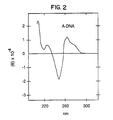
- Figures 2 and 3 are reproductions of the CD spectra described in Example 3.
- Figure 4 is a graph comparing the SLE antisera binding capabilities of DNAs having different types of helical configuration.
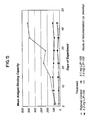
- Figures 5-8 are graphs of data obtained from the tests described in Example 5.
- the polymer component of the conjugate is biologically stable; that is, it exhibits an in vivo excretion half-life of days to months.
- These polymers are also substantially nonimmunogenic (i.e., they exhibit no or only mild immunogenicity when administered to animals) and are preferably composed of a synthetic single chain of defined composition. They will normally have an average molecular weight in the range of about 5,000 to about 200,000, preferably 5,000 to 50,000.
- Examples of such polymers are polyethylene glycol, poly- D -lysine, polyvinyl alcohol, polyvinylpyrollidone, immunoglobulins, and D -EK.
- Particularly preferred polymers are D -EKs having a molecular weight of about 5,000 to about 50,000 and a E: K mole ratio of approximately 60: 40.
- the synthetic polynucleotide duplexes that are coupled to the biologically stable polymers are composed of at least about 20 bp, more usually at least 30 bp, typically 30-250 bp, and preferably 50-150 bp.
- the duplexes are substantially homogeneous in length; that is, the variation in length in the population will not normally exceed about ⁇ 20%, preferably ⁇ 10%, of the average duplex length in base pairs. They are also preferably substantially homogeneous in nucleotide composition; that is, their base composition will not vary more than about 10%. Most preferably they are entirely homogeneous in nucleotide composition.
- the preferred synthetic or recombinant dsDNA is preferably composed of strands of complementary repeating mer units of 2-4 bases (i.e., a repeating dimer, trimer or tetramer) such as
- n, n′ and n ⁇ are integers selected to provide the desired number of base pairs.
- Polynucleotides composed of isomeric dimers, e.g., poly d(AC): poly d(GT) and poly d(AG): poly d(CT) are most preferred.
- B-DNA forms right-handed helices having base pairs nearly perpendicular to the long helical axis of the other two types of DNA helices.
- the helical structures of the different types of DNA may be characterized by the circular dichroic (CD) spectra.
- the CD spectra of the B form of DNA exhibits (1) positive dichroic bands associated with right-handed helicity in the portions of the spectrum below 250 nm but separated from the positive long wavelength dichroic band above 206 nm by a significant minimum at a wavelength between 240 and 260 nm, and (2) a broad singlet peak above 250 nm with a maximum blue shifted relative to the maxima seen in spectra of the A forms of RNA and DNA and centered at a wavelength between 270 and 290 nm.
- Z-DNA is distinguished by its tight left-handed helical twist with base pairs not positioned symmetrically around the helical axis and A-DNA forms a more open, right-handed helix on which the base pairs are obliquely oriented to the long helical axis and are pulled away from the helix core.
- polynucleotide duplexes may be synthesized from native DNA or synthesized by chemical or recombinant techniques.
- Naturally occurring or recombinantly produced dsDNA of longer length may be digested (e.g., enzymatically, chemically or by mechanical shearing) and fractionated (e.g., by agarose gel or Sephadex column) to obtain polynucleotides of the desired length.
- pairs of complementary single-stranded polynucleotide chains up to about 70 bases in length are readily prepared using commercially available DNA synthesizers and then annealed to form duplexes by conventional procedures.
- Synthetic dsDNA of longer length may be obtained by enzymatic extension (5′-phosphorylation followed by ligation) of the chemically produced shorter chains.
- the polynucleotides may also be made by molecular cloning. For instance, oligonucleotides of desired length and sequence are synthesized as above. These oligonucleotides may be designed to have appropriate termini for ligation into specific restriction sites. Multiple iterations of these oligomers may be ligated in tandem to provide for multicopy replication. The resulting construct is inserted into a standard cloning vector and the vector is introduced into a suitable microorganism/cell by transformation. Transformants are identified by standard markers and are grown under conditions that favor DNA replication. The polynucleotides may be isolated from the other DNA of the cell/microorganism by treatment with restriction enzymes and conventional size fractionation (e.g., agarose gel, Sephadex column).
- restriction enzymes and conventional size fractionation e.g., agarose gel, Sephadex column.
- the oligonucleotides may be replicated by the polymerase chain reaction (PCR) technology.
- PCR polymerase chain reaction
- each polynucleotide duplex employed in the present invention exhibits significant binding activity with SLE antisera.
- they are substantially homogeneous in length.
- the prior art polynucleotides were heterogeneous in length and composed of a mixture of chains, some or all of which were too short to exhibit such activity.
- Polynucleotides may be screened for binding activity with SLE antisera by the assays described in the examples.
- the modified Farr assay in which binding activity may be expressed as I50 is a preferred assay.
- Polynucleotide duplexes having an I50 of less than about 500 nM, preferably less than 50 nM, are deemed to have significant binding activity and are, therefore, useful for making the conjugates of this invention.
- the polynucleotides are bound to the polymer in a manner that preserves their binding activity. This is done by coupling the polynucleotide to the polymer at a predetermined site on the polynucleotide chain such that the polynucleotide forms a pendant chain of at least about 30 base pairs measured from the coupling site to the free (unattached) end of the chain.
- the glutaraldehyde coupling technique taught by the Borel et al. references causes coupling at random sites along the chain and cross-linking.
- chains of greater than 20 base pairs may be coupled at an intermediate site on the chain to form pendant chains of substantially less than 20 base pairs in length or chains may be coupled together to form cross-linked networks of undefined size.
- the polynucleotide duplexes of the invention conjugates are coupled or conjugated to the polymer at a site at or proximate one of their ends.
- Several conjugation strategies are available for so attaching the oligonucleotides to the biopolymer.
- the polynucleotide may be coupled to the polymer at the 3′ end of the polynucleotide via a morpholino bridge formed by condensing an oxidized 3′ terminal ribose on one of the strands of the polynucleotide with a free amino group on the polymer and then subjecting the adduct to reducing conditions to form the morpholino linkage.
- Such coupling requires the polymer to have at least an equal number of free amino groups (e.g., the epsilon amino groups of D -EK) to the number of polynucleotide duplexes to be bound to the polymer.
- the synthesis of such a conjugate is carried out in two steps.
- the first step is coupling one strand of the polynucleotide duplex to the polymer via the condensation/reduction reaction described above.
- the oxidized 3′ terminal ribose is formed on the single polynucleotide strand by treating the strand with periodate to convert the 3′ terminal ribose group to an oxidized ribose group.
- the single-stranded polynucleotide is then added slowly to an aqueous solution of the polymer of about pH 6.0 to 8.0 at 2-8°C.
- the molar ratio of polynucleotide to polymer in all the conjugation strategies will normally be in the range of about 2: 1 to about 30: 1, preferably about 5: 1 to 10: 1.
- a strong reducing agent such as sodium cyanoborohydride, is added to form the morpholino group.
- the complementary strand of the duplex is then added to the conjugate and the mixture is heated and slowly cooled to cause the strands to anneal.
- the conjugate may be purified by gel permeation chromatography.
- Another strategy involves forming terminal aldehyde functionalities on the oligonucleotides and using those functionalities to couple the oligonucleotide to the polymer via amino groups thereon.
- Advantage may be taken of the fact that gem , vicinal diols, attached to the 3′ end of the oligonucleotide, may be oxidized with sodium periodate to yield aldehydes which can condense with the amino groups of the polymer.
- the diols are in a ring system, e.g., a five-membered ring
- the resulting condensation product is a heterocyclic ring containing nitrogen, e.g., a six-membered morpholino or piperidino ring.
- the imino-condensation product is stabilized by reduction with a suitable reducing agent; e.g., sodium borohydride or sodium cyanoborohydride.
- a suitable reducing agent e.g., sodium borohydride or sodium cyanoborohydride.
- the resulting oxidation product contains just one aldehyde and the condensation product is a secondary amine.
- the vicinal diol strategy also may be followed for 5′-terminal linkers. This is accomplished by making cyanoethylphosphoramidite derivatives of a third hydroxy group on a triol, where the remaining hydroxy groups are vicinal; e.g., 3,4-cis dihydroxy,1-hydroxymethylcyclopentane.
- the vicinal dihydroxy groups are blocked with dimethylsilane, and the primary hydroxy group is derivatized with 2-cyanoethyl-N,N-diisopropylchlorophosphoramidite.
- the resulting derivative is used in the last step of standard oligonucleotide synthesis, and becomes the 5-terminal residue.
- the vicinal diol can be oxidized with periodate and condensed with amine groups as above.
- a similar strategy could be followed for acyclic triols to be used as 5′-terminal linkers.
- Another procedure involves introducing alkylamino or alkylsulfhydryl moieties into either the 3′ or 5′ ends of the oligonucleotide by appropriate nucleotide chemistry, e.g., phosphoramidate chemistry.
- the nucleophilic groups may then be used to react with a large excess of homobifunctional cross-linking reagent, e.g., dimethyl suberimidate, in the case of alkylamine derivatives, or an excess of heterobifunctional crosslinking reagent, e.g., m-maleimidobenzoyl-N-hydroxysuccinimide ester (MBS) or succinimidyl (4-iodoacetyl) aminobenzoate (SIAB), for the alkylsulfhydryl derivatives.
- MBS m-maleimidobenzoyl-N-hydroxysuccinimide ester
- SIAB succinimidyl (4-iodoacetyl) aminobenzoate
- nucleosides employs modified nucleosides.
- Suitable deoxynucleoside derivatives can be incorporated, by standard DNA synthetic chemistry, at desired positions in the oligonucleotide, preferably on the 5′ or 3′ ends. These nucleoside derivatives may then react specifically and directly with alkylamino groups on the polymer.
- side reactions seen with the above-described dialdehyde chemistry, such as amine catalyzed beta-elimination can be circumvented by employing appropriate nucleoside derivatives as the 3′ terminus of the chain to be attached.
- 5′ methylene extension of ribose i.e., a 5′ (2-hydroxyethyl)- group instead of a 5′ hydroxymethyl group.
- An alternative would be to use a phosphonate or phosphinate linkage for the 3′ terminal dinucleotide of the oligonucleotide to be attached to the polymer.
- the ability of the conjugates to act as SLE tolerogens and specifically suppress production of anti-dsDNA antibodies may be evaluated in the murine model described in the examples.
- the conjugates will normally be formulated for administration by injection, (e.g., intraperitoneally, intramuscularly, etc.). Accordingly, they will typically be combined with pharmaceutically acceptable aqueous carriers such as saline, Ringer's solution, dextrose solution, and the like.
- the conjugate will normally constitute about 0.01% to 10% by weight of the formulation.
- the conjugate is administered to an individual in amounts sufficient to at least partially reestablish tolerance to the autoantigens causing SLE. Such amounts are sometimes herein referred to as "therapeutically effective" amounts.
- the particular dosage regimen i.e., dose, timing and repetition, will depend upon the particular individual, and that individual's medical history. Normally a dose of about 1 to 1000 ug conjugate/kg body weight will be given. Repetitive administrations may be required to achieve and/or maintain a state of immune tolerance.
- D -EK were obtained from BioMakor/Yeda (Rehovet, Israel). Their relative molecular weights were standardized against known globular proteins by HPLC gel permeation chromatography and the material was desalted and sized by exhaustive dialysis in 25 Kd cutoff tubing against 0.1M K2HPO4, pH 9.5. The material was then dialyzed twice against water. This material is stored in 0.1M K2HPO4, pH 9.5 buffer at 4°C. The weight average molecular weights of the products were determined by physical methods including sedimentation equilibrium, PAGE, and HPLC-GPC and low-angle scattering and found to be approximately 28,000. Amino acid analysis by acid hydrolysis showed the copolymer was 60% glutamic acid and 40% lysine.
- Conjugates of the D -EK and riboadenosine, riboguanosine, ribocytosine and ribothymidine were prepared essentially as described in Eshar et al., J. Imm. (1975) 114 : 872. A mixture of equal parts of each of these conjugates (designated nucleoside- D -EK) was used in the following tests.
- mice Two groups of 6, 17-week-old (NZB x NZW)F1 female mice were injected i.p. with either saline or 1 mg/ mouse of nucleoside- D -EK each day for three days. Seven days later the mice were bled. Two weeks later the treatment was repeated. Seven days later the mice were bled. Sera from the first and second bleedings were tested for anti-ssDNA antibodies using the following antigen specific ELISA protocol.
- the ssDNA is immobilized in wells of polystyrene plates and is reacted with antibodies in the sera of lupus MRL (lpr/lpr) mice.
- the anti-ssDNA antibodies are visualized by addition of enzyme-linked antibodies specific for the isotypes of immunoglobulins bound to ssDNA on the plate. Subsequent addition of enzyme substrate results in a color reaction that is read in a spectrophotometer.
- the ssDNA is prepared from calf thymus dsDNA.
- the calf thymus dsDNA obtained commercially is treated with S-1 nuclease to obtain homogenous dsDNA.
- the dsDNA is boiled for 5 min in a water bath and quickly cooled in an ice-water bath. Each ssDNA batch is prepared just before use in the experiment.
- oligonucleotides were prepared by chemical synthesis and, where appropriate, enzymaticextension and/or annealing. Chemical synthesis of oligonucleotides was done on a Pharmacia Gene Assembler using a Cruachem adjustable column employing phosphite triester chemistry. The solid phase was 500-angstrom controlled-pore glass beads that were derivatized with the appropriate 3′-ribo or 3′-deoxynucleotide. The oligonucleotides were purified by simple dialysis.
- oligonucleotides of length greater than 70 bases individual strands were phosphorylated using ATP and rT4 polynucleotide kinase. After desalting on a Pharmacia PD10 column, the phosphorylated strands were covalently coupled using rT4 DNA ligase. All strands shared a common CATG 5′ end sequence that provided a unique sticky end. Where appropriate single strands were annealed to form dsDNA.
- Two assays were employed to determine the binding of the polynucleotides with lupus antisera: (1) a modified Farr assay in which radiolabeled DNA is precipitated from solution after it is bound to antibody and (2) an ELISA.
- 25 ul of each antiserum dilution were first prepared in Tris-buffered saline (TBS, 0.15M NaCl, 0.01M Tris, pH 7.5) containing 0.1 mg/ml human gamma globulin. These were diluted with 125 ul of TBS, 50 ul of 125I-dsDNA (Diagnostics Products Corp., Los Angeles, CA) was added to each sample, and the samples incubated at 37°C for 1/2 hr.
- test sera diluted in 1% PBSA containing 0.5% Tween 20 were added.
- the inhibitor e.g., polynucleotide
- the plates were then incubated 1 hr at 37°C and washed with PBS.
- Alkaline phosphatase labeled goat antibody 100 ul/well, was added and the plates incubated for another hr at 37°C.
- the plates were then washed, substrate was added, and the plates were incubated at room temperature for 1/2 hr.
- the reaction was stopped by adding disodium hydrogen phosphate and the plates were read with a spectrophotometer.
- CD spectral measurements were carried out on poly(AT): poly(AT) of about 228 bp in length (exemplary of A-DNA), poly(GC): poly(GC) of approximately 330 bp in length (exemplary of Z-DNA) salmon sperm DNA of average length greater than 1200 bp (an example of native DNA having a B-DNA type helical configuration) and the (AC)30: (TG)30 duplex described above.
- SLE antisera binding assays on these oligonucleotides and DNA were carried out using the modified Farr assay as above.
- Figure 2 shows the CD spectrum of the poly(AT): poly(AT).
- Figure 3 shows the CD spectra of the poly(GC): poly(GC) (solid line interrupted with solid circles), the salmon sperm DNA (dashed line), and the (AC)30: (TG)30 duplex (solid continuous line).
- Figure 4 shows the relative capacities of the different forms of DNA to bind SLE antisera.
- the synthetic B-type DNA had similar reactivity to native B-type DNA (calf thymus DNA was used) and substantially greater reactivity than either A-type or Z-type DNA.
- Helical typing was characterized by CD spectra and, as indicated above, may not be conclusive.
- (AC)30 was synthesized on a DNA synthesizer and dialyzed against deionized water in dialysis tubing with a molecular weight cutoff of 12,000-14,000 daltons. The resulting solution is adjusted to a final concentration of 35 mg/ml as determined by absorbance at 260 nm in a 1 cm cuvette, where An aqueous solution of sodium periodate, 0.1M, and water was added to the (AC)30 to give a reaction mixture having a 5: 1 molar excess of periodate to DNA. The mixture was stirred well and then placed at 4°C for 15 min. Excess periodate was then precipitated by adding an excess of potassium chloride and the precipitate was removed by centrifugation.
- a solution of D -EK and sodium cyanoborohydride was pipetted into a polypropylene reaction vessel and the pH was adjusted to between 6.0 and 8.0.
- the oxidized (AC)30 was added dropwise to the D -EK in a weight ratio of 6.035:1 (10: 1 molar conjugation ratio) with vigorous stirring over 24-48 hours at 4°C.
- solid sodium borohydride was added to the reaction mixture, with stirring, until a final concentration of 1.0 mg/ml was reached.
- the reaction vessel was loosely capped and was allowed to stand, unstirred, for at least 30 min.
- the reaction mixture was then transferred to dialysis tubing with a 50,000 dalton cutoff and was dialyzed extensively against 0.2M sodium citrate, pH 5.0, at 4°C.
- the conjugate was then purified on a Sephacryl S-200 gel permeation chromatography column in 0.2M sodium phosphate, 0.5M sodium chloride, pH 7.2. Fractions were analyzed for oligonucleotide concentration by OD260, and for D -EK concentration by a trinitrobenzene sulfonate asay (Albers, R.W., et al., Analyt Biochem (1983) 137 : 437-443). Separation of the conjugate from free oligonucleotide was assessed by 32P-kinase labeling of the 5′ hydroxyl on the oligonucleotide strand, followed by a 10% polyacrylamide, 8M urea sequencing gel andautoradiography.
- the gel was cut and counted on a liquid scintillation beta counter, and those fractions exhibiting ⁇ 95% purity were pooled and dialyzed against 0.01M sodium citrate, 0.15M sodium chloride, pH 7.0 (formulation buffer) in preparation for annealing.
- (TG)30 was then annealed to the (AC30- D -EK conjugate as follows.
- An equal MNC of (TG)30 was added to the limiting reagent of (AC)30- D -EK in a polypropylene or glass container.
- the mixture was heated to >95°C in a water bath, which was maintained between 95° and 98°C for 10 min.
- the solution was then cooled slowly to room temperature at the rate of ⁇ 10°/hour.
- the annealed product is dialyzed against formulation buffer in dialysis tubing with a molecular weight cutoff of 50,000 daltons. After extensive dialysis, the final conjugate is sterile-filtered through a 0.22 um membrane. It is characterized by uv spectroscopy, high performance gel permeation liquid chromatography, polyacrylamide gel electrophoresis and thermography before sterile-filling.
- the (TG)30: (AC)30-D-EK conjugate described above was tested in the MRL (1pr/1pr) murine model for human SLE.
- a genetic defect in this mouse strain leads to hyperproliferation of helper T cells that, in all likelihood, participate in autoreactive B-cell differentiation. This results in secretion of autoantibodies to DNA as well as a plethora of other autoantibodies.
- antibodies to dsDNA are a hallmark of human SLE and their presence correlates well with disease severity and renal pathology in humans.
- the conjugate was diluted in saline to desired concentration for i.p. injection into mice.
- Four groups of five 12- to 14-week-old mice each were used. The mice were bled in the morning on day 1 and injected in the afternoon. Thereafter the mice were bled in the morning and injected in the afternoon each week for five more weeks. At weeks 6 and 7 the mice were only bled.
- Group 1 (control) was injected with 03 mg D -EK copolymer/week/ mouse; Group 2, with 0.1 mg of the conjugate/week/mouse; Group 3, with 0.3 mg of the conjugate/week/mouse; and Group 4, with 1.0 mg of the conjugate/week/mouse.
- the plasma samples collected from the mice were diluted 1: 10 and 1: 50 in Tris buffer (0.1M, pH 7.4) and used in the modified Farr assay described above using 3H-dsDNA instead of 125I-dsDNA to determine the anti-dsDNA antibody titer of the samples.
- the data obtained in the modified Farr assay were converted into antigen binding capacity and are depicted in Figure 5 (the conjugate is designated LJP-105).
- a trial of the conjugate was also carried out in older MRL mice, aged 22 to 24 weeks. Again, the mice were dosed i.p. once a week, for four weeks. The serological levels of anti-dsDNA were determined after the month of treatment, and were compared to the prebleed values obtained at the start. These data, expressed as a percent change in antigen binding capacity (ABC) for individual mice, are shown in Figure 7.
- Figure 7a shows the mean data from these tests.
- the variability in mice per dosage group (conjugate: 0.01, 0.1, 0.3 and 1.0 mg/mouse; control mice received a mixture of polymer carrier and unconjugated nucleic acid surrogate) reflects the deaths during the experiment.
- the conjugate may be efficacious by i.p., i.m. and i.v. routes.
- Twenty-two-week, female MRL mice were dosed with 0.1 mg of conjugate per week for four weeks, and the percent change in antigen-binding capacity for anti-dsDNA measured.
- the control mice did not increase as much as has been seen with other experiments, there were significantly higher titers of anti-dsDNA in subcutaneously dosed mice on the one hand, and mice dosed with the conjugate by i.p., i.m. or i.v. routes on the other.
- This example illustrates alternative procedures for making the (AC)30: (TG)30- D -EK conjugate.
- a 64-mer consisting of the sequence 5′AATTC(GT)29G3′ and a second 64-mer of the sequence 5′TCGAC(AC)29G3′ are synthesized and phosphorylated by standard methods.
- the oligomers are mixed in equal molar ratios and slow cooled to allow duplex formation and oligomerization to occur.
- the overhangs of the oligomers are annealed by virtue of the 4 base overlap of the first oligomer creating an EcoRI site and the second overhang a SalI site (same as HincII site).
- the mixture is ligated by standard methods to form an oligomer of covalently attached 60-mer units separated by either an EcoRI or SalI site.
- the oligomer mixture is ligated into pUC19 which had been previously digested with EcoRI and SalI.
- the ligation mixture is introduced into E. coli JM107 by transformation.
- Insert size is determined by restriction digest.
- the desired clone has an insert which comprised at least one-half the plasmid or >50 60-mer units.
- the resulting clone is grown in large scale and plasmid isolated.
- the plasmid is digested with EcoRI and HincII to release 60-mer with a 4 base EcoRI overhang and a blunt end at the opposite end generated by HincII.
- the oligomers are purified and annealed to D -EK which has the 4 base oligomer 3′TTAA-P with a 5′ phosphate covalently attached to D -EK through the 3′T.
- the 60-mers are annealed and covalently attached to the D -EK/TTAA by ligase.
- the polymerase chain reaction is used to synthesize 60-mer for coupling to D -EK by the methods described in the references cited above.
- (GT)30 is chemically synthesized with short random sequences such as GACT and CTGA at the 5′ and 3′ end of (GT)30, respectively (as illustrated below).
- the short random sequences are long enough to ensure proper register of the primer to the template.
- the primer contains the sequence of the random sequence plus several extra GT repeats as needed for stability in the annealing reaction.
- One of the primers also has an extra modified base at the 5′ end, which allows chemical coupling to D -EK.
- the PCR reaction is carried out for at least 20 cycles according to the methods cited above.
- the oligomers produced by PCR are purified by chromatography, such as HPLC, and then conjugated to D -EK by one of the procedures described above.
Landscapes
- Health & Medical Sciences (AREA)
- Life Sciences & Earth Sciences (AREA)
- Chemical & Material Sciences (AREA)
- Engineering & Computer Science (AREA)
- General Health & Medical Sciences (AREA)
- Immunology (AREA)
- Bioinformatics & Cheminformatics (AREA)
- Veterinary Medicine (AREA)
- Organic Chemistry (AREA)
- Pharmacology & Pharmacy (AREA)
- Medicinal Chemistry (AREA)
- Animal Behavior & Ethology (AREA)
- Public Health (AREA)
- Molecular Biology (AREA)
- Biochemistry (AREA)
- Proteomics, Peptides & Aminoacids (AREA)
- Epidemiology (AREA)
- Nuclear Medicine, Radiotherapy & Molecular Imaging (AREA)
- General Chemical & Material Sciences (AREA)
- Chemical Kinetics & Catalysis (AREA)
- Genetics & Genomics (AREA)
- Mycology (AREA)
- Microbiology (AREA)
- Biotechnology (AREA)
- Transplantation (AREA)
- Pharmaceuticals Containing Other Organic And Inorganic Compounds (AREA)
- Addition Polymer Or Copolymer, Post-Treatments, Or Chemical Modifications (AREA)
- Saccharide Compounds (AREA)
- Medicinal Preparation (AREA)
- Medicines That Contain Protein Lipid Enzymes And Other Medicines (AREA)
- Polyamides (AREA)
- Peptides Or Proteins (AREA)
- Immobilizing And Processing Of Enzymes And Microorganisms (AREA)
- Medicines Containing Antibodies Or Antigens For Use As Internal Diagnostic Agents (AREA)
Applications Claiming Priority (4)
| Application Number | Priority Date | Filing Date | Title |
|---|---|---|---|
| US46613890A | 1990-01-16 | 1990-01-16 | |
| US466138 | 1990-01-16 | ||
| US494118 | 1990-03-13 | ||
| US07/494,118 US5162515A (en) | 1990-01-16 | 1990-03-13 | Conjugates of biologically stable polymers and polynucleotides for treating systemic lupus erythematosus |
Publications (2)
| Publication Number | Publication Date |
|---|---|
| EP0438259A1 true EP0438259A1 (fr) | 1991-07-24 |
| EP0438259B1 EP0438259B1 (fr) | 1996-06-19 |
Family
ID=27041547
Family Applications (1)
| Application Number | Title | Priority Date | Filing Date |
|---|---|---|---|
| EP91300262A Expired - Lifetime EP0438259B1 (fr) | 1990-01-16 | 1991-01-15 | Conjugués de polymères biologiquement stables et polynucléotides pour le traitement du lupus erythematosus systémique |
Country Status (15)
| Country | Link |
|---|---|
| US (2) | US5162515A (fr) |
| EP (1) | EP0438259B1 (fr) |
| JP (2) | JPH05505520A (fr) |
| AT (1) | ATE139448T1 (fr) |
| AU (1) | AU640730B2 (fr) |
| CA (2) | CA2034197C (fr) |
| DE (1) | DE69120303T2 (fr) |
| DK (1) | DK0438259T3 (fr) |
| ES (1) | ES2090233T3 (fr) |
| FI (1) | FI107514B (fr) |
| GR (1) | GR3021113T3 (fr) |
| IE (1) | IE910131A1 (fr) |
| NO (1) | NO303940B1 (fr) |
| PT (1) | PT96503B (fr) |
| WO (1) | WO1991010426A1 (fr) |
Cited By (13)
| Publication number | Priority date | Publication date | Assignee | Title |
|---|---|---|---|---|
| WO1995032430A3 (fr) * | 1994-05-25 | 1996-03-07 | Oklahoma Med Res Found | Analyse du pouvoir pathogene d'anticorps anti-adn |
| EP0722318A4 (fr) * | 1993-09-08 | 1998-08-05 | Jolla Pharma | Molecules plates-formes non polymeres a valence, chimiquement definies, et leur conjugues |
| EP0642798A3 (fr) * | 1993-09-08 | 1998-09-16 | La Jolla Pharmaceutical Company | Molécules "platform" définis et de valence non-polymérique et leur conjugés |
| EP0963758A3 (fr) * | 1998-05-07 | 2000-03-22 | Universiteit Gent | Synthetique polyaminoacide complexes pour l'apport des acides nucleiques aux celles cibles |
| US6207160B1 (en) | 1995-06-07 | 2001-03-27 | La Jolla Pharmaceutical Company | aPL immunoreactive peptides, conjugates thereof and methods of treatment for aPL antibody-mediated pathologies |
| US6280944B1 (en) | 1994-05-25 | 2001-08-28 | Oklahoma Medical Research Foundation | Assay for pathogenicity of anti-DNA antibodies |
| WO2001041813A3 (fr) * | 1999-11-28 | 2002-01-03 | Jolla Pharma | Procedes de traitement de lupus sur la base de l'affinite aux anticorps et procedes de criblage et compositions associees |
| US6399578B1 (en) | 1998-12-09 | 2002-06-04 | La Jolla Pharmaceutical Company | Conjugates comprising galactose α1,3 galactosyl epitopes and methods of using same |
| US6458953B1 (en) | 1998-12-09 | 2002-10-01 | La Jolla Pharmaceutical Company | Valency platform molecules comprising carbamate linkages |
| US6858210B1 (en) | 1998-06-09 | 2005-02-22 | La Jolla Pharmaceutical Co. | Therapeutic and diagnostic domain 1 β2GPI polypeptides and methods of using same |
| EP1598081A3 (fr) * | 1998-03-30 | 2008-05-07 | PG-TXL Company, L.P. | Conjugues d'un polymère d'acides aminés soluble dans l'eau et un médeicament |
| US8071737B2 (en) | 1995-05-04 | 2011-12-06 | Glead Sciences, Inc. | Nucleic acid ligand complexes |
| WO2012138694A3 (fr) * | 2011-04-07 | 2013-04-04 | Emory University | Compositions comprenant des fractions de liaison au saccharide et procédés pour une thérapie ciblée |
Families Citing this family (26)
| Publication number | Priority date | Publication date | Assignee | Title |
|---|---|---|---|---|
| US5447722A (en) * | 1983-12-12 | 1995-09-05 | University Of Manitoba | Method for the suppression of an immune response with antigen-MPEG conjugates in nonsensitized individuals |
| US5391785A (en) * | 1990-01-16 | 1995-02-21 | La Jolla Pharmaceutial Company | Intermediates for providing functional groups on the 5' end of oligonucleotides |
| US5268454A (en) * | 1991-02-08 | 1993-12-07 | La Jolla Pharmaceutical Company | Composition for inducing humoral anergy to an immunogen comprising a t cell epitope-deficient analog of the immunogen conjugated to a nonimmunogenic carrier |
| US6465188B1 (en) * | 1990-06-11 | 2002-10-15 | Gilead Sciences, Inc. | Nucleic acid ligand complexes |
| KR100361933B1 (ko) | 1993-09-08 | 2003-02-14 | 라 졸라 파마슈티칼 컴파니 | 화학적으로정의된비중합성결합가플랫폼분자및그것의콘주게이트 |
| US5599912A (en) * | 1993-09-10 | 1997-02-04 | Coretech, Inc. | Compounds and methods for suppressing an immune response to sulfomethoxozale containing substances |
| US5573916A (en) * | 1994-05-19 | 1996-11-12 | Coretech, Inc. | Immunogenic constructs comprising b-cell and t-cell epitopes on common carrier |
| AU728176B2 (en) * | 1995-05-04 | 2001-01-04 | Gilead Sciences, Inc. | Nucleic acid ligand complexes |
| US6410775B1 (en) * | 1995-06-07 | 2002-06-25 | La Jolla Pharmaceutical Company | APL immunoreactive peptides, conjugates thereof and methods of treatment for APL antibody-mediated pathologies |
| US5856446A (en) * | 1995-07-07 | 1999-01-05 | Autoimmune Inc. | Method of treating rheumatoid arthritis with low dose type II collagen |
| AU3665699A (en) | 1998-04-27 | 1999-11-16 | Biocrystal Limited | Compositions and methods for tolerization in immune complex-mediated disease progression |
| US20010010818A1 (en) * | 1998-12-09 | 2001-08-02 | Engle Steven B. | Methods and formulations for reducing circulating antibodies |
| CN1762990A (zh) * | 1999-06-08 | 2006-04-26 | 拉卓拉药物公司 | 包含氨基氧基的化合价平台分子 |
| US6911535B2 (en) * | 2000-03-22 | 2005-06-28 | Solvlink Biosciences | Biomolecule/polymer conjugates |
| WO2001093914A2 (fr) | 2000-06-08 | 2001-12-13 | La Jolla Pharmaceutical Company | Molecules a plate-forme polyvalentes comprenant un poly(ethylene oxyde) de poids moleculaire eleve |
| JP2004529945A (ja) * | 2001-05-17 | 2004-09-30 | ラ ホヤ ファーマシューティカル カンパニー | Cd21を阻害する薬剤を使用して抗体媒介性病理を処置する方法 |
| EP2423335B1 (fr) * | 2001-06-21 | 2014-05-14 | Dynavax Technologies Corporation | Composés immunomodulateurs chimères et leur procédé d'utilisation |
| US7785610B2 (en) * | 2001-06-21 | 2010-08-31 | Dynavax Technologies Corporation | Chimeric immunomodulatory compounds and methods of using the same—III |
| US20030114405A1 (en) * | 2001-08-13 | 2003-06-19 | Linnik Matthew D. | Methods of treating systemic lupus erythematosus in individuals having significantly impaired renal function |
| US7105135B2 (en) * | 2001-10-16 | 2006-09-12 | Lockheed Martin Corporation | System and method for large scale detection of hazardous materials in the mail or in other objects |
| US20050266427A1 (en) * | 2002-01-15 | 2005-12-01 | Schwartz David A | Biomolecule/polymer conjugates |
| WO2004060320A2 (fr) * | 2002-12-27 | 2004-07-22 | La Jolla Pharmaceutical Company | Procedes d'amelioration de la qualite de vie, sur le plan de la sante, chez des individus, au moyen de lupus erythematosus systemique |
| US20040258683A1 (en) * | 2003-03-30 | 2004-12-23 | Linnik Matthew D. | Methods of treating and monitoring systemic lupus erythematosus in individuals |
| NZ542687A (en) * | 2003-04-13 | 2010-02-26 | Enzon Pharmaceuticals Inc | Polymeric oligonucleotide prodrugs |
| US10864279B2 (en) * | 2016-12-16 | 2020-12-15 | Industrial Technology Research Institute | Linker-drug and antibody-drug conjugate (ADC) employing the same |
| CN113150064B (zh) * | 2021-04-14 | 2023-04-11 | 中山大学 | 一种抗菌抗虫肽的人工合成方法及其应用 |
Citations (3)
| Publication number | Priority date | Publication date | Assignee | Title |
|---|---|---|---|---|
| US4191668A (en) * | 1977-02-03 | 1980-03-04 | Scripps Clinic And Research Foundation | Induction of immunological tolerance |
| US4650675A (en) * | 1983-08-18 | 1987-03-17 | The Children's Medical Center Corporation | Oligonucleotide conjugates |
| WO1989009628A1 (fr) * | 1988-04-04 | 1989-10-19 | Potempa Lawrence A | Liaison de complexes immuns a l'aide de formes modifiees de proteine c-reactive |
Family Cites Families (4)
| Publication number | Priority date | Publication date | Assignee | Title |
|---|---|---|---|---|
| US4220565A (en) * | 1979-01-18 | 1980-09-02 | Scripps Clinic & Research Foundation | Immunochemical conjugates: method and composition |
| US5126131A (en) * | 1983-01-24 | 1992-06-30 | The Johns Hopkins University | Therapeutic suppression of specific immune responses by administration of antigen-competitive conjugates. |
| US4751181A (en) * | 1984-12-31 | 1988-06-14 | Duke University | Methods and compositions useful in the diagnosis and treatment of autoimmune diseases |
| JPH06503833A (ja) * | 1990-12-17 | 1994-04-28 | ザ ジョンズ ホプキンス ユニバーシティ | 制御された化学のオリゴマー形態の抗原での免疫応答抑制 |
-
1990
- 1990-03-13 US US07/494,118 patent/US5162515A/en not_active Expired - Lifetime
-
1991
- 1991-01-15 DE DE69120303T patent/DE69120303T2/de not_active Expired - Fee Related
- 1991-01-15 WO PCT/US1991/000293 patent/WO1991010426A1/fr not_active Ceased
- 1991-01-15 ES ES91300262T patent/ES2090233T3/es not_active Expired - Lifetime
- 1991-01-15 IE IE013191A patent/IE910131A1/en not_active IP Right Cessation
- 1991-01-15 JP JP91503584A patent/JPH05505520A/ja active Pending
- 1991-01-15 DK DK91300262.2T patent/DK0438259T3/da active
- 1991-01-15 CA CA002034197A patent/CA2034197C/fr not_active Expired - Lifetime
- 1991-01-15 AT AT91300262T patent/ATE139448T1/de not_active IP Right Cessation
- 1991-01-15 EP EP91300262A patent/EP0438259B1/fr not_active Expired - Lifetime
- 1991-01-15 CA CA002173878A patent/CA2173878C/fr not_active Expired - Lifetime
- 1991-01-16 AU AU69418/91A patent/AU640730B2/en not_active Ceased
- 1991-01-16 PT PT96503A patent/PT96503B/pt active IP Right Grant
-
1992
- 1992-07-14 NO NO922781A patent/NO303940B1/no not_active IP Right Cessation
- 1992-07-15 US US07/914,869 patent/US5276013A/en not_active Expired - Lifetime
- 1992-07-15 FI FI923241A patent/FI107514B/fi active
-
1996
- 1996-09-19 GR GR960402478T patent/GR3021113T3/el unknown
-
2001
- 2001-04-04 JP JP2001106534A patent/JP2001354569A/ja not_active Withdrawn
Patent Citations (3)
| Publication number | Priority date | Publication date | Assignee | Title |
|---|---|---|---|---|
| US4191668A (en) * | 1977-02-03 | 1980-03-04 | Scripps Clinic And Research Foundation | Induction of immunological tolerance |
| US4650675A (en) * | 1983-08-18 | 1987-03-17 | The Children's Medical Center Corporation | Oligonucleotide conjugates |
| WO1989009628A1 (fr) * | 1988-04-04 | 1989-10-19 | Potempa Lawrence A | Liaison de complexes immuns a l'aide de formes modifiees de proteine c-reactive |
Cited By (18)
| Publication number | Priority date | Publication date | Assignee | Title |
|---|---|---|---|---|
| EP0722318A4 (fr) * | 1993-09-08 | 1998-08-05 | Jolla Pharma | Molecules plates-formes non polymeres a valence, chimiquement definies, et leur conjugues |
| EP0642798A3 (fr) * | 1993-09-08 | 1998-09-16 | La Jolla Pharmaceutical Company | Molécules "platform" définis et de valence non-polymérique et leur conjugés |
| CN1318023C (zh) * | 1993-09-08 | 2007-05-30 | 拉卓拉药物公司 | 化学上定义的非聚合价平台分子和其偶联物 |
| EP1808183A3 (fr) * | 1993-09-08 | 2009-07-01 | La Jolla Pharmaceutical Company | Molécules à plate-forme de valence non polymères, définies chimiquement et leurs conjugués |
| WO1995032430A3 (fr) * | 1994-05-25 | 1996-03-07 | Oklahoma Med Res Found | Analyse du pouvoir pathogene d'anticorps anti-adn |
| US5681700A (en) * | 1994-05-25 | 1997-10-28 | Oklahoma Medical Research Foundation | Assay for pathogenicity of anti-DNA antibodies |
| US6280944B1 (en) | 1994-05-25 | 2001-08-28 | Oklahoma Medical Research Foundation | Assay for pathogenicity of anti-DNA antibodies |
| US8071737B2 (en) | 1995-05-04 | 2011-12-06 | Glead Sciences, Inc. | Nucleic acid ligand complexes |
| US6207160B1 (en) | 1995-06-07 | 2001-03-27 | La Jolla Pharmaceutical Company | aPL immunoreactive peptides, conjugates thereof and methods of treatment for aPL antibody-mediated pathologies |
| EP1598081A3 (fr) * | 1998-03-30 | 2008-05-07 | PG-TXL Company, L.P. | Conjugues d'un polymère d'acides aminés soluble dans l'eau et un médeicament |
| WO1999058151A3 (fr) * | 1998-05-07 | 2000-04-13 | Univ Gent | Systeme polymere aux fins de l'apport d'acide nucleique a des cellules cibles dans des systemes biologiques |
| EP0963758A3 (fr) * | 1998-05-07 | 2000-03-22 | Universiteit Gent | Synthetique polyaminoacide complexes pour l'apport des acides nucleiques aux celles cibles |
| US6858210B1 (en) | 1998-06-09 | 2005-02-22 | La Jolla Pharmaceutical Co. | Therapeutic and diagnostic domain 1 β2GPI polypeptides and methods of using same |
| US6399578B1 (en) | 1998-12-09 | 2002-06-04 | La Jolla Pharmaceutical Company | Conjugates comprising galactose α1,3 galactosyl epitopes and methods of using same |
| US6458953B1 (en) | 1998-12-09 | 2002-10-01 | La Jolla Pharmaceutical Company | Valency platform molecules comprising carbamate linkages |
| WO2001041813A3 (fr) * | 1999-11-28 | 2002-01-03 | Jolla Pharma | Procedes de traitement de lupus sur la base de l'affinite aux anticorps et procedes de criblage et compositions associees |
| US7081242B1 (en) | 1999-11-28 | 2006-07-25 | La Jolla Pharmaceutical Company | Methods of treating lupus based on antibody affinity and screening methods and compositions for use thereof |
| WO2012138694A3 (fr) * | 2011-04-07 | 2013-04-04 | Emory University | Compositions comprenant des fractions de liaison au saccharide et procédés pour une thérapie ciblée |
Also Published As
| Publication number | Publication date |
|---|---|
| JPH05505520A (ja) | 1993-08-19 |
| CA2034197C (fr) | 2001-07-17 |
| GR3021113T3 (en) | 1996-12-31 |
| NO303940B1 (no) | 1998-09-28 |
| FI923241A0 (fi) | 1992-07-15 |
| US5162515A (en) | 1992-11-10 |
| IE910131A1 (en) | 1991-07-17 |
| AU640730B2 (en) | 1993-09-02 |
| DE69120303T2 (de) | 1996-11-28 |
| AU6941891A (en) | 1991-07-18 |
| DE69120303D1 (de) | 1996-07-25 |
| JP2001354569A (ja) | 2001-12-25 |
| DK0438259T3 (da) | 1996-07-15 |
| FI923241L (fi) | 1992-07-15 |
| WO1991010426A1 (fr) | 1991-07-25 |
| FI107514B (fi) | 2001-08-31 |
| CA2173878A1 (fr) | 1991-07-17 |
| CA2173878C (fr) | 2000-04-04 |
| EP0438259B1 (fr) | 1996-06-19 |
| ATE139448T1 (de) | 1996-07-15 |
| NO922781L (no) | 1992-07-14 |
| US5276013A (en) | 1994-01-04 |
| NO922781D0 (no) | 1992-07-14 |
| PT96503A (pt) | 1991-10-31 |
| ES2090233T3 (es) | 1996-10-16 |
| PT96503B (pt) | 1998-07-31 |
| CA2034197A1 (fr) | 1991-07-17 |
Similar Documents
| Publication | Publication Date | Title |
|---|---|---|
| EP0438259B1 (fr) | Conjugués de polymères biologiquement stables et polynucléotides pour le traitement du lupus erythematosus systémique | |
| EP0498658B1 (fr) | Composition pour induire une anergy humorale vis à vis d'un immunogène | |
| US5851801A (en) | Method of preparing polypeptide binding compositions derived from immunoglobulin variable regions | |
| CA2171434C (fr) | Molecules, definies chimiquement, non polymeriques, avec une plate-forme de valences, et leurs conjugues | |
| Plescia et al. | Nucleic acids in immunology: Proceedings of a symposium held at the Institute of Microbiology of Rutgers, The State University | |
| NO153419B (no) | Fremgangsmaate for fremstilling av et terapeutisk immunoundertrykkende middel, omfattende et konjugat av d-glutaminsyre: d-lysin-copolymer og et antingen som er et allergen. | |
| JPH09511641A (ja) | 自己集合性多量体核酸構築物 | |
| KR100361933B1 (ko) | 화학적으로정의된비중합성결합가플랫폼분자및그것의콘주게이트 | |
| WO1995021926A1 (fr) | Induction d'une tolerance au moyen de proteines de fusion tolerogenes | |
| EP0642798B1 (fr) | Molécules "platform" définis et de valence non-polymérique et leur conjugés | |
| JP2000507232A (ja) | 慢性関節リウマチの病理発生に必要な関節炎誘発性ペプチドに対して免疫防御を誘発するために有用なワクチン組成物と方法 | |
| Schwartz et al. | Genetic control of the T lymphocyte proliferative response to staphylococcal nuclease: evidence for multiple MHC-linked Ir gene control | |
| WO2004089422A2 (fr) | Methodes de traitement et de surveillance du lupus erythemateux dissemine | |
| Eshhar et al. | Induction of tolerance to nucleic acid determinants by administration of a complex of nucleoside D-glutamic acid and D-lysine (D-GL) | |
| Edgington et al. | Immunogenicity of Z-DNA depends on the size of polynucleotide presented in complexes with methylated BSA | |
| JP4253122B2 (ja) | アレルゲンの非アナフィラキシー形およびその使用 | |
| US20060217333A1 (en) | Methods of treating systemic lupus erythematosus in individuals having significantly impaired renal function | |
| Bonavida et al. | Antibodies to transfer RNA obtained with covalently linked tRNA conjugates | |
| Plescia | [174] Preparation and assay of nucleic acids as antigens | |
| CA2161316A1 (fr) | Retro-regulation de la reaction immunitaire specifique aux allergenes | |
| Alarcón-Segovia et al. | Immunochemical characterization of the anti-RNA antibodies found in scleroderma and systemic lupus erythematosus. II. Reactivity with hsa-coupled, uridine-containing, monophosphoric ribodinucleotides | |
| Pinchuck et al. | Antigenicity of Polypeptides (Poly-α-Amino Acids) XXVI. Studies of the Ability of Homo-and Copolymers to Act As Hapten Carriers in Mice | |
| Rasmussen et al. | Specificity of antibodies raised against a specific phosphoromonothioate oligonucleotide sequence | |
| HK1014240B (en) | Chemically-defined non-polymeric valency platform molecules and conjugates thereof | |
| Eaton | Studies on antideoxyribonucleic acid antibodies |
Legal Events
| Date | Code | Title | Description |
|---|---|---|---|
| PUAI | Public reference made under article 153(3) epc to a published international application that has entered the european phase |
Free format text: ORIGINAL CODE: 0009012 |
|
| AK | Designated contracting states |
Kind code of ref document: A1 Designated state(s): AT BE CH DE DK ES FR GB GR IT LI LU NL SE |
|
| 17P | Request for examination filed |
Effective date: 19920128 |
|
| 17Q | First examination report despatched |
Effective date: 19930317 |
|
| GRAA | (expected) grant |
Free format text: ORIGINAL CODE: 0009210 |
|
| AK | Designated contracting states |
Kind code of ref document: B1 Designated state(s): AT BE CH DE DK ES FR GB GR IT LI LU NL SE |
|
| REF | Corresponds to: |
Ref document number: 139448 Country of ref document: AT Date of ref document: 19960715 Kind code of ref document: T |
|
| REG | Reference to a national code |
Ref country code: DK Ref legal event code: T3 |
|
| REF | Corresponds to: |
Ref document number: 69120303 Country of ref document: DE Date of ref document: 19960725 |
|
| GRAH | Despatch of communication of intention to grant a patent |
Free format text: ORIGINAL CODE: EPIDOS IGRA |
|
| ITF | It: translation for a ep patent filed | ||
| ET | Fr: translation filed | ||
| REG | Reference to a national code |
Ref country code: CH Ref legal event code: NV Representative=s name: R. A. EGLI & CO. PATENTANWAELTE |
|
| REG | Reference to a national code |
Ref country code: ES Ref legal event code: FG2A Ref document number: 2090233 Country of ref document: ES Kind code of ref document: T3 |
|
| REG | Reference to a national code |
Ref country code: CH Ref legal event code: PFA Free format text: LA JOLLA PHARMACEUTICAL COMPANY,10165 MCKELLAR COURT,SAN DIEGO, CALIFORNIA 92121 (CA) TRANSFER- LA JOLLA PHARMACEUTICAL,6455 NANCY RIDGE DRIVE, SUITE 300,SAN DIEGO, CALIFORNIA 92121 (US) |
|
| RAP2 | Party data changed (patent owner data changed or rights of a patent transferred) |
Owner name: LA JOLLA PHARMACEUTICAL COMPANY |
|
| REG | Reference to a national code |
Ref country code: ES Ref legal event code: FG2A Ref document number: 2090233 Country of ref document: ES Kind code of ref document: T3 |
|
| REG | Reference to a national code |
Ref country code: GR Ref legal event code: FG4A Free format text: 3021113 |
|
| NLT2 | Nl: modifications (of names), taken from the european patent patent bulletin |
Owner name: LA JOLLA PHARMACEUTICAL COMPANY |
|
| PLBE | No opposition filed within time limit |
Free format text: ORIGINAL CODE: 0009261 |
|
| STAA | Information on the status of an ep patent application or granted ep patent |
Free format text: STATUS: NO OPPOSITION FILED WITHIN TIME LIMIT |
|
| 26N | No opposition filed | ||
| REG | Reference to a national code |
Ref country code: GB Ref legal event code: IF02 |
|
| PGFP | Annual fee paid to national office [announced via postgrant information from national office to epo] |
Ref country code: AT Payment date: 20090113 Year of fee payment: 19 Ref country code: DK Payment date: 20090113 Year of fee payment: 19 Ref country code: ES Payment date: 20090218 Year of fee payment: 19 Ref country code: LU Payment date: 20090114 Year of fee payment: 19 |
|
| PGFP | Annual fee paid to national office [announced via postgrant information from national office to epo] |
Ref country code: NL Payment date: 20090104 Year of fee payment: 19 Ref country code: DE Payment date: 20090108 Year of fee payment: 19 |
|
| PGFP | Annual fee paid to national office [announced via postgrant information from national office to epo] |
Ref country code: GB Payment date: 20090114 Year of fee payment: 19 Ref country code: CH Payment date: 20090114 Year of fee payment: 19 Ref country code: GR Payment date: 20081215 Year of fee payment: 19 |
|
| PGFP | Annual fee paid to national office [announced via postgrant information from national office to epo] |
Ref country code: BE Payment date: 20090213 Year of fee payment: 19 |
|
| PGFP | Annual fee paid to national office [announced via postgrant information from national office to epo] |
Ref country code: IT Payment date: 20090127 Year of fee payment: 19 Ref country code: SE Payment date: 20090108 Year of fee payment: 19 |
|
| PGFP | Annual fee paid to national office [announced via postgrant information from national office to epo] |
Ref country code: FR Payment date: 20090113 Year of fee payment: 19 |
|
| BERE | Be: lapsed |
Owner name: *LA JOLLA PHARMACEUTICAL CY Effective date: 20100131 |
|
| REG | Reference to a national code |
Ref country code: NL Ref legal event code: V1 Effective date: 20100801 |
|
| REG | Reference to a national code |
Ref country code: CH Ref legal event code: PL |
|
| REG | Reference to a national code |
Ref country code: DK Ref legal event code: EBP |
|
| GBPC | Gb: european patent ceased through non-payment of renewal fee |
Effective date: 20100115 |
|
| EUG | Se: european patent has lapsed | ||
| REG | Reference to a national code |
Ref country code: FR Ref legal event code: ST Effective date: 20100930 |
|
| PG25 | Lapsed in a contracting state [announced via postgrant information from national office to epo] |
Ref country code: CH Free format text: LAPSE BECAUSE OF NON-PAYMENT OF DUE FEES Effective date: 20100131 Ref country code: NL Free format text: LAPSE BECAUSE OF NON-PAYMENT OF DUE FEES Effective date: 20100801 Ref country code: LI Free format text: LAPSE BECAUSE OF NON-PAYMENT OF DUE FEES Effective date: 20100131 Ref country code: FR Free format text: LAPSE BECAUSE OF NON-PAYMENT OF DUE FEES Effective date: 20100201 |
|
| PG25 | Lapsed in a contracting state [announced via postgrant information from national office to epo] |
Ref country code: DE Free format text: LAPSE BECAUSE OF NON-PAYMENT OF DUE FEES Effective date: 20100803 Ref country code: AT Free format text: LAPSE BECAUSE OF NON-PAYMENT OF DUE FEES Effective date: 20100115 |
|
| PG25 | Lapsed in a contracting state [announced via postgrant information from national office to epo] |
Ref country code: GB Free format text: LAPSE BECAUSE OF NON-PAYMENT OF DUE FEES Effective date: 20100115 |
|
| PG25 | Lapsed in a contracting state [announced via postgrant information from national office to epo] |
Ref country code: DK Free format text: LAPSE BECAUSE OF NON-PAYMENT OF DUE FEES Effective date: 20100131 |
|
| PG25 | Lapsed in a contracting state [announced via postgrant information from national office to epo] |
Ref country code: BE Free format text: LAPSE BECAUSE OF NON-PAYMENT OF DUE FEES Effective date: 20100131 |
|
| PG25 | Lapsed in a contracting state [announced via postgrant information from national office to epo] |
Ref country code: IT Free format text: LAPSE BECAUSE OF NON-PAYMENT OF DUE FEES Effective date: 20100115 |
|
| REG | Reference to a national code |
Ref country code: ES Ref legal event code: FD2A Effective date: 20110408 |
|
| PG25 | Lapsed in a contracting state [announced via postgrant information from national office to epo] |
Ref country code: ES Free format text: LAPSE BECAUSE OF NON-PAYMENT OF DUE FEES Effective date: 20110324 |
|
| PG25 | Lapsed in a contracting state [announced via postgrant information from national office to epo] |
Ref country code: ES Free format text: LAPSE BECAUSE OF NON-PAYMENT OF DUE FEES Effective date: 20100116 |
|
| PG25 | Lapsed in a contracting state [announced via postgrant information from national office to epo] |
Ref country code: SE Free format text: LAPSE BECAUSE OF NON-PAYMENT OF DUE FEES Effective date: 20100116 Ref country code: LU Free format text: LAPSE BECAUSE OF NON-PAYMENT OF DUE FEES Effective date: 20100115 |