EP0438520B1 - Systeme servant a separer par affinite magnetique des cellules d'un concentre cellulaire - Google Patents
Systeme servant a separer par affinite magnetique des cellules d'un concentre cellulaire Download PDFInfo
- Publication number
- EP0438520B1 EP0438520B1 EP89912306A EP89912306A EP0438520B1 EP 0438520 B1 EP0438520 B1 EP 0438520B1 EP 89912306 A EP89912306 A EP 89912306A EP 89912306 A EP89912306 A EP 89912306A EP 0438520 B1 EP0438520 B1 EP 0438520B1
- Authority
- EP
- European Patent Office
- Prior art keywords
- container
- cell
- cells
- particle
- magnetic
- Prior art date
- Legal status (The legal status is an assumption and is not a legal conclusion. Google has not performed a legal analysis and makes no representation as to the accuracy of the status listed.)
- Expired - Lifetime
Links
- 230000005291 magnetic effect Effects 0.000 title claims abstract description 79
- 238000000926 separation method Methods 0.000 title claims abstract description 41
- 239000012141 concentrate Substances 0.000 title abstract description 35
- 239000002245 particle Substances 0.000 claims abstract description 120
- 239000000203 mixture Substances 0.000 claims abstract description 34
- 239000000126 substance Substances 0.000 claims abstract description 12
- 210000004027 cell Anatomy 0.000 claims description 198
- 238000000034 method Methods 0.000 claims description 30
- 230000005298 paramagnetic effect Effects 0.000 claims description 22
- 238000003860 storage Methods 0.000 claims description 15
- 210000004369 blood Anatomy 0.000 claims description 14
- 239000008280 blood Substances 0.000 claims description 14
- 210000001185 bone marrow Anatomy 0.000 claims description 14
- 238000002360 preparation method Methods 0.000 claims description 14
- 210000000601 blood cell Anatomy 0.000 claims description 12
- 210000005087 mononuclear cell Anatomy 0.000 claims description 12
- 239000012530 fluid Substances 0.000 claims description 7
- 210000001744 T-lymphocyte Anatomy 0.000 claims description 4
- NOESYZHRGYRDHS-UHFFFAOYSA-N insulin Chemical compound N1C(=O)C(NC(=O)C(CCC(N)=O)NC(=O)C(CCC(O)=O)NC(=O)C(C(C)C)NC(=O)C(NC(=O)CN)C(C)CC)CSSCC(C(NC(CO)C(=O)NC(CC(C)C)C(=O)NC(CC=2C=CC(O)=CC=2)C(=O)NC(CCC(N)=O)C(=O)NC(CC(C)C)C(=O)NC(CCC(O)=O)C(=O)NC(CC(N)=O)C(=O)NC(CC=2C=CC(O)=CC=2)C(=O)NC(CSSCC(NC(=O)C(C(C)C)NC(=O)C(CC(C)C)NC(=O)C(CC=2C=CC(O)=CC=2)NC(=O)C(CC(C)C)NC(=O)C(C)NC(=O)C(CCC(O)=O)NC(=O)C(C(C)C)NC(=O)C(CC(C)C)NC(=O)C(CC=2NC=NC=2)NC(=O)C(CO)NC(=O)CNC2=O)C(=O)NCC(=O)NC(CCC(O)=O)C(=O)NC(CCCNC(N)=N)C(=O)NCC(=O)NC(CC=3C=CC=CC=3)C(=O)NC(CC=3C=CC=CC=3)C(=O)NC(CC=3C=CC(O)=CC=3)C(=O)NC(C(C)O)C(=O)N3C(CCC3)C(=O)NC(CCCCN)C(=O)NC(C)C(O)=O)C(=O)NC(CC(N)=O)C(O)=O)=O)NC(=O)C(C(C)CC)NC(=O)C(CO)NC(=O)C(C(C)O)NC(=O)C1CSSCC2NC(=O)C(CC(C)C)NC(=O)C(NC(=O)C(CCC(N)=O)NC(=O)C(CC(N)=O)NC(=O)C(NC(=O)C(N)CC=1C=CC=CC=1)C(C)C)CC1=CN=CN1 NOESYZHRGYRDHS-UHFFFAOYSA-N 0.000 claims description 4
- 206010029260 Neuroblastoma Diseases 0.000 claims description 3
- 238000007789 sealing Methods 0.000 claims description 3
- 210000002237 B-cell of pancreatic islet Anatomy 0.000 claims description 2
- 206010006187 Breast cancer Diseases 0.000 claims description 2
- 208000026310 Breast neoplasm Diseases 0.000 claims description 2
- 102000004877 Insulin Human genes 0.000 claims description 2
- 108090001061 Insulin Proteins 0.000 claims description 2
- 206010025323 Lymphomas Diseases 0.000 claims description 2
- 210000001151 cytotoxic T lymphocyte Anatomy 0.000 claims description 2
- 210000003494 hepatocyte Anatomy 0.000 claims description 2
- 229940125396 insulin Drugs 0.000 claims description 2
- 208000032839 leukemia Diseases 0.000 claims description 2
- 210000004185 liver Anatomy 0.000 claims description 2
- 238000002156 mixing Methods 0.000 claims description 2
- 239000002907 paramagnetic material Substances 0.000 claims description 2
- 238000003825 pressing Methods 0.000 claims description 2
- 230000003248 secreting effect Effects 0.000 claims description 2
- 210000001778 pluripotent stem cell Anatomy 0.000 claims 1
- 238000011144 upstream manufacturing Methods 0.000 claims 1
- 238000005119 centrifugation Methods 0.000 abstract description 7
- 238000011534 incubation Methods 0.000 abstract description 7
- 230000000704 physical effect Effects 0.000 abstract description 2
- 230000004071 biological effect Effects 0.000 abstract 1
- 239000011324 bead Substances 0.000 description 46
- 210000004698 lymphocyte Anatomy 0.000 description 11
- 239000011325 microbead Substances 0.000 description 10
- 239000006285 cell suspension Substances 0.000 description 9
- 239000000243 solution Substances 0.000 description 9
- 239000006148 magnetic separator Substances 0.000 description 8
- 238000012546 transfer Methods 0.000 description 8
- LOKCTEFSRHRXRJ-UHFFFAOYSA-I dipotassium trisodium dihydrogen phosphate hydrogen phosphate dichloride Chemical compound P(=O)(O)(O)[O-].[K+].P(=O)(O)([O-])[O-].[Na+].[Na+].[Cl-].[K+].[Cl-].[Na+] LOKCTEFSRHRXRJ-UHFFFAOYSA-I 0.000 description 7
- 239000007788 liquid Substances 0.000 description 7
- 239000002953 phosphate buffered saline Substances 0.000 description 7
- 239000000725 suspension Substances 0.000 description 7
- 239000000463 material Substances 0.000 description 6
- 230000008569 process Effects 0.000 description 6
- 230000000717 retained effect Effects 0.000 description 6
- 210000000265 leukocyte Anatomy 0.000 description 5
- 238000007885 magnetic separation Methods 0.000 description 5
- 108090000623 proteins and genes Proteins 0.000 description 5
- 210000000130 stem cell Anatomy 0.000 description 5
- 210000001519 tissue Anatomy 0.000 description 5
- JWDFQMWEFLOOED-UHFFFAOYSA-N (2,5-dioxopyrrolidin-1-yl) 3-(pyridin-2-yldisulfanyl)propanoate Chemical compound O=C1CCC(=O)N1OC(=O)CCSSC1=CC=CC=N1 JWDFQMWEFLOOED-UHFFFAOYSA-N 0.000 description 4
- 239000012981 Hank's balanced salt solution Substances 0.000 description 4
- 206010028980 Neoplasm Diseases 0.000 description 4
- 239000000427 antigen Substances 0.000 description 4
- 102000036639 antigens Human genes 0.000 description 4
- 108091007433 antigens Proteins 0.000 description 4
- 230000008901 benefit Effects 0.000 description 4
- 238000013461 design Methods 0.000 description 4
- 239000002504 physiological saline solution Substances 0.000 description 4
- 230000037452 priming Effects 0.000 description 4
- 102000004169 proteins and genes Human genes 0.000 description 4
- 210000004881 tumor cell Anatomy 0.000 description 4
- QTBSBXVTEAMEQO-UHFFFAOYSA-N Acetic acid Chemical compound CC(O)=O QTBSBXVTEAMEQO-UHFFFAOYSA-N 0.000 description 3
- FAPWRFPIFSIZLT-UHFFFAOYSA-M Sodium chloride Chemical compound [Na+].[Cl-] FAPWRFPIFSIZLT-UHFFFAOYSA-M 0.000 description 3
- 230000015572 biosynthetic process Effects 0.000 description 3
- 201000010099 disease Diseases 0.000 description 3
- 208000037265 diseases, disorders, signs and symptoms Diseases 0.000 description 3
- VHJLVAABSRFDPM-QWWZWVQMSA-N dithiothreitol Chemical compound SC[C@@H](O)[C@H](O)CS VHJLVAABSRFDPM-QWWZWVQMSA-N 0.000 description 3
- 239000011521 glass Substances 0.000 description 3
- 230000014759 maintenance of location Effects 0.000 description 3
- 239000004033 plastic Substances 0.000 description 3
- 229920003023 plastic Polymers 0.000 description 3
- 241000283707 Capra Species 0.000 description 2
- CURLTUGMZLYLDI-UHFFFAOYSA-N Carbon dioxide Chemical compound O=C=O CURLTUGMZLYLDI-UHFFFAOYSA-N 0.000 description 2
- LFQSCWFLJHTTHZ-UHFFFAOYSA-N Ethanol Chemical compound CCO LFQSCWFLJHTTHZ-UHFFFAOYSA-N 0.000 description 2
- 102000003886 Glycoproteins Human genes 0.000 description 2
- 108090000288 Glycoproteins Proteins 0.000 description 2
- 229920001612 Hydroxyethyl starch Polymers 0.000 description 2
- XEEYBQQBJWHFJM-UHFFFAOYSA-N Iron Chemical compound [Fe] XEEYBQQBJWHFJM-UHFFFAOYSA-N 0.000 description 2
- 230000009471 action Effects 0.000 description 2
- 210000001772 blood platelet Anatomy 0.000 description 2
- 239000007767 bonding agent Substances 0.000 description 2
- 210000002798 bone marrow cell Anatomy 0.000 description 2
- 201000011510 cancer Diseases 0.000 description 2
- 239000000306 component Substances 0.000 description 2
- 150000001875 compounds Chemical class 0.000 description 2
- 238000011109 contamination Methods 0.000 description 2
- 230000008878 coupling Effects 0.000 description 2
- 238000010168 coupling process Methods 0.000 description 2
- 238000005859 coupling reaction Methods 0.000 description 2
- 230000007423 decrease Effects 0.000 description 2
- 239000002158 endotoxin Substances 0.000 description 2
- 230000007717 exclusion Effects 0.000 description 2
- 150000004676 glycans Chemical class 0.000 description 2
- 210000003714 granulocyte Anatomy 0.000 description 2
- 230000005484 gravity Effects 0.000 description 2
- 230000001900 immune effect Effects 0.000 description 2
- 239000000411 inducer Substances 0.000 description 2
- 230000003993 interaction Effects 0.000 description 2
- 229920006008 lipopolysaccharide Polymers 0.000 description 2
- 239000006194 liquid suspension Substances 0.000 description 2
- 238000004519 manufacturing process Methods 0.000 description 2
- 239000011159 matrix material Substances 0.000 description 2
- 229910052751 metal Inorganic materials 0.000 description 2
- 239000002184 metal Substances 0.000 description 2
- 210000001616 monocyte Anatomy 0.000 description 2
- 229940126619 mouse monoclonal antibody Drugs 0.000 description 2
- 210000005259 peripheral blood Anatomy 0.000 description 2
- 239000011886 peripheral blood Substances 0.000 description 2
- 229920001282 polysaccharide Polymers 0.000 description 2
- 239000005017 polysaccharide Substances 0.000 description 2
- 238000012545 processing Methods 0.000 description 2
- 238000012360 testing method Methods 0.000 description 2
- SPBDXSGPUHCETR-JFUDTMANSA-N 8883yp2r6d Chemical compound O1[C@@H](C)[C@H](O)[C@@H](OC)C[C@@H]1O[C@@H]1[C@@H](OC)C[C@H](O[C@@H]2C(=C/C[C@@H]3C[C@@H](C[C@@]4(O[C@@H]([C@@H](C)CC4)C(C)C)O3)OC(=O)[C@@H]3C=C(C)[C@@H](O)[C@H]4OC\C([C@@]34O)=C/C=C/[C@@H]2C)/C)O[C@H]1C.C1C[C@H](C)[C@@H]([C@@H](C)CC)O[C@@]21O[C@H](C\C=C(C)\[C@@H](O[C@@H]1O[C@@H](C)[C@H](O[C@@H]3O[C@@H](C)[C@H](O)[C@@H](OC)C3)[C@@H](OC)C1)[C@@H](C)\C=C\C=C/1[C@]3([C@H](C(=O)O4)C=C(C)[C@@H](O)[C@H]3OC\1)O)C[C@H]4C2 SPBDXSGPUHCETR-JFUDTMANSA-N 0.000 description 1
- 108010088751 Albumins Proteins 0.000 description 1
- 102000009027 Albumins Human genes 0.000 description 1
- 208000023275 Autoimmune disease Diseases 0.000 description 1
- 229910000521 B alloy Inorganic materials 0.000 description 1
- ZOXJGFHDIHLPTG-UHFFFAOYSA-N Boron Chemical compound [B] ZOXJGFHDIHLPTG-UHFFFAOYSA-N 0.000 description 1
- 108091003079 Bovine Serum Albumin Proteins 0.000 description 1
- BWGNESOTFCXPMA-UHFFFAOYSA-N Dihydrogen disulfide Chemical compound SS BWGNESOTFCXPMA-UHFFFAOYSA-N 0.000 description 1
- 206010073306 Exposure to radiation Diseases 0.000 description 1
- 229910000640 Fe alloy Inorganic materials 0.000 description 1
- 229910000583 Nd alloy Inorganic materials 0.000 description 1
- 239000004793 Polystyrene Substances 0.000 description 1
- 239000012980 RPMI-1640 medium Substances 0.000 description 1
- 229920002684 Sepharose Polymers 0.000 description 1
- VMHLLURERBWHNL-UHFFFAOYSA-M Sodium acetate Chemical compound [Na+].CC([O-])=O VMHLLURERBWHNL-UHFFFAOYSA-M 0.000 description 1
- 229910000831 Steel Inorganic materials 0.000 description 1
- 210000000662 T-lymphocyte subset Anatomy 0.000 description 1
- 210000001999 activated killer monocyte Anatomy 0.000 description 1
- 239000003463 adsorbent Substances 0.000 description 1
- 238000001042 affinity chromatography Methods 0.000 description 1
- 229910052782 aluminium Inorganic materials 0.000 description 1
- XAGFODPZIPBFFR-UHFFFAOYSA-N aluminium Chemical compound [Al] XAGFODPZIPBFFR-UHFFFAOYSA-N 0.000 description 1
- 238000013459 approach Methods 0.000 description 1
- 238000000429 assembly Methods 0.000 description 1
- 230000000712 assembly Effects 0.000 description 1
- 210000003719 b-lymphocyte Anatomy 0.000 description 1
- 238000010923 batch production Methods 0.000 description 1
- 230000017531 blood circulation Effects 0.000 description 1
- 239000012503 blood component Substances 0.000 description 1
- 239000000872 buffer Substances 0.000 description 1
- 239000006227 byproduct Substances 0.000 description 1
- 239000001569 carbon dioxide Substances 0.000 description 1
- 229910002092 carbon dioxide Inorganic materials 0.000 description 1
- 238000011072 cell harvest Methods 0.000 description 1
- 210000002421 cell wall Anatomy 0.000 description 1
- 230000008614 cellular interaction Effects 0.000 description 1
- 239000004568 cement Substances 0.000 description 1
- 238000006243 chemical reaction Methods 0.000 description 1
- 239000003153 chemical reaction reagent Substances 0.000 description 1
- 239000011248 coating agent Substances 0.000 description 1
- 238000000576 coating method Methods 0.000 description 1
- 238000006482 condensation reaction Methods 0.000 description 1
- 238000010276 construction Methods 0.000 description 1
- 238000001816 cooling Methods 0.000 description 1
- 239000003431 cross linking reagent Substances 0.000 description 1
- 231100000433 cytotoxic Toxicity 0.000 description 1
- 230000001472 cytotoxic effect Effects 0.000 description 1
- 230000000694 effects Effects 0.000 description 1
- 210000003743 erythrocyte Anatomy 0.000 description 1
- 230000002349 favourable effect Effects 0.000 description 1
- 239000012894 fetal calf serum Substances 0.000 description 1
- 238000001914 filtration Methods 0.000 description 1
- 239000012467 final product Substances 0.000 description 1
- 125000000524 functional group Chemical group 0.000 description 1
- 238000001415 gene therapy Methods 0.000 description 1
- ZDXPYRJPNDTMRX-UHFFFAOYSA-N glutamine Natural products OC(=O)C(N)CCC(N)=O ZDXPYRJPNDTMRX-UHFFFAOYSA-N 0.000 description 1
- 239000001963 growth medium Substances 0.000 description 1
- 229940064366 hespan Drugs 0.000 description 1
- 229940027278 hetastarch Drugs 0.000 description 1
- 239000012510 hollow fiber Substances 0.000 description 1
- 238000002513 implantation Methods 0.000 description 1
- 238000000338 in vitro Methods 0.000 description 1
- 238000011065 in-situ storage Methods 0.000 description 1
- 230000036512 infertility Effects 0.000 description 1
- 230000008595 infiltration Effects 0.000 description 1
- 238000001764 infiltration Methods 0.000 description 1
- UQSXHKLRYXJYBZ-UHFFFAOYSA-N iron oxide Inorganic materials [Fe]=O UQSXHKLRYXJYBZ-UHFFFAOYSA-N 0.000 description 1
- SZVJSHCCFOBDDC-UHFFFAOYSA-N iron(II,III) oxide Inorganic materials O=[Fe]O[Fe]O[Fe]=O SZVJSHCCFOBDDC-UHFFFAOYSA-N 0.000 description 1
- 238000002955 isolation Methods 0.000 description 1
- 239000004816 latex Substances 0.000 description 1
- 229920000126 latex Polymers 0.000 description 1
- 239000003446 ligand Substances 0.000 description 1
- 150000002632 lipids Chemical class 0.000 description 1
- 230000007774 longterm Effects 0.000 description 1
- 230000005389 magnetism Effects 0.000 description 1
- 239000003550 marker Substances 0.000 description 1
- 239000012528 membrane Substances 0.000 description 1
- 206010028417 myasthenia gravis Diseases 0.000 description 1
- 102000039446 nucleic acids Human genes 0.000 description 1
- 108020004707 nucleic acids Proteins 0.000 description 1
- 150000007523 nucleic acids Chemical class 0.000 description 1
- 210000000056 organ Anatomy 0.000 description 1
- NDLPOXTZKUMGOV-UHFFFAOYSA-N oxo(oxoferriooxy)iron hydrate Chemical compound O.O=[Fe]O[Fe]=O NDLPOXTZKUMGOV-UHFFFAOYSA-N 0.000 description 1
- 239000008188 pellet Substances 0.000 description 1
- 230000002093 peripheral effect Effects 0.000 description 1
- 210000001539 phagocyte Anatomy 0.000 description 1
- YHHSONZFOIEMCP-UHFFFAOYSA-O phosphocholine Chemical compound C[N+](C)(C)CCOP(O)(O)=O YHHSONZFOIEMCP-UHFFFAOYSA-O 0.000 description 1
- 229950004354 phosphorylcholine Drugs 0.000 description 1
- 229920003229 poly(methyl methacrylate) Polymers 0.000 description 1
- 239000004926 polymethyl methacrylate Substances 0.000 description 1
- 229920002223 polystyrene Polymers 0.000 description 1
- 239000002243 precursor Substances 0.000 description 1
- 125000002924 primary amino group Chemical group [H]N([H])* 0.000 description 1
- 238000005086 pumping Methods 0.000 description 1
- 230000036647 reaction Effects 0.000 description 1
- 238000011160 research Methods 0.000 description 1
- 239000001632 sodium acetate Substances 0.000 description 1
- 235000017281 sodium acetate Nutrition 0.000 description 1
- 239000011780 sodium chloride Substances 0.000 description 1
- 239000001509 sodium citrate Substances 0.000 description 1
- NLJMYIDDQXHKNR-UHFFFAOYSA-K sodium citrate Chemical compound O.O.[Na+].[Na+].[Na+].[O-]C(=O)CC(O)(CC([O-])=O)C([O-])=O NLJMYIDDQXHKNR-UHFFFAOYSA-K 0.000 description 1
- 239000007790 solid phase Substances 0.000 description 1
- 238000001179 sorption measurement Methods 0.000 description 1
- 239000010959 steel Substances 0.000 description 1
- 230000000153 supplemental effect Effects 0.000 description 1
- 230000008685 targeting Effects 0.000 description 1
- 229960000814 tetanus toxoid Drugs 0.000 description 1
- 230000001225 therapeutic effect Effects 0.000 description 1
- 125000003396 thiol group Chemical group [H]S* 0.000 description 1
- 150000003573 thiols Chemical class 0.000 description 1
- 239000003104 tissue culture media Substances 0.000 description 1
- 238000002054 transplantation Methods 0.000 description 1
Images



Classifications
-
- A—HUMAN NECESSITIES
- A61—MEDICAL OR VETERINARY SCIENCE; HYGIENE
- A61M—DEVICES FOR INTRODUCING MEDIA INTO, OR ONTO, THE BODY; DEVICES FOR TRANSDUCING BODY MEDIA OR FOR TAKING MEDIA FROM THE BODY; DEVICES FOR PRODUCING OR ENDING SLEEP OR STUPOR
- A61M1/00—Suction or pumping devices for medical purposes; Devices for carrying-off, for treatment of, or for carrying-over, body-liquids; Drainage systems
- A61M1/36—Other treatment of blood in a by-pass of the natural circulatory system, e.g. temperature adaptation, irradiation ; Extra-corporeal blood circuits
- A61M1/362—Other treatment of blood in a by-pass of the natural circulatory system, e.g. temperature adaptation, irradiation ; Extra-corporeal blood circuits changing physical properties of target cells by binding them to added particles to facilitate their subsequent separation from other cells, e.g. immunoaffinity
-
- A—HUMAN NECESSITIES
- A61—MEDICAL OR VETERINARY SCIENCE; HYGIENE
- A61M—DEVICES FOR INTRODUCING MEDIA INTO, OR ONTO, THE BODY; DEVICES FOR TRANSDUCING BODY MEDIA OR FOR TAKING MEDIA FROM THE BODY; DEVICES FOR PRODUCING OR ENDING SLEEP OR STUPOR
- A61M1/00—Suction or pumping devices for medical purposes; Devices for carrying-off, for treatment of, or for carrying-over, body-liquids; Drainage systems
- A61M1/36—Other treatment of blood in a by-pass of the natural circulatory system, e.g. temperature adaptation, irradiation ; Extra-corporeal blood circuits
- A61M1/3618—Magnetic separation
-
- B—PERFORMING OPERATIONS; TRANSPORTING
- B03—SEPARATION OF SOLID MATERIALS USING LIQUIDS OR USING PNEUMATIC TABLES OR JIGS; MAGNETIC OR ELECTROSTATIC SEPARATION OF SOLID MATERIALS FROM SOLID MATERIALS OR FLUIDS; SEPARATION BY HIGH-VOLTAGE ELECTRIC FIELDS
- B03C—MAGNETIC OR ELECTROSTATIC SEPARATION OF SOLID MATERIALS FROM SOLID MATERIALS OR FLUIDS; SEPARATION BY HIGH-VOLTAGE ELECTRIC FIELDS
- B03C1/00—Magnetic separation
- B03C1/005—Pretreatment specially adapted for magnetic separation
- B03C1/01—Pretreatment specially adapted for magnetic separation by addition of magnetic adjuvants
-
- B—PERFORMING OPERATIONS; TRANSPORTING
- B03—SEPARATION OF SOLID MATERIALS USING LIQUIDS OR USING PNEUMATIC TABLES OR JIGS; MAGNETIC OR ELECTROSTATIC SEPARATION OF SOLID MATERIALS FROM SOLID MATERIALS OR FLUIDS; SEPARATION BY HIGH-VOLTAGE ELECTRIC FIELDS
- B03C—MAGNETIC OR ELECTROSTATIC SEPARATION OF SOLID MATERIALS FROM SOLID MATERIALS OR FLUIDS; SEPARATION BY HIGH-VOLTAGE ELECTRIC FIELDS
- B03C1/00—Magnetic separation
- B03C1/02—Magnetic separation acting directly on the substance being separated
- B03C1/025—High gradient magnetic separators
- B03C1/031—Component parts; Auxiliary operations
- B03C1/033—Component parts; Auxiliary operations characterised by the magnetic circuit
- B03C1/0332—Component parts; Auxiliary operations characterised by the magnetic circuit using permanent magnets
-
- B—PERFORMING OPERATIONS; TRANSPORTING
- B03—SEPARATION OF SOLID MATERIALS USING LIQUIDS OR USING PNEUMATIC TABLES OR JIGS; MAGNETIC OR ELECTROSTATIC SEPARATION OF SOLID MATERIALS FROM SOLID MATERIALS OR FLUIDS; SEPARATION BY HIGH-VOLTAGE ELECTRIC FIELDS
- B03C—MAGNETIC OR ELECTROSTATIC SEPARATION OF SOLID MATERIALS FROM SOLID MATERIALS OR FLUIDS; SEPARATION BY HIGH-VOLTAGE ELECTRIC FIELDS
- B03C1/00—Magnetic separation
- B03C1/02—Magnetic separation acting directly on the substance being separated
- B03C1/28—Magnetic plugs and dipsticks
- B03C1/288—Magnetic plugs and dipsticks disposed at the outer circumference of a recipient
-
- G—PHYSICS
- G01—MEASURING; TESTING
- G01N—INVESTIGATING OR ANALYSING MATERIALS BY DETERMINING THEIR CHEMICAL OR PHYSICAL PROPERTIES
- G01N33/00—Investigating or analysing materials by specific methods not covered by groups G01N1/00 - G01N31/00
- G01N33/48—Biological material, e.g. blood, urine; Haemocytometers
- G01N33/50—Chemical analysis of biological material, e.g. blood, urine; Testing involving biospecific ligand binding methods; Immunological testing
- G01N33/5005—Chemical analysis of biological material, e.g. blood, urine; Testing involving biospecific ligand binding methods; Immunological testing involving human or animal cells
-
- G—PHYSICS
- G01—MEASURING; TESTING
- G01N—INVESTIGATING OR ANALYSING MATERIALS BY DETERMINING THEIR CHEMICAL OR PHYSICAL PROPERTIES
- G01N33/00—Investigating or analysing materials by specific methods not covered by groups G01N1/00 - G01N31/00
- G01N33/48—Biological material, e.g. blood, urine; Haemocytometers
- G01N33/50—Chemical analysis of biological material, e.g. blood, urine; Testing involving biospecific ligand binding methods; Immunological testing
- G01N33/53—Immunoassay; Biospecific binding assay; Materials therefor
- G01N33/543—Immunoassay; Biospecific binding assay; Materials therefor with an insoluble carrier for immobilising immunochemicals
- G01N33/54313—Immunoassay; Biospecific binding assay; Materials therefor with an insoluble carrier for immobilising immunochemicals the carrier being characterised by its particulate form
- G01N33/54326—Magnetic particles
-
- G—PHYSICS
- G01—MEASURING; TESTING
- G01N—INVESTIGATING OR ANALYSING MATERIALS BY DETERMINING THEIR CHEMICAL OR PHYSICAL PROPERTIES
- G01N33/00—Investigating or analysing materials by specific methods not covered by groups G01N1/00 - G01N31/00
- G01N33/48—Biological material, e.g. blood, urine; Haemocytometers
- G01N33/50—Chemical analysis of biological material, e.g. blood, urine; Testing involving biospecific ligand binding methods; Immunological testing
- G01N33/53—Immunoassay; Biospecific binding assay; Materials therefor
- G01N33/569—Immunoassay; Biospecific binding assay; Materials therefor for microorganisms, e.g. protozoa, bacteria, viruses
- G01N33/56966—Animal cells
-
- A—HUMAN NECESSITIES
- A61—MEDICAL OR VETERINARY SCIENCE; HYGIENE
- A61M—DEVICES FOR INTRODUCING MEDIA INTO, OR ONTO, THE BODY; DEVICES FOR TRANSDUCING BODY MEDIA OR FOR TAKING MEDIA FROM THE BODY; DEVICES FOR PRODUCING OR ENDING SLEEP OR STUPOR
- A61M1/00—Suction or pumping devices for medical purposes; Devices for carrying-off, for treatment of, or for carrying-over, body-liquids; Drainage systems
- A61M1/02—Blood transfusion apparatus
- A61M1/0209—Multiple bag systems for separating or storing blood components
-
- A—HUMAN NECESSITIES
- A61—MEDICAL OR VETERINARY SCIENCE; HYGIENE
- A61M—DEVICES FOR INTRODUCING MEDIA INTO, OR ONTO, THE BODY; DEVICES FOR TRANSDUCING BODY MEDIA OR FOR TAKING MEDIA FROM THE BODY; DEVICES FOR PRODUCING OR ENDING SLEEP OR STUPOR
- A61M1/00—Suction or pumping devices for medical purposes; Devices for carrying-off, for treatment of, or for carrying-over, body-liquids; Drainage systems
- A61M1/36—Other treatment of blood in a by-pass of the natural circulatory system, e.g. temperature adaptation, irradiation ; Extra-corporeal blood circuits
- A61M1/3693—Other treatment of blood in a by-pass of the natural circulatory system, e.g. temperature adaptation, irradiation ; Extra-corporeal blood circuits using separation based on different densities of components, e.g. centrifuging
-
- B—PERFORMING OPERATIONS; TRANSPORTING
- B03—SEPARATION OF SOLID MATERIALS USING LIQUIDS OR USING PNEUMATIC TABLES OR JIGS; MAGNETIC OR ELECTROSTATIC SEPARATION OF SOLID MATERIALS FROM SOLID MATERIALS OR FLUIDS; SEPARATION BY HIGH-VOLTAGE ELECTRIC FIELDS
- B03C—MAGNETIC OR ELECTROSTATIC SEPARATION OF SOLID MATERIALS FROM SOLID MATERIALS OR FLUIDS; SEPARATION BY HIGH-VOLTAGE ELECTRIC FIELDS
- B03C2201/00—Details of magnetic or electrostatic separation
- B03C2201/18—Magnetic separation whereby the particles are suspended in a liquid
-
- B—PERFORMING OPERATIONS; TRANSPORTING
- B03—SEPARATION OF SOLID MATERIALS USING LIQUIDS OR USING PNEUMATIC TABLES OR JIGS; MAGNETIC OR ELECTROSTATIC SEPARATION OF SOLID MATERIALS FROM SOLID MATERIALS OR FLUIDS; SEPARATION BY HIGH-VOLTAGE ELECTRIC FIELDS
- B03C—MAGNETIC OR ELECTROSTATIC SEPARATION OF SOLID MATERIALS FROM SOLID MATERIALS OR FLUIDS; SEPARATION BY HIGH-VOLTAGE ELECTRIC FIELDS
- B03C2201/00—Details of magnetic or electrostatic separation
- B03C2201/26—Details of magnetic or electrostatic separation for use in medical or biological applications
-
- C—CHEMISTRY; METALLURGY
- C12—BIOCHEMISTRY; BEER; SPIRITS; WINE; VINEGAR; MICROBIOLOGY; ENZYMOLOGY; MUTATION OR GENETIC ENGINEERING
- C12M—APPARATUS FOR ENZYMOLOGY OR MICROBIOLOGY; APPARATUS FOR CULTURING MICROORGANISMS FOR PRODUCING BIOMASS, FOR GROWING CELLS OR FOR OBTAINING FERMENTATION OR METABOLIC PRODUCTS, i.e. BIOREACTORS OR FERMENTERS
- C12M47/00—Means for after-treatment of the produced biomass or of the fermentation or metabolic products, e.g. storage of biomass
- C12M47/04—Cell isolation or sorting
-
- G—PHYSICS
- G01—MEASURING; TESTING
- G01N—INVESTIGATING OR ANALYSING MATERIALS BY DETERMINING THEIR CHEMICAL OR PHYSICAL PROPERTIES
- G01N35/00—Automatic analysis not limited to methods or materials provided for in any single one of groups G01N1/00 - G01N33/00; Handling materials therefor
- G01N35/0098—Automatic analysis not limited to methods or materials provided for in any single one of groups G01N1/00 - G01N33/00; Handling materials therefor involving analyte bound to insoluble magnetic carrier, e.g. using magnetic separation
Definitions
- the present invention concerns a novel apparatus and method for separating a specific cell population from a heterogeneous cell mixture.
- T-lymphocyte subset populations helper-inducer or suppressor-cytotoxic T-lymphocytes
- LAK lymphokine activated killer
- TIL tumor infiltration lymphocyte
- activated killer monocytes from lymphocyte or monocyte cell concentrates or from a tissue cell preparation.
- US-A-4710472 discloses a device for removing magnetic bead-coated cells from a heterogeneous cell mixture using magnetic means.
- Magnetic separations of individual subsets of cells from larger populations in significant quantities become possible. This, in turn, opens up new vistas of research and therapeutic techniques, making use of the purified cell populations which may be obtained.
- Another current practice in the field for cell separation utilizes hollow fiber, flat sheet membrane or packed bed bead or particle matrix materials with physically adsorbed or covalently attached chemicals or biochemicals for the selective cell separation from whole blood or the like. These devices are designed to allow continuous whole blood or blood component inflow and return. Since these devices operate at normal blood flow rates under conditions in which the concentration of desired cells can be very low compared with other cell types, the separation process is often not efficient.
- an apparatus and a method are provided for selective separation of a specific cell population from a heterogeneous cell mixture.
- the heterogenous cell mixture may first be subjected to a means for obtaining a selective cell concentrate from the heterogeneous cell mixture by separating the selective cell concentrate based upon the physical properties of the concentrate.
- the selective cell concentrate is used with the apparatus and method embodying the invention. Specifically, centrifugation may be used as a first separation step.
- centrifugation may be used as a first separation step.
- a flexible, collapsible, aseptically sealed container having particle means inside, with the particle means preferably having chemically covalently attached thereto a substance capable of binding to the desired cells only, to the exclusion of other cells.
- a covalently bonded substance may include antibodies, antigens, proteins, glycoproteins, polysaccharides, or lipopolysaccharides.
- the particle means to be in long term contact with the container walls or the like.
- Means are provided for intimately contacting either the heterogenous cell mixture or the cell concentrate with the particle means within the container.
- This may simply be a flexible, aseptic conduit system which communicates between the site of formation of the cell mixture orconcentrate and the container which has the particle means. Incubation of the cell mixture or concentrate with the particle means may then be permitted, to cause selective binding of a specific cell population from the cell concentrate to the particles, creating a particle/cell conjugate.
- the new particle/cell conjugate will have significantly different properties from the remainder of the cells, it becomes an easy matter to separate them from other cells, by centrifugation, for example.
- the initial cell fluid volume may remain within the container during the incubation period, when binding to the particles takes place. Also, means may be provided for introducing additional volume of the cell mixture or concentrate into the container during the incubation period.
- the unbound cells may be the desired cells, being removed from the particle/cell conjugates.
- the particle/cell conjugate may be retained in a fixed location by action of the magnetic members, as remaining, unbound portions of the cell concentrate are removed from the location.
- the magnetic members which retain the particle/cell conjugate define first and second spaced magnetic members, one being downstream of the other, so that the second, downstream, spaced magnet member can pick up any bound particle/cell conjugate that is lost by the first magnet member, so that no particle/cell conjugate goes downstream with remaining cells.
- the magnetic members may be positioned adjacent to means for carrying and positioning the flexible, collapsible container which carries the particle/cell conjugate, to permit at least one inner wall portion of the container to be within the magnetic field of a magnetic member.
- this inner wall portion serves as the fixed location at which the particle/cell conjugate is retained.
- Flat-pressing means may also be provided, to press the collapsible container flat while the inner wall portion is within the magnetic field, to facilitate separation of the particle/cell conjugate from the remainder of the cell concentrate.
- the second magnetic member possesses a magnetic field that is shallower (ie, less extensive in distance) than the magnetic field of the first magnetic member, but stronger adjacent the magnet surface for stronger paramagnetic particle retention.
- the magnetic reach of the first magnetic member is substantially equivalent to the width of the fluid container being placed thereon. This ensures that the majority of the paramagnetic particles in the container will fall within the reach of the magnetic field and be drawn to the magnet surface.
- the container which contains the particle means is also preferred for the container which contains the particle means to be aseptically connected to a flexible, multiple-chamber insert member for a blood cell separation centrifuge.
- a flexible, multiple-chamber insert member for a blood cell separation centrifuge.
- Such an insert member may be the disposable, blood-carrying, inner, flexible portion typically used in such a centrifuge. It may be integrally aseptically connected to the container, so that freshly collected blood cells may be aseptically transferred from the insert member to the container having the particle means, without any need of forming a sterile connection therebetween. This greatly simplifies the use, and also increases the likelihood that there is not breach of aseptic conditions.
- a first container having the particle means may be aseptically connected to further flexible, collapsible container means, for receiving processed cells from the first container which contains the paramagnetic particle means, or particle means of another type, if desired.
- a second flexible, collapsible container is sealingly, aseptically connected to and positioned between the first container described above and the further collapsible container means. This may serve as a downstream catch area which is positioned against the second magnetic member described above to catch any particle/cell conjugate which escapes the first magnetic member against which the first container may be pressed during the cell separation operation.
- the second flexible, collapsible container may preferably be of hexagonal shape with inlet and outlet ports at opposed corners, to cause generally slow flow of cells through said second container relative to flow lines connected thereto.
- the flow line diameter is typically no more than one-fourth the width of the second container.
- the flow path, particularly through the second container during magnetic separation, should be of a very shallow depth, typically 0.508 mm to 2.54 mm (0.02 to 0.1 inch).
- Blood from the patient may either be collected in a first container or the patient may be connected to a blood separation centrifuge, the centrifuge being operated to form a cell concentrate which is collected in the first container.
- the first container is sealed. If the particle means are not already in the container, they may be placed in the container in some aseptic manner, or an inner container positioned within the container may be broken from outside of the container to cause their release within the container. Thus the cells and the particle means are mixed. Then, the primary container is connected, if not already integrally connected, to the inlet of a clamped separation set.
- the primary container and a desired secondary chamber between the primary container and the rest of the separation set are both placed in magnetic separator means.
- a primary magnet attracts the particles of the particle means, which by now are bonded to the desired cells, to retain the particle means in the primary bag as the remaining contents of the bag flow toward the separation set.
- the same principle takes place in the secondary chamber under the influence of a secondary magnet, to eliminate or greatly reduce the possibility of any of the particle means and attached cells flowing downstream with the rest of the contents of the primary container.
- a clamp is then opened and/or a pump actuated to initiate flow from the primary container through the secondary container and across the magnetic field of the secondary magnet, into storage containers of the separation set.
- the storage containers may then be sealed, followed by optional disconnection of the storage containers.
- the magnets may be removed and the adhering cells flushed, so that one or more storage containers may contain pure cell/particle conjugate, while other storage containers contain the remaining contents of the primary container.
- a conventional process may be used to separate the particles of the particle means from their attached cells, with the cells then being separated by centrifugation or other desired means, such as filtration or magnetic separation, and sent to a container for storage of the pure cells.
- the means used to break the connection between the particles and the cells depends, of course, upon the specific bonding agent.
- the particle means may be coated with a antibody for the specific desired cells, with the result that the cells bond to the particle means. Then, when the bond is to be broken, an appropriate reagent may be used to break the bond.
- An advantage of the method is use of the magnetic separating apparatus with a cell concentrate in a batch process.
- the specific cell population to be separated is present at higher concentration, which tends to favor separation kinetics.
- Another advantage is that numerous unwanted blood cell types, in the situation where blood cells are being separated, may have already been greatly reduced in number by the preliminary, typically centrifugal cell separation process, to reduce non-specific cell reactions.
- the collection of a lymphocyte cell concentration with minimal red blood cell, platelet, and granulocyte contamination may be effected using a blood cell separator.
- the incubation solution composition can be configured to more easily obtain favorable final incubation conditions for formation of the particle/cell conjugate. These conditions may then be optimized for a specific purpose in a way which is far more versatile than otherwise.
- the subsequent separation of the particle/cell conjugate is also advantageously achieved, with separation times being faster, and fewer cell types in the original concentrate providing a final product with fewer non-desired contaminating cells.
- the material which is covalently attached to the particle means may be, for example, an antibody, antigen, protein, glycoprotein, polysaccharide, lipopolysaccharide.
- the material may also be a nucleic acid, a lipid molecule, or a synthetic or chemically modified component of such a substance which shows a selective binding affinity for the cell population to be separated.
- the methods used for the chemical covalent attachment of such are known and used in the production of coupled matrix material for affinity chromatography and other selective adsorption applications.
- the solution in which the particle means may be suspended can be a buffered sale solution which may contain a protein such as albumin, and is compatible with the physiological requirements of the heterogeneous cell concentrate and the biological binding material attached to the particle means.
- This solution may be configured in its chemical composition and properties to confer sterility to the substance which is covalently attached to the bead or particle.
- the solution may be configured in its chemical composition and properties such that when a bead or particle suspension is added to the heterogeneous cell concentrate, the properties of the resulting mixture favor the formation of the bead or particle conjugate.
- the heterogeneous cell mixture or concentrate may be a bone marrow preparation in which the cells may be further concentrated in a cell concentrating centrifuge or the like.
- the heterogeneous cell mixture can be a tissue derived cell suspension, or a cell concentrate prepared from peripheral blood using such centrifugal device. Examples of the latter are concentrates of platelets, lymphocytes, granulocyte, monocytes, or peripheral bone marrow stem cell preparations prepared with a blood cell separator such as the previously described CS3000 blood cell separator or Autopheresis-C device.
- the beads or particles used in the system may be selected for particular size and specific gravity properties so as to allow the subsequent separation of the beads or particle/cel conjugate from the unconjugated cells in the heterogeneous cell concentrate using the centrifugal capabilities of a blood cell separator.
- a solution such as Ficoll-Hypaque or Percoll might be used to facilitate this separation.
- the beads or particles of the particle means may be composed of any number of different materials such as polystyrene, latex, plastic copolymers, glass, synthetically produced gel beads and the like.
- materials such as polystyrene, latex, plastic copolymers, glass, synthetically produced gel beads and the like.
- such materials will possess good mechanical properties to prevent flaking or fracturing of the beads or particles, and will allow chemical covalent attachment with ease.
- beads or particles may be formed around a magnetite particle, for example, to allow separation of the bead or particle/cell conjugate using magnets, as described above.
- particles may be produced in accordance with the methods as described in EP-A-0344270
- the typical size of the particle means used in this invention may be from about 2 to 10 microns, preferably about 3 to 5 microns.
- the particles may be added in a liquid suspension, forming a typically dark sludge-like material.
- the various containers used in this application are preferably integrally linked together in their initial manufacture so as to avoid the need for sterile connection during the processing.
- they may also be connected together with sterile connectors, numerous designs of which are well-known, for example, those of U.S. Patent No. Re. 32,056.
- the Dynal Company of Great Neck, New York manufactures paramagnetic microbeads which may be used in accordance with this invention.
- the number of microbeads of the particle means used may number from about a hundred thousand to one billion. It has been found, when making use of a primary and secondary magnetic separator as described above, that the removal of microbeads and the cells attached to them from a cell suspension may be quantitative, with virtually no microbeads found in downstream effluent after passage through the magnetic separation apparatus.
- Figure 1 is a partially schematic plan view of apparatus for selectively separating cells.
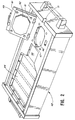
- Figure 2 is a perspective view of part of a magnetic separation device used with the apparatus of Figure 1.
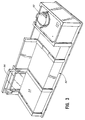
- Figure 3 is a perspective view of another part of magnetic separator used with the apparatus of Figure 1.
- Figure 4 is a perspective view of the separation system in operating position.
- Figure 5 is a plan view of a compound magnet used in the magnetic separator of Figures 2-4.
- Figure 6 is an end view of the magnet of Figure 5.
- Figure 7 is an end view of a second compound magnet used in the magnetic separator of Figures 2-4.
- a disposable system 10 for separating an individual population or populations of cells from a heterogeneous cell mixture.
- Cell concentrator portion 12 which may be used withthis invention is schematically shown and may be of a design as shown in U.S. Patent Nos. 4,379,452 or 4,410,026, or may be any cell concentrator member usable in any known apparatus for the concentrating of cells.
- the CS3000 T.M. separation system sold by Baxter Healthcare Corporation may be used, or the Autopheresis-C T.M. separation system, sold also by Baxter Healthcare Corporation, or any other desired, similar device, may be used.
- a desired population of cells may be provided, for example lymphocytes, separated in concentrator system 12 from whole blood.
- the lymphocytes perhaps mixed with other white blood cells, pass through flexible conduit 16 into flexible, collapsible container 18 of generally conventional design, which contains the particle means of micron-sized particles including a paramagnetic material such as ferric oxide, coated with plastic such as polymethyl methacrylate, which, in turn, is further coated with an antibody or other cell bonding agent to the specific marker proteins in the cell wall of a given category of leukocytes, so that the leukocytes and particles 20 selectively bond to each other, to the exclusion of the remaining leukocytes and other cells.
- a paramagnetic material such as ferric oxide
- plastic such as polymethyl methacrylate
- the apparatus of this invention also carries flexible tubing 22 which communicates between flexible, collapsible container 18 and a flexible collapsible container 24 communicating with tubing 22 at one end and communicating with an outlet tubing 26 at this other end.
- Tubing 26 branches into tubings 28, 30 each of which connects to another flexible, collapsible container 32, 34.
- cell concentrator portion 12 is preferably integrally connected to flexible container 18, the connection may be made by a conventional sterile connector system, if desired.
- the particles 20 may be stored either outside of container 18 and connected with a sterile connector system, or they may be placed in a frangible container inside of bag 18 with the container being breakable on use so that the particles 20 do not have an excessive amount of time to interact with the bag walls, in the event that some adhesion may take place there. Of course, the particles 20 may reside freely within the bag if the particles do not interact with the bag wall.
- the primary, cell-containing container 18 may be sealed by heat sealing of line 16 and by operation of clamp 36 (although clamp 36 may be closed at an earlier stage of the operation). If the microbeads or particles 20 are not already added to the container, they may be so added at this time, followed by gentle mixing of the contents of the primary container: specifically, the cells and the microbeads or particles. At this time, bonding takes place between the particular cells selected and the antibody coating of the particles or microbeads 20.
- containers 18 and 24 are placed into magnetic separator 40, which is shown in various aspects in Figures 2-7.
- Separator 40 carries upper base member 42 which carries magnet assemblies 44, 46.
- Upper rotatable, hinged presser member 49 comprises a flat undersurface portion 50, and carried by base 42, overlying in its closed position magnet 46.
- Upper base member 42 thus provides two spaces, respectively against magnet 44 and magnet 46, which are respectively proportioned to receive bag 18 and bag 24.
- Channel 47 and space 48 provide room for tubing 22, while channel 51 is provided to receive tubing 26.
- lower base member 52 is proportioned to receive upper base member 42 in cradle area 54 so that tubing 26 can be connected to roller pump assembly 53 for controlled pumping flow of cells out of bag 18, through intermediate bag 24, and into one or the other of containers 32 or 34.
- Hinged cover 56 is positioned to be brought down on top of bag 18 as installed in upper base member 42.
- Upper rotatable hinged presser member 49 presses down in similar manner on flexible chamber 24.
- the purpose of particularly presser member 49 is to provide precise definition of the thickness of the flow path of chamber 24 during processing to cause the flow path across the associated magnet 46 to be of very shallow depth, for example, about 1.27 mm (0.05 inch).
- magnet 44 is positioned to associate with chamber 18.
- the magnets 44 and 46 are designed to provide suitably configured magnet fields to capture and retain paramagnetic particles passing through the containers positioned thereon, respectively containers 18 and 24.
- magnetic 44 will possess a greatermagnetic field reach than magnetic 46 in order to capture a larger percentage of particles. This places the cells passing therethrough into a position to be strongly influenced by the fields generated by magnets 44, 46. Thus, those cells bonded to magnetic beads will be retained adjacent one or the other of the magnets.
- upper base member 42 may be refrigerated to a temperature on the order of 4° C. prior to use.
- the cold magnets keep the cells cold during operation, as well as providing some increase in magnetic field strength.
- the cold cells are less active and better preserved.
- non-specific cell interactions with the paramagnetic beads can be reduced. For example, phagocytes present are less active in ingesting available beads when kept at low temperatures.
- clamp 36 When containers 18, 24 are lying on magnets 44, 46, clamp 36 may be opened, and pivotable pressure member 56 may be gently closed to press the container 18 flat and to press the cells and their carrier liquids out of bag 18, which rests upon magnet 44.
- Presser 56 may also contain magnetizable metal strips that are sized and positioned so that they are magnetically pulled to the magnet 44 in a way such that the plastic bag 18 is squeezed and the efficient flow from the bag is controlled and relatively constant.
- the roller pump 53 may be activated to cause the cells and their carrier liquids to flow out of bag 18.
- the magnetic field from magnet 44 attracts the particles or microbeads 20, and the cells to which they are bonded, causing such microbeads 20 to be generally firmly affixed against the inner wall 57 (Fig. 6) of bag 18 that is closest to magnet 44, holding the particles 20 and their attached cells as the remaining cells and suspension liquid pass through tubing 22 out of bag 18.
- Hinged presser member 49 contains four metal bolts 81 that are sized to hold the presser member 49 in place with the proper spacing and mount of magnetic force.
- the surface 50 of presser member 49 is precisely machined to precisely define the thickness of the flow path through container 24. The shallow depth of this flow path causes any particles or microbeads present to drift into the influence of the magnetic field of magnet 46, to be retained on the inner wall 59 of container 24 as the remaining cells and liquid flow by, out of container 24, through tubing 26, into bag 32, for example. In such a circumstance, tubing 30 may be clamped off to keep bag 34 empty.
- a small amount of cell-compatible suspension liquid may be passed through the system, via sterile connector port 61, priming line 33, or another integrally connected container, to flush the remaining cells which are unattached to paramagnetic particles through the system into bag 32.
- tubing 28 may be closed, and tubing 30 opened by conventional clamp means.
- the system may be removed from the field of influence of magnets 44, 46, and, more suspension/solution may be passed into container 18, to flush the cells which are bound to particles 20 through tubing 22, through chamber 24, picking up any bound cells retained there, and into container 34.
- containers 32, 34 may be separated from the system by sealing and severing of tubings 28, 30 in conventional manner, with the desired particular population of cells being separated out from the main body of cells, and placed in separate container 34 for separate use.
- magnet 44 is designed to possess a greater magnetic field reach than magnet 46.
- this magnetic field reach is at least equal to about three-quarters of the width of the container 18, and more preferably substantially equivalent to such width. This ensures that a majority of the paramagnetic particles within container 18 are captured by the magnetic field and drawn to the surface of magnet 44.
- magnet 44 will have a magnetic field reach of from about 12.7 to 25.4 mm (one-half to one inch), preferably, 12.7 to 19.05 mm (one-half to three-quaters of an inch).
- Magnet assembly 46 may be made of similar construction. Magnet assembly 44 is shown to comprise a stack of bar magnets 64 which are separated by, and in contact with, steel pole pieces 66. As a particular advantageous feature, the like poles of adjacent bar magnets 64 in the stack face each other and particular pole piece separating them. This is demonstrated by the letters "N" and "S", each of which indicate the combined north poles or south poles of the respective magnets which are facing each other.
- the bar magnets 64 define long sides 68 and ends 70, and north and south poles of the bar magnets being defined along an opposed pair of long sides as shown in Figure 5.
- the bar magnets are made of a high magnetism alloy of neodymium, iron and boron.
- the face 72 of the magnet assembly shown rests in use against an outer wall of bag 18 so that the magnetic field from magnet assembly 44 passes into container 18, for retention of particles 20.
- magnet assembly 44 an end view of magnet assembly 44 is shown, with face 72 being the face that is displayed in Figure 5.
- magnets 64 separated by pole pieces 66, rest upon a non-magnetizable aluminum plate 74 or the like, to support the respective magnets and pole pieces.
- pole pieces 66 each define an angled groove 76 along parallel end faces which are spaced from bar magnets 64, and which are opposed to face 72 of the assembly 44, which face is the fixed location for retaining the particle/cell conjugate formed through the paramagnetic particles as in this invention.
- the bar magnets 64, pole pieces 66, and support plate 74 may be bonded together in any conventional manner with non-magnetic cement, or making use of appropriate clamps or retention straps.
- Appropriate magnets for use herein may be obtained from the Crucible Magnetics Co. of Elizabethtown, Kentucky.
- Magnet assembly 44 contains magnets 64 that are 12.7 mm (.50 inch) thick and pole pieces 66 that are 6.35 mm (.25 inch) thick. This generates a magnetic field that has local maxima of 7000 to 9100 gauss (average 8300 gauss) at the surface of the magnet and which decreases to 1100 to 1700 gauss (average 1400 gauss) at a distance of 1 cm. from the magnet surface.
- This magnet assembly gives both a relatively strong magnetic holding force at the magnet surface and a relatively good magnetic "reach out” force to capture beads some distance (up to 25.4 mm (1")) from the magnet surface.
- Magnet assembly 46 contains magnets 64 that are 6.35 mm (.25 inch) thick and pole pieces 66 that are 2.54 mm (0.1 inch) thick. This generates a magnetic field that has local maxima at the magnet surface ranging from 7300 to 8000 gauss and which decreases to 80 to 500 gauss at a distance of 1 cm from the magnet surface. Compared to magnet assembly 44, magnet assembly 46 has a stronger magnetic holding force at the magnet surface, but has less magnetic "reach out” force and thus has a shallower magnetic field.
- the second flexible container 24 is designed to take advantage of the particular magnetic field of magnet 46. First container 18 is shown to rest on magnet assembly 44 for cell separation.
- the system isolates in an aseptic, simplified manner, a particular subclass of concentrated cells, which may be separated as shown for any desired purpose.
- This example illustrates a specific application of the apparatus and method of this invention in the separation of T-helper/inducer lymphocyte cells collected from whole blood.
- HBSS Hanks Balanced Salt Solution
- phosphate buffered saline aliquots of phosphate buffered saline.
- the beads were then suspended in 20 ml. of 50 millimolar dithiothreitol in sodium acetate (0.1 Ml buffer, pH 4.5) and incubated with end-over-end rotation for 30 minutes at 4° C. to form the thiol derivative.
- the bead preparation was then washed five times in phosphate buffered saline, collecting the beads with a magnet after each wash. Finally, the beads were resuspended in 20 ml. of phosphate buffered saline.
- Mouse anti-Leu 3a antibody (type CD4 antibody-2mg. in 2 ml. phosphate buffered saline) was added to 0.1 ml. of 20mM SPDP in absolute ethanol. The mixture was dialyzed overnight against 500 ml. of phosphate buffered saline.
- the resulting antibody solution was added to the derivitized bead suspension in a 50 ml. glass centrifuge tube. The tube was rotated end-over-end overnight at room temperature to cause coupling of the antibody to the beads. Then, the beads were washed five times with phosphate buffered saline and resuspended in 30 ml. of phosphate buffered saline.
- the beads because of their dithiothreitol treatment, carry bound sulfhydryl active groups. Accordingly, upon being brought together, the antibody and the beads become chemically bonded together through a disulfide linkage resulting from a condensation reaction, with 2-thiolpyridine being split off as a by-product.
- roller pump 53 was actuated to pump at a rate of 10 ml. of fluid per minute into collection bag 32. Any bead-cell conjugates that escaped from bag 18 were subjected to the influence of secondary magnet 46 in bag 24, to be captured on the inner surface of chamber 24 adjacent that magnet, while cells which were not so bonded to the beads flowed out with fluids to collection bag 32.
- bag 18 and container 24 of fluids After substantial emptying of bag 18 and container 24 of fluids, the bead-cell conjugate in bag 18 was resuspended in 100 ml. of physiological saline, while removing bag 18 and container 24 from their seating on the respective magnets, and closing flow through tubing 26 while so doing. Following this, bag 18 and container 24 were reinstalled in their positions on upper magnet tray 42, and the suspending saline solution withdrawn from bag 18 by roller pump 53, as before, through tubing 26 into collection bag 32, along with any remaining cells which were not bonded to a paramagnetic bead.
- bag 18 and container 24 were once again removed from the influence of the magnets, after closing off flow through tubing 26.
- the bead-cell conjugate in bag 18 and container 24 was resuspended in 100 ml. of physiological saline containing 25mM dithiothreitol to break the bond between cells and beads.
- Bag 18 and container 24 were placed on a rotator at 4° C for 20 minutes.
- bag 18 and container 24 were connected to a 1 liter Fenwal PL269 tissue culture flask (symbolized in Fig. 1 as container 34).
- bag 18 and container 24 were reinstalled in upper tray 42, the hinged presser plates were closed, and the bag fluid contents were flushed into the tissue culture flask 34 while the paramagnetic bead particles remain trapped adjacent the magnets.
- the free lymphocytes which are positive to the action of CD4 antibody have been separated from other cells in the mixture, and are provided in isolated form in the tissue culture flask 34, or, if desired, a blood bag 34 as specifically shown in Fig. 1.
- Residual cells in the separation set downstream from bag 24 are also flushed into flask or bag 34 with more physiological saline.
- the cells in flask 34 may be collected by centrifugation and resuspended in 100 ml.
- RPMI 1640 tissue culture medium containing supplemental glutamine and placed in a carbon dioxide incubator for subsequent further study.
- bone marrow cells generally, cells of the following types: B-lymphoma, neuroblastoma, breast cancer, or leukemia cells, when such cells express a tumor associated antigen on their surface recognizable by a biological attached to the bead particle surface.
- the process may be used or purifying bone marrow cells prior to autologous bone marrow transplant.
- the bone marrow may be processed through a conventional cell separator to extract a mononuclear cell preparation therefrom.
- This mononuclear cell preparation may be incubated with a panel of mouse-derived monoclonal antibodies against the tumor cells, washed to remove excess antibody, and then incubated with paramagnetic beads as described in Example 1, coated with goat antimouse antibody to selectively bind the tumor cell to the bead.
- the tumor cell is then removed as in Example 1, using a magnetic separator of the type disclosed.
- T-lymphocytes may be removed from the mononuclear cell preparation described in Example 2 before an allogenic transplant to prevent Graft vs. Host Disease.
- This may be used in the case where bone marrow grafts are provided for the treatment of cancer, or for reconstitution of the bone marrow after exposure to radiation apart from cancer treatment.
- the Mononuclear cell preparation from the bone marrow is treated with a mouse monoclonal antibody (for example, anti CD3) to tag the T-lymphocyte cells for binding by the goat antimouse antibody coated beads.
- a mouse monoclonal antibody for example, anti CD3
- the mononuclear cell preparation previously prepared from bone marrow as in Example 2 may also be treated in a manner similar to that described above, making use of a mouse monoclonal antibody bonded to the paramagnetic beads to allow the selection of pluripotent stems cells from the mononuclear cell preparation.
- the isolated stem cells can thus be used for bone marrow transplant. This approach could be used to provide for autologous bone marrow transplants which are substantially free of tumor cells, while suppressing Graft vs. Host Disease. Such isolated stem cells could also be used for gene therapy, in which genes are inserted into the stem cells prior to their implantation as a bone marrow transplant.
- liver hepatocytes or insulin secreting pancreatic beta cells may be isolated and thereafter cultured in an appropriate culture medium to expand the cells for use in organ transplantation.
- cytotoxic T-lymphocytes By a process similar to that of Example 1, making use of an appropriate monoclonal antibody, specific populations of cytotoxic T-lymphocytes may be selected, such as tetanus-toxoid primed lymphocyte cells. These cells can be separated by an analogous technique similar to that of Example 1, manipulated in vitro and transfused to effect targeting of the cytotoxic cells to specific B-lymphocytes which mediate autoimmune disease (for example, Myasthenia Gravis). In this way, the disease mediating cells could be destroyed in situ.
- autoimmune disease for example, Myasthenia Gravis
Landscapes
- Health & Medical Sciences (AREA)
- Life Sciences & Earth Sciences (AREA)
- Engineering & Computer Science (AREA)
- Immunology (AREA)
- Biomedical Technology (AREA)
- Hematology (AREA)
- Heart & Thoracic Surgery (AREA)
- Vascular Medicine (AREA)
- General Health & Medical Sciences (AREA)
- Urology & Nephrology (AREA)
- Chemical & Material Sciences (AREA)
- Molecular Biology (AREA)
- Anesthesiology (AREA)
- Animal Behavior & Ethology (AREA)
- Public Health (AREA)
- Veterinary Medicine (AREA)
- Cell Biology (AREA)
- Cardiology (AREA)
- Microbiology (AREA)
- General Physics & Mathematics (AREA)
- Food Science & Technology (AREA)
- Medicinal Chemistry (AREA)
- Physics & Mathematics (AREA)
- Analytical Chemistry (AREA)
- Biochemistry (AREA)
- Biotechnology (AREA)
- Pathology (AREA)
- Tropical Medicine & Parasitology (AREA)
- Zoology (AREA)
- Virology (AREA)
- Apparatus Associated With Microorganisms And Enzymes (AREA)
- Micro-Organisms Or Cultivation Processes Thereof (AREA)
Abstract
Claims (28)
- Installation pour la séparation sélective d'une population spécifique de cellules d'un mélange hétérogène de cellules comprenant un conteneur (18) contenant des éléments de particules (20) formés à partir d'un matériau paramagnétique, une substance capable de se lier à la population spécifique de cellules dudit mélange de cellules étant reliée auxdits éléments de particules (20) ; un trajet d'écoulement de cellules (16, 22), le conteneur (18) étant disposé sur le trajet d'écoulement (16, 22) pour recevoir le mélange de cellules, de sorte qu'en fonctionnement, ledit mélange de cellules est en contact étroit et est mis à incuber avec lesdits éléments de particules à l'intérieur dudit conteneur (18) afin de lier de façon sélective ladite population spécifique de cellules dudit mélange de cellules auxdits éléments de particules (20), créant ainsi un conjugué particules/cellules ; et des premier et deuxième éléments magnétiques (44, 46), disposés chacun par rapport audit trajet d'écoulement, ledit deuxième élément magnétique (46) étant espacé en aval dudit premier élément magnétique (44), pour créer des champs magnétiques respectifs à des emplacements fixés le long dudit trajet d'écoulement afin de retenir ledit conjugué particules/cellules dans ledit emplacement fixé et permettre aux parties restantes non liées dudit mélange de cellules d'être éliminées desdits emplacements (44), caractérisée en ce que ledit deuxième élément magnétique (46) crée un champ magnétique moins profond à son emplacement associé, mais présente une force de maintien magnétique plus importante à sa surface que le premier élément magnétique (44).
- Installation selon la revendication 1, dans laquelle ledit conteneur (18) est un conteneur souple écrasable.
- Installation selon l'une quelconque des revendications précédentes, comprenant au moins un deuxième conteneur (24) en aval du premier conteneur (18), le deuxième conteneur (24) étant souple et écrasable.
- Installation selon la revendication 3, dans laquelle ledit deuxième conteneur (24) comprend des orifices d'entrée et de sortie à ses extrémités opposées, l'aire de la section transversale desdits orifices d'entrée et de sortie ne dépassant pas un quart de l'aire de la section transversale dudit deuxième conteneur (24).
- Installation selon la revendication 4, dans laquelle ledit deuxième conteneur (24) est de forme hexagonale, lesdits orifices d'entrée et de sortie étant placés à des angles opposés de celui-ci.
- Installation selon la revendication 3, 4, ou 5, dans laquelle ledit deuxième élément magnétique (46) est placé près de moyens (42) portant ledit deuxième conteneur (24), au moins une partie de paroi intérieure (59) dudit deuxième conteneur (24) étant à l'intérieur du champ magnétique dudit deuxième élément magnétique (46), ladite partie de paroi intérieure (59) étant audit emplacement fixé.
- Installation selon la revendication 6, comprenant des moyens de presse à plateau (49) pour aplatir ledit deuxième conteneur écrasable (24) pendant que ladite partie de paroi intérieure (59) dudit deuxième conteneur (24) est à l'intérieur du champ magnétique du deuxième élément magnétique (46) pour fournir une épaisseur de trajet d'écoulement de cellules de 0,5 à 2,6 mm (0,02 à 0,1 pouce) dans ledit deuxième conteneur (24) pour faciliter la séparation dudit conjugué particules/cellules du reste dudit mélange de cellules.
- Installation selon l'une quelconque des revendications précédentes, dans laquelle le premier élément magnétique (44) est placé près de moyens (42) portant le premier conteneur (24), une partie de paroi intérieure (57) du premier conteneur (18) étant à l'intérieur du champ magnétique dudit premier élément magnétique (44), ladite partie de paroi intérieure (57) du premier conteneur (18) étant audit emplacement fixé.
- Installation selon l'une quelconque des revendications 3 à 8, dans laquelle ledit deuxième conteneur (24) est relié de façon étanche et aseptique au premier conteneur (18), ledit premier élément magnétique (44) étant placé contre ledit premier conteneur (18) et ledit deuxième élément magnétique (46) étant placé contre ledit deuxième conteneur (24).
- Installation selon l'une quelconque des revendications précédentes, comprenant un récipient écrasable (32) en aval du premier conteneur (18).
- Installation selon la revendication 10, dans laquelle le premier conteneur (18) est relié de façon aseptique audit récipient (32), le récipient (32) étant placé pour recevoir des cellules traitées provenant du premier conteneur (18) sans nécessité de former une connexion stérile entre eux.
- Installation selon la revendication 10 ou 11, dans laquelle ledit deuxième conteneur (24) est relié de façon étanche et aseptique audit premier conteneur (18) et audit récipient (32) et est placé entre eux.
- Installation selon l'une quelconque des revendications précédentes, comprenant un conteneur de fraction à utiliser avec des moyens de séparation de mélange de cellules (12), le conteneur de fraction étant placé en amont du premier conteneur (18).
- Installation selon la revendication 13, dans laquelle ledit mélange est du sang et ledit conteneur de fraction est un moyen souple à insert à chambres multiples pour une centrifugeuse de séparation de cellules sanguines, le premier conteneur (18) étant relié de façon aseptique au moyen souple à insert pour permettre à une fraction concentrée de cellules sanguines fraîchement recueillies d'être transférée de façon aseptique dudit moyen à insert au premier conteneur (18) sans nécessité de former une connexion stérile entre eux.
- Installation selon l'une quelconque des revendications précédentes, dans laquelle ledit premier élément magnétique (44) possède un champ magnétique présentant une étendue sensiblement équivalente à la largeur du premier conteneur (18).
- Installation selon la revendication 15, dans laquelle ledit premier élément magnétique (44) possède un champ magnétique présentant une étendue d'environ un demi-pouce à environ un pouce (1,2 à 2,6 cm).
- Installation selon la revendication 15 ou 16, dans laquelle ledit premier élément magnétique (44) possède un champ magnétique présentant une portée d'environ un demi à environ trois quarts d'un pouce (1,2 à 1,9 cm).
- Installation selon l'une quelconque des revendications 1 à 17, dans laquelle lesdits éléments de particules paramagnétiques (20) portent sur leurs surfaces un anticorps spécifique des cellules choisies parmi le groupe constitué des B-lymphome, neuroblastome, cancer du sein, leucémie, T-lymphocytes, et cellules tigées pluripotentes, ou sont revêtus d'un anticorps spécifique de cellules choisies parmi le groupe constitué des hépatocytes et des cellules pancréatiques bêta sécrétant de l'insuline;
- Installation selon la revendication 18, dans laquelle lesdits éléments paramagnétiques (20) portent sur leurs surfaces un anticorps spécifique d'une population spécifique de T-lymphocytes cytotoxiques.
- Procédé pour la séparation sélective d'une population spécifique de cellules d'un mélange de cellules, le procédé comprenant (a) le mélange du mélange de cellules avec les éléments de particules paramagnétiques (20) dans un conteneur (18), une substance capable de se lier uniquement à la population de cellules spécifique du mélange étant reliée aux éléments de particules (20), (b) l'exposition du conteneur (18) à un champ magnétique pour immobiliser lesdits éléments de particules (20) et la population spécifique de cellules qui y est liée, et (c) l'écoulement des cellules non liées vers le premier moyen de conteneur de stockage (32), moyennant quoi le premier moyen de conteneur de stockage (32) reçoit des cellules non liées auxdits éléments de particules (20), caractérisé par l'écoulement des cellules du premier conteneur (18) vers un deuxième conteneur (24) à l'étape (b) tout en exposant le premier conteneur à un premier champ magnétique, et l'exposition du deuxième conteneur (24) à un deuxième champ magnétique qui est plus superficiel que le premier champ magnétique et qui présente une force de maintien plus importante à la surface de son élément magnétique associé que le premier champ magnétique.
- Procédé selon la revendication 20, dans lequel l'étendue du champ magnétique du premier élément magnétique (44) est sensiblement équivalente à la largeur dudit premier conteneur (18).
- Procédé selon la revendication 20 ou 21, dans lequel le mélange de cellules est une fraction sanguine, et comprenant en outre les étapes consistant à centrifuger la totalité du sang pour extraire la fraction, recueillir la fraction sanguine dans le premier conteneur (18) et isoler hermétiquement ledit premier conteneur (18) de la centrifugeuse.
- Procédé selon la revendication 20, 21 ou 22, comprenant en outre les étapes consistant à placer lesdits premier et deuxième éléments magnétiques (44, 46) contre lesdits premier et deuxième conteneurs (18, 24) respectivement dans le but d'exposer les conteneurs (18, 24) aux champs magnétiques.
- Procédé selon l'une quelconque des revendications 20 à 23, comprenant en outre l'arrêt de l'écoulement entre ledit deuxième conteneur (24) et ledit premier moyen de conteneur de stockage (32) ; le retrait desdits premier et deuxième conteneurs (18, 24) du champ magnétique de l'élément magnétique respectif (44, 46) et l'écoulement de la population spécifique de cellules (20) desdits premier et deuxième conteneurs (18, 24) dans un deuxième moyen de conteneur de stockage (34).
- Procédé selon la revendication 24, dans lequel les cellules sont liées aux éléments de particules paramagnétiques (20) quand ils s'écoulent des conteneurs (18, 24) dans le deuxième moyen de conteneur de stockage (34).
- Procédé selon la revendication 24, comprenant en outre la coupure de la communication de fluide entre ledit deuxième conteneur (24) et le premier moyen de conteneur de stockage (32), le retrait des connexions de liaison entre les cellules de la population spécifique et les éléments de particules paramagnétiques (20) de sorte que la population spécifique de cellules n'est plus liée aux éléments de particules (20), et l'écoulement de la population de cellules dans ledit deuxième moyen de conteneur de stockage (34) pendant que les premier et deuxième conteneurs (18, 24) sont sous l'influence desdits champs magnétiques, moyennant quoi lesdits éléments de particules (20) sont empêchés de s'écouler avec lesdites cellules dans le deuxième moyen de conteneur de stockage (34), séparant ainsi les cellules des éléments de particules.
- Procédé selon l'une quelconque des revendications 20 à 26, dans lequel ledit mélange de cellules placé dans le premier conteneur comprenant des éléments de particules paramagnétiques est une préparation de cellules mononucléaires préalablement séparées de la moelle osseuse.
- Procédé selon l'une quelconque des revendications 20 à 27, quand il est mis en oeuvre en utilisant l'installation selon l'une quelconque des revendications 1 à 19.
Applications Claiming Priority (5)
| Application Number | Priority Date | Filing Date | Title |
|---|---|---|---|
| US25521488A | 1988-10-11 | 1988-10-11 | |
| US39706789A | 1989-08-22 | 1989-08-22 | |
| US397067 | 1989-08-22 | ||
| PCT/US1989/004527 WO1990004019A1 (fr) | 1988-10-11 | 1989-10-10 | Systeme servant a separer par affinite magnetique des cellules d'un concentre cellulaire |
| US255214 | 1999-02-22 |
Publications (2)
| Publication Number | Publication Date |
|---|---|
| EP0438520A1 EP0438520A1 (fr) | 1991-07-31 |
| EP0438520B1 true EP0438520B1 (fr) | 1994-08-24 |
Family
ID=26944532
Family Applications (1)
| Application Number | Title | Priority Date | Filing Date |
|---|---|---|---|
| EP89912306A Expired - Lifetime EP0438520B1 (fr) | 1988-10-11 | 1989-10-10 | Systeme servant a separer par affinite magnetique des cellules d'un concentre cellulaire |
Country Status (6)
| Country | Link |
|---|---|
| EP (1) | EP0438520B1 (fr) |
| JP (1) | JPH0757177B2 (fr) |
| AU (1) | AU4492789A (fr) |
| CA (1) | CA1335181C (fr) |
| DE (1) | DE68917736T2 (fr) |
| WO (1) | WO1990004019A1 (fr) |
Cited By (5)
| Publication number | Priority date | Publication date | Assignee | Title |
|---|---|---|---|---|
| US7381561B2 (en) | 2002-08-27 | 2008-06-03 | Stemcells California, Inc. | Enriched central nervous system stem cell and progenitor cell populations, and methods for identifying, isolating and enriching for such populations |
| US8168393B2 (en) | 2007-02-16 | 2012-05-01 | The Brigham And Women's Hospital, Inc. | Compositions and methods for diagnosing tumors using LEDGF/p75 |
| US8425928B2 (en) | 2008-11-14 | 2013-04-23 | Viacyte, Inc. | Encapsulation of pancreatic cells derived from human pluripotent stem cells |
| US10266808B2 (en) | 2008-04-21 | 2019-04-23 | Viacyte, Inc. | Method of enriching for pancreatic endocrine cells that express chromogranin A |
| US10518021B2 (en) * | 2015-02-20 | 2019-12-31 | Terumo Bct, Inc. | Composite liquid bag system holder |
Families Citing this family (47)
| Publication number | Priority date | Publication date | Assignee | Title |
|---|---|---|---|---|
| EP0513219B1 (fr) * | 1990-01-31 | 1996-04-03 | Baxter International Inc. | Sac souple pour separateur magnetique |
| US5372439A (en) * | 1992-12-18 | 1994-12-13 | Zebra Technologies Corporation | Thermal transfer printer with controlled ribbon feed |
| US5439586A (en) * | 1993-09-15 | 1995-08-08 | The Terry Fox Laboratory Of The British Columbia Cancer Agnecy | Magnetic filter with ordered wire array |
| JPH0780041A (ja) * | 1993-09-20 | 1995-03-28 | Terumo Corp | 細胞保存バッグシステム |
| EP0672458A3 (fr) * | 1994-03-04 | 1996-02-28 | Cleveland Clinic Foundation | Méthode et appareil pour la cytométrie magnétique. |
| CA2161958C (fr) * | 1994-03-14 | 2010-02-23 | Ahmad-Maher Moubayed | Procede et appareil pour une separation semi-automatique ce cellules |
| GB9425138D0 (en) | 1994-12-12 | 1995-02-08 | Dynal As | Isolation of nucleic acid |
| EP0819250B1 (fr) * | 1995-04-06 | 2006-09-20 | Miltenyi Biotec Inc. | Separation cellulaire multi-parametre faisant appel a des particules magnetiques collo dales liberables |
| US5998224A (en) * | 1997-05-16 | 1999-12-07 | Abbott Laboratories | Magnetically assisted binding assays utilizing a magnetically responsive reagent |
| IL124514A (en) * | 1998-05-17 | 2002-02-10 | Davidson Chaim | Method and apparatus for magnetically separating selected particles, particularly biological cells |
| US6294342B1 (en) | 1999-09-29 | 2001-09-25 | Abbott Laboratories | Magnetically assisted binding assays utilizing a magnetically responsive reagent |
| US20020058030A1 (en) * | 2000-05-03 | 2002-05-16 | Eligix, Inc. | Whole blood separator apparatus and method of use |
| GB0013658D0 (en) | 2000-06-05 | 2000-07-26 | Dynal Asa | Nucleic acid isolation |
| AU2001280959A1 (en) * | 2000-08-01 | 2002-02-13 | Carepoint Diagnostics, Inc. | Analysis of biological samples for platelet activation or coagulation activationmarkers using microparticules |
| US6984522B2 (en) | 2000-08-03 | 2006-01-10 | Regents Of The University Of Michigan | Isolation and use of solid tumor stem cells |
| DE10127068A1 (de) * | 2001-05-23 | 2002-11-28 | Bio Medical Apherese Systeme G | Vorrichtung und Verfahren zum Inkubieren und Wiederabtrennen von Magnetteilchen in und von flüssige biologische Dispersionen |
| WO2003042405A2 (fr) | 2001-11-15 | 2003-05-22 | Children's Medical Center Corporation | Techniques d'isolation, de developpement et de differenciation de cellules souches provenant de villosites choriales, de liquide amniotique ainsi que de placenta et applications therapeutiques |
| EP1494028A1 (fr) * | 2003-07-03 | 2005-01-05 | Labsoft Diagnostics AG | Séparation immuno-magnétique des cellulles cibles spécifiques |
| RU2252037C1 (ru) * | 2003-10-14 | 2005-05-20 | Германов Евгений Павлович | Система коррекции биологической жидкости |
| FI20051248A7 (fi) | 2005-12-02 | 2007-06-03 | Biocontrol Systems Oy | Biologisten komponenttien rikastusyksikkö ja rikastusmenetelmä |
| US7985340B2 (en) | 2005-12-02 | 2011-07-26 | Invitrogen Dynal As | Magnetic separator |
| GB2445073A (en) * | 2006-12-18 | 2008-06-25 | Ge Healthcare Bio Sciences Ab | Cell separation device |
| ES2640216T3 (es) * | 2007-12-07 | 2017-11-02 | Miltenyi Biotec Gmbh | Sistemas y métodos para procesamiento de células |
| DK2283117T3 (da) | 2008-04-21 | 2014-01-20 | Viacyte Inc | Fremgangsmåde til oprensning af pancreatiske endodermceller afledt fra humane embryoniske stamceller |
| CN102325878A (zh) | 2008-12-23 | 2012-01-18 | 斯特姆塞尔思加利福尼亚有限公司 | 少突胶质前体细胞的靶向细胞群及制备与使用方法 |
| EP2597153B1 (fr) | 2011-11-25 | 2016-10-05 | Miltenyi Biotec GmbH | Procédé de séparation de cellules |
| WO2013095867A1 (fr) | 2011-12-21 | 2013-06-27 | Becton, Dickinson And Company | Systèmes cytométriques à écoulement pour séparation stérile de composants d'échantillon magnétiquement étiquetés |
| DE102014106603A1 (de) * | 2014-05-12 | 2015-11-12 | Verein zur Förderung von Innovationen durch Forschung, Entwicklung und Technologietransfer e.V. (Verein INNOVENT e.V.) | Verfahren und Vorrichtung zur Abreicherung von zirkulierenden Tumorzellen aus einer Zellsuspension |
| CA2984884A1 (fr) | 2014-05-15 | 2015-11-19 | Kellbenx Incorporated | Preparation de globules rouges nucleees ftales (nrbc) pour test de diagnostic |
| WO2016183032A1 (fr) | 2015-05-08 | 2016-11-17 | Biomagnetic Solutions Llc | Appareil et procédé de séparation de cellules immunomagnétique |
| EP3397389B1 (fr) * | 2015-12-29 | 2024-05-15 | Life Technologies Corporation | Procédé et système de séparation de particules magnétiques d'un fluide |
| GB2565664A (en) * | 2016-03-07 | 2019-02-20 | Hitachi Chemical Advanced Therapeutics Solutions Llc | A closed system for labelling and selecting live cells |
| CN118670959A (zh) | 2016-04-15 | 2024-09-20 | 贝克顿·迪金森公司 | 封闭式小滴分选器以及其使用方法 |
| EP3548108B1 (fr) | 2016-12-02 | 2024-01-31 | Terumo BCT, Inc. | Séparation de fluide composite |
| EP3427052A4 (fr) * | 2017-03-27 | 2019-12-04 | Hitachi Chemical Advanced Therapeutics Solutions, LLC | Système fermé pour le marquage et la sélection de cellules vivantes |
| TWI616526B (zh) * | 2017-05-15 | 2018-03-01 | Cell separation and purification device | |
| JP7145209B2 (ja) | 2017-06-14 | 2022-09-30 | ヘルムホルツ ツェントゥルム ミュンヘン ドイチェス フォルシュングスツェントゥルム フューア ゲズントハイト ウント ウムヴェルト (ゲーエムベーハー) | ヒト胚性幹細胞から誘導された内胚葉及び膵内胚葉細胞を精製するための方法 |
| EP3785017B1 (fr) * | 2018-04-27 | 2025-09-10 | Becton, Dickinson And Company | Systèmes de collecte pour échantillons triés par cytométrie en flux et procédés les mettant en oeuvre |
| CN119269374A (zh) | 2018-04-27 | 2025-01-07 | 贝克顿·迪金森公司 | 具有气溶胶含量受控的封闭式液滴分选仪的流式细胞仪及其使用方法 |
| CN112135789B (zh) | 2018-05-08 | 2023-09-08 | 生物磁性解决方案有限责任公司 | 从柔性一次性袋中分离细胞的刚性腔室 |
| WO2020091866A1 (fr) | 2018-10-30 | 2020-05-07 | Becton, Dickinson And Company | Module de tri de particules à fenêtre d'alignement, systèmes et procédés d'utilisation de ce dernier |
| CN109735447B (zh) * | 2019-02-20 | 2025-02-07 | 温州市怡康细胞移植技术开发有限公司 | 一种用于分离胰岛组织的装置及其方法 |
| EP3963337A1 (fr) | 2019-05-02 | 2022-03-09 | KellBenx Inc. | Procédés basés sur la filtration pour préparer des globules rouges nucléés foetaux (nrbc) pour un test diagnostique |
| EP4055381A4 (fr) * | 2019-11-05 | 2024-03-20 | Biomagnetic Solutions LLC | Dispositif amélioré de séparation immunomagnétique à grande échelle |
| US20210387176A1 (en) * | 2020-06-16 | 2021-12-16 | Sani-Tech West, Inc. | Closed fluid receiving and sampling container |
| CN115521896B (zh) * | 2022-09-27 | 2024-06-25 | 深圳赛桥生物创新技术有限公司 | 磁珠去除方法、设备和存储介质 |
| CN115524482B (zh) * | 2022-09-27 | 2026-03-06 | 深圳赛桥生物创新技术有限公司 | 磁珠分选方法、设备及存储介质 |
Family Cites Families (6)
| Publication number | Priority date | Publication date | Assignee | Title |
|---|---|---|---|---|
| DE3200988A1 (de) * | 1982-01-14 | 1983-07-28 | Thomas A. Dr. 6900 Heidelberg Reed | Verfahren und vorrichtung zur abtrennung von organischen stoffen aus einer suspension oder loesung |
| US4554088A (en) * | 1983-05-12 | 1985-11-19 | Advanced Magnetics Inc. | Magnetic particles for use in separations |
| DE3444939A1 (de) * | 1984-12-08 | 1986-06-12 | Bayer Ag, 5090 Leverkusen | Magnetische microspheres |
| US4710472A (en) * | 1985-09-25 | 1987-12-01 | The United States Of America As Represented By The Secretary Of The Navy | Magnetic separation device |
| AU7399787A (en) * | 1986-05-16 | 1987-12-01 | Omega Medicinteknik A.B. | Method and apparatus for plasmapheresis |
| AU2613988A (en) * | 1988-01-04 | 1989-08-01 | E.I. Du Pont De Nemours And Company | Multiple stage affinity process for isolation of specific cells from a cell mixture |
-
1989
- 1989-09-28 CA CA000614111A patent/CA1335181C/fr not_active Expired - Fee Related
- 1989-10-10 AU AU44927/89A patent/AU4492789A/en not_active Abandoned
- 1989-10-10 WO PCT/US1989/004527 patent/WO1990004019A1/fr not_active Ceased
- 1989-10-10 JP JP1511428A patent/JPH0757177B2/ja not_active Expired - Fee Related
- 1989-10-10 DE DE68917736T patent/DE68917736T2/de not_active Expired - Fee Related
- 1989-10-10 EP EP89912306A patent/EP0438520B1/fr not_active Expired - Lifetime
Cited By (7)
| Publication number | Priority date | Publication date | Assignee | Title |
|---|---|---|---|---|
| US7381561B2 (en) | 2002-08-27 | 2008-06-03 | Stemcells California, Inc. | Enriched central nervous system stem cell and progenitor cell populations, and methods for identifying, isolating and enriching for such populations |
| US8168393B2 (en) | 2007-02-16 | 2012-05-01 | The Brigham And Women's Hospital, Inc. | Compositions and methods for diagnosing tumors using LEDGF/p75 |
| US10266808B2 (en) | 2008-04-21 | 2019-04-23 | Viacyte, Inc. | Method of enriching for pancreatic endocrine cells that express chromogranin A |
| US8425928B2 (en) | 2008-11-14 | 2013-04-23 | Viacyte, Inc. | Encapsulation of pancreatic cells derived from human pluripotent stem cells |
| US9132226B2 (en) | 2008-11-14 | 2015-09-15 | Viacyte, Inc. | Encapsulation of pancreatic cells derived from human pluripotent stem cells |
| US11660377B2 (en) | 2008-11-14 | 2023-05-30 | Viacyte, Inc. | Cryopreserved in vitro cell culture of human pancreatic progenitor cells |
| US10518021B2 (en) * | 2015-02-20 | 2019-12-31 | Terumo Bct, Inc. | Composite liquid bag system holder |
Also Published As
| Publication number | Publication date |
|---|---|
| JPH0757177B2 (ja) | 1995-06-21 |
| EP0438520A1 (fr) | 1991-07-31 |
| AU4492789A (en) | 1990-05-01 |
| DE68917736T2 (de) | 1995-05-04 |
| CA1335181C (fr) | 1995-04-11 |
| JPH04500008A (ja) | 1992-01-09 |
| DE68917736D1 (de) | 1994-09-29 |
| WO1990004019A1 (fr) | 1990-04-19 |
Similar Documents
| Publication | Publication Date | Title |
|---|---|---|
| CA1335181C (fr) | Systeme de separation selective de cellules d'un concentrat cellulaire | |
| US6221315B1 (en) | Apparatus for separation of biologic components from heterogeneous cell populations | |
| EP0653062B1 (fr) | Procede de centrifugation continue destine a la separation de constituants biologiques de populations de cellules heterogenes | |
| US11499977B2 (en) | Equipment and procedure for culturing, separating, and genetically modifying donor cells for reinfusion into a patient | |
| Kemsheadl et al. | Magnetic separation techniques: their application to medicine | |
| US5840502A (en) | Methods for enriching specific cell-types by density gradient centrifugation | |
| AU720285B2 (en) | Process for preparing macrophages, and kits and compositions therefore | |
| WO2001083002A2 (fr) | Appareil de separation de sang total et procede d'utilisation | |
| WO1987004628A1 (fr) | Procede de selection immunologique | |
| Kemshead | The immunomagnetic manipulation of bone marrow |
Legal Events
| Date | Code | Title | Description |
|---|---|---|---|
| PUAI | Public reference made under article 153(3) epc to a published international application that has entered the european phase |
Free format text: ORIGINAL CODE: 0009012 |
|
| 17P | Request for examination filed |
Effective date: 19910308 |
|
| AK | Designated contracting states |
Kind code of ref document: A1 Designated state(s): DE FR GB IT |
|
| 17Q | First examination report despatched |
Effective date: 19930426 |
|
| GRAA | (expected) grant |
Free format text: ORIGINAL CODE: 0009210 |
|
| AK | Designated contracting states |
Kind code of ref document: B1 Designated state(s): DE FR GB IT |
|
| REF | Corresponds to: |
Ref document number: 68917736 Country of ref document: DE Date of ref document: 19940929 |
|
| ITF | It: translation for a ep patent filed | ||
| ET | Fr: translation filed | ||
| PLBE | No opposition filed within time limit |
Free format text: ORIGINAL CODE: 0009261 |
|
| STAA | Information on the status of an ep patent application or granted ep patent |
Free format text: STATUS: NO OPPOSITION FILED WITHIN TIME LIMIT |
|
| 26N | No opposition filed | ||
| REG | Reference to a national code |
Ref country code: GB Ref legal event code: 732E |
|
| REG | Reference to a national code |
Ref country code: FR Ref legal event code: TP |
|
| REG | Reference to a national code |
Ref country code: GB Ref legal event code: IF02 |
|
| PGFP | Annual fee paid to national office [announced via postgrant information from national office to epo] |
Ref country code: FR Payment date: 20021104 Year of fee payment: 14 Ref country code: DE Payment date: 20021104 Year of fee payment: 14 |
|
| PGFP | Annual fee paid to national office [announced via postgrant information from national office to epo] |
Ref country code: GB Payment date: 20031001 Year of fee payment: 15 |
|
| PG25 | Lapsed in a contracting state [announced via postgrant information from national office to epo] |
Ref country code: DE Free format text: LAPSE BECAUSE OF NON-PAYMENT OF DUE FEES Effective date: 20040501 |
|
| PG25 | Lapsed in a contracting state [announced via postgrant information from national office to epo] |
Ref country code: FR Free format text: LAPSE BECAUSE OF NON-PAYMENT OF DUE FEES Effective date: 20040630 |
|
| REG | Reference to a national code |
Ref country code: FR Ref legal event code: ST |
|
| PG25 | Lapsed in a contracting state [announced via postgrant information from national office to epo] |
Ref country code: GB Free format text: LAPSE BECAUSE OF NON-PAYMENT OF DUE FEES Effective date: 20041010 |
|
| GBPC | Gb: european patent ceased through non-payment of renewal fee |
Effective date: 20041010 |
|
| PG25 | Lapsed in a contracting state [announced via postgrant information from national office to epo] |
Ref country code: IT Free format text: LAPSE BECAUSE OF NON-PAYMENT OF DUE FEES Effective date: 20051010 |