EP0439155A1 - Housse pour bicyclette - Google Patents
Housse pour bicyclette Download PDFInfo
- Publication number
- EP0439155A1 EP0439155A1 EP91100850A EP91100850A EP0439155A1 EP 0439155 A1 EP0439155 A1 EP 0439155A1 EP 91100850 A EP91100850 A EP 91100850A EP 91100850 A EP91100850 A EP 91100850A EP 0439155 A1 EP0439155 A1 EP 0439155A1
- Authority
- EP
- European Patent Office
- Prior art keywords
- protective cover
- cover according
- wheeler
- velcro
- elements
- Prior art date
- Legal status (The legal status is an assumption and is not a legal conclusion. Google has not performed a legal analysis and makes no representation as to the accuracy of the status listed.)
- Withdrawn
Links
- 230000001681 protective effect Effects 0.000 claims abstract description 153
- 239000002985 plastic film Substances 0.000 claims abstract 3
- 229920006255 plastic film Polymers 0.000 claims abstract 3
- 125000006850 spacer group Chemical group 0.000 claims description 13
- 230000000087 stabilizing effect Effects 0.000 claims description 10
- XLYOFNOQVPJJNP-UHFFFAOYSA-N water Substances O XLYOFNOQVPJJNP-UHFFFAOYSA-N 0.000 claims description 6
- 230000003014 reinforcing effect Effects 0.000 claims description 5
- 230000006378 damage Effects 0.000 claims description 3
- 239000002184 metal Substances 0.000 claims description 3
- 229910052751 metal Inorganic materials 0.000 claims description 3
- 230000002787 reinforcement Effects 0.000 claims description 3
- 239000010985 leather Substances 0.000 claims description 2
- 230000008961 swelling Effects 0.000 claims description 2
- 239000002990 reinforced plastic Substances 0.000 claims 1
- 230000003019 stabilising effect Effects 0.000 abstract 1
- 238000004519 manufacturing process Methods 0.000 description 3
- 230000006978 adaptation Effects 0.000 description 2
- 230000008901 benefit Effects 0.000 description 2
- 238000011109 contamination Methods 0.000 description 2
- 230000002349 favourable effect Effects 0.000 description 2
- 230000035515 penetration Effects 0.000 description 2
- 238000003860 storage Methods 0.000 description 2
- 241000567772 Cetorhinus maximus Species 0.000 description 1
- 238000005299 abrasion Methods 0.000 description 1
- 230000009471 action Effects 0.000 description 1
- 238000004026 adhesive bonding Methods 0.000 description 1
- 239000000969 carrier Substances 0.000 description 1
- 230000008859 change Effects 0.000 description 1
- 230000000694 effects Effects 0.000 description 1
- 238000000034 method Methods 0.000 description 1
- 238000012986 modification Methods 0.000 description 1
- 230000004048 modification Effects 0.000 description 1
- 238000004806 packaging method and process Methods 0.000 description 1
- 230000002028 premature Effects 0.000 description 1
- 230000002035 prolonged effect Effects 0.000 description 1
- 230000009467 reduction Effects 0.000 description 1
- 230000002441 reversible effect Effects 0.000 description 1
- 238000000926 separation method Methods 0.000 description 1
- 230000006641 stabilisation Effects 0.000 description 1
- 238000011105 stabilization Methods 0.000 description 1
- 230000000007 visual effect Effects 0.000 description 1
- 230000037303 wrinkles Effects 0.000 description 1
Images





Classifications
-
- B—PERFORMING OPERATIONS; TRANSPORTING
- B60—VEHICLES IN GENERAL
- B60R—VEHICLES, VEHICLE FITTINGS, OR VEHICLE PARTS, NOT OTHERWISE PROVIDED FOR
- B60R9/00—Supplementary fittings on vehicle exterior for carrying loads, e.g. luggage, sports gear or the like
- B60R9/08—Supplementary fittings on vehicle exterior for carrying loads, e.g. luggage, sports gear or the like specially adapted for sports gear
- B60R9/10—Supplementary fittings on vehicle exterior for carrying loads, e.g. luggage, sports gear or the like specially adapted for sports gear for cycles
-
- B—PERFORMING OPERATIONS; TRANSPORTING
- B62—LAND VEHICLES FOR TRAVELLING OTHERWISE THAN ON RAILS
- B62J—CYCLE SADDLES OR SEATS; AUXILIARY DEVICES OR ACCESSORIES SPECIALLY ADAPTED TO CYCLES AND NOT OTHERWISE PROVIDED FOR, e.g. ARTICLE CARRIERS OR CYCLE PROTECTORS
- B62J19/00—Parking covers for cycles
-
- B—PERFORMING OPERATIONS; TRANSPORTING
- B65—CONVEYING; PACKING; STORING; HANDLING THIN OR FILAMENTARY MATERIAL
- B65D—CONTAINERS FOR STORAGE OR TRANSPORT OF ARTICLES OR MATERIALS, e.g. BAGS, BARRELS, BOTTLES, BOXES, CANS, CARTONS, CRATES, DRUMS, JARS, TANKS, HOPPERS, FORWARDING CONTAINERS; ACCESSORIES, CLOSURES, OR FITTINGS THEREFOR; PACKAGING ELEMENTS; PACKAGES
- B65D2585/00—Containers, packaging elements or packages specially adapted for particular articles or materials
- B65D2585/68—Containers, packaging elements or packages specially adapted for particular articles or materials for machines, engines, or vehicles in assembled or dismantled form
- B65D2585/6802—Containers, packaging elements or packages specially adapted for particular articles or materials for machines, engines, or vehicles in assembled or dismantled form specific machines, engines or vehicles
- B65D2585/686—Containers, packaging elements or packages specially adapted for particular articles or materials for machines, engines, or vehicles in assembled or dismantled form specific machines, engines or vehicles vehicles
- B65D2585/6862—Containers, packaging elements or packages specially adapted for particular articles or materials for machines, engines, or vehicles in assembled or dismantled form specific machines, engines or vehicles vehicles bicycles
Definitions
- the invention relates to a protective cover for two-wheelers, in particular for transport on motor vehicles.
- a disadvantage of such protective covers is that they are sometimes very difficult to attach to the vehicle, can only be used sensibly when the vehicle is parked or at rest, and only keep dirt or moisture coming from above.
- Protective covers of this type have only limited effectiveness against dirt, moisture or wind loads acting from the lower region of the tarpaulin.
- two-wheeled vehicles are usually transported unprotected when fastened to the roof of the motor vehicle. Covering with customary tarpaulins or veils leads to the drenching and contamination of the two-wheeler, despite the cover, due to the action of the driving wind, which also acts on the cover from the lower region. In addition, the wind load leads usually very quickly to destroy the cover.
- the object of the invention is therefore to propose a protective cover which can be easily and quickly attached to the two-wheeler and which also provides reliable protection against moisture or dirt on the two-wheeler under the influence of the wind.
- the protective cover is sealed splashproof on all sides and has a releasable closure on at least one side, which is also made impermeable to splash water in the closed state.
- the closure is designed as a Velcro fastener or as a zipper.
- the protective cover has an aerodynamic basic shape which is reinforced with stabilizing elements.
- the protective cover according to the invention in addition to the usual applications, ie. H. in the case of parked or stored two-wheelers, also the transport of two-wheelers in bad weather conditions on the car roof, on trailers or mobile homes.
- the all-round closure of the cover almost completely prevents the ingress of splash water, such as occurs during transport in the rain.
- the water sensitive parts such.
- B. Bottom bracket, gear shift or saddle are protected from water and dirt. Contamination of the car roof by oil or dirt dripping from the bicycle is also avoided.
- the basic aerodynamic shape ensures a minimal wind resistance, which means that the wind load during transport is reasonably low.
- the additionally provided stabilizing elements prevent the protective cover from fluttering or swelling and thus preventing premature destruction.
- the covering Due to the shape of the protective cover adapted to the basic shape of the two-wheeler, the covering is extremely simple by simply putting it on the two-wheeler. With the help of the detachable closure, the waterproof packaging of the two-wheeler is also possible for an individual with a few simple steps. Unpacking the two-wheeler is just as easy and quick in reverse order. A cumbersome lacing of the protective cover is completely eliminated, so that the application is also suitable for short transport routes.
- At least two further closable opening slots are provided in the surface of the protective cover, at least on one side thereof, which intersect with the frame tubes of the encased two-wheeler or run approximately parallel to it and which provide direct access to the Enable frame of the two-wheeler.
- the opening slots are provided on both sides of the protective cover.
- this measure enables two-sided access to the two-wheeler; in addition, however, direct attachment to the frame of the two-wheeler by means of brackets of the luggage carrier or penetration of the protective cover by holding elements for fastening further, two-wheelers arranged in parallel is also possible through these openings.
- the opening slits can be closed with Velcro fasteners or multi-zip fasteners.
- the opening slots can be closed in a simple manner, taking into account the individual mounting positions.
- FIG. 1 an embodiment of the protective cover 1 according to the invention is shown schematically. For the sake of better understanding, the presentation has been limited to the most important functional elements.
- the protective cover 1 is put over a bicycle 2, which is attached to a car roof stand 3.
- the bicycle is arranged on the roof stand with the rear wheel pointing in the direction of travel 4.
- the protective cover 1 is completely slipped over the bicycle 2.
- the protective cover is sewn waterproof and / or glued.
- the cover has a detachable closure 6 over the entire length, which, preferably in the form of a Velcro fastener, enables the protective cover to be completely closed.
- the Velcro fastener is passed very tightly past the fastening means of the roof stand, so that here too an adequate closure of the cover is ensured and thus penetration of dirt or moisture is avoided becomes.
- Velcro strips 8, 9 are provided, which adhere to one another of the two side surfaces of the protective cover in the middle area, which results in a particularly favorable and stable aerodynamic basic shape.
- this central fixing of the two side parts prevents the tarpaulin from fluttering or inflating particularly effectively, since the two sides of the protective cover support one another and always counteract an inflating or fluttering movement of the surface. If the Velcro strips 8, 9, as shown in FIG.
- Fig. 2 shows the protective cover shown in Fig. 1 in plan view.
- the basic aerodynamic shape of the protective cover can be seen particularly well in this illustration.
- the rear wheel of the bicycle pointing in the direction of travel 4 is enveloped relatively closely by the protective cover 1.
- the surfaces of the protective cover touch, resulting in a constriction of the protective cover.
- In the direction of travel seen rear area results in a teardrop-shaped widening 10 of the protective cover, since the handlebar of the bicycle is arranged in this area.
- This drop-shaped extension 10 could be somewhat reduced by transverse positioning of the bicycle handlebar, but such measures additionally hinder the storage and the subsequent readying of the bicycle. It has also been shown that the widening of the protective cover in the bicycle handlebar region does not have a particularly negative effect on the aerodynamic behavior of the overall structure.
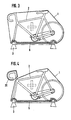
- FIG. 3 shows a further embodiment of the protective cover.
- a bicycle is encased, which is attached to the roof stand of the motor vehicle without a front wheel.
- This type of bicycle attachment on the roof stand is used very often, since on the one hand this results in a higher stability of the overall arrangement and a warping (figure of eight) of the front wheel is avoided.
- FIG. 4 a further minimization of the total area of the protective cover is achieved. Since in this embodiment the bicycle handlebar is arranged outside the main protective cover and, as in the variant already mentioned in FIG. 3, the bicycle is fastened to the roof stand without a front wheel, the bulge of the protective cover in the region of the bicycle handlebar is eliminated. The two main surfaces of the shell run almost parallel over the entire length. In this way, the bike is no longer fully protected, but you can achieve a further reduction in the minimum air resistance. In this embodiment, the susceptibility to cross wind loads is also significantly lower than in the embodiment shown in FIG. 1.
- Fig. 5 shows a development of the invention, in which a pocket 11 is sewn in the central area of the protective cover, which also has a detachable closure in the rear area 4 in the direction of travel.
- the bag 11 is designed so that the front wheel of the bicycle can be accommodated therein.
- the arrangement of the pocket 11 not only creates additional storage space which receives the front wheel removed from the bicycle, the front wheel accommodated in the pocket also additionally stabilizes the entire surface of the protective cover.
- the aforementioned Velcro cross 8, 9 is also provided in this embodiment in the center area. In this way, the opposite protective cover side is also stiffened by the front wheel stowed in the pocket 11.
- FIG. 6 shows a protective cover 1 with elongated stabilizing elements 12 applied on both sides. They consist of film pockets applied on the outside of the protective cover, into which so-called stabilizing slats are inserted. At the end of the pockets 12, Velcro fasteners are also provided, which enables the pockets to be securely closed, but at the same time also enables the stabilizing slats to be easily removed. With the aid of the Velcro cross 8, 9, a further stabilization of both total surfaces is achieved in this embodiment as well.
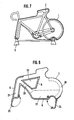
- Fig. 7 shows how a bicycle is covered by the protective cover.
- Fig. 8 the shell is shown alone.
- the case shown in FIGS. 7, 8 differs from that described above by consistently reducing the protective tarpaulin area by extremely adapting the shape of the protective case to that of the two-wheeler.
- the front wheel fork is stowed in a protective hose 21, which relatively closely fits the shape of this area of the bicycle.
- a recess 22 is provided in the interior of the bicycle frame, which breaks through the entire surface and with which, in particular, the surface area for cross winds is considerably reduced.
- the outline shape is more closely adapted to the outline shape of the two-wheeler as far as possible.
- the protective cover is equipped with detachable fasteners in the entire central region, on both sides of the tubular part 21 and in the region of the recess 22.
- the protective cover can thus be opened in half. In this open form, it is put over the rear wheel, saddle and frame.
- the closures are then closed in sequence. When closing, make sure that the sleeve 1 fits snugly on the bike and sits in the final shape with as few wrinkles as possible.
- the sheath can preferably be tensioned first with the strap 23 and then with the strap 24 on the roof stand.
- the bracing is done by wrapping the roof stand spar with the straps 23, 24 and then fixing the ends, which are also equipped with Velcro strips, to the Velcro counterparts arranged on the protective cover.
- the final tensioning of the protective cover makes moving the cover in the airstream particularly simple and yet effectively prevented.
- Such measures can of course also be used with the previous protective covers.
- the belts 23, 24 are designed to be elastic, at least within certain limits, which also prevents the tension from loosening.
- Various bicycle roof stands additionally support the bicycle from the roof stand to the bicycle frame by means of support struts or the like. If you add the protective cover z. B. in the area 25 with a further reinforcing element, the support strut can also be attached to the bicycle frame with the cover closed, without the cover being expected to be damaged.
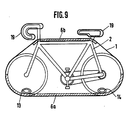
- FIG. 9 shows an alternative protective cover, in which the handlebar and saddle of the two-wheeler 2 protrude from the cover 1.
- Handlebars and saddles can also be covered with separate protective covers.
- transportation is also possible without further protection of these two elements.
- the protective cover has two closable openings 6a and 6b, the opening 6a allowing the protective cover to be placed over the two-wheeler; the opening 6b enables the handlebar and saddle to be pushed outward through the cover in a very simple manner.
- closure 6a As a zipper and the closure 6b as a Velcro fastener.
- the upper opening 6b can also be closed at a different distance between the handlebar and the saddle.
- handlebars and seat tube can be additionally wrapped and thus hermetically sealed.
- the protective cover shown in FIG. 9 has two pairs of openings 13 and 14 arranged congruently one above the other in the lower region of the two wheels, through the holding elements of the roof rack or also on the luggage rack or the like attachable anti-theft devices can be fixed.
- the pairs of openings 13, 14 are provided with edge reinforcements, preferably metal eyelets, which prevent the casing from tearing.
- flaps which can be closed with Velcro can be provided via the openings 13, 14.
- Practice has shown, however, that the amounts of water and dirt entering through these openings are negligible, so that such measures are generally not necessary.
- the protective cover shown in Fig. 10 includes the entire frame of the two-wheeler in addition to the bottom bracket, gearshift and chain.
- the detachable closure 6a in the lower region of the casing is preferably designed as a zipper.
- the upper closure is particularly easy to handle, at least in the areas in which the handlebars and seat post protrude from the cover, if Velcro fastener elements are provided.
- zippers with multiple sliders can also be used, preferably four sliders, i. H. two for each pipe outlet.
- FIG. 11 The envelope shown in FIG. 11 is reduced to a minimum in area. With her, parts of the bicycle frame are also left outside the cover. Just as with the various previous covers, separate fasteners 6b, 6a are provided in the upper and lower regions, which can be designed as zippers or Velcro fasteners.
- a tensioning belt is provided here, which is preferably attached to the sleeve and can be tensioned by means of tensioning elements (not shown) after the closures 6a, 6b have been closed.
- tensioning elements not shown
- the protective cover on the bicycle is lashed, which also prevents the cover from inflating.
- tensioning strap 15 can also be used with the other sleeves.
- the Velcro crosses 8, 9 are, however, as far as can be provided in the frame triangle, easier and cheaper to manufacture.
- pairs of openings 14 are also provided in FIGS. 10, 11 in the area of the roof stand fastening, which are introduced into the envelope surface with edge reinforcements, preferably as metal eyelets.
- edge reinforcements preferably as metal eyelets.
- the sleeve closure 6a is no longer guided tightly past the fastening means of the roof stand, but completely encloses the bicycle.
- the fastening means of the roof stand are passed through the eyelets 14 provided on both sides of the envelope.
- FIG. 12 shows the protective cover described in FIG. 9 in connection with two opening slots 16.
- the opening slots 16 are arranged such that they cross the seat tube and down tube of the two-wheeled frame. In the open state, the opening slots 16 allow direct access to the two tubes of the frame. Despite the wrapping, the two-wheeler is therefore safe to hold and easy to place on roof racks or rear luggage racks.
- the opening slots 17, 18 differ from the arrangement shown in FIG. 12 however not arranged mirror-symmetrically to the line of symmetry of the protective cover. Rather, the opening slot 17 runs horizontally or largely parallel to the upper and lower edges of the protective cover. The opening slot 18 runs slightly diagonally or parallel to the saddle tube of the two-wheel frame and extends almost over the entire width of the protective cover.
- the opening slot 17 is arranged so that it always crosses the down tube of the frame regardless of the shape of the two-wheeler to be wrapped.
- the crossing point is marked as point C.
- the opening slot 18, which runs parallel to the seat tube, on the one hand allows access to the entire length of the seat tube and also offers the possibility of having the pedal pedals protrude from the casing on both sides, which enables a particularly flat covering of the two-wheeler.
- the externally arranged pedals prevent selective loads in the area of the outer pedal ends.
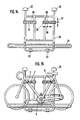
- FIGS. 14 and 15 A rear luggage rack which is very widespread on the market and sold as a so-called "Paulchen system” (registered trademark) is shown schematically in FIGS. 14 and 15. It essentially consists of the base support 30, which is to be fastened to the rear of the respective motor vehicle with the four fastening elements 32.
- Telescopic rail 33 is provided, into which the two-wheeler is to be placed, as can be seen in FIG. 15.
- the telescopic rails 33 are arranged at right angles to the base support 30 and are mounted at such a distance from the base support that the two-wheeler can be attached to it without bumping the handlebars or the pedals on the motor vehicle.
- By longitudinally adjusting the telescopic rail 33 an adaptation to the respective wheel diameter or the respective wheel distance of the two-wheeler to be transported is possible.
- the telescopic rail 33 thus fixes the two-wheeler in the lower region of the two wheels. So that the two-wheeler does not tip over and does not jump out of the telescopic rail during transport, at least one further fixation is necessary.
- the spacers 35 are designed as spacer tubes which are mounted on the side in the mounting rails 44 (arrow direction 38). Fastening elements are provided at the end of the spacers, which enable the two-wheeled frame to be fixed by means of quick-release fasteners.
- the mounting rails 34 on the base support 30 can also be adjusted in height in accordance with the double arrows 37, an individual adaptation of the brackets to the two-wheelers to be transported is possible.
- At least one spacer 35 is required for each two-wheeler. If several two-wheelers are to be transported with the base support 30, a corresponding number of telescopic rails 33 and spacer 35 must be provided. In this case, the two-wheelers are usually stacked mirror-inverted in front of each other, which results in a close "nesting" of the two-wheelers. Such rack systems are known. For further details, please refer to the advertising documents of the so-called "Paulchen-Systems" referenced. The protective cover shown in Fig. 13 now allows
- multi-way zippers are preferably used.
- zippers with four slider elements are recommended, each of which allows partial areas of the zipper to be opened and closed.
- the zipper belonging to the opening slot 10 the rear tarpaulin facing the base carrier 30, can be closed with two zipper slides at point C (spacer of the first two-wheeler).
- An opening to be provided at point C 'for a further spacer is closed with the other two slide zippers.
- the spacer provided for the second two-wheeler is only to be passed through at point C '.
- the spacer provided for the second two-wheeler is only to be passed through at point C '.
- the other two slide fasteners have no function.
- the protective cover is turned sideways used, e.g. B. for the transport of a second two-wheeler to be arranged in parallel, the functions of the zippers also change accordingly, ie all four sliders are required by the zipper used only in partial functions in the present case and vice versa.
- the zippers of the openings 18 also have four sliders and thus allow two through openings to be closed in the same way.
- two zipper sliders close the opening formed by the spacer at point A, and two additional zipper sliders allow the pedal to be exposed at point B.
- zippers with zipper sliders that can be operated on both sides also offers the possibility of zippers to operate the protective cover side facing the base carrier 30 through the opening slots on the front.
- the assembly of the two-wheeler as well as the opening and closing of the zippers is therefore completely problem-free without laboriously reaching around the cover.
- the respective opening slots 17, 18 fulfill their function due to the flexibility of the protective cover even if they do not correspond exactly with the ideal positions. For this reason, it is also possible to arrange the opening slots 17, 18 according to the invention in a type of mean position, with which it is possible to make the invention usable in standard protective covers for different types of two-wheelers. In the same way, the opening slots according to the invention can be used in protective sleeves whose outer shape differs from that shown in the figures.
- the production of the protective cover 1 according to the invention shown in FIG. 1 is relatively simple.
- the basic principle is shown schematically in FIG. 16.
- the outline 45 of the bicycle cover is recorded on a rectangular tarpaulin 43 on both sides of the line of symmetry 44, in the present case the outline of the protective cover shown in FIG. 3.
- the outline 45 naturally takes into account a corresponding surcharge in the areas in which the symmetrical surface areas are sewn together.
- the respective halves of the Velcro tape are arranged in the regions 17.
- An additional film wedge is provided in area 48 of the protective cover, with which the widening of the cover in the bicycle handlebar area is taken into account.
- the tarpaulin cut out along the outline 45 becomes along the lines XY with the insert wedge 46 along the lines X'Y ' sewn in such a way that the points X and X ' and Y and Y 'are each arranged one above the other.
- the Velcro tape 47 is continued, so that the entire lower edge area of the protective case can now be closed by means of the Velcro tape in the sewn protective cover.
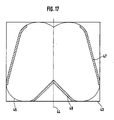
- FIG. 17 shows the schematic elevation of the protective cover shown in FIG. 4.
- no insert wedge 46 is necessary due to the bicycle handlebar arranged outside the protective cover. Since in this variant in the sewn state an opening is to be provided through which the bicycle handlebar can be pushed through the cover to the outside, in addition to the Velcro regions 47, which represent the lower detachable closure in the finished protective cover, also in regions 49 a Velcro fastener to provide, by which the bicycle handlebar can be pushed through the cover and then the cover can be closed watertight.
- the protective cover largely corresponds to the basic shape of the two-wheeler and that it is closed on all sides in the "assembled" state.
- the detachable fasteners you always get a protective cover that allows the two-wheeler to be packaged watertight with just a few hand movements.
- Velcro straps as a releasable closure, the wrapping is also not significantly affected in the area of the fastening elements of the roof rack, since the Velcro tape can be tightly guided around such fastening elements on both sides and tightly closed, which also results in a splash-proof hermetic closure in these areas.
- FIGS. 1 to 11 cover a wide range of applications.
- the version shown in FIGS. 1 and 2 is more of a universal protective cover, which is very suitable both for two-wheelers of different sizes and for the protection of parked (stationary) two-wheelers.
- the variant shown in FIGS. 7, 8 is ideally adapted exactly like a tailored suit to the shape of the two-wheeler. The other forms are between these two extremes.
- bicycle handlebar and saddle can also be covered with separate protective covers 19, 20.
- the handlebar cover 20 is closed in the lower area with a Velcro.
- the saddle cover 21 is expediently provided with an elastic band or a tension cord which can be closed with a knot and loop or with a conventional quick-release element.
Landscapes
- Engineering & Computer Science (AREA)
- Mechanical Engineering (AREA)
- Outer Garments And Coats (AREA)
Applications Claiming Priority (4)
| Application Number | Priority Date | Filing Date | Title |
|---|---|---|---|
| DE4002023 | 1990-01-24 | ||
| DE4002023 | 1990-01-24 | ||
| DE19904034704 DE4034704A1 (de) | 1990-10-31 | 1990-10-31 | Schutzabdeckung fuer zweiraeder |
| DE4034704 | 1990-10-31 |
Publications (1)
| Publication Number | Publication Date |
|---|---|
| EP0439155A1 true EP0439155A1 (fr) | 1991-07-31 |
Family
ID=25889365
Family Applications (1)
| Application Number | Title | Priority Date | Filing Date |
|---|---|---|---|
| EP91100850A Withdrawn EP0439155A1 (fr) | 1990-01-24 | 1991-01-23 | Housse pour bicyclette |
Country Status (1)
| Country | Link |
|---|---|
| EP (1) | EP0439155A1 (fr) |
Cited By (10)
| Publication number | Priority date | Publication date | Assignee | Title |
|---|---|---|---|---|
| US5445200A (en) * | 1993-06-14 | 1995-08-29 | Celestino; Mario | Bicycle enclosing protective cover |
| WO1997010987A1 (fr) * | 1995-09-21 | 1997-03-27 | Miller Mcclelland Limited, The Receiver And Receiver Manager Of Dirtbag Sports Products Inc. | Housse de bicyclette ajustee de forme aerodynamique |
| FR2741035A1 (fr) * | 1995-11-14 | 1997-05-16 | Fradin Philippe | Dispositif pour proteger des cycles fixes sur un attelage arriere pour vehicules |
| US5676616A (en) * | 1996-03-06 | 1997-10-14 | Shimano, Inc. | Protective cover for a bicycle derailleur |
| FR2789967A1 (fr) * | 1999-02-22 | 2000-08-25 | Sylvie Lehner | Housse de protection et de transport pour cycles |
| US7137422B2 (en) * | 2004-06-17 | 2006-11-21 | Mcmillen Brett William | Motorcycle transportation cover |
| US7866517B2 (en) | 2002-10-31 | 2011-01-11 | Fabio Pedrini | Vehicle-mounted equipment carrier |
| DE102011121417A1 (de) * | 2011-12-17 | 2013-06-20 | Gm Global Technology Operations, Llc | Geräteschutzhülle für einen Lastenträger eines Kraftfahrzeugs |
| CN114906059A (zh) * | 2021-02-10 | 2022-08-16 | 瑞伟安知识产权控股有限公司 | 内置娱乐设备支架 |
| CN116713944A (zh) * | 2023-07-20 | 2023-09-08 | 红塔烟草(集团)有限责任公司 | 一种用于多种规格压力表防护罩拆卸装置 |
Citations (6)
| Publication number | Priority date | Publication date | Assignee | Title |
|---|---|---|---|---|
| US3968913A (en) * | 1975-05-05 | 1976-07-13 | Weed Terrance O | Protective cover for automobile mounted bicycle carrier |
| US4009744A (en) * | 1975-10-01 | 1977-03-01 | Joslyn John A | Bicycle bag |
| FR2434076A1 (fr) * | 1978-08-25 | 1980-03-21 | Jubeau France Jean | Housse pour cycle homme s'adaptant sur les cycles de toutes dimensions |
| US4356831A (en) * | 1980-11-12 | 1982-11-02 | Adams Laura A | Bicycle cover with lock holes |
| US4378883A (en) * | 1980-12-29 | 1983-04-05 | Profeta Joseph G | Bicycle carrying case |
| US4715646A (en) * | 1987-03-02 | 1987-12-29 | Goffi Carlo P | Protective covering for lightweight vehicle |
-
1991
- 1991-01-23 EP EP91100850A patent/EP0439155A1/fr not_active Withdrawn
Patent Citations (6)
| Publication number | Priority date | Publication date | Assignee | Title |
|---|---|---|---|---|
| US3968913A (en) * | 1975-05-05 | 1976-07-13 | Weed Terrance O | Protective cover for automobile mounted bicycle carrier |
| US4009744A (en) * | 1975-10-01 | 1977-03-01 | Joslyn John A | Bicycle bag |
| FR2434076A1 (fr) * | 1978-08-25 | 1980-03-21 | Jubeau France Jean | Housse pour cycle homme s'adaptant sur les cycles de toutes dimensions |
| US4356831A (en) * | 1980-11-12 | 1982-11-02 | Adams Laura A | Bicycle cover with lock holes |
| US4378883A (en) * | 1980-12-29 | 1983-04-05 | Profeta Joseph G | Bicycle carrying case |
| US4715646A (en) * | 1987-03-02 | 1987-12-29 | Goffi Carlo P | Protective covering for lightweight vehicle |
Cited By (12)
| Publication number | Priority date | Publication date | Assignee | Title |
|---|---|---|---|---|
| US5445200A (en) * | 1993-06-14 | 1995-08-29 | Celestino; Mario | Bicycle enclosing protective cover |
| WO1997010987A1 (fr) * | 1995-09-21 | 1997-03-27 | Miller Mcclelland Limited, The Receiver And Receiver Manager Of Dirtbag Sports Products Inc. | Housse de bicyclette ajustee de forme aerodynamique |
| FR2741035A1 (fr) * | 1995-11-14 | 1997-05-16 | Fradin Philippe | Dispositif pour proteger des cycles fixes sur un attelage arriere pour vehicules |
| WO1997018121A1 (fr) * | 1995-11-14 | 1997-05-22 | Philippe Fradin | Dispositif de protection de cycles fixes sur un attelage arriere pour vehicules |
| US5984284A (en) * | 1995-11-14 | 1999-11-16 | Fradin; Philippe | Protective device for cycles fixed onto a rear harness for vehicles |
| US5676616A (en) * | 1996-03-06 | 1997-10-14 | Shimano, Inc. | Protective cover for a bicycle derailleur |
| FR2789967A1 (fr) * | 1999-02-22 | 2000-08-25 | Sylvie Lehner | Housse de protection et de transport pour cycles |
| US7866517B2 (en) | 2002-10-31 | 2011-01-11 | Fabio Pedrini | Vehicle-mounted equipment carrier |
| US7137422B2 (en) * | 2004-06-17 | 2006-11-21 | Mcmillen Brett William | Motorcycle transportation cover |
| DE102011121417A1 (de) * | 2011-12-17 | 2013-06-20 | Gm Global Technology Operations, Llc | Geräteschutzhülle für einen Lastenträger eines Kraftfahrzeugs |
| CN114906059A (zh) * | 2021-02-10 | 2022-08-16 | 瑞伟安知识产权控股有限公司 | 内置娱乐设备支架 |
| CN116713944A (zh) * | 2023-07-20 | 2023-09-08 | 红塔烟草(集团)有限责任公司 | 一种用于多种规格压力表防护罩拆卸装置 |
Similar Documents
| Publication | Publication Date | Title |
|---|---|---|
| DE9108614U1 (de) | Schutzabdeckung für Motorräder | |
| EP0439155A1 (fr) | Housse pour bicyclette | |
| EP3003843B1 (fr) | Dispositif de protection contre les intempéries destiné à être monté de façon amovible sur un véhicule à deux roues ou plus | |
| DE102023104472A1 (de) | Ein rahmenmontiertes fahrradzubehör | |
| EP0523811A1 (fr) | Garde-boue | |
| DE102021113190A1 (de) | Fahrradtransporttasche und Steuersatzschutzvorrichtung | |
| DE102011017228B4 (de) | Dach für offene Fahrzeuge, insbesondere Zweiräder | |
| DE4213254C2 (de) | Transportschutzhülle für Fahrräder | |
| DE3244492C2 (de) | Transportvorrichtung zum Transportieren losen Gutes, wie Einkaufsgut, auf Zweiradfahrzeugen, insbesondere Fahrrädern | |
| DE3105764A1 (de) | Vorrichtung zur halterung von gepaeckstuecken am gepaecktraeger eines zweirades | |
| DE9002774U1 (de) | Schutzabdeckung für Zweiräder | |
| DE19723886C1 (de) | Gepäcktasche | |
| DE19537937A1 (de) | Temporär aufspannbare Wetterschutz-Abdeckung für Fahrer und Mitfahrer offener Fahrzeuge | |
| EP1930232B1 (fr) | Sacoche de réservoir dotée d'un porte carte pour motocyclette | |
| DE4209404C1 (fr) | ||
| DE9112136U1 (de) | Fahrersitz-Schutzbezug-Vorrichtung, vorzugsweise für Zweiradfahrzeuge | |
| DE3643355A1 (de) | Schutzhuelle fuer fahrraeder, speziell rennraeder | |
| EP0614827B1 (fr) | Emballage pour une bicyclette | |
| DE4416975C2 (de) | Flexibler Großraumrucksack | |
| EP0132461B1 (fr) | Chariot de transport | |
| DE10056699B4 (de) | Flexible Seitenwand für einen Fahrzeugaufbau | |
| DE4034704A1 (de) | Schutzabdeckung fuer zweiraeder | |
| DE9017651U1 (de) | Schutzabdeckung für Zweiräder | |
| DE102024129464A1 (de) | Eine packtasche zur befestigung an einem fahrrad | |
| DE923344C (de) | Gestell zum Mitfuehren zusaetzlicher Lasten auf Strassenfahrzeugen |
Legal Events
| Date | Code | Title | Description |
|---|---|---|---|
| PUAI | Public reference made under article 153(3) epc to a published international application that has entered the european phase |
Free format text: ORIGINAL CODE: 0009012 |
|
| AK | Designated contracting states |
Kind code of ref document: A1 Designated state(s): AT BE CH DE FR GB IT LI LU NL SE |
|
| 17P | Request for examination filed |
Effective date: 19920120 |
|
| STAA | Information on the status of an ep patent application or granted ep patent |
Free format text: STATUS: THE APPLICATION HAS BEEN WITHDRAWN |
|
| 17Q | First examination report despatched |
Effective date: 19930120 |
|
| 18W | Application withdrawn |
Withdrawal date: 19930115 |