EP0439805A2 - Vorrichtung zum Kühlen des Öls der hydraulischen Antriebseinrichtungen einer Kunststoff-Spritzgiessmaschine - Google Patents
Vorrichtung zum Kühlen des Öls der hydraulischen Antriebseinrichtungen einer Kunststoff-Spritzgiessmaschine Download PDFInfo
- Publication number
- EP0439805A2 EP0439805A2 EP90125150A EP90125150A EP0439805A2 EP 0439805 A2 EP0439805 A2 EP 0439805A2 EP 90125150 A EP90125150 A EP 90125150A EP 90125150 A EP90125150 A EP 90125150A EP 0439805 A2 EP0439805 A2 EP 0439805A2
- Authority
- EP
- European Patent Office
- Prior art keywords
- channel
- cooler
- oil
- cooling
- connection
- Prior art date
- Legal status (The legal status is an assumption and is not a legal conclusion. Google has not performed a legal analysis and makes no representation as to the accuracy of the status listed.)
- Granted
Links
Images


Classifications
-
- B—PERFORMING OPERATIONS; TRANSPORTING
- B29—WORKING OF PLASTICS; WORKING OF SUBSTANCES IN A PLASTIC STATE IN GENERAL
- B29C—SHAPING OR JOINING OF PLASTICS; SHAPING OF MATERIAL IN A PLASTIC STATE, NOT OTHERWISE PROVIDED FOR; AFTER-TREATMENT OF THE SHAPED PRODUCTS, e.g. REPAIRING
- B29C45/00—Injection moulding, i.e. forcing the required volume of moulding material through a nozzle into a closed mould; Apparatus therefor
- B29C45/17—Component parts, details or accessories; Auxiliary operations
-
- B—PERFORMING OPERATIONS; TRANSPORTING
- B29—WORKING OF PLASTICS; WORKING OF SUBSTANCES IN A PLASTIC STATE IN GENERAL
- B29C—SHAPING OR JOINING OF PLASTICS; SHAPING OF MATERIAL IN A PLASTIC STATE, NOT OTHERWISE PROVIDED FOR; AFTER-TREATMENT OF THE SHAPED PRODUCTS, e.g. REPAIRING
- B29C45/00—Injection moulding, i.e. forcing the required volume of moulding material through a nozzle into a closed mould; Apparatus therefor
- B29C45/17—Component parts, details or accessories; Auxiliary operations
- B29C45/72—Heating or cooling
-
- Y—GENERAL TAGGING OF NEW TECHNOLOGICAL DEVELOPMENTS; GENERAL TAGGING OF CROSS-SECTIONAL TECHNOLOGIES SPANNING OVER SEVERAL SECTIONS OF THE IPC; TECHNICAL SUBJECTS COVERED BY FORMER USPC CROSS-REFERENCE ART COLLECTIONS [XRACs] AND DIGESTS
- Y10—TECHNICAL SUBJECTS COVERED BY FORMER USPC
- Y10T—TECHNICAL SUBJECTS COVERED BY FORMER US CLASSIFICATION
- Y10T137/00—Fluid handling
- Y10T137/8593—Systems
- Y10T137/85938—Non-valved flow dividers
Definitions
- the invention relates to a device according to the preamble of claim 1.
- the cooling requirements for the oil of the hydraulic drive devices fluctuate within wide limits. This cooling requirement does not only depend on the size of the injection molding machine but also on the operating mode and on the physical properties of the processed material and also on the temperature of the surrounding atmosphere. Finally, the often very different inlet temperature of the temperature control medium or the cooling water plays a decisive role. The latter can be 20 ° to 30 ° higher, for example, in a non-air-conditioned room in the tropics than in a room with little or no heating in countries with a harsh climate.
- the known generic device (DE 34 03 429 C2; DE-G 83 33 616.8) is therefore necessarily designed for the maximum cooling requirement, ie provided with a relatively large reserve of cooling capacity.
- cooling capacity is also partly a function of the size of the device, it therefore also takes up a relatively large space on the outer wall of the machine base of the injection molding machine. This applies in particular to the variant described in column 6, lines 26-34 of DE 34 03 429 C2.
- the invention has for its object to develop a device of the type mentioned in such a way that it is much better adaptable to different cooling requirements with little manufacturing effort and less space.
- the cooling requirement required in each case can be taken into account by doubling or multiplying a basic stage given by a cooler filter unit, without the manufacturing costs being appreciably increased. If a total cooling capacity is required which approximately corresponds to two or more times a cooler filter unit, the required number of units can be combined to form a hydraulic unit by means of the connecting block. Manufacturing and warehousing can therefore be carried out on the basis of a set of components which comprises identical basic stage cooler filter units, connecting blocks and connecting blocks.
- a major advantage of the design according to the invention is that the device e.g. in a remote location, which cannot be reached by regular service or can only be reached with great effort, can also be subsequently adapted by refrigerated staff to cooling requirements that were initially not recognizable. Thanks to the low weight and the small space requirements of the flat connecting blocks, they can also be transported to the place of use by post if necessary.
- the device cools the oil of the hydraulic drive devices of a plastic injection molding machine by means of water. In addition, the cooled oil is cleaned by filtration.
- the device comprises at least one cooler-filter unit, as disclosed in DE-34 03 429 C2.
- the device can be built up from a set of components (component set) for different cooling stages as required. These cooling levels provide a cooling capacity that is one, two or three times that of a basic level.
- the set of components comprises, designed for the basic stage, cooler filter units E, which are each provided with a connecting part 10a, further connecting blocks, which are to be arranged within the tank space of the plastic injection molding machine, and between the connecting parts of two or more cooler filters -Eunits E of a device and at least one connection block 15 in the tank space T insertable connecting blocks 18.
- These are intended and suitable for connecting inflow channel sections 16 in the connecting piece 10a to the inflow channel section 16 'of a connection block 15 by means of an inflow transverse channel 16''.
- These are also designed to drain channel sections 17 to connect the connecting piece 10a to a discharge channel section 17 'of the connection block 15 by means of a discharge cross channel 17''.
- the connection blocks are described in detail below.
- the cooler-filter unit E comprises two coaxial guide tubes 10, 11 for the oil.
- a spirally laid cooling tube 12 is arranged in the annular space (first annular space R) between the two guide tubes 10, 11, a spirally laid cooling tube 12 is arranged.
- a cooling flange 12a is driven out of the wall of the metal cooling tube 12 to increase the heat exchange along a helical line.
- the cooler-filter unit is also provided with a filter insert 13 enclosed by the inner guide tube 11.
- Another annular space (second annular space K) is delimited by the filter insert 13 and the inner guide tube 11.
- the outer guide tube is provided with a connecting part 10a with centering projection 10a ', which guide tube 10 also forms the housing for the cooler-filter unit and is provided with cooling fins 10a.
- the connection part 10a is part of a device for fastening the device to a wall 14 delimiting the oil tank space T of the plastic injection molding machine. This device further comprises a connection block 15 arranged in the tank space T.
- connection block 15 is connected by means of fastening elements 22 to the connection piece 10 a of the cooler filter unit (s), which are located on the outside of the wall 14.
- Connection part 10a and connection block 15 each have coaxial channel sections 16, 17; 16 ', 17', which participate in the formation of an inlet channel 16, 16 'and an outlet channel 17, 17' for the oil.
- the cooling water is supplied to the cooling pipe 12 via the connection 20 and leaves the cooling pipe via the connection 20.
- the oil to be cooled passes via the inlet lines 21 into the inflow channel section 16 'of the connection block 15 and from there indirectly (via the connection block 18) or directly into the Inflow channel section 16 of the connecting piece 10a, which opens into an annular space 23 below the cooling tube, which in turn is connected to the first annular space R.
- the oil is pressed upwards through the gaps remaining between the inner walls of the guide tubes 10, 11 and the surfaces of the cooling tube and cooling flange and, after cooling in the countercurrent principle, reaches the second annular space K.
- the second annular space K can distribute the oil over the entire outer surface of the radiator insert.
- the oil penetrating into the filter interior through the cylindrical wall of the filter insert 21 is filtered as it passes through the wall and flows via an outflow connection piece into the discharge channel section 17 in the connection piece 10a. From this, the cooled and cleaned oil passes indirectly (via the connector 18) or directly into the drain channel section 17 'in the connection block 15 in order to reach the oil of the tank space via the drain connection 15a.
- connection block 18 is designed for two cooler filter units E. It is therefore symmetrical on both sides, as can be seen in particular from FIG. 4.
- the inflow transverse channel 16 ′′ connecting the two inflow channel sections in the connection piece 10a communicates with the inflow channel section 16 ′ of a single connection block 15.
- the connection block 18 has a single centering projection 18a which engages in an annular recess in the wall 14. This is identical to the centering projection 10a 'of the connection part 10a of each cooler filter unit E.
- the connecting block 18 has a number of ring-shaped centering shoulders 18b corresponding to the number of cooler-filter units E for centering reception of the centering shoulders 10a 'of the connecting parts 10a.
- the two cooler-filter units E can be supported on the wall 14 or on annular contact surfaces 18c of the distributor block 18 via annular support surfaces 10b. This in turn lies against the wall 14 via an annular support surface 18d for supporting the device.
- the horizontal inflow cross channel 16 ′′ and the outflow cross channel 17 ′′ of the connecting block 18 running underneath communicate with one another via connecting channels 16a, 17a the channel sections 16, 17 of each connector 10a.
- the connection channels 16a, 17a have a length which corresponds to the depth of the centering shoulders 18b.
- the inflow cross channel 16 '' and the outflow cross channel 17 '' are each connected via a single connecting channel 16 '''or17''' to the coaxial channel section 16 'or 17''' in the connecting piece 15.
- the inflow cross channel 16 ′′ and the outflow cross channel 17 ′′ each have a central section of a circular cross section and end sections of a square cross section.
- Inflow channel 16, 16 'and outflow channel 17, 17' are perpendicular to the wall 14 of the oil tank space T and perpendicular to the inflow and outflow transverse channel 16 '' with the axis of symmetry zz of the filter insert 13 running vertically; 17 ''.
- the outer guide tube 10 with cooling fins 10c and with connecting parts 10a, which serves as a housing for the cooler-filter unit, and the connecting piece 18 are each formed by a die-cast part made of aluminum.
- the connector 15 is a cast iron fitting with drain stub 15a.
- connection parts 10a are provided with ring seals.
Landscapes
- Engineering & Computer Science (AREA)
- Manufacturing & Machinery (AREA)
- Mechanical Engineering (AREA)
- Injection Moulding Of Plastics Or The Like (AREA)
- Fluid-Pressure Circuits (AREA)
- Moulds For Moulding Plastics Or The Like (AREA)
- Lubrication Details And Ventilation Of Internal Combustion Engines (AREA)
Abstract
Description
- Die Erfindung bezieht sich auf eine Vorrichtung entsprechend dem Oberbegriff des Patentanspruches 1.
- Bei Kunststoff-Spritzgießmaschine schwankt der Kühl bedarf für das Öl der hydraulischen Antriebseinrichtungen in weiten Grenzen. Dieser Kühlbedarf hängt nämlich nicht nur von der Größe der Spritzgießmaschine sondern auch von der Betriebsart und von den physikalischen Eigenschaften des verarbeiteten Materials und darüberhinaus auch noch von der Temperatur der umgebenden Atmosphäre ab. Eine entscheidende Rolle spielt dabei schließlich die oftmals sehr unterschiedliche Zulauftemperatur des Temperiermediums bzw. des Kühlwassers. Letztere kann z.B. in einem nicht klimatisierten Raum in den Tropen um 20° bis 30° höher liegen als in einem nicht oder wenig beheizten Raum in Ländern mit rauhem Klima. Die bekannte, gattungsgemäße Einrichtung(DE 34 03 429 C2; DE-G 83 33 616.8) ist daher notwendigerweise für den maximalen Kühlbedarf ausgelegt, d.h. mit einer verhältnismäßig großen Reserve an Kühlleistung versehen. Da die Kühlleistung zum Teil auch eine Funktion der Größe der Vorrichtung ist, beansprucht diese daher auch einen relativ großen Raum an der Außenwand des Maschinenfußes der Spritzgießmaschine. Dies gilt insbesondere auch für die in Sp. 6, Zn. 26-34 der DE 34 03 429 C2 beschriebenen Variante.
- Der Erfindung liegt die Aufgabe zugrunde, eine Vorrichtung der eingangs genannten Gattung derart weiterzubilden, daß sie bei geringem Fertigungsaufwand und geringerem Raumbedarf wesentlich besser an unterschiedliche Kühlerfordernisse anpaßbar ist. Diese
- Aufgabe wird durch die im Patentanspruch 1 genannten Merkmale gelöst.
- Bei einer solchen Ausbildung kann dem jeweils erforderlichen Kühlbedarf durch Verdoppelung bzw. Vervielfachung einer durch eine Kühlerfiltereinheit gegebene Grundstufe Rechnung getragen werden, ohne daß die Fertigungskosten nennenswert erhöht wären. Ist nämlich eine Gesamtkühlleistung erforderlich, welche annäherungs- weise dem zwei- oder mehrfachen einer Kühlerfiltereinheit entspricht, so kann die erforderliche Anzahl von Einheiten mittels Hilfe des Verbindungsblockes zu einer hydraulischen Einheit zusam mengefaßt werden. Fertigung und Lagerhaltung kann also auf der Grundlage eines Bauteilsatzes erfolgen, der identische Kühlerfiltereinheiten der Grundstufe, Verbindungsblöcke und Anschlußblöcke umfaßt.
- Ein wesentlicher Vorteil der erfindungsgemäßen Ausbildung besteht darin, daß die Vorrichtung z.B. an einem entlegenen Standort, der vom regulären Service nicht oder nur mit großem Aufwand erreichbar ist, auch von wenig geschultem Personal nachträglich an Kühlerfordernisse angepaßt werden kann, die zunächst nicht erkennbar waren. Dank des niedrigen Gewichtes und des geringen Raumbedarfs der flachen Verbindungsblöcke, kann deren Transport zum Einsatzort erforderlichenfalls auch auf postalischem Wege erfolgen.
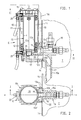
- Nachstehend wird die Erfindung anhand der Zeichnung an zwei Ausführungsbeispielen erläutert.
- Es zeigen:
- Fig. 1
- Die Vorrichtung mit einer einzigen Kühlerfiltereinheit im Schnitt nach Linie I-I von Fig. 2,
- Fig. 2
- die Vorrichtung gemäß Fig. 1 im Schnitt nach Linie II-II von Fig. 1,
- Fig. 3, 4
- die Vorrichtung mit zwei Kühlerfiltereinheiten in einer den Fig. 1, 2 entsprechenden Darstellung,
- Fig. 5
- das Verbindungsstück im Schnitt nach Linie V-V von Figur 6,
- Fig. 6
- das Verbindungsstück im Schnitt nach Linie VI-VI von Fig. 8,
- Fig. 7
- das Verbindungsstück im Schnitt nach Linie VII-VII von Figur 6 und
- Fig. 8
- das um 90° gedrehte Verbindungsstück gemäß Fig. 6.
- Die Vorrichtung kühlt das Öl der hydraulischen Antriebseinrichtungen einer Kunststoff-Spritzgießmaschine mittels Wasser. Darüber hinaus wird das gekühlte Öl durch Filtration gereinigt. Die Vorrichtung umfaßt wenigstens eine Kühler-Filter-Einheit, wie sie in der DE-34 03 429 C2 offenbart ist. Die Vorrichtung ist aus einem Satz von Bauteilen (Bauteilesatz) bedarfsweise für unterschiedliche Kühlstufen aufbaubar. Diese Kühlstufen stellen eine Kühlleistung bereit, die das Ein-, Zwei- oder Dreifache einer Grundstufe beträgt. Der Bauteilesatz umfaßt, für die Grundstufe ausgelegte, Kühler-Filter-Einheiten E, die je mit einem Anschlußteil 10a versehen sind, ferner Anschlußblöcke, die innerhalb des Tankraumes der Kunststoff-Spritzgießmaschine anzuordnen sind, ferner zwischen den Anschlußteilen von zwei oder mehr Kühler-Filter-Einheiten E einer Vorrichtung und wenigstens einem Anschlußblock 15 im Tankraum T einfügbare Verbindungsblöcke 18. Diese sind dazu bestimmt und geeignet, Zuflußkanalabschnitte 16 in den Anschlußstutzen 10a mit dem Zuflußkanalabschnitt 16' eines Anschlußblockes 15 mittels eines Zufluß-Querkanals 16'' zu verbinden. Diese sind ferner dazu bestimmt, Abflußkanalabschnitte 17 der Anschlußstutzen 10a mit einem Abflußkanalabschnitt 17' des Anschlußblockes 15 mittels eines Abfluß-Querkanales 17'' zu verbinden. Die Verbindungsblöcke werden weiter unten im einzelnen beschrieben.
- Da die Kühler-Filter-Einheit E als solche durch die DE 34 03 429 C2 an sich bekannt ist, genügt es im folgenden auf ihre wesentlichen baulichen Merkmale, die im Oberbegriff des Anspruches 1 verankert sind, einzugehen. Die Kühler-Filter-Einheit umfaßt zwei koaxiale Leitrohre 10, 11 für das Öl. Im Ringraum (erster Ringraum R) zwischen schen den beiden Leitrohren 10, 11 ist ein spiralförmig gelegtes Kühlrohr 12 angeordnet. Aus der Wandung des metallenen Kühlrohres 12 ist zur Steigerung des Wärmeaustausches entlang einer Schraubenlinie ein Kühlflansch 12a herausgetrieben. Die Kühler-Filter-Einheit ist ferner mit einem vom inneren Leitrohr 11 umschlossenen Filtereinsatz 13 versehen. Ein weiterer Ringraum (zweiter Ringraum K) ist vom Filtereinsatz 13 und dem inneren Leitrohr 11 begrenzt. Das äußere Leitrohr ist mit einem Anschlußteil 10a mit Zentrieransatz 10a' versehen, welches Leitrohr 10 zugleich das Gehäuse für die Kühler-Filter-Einheit bildet und mit Kühlrippen 10a versehen ist. Das Anschlußteil 10a ist Bestandteil einer Einrichtung zur Befestigung der Vorrichtung an einer den Öl-Tankraum T der Kunststoff-Spritzgießmaschine begrenzenden Wand 14. Diese Einrichtung umfaßt ferner einen im Tankraum T angeordneten Anschlußblock 15.
- Der Anschlußblock 15 ist mittels Befestigungselementen 22 mit dem bzw. den Anschlußstutzen 10a der Kühler-Filter-Einheit(en) verbunden, welche sich an der Außenseite der Wand 14 befinden. Anschlußteil 10a und Anschlußblock 15 weisen je koaxiale Kanalabschnitte 16, 17; 16', 17' auf, die an der Bildung eines Zulaufkanales 16, 16' und eines Ablaufkanales 17, 17' für das Öl teilhaben. Das Kühlwasser wird über den Anschluß 20 dem Kühlrohr 12 zugeführt und verläßt das Kühlrohr über den Anschluß 20. Das zu kühlende Öl gelangt über die Zulaufleitungen 21 in den Zuflußkanalabschnitt 16' des Anschlußblockes 15 und von dort mittelbar (über den Verbindungsblock 18) oder unmittelbar in den Zuflußkanal-Abschnitt 16 des Anschlußstutzens 10a, der in einen Ringraum 23 unterhalb des Kühlrohres mündet, der seinerseits mit dem ersten Ringraum R in Verbindung steht. Dabei wird das Öl durch die zwischen den inneren Wandungen der Leitrohre 10, 11 und den Oberflächen von Kühlrohr und Kühlflansch verbleibenden Zwischenräumen nach oben hin durchgepreßt und gelangt nach einer im Gegenstrom-Prinzip erfolgten Kühlung in den zweiten Ringraum K. Im zweiten Ringraum K kann sich das Öl über die gesamte äußere Mantelfläche des Kühlereinsatzes verteilen. Das durch die zylindrische Wandung des Filtereinsatzes 21 in den Filter-Innenraum eindringende Öl wird beim Passieren der Wandung gefiltert und fließt über einen Ausflußstutzen in den Abflußkanalabschnitt 17 im Anschlußstutzen 10a. Von diesem gelangt das gekühlte und gereinigte Öl mittelbar (über das Verbindungsstück 18) oder unmittelbar in den Abflußkanalabschnitt 17' im Anschlußblock 15, um über den Abflußstutzen 15a zum Öl des Tankraumes zu gelangen. Im zeichnerisch dargestellten Ausführungsbeispiel ist der Verbindungsblock 18 für zwei Kühler-Filter-Einheiten E ausgelegt. Er ist daher zweiseitig-symmetrisch, wie insbesondere aus Fig. 4 ersichtlich. Der die beiden Zuflußkanalabschnitte in den Anschlußstutzen 10a verbindende Zufluß-Querkanal 16'' kommuniziert mit dem Zuflußkanalabschnitt 16' eines einzigen Anschlußblockes 15. Der Verbindungsblock 18 weist einen einzigen, in eine ringförmige Ausnehmung der Wand 14 eingreifenden Zentrieransatz 18a auf. Dieser ist mit den Zentrieransatz 10a' des Anschlußteiles 10a jeder Kühler-Filter-Einheit E identisch. Der Verbindungsblock 18 weist eine der Anzahl der Kühler-Filter-Einheiten E entsprechende Anzahl von ringförmigen Zentrierschultern 18b zur zentrierenden Aufnahme der Zentrieransätze 10a' der Anschlußteile 10a auf. Im Ausführungsbeispiel sind die beiden Kühler-Filter-Einheiten E über ringförmige Stützflächen 10b an der Wand 14 bzw. an ringförmigen Anlageflächen 18c des Verteilerblockes 18 abstützbar. Dieser liegt seinerseits über eine ringförmige Abstützfläche 18d zur Abstützung der Vorrichtung an der Wand 14 an. Der horizontale Zufluß-Querkanal 16'' und der unter diesem verlaufende Abfluß-Querkanal 17'' des Verbindungsblockes 18 kommuniziert über Anschlußkanäle 16a, 17a mit den Kanalabschnitten 16, 17 jedes Anschlußteiles 10a. Die Anschlußkanäle 16a, 17a weisen eine Länge auf, welche der Tiefe der Zentrierschultern 18b entspricht. Der Zufluß-Querkanal 16'' und der Abfluß-Querkanal 17'' steht je über einen einzigen Anschlußkanal 16'' ' bzw. 17'' ' mit dem koaxialen Kanalabschnitt 16' bzw. 17'' ' im Anschlußstück 15 in Verbindung. Wie insbesondere aus den Fig. 5-8 ersichtlich, weisen der Zuflußquerkanal 16'' und der Abflußquerkanal 17'' je einen Mittelabschnitt von kreisrundem Querschnitt und Endabschnitte von viereckigem Querschnitt auf. Zuflußkanal 16, 16' und Abflußkanal 17, 17' stehen bei senkrecht verlaufender Symmetrieachse z-z des Filtereinsatzes 13 senkrecht zur Wand 14 des Öl -Tankraumes T und senkrecht zum Zu- und Abfluß-Querkanal 16''; 17''. Das als Gehäuse für die Kühler-Filter-Einheit dienende äußere Leitrohr 10 mit Kühlrippen 10c und mit Anschlußteilen 10a sowie das Verbindungsstück 18 ist je durch ein im Druckgußverfahren aus Aluminium hergestelltes Formstück gebildet. Das Anschlußstück 15 ist ein Grauguß-Formstück mit Abflußstutzen 15a.
- Wie aus den Figuren 1-4 erkennbar, sind die Stützflächen 10b der Anschlußteile 10a mit Ringdichtungen versehen.
Claims (9)
- Vorrichtung zum Kühlen des Öls der hydraulischen Antriebseinrichtungen einer Kunststoff-Spritzgießmaschine mittels Wasser und zum Reinigen des Öls durch Filtration, mit zwei koaxialen Leitrohren (10,11) für das Öl, mit wenigstens einem Kühlrohr (12) in einem Ringraum (erster Ringraum R) zwischen den Leitrohren (10,11) und mit einem vom inneren Leitrohr (11) umschlossenen Filtereinsatz (13) sowie mit einem vom Filtereinsatz (13) und dem inneren Leitrohr (11) begrenzten weiteren Ringraum (zweiter Ringraum K), in welchen das aus dem ersten Ringraum (R) kommende Öl zur Filtration einströmt, und mit einer Einrichtung zur Befestigung der Vorrichtung an einer den Öl-Tankraum (T) der Kunststoff-Spritzgießmaschine begrenzenden Wand (14), welche Einrichtung wenigstens ein mit Zentrieransatz versehenes Anschlußteil (10a) am äußeren Leitrohr (10) und einen im Tankraum (T) angeordneten
Anschlußblock (15) aufweist, wobei Anschlußteil (10a) und Anschlußblock (15) je koaxiale Kanalabschnitte (16,17;16' ,17') aufweisen, die einen Zulaufkanal (16,16') und einen Ablaufkanal (17,17') für das Öl bilden,
dadurch gekennzeichnet, daß die Vorrichtung aus einem Satz von Bauteilen (Bauteilesatz) bedarfsweise für unterschiedliche Kühlstufen aufbaubar ist, welche das Ein- , Zwei- oder Dreifache einer Grundstufe an Kühlwirkung leisten, welcher Bauteilesatz umfaßt:a) Für die Grundstufe ausgelegte, entsprechend der gattungsgemäßen Vorrichtung aufgebaute, je mit Anschlußteil (10a) versehene Kühlerfiltereinheiten (E),b) Anschlußblöcke (15),c) zwischen den Anschlußteilen von zwei oder mehr Kühlerfiltereinheiten (E) und wenigstens einem Anschlußblock (15) einfügbare Verbindungsblöcke (18), welche die Zu- und Abflußkanalabschnitte (16,17) der Anschlußstutzen (10a) mit den Zu- und Abflußkanalabschnitten (16' ,17') wenigstens eines Anschlußblockes (15) mittels eines Zuflußquerkanales (16'') und eines Abflußquerkanales (17'') verbinden. - Vorrichtung nach Anspruch 1, dadurch gekennzeichnet, daß der Zuflußquerkanal (16'') mit dem Zuflußkanalabschnitt (16') eines einzigen Anschlußblockes (15) kommuniziert.
- Vorrichtung nach Anspruch 1 oder 2, dadurch gekennzeichnet, daß die für zwei, drei oder vier Kühlerfiltereinheiten (E) ausgelegten Verbindungsblöcke (18) je einen einzigen, in eine ringförmige Ausnehmung der Wand (14) eingreifenden Zentrieransatz (18a) aufweisen, der mit dem Zentrieransatz (10a') des Anschlußteiles (10a) identisch ist.
- Vorrichtung nach Anspruch 3, dadurch gekennzeichnet, daß die Verbindungsblöcke (18) je mit einer der Anzahl der Kühlerfiltereinheiten (E) entsprechenden Anzahl von ringförmigen Zentrierschultern (18b) zur zentrierenden Aufnahme der Zentrieransätze (10a') der Anschlußteile (10a) aufweisen.
- Vorrichtung nach einem der vorhergehenden Ansprüche, dadurch gekennzeichnet, daß die Kühlerfiltereinheiten (E) über ringförmige Stützflächen (10b) an der Wand (14 in Fig. 1,2) bzw. an ringförmigen Anlageflächen (18c) des Verteilerblockes (18) abstützbar sind, der seinerseits über eine ringförmige Abstützfläche (18d) zur Abstützung der Vorrichtung an der Wand (14) anliegt.
- Vorrichtung nach einem der vorhergehenden Ansprüche, dadurch gekennzeichnet, daß der Zuflußquerkanal (16' ') und der Abflußquerkanal (17'') je über einen einzigen Anschlußkanal (16''') bzw. (17''') min den Kanalabschnitten (16' ,17') in Verbindung steht.
- Vorrichtung nach einem der vorhergehenden Ansprüche, dadurch gekennzeichnet, daß der Zuflußquerkanal (16'') und der Abflußquerkanal (17'') je einen Mittelabschnitt von kreisrundem Querschnitt und Endabschnitte von viereckigem Querschnitt aufweisen.
- Vorrichtung nach einem der vorhergehenden Ansprüche, dadurch gekennzeichnet, daß Zuflußkanal (16,16') und Abflußkanal (17,17') bei senkrecht verlaufender Symmetrieachse (z-z) des Filtereinsatzes (13) senkrecht zur Wand des Öl-Tankraumes (T) und senkrecht zum Zu- und Abflußquerkanal (16'', 17'') stehen.
- Vorrichtung nach einem der vorhergehenden Ansprüche, dadurch gekennzeichnet, daß das als Gehäuse für die Kühlerfiltereinheit dienende Leitrohr (10) mit Kühlrippen (10c) und mit Anschlußteil (10a) und das Verbindungsstück (18) je durch ein im Druckgußverfahren aus Aluminium hergestelltes Formstück gebildet sind und daß das Anschlußstück (15) ein Grauguß-Formstück ist.
Applications Claiming Priority (2)
| Application Number | Priority Date | Filing Date | Title |
|---|---|---|---|
| DE4002739 | 1990-01-31 | ||
| DE4002739A DE4002739C1 (en) | 1990-01-31 | 1990-01-31 | Appts. for cooling oil in hydraulic drive unit - includes two coaxial guide tubes for oils, cooling tube in annular chamber filter insert etc. |
Publications (3)
| Publication Number | Publication Date |
|---|---|
| EP0439805A2 true EP0439805A2 (de) | 1991-08-07 |
| EP0439805A3 EP0439805A3 (en) | 1991-10-16 |
| EP0439805B1 EP0439805B1 (de) | 1994-08-10 |
Family
ID=6399088
Family Applications (1)
| Application Number | Title | Priority Date | Filing Date |
|---|---|---|---|
| EP19900125150 Expired - Lifetime EP0439805B1 (de) | 1990-01-31 | 1990-12-21 | Vorrichtung zum Kühlen des Öls der hydraulischen Antriebseinrichtungen einer Kunststoff-Spritzgiessmaschine |
Country Status (7)
| Country | Link |
|---|---|
| US (1) | US5095971A (de) |
| EP (1) | EP0439805B1 (de) |
| JP (1) | JPH0655399B2 (de) |
| AT (1) | ATE109672T1 (de) |
| CA (1) | CA2034686C (de) |
| DE (2) | DE4002739C1 (de) |
| ES (1) | ES2059979T3 (de) |
Families Citing this family (9)
| Publication number | Priority date | Publication date | Assignee | Title |
|---|---|---|---|---|
| US5718281A (en) * | 1994-05-13 | 1998-02-17 | Contech Division, Spx Corporation | Cooler reservoir/filter holder |
| US5630956A (en) * | 1995-06-20 | 1997-05-20 | Certified Technologies Corporation | Oil filtering and refining device |
| DE19546489A1 (de) * | 1995-07-12 | 1997-01-16 | Bosch Gmbh Robert | Wärmeübertrager und Verfahren zur Herstellung eines Wärmeübertragers |
| US6035930A (en) * | 1998-06-30 | 2000-03-14 | Nelson Industries, Inc. | Power steering reservoir and cooler |
| US7055654B2 (en) * | 2001-09-05 | 2006-06-06 | Gasseling John B | Oil filter cooler |
| US6746600B2 (en) * | 2001-10-31 | 2004-06-08 | Arvin Technologies, Inc. | Fluid filter with integrated cooler |
| JP4646208B2 (ja) * | 2005-02-15 | 2011-03-09 | キャタピラー エス エー アール エル | カプセル型フィルタの配管構造 |
| DE202007010956U1 (de) * | 2007-08-07 | 2008-12-18 | Mann+Hummel Gmbh | Kombinationsfilteranordnung |
| DE102008059541A1 (de) * | 2008-11-30 | 2010-06-02 | Solarhybrid Ag | Wärmetauscher |
Family Cites Families (15)
| Publication number | Priority date | Publication date | Assignee | Title |
|---|---|---|---|---|
| DE8333616U1 (de) * | 1984-04-12 | INTERNORMEN-Filter Gesellschaft für Aggregatebau und Bedarf mbH, 6831 Altlußheim | Kühler mit Filter für Blockanbau an Hydraulik- und Schmiersystemen | |
| US2063782A (en) * | 1935-10-23 | 1936-12-08 | Theodore G Grieder | Means for cooling the lubricating oil in internal combustion engines |
| US2218226A (en) * | 1938-05-14 | 1940-10-15 | Motor Improvements Inc | Filter |
| US2473032A (en) * | 1944-02-17 | 1949-06-14 | Tecalemit Ltd | Multifilter assembly for filtering oil or liquids |
| US3295685A (en) * | 1965-02-17 | 1967-01-03 | Sun Oil Co | Filtering arrangement for motor fuels |
| GB1270092A (en) * | 1968-06-04 | 1972-04-12 | Amf Inc | Improvements in or relating to fluid treatment apparatus |
| US4192750A (en) * | 1976-08-09 | 1980-03-11 | Massey-Ferguson Inc. | Stackable filter head unit |
| US4246115A (en) * | 1978-08-28 | 1981-01-20 | Cummins Engine Company, Inc. | Multi-valve interlock apparatus |
| DE7917271U1 (de) * | 1979-06-15 | 1980-11-20 | Sartorius Gmbh, 3400 Goettingen | Mehrteiliges filtergehaeuse zur aufnahme von mindestens einem patronenfoermigen filterelement |
| US4383920A (en) * | 1981-05-29 | 1983-05-17 | Ecolochem, Inc. | Mobile fluid purification system |
| US4424778A (en) * | 1982-09-30 | 1984-01-10 | Minoru Yoshida | Coupler for use in an oil cooling system |
| DE3400883C2 (de) * | 1984-01-12 | 1986-08-21 | Franz 5413 Bendorf Hübner | Ölbehälter-Kühlerbaueinheit |
| DE3403429A1 (de) * | 1984-02-01 | 1985-08-08 | Karl 7298 Loßburg Hehl | Kuehlereinheit fuer kunststoff-spritzgiessmaschine |
| US4615800A (en) * | 1985-01-14 | 1986-10-07 | Donaldson Company, Inc. | Duplex filter apparatus |
| DE8809456U1 (de) * | 1988-07-25 | 1989-03-09 | Sander, Anita, 7531 Neuhausen | Filtergerät |
-
1990
- 1990-01-31 DE DE4002739A patent/DE4002739C1/de not_active Expired - Lifetime
- 1990-12-21 EP EP19900125150 patent/EP0439805B1/de not_active Expired - Lifetime
- 1990-12-21 DE DE59006771T patent/DE59006771D1/de not_active Expired - Fee Related
- 1990-12-21 AT AT90125150T patent/ATE109672T1/de not_active IP Right Cessation
- 1990-12-21 ES ES90125150T patent/ES2059979T3/es not_active Expired - Lifetime
-
1991
- 1991-01-22 CA CA 2034686 patent/CA2034686C/en not_active Expired - Fee Related
- 1991-01-25 US US07/649,007 patent/US5095971A/en not_active Expired - Fee Related
- 1991-01-31 JP JP3029094A patent/JPH0655399B2/ja not_active Expired - Lifetime
Also Published As
| Publication number | Publication date |
|---|---|
| JPH0671717A (ja) | 1994-03-15 |
| EP0439805A3 (en) | 1991-10-16 |
| ATE109672T1 (de) | 1994-08-15 |
| ES2059979T3 (es) | 1994-11-16 |
| CA2034686C (en) | 1996-12-03 |
| JPH0655399B2 (ja) | 1994-07-27 |
| DE4002739C1 (en) | 1991-06-13 |
| EP0439805B1 (de) | 1994-08-10 |
| CA2034686A1 (en) | 1991-08-01 |
| DE59006771D1 (de) | 1994-09-15 |
| US5095971A (en) | 1992-03-17 |
Similar Documents
| Publication | Publication Date | Title |
|---|---|---|
| DE19654362B4 (de) | Wärmeübertrageranordnung | |
| DE69414006T2 (de) | Vorrichtung und methode zur verbesserung des rückspülens mit gas in seitlichen unterdrainagesystemen | |
| DE19709601C5 (de) | Plattenwärmeübertrager | |
| DE3403429A1 (de) | Kuehlereinheit fuer kunststoff-spritzgiessmaschine | |
| DE4002739C1 (en) | Appts. for cooling oil in hydraulic drive unit - includes two coaxial guide tubes for oils, cooling tube in annular chamber filter insert etc. | |
| EP0024514A1 (de) | Filteranordnung zum Filtern von Flüssigkeiten, insbesondere Motoröl | |
| DE4341024C1 (de) | Anlage für die Temperaturkonditionierung eines bergbaulichen Untertagebetriebes | |
| AT508436B1 (de) | Plattenkühler für flüssigkeiten | |
| DE202007001107U1 (de) | Wasserverteiler für den parallelen Anschluss mehrerer Wasserbehandlungsgeräte | |
| EP3523587B1 (de) | Kühlaggregat | |
| DE2435018C2 (de) | Anordnung von Dosiereinheiten für Zentralschmiersysteme | |
| EP1243300B1 (de) | Kerzenfiltervorrichtung für die Bierfiltration | |
| DE3533196C2 (de) | ||
| DE69210039T2 (de) | Verbrennungsvorrichtung | |
| DE69209365T2 (de) | Schutzvorrichtung gegen Verstopfungen von Platten-Wärmetauschern | |
| DE3613535A1 (de) | Behandlungsvorrichtung zur warm- oder kaltbehandlung von fluiden | |
| DE112007000886T5 (de) | Mehrfachfilteranlage | |
| EP1129625A2 (de) | Kühltunnel für Süsswarenstücke | |
| DE102005054755B3 (de) | Kühlvorrichtung | |
| DE3011339C2 (de) | Verfahren zur Reinigung der Röhren eines Kraftwerkskondensators und Einrichtung zur Durchführung des Verfahrens | |
| EP0885056B1 (de) | System für die membranfiltration im querstromverfahren | |
| DE3131642C2 (de) | Wärmetauscher für Maische | |
| DE2817992C2 (de) | Röhrenwärmetauscher mit einer Reinigungsvorrichtung | |
| CH645815A5 (de) | Rueckspuelbare drainagerohr-filteranlage. | |
| DE3821675C1 (en) | Heat exchanger for car heater - has tube block with ribs and risers carrying engine coolant flowing upward |
Legal Events
| Date | Code | Title | Description |
|---|---|---|---|
| PUAI | Public reference made under article 153(3) epc to a published international application that has entered the european phase |
Free format text: ORIGINAL CODE: 0009012 |
|
| AK | Designated contracting states |
Kind code of ref document: A2 Designated state(s): AT CH DE ES FR GB IT LI NL |
|
| PUAL | Search report despatched |
Free format text: ORIGINAL CODE: 0009013 |
|
| AK | Designated contracting states |
Kind code of ref document: A3 Designated state(s): AT CH DE ES FR GB IT LI NL |
|
| 17P | Request for examination filed |
Effective date: 19910905 |
|
| 17Q | First examination report despatched |
Effective date: 19930309 |
|
| GRAA | (expected) grant |
Free format text: ORIGINAL CODE: 0009210 |
|
| AK | Designated contracting states |
Kind code of ref document: B1 Designated state(s): AT CH DE ES FR GB IT LI NL |
|
| REF | Corresponds to: |
Ref document number: 109672 Country of ref document: AT Date of ref document: 19940815 Kind code of ref document: T |
|
| REF | Corresponds to: |
Ref document number: 59006771 Country of ref document: DE Date of ref document: 19940915 |
|
| ET | Fr: translation filed | ||
| GBT | Gb: translation of ep patent filed (gb section 77(6)(a)/1977) |
Effective date: 19940912 |
|
| ITF | It: translation for a ep patent filed | ||
| REG | Reference to a national code |
Ref country code: ES Ref legal event code: FG2A Ref document number: 2059979 Country of ref document: ES Kind code of ref document: T3 |
|
| PLBE | No opposition filed within time limit |
Free format text: ORIGINAL CODE: 0009261 |
|
| STAA | Information on the status of an ep patent application or granted ep patent |
Free format text: STATUS: NO OPPOSITION FILED WITHIN TIME LIMIT |
|
| 26N | No opposition filed | ||
| PGFP | Annual fee paid to national office [announced via postgrant information from national office to epo] |
Ref country code: GB Payment date: 19951201 Year of fee payment: 6 |
|
| PGFP | Annual fee paid to national office [announced via postgrant information from national office to epo] |
Ref country code: FR Payment date: 19951214 Year of fee payment: 6 |
|
| PGFP | Annual fee paid to national office [announced via postgrant information from national office to epo] |
Ref country code: NL Payment date: 19951220 Year of fee payment: 6 |
|
| PGFP | Annual fee paid to national office [announced via postgrant information from national office to epo] |
Ref country code: ES Payment date: 19951229 Year of fee payment: 6 |
|
| PGFP | Annual fee paid to national office [announced via postgrant information from national office to epo] |
Ref country code: DE Payment date: 19961118 Year of fee payment: 7 |
|
| PGFP | Annual fee paid to national office [announced via postgrant information from national office to epo] |
Ref country code: AT Payment date: 19961219 Year of fee payment: 7 |
|
| PGFP | Annual fee paid to national office [announced via postgrant information from national office to epo] |
Ref country code: CH Payment date: 19961220 Year of fee payment: 7 |
|
| PG25 | Lapsed in a contracting state [announced via postgrant information from national office to epo] |
Ref country code: GB Effective date: 19961221 |
|
| PG25 | Lapsed in a contracting state [announced via postgrant information from national office to epo] |
Ref country code: ES Free format text: LAPSE BECAUSE OF EXPIRATION OF PROTECTION Effective date: 19961223 |
|
| PG25 | Lapsed in a contracting state [announced via postgrant information from national office to epo] |
Ref country code: NL Effective date: 19970701 |
|
| GBPC | Gb: european patent ceased through non-payment of renewal fee |
Effective date: 19961221 |
|
| PG25 | Lapsed in a contracting state [announced via postgrant information from national office to epo] |
Ref country code: FR Effective date: 19970829 |
|
| NLV4 | Nl: lapsed or anulled due to non-payment of the annual fee |
Effective date: 19970701 |
|
| REG | Reference to a national code |
Ref country code: FR Ref legal event code: ST |
|
| PG25 | Lapsed in a contracting state [announced via postgrant information from national office to epo] |
Ref country code: AT Free format text: LAPSE BECAUSE OF NON-PAYMENT OF DUE FEES Effective date: 19971221 |
|
| PG25 | Lapsed in a contracting state [announced via postgrant information from national office to epo] |
Ref country code: LI Free format text: LAPSE BECAUSE OF NON-PAYMENT OF DUE FEES Effective date: 19971231 Ref country code: CH Free format text: LAPSE BECAUSE OF NON-PAYMENT OF DUE FEES Effective date: 19971231 |
|
| REG | Reference to a national code |
Ref country code: CH Ref legal event code: PL |
|
| PG25 | Lapsed in a contracting state [announced via postgrant information from national office to epo] |
Ref country code: DE Free format text: LAPSE BECAUSE OF NON-PAYMENT OF DUE FEES Effective date: 19980901 |
|
| REG | Reference to a national code |
Ref country code: ES Ref legal event code: FD2A Effective date: 20010301 |
|
| PG25 | Lapsed in a contracting state [announced via postgrant information from national office to epo] |
Ref country code: IT Free format text: LAPSE BECAUSE OF NON-PAYMENT OF DUE FEES;WARNING: LAPSES OF ITALIAN PATENTS WITH EFFECTIVE DATE BEFORE 2007 MAY HAVE OCCURRED AT ANY TIME BEFORE 2007. THE CORRECT EFFECTIVE DATE MAY BE DIFFERENT FROM THE ONE RECORDED. Effective date: 20051221 |