EP0439962A1 - Article jetable pour retenir l'urine et les matières fécales - Google Patents
Article jetable pour retenir l'urine et les matières fécales Download PDFInfo
- Publication number
- EP0439962A1 EP0439962A1 EP90314378A EP90314378A EP0439962A1 EP 0439962 A1 EP0439962 A1 EP 0439962A1 EP 90314378 A EP90314378 A EP 90314378A EP 90314378 A EP90314378 A EP 90314378A EP 0439962 A1 EP0439962 A1 EP 0439962A1
- Authority
- EP
- European Patent Office
- Prior art keywords
- pad
- absorbent
- liquid
- sheet
- absorbent core
- Prior art date
- Legal status (The legal status is an assumption and is not a legal conclusion. Google has not performed a legal analysis and makes no representation as to the accuracy of the status listed.)
- Granted
Links
- 230000002550 fecal effect Effects 0.000 title claims abstract description 52
- 239000002699 waste material Substances 0.000 title claims abstract description 14
- 210000002700 urine Anatomy 0.000 title description 10
- 230000002745 absorbent Effects 0.000 claims abstract description 140
- 239000002250 absorbent Substances 0.000 claims abstract description 140
- 230000002485 urinary effect Effects 0.000 claims abstract description 48
- 239000007788 liquid Substances 0.000 claims abstract description 40
- 239000003415 peat Substances 0.000 claims description 60
- 239000000835 fiber Substances 0.000 claims description 58
- 239000000463 material Substances 0.000 claims description 50
- 229920001131 Pulp (paper) Polymers 0.000 claims description 48
- -1 polyethylene Polymers 0.000 claims description 22
- 239000004698 Polyethylene Substances 0.000 claims description 19
- 229920000728 polyester Polymers 0.000 claims description 19
- 229920000573 polyethylene Polymers 0.000 claims description 19
- 239000000853 adhesive Substances 0.000 claims description 17
- 230000001070 adhesive effect Effects 0.000 claims description 17
- 239000006260 foam Substances 0.000 claims description 17
- 239000000203 mixture Substances 0.000 claims description 15
- 239000012209 synthetic fiber Substances 0.000 claims description 15
- 229920002994 synthetic fiber Polymers 0.000 claims description 15
- 229920000642 polymer Polymers 0.000 claims description 14
- 239000002131 composite material Substances 0.000 claims description 12
- 239000004744 fabric Substances 0.000 claims description 12
- 238000012546 transfer Methods 0.000 claims description 11
- VGGSQFUCUMXWEO-UHFFFAOYSA-N Ethene Chemical compound C=C VGGSQFUCUMXWEO-UHFFFAOYSA-N 0.000 claims description 7
- 239000005977 Ethylene Substances 0.000 claims description 7
- 229920000098 polyolefin Polymers 0.000 claims description 6
- 238000007906 compression Methods 0.000 claims description 4
- 230000006835 compression Effects 0.000 claims description 4
- 230000002209 hydrophobic effect Effects 0.000 claims description 4
- 229920006257 Heat-shrinkable film Polymers 0.000 claims description 3
- 239000004743 Polypropylene Substances 0.000 claims description 3
- 229920001155 polypropylene Polymers 0.000 claims description 3
- 239000004677 Nylon Substances 0.000 claims description 2
- 229920005830 Polyurethane Foam Polymers 0.000 claims description 2
- 229920000297 Rayon Polymers 0.000 claims description 2
- 229920001971 elastomer Polymers 0.000 claims description 2
- 229920001778 nylon Polymers 0.000 claims description 2
- 239000011496 polyurethane foam Substances 0.000 claims description 2
- 239000002964 rayon Substances 0.000 claims description 2
- 238000000034 method Methods 0.000 description 13
- 239000004745 nonwoven fabric Substances 0.000 description 9
- 206010021639 Incontinence Diseases 0.000 description 5
- 238000000465 moulding Methods 0.000 description 5
- 239000002245 particle Substances 0.000 description 5
- 239000000126 substance Substances 0.000 description 5
- 150000004676 glycans Chemical class 0.000 description 4
- 239000002655 kraft paper Substances 0.000 description 4
- 238000012545 processing Methods 0.000 description 4
- 229920005989 resin Polymers 0.000 description 4
- 239000011347 resin Substances 0.000 description 4
- XLYOFNOQVPJJNP-UHFFFAOYSA-N water Substances O XLYOFNOQVPJJNP-UHFFFAOYSA-N 0.000 description 4
- 239000004820 Pressure-sensitive adhesive Substances 0.000 description 3
- 210000001124 body fluid Anatomy 0.000 description 3
- 239000010839 body fluid Substances 0.000 description 3
- 239000012530 fluid Substances 0.000 description 3
- 229920001282 polysaccharide Polymers 0.000 description 3
- 239000005017 polysaccharide Substances 0.000 description 3
- 230000008569 process Effects 0.000 description 3
- 239000004372 Polyvinyl alcohol Substances 0.000 description 2
- XTXRWKRVRITETP-UHFFFAOYSA-N Vinyl acetate Chemical compound CC(=O)OC=C XTXRWKRVRITETP-UHFFFAOYSA-N 0.000 description 2
- 238000010521 absorption reaction Methods 0.000 description 2
- NIXOWILDQLNWCW-UHFFFAOYSA-N acrylic acid group Chemical group C(C=C)(=O)O NIXOWILDQLNWCW-UHFFFAOYSA-N 0.000 description 2
- 229920002678 cellulose Polymers 0.000 description 2
- 239000001913 cellulose Substances 0.000 description 2
- 229920001577 copolymer Polymers 0.000 description 2
- 238000009472 formulation Methods 0.000 description 2
- 239000000416 hydrocolloid Substances 0.000 description 2
- 230000014759 maintenance of location Effects 0.000 description 2
- 238000002156 mixing Methods 0.000 description 2
- 229920001495 poly(sodium acrylate) polymer Polymers 0.000 description 2
- 229920005594 polymer fiber Polymers 0.000 description 2
- 229920002451 polyvinyl alcohol Polymers 0.000 description 2
- 235000019422 polyvinyl alcohol Nutrition 0.000 description 2
- 229920001059 synthetic polymer Polymers 0.000 description 2
- 238000011282 treatment Methods 0.000 description 2
- 229920003043 Cellulose fiber Polymers 0.000 description 1
- JIGUQPWFLRLWPJ-UHFFFAOYSA-N Ethyl acrylate Chemical compound CCOC(=O)C=C JIGUQPWFLRLWPJ-UHFFFAOYSA-N 0.000 description 1
- UFHFLCQGNIYNRP-UHFFFAOYSA-N Hydrogen Chemical compound [H][H] UFHFLCQGNIYNRP-UHFFFAOYSA-N 0.000 description 1
- 229920003171 Poly (ethylene oxide) Polymers 0.000 description 1
- 241000736285 Sphagnum Species 0.000 description 1
- 229920002472 Starch Polymers 0.000 description 1
- QAOWNCQODCNURD-UHFFFAOYSA-L Sulfate Chemical compound [O-]S([O-])(=O)=O QAOWNCQODCNURD-UHFFFAOYSA-L 0.000 description 1
- LSNNMFCWUKXFEE-UHFFFAOYSA-N Sulfurous acid Chemical compound OS(O)=O LSNNMFCWUKXFEE-UHFFFAOYSA-N 0.000 description 1
- 230000004913 activation Effects 0.000 description 1
- 229910052783 alkali metal Inorganic materials 0.000 description 1
- 150000001340 alkali metals Chemical class 0.000 description 1
- 125000000217 alkyl group Chemical group 0.000 description 1
- 238000004873 anchoring Methods 0.000 description 1
- 230000008901 benefit Effects 0.000 description 1
- 239000011230 binding agent Substances 0.000 description 1
- 238000004061 bleaching Methods 0.000 description 1
- DQXBYHZEEUGOBF-UHFFFAOYSA-N but-3-enoic acid;ethene Chemical compound C=C.OC(=O)CC=C DQXBYHZEEUGOBF-UHFFFAOYSA-N 0.000 description 1
- 210000001217 buttock Anatomy 0.000 description 1
- 238000003490 calendering Methods 0.000 description 1
- 125000004432 carbon atom Chemical group C* 0.000 description 1
- 230000001143 conditioned effect Effects 0.000 description 1
- 230000003750 conditioning effect Effects 0.000 description 1
- 239000000470 constituent Substances 0.000 description 1
- 230000008602 contraction Effects 0.000 description 1
- 238000007334 copolymerization reaction Methods 0.000 description 1
- 238000004132 cross linking Methods 0.000 description 1
- 229920003020 cross-linked polyethylene Polymers 0.000 description 1
- 239000004703 cross-linked polyethylene Substances 0.000 description 1
- 230000005574 cross-species transmission Effects 0.000 description 1
- 238000005520 cutting process Methods 0.000 description 1
- 238000011161 development Methods 0.000 description 1
- 238000001035 drying Methods 0.000 description 1
- 230000000694 effects Effects 0.000 description 1
- 239000000839 emulsion Substances 0.000 description 1
- 150000002148 esters Chemical class 0.000 description 1
- 239000005038 ethylene vinyl acetate Substances 0.000 description 1
- 210000003608 fece Anatomy 0.000 description 1
- 239000002657 fibrous material Substances 0.000 description 1
- 239000006261 foam material Substances 0.000 description 1
- 239000007789 gas Substances 0.000 description 1
- 238000003306 harvesting Methods 0.000 description 1
- 238000010438 heat treatment Methods 0.000 description 1
- 229910052739 hydrogen Inorganic materials 0.000 description 1
- 239000001257 hydrogen Substances 0.000 description 1
- 230000007062 hydrolysis Effects 0.000 description 1
- 238000006460 hydrolysis reaction Methods 0.000 description 1
- 238000011065 in-situ storage Methods 0.000 description 1
- 239000004615 ingredient Substances 0.000 description 1
- 239000011872 intimate mixture Substances 0.000 description 1
- 229920000831 ionic polymer Polymers 0.000 description 1
- 238000005304 joining Methods 0.000 description 1
- 210000002414 leg Anatomy 0.000 description 1
- 229920000092 linear low density polyethylene Polymers 0.000 description 1
- 239000004707 linear low-density polyethylene Substances 0.000 description 1
- 238000004519 manufacturing process Methods 0.000 description 1
- 125000005395 methacrylic acid group Chemical class 0.000 description 1
- 238000012986 modification Methods 0.000 description 1
- 230000004048 modification Effects 0.000 description 1
- 229920005615 natural polymer Polymers 0.000 description 1
- 239000000123 paper Substances 0.000 description 1
- 239000013618 particulate matter Substances 0.000 description 1
- PNJWIWWMYCMZRO-UHFFFAOYSA-N pent‐4‐en‐2‐one Natural products CC(=O)CC=C PNJWIWWMYCMZRO-UHFFFAOYSA-N 0.000 description 1
- 230000035699 permeability Effects 0.000 description 1
- 229920003057 poly(N-N-dimethylacrylamide) Polymers 0.000 description 1
- 229920000233 poly(alkylene oxides) Polymers 0.000 description 1
- 229920001200 poly(ethylene-vinyl acetate) Polymers 0.000 description 1
- 229920001467 poly(styrenesulfonates) Polymers 0.000 description 1
- 229920002401 polyacrylamide Polymers 0.000 description 1
- 229920002239 polyacrylonitrile Polymers 0.000 description 1
- 229920005638 polyethylene monopolymer Polymers 0.000 description 1
- 229920000139 polyethylene terephthalate Polymers 0.000 description 1
- 239000005020 polyethylene terephthalate Substances 0.000 description 1
- 229920001451 polypropylene glycol Polymers 0.000 description 1
- 150000004804 polysaccharides Polymers 0.000 description 1
- 229920002635 polyurethane Polymers 0.000 description 1
- 239000004814 polyurethane Substances 0.000 description 1
- 239000000843 powder Substances 0.000 description 1
- 238000011084 recovery Methods 0.000 description 1
- 230000009467 reduction Effects 0.000 description 1
- 239000004627 regenerated cellulose Substances 0.000 description 1
- 230000000717 retained effect Effects 0.000 description 1
- 239000002002 slurry Substances 0.000 description 1
- 239000008107 starch Substances 0.000 description 1
- 235000019698 starch Nutrition 0.000 description 1
- 230000003068 static effect Effects 0.000 description 1
- 238000003860 storage Methods 0.000 description 1
- 238000010998 test method Methods 0.000 description 1
- 239000011800 void material Substances 0.000 description 1
Images



Classifications
-
- A—HUMAN NECESSITIES
- A61—MEDICAL OR VETERINARY SCIENCE; HYGIENE
- A61F—FILTERS IMPLANTABLE INTO BLOOD VESSELS; PROSTHESES; DEVICES PROVIDING PATENCY TO, OR PREVENTING COLLAPSING OF, TUBULAR STRUCTURES OF THE BODY, e.g. STENTS; ORTHOPAEDIC, NURSING OR CONTRACEPTIVE DEVICES; FOMENTATION; TREATMENT OR PROTECTION OF EYES OR EARS; BANDAGES, DRESSINGS OR ABSORBENT PADS; FIRST-AID KITS
- A61F5/00—Orthopaedic methods or devices for non-surgical treatment of bones or joints; Nursing devices ; Anti-rape devices
- A61F5/44—Devices worn by the patient for reception of urine, faeces, catamenial or other discharge; Colostomy devices
- A61F5/4401—Devices worn by the patient for reception of urine, faeces, catamenial or other discharge; Colostomy devices with absorbent pads
-
- A—HUMAN NECESSITIES
- A61—MEDICAL OR VETERINARY SCIENCE; HYGIENE
- A61F—FILTERS IMPLANTABLE INTO BLOOD VESSELS; PROSTHESES; DEVICES PROVIDING PATENCY TO, OR PREVENTING COLLAPSING OF, TUBULAR STRUCTURES OF THE BODY, e.g. STENTS; ORTHOPAEDIC, NURSING OR CONTRACEPTIVE DEVICES; FOMENTATION; TREATMENT OR PROTECTION OF EYES OR EARS; BANDAGES, DRESSINGS OR ABSORBENT PADS; FIRST-AID KITS
- A61F13/00—Bandages or dressings; Absorbent pads
- A61F13/15—Absorbent pads, e.g. sanitary towels, swabs or tampons for external or internal application to the body; Supporting or fastening means therefor; Tampon applicators
- A61F13/45—Absorbent pads, e.g. sanitary towels, swabs or tampons for external or internal application to the body; Supporting or fastening means therefor; Tampon applicators characterised by the shape
- A61F2013/4512—Absorbent pads, e.g. sanitary towels, swabs or tampons for external or internal application to the body; Supporting or fastening means therefor; Tampon applicators characterised by the shape folded in special shape during use
- A61F2013/4543—Absorbent pads, e.g. sanitary towels, swabs or tampons for external or internal application to the body; Supporting or fastening means therefor; Tampon applicators characterised by the shape folded in special shape during use with a special transverse section
- A61F2013/4556—Absorbent pads, e.g. sanitary towels, swabs or tampons for external or internal application to the body; Supporting or fastening means therefor; Tampon applicators characterised by the shape folded in special shape during use with a special transverse section having a "M" shape
-
- A—HUMAN NECESSITIES
- A61—MEDICAL OR VETERINARY SCIENCE; HYGIENE
- A61F—FILTERS IMPLANTABLE INTO BLOOD VESSELS; PROSTHESES; DEVICES PROVIDING PATENCY TO, OR PREVENTING COLLAPSING OF, TUBULAR STRUCTURES OF THE BODY, e.g. STENTS; ORTHOPAEDIC, NURSING OR CONTRACEPTIVE DEVICES; FOMENTATION; TREATMENT OR PROTECTION OF EYES OR EARS; BANDAGES, DRESSINGS OR ABSORBENT PADS; FIRST-AID KITS
- A61F13/00—Bandages or dressings; Absorbent pads
- A61F13/15—Absorbent pads, e.g. sanitary towels, swabs or tampons for external or internal application to the body; Supporting or fastening means therefor; Tampon applicators
- A61F13/45—Absorbent pads, e.g. sanitary towels, swabs or tampons for external or internal application to the body; Supporting or fastening means therefor; Tampon applicators characterised by the shape
- A61F2013/4587—Absorbent pads, e.g. sanitary towels, swabs or tampons for external or internal application to the body; Supporting or fastening means therefor; Tampon applicators characterised by the shape with channels or deep spot depressions on the upper surface
-
- A—HUMAN NECESSITIES
- A61—MEDICAL OR VETERINARY SCIENCE; HYGIENE
- A61F—FILTERS IMPLANTABLE INTO BLOOD VESSELS; PROSTHESES; DEVICES PROVIDING PATENCY TO, OR PREVENTING COLLAPSING OF, TUBULAR STRUCTURES OF THE BODY, e.g. STENTS; ORTHOPAEDIC, NURSING OR CONTRACEPTIVE DEVICES; FOMENTATION; TREATMENT OR PROTECTION OF EYES OR EARS; BANDAGES, DRESSINGS OR ABSORBENT PADS; FIRST-AID KITS
- A61F13/00—Bandages or dressings; Absorbent pads
- A61F13/15—Absorbent pads, e.g. sanitary towels, swabs or tampons for external or internal application to the body; Supporting or fastening means therefor; Tampon applicators
- A61F13/45—Absorbent pads, e.g. sanitary towels, swabs or tampons for external or internal application to the body; Supporting or fastening means therefor; Tampon applicators characterised by the shape
- A61F13/49—Absorbent pads, e.g. sanitary towels, swabs or tampons for external or internal application to the body; Supporting or fastening means therefor; Tampon applicators characterised by the shape specially adapted to be worn around the waist, e.g. diapers, nappies
- A61F13/495—Absorbent pads, e.g. sanitary towels, swabs or tampons for external or internal application to the body; Supporting or fastening means therefor; Tampon applicators characterised by the shape specially adapted to be worn around the waist, e.g. diapers, nappies with faecal cavity
- A61F2013/4953—Absorbent pads, e.g. sanitary towels, swabs or tampons for external or internal application to the body; Supporting or fastening means therefor; Tampon applicators characterised by the shape specially adapted to be worn around the waist, e.g. diapers, nappies with faecal cavity with rear faecal part separate from front urinary part
-
- A—HUMAN NECESSITIES
- A61—MEDICAL OR VETERINARY SCIENCE; HYGIENE
- A61F—FILTERS IMPLANTABLE INTO BLOOD VESSELS; PROSTHESES; DEVICES PROVIDING PATENCY TO, OR PREVENTING COLLAPSING OF, TUBULAR STRUCTURES OF THE BODY, e.g. STENTS; ORTHOPAEDIC, NURSING OR CONTRACEPTIVE DEVICES; FOMENTATION; TREATMENT OR PROTECTION OF EYES OR EARS; BANDAGES, DRESSINGS OR ABSORBENT PADS; FIRST-AID KITS
- A61F13/00—Bandages or dressings; Absorbent pads
- A61F13/15—Absorbent pads, e.g. sanitary towels, swabs or tampons for external or internal application to the body; Supporting or fastening means therefor; Tampon applicators
- A61F13/51—Absorbent pads, e.g. sanitary towels, swabs or tampons for external or internal application to the body; Supporting or fastening means therefor; Tampon applicators characterised by the outer layers of the pads
- A61F13/514—Backsheet, i.e. the impermeable cover or layer furthest from the skin
- A61F13/51474—Backsheet, i.e. the impermeable cover or layer furthest from the skin characterised by its structure
- A61F2013/51486—Backsheet, i.e. the impermeable cover or layer furthest from the skin characterised by its structure with specially shaped backsheets
-
- A—HUMAN NECESSITIES
- A61—MEDICAL OR VETERINARY SCIENCE; HYGIENE
- A61F—FILTERS IMPLANTABLE INTO BLOOD VESSELS; PROSTHESES; DEVICES PROVIDING PATENCY TO, OR PREVENTING COLLAPSING OF, TUBULAR STRUCTURES OF THE BODY, e.g. STENTS; ORTHOPAEDIC, NURSING OR CONTRACEPTIVE DEVICES; FOMENTATION; TREATMENT OR PROTECTION OF EYES OR EARS; BANDAGES, DRESSINGS OR ABSORBENT PADS; FIRST-AID KITS
- A61F13/00—Bandages or dressings; Absorbent pads
- A61F13/15—Absorbent pads, e.g. sanitary towels, swabs or tampons for external or internal application to the body; Supporting or fastening means therefor; Tampon applicators
- A61F13/53—Absorbent pads, e.g. sanitary towels, swabs or tampons for external or internal application to the body; Supporting or fastening means therefor; Tampon applicators characterised by the absorbing medium
- A61F2013/530007—Absorbent pads, e.g. sanitary towels, swabs or tampons for external or internal application to the body; Supporting or fastening means therefor; Tampon applicators characterised by the absorbing medium being made from pulp
-
- A—HUMAN NECESSITIES
- A61—MEDICAL OR VETERINARY SCIENCE; HYGIENE
- A61F—FILTERS IMPLANTABLE INTO BLOOD VESSELS; PROSTHESES; DEVICES PROVIDING PATENCY TO, OR PREVENTING COLLAPSING OF, TUBULAR STRUCTURES OF THE BODY, e.g. STENTS; ORTHOPAEDIC, NURSING OR CONTRACEPTIVE DEVICES; FOMENTATION; TREATMENT OR PROTECTION OF EYES OR EARS; BANDAGES, DRESSINGS OR ABSORBENT PADS; FIRST-AID KITS
- A61F13/00—Bandages or dressings; Absorbent pads
- A61F13/15—Absorbent pads, e.g. sanitary towels, swabs or tampons for external or internal application to the body; Supporting or fastening means therefor; Tampon applicators
- A61F13/53—Absorbent pads, e.g. sanitary towels, swabs or tampons for external or internal application to the body; Supporting or fastening means therefor; Tampon applicators characterised by the absorbing medium
- A61F2013/530131—Absorbent pads, e.g. sanitary towels, swabs or tampons for external or internal application to the body; Supporting or fastening means therefor; Tampon applicators characterised by the absorbing medium being made in fibre but being not pulp
- A61F2013/530335—Absorbent pads, e.g. sanitary towels, swabs or tampons for external or internal application to the body; Supporting or fastening means therefor; Tampon applicators characterised by the absorbing medium being made in fibre but being not pulp being in peat moss
-
- A—HUMAN NECESSITIES
- A61—MEDICAL OR VETERINARY SCIENCE; HYGIENE
- A61F—FILTERS IMPLANTABLE INTO BLOOD VESSELS; PROSTHESES; DEVICES PROVIDING PATENCY TO, OR PREVENTING COLLAPSING OF, TUBULAR STRUCTURES OF THE BODY, e.g. STENTS; ORTHOPAEDIC, NURSING OR CONTRACEPTIVE DEVICES; FOMENTATION; TREATMENT OR PROTECTION OF EYES OR EARS; BANDAGES, DRESSINGS OR ABSORBENT PADS; FIRST-AID KITS
- A61F13/00—Bandages or dressings; Absorbent pads
- A61F13/15—Absorbent pads, e.g. sanitary towels, swabs or tampons for external or internal application to the body; Supporting or fastening means therefor; Tampon applicators
- A61F13/53—Absorbent pads, e.g. sanitary towels, swabs or tampons for external or internal application to the body; Supporting or fastening means therefor; Tampon applicators characterised by the absorbing medium
- A61F2013/530868—Absorbent pads, e.g. sanitary towels, swabs or tampons for external or internal application to the body; Supporting or fastening means therefor; Tampon applicators characterised by the absorbing medium characterized by the liquid distribution or transport means other than wicking layer
- A61F2013/530883—Absorbent pads, e.g. sanitary towels, swabs or tampons for external or internal application to the body; Supporting or fastening means therefor; Tampon applicators characterised by the absorbing medium characterized by the liquid distribution or transport means other than wicking layer having folds
Definitions
- the present invention relates to a new and improved disposable urine and fecal waste containment product.
- the product is particularly suitable for use by active adults and provides a means for containing adult discharges of urine and fecal waste.
- the product has a high liquid impact capacity, high liquid retention, contains fecal waste without leakage and allows the skin of the wearer to remain dry.
- Disposable absorbent products have been known for some time, including such products as disposable diapers, sanitary napkins, wound dressings, bandages, incontinent pads, and the like. These products incorporate an absorbent batt which is used to absorb and hold or contain body fluids. Initially in many of these products, especially diapers and sanitary napkins, the absorbent batt comprised what is termed "wadding" or plies of tissue. The wadding was disposed between a liquid-impermeable backing and a liquid-permeable facing and the plies of tissue were used to absorb and, hopefully, contain the liquid within the product. A diaper which utilizes such an absorbent batt is disclosed in U.S. Reissue Patent No. 26,151.
- the wadding type of product was replaced, for the most part, by an improved absorbent batt which comprises what is termed "fluffed wood pulp fibers".
- This absorbent batt comprises a layer of individualized wood pulp fibers with the layer having substantial thickness.
- a diaper which incorporates such fluffed wood pulp absorbent batt is described in U.S. Patent No. 2,788,003. This diaper had improved absorbent capacity and somewhat better containment than a diaper using a wadding layer.
- the fluffed wood pulp layer is quite soft, flexible, and conformable, and, hence, produces an improved diaper over diapers using wadding as the absorbent layer.
- fluffed wood pulp absorbent batts have a good absorptive capacity, the efficiency with which the capacity is used in a diaper or sanitary napkin is poor.
- the reason for this is that the fluid to be absorbed is generally deposited in a localized area within the absorbent batt, and the ability of the fluid to move along the plane of the batt is poor. The fluid tends to follow a radial wicking path and consequently moves to the closest edge of the batt where it generally is no longer contained and the product leaks.
- U.S. Patent No. 4,170,515 to J-M Lalancette discloses a method for bleaching peat moss, thereby making it suitable for use in absorbent dressings and the like.
- U.S. Patent No. 4,226,237 to Y. Levesque discloses a layered absorbent structure including a first layer comprising cellulose fibers and, adjacent to the first layer, a second layer comprising, in admixture, peat moss and finely ground mechanical wood pulp.
- 4,676,871 discloses an air laid peat moss board suitable for use in absorbent products which is made by harvesting and individualizing peat moss, drying the peat moss, entraining the peat moss in a gas stream, and then condensing the entrained peat moss to form a low density board.
- the disclosures of each of these patents are herein incorporated by reference.
- U.S. Patent No. 3,525,337 discloses an absorbent element for sanitary napkins or the like consisting of an accordion-pleated pad formed from a thin layer of absorbent fibers faced on each side with sheets of absorbent cellulose wadding. The pleats are secured in their folded configuration by having the peaks of the folds on one side of the pad attached to an anchoring sheet.
- U.S. Patent No. 4,685,914 discloses a disposable urinary pad which utilizes superabsorbent material.
- the pad disclosed in this patent comprises a liquid-impermeable, substantially flexible shell containing a superstructure consisting essentially of a fibrous web of hydrophobic, wet resilient, dry resilient fibers and an absorbent medium in intimate contact with at least a portion of said superstructure and at least a portion of said shell.
- the superstructure is a corrugated fibrous web, e.g., of polyester fibers
- the absorbent medium is a superabsorbent material.
- U.S. Patent No. 4,501,586 discloses an absorbent structure comprising a moisture-impermeable backing, an absorbent batt and a moisture-permeable cover covering at least the side opposite the moisture-impermeable backing.
- the absorbent batt is of loosely-compacted, cellulosic fibers and is provided with a reservoir having a capacity of at least 10cc.
- the reservoir is formed by compression of the fibers in the reservoir zone and is located so that the product, when worn, retains the proper shape.
- U.S. Patent No. 4,731,070 discloses an absorbent article particularly suitable for use by male and female incontinents.
- the absorbent article includes a urine receptacle pocket offset to one end of the product and formed by folding the product and adhering together portions of a moisture impervious sheet that are folded over side marginal edges of an absorbent batt.
- U.S. Patent No. 4,681,577 discloses a disposable urine and fecal waste containment product for adults.
- the product has a liquid-impermeable, substantially flexible shell containing a front urinary portion and a rear fecal portion.
- the urinary and fecal portions appear to be separate, but there is no indication that the front and rear portions of the product are detachably connected to one another.
- the present invention provides a new and improved absorbent product which possesses a large storage capacity, which is soft and comfortable, which can be designed so as not to be apparent through normal clothing and which utilizes a substantial portion of the absorptive capacity of superabsorbent materials or of highly absorbent peat moss materials. Still further, the product retains fecal waste matter thus keeping it from the clothing of the wearer.
- the present invention relates to a disposable urine and fecal waste containment product comprising a separate front urinary pad and a separate rear fecal pad detachably joined to one another.
- the front urinary pad comprises a liquid impermeable backing, an absorbent core and a liquid permeable facing and is capable of absorbing and storing a relatively large quantity of liquid.
- the liquid impermeable backing may be, for example, a polymeric foam shell into which an absorbent core is placed or a liquid impermeable film such as a polyolefin film.
- Absorbent materials utilized in the urinary pad include such materials as ground wood pulp, non-cellulosic synthetic fibers, peat moss, superabsorbent materials, and mixtures or combinations thereof.
- a liquid permeable facing, disposed upwardly in the pad toward the wearer of the product, is generally adhered to the liquid impermeable backing to entrap the absorbent core therebetween.
- the front urinary portion will generally have a cup-like configuration to best receive and contain liquid.
- the rear fecal pad also comprises a liquid-impermeable backing, an absorbent core and a liquid permeable facing.
- the liquid-impermeable backing will be a polyolefin film, such as a polyethylene film.
- the rear fecal pad may have the same absorptive qualities as the front urinary pad, it should be capable of absorbing any liquids expelled by the wearer along with fecal matter.
- the same absorbent materials mentioned above for use in the front urinary pad may be used in the rear fecal pad.
- the rear fecal pad is substantially square or rectangular in shape and has a top, bottom and two lateral edges.
- the rear fecal pad has elastic means along its lateral edges and its top edge so as to cause the pad to be gathered and to assume a bowl-like configuration. It should substantially cover and conform to the hip area of the wearer.
- the product of this invention has a high impact capacity, i.e. the product accepts a relatively large quantity of liquid quickly and retains it. Furthermore, the product does not leak or spill over. In other words, once the urine enters the pad, the urine remains entrapped within the product.
- the product also has a high liquid-holding capacity. In addition, the product maintains its surface dry thereby keeping any moisture away from the skin of the wearer. Still further, the product of this invention permits air circulation in the region where the product is worn which results in a high degree of comfort. The product will contain absorbed liquid and deposited fecal waste matter even when pressure is placed upon the product during use.
- Another advantage of the product of this invention stems from the fact that the urinary and fecal portions of the product are separate and detachably joined. Some incontinence sufferers do not require full time bowel protection. Thus, after a discharge, they could detach the fecal portion of the product and continue to use the urinary portion. Alternately, if the urinary portion became full, it could be discarded and replaced with a new unit without wasting the fecal portion of the product.
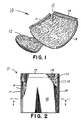
- Figure 1 is a perspective view of a disposable containment device of this invention.
- Figure 2 is a top view of the rear fecal pad of a disposable containment device of this invention prior to activation of the elastic means located at the top and side edges thereof.
- Figure 3 is a cross-sectional view taken along line 3-3 of Fig. 2.
- Figure 4 is an exploded perspective of the structural parts, prior to assembly, of a front urinary pad comprising the disposable containment device of this invention.
- Figure 5 is a cross-sectional view taken along line 5-5 of Fig. 4.
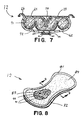
- Figure 6 is a perspective view, with parts cut away, of another embodiment of a front urinary pad comprising the disposable containment device of this invention.
- Figure 7 is a cross-sectional view taken along line 7-7 of Fig. 6.
- Figure 8 is a perspective view, also with parts cut away, of another embodiment of a front urinary pad comprising the disposable containment device of this invention.
- Figure 9 is a cross-sectional view taken along line 9-9 of Fig. 8.
- Figure 10 is a top plan view of an absorbent peat moss element utilized in the pad illustrated in Figs. 8 and 9.
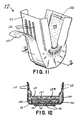
- Figure 11 is a perspective view of yet another embodiment of a front urinary pad comprising the disposable containment device of this invention.
- Figure 12 is a cross-sectional view taken along line 12-12 of Fig. 11.
- Fig. 1 illustrates an embodiment of a disposable urine and fecal waste containment product 10 of this invention.
- Rear fecal pad 11 is detachably joined, near its bottom edge, to front urinary pad 12, as by adhesive means.
- urinary pad 12 attached at its top surface to the bottom surface of fecal pad 11, it will be appreciated that other arrangements are possible.
- the urinary pad might be attached at its bottom surface to the top surface of the fecal pad, or the fecal pad may even be provided with a slit or pocket into which a portion of the urinary pad can fit so as to detachably join it thereto.
- Front urinary pad 12 is generally cup-shaped in configuration and, although a pad with a boat-shaped, foam cup shell is illustrated, other types of pads, as described in more detail below, may be used.
- Rear fecal pad 11 is substantially square or rectangular in shape and is provided with elastic means 13 and 14 so that it is gathered at its upper and side edges as shown in Fig. 1 and assumes a bowl-like configuration.
- Each of the front urinary pad and the rear fecal pad comprise a liquid-impermeable backing, an absorbent core and a liquid-permeable facing, which elements can be described in more detail as follows.
- the liquid-impermeable backing for either the front urinary or the rear fecal pads may be a liquid-impermeable polyolefin film, e.g., polyethylene or polyethylene terephthalate.
- the liquid-impermeable backing for the rear fecal pad generally will be a film
- a liquid-impermeable, flexible shell generally a polyethylene-containing foam shell which is preformed by a thermal molding process known in the art, may be used as the liquid-impermeable backing for the front urinary pad.
- the shell generally has a boat-like shape and ranges in thickness from about 1/64 to 1/4 inch, preferably about 1/16 inch, in thickness.
- the shell generally has a length which ranges from about 4 inches to about 12 inches, a width measured from one rim to another across the top space from about 2 inches to about 7 inches, and a depth, measured from a line extending across the width at the upper shell rim in the central portion to the bottom of the shell interior, from about 0.5 to about 2.5 inches.
- the shell is resilient, and, when deformed, should substantially return to its original shape.
- the attachment means may comprise adhesive lines covered with release strips which, when peeled from the adhesive strips, leave the adhesive ready for use.
- the attachment means might also comprise pressure-sensitive adhesive tape, said tape having a first face permanently adhered to the pad and an opposite second face adapted to be temporarily attached to the undergarment.
- the product could also be provided with a strip of fabric for wrapping around the waist, or could be used in conjunction with a garment to facilitate wearing and use.
- the ethylene-containing polymer foam shell can be prepared by known thermal molding processing.
- One preferred formulation for forming the ethylene-containing polymer foam material is identified as Volara Type A, which is a crosslinked polyethylene foam.
- the product is manufactured and sold by Voltek, Ind., Lawrence, Mass.
- the expression "ethylene-containing polymer foam” used herein includes polyethylene homopolymer and ethylene-containing copolymers, preferably containing a major portion, by weight, of ethylene. It is preferred that the polymer present be crosslinked.
- Preferred comonomers, for preparing the polymers include vinyl acetate, acrylic and methacrylic acids and esters, such as ethyl acrylate. Blends of such polymers can also be used.
- the formulation is prepared in sheet form at approximately 1/8 inch thickness. The sheet is subjected to thermal molding at a temperature of bout 260°F to form the foam shell.
- the liquid-permeable facing provided on the structures of the present invention is an apertured film, nonwoven fabric or the like having a high degree of moisture permeability.
- the fabric may be polyester, polyethylene, polypropylene, bicomponent, nylon, rayon, or the like fibers.
- the fabric used for the cover is a lightweight fabric in the range of 0.3 to 5.0 oz. per square yard and with a density less than 0.2 gm/cc. The most suitable fabrics have high loft, softness and drape characteristics.
- the cover is a web of through air bonded bicomponent (polyester/polyethylene) fiber. Excellent results have been obtained using such a fabric of 0.5 - 0.7 oz/yd2 formed from 3 denier 11 ⁇ 2 inch bicomponent staple fiber.
- hydrophilic fibers from which the absorbent core may be made include wood pulp fibers.
- Wood pulp is highly liquid absorbent and wettable, but collapses when wet.
- Non-cellulosic synthetic fibers such as but not limited to polyolefin fibers (polyethylene, polypropylene, and bicomponent fibers) are resistant to wet collapse.
- Blending about 5 to 50 weight %, preferably about 20 - 25 weight %, of non-cellulosic synthetic fibers with the wood pulp fibers leads to a material with markedly improved wet collapse properties compared to 100% wood pulp, but which substantially retains the absorbent and wettability properties of the wood pulp.
- the absorbent core comprises approximately 77% by weight wood pulp and approximately 23% Pulpex®, the latter being a synthetic polyethylene wood pulp supplied by Hercules, Wilmington, Delaware, USA.
- the absorbent core it may be desirable to include therein certain "superabsorbent" materials.
- These are generally water-insoluble, water-swellable polymeric substances capable of absorbing water in an amount which is at least 10 times the weight of the substance in its dry form.
- the superabsorbent is in the form of powders, fibers, spheres, particles, bits of film, globules, or the like.
- One type of superabsorbent material provides particles or fibers which may be described chemically as having a backbone of natural or synthetic polymers with hydrophilic groups or polymers containing hydrophilic groups being chemically bonded to the backbone or an intimate mixture therewith.
- modified natural and regenerated polymers as polysaccharides including, for example, cellulose and starch and regenerated cellulose which are modified by being carboxylalkylated, phosphonoalkylated, sulfoalkylated, or phosphorylated to render them highly hydrophilic.
- modified polymers may also be cross-linked to improve their water-insolubility.
- polysaccharides may also serve, for example, as the backbone on to which other polymer moieties may be bonded by graft copolymerization techniques.
- grafted polysaccharides and their method of manufacture are described in U.S. Patent No. 4,105,033 to Chatterjee et al.
- R1 and R2 are selected from the group consisting of hydrogen and alkyl having 1 to 4 carbon atoms
- X and Y are selected from the group consisting of -OH, -O(alkali metal), and -NH2, wherein m is an integer having a value of 0 to about 5000, n is an integer having a value of 0 to about 5000, m plus n is at least 500, p is an integer having a value of 0 or 1, and q is an integer having a value of 1 to 4.
- the hydrocolloid component may comprise wholly synthetic hydrophilic particles.
- examples of those now known in the art are polyacrylonitrile fibers which may be modified by grafting moieties thereon such as polyvinylalcohol chains, polyvinyl alcohol itself, hydrophilic polyurethane, poly(alkyl phosphonates), partially hydrolyzed polyacrylamides (e.g., poly (N-N-dimethylacrylamide), sulfonated polystyrene, or a class of poly(alkyleneoxide).
- These highly hydrophilic synthetic polymers may be modified by other chemical treatments such as cross-linking or hydrolysis.
- non-ionic polymers such as polyoxyethylene, polyoxypropylene, and mixtures thereof which have been suitably crosslinked, either chemically or by irradiation.
- Still another more recent type is a derivative of isobutylene-maleic anhydride copolymer.
- the absorbent core generally comprises about 10 to 50 weight %, based on its total weight, of superabsorbent.
- the superabsorbent is poly-(sodium acrylate) and the superabsorbent comprises about 33 weight % of the total weight of the composite web.
- the balance of the composite web is a blend of wood pulp and Pulpex® in a weight ratio of 77:23.
- the absorbent composite web of wood pulp/noncellulosic synthetic fiber/-superabsorbent can be prepared by methods known in the art utilizing a transverse webber as disclosed in U.S. Patent Application Serial No. 99,875, filed September 22, 1987, the disclosure of which is incorporated herein by reference *.
- a single feed of a combined pulp/synthetic fiber material may be fed to the webber, ground so as to individualize the fibers and then fed into an air stream into which superabsorbent material is also introduced.
- the combined pulp/synthetic fiber/superabsorbent may be collected thermally bonded together to produce a stable web.
- this web comprises a homogenenous blend of the three materials; however, there may be some settling of superabsorbent particles to the bottom of the web during subsequent processing steps. * see EP-A-0307967
- Sheets of tenderized peat moss may be made by methods well known in the art, such as those disclosed in the patents the disclosures of which were previously incorporated by reference.
- the raw peat moss material utilized is peat moss of the sphagnum variety and is preferably capable of absorbing at least about 15 times, preferably about 20 times, its weight in water.
- the peat moss is generally screened and then separated into a usable fraction and peat fines.
- the screened peat moss may be combined with other absorbent materials, preferably fibrous and cellulosic in nature.
- These art-recognized materials may include Kraft, wood pulp and mechanical wood pulp.
- mechanical wood pulp is meant to include ground wood pulp, thermomechanical pulp and refiner wood pulp.
- the common characteristic of these mechanical pulps is that no attempt has been made to separate the fibers by chemical means although they may later, after being reduced to fine particulate matter, be subjected to chemical treatment.
- mechanical wood pulp has a Canadian Standard Freeness (TAPPI TEST METHOD T-227) of from about 60-500 and preferably from about 150-300.
- Kraft wood pulp is generally a chemically treated, long fibered pulp such as sulfite and sulfate wood pulps.
- a suitable mixture of ingredients for the absorbent boards of the invention may comprise from about 5 to about 20 percent by weight of Kraft wood pulp, with the remainder being essentially peat moss. It is understood that these compositions are preferred peat moss embodiments and that those familiar with the art may find a wide range of peat moss compositions as well as other absorbent materials, i.e., superabsorbents, for use with the products of this invention.
- the above peat mixtures can be additionally combined with fibrous means comprising polymer fibers, preferably polyester fibers, and most preferably staple-length polyester fibers.
- the preferred polyester fibers are disposed to maintain the integrity of the product during processing and use, without subtracting from the intended mechanical flexibility.
- the polyester material or other suitable fibrous material is slurried with water in a pulper prior to being mixed with the preferred peat moss compositions.
- the preferred absorbent elements of this invention can comprise about 2.5% to about 20.0% polyester by weight, preferably about 4.0 to 8.0 % polyester by weight.
- peat moss then, as used herein to describe the first absorbent member of the absorbent core, is intended to include peat moss products comprising, in addition to particles of peat moss, cellulosic fibers and polymer fibers as described above.
- the mixture of screened peat moss and selected fibers are processed into an absorbent element by methods known in the art.
- the screened peat moss and selected fibers are slurried together to form an aqueous slurry which is preferably flowed onto a Fourdrinier wire and dewatered to form the starting board.
- a laminate is then made from the peat board and layers of Kraft wood pulp.
- the resulting composite board is then conditioned to contain a prescribed moisture content and calendared.
- the absorbent peat moss elements prepared as described above tend not to be flexible enough for use in an absorbent garment without undergoing "tenderizing", i.e., processing by any number of known methods to increase the cross-direction flexibility of the board. See, for example, the disclosure of U.S.S.N. 242,274, filed September 12, 1988, ** which discloses a method of tenderizing the absorbent element by a special cutting process which severs the peat moss portions of the element but which leaves those portions linked with fibrous means to produce a hinge-like effect in the resulting element.
- Other "tenderizing" methods which might be employed to enhance the flexibility of the absorbent board are microcorrugation and perfembossing as disclosed in U.S. Patent No. 4,605,402 to Iskra. **see EP-A-0360472
- peat moss material may be used as the absorbent element. Obviously, the greater the absorptive capacity which is desired for the final absorptive product, the more absorptive capacity must be provided in the absorbent core. As the peat moss boards decrease in flexibility with thickness, it may be desired to utilize two (or more) layers of peat moss board in lieu of one thicker layer.
- Figs. 2 and 3 illustrate an embodiment of the rear fecal pad 11 prior to contraction of the elastic means.
- the pad is substantially square or rectangular in shape, with typical dimensions being 10" along the lateral edges and 12" along the top and bottom edges.
- An absorbent core 21 is sandwiched between a liquid-impermeable backing 22 and a liquid permeable facing 23, and is generally smaller in dimensions than both said backing and said facing.
- Elastic means 12 along the lateral edges 17,18 of pad 11 and elastic means 14 (not shown in Fig. 3) along the top, edge 19 of the pad, when contracted, cause the pad to assume a bowl-like configuration and substantially conform to the shape of the wearer's buttocks.
- the absorbent material used in absorbent core 21 of the rear fecal pad can be any of the absorbent materials, or combinations thereof, previously described.
- it could comprise wood pulp, wood pulp in combination with synthetic fibers, either of the foregoing in combination with superabsorbent material, or peat moss.
- Elastic means 13,13 such as elastic threads are preferably used along the lateral edges of the pad to cause it to gather.
- the rubber threads provided in pairs approximately 1 ⁇ 4" apart, are applied to the side edges of the backing material and adhered intermittently thereto.
- the threads are secured to the backing in a stretched condition (e.g., about 50% stretch). When the threads are allowed to contract, gathered portions are formed.
- a heat-shrinkable film or extensible film or foam which is adhered to the pad in a tensioned condition relative thereto.
- a suitable heat-shrinkable film include a three-ply coextruded film comprising two outer layers of LLDPE and a center ply of ethylene vinyl acetate (28% vinyl acetate, melt index 6). This film is advantageous in that it can be glued to typical backing and facing materials, and is conveniently thermally activated (shrunk to an elastic state), so as to cause gathers, by the application thereto of hot air.
- An extensible foam which can be adhered to the pad in a tensioned condition and thereafter released to create the desired gathers includes a polyurethane foam.
- Figs. 4 and 5 show one embodiment of a suitable front urinary pad 12.
- Fig. 4 illustrates the embodiment with the structural elements thereof separated and showing their spatial relationship.
- the shell 42 is a liquid-impermeable shell which is preformed by a thermal molding process known in the art.
- Absorbent core 43 is "squeezed" at its center, as illustrated by the directional arrows in Fig. 4, in order to fit it into the shell 42.
- the facing 44 is a liquid-permeable, generally hydrophobic fibrous web, typically having a basis weight of 0.5 oz/yd2.
- the three elements, the shell 42, the absorbent core 43, and the facing 44, are combined as shown in the drawing, the facing being sealed at its periphery to the flange 41 of the shell so as to provide a unitary product.
- Fig. 5 is a cross-sectional view along line 5-5 of Fig. 4 of a portion of absorbent core 43.
- the absorbent core 43 comprises an absorbent web 51 of wood pulp fibers, synthetic staple fibers and superabsorbent [preferably poly-(sodium acrylate)].
- Absorbent web 51 can be prepared by methods well-known in the art. For example, a single feed of a combined wood pulp/synthetic fiber material may be fed to a webber, ground so as to individualize the fibers and then fed into an air stream into which superabsorbent material is also introduced. The blended pulp/synthetic fiber/superabsorbent materials are collected on a carrier tissue 53 after which they are treated with hot air to produce stabilized web 51.
- a first liquid-permeable nonwoven fabric 52 comprising a thermally bonded web of bicomponent fibers (polyester core/polyethylene sheath) is then placed on top of the tissue-carried, heat-stabilized web 51.
- the resulting laminate is then corrugated in known fashion to produce the pleated structure shown in Fig. 5.
- a second nonwoven fabric 55 identical to nonwoven fabric 52, is secured by heat treatment to the peaks 57 of the folds of the pleated web 51 to thereby stabilize the same and to provide absorbent core 43 as seen in perspective in Fig. 4.
- second nonwoven fabric 55 has a width which is greater than the width of pleated web 51 to which it is applied.
- the side marginal portions 55a of second nonwoven fabric 55 extend over and are continued at least partially downward over the side edges 51a of corrugated member 51.
- side marginal portions 52a of first liquid-permeable nonwoven fabric 52 and side marginal portions 55a of second nonwoven fabric 55 provide means for transferring discharged liquid from the area of impact to the bottom of shell 42. In this manner, a large volume of voided liquid can be held in waste in front urinary pad 12 until it is taken and retained by absorbent core 43.
- Fig. 6 is a perspective view of another embodiment of a urinary pad 12 of the containment product of the present invention.
- the liquid-impermeable backing 62 is again a foam shell which is preformed by a thermal molding process known in the art and referred to earlier herein.
- Absorbent core 63 pleated in an M-configuration, is fit into shell 62.
- the facing 64 is again a liquid-permeable, generally hydrophobic fibrous web.
- the three elements, i.e. shell 62, absorbent core 63 and facing 64, are combined as shown in Fig. 7, the facing being sealed at its periphery to flange 66 of the shell so as to provide a unitary product.
- adhesive means 65 for detachably joining the front urinary pad to a rear fecal pad to create the containment product of the invention.
- Fig. 7 is a cross-sectional view of pad 12 illustrated in Fig. 6.
- Absorbent core 63 comprises an absorbent medium 71 and a transfer layer 73.
- the absorbent medium 71 comprising a blend of wood pulp fibers, synthetic fibers and superabsorbent material deposited onto a layer of tissue 72 is faced on one surface with transfer layer 73, and is then pleated into the M-configuration shown in Fig. 7.
- the transfer layer 73 is preferably a layer of synthetic fusible fibers and should be a high loft material having high resiliency and substantially no resistance to liquid flow. Resin bonded polyester fabrics have been found to be particularly suitable for use in the transfer layer.
- a preferred embodiment utilizes a nonwoven fabric which has a basis weight of 1.5 oz/yd2, is resin bonded, and comprises 6 denier, 11 ⁇ 2 inch staple polyester fibers.
- the binder resin is derived from an acrylic emulsion and comprises 25 weight % of the fabric weight.
- the transfer layer may be a discrete layer of fabric or may be created in-situ by applying fiber and resin to one surface of the absorbent medium.
- the M-configured pleat in absorbent core 63 (comprising absorbent medium 71 plus transfer layer 73) can be formed using a three-finger device, the center finger remaining static while the two outside fingers move toward the center stationary finger. This causes the M-fold and a reduction in the width of the pad in its center portion.
- core 63 is squeezed at its center and then placed into the liquid-impermeable foam shell which holds it in the pleated configuration.
- the pleats do not have to be restricted to the center portion of the core and could be extended throughout the entire length thereof.
- a channel 74 is created in approximately the center of the pad in a lengthwise direction which serve to hold discharge until absorbed by the absorbent core.
- the transfer layer 73 is configured, after the M-folding step, so as to extend substantially down the side of the pleated absorbent medium 71 to provide a liquid path to the bottom of the absorbent medium and, in this embodiment, to the bottom of the liquid impermeable foam shell 62.
- the M-configured pleats are also advantageous in that they provide recovery from lateral compression forces.
- Foam shell 62 has upper outwardly extending flanges 66 to which are adhered liquid permeable nonwoven facing fabric 64. There are adhesive means on the bottom of the foam shell to facilitate adhering the pad to the wearer's garment.
- the adhesive means comprise a tape 79 coated on both sides with a pressure sensitive adhesive 60 and are protected prior to use with a removable cover sheet 61 and there may, of course, also be adhesive means (not shown) on the upper or bottom surface of the pad to detachably join it to the rear fecal pad.
- Fig. 8 illustrates yet another embodiment of a front urinary pad 12 suitable for use in the containment device 10 of this invention.
- Absorbent core 83 is pleated in an M-configuration, and is inserted into liquid-impermeable shell 82.
- Liquid-permeable nonwoven facing 84 is adhered to flange 81 of the shell to enclose the absorbent core therein.
- the absorbent core utilized in this embodiment differs from that of the previously disclosed embodiment, however, in that it utilizes the highly liquid absorptive and retentive properties of peat moss.
- the absorbent core 83 of the embodiment of Fig. 8 is shown in more detail in the cross-sectional view in Fig. 9.
- the absorbent core 83 comprises two layers 91,91 of a tenderized peat product, and, on top thereof, facing upwards towards the wearer of the product, is the receiving layer 92.
- the receiving layer is formed of a material which is capable of absorbing body fluid more rapidly than does the peat moss product, but which does not exhibit the overall liquid absorption and retention properties of the peat moss product 91. The receiving layer therefore operates to "receive" and hold the body fluid until it is absorbed by the layers of peat moss product adjacent to it.
- receiving layer 92 should be capable of absorbing at least about 12 grams of aqueous liquid per gram of receiving layer.
- the receiving layer comprises a fibrous web of wood pulp fibers and non-cellulosic fibers, e.g., about 50 - 95 weight percent wood pulp fibers and about 5 to 50 weight percent non-cellulosic synthetic fibers like polyester fibers.
- a particularly preferred embodiment utilizes as the receiving layer a web of 80% by weight wood pulp and 20% bicomponent (polyester core/polyethylene sheath) fibers having a denier of 3 and a length of 11 ⁇ 2 inches.
- Receiving layer 92 preferably has a basis weight of 11 oz/yd2.
- the absorbent core 83 comprising at least one layer of peat moss product 91 and receiving layer 92, is pleated into an M-configuration.
- the peat moss material comprising the absorbent core can, even after tenderizing, tend to be stiff and lack flexibility.
- Lengthwise slits 102, shown in Fig. 10, can be provided in the material if enhanced flexibility is desired.
- Fig. 11 illustrates another embodiment of a front urinary pad of this invention.
- the backing 112 is a sheet of liquid impermeable material, such as a polyolefin film.
- Absorbent core 113 is sandwiched between the backing 112 and a liquid-permeable facing 114.
- Elastic means 115 in the crotch area of the product cause the product to have a cup-shaped configuration.
- adhesive means 116 on the bottom of the backing to facilitate adhering the pad to the wearer's garment. These adhesive means are protected prior to use by removable cover strip 125.
- Fig. 12 is a cross-sectional view of the pad illustrated in Fig. 11.
- an absorbent member 121 comprises a sheet of a tenderized peat product folded back on itself in a C-configuration and surrounded by a layer of tissue 122 (e.g., 0.6 oz/yd2 paper).
- tissue 122 e.g., 0.6 oz/yd2 paper
- the receiving layer 123 is adhered to the absorbent member 121 with a layer of adhesive 127.
- the receiving layer 123 is greater in width than the absorbent member 121 and extends partially over the side edges of the absorbent member when the product is in its cup-like configuration.
- a layer of adhesive 126 adheres both the bottom surface of the absorbent member 121, i.e., that surface facing the garment of the wearer, and the side portions of the receiving layer 123 extending beyond the width of the absorbent member 121, to backing sheet 112.
- the upper surface of receiving layer 123 i.e. that surface facing the wearer, is kept in contact with liquid permeable facing 114 by frictional engagement of their respective fibrous constituents.
Landscapes
- Health & Medical Sciences (AREA)
- Epidemiology (AREA)
- Nursing (AREA)
- Orthopedic Medicine & Surgery (AREA)
- Engineering & Computer Science (AREA)
- Biomedical Technology (AREA)
- Heart & Thoracic Surgery (AREA)
- Vascular Medicine (AREA)
- Life Sciences & Earth Sciences (AREA)
- Animal Behavior & Ethology (AREA)
- General Health & Medical Sciences (AREA)
- Public Health (AREA)
- Veterinary Medicine (AREA)
- Orthopedics, Nursing, And Contraception (AREA)
- Absorbent Articles And Supports Therefor (AREA)
- Mattresses And Other Support Structures For Chairs And Beds (AREA)
- Bedding Items (AREA)
Applications Claiming Priority (2)
| Application Number | Priority Date | Filing Date | Title |
|---|---|---|---|
| US07/464,508 US5167654A (en) | 1990-01-12 | 1990-01-12 | Disposable urine and fecal waste containment product |
| US464508 | 1990-01-12 |
Publications (2)
| Publication Number | Publication Date |
|---|---|
| EP0439962A1 true EP0439962A1 (fr) | 1991-08-07 |
| EP0439962B1 EP0439962B1 (fr) | 1995-02-15 |
Family
ID=23844222
Family Applications (1)
| Application Number | Title | Priority Date | Filing Date |
|---|---|---|---|
| EP90314378A Expired - Lifetime EP0439962B1 (fr) | 1990-01-12 | 1990-12-28 | Article jetable pour retenir l'urine et les matières fécales |
Country Status (8)
| Country | Link |
|---|---|
| US (2) | US5167654A (fr) |
| EP (1) | EP0439962B1 (fr) |
| AT (1) | ATE118333T1 (fr) |
| BR (1) | BR9100113A (fr) |
| DE (1) | DE69016994T2 (fr) |
| ES (1) | ES2076342T3 (fr) |
| IE (1) | IE68678B1 (fr) |
| ZA (1) | ZA91243B (fr) |
Cited By (12)
| Publication number | Priority date | Publication date | Assignee | Title |
|---|---|---|---|---|
| EP0532005A1 (fr) * | 1991-09-11 | 1993-03-17 | Kimberly-Clark Corporation | Article absorbant |
| EP0539703A1 (fr) * | 1991-09-11 | 1993-05-05 | Kimberly-Clark Corporation | Article absorbant |
| WO1993012747A1 (fr) * | 1991-12-20 | 1993-07-08 | The Procter & Gamble Company | Serviette hygienique elastifiee |
| US5236428A (en) * | 1992-03-19 | 1993-08-17 | Paragon Trade Brands, Inc. | Absorbent article having auxillary absorbent member having standing leg gathers |
| GB2284553A (en) * | 1993-12-09 | 1995-06-14 | Kimberly Clark Co | Incontinence article for males |
| US5451442A (en) * | 1991-12-17 | 1995-09-19 | Paragon Trade Brands, Inc. | Absorbent panel structure for a disposable garment |
| EP0622064A3 (en) * | 1993-04-28 | 1996-01-17 | Kimberly Clark Co | Hygienic absorbent article. |
| WO1996007376A1 (fr) * | 1994-09-09 | 1996-03-14 | Kimberly-Clark Worldwide, Inc. | Stratifie non-tisse thermoformable formant barriere |
| WO1996013237A1 (fr) * | 1994-10-31 | 1996-05-09 | Mcneil-Ppc, Inc. | Article absorbant se cintrant et se dilatant |
| EP0779066A1 (fr) * | 1995-12-14 | 1997-06-18 | Johnson & Johnson Inc. | Article absorbant comprenant de sphagnum et procédé de fabrication |
| KR100266192B1 (ko) * | 1991-12-20 | 2000-09-15 | 데이비드 엠 모이어 | 탄력적인생리대 |
| GB2462808A (en) * | 2008-08-18 | 2010-02-24 | Jyldyz Mambetova | Nappy with separate sections for the collection of urine and faeces |
Families Citing this family (49)
| Publication number | Priority date | Publication date | Assignee | Title |
|---|---|---|---|---|
| US6440114B1 (en) * | 1909-11-14 | 2002-08-27 | The Procter & Gamble Company | Disposable absorbent article having fecal management layer |
| JP3343624B2 (ja) * | 1992-12-04 | 2002-11-11 | 株式会社日本吸収体技術研究所 | 吸収体製品 |
| US5531726A (en) * | 1993-09-21 | 1996-07-02 | Johnson & Johnson, Inc. | Sphagnum moss composition for the production of sheeted absorbent and method for evaluating the potential of sphagnum moss material for absorbing liquid |
| US5599334A (en) * | 1993-11-12 | 1997-02-04 | Confab, Inc. | Absorbent article with substantial volume capacity and retainable shape |
| CA2123329C (fr) | 1993-12-17 | 2005-01-11 | Mary Eva Garvie Weber | Materiau absorbant les liquides pour articles absorbants d'usage personnel et autres |
| SE508400C2 (sv) * | 1993-12-29 | 1998-10-05 | Sca Hygiene Prod Ab | Absorptionskropp i ett absorberande alster |
| US5786359A (en) * | 1994-05-27 | 1998-07-28 | The Scripps Research Institute | N9 alkyl or aralkyl derivatives of 7, 8-disubstituted guanines |
| US5591147A (en) * | 1994-08-12 | 1997-01-07 | Kimberly-Clark Corporation | Absorbent article having an oppositely biased attachment flap |
| US5853403A (en) * | 1994-10-25 | 1998-12-29 | Kimberly-Clark Worldwide, Inc. | Absorbent article with body contacting liquid control member |
| US5716351A (en) * | 1996-07-25 | 1998-02-10 | The Procter & Gamble Company | Diaper having adjustable absorbent assemblies |
| US20030196742A1 (en) * | 1997-02-07 | 2003-10-23 | Weder Donald E. | Synthetic decorative moss simulating Spanish moss and method for making same |
| US5906879A (en) * | 1997-04-30 | 1999-05-25 | Kimberly-Clark Worldwide, Inc. | Ultra resilient three-dimensional nonwoven fiber material and process for producing the same |
| US6676646B2 (en) * | 1997-11-14 | 2004-01-13 | The Procter & Gamble Company | Zoned disposable absorbent article for urine and low-viscosity fecal material |
| US6465379B1 (en) | 1998-06-30 | 2002-10-15 | Bki Holding Corporation | Unitary absorbent material for use in absorbent structures |
| US6468196B1 (en) | 1998-07-09 | 2002-10-22 | Southpac Trust International, Inc. | Synthetic decorative grass simulating Spanish moss and method for making same |
| EP0976373A1 (fr) * | 1998-07-29 | 2000-02-02 | The Procter & Gamble Company | Article absorbant jetable comportant un élément pour retenir des matières fécales |
| EP0976374A1 (fr) | 1998-07-29 | 2000-02-02 | The Procter & Gamble Company | Article absorbant jetable comportant un élément pour retenir des matières fécales |
| US6749593B1 (en) | 1998-08-07 | 2004-06-15 | The Procter & Gamble Company | Disposable absorbent article comprising fecal management member having fibers oriented in the z-direction |
| US6673982B1 (en) | 1998-10-02 | 2004-01-06 | Kimberly-Clark Worldwide, Inc. | Absorbent article with center fill performance |
| US6562192B1 (en) | 1998-10-02 | 2003-05-13 | Kimberly-Clark Worldwide, Inc. | Absorbent articles with absorbent free-flowing particles and methods for producing the same |
| US6503233B1 (en) | 1998-10-02 | 2003-01-07 | Kimberly-Clark Worldwide, Inc. | Absorbent article having good body fit under dynamic conditions |
| US6667424B1 (en) | 1998-10-02 | 2003-12-23 | Kimberly-Clark Worldwide, Inc. | Absorbent articles with nits and free-flowing particles |
| JP3727207B2 (ja) * | 1999-11-15 | 2005-12-14 | ユニ・チャーム株式会社 | 吸収性物品 |
| US7147628B2 (en) * | 2000-10-02 | 2006-12-12 | Sca Hygiene Products Ab | Absorbent article with improved liquid-handling ability |
| RU2003117081A (ru) * | 2000-12-07 | 2004-11-10 | Вейерхойзер Компани (Us) | Распределительный слой с улучшенным переносом жидкости в удерживающий слой |
| EP1392210B1 (fr) * | 2001-04-24 | 2011-01-26 | The Procter & Gamble Company | Dispositif de gestion de fluides biologiques utilise avec un article absorbant |
| US6797360B2 (en) | 2001-08-22 | 2004-09-28 | Kimberly-Clark Worldwide, Inc. | Nonwoven composite with high pre-and post-wetting permeability |
| US6500947B1 (en) * | 2001-08-24 | 2002-12-31 | Weyerhaeuser Company | Superabsorbent polymer |
| JP3647797B2 (ja) * | 2001-11-28 | 2005-05-18 | コナミ株式会社 | 画像表示プログラム、画像表示方法及びビデオゲーム装置 |
| US20030236512A1 (en) * | 2002-06-19 | 2003-12-25 | Baker Andrew A. | Absorbent core with folding zones for absorbency distribution |
| US20030024663A1 (en) * | 2002-07-19 | 2003-02-06 | Neogi Amar N. | Superabsorbent cellulosic fiber |
| US20030035950A1 (en) * | 2002-07-19 | 2003-02-20 | Neogi Amar N. | Superabsorbent cellulosic fiber |
| US20030034136A1 (en) * | 2002-07-19 | 2003-02-20 | Neogi Amar N. | Superabsorbent cellulosic fiber |
| US20030034137A1 (en) * | 2002-07-19 | 2003-02-20 | Neogi Amar N. | Superabsorbent cellulosic fiber |
| US7008497B2 (en) * | 2002-08-22 | 2006-03-07 | Zuiko Corporation | Method and apparatus for producing wearing article |
| US20050096615A1 (en) * | 2003-10-31 | 2005-05-05 | Kimberly-Clark Worldwide, Inc. | Absorbent article with segmented absorbent structure |
| US20060069367A1 (en) * | 2004-09-29 | 2006-03-30 | Andrew Waksmundzki | Absorbent core having two or more types of superabsorbent |
| US20060135933A1 (en) * | 2004-12-21 | 2006-06-22 | Newlin Seth M | Stretchable absorbent article featuring a stretchable segmented absorbent |
| US20060142717A1 (en) * | 2004-12-27 | 2006-06-29 | David Horowitz | Absorbent bed pad |
| US20070197984A1 (en) * | 2006-02-17 | 2007-08-23 | Richardson William C | Fecal disposal device |
| US7927320B2 (en) * | 2006-09-20 | 2011-04-19 | Tisteron, Ltd. | Disposable waste containment article and a combination of two articles worn simultaneously |
| US20090076472A1 (en) * | 2007-09-17 | 2009-03-19 | Tisteron, Ltd. | Absorbent layer, structure and article along with a method of forming the same |
| US8740868B2 (en) * | 2011-08-16 | 2014-06-03 | Anthony Chambers | Male undergarment discharge shield |
| US10271997B2 (en) | 2014-04-08 | 2019-04-30 | The Procter & Gamble Company | Absorbent articles having substrates having zonal treatments |
| CN106132372A (zh) * | 2014-04-08 | 2016-11-16 | 宝洁公司 | 具有包括流控制材料的基底的吸收制品 |
| US11806217B2 (en) * | 2016-12-12 | 2023-11-07 | Smith & Nephew Plc | Wound dressing |
| USD934416S1 (en) * | 2019-04-28 | 2021-10-26 | Joshua Shaw Slepkow | Infant urination shield |
| US20230149223A1 (en) * | 2021-11-18 | 2023-05-18 | Judith Snyder | Waste collection device |
| US12558271B1 (en) * | 2024-12-23 | 2026-02-24 | Patrick Anthony Calame | Foldable sanitary napkin |
Citations (10)
| Publication number | Priority date | Publication date | Assignee | Title |
|---|---|---|---|---|
| FR2532337A1 (fr) * | 1982-08-25 | 1984-03-02 | Dispovet | Article comportant une bande froncee elastique, procede et dispositif pour sa fabrication |
| US4507122A (en) * | 1980-08-01 | 1985-03-26 | Johnson & Johnson | Low density peat moss board |
| US4536181A (en) * | 1984-04-03 | 1985-08-20 | Cook Linda E | Sanitary napkin with improved protection |
| EP0164435A1 (fr) * | 1983-06-01 | 1985-12-18 | Kimberly-Clark Corporation | Vêtement pour incontinent à soufflet élastique |
| EP0202472A1 (fr) * | 1985-04-22 | 1986-11-26 | Grain Processing Corporation | Produit absorbant non laminé formé à sec |
| US4681577A (en) * | 1983-09-23 | 1987-07-21 | Personal Products Company | Disposable urinary and fecal waste containment product |
| US4685914A (en) * | 1983-09-23 | 1987-08-11 | Personal Products Company | Disposable urinary pad |
| US4758240A (en) * | 1985-08-05 | 1988-07-19 | Glassman Jacob A | Anantomical sanitary and incontinent pads |
| EP0335253A1 (fr) * | 1988-03-31 | 1989-10-04 | The Procter & Gamble Company | Article absorbant |
| US4880417A (en) * | 1987-10-16 | 1989-11-14 | Biological Resistance, Inc. | Deodorizing and sound muffling anal pad |
Family Cites Families (4)
| Publication number | Priority date | Publication date | Assignee | Title |
|---|---|---|---|---|
| US3875943A (en) * | 1973-09-04 | 1975-04-08 | Colgate Palmolive Co | Diaper |
| US4338938A (en) * | 1980-05-19 | 1982-07-13 | Seavitt Susan A | Washable diaper |
| US4627847A (en) * | 1985-04-03 | 1986-12-09 | National Starch And Chemical Corporation | Hot melt adhesive waste barrier |
| US4804380A (en) * | 1987-08-06 | 1989-02-14 | Kimberly-Clark Corporation | Anatomically shaped, self-aligning, sanitary protection device |
-
1990
- 1990-01-12 US US07/464,508 patent/US5167654A/en not_active Expired - Lifetime
- 1990-12-28 DE DE69016994T patent/DE69016994T2/de not_active Expired - Fee Related
- 1990-12-28 EP EP90314378A patent/EP0439962B1/fr not_active Expired - Lifetime
- 1990-12-28 AT AT90314378T patent/ATE118333T1/de not_active IP Right Cessation
- 1990-12-28 ES ES90314378T patent/ES2076342T3/es not_active Expired - Lifetime
-
1991
- 1991-01-11 IE IE9191A patent/IE68678B1/en not_active IP Right Cessation
- 1991-01-11 ZA ZA91243A patent/ZA91243B/xx unknown
- 1991-01-11 BR BR9100113-7A patent/BR9100113A/pt not_active IP Right Cessation
-
1992
- 1992-04-24 US US07/874,231 patent/US5476459A/en not_active Expired - Fee Related
Patent Citations (10)
| Publication number | Priority date | Publication date | Assignee | Title |
|---|---|---|---|---|
| US4507122A (en) * | 1980-08-01 | 1985-03-26 | Johnson & Johnson | Low density peat moss board |
| FR2532337A1 (fr) * | 1982-08-25 | 1984-03-02 | Dispovet | Article comportant une bande froncee elastique, procede et dispositif pour sa fabrication |
| EP0164435A1 (fr) * | 1983-06-01 | 1985-12-18 | Kimberly-Clark Corporation | Vêtement pour incontinent à soufflet élastique |
| US4681577A (en) * | 1983-09-23 | 1987-07-21 | Personal Products Company | Disposable urinary and fecal waste containment product |
| US4685914A (en) * | 1983-09-23 | 1987-08-11 | Personal Products Company | Disposable urinary pad |
| US4536181A (en) * | 1984-04-03 | 1985-08-20 | Cook Linda E | Sanitary napkin with improved protection |
| EP0202472A1 (fr) * | 1985-04-22 | 1986-11-26 | Grain Processing Corporation | Produit absorbant non laminé formé à sec |
| US4758240A (en) * | 1985-08-05 | 1988-07-19 | Glassman Jacob A | Anantomical sanitary and incontinent pads |
| US4880417A (en) * | 1987-10-16 | 1989-11-14 | Biological Resistance, Inc. | Deodorizing and sound muffling anal pad |
| EP0335253A1 (fr) * | 1988-03-31 | 1989-10-04 | The Procter & Gamble Company | Article absorbant |
Cited By (22)
| Publication number | Priority date | Publication date | Assignee | Title |
|---|---|---|---|---|
| EP0539703A1 (fr) * | 1991-09-11 | 1993-05-05 | Kimberly-Clark Corporation | Article absorbant |
| EP0532005A1 (fr) * | 1991-09-11 | 1993-03-17 | Kimberly-Clark Corporation | Article absorbant |
| AU658439B2 (en) * | 1991-09-11 | 1995-04-13 | Kimberly-Clark Worldwide, Inc. | Absorbent article having a liner which exhibits improved softness and dryness, and provides for rapid uptake of liquid |
| KR100230217B1 (ko) * | 1991-09-11 | 1999-11-15 | 로날드 디. 맥크레이 | 부드러움 및 건조감이 개선된 신속한 액체흡수성 라이너가 있는 흡수용품 |
| US5451442A (en) * | 1991-12-17 | 1995-09-19 | Paragon Trade Brands, Inc. | Absorbent panel structure for a disposable garment |
| KR100266192B1 (ko) * | 1991-12-20 | 2000-09-15 | 데이비드 엠 모이어 | 탄력적인생리대 |
| WO1993012747A1 (fr) * | 1991-12-20 | 1993-07-08 | The Procter & Gamble Company | Serviette hygienique elastifiee |
| TR26372A (tr) * | 1991-12-20 | 1995-03-15 | Procter & Gamble | Esnek hijyenik adet bezi |
| US5236428A (en) * | 1992-03-19 | 1993-08-17 | Paragon Trade Brands, Inc. | Absorbent article having auxillary absorbent member having standing leg gathers |
| EP0622064A3 (en) * | 1993-04-28 | 1996-01-17 | Kimberly Clark Co | Hygienic absorbent article. |
| GB2284553A (en) * | 1993-12-09 | 1995-06-14 | Kimberly Clark Co | Incontinence article for males |
| US5558734A (en) * | 1993-12-09 | 1996-09-24 | Kimberly-Clark Corporation | Method of manufacturing incontinence article for males |
| US5558659A (en) * | 1993-12-09 | 1996-09-24 | Kimberly-Clark Corporation | Incontinence article for males |
| GB2284553B (en) * | 1993-12-09 | 1997-12-03 | Kimberly Clark Co | Incontinence article for males and method of manufacture |
| US5695376A (en) * | 1994-09-09 | 1997-12-09 | Kimberly-Clark Worldwide, Inc. | Thermoformable barrier nonwoven laminate |
| WO1996007376A1 (fr) * | 1994-09-09 | 1996-03-14 | Kimberly-Clark Worldwide, Inc. | Stratifie non-tisse thermoformable formant barriere |
| US6159881A (en) * | 1994-09-09 | 2000-12-12 | Kimberly-Clark Worldwide, Inc. | Thermoformable barrier nonwoven laminate |
| WO1996013237A1 (fr) * | 1994-10-31 | 1996-05-09 | Mcneil-Ppc, Inc. | Article absorbant se cintrant et se dilatant |
| AU712856B2 (en) * | 1994-10-31 | 1999-11-18 | Mcneil-Ppc, Inc. | Arcing and expanding absorbent article |
| EP0779066A1 (fr) * | 1995-12-14 | 1997-06-18 | Johnson & Johnson Inc. | Article absorbant comprenant de sphagnum et procédé de fabrication |
| SG95582A1 (en) * | 1995-12-14 | 2003-04-23 | Johnson & Johnson Inc | Liquid absorbent shagnum moss article and method for manufacturing the absorbent article |
| GB2462808A (en) * | 2008-08-18 | 2010-02-24 | Jyldyz Mambetova | Nappy with separate sections for the collection of urine and faeces |
Also Published As
| Publication number | Publication date |
|---|---|
| US5167654A (en) | 1992-12-01 |
| ZA91243B (en) | 1992-09-30 |
| IE68678B1 (en) | 1996-07-10 |
| DE69016994D1 (de) | 1995-03-23 |
| DE69016994T2 (de) | 1995-07-20 |
| BR9100113A (pt) | 1991-10-22 |
| US5476459A (en) | 1995-12-19 |
| ATE118333T1 (de) | 1995-03-15 |
| IE910091A1 (en) | 1991-07-31 |
| EP0439962B1 (fr) | 1995-02-15 |
| ES2076342T3 (es) | 1995-11-01 |
Similar Documents
| Publication | Publication Date | Title |
|---|---|---|
| EP0439962B1 (fr) | Article jetable pour retenir l'urine et les matières fécales | |
| US5030229A (en) | Disposable urinary pad | |
| EP0439961B1 (fr) | Article absorbant jetable | |
| JP3234235B2 (ja) | 高吸収力液体吸収性構成要素 | |
| JP3319603B2 (ja) | 高吸引及び高容量を示す吸収性製品用液体分配部材 | |
| CA1233951A (fr) | Serviette pour incontinence urinaire | |
| FI97274B (fi) | Imukykyinen rakenneyksikkö | |
| KR100221095B1 (ko) | 일체형으로 부착된 소수성 대향층을 갖는 섬유상 초흡수 코어 | |
| KR100345268B1 (ko) | 개별포켓내에 위치하는 초흡수성재료 및 친수성섬유를 포함하는 흡수용품 | |
| US4685914A (en) | Disposable urinary pad | |
| CA2487053C (fr) | Article absorbant multicouche | |
| EP0139484B1 (fr) | Serviette hygiénique jetable dans une enveloppe flexible | |
| JPS6052603A (ja) | 吸収製品 | |
| JPH08502177A (ja) | 混合吸収体コアを有する衛生吸収製品 | |
| JP2001502939A (ja) | 吸収性物品 | |
| EP0442223B1 (fr) | Article absorbant jetable | |
| JP2009131349A (ja) | 吸収体及び吸収性物品 | |
| JP3805035B2 (ja) | 吸収性物品 | |
| WO2003015671A1 (fr) | Agent d'absorption et article absorbant | |
| JP3805034B2 (ja) | 吸収性物品 | |
| KR20040059244A (ko) | 극초박형 일회용 기저귀 | |
| KR20040052167A (ko) | 적층 구조의 흡수체를 갖는 일회용 흡수제품 | |
| KR20040009026A (ko) | 흡수체 | |
| KR20040026482A (ko) | 위생용 흡수체 |
Legal Events
| Date | Code | Title | Description |
|---|---|---|---|
| PUAI | Public reference made under article 153(3) epc to a published international application that has entered the european phase |
Free format text: ORIGINAL CODE: 0009012 |
|
| AK | Designated contracting states |
Kind code of ref document: A1 Designated state(s): AT CH DE ES FR GB LI |
|
| 17P | Request for examination filed |
Effective date: 19920116 |
|
| 17Q | First examination report despatched |
Effective date: 19930622 |
|
| GRAA | (expected) grant |
Free format text: ORIGINAL CODE: 0009210 |
|
| AK | Designated contracting states |
Kind code of ref document: B1 Designated state(s): AT CH DE ES FR GB LI |
|
| REF | Corresponds to: |
Ref document number: 118333 Country of ref document: AT Date of ref document: 19950315 Kind code of ref document: T |
|
| REF | Corresponds to: |
Ref document number: 69016994 Country of ref document: DE Date of ref document: 19950323 |
|
| ET | Fr: translation filed | ||
| PGFP | Annual fee paid to national office [announced via postgrant information from national office to epo] |
Ref country code: FR Payment date: 19951114 Year of fee payment: 6 Ref country code: AT Payment date: 19951114 Year of fee payment: 6 |
|
| PGFP | Annual fee paid to national office [announced via postgrant information from national office to epo] |
Ref country code: CH Payment date: 19951123 Year of fee payment: 6 |
|
| PGFP | Annual fee paid to national office [announced via postgrant information from national office to epo] |
Ref country code: GB Payment date: 19951124 Year of fee payment: 6 |
|
| PGFP | Annual fee paid to national office [announced via postgrant information from national office to epo] |
Ref country code: DE Payment date: 19951129 Year of fee payment: 6 |
|
| PGFP | Annual fee paid to national office [announced via postgrant information from national office to epo] |
Ref country code: ES Payment date: 19951205 Year of fee payment: 6 |
|
| PLBE | No opposition filed within time limit |
Free format text: ORIGINAL CODE: 0009261 |
|
| STAA | Information on the status of an ep patent application or granted ep patent |
Free format text: STATUS: NO OPPOSITION FILED WITHIN TIME LIMIT |
|
| REG | Reference to a national code |
Ref country code: ES Ref legal event code: PC2A Owner name: MCNEIL-PPC, INC. |
|
| 26N | No opposition filed | ||
| PG25 | Lapsed in a contracting state [announced via postgrant information from national office to epo] |
Ref country code: GB Effective date: 19961228 Ref country code: AT Effective date: 19961228 |
|
| PG25 | Lapsed in a contracting state [announced via postgrant information from national office to epo] |
Ref country code: LI Effective date: 19961231 Ref country code: CH Effective date: 19961231 |
|
| REG | Reference to a national code |
Ref country code: CH Ref legal event code: PL |
|
| GBPC | Gb: european patent ceased through non-payment of renewal fee |
Effective date: 19961228 |
|
| PG25 | Lapsed in a contracting state [announced via postgrant information from national office to epo] |
Ref country code: FR Effective date: 19970829 |
|
| PG25 | Lapsed in a contracting state [announced via postgrant information from national office to epo] |
Ref country code: DE Effective date: 19970902 |
|
| REG | Reference to a national code |
Ref country code: FR Ref legal event code: ST |
|
| PG25 | Lapsed in a contracting state [announced via postgrant information from national office to epo] |
Ref country code: ES Free format text: LAPSE BECAUSE OF NON-PAYMENT OF DUE FEES Effective date: 19971229 |
|
| REG | Reference to a national code |
Ref country code: ES Ref legal event code: FD2A Effective date: 19980113 |