EP0440019B1 - Verfahren zur Herstellung von zellularen Polyurethan- und/oder Polyharnstofformkörpern nach dem RIM-Verfahren - Google Patents
Verfahren zur Herstellung von zellularen Polyurethan- und/oder Polyharnstofformkörpern nach dem RIM-Verfahren Download PDFInfo
- Publication number
- EP0440019B1 EP0440019B1 EP91100139A EP91100139A EP0440019B1 EP 0440019 B1 EP0440019 B1 EP 0440019B1 EP 91100139 A EP91100139 A EP 91100139A EP 91100139 A EP91100139 A EP 91100139A EP 0440019 B1 EP0440019 B1 EP 0440019B1
- Authority
- EP
- European Patent Office
- Prior art keywords
- radical
- methyl
- value
- radicals
- additives
- Prior art date
- Legal status (The legal status is an assumption and is not a legal conclusion. Google has not performed a legal analysis and makes no representation as to the accuracy of the status listed.)
- Expired - Lifetime
Links
- 238000000034 method Methods 0.000 title claims description 17
- 239000004814 polyurethane Substances 0.000 title claims description 7
- 230000001413 cellular effect Effects 0.000 title claims description 6
- 238000004519 manufacturing process Methods 0.000 title claims description 6
- 229920002396 Polyurea Polymers 0.000 title claims description 5
- 229920003226 polyurethane urea Polymers 0.000 title claims description 5
- -1 alkyl radical Chemical group 0.000 claims description 42
- 229920001296 polysiloxane Polymers 0.000 claims description 14
- 239000000654 additive Substances 0.000 claims description 11
- 150000003254 radicals Chemical class 0.000 claims description 10
- 239000004721 Polyphenylene oxide Substances 0.000 claims description 9
- 229920000570 polyether Polymers 0.000 claims description 9
- 239000004604 Blowing Agent Substances 0.000 claims description 6
- WCYWZMWISLQXQU-UHFFFAOYSA-N methyl Chemical group [CH3] WCYWZMWISLQXQU-UHFFFAOYSA-N 0.000 claims description 6
- 125000004432 carbon atom Chemical group C* 0.000 claims description 5
- 125000002496 methyl group Chemical group [H]C([H])([H])* 0.000 claims description 5
- 238000000465 moulding Methods 0.000 claims description 5
- 239000005056 polyisocyanate Substances 0.000 claims description 5
- 229920001228 polyisocyanate Polymers 0.000 claims description 5
- 239000004094 surface-active agent Substances 0.000 claims description 5
- XLYOFNOQVPJJNP-UHFFFAOYSA-N water Substances O XLYOFNOQVPJJNP-UHFFFAOYSA-N 0.000 claims description 5
- 125000003118 aryl group Chemical group 0.000 claims description 4
- 125000005375 organosiloxane group Chemical group 0.000 claims description 4
- 239000004970 Chain extender Substances 0.000 claims description 3
- 239000003054 catalyst Substances 0.000 claims description 3
- 239000003431 cross linking reagent Substances 0.000 claims description 3
- 239000000945 filler Substances 0.000 claims description 3
- 239000007788 liquid Substances 0.000 claims description 3
- 229920000768 polyamine Polymers 0.000 claims description 3
- 229920002959 polymer blend Polymers 0.000 claims description 3
- YZCKVEUIGOORGS-IGMARMGPSA-N Protium Chemical group [1H] YZCKVEUIGOORGS-IGMARMGPSA-N 0.000 claims description 2
- 125000002877 alkyl aryl group Chemical group 0.000 claims description 2
- 125000001997 phenyl group Chemical group [H]C1=C([H])C([H])=C(*)C([H])=C1[H] 0.000 claims description 2
- 229920005862 polyol Polymers 0.000 description 14
- 150000003077 polyols Chemical class 0.000 description 14
- 235000014113 dietary fatty acids Nutrition 0.000 description 4
- 238000009826 distribution Methods 0.000 description 4
- 229930195729 fatty acid Natural products 0.000 description 4
- 239000000194 fatty acid Substances 0.000 description 4
- 239000000126 substance Substances 0.000 description 4
- LYCAIKOWRPUZTN-UHFFFAOYSA-N Ethylene glycol Chemical compound OCCO LYCAIKOWRPUZTN-UHFFFAOYSA-N 0.000 description 3
- PEDCQBHIVMGVHV-UHFFFAOYSA-N Glycerine Chemical compound OCC(O)CO PEDCQBHIVMGVHV-UHFFFAOYSA-N 0.000 description 3
- 230000015572 biosynthetic process Effects 0.000 description 3
- CURLTUGMZLYLDI-UHFFFAOYSA-N Carbon dioxide Chemical compound O=C=O CURLTUGMZLYLDI-UHFFFAOYSA-N 0.000 description 2
- 239000013543 active substance Substances 0.000 description 2
- WNLRTRBMVRJNCN-UHFFFAOYSA-N adipic acid Chemical compound OC(=O)CCCCC(O)=O WNLRTRBMVRJNCN-UHFFFAOYSA-N 0.000 description 2
- 238000006243 chemical reaction Methods 0.000 description 2
- KPUWHANPEXNPJT-UHFFFAOYSA-N disiloxane Chemical class [SiH3]O[SiH3] KPUWHANPEXNPJT-UHFFFAOYSA-N 0.000 description 2
- 230000000694 effects Effects 0.000 description 2
- 150000004665 fatty acids Chemical class 0.000 description 2
- NBVXSUQYWXRMNV-UHFFFAOYSA-N fluoromethane Chemical compound FC NBVXSUQYWXRMNV-UHFFFAOYSA-N 0.000 description 2
- 239000006260 foam Substances 0.000 description 2
- 229910052739 hydrogen Inorganic materials 0.000 description 2
- 239000001257 hydrogen Substances 0.000 description 2
- 125000002887 hydroxy group Chemical group [H]O* 0.000 description 2
- 238000011068 loading method Methods 0.000 description 2
- 229920000642 polymer Polymers 0.000 description 2
- IMNIMPAHZVJRPE-UHFFFAOYSA-N triethylenediamine Chemical compound C1CN2CCN1CC2 IMNIMPAHZVJRPE-UHFFFAOYSA-N 0.000 description 2
- IAYPIBMASNFSPL-UHFFFAOYSA-N Ethylene oxide Chemical compound C1CO1 IAYPIBMASNFSPL-UHFFFAOYSA-N 0.000 description 1
- UFHFLCQGNIYNRP-UHFFFAOYSA-N Hydrogen Chemical compound [H][H] UFHFLCQGNIYNRP-UHFFFAOYSA-N 0.000 description 1
- 229920003171 Poly (ethylene oxide) Polymers 0.000 description 1
- GOOHAUXETOMSMM-UHFFFAOYSA-N Propylene oxide Chemical compound CC1CO1 GOOHAUXETOMSMM-UHFFFAOYSA-N 0.000 description 1
- XSTXAVWGXDQKEL-UHFFFAOYSA-N Trichloroethylene Chemical compound ClC=C(Cl)Cl XSTXAVWGXDQKEL-UHFFFAOYSA-N 0.000 description 1
- ZJCCRDAZUWHFQH-UHFFFAOYSA-N Trimethylolpropane Chemical compound CCC(CO)(CO)CO ZJCCRDAZUWHFQH-UHFFFAOYSA-N 0.000 description 1
- UKLDJPRMSDWDSL-UHFFFAOYSA-L [dibutyl(dodecanoyloxy)stannyl] dodecanoate Chemical compound CCCCCCCCCCCC(=O)O[Sn](CCCC)(CCCC)OC(=O)CCCCCCCCCCC UKLDJPRMSDWDSL-UHFFFAOYSA-L 0.000 description 1
- 238000010521 absorption reaction Methods 0.000 description 1
- 239000002253 acid Substances 0.000 description 1
- 150000007513 acids Chemical class 0.000 description 1
- 239000001361 adipic acid Substances 0.000 description 1
- 235000011037 adipic acid Nutrition 0.000 description 1
- 239000003513 alkali Substances 0.000 description 1
- 150000001447 alkali salts Chemical class 0.000 description 1
- 150000003863 ammonium salts Chemical class 0.000 description 1
- 239000003945 anionic surfactant Substances 0.000 description 1
- 229920001400 block copolymer Polymers 0.000 description 1
- 239000001569 carbon dioxide Substances 0.000 description 1
- 229910002092 carbon dioxide Inorganic materials 0.000 description 1
- 210000004027 cell Anatomy 0.000 description 1
- 210000003850 cellular structure Anatomy 0.000 description 1
- 239000003795 chemical substances by application Substances 0.000 description 1
- WBLIXGSTEMXDSM-UHFFFAOYSA-N chloromethane Chemical compound Cl[CH2] WBLIXGSTEMXDSM-UHFFFAOYSA-N 0.000 description 1
- 150000001875 compounds Chemical class 0.000 description 1
- 238000001739 density measurement Methods 0.000 description 1
- 239000012975 dibutyltin dilaurate Substances 0.000 description 1
- 238000004821 distillation Methods 0.000 description 1
- GDNCXORZAMVMIW-UHFFFAOYSA-N dodecane Chemical compound [CH2]CCCCCCCCCCC GDNCXORZAMVMIW-UHFFFAOYSA-N 0.000 description 1
- 230000007613 environmental effect Effects 0.000 description 1
- 150000002148 esters Chemical class 0.000 description 1
- 125000001495 ethyl group Chemical group [H]C([H])([H])C([H])([H])* 0.000 description 1
- 150000002191 fatty alcohols Chemical class 0.000 description 1
- 238000011049 filling Methods 0.000 description 1
- 125000004051 hexyl group Chemical group [H]C([H])([H])C([H])([H])C([H])([H])C([H])([H])C([H])([H])C([H])([H])* 0.000 description 1
- 125000004435 hydrogen atom Chemical group [H]* 0.000 description 1
- 230000001771 impaired effect Effects 0.000 description 1
- 239000012948 isocyanate Substances 0.000 description 1
- 150000002513 isocyanates Chemical class 0.000 description 1
- 125000001449 isopropyl group Chemical group [H]C([H])([H])C([H])(*)C([H])([H])[H] 0.000 description 1
- 239000000463 material Substances 0.000 description 1
- 238000002156 mixing Methods 0.000 description 1
- 239000000203 mixture Substances 0.000 description 1
- 239000002736 nonionic surfactant Substances 0.000 description 1
- 125000002347 octyl group Chemical group [H]C([*])([H])C([H])([H])C([H])([H])C([H])([H])C([H])([H])C([H])([H])C([H])([H])C([H])([H])[H] 0.000 description 1
- 125000006353 oxyethylene group Chemical group 0.000 description 1
- WXZMFSXDPGVJKK-UHFFFAOYSA-N pentaerythritol Chemical compound OCC(CO)(CO)CO WXZMFSXDPGVJKK-UHFFFAOYSA-N 0.000 description 1
- 230000000704 physical effect Effects 0.000 description 1
- 229920000056 polyoxyethylene ether Polymers 0.000 description 1
- 229920002635 polyurethane Polymers 0.000 description 1
- 125000001436 propyl group Chemical group [H]C([*])([H])C([H])([H])C([H])([H])[H] 0.000 description 1
- 238000010107 reaction injection moulding Methods 0.000 description 1
- 238000004088 simulation Methods 0.000 description 1
- 210000002023 somite Anatomy 0.000 description 1
- 238000003756 stirring Methods 0.000 description 1
Classifications
-
- C—CHEMISTRY; METALLURGY
- C08—ORGANIC MACROMOLECULAR COMPOUNDS; THEIR PREPARATION OR CHEMICAL WORKING-UP; COMPOSITIONS BASED THEREON
- C08J—WORKING-UP; GENERAL PROCESSES OF COMPOUNDING; AFTER-TREATMENT NOT COVERED BY SUBCLASSES C08B, C08C, C08F, C08G or C08H
- C08J9/00—Working-up of macromolecular substances to porous or cellular articles or materials; After-treatment thereof
- C08J9/0061—Working-up of macromolecular substances to porous or cellular articles or materials; After-treatment thereof characterized by the use of several polymeric components
-
- C—CHEMISTRY; METALLURGY
- C08—ORGANIC MACROMOLECULAR COMPOUNDS; THEIR PREPARATION OR CHEMICAL WORKING-UP; COMPOSITIONS BASED THEREON
- C08F—MACROMOLECULAR COMPOUNDS OBTAINED BY REACTIONS ONLY INVOLVING CARBON-TO-CARBON UNSATURATED BONDS
- C08F18/00—Homopolymers and copolymers of compounds having one or more unsaturated aliphatic radicals, each having only one carbon-to-carbon double bond, and at least one being terminated by an acyloxy radical of a saturated carboxylic acid, of carbonic acid or of a haloformic acid
- C08F18/02—Esters of monocarboxylic acids
- C08F18/04—Vinyl esters
- C08F18/08—Vinyl acetate
-
- C—CHEMISTRY; METALLURGY
- C08—ORGANIC MACROMOLECULAR COMPOUNDS; THEIR PREPARATION OR CHEMICAL WORKING-UP; COMPOSITIONS BASED THEREON
- C08G—MACROMOLECULAR COMPOUNDS OBTAINED OTHERWISE THAN BY REACTIONS ONLY INVOLVING UNSATURATED CARBON-TO-CARBON BONDS
- C08G18/00—Polymeric products of isocyanates or isothiocyanates
- C08G18/06—Polymeric products of isocyanates or isothiocyanates with compounds having active hydrogen
- C08G18/08—Processes
-
- C—CHEMISTRY; METALLURGY
- C08—ORGANIC MACROMOLECULAR COMPOUNDS; THEIR PREPARATION OR CHEMICAL WORKING-UP; COMPOSITIONS BASED THEREON
- C08G—MACROMOLECULAR COMPOUNDS OBTAINED OTHERWISE THAN BY REACTIONS ONLY INVOLVING UNSATURATED CARBON-TO-CARBON BONDS
- C08G2120/00—Compositions for reaction injection moulding processes
-
- C—CHEMISTRY; METALLURGY
- C08—ORGANIC MACROMOLECULAR COMPOUNDS; THEIR PREPARATION OR CHEMICAL WORKING-UP; COMPOSITIONS BASED THEREON
- C08J—WORKING-UP; GENERAL PROCESSES OF COMPOUNDING; AFTER-TREATMENT NOT COVERED BY SUBCLASSES C08B, C08C, C08F, C08G or C08H
- C08J2375/00—Characterised by the use of polyureas or polyurethanes; Derivatives of such polymers
- C08J2375/04—Polyurethanes
-
- C—CHEMISTRY; METALLURGY
- C08—ORGANIC MACROMOLECULAR COMPOUNDS; THEIR PREPARATION OR CHEMICAL WORKING-UP; COMPOSITIONS BASED THEREON
- C08J—WORKING-UP; GENERAL PROCESSES OF COMPOUNDING; AFTER-TREATMENT NOT COVERED BY SUBCLASSES C08B, C08C, C08F, C08G or C08H
- C08J2483/00—Characterised by the use of macromolecular compounds obtained by reactions forming in the main chain of the macromolecule a linkage containing silicon with or without sulfur, nitrogen, oxygen, or carbon only; Derivatives of such polymers
Definitions
- the invention relates to a process for the production of cellular polyurethane and / or polyurea moldings by the RIM process by reacting a component containing liquid polyisocyanates with a component containing polyols and / or polyamines, which reactive additives, such as chain extenders, crosslinking agents and / or water , and non-reactive additives, such as catalysts, surfactants, blowing agents, fillers and / or other additives.
- reactive additives such as chain extenders, crosslinking agents and / or water
- non-reactive additives such as catalysts, surfactants, blowing agents, fillers and / or other additives.
- Another possibility for the formation of cellular structures is to stir or hammer air into the polyol component before it is fed to the mixing head. It is generally possible incorporate about 20 to 40% by volume of air into the polyol component. By adding surface-active substances, it is possible to increase this amount of air to about 50 to 70% by volume, based on polyol.
- Suitable surface-active substances are anionic surfactants, such as the alkali or ammonium salts of fatty acids or alkylarylsulfonic acids and nonionic surfactants, such as the polyoxyethylene ethers of fatty alcohols, the polyoxyethylene esters of fatty acids or partial fatty acid glycerol esters, the adipic and fatty acid esters of pentaerythritol or in the polyol soluble polyoxyalkylene-polysiloxane block copolymers.
- anionic surfactants such as the alkali or ammonium salts of fatty acids or alkylarylsulfonic acids
- nonionic surfactants such as the polyoxyethylene ethers of fatty alcohols, the polyoxyethylene esters of fatty acids or partial fatty acid glycerol esters, the adipic and fatty acid esters of pentaerythritol or in the polyol soluble polyoxyalkylene-polysiloxane
- R1 may also be an aryl group and is then preferably the phenyl group. If R1 has the meaning of an alkylaryl radical, the isopropylphenyl radical is preferred.
- R1 can also have the meaning of a polyether radical.
- This polyether radical corresponds to the general formula - (CH2) 3O- (C2H4O-) a (C3H6O-) b R3 II
- the polyether residue is linked to the siloxane molecule by an SiC bond.
- a has an average value from 0 to 15;
- b has an average value of 1 to 15.
- a has a value of 0 to 4, b has an average value of 2 to 8.
- R3 is a hydrogen or alkyl radical having 1 to 4 carbon atoms, preferably a hydrogen or methyl radical.
- R 1 radicals the condition must be met that at least n-1 R 1 radicals are methyl radicals.
- siloxanes in the production of PU molded parts by the RIM process.
- polysiloxane polyether copolymers have been used as internal release agents to facilitate demolding.
- Such polyether siloxanes are u. a. in EP-A2-0 122 743.
- these polyether siloxanes are based on higher molecular weight equilibrated siloxanes whose polymer distribution essentially corresponds to the statistical distribution.
- the siloxanes used in the process according to the invention are siloxane fractions, i. H. Products processed by distillation.
- the index n is therefore to be understood as an absolute value, not as an average value.
- siloxanes used in the process according to the invention can also be combined with other nonionic compounds.
- polysiloxanes of the formula I to be used in the process according to the invention are examples of polysiloxanes of the formula I to be used in the process according to the invention.
- the process according to the invention can be carried out using the customary polyols, polyisocyanates and reactive and non-reactive additives. These are familiar to the person skilled in the art. Suitable polyols, polyisocyanates and additives can be found in the literature. Reference is made to the book "Introduction to Reaction Injection Molding" by F. Melvin Sweeny, Technomic Publishing Co., Westport, USA, ISBN # 087762-271-X, as well as EP-A2-0 122 743 and EP-A1-0 173 888.
- the process according to the invention makes it possible to disperse a certain amount of air into the polyol component, which on the one hand can serve to generate a counterpressure in the mold in order to improve the surface properties of the moldings, and on the other hand the fluorocarbon used as a physical blowing agent or as reactive blowing agent used water entirely or partially to be replaced by the organopolysiloxanes of the formula I to be used according to the invention, the physical properties of the polyurethane moldings not being impaired.
- a higher air load also enables the reaction material to flow better.
- the following examples further illustrate the effect of air loading.
- the amount of air is usually measured volumetrically directly at a measuring station on a RIM system using a density measurement.
- a simulation test is used which allows a statement about the amount of air to be dispersed.
- the amount of air that can be stirred in in this test is, however, in this test by a factor of 2-3 less than can be achieved in a loading station on a RIM system. This must be taken into account when evaluating the results.
- the test is carried out as follows: 88 parts by weight of a polyether triol, prepared by the addition of ethylene oxide and propylene oxide to glycerol or trimethylolpropane, with a molecular weight of approximately 4800 and a content of approximately 16% by weight of oxyethylene units, 50 to 70% of the terminal units OH groups are primary OH groups, 28 parts by weight of ethylene glycol, 0.35 part by weight of triethylene diamine, 0.02 part by weight of dibutyltin dilaurate x parts by weight of the substances to be used according to the invention or the comparison substances mixed.
- the mixture is stirred intensively for 4 minutes at 3200 revolutions. As much air as possible is taken in.
- 70 g of the polyol foam are weighed out in a standing cylinder.
- the filling level of this polyol foam is measured immediately after the substance has been filled in. The measured values obtained are given in the table.
- the measured values show that the organopolysiloxanes of the formula I to be used in the process according to the invention enable a significantly higher air load than is the case with comparable products of the prior art.
Landscapes
- Chemical & Material Sciences (AREA)
- Health & Medical Sciences (AREA)
- Chemical Kinetics & Catalysis (AREA)
- Medicinal Chemistry (AREA)
- Polymers & Plastics (AREA)
- Organic Chemistry (AREA)
- Engineering & Computer Science (AREA)
- Materials Engineering (AREA)
- Polyurethanes Or Polyureas (AREA)
- Silicon Polymers (AREA)
Description
- Die Erfindung betrifft ein Verfahren zur Herstellung von zellularen Polyurethan- und/oder Polyharnstofformkörpern nach dem RIM-Verfahren durch Umsetzung einer flüssigen Polyisocyanate enthaltenden Komponente mit einer Polyole und/oder Polyamine enthaltenden Komponente, welche reaktive Zusatzmittel, wie Kettenverlängerungs-, Vernetzungsmittel und/oder Wasser, und nichtreaktive Zusatzmittel, wie Katalysatoren, grenzflächenaktive Substanzen, Treibmittel, Füllstoffe und/oder weitere Additive enthalten kann.
- Bei der Herstellung zellularer Polyurethan- oder Polyharnstofformkörper nach dem RIM-Verfahren ist es bekannt, die Zellstruktur durch Zugabe eines physikalischen Treibmittels, wie eines Fluorkohlenwasserstoffes, zur Polyolkomponente zu erzeugen. Die Verwendung von Fluorkohlenwasserstoffen sollte jedoch aus den bekannten Gründen des Umweltschutzes möglichst eingeschränkt werden.
- Eine andere Möglichkeit der Ausbildung eines zellularen Formkörpers besteht im Zusatz von Wasser zur Polyolkomponente, welches bei der Reaktion mit dem Isocyanat Kohlendioxid entwickelt. Hierbei wird jedoch die Bildung offener und poröser Oberflächen der hergestellten Formteile beobachtet.
- Eine weitere Möglichkeit zur Ausbildung zellularer Strukturen besteht darin, in die Polyolkomponente vor der Zuführung zum Mischkopf Luft einzurühren oder einzuschlagen. Dabei ist es im allgemeinen möglich, in die Polyolkomponente etwa 20 bis 40 Vol.-% Luft einzuarbeiten. Durch Zugabe von grenzflächenaktiven Substanzen ist es möglich, diese Luftmenge auf etwa 50 bis 70 Vol.-%, bezogen auf Polyol, zu erhöhen. Beispiele von geeigneten grenzflächenaktiven Substanzen sind anionaktive Tenside, wie zum Beispiel die Alkali- oder Ammoniumsalze von Fettsäuren oder Alkylarylsulfonsäuren und nichtionische Tenside, wie die Polyoxyethylenether von Fettalkoholen, die Polyoxyethylenester von Fettsäuren oder partiellen Fettsäureglycerinestern, die Adipin- und Fettsäureester von Pentaerythrit oder in dem Polyol lösliche Polyoxyalkylen-Polysiloxan-Blockmischpolymerisate.
- Es wurde nun gefunden, daß überraschenderweise bestimmte Organopolysiloxane die Luftaufnahmefähigkeit der Polyolkomponente über das bisher erreichbare Maß erhöhen können.
- Gegenstand der Erfindung ist deshalb ein Verfahren zur Herstellung von zellularen Polyurethan- und/oder Polyharnstofformkörpern nach dem RIM-Verfahren durch Umsetzung einer flüssigen Polyisocyanate enthaltenden Komponente mit einer Polyole und/oder Polyamine enthaltenden Komponente, welche reaktive Zusatzmittel, wie Kettenverlängerungs-, Vernetzungsmittel und/oder Wasser, und nichtreaktive Zusatzmittel, wie Katalysatoren, grenzflächenaktive Substanzen, Treibmittel, Füllstoffe und/oder weitere Additive enthalten kann, mit dem Kennzeichen, daß man als grenzflächenaktive Substanzen Organopolysiloxane der allgemeinen durchschnittlichen Formel

wobei - R¹
- gleich oder verschieden sein kann und ein gegebenenfalls halogensubstituierter Alkylrest, ein Aryl-, Alkylaryl- oder ein Polyetherrest der allgemeinen durchschnittlichen Formel
-(CH₂)₃O-(C₂H₄O-)a(C₃H₆O-)bR³
ist, wobei a einen durchschnittlichen Wert von 0 bis 15, b einen durchschnittlichen Wert von 1 bis 15 hat, und R³ ein Wasserstoffrest oder ein Alkylrest mit 1 bis 4 Kohlenstoffatomen ist, mit der Maßgabe, daß mindestens n-1 Reste R¹ Methylreste sind, - R²
- ein Methyl- oder Trimethylsiloxyrest ist und
- n,
- wenn R² ein Methylrest ist, einen Wert von 3 bis 8, wenn R² ein Trimethylsiloxyrest ist, einen Wert von 1 bis 4 hat,
- Organopolysiloxane, welche außerhalb des erfindungsgemäß definierten Bereiches von n liegen, tragen zum erfindungsgemäßen Effekt nichts bei oder reduzieren sogar die Luftaufnahmefähigkeit. Durch die Bedingung, daß das Polymerengemisch der Organosiloxane
- für den Fall,
- daß R² ein Methylrest ist, im wesentlichen frei von Siloxanen ist, bei denen n < 3 und > 8 ist, bzw.
- für den Fall,
- daß R² ein Trimethylsiloxyrest ist, im wesentlichen frei von Siloxanen ist, bei denen n < 1 und > 4 ist,
- R¹ kann ferner ein Arylrest sein und ist dann vorzugsweise der Phenylrest. Hat R¹ die Bedeutung eines Alkylarylrestes, ist der Isopropylphenylrest bevorzugt.
- R¹ kann auch die Bedeutung eines Polyetherrestes haben. Dieser Polyetherrest entspricht der allgemeinen Formel
-(CH₂)₃O-(C₂H₄O-)a(C₃H₆O-)bR³ II
Wie aus der Formel ersichtlich ist, ist der Polyetherrest mit dem Siloxanmolekül durch eine SiC-Bindung verknüpft. a hat einen durchschnittlichen Wert von 0 bis 15; b hat einen durchschnittlichen Wert von 1 bis 15. Vorzugsweise hat a einen Wert von 0 bis 4, b einen durchschnittlichen Wert von 2 bis 8. - R³ ist ein Wasserstoff- oder Alkylrest mit 1 bis 4 Kohlenstoffatomen, vorzugsweise ein Wasserstoff- oder Methylrest.
- Für die Reste R¹ muß die Bedingung erfüllt sein, daß mindestens n-1 Reste R¹ Methylreste sind.
- Der Rest R² ist ein Methyl- oder Trimethylsiloxyrest. Durch die jeweilige Bedeutung von R² wird der Zahlenwert des Index n festgelegt. Dabei ist es verständlich, daß der Wert von n durch die zusätzliche Anwesenheit eines oder mehrerer Trimethylsiloxyreste ein niedrigerer Wert von n gilt:
- Im Falle R² =
- Methylrest ist n 3 bis 8,
- im Falle R² =
- Trimethylsiloxyrest ist n = 1 bis 4, vorzugsweise 1 bis 2.
- Es ist Stand der Technik, bei der Herstellung von PU-Formteilen nach dem RIM-Verfahren organisch modifizierte Siloxane einzusetzen. So wurden beispielsweise Polysiloxanpolyethercopolymere als interne Trennmittel verwendet, um die Entformung zu erleichtern. Derartige Polyethersiloxane sind u. a. in der EP-A2-0 122 743 beschrieben. Diese Polyethersiloxane basieren jedoch auf höhermolekularen äquilibrierten Siloxanen, deren Polymerenverteilung im wesentlichen der statistischen Verteilung entspricht. Im Gegensatz dazu handelt es sich bei den beim erfindungsgemäßen Verfahren verwendeten Siloxanen um Siloxanfraktionen, d. h. destillativ aufgearbeitete Produkte. Der Index n ist deshalb als Absolutwert, nicht als Durchschnittswert zu verstehen.
- Die beim erfindungsgemäßen Verfahren eingesetzten Siloxane können auch mit anderen nichtionischen Verbindungen kombiniert werden.
- Beispiele von beim erfindungsgemäßen Verfahren zu verwendenden Polysiloxanen der Formel I sind

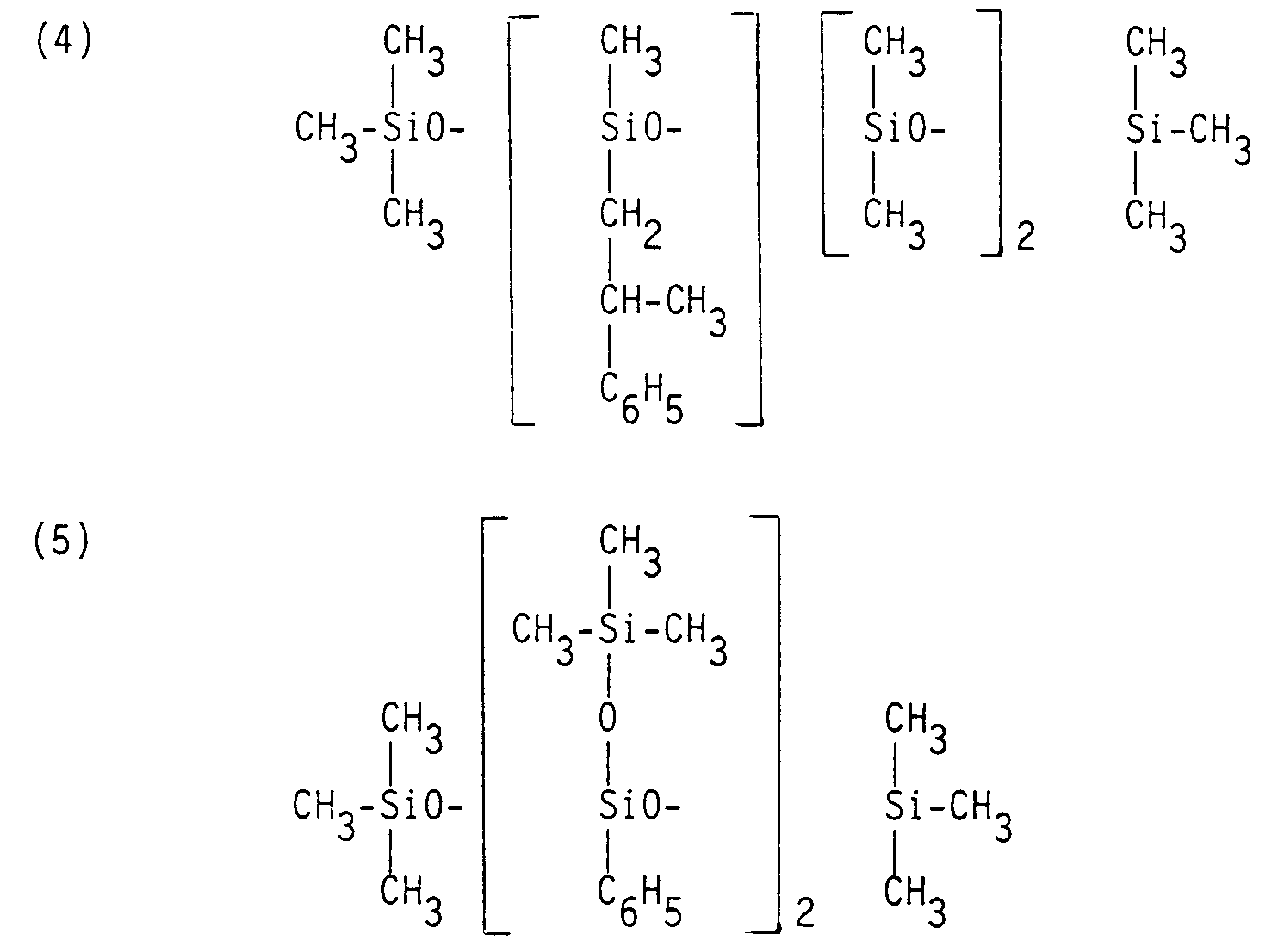
- Das erfindungsgemäße Verfahren kann mit den üblichen Polyolen, Polyisocyanaten und reaktiven, sowie nichtreaktiven Zusatzmitteln durchgeführt werden. Diese sind dem Fachmann geläufig. Geeignete Polyole, Polyisocyanate und Zusatzmittel können der Literatur entnommen werden. Es wird auf das Buch "Introduction to Reaction Injection Molding" von F. Melvin Sweeny, Technomic Publishing Co., Westport, USA, ISBN #087762-271-X, sowie die EP-A2-0 122 743 und EP-A1-0 173 888 verwiesen.
- Durch das erfindungsgemäße Verfahren ist es möglich, eine gewisse Menge Luft in die Polyolkomponente einzudispergieren, die einerseits dazu dienen kann, einen Gegendruck in der Form zu erzeugen, um die Oberflächenbeschaffenheit der Formteile zu verbessern, und andererseits den als physikalisches Treibmittel verwendeten Fluorkohlenwasserstoff oder das als reaktives Treibmittel verwendete Wasser ganz oder teilweise durch die erfindungsgemäß zu verwendenden Organopolysiloxane der Formel I zu ersetzen, wobei die physikalischen Eigenschaften der Polyurethanformkörper nicht beeinträchtigt werden. Eine höhere Luftbeladung ermöglicht auch ein besseres Fließen des Reaktionsgutes. Der Effekt der Luftbeladung wird anhand der folgenden Beispiele noch weiter verdeutlicht.
- In der Praxis erfolgt die Messung der Luftmenge in der Regel direkt an einer Meßstation an einer RIM-Anlage volumetrisch über eine Dichtemessung. Zur Überprüfung der erfindungsgemäß zu verwendenden Substanzen wird ein Simulationstest verwendet, der eine Aussage über die einzudispergierende Luftmenge zuläßt. Die bei diesem Test einrührbare Luftmenge ist jedoch in diesem Test um den Faktor 2 - 3 geringer als dies in einer Beladestation an einer RIM-Anlage erreichbar ist. Dies ist bei der Bewertung der Ergebnisse zu berücksichtigen.
- Der Test wird folgendermaßen durchgeführt:
88 Gew.-Teile eines Polyethertriols, hergestellt durch Anlagerung von Ethylenoxid und Propylenoxid an Glycerin, bzw. Trimethylolpropan, mit einem Molekulargewicht von etwa 4800, einem Gehalt von ca. 16 Gew.-% Oxyethylen-Einheiten, wobei 50 bis 70 % der endständigen OH-Gruppen primäre OH-Gruppen sind,
28 Gew.-Teile Ethylenglykol,
0,35 Gew.-Teile Triethylendiamin,
0,02 Gew.-Teile Dibutylzinndilaurat werden mit
x Gew.-Teilen der erfindungsgemäß zu verwendenden Substanzen, bzw. der Vergleichssubstanzen vermischt. - Das Gemisch wird 4 Minuten lang bei 3200 Umdrehungen intensiv gerührt. Es wird dabei möglichst viel Luft eingeschlagen. Danach werden 70 g des Polyol-Schaumes in einem Standzylinder abgewogen. Es wird unmittelbar nach dem Einfüllen der Substanz die Füllhöhe dieses Polyol-Schaumes gemessen. In der Tabelle sind die erhaltenen Meßwerte angegeben.


- Die Meßwerte zeigen, daß die beim erfindungsgemäßen Verfahren zu verwendenden Organopolysiloxane der Formel I eine wesentlich höhere Luftbeladung ermöglichen, als dies bei vergleichbaren Produkten des Standes der Technik der Fall ist.
In der allgemeinen Formel I können die Reste R¹ gleich oder verschieden sein und die folgenden Bedeutungen haben:
R¹ kann ein Alkylrest sein, der gegebenenfalls halogeniert ist. Beispiele für solche Alkylreste sind der Methyl-, Ethyl-, Propyl-, iso-Propyl-, Hexyl-, Octyl- oder Dodecylrest. Bevorzugt sind Alkylreste mit 1 bis 4 Kohlenstoffatomen, besonders bevorzugt ist der Methylrest. Als Beispiel eines halogenierten Alkylrestes ist der Chlormethylrest zu nennen.
Claims (3)
- Verfahren zur Herstellung von zellularen Polyurethan- und/oder Polyharnstofformkörpern nach dem RIM-Verfahren durch Umsetzung einer flüssigen Polyisocyanate enthaltenden Komponente mit einer Polyole und/oder Polyamine enthaltenden Komponente, welche reaktive Zusatzmittel, wie Kettenverlängerungs-, Vernetzungsmittel und/oder Wasser, und nichtreaktive Zusatzmittel, wie Katalysatoren, grenzflächenaktive Substanzen, Treibmittel, Füllstoffe und/oder weitere Additive enthalten kann, dadurch gekennzeichnet, daß man als grenzflächenaktive Substanzen Organopolysiloxane der allgemeinen durchschnittlichen Formel
 R¹ gleich oder verschieden sein kann und ein gegebenenfalls halogensubstituierter Alkylrest, ein Aryl-, Alkylaryl- oder ein Polyetherrest der allgemeinen durchschnittlichen Formel
-(CH₂)₃O-(C₂H₄O-)a(C₃H₆O-)bR³
ist, wobei a einen durchschnittlichen Wert von 0 bis 15, b einen durchschnittlichen Wert von 1 bis 15 hat, und R³ ein Wasserstoffrest oder ein Alkylrest mit 1 bis 4 Kohlenstoffatomen ist,
mit der Maßgabe, daß mindestens n-1 Reste R¹ Methylreste sind,R² ein Methyl- oder Trimethylsiloxyrest ist undn, wenn R² ein Methylrest ist, einen Absolutwert von 3 bis 8, wenn R² ein Trimethylsiloxyrest ist, einen Absolutwert von 1 bis 4 hat,mit der Maßgabe, daß das Polymerengemisch der Organosiloxane im wesentlichen frei von Siloxanen ist, bei denen die Werte von n über oder unterschritten werden. - Verfahren nach Anspruch 1, dadurch gekennzeichnet, daß man Polysiloxane verwendet, bei denen R¹ ein niederer gegebenenfalls halogensubstituierter niederer Alkylrest mit 1 bis 4 Kohlenstoffatomen, ein Phenyl- oder Isopropylphenylrest ist.
- Verfahren nach Anspruch 1, dadurch gekennzeichnet, daß R¹ ein Methylrest ist.
Applications Claiming Priority (2)
| Application Number | Priority Date | Filing Date | Title |
|---|---|---|---|
| DE4001156A DE4001156C1 (en) | 1990-01-17 | 1990-01-17 | Cellular polyurethane and/or polyurea moulding prodn. - involves air injection moulding reactive mixt. in presence of surfactant organo:polysiloxane |
| DE4001156 | 1990-01-17 |
Publications (3)
| Publication Number | Publication Date |
|---|---|
| EP0440019A2 EP0440019A2 (de) | 1991-08-07 |
| EP0440019A3 EP0440019A3 (en) | 1992-01-15 |
| EP0440019B1 true EP0440019B1 (de) | 1994-11-23 |
Family
ID=6398221
Family Applications (1)
| Application Number | Title | Priority Date | Filing Date |
|---|---|---|---|
| EP91100139A Expired - Lifetime EP0440019B1 (de) | 1990-01-17 | 1991-01-04 | Verfahren zur Herstellung von zellularen Polyurethan- und/oder Polyharnstofformkörpern nach dem RIM-Verfahren |
Country Status (2)
| Country | Link |
|---|---|
| EP (1) | EP0440019B1 (de) |
| DE (2) | DE4001156C1 (de) |
Families Citing this family (1)
| Publication number | Priority date | Publication date | Assignee | Title |
|---|---|---|---|---|
| US5244613A (en) * | 1993-01-21 | 1993-09-14 | Miles Inc. | Process for the production of reinforced moldings and the resultant products |
Family Cites Families (3)
| Publication number | Priority date | Publication date | Assignee | Title |
|---|---|---|---|---|
| EP0122743B1 (de) * | 1983-04-13 | 1990-12-05 | Ici Americas Inc. | Flüssige organische Polyisocyanatzusammensetzung zur Anwendung im Reaktionsspritzgiessverfahren in Anwesenheit von Siloxantrennmitteln |
| DE3406188C1 (de) * | 1984-02-21 | 1985-01-10 | Th. Goldschmidt Ag, 4300 Essen | Verfahren zur Herstellung von flexiblen Polyesterurethanschaeumen |
| US4751251A (en) * | 1987-05-19 | 1988-06-14 | Dow Corning Corporation | Surfactant composition for rigid urethane and isocyanurate foams |
-
1990
- 1990-01-17 DE DE4001156A patent/DE4001156C1/de not_active Expired - Lifetime
-
1991
- 1991-01-04 DE DE59103551T patent/DE59103551D1/de not_active Expired - Fee Related
- 1991-01-04 EP EP91100139A patent/EP0440019B1/de not_active Expired - Lifetime
Also Published As
| Publication number | Publication date |
|---|---|
| DE59103551D1 (de) | 1995-01-05 |
| EP0440019A3 (en) | 1992-01-15 |
| EP0440019A2 (de) | 1991-08-07 |
| DE4001156C1 (en) | 1991-03-14 |
Similar Documents
| Publication | Publication Date | Title |
|---|---|---|
| EP0555721B1 (de) | Verfahren zur Herstellung von kalthärtenden Polyurethan-Weichformschaumstoffen | |
| EP3536735B1 (de) | Vernetzte polyether-siloxan block-copolymere sowie deren verwendung zur herstellung von polyurethanschaumstoffen | |
| EP1935923B1 (de) | Verfahren zur Herstellung von SiOC-verknüpften, linearen Polydimethylsiloxan-Polyoxyalkylen-Blockcopolymeren und ihre Verwendung | |
| DE60017847T2 (de) | Silikon-Schaumstabilisatoren zur Herstellung offenzelliger Polyurethanweichschaumstoffe | |
| DE69220338T2 (de) | Polyurethanschäume | |
| WO2010081601A1 (de) | Verfahren zur herstellung von kaltschäumen | |
| DE1544634A1 (de) | Verfahren zur Herstellung von flexiblem Polyurethanschaum | |
| EP0367071B1 (de) | Verfahren zur Herstellung von Polyurethan- und/oder Polyharnstoffformkörpern | |
| DE102005050473A1 (de) | Verfahren zur Herstellung von Polyurethan-Kaltschäumen | |
| EP0106101B1 (de) | Verfahren zur Herstellung hochelastischer kalthärtender Polyurethanschaumstoffe | |
| EP0415208B1 (de) | Verwendung von Polysiloxan-Polyoxyalkylen-Blockmischpolymerisaten bei der Herstellung von Polyurethanhartschäumen | |
| DE69126212T2 (de) | Polyurethan-polymere mit hohem elastizitätsmodul sowie diese polymere verwendende reaktionsspritzguss-verfahren | |
| DE60020035T2 (de) | Silicontenside zur Herstellung von weichen Polyurethanschaumstoffen | |
| DE3600402C2 (de) | ||
| DE69111117T2 (de) | Verfahren zur Herstellung eines eine hohe Luftdurchlässigkeit aufweisenden, flexiblen Polyurethanschaumstoffes. | |
| EP0142689B1 (de) | Verfahren zur Herstellung von Polyurethanhartschäumen | |
| CH529809A (de) | Verfahren zur Herstellung eines Siloxanblockcopolymerisats und dessen Verwendung | |
| DE69312711T2 (de) | Flammwidrige polyurethanweichschaumstoffe | |
| EP0440019B1 (de) | Verfahren zur Herstellung von zellularen Polyurethan- und/oder Polyharnstofformkörpern nach dem RIM-Verfahren | |
| EP0258600B1 (de) | Verfahren zur Herstellung hochelastischer, kalthärtender Polyurethanschaumstoffe | |
| EP0731120B1 (de) | Verfahren zur Herstellung von hochelastischen Polyurethanschaumstoffen | |
| DE3509810C1 (de) | Verfahren zur Herstellung von Polyurethanformteilen | |
| EP0092700B1 (de) | Verfahren zur Herstellung hochelastischer kalthärtender Polyurethanschaumstoffe | |
| DE4001156C2 (de) | ||
| EP1640418B1 (de) | Verwendung organomodifizierter Siloxane zur Behandlung von Oberflächen thermoplastischer Elastomere |
Legal Events
| Date | Code | Title | Description |
|---|---|---|---|
| PUAI | Public reference made under article 153(3) epc to a published international application that has entered the european phase |
Free format text: ORIGINAL CODE: 0009012 |
|
| 17P | Request for examination filed |
Effective date: 19910112 |
|
| AK | Designated contracting states |
Kind code of ref document: A2 Designated state(s): BE DE FR GB IT NL |
|
| PUAL | Search report despatched |
Free format text: ORIGINAL CODE: 0009013 |
|
| AK | Designated contracting states |
Kind code of ref document: A3 Designated state(s): BE DE FR GB IT NL |
|
| 17Q | First examination report despatched |
Effective date: 19940510 |
|
| GRAA | (expected) grant |
Free format text: ORIGINAL CODE: 0009210 |
|
| ITF | It: translation for a ep patent filed | ||
| AK | Designated contracting states |
Kind code of ref document: B1 Designated state(s): BE DE FR GB IT NL |
|
| GBT | Gb: translation of ep patent filed (gb section 77(6)(a)/1977) |
Effective date: 19941130 |
|
| REF | Corresponds to: |
Ref document number: 59103551 Country of ref document: DE Date of ref document: 19950105 |
|
| ET | Fr: translation filed | ||
| PLBE | No opposition filed within time limit |
Free format text: ORIGINAL CODE: 0009261 |
|
| STAA | Information on the status of an ep patent application or granted ep patent |
Free format text: STATUS: NO OPPOSITION FILED WITHIN TIME LIMIT |
|
| 26N | No opposition filed | ||
| PGFP | Annual fee paid to national office [announced via postgrant information from national office to epo] |
Ref country code: GB Payment date: 19951227 Year of fee payment: 6 |
|
| PGFP | Annual fee paid to national office [announced via postgrant information from national office to epo] |
Ref country code: FR Payment date: 19960109 Year of fee payment: 6 |
|
| PGFP | Annual fee paid to national office [announced via postgrant information from national office to epo] |
Ref country code: NL Payment date: 19960130 Year of fee payment: 6 |
|
| PGFP | Annual fee paid to national office [announced via postgrant information from national office to epo] |
Ref country code: BE Payment date: 19960212 Year of fee payment: 6 |
|
| PG25 | Lapsed in a contracting state [announced via postgrant information from national office to epo] |
Ref country code: GB Effective date: 19970104 |
|
| PG25 | Lapsed in a contracting state [announced via postgrant information from national office to epo] |
Ref country code: BE Effective date: 19970131 |
|
| BERE | Be: lapsed |
Owner name: TH. GOLDSCHMIDT A.G. Effective date: 19970131 |
|
| PG25 | Lapsed in a contracting state [announced via postgrant information from national office to epo] |
Ref country code: NL Effective date: 19970801 |
|
| GBPC | Gb: european patent ceased through non-payment of renewal fee |
Effective date: 19970104 |
|
| PG25 | Lapsed in a contracting state [announced via postgrant information from national office to epo] |
Ref country code: FR Effective date: 19970930 |
|
| NLV4 | Nl: lapsed or anulled due to non-payment of the annual fee |
Effective date: 19970801 |
|
| REG | Reference to a national code |
Ref country code: FR Ref legal event code: ST |
|
| PGFP | Annual fee paid to national office [announced via postgrant information from national office to epo] |
Ref country code: DE Payment date: 20030124 Year of fee payment: 13 |
|
| PG25 | Lapsed in a contracting state [announced via postgrant information from national office to epo] |
Ref country code: DE Free format text: LAPSE BECAUSE OF NON-PAYMENT OF DUE FEES Effective date: 20040803 |
|
| PG25 | Lapsed in a contracting state [announced via postgrant information from national office to epo] |
Ref country code: IT Free format text: LAPSE BECAUSE OF NON-PAYMENT OF DUE FEES;WARNING: LAPSES OF ITALIAN PATENTS WITH EFFECTIVE DATE BEFORE 2007 MAY HAVE OCCURRED AT ANY TIME BEFORE 2007. THE CORRECT EFFECTIVE DATE MAY BE DIFFERENT FROM THE ONE RECORDED. Effective date: 20050104 |