EP0440034A1 - Verträgliche Polymermischungen - Google Patents
Verträgliche Polymermischungen Download PDFInfo
- Publication number
- EP0440034A1 EP0440034A1 EP19910100383 EP91100383A EP0440034A1 EP 0440034 A1 EP0440034 A1 EP 0440034A1 EP 19910100383 EP19910100383 EP 19910100383 EP 91100383 A EP91100383 A EP 91100383A EP 0440034 A1 EP0440034 A1 EP 0440034A1
- Authority
- EP
- European Patent Office
- Prior art keywords
- polymer
- weight
- formula
- polyester
- polyesters
- Prior art date
- Legal status (The legal status is an assumption and is not a legal conclusion. Google has not performed a legal analysis and makes no representation as to the accuracy of the status listed.)
- Withdrawn
Links
- 229920005622 compatible polymer blend Polymers 0.000 title claims 2
- 229920000728 polyester Polymers 0.000 claims abstract description 54
- 239000002131 composite material Substances 0.000 claims abstract description 5
- 229920000642 polymer Polymers 0.000 claims description 44
- 239000000203 mixture Substances 0.000 claims description 32
- -1 polyethylene terephthalates Polymers 0.000 claims description 29
- 229920001707 polybutylene terephthalate Polymers 0.000 claims description 23
- 229920000139 polyethylene terephthalate Polymers 0.000 claims description 19
- NIXOWILDQLNWCW-UHFFFAOYSA-M Acrylate Chemical compound [O-]C(=O)C=C NIXOWILDQLNWCW-UHFFFAOYSA-M 0.000 claims description 17
- 229920002959 polymer blend Polymers 0.000 claims description 15
- 125000004432 carbon atom Chemical group C* 0.000 claims description 12
- 239000000178 monomer Substances 0.000 claims description 12
- 229920000058 polyacrylate Polymers 0.000 claims description 8
- 125000002496 methyl group Chemical group [H]C([H])([H])* 0.000 claims description 7
- 229910052739 hydrogen Inorganic materials 0.000 claims description 5
- 239000001257 hydrogen Substances 0.000 claims description 5
- UFHFLCQGNIYNRP-UHFFFAOYSA-N Hydrogen Chemical compound [H][H] UFHFLCQGNIYNRP-UHFFFAOYSA-N 0.000 claims description 4
- 125000001118 alkylidene group Chemical group 0.000 claims description 3
- 125000004103 aminoalkyl group Chemical group 0.000 claims description 3
- 230000009477 glass transition Effects 0.000 claims description 3
- 229910052799 carbon Inorganic materials 0.000 claims description 2
- 229920000193 polymethacrylate Polymers 0.000 abstract description 3
- 239000006096 absorbing agent Substances 0.000 abstract 1
- 238000000465 moulding Methods 0.000 abstract 1
- 239000005020 polyethylene terephthalate Substances 0.000 description 18
- 229920001577 copolymer Polymers 0.000 description 14
- PPBRXRYQALVLMV-UHFFFAOYSA-N Styrene Chemical compound C=CC1=CC=CC=C1 PPBRXRYQALVLMV-UHFFFAOYSA-N 0.000 description 12
- YXFVVABEGXRONW-UHFFFAOYSA-N Toluene Chemical compound CC1=CC=CC=C1 YXFVVABEGXRONW-UHFFFAOYSA-N 0.000 description 12
- 229920003229 poly(methyl methacrylate) Polymers 0.000 description 12
- 239000004926 polymethyl methacrylate Substances 0.000 description 12
- 239000005022 packaging material Substances 0.000 description 10
- QIWKUEJZZCOPFV-UHFFFAOYSA-N phenyl 2-methylprop-2-enoate Chemical class CC(=C)C(=O)OC1=CC=CC=C1 QIWKUEJZZCOPFV-UHFFFAOYSA-N 0.000 description 7
- XLYOFNOQVPJJNP-UHFFFAOYSA-N water Substances O XLYOFNOQVPJJNP-UHFFFAOYSA-N 0.000 description 7
- OKKJLVBELUTLKV-UHFFFAOYSA-N Methanol Chemical compound OC OKKJLVBELUTLKV-UHFFFAOYSA-N 0.000 description 6
- 238000001816 cooling Methods 0.000 description 6
- 238000005259 measurement Methods 0.000 description 6
- 238000002156 mixing Methods 0.000 description 6
- 238000012360 testing method Methods 0.000 description 6
- 125000004172 4-methoxyphenyl group Chemical group [H]C1=C([H])C(OC([H])([H])[H])=C([H])C([H])=C1* 0.000 description 5
- 150000001252 acrylic acid derivatives Chemical class 0.000 description 5
- 230000015572 biosynthetic process Effects 0.000 description 5
- 239000011248 coating agent Substances 0.000 description 5
- 238000000576 coating method Methods 0.000 description 5
- 230000000694 effects Effects 0.000 description 5
- 229920001971 elastomer Polymers 0.000 description 5
- 239000000463 material Substances 0.000 description 5
- 238000006116 polymerization reaction Methods 0.000 description 5
- 229920000182 polyphenyl methacrylate Polymers 0.000 description 5
- IJGRMHOSHXDMSA-UHFFFAOYSA-N Atomic nitrogen Chemical compound N#N IJGRMHOSHXDMSA-UHFFFAOYSA-N 0.000 description 4
- 239000004609 Impact Modifier Substances 0.000 description 4
- KKEYFWRCBNTPAC-UHFFFAOYSA-N Terephthalic acid Chemical compound OC(=O)C1=CC=C(C(O)=O)C=C1 KKEYFWRCBNTPAC-UHFFFAOYSA-N 0.000 description 4
- 125000003545 alkoxy group Chemical group 0.000 description 4
- 239000011258 core-shell material Substances 0.000 description 4
- 229920000578 graft copolymer Polymers 0.000 description 4
- QQVIHTHCMHWDBS-UHFFFAOYSA-N isophthalic acid Chemical compound OC(=O)C1=CC=CC(C(O)=O)=C1 QQVIHTHCMHWDBS-UHFFFAOYSA-N 0.000 description 4
- 238000004519 manufacturing process Methods 0.000 description 4
- 239000000155 melt Substances 0.000 description 4
- 238000000034 method Methods 0.000 description 4
- 239000000243 solution Substances 0.000 description 4
- 238000003786 synthesis reaction Methods 0.000 description 4
- 239000004793 Polystyrene Substances 0.000 description 3
- 239000000806 elastomer Substances 0.000 description 3
- 238000007720 emulsion polymerization reaction Methods 0.000 description 3
- 238000001125 extrusion Methods 0.000 description 3
- 239000007789 gas Substances 0.000 description 3
- 238000001746 injection moulding Methods 0.000 description 3
- 229920000126 latex Polymers 0.000 description 3
- 238000012986 modification Methods 0.000 description 3
- 230000004048 modification Effects 0.000 description 3
- 229910052757 nitrogen Inorganic materials 0.000 description 3
- 229920003023 plastic Polymers 0.000 description 3
- 239000004033 plastic Substances 0.000 description 3
- 230000001681 protective effect Effects 0.000 description 3
- 150000003254 radicals Chemical class 0.000 description 3
- 229920006395 saturated elastomer Polymers 0.000 description 3
- 239000007787 solid Substances 0.000 description 3
- WIZMCLXMWBKNKH-UHFFFAOYSA-N (4-methoxyphenyl) 2-methylprop-2-enoate Chemical compound COC1=CC=C(OC(=O)C(C)=C)C=C1 WIZMCLXMWBKNKH-UHFFFAOYSA-N 0.000 description 2
- FJKROLUGYXJWQN-UHFFFAOYSA-N 4-hydroxybenzoic acid Chemical compound OC(=O)C1=CC=C(O)C=C1 FJKROLUGYXJWQN-UHFFFAOYSA-N 0.000 description 2
- OFOBLEOULBTSOW-UHFFFAOYSA-N Malonic acid Chemical compound OC(=O)CC(O)=O OFOBLEOULBTSOW-UHFFFAOYSA-N 0.000 description 2
- CERQOIWHTDAKMF-UHFFFAOYSA-N Methacrylic acid Chemical compound CC(=C)C(O)=O CERQOIWHTDAKMF-UHFFFAOYSA-N 0.000 description 2
- VVQNEPGJFQJSBK-UHFFFAOYSA-N Methyl methacrylate Chemical compound COC(=O)C(C)=C VVQNEPGJFQJSBK-UHFFFAOYSA-N 0.000 description 2
- 229910004879 Na2S2O5 Inorganic materials 0.000 description 2
- 229920001283 Polyalkylene terephthalate Polymers 0.000 description 2
- 239000005062 Polybutadiene Substances 0.000 description 2
- 239000002253 acid Chemical group 0.000 description 2
- NIXOWILDQLNWCW-UHFFFAOYSA-N acrylic acid group Chemical group C(C=C)(=O)O NIXOWILDQLNWCW-UHFFFAOYSA-N 0.000 description 2
- 239000000654 additive Substances 0.000 description 2
- 125000000217 alkyl group Chemical group 0.000 description 2
- 230000008901 benefit Effects 0.000 description 2
- BVKZGUZCCUSVTD-UHFFFAOYSA-N carbonic acid Chemical class OC(O)=O BVKZGUZCCUSVTD-UHFFFAOYSA-N 0.000 description 2
- 230000000052 comparative effect Effects 0.000 description 2
- 150000001875 compounds Chemical class 0.000 description 2
- 239000013078 crystal Substances 0.000 description 2
- 239000006185 dispersion Substances 0.000 description 2
- 238000005516 engineering process Methods 0.000 description 2
- 150000002148 esters Chemical class 0.000 description 2
- 239000000835 fiber Substances 0.000 description 2
- 239000003063 flame retardant Substances 0.000 description 2
- 239000006260 foam Substances 0.000 description 2
- VOZRXNHHFUQHIL-UHFFFAOYSA-N glycidyl methacrylate Chemical compound CC(=C)C(=O)OCC1CO1 VOZRXNHHFUQHIL-UHFFFAOYSA-N 0.000 description 2
- 150000002430 hydrocarbons Chemical group 0.000 description 2
- 150000002431 hydrogen Chemical group 0.000 description 2
- BAUYGSIQEAFULO-UHFFFAOYSA-L iron(2+) sulfate (anhydrous) Chemical compound [Fe+2].[O-]S([O-])(=O)=O BAUYGSIQEAFULO-UHFFFAOYSA-L 0.000 description 2
- 229910000359 iron(II) sulfate Inorganic materials 0.000 description 2
- 239000004816 latex Substances 0.000 description 2
- 125000001997 phenyl group Chemical group [H]C1=C([H])C([H])=C(*)C([H])=C1[H] 0.000 description 2
- 239000000049 pigment Substances 0.000 description 2
- 229920001485 poly(butyl acrylate) polymer Polymers 0.000 description 2
- 229920002857 polybutadiene Polymers 0.000 description 2
- 229920000515 polycarbonate Polymers 0.000 description 2
- 239000004417 polycarbonate Substances 0.000 description 2
- 238000006068 polycondensation reaction Methods 0.000 description 2
- 229920002223 polystyrene Polymers 0.000 description 2
- 238000003825 pressing Methods 0.000 description 2
- 230000008569 process Effects 0.000 description 2
- 238000012545 processing Methods 0.000 description 2
- 238000010526 radical polymerization reaction Methods 0.000 description 2
- 239000005060 rubber Substances 0.000 description 2
- HRZFUMHJMZEROT-UHFFFAOYSA-L sodium disulfite Chemical compound [Na+].[Na+].[O-]S(=O)S([O-])(=O)=O HRZFUMHJMZEROT-UHFFFAOYSA-L 0.000 description 2
- 235000010262 sodium metabisulphite Nutrition 0.000 description 2
- 159000000000 sodium salts Chemical class 0.000 description 2
- 239000000126 substance Substances 0.000 description 2
- 239000002699 waste material Substances 0.000 description 2
- GRKDVZMVHOLESV-UHFFFAOYSA-N (2,3,4,5,6-pentabromophenyl)methyl prop-2-enoate Chemical class BrC1=C(Br)C(Br)=C(COC(=O)C=C)C(Br)=C1Br GRKDVZMVHOLESV-UHFFFAOYSA-N 0.000 description 1
- LGJCFVYMIJLQJO-UHFFFAOYSA-N 1-dodecylperoxydodecane Chemical compound CCCCCCCCCCCCOOCCCCCCCCCCCC LGJCFVYMIJLQJO-UHFFFAOYSA-N 0.000 description 1
- RNFJDJUURJAICM-UHFFFAOYSA-N 2,2,4,4,6,6-hexaphenoxy-1,3,5-triaza-2$l^{5},4$l^{5},6$l^{5}-triphosphacyclohexa-1,3,5-triene Chemical compound N=1P(OC=2C=CC=CC=2)(OC=2C=CC=CC=2)=NP(OC=2C=CC=CC=2)(OC=2C=CC=CC=2)=NP=1(OC=1C=CC=CC=1)OC1=CC=CC=C1 RNFJDJUURJAICM-UHFFFAOYSA-N 0.000 description 1
- YAJYJWXEWKRTPO-UHFFFAOYSA-N 2,3,3,4,4,5-hexamethylhexane-2-thiol Chemical compound CC(C)C(C)(C)C(C)(C)C(C)(C)S YAJYJWXEWKRTPO-UHFFFAOYSA-N 0.000 description 1
- GOXQRTZXKQZDDN-UHFFFAOYSA-N 2-Ethylhexyl acrylate Chemical compound CCCCC(CC)COC(=O)C=C GOXQRTZXKQZDDN-UHFFFAOYSA-N 0.000 description 1
- CEXQWAAGPPNOQF-UHFFFAOYSA-N 2-phenoxyethyl 2-methylprop-2-enoate Chemical compound CC(=C)C(=O)OCCOC1=CC=CC=C1 CEXQWAAGPPNOQF-UHFFFAOYSA-N 0.000 description 1
- JLBJTVDPSNHSKJ-UHFFFAOYSA-N 4-Methylstyrene Chemical compound CC1=CC=C(C=C)C=C1 JLBJTVDPSNHSKJ-UHFFFAOYSA-N 0.000 description 1
- 229940090248 4-hydroxybenzoic acid Drugs 0.000 description 1
- NLHHRLWOUZZQLW-UHFFFAOYSA-N Acrylonitrile Chemical compound C=CC#N NLHHRLWOUZZQLW-UHFFFAOYSA-N 0.000 description 1
- 239000004604 Blowing Agent Substances 0.000 description 1
- 239000004215 Carbon black (E152) Substances 0.000 description 1
- 229920001634 Copolyester Polymers 0.000 description 1
- 229920002943 EPDM rubber Polymers 0.000 description 1
- VGGSQFUCUMXWEO-UHFFFAOYSA-N Ethene Chemical compound C=C VGGSQFUCUMXWEO-UHFFFAOYSA-N 0.000 description 1
- 239000005977 Ethylene Substances 0.000 description 1
- IAYPIBMASNFSPL-UHFFFAOYSA-N Ethylene oxide Chemical compound C1CO1 IAYPIBMASNFSPL-UHFFFAOYSA-N 0.000 description 1
- CERQOIWHTDAKMF-UHFFFAOYSA-M Methacrylate Chemical compound CC(=C)C([O-])=O CERQOIWHTDAKMF-UHFFFAOYSA-M 0.000 description 1
- SECXISVLQFMRJM-UHFFFAOYSA-N N-Methylpyrrolidone Chemical compound CN1CCCC1=O SECXISVLQFMRJM-UHFFFAOYSA-N 0.000 description 1
- 239000006057 Non-nutritive feed additive Substances 0.000 description 1
- IGFHQQFPSIBGKE-UHFFFAOYSA-N Nonylphenol Natural products CCCCCCCCCC1=CC=C(O)C=C1 IGFHQQFPSIBGKE-UHFFFAOYSA-N 0.000 description 1
- 229920005379 Plexiglas® 8N Polymers 0.000 description 1
- BLRPTPMANUNPDV-UHFFFAOYSA-N Silane Chemical compound [SiH4] BLRPTPMANUNPDV-UHFFFAOYSA-N 0.000 description 1
- NINIDFKCEFEMDL-UHFFFAOYSA-N Sulfur Chemical compound [S] NINIDFKCEFEMDL-UHFFFAOYSA-N 0.000 description 1
- 239000004809 Teflon Substances 0.000 description 1
- 229920006362 Teflon® Polymers 0.000 description 1
- 238000006887 Ullmann reaction Methods 0.000 description 1
- YIMQCDZDWXUDCA-UHFFFAOYSA-N [4-(hydroxymethyl)cyclohexyl]methanol Chemical compound OCC1CCC(CO)CC1 YIMQCDZDWXUDCA-UHFFFAOYSA-N 0.000 description 1
- 238000005299 abrasion Methods 0.000 description 1
- 150000001253 acrylic acids Chemical class 0.000 description 1
- 125000003647 acryloyl group Chemical group O=C([*])C([H])=C([H])[H] 0.000 description 1
- 230000001464 adherent effect Effects 0.000 description 1
- 125000005036 alkoxyphenyl group Chemical group 0.000 description 1
- XYLMUPLGERFSHI-UHFFFAOYSA-N alpha-Methylstyrene Chemical compound CC(=C)C1=CC=CC=C1 XYLMUPLGERFSHI-UHFFFAOYSA-N 0.000 description 1
- 238000010539 anionic addition polymerization reaction Methods 0.000 description 1
- 238000000149 argon plasma sintering Methods 0.000 description 1
- 125000003118 aryl group Chemical group 0.000 description 1
- 150000005840 aryl radicals Chemical class 0.000 description 1
- QVGXLLKOCUKJST-UHFFFAOYSA-N atomic oxygen Chemical compound [O] QVGXLLKOCUKJST-UHFFFAOYSA-N 0.000 description 1
- 238000000071 blow moulding Methods 0.000 description 1
- MTAZNLWOLGHBHU-UHFFFAOYSA-N butadiene-styrene rubber Chemical compound C=CC=C.C=CC1=CC=CC=C1 MTAZNLWOLGHBHU-UHFFFAOYSA-N 0.000 description 1
- AHVOFPQVUVXHNL-UHFFFAOYSA-N butyl prop-2-enoate;methyl 2-methylprop-2-enoate Chemical compound COC(=O)C(C)=C.CCCCOC(=O)C=C AHVOFPQVUVXHNL-UHFFFAOYSA-N 0.000 description 1
- 125000003178 carboxy group Chemical group [H]OC(*)=O 0.000 description 1
- 239000003153 chemical reaction reagent Substances 0.000 description 1
- 230000015271 coagulation Effects 0.000 description 1
- 238000005345 coagulation Methods 0.000 description 1
- 239000002537 cosmetic Substances 0.000 description 1
- 230000008878 coupling Effects 0.000 description 1
- 238000010168 coupling process Methods 0.000 description 1
- 238000005859 coupling reaction Methods 0.000 description 1
- 238000002425 crystallisation Methods 0.000 description 1
- 230000008025 crystallization Effects 0.000 description 1
- 150000001991 dicarboxylic acids Chemical class 0.000 description 1
- 229920003244 diene elastomer Polymers 0.000 description 1
- 235000014113 dietary fatty acids Nutrition 0.000 description 1
- 150000002009 diols Chemical group 0.000 description 1
- WNAHIZMDSQCWRP-UHFFFAOYSA-N dodecane-1-thiol Chemical compound CCCCCCCCCCCCS WNAHIZMDSQCWRP-UHFFFAOYSA-N 0.000 description 1
- 238000001035 drying Methods 0.000 description 1
- 239000003995 emulsifying agent Substances 0.000 description 1
- 230000001804 emulsifying effect Effects 0.000 description 1
- 125000003700 epoxy group Chemical group 0.000 description 1
- 125000004185 ester group Chemical group 0.000 description 1
- CGPRUXZTHGTMKW-UHFFFAOYSA-N ethene;ethyl prop-2-enoate Chemical group C=C.CCOC(=O)C=C CGPRUXZTHGTMKW-UHFFFAOYSA-N 0.000 description 1
- 229920001038 ethylene copolymer Polymers 0.000 description 1
- 238000002474 experimental method Methods 0.000 description 1
- 229930195729 fatty acid Natural products 0.000 description 1
- 239000000194 fatty acid Substances 0.000 description 1
- 150000004665 fatty acids Chemical class 0.000 description 1
- 238000010528 free radical solution polymerization reaction Methods 0.000 description 1
- 239000011521 glass Substances 0.000 description 1
- 238000010559 graft polymerization reaction Methods 0.000 description 1
- 229910052736 halogen Inorganic materials 0.000 description 1
- 150000002367 halogens Chemical class 0.000 description 1
- 238000010438 heat treatment Methods 0.000 description 1
- 229920001519 homopolymer Polymers 0.000 description 1
- 229930195733 hydrocarbon Natural products 0.000 description 1
- 239000003999 initiator Substances 0.000 description 1
- 238000002347 injection Methods 0.000 description 1
- 239000007924 injection Substances 0.000 description 1
- 229920002521 macromolecule Polymers 0.000 description 1
- 238000002844 melting Methods 0.000 description 1
- 230000008018 melting Effects 0.000 description 1
- 238000002715 modification method Methods 0.000 description 1
- SNQQPOLDUKLAAF-UHFFFAOYSA-N nonylphenol Chemical compound CCCCCCCCCC1=CC=CC=C1O SNQQPOLDUKLAAF-UHFFFAOYSA-N 0.000 description 1
- 239000002667 nucleating agent Substances 0.000 description 1
- 229910052760 oxygen Inorganic materials 0.000 description 1
- 239000001301 oxygen Substances 0.000 description 1
- 239000012188 paraffin wax Substances 0.000 description 1
- 125000000864 peroxy group Chemical group O(O*)* 0.000 description 1
- 229920002454 poly(glycidyl methacrylate) polymer Polymers 0.000 description 1
- 229920002285 poly(styrene-co-acrylonitrile) Polymers 0.000 description 1
- 229920013639 polyalphaolefin Polymers 0.000 description 1
- 229920001195 polyisoprene Polymers 0.000 description 1
- 229920000098 polyolefin Polymers 0.000 description 1
- USHAGKDGDHPEEY-UHFFFAOYSA-L potassium persulfate Chemical compound [K+].[K+].[O-]S(=O)(=O)OOS([O-])(=O)=O USHAGKDGDHPEEY-UHFFFAOYSA-L 0.000 description 1
- 239000000843 powder Substances 0.000 description 1
- 238000001556 precipitation Methods 0.000 description 1
- 238000002360 preparation method Methods 0.000 description 1
- SCUZVMOVTVSBLE-UHFFFAOYSA-N prop-2-enenitrile;styrene Chemical compound C=CC#N.C=CC1=CC=CC=C1 SCUZVMOVTVSBLE-UHFFFAOYSA-N 0.000 description 1
- 239000003223 protective agent Substances 0.000 description 1
- 229910000077 silane Inorganic materials 0.000 description 1
- 238000001694 spray drying Methods 0.000 description 1
- 229920000638 styrene acrylonitrile Polymers 0.000 description 1
- BDHFUVZGWQCTTF-UHFFFAOYSA-M sulfonate Chemical compound [O-]S(=O)=O BDHFUVZGWQCTTF-UHFFFAOYSA-M 0.000 description 1
- 229910052717 sulfur Inorganic materials 0.000 description 1
- 239000011593 sulfur Substances 0.000 description 1
- KQYLUTYUZIVHND-UHFFFAOYSA-N tert-butyl 2,2-dimethyloctaneperoxoate Chemical compound CCCCCCC(C)(C)C(=O)OOC(C)(C)C KQYLUTYUZIVHND-UHFFFAOYSA-N 0.000 description 1
- 238000003856 thermoforming Methods 0.000 description 1
- 229920001169 thermoplastic Polymers 0.000 description 1
- 239000004416 thermosoftening plastic Substances 0.000 description 1
- 238000012546 transfer Methods 0.000 description 1
Classifications
-
- C—CHEMISTRY; METALLURGY
- C08—ORGANIC MACROMOLECULAR COMPOUNDS; THEIR PREPARATION OR CHEMICAL WORKING-UP; COMPOSITIONS BASED THEREON
- C08L—COMPOSITIONS OF MACROMOLECULAR COMPOUNDS
- C08L33/00—Compositions of homopolymers or copolymers of compounds having one or more unsaturated aliphatic radicals, each having only one carbon-to-carbon double bond, and only one being terminated by only one carboxyl radical, or of salts, anhydrides, esters, amides, imides or nitriles thereof; Compositions of derivatives of such polymers
- C08L33/04—Homopolymers or copolymers of esters
- C08L33/06—Homopolymers or copolymers of esters of esters containing only carbon, hydrogen and oxygen, which oxygen atoms are present only as part of the carboxyl radical
- C08L33/08—Homopolymers or copolymers of acrylic acid esters
-
- C—CHEMISTRY; METALLURGY
- C08—ORGANIC MACROMOLECULAR COMPOUNDS; THEIR PREPARATION OR CHEMICAL WORKING-UP; COMPOSITIONS BASED THEREON
- C08J—WORKING-UP; GENERAL PROCESSES OF COMPOUNDING; AFTER-TREATMENT NOT COVERED BY SUBCLASSES C08B, C08C, C08F, C08G or C08H
- C08J7/00—Chemical treatment or coating of shaped articles made of macromolecular substances
- C08J7/04—Coating
- C08J7/0427—Coating with only one layer of a composition containing a polymer binder
-
- C—CHEMISTRY; METALLURGY
- C08—ORGANIC MACROMOLECULAR COMPOUNDS; THEIR PREPARATION OR CHEMICAL WORKING-UP; COMPOSITIONS BASED THEREON
- C08J—WORKING-UP; GENERAL PROCESSES OF COMPOUNDING; AFTER-TREATMENT NOT COVERED BY SUBCLASSES C08B, C08C, C08F, C08G or C08H
- C08J7/00—Chemical treatment or coating of shaped articles made of macromolecular substances
- C08J7/04—Coating
- C08J7/043—Improving the adhesiveness of the coatings per se, e.g. forming primers
-
- C—CHEMISTRY; METALLURGY
- C08—ORGANIC MACROMOLECULAR COMPOUNDS; THEIR PREPARATION OR CHEMICAL WORKING-UP; COMPOSITIONS BASED THEREON
- C08L—COMPOSITIONS OF MACROMOLECULAR COMPOUNDS
- C08L67/00—Compositions of polyesters obtained by reactions forming a carboxylic ester link in the main chain; Compositions of derivatives of such polymers
- C08L67/02—Polyesters derived from dicarboxylic acids and dihydroxy compounds
-
- C—CHEMISTRY; METALLURGY
- C08—ORGANIC MACROMOLECULAR COMPOUNDS; THEIR PREPARATION OR CHEMICAL WORKING-UP; COMPOSITIONS BASED THEREON
- C08J—WORKING-UP; GENERAL PROCESSES OF COMPOUNDING; AFTER-TREATMENT NOT COVERED BY SUBCLASSES C08B, C08C, C08F, C08G or C08H
- C08J2367/00—Characterised by the use of polyesters obtained by reactions forming a carboxylic ester link in the main chain; Derivatives of such polymers
- C08J2367/02—Polyesters derived from dicarboxylic acids and dihydroxy compounds
-
- C—CHEMISTRY; METALLURGY
- C08—ORGANIC MACROMOLECULAR COMPOUNDS; THEIR PREPARATION OR CHEMICAL WORKING-UP; COMPOSITIONS BASED THEREON
- C08J—WORKING-UP; GENERAL PROCESSES OF COMPOUNDING; AFTER-TREATMENT NOT COVERED BY SUBCLASSES C08B, C08C, C08F, C08G or C08H
- C08J2433/00—Characterised by the use of homopolymers or copolymers of compounds having one or more unsaturated aliphatic radicals, each having only one carbon-to-carbon double bond, and only one being terminated by only one carboxyl radical, or of salts, anhydrides, esters, amides, imides, or nitriles thereof; Derivatives of such polymers
-
- Y—GENERAL TAGGING OF NEW TECHNOLOGICAL DEVELOPMENTS; GENERAL TAGGING OF CROSS-SECTIONAL TECHNOLOGIES SPANNING OVER SEVERAL SECTIONS OF THE IPC; TECHNICAL SUBJECTS COVERED BY FORMER USPC CROSS-REFERENCE ART COLLECTIONS [XRACs] AND DIGESTS
- Y10—TECHNICAL SUBJECTS COVERED BY FORMER USPC
- Y10T—TECHNICAL SUBJECTS COVERED BY FORMER US CLASSIFICATION
- Y10T428/00—Stock material or miscellaneous articles
- Y10T428/31504—Composite [nonstructural laminate]
- Y10T428/31786—Of polyester [e.g., alkyd, etc.]
- Y10T428/31797—Next to addition polymer from unsaturated monomers
Definitions
- the invention relates to compatible polymer mixtures made from polyarylacrylates and polyesters.
- polyesters represent macromolecular substances which are characterized by the presence of carboxyl ester groups in the repeating units of the main chains (cf. H. Mark et al. Encyclopedia of Polymer Science and Technology, 2nd Ed. Vol. 12, 1-75, J. Wiley-Interscience 1988, R. Vieweg et al. Kunststoff-Handbuch, Vol. VIII, Polyester, Carl Hanser Verlag 1973, Ullmanns Encyclopadie der Techn. Chemie, 4th edition, Vol. 19, p 61-88, Verlag Chemie 1980).
- the manufacturing processes use either the self-polycondensation of hydroxycarboxylic acids or the polycondensation of dicarboxylic acids with dihydroxy compounds.
- the former polymers can by the general formula where R 'represents a suitable hydrocarbon radical, the latter by the general formula where R '' for a suitable one spacing hydrocarbon residue and R '''stands for the hydrocarbon residue of a dicarboxylic acid and n or n' in both cases has a value which corresponds to a molecular weight of the polymer of> 10-15 x 103.
- polyalkylene terephthalates are generally thermoplastically processable by injection molding or by extrusion. Parts made of PET are characterized, among other things, by hardness and good abrasion resistance with high dimensional stability. They generally have satisfactory impact strength, but only moderate impact strength.
- the most important area of application for linear polyesters is man-made fibers (polyester fibers, abbreviation PES according to DIN 60 001 T1).
- PES polyethylene terephthalate
- plastics 79, 925-926 (1989) Efforts to improve the properties of these bulk plastics have therefore not been lacking in the past, with particular emphasis being placed on improving the notched impact strength.
- a larger number of property rights deals, for example, with the modification of polyesters by mixing them with polyacrylates or copolymers thereof.
- Glass fiber-reinforced PBT can, for example, advantageously be mixed with methyl acrylate-methyl methacrylate copolymers (JP-A 74 90 345; Chem Abstr. 82, 99221a). Improved formability is e.g. claimed for blends of PET with a (partially) saponified methyl methacrylate-methyl acrylate copolymer (cf. JP-A 84 47 256; Chem. Abstr. 101, 131 801p).
- the notched impact strength is also improved by blending thermoplastic polyesters with core shell polymers, consisting of an acrylic tough phase as the core and a hard shell made of PMMA or styrene.
- JP-A 78 133254 (Chem. Abstr. 90, 122 459k) also reports on pearlescent effects of mixtures of acrylate copolymers with acrylonitrile and diene rubber graft polymers and aromatic polyesters. For the same reason, incompatibility must also be assumed for the iridescent ternary polymer mixtures made of PET, polystyrene and PMMA according to JP-A 80 03 471 (Chem. Abstr. 92, 199 282w).
- Polycarbonate is also used as a further mixture component for polyester in addition to impact modifiers (cf. JP-A 76 44160, Chem Abstr. 85, 47657g; PCT Int. Appl. WP 80 00 972).
- Halogen-containing groups in particular halogenated aromatics, have been introduced into the polymers for flame-retardant treatment.
- the addition of poly (pentabromobenzyl) acrylates JP-A 84 06248, Chem. Abstr. 100, 193020w; JP-A 84 20351, Chem. Abstr 101, 8220w, JP-A 84 20350, Chem. Abstr. 101, 24542h; JP-A 84 11351, Chem.
- the final saturation of the units of the formula I corresponds to that which is usually found, in particular that of commercial products. It is preferably the hydroxyalkylidene unit from excess diol or acid groups from excess dicarboxylic acid.
- monofunctional reagents can also be used for chain termination, for example alkoxyl functions.
- Polymers P2 which are composed of 40-100% by weight, very particularly preferably 51-99% by weight, of monomers of the formula II are particularly preferred.
- the sum of the components A) and B) in the polymer mixtures PM is generally 100% by weight.
- polyesters to be used for the purposes of the present invention which can preferably be processed thermoplastically, are generally at least 70% by weight and preferably up to 100 wt .-% - minus the end groups - built up from the units of the formula (I).
- the remaining monomer units either consist of mono-hydroxycarboxylic acids such as p-hydroxybenzoic acid or preferably units of the type in which R has the meanings indicated above and in which Ar represents 1,3-phenylidene or naphthylidene.
- Polyesters of terephthalic acid which contain less than 10% by weight of units containing isophthalic acid are particularly preferred. Particularly preferred are polyesters which are composed exclusively of repeating units of the formula (I), in particular of the PET and PBT types.
- the polyesters generally have a molecular weight Mw of> 10 x 103 and up to approximately 500 x 103, the molecular weight usually being determined indirectly via the solution viscosity ⁇ sp / c (in cm / g) - measured by means of a capillary viscometer.
- the polyesters of the formula I are preferably used, in particular the polyethylene terephthalate and the polybutylene terephthalate, but also, for example, copolyesters based on 1,4-bis (hydroxymethyl) cyclohexane, terephthalic acid and isophthalic acid are suitable. It should be emphasized that the polyesters to be used are generally commercial products.
- the polyesters can optionally contain additives known per se, for example nucleating agents, pigments, flame retardants (cf. Ullmann, loc.cit).
- halogen-free polyaryl (meth) acrylates form the second polymer component of the polymer mixtures PM.
- the monomers in question are known per se: Examples include phenyl (meth) acrylate and its alkyl, alkoxy and alkylamine-substituted derivatives with 1-6 carbon atoms in the alkyl radicals, especially p-methoxyphenyl (meth) acrylate.
- the N, N-dialkylamino-substituted phenyl (meth) acrylates for example the pN, N-dimethylaminophenyl methacrylate.
- alkoxyphenyl (meth) acrylates especially methoxyphenyl and phenyl methacrylate.
- the polyaryl (meth) acrylates can also be composed of several types of monomers, preferably those of the formula II. If the polymers P2 are not composed exclusively of monomers of the formula II, other esters of (meth) acrylic acid, in particular those of the formula III, come as comonomers wherein R4 for an aliphatic radical with 1 to 12 carbon atoms, or for one with at least a radical X substituted alkyl radical with 2 to 8 carbon atoms, where X is an -OH, -OR5 or an -NR6R7 group, where R5 is an alkyl radical with 1 to 6 carbon atoms or an alkoxy radical with 1 to 6 carbon atoms and R6 for hydrogen or an alkyl radical with 1 to 6 carbon atoms and R7 is an alkyl radical with 1 to 6 carbon atoms or in which R6 and R7 optionally form a five- or six-membered, preferably saturated ring with the inclusion of a further nitrogen or oxygen or styrene
- Polymers P2 which contain less than 10% by weight, in particular less than 1% by weight and very particularly preferably 0% by weight of monomers with epoxy groups (such as glycidyl methacrylate) or acid groups such as (meth) acrylic acids are particularly preferred.
- the homopolymers or copolymers P2 are prepared by known processes. (See H. Rauch-Puntigam, Th. Völker Acryl- und Methacryl für Informen, Springerverlag 1967). Although it is often possible in principle to prepare by anionic polymerization or group transfer polymerization (see also OW Webster et al., J. Am. Chem. Soc., 105, 5706 (1983)), the preferred form of preparation is radical polymerization. Both substance and solution or emulsion polymerization can be carried out.
- the usual free radical initiators for example peroxidic, in particular organic peroxy compounds or azo compounds in amounts of 0.01 to 1% by weight (based on the monomers) are preferably used.
- the usual sulfur regulators in the proven concentrations e.g. in amounts of 0.01 to 2 wt .-% (based on the monomers) are used.
- the molecular weights M of the polymers P2 are generally above 3,000, generally in the range from 10,000 to 2,000,000, preferably 20,000 to 300,000 (light scattering).
- care must be taken to ensure that the glass transition temperature Tg of the resulting polymer does not restrict the technical applicability of the overall PM system.
- the compatible mixtures PM can be produced by the different processes, they are produced, for example, by intensive mechanical mixing of components P1 and P2 in the melt, in the extruder, kneader, etc. (See Kirk-Othmer "Encyclopedia of Chemical Technology” 3rd Ed. Vol. 18, pg. 443-478, J. Wiley, 1982).
- the melt is mixed in a suitable, generally relatively high temperature range, for example at 220 to 320 degrees C, as a rule of thumb at about 280 degrees C.
- the polyester-polyarylacrylate mixtures according to the invention are compatible, ie the mixtures of these polymers result in a homogeneous melt.
- such polyester / polyaryl acrylate blends contain 0.5-20, in particular 1-10% by weight polyaryl acrylate.
- the wider processing latitude of the blends compared to pure polyester also allows thermoforming of the blends, especially blow molding or deep drawing.
- Another advantage of the blends, especially when used in very high molecular weight polyarylacrylates, is that See foam manufacturing.
- polyester / polyaryl acrylate blends with 3 to 30% by weight of polyaryl acrylate, in particular 5 to 20% by weight of polyaryl acrylate / polyester foams should be accessible using the customary blowing agents.
- the good compatibility of the polyaryl acrylate with the polyester also makes it possible to produce highly adherent layers of polyaryl acrylate on polyester.
- composite systems made of polyester and polyarylacrylate that adhere well to one another can be produced.
- polyester can be coated with polyaryl acrylate.
- coextrusion and co-injection molding Of particular interest are those polymer compositions in which a molded article (for example a plate or film) made of polyester is surrounded by a jacket made of polyarylacrylate.
- the polyaryl acrylate used as a coat preferably contains UV protective agents known per se in proportions of 0.1-10% by weight and thus protects the overall composition against weathering.
- these polymer compositions made of polyester and polyarylacrylate have the following advantages: a) better adhesion of the layers to each other, b) no waste problem, since the waste pieces can be easily re-incorporated due to their good compatibility.
- polymer mixtures PM ' which, in addition to the polyarylacrylate and the polyester, also contain 1-40% by weight of a further polymer P3, where applies that the polymer P3 is neither compatible with the polymer P1 nor with the polymer P2 nor with the polymer mixture PM.
- Mixtures of PM ' are particularly preferred 60-99 (70-95) wt% PM and 40-1 (30-5)% by weight of a polymer P3 which has a glass transition temperature ⁇ 0 ° C. and which is at least partially (generally at least 5% by weight) covalently linked to polyarylacrylate.
- P3 is crosslinked and represents a rubber phase.
- P3 is thus, for example, polybutadiene, polyisoprene or another polyolefin, for example EPDM or a polyacrylate, for example polyethyl, polybutyl or poly-2-ethylhexyl acrylate.
- a core-shell latex is assumed, the latex core (diameter 100-500 nm) consisting of the elastomers, for example crosslinked polybutadiene or crosslinked polybutyl acrylate.
- a shell made of polyaryl acrylate is grafted onto this core.
- Such core-shell latices can be used as impact modifiers for the polyesters after the water has been removed, for example by spray drying.
- the elastomer eg the polybutyl acrylate
- Polymer mixtures of this type can be processed very well and in particular improve the impact strength of the polyester.
- the viscosity number J. [ml / g] is determined in accordance with DIN 51 562, parts 2 and 3 and Din 7745, part 2.
- Example 2 The mixing is repeated according to Example 2, but a different mixing ratio is selected: 50 parts of polybutylene terephthalate, 20 parts of polyphenyl methacrylate. This melt is also compatible.
- PET 50 parts of PET are mixed with 5 parts of poly-p-methoxyphenyl methacrylate at 280 degrees C in a measuring kneader.
- the result is a crystal clear, compatible melt.
- PET 50 parts of PET are mixed with 10, 20, 30 parts of poly-p-methoxyphenyl methacrylate. You always get a crystal clear, compatible melt.
- PET 50 parts of PET are mixed with 10 parts of a copolymer of phenyl methacrylate and styrene at 280 degrees C in a measuring kneader. A clear, compatible melt is obtained.
- polystyrene PS 158K from BASF
- Example 12 The procedure is as in Example 12, but other weights are selected 800 g phenyl methacrylate 200 g p-methoxyphenyl methacrylate 1500 g water 3.3 g of C15 paraffin sulfonate, sodium salt
- the polymerization is started at 50 ° C. by adding 0.33 g Na2S2O5.
- Injection molded platelets (3 mm thick) made of PBT (Vestodur 1000® from Huls AG) are coated with approx. 10-20% strength solutions of the polymers according to Examples 8, 12 + 13 in methylpyrrolidone (Teflon doctor blade, wet layer thickness: 120 ⁇ m, Dried film thickness: 12-25 ⁇ m) and then dried at elevated temperature (75 ° C in a vacuum). Some samples are additionally annealed at 200 ° C for 1 hour. After cooling, the adhesion of the layer to the PBT is determined in accordance with DIN 53151.
- Example 15 PBT with a coating of poly-p-methoxyphenyl methacrylate (polymers according to Example 8)
- Tesatest 0% demolition Cross cut according to DIN 53151 with the following test: 5% tear.
- Example 16 PBT with a coating of polyphenyl methacrylate (polymer according to Example 12)
- Example 17 PBT with a coating of the copolymer according to Example 13
- Example 14 The experiment according to Example 14 is repeated using polymethyl methacrylate as the coating material (Plexiglas®8N from Röhm). Measurement on the sample dried at 75 ° C. Tesatest: 100% demolition Measurement on the sample annealed at 200 ° C: Cross cut according to DIN 53151 with the following test: 100% demolition
- the polymethyl methacrylate therefore shows no liability on PBT.
Landscapes
- Chemical & Material Sciences (AREA)
- Health & Medical Sciences (AREA)
- Chemical Kinetics & Catalysis (AREA)
- Medicinal Chemistry (AREA)
- Polymers & Plastics (AREA)
- Organic Chemistry (AREA)
- Compositions Of Macromolecular Compounds (AREA)
- Laminated Bodies (AREA)
- Radar Systems Or Details Thereof (AREA)
- Production Of Multi-Layered Print Wiring Board (AREA)
- Medicinal Preparation (AREA)
- Acyclic And Carbocyclic Compounds In Medicinal Compositions (AREA)
Abstract
Die Anmeldung betrifft verträgliche Polymermischungen PM mit Polyestern als Mischungskomponente, die aus A) 0,1 - 99,9 Gew.-% eines Polyesters P1 aufgebaut aus Einheiten der Formel I <IMAGE> worin R für einen Rest -(CH2)m- oder für einen Rest <IMAGE> und wobei m für eine Zahl von 2 bis 6 steht und B) 99,9 - 0,1 Gew.-% eines Polyacrylats P2 aufgebaut zu 20 - 100 Gew.-% aus halogenfreien Monomeren der Formel II <IMAGE> worin R1 für Wasserstoff oder Methyl R2 für eine abstandhaltende Gruppe mit 1 bis 6 Gliedern R3 für einen Alkylrest, Alkoxylrest oder Aminoalkyl- oder -dialkylrest mit 1 bis 6 Kohlenstoffatomen und q für null oder eins und z für null, eins oder zwei steht, bestehen.
Description
- Die Erfindung betrifft verträgliche Polymermischungen aus Polyarylacrylaten und Polyestern.
- Gemäß der allgemeinen Definition stellen "Polyester" makromolekulare Substanzen dar, die durch die Anwesenheit von Carboxylester-Gruppen in den sich wiederholenden Einheiten der Hauptketten charakterisiert sind (vgl. H. Mark et al. Encyclopedia of Polymer Science and Technology, 2nd Ed. Vol. 12, 1 - 75, J. Wiley-Interscience 1988, R. Vieweg et al. Kunststoff-Handbuch, Bd. VIII, Polyester, Carl Hanser Verlag 1973, Ullmanns Encyclopädie der Techn. Chemie, 4. Auflage, Bd. 19, S. 61 - 88, Verlag Chemie 1980). Die Herstellungsverfahren bedienen sich dabei entweder der Selbst-Polycondensation von Hydroxycarbonsäuren oder der Polycondensation von Dicarbonsäuren mit Dihydroxyverbindungen.
Die ersteren Polymeren können durch die allgemeine Formel

Die Polyalkylenterephthalate sind im allgemeinen thermoplastisch im Spritzguß bzw. durch Extrusion verarbeitbar. Teile aus PET zeichnen sich u.a. durch Härte und gute Abriebfestigeit bei hoher Dimensionsstabilität aus.
Sie besitzen im allgemeinen eine befriedigende Schlagzähigkeit, aber eine nur mäßige Kerbschlagzähigkeit. Das wichtigste Anwendungsgebiet für lineare Polyester stellen Chemiefasern (Polyesterfasern, Kurzzeichen PES nach DIN 60 001 T1) dar. Daneben gewinnt der Einsatz von gesättigten Polyestern als Spritzgieß- und Extrusionsformmasse sowie als Folienmaterial an Bedeutung (vgl. Kunststoffe 79, 925-926 (1989).
Es hat daher in der Vergangenheit nicht an Bemühungen gefehlt, die Eigenschaften dieser Massenkunststoffe zu verbessern, wobei besonderes Gewicht auf die Verbesserung der Kerbschlagzähigkeit gelegt wurde. Eine größere Zahl von Schutzrechten befaßt sich z.B. mit der Modifikation von Polyestern durch Abmischen derselben mit Polyacrylaten bzw. Mischpolymerisaten derselben. - Dem praktischen Ziel der Schlagzähmodifikation von Polyestern gilt eine größere Gruppe von Schutzrechten, wobei auf bekannte Konzepte zurückgegriffen werden konnte. Glasfaserverstärktes PBT kann beispielsweise vorteilhaft mit Methylacrylat-Methylmethacrylat-Copolymeren abgemischt werden (JP-A 74 90 345; Chem Abstr. 82, 99221a). Verbesserte Umformbarkeit wird z.B. für Abmischungen von PET mit einem (teil)verseiften Methylmethacrylat-Methylacrylat-Copolymeren beansprucht (vgl. JP-A 84 47 256; Chem. Abstr. 101, 131 801p). Die Ölbeständigkeit eines Gemisches aus > 50 Gew.-Teilen PMMA und < 50 Gew.-Teilen gesättigtem Polyester wie PET wird in JP-A 84 152 945 (Chem. Abstr. 102, 79 763g) hervorgehoben. Zur Verbesserung der Kerbschlagzähigkeit dient die Abmischung von Polyalkylenterephthalat mit 5 - 30 Gew.-% eines Acrylat-Pfropfpolymeren wie z.B. eines Butylacrylat-Methylmethacrylat Pfropfcopolymeren (vgl. DE-A 33 28 568).
- Verbesserung der Kerbschlagzähigkeit wird laut EP-A 50 265 auch durch Abmischung von thermoplastischen Polyestern mit Kernschale-Polymerisaten, bestehend aus einer Acrylat-Zähphase als Kern und einer harten Schale aus PMMA oder Styrol erreicht.
- In Verbindung mit einer Silan-Kupplungskomponente haben Mischungen von PBT und Polyacrylaten gemäß EP-A 190 030 gute Schlagzähigkeit und Dehnbarkeit. Beobachtet wird eine erniedrigte Umformtemperatur.
Aus der JP-A 87 149 746 (Chem. Abstr. 108, 7017t) ist eine Mischung aus PET und Polyglycidylmethacrylat und/oder Fettsäurepolyester bekannt. Pfropf-Copolymere von Tetrahydrofurfurylestern der (Meth)acrylsäure auf Poly-α -Olefine sind ebenfalls als Zusätze zu Polyestern beschrieben (vgl. DE-A 35 25 253). Masterbatches für das Einbringen von Pigmenten in Polyester stellen nach der JP-A 79 129 050 (Chem. Abstr. 92, 77 480p) Ethylacrylat-Ethylen-copolymere dar. - Der Einfluß eines Zusatzes von PMMA auf das Kristallisationsverhalten von PET wurde von V.M.Nadkarny et al (Polym. Eng. Sci. 1987, 27 (6) 451-457) untersucht. Praktische Anwendung als ofenfestes Geschirr wird für kristallisierbares Polyethylenterephthalat vorgesehen, das mit 4 - 29 Gew.-% eines Kern-Schale-Polymeren, beispielsweise aufgebaut aus Allylmethacrylat-Butylacrylat-Butylenglykoldiacrylat als Kern und Polymethylmethacrylat als Schale und mit 0 - 14,5 Gew.-% Polycarbonat modifiziert ist (vgl. US-A 4 713 268). Andere Modifizierungsverfahren bedienen sich eines Allylmethacrylat-Butylacrylat-Methylacrylatcopolymeren, auf das Methylmethacrylat gepfropft wurde (JP-A 82 137 347; Chem. Abstr. 98, 55092 k).
Der Frage der Polymerverträglichkeit in den Mischungen wird im Stand der Technik nicht explizit nachgegangen, jedoch lassen die angezeigten Verwendungen bzw. die berichteten Mattierungseffekte erkennen, daß es sich um unverträgliche Polymermischungen handelt.
So wird in der JP-A 76 75749 (Chem. Abstr. 85, 124 964s) ein Perlglanzeffekt für Mischungen aus beispielsweise 70 Gew.-Teilen PMMA und 30 Gew.-Teilen PBT berichtet. Als Indiz für Polymerunverträglichkeit muß auch der berichtete Perlglanzeffekt für Kosmetikbehälter aus PET und PMMA Vgl. JP-A 82 15929; Chem. Abstr. 96, 200978u) gewertet werden. Entsprechendes gilt für Mischungen aus PET und Methylacrylat-Methylmethacrylat-Copolymeren (vgl. JP-A 81 161472; Chem. Abstr. 96, 124179s; JP-A 82 63353; Chem. Abstr. 97, 183608z; JP-A 82 96817, Chem. Abstr. 97, 199244p; JP-A 82 98327, Chem. Abstr. 97, 199245q). Mit dem Zusatz von Polyacrylaten zu Polyestern wird ein Mattierungseffekt bei Filmen erreicht (EP-A 184 028). Auch die JP-A 78 133254 (Chem. Abstr. 90, 122 459k) berichtet über Perlglanzeffekte von Mischungen von Acrylatcopolymeren mit Acrylnitril und Dien-Rubber-Pfropfpolymeren und arom. Polyestern. Aus demselben Grunde muß auch für die iridisierenden ternären Polymermischungen aus PET, Polystyrol und PMMA gemäß JP-A 80 03 471 (Chem. Abstr. 92, 199 282w) Unverträglichkeit angenommen werden. - Die Schlagzähmodifizierung von Polybutylenterephthalat-Kunststoffen, deren Wärmeformbeständigkeit und Witterungsbeständigkeit werden von D. Rempel in "Kunststoffe", 1986, (76) 900 - 904 dargestellt. Als Schlagzäh-Modifizierungmittel werden z.B. mit Styrol und Methylmethacrylat gepfropfte Butadien-Styrol-Kautschuke empfohlen (vgl. NL-A 73 12 510, DE-A 30 04 942). Ebenfalls untersucht wurden mit Acrylat modifizierte Styrol-Acrylnitril-Copolymere als Schlagzäh-Komponente (z.B. DE-A 27 58 497; JP-A 84 11347, Chem. Abstr. 100, 211063u).
In anderen Druckschriften wird der Zusatz von Ethylen(Meth)acrylsäureester-Glycidylmethacrylat-Copolymeren (vgl. PCT-Int. Appl. WO 85 03 718) oder von Ethylen-Glycidylmethacrylat-Vinylacetat-Copolymeren (JP-A 78 117 049, Chem. Abstr. 90, 55830j) berichtet. - Als eine weitere Mischungskomponente für Polyester zusätzlich zu Schlagzähmodifizierungsmitteln wird auch Polycarbonat eingesetzt (vgl. JP-A 76 44160, Chem Abstr. 85, 47657g; PCT Int. Appl. WP 80 00 972).
Zur Flammfestausrüstung hat man halogenhaltige Gruppen, insbesondere halogenierte Aromaten in die Polymeren eingeführt. So wird der Zusatz von Poly(pentabrombenzyl)acrylaten (JP-A 84 06248, Chem. Abstr. 100, 193020w; JP-A 84 20351, Chem. Abstr 101, 8220w, JP-A 84 20350, Chem. Abstr. 101, 24542h; JP-A 84 11351, Chem. Abstr. 101, 92117y) empfohlen.
Auf die offenbar vorhandene Unverträglichkeit (=Nichtmischbarkeit) von Polyestern mit Poly(meth)acrylaten wurde bereits hingewiesen.
Bei den Schlagzähmodifikationsmitteln erfolgt eine Phasenanbindung des Elastomeren an die Polyester-Phase über das PMMA, bzw. das Styrol-MMA-Copolymere oder über das Styrol-Acrylnitrilpolymere obwohl Verträglichkeit zwischen dem Polyester und diesem Polymeren nicht gegeben ist. - Zur Anbindung müssen in der Regel Reaktivkomponenten wie z.B. Glycidylmethacrylat copolymerisiert werden. In der Literatur wird Mischbarkeit für die Systeme Poly-ethylenadipat-PMMA und Poly-ethylensebacinat-PMMA aufgrund der beobachteten Schmelzpunktsdepression angegeben (vgl. M. Natov et al. J. Polym. Scie. Part C16, 4197 (1968)).
Auch aus technischer Sicht spielen die nicht-verträglichen Mischungen von Polyestern mit anderen Polymeren die beherrschende Rolle. - Unter einer Reihe von Gesichtspunkten ist es vorteilhaft verträgliche Polymermischungen zur Verfügung zu haben. Sie gewährleisten Homogenität des Materials und somit eine gewisse Konstanz der Materialdaten. Sie eröffnen günstige Möglichkeiten zur Modifizierung der Verarbeitungsbedingungen und zur Beeinflussung der Materialeigenschaften.
- Es wurde nun gefunden, daß Mischungen aus halogenfreien Polyaryl(meth)acrylaten und Polyester ausgezeichnete Verträglichkeit aufweisen, wobei der Arylrest durch Alkylreste oder insbesondere durch Alkoxyl oder Aminoalkylgruppen substituiert sein kann. Der Alkylrest kann jeweils bis zu 6 Kohlenstoffatome besitzen. Die Erfindung betrifft insbesondere Polymermischungen PM gebildet aus
- A) 0,1 bis 99,9 Gew.-%, insbesondere 1 bis 99, ganz besonders 10 bis 90 Gew.-% eines Polyesters P1 aufgebaut aus Einheiten der Formel I

R
für einen Rest (CH₂)m oder für einen Rest
- B) 99,9 - 0,1 Gew.-%, insbesondere 99-1 , ganz besonders 90 bis 10 Gew.-% eines Polymeren P2, aufgebaut zu 20 - 100 Gew.-% aus halogenfreien Monomeren der Formel

R₁
für Wasserstoff oder Methyl
R₂
für eine abstandhaltende Gruppe mit 1 - 6 Gliedern, vorzugsweise ausgewählt aus der Gruppe der Alkylidene mit 1 bis 6 Kohlenstoffatomen in der Kette und der Gruppe -(CH₂)p-O-, wobei q null oder 1 und p eine Zahl von 2 - 6 bedeutet,
R₃
für einen Alkylrest, Alkoxyrest oder Aminoalkyl- oder dialkylrest mit 1 bis 6 Kohlenstoffatomen und z für null, 1 oder 2 steht. - Die Endabsättigung der Einheiten der Formel I entspricht der üblicherweise anzutreffenden, insbesondere der von Handelsprodukten. Vorzugsweise handelt es sich um die Hydroxyalkylideneinheit aus überschüssigem Diol oder um Säuregruppen aus überschüssiger Dicarbonsäure. Darüber hinaus können auch monofunktionelle Reagentien zum Kettenabschluß eingesetzt werden, beispielsweise Alkoxylfunktionen. Besonders bevorzugt sind Polymere P2, die zu 40 - 100 Gew.-%, ganz besonders bevorzugt zu 51 - 99 Gew.-% aus Monomeren der Formel II aufgebaut sind. Die Summe der Bestandteile A) und B) in den Polymermischungen PM beträgt im allgemeinen 100 Gew.-%.
- Die im Sinne der vorliegenden Erfindung anzuwendenden Polyester, die vorzugsweise thermoplastisch verarbeitbar sind, sind im allgemeinen zu mindestens 70 Gew.-% und vorzugsweise bis zu 100 Gew.-% - abzüglich der Endgruppen - aus den Einheiten gemäß Formel (I) aufgebaut. Die restlichen Monomereinheiten bestehen entweder aus Mono-Hydroxycarbonsäuren wie p-Hydroxybenzoesäure oder bevorzugt aus Einheiten vom Typ

worin R die oben bezeichneten Bedeutungen besitzt und worin Ar für 1,3-Phenyliden oder Naphthyliden steht. - Besonders bevorzugt sind Polyester der Terephthalsäure, die zu weniger als 10 Gew.% Iso-Phthalsäure-haltige Einheiten aufweisen. Besonders bevorzugt sind Polyester, die ausschließlich aus repetierenden Einheiten der Formel (I) aufgebaut sind, insbesondere vom Typ PET und PBT.
- Die Polyester besitzen im allgemeinen ein Molgewicht Mw von > 10 x 10³ und bis ca. 500 x 10³ wobei das Molgewicht meist indirekt über die Lösungsviskosität ηsp/c (in cm/g) - gemessen mittels Kapillarviskosimeter - bestimmt wird. Bevorzugt kommen die Polyester der Formel I zur Anwendung, insbesondere das Polyethylenterephthalat und das Polybutylenterephthalat aber auch z.B. Copolyester auf Basis von 1,4-Bis-(hydroxymethyl)cyclohexan, Terephthalsäure und Isophthalsäure sind geeignet. Betont werden soll, daß es sich bei den anzuwendenden Polyestern in der Regel um kommerzielle Produkte handelt. Die Polyester können gegebenenfalls noch an sich bekannte Zusätze, z.B. Nucleierungsmittel, Pigmente, Flammschutzmittel (vgl. Ullmann, loc.cit) enthalten.
- Im Sinne der vorliegenden Erfindung bilden halogenfreie Polyaryl(meth)acrylate die zweite Polymerkomponente der Polymermischungen PM. Die dafür infrage kommenden Monomeren sind an sich bekannt:
Genannt seien z.B. das Phenyl(meth)acrylat und dessen Alkyl-, Alkoxy- und Alkylamin-substituierten Derivate mit 1 - 6 Kohlenstoffatomen in den Alkylresten, insbesondere das p-Methoxyphenyl-(meth)acrylat. Ferner die N,N-Dialkylamino-substituierten Phenyl(meth)-acrylate, so z.B. das p-N,N-Dimethylaminophenylmethacrylat.
Von Interesse sind aber auch die nicht direkt mit der (Meth)acryloylgruppe verbundenen (Alkyloxy)phenylmethacrylate, s. z.B. das Phenoxyethylmethacrylat (R₂= -CH₂-CH₂-O-).
Besonders hervorzuheben sind jedoch Alkoxyphenyl(meth)acrylate insbesondere Methoxyphenyl- und das Phenylmethacrylat. - Die Polyaryl(meth)acrylate können auch aus mehreren Arten von Monomeren, vorzugsweise solchen der Formel II aufgebaut sein. Sofern die Polymeren P2 nicht ausschließlich aus Monomeren der Formel II aufgebaut sind, kommen als Comonomere sonstige Ester der (Meth)acrylsäure, insbesondere solche der Formel III
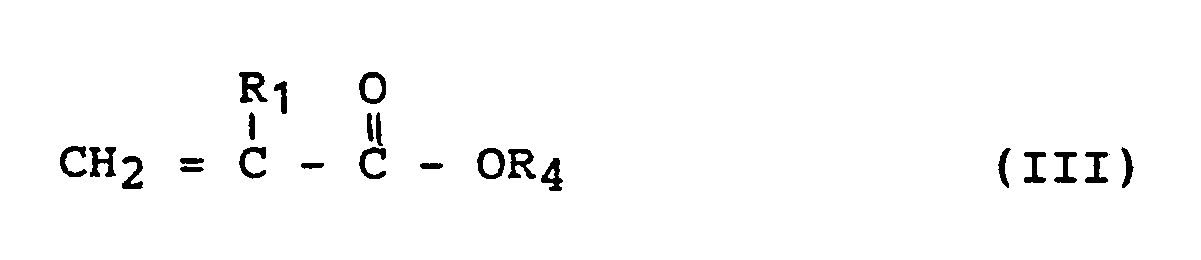
R₄
für eine aliphatischen Rest mit 1 bis 12 Kohlenstoffatomen, oder für einen mit mindestens einem Rest X substituierten Alkylrest mit 2 bis 8 Kohlenstoffatomen, wobei X für eine -OH, -OR₅ oder eine -NR₆R₇-Gruppe steht, wobei R₅ für einen Alkylrest mit 1 bis 6 Kohlenstoffatomen oder einen Alkoxyrest mit 1 bis 6 Kohlenstoffatomen und R₆ für Wasserstoff oder einen Alkylrest mit 1 bis 6 Kohlenstoffatomen und R₇ für einen Alkylrest mit 1 bis 6 Kohlenstoffatomen steht oder worin R₆ und R₇ gegebenenfalls unter Einbeziehung eines weiteren Stickstoffs oder eines Sauerstoffs einen fünf- oder sechsgliedrigen, vorzugsweise gesättigten Ring bilden
oder Styrol, p- oder α-Methylstyrol
infrage. - Besonders bevorzugt sind solche Polymeren P2, die weniger als 10 Gew.-%, insbesondere weniger als 1 Gew.-% und ganz besonders bevorzugt 0 Gew.-% an Monomeren mit Epoxygruppen (wie Glycidylmethacylat) oder Säuregruppen wie (Meth)acrylsäuren enthalten.
- Die Herstellung der Homo- bzw. Copolymerisate P2 erfolgt nach bekannten Verfahren. (Vgl. H. Rauch-Puntigam, Th. Völker Acryl- und Methacrylverbindungen, Springerverlag 1967). Wenn auch häufig prinzipiell eine Herstellung durch anionische Polymerisation oder Group-Transfer-Polymerisation (siehe auch O.W. Webster et al., J. Am. Chem. Soc., 105, 5706 (1983)) möglich ist, so ist doch die bevorzugte Herstellungsform die radikalische Polymerisation. Dabei kann sowohl Substanz- als Lösungs- oder Emulsionspolymerisation durchgeführt werden.
- Bei den radikalischen Polymerisationsverfahren finden vorzugsweise die üblichen radikalischen Initiatoren, beispielsweise peroxidische, insbesondere organische Peroxiverbindungen oder Azoverbindungen in Mengen von 0,01 bis 1 Gew.-% (bezogen auf die Monomeren) Anwendung. Als Regler können z.B. die üblichen Schwefelregler in den bewährten Konzentrationen z.B. in Mengen von 0,01 bis 2 Gew.-% (bezogen auf die Monomeren) angewendet werden.
- Die Molgewichte M der Polymerisate P2 liegen in der Regel oberhalb von 3 000 im allgemeinen im Bereich von 10 000 bis 2 000 000, vorzugsweise 20 000 bis 300 000 (Lichtstreuung). Bei der Auswahl der Monomerkomponenten, die als Comonomere bei P2 eingesetzt werden sollen, ist darauf zu achten, daß die Glastemperatur Tg des resultierenden Polymerisats die technische Anwendbarkeit des Gesamtsystems PM nicht einschränkend beeinflußt.
- Die verträglichen Mischungen PM können durch die unterschiedlichen Verfahren hergestellt werden, sie werden z.B. durch intensives mechanisches Vermischen der Komponenten P1 und P2 in der Schmelze, im Extruder, Kneter usw. erzeugt. (Vgl. Kirk-Othmer "Encyclopedia of Chemical Technology" 3rd Ed. Vol. 18, pg. 443 - 478, J. Wiley, 1982).
Das Mischen der Schmelze geschieht im geeigneten, im allgemeinen relativ hohen Temperaturbereich, beispielsweise bei 220 bis 320 Grad C, als Faustregel bei ca. 280 Grad C. - Es resultiert regelmäßig eine glasklare Schmelze und zwar nach bisher vorliegenden Beobachtungen in allen angewendeten Proportionen der Polymerkomponenten.
In der Regel erstarrt die Schmelze beim Abkühlen kristallin. Die Bildung einer glasklaren Schmelze kann als ein sicheres Indiz für das Vorliegen einer einzigen homogenen Phase im schmelzflüssigen Zustand gewertet werden. - Zunächst sind die erfindungsgemäßen Polyester-Polyarylacrylat-Mischungen verträglich, d.h. die Mischungen dieser Polymeren ergeben eine homogene Schmelze. Damit besteht die Möglichkeit, das Polyarylacrylat als Verarbeitungshilfsmittel für den Polyester (insbesondere für Polyethylenterephthalat und Polybutylenterephthalat) einzusetzen. So kann vor allem hochmolekulares Polyarylacrylat mit einem Molekulargewicht von Mw = 100 000 - 2 000 000, insbesondere 300 000 - 1 200 000, als Extrusionshilfsmittel für Polyester eingesetzt werden. In der Regel enthalten derartige Polyester/Polyarylacrylat-Blends 0,5 - 20, insbesondere 1 - 10 Gew.-% Polyarylacrylat.
Der breitere Verarbeitungsspielraum der Blends im Vergleich zum reinen Polyester erlaubt auch das Thermoformen der Mischungen, insbesondere das Blasformen oder Tiefziehen.
Ein weiterer Vorteil der Blends insbesondere beim Einsatz in sehr hochmolekularen Polyarylacrylaten ist in der Herstellung von Schaumstoffen zu sehen. So sollten unter Verwendung der üblichen Treibmittel Polyester/Polyarylacrylat-Blends mit 3 - 30 Gew.-% Polyarylacrylat, insbesondere 5 - 20 Gew.-% Polyarylacrylat/Polyesterschaumstoffe zugänglich sein. - Die gute Verträglichkeit des Polyarylacrylats mit dem Polyester gestattet es auch, gut haftende Schichten von Polyarylacrylat auf Polyester zu erzeugen.
So können z.B. gut aufeinander haftende Verbundsysteme aus Polyester und Polyarylacrylat hergestellt werden.
Dazu kann beispielsweise Polyester mit Polyarylacrylat lackiert werden. Besonderes Interesse gilt der Coextrusion bzw. dem Cospritzguß. Von besonderem Interesse sind solche Polymerkompositionen, in denen ein Formkörper (z.B. eine Platte oder Folie) aus Polyester mit einem Mantel aus Polyarylacrylat umgeben ist.
Vorzugsweise enthält das als Mantel verwendete Polyarylacrylat an sich bekannte UV-Schutzmittel in Anteilen um 0,1 - 10 Gew.-% und schützt so die Gesamtkomposition gegen Verwitterung. - Im Vergleich zu nicht verträglichen Polymerkompositionen haben diese Polymerkompositionen aus Polyester und Polyarylacrylat folgende Vorteile: a) bessere Haftung der Schichten aufeinander, b) kein Abfallproblem, da die Abfallstücke aufgrund der guten Verträglichkeit problemlos wieder eingearbeitet werden können.
- Von besonderem Interesse sind auch Polymermischungen PM', die neben dem Polyarylacrylat und dem Polyester noch 1 - 40 Gew.-% eines weiteren Polymeren P3 enthalten, wobei gilt, daß das Polymere P3 weder mit dem Polymeren P1 noch dem Polymeren P2 noch mit der Polymermischung PM verträglich ist.
Besonders bevorzugt sind Mischungen PM' aus
60 - 99 (70 - 95) Gew.-% PM und
40 - 1 (30 - 5) Gew.-% eines Polymeren P3, das eine Glastemperatur < 0 Grad C aufweist und wenigstens teilweise (im allgemeinen zu wenigestens 5 Gew.-%) mit Polyarylacrylat kovalent verknüpft ist. Im allgemeinen ist P3 vernetzt und stellt eine Gummiphase dar. P3 ist also beispielsweise Polybutadien, Polyisopren oder ein anderes Polyolefin, z.B. EPDM oder ein Polyacrylat, z.B. Polyethyl-, Polybutyl- oder Poly-2-ethylhexylacrylat. In einem besonders bevorzugten Fall wird von einem Kern-Schale-Latex ausgegangen, wobei der Latex-Kern (Durchmesser 100 - 500 nm) aus den Elastomeren, z.B. vernetzten Polybutadien oder vernetzten Polybutylacrylat besteht. Auf diesen Kern ist eine Schale aus Polyarylacrylat aufgepfropft. (Zur Pfropfpolymerisation vgl. Houben-Weyl, Methoden der org. Chemie E20, Teil 1 S. 626f, Georg-Thieme-Verlag 1987) - Derartige Kern-Schale-Latices können nach Entfernen des Wassers z.B. durch Sprühtrocknung als Schlagzähmodifier für die Polyester eingesetzt werden. Dabei wird das Elastomere (z.B. das Polybutylacrylat) über das Polyacrylat an den Polyester gebunden. Derartige Polymermischungen lassen sich sehr gut verarbeiten und verbessern insbesondere die Kerbschlagzähigkeit des Polyesters.
- Die folgenden Beispiele dienen zur Erläuterung der Erfindung (wobei sich die symbolischen Bezeichnungen auf die Formel II beziehen).
- Die Bestimmung der Viskositätszahl J. [ml/g] erfolgt in Anlehnung an DIN 51 562, Teile 2 und 3 und Din 7745, Teil 2.
- 50 Teile Polyethylenterephthalat (Aldrich, Inhaerente Viskosität: 0,7) werden mit 10 Teilen Polyphenylmethacrylat (J = 46 ml/g) in einem Meßkneter bei 280 Grad C gemischt. Es resultiert eine glasklare, verträgliche Schmelze, die beim Abkühlen kristallin erstarrt.
- 50 Teile Polybutylenterephthalat (Aldrich, No. 02123 KL) werden mit 10 Teilen Polyphenylmethacrylat (J = 46 ml/g) bei 280 Grad C gemischt. Es resultiert eine niedrigviskose, glasklare, verträgliche Schmelze, die beim Abkühlen kristallin erstarrt.
- Man wiederholt die Abmischung gemäß Beispiel 2, wählt jedoch ein anderes Mischungsverhältnis: 50 Teile Polybutylenterephthalat, 20 Teile Polyphenylmethacrylat. Auch diese Schmelze ist verträglich.
- 50 Teile PET werden mit 5 Teilen Poly-p-methoxyphenylmethacrylat bei 280 Grad C im Meßkneter gemischt. Es resultiert eine glasklare, verträgliche Schmelze.
- 50 Teile PET werden mit 10, 20, 30 Teilen Poly-p-methoxyphenylmethacrylat gemischt. Man erhält stets eine glasklare, verträgliche Schmelze.
- 250 g p-Methoxyphenylmethacrylat werden in 375 g Toluol unter Erwärmen gelöst, es wird filtriert. Nach Zugabe von 0,25 g Dodecylmercaptan und 0,125 g tert.Butylperneodecanoat (gelöst in 10 g Toluol) wird unter Schutzgas (N₂) 4 Stunden bei 80 - 85 Grad C gerührt. Nach Abkühlen auf Raumtemperatur wird das Polymere in Methanol ausgefällt und in Vacuum getrocknet. Es resultiert ein pulvriges Polymer
(J = 27,4 ml/g). - 50 Teile PET werden mit 10 Teilen eines Copolymeren aus Phenylmethacrylat und Styrol bei 280 Grad C im Meßkneter gemischt. Man erhält eine klare, verträgliche Schmelze.
- 50 g Styrol und 150 g Phenylmethacrylat werden in 200 g Toluol gelöst, es wird auf 70 Grad C erwärmt, mit einem inerten Schutzgas beschickt (N₂), es wird nacheinander 1 g tert.-Dodecylmercaptan und 1 g Dilaurylperoxid (gelöst in 10 g Toluol) zugesetzt. Man polymerisiert 3 Stunden bei 70 Grad C, kühlt ab und isoliert das Polymere durch Ausfällen in Methanol.
Nach Trocknung im Vacuum erhält man ein weißes Pulver.
(J = 46,1 ml/g). - 50 Teile Polybutylenterephthalat werden mit 5 Teilen Polystyrol (PS 158K der BASF) bei 280 Grad C gemischt. Es resultiert eine trübe, unverträgliche Polymerschmelze.
- In einem 3 l-Witt'schen Topf mit Kühler, Rührer, Thermometer und Schutzgaseinleitung (Stickstoff) werden
600 g Phenylmethacrylat
900 9 Wasser
2 g Emulgator (Nonylphenol, umgesetzt mit 6 Mol Ethylenoxid, sulfatiert, Natrium-Salz)
mit 500 Up emulgiert (2 Minuten), dann wird die Rührerdrehzahl auf 150 Up zurückgenommen, 2 ppm FeSO₄ (bezogen auf das Monomere) und 0,4 g Kaliumperoxodisulfat zugesetzt und auf 40°C erwärmt. Sobald die Innentemperatur 40°C erreicht hat, wird die Polymerisation durch Zugabe von 0,33 g Na₂S₂O₅ (in 5 g Wasser) gestartet. Im Verlauf der Polymerisation steigt die Innentemperatur auf ca. 60°C (Badtemperatur: 43°C). Nach ca. 1 1/2 Stunden wird auf Raumtemperatur gekühlt.
Zur Gewinnung des Polymerisat-Feststoffs wird die Dispersion eingefroren (- 15°C) und in heißem Wasser aufgetaut. Der erhaltene Feststoff wird abfiltriert und bei 90°C im Vacuum getrocknet.
(J = 280 ml/g) - Man verfährt wie in Beispiel 12, wählt jedoch andere Einwaagen
800 g Phenylmethacrylat
200 g p-Methoxyphenylmethacrylat
1500 g Wasser
3,3 g C₁₅-Paraffinsulfonat, Natrium-Salz
Nach Emulgieren mit 500 Up und Zugabe von 2 ppm FeSO₄ und 0,67 g KPS wird bei 50°C durch Zugabe von 0,33 g Na₂S₂O₅ die Polymerisation gestartet. Nach Beendigung der Polymerisation wird die Dispersion auf Raumtemperatur gekühlt und zur Gewinnung des Polymerisat-Feststoffes eingefroren und in heißem Wasser wieder aufgetaut (Gefrierkoagulation). Es wird filtriert, mehrfach mit Wasser gewaschen und anschließend bei 90°C im Vacuum getrocknet.
J = 298 ml/g. - Spritzgußplättchen (Dicke 3 mm) aus PBT (Vestodur 1000®der Fa. Hüls AG) werden mit ca. 10 - 20 %igen Lösungen der Polymeren gemäß Beispiel 8,12+13 in Methylpyrrolidon beschichtet (Teflon-Rakel, Naßschichtdicke: 120 µm, Dicke des getrockneten Films:
12-25 µm) und anschließend bei erhöhter Temperatur getrocknet (75°C im Vacuum). Einige Proben werden zusätzlich 1 Stunde bei 200°C getempert.
Nach dem Abkühlen wird die Haftung der Schicht auf dem PBT gemäß DIN 53151 bestimmt. - Tesatest : 0 % Abriß
Gitterschnitt nach DIN 53151 mit nachfolgendem Tesatest: 5 % Abriß. - Gitterschnitt nach DIN 53151 mit nachfolgendem Tesatest: 0 % Abriß
- Messung an der bei 200°C getemperten Probe:
Gitterschnitt nach DIN 53151 mit nachfolgendem Tesatest: 0 % Abriß - Messung an der bei 200°C getemperten Probe:
Gitterschnitt nach DIN 53151 mit nachfolgendem Tesatest: 0 % Abriß.
Polymere gemäß den Beispielen 12+13 zeigen demnach hervorragende Haftung auf PBT. - Man wiederholt den Versuch gemäß Beispiel 14 mit Polymethylmethacrylat als Beschichtungsmaterial (Plexiglas®8N der Fa. Röhm).
Messung an der bei 75°C getrockneten Probe.
Tesatest: 100 % Abriß
Messung an der bei 200°C getemperten Probe:
Gitterschnitt nach DIN 53151 mit nachfolgendem Tesatest: 100 % Abriß - Das Polymethylmethacrylat zeigt demnach keinerlei Haftung auf PBT.
- 0,24 g fein gemahlenes Polymerisat gemäß Beispiel 8 wird auf eine 3 mm dicke 24 cm² große PBT-Platte aufgebracht und bei 175°C aufgepreßt (Druck: 4 KN/cm², Preßdauer: 5 Minuten) Nach dem Abkühlen erhält man eine hochglänzende Verbundplatte aus PBT mit Poly-p-methoxymethacrylat-Deckschicht.
Gitterschnitt nach DIN 53151 mit nachfolgendem Tesatest: 0 % Abriß.
Claims (6)
- Verträgliche Polymermischungen mit Polyestern als Mischungskomponente,
dadurch gekennzeichnet,
daß die Polymermischungen PM ausA) 0,1 - 99,9 Gew.-% eines Polyesters P1 aufgebaut aus Einheiten der Formel I
R
für einen Rest -(CH₂)m- oder für einen Rest
m
für eine Zahl von 2 bis 6 steht undB) 99,9 - 0,1 Gew.-% eines Polyacrylats P2 aufgebaut zu 20 - 100 Gew.-% aus halogenfreien Monomeren der Formel II
R₁
für Wasserstoff oder Methyl
R₂
für eine abstandhaltende Gruppe mit 1 bis 6 Gliedern
R₃
für einen Alkylrest, Alkoxylrest oder Aminoalkyl- oder -dialkylrest mit 1 bis 6 Kohlenstoffatomen und
q
für null oder eins und
z
für null, eins oder zwei steht,
bestehen. - Verträgliche Polymermischungen gemäß Anspruch 1, dadurch gekennzeichnet, daß R₂ ausgewählt ist aus der Gruppe bestehend aus den Alkylidenen mit 1 bis 6 Kohlenstoffatomen in der Kette und dem Rest -(CH₂)pO- worin p für eine Zahl von 2 bis 6 steht.
- Verträgliche Polymermischungen gemäß Anspruch 1, dadurch gekennzeichnet, daß der Polyester P1 ausgewählt ist aus der Gruppe der Polyethylenterephthalate und der Polybutylenterephthalate.
- Polymermischungen PM', aufgebaut aus 60 - 99 Gew.-% der Polymermischung PM gemäß Anspruch 1 und 40 - 1 Gew.-% eines Polymeren P3, das eine Glastemperatur < 0 Grad C aufweist und wenigstens teilweise mit dem Polyacrylacrylat P2 gemäß Formel II kovalent verknüpft ist.
- Verbundsystem, aufgebaut aus Polyester P1 gemäß Formel I in Anspruch 1 und Polyacrylat P2 gemäß Formel II in Anspruch 1.
- Formkörper, bestehend aus Polymer P1 gemäß Formel I in Anspruch 1 mit einem Mantel aus Polyacrylat P2 gemäß Formel II in Anspruch 1.
Priority Applications (1)
| Application Number | Priority Date | Filing Date | Title |
|---|---|---|---|
| EP19940114991 EP0635536B1 (de) | 1990-02-02 | 1991-01-15 | Mehrschichtige Verbundsysteme |
Applications Claiming Priority (2)
| Application Number | Priority Date | Filing Date | Title |
|---|---|---|---|
| DE19904003088 DE4003088A1 (de) | 1990-02-02 | 1990-02-02 | Vertraegliche polymermischungen |
| DE4003088 | 1990-02-02 |
Related Child Applications (2)
| Application Number | Title | Priority Date | Filing Date |
|---|---|---|---|
| EP19940114991 Division EP0635536B1 (de) | 1990-02-02 | 1991-01-15 | Mehrschichtige Verbundsysteme |
| EP94114991.6 Division-Into | 1991-01-15 |
Publications (1)
| Publication Number | Publication Date |
|---|---|
| EP0440034A1 true EP0440034A1 (de) | 1991-08-07 |
Family
ID=6399285
Family Applications (2)
| Application Number | Title | Priority Date | Filing Date |
|---|---|---|---|
| EP19910100383 Withdrawn EP0440034A1 (de) | 1990-02-02 | 1991-01-15 | Verträgliche Polymermischungen |
| EP19940114991 Expired - Lifetime EP0635536B1 (de) | 1990-02-02 | 1991-01-15 | Mehrschichtige Verbundsysteme |
Family Applications After (1)
| Application Number | Title | Priority Date | Filing Date |
|---|---|---|---|
| EP19940114991 Expired - Lifetime EP0635536B1 (de) | 1990-02-02 | 1991-01-15 | Mehrschichtige Verbundsysteme |
Country Status (8)
| Country | Link |
|---|---|
| US (2) | US5250623A (de) |
| EP (2) | EP0440034A1 (de) |
| JP (1) | JPH04504589A (de) |
| AT (1) | ATE165610T1 (de) |
| DE (2) | DE4003088A1 (de) |
| DK (1) | DK0635536T3 (de) |
| ES (1) | ES2115832T3 (de) |
| WO (1) | WO1991011490A1 (de) |
Families Citing this family (3)
| Publication number | Priority date | Publication date | Assignee | Title |
|---|---|---|---|---|
| DE4030553A1 (de) * | 1990-09-27 | 1992-04-02 | Roehm Gmbh | Ternaere polymermischungen |
| ES2159459B1 (es) * | 1998-11-20 | 2002-05-01 | Petglass S L | Placa de construccion transparente. |
| CN114316529B (zh) * | 2021-12-29 | 2024-04-09 | 东莞市达瑞电子股份有限公司 | 一种高透明耐刮擦的pet复合材料及其制备方法 |
Citations (3)
| Publication number | Priority date | Publication date | Assignee | Title |
|---|---|---|---|---|
| FR2316254A1 (fr) * | 1975-06-21 | 1977-01-28 | Dynamit Nobel Ag | Polymeres et copolymeres a base d'acrylates et leur utilisation comme agents retardateurs de combustion |
| GB2105351A (en) * | 1981-09-09 | 1983-03-23 | Mitsubishi Chem Ind | Polyester resin composition |
| EP0142336A1 (de) * | 1983-11-10 | 1985-05-22 | Polyplastics Co. Ltd. | Zusammensetzung aus Polybutylenterephthalat |
Family Cites Families (3)
| Publication number | Priority date | Publication date | Assignee | Title |
|---|---|---|---|---|
| DE1694200A1 (de) * | 1967-10-10 | 1971-10-21 | Hoechst Ag | Thermoplastische Formmassen |
| US4781978A (en) * | 1987-03-02 | 1988-11-01 | Minnesota Mining And Manufacturing Company | Articles having a coating formed from a polymeric blend |
| JPH01295880A (ja) * | 1988-05-25 | 1989-11-29 | Tomoegawa Paper Co Ltd | 印刷用シート |
-
1990
- 1990-02-02 DE DE19904003088 patent/DE4003088A1/de not_active Withdrawn
-
1991
- 1991-01-15 DK DK94114991T patent/DK0635536T3/da active
- 1991-01-15 EP EP19910100383 patent/EP0440034A1/de not_active Withdrawn
- 1991-01-15 EP EP19940114991 patent/EP0635536B1/de not_active Expired - Lifetime
- 1991-01-15 DE DE59108973T patent/DE59108973D1/de not_active Expired - Fee Related
- 1991-01-15 AT AT94114991T patent/ATE165610T1/de not_active IP Right Cessation
- 1991-01-15 ES ES94114991T patent/ES2115832T3/es not_active Expired - Lifetime
- 1991-01-21 US US07/721,466 patent/US5250623A/en not_active Expired - Fee Related
- 1991-01-21 WO PCT/DE1991/000054 patent/WO1991011490A1/de not_active Ceased
- 1991-01-21 JP JP3502375A patent/JPH04504589A/ja active Pending
-
1993
- 1993-07-06 US US08/086,128 patent/US5374487A/en not_active Expired - Fee Related
Patent Citations (3)
| Publication number | Priority date | Publication date | Assignee | Title |
|---|---|---|---|---|
| FR2316254A1 (fr) * | 1975-06-21 | 1977-01-28 | Dynamit Nobel Ag | Polymeres et copolymeres a base d'acrylates et leur utilisation comme agents retardateurs de combustion |
| GB2105351A (en) * | 1981-09-09 | 1983-03-23 | Mitsubishi Chem Ind | Polyester resin composition |
| EP0142336A1 (de) * | 1983-11-10 | 1985-05-22 | Polyplastics Co. Ltd. | Zusammensetzung aus Polybutylenterephthalat |
Non-Patent Citations (1)
| Title |
|---|
| CHEMICAL ABSTRACTS Band 113, Nr. 2, 9. Juli 1990, Seite 66, Zusammenfassung Nr. 7727c, Columbus, Ohio, US; & JP - A - 01295880 (TOMOEGAWA PAPER CO., LTD.) 29.11.1989 * |
Also Published As
| Publication number | Publication date |
|---|---|
| US5374487A (en) | 1994-12-20 |
| DK0635536T3 (da) | 1998-10-07 |
| DE59108973D1 (de) | 1998-06-04 |
| JPH04504589A (ja) | 1992-08-13 |
| ES2115832T3 (es) | 1998-07-01 |
| DE4003088A1 (de) | 1991-08-08 |
| US5250623A (en) | 1993-10-05 |
| EP0635536B1 (de) | 1998-04-29 |
| ATE165610T1 (de) | 1998-05-15 |
| WO1991011490A1 (de) | 1991-08-08 |
| EP0635536A1 (de) | 1995-01-25 |
Similar Documents
| Publication | Publication Date | Title |
|---|---|---|
| DE69230602T2 (de) | Mischungen sulfonierter Polyester | |
| EP1742990B1 (de) | Dispergiermittel für pigmentkonzentrate, seine verwendung und das dispergiermittel enthaltende masterbatches | |
| EP0372213B1 (de) | UV-Absorber-haltige Methacrylatschutzschicht für Polycarbonat | |
| EP0326938B1 (de) | Schlagzäh-modifiziertes Polycarbonat | |
| EP0477726B1 (de) | Ternäre Polymermischungen | |
| DE3518538A1 (de) | Vertraegliche polymermischungen | |
| DE1569031B2 (de) | Masse zur herstellung faerb und bedruckbarer formkoerper und ueberzuege aus propylenpolymerisaten | |
| DE69920200T2 (de) | Kompatibilisierte abs-polycarbonat-formmasse | |
| EP2132265B1 (de) | Polyestermischung enthaltend biodiesel | |
| EP0321878B1 (de) | Schlagzäh-Modifizierungsmittel für Kunststoffe | |
| DE69121485T2 (de) | Mehrschichtiges Polymer, dieses enthaltende thermoplastische Harzzusammensetzung und aus dieser Zusammensetzung hergestellte Formkörper | |
| DE60002569T2 (de) | Mischungen aus polyamiden und emulsionspolymeren | |
| EP0492405B1 (de) | Acrylat-Methacrylat-Propfpolymerisate | |
| EP0101899B1 (de) | Formmassen aus Vinylchloridpolymerisat, Pfropfpolymeren und polymeren Weichmachern mit hoher Alterungsbeständigkeit | |
| EP0101903B1 (de) | Formmassen aus Vinylchloridpolymerisat, Pfropfpolymeren und polymeren Weichmachern mit hoher Alterungsbeständigkeit | |
| DE112004001409T5 (de) | Harzzusammensetzung für ein Formmaterial und daraus hergestellter Formartikel | |
| DE3638443A1 (de) | Vertraegliche polymermischungen | |
| EP0635536B1 (de) | Mehrschichtige Verbundsysteme | |
| DE102010042810A1 (de) | Blockcopolymere umfassend Polylactid | |
| DE60223612T2 (de) | Verfahren zur Herstellung von nicht gelierenden Hochpolymer- zusammensetzungen und deren thermoplastischen Blends | |
| EP0352455A1 (de) | Schlagzähe Polymethylmethacrylat-Formmasse | |
| EP0101904B1 (de) | Formmassen aus Vinylchloridpolymerisat, bestimmten Copolymerisaten und polymeren Weichmachern mit hoher Alterungsbeständigkeit | |
| EP4534600A1 (de) | Harzzusammensetzung und formprodukt | |
| EP0360128B1 (de) | Verträgliche Polymermischungen (I) | |
| DE2416712B2 (de) | Biaxial gereckte polyester-folie |
Legal Events
| Date | Code | Title | Description |
|---|---|---|---|
| PUAI | Public reference made under article 153(3) epc to a published international application that has entered the european phase |
Free format text: ORIGINAL CODE: 0009012 |
|
| AK | Designated contracting states |
Kind code of ref document: A1 Designated state(s): AT BE CH DE DK ES FR GB IT LI NL SE |
|
| 17P | Request for examination filed |
Effective date: 19910826 |
|
| 17Q | First examination report despatched |
Effective date: 19931208 |
|
| STAA | Information on the status of an ep patent application or granted ep patent |
Free format text: STATUS: THE APPLICATION HAS BEEN WITHDRAWN |
|
| 18W | Application withdrawn |
Withdrawal date: 19950217 |