EP0440071B1 - Plating process - Google Patents
Plating process Download PDFInfo
- Publication number
- EP0440071B1 EP0440071B1 EP91100754A EP91100754A EP0440071B1 EP 0440071 B1 EP0440071 B1 EP 0440071B1 EP 91100754 A EP91100754 A EP 91100754A EP 91100754 A EP91100754 A EP 91100754A EP 0440071 B1 EP0440071 B1 EP 0440071B1
- Authority
- EP
- European Patent Office
- Prior art keywords
- plating
- alloy
- plating solution
- component
- composition
- Prior art date
- Legal status (The legal status is an assumption and is not a legal conclusion. Google has not performed a legal analysis and makes no representation as to the accuracy of the status listed.)
- Expired - Lifetime
Links
Images


Classifications
-
- C—CHEMISTRY; METALLURGY
- C25—ELECTROLYTIC OR ELECTROPHORETIC PROCESSES; APPARATUS THEREFOR
- C25D—PROCESSES FOR THE ELECTROLYTIC OR ELECTROPHORETIC PRODUCTION OF COATINGS; ELECTROFORMING; APPARATUS THEREFOR
- C25D21/00—Processes for servicing or operating cells for electrolytic coating
- C25D21/12—Process control or regulation
Definitions
- the present invention relates generally to electroplating of nickel-iron (Ni-Fe) alloy for example, and more specifically to a plating method of electroplating a uniform Ni-Fe composition alloy of film on a magnetic film such as an 80 : 20 Ni-Fe magnetic core thin film for use in a magnetic recording head for example.
- Ni-Fe nickel-iron
- the present invention relates generally to electroplating of nickel-iron (Ni-Fe) alloy for example, and more specifically to a plating method of electroplating a uniform Ni-Fe composition alloy of film on a magnetic film such as an 80 : 20 Ni-Fe magnetic core thin film for use in a magnetic recording head for example.
- a nickel-iron plated film used as a magnetic film has its magnetic properties severely varied depending on alloy compositions.
- FIG. 1 there is illustrated an interrelation between iron weight composition (wt%) and pH value of a plating solution, those pH values being a factor to influence the alloy composition.
- the iron weight composition (wt%) in the plating alloy is increased, the iron weight composition (wt%) has its maximum Fe max when the pH is i z , around which there is provided a smooth characteristic curve with reduced variations of the iron weight composition.
- selection may be made of the least variations of the iron weight composition with respect to the variations of the pH of the plating solution, say, a pH value i z of the plating solution. Accordingly, prior practice of the plating adopted such a pH of a plating solution that the iron weight composition is maximum.
- US-A-4279707 discloses a method of plating permalloy with a Ni:Fe ratio 80:20 for thin film magnetic recording heads. In a bath the pH is kept substantially constant at pH 3, allowing variations of max. ⁇ 0.05.
- an object of the present invention to provide a plating method wherein an alloy composition in the direction of the film thickness can be uniformalized even without any replenishment of metal ion (iron ion for example) in the course of plating.
- an increase ( ⁇ Fe) of the weight composition (Fe 1 ) of a metal to be plated due to an increase ( ⁇ I) of the pH and a decrease ( ⁇ Fe) of the weight composition (Fe 1 ) of the metal to be plated due to a decrease of metal ion (iron ion) concentration of the metal to be plated in the plating solution are compensated by each other, thereby providing uniform weight composition (Fe 1 ) of the metal to be plated in the course of the plating.
- FIG. 1 is a view illustrating a change in iron weight composition with respect to pH values
- FIG. 2 is a view illustrating a change in pH values with respect to the elapsed time of plating
- FIG. 3 is a view illustrating a change in iron weight composition in alloy plating upon the rise of pH with respect to the elapsed time of plating
- FIG. 4 is a view illustrating a change in the iron weight composition in the alloy plating as Fe ion concentration is reduced, with respect to the elapsed time of plating,
- FIG. 5 is a graphical representation of an experimental result illustrating an interrelation among changes in Fe composition, distribution of the former, and deposition rates in the course of the plating of an upper core, with respect to pHs,
- FIG. 6 is an enlarged view illustrating the structure of a thin film head element
- FIG. 7 is a view illustrating the film thickness of the upper core
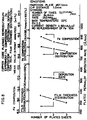
- FiG. 8 is a graphical representation of an experimental result illustrating an interrelation among changes in Fe composition Fe composition distribution, deposition rates, and film thickness distribution during the plating of the upper core, with respect to the number of plating sheets.
- a nickel-iron plated film for example used for a magnetic film sharply relies in its magnetic properties upon distinct alloy compositions, for a factor to control the alloy composition, there is known the pH of a plating solution as illustrated in FIG. 1.
- the pH in a plating solution is increased in proportion to the elapsed time of plating as illustrated in FIG. 2.
- Fe ion (ion of metal to be plated) concentration in the plating solution is decreased in proportion to the elapsed time of the plating and hence an iron weight composition during alloy plating is also decreased, as illustrated in FIG. 4.
- Fe 2+ concentration is reduced as the plating is advanced.
- the Fe 2+ concentration is decreased by the amount of Fe deposition (g)/17(l).
- the Fe deposition rate is more reduced (by ⁇ Fe in the case of the 17l plating bath volume) than that of Ni is as the result of the just-mentioned concentration decrease unless there is such Fe 2+ PH depending as described above, the pH dependency assures ⁇ Fe ⁇ ⁇ Fe - 0 and hence the Fe composition is kept unchanged.
- the plating method will be described in terms of a concrete example.
- an acidic bath which includes nickel sulfate, nickel chloride (Ni 2+ concentration, 10 g/l), iron sulfate (Fe 2+ concentration, 0.25 g/l or less), boric acid as a pH buffer, and other additives.
- the plating bath volume is set to 17l for example, and plating temperature is set to predetermined temperature near room temperature.
- the degree of stirring of the plating solution sharply influences deposition conditions such as the deposition composition and thickness distirbution, etc., of a plating solution, so that it is required for the degree of stirring to be strictly controlled.
- a stirring rod which reciprocates parallely to a wafer surface as an object to be plated in close vicinity of the same.
- Plating current density is lowered to the almost, for example about 5 m ⁇ /cm 2 .
- the weight composition Fe 1 of iron as a metal to be plated is 17.5 (wt %)
- the amount ⁇ Fe of an increase or a decrease of the weight composition Fe 1 is 0.1 (wt %)
- the amount ⁇ I of an increase of the pH in the plating solution occurring during the plating is 0.08 (pH).
- FIG. 6 there is illustrated in an enlarged view the arrangement of a thin film head device in the 8 inch fixed disk device.
- the thin film head device is formed with laminating cores (upper core 12, lower core 11), a gap layer 13, a coil 14, and a protective film 15 on a three inch wafer 10 of 4mm thick Al 2 O 3 /TiC (alumina/titanium carbide).
- the upper and lower cores 12 and 11 both located at the center of the film head device are coated with permalloy plating (alloy plating of Ni and Fe).
- the Fe composition and film thicknesses of the upper and lower cores 12 and 11 sharply influence the electric characteristics of the head. Accordingly, for improving the yield of the electric characteristics of the head, there has been applied the plating method of the present invention in order to make uniform the Fe composition and film thickness of the permalloy plating.
- the alloy composition of the upper core 12 in the thickness direction of the same shown in Fig. 6 is as illustrated in FIG. 8, but where plating is carried out at the conventional pH i 2 shown in FIG, 1, a difference between the lower and upper side Fe composition of the upper core is 17.5 - 17.32 - 0.18 (wt %) and the film thickness of the upper core is 3.3 ⁇ m, as illustrated in FIG. 7.
- the use of the plating method of the above embodiment assures plating where the difference between the composition is substantially 0.
- the iron weight composition in the direction of the deposition of the plating deposition film is made uniform to yield a nickel-iron plated film with uniform magnetic properties.
- the plating method of the present invention could satisfactorily be applied to other alloy platings having similar electrodeposition mechanisms.
- the deposition of Fe in the nickel-iron alloy plating in the above embodiment is considered to proceed in two steps as follows: (1) Fe 2+ + 2 OH - ⁇ Fe(OH) 2 (2) Fe(OH) 2 + 2H* ⁇ Fe + 2H 2 O (H* is hydrogen from a hydrogen producer.)
- the plating method in the above embodiment is carried out on the basis of the idea that hydroxide is once produced in the course of plating, as illustrated in the above two steps, which is different from other general plating methods.
- the Fe deposition rate according to the present plating method is therefore highly pH-dependent (pH is higher as OH - is higher.).
- alloy plating under identical reaction there are included Zn in Ni-Zn alloy plating, Co in Ni-Co alloy plating, and Zn in Fe-Zn alloy plating, etc.
- alloy compositions can undergo precision control in a region of a rising slope in a relationship between pH and deposition rates.
- a pH is selected where the increase of the weight composition of a metal to be plated due to the increase of a pH in a plating solution occuring in plating and the decrease of the same ratio due to the decrease of ion concentration of the metal in the plating are compensated each other, and the metal is plated using the plating solution of the selected pH. Accordingly, even though metal ion to be plated is not replenished, in the course of the plating, the weight composition of the metal in the direction of the deposition of a plated deposition film is made uniform, and hence an alloy film can be yielded which has been made uniform in the alloy composition in the direction of film thickness.
Landscapes
- Engineering & Computer Science (AREA)
- Chemical & Material Sciences (AREA)
- Automation & Control Theory (AREA)
- Chemical Kinetics & Catalysis (AREA)
- Electrochemistry (AREA)
- Materials Engineering (AREA)
- Metallurgy (AREA)
- Organic Chemistry (AREA)
- Electroplating Methods And Accessories (AREA)
- Magnetic Heads (AREA)
- Electroplating And Plating Baths Therefor (AREA)
Description
- The present invention relates generally to electroplating of nickel-iron (Ni-Fe) alloy for example, and more specifically to a plating method of electroplating a uniform Ni-Fe composition alloy of film on a magnetic film such as an 80 : 20 Ni-Fe magnetic core thin film for use in a magnetic recording head for example.
- A nickel-iron plated film used as a magnetic film has its magnetic properties severely varied depending on alloy compositions. Referring to FIG. 1, there is illustrated an interrelation between iron weight composition (wt%) and pH value of a plating solution, those pH values being a factor to influence the alloy composition. As the pH of the plating solution is raised, the iron weight composition (wt%) in the plating alloy is increased, the iron weight composition (wt%) has its maximum Fe max when the pH is iz, around which there is provided a smooth characteristic curve with reduced variations of the iron weight composition.
- For bringing the alloy composition into its most stabilized state, selection may be made of the least variations of the iron weight composition with respect to the variations of the pH of the plating solution, say, a pH value iz of the plating solution. Accordingly, prior practice of the plating adopted such a pH of a plating solution that the iron weight composition is maximum.
- With such prior practice where metal is plated under a pH of a plating solution selected conventionally, iron ion concentration in the plating solution is decreased following the deposition of a plated film and hence an iron weight composition in the plated film is also decreased, so that iron ion must be replenished into the plating solution during the plating to assure uniform components in the direction of film thickness. The prior practice therefore suffers from difficulties that there is required an additional dropping device using a high precision constant capacity pump as well as required much labor for operation, followed by a difficulty in reliability and reproducibility on whether or not uniform components have been yielded in the direction of film thickness.
- US-A-4279707 discloses a method of plating permalloy with a Ni:Fe ratio 80:20 for thin film magnetic recording heads. In a bath the pH is kept substantially constant at
pH 3, allowing variations of max. ±0.05. - In view of the drawbacks with the prior art, it is an object of the present invention to provide a plating method wherein an alloy composition in the direction of the film thickness can be uniformalized even without any replenishment of metal ion (iron ion for example) in the course of plating.
- This object is solved by the
independent claims 1 to 4. - For example, where plating is carried out with use of a plating solution of a pH i1, an increase (ΔFe) of the weight composition (Fe1) of a metal to be plated due to an increase (ΔI) of the pH and a decrease (ΔFe) of the weight composition (Fe1) of the metal to be plated due to a decrease of metal ion (iron ion) concentration of the metal to be plated in the plating solution are compensated by each other, thereby providing uniform weight composition (Fe1) of the metal to be plated in the course of the plating.
- The above and other objects, features, and advantages of the invention will become more apparent from the following description when taken in conjunction with the accompanying drawings.
- FIG. 1 is a view illustrating a change in iron weight composition with respect to pH values,
- FIG. 2 is a view illustrating a change in pH values with respect to the elapsed time of plating,
- FIG. 3 is a view illustrating a change in iron weight composition in alloy plating upon the rise of pH with respect to the elapsed time of plating,
- FIG. 4 is a view illustrating a change in the iron weight composition in the alloy plating as Fe ion concentration is reduced, with respect to the elapsed time of plating,
- FIG. 5 is a graphical representation of an experimental result illustrating an interrelation among changes in Fe composition, distribution of the former, and deposition rates in the course of the plating of an upper core, with respect to pHs,
- FIG. 6 is an enlarged view illustrating the structure of a thin film head element,
- FIG. 7 is a view illustrating the film thickness of the upper core, and
- FiG. 8 is a graphical representation of an experimental result illustrating an interrelation among changes in Fe composition Fe composition distribution, deposition rates, and film thickness distribution during the plating of the upper core, with respect to the number of plating sheets.
- As described previously, a nickel-iron plated film for example used for a magnetic film sharply relies in its magnetic properties upon distinct alloy compositions, for a factor to control the alloy composition, there is known the pH of a plating solution as illustrated in FIG. 1. The pH in a plating solution is increased in proportion to the elapsed time of plating as illustrated in FIG. 2. Additionally, Fe ion (ion of metal to be plated) concentration in the plating solution is decreased in proportion to the elapsed time of the plating and hence an iron weight composition during alloy plating is also decreased, as illustrated in FIG. 4.
- More specifically, for example, when there is denoted by ΔFe the amount of a decrease of an iron weight composition during alloy plating as the Fe ion concentration in the plating solution is decreased with plating time assumed to be 7 minutes, in FIG. 4, and when there is denoted by ΔI the degree of the rise of the pH after the lapse of 7 minutes of the plating time in FIG. 2, there is selected an iron weight composition Fe, where the amount of the increase of the iron weight composition during the alloy plating upon the rise of the pH at the plating time of 7 minutes is the same as that ΔFe of the decrease of the foregoing iron weight composition, as shown in Fig. 3, and a pH value i1, at the iron weight composition Fe1 is selected FIG. 1.
- When 7 minute plating is carried out at the pH i1 selected in FIG. 1, the pH rises by ΔI. Thereupon, an alloy component ratio in the thickness direction of a resulting film is made uniform because the amount ΔFe of the increase of the iron weight composition during the alloy plating is equal to the amount ΔFe of the decrease of the iron weight composition during the alloy plating in the decrease of the Fe ion concentration.
- In the following, there will be described a rational base in the electroplating of a nickel-iron alloy on why the uniform plating is achieved by cancellation between the amount ΔFe of the increase of the iron weight composition in the alloy plating and the amount ΔFe of the decrease of the iron weight composition in the alloy plating as the Fe ion concentration is decreased. The pH of the plating solution during the plating is increased. Hereby, the deposition rate highly pH dependent Fe is increased. Herein, Ni2+. is less pH- dependent than Fe2+ is, so that the deposition rate of Niz remains substantially unchanged. Accordingly, provided Fe2+ is replenished and Ni2+ is kept constant, the Fe composition is increased (corresponding to the aforementioned ΔFe). However, where Fe2+ need not be replenished in the present invention, as Fe2+ concentration is reduced as the plating is advanced. With a plating bath volume of 17ℓ for example, the Fe2+ concentration is decreased by the amount of Fe deposition (g)/17(ℓ). Although the Fe deposition rate is more reduced (by ΔFe in the case of the 17ℓ plating bath volume) than that of Ni is as the result of the just-mentioned concentration decrease unless there is such Fe2+ PH depending as described above, the pH dependency assures ΔFe · ΔFe - 0 and hence the Fe composition is kept unchanged.
- In the following, the plating method will be described in terms of a concrete example. For the plating bath, there is employed an acidic bath which includes nickel sulfate, nickel chloride (Ni2+ concentration, 10 g/ℓ), iron sulfate (Fe2+ concentration, 0.25 g/ℓ or less), boric acid as a pH buffer, and other additives. The plating bath volume is set to 17ℓ for example, and plating temperature is set to predetermined temperature near room temperature. The degree of stirring of the plating solution sharply influences deposition conditions such as the deposition composition and thickness distirbution, etc., of a plating solution, so that it is required for the degree of stirring to be strictly controlled. Herein, there is employed a stirring rod which reciprocates parallely to a wafer surface as an object to be plated in close vicinity of the same. Plating current density is lowered to the almost, for example about 5 mΛ/cm2.
- Referring now to FIG. 5, there is illustrated data as the plating is carried out under such conditions. As illustrated in FIG. 5, the weight composition Fe1 of iron as a metal to be plated is 17.5 (wt %), the amount Δ Fe of an increase or a decrease of the weight composition Fe1 is 0.1 (wt %), and the amount ΔI of an increase of the pH in the plating solution occurring during the plating is 0.08 (pH).
- In the following, a case will be described in which the plating method of the present embodiment is applied to a computer 8 inch fixed disk device. Referring to FIG. 6, there is illustrated in an enlarged view the arrangement of a thin film head device in the 8 inch fixed disk device. The thin film head device is formed with laminating cores (
upper core 12, lower core 11), agap layer 13, acoil 14, and aprotective film 15 on a threeinch wafer 10 of 4mm thick Aℓ2O3/TiC (alumina/titanium carbide). The upper andlower cores - It has been commonly believed that the Fe composition and film thicknesses of the upper and
lower cores - It should be noticed here that the alloy composition of the
upper core 12 in the thickness direction of the same shown in Fig. 6 is as illustrated in FIG. 8, but where plating is carried out at the conventional pH i2 shown in FIG, 1, a difference between the lower and upper side Fe composition of the upper core is 17.5 - 17.32 - 0.18 (wt %) and the film thickness of the upper core is 3.3 µm, as illustrated in FIG. 7. In this occasion, the use of the plating method of the above embodiment assures plating where the difference between the composition is substantially 0. - According to the above embodiment, as described above, the iron weight composition in the direction of the deposition of the plating deposition film is made uniform to yield a nickel-iron plated film with uniform magnetic properties.
- Although in the above embodiment, the case of the electroplating of nickel-iron alloy was exemplified, any other similar plating may be used for formation of a magnetic film, which could achieve the same effect as in the above embodiment.
- Now, another plating method other than the nickel iron alloy plating will be described. The plating method of the present invention could satisfactorily be applied to other alloy platings having similar electrodeposition mechanisms. The deposition of Fe in the nickel-iron alloy plating in the above embodiment is considered to proceed in two steps as follows:


- The plating method in the above embodiment is carried out on the basis of the idea that hydroxide is once produced in the course of plating, as illustrated in the above two steps, which is different from other general plating methods. The Fe deposition rate according to the present plating method is therefore highly pH-dependent (pH is higher as OH - is higher.). For alloy plating under identical reaction, there are included Zn in Ni-Zn alloy plating, Co in Ni-Co alloy plating, and Zn in Fe-Zn alloy plating, etc. Also in these platings, alloy compositions can undergo precision control in a region of a rising slope in a relationship between pH and deposition rates.
- In accordance with the present invention, as described above, a pH is selected where the increase of the weight composition of a metal to be plated due to the increase of a pH in a plating solution occuring in plating and the decrease of the same ratio due to the decrease of ion concentration of the metal in the plating are compensated each other, and the metal is plated using the plating solution of the selected pH. Accordingly, even though metal ion to be plated is not replenished, in the course of the plating, the weight composition of the metal in the direction of the deposition of a plated deposition film is made uniform, and hence an alloy film can be yielded which has been made uniform in the alloy composition in the direction of film thickness.
Claims (5)
- A Ni-Fe electroplating method for-plating Ni-Fe alloy onto a substrate with a high degree of uniformity of magnetic nickel iron alloy composition by using a plating solution,
characterized by
starting to plate with a plating solution having a pH-value selected so that- a reduction in the weight composition in the alloy of the component Fe occuring owing to a reduction of ion concentration in the plating solution and- an increase in the weight composition in the alloy of the component Fe caused by an increase in the pH-value of the plating solutioncompensate each other,in which method no ions of the component Fe are supplied during plating andthe amount Δ I of an increase in the pH is more than 0.05.. - A Ni-Zn electroplating method for plating Ni-Zn alloy onto a substrate with a high degree of uniformity of magnetic nickel zinc alloy composition by using a plating solution,
characterized by
starting to plate with a plating solution having a pH-value selected so that- a reduction in the weight composition in the alloy of the component Zn occuring owing to a reduction of ion concentration in the plating solution and- an increase in the weight composition in the alloy of the component Zn caused by an increase in the pH-value of the plating solutioncompensate each other,
in which method no ions of the component Zn are supplied during plating. - A Ni-Co electroplating method for plating Ni-Co alloy onto a substrate with a high degree of uniformity of magnetic nickel cobalt alloy composition by using a plating solution,
characterized by
starting to plate with a plating solution having a pH-value selected so that- a reduction in the weight composition in the alloy of the component Co occuring owing to a reduction of ion concentration in the plating solution and- an increase in the weight composition in the alloy of the component Co caused by an increase in the pH-value of the plating solutioncompensate each other,
in which method no ions of the component Co are supplied during plating. - A Fe-Zn electroplating method for plating Fe-Zn alloy onto a substrate with a high degree of uniformity of magnetic iron zinc alloy composition by using a plating solution,
characterized by
starting to plate with a plating solution having a pH-value selected so that- a reduction in the weight composition in the alloy of the component Zn occuring owing to a reduction of ion concentration in the plating solution and- an increase in the weight composition in the alloy of the component Zn caused by an increase in the pH-value of the plating solutioncompensate each other,
in which method no ions of the component Zn are supplied during plating. - A plating method according to any of claims 1-4, characterized in that said alloy to be plated is a core constituting a thin-film head.
Applications Claiming Priority (4)
| Application Number | Priority Date | Filing Date | Title |
|---|---|---|---|
| JP1308090 | 1990-01-23 | ||
| JP13080/90 | 1990-01-23 | ||
| JP2211259A JPH03257191A (en) | 1990-01-23 | 1990-08-08 | Plating method |
| JP211259/90 | 1990-08-08 |
Publications (2)
| Publication Number | Publication Date |
|---|---|
| EP0440071A1 EP0440071A1 (en) | 1991-08-07 |
| EP0440071B1 true EP0440071B1 (en) | 1996-08-28 |
Family
ID=26348803
Family Applications (1)
| Application Number | Title | Priority Date | Filing Date |
|---|---|---|---|
| EP91100754A Expired - Lifetime EP0440071B1 (en) | 1990-01-23 | 1991-01-22 | Plating process |
Country Status (3)
| Country | Link |
|---|---|
| US (1) | US5182009A (en) |
| EP (1) | EP0440071B1 (en) |
| DE (1) | DE69121597T2 (en) |
Families Citing this family (2)
| Publication number | Priority date | Publication date | Assignee | Title |
|---|---|---|---|---|
| US6454918B1 (en) * | 1999-03-23 | 2002-09-24 | Electroplating Engineers Of Japan Limited | Cup type plating apparatus |
| DE10246467B4 (en) * | 2002-10-04 | 2006-04-27 | Ehrfeld Mikrotechnik Ag | Method and system for map-controlled deposition of alloys |
Family Cites Families (3)
| Publication number | Priority date | Publication date | Assignee | Title |
|---|---|---|---|---|
| US4279707A (en) * | 1978-12-18 | 1981-07-21 | International Business Machines Corporation | Electroplating of nickel-iron alloys for uniformity of nickel/iron ratio using a low density plating current |
| US4179343A (en) * | 1979-02-12 | 1979-12-18 | Oxy Metal Industries Corporation | Electroplating bath and process for producing bright, high-leveling nickel iron electrodeposits |
| US4450051A (en) * | 1981-01-13 | 1984-05-22 | Omi International Corporation | Bright nickel-iron alloy electroplating bath and process |
-
1991
- 1991-01-22 EP EP91100754A patent/EP0440071B1/en not_active Expired - Lifetime
- 1991-01-22 DE DE69121597T patent/DE69121597T2/en not_active Expired - Fee Related
- 1991-01-23 US US07/644,824 patent/US5182009A/en not_active Expired - Fee Related
Also Published As
| Publication number | Publication date |
|---|---|
| DE69121597D1 (en) | 1996-10-02 |
| EP0440071A1 (en) | 1991-08-07 |
| DE69121597T2 (en) | 1997-01-16 |
| US5182009A (en) | 1993-01-26 |
Similar Documents
| Publication | Publication Date | Title |
|---|---|---|
| US6197364B1 (en) | Production of electroless Co(P) with designed coercivity | |
| CA1135411A (en) | Thin film head having negative magnetostriction | |
| US5883762A (en) | Electroplating apparatus and process for reducing oxidation of oxidizable plating anions and cations | |
| US2644787A (en) | Electrodeposition of a magnetic coating | |
| US4279707A (en) | Electroplating of nickel-iron alloys for uniformity of nickel/iron ratio using a low density plating current | |
| EP0471946A2 (en) | High magnetic moment materials and process for fabrication of thin film heads | |
| Andricacos et al. | Magnetically soft materials in data storage: Their properties and electrochemistry | |
| US20020154443A1 (en) | Soft magnetic film having high saturation magnetic flux density, thin film magnetic head using the same, and methods of producing the soft magnetic film and the thin film magnetic head | |
| US7113367B2 (en) | FeNiRe soft magnetic film and thin film magnetic head using the same for simultaneous adjustment of resistivity and saturated magnetic flux density | |
| US7396445B2 (en) | Method of manufacturing a thin-film magnetic head using a soft magnetic film having high saturation magnetic flux density | |
| JP2002057030A (en) | Soft magnetic film, thin film magnetic head using the same, method of manufacturing the magnetic film, and method of manufacturing the magnetic head | |
| EP0076152A1 (en) | Method of producing a continuous thin film magnetic medium | |
| EP0361451B1 (en) | Process for producing a thin alloy film having high saturation magnetic flux density | |
| EP0164135B1 (en) | Magnetic recording medium | |
| JP3102505B2 (en) | Method for manufacturing soft magnetic multilayer plating film, soft magnetic multilayer plating film, and magnetic head | |
| EP0395111B1 (en) | Method of manufacturing high magnetic flux density electrodeposited quarternary alloy thin film | |
| US5182009A (en) | Plating process | |
| US3691032A (en) | Permalloy film plated wires having superior nondestructive read-out characteristics and method of forming | |
| EP0012326B1 (en) | A method of electroplating nickel-iron alloys | |
| KR930009993B1 (en) | Plating method | |
| US7274541B2 (en) | Magnetic thin film head, the fabrication method, and magnetic disk | |
| JP3826323B2 (en) | Manufacturing method of plated magnetic thin film | |
| US3463708A (en) | Electrolytic bath for magnetic deposition | |
| JP2002280217A (en) | Soft magnetic film and thin-film magnetic head using the same, and method for manufacturing soft magnetic film and method for manufacturing thin-film magnetic head | |
| JP2662904B2 (en) | Cobalt-nickel-phosphorus alloy magnetic film, magnetic recording medium therefor, and method of manufacturing the same |
Legal Events
| Date | Code | Title | Description |
|---|---|---|---|
| PUAI | Public reference made under article 153(3) epc to a published international application that has entered the european phase |
Free format text: ORIGINAL CODE: 0009012 |
|
| AK | Designated contracting states |
Kind code of ref document: A1 Designated state(s): DE FR GB |
|
| 17P | Request for examination filed |
Effective date: 19910829 |
|
| K1C3 | Correction of patent application (complete document) published |
Effective date: 19910807 |
|
| 17Q | First examination report despatched |
Effective date: 19930722 |
|
| GRAH | Despatch of communication of intention to grant a patent |
Free format text: ORIGINAL CODE: EPIDOS IGRA |
|
| GRAH | Despatch of communication of intention to grant a patent |
Free format text: ORIGINAL CODE: EPIDOS IGRA |
|
| GRAA | (expected) grant |
Free format text: ORIGINAL CODE: 0009210 |
|
| AK | Designated contracting states |
Kind code of ref document: B1 Designated state(s): DE FR GB |
|
| REF | Corresponds to: |
Ref document number: 69121597 Country of ref document: DE Date of ref document: 19961002 |
|
| ET | Fr: translation filed | ||
| PLBE | No opposition filed within time limit |
Free format text: ORIGINAL CODE: 0009261 |
|
| STAA | Information on the status of an ep patent application or granted ep patent |
Free format text: STATUS: NO OPPOSITION FILED WITHIN TIME LIMIT |
|
| 26N | No opposition filed | ||
| REG | Reference to a national code |
Ref country code: GB Ref legal event code: 746 Effective date: 20000126 |
|
| REG | Reference to a national code |
Ref country code: FR Ref legal event code: D6 |
|
| PGFP | Annual fee paid to national office [announced via postgrant information from national office to epo] |
Ref country code: DE Payment date: 20010115 Year of fee payment: 11 |
|
| PGFP | Annual fee paid to national office [announced via postgrant information from national office to epo] |
Ref country code: GB Payment date: 20010118 Year of fee payment: 11 |
|
| PGFP | Annual fee paid to national office [announced via postgrant information from national office to epo] |
Ref country code: FR Payment date: 20010125 Year of fee payment: 11 |
|
| REG | Reference to a national code |
Ref country code: GB Ref legal event code: IF02 |
|
| PG25 | Lapsed in a contracting state [announced via postgrant information from national office to epo] |
Ref country code: GB Free format text: LAPSE BECAUSE OF NON-PAYMENT OF DUE FEES Effective date: 20020122 |
|
| PG25 | Lapsed in a contracting state [announced via postgrant information from national office to epo] |
Ref country code: DE Free format text: LAPSE BECAUSE OF NON-PAYMENT OF DUE FEES Effective date: 20020801 |
|
| GBPC | Gb: european patent ceased through non-payment of renewal fee |
Effective date: 20020122 |
|
| PG25 | Lapsed in a contracting state [announced via postgrant information from national office to epo] |
Ref country code: FR Free format text: LAPSE BECAUSE OF NON-PAYMENT OF DUE FEES Effective date: 20020930 |
|
| REG | Reference to a national code |
Ref country code: FR Ref legal event code: ST |