EP0440075A2 - Objet de décoration en verre - Google Patents
Objet de décoration en verre Download PDFInfo
- Publication number
- EP0440075A2 EP0440075A2 EP91100778A EP91100778A EP0440075A2 EP 0440075 A2 EP0440075 A2 EP 0440075A2 EP 91100778 A EP91100778 A EP 91100778A EP 91100778 A EP91100778 A EP 91100778A EP 0440075 A2 EP0440075 A2 EP 0440075A2
- Authority
- EP
- European Patent Office
- Prior art keywords
- glass
- viewing
- body according
- base
- decor body
- Prior art date
- Legal status (The legal status is an assumption and is not a legal conclusion. Google has not performed a legal analysis and makes no representation as to the accuracy of the status listed.)
- Withdrawn
Links
- 239000011521 glass Substances 0.000 title claims abstract description 55
- 239000005355 lead glass Substances 0.000 claims description 4
- 230000003287 optical effect Effects 0.000 description 6
- 230000000007 visual effect Effects 0.000 description 3
- 239000000463 material Substances 0.000 description 2
- 229910000831 Steel Inorganic materials 0.000 description 1
- 238000005034 decoration Methods 0.000 description 1
- 230000000694 effects Effects 0.000 description 1
- 238000009434 installation Methods 0.000 description 1
- 229910000679 solder Inorganic materials 0.000 description 1
- 239000010959 steel Substances 0.000 description 1
- 210000004127 vitreous body Anatomy 0.000 description 1
Images
Classifications
-
- G—PHYSICS
- G02—OPTICS
- G02B—OPTICAL ELEMENTS, SYSTEMS OR APPARATUS
- G02B27/00—Optical systems or apparatus not provided for by any of the groups G02B1/00 - G02B26/00, G02B30/00
- G02B27/02—Viewing or reading apparatus
- G02B27/022—Viewing apparatus
Definitions
- the invention relates to a glass decorative body which is distinguished by special optical effects.
- Decorative bodies made of glass and other materials for installation, for example on the desk, are known in many embodiments. However, there is always a need for new decorative elements, especially if they have new effects, which are not yet known.
- the object of the invention is to create a new glass decorative body which is distinguished by special optical effects.
- the invention relates to a glass decorative body for viewing objects, on the base of which an object is arranged, the viewing surface is opposite the base surface, the side surface facing the viewer and lying between the base surface and the viewing surface is inclined to the viewer such that at a predetermined viewing angle range, the Viewing direction is oblique to the viewing surface, the entire object is visible through the viewing surface.
- the object provided on the base area is preferably only visible through the first viewing area, but not through other areas of the glass decoration body.
- optical effects change when the viewing angle changes.
- a given viewing angle or a preferred viewing direction is assumed here, such as results, for example, when the glass decorative body is at a certain distance from the viewer at the desk and the viewer is sitting at the desk.
- a first advantage is that the viewer sees the object at a steeper angle and thus better than he would see it if the vitreous body were not over the object. This is because the glass, in particular lead crystal glass, breaks the light steel to a solder.
- a special optical effect results from the fact that the object, for example the clock, seems to float in the glass decorative body, the height at which the object seems to float in the glass body changes due to a change in the viewing angle.
- a second object is arranged on a rear surface of the glass decor body. This is also visible through an associated viewing surface and preferably not through the other surfaces of the glass decor body.
- This second object has the same optical effects, namely that the object appears to float in the glass decor body and its position changes with the viewing angle.
- the glass decorative body is designed such that, in the preferred viewing direction, both objects can be seen simultaneously and in approximately the same size. This is particularly the case if, for a given viewing angle, the surface projections of the first viewing surface and the second viewing surface perpendicular to the line of sight are approximately the same size.
- the objects and the associated viewing surfaces lie in parallel planes.
- a preferred embodiment of the glass decorative body is the shape of an oblique square prism. There are no limits to the variety of shapes. Glass decor bodies with prism surfaces, pyramid surfaces or surfaces of other spatial bodies come into consideration. There are also no limits to the imagination with regard to the type and number of objects.
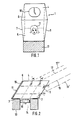
- the first object 10 can be seen in accordance with the preferred viewing direction from obliquely at the top through the first viewing surface 4.
- the object 10 in this case is a clock, an object that is particularly suitable for the glass decor bodies according to the invention.
- the clock 10 is accommodated in the base 13, specifically in the bore 14, as can be seen from FIG. 2.
- the clock is easy to operate from below.
- a second object 11 can be seen through the second viewing surface 5, which is located on the rear surface 6 of the glass decorative body.
- This second object can be, for example, an image or a photograph, which is arranged in a holding device 15 on the rear surface 6. In this way an exchange possibility is created.
- the drawn visual rays 17, 17 ' also document why the viewer sees the first object 10 through the glass decorative body 1 better than without the glass decorative body, namely because the light rays are broken through the lead crystal glass and the viewing angle thus becomes steeper.
- the shape of the glass decor body is also based on this regularity. Since the entire first object 10 is to be seen by the viewer in the preferred viewing direction, it is necessary to arrange the associated first viewing surface 4 of the glass decor body 1 displaced by a distance from the viewer, i.e. the side surface 5 facing the viewer and lying between base area 3 and viewing area 4 is inclined towards the viewer. This can be seen well when viewing the visual rays 17, 17 'in FIG. 2. As can be seen, this distance depends on the refractive index of the glass and thus on the angles ⁇ and ⁇ and on the distance of the first object 10 from the associated first viewing surface 4.
- the glass decorative body according to the invention is designed as an oblique square prism, as shown in the figures.
- the prism angles are preferably dimensioned such that the angle of incidence of the visual rays is smaller than the critical angle over the entire area of the object planes, namely the base surface 3 and the rear surface 6 is the total reflection.
- the objects 10 and 11 are then visible through the viewing surfaces 4 and 5 even if they are not in optical contact with the prism surfaces, but instead have an air distance from them.
- the refractive index of the glass of the glass decor body is greater than ⁇ 2nd , so when viewing through the side surfaces 7, 8 on the base 3 and the rear surface 6 always total reflection occurs, so that the objects 10, 11 located at a distance from the surfaces are not accessible for viewing through the side surfaces 7, 8 .
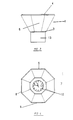
- FIGS. 3 and 4 show a pyramid-shaped glass decorative body 1.
- An object 10, for example a clock, is arranged on the base 3 in a base 13.
- the viewing surface 4 is parallel to the base surface 3.
- the side surface 5 is inclined towards the viewer.
- a second object 11 (not shown) can be arranged on the opposite rear side surface 6. It is also possible to arrange further objects 12 (not shown) on further side surfaces 7, 8.
- the glass decorative bodies according to the invention can have a wide variety of shapes. However, it is preferred that the object surfaces and viewing surfaces lie in parallel planes.
- a base on the base in which the object can be arranged.
- the objects can be exchangeable.
- Lead crystal which is ground and polished, is preferred as the material for the glass decorative body.
Landscapes
- Physics & Mathematics (AREA)
- General Physics & Mathematics (AREA)
- Optics & Photonics (AREA)
- Joining Of Glass To Other Materials (AREA)
- Adornments (AREA)
- Toys (AREA)
Applications Claiming Priority (2)
| Application Number | Priority Date | Filing Date | Title |
|---|---|---|---|
| DE4002819 | 1990-01-31 | ||
| DE4002819A DE4002819C1 (en) | 1990-01-31 | 1990-01-31 | Decorative glass body for object viewing - has object support base and inclined intermediate side face between base and viewing face |
Publications (2)
| Publication Number | Publication Date |
|---|---|
| EP0440075A2 true EP0440075A2 (fr) | 1991-08-07 |
| EP0440075A3 EP0440075A3 (en) | 1992-09-09 |
Family
ID=6399131
Family Applications (1)
| Application Number | Title | Priority Date | Filing Date |
|---|---|---|---|
| EP19910100778 Withdrawn EP0440075A3 (en) | 1990-01-31 | 1991-01-22 | Glass decorative object |
Country Status (4)
| Country | Link |
|---|---|
| US (1) | US5297352A (fr) |
| EP (1) | EP0440075A3 (fr) |
| JP (1) | JPH04212397A (fr) |
| DE (1) | DE4002819C1 (fr) |
Families Citing this family (6)
| Publication number | Priority date | Publication date | Assignee | Title |
|---|---|---|---|---|
| GB2347003A (en) * | 1999-02-11 | 2000-08-23 | Designaware Trading Ltd | Prismatic display device |
| US6443848B1 (en) | 2001-07-18 | 2002-09-03 | S. Attillio Sisofo | Levitation entertainment device |
| NL1018989C2 (nl) * | 2001-09-19 | 2003-03-20 | Leonard De Vogel | Inrichting voor het opwekken van een optische illusie. |
| US7980957B2 (en) * | 2007-09-12 | 2011-07-19 | Elizabeth Schumm | Periodic three dimensional illusion in color |
| JP3166321U (ja) | 2010-09-08 | 2011-03-03 | 一人 羽生 | 空気を封入して加工した板ガラス |
| CN102303476B (zh) * | 2011-07-03 | 2013-06-05 | 卢立新 | 水晶玻璃柱 |
Family Cites Families (10)
| Publication number | Priority date | Publication date | Assignee | Title |
|---|---|---|---|---|
| FR560412A (fr) * | 1922-12-27 | 1923-10-04 | Moyen pour obtenir des effets esthétique et pratique nouveaux applicables aux industries de la parure | |
| DE577828C (de) * | 1931-07-11 | 1933-06-06 | Max Winter Fa | Ziergegenstand |
| US2572454A (en) * | 1948-07-30 | 1951-10-23 | Down | Apparatus for displaying pictorial representations |
| US3084596A (en) * | 1959-09-15 | 1963-04-09 | Alexander J Radin | Optical reflecting device |
| US3364603A (en) * | 1966-07-27 | 1968-01-23 | Charles G. Tate Jr. | Nameplate |
| FR2025766A1 (fr) * | 1968-12-10 | 1970-09-11 | Andersen Hans | |
| US3658413A (en) * | 1970-04-08 | 1972-04-25 | Robert G Cornell | Display devices |
| DE2252743A1 (de) * | 1972-10-27 | 1974-05-16 | Rido Busse | Im wesentlichen aus durchsichtigem werkstoff bestehender bilderstaender |
| US4180930A (en) * | 1977-08-19 | 1980-01-01 | Solid Photography Inc. | Reflected three dimensional display |
| DE3340418C1 (de) * | 1983-11-09 | 1985-07-18 | Odin 6104 Seeheim Greiner | Bildstaender fuer mehrere Bilder |
-
1990
- 1990-01-31 DE DE4002819A patent/DE4002819C1/de not_active Expired - Lifetime
-
1991
- 1991-01-22 EP EP19910100778 patent/EP0440075A3/de not_active Withdrawn
- 1991-01-30 JP JP3009781A patent/JPH04212397A/ja active Pending
-
1993
- 1993-08-05 US US08/102,492 patent/US5297352A/en not_active Expired - Fee Related
Also Published As
| Publication number | Publication date |
|---|---|
| JPH04212397A (ja) | 1992-08-03 |
| DE4002819C1 (en) | 1991-06-13 |
| US5297352A (en) | 1994-03-29 |
| EP0440075A3 (en) | 1992-09-09 |
Similar Documents
| Publication | Publication Date | Title |
|---|---|---|
| DE69421668T2 (de) | Vorrichtung zum beleuchten einer fläche | |
| DE3840370C2 (fr) | ||
| DE69025502T2 (de) | Optische Vorrichtung zur Bildvergrösserung | |
| EP0562141A1 (fr) | Sertissage de pierres précieuses | |
| DE2728141A1 (de) | Spiegel | |
| DE3347014C2 (fr) | ||
| EP1001690A1 (fr) | Procede permettant de determiner la taille haute reflexion d'une pierre precieuse, procede de taille haute reflexion d'une pierre precieuse et pierre precieuse taillee a haute reflexion | |
| DE1916643A1 (de) | Transparenter Schmuckstein,insbesondere bearbeiteter Diamant | |
| DE2707540C3 (de) | Optisches Faserbündel | |
| DE4002819C1 (en) | Decorative glass body for object viewing - has object support base and inclined intermediate side face between base and viewing face | |
| DE4429683C1 (de) | Körper oder Bauteil eines strangförmigen Tripelreflektors und/ oder Werkzeugelements zur Abformung von Tripelreflektoren | |
| DE2138063B2 (de) | Anzeigevorrichtung mit flüssig kristalliner Schicht, insbesondere für die Uhrentechnik | |
| DE2926769A1 (de) | Faseroptikplatte | |
| DE68922002T2 (de) | Anamorphotische Optik und optisches Verzerrungs- und Entzerrungsgerät. | |
| DE4016700C2 (fr) | ||
| DE3816665A1 (de) | Schmuckstueck, bestehend aus mindestens einem schmuckstein und einem fassungsteil | |
| DE2722496B2 (de) | Anflugbeleuchtungsanordnung | |
| DE19538651B4 (de) | Sonnenschutzvorrichtung aus einem für Sonnenlicht transparenten Material | |
| AT393597B (de) | Zur herstellung von kesselketten geeigneter schmuckstein | |
| DE2947719C2 (de) | Retroreflektorplatte | |
| EP0029611A2 (fr) | Plaque de rétroréflecteur | |
| EP0446955A2 (fr) | Plaque de décoration | |
| DE499144C (de) | Beleuchtungsvorrichtung mit einer Reihe schraeg gestellter reflektierender Flaechen | |
| DE69708232T2 (de) | Reflektor | |
| DE3041720A1 (de) | Spiegel |
Legal Events
| Date | Code | Title | Description |
|---|---|---|---|
| PUAI | Public reference made under article 153(3) epc to a published international application that has entered the european phase |
Free format text: ORIGINAL CODE: 0009012 |
|
| 17P | Request for examination filed |
Effective date: 19910122 |
|
| AK | Designated contracting states |
Kind code of ref document: A2 Designated state(s): AT BE CH DE ES FR GB IT LI LU NL SE |
|
| PUAL | Search report despatched |
Free format text: ORIGINAL CODE: 0009013 |
|
| AK | Designated contracting states |
Kind code of ref document: A3 Designated state(s): AT BE CH DE ES FR GB IT LI LU NL SE |
|
| 17Q | First examination report despatched |
Effective date: 19931008 |
|
| STAA | Information on the status of an ep patent application or granted ep patent |
Free format text: STATUS: THE APPLICATION IS DEEMED TO BE WITHDRAWN |
|
| 18D | Application deemed to be withdrawn |
Effective date: 19940219 |