EP0440549B1 - Procédé et dispositif de gestion de transactions utilisant des cartes à microcircuit - Google Patents
Procédé et dispositif de gestion de transactions utilisant des cartes à microcircuit Download PDFInfo
- Publication number
- EP0440549B1 EP0440549B1 EP91400201A EP91400201A EP0440549B1 EP 0440549 B1 EP0440549 B1 EP 0440549B1 EP 91400201 A EP91400201 A EP 91400201A EP 91400201 A EP91400201 A EP 91400201A EP 0440549 B1 EP0440549 B1 EP 0440549B1
- Authority
- EP
- European Patent Office
- Prior art keywords
- card
- spaces
- zone
- code
- transaction
- Prior art date
- Legal status (The legal status is an assumption and is not a legal conclusion. Google has not performed a legal analysis and makes no representation as to the accuracy of the status listed.)
- Expired - Lifetime
Links
Images

Classifications
-
- G—PHYSICS
- G07—CHECKING-DEVICES
- G07F—COIN-FREED OR LIKE APPARATUS
- G07F7/00—Mechanisms actuated by objects other than coins to free or to actuate vending, hiring, coin or paper currency dispensing or refunding apparatus
- G07F7/08—Mechanisms actuated by objects other than coins to free or to actuate vending, hiring, coin or paper currency dispensing or refunding apparatus by coded identity card or credit card or other personal identification means
- G07F7/10—Mechanisms actuated by objects other than coins to free or to actuate vending, hiring, coin or paper currency dispensing or refunding apparatus by coded identity card or credit card or other personal identification means together with a coded signal, e.g. in the form of personal identification information, like personal identification number [PIN] or biometric data
- G07F7/1008—Active credit-cards provided with means to personalise their use, e.g. with PIN-introduction/comparison system
-
- G—PHYSICS
- G06—COMPUTING OR CALCULATING; COUNTING
- G06Q—INFORMATION AND COMMUNICATION TECHNOLOGY [ICT] SPECIALLY ADAPTED FOR ADMINISTRATIVE, COMMERCIAL, FINANCIAL, MANAGERIAL OR SUPERVISORY PURPOSES; SYSTEMS OR METHODS SPECIALLY ADAPTED FOR ADMINISTRATIVE, COMMERCIAL, FINANCIAL, MANAGERIAL OR SUPERVISORY PURPOSES, NOT OTHERWISE PROVIDED FOR
- G06Q20/00—Payment architectures, schemes or protocols
- G06Q20/30—Payment architectures, schemes or protocols characterised by the use of specific devices or networks
- G06Q20/34—Payment architectures, schemes or protocols characterised by the use of specific devices or networks using cards, e.g. integrated circuit [IC] cards or magnetic cards
- G06Q20/341—Active cards, i.e. cards including their own processing means, e.g. including an IC or chip
-
- G—PHYSICS
- G06—COMPUTING OR CALCULATING; COUNTING
- G06Q—INFORMATION AND COMMUNICATION TECHNOLOGY [ICT] SPECIALLY ADAPTED FOR ADMINISTRATIVE, COMMERCIAL, FINANCIAL, MANAGERIAL OR SUPERVISORY PURPOSES; SYSTEMS OR METHODS SPECIALLY ADAPTED FOR ADMINISTRATIVE, COMMERCIAL, FINANCIAL, MANAGERIAL OR SUPERVISORY PURPOSES, NOT OTHERWISE PROVIDED FOR
- G06Q20/00—Payment architectures, schemes or protocols
- G06Q20/38—Payment protocols; Details thereof
- G06Q20/40—Authorisation, e.g. identification of payer or payee, verification of customer or shop credentials; Review and approval of payers, e.g. check credit lines or negative lists
- G06Q20/409—Device specific authentication in transaction processing
- G06Q20/4093—Monitoring of device authentication
-
- G—PHYSICS
- G07—CHECKING-DEVICES
- G07F—COIN-FREED OR LIKE APPARATUS
- G07F7/00—Mechanisms actuated by objects other than coins to free or to actuate vending, hiring, coin or paper currency dispensing or refunding apparatus
- G07F7/08—Mechanisms actuated by objects other than coins to free or to actuate vending, hiring, coin or paper currency dispensing or refunding apparatus by coded identity card or credit card or other personal identification means
- G07F7/10—Mechanisms actuated by objects other than coins to free or to actuate vending, hiring, coin or paper currency dispensing or refunding apparatus by coded identity card or credit card or other personal identification means together with a coded signal, e.g. in the form of personal identification information, like personal identification number [PIN] or biometric data
- G07F7/1025—Identification of user by a PIN code
Definitions
- the invention relates to the field of transaction systems using microcircuit cards, and more particularly to a method, and the corresponding device, for managing transactions using such cards.
- microcircuit cards are used in banking transaction systems, and for this type of transaction, the use of the card in a reader requires the presentation to this reader of a confidential code specific to the bearer, authorizing execution of the transaction, as soon as it involves a sum of money.
- Other applications may also not require the presentation of this confidential code, in particular if they do not involve the microcircuit and simply use the reading of a magnetic strip carried by the card.
- the presentation of the carrier code is systematic, regardless of the amount of the transaction.
- the subject of the invention is a method and a corresponding device for managing transactions using microcircuit cards, making it possible to avoid the systematic presentation of the confidential code by the holder for transactions estimated in advance of low stake, while now sufficient security for the wearer, and this by sufficiently simple means.
- the method of managing transactions in a system using card readers and associated microcircuit cards whose holders are recognized by the system by means of confidential carrier codes and which consists in organizing the memory space of the cards intended for recording transactions in at least a first zone accessible for transactions without systematic presentation of the carrier code is characterized in that a correct presentation of the code by a carrier controls the writing of opening bits of recording spaces in this first zone until the number of open spaces is equal to a predetermined number N, N being greater than or equal to 2.
- the invention also relates to a device intended for the implementation of this method.
- Figure 1 is the flow diagram of an example of the management method according to the invention.
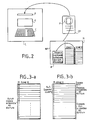
- Figure 2 schematically illustrates the device for its implementation, according to the invention ;.
- Figures 3a and 3b illustrate the memory area used for transactions of amounts below a threshold, respectively before and after presentation of the carrier code.
- the microcircuit makes it possible to direct the recording of the corresponding transactions (for example, the transactions below 100 F) towards a zone comprising a finite number of data recording spaces, and the method according to the invention provides , during the constitution of the microcircuit card, a bit initially at 0 at the head of each recording space and capable of changing value to signify the opening of the corresponding recording space, on command programmed in the microcircuit from the constitution of the card.
- This command activated by presentation of the carrier code opens previously unused recording spaces until the number of open spaces is equal to N (5 for example).
- the reader requests the composition of the confidential code and, after reception of this code and validation by the circuit, this transmits a command which on the one hand allows access to the transaction memory area called ZONE I below, provided for transactions of large amount, and on the other hand reverses the header bits of N recording spaces in the transaction memory area called ZONE II below, intended for transactions of small amount, which has the effect of opening the rights corresponding to these N spaces without redialing the code.
- the recording takes place in the corresponding zone, and none of the N open spaces is consumed. If the transaction is of small amount, the recording takes place in one of the N open spaces, and N-1 spaces remain available for the following small amount transactions.
- the code will not be requested from the bearer, via the card reader, as long as the transactions remain small and the open recording spaces are not all used.
- the code will be requested again as soon as the amount of the transaction is large on the one hand, or, for a transaction of small amount, as soon as all the open spaces have been used: in these two cases the composition of the code will command the opening of recording spaces in the memory zone allocated to small amount transactions, to open N new spaces in the second case, when the previously opened spaces have been used up.
- FIG. 1 illustrates an example of a flow diagram of the transaction management method according to the invention described below.
- the reader After the initial phase, 1, of insertion of the card in the reader and transaction request via the keyboard of the reader, the reader requests the presentation of the code, step 3, if the amount of the transaction T requested corresponds to a value greater than or equal to a predetermined threshold value S, during a test, step 2.
- a test on the value of the code, step 4, authorizes recording the transaction in ZONE I, step 5, if the code is correct and refuses the transaction (to END) if the code is not correct.
- the reader controls the reading of the opening bits of the N first empty spaces in ZONE II. If n opening bits among the N reads are 1, then by logic programmed inside the microcircuit or by wired logic, the next N-n bits are set to 1. The operation is then terminated.
- step 2 When the requested transaction is of an amount less than S, during the test of step 2, the reader orders the reading of the opening bit of the first empty space in ZONE II, step 8, then tests its value, step 9. If the bit is at 1, the transaction is recorded immediately, step 10, in the corresponding space in ZONE II.
- the reader requests the composition of the carrier code, step 11, and checks if it is correct, step 12: if not, the transaction is refused, towards END, and if so, the reader commands the launch, by the internal logic of the card, of writing to 1 the opening bits of the N first empty spaces in ZONE II, step 13, then recording the transaction, step 10, in the first open space in ZONE II.
- Figure 2 is a diagram of the device for implementing the method described above.
- a CP card includes the microcircuit P and possibly magnetic tracks and / or plain text.
- the microcircuit P comprises the microprocessor ⁇ P including in the form of a prerecorded and inaccessible program logic means for controlling the opening bits, and an associated memory space M of EPROM or EEPROM type which cannot be erased, comprising the areas I and II of recording of transactions, each comprising predefined recording spaces. In each recording area of ZONE II, the opening bit is initially provided at the start, set to 0 and capable of being set to 1 by internal control of the microcircuit.
- FIGS. 3a and 3b illustrate the memory area II, respectively before presentation of the carrier code, no space being accessible in writing, and after presentation of the carrier code following a transaction request for an amount below the threshold S, the first space having received the registration of the corresponding transaction in an embodiment where N has been chosen equal to 5: 4 spaces remain available for writing without presentation of the code, the following remaining inaccessible in writing.
- the advantage of the transaction management method according to the invention is that the security attached to the transactions remains the same as in previous systems for transactions of large amounts by the systematic presentation of the carrier code, but that simultaneously transactions of small amounts can be done by significantly reducing the number of presentations of the carrier code, without however leaving the corresponding area completely open, in order to avoid fraud, in particular in the event of loss or theft of the card: the amount corresponding to fraud is at most equal to NS.
- the invention is not limited to the embodiment precisely described and shown.
- steps 6 and 7 making it possible to complete at N the number of open spaces in ZONE II after presentation of the code for a large amount transaction recorded in ZONE I can be deleted or carried out before step 5 of registration in ZONE I.
Landscapes
- Engineering & Computer Science (AREA)
- Business, Economics & Management (AREA)
- General Physics & Mathematics (AREA)
- Physics & Mathematics (AREA)
- Accounting & Taxation (AREA)
- General Business, Economics & Management (AREA)
- Theoretical Computer Science (AREA)
- Strategic Management (AREA)
- Computer Networks & Wireless Communication (AREA)
- Microelectronics & Electronic Packaging (AREA)
- Computer Security & Cryptography (AREA)
- Finance (AREA)
- Credit Cards Or The Like (AREA)
- Control Of Vending Devices And Auxiliary Devices For Vending Devices (AREA)
- Storage Device Security (AREA)
- Financial Or Insurance-Related Operations Such As Payment And Settlement (AREA)
Description
- L'invention se rapporte au domaine des systèmes de transactions utilisant des cartes à microcircuit, et plus particulièrement à un procédé, et au dispositif correspondant, de gestion de transactions utilisant de telles cartes.
- Classiquement les cartes à microcircuit sont utilisées dans les systèmes de transactions bancaires, et, pour ce type de transactions, l'utilisation de la carte dans un lecteur nécessite la présentation à ce lecteur d'un code confidentiel propre au porteur, autorisant l'exécution de la transaction, dès que celle-ci met en jeu une somme d'argent. D'autres applications peuvent aussi ne pas nécessiter la présentation de ce code confidentiel, notamment si elles ne mettent pas en jeu le microcircuit et utilisent simplement la lecture d'une piste magnétique portée par la carte. Mais actuellement en général, dès que l'application requise utilise le microcircuit, notamment pour enregistrer une transaction dans un espace mémoire prévu à cet effet, la présentation du code du porteur est systématique, quel que soit le montant de la transaction.
- Un tel système est parfaitement sécurisé, mais il présente évidemment l'inconvénient d'être lourd et d'utilisation un peu fastidieuse dès lors que le montant des transactions est faible: si l'on conçoit en effet de présenter son code confidentiel pour de gros montants, et que l'on apprécie la sécurité ainsi attachée à de telles transactions, la présentation systématique du code confidentiel pour les achats de faible montant parait disproportionnée par rapport au risque correspondant.
- En conséquence pour les cartes multi-usages susceptibles d'être développées dans la période à venir, et notamment pour les cartes de crédits, cartes de téléphone etc..., il convient de traiter de manières différentes les transactions impliquant des montants importants et celles qui ne mettent en jeu que de faibles montants. Une solution à ce type de problème est envisagée dans le document US-A-4 001 550.
- L'invention a pour objet un procédé, et un dispositif correspondant, de gestion de transactions utilisant des cartes à microcircuit, permettant d'éviter la présentation systématique du code confidentiel par le porteur pour les transactions estimées au préalable d'enjeu faible, tout en maintenant une sécurité suffisante pour le porteur, et cela par des moyens suffisamment simples.
- Selon l'invention, le procédé de gestion de transactions dans un système mettant en oeuvre des lecteurs de cartes et des cartes à microcircuit associées dont les porteurs sont reconnus par le système au moyen de codes porteurs confidentiels et consistant à organiser l'espace mémoire des cartes destiné à l'enregistrement des transactions en au moins une première zone accessible pour des transactions sans présentation systématique du code porteur, est caractérisé en ce qu'une présentation correcte du code par un porteur commande l'écriture de bits d'ouverture d'espaces d'enregistrement dans cette première zone jusqu'à ce que le nombre d'espaces ouverts soit égal à un nombre prédéterminé N, N étant supérieur ou égal à 2.
- L'invention a également pour objet un dispositif destiné à la mise en oeuvre de ce procédé.
- L'invention sera mieux comprise et d'autres caractéristiques apparaîtront à l'aide de la description qui suit, faite au regard des figures annexées.
- La figure 1 est l'organigramme d'un exemple du procédé de gestion selon l'invention.
- La figure 2 illustre schématiquement le dispositif destiné à sa mise en oeuvre,selon l'invention;.
- Les figures 3a et 3b illustrent la zone mémoire utilisée pour les transactions de montants inférieurs à un seuil, respectivement avant et après présentation du code porteur.
- Comme indiqué ci-dessus, le procédé selon l'invention est tel que la présentation du code confidentiel du porteur au lecteur de cartes donne la possibilité au porteur de bénéficier d'un nombre N de "droits" sans avoir à présenter son code à chaque "consommation" de ce droit N>=2 : par exemple le porteur peut bénéficier de N=5 transactions monétiques de montant inférieur à 100 F chacune après chaque présentation du code.
- Pour cela, le microcircuit permet d'aiguiller l'enregistrement des transactions correspondantes (par exemple, les transactions inférieures à 100 F) vers une zone comportant un nombre fini d'espaces d'enregistrement de données, et le procédé selon l'invention prévoit, lors de la constitution de la carte à microcircuit un bit initialement à 0 en tête de chaque espace d'enregistrement et susceptible de changer de valeur pour signifier l'ouverture de l'espace d'enregistrement correspondant, sur commande programmée dans le microcircuit dès la constitution de la carte.
- Cette commande actionnée par présentation du code porteur ouvre des espaces d'enregistrement non utilisés auparavant jusqu'à ce que le nombre d'espaces ouverts soit égal à N (5 par exemple).
- Ainsi au moment de la première utilisation d'une carte neuve, le lecteur demande la composition du code confidentiel et, après réception de ce code et validation par le circuit, celui-ci transmet une commande qui d'une part permet d'accéder à la zone mémoire de transactions dite ZONE I ci-après, prévue pour les transactions de montant important, et d'autre part inverse les bits d'entête de N espaces d'enregistrement dans la zone mémoire de transactions dite ZONE II ci-après, prévue pour les transactions de faible montant, ce qui a pour effet d'ouvrir les droits correspondants à ces N espaces sans recomposer le code.
- Si la transaction qui suit est une transaction de montant important, l'enregistrement a lieu dans la zone correspondante, et aucun des N espaces ouverts n'est consommé. Si la transaction est de faible montant l'enregistrement a lieu dans un des N espaces ouverts , et N-1 espaces restent disponibles pour les transactions de faible montant suivantes.
- Lors de l'utilisation suivante, le code ne sera pas demandé au porteur, via le lecteur de cartes, tant que les transactions resteront de faible montant et que les espaces d'enregistrement ouverts ne seront pas tous utilisés.
- Par contre, le code sera à nouveau demandé dès que le montant de la transaction sera important d'une part, ou, pour une transaction de faible montant, dès que tous les espaces ouverts auront été utilisés: dans ces deux cas la composition du code commandera l'ouverture d'espaces d'enregistrement dans la zone mémoire affectée aux transactions de faible montant, pour ouvrir N nouveaux espaces dans le second cas, lorsque les espaces ouverts précédemment ont été épuisés.
- La figure 1 illustre un exemple d'organigramme du procédé de gestion de transactions selon l'invention décrit ci-après.
- Après la phase initiale, 1, d'insertion de la carte dans le lecteur et de demande de transaction via le clavier du lecteur, le lecteur demande la présentation du code, étape 3, si le montant de la transaction T demandée correspond à une valeur supérieure ou égale à une valeur de seuil prédéterminée S,lors d'un test, étape 2. Un test sur la valeur du code, étape 4, autorise l'enregistrement de la transaction en ZONE I, étape 5, si le code est correct et refuse la transaction (vers FIN ) si le code n'est pas correct.
- Le lecteur peut ne pas tenir compte de cette transaction enregistrée en ZONE I pour la gestion de la ZONE II et l'opération est alors terminée.
- Dans le mode de réalisation préféré correspondant à l'organigramme de la figure 1, la présentation correcte du code porteur ayant été effectuée, le lecteur commande la lecture des bits d'ouverture des N premiers espaces vides en ZONE II. Si n bits d'ouverture parmi les N lus sont à 1, alors par logique programmée à l'intérieur du microcircuit ou par logique câblée, les N-n bits suivants sont mis à 1. L'opération est alors terminée.
- Lorsque la transaction demandée est de montant inférieur à S, lors du test de l'étape 2, le lecteur commande la lecture du bit d'ouverture du premier espace vide en ZONE II, étape 8, puis teste sa valeur, étape 9. Si le bit est à 1, l'enregistrement de la transaction a lieu immédiatement, étape 10,dans l'espace correspondant en ZONE II.
- Par contre, si ce bit est encore à 0, le lecteur demande la composition du code porteur, étape 11, et vérifie s'il est correct, étape 12: si non, la transaction est refusée, vers FIN, et si oui, le lecteur commande le lancement, par la logique interne de la carte, de l'écriture à 1 des bits d'ouverture des N premiers espaces vides en ZONE II, étape 13, puis l'enregistrement de la transaction, étape 10, dans le premier espace ouvert en ZONE II.
- La figure 2 est un schéma du dispositif destiné à la mise en oeuvre du procédé décrit ci-dessus.
- Il comporte un lecteur L avec la fente F destinée à l'insertion d'une carte à microcircuit CP, son écran E et son clavier F pour le dialogue interactif entre le lecteur L et le porteur de la carte. Une carte CP comporte le microcircuit P et éventuellement des pistes magnétiques et/ou des inscriptions en clair. Le microcircuit P comporte le microprocesseur µP incluant sous forme d'un programme préenregistré et inaccessible des moyens logiques de commande des bits d'ouverture, et un espace mémoire associé M de type EPROM ou EEPROM non effaçable, comportant les zones I et II d'enregistrement des transactions comportant chacune des espaces d'enregistrement prédéfinis. Dans chaque espace d'enregistrement de la ZONE II est prévu en tête le bit d'ouverture initialement à 0 et susceptible d'être mis à 1 par commande interne du microcircuit.
- Les figures 3a et 3b illustrent la zone mémoire II, respectivement avant présentation du code porteur, aucun espace n'étant accessible en écriture, et après présentation du code porteur suite à une demande de transaction de montant inférieur au seuil S, le premier espace ayant reçu l'enregistrement de la transaction correspondante dans un mode de réalisation où N a été choisi égal à 5 : 4 espaces restent disponibles en écriture sans présentation du code, les suivants restant inaccessibles en écriture.
- L'avantage du procédé de gestion de transactions selon l'invention est que la sécurité attachée aux transactions reste la même que dans les systèmes antérieurs pour les transactions de montants importants par la présentation systématique du code porteur, mais que simultanément des transactions de montants faibles peuvent être effectuées en réduisant notablement le nombre de présentations du code porteur,sans toutefois laisser la zone correspondante complètement ouverte, cela afin d'éviter les fraudes, notamment en cas de perte ou vol de la carte: le montant correspondant à une fraude est au plus égal à N.S .
- L'invention n'est pas limitée au mode de réalisation précisément décrit et représenté. En particulier, il est possible de prévoir une partition de la mémoire de la carte en un nombre de zones supérieur, par exemple 3, en prévoyant une deuxième valeur de seuil, par exemple S'<S, la présentation du code permettant l'ouverture d'un nombre d'espaces d'enregistrement plus grand dans la troisième zone par exemple N', mais pour des transactions de montants faibles, inférieurs à S', la ZONE II étant alors réservée aux transactions de montants compris entre S et S'.
- De plus, l'ordre des étapes dans l'organigramme de la figure 1 n'est donné qu'à titre d'exemple et comme indiqué ci-dessus les étapes 6 et 7 permettant de compléter à N le nombre d'espaces ouverts en ZONE II après présentation du code pour une transaction de montant élevé enregistrée en ZONE I peuvent être supprimées ou effectuées avant l'étape 5 de l'enregistrement en ZONE I.
Claims (8)
- Procédé de gestion de transactions dans un système mettant en oeuvre des lecteurs de cartes et des cartes à microcircuit associées dont les porteurs sont reconnus par le système au moyen de codes porteurs confidentiels et consistant à organiser l'espace mémoire des cartes destiné à l'enregistrement des transactions en au moins une première zone accessible pour des transactions sans présentation systématique du code porteur, caractérisé en ce qu'une présentation correcte du code par un porteur commande l'écriture de bits d'ouverture d'espaces d'enregistrement dans cette première zone jusqu'à ce que le nombre d'espaces ouverts soit égal à un nombre prédéterminé N, N étant supérieur ou égal à 2.
- Procédé de gestion de transactions dans un système mettant en oeuvre des lecteurs de cartes et des cartes à microcircuit associées dont les porteurs sont reconnus par le système au moyen de codes porteurs confidentiels, caractérisé en ce qu'il consiste à organiser l'espace mémoire des cartes destiné à l'enregistrement des transactions en au moins deux zones distinctes, une première zone accessible pour un premier type de transactions, sans présentation systématique du code porteur à chaque transaction, et une deuxième zone accessible pour un deuxième type de transactions, par présentation du code à chaque transaction, une présentation correcte du code par un porteur commandant l'écriture de bits d'ouverture d'espaces d'enregistrement, dans cette première zone jusqu'à ce que le nombre d'espaces ouverts soit égal à un nombre prédéterminé N, N étant supérieur ou égal à 2.
- Procédé selon la revendication 2 caractérisé en ce que les enregistrements des transactions sont orientés par le lecteur vers la première ou deuxième zone mémoire des cartes à microcircuit selon que le montant qu'elles représentent est respectivement inférieur ou supérieur à une valeur de seuil prédéterminée.
- Procédé selon la revendication 3, caractérisé en ce que la composition du code porteur faisant suite à une demande de transaction d'un montant supérieur au seuil commande la lecture des bits d'ouverture des espaces non enregistrés suivant ceux déjà utilisés dans la première zone mémoire et l'écriture de ceux, jusqu'à N, non déjà écrits pour ouverture des espaces correspondants.
- Procédé selon l'une des revendications 1 à 4, caractérisé en ce que, le nombre d'espaces mémoires ouverts pour des transactions dans la première zone est limité au nombre prédéterminé N, et en ce que, après chaque demande de transaction et affichage de son montant, le lecteur de carte demande la composition dù code lorsqu'il n'y a plus d'espaces d'enregistrement ouverts dans la première zone, la composition du code dans ce cas commandant à nouveau l'écriture de N bits d'ouverture dans les N premiers espaces non enregistrés suivant ceux déjà utilisés dans cette première zone.
- Dispositif de gestion de transactions destiné à la mise en oeuvre du procédé selon l'une quelconque des revendications 1 à 5 comportant au moins un lecteur de cartes et des cartes à microcircuit associées dont les porteurs sont reconnus au moyen de codes porteurs confidentiels caractérisé en ce que le microcircuit de chaque carte comporte un espace mémoire destiné à l'enregistrement des transactions ayant au moins une première zone accessible pour un premier type de transactions, sans présentation systématique du code porteur à chaque transaction, et des moyens logiques inaccessibles commandant, lors d'une présentation correcte du code porteur, l'écriture de bits d'ouverture d'espaces d'enregistrements dans la première zone mémoire jusqu'à ce que le nombre d'espaces ouverts soit égal à un nombre prédéterminé N, N étant supérieur ou égal à 2, cette mémoire étant de type EPROM, ou EEPROM utilisée en EPROM, inscriptible et non effaçable.
- Dispositif selon la revendication 6, caractérisé en ce que les moyens logiques de commande d'écriture des bits d'ouverture d'espaces d'enregistrement sont constitués d'un- programme pré-enregistré dans le microcircuit.
- Dispositif selon l'une des revendications 6 ou 7, caractérisé en ce que les moyens logiques de commande d'écriture des bits d'ouverture d'espaces d'enregistrement sont constitués d'un circuit logique.
Applications Claiming Priority (2)
| Application Number | Priority Date | Filing Date | Title |
|---|---|---|---|
| FR9001073 | 1990-01-30 | ||
| FR9001073A FR2657706B1 (fr) | 1990-01-30 | 1990-01-30 | Procede et dispositif de gestion de transactions utilisant des cartes a microcircuit. |
Publications (2)
| Publication Number | Publication Date |
|---|---|
| EP0440549A1 EP0440549A1 (fr) | 1991-08-07 |
| EP0440549B1 true EP0440549B1 (fr) | 1997-09-17 |
Family
ID=9393232
Family Applications (1)
| Application Number | Title | Priority Date | Filing Date |
|---|---|---|---|
| EP91400201A Expired - Lifetime EP0440549B1 (fr) | 1990-01-30 | 1991-01-29 | Procédé et dispositif de gestion de transactions utilisant des cartes à microcircuit |
Country Status (7)
| Country | Link |
|---|---|
| US (1) | US5227612A (fr) |
| EP (1) | EP0440549B1 (fr) |
| JP (1) | JP3343130B2 (fr) |
| CA (1) | CA2035161C (fr) |
| DE (1) | DE69127641T2 (fr) |
| ES (1) | ES2109259T3 (fr) |
| FR (1) | FR2657706B1 (fr) |
Families Citing this family (36)
| Publication number | Priority date | Publication date | Assignee | Title |
|---|---|---|---|---|
| DE4129067C2 (de) * | 1991-09-02 | 1995-04-13 | Grundig Emv | Elektronisches Gerät zur Durchführung einer Vielzahl von Funktionen |
| DE69332889T2 (de) * | 1992-10-26 | 2004-03-04 | Intellect Australia Pty. Ltd. | Host-benutzer-transaktionssystem |
| CH685891A5 (de) * | 1993-01-18 | 1995-10-31 | Ascom Autelca Ag | Verfahren als Sicherheitskonzept gegen unbefugte Verwendung eines Zahlungsmittels beim bargeldlosen Begleichen an Zahlstellen |
| FR2710996B1 (fr) * | 1993-10-06 | 1995-12-01 | Gemplus Card Int | Carte portable multi-applications pour ordinateur personnel. |
| US6145739A (en) * | 1993-10-26 | 2000-11-14 | Intellect Australia Pty Ltd. | System and method for performing transactions and an intelligent device therefor |
| US5577121A (en) * | 1994-06-09 | 1996-11-19 | Electronic Payment Services, Inc. | Transaction system for integrated circuit cards |
| US5552586A (en) * | 1994-06-15 | 1996-09-03 | Kalman; Richard L. | Personal ID memory card/agency |
| US5583933A (en) * | 1994-08-05 | 1996-12-10 | Mark; Andrew R. | Method and apparatus for the secure communication of data |
| US5907597A (en) * | 1994-08-05 | 1999-05-25 | Smart Tone Authentication, Inc. | Method and system for the secure communication of data |
| US5544086A (en) * | 1994-09-30 | 1996-08-06 | Electronic Payment Services, Inc. | Information consolidation within a transaction network |
| US5596642A (en) * | 1994-09-30 | 1997-01-21 | Electronic Payment Services, Inc. | Network settlement performed on consolidated information |
| US5621796A (en) * | 1994-09-30 | 1997-04-15 | Electronic Payment Services, Inc. | Transferring information between transaction networks |
| US5559887A (en) * | 1994-09-30 | 1996-09-24 | Electronic Payment Service | Collection of value from stored value systems |
| US5633930A (en) * | 1994-09-30 | 1997-05-27 | Electronic Payment Services, Inc. | Common cryptographic key verification in a transaction network |
| KR0146624B1 (ko) * | 1994-12-19 | 1998-09-15 | 김광호 | 신용거래용 카드 및 이를 이용한 신용거래장치 및 방법 |
| US5778068A (en) * | 1995-02-13 | 1998-07-07 | Eta Technologies Corporation | Personal access management system |
| US5692049A (en) * | 1995-02-13 | 1997-11-25 | Eta Technologies Corporation | Personal access management system |
| US5682428A (en) * | 1995-02-13 | 1997-10-28 | Eta Technologies Corporation | Personal access management system |
| US5694472A (en) * | 1995-02-13 | 1997-12-02 | Eta Technologies Corporation | Personal access management system |
| US5610980A (en) * | 1995-02-13 | 1997-03-11 | Eta Technologies Corporation | Method and apparatus for re-initializing a processing device and a storage device |
| US5689564A (en) * | 1995-02-13 | 1997-11-18 | Eta Technologies Corporation | Personal access management system |
| US5696825A (en) * | 1995-02-13 | 1997-12-09 | Eta Technologies Corporation | Personal access management system |
| US5619574A (en) * | 1995-02-13 | 1997-04-08 | Eta Technologies Corporation | Personal access management system |
| US5748711A (en) * | 1995-06-07 | 1998-05-05 | Matrixx Marketing Inc. | Telephone transaction processing as a part of call transport |
| CH690530A5 (de) * | 1995-12-11 | 2000-09-29 | Ip Tpg Holdco Sarl | Verfahren zur Echtheitskontrolle eines bei einer Transaktion verwendeten vorausbezahlten Zahlungsmittels. |
| JPH1063721A (ja) * | 1996-08-14 | 1998-03-06 | Toshiba Corp | カードとカード取引システムとカード補填方法とカード取引方法 |
| SE512748C2 (sv) | 1997-05-15 | 2000-05-08 | Access Security Sweden Ab | Förfarande, aktivt kort, system samt användning av aktivt kort för att genomföra en elektronisk transaktion |
| US6000608A (en) * | 1997-07-10 | 1999-12-14 | Dorf; Robert E. | Multifunction card system |
| FR2769736B1 (fr) * | 1997-10-10 | 2000-01-14 | Denis Palos | Procede pour la securisation de transactions financieres, carte et terminal de paiement mettant en oeuvre ce procede |
| FR2783623B1 (fr) * | 1998-09-18 | 2003-05-09 | France Telecom | Procede de gestion d'une transaction electronique par carte a puce, terminal et carte a puce mettant en oeuvre ce procede |
| US6213403B1 (en) | 1999-09-10 | 2001-04-10 | Itt Manufacturing Enterprises, Inc. | IC card with fingerprint sensor |
| US6510414B1 (en) | 1999-10-05 | 2003-01-21 | Cisco Technology, Inc. | Speech recognition assisted data entry system and method |
| US7270265B2 (en) | 2001-07-06 | 2007-09-18 | France Telecom | Process for managing an electronic transaction by chip card terminal and chip card implementing this process |
| US20050216424A1 (en) * | 2004-03-23 | 2005-09-29 | Star Systems, Inc. | Transaction system with special handling of micropayment transaction requests |
| US7947805B2 (en) | 2004-12-23 | 2011-05-24 | Merck Serono S.A. | BCMA polypeptides and uses thereof |
| US7761591B2 (en) | 2005-12-16 | 2010-07-20 | Jean A. Graham | Central work-product management system for coordinated collaboration with remote users |
Family Cites Families (4)
| Publication number | Priority date | Publication date | Assignee | Title |
|---|---|---|---|---|
| US4001550A (en) * | 1975-12-04 | 1977-01-04 | Schatz Vernon L | Universal funds transfer and identification card |
| EP0247623A3 (en) * | 1984-03-19 | 1989-09-20 | Omron Tateisi Electronics Co. | Ic card transaction system |
| ES2050110T3 (es) * | 1986-01-21 | 1994-05-16 | Fujitsu Ltd | Maquina automatica de transacciones. |
| US4859837A (en) * | 1987-03-23 | 1989-08-22 | Halpern John Wolfgang | Portable data carrier incorporating manually presettable processing modes |
-
1990
- 1990-01-30 FR FR9001073A patent/FR2657706B1/fr not_active Expired - Lifetime
-
1991
- 1991-01-28 US US07/647,519 patent/US5227612A/en not_active Expired - Lifetime
- 1991-01-29 CA CA002035161A patent/CA2035161C/fr not_active Expired - Fee Related
- 1991-01-29 EP EP91400201A patent/EP0440549B1/fr not_active Expired - Lifetime
- 1991-01-29 DE DE69127641T patent/DE69127641T2/de not_active Expired - Fee Related
- 1991-01-29 ES ES91400201T patent/ES2109259T3/es not_active Expired - Lifetime
- 1991-01-30 JP JP02962291A patent/JP3343130B2/ja not_active Expired - Fee Related
Also Published As
| Publication number | Publication date |
|---|---|
| JP3343130B2 (ja) | 2002-11-11 |
| FR2657706A1 (fr) | 1991-08-02 |
| DE69127641D1 (de) | 1997-10-23 |
| ES2109259T3 (es) | 1998-01-16 |
| CA2035161A1 (fr) | 1991-07-31 |
| FR2657706B1 (fr) | 1992-11-27 |
| US5227612A (en) | 1993-07-13 |
| DE69127641T2 (de) | 1998-01-15 |
| JPH04213184A (ja) | 1992-08-04 |
| CA2035161C (fr) | 1997-02-04 |
| EP0440549A1 (fr) | 1991-08-07 |
Similar Documents
| Publication | Publication Date | Title |
|---|---|---|
| CA2035161C (fr) | Procede et dispositif de gestion de transactions utilisant des cartes a microcircuit | |
| EP0426541B1 (fr) | Procédé de protection contre l'utilisation frauduleuse de cartes à microprocesseur, et dispositif de mise en oeuvre | |
| EP0482975B1 (fr) | Procédé et dispositif pour accroître la protection d'une carte à mémoire | |
| FR2863089A1 (fr) | Procede et systeme de location automatique d'articles. | |
| FR2673476A1 (fr) | Procede securise de chargement de plusieurs applications dans une carte a memoire a microprocesseur. | |
| EP0662674A1 (fr) | Système pour transactions comprenant des terminaux et des cartes à mémoire et carte à mémoire correspondante | |
| FR2503423A1 (fr) | Systeme de cartes a memoire electronique pouvant etre rechargees a des valeurs fiduciaires | |
| US7904387B2 (en) | Method and system for facilitating purchase transactions across a network | |
| FR2716021A1 (fr) | Procédé et système de transaction par carte à puce. | |
| FR2685113A1 (fr) | Procede d'intervention sur une borne de delivrance d'un bien ou d'un service. | |
| EP0626664A1 (fr) | Système de communication avec cartes à puce | |
| WO2000067212A1 (fr) | Procede de gestion de commandes dans plusieurs fichiers d'application et carte a puce pour la mise en oeuvre du procede | |
| FR2642544A1 (fr) | Systeme de traitement de donnees a programme de securite | |
| US5940805A (en) | Method of selling data records as well as vending apparatus, memory device, chip card, and system for selling telecommunications software | |
| EP1460593A1 (fr) | Terminal de paiement securise | |
| EP0519847A1 (fr) | Carte à mémoire de comptage de données et appareil de lecture | |
| FR2643475A1 (fr) | Procede de controle de l'utilisation d'un support d'informations, notamment magnetique ou magneto-optique et systemes pour sa mise en oeuvre | |
| FR2473755A1 (fr) | Procede et dispositif electronique de memorisation et de traitement confidentiel de donnees | |
| US6680889B1 (en) | Data recording medium and data recording apparatus | |
| FR2689662A1 (fr) | Procédé de protection d'une carte à puce contre la perte d'information. | |
| FR2712104A1 (fr) | Appareil de distribution et/ou modification des supports d'informations. | |
| EP0829831A1 (fr) | Méthode d'authentification de cartes | |
| WO1999000774A1 (fr) | Module de securite comportant des moyens de creation de liens entre des fichiers principaux et des fichiers auxiliaires | |
| WO2013144514A1 (fr) | Procede et systeme de fourniture d'un ticket numerique pour l'acces a au moins un objet numerique | |
| RU2402818C2 (ru) | Автономная установка для накопления и распределения данных |
Legal Events
| Date | Code | Title | Description |
|---|---|---|---|
| PUAI | Public reference made under article 153(3) epc to a published international application that has entered the european phase |
Free format text: ORIGINAL CODE: 0009012 |
|
| AK | Designated contracting states |
Kind code of ref document: A1 Designated state(s): DE ES FR GB IT NL |
|
| 17P | Request for examination filed |
Effective date: 19910621 |
|
| 17Q | First examination report despatched |
Effective date: 19940509 |
|
| GRAG | Despatch of communication of intention to grant |
Free format text: ORIGINAL CODE: EPIDOS AGRA |
|
| GRAH | Despatch of communication of intention to grant a patent |
Free format text: ORIGINAL CODE: EPIDOS IGRA |
|
| GRAH | Despatch of communication of intention to grant a patent |
Free format text: ORIGINAL CODE: EPIDOS IGRA |
|
| GRAA | (expected) grant |
Free format text: ORIGINAL CODE: 0009210 |
|
| AK | Designated contracting states |
Kind code of ref document: B1 Designated state(s): DE ES FR GB IT NL |
|
| PG25 | Lapsed in a contracting state [announced via postgrant information from national office to epo] |
Ref country code: NL Free format text: LAPSE BECAUSE OF FAILURE TO SUBMIT A TRANSLATION OF THE DESCRIPTION OR TO PAY THE FEE WITHIN THE PRESCRIBED TIME-LIMIT Effective date: 19970917 |
|
| ITF | It: translation for a ep patent filed | ||
| REF | Corresponds to: |
Ref document number: 69127641 Country of ref document: DE Date of ref document: 19971023 |
|
| GBT | Gb: translation of ep patent filed (gb section 77(6)(a)/1977) |
Effective date: 19971031 |
|
| REG | Reference to a national code |
Ref country code: ES Ref legal event code: FG2A Ref document number: 2109259 Country of ref document: ES Kind code of ref document: T3 |
|
| NLV1 | Nl: lapsed or annulled due to failure to fulfill the requirements of art. 29p and 29m of the patents act | ||
| PLBE | No opposition filed within time limit |
Free format text: ORIGINAL CODE: 0009261 |
|
| STAA | Information on the status of an ep patent application or granted ep patent |
Free format text: STATUS: NO OPPOSITION FILED WITHIN TIME LIMIT |
|
| 26N | No opposition filed | ||
| REG | Reference to a national code |
Ref country code: GB Ref legal event code: IF02 |
|
| PGFP | Annual fee paid to national office [announced via postgrant information from national office to epo] |
Ref country code: ES Payment date: 20080111 Year of fee payment: 18 Ref country code: GB Payment date: 20071227 Year of fee payment: 18 |
|
| PGFP | Annual fee paid to national office [announced via postgrant information from national office to epo] |
Ref country code: IT Payment date: 20080123 Year of fee payment: 18 Ref country code: DE Payment date: 20080115 Year of fee payment: 18 |
|
| PGFP | Annual fee paid to national office [announced via postgrant information from national office to epo] |
Ref country code: FR Payment date: 20080131 Year of fee payment: 18 |
|
| GBPC | Gb: european patent ceased through non-payment of renewal fee |
Effective date: 20090129 |
|
| PG25 | Lapsed in a contracting state [announced via postgrant information from national office to epo] |
Ref country code: DE Free format text: LAPSE BECAUSE OF NON-PAYMENT OF DUE FEES Effective date: 20090801 |
|
| REG | Reference to a national code |
Ref country code: FR Ref legal event code: ST Effective date: 20091030 |
|
| PG25 | Lapsed in a contracting state [announced via postgrant information from national office to epo] |
Ref country code: GB Free format text: LAPSE BECAUSE OF NON-PAYMENT OF DUE FEES Effective date: 20090129 |
|
| REG | Reference to a national code |
Ref country code: ES Ref legal event code: FD2A Effective date: 20090130 |
|
| PG25 | Lapsed in a contracting state [announced via postgrant information from national office to epo] |
Ref country code: ES Free format text: LAPSE BECAUSE OF NON-PAYMENT OF DUE FEES Effective date: 20090130 Ref country code: FR Free format text: LAPSE BECAUSE OF NON-PAYMENT OF DUE FEES Effective date: 20090202 |
|
| PG25 | Lapsed in a contracting state [announced via postgrant information from national office to epo] |
Ref country code: IT Free format text: LAPSE BECAUSE OF NON-PAYMENT OF DUE FEES Effective date: 20090129 |