EP0441033A2 - Appareil pour déterminer l'histoire thermique d'appareillages utilisant des détecteurs solides des traces - Google Patents
Appareil pour déterminer l'histoire thermique d'appareillages utilisant des détecteurs solides des traces Download PDFInfo
- Publication number
- EP0441033A2 EP0441033A2 EP90312987A EP90312987A EP0441033A2 EP 0441033 A2 EP0441033 A2 EP 0441033A2 EP 90312987 A EP90312987 A EP 90312987A EP 90312987 A EP90312987 A EP 90312987A EP 0441033 A2 EP0441033 A2 EP 0441033A2
- Authority
- EP
- European Patent Office
- Prior art keywords
- equipment
- temperature
- sstrs
- activation energy
- thermal aging
- Prior art date
- Legal status (The legal status is an assumption and is not a legal conclusion. Google has not performed a legal analysis and makes no representation as to the accuracy of the status listed.)
- Granted
Links
Images

Classifications
-
- G—PHYSICS
- G01—MEASURING; TESTING
- G01K—MEASURING TEMPERATURE; MEASURING QUANTITY OF HEAT; THERMALLY-SENSITIVE ELEMENTS NOT OTHERWISE PROVIDED FOR
- G01K3/00—Thermometers giving results other than momentary value of temperature
- G01K3/02—Thermometers giving results other than momentary value of temperature giving means values; giving integrated values
- G01K3/04—Thermometers giving results other than momentary value of temperature giving means values; giving integrated values in respect of time
-
- G—PHYSICS
- G21—NUCLEAR PHYSICS; NUCLEAR ENGINEERING
- G21C—NUCLEAR REACTORS
- G21C17/00—Monitoring; Testing ; Maintaining
-
- Y—GENERAL TAGGING OF NEW TECHNOLOGICAL DEVELOPMENTS; GENERAL TAGGING OF CROSS-SECTIONAL TECHNOLOGIES SPANNING OVER SEVERAL SECTIONS OF THE IPC; TECHNICAL SUBJECTS COVERED BY FORMER USPC CROSS-REFERENCE ART COLLECTIONS [XRACs] AND DIGESTS
- Y02—TECHNOLOGIES OR APPLICATIONS FOR MITIGATION OR ADAPTATION AGAINST CLIMATE CHANGE
- Y02E—REDUCTION OF GREENHOUSE GAS [GHG] EMISSIONS, RELATED TO ENERGY GENERATION, TRANSMISSION OR DISTRIBUTION
- Y02E30/00—Energy generation of nuclear origin
- Y02E30/30—Nuclear fission reactors
Definitions
- the invention concerns an apparatus for passively determining the thermal history of equipment by employing a combination of solid state track recorders ("SSTRs").
- SSTRs solid state track recorders
- the apparatus is adapted to be used with a method disclosed in related application Serial No. 481,040, filed on February 16, 1990, to determine an equivalent average temperature from which thermal aging of the equipment may be determined.
- thermal aging The properties of many materials undergo alteration as a result of exposure to temperature, for example, rubber gaskets may take a permanent set, flexible members may become brittle, organic fluids may decompose, electrical properties of insulating materials may vary, etc. This alteration in properties as a result of exposure to temperature is termed "thermal aging”.
- a qualified life i.e. a maximum period of time for which the equipment may be placed in service. Due to the aforementioned thermal aging effect, the qualified life is a function of the temperature environment to which the equipment is subjected, as well as other factors, such as exposure to radiation.
- Some pieces of equipment may be comprised of various critical components each with its own qualified life. For maintenance purposes it is vital, therefore, to know when each piece of qualified equipment, or component therein, has reached its qualified life.
- a second possible alternative to active monitoring would be to monitor the temperature environment of the equipment by passive means, thereby enabling the extent of thermal aging to be determined with less difficulty and expense.
- a passive temperature measuring device could be placed in close proximity to the equipment of interest so that the monitor would be subjected to the same temperature environment as the equipment.
- the device would undergo a detectable change (e.g., undergo thermal aging), the rate of this change being a known function of temperature.
- the Arrhenius function has been used in the past to analyze the results of accelerated thermal aging tests, for example as disclosed in S. Carfagno and R. Gibson, A Review of Equipment Aging Theory and Technology , EPRI Report, NP-1558, ⁇ 8.3 (1980), and to analyze data from naturally occurring particle tracks in naturally occurring glasses for geological dating purposes, for example as disclosed in D. Storzer, "Fission Track Dating of Volcanic Glasses and the Thermal History of Rocks," in Earth and Planetary Science Letters , 8, pp 55-60 (1970.
- D. Storzer "Fission Track Dating of Volcanic Glasses and the Thermal History of Rocks," in Earth and Planetary Science Letters , 8, pp 55-60 (1970.
- its use as described herein, to determine an equivalent average temperature obtained from passive devices which can be related to the thermal aging of the equipment being monitored, is believed to be new.
- a passive thermal monitoring device comprises a plurality of solid state track recorders ("SSTRs").
- the thermal aging process to which each SSTR is subject is characterized by an Arrhenius function.
- the SSTRs are selected so that the Arrhenius function characterizing each SSTR is characterized by a different activation energy value.
- the range in activation energy values among the SSTRs encompasses the activation energy value characterizing the thermal aging process to which the equipment is subject.
- the apparatus is employed by exposing the passive thermal monitoring device to the same environment as the equipment to be monitored. After exposure, each SSTR is "read” by quantifying the thermal aging which it has undergone. The extent of thermal aging is then compared to a calibration standard to obtain an equivalent average temperature, termed the Arrhenius equivalent temperature (“AET”), associated with the thermal aging of each SSTR. An AET associated with the thermal aging of the equipment is then determined from the AET's obtained from the SSTRs, by comparing the activation energy of the thermal aging process to which the equipment is subject to the activation energy values of the SSTRs.
- AET Arrhenius equivalent temperature
- Figure 1 is a graph of annealing data from the annealing of particle tracks formed by exposure of hard soda lime glass to isotope 252 of californium.
- the ordinate is time, in days, on a common log scale and the abscissa is the inverse of temperature, in °Kx10 ⁇ 3.
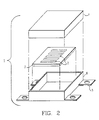
- Figure 2 is an exploded view of the passive thermal monitoring device.
- Figure 3 is a schematic representation of the variation in activation energy with the extent of annealing.
- the ordinate is activation energy in eV and the abscissa is the extent of annealing in terms of the track diameter reduction ratio.
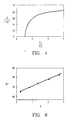
- Figure 4 is a schematic representation of the relationship of the etched track diameter D to the ratio of track to bulk etch rates V T /V B .
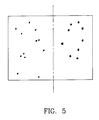
- Figure 5 is a schematic representation of annealed and unannealed tracks in hard soda lime glass after etching.
- Figure 6 is a schematic representation of Arrhenius equivalent temperature versus activation energy, obtained from a group of SSTRs after exposure to a temperature environment.
- the value of the activation energy E depends on the particular process.
- Arrhenius functions each characterized by a different value of the activation energy term.
- an individualized Arrhenius function can be developed to characterize the temperature dependence of the reaction rate for any given process.
- the processes associated with thermal aging of equipment can be characterized by Arrhenius functions, as evidenced by the fact that the Arrhenius model has often been used in accelerating aging tests (to extrapolate the results of short time exposure at high temperatures to obtain expected aging effects due to long time exposure at lower temperatures).
- the thermal aging process in the equipment to be monitored for example, a piece of qualified equipment in a nuclear power plant, can be described by an Arrhenius function, characterized by an activation energy which represents the effect of temperature on the rate at which the particular aging process occurs.
- 50% compression set in a gasket material might have an activation energy of 1.2 eV
- a 25% loss in lubricity of a lubricant might have an activation energy of 0.8 eV.
- the activation energy values in this example which have been arbitrarily assigned for illustrative purposes only, would indicate that the rate of lubricity loss increases more rapidly with increasing temperature than does the rate of gasket compression set.
- the temperature of the environment to which equipment is subjected will vary over time.
- the thermal history of a particular environment can often be characterized by a histogram, for example, 6 months at 50°C, 2 months at 70°C, etc. Since, according to the Arrhenius model, temperature has an exponential effect on the thermal aging process, it is not possible to construct an average value representative of the thermal history which is applicable to all equipment exposed to such thermal history.
- Equipment in which the rate of thermal aging increases most rapidly with increasing temperature i.e. equipment in which the aging process has a high activation energy
- this difficulty in characterizing a thermal history by use of an average temperature can be overcome by constructing an "equivalent” average temperature.
- the inventors denominate this equivalent average temperature the Arrhenius Equivalent Temperature ("AET").
- the AET is a quantity which represents the temperature which would be required to produce the thermal aging which has occurred if such thermal aging were the result of exposure to a constant temperature, rather than the variable temperature of the actual thermal history. If the thermal history of the environment were known exactly (i.e. through active temperature monitoring), the AET could be calculated using the Arrhenius function. The calculated AET would accurately characterize the thermal history with respect to any process the thermal aging of which is characterized by the same Arrhenius function as that used to calculate the AET (i.e. the same activation energy value).
- An AET can also be obtained from a passive temperature measuring device, provided the process governing the thermal aging observed in such device can be characterized by an Arrhenius function.
- the AET is obtained by comparing the observed thermal aging of the passive temperature measuring device to a calibration standard which indicates the constant temperature exposure required to produce a similar extent of thermal aging.
- the AET for the equipment being monitored may then be inferred by interpolating among, or extrapolating from, the AET's obtained from several passive temperature measuring devices. This interpolation/extrapolation is performed by comparing the activation energy associated with the Arrhenius function characterizing the thermal aging process in the equipment with the activation energy values associated with the thermal aging process in each passive temperature measuring device.
- a passive temperature measuring device may be created by exposing a member, formed from an appropriate material, to an altering agent. Such exposure produces an alteration in the member which undergoes a quantifiable change as a result of exposure to temperature (i.e., the member thus altered is subject to thermal aging).
- An SSTR is such a passive temperature measuring device.
- an SSTR is a member formed from a material, generally a dielectric material, in which, as explained further below, exposure to energetic charged particles results in the formation of observable "tracks" which anneal as a result of exposure to temperature.
- an SSTR is utilized by exposing it to energetic charged particles, such as fission fragments or alpha particles, from a radiation source.
- annealing The radiation damage associated with the track reverses itself with exposure to temperature, a thermal aging process referred to as annealing.
- annealed tracks observed after etching, are smaller.
- this process is sometimes referred to as "track fading.”
- track fading since the reduction in track size renders some tracks invisible, the density of the tracks is also reduced.
- the extent of track annealing may be quantified by determining the reduction in the average track diameter or the reduction in the track density. Calibration standards are created for each SSTR material by forming a number of test members from the material and exposing these test members to energetic charged particles.
- the tracks thus formed in the test members are then subjected to annealing at a variety of temperatures for a variety of times.
- the resulting data can be displayed in curves, such as those shown in Figure 1 (constructed from annealing data from an SSTR formed from hard soda lime glass).
- the curves in Figure 1 display the exposure time t required to produce a constant extent of track annealing D/D0 (the ratio by which the diameter of the tracks decreased as a result of annealing) as a function of exposure temperature T.
- the inventors have determined that, in a number of materials suitable for SSTRs (identified in the table below), the track annealing process follows the Arrhenius model in that the extent to which the track annealing rate varies with temperature can be characterized by an Arrhenius function.
- plotting lines of constant diameter reduction ratio as the common log of time versus the reciprocal of the temperature in °K for such materials results in the series of straight lines shown in Figure 1.
- a passive thermal monitoring device 1 which is comprised of a plurality of SSTRs 2.
- SSTR consists of a thin strip of a dielectric material, preferably glass.
- plastics have activation energies and temperature sensitivities which make them suitable for thermal aging monitoring.
- their bulk etch rate is altered by exposure to beta or gamma radiation.
- the observed particle track diameters will be affected by in-service exposure to both radiation and temperature, leading to errors in temperature measurement.
- plastics may not be suitable for use in nuclear power plants unless the possibly synergistic effects of temperature and radiation are quantified, or unless they are used in areas with very low radiation levels.
- the strips are fixed to a holding block 3 which may be injection molded plastic.
- the holding block is retained in an environmental enclosure having a cover 4 and a base 6, which may be made from stainless steel, and features mounting brackets 5 which allow the device to be conveniently bolted in close proximity to the equipment to be monitored.
- a cover 4 and a base 6 which may be made from stainless steel, and features mounting brackets 5 which allow the device to be conveniently bolted in close proximity to the equipment to be monitored.
- mounting brackets 5 which allow the device to be conveniently bolted in close proximity to the equipment to be monitored.
- the SSTRs are formed from a variety of different types of glass so that the range of their activation energies encompasses the activation energy of the thermal aging process of the equipment to be monitored.
- materials have been identified which can provide the device with a range of activation energy values as high as 0.6-2.5 eV.
- the SSTR materials should be selected so that the range of activation energies of the monitoring device is at least 0.5-1.5 eV. This range will encompass the activation energy of most of the thermal aging processes of interest.
- the monitoring device could be constructed using a single SSTR if its activation energy were sufficiently close to that of the thermal aging process of the equipment to be monitored, as discussed further below. However, it has been determined that in general at least three SSTRs should be used to obtain broad coverage and insure accurate interpolation of the results.
- Activation energy is not the only characteristic that may be used to select the SSTR materials used in the practice of this invention. Different materials exhibit different particle track annealing characteristics as a function of temperature. While such temperature sensitivities are not well defined, the SSTRs can be selected with a view to having the temperature sensitivities of the respective SSTRs encompass the range of temperatures to which the equipment is to be subjected.
- the materials for the monitoring device have been selected and SSTRs formed from such materials, half of each SSTR is exposed to energetic charged particles.
- the inventors have determined that exposure to isotope 252 of californium, in a vacuum, produces suitable particle tracks.
- the SSTRs 2 are placed in the holding block 3, which is then secured in the enclosure base 6.
- the monitoring device is then placed in service by affixing it, preferably utilizing the mounting brackets 5, in close proximity to the equipment to be monitored.
- the device After a predetermined period of time, which initially may be one fuel cycle in a nuclear power plant (approximately 1 to 2 years), the device will be removed from service and the data "read” as described below. Thereafter, the SSTRs will be replaced with fresh ones and the device is expected to remain in service until the equipment is nearing the end of its useful life, based on the temperature data obtained from the initial reading. Since the useful life is always conservatively determined, this second reading may indicate that the equipment has further life remaining. Since the useful life is more accurately determined, the cost of equipment replacement is minimized. Alternatively, in the event of an accident, the device can be read to determine what impact the short time exposure to higher than normal temperatures had on the thermal aging of the equipment.
- the SSTRs are read by exposing the previously unexposed half of each SSTR to energetic charged particles.
- the method used to form the new tracks should be identical to that used in the original exposure, to ensure that the fresh tracks are the same size (or the same density if the density reduction ratio is used to determine the extent of annealing) as the tracks formed by the original exposure.
- sufficiently accurate results may be obtained by ensuring that both exposures are conducted by substantially similar methods (i.e., same type fission source used, same distance between fission source and SSTR, and conducting both exposures in a vacuum). After exposure, the entire SSTR is then etched to render the particle tracks visible upon magnification.
- the extent of annealing can be quantified.
- this characteristic dimension should be the track diameter.
- the extent of annealing can then be quantified by determining the ratio of the reduction in track diameters, D/D0.
- isotropic track exposures can be used and by comparing the number of tracks remaining in the annealed portion with those in the unannealed portion, the reduction in track density can also be used to quantify the extent of annealing.
- the particle tracks must be etched to render them visible. This is accomplished by subjecting the SSTR to an etchant which attacks the particle tracks at a rate faster than that with which it attacks the bulk material.
- the rapidity with which the etchant attacks is called the etch rate.
- the track etch rate must be greater than the etch rate in the bulk material.
- FIG. 5 a schematic representation of a photomicrograph of annealed and unannealed tracks in hard soda lime glass after etching.
- the tracks were produced by exposure to isotope 252 of californium and annealing was done by subjecting the SSTR to 100°C for 14.1 days.
- the portion to the right of line V-V represents the unannealed tracks, the portion to the left, the annealed tracks.
- the extent of annealing was determining by initially exposing two SSTRs to energetic charge particles.
- One SSTR was placed in service and the other was maintained in a temperature controlled environment at a temperature low enough to produce negligible annealing.
- both were etched and the extent of annealing determined by determining the difference between the particle tracks in the two SSTRs.
- the inventors have determined that the method of reading SSTRs in the current invention is superior to the prior art method.
- an AET associated with each SSTR is determined by constructing a calibration curve similar to that shown in Figure 1 using calibration data corresponding to the D/D0 obtained by each SSTR (a different calibration curve is drawn for each SSTR material).
- the AET is determined for each SSTR by entering each graph for the period of time over which the SSTR was in service and reading the corresponding temperature.
- Each AET is an equivalent average temperature representative of the thermal aging to which each SSTR was subjected. This AET is applicable to any thermal aging process with an activation energy equal to that of the track annealing process in the SSTR.
- the activation energy valve for each SSTR is simply obtained from the slope of the log t versus 1/t plot for each SSTR.
- the AET associated with the thermal aging of the equipment is then determined by relating the activation energy of the equipment to the activation energies of the SSTRs.
- the activation energy characterizing the Arrhenius function characterizing the thermal aging process in the equipment is often supplied by the equipment designer along with the qualification data for the equipment.
- the activation energy can be determined from equipment life data plotted in a manner similar to Figure 1, the activation energy being the slope of the log t versus 1/T curve.
- the determination of the AET associated with the equipment can be accomplished by constructing a plot of AET versus activation energy for the SSTRs, such as that shown in Figure 6.
- the AET associated with the thermal aging of the equipment is determined by interpolation (or extrapolation if the activation energy of the equipment is outside the range of activation energies of the SSTRs comprising the monitoring device), by entering the graph at the activation energy of the thermal aging process in the equipment and reading the indicated temperature.
- equipment life data is represented by a curve of useful life versus temperature. Such curves are usually generated by exposing the equipment to a constant temperature and noting when failure occurs. This procedure may be repeated a number of times at various temperatures to determine the slope of the useful life versus temperature curve. Often, it is desired to conduct accelerated aging tests in order to reduce the time required to obtain the life data.
- the Arrhenius function may be utilized to interpret and extrapolate accelerated aging test data as explained in S. Carfagno and R. Gibson, A Review of Equipment Aging Theory and Technology , EPRI Report, NP-1558, ⁇ 8.3 (1980).
- the remaining useful life may be determined by entering the useful life versus temperature curve for the equipment at the determined AET and the known exposure time and noting the remaining life.
- the invention described above produces AET's which span a range of activation energy values as a result of employing a plurality of SSTRs in a single thermal monitoring device. This ensures that the AET associated with the equipment will be accurate, since its activation energy will be encompassed by the range of activation energy values of the SSTRs. It also allows a single monitoring device to be used to monitor the temperature environment of several pieces of equipment, each with its own activation energy value.
- the activation energy value of the SSTR should be fairly close to that of the equipment to be monitored.
- the extent to which the activation energy of the SSTR can deviate from that of the equipment depends on the desired accuracy of the final AET (that is, the AET associated with the equipment) which will be obtained by utilizing the method.
- the desired accuracy will depend on the criticality of the equipment to be monitored and the extent to which its useful life is temperature dependent.
- the acceptable activation energy tolerance can be determined by devising a histogram based on a best estimate of the thermal environment to be encountered. Using this histogram and the Arrhenius function, AET's can be calculated for a variety of activation energy values so that a curve of AET versus E, such as that shown in Figure 6, can be plotted. The slope of the AET versus E line will determine the acceptable activation energy tolerance for a given temperature tolerance (i.e. if the slope were 1°C/0.01 eV and the temperature tolerance were ⁇ 5°C, then the activation energy tolerance would be ⁇ 0.05 eV).
- a single SSTR can then be used to monitor the thermal history, provided its activation energy value falls within the tolerance.
- the activation energy value of the equipment was 1.0 eV then a single SSTR would produce a result with the desired accuracy if its activation energy was in the 0.95-1.05 eV range. Since the validity of the activation energy tolerance obtained as described above depends on the accuracy with which the thermal history can be predicted, a high degree of uncertainty concerning the temperature environment should be compensated for by tightening the temperature tolerance.
- the invention has been explained as applicable in a nuclear power plant, the invention is equally applicable to any situation in which it is desired to passively determine the thermal environment to which equipment is subjected, provided the temperature dependence of the equipment can be characterized by an Arrhenius function.
- the Arrhenius formulation has been used to determine failure probabilities in aircraft electronics exposed to elevated temperatures.
- the invention is explained as applied to determining an equivalent average temperature associated with a thermal aging process in equipment.
- the invention can be used to determine an equivalent average temperature associated with any process whose reaction rate can be characterized by an Arrhenius function of temperature, whether or not such process causes thermal aging in equipment, so long as the thermal monitoring device can be situated so that it is subjected to the same temperature environment as the constituents involved in the process and so long as the process being monitored does not interfere with the track annealing process in the SSTRs.
- the scope of the invention is illustrated by the example of compounds A and B that react over a period of time to produce compound C. Where it is known that the process by which this occurs is dependent on the temperature to which A and B are subjected, then it is desirable to determine the temperature at which the process occurred so that the amount of C produced can be calculated.
- the reaction rate of the process can be characterized by an Arrhenius function
- the invention can be applied to obtain an AET associated with the process.
- the activation energy of the process under study rather than that of the thermal aging of equipment, is used to interpolate among the AET's from the passive temperature measuring devices.
- the AET associated with the process is then be used to determine the extent to which the process occurred - in the example, the amount of C produced.
Landscapes
- Physics & Mathematics (AREA)
- Engineering & Computer Science (AREA)
- Plasma & Fusion (AREA)
- General Engineering & Computer Science (AREA)
- High Energy & Nuclear Physics (AREA)
- General Physics & Mathematics (AREA)
- Monitoring And Testing Of Nuclear Reactors (AREA)
- Testing Resistance To Weather, Investigating Materials By Mechanical Methods (AREA)
- Measurement Of Radiation (AREA)
- Measuring Temperature Or Quantity Of Heat (AREA)
- Investigating Or Analyzing Materials Using Thermal Means (AREA)
- Testing Or Measuring Of Semiconductors Or The Like (AREA)
Applications Claiming Priority (2)
| Application Number | Priority Date | Filing Date | Title |
|---|---|---|---|
| US47906090A | 1990-02-01 | 1990-02-01 | |
| US479060 | 2000-01-07 |
Publications (3)
| Publication Number | Publication Date |
|---|---|
| EP0441033A2 true EP0441033A2 (fr) | 1991-08-14 |
| EP0441033A3 EP0441033A3 (en) | 1991-10-02 |
| EP0441033B1 EP0441033B1 (fr) | 1998-09-16 |
Family
ID=23902502
Family Applications (1)
| Application Number | Title | Priority Date | Filing Date |
|---|---|---|---|
| EP90312987A Expired - Lifetime EP0441033B1 (fr) | 1990-02-01 | 1990-11-29 | Appareil pour déterminer l'histoire thermique d'appareillages utilisant des détecteurs solides des traces |
Country Status (4)
| Country | Link |
|---|---|
| EP (1) | EP0441033B1 (fr) |
| JP (1) | JP2917230B2 (fr) |
| KR (1) | KR920000085A (fr) |
| ES (1) | ES2121747T3 (fr) |
Cited By (1)
| Publication number | Priority date | Publication date | Assignee | Title |
|---|---|---|---|---|
| CN116070962A (zh) * | 2023-03-06 | 2023-05-05 | 泰安鲁怡高分子材料有限公司 | 一种基于大数据的老化试验箱运行可行性评估系统 |
Families Citing this family (1)
| Publication number | Priority date | Publication date | Assignee | Title |
|---|---|---|---|---|
| JP3483520B2 (ja) | 2000-04-26 | 2004-01-06 | 日本電信電話株式会社 | 信頼性評価試験方法および記録媒体 |
Family Cites Families (2)
| Publication number | Priority date | Publication date | Assignee | Title |
|---|---|---|---|---|
| US3102425A (en) * | 1962-03-14 | 1963-09-03 | Ontario Research Foundation | Method and apparatus for temperature integrating |
| US4167109A (en) * | 1978-06-22 | 1979-09-11 | Raymond Gold | Process for measuring temperature with solid state track recorders |
-
1990
- 1990-11-29 EP EP90312987A patent/EP0441033B1/fr not_active Expired - Lifetime
- 1990-11-29 ES ES90312987T patent/ES2121747T3/es not_active Expired - Lifetime
-
1991
- 1991-01-30 JP JP3009669A patent/JP2917230B2/ja not_active Expired - Lifetime
- 1991-01-31 KR KR1019910001697A patent/KR920000085A/ko not_active Ceased
Cited By (1)
| Publication number | Priority date | Publication date | Assignee | Title |
|---|---|---|---|---|
| CN116070962A (zh) * | 2023-03-06 | 2023-05-05 | 泰安鲁怡高分子材料有限公司 | 一种基于大数据的老化试验箱运行可行性评估系统 |
Also Published As
| Publication number | Publication date |
|---|---|
| JPH04213096A (ja) | 1992-08-04 |
| EP0441033A3 (en) | 1991-10-02 |
| JP2917230B2 (ja) | 1999-07-12 |
| ES2121747T3 (es) | 1998-12-16 |
| KR920000085A (ko) | 1992-01-10 |
| EP0441033B1 (fr) | 1998-09-16 |
Similar Documents
| Publication | Publication Date | Title |
|---|---|---|
| EP0443260A1 (fr) | Méthode pour déterminer une température moyenne équivalente associée avec l'histoire thermique d'un appareil | |
| Blank et al. | Oxide fuel transients | |
| US5064605A (en) | Apparatus for determining the thermal history of equipment using solid state track recorders | |
| Li et al. | Model selection for degradation-based Bayesian reliability analysis | |
| EP0441033B1 (fr) | Appareil pour déterminer l'histoire thermique d'appareillages utilisant des détecteurs solides des traces | |
| RU2231145C2 (ru) | Способ определения эффективной интенсивности источника нейтронов ядерной установки | |
| Plaček | Assessment of parameters for simulation of thermal ageing of materials in nuclear power plants using DSC | |
| EP0256616A1 (fr) | Méthode de correction de la génération d'isotope dans un dosimètre à neutrons de fission | |
| US5473643A (en) | Corrosion testing using isotopes | |
| US4980118A (en) | Nuclear power generating station equipment qualification method and apparatus | |
| Shlyakhter et al. | Estimating uncertainty in physical measurements, observational and environmental studies: Lessons from trends in nuclear data | |
| Allred | Effect of radiation on silicon and borosilicate glass | |
| KR820002398B1 (ko) | 연료체 캔 파쇄 특성의 결정방법 | |
| Popescu et al. | SOURCE IST 2.0 Modeling Uncertainty for Noble Gases | |
| Decréton et al. | Influence of the testing environment in bipolar transistors radiation resistance results: A benchmark exercise | |
| Gavrin et al. | Effect of radon on SAGE results | |
| Cunningham et al. | Storage of LWR spent fuel in air. Volume 3, Results from exposure of spent fuel to fluorine-contaminated air | |
| Anderson | Negative‐Margin Criterion for Impact‐Response Prediction | |
| Bussolini et al. | An Experience Report: Step Stress Testing to Failure for Reliability Analysis of Electronic Equipment | |
| Langner | Computer simulation of the L/sub III/-edge densitometer | |
| Christie et al. | Investigation of decalibrated Nicrosil versus Nisil thermocouples: Quantitative sims analysis using indexed sensitivity factors and oxygen flooding | |
| Futamura et al. | Fuel at Elevated Temperatures | |
| Kononenko et al. | Nondestructive control of condition and prediction of cable life time at nuclear power plants | |
| Wakayama et al. | Development on experimental VHTR instrumentation | |
| Grivet et al. | The use of the Projected Track Length Distributions of fission tracks in apatite for thermal hisory analysis |
Legal Events
| Date | Code | Title | Description |
|---|---|---|---|
| PUAI | Public reference made under article 153(3) epc to a published international application that has entered the european phase |
Free format text: ORIGINAL CODE: 0009012 |
|
| PUAL | Search report despatched |
Free format text: ORIGINAL CODE: 0009013 |
|
| AK | Designated contracting states |
Kind code of ref document: A2 Designated state(s): BE CH ES FR GB IT LI |
|
| AK | Designated contracting states |
Kind code of ref document: A3 Designated state(s): BE CH ES FR GB IT LI |
|
| 17P | Request for examination filed |
Effective date: 19920327 |
|
| 17Q | First examination report despatched |
Effective date: 19940211 |
|
| GRAG | Despatch of communication of intention to grant |
Free format text: ORIGINAL CODE: EPIDOS AGRA |
|
| GRAG | Despatch of communication of intention to grant |
Free format text: ORIGINAL CODE: EPIDOS AGRA |
|
| GRAH | Despatch of communication of intention to grant a patent |
Free format text: ORIGINAL CODE: EPIDOS IGRA |
|
| GRAH | Despatch of communication of intention to grant a patent |
Free format text: ORIGINAL CODE: EPIDOS IGRA |
|
| GRAA | (expected) grant |
Free format text: ORIGINAL CODE: 0009210 |
|
| AK | Designated contracting states |
Kind code of ref document: B1 Designated state(s): BE CH ES FR GB IT LI |
|
| PG25 | Lapsed in a contracting state [announced via postgrant information from national office to epo] |
Ref country code: IT Free format text: LAPSE BECAUSE OF FAILURE TO SUBMIT A TRANSLATION OF THE DESCRIPTION OR TO PAY THE FEE WITHIN THE PRESCRIBED TIME-LIMIT;WARNING: LAPSES OF ITALIAN PATENTS WITH EFFECTIVE DATE BEFORE 2007 MAY HAVE OCCURRED AT ANY TIME BEFORE 2007. THE CORRECT EFFECTIVE DATE MAY BE DIFFERENT FROM THE ONE RECORDED. Effective date: 19980916 Ref country code: LI Free format text: LAPSE BECAUSE OF FAILURE TO SUBMIT A TRANSLATION OF THE DESCRIPTION OR TO PAY THE FEE WITHIN THE PRESCRIBED TIME-LIMIT Effective date: 19980916 Ref country code: CH Free format text: LAPSE BECAUSE OF FAILURE TO SUBMIT A TRANSLATION OF THE DESCRIPTION OR TO PAY THE FEE WITHIN THE PRESCRIBED TIME-LIMIT Effective date: 19980916 Ref country code: BE Free format text: LAPSE BECAUSE OF FAILURE TO SUBMIT A TRANSLATION OF THE DESCRIPTION OR TO PAY THE FEE WITHIN THE PRESCRIBED TIME-LIMIT Effective date: 19980916 Ref country code: FR Free format text: LAPSE BECAUSE OF FAILURE TO SUBMIT A TRANSLATION OF THE DESCRIPTION OR TO PAY THE FEE WITHIN THE PRESCRIBED TIME-LIMIT Effective date: 19980916 |
|
| REG | Reference to a national code |
Ref country code: CH Ref legal event code: EP |
|
| REG | Reference to a national code |
Ref country code: ES Ref legal event code: FG2A Ref document number: 2121747 Country of ref document: ES Kind code of ref document: T3 |
|
| EN | Fr: translation not filed | ||
| REG | Reference to a national code |
Ref country code: CH Ref legal event code: PL |
|
| PLBE | No opposition filed within time limit |
Free format text: ORIGINAL CODE: 0009261 |
|
| STAA | Information on the status of an ep patent application or granted ep patent |
Free format text: STATUS: NO OPPOSITION FILED WITHIN TIME LIMIT |
|
| 26N | No opposition filed | ||
| PGFP | Annual fee paid to national office [announced via postgrant information from national office to epo] |
Ref country code: GB Payment date: 20011004 Year of fee payment: 12 |
|
| PGFP | Annual fee paid to national office [announced via postgrant information from national office to epo] |
Ref country code: ES Payment date: 20011120 Year of fee payment: 12 |
|
| REG | Reference to a national code |
Ref country code: GB Ref legal event code: IF02 |
|
| PG25 | Lapsed in a contracting state [announced via postgrant information from national office to epo] |
Ref country code: GB Free format text: LAPSE BECAUSE OF NON-PAYMENT OF DUE FEES Effective date: 20021129 |
|
| PG25 | Lapsed in a contracting state [announced via postgrant information from national office to epo] |
Ref country code: ES Free format text: LAPSE BECAUSE OF NON-PAYMENT OF DUE FEES Effective date: 20021130 |
|
| GBPC | Gb: european patent ceased through non-payment of renewal fee | ||
| REG | Reference to a national code |
Ref country code: ES Ref legal event code: FD2A Effective date: 20031213 |