EP0441207A2 - Heteroarylalkene, Verfahren und Zwischenprodukte zu ihrer Herstellung und ihre Verwendung - Google Patents
Heteroarylalkene, Verfahren und Zwischenprodukte zu ihrer Herstellung und ihre Verwendung Download PDFInfo
- Publication number
- EP0441207A2 EP0441207A2 EP19910101013 EP91101013A EP0441207A2 EP 0441207 A2 EP0441207 A2 EP 0441207A2 EP 19910101013 EP19910101013 EP 19910101013 EP 91101013 A EP91101013 A EP 91101013A EP 0441207 A2 EP0441207 A2 EP 0441207A2
- Authority
- EP
- European Patent Office
- Prior art keywords
- alkyl
- mono
- general formula
- phenyl
- substituted
- Prior art date
- Legal status (The legal status is an assumption and is not a legal conclusion. Google has not performed a legal analysis and makes no representation as to the accuracy of the status listed.)
- Granted
Links
Classifications
-
- C—CHEMISTRY; METALLURGY
- C07—ORGANIC CHEMISTRY
- C07D—HETEROCYCLIC COMPOUNDS
- C07D213/00—Heterocyclic compounds containing six-membered rings, not condensed with other rings, with one nitrogen atom as the only ring hetero atom and three or more double bonds between ring members or between ring members and non-ring members
- C07D213/02—Heterocyclic compounds containing six-membered rings, not condensed with other rings, with one nitrogen atom as the only ring hetero atom and three or more double bonds between ring members or between ring members and non-ring members having three double bonds between ring members or between ring members and non-ring members
- C07D213/04—Heterocyclic compounds containing six-membered rings, not condensed with other rings, with one nitrogen atom as the only ring hetero atom and three or more double bonds between ring members or between ring members and non-ring members having three double bonds between ring members or between ring members and non-ring members having no bond between the ring nitrogen atom and a non-ring member or having only hydrogen or carbon atoms directly attached to the ring nitrogen atom
- C07D213/24—Heterocyclic compounds containing six-membered rings, not condensed with other rings, with one nitrogen atom as the only ring hetero atom and three or more double bonds between ring members or between ring members and non-ring members having three double bonds between ring members or between ring members and non-ring members having no bond between the ring nitrogen atom and a non-ring member or having only hydrogen or carbon atoms directly attached to the ring nitrogen atom with substituted hydrocarbon radicals attached to ring carbon atoms
- C07D213/28—Radicals substituted by singly-bound oxygen or sulphur atoms
- C07D213/30—Oxygen atoms
-
- A—HUMAN NECESSITIES
- A01—AGRICULTURE; FORESTRY; ANIMAL HUSBANDRY; HUNTING; TRAPPING; FISHING
- A01N—PRESERVATION OF BODIES OF HUMANS OR ANIMALS OR PLANTS OR PARTS THEREOF; BIOCIDES, e.g. AS DISINFECTANTS, AS PESTICIDES OR AS HERBICIDES; PEST REPELLANTS OR ATTRACTANTS; PLANT GROWTH REGULATORS
- A01N43/00—Biocides, pest repellants or attractants, or plant growth regulators containing heterocyclic compounds
- A01N43/34—Biocides, pest repellants or attractants, or plant growth regulators containing heterocyclic compounds having rings with one nitrogen atom as the only ring hetero atom
- A01N43/40—Biocides, pest repellants or attractants, or plant growth regulators containing heterocyclic compounds having rings with one nitrogen atom as the only ring hetero atom six-membered rings
-
- A—HUMAN NECESSITIES
- A01—AGRICULTURE; FORESTRY; ANIMAL HUSBANDRY; HUNTING; TRAPPING; FISHING
- A01N—PRESERVATION OF BODIES OF HUMANS OR ANIMALS OR PLANTS OR PARTS THEREOF; BIOCIDES, e.g. AS DISINFECTANTS, AS PESTICIDES OR AS HERBICIDES; PEST REPELLANTS OR ATTRACTANTS; PLANT GROWTH REGULATORS
- A01N43/00—Biocides, pest repellants or attractants, or plant growth regulators containing heterocyclic compounds
- A01N43/48—Biocides, pest repellants or attractants, or plant growth regulators containing heterocyclic compounds having rings with two nitrogen atoms as the only ring hetero atoms
- A01N43/54—1,3-Diazines; Hydrogenated 1,3-diazines
-
- A—HUMAN NECESSITIES
- A01—AGRICULTURE; FORESTRY; ANIMAL HUSBANDRY; HUNTING; TRAPPING; FISHING
- A01N—PRESERVATION OF BODIES OF HUMANS OR ANIMALS OR PLANTS OR PARTS THEREOF; BIOCIDES, e.g. AS DISINFECTANTS, AS PESTICIDES OR AS HERBICIDES; PEST REPELLANTS OR ATTRACTANTS; PLANT GROWTH REGULATORS
- A01N43/00—Biocides, pest repellants or attractants, or plant growth regulators containing heterocyclic compounds
- A01N43/48—Biocides, pest repellants or attractants, or plant growth regulators containing heterocyclic compounds having rings with two nitrogen atoms as the only ring hetero atoms
- A01N43/58—1,2-Diazines; Hydrogenated 1,2-diazines
-
- A—HUMAN NECESSITIES
- A01—AGRICULTURE; FORESTRY; ANIMAL HUSBANDRY; HUNTING; TRAPPING; FISHING
- A01N—PRESERVATION OF BODIES OF HUMANS OR ANIMALS OR PLANTS OR PARTS THEREOF; BIOCIDES, e.g. AS DISINFECTANTS, AS PESTICIDES OR AS HERBICIDES; PEST REPELLANTS OR ATTRACTANTS; PLANT GROWTH REGULATORS
- A01N43/00—Biocides, pest repellants or attractants, or plant growth regulators containing heterocyclic compounds
- A01N43/48—Biocides, pest repellants or attractants, or plant growth regulators containing heterocyclic compounds having rings with two nitrogen atoms as the only ring hetero atoms
- A01N43/60—1,4-Diazines; Hydrogenated 1,4-diazines
-
- C—CHEMISTRY; METALLURGY
- C07—ORGANIC CHEMISTRY
- C07D—HETEROCYCLIC COMPOUNDS
- C07D213/00—Heterocyclic compounds containing six-membered rings, not condensed with other rings, with one nitrogen atom as the only ring hetero atom and three or more double bonds between ring members or between ring members and non-ring members
- C07D213/02—Heterocyclic compounds containing six-membered rings, not condensed with other rings, with one nitrogen atom as the only ring hetero atom and three or more double bonds between ring members or between ring members and non-ring members having three double bonds between ring members or between ring members and non-ring members
- C07D213/04—Heterocyclic compounds containing six-membered rings, not condensed with other rings, with one nitrogen atom as the only ring hetero atom and three or more double bonds between ring members or between ring members and non-ring members having three double bonds between ring members or between ring members and non-ring members having no bond between the ring nitrogen atom and a non-ring member or having only hydrogen or carbon atoms directly attached to the ring nitrogen atom
- C07D213/24—Heterocyclic compounds containing six-membered rings, not condensed with other rings, with one nitrogen atom as the only ring hetero atom and three or more double bonds between ring members or between ring members and non-ring members having three double bonds between ring members or between ring members and non-ring members having no bond between the ring nitrogen atom and a non-ring member or having only hydrogen or carbon atoms directly attached to the ring nitrogen atom with substituted hydrocarbon radicals attached to ring carbon atoms
- C07D213/44—Radicals substituted by doubly-bound oxygen, sulfur, or nitrogen atoms, or by two such atoms singly-bound to the same carbon atom
- C07D213/46—Oxygen atoms
- C07D213/50—Ketonic radicals
Definitions
- the invention relates to processes for the preparation of these compounds, further to intermediates, processes for the preparation of the intermediates, fungicidal compositions containing the heteroarylalkenes I and a process for combating harmful fungi with the aid of the heteroarylalkenes I or these fungicidal compositions.
- Fungicidal heteroarylalkenes e.g. are known from EP-A2-104 690. However, the fungicidal activity of most of these compounds is unsatisfactory.
- the invention was therefore based on the object of providing particularly active fungicidal compounds.
- heteroarylalkenes I defined at the outset were found.
- Particularly suitable compounds as fungicides are E-1- (2,4-dichlorophenyl) -2- (3-pyridylmethylidene) -4,4-dimethylpentan-1-ol, E-1- (2,4-dimethylphenyl) -2- (3-pyridylmethylidene) hexan-1-ol, E-1- (2,4-dichlorophenyl) -2- (3-pyridylmethylidene) -3,3-dimethylbutan-1-ol, E -1- (2,4-dichlorophenyl) -2- (3-pyridylmethylidene) hexan-1-ol and E-1- (2,4-dichlorophenyl) -2- (3-pyridylmethylidene) octan-1-ol .
- the pure isomers can be obtained from the isomer mixtures by known separation processes such as fractional crystallization or chromatography. Both the individual isomeric compounds and their mixtures are encompassed by the invention.
- the heteroarylalkenols la are obtained, for example, by reacting a heteroarylalkenal II with a lithium organyl Li-B or a Grignard reagent B-MgHal, where Hal is chlorine, bromine, iodine, in a manner known per se.
- the reaction is carried out in an inert solvent, preferably an ether such as diethyl ether, tetrahydrofuran, methyl tert-butyl ether or a mixture of these ethers. It is advisable to present the organometallic compound and to add the heteroarylalkenal II in the liquid phase at (-70) to 50 ° C.
- the temperatures during the reactions with the Grignard reagents are generally chosen between 0 and 50 ° C, in particular between 20 and 50 ° C.
- the starting materials mentioned are advantageously used in a molar ratio of 0.5: 1 to 2: 1.
- heteroarylalkenals II in which A denotes methyl, unsubstituted or substituted phenyl, are known from J. Org. Chem. 43 (1978) 3396 and EP-A2-298 380.
- the new heteroarylalkenals III in which Ar is 3-pyridazinyl, 5-pyrimidinyl or 2-pyrazinyl, preferably 3-pyridyl, and DC 2 -C 6 -alkyl, preferably ethyl, n-, i-propyl, n- or tert .-Butyl, C 3 -C 8 cycloalkyl, especially cyclopropyl, cyclopentyl or cyclohexyl, (C 3 -C 8 ) cycloalkyl (C 1 -C 3 ) alkyl, especially cyclopropylmethyl, cyclopentylmethyl, cyclohexylmethyl, 2-cyclohexylethyl , 3-Cy
- the syntheses of the other aldehydes of the Ar-CHO type are described, for example, in the standard work "The Chemistry of Heterocyclic Compounds" (A. Weissberger and EC Taylor) (3-formyl-pyridazine: The Pyridazines, RN Castle, Editor, p.
- the organometallic compounds Li-B and HalMgB can be prepared by known methods as described in Houben-Weyl, Methods of Organic Chemistry, Vol. XIII / 1, p. 87 ff and Houben-Weyl, Methods of Organic Chemistry, Vol. XIII / 2a , P. 54 ff are described from B-Hal and Li or Mg.
- a second method of preparing the heteroarylalkenols la is to use a heteroaryl aldehyde ArCHO with a ketone of the type to the heteroarylalkenone Ib.
- the heteroarylalkenone Ib can then be reduced to the heteroarylalkenol la using known methods.
- Ar, A and B have the meanings mentioned in claim 1.
- Suitable basic catalysts are, for example, alkali or alkaline earth metal hydroxides such as sodium, potassium, calcium or barium hydroxide, alkali metal alcoholates such as sodium or potassium methylate, ethylate, propylate or butylate or amines such as diethylamine, diisopropylamine, dicyclohexylamine, pyrrolidine or piperidine.
- acidic catalysts are weak acids such as acetic acid, oxalic acid, boric acid, sulfonic acids such as methanesulfonic acid, benzenesulfonic acid, p-toluenesulfonic acid and salts of weak acids with amines such as piperidine acetate, pyrrolidine acetate, ethylenediaminetetraacetate, pyridine methanesulfonate or pyridine-p-toluenesulfonate.
- weak acids such as acetic acid, oxalic acid, boric acid
- sulfonic acids such as methanesulfonic acid, benzenesulfonic acid, p-toluenesulfonic acid
- salts of weak acids with amines such as piperidine acetate, pyrrolidine acetate, ethylenediaminetetraacetate, pyridine methanesulfonate or pyridine-p-tol
- Suitable solvents are, for example, alcohols such as methanol, ethanol, propanol, isopropanol, butanol or tert-butanol, ethers such as diethyl ether, methyl tert-butyl ether, tetrahydrofuran or dioxane, or Hydrocarbons such as cyclohexane, benzene, toluene or xylene.
- alcohols such as methanol, ethanol, propanol, isopropanol, butanol or tert-butanol
- ethers such as diethyl ether, methyl tert-butyl ether, tetrahydrofuran or dioxane
- Hydrocarbons such as cyclohexane, benzene, toluene or xylene.
- the reaction is usually carried out at temperatures from 0 to 60 ° C.
- the molar ratio of the starting materials is 0.5: 1 to 5: 1 (ArCHO / ketone), the molar ratio ArCHO to the catalyst is 1: 1 to 100: 1.
- the output connections of the type can be prepared, for example, in a known manner from carboxylic acid chlorides and aromatics by Friedel-Crafts acylation (see Huben-Weyl, Volume 7 / 2a, p. 15 ff).
- the heteroarylalkenones Ib can be reduced using methods known per se to the heteroarylalkenols la already described (see Houben-Weyl, Methods of Organic Chemistry, Vol. IV, 1d, p. 297 ff).
- Suitable reducing agents are, for example, complex hydrides such as lithium aluminum hydride, lithium trimethoxy aluminum hydride, sodium borohydride or sodium cyanoborohydride and aluminum alcoholates such as aluminum isopropylate or aluminum cyclohexanolate (see M. Hudlicky, Reductions in Organic Chemistry, p. 119 f, Ellis Horward Series, Chichester, 1984).
- ethers such as diethyl ether, tetrahydrofuran, dimethoxyethane or dioxane or alcohols such as methanol, ethanol, n-propanol, isopropanol or cyclohexanol are used as solvents for the reductions.
- the heteroarylalkenols la according to the invention can be esterified or etherified to give the heteroarylalkenesters or ethers Ic.
- the heteroarylalkenols la are reacted with alkylating or acylating agents RX in a manner known per se (see Houben-Weyl, Volume 6/1 b, p. 800 ff, p. 823 ff).
- R stands for C, -C 4 alkyl, especially methyl, ethyl, isopropyl or tert-butyl, C 2 -C 4 acyl, preferably acetyl or propionyl, benzyl or benzoyl, the phenyl radicals being one, two or three times with C, -C4 alkyl such as methyl, ethyl, propyl or butyl, C 1 -C 4 alkoxy such as methoxy, ethoxy, propoxy, C 1 -C 4 haloalkyl, especially trifluoromethyl, C 1 -C 4 haloalkoxy such as Tetrafluoroethoxy, halogen such as fluorine, chlorine or bromine, cyano or nitro can be substituted, and also for C 1 -C 4 alkylsulfonyl, in particular methanesulfonyl or unsubstituted or substituted with C, -C 4 alkyl
- the reaction is usually carried out at a temperature of 0 to 100 ° C.
- the nature of the solvent depends on the nature of the R group.
- R is alkyl or benzyl
- ethers such as diethyl ether, tetrahydrofuran, dioxane, dimethoxyethane or amides such as N, N-dimethylformamide, N-methylpyrrolidone, N, N-dimethylethylene urea, N, N-dimethyl propylene urea are preferably used.
- ethers such as diethyl ether, tetrahydrofuran, dioxane, dimethoxyethane or amides such as N, N-dimethylformamide, N-methylpyrrolidone, N, N-dimethylethylene urea, N, N-dimethyl propylene urea are preferably used.
- bases in particular sodium hydride
- R represents an acyl or benzoyl radical or a sulfonic acid halide, preferably halogenated or halogen-free hydrocarbons such as dichloromethane or trichloromethane, toluene, xylene or an excess of a base which acts as a catalyst, preferably tertiary amines such as triethylamine, tripropylamine or pyridine, are used as diluents.
- halogenated or halogen-free hydrocarbons such as dichloromethane or trichloromethane, toluene, xylene or an excess of a base which acts as a catalyst
- tertiary amines such as triethylamine, tripropylamine or pyridine
- Heteroarylalkene esters lc in which R represents a sulfonic acid residue, can be prepared by methods known per se (see Houben-Weyl, Vol. 9, p. 343 ff) by reaction with halides, cyanides, hydrogen sulfides, alcohols or thiols to give heteroaryl alkenes of the general formula implement ld.
- Alkali metal, alkaline earth metal, ammonium or tetraalkylammonium salts are preferably used as halides, cyanides or hydrogen sulfides.
- Examples include: lithium, sodium, potassium cyanide, tetramethylammonium cyanide, tetrabutylammonium cyanide, fluoride, chloride, bromide, iodide, lithium fluoride, chloride, bromide, iodide, sodium fluoride, chloride, bromide, iodide, Potassium fluoride, chloride, bromide, iodide, sodium or potassium hydrogen sulfide.
- Preferred alcohols are, above all, phenols which can be mono-, di- or trisubstituted, in particular phenol, mono-, di-, trimethylphenol, tert-butylphenol, mono-, di-, trimethoxyphenol, trifluoromethylphenol, fluorine, chlorine , Bromophenol.
- C 1 -C 4 -alkanethiols such as methane, ethane, n-, i-propane, n-, i-, sec- or tert-butanethiol, and unsubstituted or mono-, di- or triple substituted thiophenols or thiobenzyl alcohols such as thiophenol, mono-, di-, trimethylthiophenol, tert.butylthiophenol, mono-, di-, trimethoxythiophenol, fluoro-, chlorothiophenol, thiobenzyl alcohol, mono-, di-, trimethylthiobenzyl alcohol, tert-butylthiobutylthiobenzyl alcohol, -, trimethoxythiobenzyl alcohol, fluorine, chlorothiobenzyl alcohol, cyano or nitrothiobenzyl alcohol.
- thiobenzyl alcohols such as methane, ethane, n-, i
- Polar, inert solvents such as ethers, especially tetrahydrofuran or dioxane, ketones, in particular acetone, methyl ethyl ketone or methyl isobutyl ketone, nitriles, preferably acetonitrile or propionitrile, amides, for example N, N-dimethylformamide, N-methylpyrrolidone, N, are suitable for the reaction , N-dimethylethylene urea or N, N-dimethyl propylene urea, sulfoxides, especially dimethyl sulfoxide, sulfones, for example Sulfolane, alcohols, preferably methanol, ethanol, n-propanol, isopropanol, n-butanol, tert-butanol or mixtures of these substances.
- ethers especially tetrahydrofuran or dioxane
- ketones in particular acetone, methyl ethy
- Auxiliary bases are used in the reaction of the heteroarylalkene esters Ic with phenols or thiols, especially alkali and alkaline earth hydroxides such as sodium or potassium hydroxide, alkali and alkaline earth carbonates such as sodium, potassium or calcium carbonate, alkali and alkaline earth alcoholates such as sodium methylate and ethylate , propylate, isopropoxide, potassium isopropoxide, potassium tert-butoxide, and tertiary amines such as triethylamine, tripropylamine or pyridine.
- alkali and alkaline earth hydroxides such as sodium or potassium hydroxide
- alkali and alkaline earth carbonates such as sodium, potassium or calcium carbonate
- alkali and alkaline earth alcoholates such as sodium methylate and ethylate , propylate, isopropoxide, potassium isopropoxide, potassium tert-butoxide, and tertiary amine
- the reaction is usually carried out at temperatures from 20 to 100 ° C.
- the heteroarylalkenes I are oxidized to the corresponding N-oxides by customary methods.
- Suitable oxidizing agents are, for example, peracids or peracids generated in situ from hydrogen peroxide and carboxylic anhydrides, hydrogen peroxide or organic derivatives of hydrogen peroxide (see, for example, RA Abramovitch and EM Smith in Chemistry of Heterocyclic Compounds, Volume 14, Suppl. 2, page 1 ff; John Wiley, New York 1974; AR Katritzky, JM Lagouski, The Chemistry of Heterocyclic N-Oxides, pp. 21 ff, Academic Press, New York 1971).
- the acid addition salts of the heteroarylalkenes I are also prepared by customary methods.
- the new heteroarylalkenes I are distinguished by their outstanding activity against a broad spectrum of phytopathogenic fungi, in particular from the classes of the Ascomycetes and Basidiomycetes. Some of them are systemically effective and can be used as foliar and soil fungicides. They are particularly interesting for controlling a large number of fungi on various crop plants or their seeds, in particular wheat, rye, barley, oats, rice, corn, lawn, Cotton, soybeans, coffee, sugar cane, fruit and ornamental plants in horticulture, viticulture as well as vegetables such as cucumbers, beans and pumpkin plants.
- the heteroarylalkenes are used by spraying or dusting the plants, materials or areas with the active compounds or by treating the seeds of the plants with the active compounds. It is used before or after infection by the fungi.
- the heteroarylalkenes can be converted into the usual fungicidal compositions (formulations), i.e. in solutions, emulsions, suspensions, dusts, powders, pastes and granules.
- formulations i.e. in solutions, emulsions, suspensions, dusts, powders, pastes and granules.
- the application forms depend entirely on the purposes; in any case, they should ensure a fine and uniform distribution of the active substance.
- the formulations are prepared in a known manner and with the usual auxiliaries, e.g. by stretching the active ingredient with solvents and / or carriers, optionally using emulsifiers and dispersants.
- auxiliaries solvents such as aromatics (e.g. xylene), chlorinated aromatics (e.g. chlorobenzenes), paraffins (e.g.
- Carriers such as natural stone powder (e.g. kaolins, clays, talc, chalk) and synthetic stone powder (e.g. highly disperse silica, silicates); Emulsifiers such as nonionic and anionic emulsifiers (e.g. polyoxyethylene fatty alcohol ethers, alkyl sulfonates and aryl sulfonates) and dispersants such as lignin, sulfite liquors and methyl cellulose.
- Carriers such as natural stone powder (e.g. kaolins, clays, talc, chalk) and synthetic stone powder (e.g. highly disperse silica, silicates)
- Emulsifiers such as nonionic and anionic emulsifiers (e.g. polyoxyethylene fatty alcohol ethers, alkyl sulfonates and aryl sulfonates) and dispersants such as lignin, sulfite liquors and methyl cellulose.
- the fungicidal compositions generally contain between 0.1 and 95% by weight, preferably between 0.5 and 90% by weight, of active ingredient. Depending on the type of effect desired, the application rates are between 0.02 and 3 kg of active ingredient per hectare.
- the agents are used, if appropriate after further dilution, in a known manner, for example by spraying, atomizing, dusting, scattering, pickling or pouring.
- the agents according to the invention can also be present together with other active ingredients, such as e.g. Herbicides, insecticides, growth aggregators and fungicides, or also mixed with fertilizers and applied. When mixed with fungicides, the fungicidal spectrum of activity is enlarged in many cases.
- active ingredients such as e.g. Herbicides, insecticides, growth aggregators and fungicides, or also mixed with fertilizers and applied.
- fertilizers and applied When mixed with fungicides, the fungicidal spectrum of activity is enlarged in many cases.
- the fungicidal activity of the heteroarylalkenes I was compared with that of 2- (2,4-dichlorophenyl) -3- (3-pyridyl) acrylic acid (A) - known from EP-A2-104 690 - and 1- (4-chlorophenyl) -3- (3-pyridyl) propen-2-one-1 (B) - known under CAS Reg. No. 40665-19-8 - compared in a greenhouse experiment.
- Barley seedlings of the "Igri" variety were sprayed to runoff point in the two-leaf stage with aqueous suspensions containing 80% active ingredient and 20% emulsifier in the dry matter. After 24 hours, the plants were inoculated with a spore suspension of the fungus Pyrenophora teres and placed in a climatic chamber with high atmospheric humidity at 18 ° C. for 48 hours. The plants were then cultivated in a greenhouse at 20-22 ° C. and 70% relative atmospheric humidity for a further 5 days. Then the extent of symptom development was determined.
- Young cucumber plants of the "Chinese snake” variety were sprayed at the two-leaf stage with an aqueous conidia suspension of cucumber mildew (Erysiphe cichoracearum and Sphaerotheca fuliginea). The next day these plants were sprayed to runoff point with aqueous spray liquor which contained 80% active ingredient and 20% emulsifier in the dry matter and were placed in a greenhouse at temperatures between 20 and 22 ° C. and 70 to 80% atmospheric humidity. The extent of the fungal infection was determined 21 days after the drug application.
- Pepper seedlings of the "Neusiedler Ideal Elite" variety after 4 to 5 leaves had developed well, were sprayed to runoff point with aqueous suspensions containing 80% active ingredient and 20% emulsifier in the dry matter. After the spray coating had dried on, the plants were sprayed with a conidia suspension of the botrytis cinerea fungus and placed at 22 to 24 ° C. in a chamber with high atmospheric humidity. After 5 days the disease had developed so strongly on the untreated control plants that the leaf necrosis formed covered the majority of the leaves.
Landscapes
- Life Sciences & Earth Sciences (AREA)
- Chemical & Material Sciences (AREA)
- Organic Chemistry (AREA)
- Wood Science & Technology (AREA)
- Environmental Sciences (AREA)
- Plant Pathology (AREA)
- Health & Medical Sciences (AREA)
- Engineering & Computer Science (AREA)
- Dentistry (AREA)
- General Health & Medical Sciences (AREA)
- Agronomy & Crop Science (AREA)
- Zoology (AREA)
- Pest Control & Pesticides (AREA)
- Plural Heterocyclic Compounds (AREA)
- Agricultural Chemicals And Associated Chemicals (AREA)
- Pyridine Compounds (AREA)
- Low-Molecular Organic Synthesis Reactions Using Catalysts (AREA)
- Catalysts (AREA)
- Heterocyclic Carbon Compounds Containing A Hetero Ring Having Nitrogen And Oxygen As The Only Ring Hetero Atoms (AREA)
- Steroid Compounds (AREA)
- Organic Low-Molecular-Weight Compounds And Preparation Thereof (AREA)
Abstract
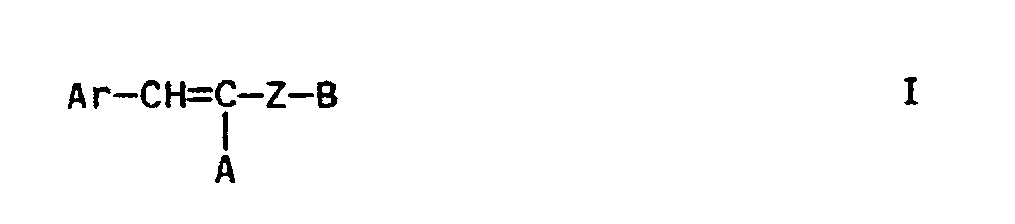
- A Ci-C6-Alkyl, C2-C6-Alkenyl, C3-C8-Cycloalkyl, (C3-C8)-Cycloalkyl-(C1-C3)-alkyl, ein-, zwei- oder dreikerniges substituiertes oder unsubstituiertes Aryl oder Aralkyl;
- Z

- R Wasserstoff, C2-C4-Acyl, gegebenenfalls substituiertes Benzoyl, C1-C4-Alkylsulfonyl, unsubstituiertes oder mit Ci-C4-Alkyl substituiertes Phenylsulfonyl oder den Rest R1 bedeutet,
- R1 für Cl-C4-Alkyl, substituiertes oder unsubstituiertes Phenyl oder Benzyl und Hal für Fluor, Chlor, Brom oder Jod stehen; B
- substituiertes oder unsubstituiertes ein- oder zweikerniges Aryl, Aralkyl oder Heteroaryl;) sowie deren N-Oxide und Säureadditionssalze; ferner die Herstellung dieser Stoffe, Zwischenprodukte dafür und deren Herstellung, Heteroarylalkene enthaltende fungizide Mittel sowie ein entsprechendes Verfahren zur Bekämpfung von Schadpilzen.
Description
- Die vorliegende Erfindung betrifft neue Heteroarylalkene der allgemeinen Formel I,

- Ar 3-Pyridyl, 3-Pyridazinyl, 5-Pyrimidinyl oder 2-Pyrazinyl;
- A
- C1-C6-Alkyl, C2-C6-Alkenyl, C3-Cs-Cycloalkyl, (C3-C8)-Cycloalkyl-(C1-C3)-alkyl, ein-, zwei- oder dreikerniges Aryl oder Aralkyl, wobei Aryl jeweils ein-, zwei- oder dreifach durch die Reste Cl-C4-Alkyl, C1-C4-Alkoxy, C1-C4-Mono-, Di- oder Trihalogenalkyl, C1-C4-Halogenalkoxy, Phenyl oder Halogen substituiert sein kann;
- Z

- R Wasserstoff, C1-C4-Alkyl, C2-C4-Acyl, Phenyl, Benzyl oder Benzoyl, in denen die Phenylringe jeweils ein- , zwei- oder dreifach durch C1-C4-Alkyl, C1-C4-Alkoxy, C1-C4-Halogenalkyl, C1-C4-Halogenalkoxy, Halogen, Cyan oder Nitro substituiert sein können, sowie C1-C4-Alkylsulfonyl, unsubstituiertes oder mit Ci-C4-Alkyl substituiertes Phenylsulfonyl bedeutet,
- R1 für C1-C4-Alkyl, Phenyl oder Benzyl, wobei die Phenylringe jeweils ein-, zwei- oder dreifach durch C1-C4-Alkyl, C1-C4-Alkoxy, C1-C4-Halogenalkyl, C1-C4-Halogenalkoxy, Halogen, Cyan oder Nitro substituiert sein können, und Hal für Fluor, Chlor, Brom oder Jod stehen;
- B ein- oder zweikerniges Aryl, Aralkyl oder Heteroaryl, wobei Heteroaryl im Falle von

- Des weiteren betrifft die Erfindung verfahren zur Herstellung dieser Verbindungen, weiterhin Zwischenprodukte, Verfahren zur Herstellung der Zwischenprodukte, die Heteroarylalkene I enthaltende fungizide Mittel, sowie ein Verfahren zur Bekämpfung von Schadpilzen mit Hilfe der Heteroarylalkene I bzw. dieser fungiziden Mittel.
- Fungizide Heteroarylalkene, z.B.

- Der Erfindung lag daher die Aufgabe zugrunde, besonders aktive fungizide Verbindungen bereitzustellen.
- Demgemäß wurden die eingangs definierten Heteroarylalkene I gefunden.
- Im Hinblick auf die bestimmungsgemäße Verwendung der Heteroarylalkene I als Fungizide kommen als Substituenten vorzugsweise folgende Reste in Betracht:
- Ar
- 3-Pyridyl, 5-Pyrimidinyl, 3-Pyridazinyl oder 2-Pyrazinyl
- A
- Methyl, Ethyl, n-Propyl, Isopropyl, n-Butyl, Isobutyl, tert.-Butyl, n-Pentyl, Isopentyl, neo-Pentyl, n-Hexyl, neo-Hexyl; Cyclopropyl, Cyclopentyl, Cyclohexyl, Cycloheptyl, Cyclooctyl, Cyclopropylmethyl, Cyclopentylmethyl, Cyclohexylmethyl, 2-Cyclohexylethyl, 3-Cyclohexylpropyl; Phenyl, Mono-, Di- oder Trimethylphenyl, tert.-Butylphenyl, Mono-, Di- oder Trimethoxyphenyl, n-, tert.-Butoxyphenyl, Trifluormethylphenyl, Difluormethoxyphenyl, Trifluormethoxyphenyl, Tetrafluorethoxyphenyl, Biphenyl, Mono-, Di- oder Trifluorphenyl, Mono-, Di-, Trichlorphenyl, Chlorfluorphenyl, Benzyl, Mono-, Di-, Trimethylbenzyl, Mono-, Di-, Trichlorbenzyl, Fluorbenzyl, 2-Phenylethyl, Mono-, Di-, Trimethylphenylethyl, Mono-, Di-, Trichlorphenylethyl, Fluorphenylethyl, 3-Phenylpropyl B Phenyl, Mono-, Di- oder Trimethylphenyl, Ethylphenyl, Isopropylphenyl, tert.-Butylphenyl, Naphthyl, Mono-, Di- oder Trimethoxyphenyl, n- oder tert.-Butoxyphenyl, Trifluormethylphenyl, Difluormethoxyphenyl, Trifluormethoxyphenyl, Tetrafluorethoxyphenyl, Biphenyl, Chlorbiphenyl, Mono-, Di- oder Trichlorphenyl, Mono-, Di-oder Trifluorphenyl, Chlorfluorphenyl, Bromphenyl, Benzyl, Mono-, Di- oder Trimethylbenzyl, Fluorbenzyl, Mono-, Di- oder Trichlorbenzyl, Chlorfluorbenzyl, Pyridyl, Chlorpyridyl, Methylpyridyl, Pyrimidinyl, Pyrazinyl, Thienyl, Furyl Z

- R bevorzugt Wasserstoff, Methyl, Ethyl, n-, i-Propyl, n-, tert.-Butyl, Acetyl, Propionyl, Butyryl, Phenyl, Mono- , Di-, Trimethylphenyl, tert.-Butylphenyl, Mono-, Di-, Trimethoxyphenyl, Trifluormethylphenyl, Fluorphenyl, Mono-, Dichlorphenyl, Bromphenyl, Cyanphenyl, Mono-, Dinitrophenyl, Benzyl, Methylbenzyl, Methoxybenzyl, Trifluormethylbenzyl, Fluorbenzyl, Mono-, Dichlorbenzyl, Brombenzyl, Cyanbenzyl, Mono-, Dinitrobenzyl, Benzoyl, Methylbenzoyl, Fluorbenzoyl, Mono-, Di-, Trichlorbenzoyl, Brombenzoyl, Cyanbenzoyl, Mono-, Dinitrobenzoyl bedeutet und
- R' bevorzugt für Methyl, Ethyl, n-, Isopropyl, n-Butyl, tert.-Butyl, Phenyl, Mono-, Di-, Trimethylphenyl, tert.-Butylphenyl, Mono-, Di-, Trimethoxyphenyl, Trifluormethylphenyl, Fluorphenyl, Mono- oder Dichlorphenyl, Bromphenyl, Cyanphenyl, Mono- oder Dinitrophenyl, Benzyl, Methylbenzyl, Methoxybenzyl, Trifluormethylbenzyl, Fluorbenzyl, Mono- oder Dichlorbenzyl, Brombenzyl, Cyanbenzyl, Mono- oder Dinitrobenzyl und Hal inbesondere für Fluor, Chlor oder Brom stehen.
- Besonders bevorzugt sind Verbindungen mit den Resten A Ethyl, n-Propyl, n-Butyl, tert.-Butyl, n-Pentyl, neo-Pentyl, n-Hexyl, Phenyl, 4-Fluorphenyl; B Phenyl, 2-Chlorphenyl, 4-Chlorphenyl, 2,4-Dichlorphenyl, 4-Fluorphenyl, 2-Methylphenyl, 4-Methylphenyl, 2,4-Dimethylphenyl, 2,6-Dimethylphenyl, 2, 4, 6-Trimethylphenyl, 4-Biphenyl, 3-Pyridyl; Ar 3-Pyridyl. Besonders gut geeignete Verbindungen als Fungizide sind E-1-(2,4-Dichlorphenyl)-2-(3-pyridylmethyliden)-4,4-dimethyl-pentan-1-ol, E-1-(2,4-Dimethylphenyl)-2-(3-pyridyl- methyliden)-hexan-1-ol, E-1-(2,4-Dichlorphenyl)-2-(3-pyridylmethyliden)-3,3-dimethyl-butan-1-ol, E-1-(2,4-Dichlorphenyl)-2-(3-pyridylmethyliden)-hexan-1-ol und E-1-(2,4-Dichlorphenyl)-2-(3-pyridylmethyliden)-octan-1-ol.
- Die Heteroarylalkene I enthalten eine unsymmetrisch substituierte C=C-Doppelbindung. Sie können daher als E/Z-Isomerengemische oder in Form der reinen Isomeren vorliegen. Die reinen Isomeren können durch bekannte Trennverfahren wie fraktionierte Kristallisation oder Chromatographie aus den Isomerengemischen gewonnen werden. Sowohl die einzelnen isomeren Verbindungen als auch ihre Gemische werden von der Erfindung umfaßt.
- Die Heteroarylalkenole la erhält man beispielsweise dadurch, daß man ein Heteroarylalkenal II mit einem Lithiumorganyl Li-B oder einem Grignard-Reagenz B-MgHal, wobei Hal für Chlor, Brom, Jod steht, in an sich bekannter Weise umsetzt. Dabei erfolgt die Umsetzung in einem inerten Lösungsmittel, vorzugsweise einem Ether wie Diethylether, Tetrahydrofuran, Methyl-tert.-butylether oder einem Gemisch dieser Ether. Es empfiehlt sich hierbei, die metallorganische Verbindung vorzulegen und das Heteroarylalkenal II in flüssiger Phase bei (-70) bis 50 C zuzudosieren. Bei den Li-Organylen ist es vorteilhaft bei (-70) bis 0°C, vorzugsweise bei (-70) bis (-30 C) zu arbeiten. Die Temperaturen bei den Umsetzungen mit den Grignard-Reagenzien wählt man in der Regel zwischen 0 und 50 C, insbesondere zwischen 20 und 50°C. Man setzt die genannten Ausgangsstoffe zweckmäßig im Molverhältnis 0,5 : 1 bis 2 : 1 ein.
- Die Heteroarylalkenale II, in denen A Methyl, unsubstituiertes oder substituiertes Phenyl bedeutet, sind aus J. Org. Chem. 43 (1978) 3396 und EP-A2-298 380 bekannt. Die neuen Heteroarylalkenale III, in denen Ar für 3-Pyridazinyl, 5-Pyrimidinyl oder 2-Pyrazinyl, bevorzugt für 3-Pyridyl steht und D C2-C6-Alkyl, bevorzugt Ethyl, n-, i-Propyl, n- oder tert.-Butyl, C3-C8-Cycloalkyl, insbesondere Cyclopropyl, Cyclopentyl oder Cyclohexyl, (C3-C8)-Cycloalkyl-(C1-C3)-alkyl, vor allem Cyclopropylmethyl, Cyclopentylmethyl, Cyclohexylmethyl, 2-Cyclohexylethyl, 3-Cyclohexylpropyl oder ein- oder zweikerniges Aryl-(C1-C3)alkyl, bevorzugt Benzyl, Chlorbenzyl, Fluorbenzyl, 2-Phenylethyl, Chlorphenylethyl, Fluorphenylethyl oder 3-Phenylpropyl bedeutet, können analog zu dem aus EP-A2-298 380 bekannten Verfahren durch Aldolkondensation von D-CHzCHO mit ArCHO hergestellt werden (s. auch Houben-Weyl, Methoden der organischen Chemie, Bd. III/1, S. 76 ff).
- Die Ausgangsstoffe des Typs D-CHzCHO sind für D = Alkyl leicht zugänglich, für die anderen Reste können sie nach bekannten Methoden (s. Houben-Weyl, Band 7/1, S. 55 f., 76 f., 159 f.) hergestellt werden. 3-Formyl-pyridin ist allgemein bekannt und leicht zugänglich. Die Synthesen der anderen Aldehyde des Typs Ar-CHO sind z.B im Standardwerk "The Chemistry of Heterocyclic Compounds" (A. Weissberger und E. C. Taylor) beschrieben (3-Formyl-pyridazin: The Pyridazines, R. N. Castle, Editor, S. 365, John Wiley & Sons, New York, 1973; 2-Formyl-pyrazin: The Pyrazines, G. B. Barlin, Editor, S. 294 ff., John Wiley & Sons, New York, 1982; 5-Formylpyrimidin: The Pyrimidines, Suppl. I, D. J. Brown, S. 127, John Wiley & Sons, New York, 1970).
- Die metallorganischen Verbindungen Li-B und HalMgB lassen sich nach bekannten Verfahren wie sie in Houben-Weyl, Methoden der organischen Chemie, Bd. XIII/1, S. 87 ff und Houben-Weyl, Methoden der organischen Chemie, Bd. XIII/2a, S. 54 ff beschrieben sind aus B-Hal und Li bzw. Mg herstellen.
- Eine zweite Methode, die Heteroarylalkenole la darzustellen, besteht darin, daß man einen Heteroarylaldehyd ArCHO mit einem Keton vom Typ

- Die Aldolkondensation des Heteroarylaldehyds ArCHO mit dem Keton

- Geeignete Lösungsmittel sind beispielsweise Alkohole wie Methanol, Ethanol, Propanol, Isopropanol, Butanol oder tert.Butanol, Ether wie Diethylether, Methyl-tert.butylether, Tetrahydrofuran oder Dioxan, oder Kohlenwasserstoffe wie Cyclohexan, Benzol, Toluol oder Xylol.
- Die Reaktion führt man in der Regel bei Temperaturen von 0 bis 60 C durch.
- Das Molverhältnis der Ausgangsstoffe beträgt 0,5 : 1 bis 5 : 1 (ArCHO/Keton), das Molverhältnis ArCHO zum Katalysator beträgt 1 : 1 bis 100 : 1.
- Die Ausgangsverbindungen des Typs

- Die Heteroarylalkenone Ib lassen sich mit an sich bekannten Methoden zu den bereits beschriebenen Heteroarylalkenolen la reduzieren (s. Houben-Weyl, Methoden der organischen Chemie, Bd. IV, 1d, S. 297 ff). Geeignete Reduktionsmittel sind beispielsweise komplexe Hydride wie Lithiumaluminiumhydrid, Lithiumtrimethoxyaluminiumhydrid, Natriumborhydrid oder Natriumcyanborhydrid sowie Aluminiumalkoholate wie Aluminiumisopropylat oder Aluminiumcyclohexanolat (s. M. Hudlicky, Reductions in Organic Chemistry, S. 119 f, Ellis Horward Series, Chichester, 1984). Als Lösungsmittel für die Reduktionen werden je nach Art des Reduktionsmittels beispielsweise Ether, wie Diethylether, Tetrahydrofuran, Dimethoxyethan oder Dioxan oder Alkohole wie Methanol, Ethanol, n-Propanol, Isopropanol oder Cyclohexanol verwendet.
- Bei der Reduktion mit komplexen Hydriden empfiehlt es sich, die Reaktion bei (-30) bis 20 C durchzuführen, während bei Verwendung von Aluminiumalkoholaten höhere Temperaturen, insbesondere die Siedetemperatur des dem Aluminiumalkoholat zugrunde liegenden freien Alkohols, vorteilhaft sind. Bevorzugt ist die Verwendung von Natriumborhydrid oder Natriumcyanborhydrid in Methanol oder Ethanol. Das Äquivalentverhältnis von Heteroarylalkenon Ib zu Reduktionsmittel beträgt in der Regel 1:1 bis 1:2.
- Die erfindungsgemäßen Heteroarylalkenole la kann man zu den Heteroarylalkenestern bzw. -ethern Ic verestern bzw. verethern. Hierzu werden die Heteroarylalkenole la mit Alkylierungs- oder Acylierungsmitteln R-X in an sich bekannter Weise zur Reaktion gebracht (s. Houben-Weyl, Band 6/1 b, S. 800 ff, S. 823 ff). R steht hierbei für C,-C4-Alkyl, insbesondere Methyl, Ethyl, Isopropyl oder tert.Butyl, C2-C4-Acyl, bevorzugt Acetyl oder Propionyl, Benzyl oder Benzoyl, wobei die Phenylreste ein-, zwei- oder dreifach mit C,-C4-Alkyl wie Methyl, Ethyl, Propyl oder Butyl, C1-C4-Alkoxy wie Methoxy, Ethoxy, Propoxy, C1-C4-Halogenalkyl, vor allem Trifluormethyl, C1-C4-Halogenalkoxy wie Tetrafluorethoxy, Halogen wie Fluor, Chlor oder Brom, Cyan oder Nitro substituiert sein können, sowie für C1-C4-Alkylsulfonyl, insbesondere Methansulfonyl oder unsubstituiertes oder mit C,-C4-Alkyl substituiertes Phenylsulfonyl, X steht beispielsweise für Chlor, Brom, Jod, die Acetylgruppe oder, falls R nicht selbst eine Sulfonsäuregruppe ist, für Methansulfonyl, Benzolsulfonyl oder p-Toluolsulfonyl.
- Die Umsetzung führt man in der Regel bei einer Temperatur von 0 bis 100° C durch.
- Die Art des Lösungsmittels hängt von der Art des Restes R ab. Für den Fall, daß R Alkyl oder Benzyl bedeutet, kommen vorzugsweise Ether wie Diethylether, Tetrahydrofuran, Dioxan, Dimethoxyethan oder Amide wie N,N-Dimethylformamid, N-Methylpyrrolidon, N,N-Dimethylethylenharnstoff, N,N-Dimethylpropylenharnstoff zum Einsatz. Zusätzlich empfiehlt sich die Zugabe äquimolarer Mengen an Basen, inbesondere Natriumhydrid.
- Steht R für einen Acyl- oder Benzoylrest oder ein Sulfonsäurehalogenid, so werden als Verdünnungsmittel vorzugsweise halogenierte oder halogenfreie Kohlenwasserstoffe wie Dichlormethan oder Trichlormethan, Toluol, Xylol oder ein Überschuß einer als Katalysator wirkenden Base, vorzugsweise tertiäre Amine wie Triethylamin, Tripropylamin oder Pyridin, verwendet.
- Heteroarylalkenester lc, in denen R einen Sulfonsäurerest darstellt, lassen sich mit an sich bekannten Methoden (s. Houben-Weyl, Bd. 9, S. 343 ff) durch Umsetzung mit Halogeniden, Cyaniden, Hydrogensulfiden, Alkoholen oder Thiolen zu Heteroarylalkenen der allgemeinen Formel ld umsetzen.
- Als Halogenide, Cyanide oder Hydrogensulfide werden vorzugsweise Alkali-, Erdalkali-, Ammonium-oder Tetraalkylammoniumsalze verwendet. Beispielhaft seien genannt: Lithium-, Natrium-, Kaliumcyanid, Tetramethylammoniumcyanid, Tetrabutylammoniumcyanid, -fluorid, -chlorid, -bromid, -iodid, Lithiumfluorid, -chlorid, -bromid, -iodid, Natriumfluorid, -chlorid, -bromid, -iodid, Kaliumfluorid, -chlorid, -bromid, -iodid, Natrium- oder Kaliumhydrogensulfid.
- Als Alkohole werden vor allem Phenole bevorzugt, die ein-, zwei- oder dreifach substituiert sein können, insbesondere Phenol, Mono-, Di-, Trimethylphenol, tert.Butylphenol, Mono-, Di-, Trimethoxyphenol, Trifluormethylphenol, Fluor-, Chlor-, Bromphenol.
- Als Thiole kommen insbesondere C1-C4-Alkanthiole wie Methan-, Ethan-, n-, i-Propan-, n-, i-, sec.- oder tert.Butanthiol, sowie unsubstituierte oder ein-, zwei- oder dreifach substituierte Thiophenole oder Thiobenzylalkohole wie Thiophenol, Mono-, Di-, Trimethylthiophenol, tert.Butylthiophenol, Mono-, Di-, Trimethoxythiophenol, Fluor-, Chlorthiophenol, Thiobenzylalkohol, Mono-, Di-, Trimethylthiobenzylalkohol, tert.Butylthiobenzylalkohol, Mono-, Di-, Trimethoxythiobenzylalkohol, Fluor-, Chlorthiobenzylalkohol, Cyan-oder Nitrothiobenzylalkohol.
- Für die Umsetzung eignen sich polare, inerte Lösungsmittel wie Ether, vor allem Tetrahydrofuran oder Dioxan, Ketone, insbesondere Aceton, Methylethylketon oder Methyl-isobutylketon, Nitrile, bevorzugt Acetonitril oder Propionitril, Amide, beispielsweise N,N-Dimethylformamid, N-Methylpyrrolidon, N,N-Dimethylethylenharnstoff oder N,N-Dimethylpropylenharnstoff, Sulfoxide, besonders Dimethylsulfoxid, Sulfone, z.B. Sulfolan, Alkohole, bevorzugt Methanol, Ethanol, n-Propanol, Isopropanol, n-Butanol, tert.-Butanol oder Gemische dieser Stoffe. Bei der Umsetzung der Heteroarylalkenester Ic mit Phenolen oder Thiolen verwendet man Hilfsbasen, vor allem Alkali- und Erdalkali-hydroxide wie Natrium- oder Kaliumhydroxid, Alkali- und Erdalkalicarbonate wie Natrium-, Kalium- oder Calciumcarbonat, Alkali- und Erdalkalialkoholate wie Natriummethylat, -ethylat, -propylat, -isopropylat, Kaliumisopropylat, Kalium-tert.-butylat, sowie tertiäre Amine wie Triethylamin, Tripropylamin oder Pyridin.
- Die Reaktion führt man in der Regel bei Temperaturen von 20 bis 100° C durch.
- Die Oxidation der Heteroarylalkene I zu den entsprechenden N-Oxiden erfolgt nach üblichen Methoden. Als Oxidationsmittel eignen sich beispielsweise Persäuren oder in situ aus Wasserstoffperoxid und Carbonsäureanhydriden erzeugte Persäuren, Wasserstoffperoxid oder organische Derivate des Wasserstoffperoxids (s. z.B. R. A. Abramovitch und E. M. Smith in Chemistry of Heterocyclic Compounds, Band 14, Suppl. 2, Seite 1 ff; John Wiley, New York 1974; A. R. Katritzky, J. M. Lagouski, The Chemistry of Heterocyclic N-Oxides, S. 21 ff, Academic Press, New York 1971).
- Die Herstellung der Säureadditionssalze von den Heteroarylalkenen I erfolgt ebenfalls nach üblichen Methoden.
- Eine Übersicht über die genannten Herstellungsverfahren der Heteroarylalkene I ist in folgendem Schema gezeigt:

- Die folgenden Beispiele erläutern die Herstellung der neuen Verbindungen:
- 1. Herstellung von E-1-(4-Fluorphenyl)-2-(3-pyridylmethyliden)-1-hexanol über E-2-(3-Pyridylmethyliden)-hexanal
- Aus 4,1 g (0,17 mol) Magnesiumspänen, die mit 1 ml 1,2-Dibrommethan aktiviert wurden, wurde durch Zutropfen einer Lösung von 29,8 g (0,17 mol) 4-Fluorbrombenzol in 200 ml Tetrahydrofuran eine Grignardlösung bereitet. Es wurde 30 min bei 50°C nachgerührt und dann 20,8 g (0,11 mol) des oben hergestellten E-2-(3-Pyridylmethyliden)hexanals in 100 ml Tetrahydrofuran zugetropft. Nach zweistündigem Rühren bei Rückflußtemperatur wurde abgekühlt, mit Wasser hydrolysiert und mit gesätt. NH4CI-Lösung auf pH 8 eingestellt. Die wäßrige Phase wurde mit Ether extrahiert, die vereinigten organischen Phasen mit Wasser gewaschen, über NazS04 getrocknet und i. Vak. eingedampft. Es verblieben 27,1 g E-1-(4-Fluorphenyl)-2-(3-pyridylmethyliden)-1-hexanol als gelbes öl, Reinheit nach GC 94 %. (Ausbeute: 82 % d. Th.) (s. Tabelle, Bsp. 290).
- IH-NMR (CDCI3) δ = 8.40, 8.30, 7.58, 7.22 (2-,6-,4-,5-H des Pyridinteils), 7.38, 7.02 (2 Hm und 2 Ho des Arylteils), 6.65 (C = CH), 5.30 (CHOH), 4.5 (OH), 2.20, 1.95 (3-CH2), 1.23 (4- und 5-CH2), 0.78 (6-CH3). IR (Film):
ν = 3200, 2957, 2931, 2870, 1603, 1507, 1222, 1155, 1028, 838, 713 cm-1. 2. Herstellung von E-1-(2-Chlorphenyl)-2-(4-fluorphenyl)-3-(3-pyridyl)-2-propen-1-on - Eine Mischung von 24,9 g (0,10 mol) (4-Fluorbenzyl)-(2-chlorphenyl)-keton, 10,7 g (0,10 mol) Pyridin-3- aldehyd und 2,9 g (0,02 mol) Piperidinacetat in 250 ml Toluol wurde solange am Wasserabscheider erhitzt, bis sich kein Wasser mehr abtrennte. Nach dem Abkühlen wurde zweimal mit gesätt. NaHCO3-Lösung und mit Wasser gewaschen, über Natriumsulfat getrocknet und i. Vak. eingeengt. Der Rückstand wurde aus Methyl-tert.butylether/Hexan (2:1) kristallisiert. Dabei wurden 16,6 g (40 % d. Th.) Produkt als gelbe Kristalle vom Schmp. 102°C erhalten.
- 3. Herstellung von E-1-(2-Chlorphenyl)-2-(4-fluorphenyl)-3-(3-pyridyl)-2-propen-1-ol
- Zu einer Lösung von 33,75 g (0,10 mol) des unter 2.) hergestellten E-1-(2-Chlorphenyl)-2-(4-fluorphenyl)-3-(3-pyridyl)-2-propen-1-ons in 500 ml Methanol wurden bei 0°C portionsweise 7,6 g (0,20 mol) Natriumborhydrid gegeben. Man rührte 2 h bei 0°C nach, zerstörte überschüssiges Natriumborhydrid durch Zutropfen von Essigsäure und engte i. Vak. ein. Der Rückstand wurde in einem Wasser/Dichlormethan-Gemisch aufgenommen, die mit Wasser gewaschene organische Phase über Natriumsulfat getrocknet und i. Vak. eingeengt. Durch Verrühren mit Methyl-tert.butylether/Pentan (9:1) wurden 27,0 g (79 % d. Th.) kristallines Produkt vom Schmp. 82-83 C erhalten (vgl. Tabelle, Bsp. Nr. 682).
- 1H-NMR(CDCl3) δ = 8.20, 8.16, 7.48, 7.27 (6-, 2-, 4-, 5-H des Pyridinteils), 7.20-6.90 (8 Aryl-H), 6.70 (C = CH), 5.90 (CHOH).
- Analog zu diesen Beispielen können folgende Verbindungen hergestellt werden:


- Die neuen Heteroarylalkene I zeichnen sich durch eine hervorragende Wirksamkeit gegen ein breites Spektrum von pflanzenpathogenen Pilzen, insbesondere aus der Klasse der Ascomyceten und Basidiomyceten, aus. Sie sind zum Teil systemisch wirksam und können als Blatt- und Bodenfungizide eingesetzt werden. Besonders interessant sind sie für die Bekämpfung einer Vielzahl von Pilzen an verschiedenen Kulturpflanzen oder ihren Samen, insbesondere Weizen, Roggen, Gerste, Hafer, Reis, Mais, Rasen, Baumwolle, Soja, Kaffee, Zuckerrohr, Obst und Zierpflanzen im Gartenbau, Weinbau sowie Gemüse, wie Gurken, Bohnen und Kürbisgewächse.
- Die neuen Heteroarylalkene sind insbesondere geeignet zur Bekämpfung folgender Schadpilze: Erysiphe graminis (echter Mehltau) in Getreide,
- Erysiphe cichoracearum und Sphaerotheca fuliginea an Kürbisgewächsen,
- Podosphaera leucotricha an Äpfeln,
- Uncinula necator an Reben,
- Puccinia-Arten an Getreide,
- Rhizoctonia-Arten an Baumwolle und Rasen,
- Ustilago-Arten an Getreide und Zuckerrohr,
- Venturia inaequalis (Schorf) an Äpfeln,
- Helminthosporium-Arten an Getreide,
- Septoria nodorum an Weizen,
- Botrytis cinerea (Grauschimmel) an Erdbeeren, Reben,
- Cercospora arachidicola an Erdnüssen,
- Pseudocercosporella herpotrichoides an Weizen, Gerste,
- Pyricularia oryzae an Reis,
- Phytophthora infestans an Kartoffeln und Tomaten,
- Fusarium- und Verticillium-Arten an verschiedenen Pflanzen,
- Plasmopara viticola an Reben,
- Alternaria-Arten an Gemüse und Obst.
- Die Heteroarylalkene werden angewendet, indem man die Pflanzen, Materialien oder Flächen mit den Wirkstoffen besprüht oder bestäubt oder die Samen der Pflanzen mit den Wirkstoffen behandelt. Die Anwendung erfolgt vor oder nach der Infektion durch die Pilze.
- Die Heteroarylalkene können in die üblichen fungiziden Mittel (Formulierungen) übergeführt werden, d.h. in Lösungen, Emulsionen, Suspensionen, Stäube, Pulver, Pasten und Granulate. Die Anwendungsformen richten sich ganz nach den Verwendungszwecken; sie sollen in jedem Fall eine feine und gleichmäßige Verteilung der wirksamen Substanz gewährleisten. Die Formulierungen werden in bekannter Weise und mit den üblichen Hilfsstoffen hergestellt, z.B. durch Verstrecken des Wirkstoffs mit Lösungsmitteln und/oder Trägerstoffen, gegebenenfalls unter Verwendung von Emulgiermitteln und Dispergiermitteln. Als Hilfsstoffe kommen dafür im wesentlichen in Frage: Lösungsmittel wie Aromaten (z.B. Xylol), chlorierte Aromaten (z.B. Chlorbenzole), Paraffine (z.B. Erdölfraktionen), Alkohole (z.B. Methanol, Butanol), Ketone (z.B. Cyclohexanon), Amine (z.B. Ethanolamin, Dimethylformamid) und Wasser (letzteres gegebenenfalls zusammen mit organischen Lösungsmitteln); Trägerstoffe wie natürliche Gesteinsmehle (z.B. Kaoline, Tonerden, Talkum, Kreide) und synthetische Gesteinsmehle (z.B. hochdisperse Kieselsäure, Silikate) ; Emulgiermittel, wie nichtionogene und anionische Emulgatoren (z.B. Polyoxyethylen-Fettalkohol-Ether, Alkylsulfonate und Arylsulfonate) und Dispergiermittel, wie Lignin, Sulfitablaugen und Methylcellulose.
- Die fungiziden Mittel enthalten im allgemeinen zwischen 0,1 und 95 Gew.-%, vorzugsweise zwischen 0,5 und 90 Gew.-% Wirkstoff. Die Aufwandmengen liegen je nach Art des gewünschten Effektes zwischen 0,02 und 3 kg Wirkstoff je ha.
- Die Mittel werden, gegebenenfalls nach weiterer Verdünnung, in bekannter Weise angewendet, beispielsweise durch Versprühen, Vernebeln, Verstäuben, Verstreuen, Beizen oder Gießen.
- Beispiele für Zubereitungen sind:
- I. Man vermischt 90 Gew.-Teile der Verbindung Nr. 66 mit 10 Gew.-Teilen N-Methyl-a-pyrrolidon und erhält eine Lösung, die zur Anwendung in Form kleinster Tropfen geeignet ist.
- 11. 20 Gew.-Teile der Verbindung Nr. 71 werden in einer Mischung gelöst, die aus 80 Gew.-Teilen Xylol, 10 Gew.-Teilen des Anlagerungsproduktes von 8 bis 10 Mol Ethylenoxid an 1 Mol Ölsäure-N-monoethanolamid, 5 Gew.-Teilen Calciumsalz der Dodecylbenzolsulfonsäure und 5 Gew.-Teilen des Anlagerungsproduktes und 40 Mol Ethylenoxid an 1 Mol Ricinusöl besteht. Durch Ausgießen und feines Verteilen der Lösung in Wasser erhält man eine wäßrige Dispersion.
- 111. 20 Gew.-Teile der Verbindung Nr. 72 werden in einer Mischung gelöst, die aus 40 Gew.-Teilen Cyclohexanon, 30 Gew.-Teilen Isobutanol, 20 Gew.-Teilen des Anlagerungsproduktes von 40 Mol Ethylenoxid an 1 Mol Ricinusöl besteht. Durch Eingießen und feines Verteilen der Lösung in Wasser erhält man eine wäßrige Dispersion.
- IV. 20 Gew.-Teile der Verbindung Nr. 99 werden in einer Mischung gelöst, die aus 25 Gew.-Teilen Cyclohexanol, 65 Gew.-Teilen einer Mineralölfraktion vom Siedepunkt 210 bis 280° C und 10 Gew.-Teilen des Anlagerungsproduktes von 40 Mol Ethylenoxid an 1 Mol Ricinusöl besteht. Durch Eingießen und feines Verteilen der Lösung in Wasser erhält man eine wäßrige Dispersion.
- V. 80 Gew.-Teile der Verbindung Nr. 131 werden mit 3 Gew.-Teilen des Natriumsalzes der Dlisobutylnaphthalin-a-sulfonsäure, 10 Gew.-Teilen des Natriumsalzes einer Ligninsulfonsäure aus einer Sulfitablauge und 7 Gew.-Teilen pulverförmigem Kieselsäuregel gut vermischt und in einer Hammermühle vermahlen. Durch feines Verteilen der Mischung in Wasser erhält man eine Spritzbrühe.
- Vl. 3 Gew.-Teile der Verbindung Nr. 132 werden mit 97 Gew.-Teilen feinteiligem Kaolin innig vermischt. Man erhält auf diese Weise ein Stäubemittel, das 3 Gew.% des Wirkstoffs enthält.
- VII. 30 Gew.-Teile der Verbindung Nr. 134 werden mit einer Mischung aus 92 Gew.-Teilen pulverförmigem Kieselsäuregel und 8 Gew.-Teilen Paraffinöl, das auf die Oberfläche dieses Kieselsäuregels gesprüht wurde, innig vermischt. Man erhält auf diese Weise eine Aufbereitung des Wirkstoffs mit guter Haftfähigkeit.
- VIII. 40 Gew.-Teile der Verbindung Nr. 135 werden mit 10 Gew.-Teilen Natriumsalz eines Phenolsulfonsäure-harnstoff-formaldehyd-Kondensates, 2 Gew.-Teilen Kieselgel und 48 Gew.-Teilen Wasser innig vermischt. Man erhält eine stabile wäßrige Dispersion. Durch Verdünnen mit Wasser erhält man eine wäßrige Dispersion.
- IX. 20 Gew.-Teile der Verbindung Nr. 136 werden mit 2 Gew.-Teilen Calciumsalz der Dodecylbenzolsulfonsäure, 8 Gew.-Teilen Fettalkoholpolyglykolether, 2 Gew.-Teilen Natriumsalz eines Phenolsulfonsäure-harnstoff-formaldehyd-Kondensats und 68 Gew.-Teilen eines paraffinischen Mineralöls innig vermischt. Man erhält eine stabile ölige Dispersion.
- Die erfindungsgemäßen Mittel können in diesen Anwendungsformen auch zusammen mit anderen Wirkstoffen vorliegen, wie z.B. Herbiziden, Insektiziden, Wachstumgregulatoren und Fungiziden, oder auch mit Düngemitteln vermischt und ausgebracht werden. Beim Vermischen mit Fungiziden erhält man dabei in vielen Fällen eine Vergrößerung des fungiziden Wirkungsspektrums.
- Die folgende Liste von Fungiziden, mit denen die erfindungsgemäßen Verbindungen kombiniert werden können, soll die Kombinationsmöglichkeiten erläutern, nicht aber einschränken.
-
- Schwefel,
- Dithiocarbamate und deren Derivate, wie
- Ferridimethyldithiocarbamat,
- Zinkdimethyldithiocarbamat,
- Zinkethylenbisdithiocarbamat,
- Manganethylenbisdithiocarbamat,
- Mangan-Zink-ethylendiamin-bis-dithiocarbamat,
- Tetramethylthiuramdisulfide,
- Ammoniak-Komplex von Zink-(N,N-ethylen-bis-dithiocarbamat),
- Ammoniak-Komplex von Zink-(N,N'-propylen-bis-dithiocarbamat),
- Zink-(N,N'-propylen-bis-dithiocarbamat),
- N,N'-Polypropylen-bis-(thiocarbamoyl)-disulfid;
- Nitroderivate, wie
- Dinitro-(1 -methylheptyl)-phenylcrotonat,
- 2-sec-Butyl-4,6-dinitrophenyl-3,3-dimethylacrylat,
- 2-sec-Butyl-4,6-dinitrophenyl-isopropylcarbonat;
- 5-Nitro-isophthalsäure-di-isopropylester
- heterocyclische Substanzen, wie
- 2-Heptadecyl-2-imidazolin-acetat,
- 2,4-Dichlor-6-(o-chloranilino)-s-triazin,
- O,O-Diethyl-phthalimidophosphonothioat,
- 5-Amino-1-[bis-(dimethylamino)-phosphinyl]-3-phenyl-1,2,4-triazol,
- 2,3-Dicyano-1,4-dithioanthrachinon,
- 2-Thio-1,3-dithio-(4,5-b)-chinoxalin,
- 1-(Butylcarbamoyl)-2-benzimidazol-carbaminsäuremethylester,
- 2-Methoxycarbonylamino-benzimidazol,
- 2-(Furyi-(2))-benzimidazoi,
- 2-(Thiazolyl-(4))-benzimidazol,
- N-(1,1,2,2-Tetrach lorethylthio)-tetrahyd rophthalimid,
- N-Trichlormethylthio-tetrahydrophthalimid,
- N-Trichlormethylthio-phthalimid,
- N-Dichlorfluormethylthio-N',N'-dimethyl-N-phenyl-schwefelsäurediamid,
- 5-Ethoxy-3-trichlormethyl-1,2,3-thiadiazol,
- 2-Rhodanmethylthiobenzthiazol,
- 1,4-Dichlor-2,5-dimethoxybenzol,
- 4-(2-Chlorphenylhydroazano)-3-methyl-5-isoxazolon,
- Pyridin-2-thio-1-oxid,
- 8-Hydroxychinolin bzw. dessen Kupfersalz,
- 2,3-Dihydro-5-carboxanilido-6-methyl-1,4-oxathün,
- 2,3-Dihydro-5-carboxanilido-6-methyl-1,4-oxathün-4,4-dioxid,
- 2-Methyl-5,6-dihydro-4H-pyran-3-carbonsäure-anilin,
- 2-Methyl-furan-3-carbonsäureanilid,
- 2,5-Dimethyl-furan-3-carbonsäureanilid,
- 2,4,5-Trimethyl-furan-3-carbonsäureanilid,
- 2,5-Dimethyl-furan-3-carbonsäurecyclohexylamid,
- N-Cyclohexyl-N-methoxy-2,5-dimethyl-furan-3-carbonsäureamid,
- 2-Methyl-benzoesäure-anilid,
- 2-lod-benzoesäure-anilid,
- N-Formyl-N-morpholin-2,2,2-trichlorethylacetal,
- Piperazin-1,4-diy(bis-(1-(2,2,2-trichlor-ethyl)-formamid,
- 1-(3,4-Dichloranilino)-1-formylamino-2,2,2-trichlorethan , ,
- 2,6-Dimethyl-N-tridecyl-morpholin bzw. dessen Salze,
- 2,6-Dimethyl-N-cyclodedecyl-morpholin bzw. dessen Salze,
- N-[3-(p-tert.-Butylphenyl)-2-methylpropyl]-cis-2,6-dimethylmorpholin,
- N-[3-(p-tert.-Butylphenyl)-2-methylpropyl]-piperidin,
- 1-[2-(2,4-Dichlorphenyl)-4-ethyl-1,3-dioxolan-2-yl-ethyl]-1H-1,2,4-triazo!
- 1-[2-(2,4-Dichlorphenyl)-4-n-propyl-1,3-dioxolan-2-yl-ethyl]-1H-1,2,4-triazol,
- N-(n-Propyl)-N-(2,4,6-trichlorphenoxyethyl)-N'-imidazol-yl-harnstoff,
- 1-(4-Chlorphenoxy)-3,3-dimethyl-1-(1H-1,2,4-triazol-1-yl)-2-butanon,
- 1-(4-Chlorphenoxy)-3,3-dimethyl-1-(1H-1,2,4-triazol-1-yl)-2-butanol,
- a-(2-Chlorphenyl)-a-(4-chlorphenyl)-5-pyrimidin-methanol,
- 5-Butyl-2-dimethylamino-4-hydroxy-6-methyl-pyrimidin,
- Bis-(p-chlorphenyl)-3-pyridinmethanol,
- 1,2-Bis-(3-ethoxycarbonyl-2-thioureido)-benzol,
- 1,2-Bis-(3-methoxycarbonyl-2-thioureido)-benzol,
- sowie verschiedene andere Fungizide, wie
- Dodecylguanidinacetat,
- 3-[3-(3,5-Dimethyl-2-oxycyclohexyl)-2-hydroxyethyl]-glutarimid,
- Hexachlorbenzol,
- DL-Methyl-N-(2,6-dimethyl-phenyl)-N-furoyl(2)-alaninat,
- DL-N-(2,6-Dimethyl-phenyl)-N-(2'-methoxyacetyl)-alanin-methylester,
- N-(2,6-Dimethylphenyl)-N-chloracetyl-D,L-2-aminobutyrolacton,
- DL-N-(2,6-Dimethylphenyl)-N-(phenylacetyl)-alaninmethylester,
- 5-Methyl-5-vinyl-3-(3,5-dichlorphenyl)-2,4-dioxo-1,3-oxazolidin,
- 3-[3,5-Dichlorphenyl(-5-methyl-5-methoxymethyl]-1,3-oxazolidin-2,4-dion,
- 3-(3,5-Dichlorphenyl)-1-isopropylcarbamoylhydantoin,
- N-(3,5-Dichlorphenyl)-1,2-dimethylcyclopropan-1,2-dicarbonsäureimid,
- 2-Cyano-[N-(ethylaminocarbonyl)-2-methoximino]-acetamid,
- 1-[2-(2,4-Dichlorphenyl)-pentyl]-1H-1,2,4-triazol,
- 2,4-Difluor-«-(1 H-1,2,4-triazoly-1-methyl)-benzhydryialkohol,
- N-(3-Chlor-2,6-dinitro-4-trifluormethyl-phenyl)-5-trifluormethyl-3-chlor-2-aminopyridin,
- 1-((bis-(4-Fluorphenyl)-methylsilyl)-methyl)-1 H-1,2,4-triazol.
- Die fungizide Wirkung der Heteroarylalkene I wurde mit denen von 2-(2,4-Dichlorphenyl)-3-(3-pyridyl)-acrylsäure (A) - bekannt aus EP-A2-104 690 - und 1-(4-Chlorphenyl)-3-(3-pyridyl)-propen-2-on-1 (B) - bekannt unter CAS-Reg. Nr. 40665-19-8 - im Gewächshausversuch verglichen.
- Wirksamkeit gegen Pyrenophora teres
- Die Versuche wurden mit den Wirkstoffen 66, 71, 72, 99, 100, 134, 135, 136, 137, 143, 262, 265, 273, 360, 490 und 555 durchgeführt.
- Gerstenkeimlinge der Sorte "Igri" wurden im Zweiblattstadium mit wäßrigen Suspensionen, die 80 % Wirkstoff und 20 % Emulgator in der Trockensubstanz enthielten, tropfnaß gespritzt. Nach 24 Stunden wurden die Pflanzen mit einer Sporensuspension des Pilzes Pyrenophora teres inokuliert und für 48 Stunden in eine Klimakammer mit hoher Luftfeuchtigkeit bei 18°C gestellt. Anschließend wurden die Pflanzen im Gewächshaus bei 20-22 C und 70 % relativer Luftfeuchtigkeit für weitere 5 Tage kultiviert. Dann wurde das Ausmaß der Symptomentwicklung ermittelt.
- Das Ergebnis zeigt, daß alle untersuchten Wirkstoffe bei Anwendung als 0,05 %ige Spritzaufbereitung eine bessere fungizide Wirkung zeigen (90 %) als der bekannte Vergleichswirkstoff A (40 %).
- Wirksamkeit gegen Gurkenmehltau
- Die Versuche wurden mit den Wirkstoffen 295, 360, 490 und 555 durchgeführt.
- Junge Gurkenpflanzen der Sorte "Chinesische Schlange" wurden im Zweiblattstadium mit einer wäßrigen Konidiensuspension des Gurkenmehltaus (Erysiphe cichoracearum und Sphaerotheca fuliginea) besprüht. Am nächsten Tag wurden diese Pflanzen mit wäßriger Spritzbrühe, die 80 % Wirkstoff und 20 % Emulgiermittel in der Trockensubstanz enthielt bis zur Tropfnäße besprüht und im Gewächshaus bei Temperaturen zwischen 20 und 22 C und 70 bis 80 % Luftfeuchtigkeit aufgestellt. 21 Tage nach der Wirkstoffapplikation wurde das Ausmaß des Pilzbefalls ermittelt.
- Das Ergebnis zeigt, daß alle untersuchten Wirkstoffe bei Anwendung als 0,025 %ige wäßrige Wirkstoffaufbereitung eine bessere fungizide Wirksamkeit (95 %) zeigen als der bekannte Vergleichswirkstoff B (0 %).
- Wirksamkeit gegen Botrytis cinerea
- Die Versuche wurden mit den Wirkstoffen 72, 136, 265, 273, 490 und 555 durchgeführt.
- Paprikasämlinge der Sorte "Neusiedler Ideal Elite" wurden, nachdem sich 4 bis 5 Blätter gut entwickelt hatten, mit wäßrigen Suspensionen, die 80 % Wirkstoff und 20 % Emulgiermittel in der Trockensubstanz enthielten, tropfnaß gespritzt. Nach dem Antrocknen des Spritzbelages wurden die Pflanzen mit einer Konidienaufschwemmung des Pilzes Botrytis cinerea besprüht und bei 22 bis 24° C in eine Kammer mit hoher Luftfeuchtigkeit gestellt. Nach 5 Tagen hatte sich die Krankheit auf den unbehandelten Kontrollpflanzen so stark entwickelt, daß die entstandenen Blattnekrosen den überwiegenden Teil der Blätter bedeckten.
- Das Ergebnis zeigt, daß alle untersuchten Wirkstoffe bei Anwendung als 0,05 %ige wäßrige Wirkstoffaufbereitung eine bessere fungizide Wirksamkeit (90 %) zeigen als der bekannte Vergleichswirkstoff A (40 %).
Claims (14)


Applications Claiming Priority (2)
| Application Number | Priority Date | Filing Date | Title |
|---|---|---|---|
| DE4003919A DE4003919A1 (de) | 1990-02-09 | 1990-02-09 | Heteroarylalkene, verfahren und zwischenprodukte zu ihrer herstellung und ihre verwendung |
| DE4003919 | 1990-02-09 |
Publications (3)
| Publication Number | Publication Date |
|---|---|
| EP0441207A2 true EP0441207A2 (de) | 1991-08-14 |
| EP0441207A3 EP0441207A3 (en) | 1992-01-15 |
| EP0441207B1 EP0441207B1 (de) | 1994-03-30 |
Family
ID=6399773
Family Applications (1)
| Application Number | Title | Priority Date | Filing Date |
|---|---|---|---|
| EP91101013A Expired - Lifetime EP0441207B1 (de) | 1990-02-09 | 1991-01-26 | Heteroarylalkene, Verfahren und Zwischenprodukte zu ihrer Herstellung und ihre Verwendung |
Country Status (9)
| Country | Link |
|---|---|
| US (1) | US5175167A (de) |
| EP (1) | EP0441207B1 (de) |
| JP (1) | JPH0525163A (de) |
| KR (1) | KR910015539A (de) |
| AT (1) | ATE103595T1 (de) |
| CA (1) | CA2035978A1 (de) |
| DE (2) | DE4003919A1 (de) |
| DK (1) | DK0441207T3 (de) |
| ES (1) | ES2062576T3 (de) |
Cited By (1)
| Publication number | Priority date | Publication date | Assignee | Title |
|---|---|---|---|---|
| US5356899A (en) * | 1992-09-04 | 1994-10-18 | Bayer Aktiengesellschaft | Substituted hydroxyalkylpyridines |
Families Citing this family (31)
| Publication number | Priority date | Publication date | Assignee | Title |
|---|---|---|---|---|
| GB9126339D0 (en) * | 1991-12-11 | 1992-02-12 | Ici Plc | Chemical process |
| GB9212673D0 (en) * | 1992-06-15 | 1992-07-29 | Celltech Ltd | Chemical compounds |
| GB9222253D0 (en) * | 1992-10-23 | 1992-12-09 | Celltech Ltd | Chemical compounds |
| US5622977A (en) * | 1992-12-23 | 1997-04-22 | Celltech Therapeutics Limited | Tri-substituted (aryl or heteroaryl) derivatives and pharmaceutical compositions containing the same |
| GB9226830D0 (en) * | 1992-12-23 | 1993-02-17 | Celltech Ltd | Chemical compounds |
| GB9304920D0 (en) * | 1993-03-10 | 1993-04-28 | Celltech Ltd | Chemical compounds |
| GB9304919D0 (en) * | 1993-03-10 | 1993-04-28 | Celltech Ltd | Chemical compounds |
| ATE260911T1 (de) * | 1993-12-22 | 2004-03-15 | Celltech R&D Ltd | Trisubstituierte phenyl-derivate, verfahren zu deren herstellung und deren verwendung als phosphodiesterase (typ iv) hemmstoffe |
| GB9326173D0 (en) * | 1993-12-22 | 1994-02-23 | Celltech Ltd | Chemical compounds and process |
| US5786354A (en) * | 1994-06-21 | 1998-07-28 | Celltech Therapeutics, Limited | Tri-substituted phenyl derivatives and processes for their preparation |
| US6245774B1 (en) | 1994-06-21 | 2001-06-12 | Celltech Therapeutics Limited | Tri-substituted phenyl or pyridine derivatives |
| GB9412573D0 (en) | 1994-06-22 | 1994-08-10 | Celltech Ltd | Chemical compounds |
| GB9412571D0 (en) * | 1994-06-22 | 1994-08-10 | Celltech Ltd | Chemical compounds |
| GB9412672D0 (en) * | 1994-06-23 | 1994-08-10 | Celltech Ltd | Chemical compounds |
| GB9523675D0 (en) * | 1995-11-20 | 1996-01-24 | Celltech Therapeutics Ltd | Chemical compounds |
| GB9526246D0 (en) * | 1995-12-21 | 1996-02-21 | Celltech Therapeutics Ltd | Chemical compounds |
| GB9526245D0 (en) * | 1995-12-21 | 1996-02-21 | Celltech Therapeutics Ltd | Chemical compounds |
| GB9526243D0 (en) * | 1995-12-21 | 1996-02-21 | Celltech Therapeutics Ltd | Chemical compounds |
| GB9608435D0 (en) * | 1996-04-24 | 1996-06-26 | Celltech Therapeutics Ltd | Chemical compounds |
| GB9619284D0 (en) * | 1996-09-16 | 1996-10-30 | Celltech Therapeutics Ltd | Chemical compounds |
| GB9622363D0 (en) * | 1996-10-28 | 1997-01-08 | Celltech Therapeutics Ltd | Chemical compounds |
| GB9625184D0 (en) * | 1996-12-04 | 1997-01-22 | Celltech Therapeutics Ltd | Chemical compounds |
| AU5330698A (en) * | 1996-12-23 | 1998-07-17 | Celltech Therapeutics Limited | Fused polycyclic 2-aminopyrimidine derivatives, their preparation and their use as protein tyrosine kinase inhibitors |
| GB9705361D0 (en) * | 1997-03-14 | 1997-04-30 | Celltech Therapeutics Ltd | Chemical compounds |
| GB9713087D0 (en) * | 1997-06-20 | 1997-08-27 | Celltech Therapeutics Ltd | Chemical compounds |
| GB9914258D0 (en) * | 1999-06-18 | 1999-08-18 | Celltech Therapeutics Ltd | Chemical compounds |
| GB9924862D0 (en) | 1999-10-20 | 1999-12-22 | Celltech Therapeutics Ltd | Chemical compounds |
| AU2002312933B2 (en) * | 2001-05-29 | 2007-12-06 | Schering Ag | CDK inhibiting pyrimidines, production thereof and their use as medicaments |
| US7112702B2 (en) | 2002-12-12 | 2006-09-26 | General Electric Company | Process for the synthesis of bisphenol |
| US7132575B2 (en) * | 2003-07-01 | 2006-11-07 | General Electric Company | Process for the synthesis of bisphenol |
| CN102471186B (zh) | 2009-08-18 | 2015-09-23 | 日本曹达株式会社 | 制备芳基、杂芳基或烯基取代的不饱和烃类的方法 |
Family Cites Families (6)
| Publication number | Priority date | Publication date | Assignee | Title |
|---|---|---|---|---|
| CA1234388A (en) * | 1982-09-27 | 1988-03-22 | Pieter T. Haken | Fungicidally active compositions containing ethene derivatives |
| US4512995A (en) * | 1983-01-03 | 1985-04-23 | Chevron Research Company | Phenoxyalkenylpyridine derivatives and fungicidal methods of use |
| DE3531659A1 (de) * | 1985-09-05 | 1987-03-12 | Basf Ag | 3-propenylpyridine und ihre verwendung als fungizide |
| DE3722886A1 (de) * | 1987-07-10 | 1989-01-19 | Basf Ag | Verfahren zur herstellung von (alpha),ss-substituierten acroleinen und neue substituierte acroleine |
| US5036074A (en) * | 1989-03-01 | 1991-07-30 | Ciba-Geigy Corporation | Certain 2,4-dichloro-phenyl(loweralkylidene) pyridines having fungicidal activity |
| DE3923896A1 (de) * | 1989-07-19 | 1991-01-31 | Basf Ag | 1-aza-butadiene und diese verbindungen enthaltende fungizide |
-
1990
- 1990-02-09 DE DE4003919A patent/DE4003919A1/de not_active Withdrawn
-
1991
- 1991-01-26 DK DK91101013.0T patent/DK0441207T3/da active
- 1991-01-26 DE DE91101013T patent/DE59101248D1/de not_active Expired - Lifetime
- 1991-01-26 EP EP91101013A patent/EP0441207B1/de not_active Expired - Lifetime
- 1991-01-26 AT AT91101013T patent/ATE103595T1/de not_active IP Right Cessation
- 1991-01-26 ES ES91101013T patent/ES2062576T3/es not_active Expired - Lifetime
- 1991-02-07 JP JP3016426A patent/JPH0525163A/ja not_active Withdrawn
- 1991-02-08 KR KR1019910002152A patent/KR910015539A/ko not_active Withdrawn
- 1991-02-08 CA CA002035978A patent/CA2035978A1/en not_active Abandoned
- 1991-02-08 US US07/652,634 patent/US5175167A/en not_active Expired - Fee Related
Cited By (1)
| Publication number | Priority date | Publication date | Assignee | Title |
|---|---|---|---|---|
| US5356899A (en) * | 1992-09-04 | 1994-10-18 | Bayer Aktiengesellschaft | Substituted hydroxyalkylpyridines |
Also Published As
| Publication number | Publication date |
|---|---|
| US5175167A (en) | 1992-12-29 |
| EP0441207A3 (en) | 1992-01-15 |
| JPH0525163A (ja) | 1993-02-02 |
| ATE103595T1 (de) | 1994-04-15 |
| CA2035978A1 (en) | 1991-08-10 |
| ES2062576T3 (es) | 1994-12-16 |
| KR910015539A (ko) | 1991-09-30 |
| EP0441207B1 (de) | 1994-03-30 |
| DE59101248D1 (de) | 1994-05-05 |
| DK0441207T3 (da) | 1994-05-02 |
| DE4003919A1 (de) | 1991-08-14 |
Similar Documents
| Publication | Publication Date | Title |
|---|---|---|
| EP0441207B1 (de) | Heteroarylalkene, Verfahren und Zwischenprodukte zu ihrer Herstellung und ihre Verwendung | |
| EP0350691B1 (de) | Heterocyclisch substituierte alfa-Aryl-acrylsäureester und Fungizide, die diese Verbindungen enthalten | |
| EP1761499B1 (de) | 1-methyl-3-trifluormethyl-pyrazol-4-carbonsäure-(ortho-phenyl)-anilide und ihre verwendung als fungizid | |
| EP0363818A1 (de) | Oximether-Derivate, Verfahren zu ihrer Herstellung und diese enthaltende Fungizide | |
| DE3917352A1 (de) | Neue oximether und diese enthaltende fungizide | |
| DE3923093A1 (de) | Neue 3-methoximinopropionsaeureester und diese enthaltende fungizide | |
| EP0178587A2 (de) | Benzyloxyalkylazole und diese enthaltende Fungizide | |
| DE3843439A1 (de) | Schwefelhaltige oximether und diese enthaltende fungizide | |
| DE3905948A1 (de) | Substituierte n-hydroxypyrazole und fungizide, die diese verbindungen enthalten | |
| DE3811012A1 (de) | Ortho-substituierte phenolether und fungizide, die diese verbindungen enthalten | |
| EP0346727A1 (de) | 1-Halogen-1-azolyl-ethan-derivate und diese enthaltende Fungizide | |
| DE3914820A1 (de) | Neue pyridinderivate und ihre verwendung als fungizide | |
| EP0214566B1 (de) | 3-Propenylpyridine und ihre Verwendung als Fungizide | |
| EP0193131B1 (de) | 5-Isoxazolcarbonsäureamide, ihre Herstellung und Verwendung als Fungizide | |
| DE4001618A1 (de) | Ungesaettigte cyclohexylessigsaeurederivate und diese enthaltende pflanzenschutzmittel | |
| EP0379098A1 (de) | Schwefelhaltige Acrylsäureester und diese enthaltende Fungizide | |
| DE3906160A1 (de) | Ortho-substituierte 1-naphthylether und diese enthaltende fungizide | |
| DE4018260A1 (de) | Derivate des (beta)-picolins und diese enthaltende pflanzenschutzmittel | |
| DE4009411A1 (de) | N-(3-phenyl-2-methylpropyl und -methylprop-2-enyl)-azaheterocyclen | |
| EP0385371B1 (de) | 1-Hydroxy-1,2,4-triazolverbindungen und diese enthaltende Fungizide | |
| DE4020397A1 (de) | Benzylketone und diese enthaltende fungizide | |
| EP0311907A2 (de) | 3-substituierte Pyridine und diese enthaltende Fungizide | |
| EP0324158A2 (de) | Pyridin-N-oxide und diese enthaltende Fungizide | |
| EP0525346A1 (de) | 3-Substituierte Pyridinmethanole und diese enthaltende Fungizide | |
| DE3923896A1 (de) | 1-aza-butadiene und diese verbindungen enthaltende fungizide |
Legal Events
| Date | Code | Title | Description |
|---|---|---|---|
| PUAI | Public reference made under article 153(3) epc to a published international application that has entered the european phase |
Free format text: ORIGINAL CODE: 0009012 |
|
| AK | Designated contracting states |
Kind code of ref document: A2 Designated state(s): AT BE CH DE DK ES FR GB GR IT LI NL SE |
|
| PUAL | Search report despatched |
Free format text: ORIGINAL CODE: 0009013 |
|
| AK | Designated contracting states |
Kind code of ref document: A3 Designated state(s): AT BE CH DE DK ES FR GB GR IT LI NL SE |
|
| 17P | Request for examination filed |
Effective date: 19911210 |
|
| 17Q | First examination report despatched |
Effective date: 19920925 |
|
| GRAA | (expected) grant |
Free format text: ORIGINAL CODE: 0009210 |
|
| RIN1 | Information on inventor provided before grant (corrected) |
Inventor name: LORENZ, GISELA, DR. Inventor name: AMMERMANN, EBERHARD, DR. Inventor name: ZIERKE, THOMAS DR. Inventor name: GOETZ, NORBERT, DR. Inventor name: LAUER, MANFRED, DR. Inventor name: ZIPPERER, BERNHARD, DR. |
|
| AK | Designated contracting states |
Kind code of ref document: B1 Designated state(s): AT BE CH DE DK ES FR GB GR IT LI NL SE |
|
| REF | Corresponds to: |
Ref document number: 103595 Country of ref document: AT Date of ref document: 19940415 Kind code of ref document: T |
|
| REG | Reference to a national code |
Ref country code: DK Ref legal event code: T3 |
|
| REF | Corresponds to: |
Ref document number: 59101248 Country of ref document: DE Date of ref document: 19940505 |
|
| ITF | It: translation for a ep patent filed | ||
| GBT | Gb: translation of ep patent filed (gb section 77(6)(a)/1977) |
Effective date: 19940426 |
|
| REG | Reference to a national code |
Ref country code: GR Ref legal event code: FG4A Free format text: 3011309 |
|
| ET | Fr: translation filed | ||
| REG | Reference to a national code |
Ref country code: ES Ref legal event code: FG2A Ref document number: 2062576 Country of ref document: ES Kind code of ref document: T3 |
|
| PGFP | Annual fee paid to national office [announced via postgrant information from national office to epo] |
Ref country code: FR Payment date: 19941223 Year of fee payment: 5 |
|
| PGFP | Annual fee paid to national office [announced via postgrant information from national office to epo] |
Ref country code: SE Payment date: 19941227 Year of fee payment: 5 Ref country code: CH Payment date: 19941227 Year of fee payment: 5 |
|
| PGFP | Annual fee paid to national office [announced via postgrant information from national office to epo] |
Ref country code: AT Payment date: 19941230 Year of fee payment: 5 |
|
| PGFP | Annual fee paid to national office [announced via postgrant information from national office to epo] |
Ref country code: DK Payment date: 19950102 Year of fee payment: 5 |
|
| PGFP | Annual fee paid to national office [announced via postgrant information from national office to epo] |
Ref country code: GB Payment date: 19950116 Year of fee payment: 5 |
|
| PGFP | Annual fee paid to national office [announced via postgrant information from national office to epo] |
Ref country code: ES Payment date: 19950118 Year of fee payment: 5 |
|
| PGFP | Annual fee paid to national office [announced via postgrant information from national office to epo] |
Ref country code: GR Payment date: 19950119 Year of fee payment: 5 |
|
| PGFP | Annual fee paid to national office [announced via postgrant information from national office to epo] |
Ref country code: DE Payment date: 19950126 Year of fee payment: 5 |
|
| EAL | Se: european patent in force in sweden |
Ref document number: 91101013.0 |
|
| PGFP | Annual fee paid to national office [announced via postgrant information from national office to epo] |
Ref country code: NL Payment date: 19950131 Year of fee payment: 5 |
|
| PLBE | No opposition filed within time limit |
Free format text: ORIGINAL CODE: 0009261 |
|
| STAA | Information on the status of an ep patent application or granted ep patent |
Free format text: STATUS: NO OPPOSITION FILED WITHIN TIME LIMIT |
|
| PGFP | Annual fee paid to national office [announced via postgrant information from national office to epo] |
Ref country code: BE Payment date: 19950207 Year of fee payment: 5 |
|
| 26N | No opposition filed | ||
| PG25 | Lapsed in a contracting state [announced via postgrant information from national office to epo] |
Ref country code: DE Effective date: 19960123 |
|
| PG25 | Lapsed in a contracting state [announced via postgrant information from national office to epo] |
Ref country code: GB Effective date: 19960126 Ref country code: DK Effective date: 19960126 Ref country code: AT Effective date: 19960126 |
|
| REG | Reference to a national code |
Ref country code: DK Ref legal event code: EBP |
|
| PG25 | Lapsed in a contracting state [announced via postgrant information from national office to epo] |
Ref country code: SE Effective date: 19960127 Ref country code: ES Free format text: LAPSE BECAUSE OF NON-PAYMENT OF DUE FEES Effective date: 19960127 |
|
| PG25 | Lapsed in a contracting state [announced via postgrant information from national office to epo] |
Ref country code: LI Effective date: 19960131 Ref country code: CH Effective date: 19960131 Ref country code: BE Effective date: 19960131 |
|
| BERE | Be: lapsed |
Owner name: BASF A.G. Effective date: 19960131 |
|
| PG25 | Lapsed in a contracting state [announced via postgrant information from national office to epo] |
Ref country code: GR Free format text: THE PATENT HAS BEEN ANNULLED BY A DECISION OF A NATIONAL AUTHORITY Effective date: 19960731 |
|
| PG25 | Lapsed in a contracting state [announced via postgrant information from national office to epo] |
Ref country code: NL Effective date: 19960801 |
|
| REG | Reference to a national code |
Ref country code: CH Ref legal event code: PL |
|
| GBPC | Gb: european patent ceased through non-payment of renewal fee |
Effective date: 19960126 |
|
| PG25 | Lapsed in a contracting state [announced via postgrant information from national office to epo] |
Ref country code: FR Effective date: 19960930 |
|
| REG | Reference to a national code |
Ref country code: GR Ref legal event code: MM2A Free format text: 3011309 |
|
| NLV4 | Nl: lapsed or anulled due to non-payment of the annual fee |
Effective date: 19960801 |
|
| EUG | Se: european patent has lapsed |
Ref document number: 91101013.0 |
|
| REG | Reference to a national code |
Ref country code: FR Ref legal event code: ST |
|
| REG | Reference to a national code |
Ref country code: ES Ref legal event code: FD2A Effective date: 19990405 |
|
| PG25 | Lapsed in a contracting state [announced via postgrant information from national office to epo] |
Ref country code: IT Free format text: LAPSE BECAUSE OF NON-PAYMENT OF DUE FEES;WARNING: LAPSES OF ITALIAN PATENTS WITH EFFECTIVE DATE BEFORE 2007 MAY HAVE OCCURRED AT ANY TIME BEFORE 2007. THE CORRECT EFFECTIVE DATE MAY BE DIFFERENT FROM THE ONE RECORDED. Effective date: 20050126 |