EP0441330A1 - Porte enroulable avec une porte flexible thermiquement isolée et/ou blindée - Google Patents
Porte enroulable avec une porte flexible thermiquement isolée et/ou blindée Download PDFInfo
- Publication number
- EP0441330A1 EP0441330A1 EP91101550A EP91101550A EP0441330A1 EP 0441330 A1 EP0441330 A1 EP 0441330A1 EP 91101550 A EP91101550 A EP 91101550A EP 91101550 A EP91101550 A EP 91101550A EP 0441330 A1 EP0441330 A1 EP 0441330A1
- Authority
- EP
- European Patent Office
- Prior art keywords
- curtain
- gear
- winding
- winding shaft
- roller door
- Prior art date
- Legal status (The legal status is an assumption and is not a legal conclusion. Google has not performed a legal analysis and makes no representation as to the accuracy of the status listed.)
- Granted
Links
- 238000004804 winding Methods 0.000 claims abstract description 75
- 238000013519 translation Methods 0.000 claims abstract description 6
- 239000002184 metal Substances 0.000 claims description 5
- 229910052751 metal Inorganic materials 0.000 claims description 5
- 239000004033 plastic Substances 0.000 claims description 5
- 229920003023 plastic Polymers 0.000 claims description 5
- 238000009420 retrofitting Methods 0.000 claims 1
- 238000013461 design Methods 0.000 description 15
- 238000009413 insulation Methods 0.000 description 6
- 238000005452 bending Methods 0.000 description 5
- 239000000463 material Substances 0.000 description 5
- 238000005096 rolling process Methods 0.000 description 5
- 230000003247 decreasing effect Effects 0.000 description 4
- 238000006073 displacement reaction Methods 0.000 description 4
- 239000004753 textile Substances 0.000 description 4
- 230000015572 biosynthetic process Effects 0.000 description 3
- 238000005755 formation reaction Methods 0.000 description 3
- 238000000034 method Methods 0.000 description 3
- 230000002787 reinforcement Effects 0.000 description 3
- CWYNVVGOOAEACU-UHFFFAOYSA-N Fe2+ Chemical compound [Fe+2] CWYNVVGOOAEACU-UHFFFAOYSA-N 0.000 description 2
- 238000004026 adhesive bonding Methods 0.000 description 2
- 210000000078 claw Anatomy 0.000 description 2
- 239000011248 coating agent Substances 0.000 description 2
- 238000000576 coating method Methods 0.000 description 2
- 239000004744 fabric Substances 0.000 description 2
- 238000012423 maintenance Methods 0.000 description 2
- 229920000114 Corrugated plastic Polymers 0.000 description 1
- 241000446313 Lamella Species 0.000 description 1
- HCHKCACWOHOZIP-UHFFFAOYSA-N Zinc Chemical compound [Zn] HCHKCACWOHOZIP-UHFFFAOYSA-N 0.000 description 1
- 238000005299 abrasion Methods 0.000 description 1
- 230000001133 acceleration Effects 0.000 description 1
- 238000004873 anchoring Methods 0.000 description 1
- 239000011324 bead Substances 0.000 description 1
- 230000005540 biological transmission Effects 0.000 description 1
- 238000005266 casting Methods 0.000 description 1
- 238000010276 construction Methods 0.000 description 1
- 230000007547 defect Effects 0.000 description 1
- 230000005489 elastic deformation Effects 0.000 description 1
- 238000002347 injection Methods 0.000 description 1
- 239000007924 injection Substances 0.000 description 1
- 238000001746 injection moulding Methods 0.000 description 1
- 239000006223 plastic coating Substances 0.000 description 1
- 239000002985 plastic film Substances 0.000 description 1
- 229920006255 plastic film Polymers 0.000 description 1
- 239000002984 plastic foam Substances 0.000 description 1
- 229920000915 polyvinyl chloride Polymers 0.000 description 1
- 239000004800 polyvinyl chloride Substances 0.000 description 1
- 239000011148 porous material Substances 0.000 description 1
- 230000005855 radiation Effects 0.000 description 1
- 239000005060 rubber Substances 0.000 description 1
- 238000007789 sealing Methods 0.000 description 1
- IHQKEDIOMGYHEB-UHFFFAOYSA-M sodium dimethylarsinate Chemical class [Na+].C[As](C)([O-])=O IHQKEDIOMGYHEB-UHFFFAOYSA-M 0.000 description 1
- 239000000243 solution Substances 0.000 description 1
- 238000004381 surface treatment Methods 0.000 description 1
- 230000001360 synchronised effect Effects 0.000 description 1
- 238000012549 training Methods 0.000 description 1
- 238000012546 transfer Methods 0.000 description 1
- 238000003466 welding Methods 0.000 description 1
- 229910052725 zinc Inorganic materials 0.000 description 1
- 239000011701 zinc Substances 0.000 description 1
Images




Classifications
-
- E—FIXED CONSTRUCTIONS
- E06—DOORS, WINDOWS, SHUTTERS, OR ROLLER BLINDS IN GENERAL; LADDERS
- E06B—FIXED OR MOVABLE CLOSURES FOR OPENINGS IN BUILDINGS, VEHICLES, FENCES OR LIKE ENCLOSURES IN GENERAL, e.g. DOORS, WINDOWS, BLINDS, GATES
- E06B9/00—Screening or protective devices for wall or similar openings, with or without operating or securing mechanisms; Closures of similar construction
- E06B9/56—Operating, guiding or securing devices or arrangements for roll-type closures; Spring drums; Tape drums; Counterweighting arrangements therefor
- E06B9/58—Guiding devices
-
- E—FIXED CONSTRUCTIONS
- E06—DOORS, WINDOWS, SHUTTERS, OR ROLLER BLINDS IN GENERAL; LADDERS
- E06B—FIXED OR MOVABLE CLOSURES FOR OPENINGS IN BUILDINGS, VEHICLES, FENCES OR LIKE ENCLOSURES IN GENERAL, e.g. DOORS, WINDOWS, BLINDS, GATES
- E06B9/00—Screening or protective devices for wall or similar openings, with or without operating or securing mechanisms; Closures of similar construction
- E06B9/02—Shutters, movable grilles, or other safety closing devices, e.g. against burglary
- E06B9/08—Roll-type closures
- E06B9/11—Roller shutters
- E06B9/13—Roller shutters with closing members of one piece, e.g. of corrugated sheet metal
-
- E—FIXED CONSTRUCTIONS
- E06—DOORS, WINDOWS, SHUTTERS, OR ROLLER BLINDS IN GENERAL; LADDERS
- E06B—FIXED OR MOVABLE CLOSURES FOR OPENINGS IN BUILDINGS, VEHICLES, FENCES OR LIKE ENCLOSURES IN GENERAL, e.g. DOORS, WINDOWS, BLINDS, GATES
- E06B9/00—Screening or protective devices for wall or similar openings, with or without operating or securing mechanisms; Closures of similar construction
- E06B9/02—Shutters, movable grilles, or other safety closing devices, e.g. against burglary
- E06B9/08—Roll-type closures
- E06B9/11—Roller shutters
- E06B9/17—Parts or details of roller shutters, e.g. suspension devices, shutter boxes, wicket doors, ventilation openings
- E06B9/174—Bearings specially adapted therefor
-
- E—FIXED CONSTRUCTIONS
- E06—DOORS, WINDOWS, SHUTTERS, OR ROLLER BLINDS IN GENERAL; LADDERS
- E06B—FIXED OR MOVABLE CLOSURES FOR OPENINGS IN BUILDINGS, VEHICLES, FENCES OR LIKE ENCLOSURES IN GENERAL, e.g. DOORS, WINDOWS, BLINDS, GATES
- E06B9/00—Screening or protective devices for wall or similar openings, with or without operating or securing mechanisms; Closures of similar construction
- E06B9/56—Operating, guiding or securing devices or arrangements for roll-type closures; Spring drums; Tape drums; Counterweighting arrangements therefor
- E06B9/58—Guiding devices
- E06B9/582—Means to increase gliss, light, sound or thermal insulation
-
- E—FIXED CONSTRUCTIONS
- E06—DOORS, WINDOWS, SHUTTERS, OR ROLLER BLINDS IN GENERAL; LADDERS
- E06B—FIXED OR MOVABLE CLOSURES FOR OPENINGS IN BUILDINGS, VEHICLES, FENCES OR LIKE ENCLOSURES IN GENERAL, e.g. DOORS, WINDOWS, BLINDS, GATES
- E06B9/00—Screening or protective devices for wall or similar openings, with or without operating or securing mechanisms; Closures of similar construction
- E06B9/56—Operating, guiding or securing devices or arrangements for roll-type closures; Spring drums; Tape drums; Counterweighting arrangements therefor
- E06B9/60—Spring drums operated only by closure members
-
- E—FIXED CONSTRUCTIONS
- E06—DOORS, WINDOWS, SHUTTERS, OR ROLLER BLINDS IN GENERAL; LADDERS
- E06B—FIXED OR MOVABLE CLOSURES FOR OPENINGS IN BUILDINGS, VEHICLES, FENCES OR LIKE ENCLOSURES IN GENERAL, e.g. DOORS, WINDOWS, BLINDS, GATES
- E06B9/00—Screening or protective devices for wall or similar openings, with or without operating or securing mechanisms; Closures of similar construction
- E06B9/56—Operating, guiding or securing devices or arrangements for roll-type closures; Spring drums; Tape drums; Counterweighting arrangements therefor
- E06B9/68—Operating devices or mechanisms, e.g. with electric drive
-
- E—FIXED CONSTRUCTIONS
- E06—DOORS, WINDOWS, SHUTTERS, OR ROLLER BLINDS IN GENERAL; LADDERS
- E06B—FIXED OR MOVABLE CLOSURES FOR OPENINGS IN BUILDINGS, VEHICLES, FENCES OR LIKE ENCLOSURES IN GENERAL, e.g. DOORS, WINDOWS, BLINDS, GATES
- E06B9/00—Screening or protective devices for wall or similar openings, with or without operating or securing mechanisms; Closures of similar construction
- E06B9/02—Shutters, movable grilles, or other safety closing devices, e.g. against burglary
- E06B9/08—Roll-type closures
- E06B9/11—Roller shutters
- E06B9/17—Parts or details of roller shutters, e.g. suspension devices, shutter boxes, wicket doors, ventilation openings
- E06B9/174—Bearings specially adapted therefor
- E06B2009/1743—Bearings specially adapted therefor allowing radial roller movement
Definitions
- the invention relates to a roller shutter curtain with the features of the preamble of claim 1.
- roller shutter curtains which consist of a continuous and correspondingly flexible film, instead of so-called panel roller shutter curtains, in which successive panels are hinged to one another in the direction of movement, in order to be rolled up into a roll.
- panel roller shutter curtains in which successive panels are hinged to one another in the direction of movement, in order to be rolled up into a roll.
- Such curtains can also often be found in high-speed doors, as they are relatively light and work quietly.
- Such simple curtains for example from a Plastic film can be made translucent or clearly transparent, but they are inferior to the conventional panel rolling door leaves in terms of thermal insulation and burglar resistance.
- the invention has for its object to provide a curtain of the type mentioned, which is designed to be wind-resistant with energy-saving bendability in the direction of curvature and in particular allows a heat-insulating, sound-absorbing and / or burglar-resistant design with either a transparent or light-reflecting design.
- the basic requirement is initially created to design the curtain in such a way that it is relatively easy to bend in the winding or guide curvature direction, while it is perpendicular to the broad side of the curtain Curtain acting force is stiff.
- heat and / or sound-insulating layers or cavity inclusions can be provided in the multilayer structure, furthermore it is possible to provide burglar-resistant reinforcement, for example a wire mesh, in the course of the multilayer structure.
- the different Bendability of the curtain from its wide area is created in that an outer layer adjacent to the outer space of the opening to be closed and an inner layer adjacent to the inner space are spaced apart by an intermediate layer, which is relatively easy to bend in the direction of movement of the curtain and seen perpendicular to it in the plane of the curtain , has a relatively high transverse stability.
- this could be achieved by inserting transverse rods extending perpendicularly to the direction of curtain movement and between the side edge guides, for example made of a light metal profile, into this intermediate layer.
- These rods can be connected to bands or ropes running in the direction of movement of the curtain, so that at the same time burglar-resistant reinforcement of the curtain is achieved.
- the intermediate layer can consist of translucent material which is wavy or meandering in the direction of curtain movement and on its elevations as seen on the outside and towards the opposite side in the direction of the ceiling Wells are each connected to the adjacent surfaces of the outer layer and the inner layer. This can involve welding, gluing or the like.
- the intermediate layer in that one between the mutually opposite surfaces of the outer layer and the inner layer arranges or forms webs which extend perpendicular to the curtain movement direction and are arranged in succession in this direction spaced apart.
- the above-mentioned transverse stability is achieved with simultaneous flexibility, as seen in the direction of curtain movement.
- cavities are formed between the outer layer and the inner layer, which are filled with air or - with particularly good heat or cold insulation - with a particularly dense gas, for example hexafluoride.
- the cavities can each be self-contained, or they can be connected to each other. It is also conceivable for the cavities to be designed, for example, to be open on the end face and thereby to make it possible for the distance between the outer layer and the inner layer to decrease in the course of the winding, i.e. to form an intermediate layer which allows such a change in thickness in an elastic manner.
- the outer layer in the winding is suitably stretchable and / or the inner layer is designed to be compressible.
- a curtain can of course also be made opaque or only partially transparent, so that a reproduction of windows is achieved.
- heat can be transmitted through radiation counter that at least one of the surfaces of the layers, here in particular the outer layer, is designed to be reflective.
- the reflected wave range can be determined, for example, in such a way that, above all, ultraviolet and / or infrared wavelengths are switched off, on the other hand allowing a certain incidence of light.
- Such reflective properties can be achieved, for example, by a non-ferrous metal coating.
- plastics are considered as materials, for example polyvinyl chloride films.
- the choice of plastic is also dimensioned according to the temperature differences that occur, which can be considerable in the case of cooled rooms to be sealed.
- a roll-shaped support device with a tubular cover is particularly suitable for this purpose, which acts on a large area, for example continuously, on at least the inside of the curtain in a leading manner. It can also be a partially jacket-cylindrical support surface, the tube-like cover can in particular consist of a textile, such as fabric, felt or the like, as will be explained in connection with the following exemplary embodiments.
- An adapted roll-up device or guide is thus provided for the different drapery properties described above.
- an inside and an outside can also be used Support device is provided so that the curtain is guided between two tubular structures sliding along the support surfaces of the support devices.
- the curtain seen from the end view is subjected to a correspondingly small change in angle between the run-up and run-off zone and the entry into contact with the tubular structure; with layers of the rolled-up curtain that remain relatively thick, a correspondingly greater change in angle arises, which, with appropriate suppleness or flexibility of the curtain perpendicular to its broad sides can also be controlled by such a support device or a pair of these.
- the door leaf consists of a curtain 1 which is wound up and unwound onto a winding roller 2.
- the function of such a roller shutter is shown in FIGS. 1 to 4, with no consideration being given to the design of the curtain.
- the curtain is one whose thickness is comparatively small in the winding state or which has only a small bending resistance in the case of a thicker configuration.
- End faces of the winding roller 2 are arranged on the same supporting shaft 3 conical rope drums 4, which are smaller in diameter than the winding roller 2 or the winding 11 of the curtain 1 arranged thereon: the radius between the axis of rotation of the shaft 3 and the The up and down area of a pull rope 5, which can be wound and unwound in a spiral groove on the cable drum 4, is half the size of the radius between the axis of rotation and the up and down area of the curtain 1 on the curtain roll 11 Winding roller 2.
- the roller shutter shown has no weight compensation spring. Such is often provided inside the winding roller 2, which complicates maintenance. There are other solutions with external counterbalance springs.
- the gate according to the invention can also be provided with such a weight compensation spring device.
- the mass of the curtain ie the door leaf weight is relatively low, so that a weight balance seems unnecessary.
- Weight differences between the rolled and the rolled curtain, which act as torque on the axis of the winding roller are - like the acceleration forces - absorbed by the drive, in particular designed as an electric motor, which is common to the winding roller 2 and the conical cable drums 4 Wave 3 attacks.
- the taper of the cable drum 4 is chosen so that when the curtain 1 rolls into the door leaf closing position and thus the curtain winding 11 decreasing in diameter, the traction cable 5 is wound up, but in the direction of a decreasing diameter in accordance with the decreasing curtain winding diameter.
- the acting on the tension cable 6 coil spring 10 is therefore not exposed to any change in length due to the curtain movement itself, so it remains during operation so far in the same more or less pretensioned working position, in which the curtain is kept so tight that it warps free in its lateral guides running.
- the spring is therefore initially only used to compensate for differences in dimensions, such as those that can occur in particular as a result of temperature changes.
- the two conical cable drums 4 are fixed on the drive shaft 3 with the aid of the ratchet wheel and pawl, the ratchet wheel being rotatably mounted on the shaft 3 and the pawl on an end face of the respective conical cable drum 4.
- the pawl works in the engagement direction so that in the course of a rotary movement of the cable drum 4 around the shaft 3 and against the latching direction of the pawl, the pull cable 5 is wound onto the cable drum. In this way, the pulling rope 5 can be wound onto the rope drum 4 against the force of the coil tension spring 10 arranged in the lower frame area via the pulley 7, 8.
- the conical cable drum has the following special feature, which is particularly, if not exclusively, important in connection with the thin, low-weight curtains of roller doors in question: Shortly before the door leaf comes into the closed position, i.e. About a distance that corresponds to the length of a reel, in the present example about 70 cm, the traction cable 5 arrives at the point with the smallest drum diameter in the course of the spiral cable receiving groove of the drum. The rope is thus wound in the course of the closing process of the curtain from one end, for example, seen from the outside of the curtain, with a large diameter of the cable drum in a position with a decreasing diameter, following the guidance of the correspondingly shaped groove in the axial direction of the roll.
- the traction cable 5 is wound onto a partial area of the cable drum 4, which increases again with regard to the drum diameter in the course of the winding process and also continues the guide groove in this area.
- the result is that the cable tries to shorten and thus exerts an increasing load on the tension spring 10.
- a corresponding tensile force is applied to the curtain 1, so that in the closed position it is stretched taut between the ropes and the winding roller 2, such that the curtain, despite the thin design, warps only slightly under strong wind loads.
- the rope drum corresponding to the above tension conditions thus has a double-conical shape, with the position of the smallest diameter is located off-center between the end faces of the drum, each with an increased diameter.
- a cable drum shape is not only important for very thin curtains, it can in principle be used for a special tensile load on a roller shutter door in the closed position.
- a special fixing of the curtain 1 on the winding roller 2 is not necessary because the curtain is only unwound by the winding roller 2 up to about one and a quarter turns. It is therefore sufficient to fix the end of the curtain 1 close to the roller on the winding roller surface at a corresponding point, for example by gluing. For normal operation, the remaining wrap angle of the curtain on the roller is large enough to ensure a non-slip attack between the curtain and the roller, even when viewed from the closed position of the curtain.
- the thin curtain in question is wound around a roller, the drive shaft 3 of which is rigidly mounted with respect to its spatial position or spacing from the lintel of the opening to be closed. There is therefore no positively controlled displacement movement of the drive shaft 3 depending on the winding condition of the winding roller 2, as can be provided in the case of thick winding layers or lamella door leaves, in order to be able to introduce the running curtain from the curtain winding into the side guides as smoothly and as freely as possible.
- the curtain 1 is steered into its closing plane or its lateral guides with the aid of a support roller 14, the special structure of which is described below:
- the support roller 14 is provided with a hose-like structure 15, in particular a textile, such as fabric, felt or the like, which is pushed onto the outer surface of a tubular fixed support 16 and is rotatably held thereon about the latter.
- the tubular structure 15 can cover the entire Extend the width of the curtain or be designed and arranged in several parts limited to part width areas of the curtain.
- the curtain attacks on the outer surface of this tubular sliding textile or the like.
- the hose or the structure is taken along by the movement of the curtain and set in rotation with respect to the carrier. In this case, measures to achieve particularly good sliding properties can be taken between the tubular structure and the carrier; this can be achieved by appropriate material pairing or also by arranging a correspondingly low-friction intermediate layer.
- Such a support or guide roller 14 can be provided between the lintel and the curtain 1, but it can also act on the surface of the curtain 1 facing the interior of the room or can additionally be arranged in this direction, so that a pair of such guide rollers or hose-like structure lead the curtain 1 between them.
- the guiding properties of such a support roller 14 are so good that even large deflections of the curtain course seen in the direction of movement can be mastered effortlessly and with little friction and thus wear.
- the carrier 16 for receiving the tubular structure 15 is fixed and accordingly has only a partial area on which the textile structure must be supported.
- the cross-sectional dimension of the carrier can accordingly be limited to such a curved wing area. So it does not have to be a tube, a support with a C-shaped cross section or a similar design can also be used.
- the radius of curvature of the wing area is primarily determined by the deformability of the curtain.
- the tubular structure is more flexible than the curtain, so it can go through greater curvatures, so that you can work with correspondingly narrower "support rollers", the carrier is significantly narrower than twice the diameter of the radius of curvature and the hose guided on the wing in the down and Run-up area of the wing passes through a narrower bend than this.
- this support roller 14 with the circumferential hose is that the moving mass is very small because the hose only has to have a small wall thickness and is the only part of this support device that rotates. There are no bearing, balancing and, in this respect, abrasion problems, which would be comparable to those of rolling bodies which are rotatably mounted about relatively thin axes.
- Such a radially projecting flange can be formed, for example, by a so-called collar bushing which has a cylindrical part, onto which the hose is pushed, and which is provided with a radially projecting part, which forms the actual end face or sliding surface.
- a so-called collar bushing which has a cylindrical part, onto which the hose is pushed, and which is provided with a radially projecting part, which forms the actual end face or sliding surface.
- the carrier in the wing area or continuously spherical or imitate such a crown by providing some webs on the carrier towards the axial center with increasing diameter and the like and more.
- the measure to be taken largely depends on the consistency of the hose material; a rigid hose can guide itself, while a hose that tends to bulge or compress in the axial direction may have to be seized separately in the end region (collar bushing).
- the traction cables must be wound onto the conical cable drums 4 following the course of the groove.
- the bottle 7, 8 in the frame side area and the tension spring 10 are accommodated in a cover 17 and / or when there is a corresponding run-up distance due to the arrangement of a support roller 14 below the winding roller 2 or the cable drums 4 or it may be necessary to arrange a rope pulley below the support roller in each side area of the frame, which takes over the guidance of the pull rope 5 from the longitudinal course parallel to the side frame to the groove guide on the associated conical rope drum 4, accordingly both with regard to the rope deflection around the shaft 3 and also distributing in the axial direction of the shaft in order to distribute the rope to the rope drum provided with a corresponding helical groove with corresponding axial displacement.
- the fastening of the traction cable or the drum-side traction cable end to the cable drum can be carried out in a simple manner from an assembly point of view, similar to that described in connection with the holding of the curtain on the winding roller 2. If you make sure that one turn of the pull rope remains on the rope drum, the friction is sufficient to hold the rope on the drum without any special definition. For example, you can simply put the end of the rope through a radially directed hole in the beginning of the spiral groove, which makes assembly very easy.
- the above-described support body is not limited to use with thin-walled curtains of roller doors, but can generally lead roller door leaves, especially those which consist of a thicker and / or stiffer, in particular multi-layered curtain.
- the particularly good guiding properties of such support rollers can lead to the fact that there is no need to adjust the winding roller shaft as a function of the unrolled door leaf length for introduction into the door leaf guides.
- the lower edge of the door leaf is formed by a curtain end rail 13, which consists of at least two hollow chamber profiles 18 and 19, one of which is designed as a base body 18, in which the other, serving as a cover part 19 profile can be hung , for which purpose a correspondingly designed cross-sectionally shaped cross-section 20 on the cover part 19 engages over a web 21 which engages in the hook-shaped recess and is provided on the base body 18.
- a kind of hinge movement about an axis running in the width direction of the curtain is possible between the two profile parts 18 and 19.
- the cover part 19 has a cavity 22 with a rectangular cross section, in which screws, not shown, spaced apart in the width direction of the curtain 1 are accommodated, which engage through the curtain 1 into a profile section 23 of the base body 18 and are screwed therein.
- the end profile of the curtain is provided with a rubber sealing bead protruding downwards and bears a yellow-black warning marking 24 on the front of the cover part 19 in the usual way.
- a roller shutter works with a curtain that is particularly supple, i.e. transversely to its broad surface is designed to be light and resistant to fatigue fracture or, in the preferred embodiment, is designed with an inner layer and an outer layer and connecting webs formed between them in such a way that the outer layer moves towards the inner layer by elastic deformation of the webs during winding, so that the curtain has a relatively small thickness in the wound state, while the elastic webs deform back during unwinding and thus form an insulating cavity distance between the inner layer and outer layer.
- Such a curtain isolated by cavities cannot be accessible to such treatment in a particularly insulating and, if necessary, additionally burglar-resistant design, particularly when closed cavities with a Seal gas filling are provided.
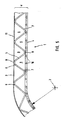
- the drawing shows a short section of a curtain denoted by 1 for winding and unwinding on a provided, not shown winding roller, the axis of rotation of which is perpendicular to the plane of the drawing and is indicated schematically at 2.
- the curtain section seen from the right and running in the area of the opening to be closed, merges to the left into a curvature which is intended to indicate the bending stress in this winding direction.
- the section is shown in a side view or cross-sectional view perpendicular to the direction of movement of the curtain.
- the curtain section has an outer layer 3 and an inner layer 4, which are kept spaced between their mutually facing surfaces by an intermediate layer 5, the latter consisting of a corrugated plastic web.
- the course of the wave goes in the direction of movement of the curtain 1, the wave elevations and depressions themselves extend perpendicular to the direction of movement of the curtain, thus extending from the area of one side edge guide to the area of the guide of the other side area of the curtain. It is readily apparent that in this way a different resistance to bending forces is achieved only by the shape of the intermediate layer, which is approximately perpendicular act on the wide area of the curtain.
- a deflection in the direction of the axis of rotation 2 is thus possible under relatively low forces, while the resistance to a deflection perpendicular between the guides, for example due to wind loads on the curtain in the closed position, is significantly higher. In this way, it is not necessary to hold the side edges of the curtain in the guides in such a way that the side edges emerge laterally from the guide rails when there is a wind load or the like.
- Cavities 9 are formed between the outer layer 3 and the inner layer 4 by the wave course of the intermediate layer 5, which cavities 9 are to be filled with air in the present case and which, in a manner not shown, can be formed individually, at certain intervals or in their entirety towards the outside. This ensures good thermal insulation.
- a wire mesh 10 is embedded in the inner layer 4, which is thicker than the outer layer 3, and forms a burglar-resistant reinforcement.
- the curtain itself has a total thickness d, which is considerably greater than the individual thicknesses of the outer layer 3 and the inner layer 4. It can be seen that the cost of materials in relation to the thickness is relatively low, which benefits the desired lightness of the curtain.
- the broad surface of the outer layer 3 facing outwards is provided with a non-ferrous metal coating 11.
- the curtain is suitable not only as a roller door curtain, but also as a gate or closing leaf of a gate, the door leaf of which is in different levels in the open and closed positions, for example Ceiling link or sliding gate.
- the axis of rotation 2 is to be regarded as the axis of curvature of a curved route section between different route sections.
- Such a curtain which is guided over a curved section of the route, can be pulled manually or by a mechanical drive in each of the two directions of movement, but it is also possible to have a drive of whatever type act only on one of the end edges pointing in the direction of movement, for example the curtain also to push it into the closed position, especially if it is an overhead curtain arrangement.
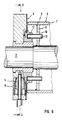
- the device 5 also has bolts 12 which extend in the direction of the axis 11 of the winding shaft 6 and which engage in the openings 10 of the side round 8 with their free end.
- the other end of the bolt 12 is fixed in a ring gear designated overall by 13.
- the ring gear 13 meshes with a bevel gear 14, which is arranged with respect to the device 5 fixed and perpendicular to the axis 11 of the winding shaft 6 as the first link in a gear train.
- a second gear 16 meshing with it is provided as a further link of the gear train, to which a third is coaxial Gear 17 of larger diameter and larger number of teeth arranged as the last gear.
- the two gears 16, 17 can be formed in one piece.
- the third gears 17 each mesh with fourth gears 18, which form a rotating part, which have a sleeve 19 with an internal thread, the third and fourth gears 17 and 18 being the same.
- a threaded rod 20 is provided as a translation part, which engages in the internal thread of the fourth gear 18 or its sleeve 19.
- the upper half is provided with reference numerals with respect to the axis of the bevel gear 14. With respect to a plane of symmetry running perpendicular to the plane of the drawing through this axis, however, the device is mirror-symmetrical, so that it is clear that when the bevel gear 14 rotates due to the rotation of the winding shaft 6, the gear wheels of the gear train (15 to 17) the rotating part 18 and this against the Fixed translation part 20 moves, which means that when the winding shaft rolls off, the threaded rod 20 is inserted into the device 5 in bores 21 provided for this purpose.
- the device 5 is formed in two parts with respect to a plane 22 so that the axis 11 of the winding shaft 6 can be received.
- Both threaded rods 20 are also rigidly connected to one another by means of a crossbar 24.
- a holding device generally designated 25, by means of which the device can be attached, for example, to the wall in a housing-fixed manner.
- the side of the device facing the side round 8 5 is also provided with an annular sheet metal disk 26, which engages in a circumferential groove 27 on the ring gear 13 and thus keeps this in constant meshing engagement with the bevel gear 14.
- a stationary pin which engages in a bracket open on one side when the device is inserted in its working position.
- the brackets are designed in such a way that when the device is pushed along in the direction of the wall or the lintel, the bracket-like opening widens when it is attacked by the bolt and the latter gets into a bracket-like opening.
- This opening is partly formed by the component, for example a die-cast part, on which the spindles of the device are also held, in such a way that a bulge opens towards the wall, into which the stationary pin ultimately ends up. Part of this opening is overlapped in the middle area by a nose, which forms a plastic clip part heard that is pivotally mounted in the die-cast part around a predetermined breaking pin.
- the nose extends in the pulling direction of an eyelet of this clamp part, and the clamp part designed as a two-armed lever has, beyond the predetermined breaking pin, a spring-like bracket which is supported on the zinc casting or injection molding, as shown in the drawing.
- This spring clip is designed like a leaf spring.
- This construction makes it possible to transfer the winding shaft with the device into the anchoring with the fixed pin in the manner of a snap lock. If - for whatever reason - you want to loosen this connection to the wall, you pull on the eyelet so that the nose releases the stationary bolt while deforming the leaf spring-shaped part and rotating it around the predetermined breaking pin. This is useful for maintenance purposes and the like, for example.
- the predetermined breaking pin has the task of releasing the plastic part and thus the clamp from its connection to the injection molded part in the event of a failure of the device, so that the device can slide freely along the console and the door leaf is not damaged as a result, but also in case of doubt can continue to be operated.
Landscapes
- Engineering & Computer Science (AREA)
- Structural Engineering (AREA)
- Architecture (AREA)
- Civil Engineering (AREA)
- Operating, Guiding And Securing Of Roll- Type Closing Members (AREA)
- Refrigerator Housings (AREA)
- Special Wing (AREA)
Applications Claiming Priority (2)
| Application Number | Priority Date | Filing Date | Title |
|---|---|---|---|
| DE4003359 | 1990-02-05 | ||
| DE4003359A DE4003359A1 (de) | 1990-02-05 | 1990-02-05 | Rolltor mit einem waermegedaemmt und/oder gepanzerten torblatt-behang |
Publications (2)
| Publication Number | Publication Date |
|---|---|
| EP0441330A1 true EP0441330A1 (fr) | 1991-08-14 |
| EP0441330B1 EP0441330B1 (fr) | 1994-12-21 |
Family
ID=6399454
Family Applications (1)
| Application Number | Title | Priority Date | Filing Date |
|---|---|---|---|
| EP91101550A Expired - Lifetime EP0441330B1 (fr) | 1990-02-05 | 1991-02-05 | Porte enroulable avec une porte flexible thermiquement isolée et/ou blindée |
Country Status (4)
| Country | Link |
|---|---|
| EP (1) | EP0441330B1 (fr) |
| AT (1) | ATE116033T1 (fr) |
| DE (2) | DE4003359A1 (fr) |
| DK (1) | DK0441330T3 (fr) |
Cited By (2)
| Publication number | Priority date | Publication date | Assignee | Title |
|---|---|---|---|---|
| EP1447515A1 (fr) * | 2003-02-12 | 2004-08-18 | Karl Achenbach GmbH & Co.KG | Porte enroulable avec arbre déplaçable |
| EP4603655A1 (fr) * | 2024-02-14 | 2025-08-20 | Shadesign GmbH & Co Kg | Système pour enrouler et dérouler une bande de matériau |
Families Citing this family (8)
| Publication number | Priority date | Publication date | Assignee | Title |
|---|---|---|---|---|
| DE4305008A1 (de) * | 1993-02-18 | 1994-08-25 | Marianne Zeisler Metallverarbe | Rolltor |
| DE19817808A1 (de) * | 1998-04-23 | 2000-05-04 | Klein Martina | Hebefalttor |
| DE29818095U1 (de) | 1998-10-09 | 1999-03-25 | Bauelemente Renate Wielath, 88094 Oberteuringen | Schnelllauftor |
| DE10324545B4 (de) * | 2003-05-28 | 2006-05-04 | Bos Gmbh & Co. Kg | Wickelwelle mit externem Federantrieb |
| CN102691469B (zh) * | 2012-06-01 | 2015-03-18 | 湖南湘联节能科技股份有限公司 | 一种卷帘门用抗风装置 |
| DE202014102237U1 (de) * | 2014-05-13 | 2015-08-17 | Beck & Heun Gmbh | Vorrichtung zum Aufwickeln von Rollpanzern |
| CN111844613A (zh) * | 2020-07-27 | 2020-10-30 | 东莞广华汽车饰件科技有限公司 | 一种汽车卷帘门制造方法 |
| DE102021120421A1 (de) | 2021-08-05 | 2023-02-09 | Cool It Isoliersysteme Gmbh | Tür- und/oder Torbehang und Schnelllauftor |
Citations (4)
| Publication number | Priority date | Publication date | Assignee | Title |
|---|---|---|---|---|
| GB191404409A (en) * | 1914-02-20 | 1915-02-04 | John Marshall Siddell | Improvements in or relating to Spring Roller Blind Apparatus. |
| DE1509687A1 (de) * | 1965-09-11 | 1969-04-03 | Peter Mueller | Verschiebevorrichtung fuer Rollwalzenlagerung |
| FR2101451A5 (fr) * | 1971-05-21 | 1972-03-31 | Boireaux Lavezard Sa | |
| DE8708710U1 (de) * | 1987-06-23 | 1988-10-20 | Hörmann KG Bielefeld, 4800 Bielefeld | Vorrichtung zum Verschieben der Achse der Wickelwelle eines Rolltores |
Family Cites Families (6)
| Publication number | Priority date | Publication date | Assignee | Title |
|---|---|---|---|---|
| DE7237193U (de) * | 1973-04-26 | Zaborowski E | Vertikal und horizontal belastbarer Rolladenkasten mit beweglich gelagerter Kaited ammung | |
| US3231006A (en) * | 1962-06-14 | 1966-01-25 | Du Pont | Pneumatically-actuated roll-up closure |
| AT339023B (de) * | 1975-03-04 | 1977-09-26 | Gassner Erich Ing | Warmedammeinrichtung in form eines fenster- schiebe- oder rolladens |
| CH595541A5 (fr) * | 1975-06-13 | 1978-02-15 | Louis Junod | |
| GB2121855B (en) * | 1982-06-11 | 1986-04-30 | Rolflex Doors Limited | Roller shutters |
| DE3706789A1 (de) * | 1987-03-03 | 1988-09-15 | Schieffer Gmbh Co Kg | Flexibles torblatt |
-
1990
- 1990-02-05 DE DE4003359A patent/DE4003359A1/de not_active Withdrawn
-
1991
- 1991-02-05 AT AT91101550T patent/ATE116033T1/de not_active IP Right Cessation
- 1991-02-05 DK DK91101550.1T patent/DK0441330T3/da active
- 1991-02-05 DE DE59103938T patent/DE59103938D1/de not_active Expired - Fee Related
- 1991-02-05 EP EP91101550A patent/EP0441330B1/fr not_active Expired - Lifetime
Patent Citations (4)
| Publication number | Priority date | Publication date | Assignee | Title |
|---|---|---|---|---|
| GB191404409A (en) * | 1914-02-20 | 1915-02-04 | John Marshall Siddell | Improvements in or relating to Spring Roller Blind Apparatus. |
| DE1509687A1 (de) * | 1965-09-11 | 1969-04-03 | Peter Mueller | Verschiebevorrichtung fuer Rollwalzenlagerung |
| FR2101451A5 (fr) * | 1971-05-21 | 1972-03-31 | Boireaux Lavezard Sa | |
| DE8708710U1 (de) * | 1987-06-23 | 1988-10-20 | Hörmann KG Bielefeld, 4800 Bielefeld | Vorrichtung zum Verschieben der Achse der Wickelwelle eines Rolltores |
Cited By (2)
| Publication number | Priority date | Publication date | Assignee | Title |
|---|---|---|---|---|
| EP1447515A1 (fr) * | 2003-02-12 | 2004-08-18 | Karl Achenbach GmbH & Co.KG | Porte enroulable avec arbre déplaçable |
| EP4603655A1 (fr) * | 2024-02-14 | 2025-08-20 | Shadesign GmbH & Co Kg | Système pour enrouler et dérouler une bande de matériau |
Also Published As
| Publication number | Publication date |
|---|---|
| ATE116033T1 (de) | 1995-01-15 |
| DE59103938D1 (de) | 1995-02-02 |
| DE4003359A1 (de) | 1991-09-19 |
| EP0441330B1 (fr) | 1994-12-21 |
| DK0441330T3 (da) | 1995-02-20 |
Similar Documents
| Publication | Publication Date | Title |
|---|---|---|
| EP1525368B1 (fr) | Systeme de store | |
| DE10236648B4 (de) | Schnellaufendes Industrietor mit flexiblem Behang | |
| DE102015117548B4 (de) | Verschlussvorrichtung und Verfahren zur Montage einer Verschlussvorrichtung für eine Bauwerksöffnung | |
| EP0427211B1 (fr) | Porte enroulable à l'étoffe flexible | |
| DE2947501A1 (de) | Ein- und ausfahrbare abdeckvorrichtung, insbesondere rolladen fuer fenster, tueren, tore o.dgl. | |
| DE19610268A1 (de) | Rolloeinrichtung für ein Isolierglaselement | |
| DE4003359A1 (de) | Rolltor mit einem waermegedaemmt und/oder gepanzerten torblatt-behang | |
| DE29922593U1 (de) | Schutzvorhang-Seitenführung | |
| EP1524400B1 (fr) | Dispositif de volet roulant avec une ouverture horizontale variable en forme d'échancrure | |
| EP2504515B1 (fr) | Dispositif de stores à rouleau | |
| DE20016562U1 (de) | Isolierglasanordnung für Folien-Rollo | |
| DE102013001176A1 (de) | lsolationsvorrichtung für Fenster | |
| EP0085861B1 (fr) | Volet roulant | |
| DE19707607A1 (de) | Einrichtung mit einem verstellbaren Organ zum Schutz gegen Licht und/oder Witterung und/oder Einbruch und/oder zum Umlenken von Licht | |
| EP1736628B1 (fr) | Dispositif de guidage pour une porte coulissante | |
| EP0358920B1 (fr) | Volets roulants | |
| DE102014113938B3 (de) | Jalousierbarer Rollladenpanzer | |
| EP1327037B1 (fr) | Store destine notamment a recouvrir la vitre d'une fenetre | |
| EP1840320B1 (fr) | Store enrouleur à câble | |
| DE102009051344A1 (de) | Folientor | |
| DE3515404A1 (de) | Jalousierbarer oeffnungsverschluss, insbesondere rolltor, rolladen, rollvorhang od.dgl. | |
| DE3740018A1 (de) | Vorrichtung zur betaetigung einer beschattungseinrichtung | |
| DE4304923A1 (de) | Rolladenelement und damit ausgerüstetes Gebäude | |
| AT522526B1 (de) | Schutzrollo | |
| EP2581544B1 (fr) | Store avec plusieurs lames de store agencées en parallèle et reliées de manière articulée à base de tôle de métal fine à simple paroi |
Legal Events
| Date | Code | Title | Description |
|---|---|---|---|
| PUAI | Public reference made under article 153(3) epc to a published international application that has entered the european phase |
Free format text: ORIGINAL CODE: 0009012 |
|
| AK | Designated contracting states |
Kind code of ref document: A1 Designated state(s): AT BE CH DE DK ES FR GB GR IT LI LU NL SE |
|
| RBV | Designated contracting states (corrected) |
Designated state(s): AT BE CH DE DK FR GB IT LI NL SE |
|
| 17P | Request for examination filed |
Effective date: 19920213 |
|
| 17Q | First examination report despatched |
Effective date: 19920819 |
|
| RAP1 | Party data changed (applicant data changed or rights of an application transferred) |
Owner name: HOERMANN KG DISSEN |
|
| GRAA | (expected) grant |
Free format text: ORIGINAL CODE: 0009210 |
|
| AK | Designated contracting states |
Kind code of ref document: B1 Designated state(s): AT BE CH DE DK FR GB IT LI NL SE |
|
| REF | Corresponds to: |
Ref document number: 116033 Country of ref document: AT Date of ref document: 19950115 Kind code of ref document: T |
|
| ET | Fr: translation filed | ||
| REF | Corresponds to: |
Ref document number: 59103938 Country of ref document: DE Date of ref document: 19950202 |
|
| REG | Reference to a national code |
Ref country code: DK Ref legal event code: T3 |
|
| ITF | It: translation for a ep patent filed | ||
| GBT | Gb: translation of ep patent filed (gb section 77(6)(a)/1977) |
Effective date: 19950315 |
|
| PLBE | No opposition filed within time limit |
Free format text: ORIGINAL CODE: 0009261 |
|
| STAA | Information on the status of an ep patent application or granted ep patent |
Free format text: STATUS: NO OPPOSITION FILED WITHIN TIME LIMIT |
|
| 26N | No opposition filed | ||
| ITTA | It: last paid annual fee | ||
| PGFP | Annual fee paid to national office [announced via postgrant information from national office to epo] |
Ref country code: SE Payment date: 19990111 Year of fee payment: 9 |
|
| PGFP | Annual fee paid to national office [announced via postgrant information from national office to epo] |
Ref country code: BE Payment date: 19990122 Year of fee payment: 9 |
|
| PGFP | Annual fee paid to national office [announced via postgrant information from national office to epo] |
Ref country code: GB Payment date: 19990128 Year of fee payment: 9 |
|
| PGFP | Annual fee paid to national office [announced via postgrant information from national office to epo] |
Ref country code: DK Payment date: 19990209 Year of fee payment: 9 |
|
| PGFP | Annual fee paid to national office [announced via postgrant information from national office to epo] |
Ref country code: CH Payment date: 19990211 Year of fee payment: 9 |
|
| PGFP | Annual fee paid to national office [announced via postgrant information from national office to epo] |
Ref country code: AT Payment date: 19990212 Year of fee payment: 9 |
|
| PGFP | Annual fee paid to national office [announced via postgrant information from national office to epo] |
Ref country code: FR Payment date: 19990226 Year of fee payment: 9 |
|
| PGFP | Annual fee paid to national office [announced via postgrant information from national office to epo] |
Ref country code: NL Payment date: 19990228 Year of fee payment: 9 |
|
| PGFP | Annual fee paid to national office [announced via postgrant information from national office to epo] |
Ref country code: DE Payment date: 19990430 Year of fee payment: 9 |
|
| PG25 | Lapsed in a contracting state [announced via postgrant information from national office to epo] |
Ref country code: GB Free format text: LAPSE BECAUSE OF NON-PAYMENT OF DUE FEES Effective date: 20000205 Ref country code: DK Free format text: LAPSE BECAUSE OF NON-PAYMENT OF DUE FEES Effective date: 20000205 Ref country code: AT Free format text: LAPSE BECAUSE OF NON-PAYMENT OF DUE FEES Effective date: 20000205 |
|
| PG25 | Lapsed in a contracting state [announced via postgrant information from national office to epo] |
Ref country code: SE Free format text: LAPSE BECAUSE OF NON-PAYMENT OF DUE FEES Effective date: 20000206 |
|
| PG25 | Lapsed in a contracting state [announced via postgrant information from national office to epo] |
Ref country code: BE Free format text: LAPSE BECAUSE OF NON-PAYMENT OF DUE FEES Effective date: 20000228 |
|
| PG25 | Lapsed in a contracting state [announced via postgrant information from national office to epo] |
Ref country code: LI Free format text: LAPSE BECAUSE OF NON-PAYMENT OF DUE FEES Effective date: 20000229 Ref country code: CH Free format text: LAPSE BECAUSE OF NON-PAYMENT OF DUE FEES Effective date: 20000229 |
|
| BERE | Be: lapsed |
Owner name: HORMANN K.G. DISSEN Effective date: 20000228 |
|
| PG25 | Lapsed in a contracting state [announced via postgrant information from national office to epo] |
Ref country code: NL Free format text: LAPSE BECAUSE OF NON-PAYMENT OF DUE FEES Effective date: 20000901 |
|
| GBPC | Gb: european patent ceased through non-payment of renewal fee |
Effective date: 20000205 |
|
| EUG | Se: european patent has lapsed |
Ref document number: 91101550.1 |
|
| REG | Reference to a national code |
Ref country code: CH Ref legal event code: PL |
|
| PG25 | Lapsed in a contracting state [announced via postgrant information from national office to epo] |
Ref country code: FR Free format text: LAPSE BECAUSE OF NON-PAYMENT OF DUE FEES Effective date: 20001031 |
|
| NLV4 | Nl: lapsed or anulled due to non-payment of the annual fee |
Effective date: 20000901 |
|
| REG | Reference to a national code |
Ref country code: DK Ref legal event code: EBP |
|
| PG25 | Lapsed in a contracting state [announced via postgrant information from national office to epo] |
Ref country code: DE Free format text: LAPSE BECAUSE OF NON-PAYMENT OF DUE FEES Effective date: 20001201 |
|
| REG | Reference to a national code |
Ref country code: FR Ref legal event code: ST |
|
| PG25 | Lapsed in a contracting state [announced via postgrant information from national office to epo] |
Ref country code: IT Free format text: LAPSE BECAUSE OF NON-PAYMENT OF DUE FEES;WARNING: LAPSES OF ITALIAN PATENTS WITH EFFECTIVE DATE BEFORE 2007 MAY HAVE OCCURRED AT ANY TIME BEFORE 2007. THE CORRECT EFFECTIVE DATE MAY BE DIFFERENT FROM THE ONE RECORDED. Effective date: 20050205 |